Why #Diversity Is Difficult | Re/code

An account by Leslie Miley on her challenges in increasing diversity at Twitter:

But then, in August 2015, Jack Dorsey returned to Twitter, and during a company meeting, responded to my question about committing Twitter to a measurable diversity goal. He publicly committed to diversity in front of every Twitter employee in attendance, and a few short weeks later, Twitter publishes this. And in a profoundly emotional moment, Jack Dorsey played the video seen below at the next company meeting:

This epitomizes the best of Twitter, and I left the meeting inspired and ready to drive the bus of diversity in engineering.

After several weeks of meetings and guidance acceptance from executive staff, I pitched a job proposal to focus on increasing diversity in engineering to the senior vice president of engineering. In the course of the meeting, he suggested that we begin tracking the ethnicity of potential candidates in the pipeline to understand better where candidates are falling out. I agreed that this is an important metric to track, and conveyed that the current data we had indicated that the problem is not just the pipeline. While ethnic and gender data early in the pipeline is incomplete, we do know that in 2013, 4.5 percent of computer science graduates from the top 25 schools were African-American, and 6.5 percent were Hispanic/Latino.

As we continued the discussion, he suggested that I create a tool to analyze candidates last names to classify their ethnicity. His rationale was to track candidates through the pipeline to understand where they were falling out. He made the argument that the last name “Nguyen,” for example, has an extremely high likelihood of being Vietnamese. As an engineer, I understand this suggestion, and why it may seem logical. However, classifying ethnicities by name is problematic, as evidenced by my name (Leslie Miley).


With my departure, Twitter no longer has any managers, directors, or VPs of color in engineering or product management. From this position, Twitter may find it difficult to make the changes to culture and product.


What I also found disconcerting is this otherwise highly sophisticated thinker could posit that an issue this complex could be addressed by name analysis. (For reference, here is a tool that attempts to do that. With Jewish or African/African Americans, this classifier scored 0 percent on identifying these groups in Twitter engineering). While not intentional, his idea underscored the unconscious tendency to ignore the complex forces of history, colonization, slavery and identity.

I left that meeting wondering how I could, in good conscience, continue to work in an organization where the senior vice president of engineering could see himself as a technology visionary and be so unaware of this blind spot in his understanding of diversity. Leadership keeps citing “the pipeline,” when the data does not support it. They continue to churn out ethnic and racial minorities and women, but still claim a commitment to diversity.

This is the last meeting of any consequence I had at Twitter. My time at Twitter is over. And I end it very conflicted. Twitter as a platform has empowered underserved and underrepresented people. It has fomented social movements and brought to the forefront of American media and politics issues that affect me personally and professionally.
Source: Why Diversity Is Difficult | Re/code

ICYMI: ‘Islam and the Future of Tolerance’ and ‘Not in God’s Name’ – The New York Times

Irshad Manji on the need for respectful discourse:

Enter Jonathan Sacks, a former chief rabbi of the British Commonwealth. In his sobering yet soul-stirring new book, “Not in God’s Name,” Sacks confronts “politicized religious extremism” and diagnoses that cancer crisply: “The 21st ­century has left us with a maximum of choice and a minimum of meaning. Religion has returned because it is hard to live without meaning.” Given that “no society has survived for long without either a religion or a substitute for religion,” and given that believers are proliferating, Sacks predicts that the next 100 years will be more religious than the last. Bottom line: Any cure for violence in God’s name will have to work with religion as a fact of life.

That is where Sacks’s brilliance as a theologian radiates. He thinks two matters need tackling. There is “identity without universality,” or solidarity only with one’s group. Then there is “universality without identity,” the unbearable lightness of humans in a transactional but not transcendent world. Sacks wants to preserve the joy of participating in something bigger than the self while averting the hostility to strangers that goes with tribal ­membership.

He attempts this balance through an ingenious rereading of Genesis. Sacks’ proposition: Genesis contains two covenants rather than one. The first focuses on justice, which is impartial and thus universal in application. The second covenant emphasizes love, which is exquisitely particular and personal. In a ­showdown, justice overrides love. Analyzing parables and sibling rivalries in the Bible, Sacks concludes that decency toward the misfit, even to the infidel, takes precedence over loyalty to your own.

This should hearten Sam Harris, who despises the tendency of Muslims (and others) to stick up for fellow believers, especially when they act like “psychopaths.” Still, I have to wonder if Harris and his disciples will put stock in any reinterpretation, no matter how learned. After all, Harris opines that to reform religion is to read scripture in “the most acrobatic” terms. Sacks turns the tables on such skepticism, observing that “fundamentalists and today’s atheists” both ignore “the single most important fact about a sacred text, namely that its meaning is not self-evident.”

My own skepticism is about whether reformist interpretations can outpace regressive readings that tap into primal fears and gain traction quickly. Sacks argues, “We must put the same long-term planning into strengthening religious freedom as was put into the spread of religious extremism.” That implies creating a matrix of schools, policies and campaigns to teach reformist perspectives. But as he admits early on, “decades of anti-racist legislation, interfaith dialogue and Holocaust education” have not prevented the mess we are in. Why would it be different now?

Here is why. The Islamic State’s savagery against Muslims offers hope for taking power politics out of Islam, eventually achieving the mosque-state separation that Nawaz views as central to reform. Sacks gives historical comparisons to justify his hope. Europe’s bloody Reformation wars showed that big religion could not be relied on to protect the religious: “Western Christianity had to learn what Jews had been forced to discover in antiquity: how to survive without power. . . . You do not learn to disbelieve in power when you are fighting an enemy, even when you lose. You do when, with a shock of recognition, you find yourself using it against the members of your own people.”

Meanwhile, back at liberal democracy’s ranch, we must “insist on the simplest moral principle of all. . . . If you seek respect, you must give respect.” This does not mean always having to agree, but it does mean viewing one another as worthy of candid, constructive engagement. On that front, Sam Harris and Maajid Nawaz are role models. The Lord works in mysterious, perhaps acrobatic, ways.

Source: ‘Islam and the Future of Tolerance’ and ‘Not in God’s Name’ – The New York Times

#Multiculturalism Transferred Back to Canadian Heritage: Impact

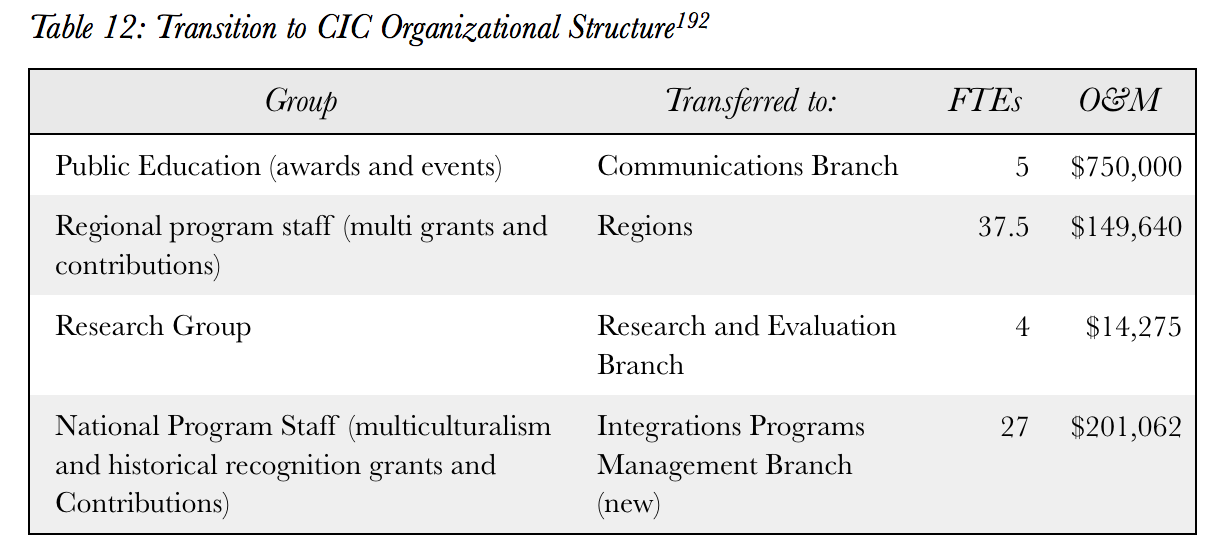
CM_Table_12_Transfer_to_CICThe Order in Council announcing the reversal of the 2008 transfer to CIC as part of then Minister Kenney’s Package:

His Excellency the Governor General in Council, on the recommendation of the Prime Minister, pursuant to paragraph 2(a) of the Public Service Rearrangement and Transfer of Duties Act, transfers, effective November 4, 2015,

(a) from the Department of Citizenship and Immigration to the Department of Canadian Heritage the control and supervision of those portions of the federal public administration in the Citizenship and Multiculturalism Branch within the Department of Citizenship and Immigration that relate to multiculturalism; and

(b) to the Minister of Canadian Heritage the powers, duties and functions of the Minister of Citizenship and Immigration relating to multiculturalism.

The PCO press release indicates that responsibility for the Canadian Race Relations Foundation is also transferred but makes no reference to either the Global Centre for Pluralism or the International Holocaust Remembrance Alliance (the previous government gave the head of the Office for Religious Freedom the lead responsibility).

Personally  interesting,  given that I managed the transfer to CIC in 2008, and have consistently written that multiculturalism was atrophying at CIC given its more operational focus on citizenship and immigration.

As I wrote two years ago in my conclusion to Policy Arrogance or Innocent Bias: Resetting Citizenship and Multiculturalism on the longer-term impact of CIC’s departmental structure and culture on the multiculturalism program:

A functional model like CIC has advantages in creating greater clarity between the policy and operational functions, but tends to reinforce the centre of gravity and allocate resources accordingly. A business line model like PCH provides more focused policy and program integration at the business line or program level, but increases rigidity and coordination issues between business lines. While the PAA structure acts as a counterweight, over time the centre of gravity will dominate. Arguably, for integration, citizenship and multiculturalism, the lines between pure policy and pure operations (e.g., citizenship ceremony design, G&C management) are less clear than for admissibility and immigration selection. Additionally, one of the legacies of the Cullen-Couture agreement transferring immigration selection and integration funding to Quebec meant CIC was largely uninterested in using the levers in citizenship and multiculturalism to highlight federal presence in Quebec. A sharp contrast to PCH which had, and viewed itself as having, a strong role in Quebec.

In many ways, the collective impact for multiculturalism will, over time, become closer to the original Reform Party objective of 1996-97 of abolishing multiculturalism and strengthening a strong, common narrative of citizenship. The Cabinet shuffle of July 2013 and the separation of the political function, which remained under Minister Kenney, from the departmental function, under Minister Alexander, is significant in that context. While political, community-based outreach is central to electoral strategies (the “fourth sister”), as evidenced by Minister Kenney’s ongoing responsibility for this critical outreach, the substantive policy and program focus on long-term integration issues will continue to decline. This is a legitimate policy choice but it is striking just how little debate this change has provoked.

The Liberal government’s decision to reverse the transfer and restore the broader Canadian Heritage identity mandate (and no longer have the file ‘travel’ with a minister), with a strong diversity and inclusion emphasis, will reinvigorate multiculturalism, both within the department and across government more generally.

However, given the dispersal of and reductions to multiculturalism resources at CIC (now IRC), considerable rebuilding will be required.

The above table highlights the FTEs and Operations and Maintennance resources transferred in 2008 (about $12 million in Grants & Contributions funding was also transferred).

Chapter 6 of my book describes the process, resource transfers and impact (available at Lulu.com, direct link My Author Spotlight).

Source: Orders in Council – Search – Privy Council Office

Why it’s not enough to simply restore the long-form census

Kevin Milligan on the longer term questions regarding how we should leverage more administrative data for future Censuses:

But how exactly should we go about repairing the damage? Census questionnaires need to be thoroughly tested, and then they must be printed. You can’t do this in a few months. According to the Huffington Post, for 2016 the government will use the already-tested questionnaire for the planned 2016 National Household Survey and simply make its completion mandatory rather than voluntary. While 33 per cent of Canadians were requested to fill in the 2011 NHS, apparently only 25 per cent will be asked in 2016. Still, if compliance rates go back to 2006 levels, this should yield a larger number of completed surveys. But much more importantly, the sample should be much cleaner because we won’t have the skewed non-completion problems that plagued the 2011 NHS.

This strategy strikes me as sensible battlefield medicine. Time is short, so the government is constrained in what can be achieved in the few short weeks before sending the census forms to the printer. Making the 2016 NHS mandatory solves the largest problem we had with the 2011 NHS. However, I hope this is just the beginning of a new conversation on the census—and data in general—rather than a one-off restoration of past practices.

In the United Kingdom in 2010, the newly-elected Conservative government also had some concerns about their census. But, instead of acting impetuously, they put in place a process to rethink how governments ought to be collecting data in the 21st Century. The initial report of this process came out in 2014, and a new “Census Transformation Programme” is at work on plans for the 2021 UK Census.

What should Canada do next? Well, the main recommendations of that 2014 UK report were to make greater use of existing data already being collected for administrative purposes and greater use of internet-based census forms. Canada was already doing both those things in 2006. But, I believe there is room for much more innovation.

I gave a guest lecture a year ago to a meeting of data librarians outlining my thoughts on the future of data in the social sciences, the notes from which can be found here. I remarked that we have more and more administrative data, such as tax, employment insurance and immigration records, at the same time as surveys (like the census) are becoming harder to conduct. If we move to greater use of administrative data, we need to be sure we properly balance privacy concerns, researcher access, cost, and data accuracy.

Restoring the mandatory basis for the 2016 survey was necessary, but also easy. The true test of the resolve of the new government on data will come in the actions they take as we begin to plan the 2021 census.

Source: Why it’s not enough to simply restore the long-form census

An Arab festival, a headless clown, a sword—cue the outrage

Martin Patriquin on the humour of the Festival du Monde Arabe de Montréal:

The festival team did so by adopting a particularly ballsy theme for this year’s festival. The FMA has never been particularly anodyne; last year’s theme was “Folies Métèques,” which translates roughly to “dirty immigrant follies.” This year’s theme goes further with  “Hilarus Delirus,” an apparent double entendre meaning either hilarious delirium or delirious slave (Hilarus was a gladiator owned by the Roman emperor Nero). The idea is that laughing  through anything—up to and including decapitation—is the best revenge against one’s decapitators, figurative or otherwise.

The festival itself further destroys the cliché that Arab culture is a desert of bloody austerity. If the headless clown wasn’t enough, consider the accompanying video by Lynda Thalie, a Montreal singer who originally hails from Algeria. It is a five-minute carnival of painted faces and naked flesh set to Arab strings­—a Muslim fundamentalist’s nightmare, performed by an Algerian woman. The lineup also includes Iraqi-Montrealer rapper Narcicyst, who is as outspoken about Islamic fundamentalist regimes as he is of what he sees as the West’s enabling of them.

The festival’s theme also exposes another unspoken truth: that the critiquing of religious fundamentalism is most visibly the domain of non-Arabs. It makes it all too easy for apologists of, say, the murder of Charlie Hebdo’s cartoonists to to wrap themselves in the veil of Muslim persecution. The FMA’s headless clown lays waste to this specious argument. It is heartening to see Arabs—namely, the Muslims, Berbers, Christians and Jews who comprise the FMA team—critique the very same fundamentalism. (An important aside: the clown bleeds words and musical notes, not blood.)

Quebec has had a tumultuous few years in regards to Muslims and other religious minorities. After the Parti Québécois’s electoral attempts to remove all religious symbols from the bodies of its public servantsin 2013, the newly elected Liberals went to another absurd extreme, by introducing a bill that many legal experts say would make it illegal to critique any organized religion. Both are shoddy in their own way. Thankfully, both failed to become law.

By laughing through his own misery, the headless clown is a reminder that the best line of attack against fundamentalism isn’t through laws or government decrees. It’s as simple as embracing the culture and deriding the extremists who would dare try to smother it.

Source: An Arab festival, a headless clown, a sword—cue the outrage

“Because It’s 2015” | Commentary magazine

The neocons at Commentary fret over ‘because it’s 2015’.

Wonder what they would have said if Lincoln had stated when slavery was abolished ‘because it’s 1865’?

On Wednesday in Ottawa, Justin Trudeau was sworn in as Canadian prime minister. He wasted no time in announcing his newly chosen cabinet of exactly 15 men and 15 women, which fulfilled a campaign pledge he’d made about gender equality. One reporter asked Trudeau why the perfect male-female split was so important to him. The prime minster’s response: “Because it’s 2015.”

It sure is. Back in the pre-identity Dark Ages, leaders of representative democracies felt obliged to cite principles or aims in explaining policy to citizens. Today they cite trends.

One problem with trends is that they go as quickly as they come. As Trudeau is sure to find out, his 50-50-gender cabinet is already passé. Where does it leave those Canadians who don’t identify as either male or female? Tell the prime minister the 1990s called. It wants its social justice back.

That’s only a practical challenge. Trudeau can pick up a full-time gendermetrician to carve up the grievance pie and reconfigure his cabinet with each newly pronounced identity.

There are deeper problems. “Because it’s 2015” kills debate, which is the lifeblood of free societies and, ironically, of social evolution. “Because it’s 2015” is a witless claim to absolute prerogative. It dresses up dogma in the finery of historical truth and casts off inquiry as another freshly uncovered offense against progress.

Source: Because It’s 2015 | commentary

How national multicultural legislation would strengthen Australian society

Andrew Jakubowicz, Professor of Sociology, University of Technology Sydney on the need for an Australian multiculturalism act:

Australians in general like the idea of a culturally diverse society. This is not surprising, given the high proportion of overseas-born Australians and their immediate descendants.

They recognise the creativity that comes from the interaction of different ideas and viewpoints. They are happy with individual cultural traditions being retained so long as the consequences do not breach social harmony. They really do not like inter-group vilification, though they want to affirm a common bond of fairness and respect – words Turnbull uses repeatedly.

When multiculturalism and these principles are marginalised as they were during the Howard, Abbott and Rudd years, social cohesion unwinds. When the allocated political champion of multiculturalism of the day has no legislative lever from which to shift prejudice and encourage engagement, society suffers.

Given the sustained avoidance of legislated multicultural goals and practices by governments and the evident consequences in pockets of alienation and fragmentation, it should be time for a debate on what form of legislative framework Australians would like to see in support of their desires for a fair and multicultural public sphere.

This means an Australian Multiculturalism Act, and a ministerial remit for the whole of government.

Source: How national multicultural legislation would strengthen Australian society

Americans Speak Over 350 Languages At Home, Census Data Shows | TIME

Comparative figures for Canada: Over 200 languages, 73 percent mother tongues other than English or French. Most common other languages: Chinese, Tagalog, Spanish, Punjabi, Arabic, Italian, German, Portuguese, Persian (Farsi) and Polish.

More than 60 million Americans over the age of five speak a language other than English in their home

Americans speak more than 350 languages in their homes according to data released Tuesday by the Census Bureau.

Findings from the 2009-2013 American Community Survey show more than 60 million Americans over the age of five speak a language other than English in their home. Spanish is by far the most common language and is spoken in the home by 37 million people.

Those who speak Spanish at home also tend to learn English, with more than half reporting they had learned the language. Speakers of Asian languages were less proficient in English: only 40 percent of the 1.4 million Vietnamese speakers and 44.7 percent of the 2.9 million Chinese-speakers speaking English “very well.”

The survey’s results show the nation’s largest metropolitan areas are also some of the most linguistically diverse. The Census reports 192 languages are spoken in New York and 54% of Los Angeles residents speak a language other than English at home. The data also shows there are more than 350,000 U.S. speakers of 150 different Native American dialects, such as Navajo, Apache, Dakota, Choctaw and Cherokee.

“While most of the U.S. population speaks only English at home or a handful of other languages like Spanish or Vietnamese, the American Community Survey reveals the wide-ranging language diversity of the United States,” said Erik Vickstrom, a Census Bureau statistician, in a Census press release. “Knowing the number of languages and how many speak these languages in a particular area provides valuable information to policymakers, planners and researchers.”

Source: Americans Speak Over 350 Languages At Home, Census Data Shows | TIME

US Supreme Court Takes On Racial Discrimination In Jury Selection

Interesting, and symptomatic of the situation in so many areas:

The U.S. Supreme Court wrestles Monday with a problem that has long plagued the criminal justice system: race discrimination in the selection of jurors.

“Numerous studies demonstrate that prosecutors use peremptory strikes to remove black jurors at significantly higher rates than white jurors.”

Those are not the words of the defense in the case. They come from a group of highly regarded prosecutors, Republican and Democrat, conservative and liberal, who have filed a friend-of-the-court brief siding with Timothy Foster, who was convicted and sentenced to death in the killing of an elderly white woman in Georgia.

It has been nearly 30 years since the Supreme Court sought to toughen the rules against racial discrimination in jury selection. But Foster’s lawyers argue that black jurors were systematically excluded from the jury at his trial in 1987, while judges at all levels looked the other way for nearly three decades thereafter.

Jury selection is done according to a set of rules. Prospective jurors are usually questioned by both prosecution and defense lawyers and then winnowed down in two different ways. First, the judge removes, “for cause,” those jurors deemed incapable of being impartial. Next, each side, prosecution and defense, has a set number of peremptory strikes, meaning that a certain number of prospective jurors can be eliminated without a stated reason, or for no reason at all.

In 1986, the Supreme Court added a third step in a case called Batson v. Kentucky. Under the Batson rules, if the defense could show a racial pattern in prosecution peremptory strikes, the prosecutor would have to justify each one by demonstrating a non-racial reason for eliminating the juror.

Still, prosecutors found ways to get around this new rule, as demonstrated by an infamous training video made in Philadelphia in the late 1980s after the court’s decision in Batson. The video features then Assistant District Attorney Jack McMahon advising trainees that “young black women are very bad, maybe because they’re downtrodden on two respects … they’re women and they’re blacks.”

He goes on to recommend avoiding older black women too, as well as young black men, and all smart, and well educated prospective jurors.

But, McMahon reminded the trainees that they had to come up with a non-racial reason for their strikes: “When you do have a black juror, you question them at length and on this little sheet that you have, mark something down that you can articulate at a later time if something happens,” he says.

Studies have shown that these proffered reasons are often a mere pretext for racial discrimination. A North Carolina study of jury selection in 173 death penalty cases found that black prospective jurors were more than twice as likely to be struck by the prosecution as similarly situated white jurors. A 2003 study of 390 felony jury trials prosecuted in Jefferson Parish, La. found that black prospective jurors were struck at three times the rate of whites. And in Houston County, Ala., prosecutors between 2005 and 2009 used their peremptory strikes to eliminate 80 percent of the blacks qualified for jury service in death penalty cases. The result was that half of these juries were all white, and the remainder had only a single black member, even though the county is 27 percent black.

Source: Supreme Court Takes On Racial Discrimination In Jury Selection : NPR

After attacks, France walks narrow line on Islam in schools

Secularism as religion – not providing pork alternatives:

This was the week that schoolchildren in one Paris suburb got a stark choice at the cafeteria: pork or nothing at all.

Chilly-Mazarin joined a handful of towns run by right-leaning mayors which have ended a practice of offering a substitute for students forbidden by their religion from eating pork.

The decisions have come amid increased discussions in France about its secularist ideals following the terror attacks in January that were blamed on French Islamic extremists — a discussion critics say has been hijacked by anti-Muslim forces on the far right.

On Wednesday, the Socialist government issued unusually direct criticism against the schools that have ended the pork substitutes as it was training dozens of appointees to mediate tense questions about the role of religion in schools and in public life.

In back-to-back speeches, the education and interior ministers walked the country’s increasingly narrow line on religion in schools, with the unspoken threat of Islamic extremism hovering over the auditorium in Paris’ tony 16th arrondissement.

Education Minister Najat Vallaud-Belkacem said teachers at schools have to impart the secularist ideal, but “not a secularism that is a declaration of war against a religion, as we see when a mayor here or there decides that in the name of a so-called secular ideal, children will be forced to eat pork or skip school lunch.”

France forbids “ostentatious” symbols of religion in schools and government buildings, a mandate generally interpreted to mean Muslim head scarves and one that includes parents who accompany school outings wearing them. Schools take seriously their mission to educate the next generation of secular French citizens, never more so than since the January terror attacks.

Source: After attacks, France walks narrow line on Islam in schools – US News