The New Cabinet: Diversity, inclusion and achieving parity

Election 2015 - VisMin and Foreign-Born MPs.002
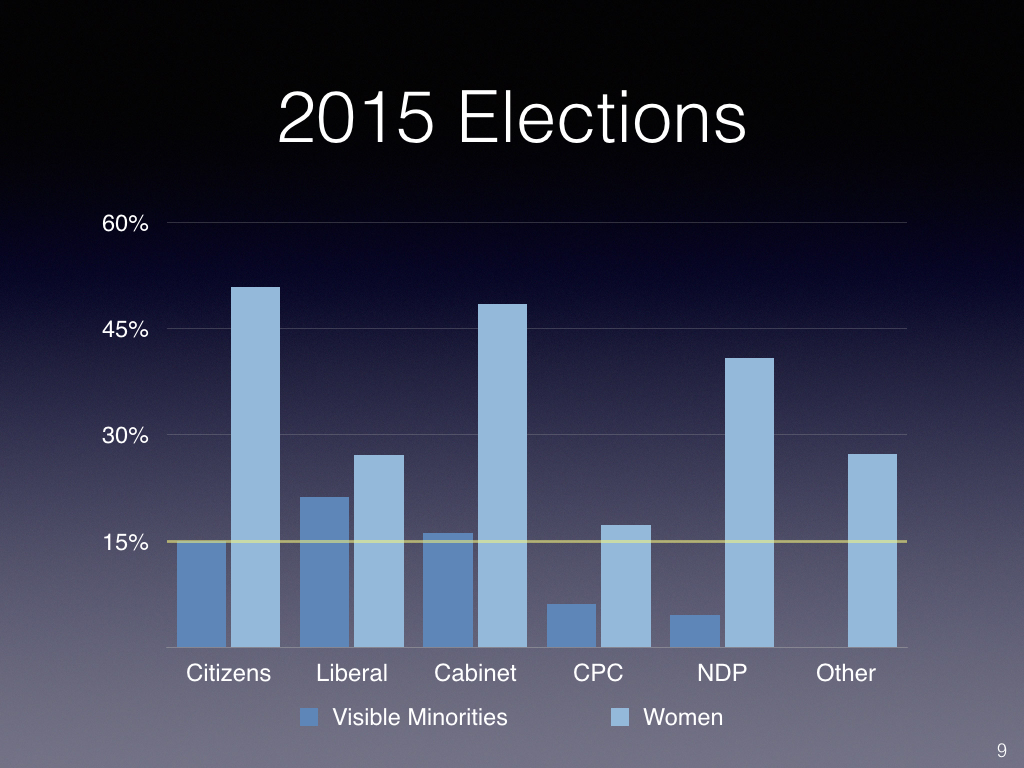
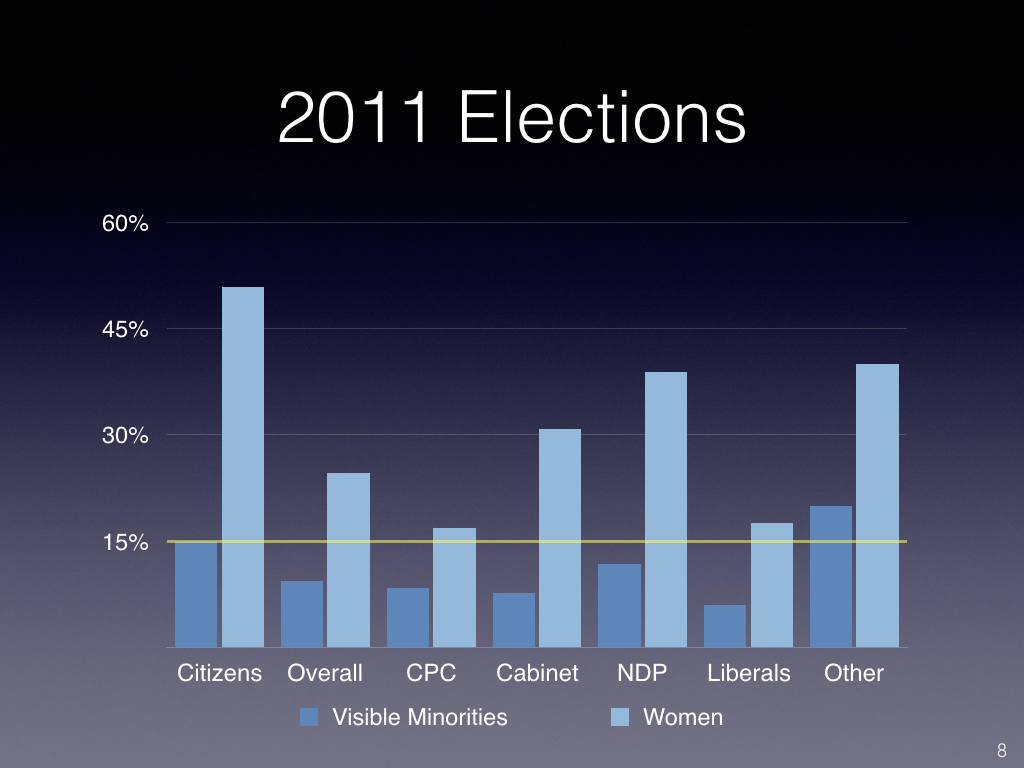
The chart shows the overall representation of Canada’s new Parliament (the 2011 Parliament equivalent is shown below).

Election 2015 - VisMin and Foreign-Born MPs.001

In addition to gender parity, visible minorities are slightly over-represented (16 percent) in relation to their share of the population who are Canadian citizens (15 percent).

However, Canadian Sikhs predominate as four out of the five visible minority ministers are Sikh: Navdeep Bains, Harjit Sajjan, Amarjeet Sohi and Bardish Chagger (the only non-Sikh is Maryam Monsef, an immigrant from Afghanistan). Likely that geographic factors played a role.

Two out of the five are women. Three are foreign-born.

Two have senior portfolios: Harjit Sajjan in Defence, Navdeep Bains in Innovation, Science and Economic Development (the rebranded Industry Canada).

The choice of John McCullum for the renamed Immigration, Refugees and Citizenship department suggests that an experience minister was wanted to move the priority files (in addition to his previous experience in a number of portfolios and was previously the Liberal critic for citizenship and immigration). So very likely that he will hit the ground running.

And the best illustration of how the overall philosophy and approach has changed can be seen in the creation of a Cabinet Committee on Diversity and Inclusion, with a mandate to:

Considers issues concerning the social fabric of Canada and the promotion of Canadian pluralism. Examines initiatives designed to strengthen the relationship with Indigenous Canadians, improve the economic performance of immigrants, and promote Canadian diversity, multiculturalism, and linguistic duality.

New Crop of Immigrants in Parliament Is Seen as Reflection of Canada – The New York Times

New York Times coverage of Canada’s many immigrant and visible minority MPs (and always nice to be quoted!):

Many factors contributed to the sweeping victory last month by the Liberals, whose leader, Justin Trudeau, will take office as prime minister on Wednesday. But several analysts said that one of the most important factors was the immigration and refugee policies of the losing Conservative government.

In a country that generally prizes immigrants as a source of economic growth and officially encourages newcomers to maintain their ethnic identities, the Conservatives and Prime Minister Stephen Harper were widely seen as anti-Muslim, especially after they made an issue of the face coverings worn by some Muslim women.

“The Conservative government tried to use wedge politics, but in the end, it backfired,” said Andrew Griffith, a former director general of the government office that oversees citizenship matters and the author of a book about multiculturalism in Canada. “It should give any political party in Canada food for thought, food for reflection.”

The move was uncharacteristic even for the Conservatives, who assiduously courted immigrant communities even before they first won power in 2006, particularly in two areas that often decide the balance of power in Parliament: the suburbs of Toronto and Vancouver, British Columbia. The Liberals and the New Democratic Party also seek support there, but the Conservatives often found that their more traditional approach to many social issues found an eager audience.

Canadian law makes it relatively easy to move from landed immigrant to citizen, and Mr. Griffith said that many newcomers became politically active once they could vote. Because Canada’s immigration rules favor well-educated and affluent migrants, ethic communities are also an important source of donations to political parties, not least because the country’s campaign finance laws ban contributions from corporations or unions and set a relatively low ceiling for individuals.

“It’s empowering in that there are groups that can no longer be ignored,” said Arif Virani, 43, a newly elected Liberal lawmaker from Toronto who came to Canada with his parents as an Ismaili Muslim refugee from Uganda in 1972. He noted that in some constituencies, all three major parties ran minority candidates.

At times over the past decade, Jason Kenney, a Conservative cabinet minister, seemed to be appearing at just about every ethnic celebration in the country — a butter-chicken circuit that appeared to take a toll on his waistline. But Mr. Kenney’s courtship of ethnic minorities, Mr. Griffith said, was undone when the Conservative government decided to make it harder for recent immigrants to bring in relatives, when it was slow to accept Syrian refugees and when it tried to ban the niqab, or face covering, during citizenship ceremonies. Mr. Harper’s use of the phrase “old-stock Canadians” on the campaign trail made matters worse.

Mr. Griffith reckons that there are 33 electoral districts where a majority of voters belong to what are known in Canada as visible minority groups — people who are not of white European extraction. All 33 districts are in the suburbs of Toronto or Vancouver, and many were held by Conservatives until last month, when Liberals won in all but three of them.

Canada first introduced a policy of official multiculturalism, recognizing the differences in Canadians’ heritage, in 1971 under Pierre Elliott Trudeau, a Liberal prime minister and the father of Justin Trudeau. Initially, the policy provided funds for programs like language classes, but it has since evolved into a broad legal protection of religious and ethnic differences.

Though it was contentious at first, the policy is now frequently cited by Canadians as a defining characteristic of their country — though both Mr. Griffith and Mr. Virani say it has limits.

Canadians tend to think that, where the United States assimilates immigrants’ cultures in a melting pot, Canada allows all cultures to flourish. But Mr. Virani said that the contrast was “a little bit more gray than that.”

Voters appeared to reject Mr. Harper’s plan to ban face coverings during citizenship ceremonies, but Mr. Griffith said there was still widespread unease about the practice of wearing them, which many Canadians believe limits the participation of Muslim women in society.

Still, despite the tenor of the Conservatives’ last campaign, all the major Canadian political parties favor encouraging immigration. New arrivals account for two-thirds of Canada’s population growth, an important factor in a country where there are now more citizens over 65 than under 15. Geography helps form that pro-immigration consensus by making it difficult to slip into the country as an illegal immigrant or a refugee.

“You can’t walk to Canada, apart from the U.S., so we don’t have a neighbor that generates a lot of refugees or immigrants coming across,” Mr. Griffith said. “That helps the discussion.”
Source: New Crop of Immigrants in Parliament Is Seen as Reflection of Canada – The New York Times

How Ontario politicians teamed up to rein in police carding: Cohn 

Good overview by Regg-Cohn on how the carding issue was addressed, with all party support (all too rare):

Provincial politicians are not usually top of mind when dealing with tensions in the inner cities or outer suburbs. But all three parties answered the call.

NDP deputy leader Jagmeet Singh launched a public campaign for change earlier this year, disclosing that he’d been carded more than 10 times by police — accosting him, questioning him, profiling him. A turban-wearing Sikh (which apparently arouses suspicions), Singh is a lawyer who now represents the riding of Bramalea-Gore-Malton — and knows his rights. But in news conferences, he made the case that most young people don’t know they have a right to refuse police street checks unless they are under suspicion for a crime.

Leading a legislative debate last month, Singh exhorted his fellow MPPs to “send a clear message to the entire province that arbitrary and discriminatory carding and street checks are not acceptable.”

The appeal from Singh’s third-place New Democrats struck a chord with the Progressive Conservatives. As the official Opposition, they have hewed to a rigid law and order line ever since John Tory led the party from 2004-09 and cleaved to police unions (a pattern he continued after becoming Toronto’s mayor last year).

The current PC leader, Patrick Brown, is taking a broader view. After reaching out to ethnic communities, notably people of South Asian descent, he is acutely aware that carding is seen as profiling. The PCs’ new legal affairs critic, Randy Hillier — a rambunctious libertarian but also a civil libertarian — delivered a passionate critique of carding for infringing on fundamental freedoms.

“Societies that arbitrarily or unduly limit people’s freedoms and liberties are also places where individual safety is in jeopardy,” Hillier argued.

The governing Liberals were ready to respond. Community Safety Minister Yasir Naqvi announced that his party would support the opposition motion to ban discriminatory street checks.

“There is zero tolerance when it comes to any kind of racial profiling or discrimination in interactions that our police engage in,” he announced.

Naqvi, who, like Singh, is a lawyer of South Asian descent, says he has never been carded. But after conducting consultations across the province through the summer, he heard an earful about the practice — and learned about his own tin ear.

His ministry’s initial consultation paper caused a storm for repeating the police claim, unquestioningly, that street checks are a “necessary and valuable tool.” Naqvi was embarrassed into admitting that he’d never asked police to back up their assertions.

Source: How Ontario politicians teamed up to rein in police carding: Cohn | Toronto Star

2 Muslim inmates file rights complaints against Alberta prison

Will be interesting to see how the Commission rules.

Underlines the mistake the Government made in cutting back non-Christian chaplains::

Two Muslim inmates have filed complaints with the Canadian Human Rights Commission over their treatment at Grande Cache Institution, a federal prison in northwestern Alberta.

Nicolas Hovanesian, 30, and Mohammed Karim, 35, say they have been called terrorists, subjected to racist jokes and refused adequate time for prayers and ceremonies in the prison chapel.

The alleged incidents took place over the past two years.

Hovanesian told CBC News that Mark McGee, a Catholic priest and chaplain for the past nine years at Grande Cache, would cut short their Friday prayers and limit their access to the chapel. “Like Eid,” Hovanesian said. “We were in the middle of our celebrations and he kicked us out of the chapel because there was a Catholic band practice … our religion was trumped because of band practice.

The men said they were both suspended from the chapel and faced institutional discipline because they refused to call the priest “Father.” While other inmates were allowed to use the washroom in the chapel, Karim said, they were refused access to it to wash before prayers, which is a requirement for Muslims.

In several cases, they said, the priest made disparaging remarks to themselves and others, especially to converts. “Like say, there was a white Muslim, like a convert, he would make comments like, say, ‘You’re white, why are you Muslim, you should be Catholic,'” Hovanesian said.

Dirty blankets as prayer mats

Karim said Muslim inmates were given dirty blankets to use as prayer mats. Then, when several prayer mats and other religious items were donated to the institution by a mosque in Edmonton, the chaplain charged the inmates $20 each to use them. “Some guys here only make $20 every two weeks in pay,” said Hovanesian.

Amira Elghawaby, communications director with the National Council of Canadian Muslims, told CBC News she is aware of the complaints and has heard of similar cases across the country. “There should be a standard of spiritual care that is provided across the board and there should not be any discrimination or any kind,” she said.

“If the government is really serious in ensuring that Canada’s prison system is preparing inmates to eventually be released into society … it’s critical that there is an effort made to ensure that religious and spiritual services are done in a very professional and open manner.”

Source: 2 Muslim inmates file rights complaints against Alberta prison – Canada – CBC News

Experts say Liberal counter-radicalization office should bridge, not drive, regional efforts

Not sure it is an either/or choice, some mix of the two approaches may be best:

The challenges, say security and radicalization experts, will lie in defining exactly how the office would work with regional actors: namely, whether it will act as a bridge or a driver.

“Is this going to be driven top-down by government or will it be government supporting more grassroots initiatives?” asked Michael Zekulin, a terrorism researcher at the University of Calgary. “I think most people would agree that it cannot be government-driven because part of the narrative is that government is part of the problem.”

During committee hearings on C-51, the Conservatives’ controversial anti-terrorism legislation, the critique given most often by terrorism researchers was that the bill ignored the need to nip radicalization in the bud, before individuals become inspired to commit violence.

Yet nothing in the legislation provided any kind of a plan for doing that.

The RCMP also promised to launch their own $3.1.-million program — initially called the Countering Violent Extremism Program but later changed to the Terrorism Prevention Program — which then-Public Safety Minister Steven Blaney admitted had no designated timeline and relies on “leveraging existing resources the RCMP already has in place, including frontline police officers, Integrated National Security Enforcement Team members and outreach coordinators.”

At this point, there are few details available about what the Liberals would plan to do differently or how a national coordinator would work with existing programs already being implemented by regional bodies.

There are various initiatives being launched by police agencies and local governments across Canada, said Lorne Dawson, co-director of the Canadian Network for Research on Terrorism, Security and Society.

In September, the City of Montreal was the only Canadian city out of 23 from across the globe that signed on to the Strong Cities Network, a forum for leaders to share best practices and community-based approaches for tackling violent extremism, while the Edmonton and Ottawa police departments are rumoured to be planning their own counter-extremism initiatives.

The York Regional Police are also in the process of hiring a “Counter Violent Extremism Subject Matter Expert” and just two months ago the Calgary Police Service launched ReDirect, which aims to prevent youth from becoming radicalized after several high-profile instances of local youth leaving the country to join ISIS.

One of those young men was Damian Clairmont, who died in January 2014 after going to Syria to fight with ISIS.

His mother, Christianne Boudreau, became an active proponent for stronger initiatives to prevent youth from becoming radicalized and in addition to launching her own family counselling network, Hayat Canada, also helped launch the the Extreme Dialogue video campaign earlier this year.

Boudreau says it’s essential to have someone who can coordinate efforts nationally and help integrate global best practices into domestic, community-based approaches. But she cautions that any coordinator will face the added challenge of having to earn the trust of organizations who may be skeptical of working with the government.

“I think the biggest difficulty is the diversity of the various organizations and helping them connect — there’s inter-faith, there’s the authorities and everybody else involved, and right now [there’s] the trust factor with the authorities, with the government,” she said, noting that any national coordinator should also be prepared to work with international partners as well as domestic ones to learn and adapt best practices.

“It’s integral to help bring the groups together to help cross those barriers, to help foster the diversity that’s there and help everybody get along.”

Experts say Liberal counter-radicalization office should bridge, not drive, regional efforts

Liberals to restore mandatory long-form census

Expected, needed and welcome:

Restoring the long-form census will be among the first acts of the new Liberal government, which takes office Wednesday.

Prime minister-designate Justin Trudeau and his cabinet are expected to move quickly on the formal decision to reinstate the mandatory questionnaire that was axed by the Conservatives in 2010, the Star has learned.

The move, seen as vital by those who rely on the census data, is an important symbolic one, too, for the Liberals, demonstrating a commitment to science-based policy while taking the first steps of undoing the legacy of almost a decade of Conservative rule.

“It will be fairly easy because it doesn’t take legislation. All it requires is cabinet saying so,” said Ivan Fellegi, who served as Canada’s chief statistician for 23 years and retired in 2008.

“It’s definitely an excellent step,” he told the Star Monday.

Fellegi was among the many voices who raised concerns about the Tory move in 2010 — done with no consultation — to replace the mandatory long-form census with a voluntary household survey for the 2011 census. The eight-question mandatory short form was distributed as well.

The 61-question long-form census — sent to one in five households –— included questions on language, aboriginal heritage, ethnicity, education, employment and commuting habits and was meant to provide greater insight into the country and its citizens.

The responses to those questions — and the trends revealed from one census to the next — helped public officials plan infrastructure and urban services and give private businesses insight into their customers.

Munir Sheikh, the head of Statistics Canada, quit in protest over the decision, warning that a voluntary survey would not work.

That warning was borne out as many experts viewed the data from the National Household Survey with suspicion because it was voluntary.

Indeed, because of the questionable nature of some results, Statistics Canada was unable to publish detailed census data for some smaller communities.

“The move to the voluntary census had a fairly substantial impact, particularly for small towns and cities and neighbourhoods . . . that’s where the impact was really felt,” said Doug Norris, the chief demographer at Environics Analytics.

But Norris said the missing data was equally felt by the business community.

“Many companies depend on the census data as a bit of a building block for many other types of information they develop to make their decisions,” Norris said.

Source: Liberals to restore mandatory long-form census | Toronto Star

Punjabi now third language in the House | hilltimes.com

The changing face of Canada and Parliament:

With the election of 20 Punjabi-speaking MPs on Oct. 19, the Punjabi language is now the third most common in the House of Commons after English and French.

In total, 23 MPs of South Asian origin were elected to the House last month. Three of them—Liberal MP Chandra Arya (Nepean, Ont.) who was born and raised in India, Gary Anandasangaree (Scarborough-Rouge Park, Ont.) who is Tamil, and Maryam Monsef (Peterborough-Kwartha, Ont.) who is of Afghan origin—do not speak Punjabi.

Of the 20 who do speak Punjabi, 18 are Liberals and two are Conservatives.

The NDP does not have any Punjabi-speaking MPs in caucus after B.C. MPs Jinny Sims and Jasbir Sandhu both lost on Oct. 19.

Among the newly-elected Punjabi-speaking MPs, 14 are males and six are females. Ontario elected 12, British Columbia four, Alberta three and one is from Quebec.

Prime Minister-designate Justin Trudeau (Papineau, Que.) is scheduled to unveil his Cabinet this week and some of these Liberal MPs are expected to be included in the front bench.

According to Statistics Canada’s 2011 National Household Survey, 430,705 Canadians identified Punjabi as their mother tongue, making it the third most common language after English and French.

About 100 million people in the world are native speakers of Punjabi, most of them based in Pakistan and India. In the Indian state of Punjab, Punjabi is the official language. In Pakistan, despite being the single largest linguistic group, Punjabi does not have official language status in the province of Punjab. Instead, Urdu and English are used in schools and offices.

 In an interview with The Hill Times, Navdeep Bains, a Liberal elected in Mississauga-Malton, Ont., said that although 20 Punjabi-speaking MPs have been elected, these MPs represent all constituents regardless of their party affiliation or ethnic origin.

“It speaks to our commitment to diversity and allowing individual [MPs] to play an important role in our political institutions,” said Mr. Bains.

Source: Punjabi now third language in the House | hilltimes.com

New Ontario Human Rights commissioner Renu Mandhane vows aggressive approach

Good profile on the background and values of the incoming commissioner:

The story underscores the empathy and compassion friends, colleagues and family say 38-year-old Mandhane — academic, lawyer, High Park-Junction resident, mother of two young boys, front line international human rights advocate — brings to her new job as the province’s top domestic rights watchdog, chief commissioner of the Ontario Human Rights Commission.

“It was that moment where I realized, wow, I’m hard-wired to really think about the underdog and the perspective of people who are less privileged than I am.”

Her brother, Piush Mandhane, an Edmonton pediatrician and medical researcher, says Renu “always had a sense of ethics and what is right and wrong. And she’s always been willing to stand up for what she believes in.

“I think Ontario couldn’t have got a better person,” he says. “That position comes with a lot of carrots, and then some sticks. I think she will know when to use which.”

Mandhane leaves her old job as executive director of the University of Toronto’s International Human Rights Program to take on her new role, beginning Monday.

During her time at the program, Mandhane edited a 2015 research paper on migrants to Canada with mental health issues who are subject to arbitrary imprisonment. It is a bleak assessment of how the country deals with these newcomers, and prompted calls for more humane treatment and an end to indefinite detention.

She also works with PEN International, and through the U of T rights program helped produce a 2015 research paper on freedom-of-speech challenges in India.

With her new role comes a public profile and the power to make change.

Source: New Ontario Human Rights commissioner Renu Mandhane vows aggressive approach | Toronto Star

F.B.I. Tool to Identify Extremists Is Criticized – The New York Times

Although understandable that the FBI would have a targeted approach with respect to Islamic-inspired extremism, the criticism is valid given that it ignores the elephant in the room: gun violence and white extremism:

The F.B.I. is about to introduce an interactive program it developed for teachers and students, aimed at training them to prevent young people from being drawn into violent extremism. But Muslim, Arab and other religious and civil rights leaders who were invited to preview the program have raised strong objections, saying it focuses almost entirely on Islamic extremism, which they say has not been a factor in the epidemic of school shootings and attacks in the United States.

The program, according to those who saw it at F.B.I. headquarters, called “Don’t Be a Puppet,” leads the viewer through a series of games and tips intended to teach how to identify someone who may be falling prey to radical extremists. With each successful answer, scissors cut a puppet’s string, until the puppet is free.

In the campaign against terrorists such as the Islamic State, law enforcement agencies have been stepping up efforts to identify those susceptible to recruitment. The agencies have enlisted the cooperation and advice of religious and community leaders. But the controversy over the Federal Bureau of Investigation’s new online tool is one more indication that there is no consensus on who should be involved in detecting and reporting suspects, and where to draw the line between prevention and racial or religious profiling.

“The F.B.I. is developing a website designed to provide awareness about the dangers of violent extremist predators on the Internet,” a spokeswoman for the agency said late Sunday, “with input from students, educators and community leaders.”

The F.B.I. had told the community organizations that the program would be available online as soon as Monday. The organizations’ leaders spoke to a reporter only after learning that the F.B.I. was likely to proceed despite their concern that the program would stigmatize Arab and Muslim students, who are already susceptible to bullying.

“Teachers in classrooms should not become an extension of law enforcement,” said Arjun S. Sethi, an adjunct professor of law at the Georgetown University Law Center. Mr. Sethi, who specializes in counterterrorism and law enforcement, was invited by the F.B.I. to give feedback on the program.

“The program is based on flawed theories of radicalization, namely that individuals radicalize in the exact same way and it’s entirely discernible,” he said. “But it’s not, and the F.B.I. is basically asking teachers and students to suss these things out.”

He said the F.B.I.’s program amounted to “misplaced priorities.”

“The greatest threat facing American schoolchildren today is gun violence,” he said. “It’s not Muslim extremism.”

Teachers do not always have the training or judgment to identify extremists, said several religious leaders who mentioned the Muslim student in Texas who was detained and handcuffed after taking a clock he built to school.

Source: F.B.I. Tool to Identify Extremists Is Criticized – The New York Times

Des Québécois haïssent la religion religieusement | Le Devoir

Not surprising given the greater intolerance of religious symbols and more negative attitudes towards religion in Quebec in all polling I have seen. But the marked difference in attitude between Christianity and minority religions  stands out:

La Commission des droits de la personne et des droits de la jeunesse possède sur l’intolérance religieuse au Québec un document si inquiétant qu’elle n’a pas osé le rendre public lors de l’examen du projet de loi 59 (sur le discours haineux et sur l’incitation à la violence). Ni non plus pendant l’élection fédérale (où l’affaire du niqab a défrayé la chronique des semaines durant). Qu’avait donc trouvé cette enquête pour que le président de la CDPDJ, Me Jacques Frémont, ait été réticent à en publier alors les résultats ?

Le juriste s’en est expliqué, vendredi, à l’ouverture d’un symposium international de trois jours tenu à l’Institut national de la recherche scientifique (INRS) sur l’islamophobie. L’enquête avait interrogé 1500 personnes de tous âges, hommes et femmes à travers la province, et nées au Québec ou à l’étranger. On ne leur demandait pas si le niqab les dérangeait, a dit Me Frémont, mais le portrait de la situation est très clair. « Au Québec, il y a des gens qui haïssent la religion religieusement. »

Les résultats complets seront diffusés prochainement. Déjà, les extraits rapportés samedi par la Gazette de Montréal sont qualifiés de « troublants » quant à la « tolérance religieuse ». Ainsi, pas moins de 43 % des gens interrogés trouveraient « suspect » quiconque exprime ouvertement sa religion. Et 45 % disaient avoir une perception négative de la religion. Cela nous dérangerait-il d’être servi par une femme portant un hidjab (à ne pas confondre avec un niqab) ? Pour près de la moitié (48,9 %), oui.

Par contre, si 5,5 % se disaient dérangés par le port d’une croix (chrétienne), 25 % l’étaient pour la kippa (juive), et 30,5 % pour le turban (sikh). La CDPDJ n’a pas reçu beaucoup de plaintes à la suite de controverses ou d’incidents lors des débats sur la charte des valeurs au Québec ou de l’affaire du niqab à l’élection du 19 octobre. Chaque année, 1500 plaintes sont portées pour discrimination. Depuis 2013, on en a enregistré seulement 64 en matière de religion, mais 65 % d’entre elles provenaient de musulmans.

Lors du débat sur la charte des valeurs, la Commission s’attendait à un déluge de plaintes, a raconté le président. Mais elle n’en a pas eu. « Les victimes choisissent de ne pas porter plainte, a-t-il dit, et c’est très inquiétant. » Elles préféreraient, croit-il, « se refermer sur elles-mêmes ». (Dans les cas de discours haineux ou d’incitation à la violence, la CDPDJ n’aurait pas à attendre des plaintes pour intervenir, un changement proposé qui soulève une forte opposition parmi les défenseurs de la liberté d’expression.)

Source: Des Québécois haïssent la religion religieusement | Le Devoir