Ahmed Hussen: The rise and rise of Canada’s immigration minister

Good long profile of IRCC Minister Hussen in Macleans (Hussen is well respected by many Conservatives who while in government engaged with the Canadian Somali Congress – whether this respect will continue as he implements Liberal policies remains to be seen):

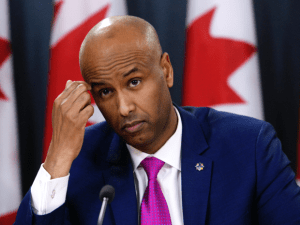
Still, Hussen was not exactly a high-profile MP, and when he was tapped to take over the immigration file from veteran John McCallum—who subsequently resigned his seat and was named ambassador to China—the reaction was largely, “Who?” Hussen says he had no sense this was coming, but he was “very, very honoured and really touched” that the Prime Minister handed him this file. “I’ll be frank: it’s a big job, and he didn’t start as a parliamentary secretary, so he didn’t have the opportunity to get seasoned on the brief,” says Chan, who remained friends with Hussen after both left McGuinty’s office. “But I’ve never doubted his intelligence. So for me, his only major challenge is the cut-and-thrust, and the speed with which things will transpire in his life.”

Chan exudes a warm, fatherly sort of pride toward his colleague, despite being only nine years older. Hussen has three sons aged seven, three and five months; Chan’s three sons are just about a decade older, and he’s warned Hussen of how hectic it will be juggling everything now. Chan echoes others who know Hussen, in remarking on how he manages to be quietly commanding. “I think the challenge sometimes is in the heat of the bright lights, some people might take that (soft-spokenness) as a form of weakness. I would never take that as a view, that he won’t see through the issues or that he’s going to act in a capricious way, or that there’s a soft underbelly to him,” Chan says.”There isn’t.”

In fact, the PMO saw Hussen’s “preternatural calm” as a major asset in this portfolio, the senior government official says. The Liberal government—not unlike vast swaths of the U.S. government apparatus, apparently—didn’t know exactly what the Trump administration had planned, but it was clear from the campaign that immigration would be a hot file. Hussen was also seen as an ideal fit because he had, quite literally, been there. “We wanted to make sure there was someone in the control room who really understood what it was like to be on the shop floor,” the official says.

Hussen is almost comically understated about his dramatic public introduction to the job, conceding only that it was a “very interesting” weekend. “I’ve always learned most when I’m placed quickly in a situation where I have to deal with something,” he says. “It was a very steep learning curve to get right into it, but I have a very good staff and supportive department officials.”

When asked about his seeming reluctance to respond to issues like the U.S. travel ban from a personal perspective, Hussen returns to a familiar line in spelling out the various pieces of his identity and history. “I’m very happy and proud of my Somali heritage, but I also make it a point to emphasize that I’m a Canadian citizen, and I’m a Canadian,” he says. “This is where I have spent more of my life, this is home for me and this is the society I have grown to cherish.”

For Hussen, it’s about being proud of his roots, but recognizing that he is a citizen of one country now: Canada.

Source: Ahmed Hussen: The rise and rise of Canada’s immigration minister

Andrew Coyne: Free speech needs to be guided by judgment and conscience, not rules

Another thoughtful column by Coyne:

It is common among some clear-thinkers to reject any allegation of speech suppression — a speaker being shouted down on campus, a boycott of an offending corporation, a Nazi getting punched — unless it involves the explicit use of the coercive power of the state. Anything else is merely the “consequences” of speech, for which one should accept “responsibility.” Suck it up, snowflake.

In a sense, of course they’re right. The obligations of the state are of a different order than private individuals or groups, because of its unique powers of coercion, and because coercion — the power, not merely to punish speech, but to actively prevent speech — is of a different order than mere disapproval, say, or shunning.

But the difference is not so absolute as all that. It is more of degree than kind. As private individuals, we may not be under the same obligations and constraints as the state, but that does not mean we are under none. We have still the obligations of judgment, of conscience, and of respect — for the spirit of free speech, if you will, rather than the legal letter.

At one extreme it is easy to see this. If a mob were to burn down the local newspaper and hang its editor, it is of no use to say, well, it wasn’t the government that did it, so no chilling of speech is involved. One should not have to factor in, among the “consequences” to be expected of speech, the chance that one might be murdered — or punched, for that matter.

Short of actual law-breaking, things get trickier. There is no violence in shouting down a speaker, you may say; neither is a university, as a private organization, obliged to provide a platform for opinions of which it, or a section of the university community, disapproves. No, indeed. But free speech exists, as a legal guarantee, in part because of the foundation of social values in which it is embedded.

The spirit of free speech, that is, is as important: the notion that none of us is in absolute possession of the truth; that the route to truth is through the exchange and conflict of ideas; that the rights we each enjoy are guaranteed only so far as they do not intrude upon another’s; and that, in particular, we do not have a right not to be offended, or to be spared any encounter with disagreeable words, images or ideas. If we do not live by these principles ourselves, we will shortly find neither will our creation, the state.

So far so good. But what of the more benign ways of expressing collective disapproval: boycotts, online campaigns, or Parliamentary motions? Are these mere consequences of speech, or constraints upon it?


Answer: It depends. Anyone who has been the subject of a Twitter mobbing can attest it can be deeply unpleasant, and quite intimidating, even without overt threats of violence. The harm to reputation, for example, of having one’s name broadly associated with sexism, racism — or “Quebec-bashing” — can be a significant deterrent to speaking freely.

Taboos, shunning and other mechanisms of social disapproval, in other words, can raise the “price” of speech to intolerable levels. On the other hand, some things are taboo for a reason. We should not feel censorious for shunning or denouncing someone who expresses hateful or noxious opinions.

Neither should we hesitate to call them what they are. A good many of the participants in the present debate seem to think their freedom to say the most virulently and prejudicially anti-Muslim things should also protect them from being accused of prejudice against Muslims — or Islamophobia — in return. Well, no. That is simply logical, as is the denunciation in the motion before Parliament.

Where do we draw the line, then? Again, it depends. It requires all of us to use our judgment. People should not be labelled bigots or hate-mongers merely for offering an unconventional view on a controversial topic. A reasoned critique of Islam’s teachings on women is not to be treated the same as, say, a blanket claim that Muslims, as a group, are “unintegrateable.” But neither should actual bigotry be excused as merely being “un-PC.”

There are no simple rules to guide us. There are only mutual obligations: not to give offence needlessly, but also not to take offence lightly; not to round up a mob every time someone’s views offend us, but neither to be intimidated by the mob when it is necessary to offend.

Source: Andrew Coyne: Free speech needs to be guided by judgment and conscience, not rules | National Post

The Tories approach a point of no return and other commentary on M-103

Terry Glavin’s usual trenchant commentary:

During the debate on the motion in the House, Khalid said she defines Islamophobia as “the irrational hate of Muslims that leads to discrimination.” That’s perfectly fine, too, but what makes no sense was Khalid’s statement that she refused Conservative MP (and party leadership hopeful) Erin O’Toole’s offer to help win unanimous consent for her motion by tightening it up, because that would have meant “watering it down.”

In a parallel topsy-turviness, Joly has objected to David Anderson’s alternative motion, which replicates Khalid’s motion except for the ambiguous term Islamophobia, because it’s a “weakened and watered down version.”

It’s true to say, as Scott Reid does, that seemingly benign injunctions against “Islamophobia” have been put to the squalid purpose of placing the Muslim religion and the practices of authoritarian Islamic regimes off limits to criticism. But it’s also fair to say that “anti-Muslim bigotry” doesn’t sufficiently capture the full-throated paranoid lunacy animating the nutcase wing of the Conservative support base these days.

“Racism” doesn’t quite cover it. “Hatred” doesn’t quite get at it. Whatever term you like, it’s more than merely ironic that those who make the most hysterical claims about clandestine Islamic conspiracies at the centre of Justin Trudeau’s government are also the ones shouting the loudest that an irrational fear of Islam isn’t even a thing.

It’s not as though the Liberals are blameless in all this. They could have welcomed O’Toole’s efforts at reaching out to find a compromise, but they didn’t. And the Liberals do seem quite content to have the Conservatives squirming and chafing against the appearance that the reason they object to the term Islamophobia is that they themselves are Islamophobic, whatever that might mean. It is not as though it bothers the Liberals that the Conservatives are stuck with the crazy talk coming from several of the leadership candidates these days.

Trudeau may have given away more than he intended last week when he was confronted at a community meeting in Iqaluit about why he reneged on his electoral reform promises. Raising the spectre of proportional representation opening the door to “fringe” parties, Trudeau asked, rhetorically: “Do you think that Kellie Leitch should have her own party?”

Clearly, Trudeau doesn’t want that. For starters, it would mean decent Conservatives couldn’t be tarred so easily with the indecencies committed by the party’s fringe factions. It would mean bigot-baiting the Conservative Party would be that much harder to do. In the meantime, it’s up to the Conservatives to get themselves sorted, and after the sordid events of the past few days, their options are limited:

Isolate, quarantine, amputate or purge.

Source: The Tories approach a point of no return – Macleans.ca

Campbell Clark in the Globe:

It’s one thing for MPs to say they oppose the motion. But it’s another to accept the bogus reasoning.

One is the slippery-slope argument. Mr. Levant is telling Canadians that once a Commons committee starts studying the vague notion of Islamophobia and what to do about it, they’re going to propose laws that make it illegal to criticize Islam, and restrict free speech.

The obvious weakness in that is that Motion M-103 doesn’t even ask the committee to propose laws, nor could it force them – let alone the kind that stifle free speech. If they ever did, MPs could vote against it then. And it still could not violate constitutional guarantees on free speech.

If Conservative objections really were about a vague term, some deal-making would be in order. There are arguments that in some countries the term has been used to refer to any criticism of Islam.

Of course, this motion calls for MPs to study it, so they could define it.

But Liberals were unwilling to compromise when the Conservatives asked them to change “Islamophobia” to “hatred for Muslims.”

But it’s not about the word. Ironically, it’s about fear.

All this began when Montreal-area MP Frank Baylis started a petition last year to assert that all Muslims should not be equated with a few extremists. NDP Leader Tom Mulcair later asked for unanimous consent for a motion condemning Islamophobia – and got it on his second attempt on Oct. 26.

Conservative House Leader Candice Bergen responded to Mr. Mulcair’s motion with her own, condemning religious discrimination.

Both were adopted. The word Islamophobia was fine for Conservatives then, before they got scared.

Source:  Conservative MPs are afraid of Motion 103, and things it can’t do 

The contrary view, and the conflation of Islamophobia/anti-Muslim hate with free speech concerns, comes from Farzana Hassan in the Sun, who appears not to have understood what the motion covers and what it does not:

When we challenge a certain Islamic practice, we are careful to exclude the moderate majority and focus our attention on a small segment of the Muslim community. Yet some claim that even such discussion conflates the radicals with the moderates.

If Khalid believes such discussions include all Muslims, she is unwittingly admitting that all Muslims are indeed like the fundamentalists.

Khalid is mistaken if she believes any rational discussion on Islamic practice castigates all Muslims. She must understand that any well-intentioned and constructive discussion on a religious practice or ideology is a fundamental right of every Canadian.

There is no phobia of Islam in Canada. There is genuine resentment toward orthodox Islam. But it has little to do with the usual public discourse.

Some practices, whether we discuss them in public or not, are commonly known to be associated with orthodox Islam, such as polygamy, wife battery and ostracism of religious minorities.

It is up to moderate Muslims to distance themselves from these outrages as much as possible. So far no robust public challenge to such practices has emerged from moderate segments of the community.

Without such a grassroots challenge any social observer, professional or amateur, can form any opinion on orthodox Islam, whether positive or negative.

We know some Muslims are working to institute gender equality, and others are partners with the government in fighting terror. However, these efforts need to become the norm rather than the exception. Once this takes place, the world will automatically begin to see Muslims in positive light.

Prime Minister Justin Trudeau has talked about finding the right balance between protecting a religious minority and also protecting our Charter rights.

The answer to his dilemma is simple: Do not put the slightest dent in our right to free speech.

To balance this, the prime minister can take more measures to protect the security of all minorities with tighter law enforcement and stricter punishments for alleged offenders like Alexandre Bissonnette.

Source: I’m a liberal Muslim and I reject M-103

Lastly, an article on Iqra Khalid’s reading out the hateful emails and tweets she has received, providing proof of the validity of M-103 and its specific reference:

The Liberal MP who tabled an anti-Islamophobia motion says she has been inundated with hate mail and death threats.

Mississauga, Ont. MP Iqra Khalid told the House of Commons today she received more than 50,000 emails in response to M-103, many of them with overt discrimination or direct threats.

“I have asked my staff to lock the office behind me as I now fear for their safety,” she said. “I have asked them not to answer all phone calls so they don’t hear the threats, insults and unbelievable amount of hate shouted at them and myself.”

She described a “chilling” video posted on YouTube that called her a terrorist sympathizer and disgusting human being.

“‘I’m not going to help them shoot you, I’m going to be there to film you on the ground crying. Yeah, I’ll be there writing my story with a big fat smile on my face. Ha ha ha. The Member got shot by a Canadian patriot,'” she read, quoting from the video.

And that, she said, was just tip of the iceberg. Here are some other messages she received and read in the House:

  • “Kill her and be done with it. I agree she is here to kill us. She is sick and she needs to be deported.”
  • “We will burn down your mosques, draper head Muslim.”
  • “Why did Canadians let her in? Ship her back.”
  • “Why don’t you get out of my country? You’re a disgusting piece of trash and you are definitely not wanted here by the majority of actual Canadians.”

Khalid said she has also received many messages of support.

Source: ‘Kill her and be done with it’: MP behind anti-Islamophobia motion reads out hate mail

Georgetown professor under fire by conservatives for lecture about slavery and Islam – The Washington Post

Challenge for academics in terms of how their nuances and subtleties get lost in public debate, and how the present can cloud our understanding of the past (understanding doesn’t equal acceptance):

Brown’s lecture was from the first of several papers he said he is writing on the question of Islam and slavery that are aimed at giving the Muslim community tools to bridge the gap between “elements of Islamic traditions and modern values” at a time when the Islamic State has “slammed the issue of slavery on the table in the 21st century.” In a phone interview, he said was trying to “help frame this problem by discussing the values of consent and autonomy that are prominent today, but they weren’t always.”

Brown denied that he had condoned slavery and non-consensual sex and said that his critics, some of them from the “alt-right,” are misquoting him. “I don’t know how they could say that I did,” he said. Scholars are at risk, he said, if “some de-contextualized quote of theirs is taken out and prompts a feeding frenzy that calls for them to be fired.”

A number of stories from conservative magazines and websites wrote scathing stories about the lecture, saying that he was condoning slavery and non-consensual sex. For example, the American Conservative wrote a piece with this headline: “Georgetown Prof Defends Islamic Slavery.” American Thinker had a story with this headline: “Georgetown professor defends Islamic slavery and ‘non-consensual’ sex.” The Daily Banter wrote: “Islamic Studies Professor On Whether Rape and Slavery Are Wrong: It Depends” and “An Islamic Studies professor at Georgetown has taken academic obscurantism and cultural relativism to new heights.”

Source: Georgetown professor under fire by conservatives for lecture about slavery and Islam – The Washington Post

Port de signes religieux: Taylor plombe un compromis possible, déplore Bouchard 

Always interesting to listen to both Taylor and Bouchard, both when they agree and when not. But the focus on the concrete mentioned at the end of this article indicates a strong convergence of views:

Le Québec a raté une occasion unique de mettre derrière lui le débat sur le port de signes religieux. En désavouant la solution mise de l’avant dans son propre rapport, Charles Taylor a coupé les ailes au consensus qui se dessinait entre les partis politiques, déplore Gérard Bouchard qui, avec M. Taylor, avait coprésidé la commission sur les accommodements reliés aux différences culturelles.

Avec la prise de position étonnante du philosophe Taylor, «le Québec risque d’être une autre fois enfoncé dans l’âcre querelle qui le divise depuis une quinzaine d’années », observe M. Bouchard dans une lettre publiée demain dans la section Débats de La Presse+. «Pour ma part, j’endosse toujours cette proposition», tranche M. Bouchard.

M. Taylor soutient intervenir pour contribuer à la réconciliation des opinions sur cette question délicate. Or, estime M. Bouchard, cette intervention aura « contribué à mettre en échec [la réconciliation] qui émergeait entre les partis politiques et qui a été rendue possible parce que d’importants éléments de consensus étaient présents dans la population ».

En désavouant cet élément de son rapport de 2008, M. Taylor risque de provoquer «l’échec du projet de consensus, dénonce son collègue Bouchard. Les jeux sont à nouveau ouverts. Il est probable que le PQ et la CAQ voudront maintenant reprendre leurs billes». Avec cette occasion ratée, prédit-il, «le débat sur les signes religieux est relancé au moins jusqu’aux prochaines élections, et peut-être au-delà».

Le sociologue du Saguenay était injoignable depuis que son partenaire Taylor avait, dans une lettre à La Presse, annoncé qu’il n’appuyait plus la recommandation formulée dans leur rapport en 2008. Il avait eu vent que son collègue s’apprêtait à rendre publique sa volte-face.

Les deux intellectuels proposaient alors d’interdire le port de signes religieux visibles aux représentants de l’État exerçant un pouvoir de coercition sur les autres citoyens. Ainsi les juges, les procureurs de la Couronne de même que les policiers et les gardiens de prison n’auraient pu afficher leur confession en portant une croix, une kippa ou un voile, par exemple. Pour Gérard Bouchard, cette formule «s’était progressivement posée, aux yeux de nombreux Québécois, comme l’assise à partir de laquelle on pourrait ériger un consensus. Cet horizon est maintenant compromis».

M. Taylor jugeait que, depuis la publication du rapport, le contexte avait changé et que le débat soulevé par cette question avait entraîné des gestes malheureux à l’endroit de la communauté musulmane. Ce revirement avait comblé d’aise le premier ministre Couillard qui, rapidement, revint à sa position – totale liberté pour le port de signes religieux à la condition que les services publics soient donnés et reçus à visage découvert.

Au passage, M. Bouchard écorche la position de Philippe Couillard qui, opposé à la «discrimination vestimentaire», prône l’absolue liberté quant au port de signes religieux.

Or, le projet de loi 62 proscrit le niqab, le voile qui couvre le visage, «une contradiction flagrante» dans la position du gouvernement, observe M. Bouchard. M. Couillard a déjà fait valoir que des questions d’identification, de sécurité, commandaient que les services soient offerts et reçus à visage découvert.

L’interdiction du rapport Bouchard-Taylor, limitée à quelques «agents exerçant une fonction tout à fait exceptionnelle», «se défendait bien sur le plan juridique», estime le sociologue, rappelant que des juristes avaient été consultés avant la publication du rapport en 2008. «Nous sommes loin d’une attaque directe contre les musulmans ou du projet de charte des valeurs, comme on l’a prétendu» dit-il.

Les «dissensions persistantes sur les signes religieux» vont rester. Il convient maintenant «d’oeuvrer énergiquement » à d’autres tâches, la lutte contre la discrimination, la destruction des stéréotypes, et « vider enfin le panier de crabes des accommodements [qui posent toujours un gros problème pour les deux tiers des Québécois]». Le gouvernement Couillard semble se montrer plus actif dans cette direction, se réjouit en conclusion Gérard Bouchard.

Source: Port de signes religieux: Taylor plombe un compromis possible, déplore Bouchard | Denis Lessard | National

Andrew Coyne: Hysteria from Conservatives over harmless motion on Islamophobia

Andrew Coyne calls out the Conservatives in their opposition to M-103. Again, the hypocrisy given the extent that the Conservative government singled out antisemitism.

Particular anti-racism and discrimination messaging and programming is not in conflict with general messaging and programming, as long as the link is made clear (which M-103 does). Some of the previous government’s messaging on antisemitism was less clear in that regard:

Conservatism used to have some claim to being a coherent political philosophy. Of late it has become a series of dares. The most extreme voice will lay down the most extreme position, then challenge others to endorse it.

As often as not this has nothing to do with conservatism. It is rather a kind of moral exhibitionism, populist virtue-signalling, in which the object is to say and do the most intolerant or ill-considered thing that comes to mind — anything that might attract the condemnation of bien-pensants in the media and elsewhere, whose opposition becomes proof in itself of its merits.

The willingness to court such controversy in turn becomes the test of political purity. To demur, conversely, can only be a sign of cowardice, or worse, liberalism, a heresy that would seem to have overcome much of the conservative movement, to judge by the ever-lengthening list of the excommunicated.

So we come to the latest of these blooding exercises, the “debate” over Motion 103, a private member’s motion introduced by Liberal MP Iqra Khalid. In the fevered imaginings of its online discussants, #M103 is decried as a bill that would forbid any criticism of Islam, if not the first step towards imposing Sharia law. I only wish I were exaggerating.

This hysteria campaign has been whipped up by exactly the people you’d expect, and pandered to by people of whom you might have expected better, including several Conservative leadership candidates. Pierre Lemieux has denounced it as “an attack on free speech.” Maxime Bernier asks whether “it is a first step towards restricting our right to criticize Islam.” Lisa Raitt, Andrew Scheer, and Erin O’Toole have all come out against it, while Kellie Leitch, bless her heart, has set up a petition to “Stop Motion 103,” complete with a blue-eyed model with a gag over her mouth.

The only candidate to say he will vote in favour of the motion is Michael Chong. For this he has been excoriated as a sellout; it rather confirms him as a man of judgment and conscience. There is simply no reasonable construction of the motion that can support the claims made of it. It is not a bill, for starters: it is a simple motion, an expression of opinion, of no legal force or effect. It does not call for any ban or restriction on speech of any kind.

It merely asks the government to “recognize the need to quell the increasing public climate of hate and fear,” condemns “Islamophobia and all forms of systemic racism and religious discrimination,” and instructs a committee of Parliament to study the matter. Yes, the motion is clumsily worded, and yes, it specifically mentions “Islamophobia.”

But the notion that this amounts to “singling out” one religion for “special privileges,” as some have claimed, is specious.

Yes, of course, all religious groups should be free of discrimination and hatred. But it does no disservice to the others to pay particular attention to one, at a time when that group is particularly exposed to both. After the slaughter of six Muslims at prayer in Quebec City, people of goodwill, not to say common sense, would understand why it might be timely for all of us to offer some assurance to members of that community.

It is, at the same time, understandable why there would be some nervousness around this subject. There is a certain school of Islam that would indeed place severe legal constraints on the right to criticize or ridicule the faith, just as there are lots of people, especially on the left, who would eagerly censor all sorts of “insensitive” speech.

This is what makes these issues so maddeningly elusive of resolution: it is not one thing or the other, but both at the same time. We live in a time both of much more widespread and open expressions of racism — thanks, internet — and of acute hypersensitivity to rude or even frank speech of all kinds. Each feeds off the other. But the alternative to “political correctness” is not bigotry and intolerance, and the answer to racism is not censorship. Indeed, we have too much of that already.

I’m not sure how many of those either praising Chong or denouncing him for his stand on Motion 103 are aware that he has at the same time proposed repealing Section 319 of the Criminal Code: the “hate speech” provision. But he is as correct in the latter stance as the former. Even a free society allows some exceptions to the liberties it enjoys — but a free society always insists that any such exception be, to borrow the language of our Charter, “demonstrably justified.”

The burden of proof is always on those who wish to restrict freedom to show why they must. At the very least they must show what harm it is they wish to address. In the case of “hate speech,” the harm is supposed to be the violence towards its objects that might ensue. But the Criminal Code already contains provisions against incitement to violence: that is, where the connection between the speech, and the violence that might reasonably be expected to result, is so immediate, so direct and so clear as to be “beyond a reasonable doubt.”

With the hate speech law, on the other hand, the fear is more generalized, more vague, more dubious: somebody somewhere might read this who might someday then be motivated to attack … someone. That is no basis for any kind of law, let alone one that would restrict something so vital as speech. If the other Conservative candidates want to fight censorship, let them join Chong in that cause, rather than this shameless demagoguery over a harmless motion.

Source: Andrew Coyne: Hysteria from Conservatives over harmless motion on Islamophobia | National Post

Quebec can’t keep politics out of the identity debate

Depressing how the cycle repeats itself:

Now, even Prof. Taylor agrees. Conceding that he never really believed in his report’s principal recommendation – that individuals invested with the “coercive” powers of the state be prohibited from wearing religious symbols – the esteemed philosopher said this week that the events of the past decade have convinced him that Quebec should abandon the idea of legislating in this area altogether. Any such law would probably be unconstitutional anyway. More important, the stigmatization of the province’s Muslim minority in the debates that followed his report, and the subsequent Parti Québécois government’s attempt to adopt a charter of Quebec values that would have extended the ban on religious symbols to all state employees, gave licence to a xenophobic minority of Quebeckers to act on their discriminatory views, Prof. Taylor said.

The 85-year-old philosopher concluded that the recent attack on a Quebec City mosque that left six worshippers dead prompted a rare expression of solidarity that must not be squandered by reopening divisive debates over Muslim headgear. It’s time for Quebec to move on – and heal.

Unfortunately, Prof. Taylor’s words of wisdom will be all but ignored, in part because the co-author of the Bouchard-Taylor report profoundly disagrees with them. For Prof. Bouchard, a sociologist and the brother of former PQ premier Lucien Bouchard, it is precisely the failure of politicians to act on his report’s recommendations that led to an increase in hate crimes and discriminatory attitudes toward Muslims. For him, it’s “urgent” to legislate the rules of religious accommodation now to prevent this debate from boiling over again in the future.

Prof. Bouchard’s point of view reflects one of his report’s fundamental observations. Though a majority in their home province, francophone Quebeckers with Catholic roots still consider themselves a threatened minority and expect newcomers to understand this. “What’s just happened in Quebec,” the 2008 report noted, “gives the impression of a face-to-face between two minorities, each asking the other to accommodate it… We can conclude that Québécois of French-Canadian ascendance are still not very comfortable with the cumulation of their two statuses – majority in Quebec, minority in Canada and North America.”

A decade later, not much has changed. The current Liberal government of Premier Philippe Couillard, which depends on the overwhelming support of the province’s anglophone and immigrant populations to win elections, once again finds itself awkwardly trying to prevent an unresolved identity crisis from again becoming a political one. It has proposed legislation establishing the parameters of the state’s religious neutrality that would ban face coverings among those who dispense or receive government services.

The opposition PQ and Coalition Avenir Québec naturally think the Liberal legislation is too timid and, barely a week after the Quebec City shooting, said they would only support it if it also included Bouchard-Taylor’s proposal to ban police officers, judges and prison guards from wearing religious symbols. Coalition Avenur Québec Leader François Legault called the idea a “compromise.”

Indeed, the opposition is attempting to exploit divisions within the Liberal caucus itself. Liberal MNA’s from outside the Montreal area are worried that a failure to address the debate over religious accommodation could lead to their defeat in the 2018 election, just as it did in 2007. Hence, Mr. Couillard’s government reportedly considered adopting Bouchard-Taylor’s recommendations after the Jan. 29 mosque shooting. But the Premier ultimately could not stomach the idea. Prof. Taylor’s volte-face vindicates Mr. Couillard. But it is a small consolation for the Premier. A decade after Bouchard-Taylor, Quebec is still no closer to reconciling its religious past and present.

Source: Quebec can’t keep politics out of the identity debate – The Globe and Mail

L’intérêt des principes: Michel David on Bill 62

While I prefer the narrow approach of PM Couillard, recognize the validity of David’s arguments given the opposition consensus. I also remain sceptical that the CAQ and PQ will not be tempted by identity politics in the next election:

En politique, il est facile de confondre ses principes et ses intérêts. Le compromis auquel en sont arrivés le PQ, la CAQ et Québec solidaire, dont les positions ont longtemps paru inconciliables, aurait le mérite de mettre un terme, au moins temporairement, à un débat qui a trop duré. En se montrant aussi intransigeant, M. Couillard donne plutôt l’impression de vouloir le poursuivre.

Le premier ministre dit vouloir empêcher une « dérive discriminatoire » qui, après les policiers et les juges, étendrait l’interdiction du port de signes religieux aux enseignants et éventuellement aux baigneuses. Précisément, si l’Assemblée nationale adoptait à l’unanimité un projet de loi traçant clairement la ligne, un nouveau gouvernement y penserait à deux fois avant de rouvrir la boîte de Pandore.

En refusant toute concession, M. Couillard fait en sorte que le débat s’envenime au cours des prochains mois et que la prochaine campagne électorale donne lieu à une surenchère qu’il se fera un devoir de dénoncer avec la dernière énergie. En raison de ses principes, bien entendu.

Comme pour mieux faire traîner les choses, le gouvernement a décidé d’accorder la préséance au projet de loi 98, qui vise à réglementer les ordres professionnels, mais dont il a soudainement découvert qu’il pouvait favoriser l’intégration des immigrants au travail. L’étude du projet de loi 62 sur la neutralité religieuse de l’État risque donc d’être reportée à l’automne, alors qu’on entrera dans l’année électorale. Avec un peu de chance, tout devrait alors être en place pour un nouveau psychodrame.

Source: L’intérêt des principes | Le Devoir

Diversity in the Senate – My latest in Policy Options

My latest, analyzing the diversity of Senators. Intro teaser below:

With the large number of Senate appointments made by Prime Minister Justin Trudeau and a more independent role for individual senators, a look at the current level of diversity in the Upper Chamber is timely.

In essence, the Trudeau appointments have made the Senate more diverse in terms of gender, visible minorities, and Indigenous peoples and thus more representative of the people it serves.

However, when viewed from the perspective of education and occupation, there is less diversity: more senators with higher degrees, and more senators with an activist background and less with a business background.

Given the increased independence of senators, the increased ethnic and gender diversity and decreased educational and occupational diversity    may play a role in terms of how the Senate responds to legislation and plays its sober second thought role.

This analysis contrasts the various aspects of diversity between the 43 non-affiliated senators (33 form the Independent Senators Group, of whom 28 were appointed by Prime Minister Trudeau),  and the 41 Conservative and 21 Liberal senators (December 2016).

Source: Diversity in the Senate – Policy Options

Une bénédiction pour Couillard | Charles Taylor on Bill 62

Nothing wrong with either remaining in favour of this recommendation in favour of banning religious symbols for police and judges, as Gérard Bouchard, or having second thoughts as Charles Taylor. IMO, Taylor is more attuned to the continued risks of divisiveness of expanding the relatively narrow focus of Bill 62 on face-coverings:

Une volte-face comme une bénédiction pour le gouvernement libéral. Contrairement à ce qu’il soutenait dans le rapport de la commission sur les accommodements raisonnables, le philosophe Charles Taylor a déclaré publiquement qu’il ne croit plus qu’il faut interdire le port de signes religieux, notamment pour les policiers et les juges. De la musique aux oreilles du premier ministre Philippe Couillard, qui a réaffirmé qu’il n’entendait pas légiférer sur le sujet.

Les libéraux rejettent ainsi tout compromis avec les partis d’opposition, qui s’étaient pourtant montrés ouverts à appuyer le projet de loi 62 sur la neutralité de l’État s’il contenait une disposition empêchant le port de tout signe religieux pour les personnes détenant une fonction « coercitive » ou en situation d’autorité. « Nous, on a toujours été opposés à la discrimination vestimentaire. Ce n’est pas la première fois que je le dis ce matin. […] Je crois que ça permet de constater que, quand on a des principes, il faut s’y tenir », a affirmé Philippe Couillard.

Dans une entrevue à Radio-Canada, M. Taylor a dit qu’il était conscient qu’il intervenait dans un débat politique, confortant du même coup le premier ministre dans sa décision. « Si j’avais une intention politique, c’était d’éviter qu’on accepte ce compromis, oui, justement parce que j’y voyais un grand danger. Le but, auquel je tiens de façon passionnée, c’est que les gens commencent à se rallier et à se comprendre. Et j’ai dû intervenir », a-t-il expliqué.

Même s’il en faisait la recommandation dans le rapport Bouchard-Taylor, déposé il y a neuf ans, le philosophe croit aujourd’hui qu’il est « dangereux » de légiférer pour interdire le port de signes religieux, car cela risque « d’exclure les immigrants de certaines zones »« Maintenant, non seulement je vois que cette distinction n’est pas importante […] mais je vois les conséquences de mener ces débats. Il y a des conséquences très sérieuses. Ça crée un effet de stigmatisation. » Un effet qui, selon lui, doit être évité à tout prix dans le contexte du nouveau gouvernement de Donald Trump et celui de la fusillade à la mosquée de Québec. « Ne rouvrons pas les plaies », a-t-il écrit dans une lettre ouverte publiée mardi.

Avec cette sortie publique, M. Taylor marque son désaccord avec son collègue et coprésident de la Commission, Gérard Bouchard. Celui-ci avait précisé à maintes reprises qu’il était important, voire « urgent », de légiférer sur la question. Ce dernier n’a pas répondu à nos demandes d’entrevue. « On n’a jamais vraiment été d’accord là-dessus, parce que pour lui c’était une question de principe, pour moi, plutôt une question de conjoncture. Mais je l’estime beaucoup et je suis d’accord avec lui pour tout le reste du rapport », a dit M. Taylor en entrevue à Radio-Canada.

Source: Une bénédiction pour Couillard | Le Devoir

Globe’s coverage:

Charles Taylor, a leading Canadian intellectual who has been described as one of the world’s greatest living philosophers, said such a ban raises the possibility of stigmatizing the Muslim community. Mr. Taylor was, along with academic Gérard Bouchard, co-chairman of a high-profile commission on reasonable accommodation that recommended in 2008 that figures of coercion in Quebec be prevented from wearing symbols of their faith.

Those figures include police officers, judges, prison guards and prosecutors.

However, Mr. Taylor has now said he has changed his mind. In an unusual move, he has disavowed a key section of his report.

“I did sign the report where this recommendation appears; but nine years later, I no longer endorse it,” he wrote in La Presse.

The mosque attack in Quebec City that claimed the lives of six Muslim worshippers last month created a new context, said Mr. Taylor, an emeritus philosopher at McGill University. Quebec has just started to close the divisions left by the acrimonious debate over the Parti Québécois’s Charter of Values, which would have banned religious headwear in the public service. That debate stigmatized some minorities and even led to verbal and physical assaults against women wearing head coverings, he said.

Quebeckers have now started to rally together in the wake of the mosque assault.

“I believe we cannot afford the luxury of taking new steps that would renew the stigmatization, regardless of the good intentions of some of their defenders,” Mr. Taylor wrote, in French. “Let’s not reopen the wounds. Let’s leave all the room to a time of reconciliation.”

He admitted his stance puts him at odds with Mr. Bouchard, who has pushed for the figures-of-authority ban on a matter of principle. “We disagree,” Mr. Taylor told an interviewer Tuesday about his former co-chairman. “We were never entirely in agreement.”

Quebec is in the throes of yet another discussion over the place of religion in the public realm because the Liberals have introduced Bill 62, legislation that would forbid people from giving or receiving public services with their faces covered. The government presents it as a matter of security and communication.

The opposition Parti Québécois and Coalition Avenir Québec have said they want the bill to include a headwear ban for authority figures.

Mr. Couillard argues that such a step would amount to “clothing discrimination.” He hinted on Tuesday he might propose changes to Bill 62, but has given no indication he is prepared to withdraw it.

Quebec’s Couillard rejects push for ban on officials’ religious headwear