No real surprise here apart from a remarkable increase in comfort of Sikhs compared to their 2015 survey:
Even though Canada has been praised for its religious and culture diversity, almost half of Canadians view Islam in an unfavourable light compared to other faiths, according to a new survey.
The Angus Reid Institute released results Tuesday on how Canadians view various faiths and religious symbolism in society.
The study found that 46 per cent of Canadians view Islam and clothing associated with the religion unfavourably compared to how they view other religions to likes of Christianity and Buddhism.
In terms of wearing religious grab in public, 88 per cent of those surveyed supported a person wearing the nun`s habit or a turban (77 per cent) compared to those wearing a niqab (32 per cent) or a burka (29 per cent).
However, the survey noted that more people are beginning to view Islam in a more favourable light, with Quebec residents leading the way.
According to the survey, those in Quebec who say they view the Islam faith more favourably has more than doubled since 2009, jump from 15 per cent to 32 per cent. More Quebecers are also seeing Sikhism (32 per cent) and Hinduism (50 per cent) in a more positive light.
A rare column by Wente that captures the issues well:
We do a pretty good job of welcoming newcomers to this country. It’s one of our great strengths. I don’t buy the myth, beloved of some, that Canadians harbour deep racist and xenophobic tendencies that are just waiting to be set alight by the likes of Kellie Leitch.
But some days, I have to wonder what’s gotten into people. Who, for example, would want to deny Muslims the right to bury their dead?
It seems that there are more than you might think.
The terrible massacre in January of six worshippers at a mosque in Quebec City revealed a problem: Quebec Muslims have few places to bury their dead. The only Muslim-run cemetery in the province is in Montreal, several hours’ drive away. After the massacre, the small town of Saint-Apollinaire (population 6,000) found some land that would be suitable for another one, and quickly struck a deal to sell it to the Muslim community. It seemed like a neighbourly way to help. But as The Globe and Mail’s Ingrid Peritz found, the plan was met with a storm of protest.
“This cemetery is just the embryo of other projects,” one person wrote in an e-mail to the town’s mayor. “These people are here to grab religious and political power.”
The mayor, Bernard Ouellet, is staunch in his support for the plan, and believes most townspeople support it too. But he’ll have to work hard to quell the fears. As Quebec imam Hassan Guillet says, “If the project is refused and we’re not allowed to be buried in this land, how are we going to be accepted to live in this land?”
Religious accommodation is always a touchy subject, but the opposition to this plan is simply wrong. There is no place for it in my Canada.
Here in Ontario, we have our own hysterias. A strident group of anti-Muslim activists have been waging a noisy campaign to end Muslim prayer at schools in a big district near Toronto. At one school-board meeting, someone tore pages from the Koran and stomped all over them. At others, people leaped to their feet to denounce Islam. A parents’ group launched a petition complaining that “unsolicited exposure to religion” could “create subconscious bias in the minds of impressionable children for or against a faith.” In the latest bit of hate-filled showmanship (as a school-board spokesman aptly called it), a local agitator offered a $1,000 reward to any student who surreptitiously recorded hate speech during a Muslim prayer service.
Needless to say, Muslim prayer in schools has always been contentious. You may believe, as I do, that any type of prayer – including this type – has no place in the public schools. But I also believe it’s not the worst idea. Like it or not, religious accommodation is the law, and the schools are devoted to inclusiveness. Our interest is to integrate new Canadians, not segregate them. We want their children to be educated in the public schools, not religious schools. So we’d better make sure the kids (and parents) feel comfortable there. And if an optional 20-minute prayer session once a week helps them feel more welcome, then why not?
The Peel District School Board, where the current commotion has broken out, serves a sprawling, suburban multiethnic community whose Muslim population is around 10 per cent. Muslim students have been observing Friday prayers for 20 years. Other schools around the province make the same accommodation. It’s been a work in progress. One heavily Muslim school in Toronto faced tough questions a few years back because menstruating girls weren’t allowed to take part in the prayer service. There have been concerns about sexism, as well as worries about just what kind of Islam is being preached. The Peel board has conducted lengthy consultations about whether the students who lead the sessions may write their own sermons, and by whom, if anyone, they must be approved.
To be honest, I have no idea how all this will work out, and neither does anybody else. It will take a generation or more to tell. Canada is not immune from the ethnoreligious tensions that are rocking the world and there’s no way we can avoid them. But we can discourage the fear-mongers and the hate-mongers from poisoning our public discourse. We won’t always agree, especially over symbols that touch our deepest values. Let’s just hope we can keep finding ways to disagree politely. That’s supposed to be the Canadian way, and I don’t want to lose it.
It is always easy (and valid) to focus on the people at the top as there are relatively few positions given their prominence and the relatively small numbers that one can easily analyse.
What is harder and takes more time, is to go through the entire list of some 65,000 names and do diversity analysis (based on names) to see the overall pattern.
To the Ontario government’s credit, the information is provided directly in spreadsheet form. If I get bored …
Naureen Rizvi says she was disappointed when only four women cracked the top 20 spots on Ontario’s annual Sunshine List, even as the province says it’s “on track” to close the wage gap.
“I always feel it’s not fast enough,” Rizvi told CBC Toronto at a Ryerson University event focused on women’s economic empowerment.
“I don’t accept that it takes 90 years to get to parity.”
At her job as the Ontario regional director with Unifor, Rizvi represents hundreds of thousands of unionized employees across a huge range of sectors, and she says there are wage gaps everywhere she looks.
‘We know that transparency is really important for achieving gender equity.’– Sarah Kaplan, Director at Rotman’s Institute for Gender and the Economy
A quick scan of the top of the Sunshine List merely confirms it. At universities, not one woman making a six-figure salary made as much as the top 20 men. At municipalities, only three women were among the best-paid.
Indira Naidoo-Harris, the province’s minister for the status of women, says the province is well aware there’s more work to do. Within the public service, she said, women make up some 55 per cent of the workforce, but take home about 12 per cent less money than their male counterparts.
The province has a strategy to deal with this, which includes setting targets for the number of women it wants at top levels.
“I think these are important targets because they really show that we are committed to really making sure that we’re putting those women in those positions of leadership where they belong,” Naidoo-Harris said.
“And that will absolutely open doors.”
Province setting targets to get women in top jobs
While the province is hoping to lead by example, it’s also asking companies listed on the Toronto Stock Exchange to alter their boards so they’re made up of at least 30 per cent women by 2020 (internally, the government’s target for women on boards is 40 per cent).
Naidoo-Harris also touted the government’s recently announced investments in child care, and called on women in this province to demand equality.
Sarah Kaplan, the director of Rotman’s Institute for Gender and the Economy, says the Sunshine List is a “small window” into the equity issue. But, she said, women should take advantage of any transparency when it comes to information about pay.
And Kaplan, who is on the list along with many of her colleagues, has done exactly that in the past.
“I said. ‘Here are the people that were promoted at the same time I was promoted — why are they getting paid more than me?'”.
It may not always work, Kaplan says, but it does lead to pointed questions.
“We know that transparency is really important for achieving gender equity,” she said.
Income inequality tougher for women who make less money
Sheila Block, senior economist at the Canadian Centre for Policy Alternatives, says it’s an “excellent idea” to use the list’s information to bargain, and that people from racialized groups, or those with different levels of ability, could do the same.
Block said the information can also be revealing about the biases that exist at certain institutions — something either employees or the employers themselves can question.
While it’s far from perfect, both Block and Kaplan note the public sector tends to be a fairer place for women.
“One of the things we’re most concerned about is the income inequality at the bottom end of the income spectrum,” Block said.
The Sunshine List itself doesn’t track gender, and crunching those numbers can be difficult due to androgynous names like Erin or Kim.
While I can understand the rationale for its removal (country of origin would be a better way to highlight the concern), we have to find a way that we can talk about particular practices or concerns related to country of origin and related risks in an evidence-based manner.
Being silent also has consequences.
And it is hard to have much sympathy for realtors given their inherent conflict of interest and lack of regulation compared to financial institutions:
Canada’s money-laundering watchdog drafted a document warning the real estate sector to be on guard for “specific ethnic communities” dealing with terrorism and war, before removing the reference at the behest of an industry association, documents show.
Correspondence between FinTRAC and the Canadian Real Estate Association, obtained by The Canadian Press through an Access to Information request, shows that the industry group was concerned that the reference would encourage agents to stop doing business with people based on their ethnicity.
The draft guidance document was aimed at helping companies meet their obligations to detect money laundering and terrorist financing.
It lists several examples of factors that may increase a company’s risk of becoming entangled in financial crimes, including dealing with “a specific ethnic community that is currently dealing with specific events (e.g. prevalence of terrorism or money laundering, war etc.) in the home country.”
Such a reference would constitute a violation of the Human Rights Act, the real estate association said in its letter.
“Canadians are rightly proud of the Human Rights Act, and especially in this day and age when we see what’s happening south of the border,” said CREA spokesman Randall McCauley.
“Our lawyers would have rightly pointed out or reminded FinTRAC that no Canadian can discriminate against another, or deny access to a service based on where they’re from.”
The federal agency says it was not referring to any particular ethnic community in the document.
“The intent of the guidance was to highlight, broadly, that regulated businesses may deal with clients that have a material connection to high-risk jurisdictions or other jurisdictions that are currently dealing with specific events, including terrorism or money laundering, war, a high level of corruption, or organized crime,” FinTRAC spokeswoman Renee Bercier said in an e-mail.
“FinTRAC chose to remove the terminology as it recognized the potential for misinterpretation and misrepresentation.”
Companies in certain sectors – including banks, casinos and real estate firms – are legally required to identify their clients, keep records and report suspicious or large cash transactions to FinTRAC. They are also required to assess their exposure to money laundering and terrorism financing risk.
Canada’s real estate sector has become an area of particular concern after a report released last fall by the Paris-based Financial Action Task Force said it is susceptible to the illegal dumping of cash.
FinTRAC provided CREA with the draft of its guidance document in 2014.
In a letter to FinTRAC dated Dec. 23, 2014, CREA calls the reference to ethnicity in the document “inappropriate,” particularly if read alongside another section of the guide that encourages companies to introduce measures that can be used to terminate business relationships, a process referred to as “de-marketing.”
“If this guidance were followed it could result in realtor members being liable for violating human rights law,” the letter reads, before going on to cite Sec. 5 of Canada’s Human Rights Act.
That section says it is a discriminatory practice to deny access to any good, service, facility or accommodation to someone for any of the prohibited grounds of discrimination. In a response letter dated Feb. 6, 2015, FinTRAC says it opted to remove the references to ethnicity and de-marketing.
The reference to ethnicity – and the decision to remove it – illustrates just how controversial the issue has become in the debate over foreign capital flowing into Canada’s real estate market.
Thomas Davidoff, an associate professor at the University of British Columbia’s Sauder School of Business, says affordability concerns in markets such as Vancouver and Toronto have in some cases resulted in ethnic divisions.
“People get their underwear in a bunch when they’re feeling threatened about having a roof over their head,” Mr. Davidoff says.
For instance, reports of money flowing into Vancouver’s housing market from China have resulted in some Vancouverites blaming the Chinese for pricing them out of the market for single-family, detached homes, Mr. Davidoff says. “Politicians and government needs to protect citizens while being tolerant and encouraging people to behave decently towards other people,” he said. “That can be a challenge.”
There’s a compelling question at the heart of a report released this week by the Metropolitan Planning Council: If more people — especially educated professional white Americans — knew exactly how they are harmed by the country’s pervasive racial segregation, would they be moved to try to decrease it?
Researchers from the MPC, a Chicago-based nonprofit, and from the Washington-based Urban Institute tried to create a workable formula for estimating the cost, collectively and individually, of the persistent problem in their report, “The Cost of Segregation: Lost income. Lost lives. Lost potential. The steep costs all of us in the Chicago region pay by living so separately from each other.”
The researchers analyzed segregation patterns in the 100 largest metropolitan areas in the country and found that if Chicago — the fifth most racially and economically segregated city in the country — were to lower its level of segregation to the national median of those 100 cities, it would have a profound impact on the entire Chicago region, including raising the region’s gross domestic product, raising incomes and lowering the homicide rate.
Amanda E. Lewis, director of the Institute for Research on Race and Public Policy at the University of Illinois-Chicago, called the MPC report “very important.”
“The findings are pretty stark,” Lewis said. “They’re hard to ignore.”
The report concluded that the Chicago region would gain many benefits from lowering its segregation level to the national median. Chief among them would be that incomes for African-Americans in the Chicago region would rise an average of $2,982 per person per year, which would increase the earnings of the region by $4.4 billion and raise the Chicago region’s gross domestic product, a leading measure of economic performance, by approximately $8 billion.
Chicago’s notorious crime would also be positively impacted. The region’s homicide rate would drop by 30 percent, which would have saved 229 lives in Chicago in 2016. In 2010, the last year for which regional numbers are available, a 30 percent drop in the homicide rate would have saved 167 lives and saved $65 million in policing costs and an estimated $218 million in corrections costs. In addition, residential real estate values would have increased by at least $6 billion.
Less segregation would also make Chicago and its environs more educated, with an estimated 83,000 more people who have bachelor’s degrees, bringing the region an added $90 billion in total lifetime earnings.
Marisa Novara, vice president of MPC and one of the report’s authors, said the MPC was trying to change the narrative around segregation away from the commonly held view that white people clustered in upper-income communities are not touched by it. “That has absolutely been the way our society has understood this,” she said in an interview. “This report really changes that. It shows that it’s not true that segregation only works in white people’s favor. We all pay a price — billions of dollars. The way we’ve talked about segregation to this point has really left a big part of our region feeling like segregation is not their problem and they don’t need to be part of the solution. That’s problematic.”
Novara said the MPC will follow up “The Cost of Segregation” with another report that details the steps the region needs to take to decrease segregation.
“I think it’s interesting to try to say, ‘Hey this is your problem, too,'” said Anne Dodge, executive director of UChicago Urban, an institute at the University of Chicago that focuses on research on cities. “I like that the report talks collectively about the city. This is one place and we all own it, and we need to own each other’s problems and each other’s successes.”
The MPC report points out that racist government policies initially created segregated neighborhoods in Chicago, when the Chicago Real Estate Board (CREB) instituted racially restrictive covenants in the early 20th century that prohibited African-Americans from purchasing, leasing and occupying housing outside of a small area on the city’s South Side. The covenants led to widespread “redlining” by denying black communities access to financial capital and resources to purchase homes and start small businesses. That kind of institutional racism has continued in the modern era by banks disproportionately saddling African-American home buyers with predatory loans.
At its root, Lewis of the University of Illinois-Chicago said, the issue is racism and the too-pervasive white view that anything associated with black people is bad.
“This isn’t some abstract thing about the market — it’s because white people don’t tend to want to buy in black neighborhoods, and they are still the majority of people buying homes. It’s a self-fulfilling prophecy,” said Lewis, co-author of Despite the Best Intentions: How Racial Inequality Thrives in Good Schools, a book about how even liberal white people make individual decisions that exacerbate inequality. “If you don’t have the largest group in society, who happen to control the greatest amount of resources, being interested in buying in certain neighborhoods, the market forces suggest those neighborhoods won’t accrue value as quickly. It has serious consequences for middle and upper middle-class black folks who want to be in communities with folks who look like them.”
Amara Enyia, a municipal policy consultant and 2014 Chicago mayoral candidate, complained on social media that the report spent too much time focusing on getting black people and white people to live together and not enough on gaining equity for black communities. “Yes, I believe there is a significant societal value to diversity and inclusion, but for now I’m focused on the premise of this report as it relates to the public space and public goods (i.e. education, housing, healthcare, etc.),” she wrote.
While she feels the report is valuable, Lewis, who is white, said she is disturbed that it is even necessary to make the case to white people that segregation also hurts them in order for white people to care about segregation.
“Why isn’t it enough to show negative consequences for black and brown people?” she asked. “Why wouldn’t that be enough to motivate us? Why shouldn’t that be the driving thing that says to us, ‘This is unjust.’ Having to make the case that all of us lose says a lot about our society writ large and why we are so segregated.”
Smugness alert for Canadians. Nevertheless there is some merit in Salim Teja, EVP of Ventures at MaRS’s arguments and narrative:
Without immigrants, Silicon Valley would look very different. There would be no Amazon, no eBay. No Reddit, no Intel. Google, Tesla, and Yahoo? Gone. And you can say goodbye to your iPhone.
These are just a few of the biggest names, but half ofall billion-dollar U.S. startups were founded by immigrants. Silicon Valley would simply not exist, and the United States’ position as a global tech leader might never have come to fruition.
Under President Donald Trump, we are not far from this hypothetical. Trump’s immigration ban and H-1B visa restrictions will significantly harm the U.S. technology industry, diverting the steady, decades-old stream of foreign tech talent to international competitors.
And there’s no country better positioned to welcome this diverse group of innovators than Trump’s northern neighbor: Oh, Canada. At the center of the country’s identity is Toronto — the fourth-largest city in North America. Boasting a diverse community, booming tech scene, and forward-thinking government, this city is the leading contender to welcome tech talent and become the next epicenter of innovation.
A Culture of Inclusion
It’s easy to talk in generalities when it comes to diversity and inclusion — but I’m actually a product of Canada’s welcoming stance on immigration. My family emigrated to Canada from Tanzania, East Africa. We fled political turmoil and settled in Canada to build a better life. It would also become the place where I eventually began to flourish as an entrepreneur.
Forty years later, Canada is still a beacon of hope for immigrants, an open society that is welcoming refugees in unprecedentednumbers. Toronto was recently named the mostdiverse city in the world, and has become a cultural haven in which foreign entrepreneurs can pursue innovative ideas. In fact, it’s easier than ever for immigrants to work up north — capitalizing on Trump’s decision to delayH-1 B visas, Canada recently announced an expedited work permit process, allowing foreign talent to be approved for work in a short ten days.
Toronto recognizes that diversity both breedsinnovation and is goodfor business. As the EVP of Venture Services at a Toronto innovation hub, I’ve seen the power of diversity on the startup teams we are advising. Of the roughly 1,000 startups within our ecosystem, 54% have at least one foreign-born founder – a higher percentage than Silicon Valley.
So, as America tightens its borders and retreats inward, diversity in cities like Toronto will flourish.
Infrastructure for Innovation
Toronto’s diverse community has fostered a rapidly growing startup scene. Recently named one of the world’smost innovative cities, Toronto is home to between 2,500 and4,100 active tech startups, the world’s largest innovation hub, and world-class academic and research institutions.
And with 150,000 full-time students enrolled in universities in the Greater Toronto Area — many focused on science and engineering fields — the region benefits from a robust pool of entrepreneurial and tech talent. Of course, this hasn’t always been the case: while Canada has historically been victim to a “brain drain” of academic talent emigrating to the U.S., Trump’s policies will undoubtedly lead to more talent staying in Toronto; and we may start seeing the reverse as Silicon Valley talent leaves to head north. University of Toronto has already seen a 70%increase in applications from American students following Trump’s win.
As always, tech follows the money — Toronto’s rapidly developing venture capital community is setting record investment numbers. VC in Canada hit a 15-yearhigh in 2016, with a total of $3.7 billion invested— a whopping 36% increase over 2015. I haven’t seen Canadian VC excel at this rate since the dot-com boom, and every day speak with investors from around the world looking to cash in on Canadian ventures. With names like Shopify and Hootsuite rivaling Silicon Valley successes, I can understand why they’re hedging their bets.
The New Wave of Global Entrepreneurship
Where investors see the mostpotential, however, is in ventures that scale — ventures that tackle tough problems and provide global solutions.
And as someone who works with fellow immigrants every day, I believe that foreign entrepreneurs are more likely to develop these types of solutions, with the broadened worldview necessary to take on global issues. In fact, amongst our ventures with foreign-born founders — over 70% have some social purpose in mind, developing solutions in areas like healthcare and clean energy. A Syrian refugee creating an open approach to drug discovery.
A Mexican immigrant developing digitalsolutionsfor mobility impairments. These are the breakthroughs I see from global entrepreneurs in Toronto every single day.
While I believe that Silicon Valley once fostered this type of innovation, somewhere along the way it got stuck in a “move fast and break things” mentality, promoting innovation for innovation’s sake. They stopped caring about true progress and started caring about VC dollars — today, you’re more likely to see the Valley pump out a new photo editing app or subscription box before a clean energy solution or drug therapy. And with Trump’s new restrictive policies, fewer entrepreneurs will be able to come to the U.S. to build the globally impactful ventures that society truly needs.
But as America shuts them out, Canada welcomes them in. Global entrepreneurs can find a home in Toronto — a city that sees beyond borders, and whose tech community leads the world with solutions in cleantech, biotech, and more. For all of Trump’s talk about bringing back jobs to America, he may actually be helping to send them to Canada. And just as it once did for my family,
If the issue is more so about visibility, as some BLM supporters say, noting that police are still welcome to participate in Pride as long as they’re not wearing their uniforms, then perhaps Pride should consider also asking clergymen not to wear their collars during marches and parades.
The religious leaders who choose to join in on Pride activities — such as those from the Metropolitan Community Church of Toronto — are obviously open, welcoming and inclusive, though some Pride-goers might find the symbols triggering because of the many religious groups and institutions that are not so open, welcoming and inclusive.
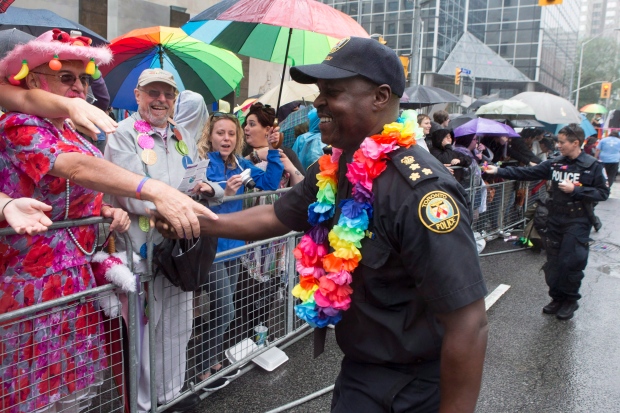
Police Chief Mark Saunders greets the crowd during Toronto’s Pride parade in 2015. (Chris Young/Canadian Press)
But if we accept that the police are being singled out because of the severity of their brutality against Canada’s black and LGBT communities — both past and present — which is a defensible position, then perhaps it would be prudent for BLM to define some sort of tangible criteria delineating how, and when, and by what measure police conduct would be acceptable enough for them to participate in the marches again.
Revoking the ban
At what point will police be distant enough from their past, like the Canadian Forces, innocuous enough in their present, like the education system, and adequately inoffensive in their image, like religious leaders, to once again be able to show their solidarity?
If we accept the notion that individuals have to carry misdeeds of the people before them — and the reputations of the worst among them — then it makes sense to prohibit any uniformed officer from participating in Pride activities.
But if we recognize that people are more than simply facets of the groups to which they belong, we’d know better than to paint them all with the same brush.
The Ryerson Student Union has adopted a new, comprehensive definition of anti-Semitism amid reports that the head of a university program resigned over anti-Semitic tweets.
The RSU’s executive on March 29 passed a motion changing its definition of anti-Semitism to add the Ottawa Protocol on Combating Anti-Semitism, adopted by the federal government in 2012.
The Centre for Israel and Jewish Affairs said it’s not aware of any other university student union in Canada to adopt the Ottawa Protocol as its definition of anti-Semitism.
In part, the new wording defines anti-Semitism as: the denial of Jews’ right to self-determination; applying “double standards” by requiring of Jews “behaviour not expected or demanded of any other democratic nation”; using symbols and images associated with classic anti-Semitism and drawing comparisons between contemporary Israeli policy and the Nazis.
The effort was spearheaded by Students Supporting Israel and Stand With Us Canada, founded in 2013 to support, train, and provide resources to university and college students.
The old definition was “prejudice or discrimination based on stereotypes and assumptions about Jewish people. This can include policies, views, or actions that harm or discriminate against Jewish people individually or on an institutional level.”
The latest version keeps the old wording and adds the wide-ranging Ottawa Protocol.
The older version was passed in November 2014, but the RSU rejected references to Zionism after objections from non-Jewish students, SSI president Rebecca Katzman told The CJN.
She said she started working on the resolution last November, when the RSU failed to pass a motion to mark Holocaust Education Week after Muslim, after pro-Palestinian students staged a walkout that triggered a loss of quorum.
The motion was passed in December, and it was later revealed that RSU president Obaid Ullah had orchestrated the walkout, despite earlier denials.
Since then, the student union and the pro-Israel group have worked together to pass the new definition, Katzman said.
“Now I can confidently say that this motion makes it far more difficult for anti-Semites to perpetuate anti-Semitism at the student government level, and now, we are able to hold them accountable,” she added in a statement.
Allysa Moses, associate director of Hillel at Ryerson University, said she hopes other student governments adopt similar motions to help strengthen the fight against anti-Semitism on campus.
The development came the same week as the Eyeopener, a Ryerson student newspaper, reported that Hirra Farooqi resigned as president of the university’s orphan sponsorship program (OSP) in late February after anti-Semitic tweets she had sent out in 2014 were discovered online.
The tweets, forwarded to The CJN by Jewish students, included the following: “My heart burns with hatred for the scums of Israel”; “Nothing pisses me off more than pro Israel pieces of s–t”; and “f—k Israel.”
Farooqi apologized for the remarks “to ensure that people of all different faiths and backgrounds feel safe and welcomed to be involved in OSP,” the Eyeopener reported.
The messages were sent out “in my teenage years” and were “without a doubt, unacceptable and hurtful to entire communities,” wrote Farooqi. She added that she does not stand by the “hateful rhetoric.”
The CJN could not reach her for comment.
Her remarks were posted at Canary Mission, a site that monitors individuals and groups that promote hatred of Israel, Jews and the United States at North American universities.
Founded by Ryerson’s Muslim Students’ Association, the OSP is “designed to unify, raise awareness and leave a positive impact for a humanitarian cause,” according to the group’s website. The group raises money for orphans worldwide and claims that in an earlier year, it raised more than $70,000.
It partners with SOS Children’s Villages, an international group that bills itself as “the world’s largest charity working with orphaned and abandoned children.”
SOS Children’s Villages Canada said it’s not directly involved in the planning or execution of any third-party fundraising activities, which should be “free of religious prejudice and racial discrimination,” spokesperson Kerline Usher said.
Our most recent study analyzed factors that might affect discriminatory hiring practices: the size of an employer, the skill level of the posted job and the educational level of the applicant.
First, we divided the employers into large (500 or more employees), medium-sized (50 to 499 employees) and small (less than 50 employees). We expected that large employers might treat applicants more fairly because they have greater resources devoted to recruitment and often have a more professionalized recruitment process. They also tend to have more experience with ethno-racial diversity in their workforces.
Asian-named applicants’ relative callback rates were indeed the lowest in small and medium-sized organizations, and somewhat higher in the largest employers. Compared with applicants with Anglo names, the Asian-named applicants with all-Canadian qualifications got 20 percent fewer calls from the largest organizations, but 39 percent fewer from the medium-sized organizations and 37 percent fewer from the smallest organizations. So, the disadvantage of having an Asian name is less for applicants to the large organizations, although it is still evident.
Looking at treatment of Asian-named applicants with some foreign qualifications, we found the largest organizations are generally the most likely to call these applicants for interviews. Large employers called these applicants 35 percent less often than Anglo-Canadian applicants with Canadian education and experience; medium-sized employers called 60 percent less often, and the smaller employers called 66 percent less often.
We were also interested in whether the skill level of the job affected discriminatory hiring practices and, in particular, whether Asian-named applicants faced greater barriers in higher-skill jobs, which are likely to be better paid. We found that the extent of discrimination against Asian-named applicants with all-Canadian qualifications is virtually the same for both high-skill jobs and lower-skill jobs. For the high-skill jobs, these applicants were 33 percent less likely to get a call; for the low-skill jobs, 31 percent less likely.
Skill level matters much more when Asian-named applicants have some foreign qualifications. Overall, these applicants had about a 53 percent lower chance of receiving a callback than comparable Anglo-Canadian applicants. But their rate of receiving calls is significantly lower at higher skill levels: they receive 59 percent fewer callbacks for high-skill jobs, 46 percent fewer for low-skill jobs. Employers may respond less favourably to Asian-named and foreign-qualified applicants for higher-skill positions because in those jobs, more is at stake, and assessing foreign credentials is more difficult than checking local sources. Avoiding the issue by not calling applicants to an interview is apparently viewed as the safer option.
Finally, we asked whether having a higher level of education than Anglo-Canadian-named applicants would lessen the negative effect of having an Asian name. We found that Asian-named applicants with Canadian education including a Canadian master’s degree were 19 percent less likely to be called in for an interview than their Anglo-Canadian counterparts holding only a Bachelor’s degree. For Asian applicants with foreign qualifications and a Canadian master’s degree, the likelihood of a callback was 54 percent lower than the rate for less-educated Anglo-Canadian-named applicants. Acquiring a higher level of education in Canada did not seem to give Asian-named applicants much of an edge.
Overall, we found that employers both large and small discriminate in assessing Asian-named applicants, even when the applicants have Canadian qualifications; and they show even more reluctance to consider Asian-named applicants with foreign qualifications. These biases are particularly evident in hiring for jobs with the highest skill levels. However, there is a substantial difference between larger and smaller organizations. Larger organizations are more receptive to Asian-named applicants than smaller ones, whether or not the applicants have Canadian qualifications.
In order to fully understand the disadvantages that racial minorities experience in the Canadian labour market, it is crucial to go beyond surveys, in which discrimination may be hidden and difficult to identify. Audit studies like ours capture “direct discrimination” by observing actual employer responses to simulated resumés. This form of discrimination is particularly significant since the inability to get an interview may prevent potentially qualified job-seekers from finding appropriate work. Its effect may be compounded in promotions and other stages of the career process and in turn exacerbate ethno-racial income inequality in Canada.
Meanwhile, employers might also be unwittingly disadvantaged, because it can prevent them from finding the best-qualified applicants. Small employers are particularly disadvantaged since they may lack the resources and expertise to fully tap more diverse segments of the workforce.
A number of measures may help to reduce name-based discrimination in the hiring process. First, a relatively low-cost measure would be for employers to introduce anonymized resumés. They could simply mask the names of applicants during the initial screening, and then track whether this results in more diverse hiring. Second, employers should ensure that more than one person is involved in the screening and interview process and that the process of resumé evaluation is open and transparent. Lastly, hiring managers should receive training on implicit bias and how to recognize and mitigate their own biases when recruiting job applicants.
 No real surprise here apart from a remarkable increase in comfort of Sikhs compared to their 2015 survey: