Growing group of Tory leadership hopefuls oppose move to have House of Commons denounce Islamophobia

Funny, I don’t recall any Conservatives expressing concerns about singling out Antisemitism when they were in power and launched a number of initiatives (e.g., hosting an international conference on combatting antisemitism, jointing the International Holocaust Remembrance Alliance) that were sometimes at the expense of general anti-racism and discrimination messaging and programming.

And was there not also a strong political aspect to the Conservative government’s efforts with respect to Canadian Jews? Interim Leader Ambrose should be mindful of stones and glass houses:

A growing number of Conservative leadership rivals are declaring their opposition to a Liberal MP’s motion to have the House of Commons denounce Islamophobia and other forms of systemic racism.

And the interim leader of the party, Rona Ambrose, is also likely to vote against the motion, which will be debated Wednesday, as she accuses the Liberals of purposefully trying to sow division in her party with the initiative.

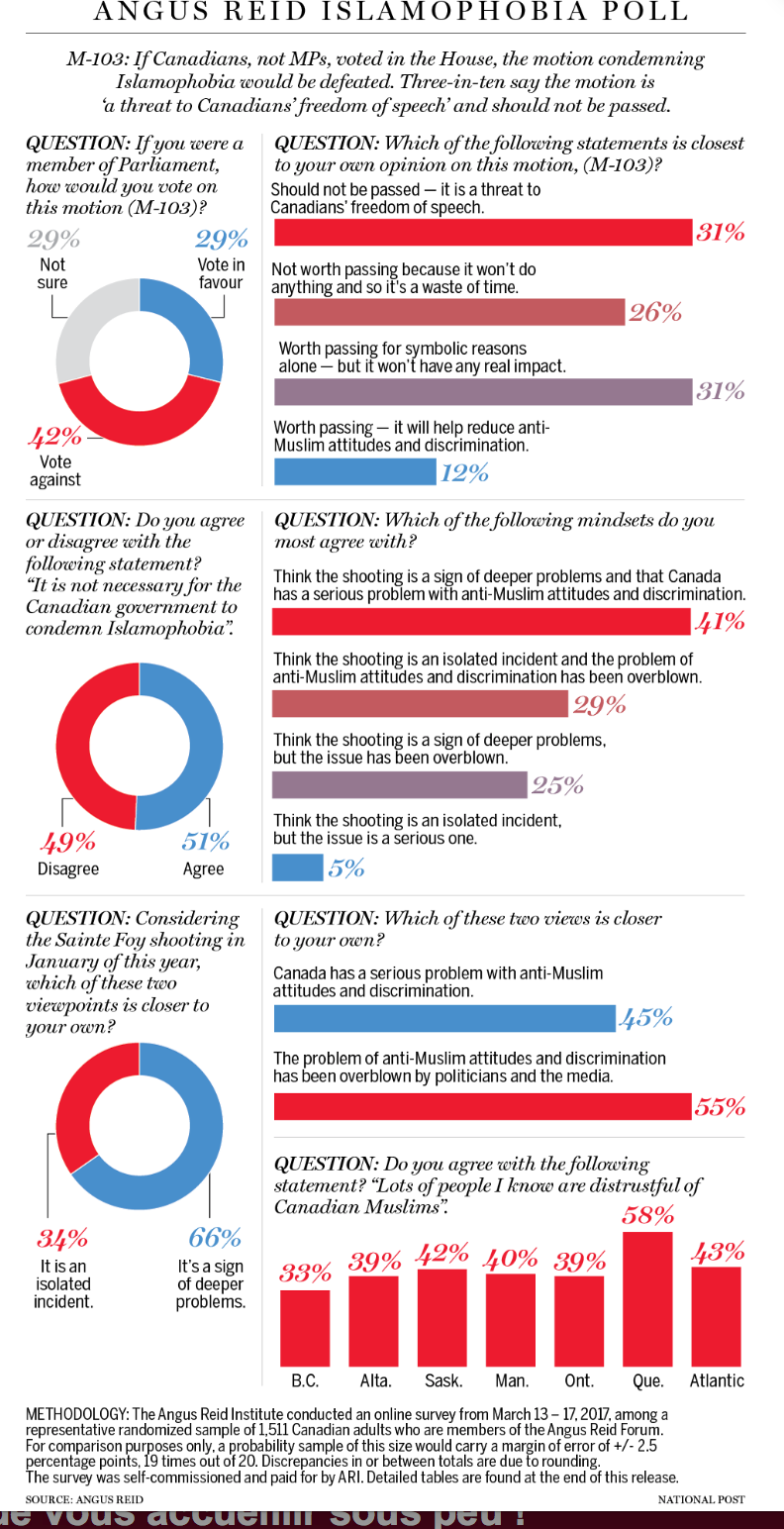
The opposition to the anti-Islamophobia motion by Kellie Leitch, Maxime Bernier, Andrew Scheer and others is likely to play well with a Conservative base that, according to several polls, is more suspicious and wary of Muslim immigrants than other groups of voters.

But as more Tories oppose the motion, their political opponents will have more of a chance to charge that Conservatives are intolerant at best and bigoted at worse, a resurrection of criticisms that hurt them at the ballot box in 2015 after the party unveiled a promise to institute a “Barbaric Practices Snitch Line” and vowed to repeal citizenship for new Canadians in some circumstances.

“Voting against this motion is simply nonsensical,” said Karl Belanger, who spent 19 years as a top adviser to three leaders of the federal NDP. “‎No matter what the convoluted explanation is, you are voting against condemning Islamophobia and all forms of systemic racism and religious discrimination. That will stick.”

The resolution at hand is known as M-103. It was put before the House of Commons in early December by Iqra Khalid, a first-time Liberal MP who represents Mississauga—Erin Mills, Ont.

The motion is scheduled for an hour’s worth of debate in the House of Commons late Wednesday afternoon. And while there is a chance a vote could be held during that hour, the more likely outcome from a procedural standpoint is that a vote will be put off until early April.

Ambrose said she believes the Liberals will want to keep the issue front-and-centre for weeks before bringing it to a final vote.

“We know they are doing this purely for politics,” she said.

Khalid, who was born in Pakistan, wants to accomplish three things with M-103: First, that the House “condemn Islamophobia and all forms of systemic racism and religious discrimination;” second, that the House of Commons Standing Committee on Canadian Heritage be instructed to study the issue of “eliminating systemic racism and religious discrimination including Islamophobia;” and, finally; that the federal government collect data on hate crimes for further study.

Scheer, in a recent fundraising letter to his supporters, said one of the reasons he will vote against Khalid’s motion is that it could be construed as a move to stifle free speech. He also says the motion does not define “Islamophobia” and, in any event, he says he cannot vote for a motion that singles out one religion for special status.

“It is also important to note that we already have laws that protect Canadians against discrimination based on their faith. We also have laws against inciting violence,” Scheer said.

Bernier cites similar reasons for his opposition to M-103 but, in a Facebook post over the weekend, said he could support the motion if the word “Islamophobia” was removed from motion.

“We should reaffirm everyone’s right to believe in and criticize whatever belief they want, whether it is Islam, Christianity, Judaism, Hinduism, atheism, or any other,” Bernier said.

MP Brad Trost, who is also running for the leadership, said Jews and Christians are more likely to be victims of faith-based intolerance. He called Khalid’s motion “a farce.”

Steven Blaney, too, will vote against the motion: “While I recognize the value of promoting respect for all religion, I intend to oppose M-103, a motion that is not well defined and clearly represents a threat to freedom of expression.”

For his part, Erin O’Toole, another leadership candidate, has reached out to Khalid with some suggestions to modify the amendment so that it might find more support among Conservative MPs.

Khalid was not available for an interview Monday but, when she tabled her motion last December, she told the House of Commons, ” I am a young, brown, Muslim, Canadian woman. When I moved to Canada in the 1990s — a young girl trying to make this nation my home — some kids in school would yell as they pushed me, ‘Go home, you Muslim,’ but I was home. I am among thousands of Muslims who have been victimized because of hate and fear.

“I am a proud Canadian among hundreds and thousands of others who will not tolerate hate based on religion or skin colour. I rise today with my fellow Canadians to reject and condemn Islamophobia.”

Her motion, if it passes, would not change any Canadian laws, as Bernier correctly noted in his Facebook post. Moreover, House of Commons standing committees are often asked to study a particular issue and make recommendations to the government on a course of action.

Governments sometimes act on committee recommendations, but they just as often ignore them.

But Ambrose, in an interview with the National Post Monday evening, said she worries her work trying to empower women and girls in Muslim communities could be branded Islamophobic if she criticizes the views of some Muslim men.

“Our members are really concerned about this as a freedom of speech issue,” Ambrose said. For Conservatives, it will be a “free vote,” which means they may vote as they choose. Ambrose said she is open to amendments that deal with her concerns about speech.

“We absolutely condemn all forms of hatred, racism and violence,” Ambrose said.

Source: Growing group of Tory leadership hopefuls oppose move to have House of Commons denounce Islamophobia | National Post

And David Akin’s latest update and interview with Iqra Khalid, the MP sponsoring the motion:

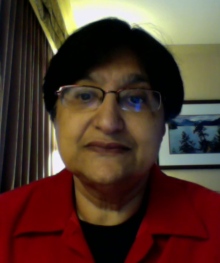
Liberal MP Iqra Khalid said she is keen to allay the “fear and anxiety” some Canadians have about her attempt to have the House of Commons denounce Islamophobia, systemic racism and intolerance.

In an exclusive interview Tuesday with the National Post, Khalid, a Pakistan-born first-time MP from Mississauga, Ont., said she is not willing to alter her  motion, which has been given the parliamentary designation M-103, even though some Conservative MPs have suggested she do so and even though she says she has been subjected to “a lot of hatred” and abuse since she first proposed the motion last December.

“Watering down the motion will not be in the best interests of Canadians who are working to fight this (intolerance),” Khalid said.

Debate on M-103 is expected to begin at about 5:30 pm ET Wednesday in the House of Commons and run for about an hour. And while it is procedurally possible that a vote could also happen Wednesday, it is much more likely that the vote will be put off until early April.

Khalid will find significant support from her own caucus colleagues and from the NDP but not as much from the Conservative benches. Rona Ambrose, the interim Conservative party leader, in an interview with the National Post Monday, said she is opposed to Khalid’s motion and several of the contenders to become permanent leader also oppose it.

Liberal MP keen to allay ‘fear and anxiety’ on anti-Islamophobia motion but will not change it in face of ‘hatred’

Supporters rally behind McGill student rep who called for Zionists to be punched

McGill’s SSMU really needs to crack down on this kind of hate speech and encouragement of violence, and those who tolerate and accept it should be ashamed:

In this age of trigger warnings and micro-aggressions, a university campus is not where you would expect people to rally behind someone who called for physical violence.

But after McGill University student politician Igor Sadikov last week used Twitter to encourage people to “punch a Zionist,” supporters have defended him while targeting Jewish students who support Israel.

On Monday, the board of directors of the Students’ Society of McGill University (SSMU), on which Sadikov represents Arts students, rejected by a vote of 5-4 a motion calling for his removal from the board.

Students attending an SSMU legislative council meeting last Thursday reported that elected representatives declined to denounce Sadikov but stood by as a Jewish member of the council was singled out for her support of Zionism.

Twitter

Twitter

Jasmine Segal, who represents social work students on the council, said she came under attack for qualifying Sadikov’s tweet as hateful.

“Instead of dealing with this important and distasteful issue, supporters from the gallery for (Sadikov) turned the meeting to attack me and request that I be removed as a representative of SSMU due to my faith,” Segal wrote in a Facebook post on Saturday.

“I was left isolated and alone to respond. My fellow representatives sat in silence and permitted this malicious, prejudicial, and unjustified attack to continue.”

The McGill Daily, a student newspaper that has a policy of not publishing Zionist viewpoints, reported that a pro-Palestinian activist complained at the meeting about the presence of Zionists on council.

“Since SSMU has a social justice mandate, why does it allow Zionist councillors on council, when Zionist ideology is inherently (linked to) ethnically cleansing Palestinians?” the activist asked. Instead of addressing Sadikov’s tweet, the question period became a “heated debate over how exactly to define Zionism, and over who had experienced violence,” the newspaper reported.

Molly Harris, a third-year Arts student who attended the meeting, said she felt targeted as a Jew and a Zionist.

“This tweet and the discourse that followed on Thursday have unleashed a wave of condemnation of Zionists and Jews at McGill and have normalized inciting violence against students who identify as such,” she said by email. “If anything, I feel more unsafe and more singled out now than I did last week because of the campus groups who have used Sadikov’s tweet as an opportunity to express their anti-Zionist, and often anti-Semitic views.”

She criticized the SSMU for failing to act promptly against Sadikov. In a statement on Saturday, the SSMU executive said it condemns violence and apologized “if the abilities of any councillor were questioned on the basis of their personal identity” during Thursday’s council meeting.

“The SSMU recognizes that this is an emotional and contentious issue revolving around differing interpretations of historical and cultural contexts,” it said.

McGill’s administration said last week that its disciplinary procedures are confidential but it is “taking action as required” with respect to Sadikov’s tweet. In a statement Monday addressed to “the McGill community” and sent to alumni, Suzanne Fortier, the principal, said she was “shocked” by the offensive tweet. She said McGill “condemns all expressions of hatred and attempts to incite violence,” but she said the administration does not have the power to intervene in the internal affairs of the SSMU.

Sadikov did not respond to messages seeking comment. On Friday, he wrote on Facebook that he had recently been reminded of tweets he wrote between 2009 and 2012, before he entered university. They contained “violent slurs and discriminatory remarks targeting racialized people, women, queer people, people with disabilities, and people with mental illness,” he wrote. He said he no longer holds those biases and regrets having written the tweets, which have now been deleted along with the rest of his Twitter account.

Source: Supporters rally behind McGill student rep who called for Zionists to be punched | National Post

Étude: la charte des valeurs québécois aurait attisé la discrimination

Not surprising but nice to see this confirmed in a more systematic manner:

Le débat sur la charte des valeurs a-t-il ouvert la porte à plus de racisme ? Depuis l’attentat à la Grande Mosquée de Québec, plusieurs membres de la communauté musulmane accusent le projet du Parti québécois d’avoir alimenté les tensions sociales et engendré des gestes violents à leur endroit. Une très rare étude sur la question, obtenue par La Presse, tend à leur donner raison.

Les jeunes plus sensibles

« La charte a-t-elle généré une solidarité accrue autour d’une identité commune ou a-t-elle sapé l’harmonie sociale ? » Voilà la question à laquelle ont tenté de répondre des chercheurs de l’UQAM et des universités Laval et McGill depuis 2014. Leur étude, qui cible les jeunes, est « très exploratoire », prévient Ghayda Hassan de l’UQAM. « C’est un projet pilote qui n’est pas nécessairement représentatif. » Il s’agit toutefois d’une très rare, sinon de la seule étude scientifique sur le sujet depuis 2014. L’équipe de Mme Hassan a interrogé 441 étudiants de l’UQAM (30,5 % d’hommes, 69,5 % de femmes). Pourquoi l’université ? D’abord parce que « les tensions intercommunautaires ont de graves conséquences pour les jeunes », lit-on. Aussi, « comparativement à la population générale, les étudiants sont plus susceptibles de connaître la charte ».

Discrimination

« Bien que le but de la charte était de placer la laïcité et l’égalité des femmes au coeur du débat public et politique, nos résultats montrent qu’il a eu des conséquences négatives », écrivent les chercheurs. Le tiers des étudiants ont déclaré avoir vécu personnellement ou avoir été témoins d’une forme de discrimination ethnique ou religieuse depuis la charte des valeurs. Un chiffre « plus élevé que prévu », qui a surpris les chercheurs. Les cas de discrimination étaient plus nombreux chez les immigrants, ainsi que chez ceux qui se sont identifiés comme biculturels ou appartenant à des groupes culturels ou religieux minoritaires par rapport aux Québécois « de souche » ou aux personnes s’identifiant comme catholiques. Les participants qui se disaient en faveur de la charte ont rapporté moins de discrimination que ceux qui y étaient opposés.

Perceptions transformées

Bonnes ou mauvaises, les relations intercommunautaires au Québec ? Le débat sur la charte a complètement changé la vision des jeunes sur cette question. Alors qu’ils voyaient majoritairement les relations intercommunautaires comme étant positives avant la charte, leur perception est devenue largement négative après, surtout chez les femmes, les immigrants et ceux qui s’identifient comme des minorités culturelles ou religieuses. C’est plus de la moitié des étudiants qui entrevoyaient un avenir sombre pour les relations entre les communautés. Seulement 20 % croyaient en un avenir positif. « L’étude révèle que la question de l’identité nationale québécoise est très sensible et sous-tend des tensions intercommunautaires importantes », écrivent les chercheurs.

Femmes musulmanes

Les femmes de confession musulmane ont été parmi les plus touchées par la charte, nous explique la chercheuse Ghayda Hassan, notamment parce que le débat sur le projet du PQ a beaucoup tourné autour du port du voile islamique. L’étude démontre que la couverture médiatique, en « dépeignant les symboles religieux comme des menaces au vivre-ensemble », en centrant son discours « autour de la sécularisation préconisée par la charte, a contribué à des manifestations de discrimination et d’ethnicisation dirigées surtout contre des femmes musulmanes immigrées, perçues comme des menaces pour la construction de la nation ».

Encore des séquelles ?

Dans la foulée de l’attentat dans une mosquée de Québec, plusieurs membres de la communauté musulmane ont montré du doigt la charte des valeurs. Visiblement, plus de deux ans après l’abandon du projet, les séquelles se font toujours sentir. Mais ont-elles encore un impact réel dans la société ? « Étant donné que le projet de charte a été abandonné lorsque le gouvernement du Parti québécois a été battu en 2014, les effets négatifs que nous avons observés ont peut-être disparu. Cependant, le débat sous-jacent est encore vivant », écrivent les chercheurs.

Source: Étude: la charte des valeurs aurait attisé la discrimination | Gabrielle Duchaine | National

Why Ontario should steer clear of East Asia’s identity politics

Diaspora politics in action.

While I would disagree that Japan has come to terms with its wartime atrocities (sharp contrast to Germany), Welch’s concern regarding the divisiveness of this proposal is valid (just as the Canadian Vietnamese community was split over Bill S-219 – Backward Bill Passed, but Vietnamese-Canadians Move Forward – New Canadian Media):

In recent years, China has fanned the flames of anti-Japanese sentiment, partly for instrumental reasons (an external enemy enhances national cohesion and regime legitimacy), and partly because many Chinese honestly believe that Japan is nostalgic for its imperial, militarist past, and continues to pose a latent threat to the mainland. It is hardly surprising that they do. Their government keeps telling them so. Chinese citizens are fed a steady diet of anti-Japanese propaganda in the press and in the form of late-night television dramas depicting the heroic struggle of Chinese soldiers against barbaric wartime Japanese invaders. The Nanjing Massacre figures heavily in these anti-Japanese narratives.

In fact, the government of Japan has long ago—and many times—acknowledged and repented of the country’s imperial sins. Only a handful of arch-nationalist cranks refuse to do so, and they speak only for themselves. Today, Japan is among the least militarist countries in the world. Most Japanese today see their own government as the primary source of their wartime suffering. Since 1945, Japan has been a responsible and constructive member of the international community.

One finds ample evidence of lack of empathy in Japan as well, where China’s anti-Japanese propaganda is seen as part of a larger geopolitical project to impose Beijing’s hegemony. With few exceptions, Japanese fail to appreciate the extent to which anti-Japanese sentiment in China can be attributed to a combination of ignorance and regime insecurity. But the Japanese government does not respond by demonizing China. Instead, it calls for greater cooperation and communication on issues of mutual interest, while hedging its bets through more-or-less-standard balance-of-power politics.

These two efforts to single out the Nanjing Massacre for commemoration effectively endorse and encourage Chinese misperceptions of Japan. They ask the people of Ontario and the people of Toronto to inflame and take sides in a dangerous clash of national egos. They work against, not for, stability in East Asia. This is not the Canadian way. Canadians are peacemakers and bridge-builders, not pawns in others’ domestic and geopolitical games.

At the same time, and at least as importantly, these two efforts threaten to undermine harmony here at home. More than 100,000 Ontarians have roots in Japan, and more than 700,000 have roots in China. Nothing good can come from fanning the flames ethnic hatred—except, perhaps, for cynical politicians who care only about the relative number of their constituents in their districts with Chinese or Japanese ancestry.

Finally, these measures are dangerous precedents. By taking sides in one case, Queen’s Park and Toronto City Council would effectively invite others to do the same. Ontario, in general, and Toronto, in particular, have more diverse populations than anywhere else in the world. There are not enough days in the calendar to commemorate every historical atrocity that drives an ethno-nationalist grievance.

Let us hope that our politicians see the wisdom of avoiding this particular minefield before the damage is done. No one could possibly object to commemorating the innocent victims of war; but if we are to do so, let us make the commemoration inclusive, in true Canadian fashion, rather than divisive.

Source: Why Ontario should steer clear of East Asia’s identity politics – The Hill Times – The Hill Times

How the word ‘terrorism’ lost its meaning: Neil Macdonald

More good commentary from Macdonald:

What appears to have qualified those attacks for inclusion on the Trump list was the fact that the attackers, Martin Couture-Rouleau and Michael Zehaf-Bibeau, had converted from their birth religion to Islam.

Similarly, Trump’s list did not include Dylann Roof, the young white supremacist who, in the summer of 2015, pulled out a gun in a black church in Atlanta and began killing. Roof was a practising Christian, a member of an evangelical Lutheran congregation. Reportedly, he sat and argued about scriptural issues with congregants at the Emanuel African Methodist Episcopal Church before murdering nine of them.

Still, like Bissonnette, Roof was not labelled a terrorist by law enforcement authorities, or charged as such. He was certainly not called a “radical Christian terrorist” or “white supremacist terrorist.” Those are phrases the mainstream media rarely find pronounceable.

The FBI even went to far as to say Roof’s killings were “not a political act.”

If that sounds outrageously hypocritical, that’s because it is. (Go ahead and imagine the official reaction had Roof or Bissonnette been Muslims).

Western concept of ‘terrorism’

But it’s perfectly consonant with the Western concept of “terrorism,” which is itself a form of hypocrisy deeply embedded in the American and Canadian psyches.

Terrorism is political invective, nothing more. It’s a great favourite of demagogues, widely accepted by audiences, and is almost always applied exclusively to the other, never to ourselves.

Take the Irish Republican Army. The IRA was an exclusively Roman Catholic organization, and had no problem killing civilians to advance its agenda. The British government characterized the IRA and all its offshoots as terrorists, but did not for decades apply the label to the equally murderous Protestant “loyalist” paramilitaries.

IRA flag Irish Republican Army Gerry Adams

The State Department’s list of designated terrorist groups has never included the IRA. (Paul McErlane/Reuters)

Some Irish Catholics in Canada and the United States, though, tended to regard the IRA’s behaviour as understandable, if not excusable. They preferred not to label it as terrorism, never mind “Christian terrorism,” even though the Troubles were all about a schism in Christianity, something like the violent Sunni/Shia fissure in the Middle East. Almost certainly because of domestic American sentiment, the U.S. State Department’s long list of designated terrorist groups has never named the IRA

Because the terrorist is always the other.

While working for CBC in Israel, I once searched the database of the Jerusalem Post for uses of the word “terror,” “terrorist” and “terrorism.”

There were thousands over the course of several years, all of them relating to Palestinians or other Arabs.

The newspaper had another term for Jewish settlers who targeted and killed Palestinian civilians: “Jewish extremists.”  Most mainstream Israeli journalists have just as hard a time with the phrase “Jewish terrorist” as Western media do with “Christian terrorist.”

Those two words simply seem a contradiction in terms to many Jews, although, to give the Israeli justice system credit for at least some consistency, authorities there have charged Jewish Israelis with terrorism-related offences.

Until the 9/11 attacks, there was at least an attempt in the West to define terrorism: the deliberate targeting of civilians by non-government players to advance a political agenda.

By that definition, of course, Alexandre Bissonnette, if convicted, and Dylann Roof would qualify.

War on Terror

But once America began its “War on Terror,” the word was stretched and adapted to mean anything Washington wanted it to mean, and the U.S. media fell obediently into line.

Any attack on any U.S. soldier anywhere became terror, even attacks by people whose country had been invaded.

Groups such as the Shining Path in Peru, or Kurdish ultranationalist groups, or fringe Irish diehards, or Tamil extremists, are relegated to trivial regional annoyances. The predations of militants or governments America approves of are overlooked or ignored.

Today, the word terrorism is so objectively meaningless that the only sensible definition is: “Violence we disapprove of.”

Source: How the word ‘terrorism’ lost its meaning: Neil Macdonald – CBC News | Opinion

Storm of reaction to news Syrian refugee charged with sex assaults

Good commentary by David Tait of Carleton University on how the media should and should not report on cases like this:

Reports that a man accused of sexual assaults on six Edmonton teenage girls was a Syrian refugee have ignited a firestorm of reaction, from anti-immigration diatribes to criticism about how the media dealt with the story.

Groups that work with refugees in the city have been inundated with calls and texts over the past 24 hours, some from people calling for an end to the refugee program and others from refugees themselves apologizing on behalf of their community.

Erick Ambtman, executive director of the Edmonton Mennonite Centre for Newcomers, said his organization received a message on Twitter from a white supremacist group that included a picture of a Syrian refugee, asking the centre to confirm whether the photo was the same man accused of the crimes.

“It may be just to scare us or to unnerve people,” Ambtman said.

“But around my office that’s what’s happening. People are starting to get really nervous, and the [English] language students are starting to get really nervous.

“And the Syrian students are apologizing for somebody who they don’t even know, because he’s got the same country of origin as they do.

“It’s really spiralling into a really ugly place.”

Soleiman Hajj Soleiman, 39, was arrested Saturday and charged with six counts of sexual assault and six counts of sexual interference after six teenage girls, all younger than 16, told police they were inappropriately touched while swimming at the West Edmonton Mall water park.

…When the media reports stories like this one, decisions about what information is relevant have to be made on a case-by-case basis and sometimes on a day-by-day basis, said David Tait, a professor at Ottawa’s Carleton University who has taught ethics courses at the journalism school.

“Journalists have to sort of go and look at a situation not from the standpoint of, ‘Is there public appetite for this information? Do people want to know it?’ But, ‘Is that detail relevant at this stage to this story?’

“And that’s a very difficult thing to determine as a journalist, because you also have to be careful that you’re not making your judgment for some sort of social engineering purpose.

“To say, ‘Oh I don’t want to make these sorts of people look bad’ or ‘I don’t want to make these sorts of people look good.’ You shouldn’t make your journalistic judgments based on how you want people to think about something, because that’s not the journalistic mission.”

‘Our job is to report what’s going on’

Tait said in this case, while reporting immediately after the arrest was made public, he would have questioned whether details about the accused’s background were relevant.

“My question would be, would we have run additional background details about this person if they were a gay man? A gun owner? If they were Jewish? If they were a fundamentalist Christian? If they were a recent arrival from the United States? If they were any number of other identifiers?”

It’s the responsibility of journalists to try to determine what the public needs to know to understand the story. Once the public has the information, people will make their own choices about what’s relevant to them, he said.

Some will seize on information that confirms their own views about the world and overlook other aspects of the story.

“Our job is to report what’s going on out there in the world,” he said.

The story about the water park allegation, Tait said, “is a classic example of where people these days are rushing to grab details, to use individual facts as weapons instead of looking at those details and saying, ‘How does this fit into my developing understanding of the world?'”

Ambtman said Soleiman came to Canada in January 2016 with his wife and six children, aged one to 13 years. The family was assisted by the Mennonite Centre.

Some commenters are exploiting the fact that a Syrian refugee has been charged with a crime, he said.

“They’re exploiting what’s happened to these girls to say something about immigration, and it’s just a really ugly thing to do. It’s been pretty awful to bear witness to.”

It will be up to the justice system to determine the facts of the case and, if a crime has been committed, punish the person responsible, he said.

“To make this about immigration is just absurd. What has happened is there has been a sexual assault at West Edmonton Mall and six girls are going to be traumatized likely for the rest of their lives because of a crime that somebody perpetrated on them. To me, that’s the concern.

Michelle Rempel demands more from politics—on both the left and right

Impressive and thoughtful speech delivered at a McGill Institute for the Study of Canada event regarding immigration and Canadian exceptionalism:

During the 2015 campaign, I thought all political parties, my party included, acted shamefully on the issue of immigration, because we used the Syrian refugee crisis as a political wedge in a political campaign, and that was wrong. The response to the Syrian refugee crisis became a campaign issue of one-upmanship on numbers, rather than talking about people as human beings. “Who’s going to bring in more?” When the question should have been: “How do we do it in a way that achieves social license in the country in an expeditious way that shows compassion and addresses the situation, and how do we support the integration of people when we come to Canada, such that we build social license for more refugees in the future, and ensure that refugees that come to Canada have a better experience here than where they came from?” That is not a politically sexy conversation, because it’s easier to say, “I’m going to bring in 25,000 and you’re going to bring 15, ergo you’re racist and I’m more awesome.” Not helpful. Also not helpful is to frame the issue of gender isolation in new Canadian women in the term of a tip line.

And what happened out of all that? Where we are today is we had a parliamentary study that looked at the response to the Syrian refugee initiative, and we had Syrian refugees come in front of a parliamentary committee and said: “I’m in a hotel room that’s infected by bed bugs, and my wife can’t go out and learn English because she’s got five kids. How are we going to have any hope to do anything well here?”

It’s not an adequate response to say, “It’s a nation-building project and the provinces are responsible for it,” when I have a school board come to parliamentary committee and say, “We’ve absorbed in our one city the equivalent of a full elementary school of refugees this year, they have needs that we need to address and need to be compassionate to because they’ve been in a war zone for years and their education has been disrupted, and we received no new funding for it. So in a political campaign for any political stripe to say it’s fully costed when there is no plan … not helpful. Not exceptional.

The thought that populist rhetoric can’t happen in Canada is shocking. The reality is that there has been a narrative that has arisen where you have groups of people who feel that their voices aren’t being heard, and it’s easy through 140 characters and short visual soundbites and memes to say it’s someone else’s fault. And in Canada, that’s still here. But the reality is there’s no “them” and “us” anymore. That’s not how the globe operates. We are so interconnected, be it through trade, or simply the reality of understanding our humanity through Twitter, through YouTube. You can see the destruction in Aleppo. To have that narrative be used in political discourse is disgusting and wrong, and oversimplified.

We all have to demand better. Demanding better for someone who’s a centrist like myself has been a very unpopular position. Because it means there’s no real home for me as a politician on some days. But it’s where we all need to be. There’s many other examples of how Canada in public policy has sort of politicized the system—they might not be as firecracker or high-profile as the barbaric cultural practices tip line. It’s things like lifting a visa requirement on a country without a formal review for some unquantified economic benefit. It’s policy around immigration that is politically motivated that is unquantifed and unsubstantiated—and both parties are guilty of this—that diminishes the public confidence that immigration is a good thing, and we are unexceptional in that, especially in Parliament.

Why should we all be listening to these sorts of things with an open mind? It’s because if we don’t do that, I’m really deeply concerned as a legislator about the peace of humanity right now, and that’s not hyperbole. When I see nationalist parties rise and gain seats in European Parliament, we should be very concerned. When I see the level of nationalist rhetoric that is acceptable among people that are pretty educated and smart people, that’s cause for concern. When I see protectionism and the thickening of borders as a populist public policy response in a globalized economy, we should all be concerned.

The way forward is to ensure we have a public policy dialogue that is not alt-right or far-left. It has to be in the middle and we have to focus not on values, but on programming and outcomes that enable what we vision exceptionalism to be. Things like: where is the smart conversation around the burqa? Where’s that safe space? I don’t wear one—women who wear one, where’s their voice on this? And why don’t we talk about the fact there are equally as many other religious groups who use dress as a control for women? So rather than judging them and shaming them, how do we reach out to them, and give them hope? The fact that we can’t even talk about that—I find as a politician, for me as a camera, even saying that is a risk. I’ve done something terribly egregious, by bringing up both sides of that argument. But if we can’t have this argument, how can we ever reduce issues like Islamophobia? The fact that we can’t have a discussion because we’re so polarized is why we need to acknowledge that we’re not exceptional.

You, as the thought leaders on this? It can’t be 140 characters “You’re a racist; you’re a socialist. You’re conservative; you’re Liberal. Your party sucked; your party sucked.” Come on. If we are truly exceptional, we have to show the world we’re better than that. And I’ll be honest with you, after 18 months of banging my head in both my own party and in the House of Commons against the Liberals, you’ve got to help me out too.

Where we are as a country, for us to be having a conference on how exceptional we are and how much better we are than the United States and we’re welcome to refugees is such a disservice to the fact that we’ve got a long way to go.

For all of you, from the bottom of my heart: let’s try to be smarter about this. And let’s demand better from our leaders.

Source: Michelle Rempel demands more from politics—on both the left and right

A week of kindness, then identity politics as usual in Quebec

Good piece by Yves Boisvert – how quickly old patterns reassert themselves:

In the aftermath of the Quebec City mosque killings, one would think the political debate around secularism and identity would be kinder and more reasonable. Quebec Premier Philippe Couillard was widely congratulated for his dignified behaviour, his call for unity, and for refusing to point fingers at political opponents or media who irresponsibly played identity politics over the past few years.

Parti Québécois leader Jean-François Lisée appeared with Mr. Couillard and admitted some wrongs. Yes, he went too far last fall when he said a provincial debate was needed on the wearing of burkas in Quebec, suggesting you could hide an assault rifle under clothing of that sort. He already had admitted in the past that the infamous so-called “Quebec Charter of Values” promoted by his government had “poisoned” the debate on secularism in Quebec.

It would, however, take a full-time job to track the fast-evolving thinking of Mr. Lisée on the matter. After losing power, he repudiated the bill banning religious signs for public servants. Just a few months before, as a minister in the PQ government, Mr. Lisée wrote an op-ed in The New York Times pretending Quebec was having a “Jefferson moment,” in its pursuit of secularism.

But politics, like gravity, adheres to inescapable laws. After a week of political kindness and introspection, Mr. Couillard tried to put the other parties on the defensive, by “reaching out” to them for quick approval of Bill 62, “an Act to foster adherence to State religious neutrality.” The small bill, an 18-section piece of legislation, states that members of public bodies have to exercise their functions “with face uncovered.” This would also apply to citizens seeking public services. An accommodation can be made except for identification or security matters.

The bill also offers a vague framework for religious accommodations, be it for employees or school children. It should respect gender equality and other basic principles.

The bill does not go far enough for the main opposition parties, who pretend the legislation should settle once and for all every case of religious accommodation that comes up in the future. The perception that Quebec is under pressure for an incredible number of demands from religious minorities (read: Muslims) is persistent. But, a Commission of inquiry by two prominent intellectuals, Gérard Bouchard and Charles Taylor, concluded in 2008 that no such crisis exists. But the PQ, since its identity shift, has worked hard to cultivate the myth.

Not as hard, though, as François Legault, the nationalist-but-not-sovereigntist leader of the Coalition Avenir Québec. If we are to believe Mr. Legault, religious compromise risks diluting Quebec’s identity, which is why Mr. Legault last summer was so concerned about the province’s so-called burkini problem.

Still, Mr. Legault offered to drop his demand that a ban on religious signs for teachers be included in the bill. He asks, as the PQ, that the Bouchard-Taylor recommendations be included, namely a ban on religious signs for officers of the law – judges, police officers, prison guards, prosecutors.

“Let’s legislate on what we agree on,” Mr. Couillard said, not willing to strip any theoretical (for now) law officer of their rights to please the opposition.

Meanwhile, left-wing Québec solidaire accuses the Premier of “systemic racism” because only 2 per cent of job appointments by the Executive Council are visible minorities.

And, the shock-media commentators are back on track, playing down the very idea that Islamophobia exists in Quebec.

The worst case of hate crime against Muslims in the country’s history has yet to inspire a more profound and painful conversation.

Source: A week of kindness, then identity politics as usual in Quebec – The Globe and Mail

Liberal MP’s anti-Islamophobia motion set for debate next week

Hate Crimes Comparison.004

Statistics Canada Annual Police Reported Hate Crimes

Canada already has hate speech laws (unlike south of the border) and tracks police reported hate crimes (although StatsCan stopped writing its analysis of the data).

While I favour tracking, analyzing and messaging that covers all forms of racism, prejudice and discrimination, community specific messaging can be part of raising awareness, addressing concerns and reassuring communities. The previous government paid particular attention to antisemitism given the concerns of Canadian Jews.

My reading of the motion is that it has an appropriate focus on data collection and analysis, places Islamophobia within the broader context of racism and discrimination. with the resulting policy recommendations to be developed within that context by Canadian Heritage:

Members of Parliament will debate a motion to condemn Islamophobia and track incidents of hate crime against Muslims in the House of Commons next week.

Motion 103 was tabled by Mississauga, Ont., Liberal backbencher Iqra Khalid last fall, but will be discussed in the  aftermath of last month’s mass shooting at a Quebec City mosque. It calls on government to “condemn Islamophobia and all forms of systemic racism and religious discrimination.”

The text of the motion also asks the government to:

  • Recognize the need to quell the increasing public climate of hate and fear.
  • Request the heritage committee study how the government could develop a government-wide approach to reducing or eliminating systemic racism and religious discrimination, including Islamophobia.
  • Collect data to contextualize hate crime reports and to conduct needs assessments for impacted communities and present findings within 240 calendar days.

The motion, scheduled for one hour of debate on Wednesday, has generated a backlash online, with petitions garnering thousands of signatures opposing the motion.

Some critics have mischaracterized M-103 as a “bill” or a “law” rather than an non-binding motion.

Some have warned that Canada is moving towards criminalizing Islamophobia or even to the implementation of Islamic law, called Shariah, in Canada.

Khalid declined requests for an interview from CBC News.

When she tabled the motion on Dec. 5, 2016, she described her experience as a “young, brown, Muslim, Canadian woman.”

“When I moved to Canada in the 1990s, a young girl trying to make this nation my home, some kids in school would yell as they pushed me, ‘Go home, you Muslim’ — but I was home. I am among thousands of Muslims who have been victimized because of hate and fear,” she said.

“I am a proud Canadian among hundreds and thousands of others who will not tolerate hate based on religion or skin colour. I rise today with my fellow Canadians to reject and condemn Islamophobia.”

E-petition condemning Islamophobia

On the same day Khalid tabled her motion, an e-petition with nearly 70,000 signatures was tabled that called on the House of Commons to join the signatories in recognizing that “extremist individuals do not represent the religion of Islam, and in condemning all forms of Islamophobia.”

Barbara Kay, a columnist for the National Post and contributor to The Rebel Media, worries about the potential impact on freedom of expression and special protections for a single religious group.

“There are a lot of countries in Europe where criticism of Islam, even if not entrenched in law as a hate crime, are being interpreted by police and law enforcement, social workers — the whole spectrum of the state apparatus. They have been internalized by those within the public service as wrong, and if not criminal then absolutely morally wrong, and therefore Muslims are a group that must be protected from this very offensive speech,” she said in an interview with CBC.

Kay said anti-hate speech laws have traditionally targeted human beings, not ideas. She questioned the need to single out Islamophobia, and argued there are more hate crimes against Jews than Muslims in Canada.

Hate crimes in Canada

According to Statistics Canada, in 2013 there were 326 police-reported hate crimes motivated by hatred of a religion or religious group, about 28 per cent of all hate crimes.

Those targeting Jewish populations were the most frequently reported, accounting for 56 per cent of religious hate crimes in 2013, according to the most recent data available. There were 181 hate-motivated crimes targeting the Jewish religion reported by police in 2013, compared to 65 crimes motivated by hatred against the Muslim religion.

In her report and a video for The Rebel website, Kay said blasphemy laws conceived according to Shariah law could creep into Canada.

She said that could have a chilling effect on free speech and ultimately mean some of her columns could be deemed Islamophobic and subject to penalties.

“I’m worried. All Canadians should be worried,” she wrote.

Push for broader discussion

B.C. Conservative MP Dianne Watts said she supports the motion but wants a broader discussion about how to end any act of hate or discrimination based on race or religion.

“We just look at what happened at the mosque in Quebec and it’s such a horrible thing to have happen in Canada because that’s not who we are, that’s not what we’re about and we have to do everything we possibly can as legislators and as a community to make sure it doesn’t happen again,” she said.

Source: Liberal MP’s anti-Islamophobia motion set for debate next week – Politics – CBC News

Motion text: Motion M-103

Shouldn’t Israel Care About Anti-Semitism? – The New York Times

This piece by Shmuel Rosner worth noting post-Trump International Holocaust Remembrance Day deliberately not mentioning Jewish victims:

Occasionally, there is even a temptation for Israel to benefit from anti-Semitism. In recent years, rather than focus on the need to fight anti-Semitism in France, Israel called on French Jews to come live in Israel.

Of course, when Israel encounters a clear-cut case of Holocaust denial, or of persecution of Jews, it does not shy away from making its voice heard. Two years ago, the Israeli foreign minister warned European far-right parties that they must shun neo-Nazis and described Hungary’s Jobbik and Greece’s Golden Dawn as “illegitimate.”

But most of the time, Israel attempts to delicately balance its wish to delegitimize anti-Semitism and its need to maintain foreign relations that advance its causes. Sometimes this means using attacks on Jews to attract Jewish immigration to Israel. Sometimes this means turning a blind eye to anti-Semitism in exchange for political support. Sometimes this means ignoring the trivialization of Jewish deaths in the Holocaust.

This is as unavoidable as it is troubling, even painful. Israel is a state with interests and priorities among which censuring anti-Semitism is one, but not the only one.

David Ben-Gurion, Israel’s founding father, understood this when he agreed to accept reparations from Germany, less than a decade after the Holocaust. Mr. Ben-Gurion’s opponents had a strong moral case against accepting money from the country that had just orchestrated the murder of millions of Jews, but the prime minister thought that his duty as the man in charge of building and defending a new state trumped such considerations. Then, as now, Israel sometimes agreed to help other countries and parties whitewash their images. It’s often a trade: We, Israel, will get what we need in the form of money or arms or political support. You will get the right to showcase Israel as proof that you aren’t an anti-Semite.

This could become much more uncomfortable when the country in question is the United States and when the person accused of tolerating anti-Semitism is the American president. Israel depends on the United States more than it does on any other country for aid, security and diplomatic support. And the American Jewish community is the other main pillar of world Jewry, alongside Israel. More than 80 percent of Jews live and thrive either in Israel or in the United States. This makes the United States the place in which official anti-Semitism cannot be overlooked — and the place where it must be overlooked.

That could result in an irreparable split between Jews. The statement on International Holocaust Remembrance Day — provoking Jewish outcry in the United States, while provoking nothing from Israel — just proved it.