Over the top commentary but elements of truth and unfair to conflate recent politicians with those living in a different time and context, with many similarities in various countries:
Last Friday, an 82-year-old woman wrapped up warm and set off on a 200-mile round trip for a meeting that she half suspected wouldn’t even let her in. As you read this, the film of her speaking that evening has been viewed more than five million times. Which is odd, because it’s not much to look at: a wobbly side-view of a woman with white hair, intense closeups of grey cardigan. Bridgerton this is not.
But it’s the words that count. Joan Salter has got herself down to Hampshire for a public meeting with the home secretary, and now it is her turn to ask a question. As a child survivor of the Holocaust, she hears Suella Braverman demean and dehumanise refugees and it is a reminder of how the Nazis justified murdering Jews like her. So why do it?
Even as the words come out, Braverman’s face freezes. The evening so far has been a Tory activists’ love-in, which, Salter tells me later, made her nervous about being the sole dissenter. But then the home secretary responds, “I won’t apologise for the language I’ve used” – and a disturbing truth is exposed about what Britain has become.
Braverman labels those seeking sanctuary in Britain an “invasion”. Quite the word, invasion. It strips people of their humanity and pretends they are instead a hostile army, sent to maraud our borders. Her junior minister Robert Jenrick once begged colleagues not to “demonise” migrants; now he stars in videos almost licking his jowls over “the Albanians” forced on to a flight to Tirana. Salter is right to say such attitudes from the top fuel and license extremists on the ground. We saw it after the toxic Brexit campaign, when Polish-origin schoolchildren in Huntingdon were called “vermin” on cards left outside their school gates, as race and religious hate crimes soared that summer.
Today, the air is once again poisonous. Far-right groups have been visiting accommodation for asylum seekers, trying to terrify those inside – many of whom have fled terror to come here – often before sharing their videos on social media. The anti-fascist campaigners Hope Not Hate recorded 182 such jaunts last year alone, culminating in a petrol bomb tossed at an asylum centre in Dover by a man with links to far-right groups and who would post about how “all Muslims are guilty of grooming … they only rape non-Muslims”.
Unlike those big men in their big boots frightening innocent people, Salter isn’t chasing social media clout. The grandmother wants to warn us not to return to the times that sent her, at the age of three, running with her parents across Europe in search of sanctuary. She does make a mistake in yoking the home secretary to the term “swarms”. As far as I can see, this figurehead for the new Tory extremism has yet to use that vile word. But I can think of a Tory prime minister who has used that word: David Cameron, the Old Etonian never shy of blowing on a dog whistle, who made a speech denouncing multiculturalism even as Tommy Robinson’s troops marched on Luton. And Margaret Thatcher talked of how the British felt “rather swamped” by immigrants. In those venerable names from the party’s past lies the big picture about the Conservatives’ chronic addiction to racist politics.
Because racism is not what polite people do – and yet Tories keep on doing it, commentators will often put it behind some behavioural cordon. It’s a few rotten apples, you’ll be told, after some councillor dons a blackshirt or moans about the new Doctor Who. Or: they need to fend off the effect of Nigel Farage. Or even, as one Times commentator wrote in 2019, Boris Johnson says it but he “barely believes a word” of it. Such clairvoyance! But that’s the thing about power: other people trot behind with a dustpan and brush to sweep up the mess you keep making.
Yet there was no Ukip when Benjamin Disraeli declared that the Irish “hate our order, our civilisation, our enterprising industry, our pure religion. This wild, reckless, indolent, uncertain and superstitious race have no sympathy with the English character.” It was no rotten apple but Winston Churchill, the Tory idol, who as prime minister pronounced: “I hate Indians. They are a beastly people with a beastly religion. The famine was their own fault for breeding like rabbits.” The Bengal famine of 1943 is widely estimated to have killed about 2 million people.
I draw these quotes from a new book, Racism and the Tory Party, by the sociologist Mike Cole. Far from being a mere slip of the tongue, racism, he argues, “has saturated the party from the beginning of the 19th century to the second decade of the 21st”. From Enoch Powell’s “rivers of blood” to Theresa May’s hostile environment, it courses through Tory history. And it is not just words. In its online safety bill, the government wants this week to make illegal any online video of people in small boats that shows such Channel crossing in a “positive light”. Braverman still grinds on with her plan to deport asylum seekers to Rwanda, to stay in hostels with 12 toilets and five showers for 100 inmates.
For the Tories, racism is a fire that they just love to play with. The heat it throws off can be electorally useful. But it is always someone else who gets burned. The targets change – two centuries ago it was the Irish, today it is Albanians – but the strategy is always the same: pick the group, render them inhuman, then chuck them out. The mystery is why a party with such a long and inglorious history can still be lauded by the press for sprinkling a few non-white people along its frontbench.
The woman who is today Joan Salter was in 1943 a three-year-old girl called Fanny Zimetbaum. As Polish-origin Jews, her family were not granted sanctuary in Britain from the Nazis marching into their home of France. Instead, her parents had to scramble through Europe, while Joan was shipped across the Atlantic to an orphanage in America. Only years later, through much wrangling, were the family reunited in London. By then, she remembers her parents as “thoroughly broken”.
When she was in her 70s and studying for a master’s, Salter went through the archives. She read a parliamentary debate from 1943, concerning 2,000 Jewish children in France refused British visas and who were then deported to Hitler’s Germany. She read foreign secretary Anthony Eden claiming “no knowledge” of the matter. Then she read the minutes and memos that proved he was lying: he was in the war cabinet meeting where the issue was discussed. Still the children were abandoned, just as her family were left to their fate.
From her own life, this remarkable woman knows that fascism is not just a one-off and racism never a mere faux pas. They are forces of evil that lurk on the political perimeter and threaten to consume our society wholesale. Joan Salter bears a warning. The rest of us should listen.
Self-identification and identity. Recently, most of the cases have been with respect to Indigenous identity, As ancestries become mixed over time, challenges for self-identification, and for organizations, will continue to increase:
Les mesures de « discrimination positive » imposées aux universités pour leur recrutement de professeurs-chercheurs soulèvent bien des questions en lien avec la justice, le caractère égalitaire, la transparence des processus d’embauche, sans compter le rôle de l’excellence dans le choix des meilleurs candidats. Ces enjeux, fondamentaux dans une démocratie, ont été mentionnés et analysés par de nombreux commentateurs. Il en est un, en revanche, qui n’a pas encore faire l’objet de toute l’attention qu’il mérite : celui qui entoure le principe de l’auto-identification.
On demande en effet aux postulants, dans le cadre de ces mesures d’action positive, de s’auto-identifier comme étant des Autochtones, des personnes en situation de handicap, des femmes, ou encore comme appartenant à l’une ou l’autre des minorités racisées ou de genre.
Or, au fur et à mesure que les demandes d’auto-identification du genre vont se multiplier (et on peut être certain qu’elles se multiplieront), tout en devenant de plus en plus impératives pour l’obtention d’une chaire du Canada, puis d’un poste à l’université, dans les institutions culturelles, dans les diverses administrations, etc., elles vont immanquablement donner lieu à de fausses déclarations.
On a déjà vu, ces dernières années, au Canada, au moins trois femmes se faire passer pour autochtones, alors que, semble-t-il, elles ne l’étaient pas : la cinéaste Michelle Latimer, en 2020 ; la prétendue « gardienne du savoir » Suzy Kies, également coprésidente de la Commission des peuples autochtones du Parti libéral du Canada et, accessoirement, instigatrice d’autodafés en Ontario ; et, plus récemment, la chercheuse Carrie Bourassa, de l’Université de la Saskatchewan, qui était aussi directrice scientifique de l’Institut de santé des Autochtones.
« Autoautochtonisation »
Et on peut être absolument certain qu’il y en aura d’autres, tout comme on verra monter en flèche le nombre de candidats à des postes ici ou là qui feront valoir leur appartenance à une minorité racisée ou de genre, puisque ces auto-identifications deviendront des sésames recherchés.
Si l’on en doute, il suffit pour s’en convaincre de considérer qu’un mot a déjà été inventé pour définir le premier phénomène : « l’autoautochtonisation ». Selon la Loi sur l’équité en matière d’emploi, il suffit d’avoir un parent issu d’une « minorité visible » pour être réputé appartenir à une « minorité visible », ce qui ouvre la porte à des recherches généalogiques intéressées. Tandis que le fait de se déclarer non binaire ou bisexuel, par exemple, n’engage à rien de très précis en termes de comportement ou de relations amoureuses.
À leur tour, ces auto-identifications frauduleuses obligeront évidemment les institutions concernées à se livrer à des vérifications de plus en plus poussées. Mais comment ? D’ores et déjà, à la suite de ce qu’il est convenu d’appeler « l’affaire Carrie Bourassa », l’Université de la Saskatchewan a modifié ses règles d’embauche. L’auto-identification ne suffit plus, il faut désormais prouver son identité, ce qui ne manque pas d’engendrer d’autres imbroglios.
Ainsi, cette université a rejeté il y a quelque temps la candidature de Réal Carrière, un professeur d’études autochtones qui avait été sélectionné par un jury unanime et lui-même composé de professeurs autochtones, car il ne pouvait pas fournir de preuves écrites de son identité supposée.
Faudra-t-il alors remettre à l’honneur ces « statuts de pureté du sang » qui avaient cours autrefois dans l’empire espagnol et exiger de chaque candidat qu’il prouve, arbre généalogique en main, la fiabilité de son identité à travers l’exposé public de ses origines ? Faudra-t-il également que l’État remette son nez dans les chambres à coucher de ces mêmes candidats pour s’assurer qu’ils appartiennent bien à une minorité sexuelle ou de genre ?
Ce genre d’immixtion dans la vie privée risque de devenir inévitable dans la vérification de ces identités revendiquées. D’autant plus que les litiges qui ne manqueront pas de surgir à ce sujet aboutiront inéluctablement devant les tribunaux, qui auront donc la charge délicate de trancher ces questions identitaires, de décréter qui est vraiment autochtone, réellement racisé, authentiquement non binaire, etc. Bonne chance !
Pour régler cette question de façon définitive, on pourrait aussi faire en sorte, comme on le fait sous d’autres cieux pour l’appartenance religieuse, que cette identité se voie inscrite dans les documents officiels et les pages intérieures de nos passeports. Nul besoin alors de continuer à s’auto-identifier. Le problème serait enfin résolu. Mais à quel prix ? Et serait-ce vraiment un progrès ?
L’auteur est professeur de littérature à Montréal, rédacteur en chef de la revue Argument et essayiste. Il a notamment publié Ces mots qui pensent à notre place (Liber, 2017) et La prose d’Alain Grandbois. Ou lire et relire Les voyages de Marco Polo (Nota bene, 2019).
Selon le chroniqueur, ma vidéo nous apprend que « ce n’est qu’en Occident qu’on “retrouve une discrimination parfaitement assumée” ». Voici l’extrait complet : « Naturellement, le racisme n’est pas exclusif aux Blancs ou encore au monde occidental, mais c’est seulement en Occident qu’on va retrouver le paradoxe de sociétés supposément égalitaires et où on retrouve également une discrimination parfaitement assumée. »
Cet extrait, qu’on entend dans la première minute de la vidéo, infirme les intentions que me prête le chroniqueur, qui m’accuse de véhiculer une « fausseté historique ». Je n’ai jamais prétendu que le racisme était exclusif à l’Occident. J’affirme même le contraire dans cette phrase qui n’est citée qu’à moitié. Par contre, il est vrai que ce n’est qu’en Occident qu’on maintenait l’institution de l’esclavage tout en prétendant que « tous les hommes naissent libres et égaux ». Les pays africains ou arabes où se pratiquait l’esclavage ne prétendaient pas partager ces idéaux universels.
Le chroniqueur poursuit : « D’ailleurs, “il faut attendre que les Européens découvrent l’Afrique noire pour qu’on puisse commencer à parler de racisme comme on l’entend aujourd’hui”. » Voilà une autre phrase citée hors contexte et vidée de son sens. Cet extrait de la vidéo explique qu’avant la Renaissance, la discrimination oppose des Blancs à d’autres Blancs — les Slaves réduits en esclavage par l’empire germanique, par exemple. Ce n’est qu’avec l’exploration de l’Afrique subsaharienne et le début du commerce des esclaves qui s’ensuit que commence l’association entre peau noire et servilité. L’objectif de la vidéo est d’expliquer comment le racisme en Occident a évolué au fil des siècles et non pas de pointer les Blancs du doigt.
Selon M. Lisée, « les jeunes sortant de ce visionnement seraient choqués d’apprendre que l’esclavage a été présent sur tous les continents, que les Africains le pratiquaient entre eux avant l’arrivée des Blancs, que les Autochtones d’Amérique le pratiquaient entre eux avant l’arrivée des colons européens ». Les jeunes seraient choqués d’apprendre cela uniquement si les enseignants d’éthique et culture religieuse se contentaient de laisser cette vidéo donner le cours pour eux. Pour avoir participé à la formation de plusieurs cohortes de futurs enseignants, j’ose croire que ce n’est pas le cas.
Dernier reproche que m’adresse le chroniqueur : « Pas un mot non plus sur le fait que les Québécois francophones furent victimes de racisme, ou du moins de discrimination linguistique. » La vidéo vise un large public et ne s’adresse pas spécialement aux élèves québécois. Mon objectif était de résumer en 20 minutes l’histoire du racisme en Occident. J’ai donc dû faire des choix. Pourquoi parler des Québécois plutôt que des Bretons, des Catalans ou de n’importe quelle autre minorité linguistique ? Lorsqu’on parle du racisme au XXe siècle en Occident, il me semble plus parlant de décrire l’antisémitisme allemand, la ségrégation américaine et l’apartheid sud-africain.
La critique de M. Lisée repose sur les intentions qu’il nous prête, à moi et à l’enseignante citée dans sa chronique : culpabiliser les Blancs en général et les Québécois en particulier. C’est un réflexe hélas répandu chez certains nationalistes, qui se placent sur la défensive dès qu’on leur parle de racisme. Si on n’affirme pas en caractères gras qu’il s’est fait pire ailleurs, que le racisme existe aussi au Canada anglais, que Montréal n’est pas Detroit et que la Nouvelle-France n’était pas la Nouvelle-Espagne, on nous reproche de faire le procès du Québec. Et une vidéo éducative se fait accuser d’être de la propagande alors qu’elle cherche seulement à expliquer et à faire réfléchir.
Jean-François Lisée a bien raison d’estimer que ma vidéo ne suffit pas à faire comprendre « la réalité du racisme et de l’antiracisme au Québec ». Je ne prétends pas le contraire, puisque tel n’a jamais été mon objectif. Je regrette toutefois de voir mon travail être considéré comme faisant partie de « la bouillie mensongère et culpabilisatrice » dénoncée par le chroniqueur.
Réplique du chroniqueur
Cher Alexandre Dumas,
D’abord, encore bravo pour vos récents ouvrages sur l’époque duplessiste. Je ne vous tiens évidemment pas pour responsable des lamentables propos tenus dans le reste du cours, mais permettez-moi d’insister : il est faux d’affirmer, comme vous le faites dans cette vidéo, que la discrimination sur la base de distinctions raciales est née avec le trafic occidental d’esclaves noirs. L’esclavage des Vietnamiens par les Chinois est vieux de 2000 ans, celui de Blancs européens par l’Empire musulman y est également antérieur et « parfaitement assumé ». Il n’est par ailleurs pas question d’être, comme vous le dites, à l’offensive ou sur la défensive sur la question du racisme et de l’esclavage, mais de respecter la réalité historique et de reconnaître à la fois la cruauté du racisme, la bravoure de ceux qui l’ont fait reculer et les réels progrès. Ainsi, j’ai été peiné de constater que vous attribuez les grandes avancées antiracistes états-uniennes des années 1960 à des impératifs de politique africaine de Washington plutôt qu’au colossal travail de Martin Luther King et des Noirs américains appuyés par un grand nombre de Blancs, dont plusieurs juifs, qui ont mis leur vie en danger pour cette cause.
Of interest and note of caution of single interest politics:
Learn tolerance and acceptance, and understand that borders are fluid – that is the advice of veteran Singapore diplomat Chan Heng Chee to young people living in a world of increasing identity politics.
“Multiculturalism (and) multi-ethnicity in Singapore is something that political leaders in Singapore pay special attention to, and they have to keep managing it,” Professor Chan said.
“It is not just a given set of laws or regulations; you have to keep tweaking it, because there are sensitivities.
“Singapore works because the majoritarian population gave up its status as a majoritarian population in its language. It accepted that Chinese would not be the national language of Singapore,” she said.
“This is very, very unusual. And I would say that’s (the late prime minister) Lee Kuan Yew’s political genius.”
Prof Chan, who is one of Singapore’s three ambassadors-at-large, was speaking in The Straits Times’ Conversations on the Future.
The diplomat, who among other appointments is a member of the Presidential Council for Minority Rights, was addressing the future of multiracial and multicultural societies in a world of increasing identity politics.
In today’s more uncertain and volatile world, young people globally have to deal with the concerns and anxieties of technology transformation as well, she said.
“I would say… really be tolerant, be open, get a good education and some domain expertise, but work for the good, because working for a good and a sense of mission is much more rewarding than just turning to yourself. Have a purpose larger than yourself.”
On the future of multiracial societies, Prof Chan said: “There are two types of strategies to deal with these multiracial societies. One is accommodation or integration as a strategy, where you accept every cultural group. They have a right to exist, and you will let them exist and flourish, and… you hope at the end of the day there will be some mixture into something new.
“But you don’t force it… No culture becomes dominant. The different cultures and race groups exist side by side.
“Then there’s assimilation. Other groups coming to the culture are expected to integrate or to embrace the dominant culture. France is that way. Everyone is French. France is race-blind and colour-blind.”
But she added: “Frankly, it doesn’t happen. I’m not a great fan of that kind of assimilation strategy. If you are race-blind and colour-blind, (that doesn’t) address the problems.”
Paris’ banlieues – working-class enclaves and suburbs populated mainly by immigrants – are an example, Prof Chan said. “Some police do not dare to enter some banlieues. And you still have population segments that feel alienated and rejected by society.”
On the rise of identity politics, she noted that groups which mobilise behind identity in the name of democracy and seek a place, rights and allocations, paradoxically do not help democracy.
“It is a single-issue orientation and democracy makes it necessary to compromise and to work with others,” she said. “And in identity politics, by and large, there’s much less working together. You can see this in the United States.”
The Conversations on the Future series focuses not on current news but on broader, and larger, long-term issues and trends.
Among the interviewees are Harvard professor Graham Allison, historian Wang Gungwu, science fiction writer Chen Qiufan, Yale law professor Amy Chua and diplomat Tommy Koh.
Of note, how good program intentions can go wrong:
Revêtus de notre cape d’invisibilité, assoyons-nous à l’arrière d’une classe de cinquième secondaire de la région de Montréal en ce frisquet mois de janvier pour être instruit sur le problème du racisme dans le cours Éthique et culture religieuse.
Nous avons d’abord droit à une définition classique du racisme : la conviction que certaines races sont supérieures aux autres. Bien. Qu’en est-il chez nous ? « Selon les chiffres de Statistique Canada, Statistique Québec, affirme l’enseignante, 59 % des Québécois se prétendent racistes. 59 %, c’est énorme. Alors, quand le gouvernement dit qu’on n’est pas racistes, c’est pas vrai, hein. Les chiffres parlent plus fort que les mots. »
Ça commence fort. Ce pourcentage existe : il vient d’un sondage Léger de 2007 et cumule les réponses « fortement, moyennement ou faiblement racistes ». Léger n’avait cependant pas demandé si les Québécois estimaient certaines races supérieures aux autres. Angus Reid l’a demandé pas plus tard qu’en 2021 et a trouvé que 9 % des Québécois partageaient cette odieuse conviction, comparativement à 12 % des Canadiens et (cramponnez-vous) à 18 % des membres des minorités visibles.
Mais ne chipotons pas, continuons d’écouter la prof qui assène cette vérité : « Le Québec est la province la moins tolérante et la moins accueillante du Canada. » Mais d’où vient notre propension à autant détester l’autre ? Pas des générations dont font partie la prof et ses élèves, précise-t-elle. Alors qui ? Voici l’extrait complet de l’enregistrement audio qu’une bonne âme m’a fait parvenir : « Ça s’explique avec la génération des baby-boomers — vous connaissez ? —, donc ceux qui ont grandi dans les années 1950 et 1960. Et qu’est-ce qui est arrivé de majeur dans les années 1950 et 1960 ? Il y a eu des grosses vagues d’immigration. Ç’a créé un choc culturel que certains d’entre eux n’ont pas encore digéré. Nous, on est habitués de vivre avec d’autres cultures, mais cette génération-là, au départ, ne l’était pas. » Heureusement, ce problème va finir par disparaître de lui-même.
Mais ne chipotons pas. Les élèves visionnent ensuite un documentaire de 20 minutes de l’historien Julien Talbot intitulé Racisme, ses origines, son histoire. On y apprend que ce n’est qu’en Occident qu’on « retrouve une discrimination parfaitement assumée ». D’ailleurs, « il faut attendre que les Européens découvrent l’Afrique noire pour qu’on puisse commencer à parler de racisme comme on l’entend aujourd’hui ». On peut — et l’on doit — dénoncer jusqu’à plus soif le racisme occidental, mais les jeunes sortant de ce visionnement seraient choqués d’apprendre que l’esclavage a été présent sur tous les continents, que les Africains le pratiquaient entre eux avant l’arrivée des Blancs, que les Autochtones d’Amérique le pratiquaient entre eux avant l’arrivée des colons européens.
Motus aussi sur le fait, non contesté, que la plus grande opération mondiale d’esclavage de l’histoire fut musulmane, les États musulmans ayant cumulativement mis environ un million de chrétiens en esclavage à partir du XVIe siècle. Pas un mot non plus sur le fait que les Québécois francophones furent victimes de racisme, ou du moins de discrimination linguistique.
Bref, en 55 minutes, le cours réussit à cumuler une fausseté historique — le racisme est occidental —, une fausseté nationale — les Québécois sont massivement racistes —, une fausseté canadienne — le Québec est l’endroit le plus raciste au Canada — et une fausseté générationnelle — c’est la faute des baby-boomers. C’est beaucoup.
Je ne jette pas la pierre à cette enseignante, car elle relaie le discours dominant. Mais à l’heure où l’on invente un nouveau cours de citoyenneté québécoise pour remplacer le cours ECR, il faut saisir l’occasion de mieux enseigner à nos jeunes ce que sont le racisme et l’antiracisme.
D’abord, en donnant un portrait juste de l’universalité du racisme et de l’esclavage. Ensuite, en expliquant comment, au sein de l’Amérique du Nord et du Québec, les forces d’oppression et de libération se sont opposées à travers les siècles. Il faut avoir la franchise de parler à la fois de l’esclavage autochtone, de celui qui a eu cours en Nouvelle-France, puis d’indiquer que c’est au Québec que ce fléau a été aboli de facto avant qu’il ne le soit dans le reste du Canada, dans l’Empire britannique et aux États-Unis. C’est aussi d’abord au Québec que les Juifs ont été reconnus comme des citoyens à part entière, avant le reste de l’empire.
Et si on tient à parler des baby-boomers, admettons qu’ils n’ont certes pas réussi à juguler le racisme envers les Autochtones, les Noirs ou les Arabes, mais qu’ils ont ouvert grands les bras aux réfugiés chiliens, vietnamiens et haïtiens alors même qu’ils se battaient contre des patrons qui refusaient de les embaucher, eux, dans des positions de pouvoir ou de leur parler dans leur langue. Et alors qu’ils se battaient, de l’autre main, pour les droits des femmes et des gais.
La réalité du racisme et de l’antiracisme au Québec déborde largement les cases caricaturales dans lesquelles on tente de l’enfermer. Enseigner à la future génération que depuis Champlain — le plus égalitariste de tous les colonisateurs européens — jusqu’aux baby-boomers, nous avons eu notre part de racistes et d’antiracistes, de brutes et de héros (et qu’au fil du temps, les seconds l’ont généralement emporté sur les premiers ), leur dire que ce juste combat leur incombera bientôt à eux, me semble autrement plus juste historiquement — et motivant pour les progrès à venir — que la bouillie mensongère et culpabilisatrice qu’on les force aujourd’hui à ingurgiter.
Legitimate lawsuit and university admin having to scramble:
A former art instructor who showed images of the Prophet Muhammad in class has sued Hamline University, saying administrators defamed her and reneged on an offer to teach in the spring semester.
Attorneys for Erika López Prater announced Tuesday that she had sued the university for defamation, religious discrimination and breach of contract, among other things. Less than two hours later, the university’s president and board chair said in a joint statement that they had “learned much” about Islam and that the previous decision to describe the incident as Islamophobic was “flawed.”
The St. Paul private college found itself at the center of a painful debate over academic freedom and religious tolerance this month as news of the university’s decision not to renew López Prater’s contract spread across the globe. Instructors rallied around López Prater, saying the university’s decisions could have a chilling effect on professors who teach controversial material. A prominent local Muslim organization supported administrators, saying they had to act to protect students with diverse religious beliefs while a national Muslim group said it didn’t consider the teacher’s conduct wrong.
Scholars and religious leaders have sometimes disagreed about whether Islam permits images of the Prophet Muhammad. Some Muslims argue that the images are strictly prohibited to avoid idolization. Others have images of the prophet in their homes.
During a class in October, López Prater showed two centuries-old artworksthat depict the prophet receiving revelations from the angel Gabriel that would later form the basis for the Qur’an. López Prater said she provided a disclaimer in the syllabus for the course and spent “at least a couple minutes” preparing students for the images. One of her students, Aram Wedatalla, president of the Muslim Student Association, said she heard the professor give a “trigger warning,” wondered what it was for “and then I looked and it was the prophet.”
In the lawsuit, attorneys for López Prater said she shared her syllabus with a department chair and others at Hamline University and no one raised concerns about her decision to show the images.
“Students viewing the online class had ample warning about the paintings,” wrote attorney David Redden. “Students viewing the online class also had ample opportunity to turn away from their computer screens, turn their screens away from them, turn off their screens, or even leave their rooms before the paintings were displayed.”
Redden wrote that a department leader initially told López Prater “it sounded like you did everything right.”
A few weeks later, she received an email informing her that the university would no longer offer the spring semester online art history class she’d been in discussions about teaching. In early November, the university’s Office of Inclusive Excellence sent a campus email saying actions taken in her class were “undeniably inconsiderate, disrespectful and Islamophobic” — a statement disputed by some Muslim scholars and advocacy groups.
Redden wrote that Hamline University had made López Prater a “pariah,” quashed dissent from others seeking to support her, and allowed people to defame her in the student newspaper and during a “Community Conversation” event discussing Islamophobia in December. He accused the university of violating its own policy on academic freedom and of discriminating against López Prater “because she is not Muslim, because she did not conform her conduct to the specific beliefs of a Muslim sect, and because she did not conform her conduct to the religion-based preferences of Hamline that images of Muhammad not be shown to any Hamline student.”
Throughout it all, Redden wrote, López Prater “suffered immediate, severe, and lasting emotional distress, including various physical manifestations of that distress.”
The university declined to comment on the lawsuit Tuesday night. In a joint statement, university President Fayneese Miller and board Chair Ellen Watters didn’t discuss the lawsuit but said the flurry of news coverage had prompted them to “review and re-examine” the university’s response.
“Hamline is a multi-cultural, multi-religious community that has been a leader in creating space for civil conversations. Like all organizations, sometimes we misstep,” the pair wrote.
“In the interest of hearing from and supporting our Muslim students, language was used that does not reflect our sentiments on academic freedom. Based on all that we have learned, we have determined that our usage of the term ‘Islamophobic’ was therefore flawed,” they wrote. “We strongly support academic freedom for all members of the Hamline community. We also believe that academic freedom and support for students can and should co-exist.”
The university said it will host two events in the coming months: One will focus on academic freedom and student care, and the other on academic freedom and religion.
How does diversity in the provincial and territorial legislatures compare with diversity in the federal Parliament? Federal Parliament diversity has been tracked systematically since 1993 by Jerome Black, but little comparative analysis has taken place at the level of the legislatures. This analysis aims to fill that gap by contrasting the most recent elections with the previous ones for all provinces and territories, looking at the percentage of women, visible minorities and Indigenous Peoples elected among the total of 772 provincial and territorial legislature members.
Just as diversity in the federal Parliament has increased over time, the last two provincial/territorial election cycles have shown an increase in diversity in most legislatures.
For a benchmark, the percentage of visible-minority citizens from the 2021 census is used rather than the percentage of visible-minority residents. This narrow approach reflects the fact that only citizens can become members of legislatures, whereas the population approach recognizes that non-residents also participate in supporting candidates and political parties. For Canada, visible minority citizens make up 21.4 per cent of the total population, compared to 26.5 per cent for all visible minorities, but there is considerable variation among provinces.
Table 1 compares overall representation to citizens. Underrepresentation of women ranges from almost 30 per cent in Newfoundland and Labrador to only four per cent in Quebec. Underrepresentation of visible minorities ranges from nine per cent in British Columbia to around five per cent or less for other provinces. Nova Scotia is the only province with greater representation of visible minorities (seven per cent) than their share of the population, in part because of a significant African Nova Scotian population. Underrepresentation of Indigenous Peoples ranges from a high of 14 per cent in Saskatchewan to two per cent in Ontario, Quebec and Prince Edward Island, with only Nunavut, not surprisingly, having representation reflecting the population.
Table 2 contrasts representation at both the member and cabinet levels, highlighting overall representation of women, visible minorities and Indigenous members. Given that governments often factor diversity into cabinet formation, the third set of columns assesses the degree that provincial and territorial governments have compensated for underrepresentation of their caucus. It is clearly the case with Alberta for both visible minorities and Indigenous members, and for Ontario in the case of visible minorities. It is striking that Saskatchewan and Manitoba cabinets have not done so for both visible minorities and Indigenous Peoples, whereas it is less surprising that Quebec has not done so for visible minorities.
Table 3 contrasts the most recent provincial and territorial elections with the previous election. Representation of women increased in all provinces save Alberta, Ontario, and Newfoundland and Labrador. Similarly, representation of visible minorities remained stable or increased in all provinces save Newfoundland and Labrador. However, Indigenous Peoples’ representation decreased or remained stable in all provinces save Manitoba, Newfoundland and Labrador, and The Northwest Territories.
Table 4 examines the intersectionality between gender and visible minorities. Visible minority women members made up a larger share of the total number of visible minority members than their respective non-visible minority counterparts, and by 9.5 per cent overall. Notable exceptions are Alberta, Saskatchewan and Yukon. (Provinces with no visible minority members are excluded.) In short, visible minority women were more likely to contribute to greater gender diversity in most provinces.
While there is no clear political alignment between parties at the provincial/territorial levels, table 5 attempts an approximate ideological lens between left-leaning, centrist and right-leaning parties. Left-leaning parties have the strongest representation of women, visible minorities and Indigenous Peoples followed by centrist parties for women and visible minorities. Right-leaning parties have lower representation for all groups save men.
Provincial and territorial legislatures, like the federal Parliament, have considerable underrepresentation of women, visible minorities and Indigenous Peoples with the exceptions noted above. In general, greater diversity can be found in parties leaning left compared to parties leaning right. However, compared with the previous election, representation is improving for women and visible minorities in most provinces and territories, with a more mixed record for Indigenous Peoples.
For the four largest provinces, Quebec has the least underrepresentation of visible minorities and Indigenous Peoples while British Columbia has greatest underrepresentation of visible minorities and Alberta has the greatest underrepresentation of Indigenous Peoples.
The 2021 census has highlighted an ongoing increase in immigrants and visible minorities. Parties at the provincial level, like their federal counterparts, are clearly taking this into account in their candidate selection and campaign strategies. The increase in representation, while uneven and partially dependent on which party wins an election, indicates the degree to which this is so.
Methodology
Women, visible minorities and Indigenous Peoples are identified through name, photo and biographical analysis. MLA lists come from provincial and territorial election organizations and legislatures.
For the ideological lens, we classified parties as follows, recognizing that there is considerable variation among the provinces:
Left-leaning: NDP, Québec solidaire, Parti québécois, Green
Yet another analysis questioning the value of some diversity training and a reminder to focus on actions and behaviours, not “hearts and minds”:
Diversity trainings have been around for decades, long before the country’s latest round of racial reckoning. But after George Floyd’s murder — as companies faced pressure to demonstrate a commitment to racial justice — interest in the diversity, equity and inclusion (D.E.I.) industry exploded. The American market reached an estimated $3.4 billion in 2020.
D.E.I. trainings are designed to help organizations become more welcoming to members of traditionally marginalized groups. Advocates make bold promises: Diversity workshops can foster better intergroup relations, improve the retention of minority employees, close recruitment gaps and so on. The only problem? There’s little evidence that many of these initiatives work. And the specific type of diversity training that is currently in vogue — mandatory trainings that blame dominant groups for D.E.I. problems — may well have a net-negative effect on the outcomes managers claim to care about.
Over the years, social scientists who have conducted careful reviews of the evidence base for diversity trainings have frequently come to discouraging conclusions. Though diversity trainings have been around in one form or another since at least the 1960s, few of them are ever subjected to rigorous evaluation, and those that are mostly appear to have little or no positive long-term effects. The lack of evidence is “disappointing,” wrote Elizabeth Levy Paluck of Princeton and her co-authors in a 2021 Annual Review of Psychology article, “considering the frequency with which calls for diversity training emerge in the wake of widely publicized instances of discriminatory conduct.”
Dr. Paluck’s team found just two large experimental studies in the previous decade that attempted to evaluate the effects of diversity trainings and met basic quality benchmarks. Other researchers have been similarly unimpressed. “We have been speaking to employers about this research for more than a decade,” wrote the sociologists Frank Dobbin and Alexandra Kalev in 2018, “with the message that diversity training is likely the most expensive, and least effective, diversity program around.” (To be fair, not all of these critiques apply as sharply to voluntary diversity trainings.)
If diversity trainings have no impact whatsoever, that would mean that perhaps billions of dollars are being wasted annually in the United States on these efforts. But there’s a darker possibility: Some diversity initiatives might actually worsen the D.E.I. climates of the organizations that pay for them.
That’s partly because any psychological intervention may turn out to do more harm than good. The late psychologist Scott Lilienfeld made this point in an influential 2007 article where he argued that certain interventions — including ones geared at fighting youth substance use, youth delinquency and PTSD — likely fell into that category. In the case of D.E.I., Dr. Dobbin and Dr. Kalev warn that diversity trainings that are mandatory, or that threaten dominant groups’ sense of belonging or make them feel blamed, may elicit negative backlash or exacerbate pre-existing biases.
Many popular contemporary D.E.I. approaches meet these criteria. They often seem geared more toward sparking a revolutionary re-understanding of race relations than solving organizations’ specific problems. And they often blame white people — or their culture — for harming people of color. For example, the activist Tema Okun’s work cites concepts like “objectivity” and “worship of the written word” as characteristics of “white supremacy culture.” Robin DiAngelo’s “white fragility” trainings are intentionally designed to make white participants uncomfortable. And microaggression trainings are based on an area of academic literature that claims, without quality evidence, that common utterances like “America is a melting pot” harm the mental health of people of color. Many of these trainings run counter to the views of most Americans — of any color — on race and equality. And they’re generating exactly the sort of backlash that research predicts.
Just ask employees at the Smithsonian’s National Museum of African American History and Culture, which had to issue an apology after it posted an Okunesque graphic that presented rational thought, hard work and “emphasis on scientific method” as attributes of “white culture.”
Then there are the lawsuits. As The New York Times Magazine noted in 2020, at least half a dozen people who had been employed by the New York City Department of Education filed lawsuits or won settlements in cases relating to mandatory D.E.I. trainings. Racial affinity groups, a popular intervention in which participants are temporarily separated by race so they can talk about, well, race, have perhaps proved even more problematic. They’ve sparked complaints in places like Jacksonville, Fla. (where a principal was temporarily reassigned after she attempted to separate white students from students of color to discuss “cultural issues”), and Wellesley, Mass. (where the creation of racial affinity groups for students provoked a now-settled lawsuit from a conservative group).
Not every complaint is valid, not every lawsuit has merit and backlash to conversations about racial justice is nothing new. Martin Luther King Jr. had an unfavorable rating of 63 percent before his assassination. If common diversity trainings definitively made institutions fairer or more inclusive in measurable ways, then one could argue they are worth it, backlash and mounting legal fees notwithstanding. But there’s little evidence that they do.
So what does work? Robert Livingston, a lecturer at the Harvard Kennedy School who works as both a bias researcher and a diversity consultant, has a simple proposal: “Focus on actions and behaviors rather than hearts and minds.”
Dr. Livingston suggests that it’s more important to accurately diagnose an organization’s specific problems with D.E.I. and to come up with concrete strategies for solving them than it is to attempt to change the attitudes of individual employees. And D.E.I. challenges vary widely from organization to organization: Sometimes the problem has to do with the relationship between white and nonwhite employees, sometimes it has to do with the recruitment or retention of new employees and sometimes it has to do with disparate treatment of customers (think of Black patients prescribed less pain medication than white ones).
The legwork it takes to actually understand and solve these problems isn’t necessarily glamorous. If you want more Black and Latino people in management roles at your large company, that might require gathering data on what percentage of applicants come from these groups, interviewing current Black and Latino managers on whether there are climate issues that could be contributing to the problem and possibly beefing up recruitment efforts at, say, business schools with high percentages of Black and Latino graduates. Even solving this one problem — and it’s a fairly common one — could take hundreds of hours of labor.
The truth, as Dr. Livingston pointed out, is that not every organization is up to this sort of task. Ticking a box and moving on can be the more attractive option. “Some organizations want to do window dressing,” he said. “And if so, then, OK, bring in a white fragility workshop and know you’ve accomplished your goal.”
The history of diversity trainings is, in a sense, a history of fads. Maybe the current crop will wither over time, new ones will sprout that are stunted by the same lack of evidence, and a decade from now someone else will write a version of this article. But it’s also possible that organizations will grow tired of throwing time and money at trainings where the upside is mostly theoretical and the potential downsides include unhappy employees, public embarrassment and even lawsuits. It’s possible they will realize that a true commitment to D.E.I. does not lend itself to easy solutions.
Somewhat tortured language trying to appease everyone but ends up IMO largely in the right place.
Bu the qualification that “encouraged schools to consider the perspective of students who argue that displaying depictions of Prophet in the classroom is harmful and also unnecessary, given they represent a small and late-stage part of the vast Muslim art history” rather than encourage students to have a broader perspective:
The Council on American-Islamic Relations (CAIR), the nation’s largest Muslim civil rights and advocacy organization, today released an official, nationwide position statement in response to a controversy at Minnesota’s Hamline University involving visual representations of Prophet Muhammad (may peace be upon him) in the classroom.
“Although CAIR’s national headquarters normally does not comment on local issues that arise in states with one of our state chapters, we must sometimes speak up to clarify where our entire organization stands on issues of national concern,” said CAIR National Executive Director Nihad Awad. “This is one of those times.”
In its statement, CAIR reaffirmed its longstanding policy of discouraging the display of images of the Prophet while also noting that the academic study of ancient paintings depicting him does not, by itself, constitute Islamophobia. CAIR also said that it has seen “no evidence” that former Hamline University professor Erika Lopez Prater had bigoted intent or engaged in Islamophobic conduct in the classroom.
“For almost thirty years, CAIR has been…exposing, countering, and preventing incidents of Islamophobia. This pervasive form of bigotry harms countless people here in America and around the world. We never hesitate to call out Islamophobia, but we never use the word Islamophobia lightly. It is not a catch-all term for anything that we find insensitive, offensive or immoral. To determine what constitutes an act of anti-Muslim bigotry or discrimination, we always consider intent, actions and circumstances…”
“Although we strongly discourage showing visual depictions of the Prophet, we recognize that professors who analyze ancient paintings for an academic purpose are not the same as Islamophobes who show such images to cause offense. Based on what we know up to this point, we see no evidence that Professor Erika López Prater acted with Islamophobic intent or engaged in conduct that meets our definition of Islamophobia…
“Academics should not be condemned as bigots without evidence or lose their positions without justification.”
CAIR also expressed support for Muslim students at Hamline University and encouraged schools to consider the perspective of students who argue that displaying depictions of Prophet in the classroom is harmful and also unnecessary, given they represent a small and late-stage part of the vast Muslim art history.
CAIR encouraged school officials, academics, students and others involved in the situation at the local and national level to re-examine the controversy with open minds, and pledged to do what it can to help resolve the conflict.
[NOTE: CAIR noted that its statement today represents the sole official and authorized position of the organization. Any past comments which contradict the statement do not represent CAIR’s position.]
BACKGROUND
Islamic artwork and iconography dating back to early Muslim history center largely around calligraphy and geometric designs because of ancient teachings that limited, discouraged or outright forbade the drawing of living beings, especially Prophets and other figures whose images might be subjected to idolatry. No images of the Prophet were drawn during or anywhere near his lifetime.
Many Muslims therefore consider visual depictions of Prophet Muhammad (may peace be upon him) sacrilegious and offensive. However, Muslim artists in some regions of the world did draw paintings depicting the Prophet hundreds of years after his passing, and some Muslims use certain images as part of their religious practices.
Like many other American Muslim institutions, CAIR has condemned anti-Muslim extremists who create or display images of the Prophet to cause offense. CAIR and others have also respectfully discouraged mainstream institutions from showing images of him meant to be positive.
In 1997, sixteen major American Muslim groups, including CAIR, asked the U.S. Supreme Court to respect Islamic teachings and the sentiments of most Muslims by altering or removing a frieze that depicted the Prophet in an attempt to honor him as a “great lawgiver.”
However, Muslim groups did not describe the Court as Islamophobic because its intent was not bigoted.
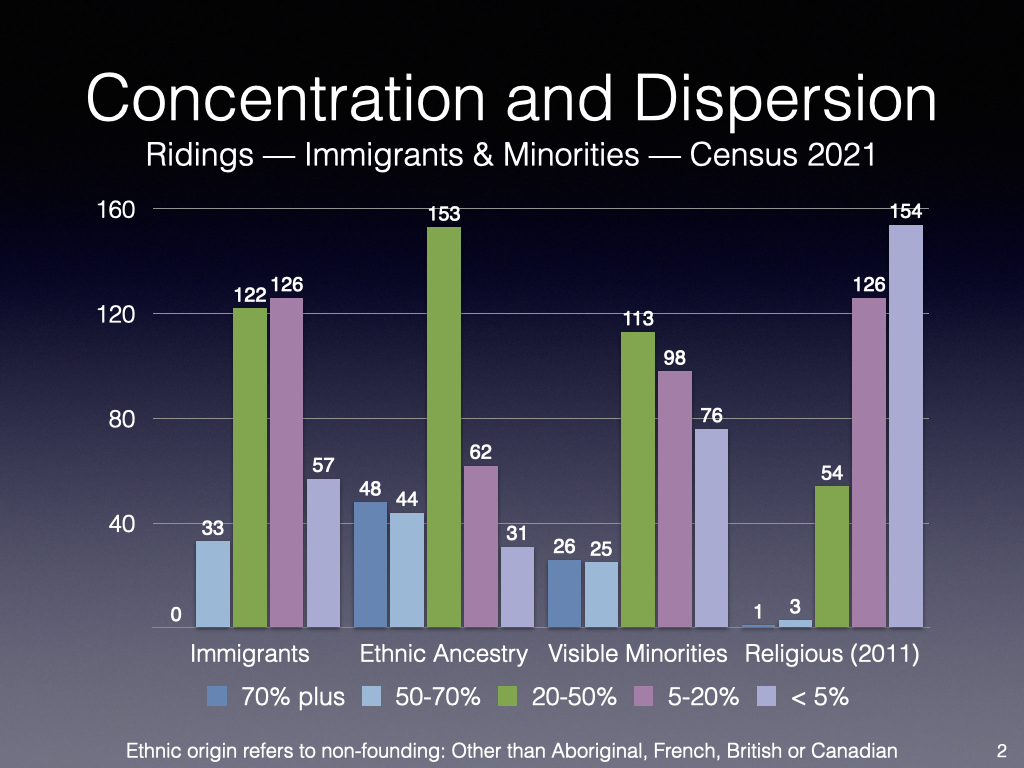
The 2021 census highlights the growth in immigrants, visible and religious minorities. The political impact will continue to play out at the riding level, further reinforcing political party efforts to attract voters from these groups. This article provides a detailed analysis of diversity at the riding level, with the percentage of visible minorities and key demographic and socio-economic characteristics of these ridings.
Figure 1 contrasts immigrants, non-founding ethnic ancestry or origin, visible and religious minorities by their percentage in ridings, highlighting the large number of ridings with significant population shares of each group.
Figure 2 highlights the growth of ridings where visible minorities form a significant share of the population. The number of ridings in which visible minorities form a majority of the population has increased from one in ten (33) in 2011 to close to one in six (51), reflecting high and increasing levels of immigration. Moreover, the number of ridings with significant numbers of visible minorities (20 to 50 percent) has also increased significantly, reflecting ongoing immigration to smaller urban and suburban centres.
While the number of ridings with between five and 20 percent visible minorities has stayed relatively constant, the percentage of visible minorities has increased by five percent or more in about half of these ridings.
In contrast, there are only four ridings in which religious minorities form the majority, an increase of two compared to 2011, with 54 ridings in which religious minorities are between 20 and 50 percent, an increase of 12 compared to 2011.
Figure 3 shows ridings with a majority of visible minorities by province, with Ontario, British Columbia and Alberta having the greatest share and increase compared to the 2016 census. These are all ridings where one can expect all parties to run visible minority candidates, most likely from the largest visible minority group in the riding.
However, virtually all provinces have an increased number of ridings with between 20 and 50 percent visible minorities, and thus ridings where visible minorities are a significant constituency.
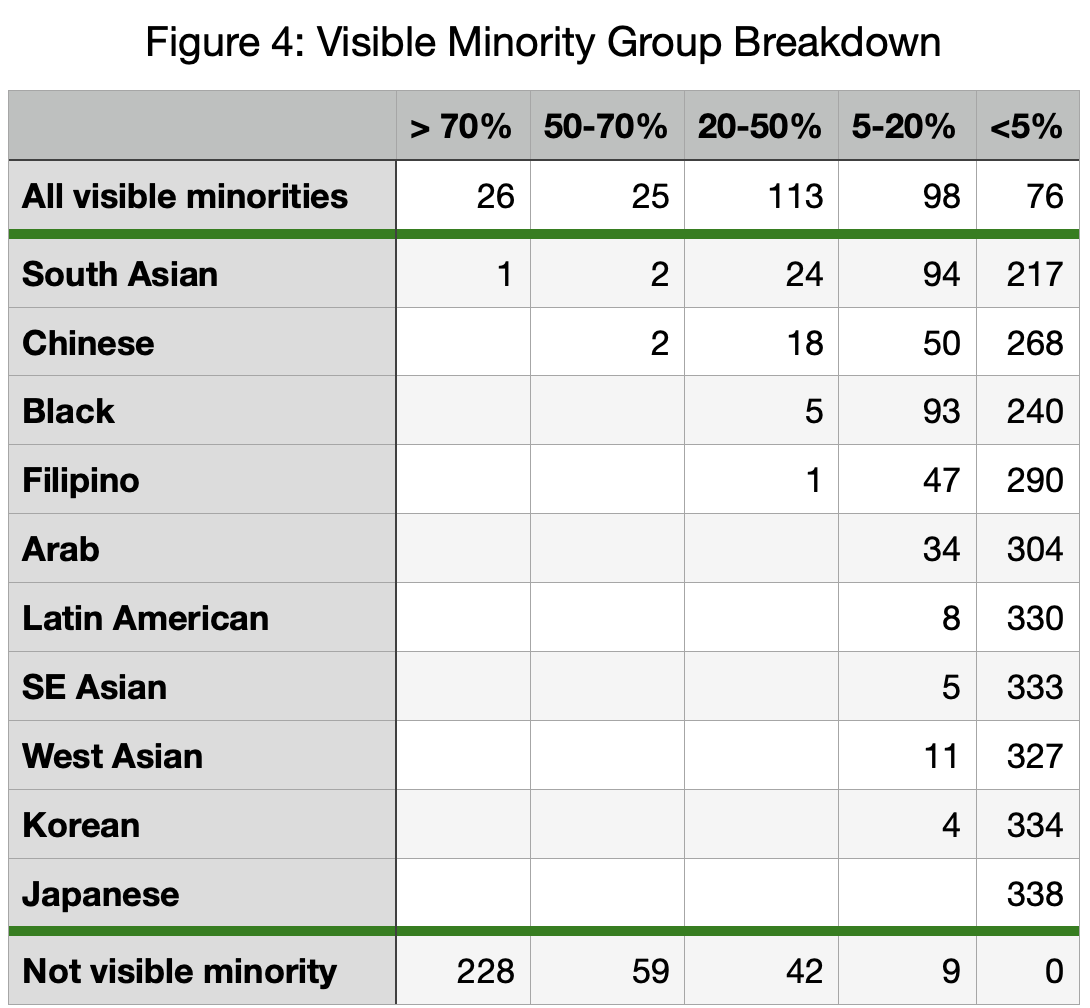
Figure 4 provides the breakdown by visible minority group, with only South Asians and Chinese being a majority of the population (five ridings out of 51 – Brampton East and West, Surrey-Newton for South Asians, Markham-Unionville and Richmond Centre for Chinese), highlighting that most visible minority majority ridings have a mix of visible minority groups. All visible minority groups are present in ridings with between 5 and 20 percent, save Japanese.
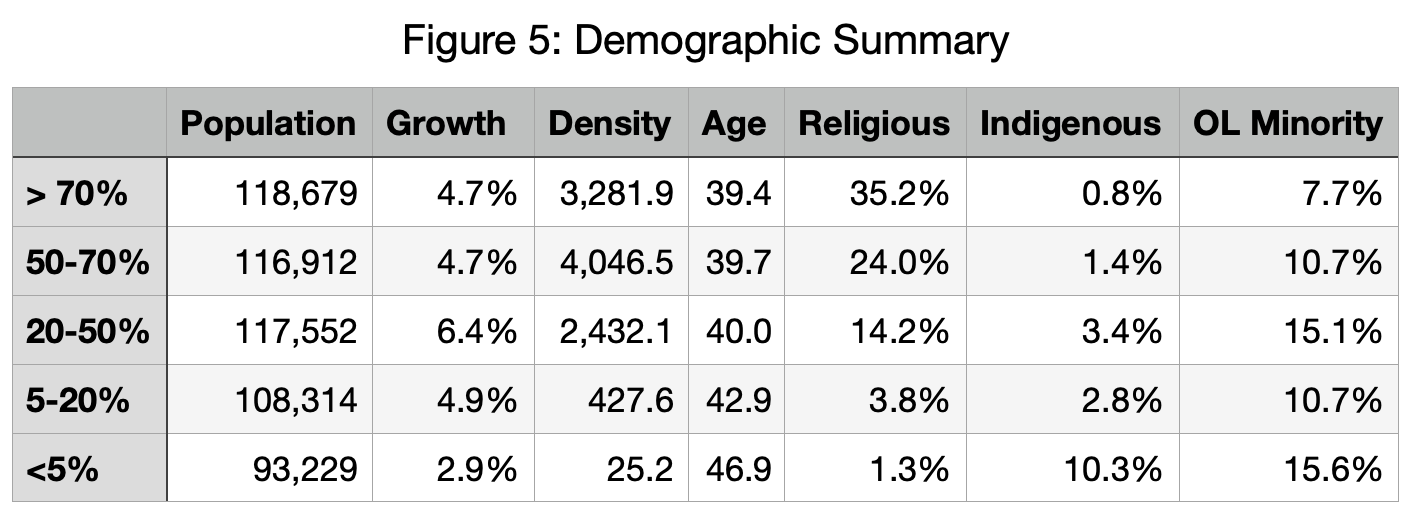
Demographic and socioeconomic characteristics vary by percentage of visible minorities as shown in Figure 5.
Visible minority majority ridings are characterized by larger populations, moderate growth, high densities, a younger population, a higher percentage of religious minorities and a low percentage of Indigenous peoples, with the reverse generally being the case for ridings with less than 20 percent visible minorities, highlighting the differences between rural and urban Canada. The highest growth occurs in ridings with 20 to 50 percent visible minorities, ridings that are increasingly diverse. The percentage of religious minorities correlates with the percentage of visible minorities. There is no overall pattern with respect to official language (OL) minorities.
As one would expect, the higher the percentage of visible minorities, the higher the percentage of immigrants and conversely, the lower the percentage of citizens given residency and other requirements as shown in Figure 6. The period of immigration highlights the contrast between earlier waves of immigration, largely European in origin and in low visible minority ridings, and later waves, largely visible minority, with an impact across all ridings, particularly in the last five years and in ridings with lower overall percentage of visible minorities.
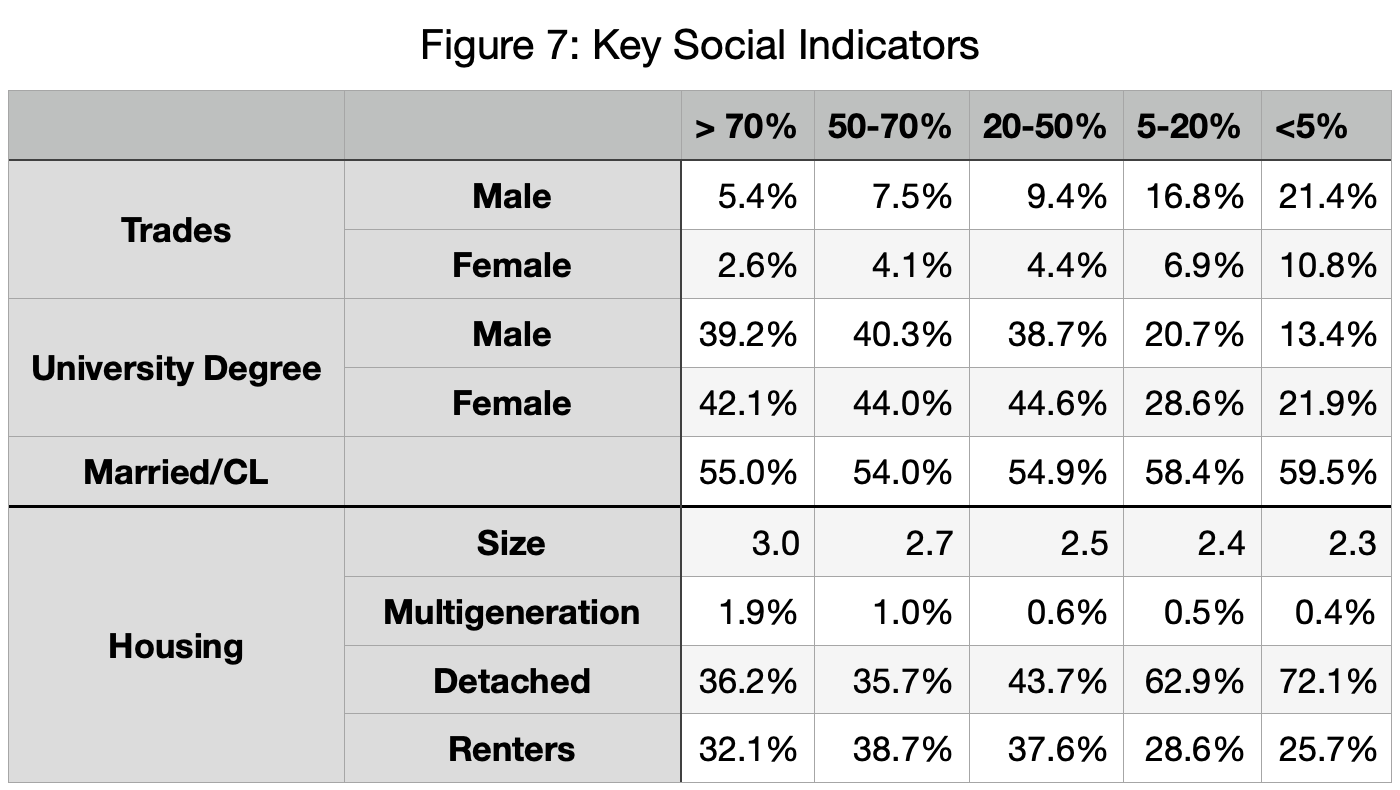
Figure 7 highlights educational attainment (trades and university degree, the percentage of married or common-law couples, household size, and whether residents form part of multigenerational households, are in single-detached housing and the percentage of renters. Trades are more prevalent in ridings with fewer visible minorities and university diplomas more prevalent in ridings with more visible minorities. Women have higher rates of university degrees across all ridings.
Variations on marriage or common law between ridings are small. Household size directly relates to the percentage of visible minorities whereas the prevalence of single detached homes is inversely proportional. Renting is more prevalent in ridings with between 20 and 70 percent visible minorities.
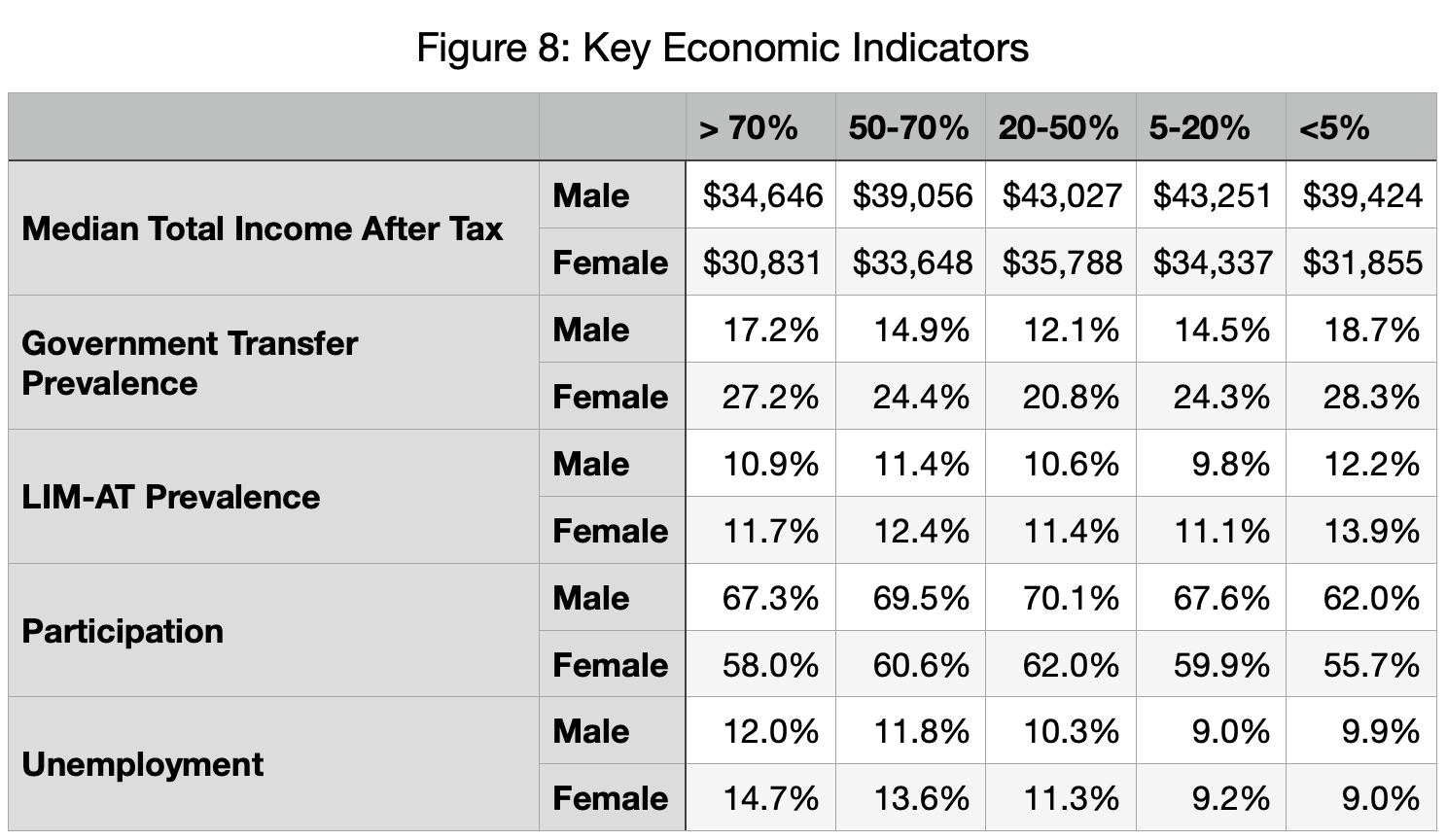
Figure 8 highlights median total after tax income, the percentage of government transfers and income along with participation and unemployment rates. In general, ridings with between 20 and 50 percent have the strongest economic outcomes save for unemployment rates which are lowest in ridings with fewer visible minorities. Outcomes for women are worse overall except with respect to unemployment in ridings with less than 20 percent visible minorities.
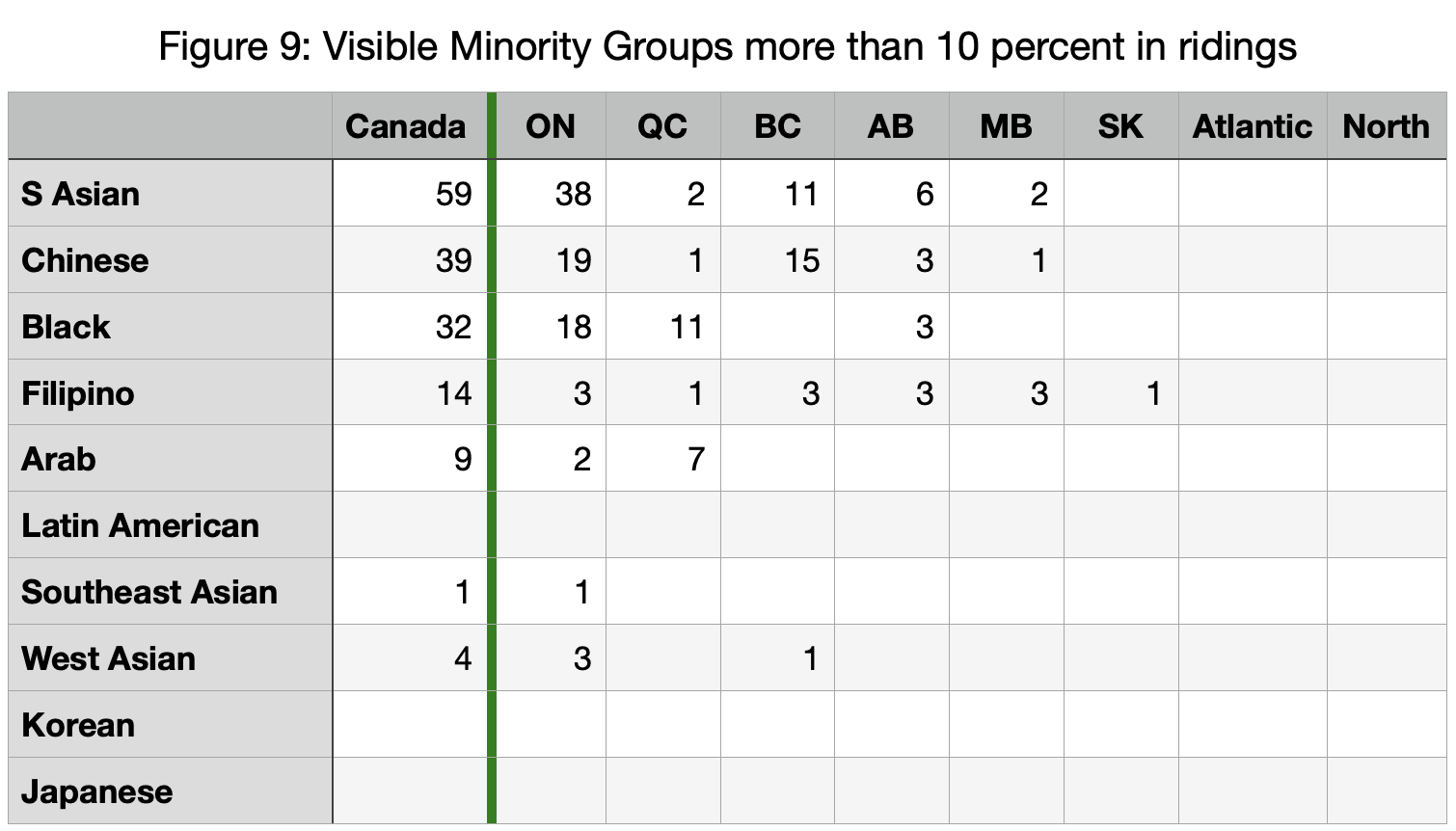
Turning to the political aspect and voter targeting, Figure 9 highlights the number of ridings where a visible minority group forms more than 10 percent of the population, broken down by province, again demonstrating the extent to which political parties need to address specific group concerns. Only Latin American, Korean and Japanese have no ridings with ten percent or more of the population; however, with a threshold of five percent, only Japanese have no ridings of significant concentration. Regionally, there are no ridings in Atlantic Canada and the North with one visible minority group forming 10 percent of the population but six ridings where one group forms more than five percent: three South Asian, two Black and one Chinese.
Figure 10 highlights the 190 ridings where a religious minority forms more than five percent of the population as a threshold of ten percent would exclude Buddhist and Indigenous spirituality. Most groups are concentrated in a number of ridings, with Muslims dispersed across the greatest number of ridings.
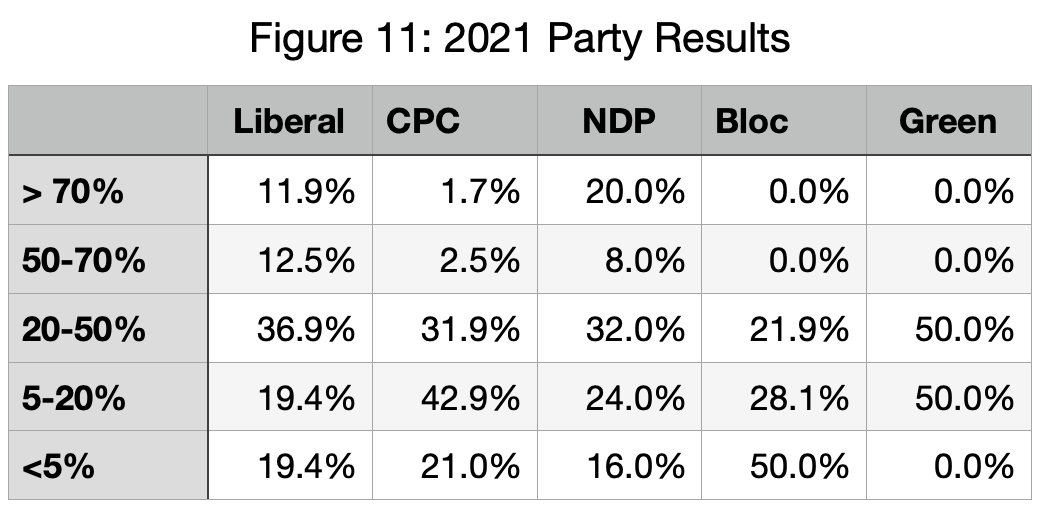
Figure 11 breaks down the 2021 election results, highlighting the relative strength of the Liberals and NDP in visible minority majority urban ridings and the relative strength of the Conservatives in ridings with between five and twenty percent visible minorities. Compared to the 2015 election, the biggest change was the increase in the relative share of NDP MPs in visible minority majority ridings and the Conservative and Bloc relative share increase in ridings with between 20 to 50 percent visible minorities. These ridings can flip; in 2011, the Conservatives won a majority of ridings with more than 50 percent visible minorities.
But in general, visible minority voters are more affected by overall campaign themes and issues, whether these be with respect to campaign tone, general concerns regarding the economy, housing, and healthcare, and largely follow the overall electoral trend at national and regional levels.
Riding characteristics impact upon voting patterns. Visible minority majority ridings have lower incomes and higher unemployment which generally play to left and left-of-centre parties. Similarly, larger family size and more multigenerational households in these ridings suggest that political parties target their messaging accordingly.
No major party is arguing against increased immigration, nor is any province except for Quebec. Public support is strong. Apart from administrative issues like backlogs and poor Immigration, Refugees and Citizenship Canada service, debates and discussion focus more on the practicalities and impact of immigration on housing affordability, healthcare stresses and infrastructure gaps. More recent commentaries are focussing on these negative impacts but in a non-xenophobic manner. After all, these issues affect immigrants and non-immigrants alike, helping to reduce polarization.
Methodology:
All data is from the Census profile given that it provides riding-level data. Indicators were chosen based on their pertinence. Non-founding ethnic ancestry includes all groups save for English, Scottish, Irish, Welsh, Canadian, French and Indigenous (Census allows for multiple responses). Electoral results data is from Elections Canada.