Blogging break
2026/05/19 Leave a comment
Back in 3 weeks
Working site on citizenship and multiculturalism issues.
2026/05/15 2 Comments
Downplaying the impact:
…Elle était questionnée par la députée libérale Madwa-Nika Cadet lors de l’étude des crédits budgétaires, un exercice de reddition de comptes qui se tient annuellement à l’Assemblée nationale.
Le projet de loi 94, adopté en octobre dernier, étend notamment l’interdiction du port de signes religieux à l’ensemble du personnel dans les écoles et dans les centres de services scolaires (CSS).
Une clause de droits acquis existe pour tous ceux ayant été embauchés avant le 19 mars 2025.
Mercredi, Mme Cadet a voulu savoir combien d’employés avaient été licenciés en raison de leur refus de se conformer à la nouvelle loi.
« C’est marginal, a répondu la ministre LeBel. À ma connaissance, on est dans les dizaines, même pas les centaines, même pas 100. C’est très minime. […] À ma connaissance, c’est très peu. »
Selon ses explications, la plupart des gens qui ont été contactés étaient sur des listes de rappel.
« La grande majorité de ces gens-là n’avaient pas enseigné dans le réseau de l’éducation depuis plusieurs années. […] Cent cinquante personnes ont été contactées et beaucoup là-dedans n’enseignent même plus.
« Les gens […] qui étaient dans des écoles, qui occupaient un poste dans des écoles (et qui ont quitté), je pense qu’on les compte sur les doigts de la main », a-t-elle insisté.
Le mois dernier, des syndicats avaient pourtant dénoncé la perte de 150 employés, dont des dizaines d’éducatrices en service de garde, des techniciennes en éducation spécialisée (TES) et des préposées aux élèves handicapés.
Ils avaient dit craindre, sur les ondes de Radio-Canada, que ces départs forcés n’accentuent la pénurie de personnel dans les écoles à Montréal.
Le Centre de services scolaire de Montréal (CSSDM) affirmait, lui aussi, que les congédiements allaient avoir un impact dans les écoles.
« La Coalition avenir Québec semble sous-estimer le défi de rétention de personnel touché par les dispositions du projet de loi 94 », a déclaré Mme Cadet, mercredi.
« Si plusieurs employées quittent, il y aura certainement des ruptures de services. Il faudrait tout de même se préparer à cette éventualité pour ne pas nuire aux élèves, alors que le milieu prépare déjà la prochaine rentrée scolaire », a-t-elle ajouté.
Selon les données du gouvernement, plus de 3100 postes (enseignants, personnel de soutien, professionnels) étaient toujours à pourvoir en date de février.
Source: Laïcité dans les écoles: Un nombre « marginal » d’employés ont quitté, dit Sonia LeBel
… She was questioned by Liberal MP Madwa-Nika Cadet during the study of budget appropriations, an accounting exercise held annually in the National Assembly.
Bill 94, adopted last October, extends in particular the ban on the wearing of religious signs to all staff in schools and school service centers (CSS).
An acquired rights clause exists for all those who were hired before March 19, 2025.
On Wednesday, Ms. Cadet wanted to know how many employees had been laid off because of their refusal to comply with the new law.
“It’s marginal,” replied Minister LeBel. To my knowledge, we are in the dozens, not even hundreds, not even 100. It’s very minimal. […] To my knowledge, this is very little. ”
According to his [her, translation program mistake] explanations, most of the people who were contacted were on recall lists.
“The vast majority of these people had not taught in the education network for several years. […] One hundred and fifty people have been contacted and many there do not even teach anymore.
“People […] who were in schools, who held a position in schools (and who left), I think we can count them on the fingers of the hand,” she insisted.
Last month, however, unions denounced the loss of 150 employees, including dozens of childcare educators, special education technicians (TES) and disabled student attendants.
They said they feared, on Radio-Canada, that these forced departures would accentuate the shortage of staff in schools in Montreal.
The Centre de services scolaires de Montréal (CSSDM) also said that layoffs would have an impact on schools.
“The Coalition avenir Québec seems to underestimate the challenge of staff retention affected by the provisions of Bill 94,” Cadet said on Wednesday.
“If several employees leave, there will certainly be service breaks. We should still prepare for this eventuality so as not to harm students, while the community is already preparing for the next school year, “she added.
According to government data, more than 3,100 positions (teachers, support staff, professionals) were still to be filled as of February.
2026/05/15 Leave a comment
One view is that by allowing Permanent Residents to participate in candidate selection, political parties are facilitation overall integration. In discussions I have had on political representation benchmarks, some have maintained that the overall benchmark should be the number of both citizens and Permanent Residents, rather than citizens only. I favour citizens only and Sarkonak is correct to note the pandering nature and related electoral strategies:
…Well, we’ll see how the investigation goes. Already, some onlookers are gloating, seeing Erskine-Smith’s loss as a strike of karmic justice.
Erskine-Smith was absolutely one of them. He participated in Bangladeshi flag-raisings at city hall; he dressed up in the cultural garb. When he talks about immigration, he speaks in economic terms, not cultural terms. He speaks of the tide of asylum seekers as if they’re an inevitable force of nature, and of his desire to “regularize” the status of people who are in Canada illegally — a point so radical that even the CEO of the Century Initiative told him it’s not worth talking about.
But the conservatives out there should limit their gloating and use the moment to get their own house in order. They engage in diaspora politics all the same.
Without getting into any specific ridings, it’s not unusual for nomination races to be co-opted by diaspora interests. Conservative or Liberal.
Just as Liberals allow non-citizens to vote in their nominations, Conservatives do, too. When some members of the party sought to end the practice of allowing permanent residents to participate in nomination votes, they were shut down by the rest. This is a clear vector for foreign interference.
If individual parties can’t be trusted to ensure that the gears of democracy are turned by citizens only, then their hands should be forced by legislation. And at a higher level, they need to learn that diaspora pandering is like walking through a field of rakes. It might not whack you in the face today, but there’s always a risk it will — just ask Erskine-Smith.
Source: Jamie Sarkonak: The rake of diaspora politics hits Nate Erskine-Smith in the face
2026/05/13 Leave a comment
Good reminder that Canadian history, context and policies are different. Now if we could only stop using US terminology like BIPOC….:
…Canada is not the U.S.
Canada’s social policies are distinct from American policies. To begin with, the racial and ethnic makeup of the populations differ. Canada, for example, has a smaller Black population and a larger Asian population than the U.S.. These differences reflect broader historical and institutional contexts that shape how racial and ethnic inequalities are structured in each country.
At the same time, Indigenous Peoples are more central to health inequality in Canada. This is because Canada has a relatively high percentage of Indigenous Peoples compared to the U.S. and many other more economically developed nations. The health of Indigenous Peoples is shaped by a long history of colonialism and ongoing structural disadvantage.
Immigrant population also differs. About one-quarter of Canada’s population is foreign-born, compared to about one in seven in the U.S. Canada’s selective immigration system means many immigrants arrive with relatively high levels of education and good health. This contributes to patterns like “the healthy immigrant effect.”
Research has shown that Canada exhibits the healthy immigrant effect, in which newly arrived immigrants tend to have better health than the Canadian-born population, though this advantage often declines over time with longer residence. Inequality does not line up neatly with race.
Policy matters too. Canada promotes multiculturalism, while the U.S. emphasizes assimilation into a single national culture. Canada has universal health care, which reduces financial barriers to basic care.
But this coverage is partial. Services such as prescription drugs, dental care and mental-health support are not fully covered and often depend on employment benefits or where people live. Since health care is organized at the provincial level, access and quality also vary across regions. These gaps shape who gets timely care and who falls through the cracks….
A Canadian approach
Studying racial and ethnic health inequality in Canada requires a distinctly Canadian approach. The population, data and policy context differ from those in the U.S., and these differences shape both how inequalities emerge and how they should be studied.
This means moving beyond broad categories, improving race-based data, and using more meaningful and diverse measures of health. It also requires closer attention to context, including Indigenous and rural settings, as well as Canada’s social, immigration and health policy landscape.
To effectively address health disparities, research needs to be grounded in Canada’s realities, not simply adapted from models developed elsewhere.
Source: Studying racial and ethnic health inequality in Canada: What we need to get right
2026/05/12 Leave a comment
Part of her ongoing series:
…Mandhane treated a case of loan-shark violence by a foreigner against a petite, young woman in a dark street as if it were a toy-sharing dispute between children at a daycare. Every day, courts see a good number of low-stakes, wrong-place-at-wrong-time cases where a conditional discharge is appropriate; this was absolutely not one of them.
The suitable result would have been jail, or at least house arrest or probation. That’s what you see when crime is committed in the course of debt collection: for example, a man in Newfoundland was sentenced to one year in jail in 2022 for participating in a group break-in during which “PAY THE DEBT” was written on the victim’s walls (among other acts of vandalism) and during which he stole some cannabis from the house; the organized crime factor worsened his case, but he was a young, first-time offender like E.A., and he didn’t physically attack anyone. He was a citizen though, and he was evidently not before a soft judge, resulting in a much more appropriate sentence.
“But what stings most about E.A.’s case is the Crown prosecutor’s failure to pursue a proper punishment. No one at court that day stood up for the public interest — not even the guy whose job was specifically that.
This can change, but it’s going to take Ontario’s attorney general toughening up his prosecutions, Parliament prohibiting immigration status from being considered in sentencing, and people making sure that judges know when their decisions bring the administration of justice into disrepute. If we tolerate authorities who do everything they can to keep violent non-citizen rulebreakers in Canada, it’s going to keep happening.
Source: Jamie Sarkonak: Progressive judge spares violent loan shark criminal record to avoid deportation
2026/05/12 Leave a comment
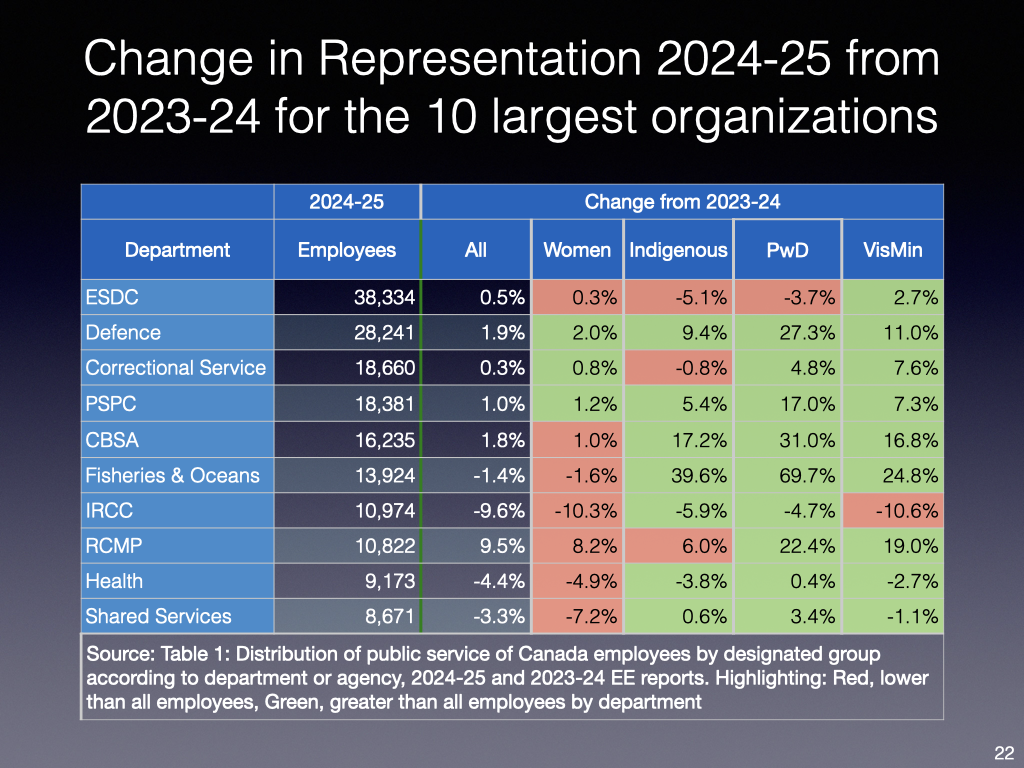
My latest analysis. Short version in the Hill Times.
Source: Dissecting 2024-25 data on the public service, early cuts, and equity goals
Full detailed version below:
2026/05/11 Leave a comment
Not the principle but the details need to be fixed:
…Very simply, the problems with the CAF’s recruiting system have not yet been remedied. Yes, permanent residents and naturalized citizens should be encouraged to join the military, but not until they can speak, read, and understand French and/or English and are adapted to Canadian life and the military’s expectations. Yes, those with medical problems should be enlisted, but only if they have been properly screened in the recruitment process. And certainly, the CAF should not accept candidates who cannot read, write, or comprehend instruction at an acceptable standard.
To judge by his long memorandum with its substantiated recommendations, Kieley is a very able officer doing his best to deal with the difficulties he and his understrength staff face. The generals in Ottawa had changed the rules to speed up recruiting with good intentions but had failed to consider the possible consequences. The recruiting officers across the country too often pushed the unqualified to Saint-Jean, and Kieley had to clean up the mess. It’s almost as if NHL scouts sent those who cannot skate to training camp. This cannot work.
This matters because such applicants at the CAF’s Leadership and Training School cost DND money and take spots from better-qualified candidates. It also matters because General Carignan is studying options to expand the CAF to as many as 85,500 regular force members. “In the next month or so,” the CDS told the CBC in April, “we will be able to present various options, and the discussion is going very well,” Carignan said. “There is a lot of interest in doing this.”
Canada needs a bigger and better Canadian Armed Forces, and the Carney government is putting much money (and much of its credibility) into getting this program right. But if the recruitment process does not speed up and function properly, that investment will achieve little. The generals at National Defence Headquarters and officers in recruiting centres across Canada must fix these problems now.
Source: The CAF recruitment system is failing everyone: J.L. Granatstein for Inside Policy
2026/05/08 Leave a comment
Of note:
…At Queen’s Park on Wednesday, the Black Women’s Institute of Health pushed for urgent action on equity for Black women’s health, based on these experiences, shared by women in a report completed by the institute. The report, “Voices UnHeard,” was based on the findings of a first-of-its-kind national survey that focused on the experiences of Black women and girls and health care.
“There’s nothing in this report that I would say I haven’t lived or experienced,” said Kearie Daniel, who spearheaded the report and is the executive director of Black Women’s Institute for Health.“This is the first time ever that we had anyone survey Black women across this country to this extent in a cohesive way,” Daniel said.
Researchers say there’s a lack of data about the experiences of Black women and girls in Canada when accessing health-care — that’s why a report like this is desperately needed. A health system ill-equipped to provide a basic standard of care for a community group that already disproportionately faces higher rates of certain chronic illnesses and medical conditions could lead to worse health outcomes and higher mortality.
The briefing Wednesday “was part of taking the report from just a report into action,” Daniel said.
The “Voices UnHeard” report was published in November. The report served as an anchor for the policy and legislative moves Daniel is advocating for at Queen’s Park.
The briefing followed Tuesday’s tabling by the NDP of the Black Health Equity and Accountability Act, 2026 (Bill 115), which Daniel says aligns with many of the 70 recommendations in the report….
…At Queen’s Park on Wednesday, the Black Women’s Institute of Health pushed for urgent action on equity for Black women’s health, based on these experiences, shared by women in a report completed by the institute. The report, “Voices UnHeard,” was based on the findings of a first-of-its-kind national survey that focused on the experiences of Black women and girls and health care.
“There’s nothing in this report that I would say I haven’t lived or experienced,” said Kearie Daniel, who spearheaded the report and is the executive director of Black Women’s Institute for Health.“This is the first time ever that we had anyone survey Black women across this country to this extent in a cohesive way,” Daniel said.
Researchers say there’s a lack of data about the experiences of Black women and girls in Canada when accessing health-care — that’s why a report like this is desperately needed. A health system ill-equipped to provide a basic standard of care for a community group that already disproportionately faces higher rates of certain chronic illnesses and medical conditions could lead to worse health outcomes and higher mortality.
The briefing Wednesday “was part of taking the report from just a report into action,” Daniel said.
The “Voices UnHeard” report was published in November. The report served as an anchor for the policy and legislative moves Daniel is advocating for at Queen’s Park.
The briefing followed Tuesday’s tabling by the NDP of the Black Health Equity and Accountability Act, 2026 (Bill 115), which Daniel says aligns with many of the 70 recommendations in the report….
2026/05/08 Leave a comment
Will be interesting to see whether there is any impact on the diversity and political leanings of Carney appointments. Trudeau appointments: 55.2 percent women, 19.8 percent visible minorities, and 12.5 percent Indigenous:
Prime Minister Mark Carney said Wednesday he will continue to rely on the independent advisory board created by Justin Trudeau to suggest Senate appointments, but gave no timeline for filling a growing number of vacancies.
After more than a year in office Mr. Carney has yet to make a single Senate appointment. Vacancies are mounting not just among senators but also on the board tasked with selecting new members of the Senate.
There are currently nine vacancies in the 105-member Senate and another six senators are planning to retire by the end of 2026. The Independent Advisory Board for Senate Appointments, consisting of federal, provincial and territorial representatives, currently has just five members. It has 24 vacancies, leaving most provinces without representation on the board.
At a Montreal-area press conference, Mr. Carney gave no indication of when he would begin addressing the vacancies in the Senate. “We will be appointing senators in due course, and I will take into account the advice of the independent advisory committee that was established by my predecessor,” he said.
Source: Carney to continue using Trudeau-era advisory board to suggest Senate appointments, Carney not planning to allow senators in Liberal caucus, senior government official says

Click image for book purchase

