PROC report: Challenges Regarding Special Voting [Recommendations]

In general, sensible recommendations with my comments below each one. On a personal note, both of our children are expats, one’s ballot arrived in time (from the USA) the other not (from Europe):

Recommendation 1: That the Government of Canada should consider introducing legislation to amend the Canada Elections Act so as to require electors residing abroad to provide proof of their last place of Canadian residence as part of their application to be added to the International Register of Electors. 

Agree. While the current honour system has merit, given the potential for significant increases in expatriate voting due to C-3 expansion of citizenship transmission beyond the second generation, this would enhance the integrity, and perceived integrity, of expatriate votes.

Recommendation 2: That the Canada Revenue Agency and Elections Canada consider pursuing closer cooperation in order to determine, where possible, the most recent Canadian addresses of voters living abroad so as to assign them the electoral district in which they may vote, and improve the delivery of election information to voters living abroad. 

Worth considering as part of integrity measures and complements recommendation 1. Would only apply to those who submitted tax returns.

Recommendation 3: That for elections held on a fixed date under 56.1(2) of the Canada Elections Act, voters should be allowed to apply for a special ballot at least 45 days before election day, even if the writ has not yet been issued. Elections Canada would then be able to send a special ballot to the elector as soon as the writ has been issued. 

Makes sense. Unfortunately, given fixed election dates are more notional than real so likely little practical impact.

Recommendation 4: That the Canada Elections Act be amended to set the deadline for candidate nominations to close three days earlier than at current (i.e., on day 24 before election day, instead of on day 21 before election day). 

Would help. Not supported by Conservatives.

Recommendation 5: That Elections Canada should use couriers, when it deems appropriate, to send ballots to voters living abroad who are on the International Register of Electors. They should also provide voters with a return label to return their ballot via courier. 

Given that most expatriates don’t pay Canadian taxes, should Elections Canada pick up the tab? Alternatively, Elections Canada could offer a fee-based expedited delivery service, as it does for passports.

Recommendation 6: That Elections Canada should undertake further study of the hybrid ballot delivery systems that are used elsewhere in the world, such as printing a ballot at home to assess the feasibility of implementing them in Canada. 

Never argue about further study but found Elections Canada testimony convincing in terms of some of the issues. Conservatives expressed considerable concerns regarding possible negative impact on integrity.

Recommendation 7: That the Government of Canada should not consider any measures which would see special ballots cast by electors electronically. 

Clear response, based on integrity concerns.

Recommendation 8: That, at present, the Committee does not hold the view that electors, who cast their vote by special ballot, ought to be permitted to write the name of a political party instead of writing the name of a candidate, as was proposed in Bill C-65, An Act to amend the Canada Elections Act of the 1st Session of the 44th Parliament. 

Interesting that they ended up here. But the logic is sound, even if one’s vote is party-based, MPs are elected individually. Also required expatriate voters to research the names of candidates, not just indicate the party they support.

Recommendation 9: That the Government of Canada should undertake a study to assess the feasibility of embassies providing ballots and/or acting as polling stations during Canada’s federal general elections. 

No issue with studying the issue but suspect some integrity and operational issues.

Recommendation 10: That the Government of Canada should ensure that, subject to security and logistical considerations, Canada’s embassies, high commissions and consulates provide opportunities for Canadian electors abroad to submit their special ballots for expeditious return to Elections Canada. 

Easier than Recommendation 9, but given the “subject to security and logistical considerations” and the impact on regular mission operations, even the mailbox function would raise complications in terms of meeting ballot deadlines and when they would be counted.

Recommendation 11: That having conducted a comprehensive review of the testimony, the Committee holds the view that there is no consensus on the creation of extraterritorial electoral ridings. 

Fair enough. Good discussion on issue and various complications.

Recommendation 12: That the Committee believes that candidates and political parties bear the greatest responsibilities for motivating electors, including those residing abroad, to turn out to exercise their franchise. For greater certainty, this recognition does not remove or diminish from the responsibilities borne by Elections Canada and Global Affairs Canada to provide information to Canadian electors residing abroad on how to exercise their right to vote. 

Agreed!

Source: PROC report: Challenges Regarding Special Voting [Recommendations]
McCauley and Wang: In this time of crisis, let’s make better use of Canadians abroad to build our future

Perennial call, but greater urgency.

But there may be limits.

For example, the authors argue that the number of expat Canadians who are engaged politically has increased dramatically (62 percent) without the absolute numbers which show only 56,000 registrations, 26,000 votes counted and 12,000 submitted late and thus not counted. Minimal numbers, and statistical malpractice to cite the percentage increase without actual numbers:

…Today, a growing number of Canadians overseas are engaged politically, as evidenced by the 62 per cent of registered overseas voters who cast ballots in the 2019 federal election, a significant increase over previous years. Many Canadians abroad remain keen to give back and contribute their ideas, expertise and networks to build our country’s future. For some, that means moving home and searching for meaningful ways to engage with our social and civic fabric. Those who remain abroad are left to find mechanisms to participate in and shape Canadian policies….

This is our call to action. To our leaders: develop a national strategy to engage Canadians abroad. To our businesses: tap into our global talent pool for nation-building at home. To Canadians living outside our borders: stay engaged, demand inclusion and bring your ideas and energy home when Canada needs them most. At a time of nation-building at home, we should recognize that our country’s future is also global – and it’s time we start acting like it.

Adam McCauley is a Canadian journalist and academic based in Ottawa. He writes about international relations, defence and security, and technology.

Steven Wang is a Canadian lawyer based in Toronto and an adjunct professor at the University of Toronto Faculty of Law and Harvard Law School.

Source: In this time of crisis, let’s make better use of Canadians abroad to build our future

Expats may have Harper Tory restrictions on voting dropped, Liberals say

To be watched – I think the current 5 year rule is appropriate (it was instituted in 1993 and the social contract reasoning of the Court decision makes sense). Moreover, not clear how many expats would in fact vote (see earlier Reframing the debate over expat voting: Russell and Sevi, Globe editorial for the numbers):

The new Liberal government wants more Canadians to vote in elections and won’t be reviving measures proposed by the former Conservative regime that critics said would have the effect of suppressing voting, the Prime Minister’s Office said Wednesday.

At the same time, a spokesman for the PMO said the government had made no decision on an existing law currently subject of a court battle that effectively disenfranchises expats abroad for more than five years.

“We will be able to clarify our intent in the coming months,” Olivier Duchesneau, deputy communications director in the Prime Minister’s Office, said in an email.

“But we believe that more Canadians should have the ability to vote, not the opposite.”

Two expat Canadians in the United States launched a constitutional challenge to rules in the Canada Elections Act that bar them from voting from abroad. They were initially successful in Ontario Superior Court in 2014, but the province’s Court of Appeal sided with the Conservative government in July.

The two are now waiting to see if the Supreme Court of Canada will take up their case. In the interim, they have called on Prime Minister Justin Trudeau to withdraw the government’s defence of the legislation if the top court does agree to a hearing.

The PMO said no decision has been made on the litigation or the existing legislation, but made it clear the Citizens Voting Act or Bill C-50 proposed by the former government would stay dead.

Among other things, it tightened ID and registration requirements for voters living abroad. The Conservatives argued it was aimed at preventing fraud, but critics said it would make it harder for expats to vote.

The bill, introduced last December by then-democratic reform minister Pierre Poilievre in response to the initial court decision, passed second reading in May and was being debated in committee. The legislation died on the order paper when the election was called.

“The government is committed to scrapping the Citizens Voting Act,” Duchesneau said.

Source: Expats may have Harper Tory restrictions on voting dropped, Liberals say

I’m Canadian – and I should have a right to vote – Donald Sutherland

He forgets that US citizens also have to file US tax returns:

Did you know that? If you don’t live here all the time you can’t vote. Americans who live abroad can vote. They can vote because they’re citizens! Citizens! But I can’t. Because why? Because I’m not a citizen? Because what happens to Canada doesn’t matter to me? Ask any journalist that’s ever interviewed me what nationality I proudly proclaim to have. Ask them. They’ll tell you. I am a Canadian. But I’m an expatriate and the Harper government won’t let expatriates participate in Canadian elections.

But the broader question, for every Donald Sutherland and those like him, there are many more that have a lessor connection to Canada. And there is no way that I can think of that could consistently apply a “connection to Canada” in an administratively fair and efficient manner.

I’m Canadian – and I should have a right to vote – The Globe and Mail.

Are you Canadian enough to vote? – Mark Kersten

Another one of the series of arguments allowing for unlimited voting rights for Canadian expatriates, including having MPs representing overseas constituencies:

Rather than pursuing inward, regressive policies, the government could think creatively. Instead of constructing barriers to democratic participation, what a progressive government could, and should, do is to create a handful of members of Parliament to directly represent Canadians who live abroad. France and Italy already have parliamentarians who represent their respective diasporas. Why not have MPs on Parliament Hill to represent the unique interests and diversity of Canadians living abroad? Surely that could only enrich our democracy.

The arguments of many proponents of extending voting rights to expats have relied on the view that it is unfair to strip voting rights from any tax-paying Canadians living abroad. The assumption is that if you’re contributing money to federal tax coffers, you should be allowed to vote. This may be intuitively persuasive, but there is a danger in taking this argument to its logical extreme. If it were, homeless citizens or some retirees could lose the vote. Paying more taxes surely doesn’t make you “citizen plus,” a better citizen than others. Canadian citizenship, as spelled out in the Charter, is not transactional. We don’t have to buy it.

Still, it is inescapable that the prohibition on long-term Canadian expats to vote in federal elections creates a bifurcated form of citizenship. All Canadian citizens are equal, but if only those living in Canada are allowed to vote, then some are more equal than others.

And while the advocates are all too quick to trot out anecdotes of Canadian expatriates who are connected to Canada in a meaningful way, one could equally draw up a list of those who are not, and likely also find some evidence to buttress the claim that most are not. The tiny number of Canadian expatriates who vote under the current 5-year limit (see Reframing the debate over expat voting: Russell and Sevi, Globe editorial) is illustrative.

Are you Canadian enough to vote? – The Globe and Mail.

Reframing the debate over expat voting: Russell and Sevi, Globe editorial

Reframing_the_debate_over_expat_voting_-_Macleans_caTwo contrasting views on expatriate voting.

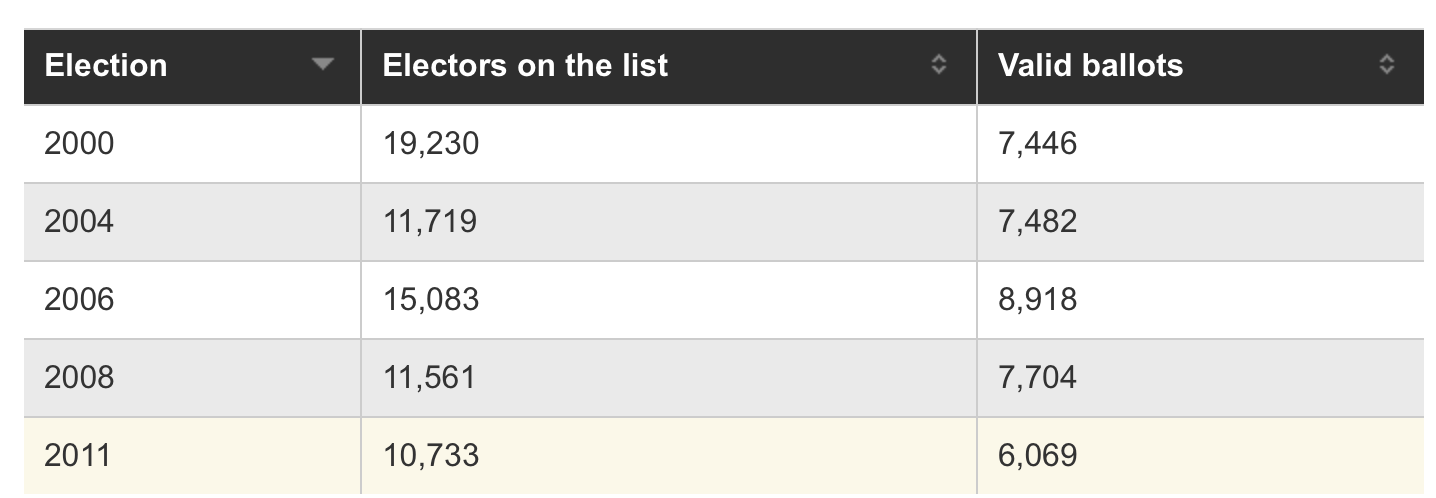
The first, by Peter Russell (a former excellent and insightful professor of mine) and Semra Sevi (who has written before Canadian expatriates should never lose the right to vote), provides useful data on the number of expatriates who actually vote.

The number, as shown above, is minuscule compared to the estimated almost three million Canadian expatriates. The article also has the following international comparisons:

The five-year limitation, as opposed to some other limit, is overly drastic and Canada’s provision is not comparable with similar democracies around the world.

Americans living outside of the country have the right to vote no matter how long they have been abroad providing they pay taxes. The right to vote expires in the United Kingdom after 15 years abroad. To put this into perspective, this is three times longer than what Canada permits even though Canada is part of the Commonwealth.

Australian citizens abroad are allowed to vote so long as they intend to return to Australia within six years. After six years, citizens can renew their status by making an annual declaration of their intention to return “at some point” thereby voting for an indefinite period. In New Zealand, there is a three-year limit but the clock restarts every time citizens visit the country. Moreover, New Zealand extends the right to vote to non-citizen residents from other Commonwealth countries.

The United Kingdom extends similar voting rights to citizens of Commonwealth countries and citizens of the Republic of Ireland. The five-year limit in Canada is an arbitrary number and is unnecessarily onerous. On the surface, it is a year less generous than Australia, but Australians can renew their status by expressing a mere intent to return to the country “at some point” in the future. Canadians, on the other hand, need to resume residency to regain their right to vote abroad.

The right to vote is a fundamental right of citizenship that is protected by the Charter and does not depend on place of residence. The five-year limitation does not conform to the 21st-century demands of globalization. While there is currently an NDP-sponsored bill to repeal the provision that limits voting rights for Canadians abroad as unconstitutional, it is possible that the unconvincing judgment of two Ontario appellate judges could be overturned on appeal to the Supreme Court of Canada—but, alas, not in time to restore democratic rights to the close to a million and a half Canadians living abroad for the fall election.

Reframing the debate over expat voting – Macleans.ca.

Expatriate Voter TurnoutThe Globe editorial takes, correctly in my view, takes the opposite view:

We think the decision is the right one, for three reasons.

First, because our electoral system, based as it is on residence in a particular electoral district, assumes a connection between residence and voting, governors and the governed.

Second, because we live in a world of national borders and laws that do not apply extraterritorially, which means the lives of non-resident Canadians are largely not governed by Canadian law. As Ontario Chief Justice George Strathy put it, “permitting all non-resident citizens to vote would allow them to participate in making laws that affect Canadian residents on a daily basis, but have little to no practical consequence for their own daily lives.”

And third, because reasonable people can disagree, reasonably, over how long a citizen should reside outside of Canada before having her vote suspended. Should the limit be five years? Ten? Two generations? Never? The practical question of setting reasonable limits is best left where the Ontario Court of Appeal left it, in the hands of Parliament.

The Canada Elections Act says that Canadian citizens are entitled to vote in the riding in which they typically reside. However, the Act also says that Canadian citizens living abroad for more than five years cannot vote. There are exceptions for people sent overseas in service to the country, such as members of the Armed Forces.

All of which is not unreasonable. Justice Strathy noted that “residence is a determinant of voter eligibility in all provinces and territories.” If you move from Nova Scotia to Alberta, you can’t continue voting in Nova Scotia in perpetuity.

He also pointed out that “residence is a requirement of the electoral laws of the other Westminster democracies. The U.K., Australia and New Zealand limit the voting rights of non-resident citizens to those temporarily resident abroad.” The maximum time overseas before one loses the vote is 15 years in Britain, six years in Australia and three years in New Zealand. Canada’s current law is fair.

 No, Canadians living abroad shouldn’t get to vote 

Expat voting: Court denies Ottawas fight for 5-year rule for voters abroad

While the Government failed to get a stay for the by-elections this coming Monday, expect that the Government will make a formal appeal of the earlier decision removing the five-year limit for the 2015 elections (see earlier Expat voters launch legal challenge of ‘5-year rule’):

In Mondays ruling denying the federal governments request of a stay, Justice Robert Sharpe wrote that while there was “an arguable appeal” from the Attorney General of Canada, “the balance of convenience weights in favour of refusing a stay.”

Sharpe dismissed the government’s argument that it could cause “irreparable harm” if a close election came down to the single vote of a non-resident who, it might turn out, was ineligible to vote. But such a scenario would be “fairly remote,” Sharpe said.

He also reasoned that Elections Canada had already taken administrative steps to allow citizens abroad to vote after the lower court ruling, and it was counterproductive to “undo what [Elections Canada] has already done.”

Only 13 Canadian ex-pats have so far registered to vote since the May decision.

Even so, Sharpe wrote today: “To grant a stay in this case would require Elections Canada to rescind the registrations of up to 13 non-resident electors and claw back the vote of citizens who may well in the end have the right to cast their ballot.”

Expat voting: Court denies Ottawas fight for 5-year rule for voters abroad – Politics – CBC News.

De l’exclusion des expatriés | Le Devoir

An opinion piece by Eric Laporte on voting rights for expatriates and a good short comparison table. I am comfortable with Canada’s five-year rule. While one can keep in contact with the politics and culture back home, the reality is that one does become more distant over time and, apart from the US, most expatriates pay taxes to the country they reside in, not their country of citizenship. No representation without taxation.

Un Américain, un Français, un Allemand, un Britannique est fier que l’un des leurs aille à l’étranger pour représenter son pays et aussi, ce qui est le plus important, aille à l’étranger pour aller chercher de la nouvelle expertise. C’est comme ça que les États-Unis se sont bâtis, en allant chercher l’expertise étrangère, non seulement avec l’immigration, mais aussi avec les contacts à l’international. On ne peut pas donner de signe plus clair à un citoyen qu’on ne le soutient pas qu’en lui enlevant ses droits démocratiques.

De l’exclusion des expatriés | Le Devoir.

With all the comings and goings, who is Canadian any more? – The Globe and Mail

Somewhat tongue-in-cheek, but Elizabeth Renzetti has a point on expatriate Canadians, identity and citizenship.

With all the comings and goings, who is Canadian any more? – The Globe and Mail.