Native Americans recall torture, hatred at boarding schools

As in Canada:

After her mother died when Rosalie Whirlwind Soldier was just four years old, she was put into a Native American boarding school in South Dakota and told her native Lakota language was “devil’s speak.”

She recalls being locked in a basement at St. Francis Indian Mission School for weeks as punishment for breaking the school’s strict rules. Her long braids were shorn in a deliberate effort to stamp out her cultural identify. And when she broke her leg in an accident, Whirlwind Soldier said she received shoddy care leaving her with pain and a limp that still hobbles her decades later.

“I thought there was no God, just torture and hatred,” Whirlwind Soldier testified during a Saturday event on the Rosebud Sioux Reservation led by U.S. Interior Secretary Deb Haaland, as the agency confronts the bitter legacy of a boarding school system that operated in the U.S. for more than a century.

Now 78 and still living on the reservation, Whirlwind Soldier said she was airing her horrific experiences in hopes of finally getting past them.

“The only thing they didn’t do was put us in (an oven) and gas us,” she said, comparing the treatment of Native Americans in the U.S. in the 19th and 20th centuries to the Jewish Holocaust during World War II.

“But I let it go,” she later added. “I’m going to make it.”

Saturday’s event was the third in Haaland’s yearlong “Road to Healing” initiative for victims of abuse at government-backed boarding schools, after previous stops in Oklahoma and Michigan.

Starting with the Indian Civilization Act of 1819, the U.S. enacted laws and policies to establish and support the schools. The stated goal was to “civilize” Native Americans, Alaska Natives and Native Hawaiians, but that was often carried out through abusive practices. Religious and private institutions that ran many of the schools received federal funding and were willing partners.

Most closed their doors long ago and none still exist to strip students of their identities. But some, including St. Francis, still function as schools — albeit with drastically different missions that celebrate the cultural backgrounds of their Native students.

Former St. Francis student Ruby Left Hand Bull Sanchez traveled hundreds of miles from Denver to attend Saturday’s meeting. She cried as she recalled almost being killed as a child when a nun stuffed lye soap down her throat in response to Sanchez praying in her native language.

“I want the world to know,” she said.

Accompanying Haaland was Wizipan Garriott, a Rosebud Sioux member and principal deputy assistant secretary for Indian affairs. Garriott described how boarding schools were part of a long history of injustices against his people that began with the widespread extermination of their main food source — bison, also known as buffalo.

“First they took our buffalo. Then our land was taken, then our children, and then our traditional form of religion, spiritual practices,” he said. “It’s important to remember that we Lakota and other Indigenous people are still here. We can go through anything.”

The first volume of an investigative report released by the Interior Department in May identified more than boarding 400 schools that the federal government supported beginning in the late 19th century and continuing well into the 1960s. It also found at least 500 children died at some of the schools, though that number is expected to increase dramatically as research continues.

The National Native American Boarding School Healing Coalition says it’s tallied about 100 more schools not on the government list that were run by groups such as churches.

“They all had the same missions, the same goals: ‘Kill the Indian, save the man,’” said Lacey Kinnart, who works for the Minnesota-based coalition. For Native American children, Kinnart said the intention was “to assimilate them and steal everything Indian out of them except their blood, make them despise who they are, their culture, and forget their language.”

South Dakota had 31 of the schools including two on the Rosebud Sioux Reservation — St. Francis and the Rosebud Agency Boarding and Day School.

The Rosebud Agency school, in Mission, operated through at least 1951 on a site now home to Sinte Gleska University, where Saturday’s meeting happened.

All that remains of the boarding school is a gutted-out building that used to house the dining hall, according to tribal members. When the building caught fire about five years ago, former student Patti Romero, 73, said she and others were on hand to cheer its destruction.

“No more worms in the chili,” said Romero, who attended the school from ages 6 to 15 and said the food was sometimes infested.

A second report is pending in the investigation into the schools launched by Haaland, herself a Laguna Pueblo from New Mexico and the first Native American cabinet secretary. It will cover burial sites, the schools’ impact on Indigenous communities and also try to account for federal funds spent on the troubled program.

Congress is considering a bill to create a boarding school “truth and healing commission,” similar to one established in Canada in 2008. It would have a broader scope than the Interior Department’s investigation into federally run boarding schools and subpoena power, if passed.

Source: Native Americans recall torture, hatred at boarding schools

Canada’s Governor General to speak about immigration and reconciliation at event in Calgary

Of note:
Canada’s Governor General will speak at an event in Calgary on Thursday about the complex relationship between immigration and reconciliation.
Calgary was chosen as the location for this year’s LaFontaine-Baldwin Lecture, hosted by the Institute for Canadian Citizenship (ICC), because of the city’s exceptional work connecting Indigenous people and newcomers, said the ICC’s CEO Daniel Bernhard.

Source: Canada’s Governor General to speak about immigration and reconciliation at event in Calgary

New immigrants to Canada are building bridges with Indigenous Peoples. Here’s why that matters

Small scale and personal, along with a mix of practical and woke:

At the South Vancouver Neighbourhood House, Indigenous Elders Al Houston and Travis Angus are taking centre stage.

The pair walk into the full meeting room and smudge it, with the ritual burning of sacred plants.

“If we’re going to listen to one another, we’re going to be able to keep going forward,” Houston, president of the Greater Vancouver Native Cultural Society, tells those in attendance. “Your perfect example is right here in front of you. You’re asking questions and we are responding.”

Their audience at the community hub is a couple of dozen eager newcomers from Afghanistan, Egypt, Hong Kong, Nepal and the Philippines, who sit in a circle.

For the new immigrants, this “info and orientation circle” is their first look at the Indigenous past of the land where they have just settled.

For Houston, an Ojibwe Cree, and Angus of the Nisga’a Nation, this community program, The First Nations of Canada, is part of the mending of a broken relationship.

It is an example of reconciliation at its most essential, person-to-person level. For both communities, Indigenous Peoples and newcomers, it is uncharted territory.

Generations of immigrants settling in Canada have been kept away from the country’s horrific Indigenous history. For generations, Indigenous communities have been blamed by those unfamiliar with the history of this land for their social ills, whether it’s their poverty, substance abuse, health or relationship issues.

That distrust is often mutual. Some in the Indigenous communities view immigrants as continuing the relentless colonization of their ancestral lands.

But recent years, in the wake of the racial reckoning that made headlines in 2020 and the shock over the discovery of probable unmarked graves near residential school sites, have spurred the interest in relationship building with Indigenous people among new immigrants, the latest wave of settlers if not colonists.

“It’s kind of a watershed moment,” said Antje Ellermann, founding director of the University of British Columbia’s Centre for Migration Studies. “A lot of things are coming together. I’m hoping that and I do think that there will be a real generational difference.

“There is a lot of positive energy coming from newcomers, and openness and less defensiveness, because they don’t have family going back generations with that kind of pioneer spirit.”

And Vancouver — the unceded territory of the Musqueam, Squamish or Tsleil-Waututh peoples — seems to be leading the way.

Elders Houston and Angus both sit on the Indigenous Advisory Council at the South Vancouver Neighbourhood House and facilitate the orientation circle with newcomers, where they go over cultural practices and the travesties, such as residential schools, faced by Indigenous people in Canada.

“Let’s talk protocol,” Houston said. “In our culture, we can appreciate the applause, but technically in our culture we don’t like to clap because the spirits are awakened.” In the evening, whistling is also avoided, for the same reason.

Much of these teachings, he said, are passed down from Elders, but much of this culture was lost, due to the residential school system.

He tells bits of his own personal history, starting with his mother’s stay in a residential school and his own situation of being taken from his mother during the Sixties Scoop.

It was supposed to be for a short period while she dealt with her own challenges from her time in residential school, but Houston said the ordeal lasted years. Authorities told both the children and the mother they each did not want to be reunited. He did not see his mother again until she showed up at his hospital bed after he’d been hit by a car.

The accident made the newspaper and was the only reason his mother knew where to find him.

Silence settles down over the circle of chairs in the room.

“I looked at her and said, ‘I’ve waited all my life for this day to happen,’ ” said Houston. “That was the relationship rekindled right there because of the hope we never let go of.”

It used to make the 44-year-old man angry when he saw other Canadians taking more interest in newcomers and their culture than the issues faced by the first people on this land.

“We’ve become a minority in our own country. There’s still that stigma of First Nations that we’ve lived through,” noted Houston, who has become a regular guest in community events to talk about residential schools, history and cultures.

“People now are seeking us out. It never used to be like that. It’s a great feeling. Now we are getting a lot of compassion. People are wanting to understand and ask, ‘How can we help?’ ”


Toronto Metropolitan University geography professor Harald Bauder, himself an immigrant from Germany, has published numerous papers about immigration, settlement, colonialism and indigeneity.

He said he’s surprised immigration policy has garnered little attention within the Indigenous communities.

Among the 94 recommendations by the Truth and Reconciliation Commission, the last two address “newcomers to Canada” — revising the citizenship study guide and test to include more Indigenous content, and updating the oath of citizenship to observe treaties with Indigenous Peoples — and none deals with immigration policy.

“To me, as an immigration researcher, this is a core issue because immigration policy and selection is what has led to the conflict that we’re dealing with in settlement and colonialism to begin with,” he said. “Without immigration, you wouldn’t have settler colonialism. So why is the underlying force always just an afterthought?”

Bauder said immigrants and Indigenous people can forge great alliances with their respective experiences of colonization. While not every newcomer is a colonist, he adds, many themselves have lived the colonial legacies or have been displaced and oppressed due to their race and ethnicity.

“There’s a great deal of potential to forge alliances and I think there are some alliances being forged already in some cases.”

Born and raised in East Vancouver, Norm Leech has ancestry in the T’it’q’et community of the St’at’imc Nation and has been a frequent speaker on the Indigenous experience with colonization.

He likes to start his talk with the land acknowledgment because the land is a “relative” and “ancestor” that came before all humans and has provided people with everything. In his presentation, he always stresses the need to care for the land just like their kin.

He explains how that relationship with the land has been disrupted by colonization and replaced by systems that reduced it to property to be owned and abused.

“Colonization teaches us that we only have five senses,” said Leech. “We know we have a sense of connection to our land. We have a sense of connection to our ancestors. We have a sense of connection to our family. We know we are connected to everything, everywhere, all the time.

“We are absolutely part of this planet and everything on it. We are not separate at all. To be separate is essentially the roots of western philosophy … We’re in this colonized system that separates us and divides us and isolates us and tells us you’re alone.”

Leech said many immigrants come from places with a much longer history of colonization than Canada, suffering different forms of “intergenerational trauma,” and his workshop attempts to help participants re-imagine their relationship with the land and relating to one another before colonists came.

“The more we can have the conversation, extend and magnify the conversation, the better. Immigrants are going to be our greatest pool of allies once we make them understand we’re not their enemies.”

Binish Ahmed was 11 when she and her family fled to Canada in the 1990s from Kashmir, a disputed region under the control of India, Pakistan and China ever since the partition of India in 1947, when British colonial rule ended.

An Indigenous Kashmiri, the Toronto Metropolitan University doctoral student says foreign powers seized the land of her people and still oppress them under their rules, much like what happened to the Indigenous people in North America and around the world.

“I did not voluntarily want to come here as a kid,” said Ahmed, who lives in Toronto. “I wanted to stay with my relatives, with my cousins, with my friends on my land. My land is very sacred to me. I love the smell of my land, I love the birds, the bees, the flowers, the lakes, the mountains.

“We consider ourselves gardeners. In our language, the land is called ‘mouj Kasheer,’ which means ‘mother Kashmir.’ We feel pride and a sense of fulfilment in caring for Mother Earth.”

It was around 2010 when Ahmed, then a university student, saw smudging performed at an equity conference in Toronto. It reminded her of “isband,” a similar ceremony in her own culture.

Ahmed began reading about Indigenous history, culture and traditions, and contacting Indigenous leaders and activists. That inspired her to pursue a doctoral degree in Indigenous governance and policy, immigration and migration, anti-racism and anti-colonial practice.

In her activism, she and friends always take a stand for their Indigenous kins in Canada.

There’s a lot of self-education required of new immigrants, said Ahmed, especially those who come from a privileged background, who can’t expect the Indigenous community to teach them.

“My responsibility here is to be in good relations with people whose land I’m on. What immigrants and newcomers should do is learn about the campaigns that are led by Indigenous Peoples themselves and lend your support,” she said. “We don’t have to come up with something new.”


The Punjabi word for Indigenous people — “tiake,” which means a relation of my father’s older brother — was originally coined in small towns in B.C., where a lot of Indigenous people and Punjabi migrants worked in lumber mills.

To Vancouver-based activist Harsha Walia, the hundred-year-old word that is now in the Punjabi language expresses the relationship with Indigenous Peoples.

“Those are the kinds of historic alliances and solidarities and relationships and kinship that I think we have to actively work to unearth because they’ve been buried,” said Walia, who came to Canada in the 1990s as an international student.

Born in Bahrain to Punjabi parents, Walia has been involved in grassroots immigrant rights, migrant justice and social movements, but soon decided it’s not enough just to fight for citizenship rights for immigrants and refugees.

“That anti-racist fight cannot erase settler colonialism,” Walia explained. “It cannot erase the realities of genocide against Indigenous Peoples. The home that I am building is built on top of the home of other peoples. It is built on the dispossession of other peoples. The safety and the life that I am seeking for myself and for my family cannot be built on the ruins of other people.

“That is part of the ethical orientation that compels me to be in relationship to Indigenous Peoples fighting for their homes, fighting for their homelands, fighting for clean water and the right not to be dispossessed.”

But there is so much learning to do in the process.

Walia remembers joining others in an Indigenous land blockade in Ontario and offering her service along with other non-Indigenous supporters. They showed up in the community kitchen and worked there but soon sensed that it wasn’t received well.

“We just thought to ask, ‘Should we be somewhere else?’ In that instance, we got the feedback that us being there was displacing some Indigenous people who took their role in their kitchen and in serving food and providing for the front line seriously,” she recalled.

“And that was really eye-opening. We thought ‘we’re going with good intentions,’ ” she said, adding that solidarity is “going to look different in each context. Always being humble, never assuming.”

Elder Angus, whose traditional name is Niis Miou, says neighbours in the Little India area of Vancouver were not friendly to him and his family when they first moved into the neighbourhood, possibly because he’s an Indigenous, two-spirit single parent of three.

But he insisted on getting involved in the community and making it clear he wasn’t going to leave, till one day when neighbours asked him why he was there.

“I’d ask them the same thing, ‘Why are you here?’ It’s just being who you are as an individual, no matter where you live, and really recognizing that strength and that power that you have to stand up … to carry on with the community and to be able to help,” said Angus.

At the onset of the pandemic, Angus became aware of the food-security needs among his neighbours and started providing others with non-perishables from his own pantry and fresh vegetables from his garden. Soon, South Vancouver Neighbourhood House approached him and offered its support, which started a trusting partnership.

Angus was then invited to speak and perform traditional ceremonies.

That intent to initiate and build a relationship has to be genuine and authentic, he said. He gave the example of land acknowledgments that have slowly become a feature at the beginning of hockey games, community events and parliamentary meetings.

While it’s great to see the recognition, he said what’s more important goes beyond the manifestations of those practices but the meanings behind them.

“By explaining it to the newcomers, it gives them more of an understanding in that perspective of Indigenous people.”

It’s a steep learning curve but being consistent in offering the support to the community is key to sustaining the fledgling relationship, said Angus. “Don’t do it just because it’s filling up a week in our calendar.”


When reports from the Truth and Reconciliation Commission and the National Inquiry into Missing and Murdered Indigenous Women and Girls emerged, community members and staff at the neighbourhood houses in B.C. — which provide local social, educational and recreational activities — were shocked and asked how they should respond.

As the Association of Neighbourhood Houses of B.C. was developing a new strategic plan, it seized on the opportunity to achieve the transformation that they had already been pushing toward.

“We’re being really intentional about evolving as an anti-racist organization and actively learning what decolonizing our work needs to look like. And so that has accelerated,” said its CEO, Liz Lougheed Green.

“Another big accelerant was the discovery of mass graves. There’s no way that you can come away from that and not be completely moved to action.”

The strategic plan focuses on creating “brave spaces” to talk about racism, recognizing the harm of colonization and taking a stand against injustice.

Despite the commitment, Green said it’s a long journey and no one knows it is going to take the community.

“I’d love to be able to say we’re going to be done in two months but what we’re learning is it takes what it takes because everybody is at a different place.”

It also took a different mindset from the traditional management approach of pinning down the budget, steps, timeline and outcomes.

“What I’m learning more than anything is that there is an incredible importance to dialogue, to getting in and tucking into all these pieces deeply and trying to understand with each other … It’s going to be the journey and that’s where it’s going to take time.”


Neeham Sahota, CEO of DIVERSEcity Community Resources Society, said it’s key to create a safe space to “unlearn” what has been learned in a colonial system.

Last year, the Surrey First Peoples Guide for Newcomers was launched as a resource about First Peoples in Canada created from an Indigenous perspective on protocols, histories and government policies toward the community.

“This type of curriculum that is developed by Indigenous communities to welcome those that are the newest citizens of our land is such a strong, powerful bridge,” says Sahota of the 32-page guide that’s been translated into Chinese, Punjabi and Tagalog.

“We hope future generations are going to have less unlearning to do.”

Source: New immigrants to Canada are building bridges with Indigenous Peoples. Here’s why that matters
Douglas Todd: How does Indigenous reconciliation square with big business?

Understandable on the one hand that residents are critical of the lack of consultation but ironic that settlers did not consult Indigenous communities when establishing farms and cities:
Leaders of the 4,000-member Squamish Nation, who are behind one of the most dense property developments in Canadian history, have signed an agreement with Vancouver councillors saying one of the five aims of its 11-tower Senakw project is to “promote further reconciliation between the Nation and the City.”
But to what extent will this Indigenous-controlled multi-billion-dollar skyscraper project, which is unprecedented in North America, actually contribute to reconciliation between Indigenous and non-Indigenous peoples?

Source: Douglas Todd: How does Indigenous reconciliation square with big business?

Myles: Le bilinguisme avant la réconciliation

A Quebec perspective on the government discussion draft on possibly exempting Indigenous Canadians from the public service bilingualism requirement:

Selon des informations obtenues par La Presse canadienne, de hauts fonctionnaires fédéraux étudient la possibilité d’accorder une exemption à l’exigence de bilinguisme à leurs employés qui parlent une langue autochtone, mais qui ne maîtrisent pas l’anglais ou le français. Aucune décision n’a été prise, mais le gouvernement Trudeau ferait mieux d’y penser deux fois avant de s’engager sur cette voie.

Une note obtenue par La Presse canadienne fait état de « tensions croissantes » au sein des fonctionnaires fédéraux autochtones qui ne maîtrisent pas les deux langues officielles du Canada. Environ 400 d’entre eux ont exprimé leur souhait d’obtenir une exemption générale aux exigences de bilinguisme dans la fonction publique fédérale. La Gouverneure générale, Mary Simon, a été citée en exemple par une sous-ministre à Patrimoine canadien. Mme Simon parle l’inuktitut et l’anglais, mais pas le français, une langue qu’elle a promis d’apprendre lors de sa nomination. À son sujet, l’heure des bilans est prématurée quoiqu’il soit permis de douter qu’elle puisse faire des progrès significatifs, à l’aube de ses 75 ans.

Le ministre des Relations Couronne-Autochtones, Marc Miller, a joué de prudence en commentant le sujet délicat de l’exemption de bilinguisme des fonctionnaires autochtones. « Quand on prend ce genre de décision, c’est presque toujours au détriment du français, a-t-il dit. Ce n’est pas quelque chose qu’une majorité de gens trouveront acceptable. »

Le ministre Miller a dit tout ce qu’il fallait pour prendre une décision éclairée. En matière de dualité linguistique, les assouplissements se font inévitablement au détriment du français. On tolère bien les juges unilingues anglophones à la Cour suprême, mais accepterait-on un juge unilingue francophone ? L’histoire de ce beau pays bilingue, au sein duquel une langue est plus officielle que l’autre, regorge d’exemples où le français est déconsidéré dans la prestation de services et de travail par les institutions fédérales.

Au nom de la réconciliation avec les Autochtones, le gouvernement Trudeau avait sans doute de bonnes raisons de faire de Mary Simon la première Gouverneure générale inuite dans l’histoire du Canada. Que dire de sa décision subséquente de nommer une lieutenante-gouverneure unilingue anglophone, Brenda Murphy, dans la seule province officiellement bilingue du pays, le Nouveau-Brunswick ? Encore là, l’inverse aurait été impensable. Pour couronner le tout, les libéraux de Justin Trudeau n’acceptent pas le jugement d’un tribunal du Nouveau-Brunswick qui a déclaré inconstitutionnel le processus de nomination de Mme Murphy, justement parce qu’elle ne maîtrisait pas le français. Ottawa a choisi de porter la cause en appel, si bien qu’il faut se questionner sur la valeur symbolique de tels gestes.

En nommant avec autant de désinvolture des unilingues anglophones à des postes clés de l’appareil étatique, le premier ministre, Justin Trudeau, libère les voix dissidentes qui se moquent de la Loi sur les langues officielles. À la moindre difficulté, « c’est le français qui prend le bord », fait remarquer le porte-parole du Bloc québécois en matière de langues officielles, Mario Beaulieu.

Malgré les nobles intentions et les boniments d’usage sur le bilinguisme du Canada, les francophones ne sont pas dupes de l’inégalité de rapports de force dans la fonction publique fédérale. Selon une compilation récente de Radio-Canada, les postes de sous-ministres et de sous-ministres associés sont occupés par des anglophones quatre fois sur cinq. Le poids des hauts fonctionnaires francophones (19 %) est inférieur à leur poids réel dans la population (23 %). Le bassin de fonctionnaires francophones (31 %) rend encore plus incompréhensible leur faible représentativité dans les postes d’influence.

Les conséquences ne surprendront guère. Une « insécurité linguistique » plombe l’usage du français dans les officines fédérales à Ottawa, à Gatineau et à Montréal. Pas moins de 44 % des fonctionnaires francophones sont mal à l’aise d’utiliser leur langue première sur les lieux de travail, par crainte d’être jugés, d’être mal compris par leurs supérieurs ou d’exiger des efforts de compréhension supplémentaires de leurs collègues anglophones. Le constat provient d’une source fiable : le Commissaire aux langues officielles du Canada. Voilà l’état de cette maison bilingue irréformable.

Les critiques rappelleront que les Autochtones sont encore plus sous-représentés que les francophones dans la fonction publique et que leur accorder une exemption est un moindre mal dans la perspective d’une réconciliation avec les peuples autochtones. La réconciliation, nous en sommes. Elle sera nettement plus féconde et durable si elle englobe les deux « peuples fondateurs » de jadis, aux côtés des Autochtones. Ceux-ci sont bien placés pour comprendre les risques et périls qui guettent les langues en situation de minorité. Ce n’est rien leur enlever que de maintenir les exigences de bilinguisme dans la fonction publique, quitte à leur donner du temps et du soutien pour qu’ils puissent avoir la possibilité de s’ouvrir au français avec la même générosité qu’à l’anglais.

Source: Le bilinguisme avant la réconciliation

Ottawa should offer Indigenous-language training, exemptions to public servants, memo says

Easier to see from a service perspective in certain localities where numbers warrant but does pose significant operational challenges. The risk of an exemption, of course, is that it may provoke further requests for exemptions:

Senior civil servants explored offering Indigenous-language training to federal employees and possible exemptions to those who already speak one from requiring fluency in both English and French, newly released documents show.

Deputy ministers from several departments discussed the issue last fall.

A memo, released to The Canadian Press under federal access-to-information laws, flagged a “growing tension” between official-language requirements and Indigenous languages.

Under Canada’s Official Languages Act, federal institutions must offer working environments for employees to communicate in both French and English, and offer services to Canadians in either language.

As such, communicating in both is expected for senior executives and there are a number of public-service jobs where bilingualism is mandatory. There is room, however, for an employee to take classes and learn French or English as a second language.

The memo issued last fall said a working group was held about making changes to the official-language requirements. It said some Indigenous public servants belonging to a network of around 400 who work for the federal government asserted the need for a “blanket exemption.”

“My own personal view is there are opportunities for exemption – if the individual speaks an Indigenous language,” Gina Wilson, a deputy minister who champions the needs of federal Indigenous public servants, wrote in an e-mail to colleagues last November.

“Our GG [Governor-General] is a good example.”

Inuk leader Mary Simon’s appointment in 2021 sparked a discussion – and some controversy – over bilingualism in Canada’s highest offices, given how Ms. Simon, the first Indigenous person named as Governor-General, spoke English and Inuktitut, but not French.

Ms. Simon, who was born in Kangiqsualujjuaq, in the Nunavik region of northern Quebec, said she attended a federal day school and wasn’t able to learn French.

She committed to doing so after her appointment and has been taking lessons, delivering some French remarks in public speeches.

Commissioner of official languages Raymond Théberge said more than 1,000 complaints about Ms. Simon’s lack of French were lodged with his office after Prime Minister Justin Trudeau named her to the role.

Language training has been identified as one of the issues preventing Indigenous employees in the federal public service from advancing in their careers.

A report authored by public servants around the celebration of Canada’s 150th anniversary recommended those who are Indigenous be exempt from official-language requirements and instead be provided with chances to learn the language of their community.

It’s unclear if Ottawa plans to move ahead on changes to language requirements, training or exemptions.

A spokeswoman for Crown-Indigenous-Relations and Northern Affairs Canada said both that ministry and Indigenous Services Canada “have no plans to offer departmentwide Indigenous language training,” noting employees have offered workshops in the past.

It said Indigenous employees are encouraged to talk to their managers about language training.

Crown-Indigenous Relations Minister Marc Miller, an anglophone who speaks French and is learning Mohawk, said in an interview that the idea of an exemption is a sensitive issue.

“Inevitably, when you have to make one of those decisions, it is more often than not, and almost always, at the expense of jettisoning French,” said Mr. Miller, who represents a riding in Montreal.

“I don’t think that’s something that most people would find palatable … there are resources to learn it and I think there is the availability to do so.”

In their talks last fall, senior officials proposed ways to address concerns from Indigenous public servants about languages.

Ideas included providing more time to learn a second language and even offering Indigenous-language training, including to non-Indigenous public servants, as a show of reconciliation.

“I certainly recall during my French classes having this nagging thought in the back of my mind that I would be so much more open to this if I had the opportunity to be given training in my own Algonquin language,” Ms. Wilson wrote in her e-mail.

“I had a pretty good base in both, but of course my French is much better than my Algonquin now.”

Mr. Miller said he supports the idea of Ottawa providing classes, particularly to Indigenous public servants who were not provided the chance to learn these languages for themselves.

He said one challenge to doing so would be making sure Ottawa wasn’t taking language teachers away from communities.

“When you look at the fragility of Indigenous languages across the country, you would not want to be in a circumstance where we’re taking really valuable assets … people in many circumstances that are quite older, and just walking dictionaries out of their communities where communities are struggling to regain their languages.”

The same concern was highlighted by government officials. Both they and Mr. Miller said Ottawa faces calls to ensure it provides services to Inuit in Inuktitut.

“We could do better on that,” he said.

One change Lori Idlout, Nunavut’s federal member of Parliament, said should happen – and which officials also pitch in the memo – is for Ottawa to extend the $800 annual bonus it pays to employees who are bilingual to those who speak an Indigenous language.

The representative says she’s been approached by a union about federal employees in Nunavut who speak Inuktitut but are unable to access the compensation because they are not bilingual in French.

“Meanwhile, they’re providing valuable services to Inuit in Inuktitut,” she said. “It’s a huge issue.”

Ms. Idlout said Nunavut residents face many barriers when it comes to accessing federal services in general, including in Inuktitut.

According to the memo, officials recommend the government explore a pilot in Nunavut where jobs that require they speak Inuktitut “would not require competency in a second official language.”

Source: Ottawa should offer Indigenous-language training, exemptions to public servants, memo says

The Darkness Down Under: Australia Still Reckons With Racism [Indigenous focus]

Surprised Canada not used also as a comparison as parallels and differences more comparable:

Uluru—a monumental, cathedral-like rock that stands alone in the western deserts of Central Australia—may seem an unlikely place from which to reflect on the scourge of violence against Black Americans that stains the U.S. body-politic today. But understanding the consequences of one event that happened far away in 1934 is a powerful reminder that the struggle to make Black lives matter and counter white supremacist violence transcends national boundaries.

In June 1931, Constable Bill McKinnon arrived in Alice Springs to take up his appointment as a police officer in central Australia. He was barely thirty—lean, brash, and tough—a no-nonsense raconteur with a sharp tongue and unyielding determination.

In 1934, after chasing down six Aboriginal men for the killing of an Aboriginal man that had taken place under tribal law, he cornered one man in a cave and shot and killed him at Uluru, a place that has long been sacred for the Anangu, its traditional owners, and is now spiritually significant for the entire nation.

Source: The Darkness Down Under: Australia Still Reckons With Racism

Nicolas: Doctrine de la découverte

More important to focus on concrete issues but understand the importance:

Le pape François est venu au Canada cette semaine tenir un discours qui ne correspond pas tout à fait à ce qui était demandé dans le rapport de la Commission de vérité et réconciliation de 2015. En arrivant à Edmonton, le pape s’est excusé pour les actes de « plusieurs chrétiens » et « membres de communautés religieuses », mais pas au nom de l’Église comme telle. Le discours papal a déploré la collaboration de certains catholiques aux projets d’assimilation et de destruction culturelle pilotés par les gouvernements, mais n’a pas admis la responsabilité de l’Église, comme institution, dans la direction de ces projets. Légalement, politiquement, et même spirituellement, la nuance est majeure. C’est aux survivants des pensionnats et à leurs proches de réagir à ce choix de mots, et d’omissions.

Mais quoi qu’en dise le pape François, l’Église catholique a joué un rôle central dans la dépossession territoriale des peuples autochtones à travers les Amériques. C’est pourquoi dans les derniers jours, plus de 4800 gazouillis incluant le mot-clé #DoctrineofDiscovery ont été lancés dans la twittosphère canadienne. À l’initiative de plusieurs personnalités autochtones, la mobilisation en ligne cherche à obtenir un commentaire du pape sur la doctrine de la découverte, un concept de droit international vieux de plus de 500 ans, durant les jours qui lui reste à passer au Canada.

Alors, qu’est-ce c’est, au juste, la doctrine de la découverte ? Il s’agit d’un concept émanant de la bulle papale Inter caetera, émise en 1493 par le pape Alexandre VI à la demande des monarques d’Espagne, après que leur émissaire, Christophe Colomb, a atteint les Caraïbes.

Une bulle (ou édit) papale précédente avait donné au monarque du Portugal le « droit » de s’approprier le continent africain, ou plus précisément « la pleine et entière faculté d’attaquer, de rechercher, de capturer, de vaincre, de soumettre tous les sarrasins et les païens et les autres ennemis du Christ où qu’ils se trouvent […] et de réduire leurs personnes en servitude perpétuelle ».

Dans le contexte, les monarques espagnols cherchent donc à avoir la bénédiction de l’Église pour faire de même sur le « nouveau » continent. La bulle de 1493 trace essentiellement une ligne dans l’Atlantique, laissant toutes les terres « découvertes » à l’ouest aux Espagnols (la majorité des Amériques) et celles à l’est aux Portugais (l’Afrique et ce qui deviendra Brésil).

En 1533, le monarque français François 1er réussit à faire spécifier par le nouveau pape, Clément VII, que la bulle de 1493 ne concernait que les terres déjà « découvertes » à l’époque. L’Église instaure en quelque sorte une règle du « premier arrivé, premier servi » pour toutes les terres non chrétiennes encore inconnues des Européens. C’est dans ce contexte que Jacques Cartier est envoyé par la France l’année suivante, et plante une croix dans la péninsule de Gaspé pour « prendre possession » du territoire au nom de son roi. Ainsi, on peut tracer une ligne directe entre l’autorité papale et le déni de la souveraineté autochtone sur les terres d’Amériques, y compris sur le territoire canadien.

Parmi les personnalités qui parlent de la doctrine de la découverte ces jours-ci, on compte le juge et sénateur à la retraite Murray Sinclair, qui a présidé à la Commission de vérité et réconciliation. En plus des excuses du pape, le rapport de la commission demandait « aux intervenants de toutes les confessions religieuses et de tous les groupes confessionnels qui ne l’ont pas déjà fait de répudier les concepts utilisés pour justifier la souveraineté européenne sur les terres et les peuples autochtones, notamment la doctrine de la découverte et le principe de terra nullius ».

C’est que dans les siècles qui ont suivi ces décisions de l’Église, le droit international a continué de se construire sur les mêmes bases. On s’est demandé, par exemple, si le pape avait l’autorité de décider qui pouvait prendre possession des terres des peuples autochtones — plutôt que de seulement organiser leur conversion massive. Certains ont cru qu’il valait mieux ne s’approprier que les territoires inhabités, dit « terra nullius », et chercher à conquérir le reste par des traités.

En réponse, des penseurs influents (dont le philosophe John Locke) se sont affairés à développer une définition de la terra nullius incluant toutes les terres qui n’étaient pas occupées… à l’européenne — soit sur un mode sédentaire, agricole, puis industriel. Ces débats ont eu une forte influence sur le développement du droit canadien, alors que bien des Premières Nations au mode de vie traditionnel nomade ont dû aller devant les tribunaux « prouver » une occupation ancestrale du territoire.

En 1792, Thomas Jefferson a décrété que la doctrine de la découverte formait une base du droit international et s’appliquait aussi à la nouvelle république des États-Unis d’Amérique. Et en 1823, la Cour suprême américaine s’est appuyée explicitement sur cette doctrine pour arbitrer un conflit entre deux citoyens prétendant posséder une terre. L’un l’ayant acquis auprès de la communauté autochtone locale, l’autre auprès du gouvernement, le tribunal donnera raison au dernier.

Au fil des décennies, les tribunaux canadiens se sont appuyés sur cette décision américaine pour construire leurs propres traditions légales. C’est pourquoi plusieurs experts de la question croient qu’il serait très complexe, mais aussi éminemment nécessaire, de refonder le contrat politique et légal entre le gouvernement du Canada et les peuples autochtones afin de se dissocier, pour de bon, de la doctrine de la découverte. Ce serait là la seule façon de cesser, en tout point, d’asseoir la légitimité de l’État sur un principe colonial dont la généalogie remonte aux papes de la Renaissance.

Il serait, disons, extrêmement optimiste de croire que la mobilisation actuelle autour de la doctrine de la découvertesera commentée par le pape actuel d’ici la fin de son périple. Mais la campagne informelle contribue déjà efficacement à attirer l’attention publique sur cette question fondamentale pour les Amériques.

Source: Doctrine de la découverte

The U.S. is reckoning with its troubled past of Indian boarding schools

Long overdue. Having an Indigenous head of the Dept of Interior makes a difference:

When the U.S. federal government began its Indian Boarding School Initiative in the mid-19th century, the goal was clear: to erase Indigenous cultures through a process of forced assimilation.

Now, the head of the Department of the Interior hopes to address the generations-long fallout from those policies.

On Wednesday, Interior Secretary Deb Haaland advocated for a Truth and Healing Commission to examine past U.S. government efforts to eradicate the languages, identities and cultural practices of Native Americans, Alaska Natives, and Native Hawaiians. Her comments came as she updated the U.S. Senate Committee on Indian Affairs on her department’s ongoing investigation into federal boarding schools, which released its first report last month.

Haaland told the committee the story behind the federal boarding schools is “a part of America’s story we must tell.”

“While we cannot change that history, I believe that our nation will benefit from a full understanding of the truth of what took place and a focus on healing the wounds of the past,” she said.

The U.S. government operated hundreds of Indian boarding schools

Between 1819 and 1969, the federal government operated more than 400 boarding schools across the country and provided support for more than 1,000 others, according to the department’s investigation. It also counted 53 schools with marked and unmarked burial sites of children, a number it says will likely increase as the investigation continues.

Haaland was speaking in support of the Truth and Healing Commission on Indian Boarding School Policies Act, which could allow Congress to issue subpoenas to non-federal entities to obtain more detailed information about the locations of the burial sites. It would also help trace the identities of the children back to their families, work with tribal leaders to arrange repatriation in a culturally-appropriate manner, and end removal of Indigenous children from their families by state adoption, social service, and foster care agencies.

Haaland introduced the legislation in the U.S. House in 2020, before her appointment to the Cabinet. A Senate version is now being sponsored by Sen. Elizabeth Warren, D-Mass. Haaland told the committee she hoped it could work alongside existing efforts by the Interior Department to help Native American communities heal from the impacts of the policies.

She also requested $7 million in additional congressional funding– the same amount as last year– to continue the Interior Department’s work documenting and cataloging grave sites, as well as to create a “road to healing” that will work directly with tribal communities to document stories and assess their needs. She emphasized the need for the federal government to act in a holistic way.

“I believe that our obligations to Native communities mean that federal policies should fully support and revitalize Native health care, education, Native languages, and cultural practices that prior federal Indian policies, like those supporting Indian boarding schools, sought to destroy,” she said.

Haaland says she is a product of these policies

In her remarks, Haaland, who is a member of Laguna Pueblo, said her position as the first Native American cabinet secretary places her in a “unique position” to address the impacts of the U.S. government’s policies towards Native children.

“Like all Native people, I am a product of these horrific assimilation-era policies, as my grandparents were removed from their families to federal Indian boarding schools when they were only eight years old and forced to live away from their parents, culture, and Pueblos until they were 13 years old,” she said.

A group of other leaders from around the country, who also testified in support of the bill, described the impacts of the boarding school policies on their people, which they said have included physical, mental, and emotional traumas over the course of generations. Several described their own work to document those today.

Sandra White Hawk is president of the Minneapolis-based National Native American Boarding School Healing Coalition, which has been working to survey boarding school survivors and their descendants, and has found high rates of depression, PTSD, and suicide attempts among respondents. She said the truth and healing commission could provide an opportunity to allow people’s stories to be heard by a wider audience.

“It’s one thing to share your stories within your home, or in your community,” she said, “but it’s another place to share it, where it’s going to be validated with the outside entities that brought this on.”

Sen. Brian Schatz, D-Hawaii, who is the committee’s chairperson, said the boarding school era was a “dark period” in U.S. history and a “painful example” of how U.S. policy has failed Native Americans, Alaska Natives, and Native Hawai’ians.

“We must do all we can to right this wrong,” he said.

Committee vice chairperson Lisa Murkowski, R-Alaska, pointed to the conditions at the boarding schools, where the Interior Department report noted children were subjected to emotional, physical, and sexual abuse as well as malnutrition, unsanitary conditions, and forced labor.

“And we know it just scratches the surface of what actually happened,” Murkowski said.

A pathway for stories from the elders who experienced the schools

La Quen Náay Liz Medicine Crow, president of the Anchorage-based First Alaskans Institute, called the government policies “intentional and purposeful”. And, she said, tribal elders are some of the only ones who will be able to tell the complete story about what really happened there. She described hearing her grandmother asked to recount experiences in boarding schools.

“And my grandmother responded, ‘I can tell you what happened physically, but I’m still not able to tell you what happened inside,'” Medicine Crow said, gesturing to her heart.

“This commission will open up a pathway where these stories, from people – who are now elders – will be heard,” she said. “Time is of the essence. We cannot waste any more of their precious life [by] not giving them a forum to share their lived experiences.”

Source: The U.S. is reckoning with its troubled past of Indian boarding schools

Parkin, Triandafyllidou, Aytac: Newcomers to Canada are supportive of Indigenous Peoples and reconciliation

Particularly relevant on National Indigenous Peoples Day and current high levels of immigration:

Public education about Canada’s treatment of Indigenous Peoples is an important component of the process of reconciliation.

Knowing the history can better help citizens understand current challenges and equip them with the tools to work respectfully with Indigenous Peoples to build a better future, in keeping with the section on “education for reconciliation” in the Truth and Reconciliation Commission’s final report. 

Much of this public education occurs in schools, through the media and even via discussions among friends and within families. But new immigrants to Canada might miss some of this socialization (depending on their age of arrival) because they’ll have less exposure to Canadian schools and media in their formative years. 

This could affect their attitudes to Indigenous Peoples and support for the process of reconciliation itself. Given that one in five Canadians was born abroad, this would pose a significant political risk. 

Alternatively, it’s possible that, despite less exposure to Canadian schools and media, immigrants might be more supportive of Indigenous Peoples because they could be more aware of the legacies of colonialism worldwide, more open to learn about their new country or more conscious of their responsibility as newcomers to learn Canadian history.

Supportive of Indigenous Peoples

The question of how immigrants perceive Indigenous Peoples in Canada, and vice versa, is therefore relevant but rarely explored. 

But data from the Confederation of Tomorrow 2021 survey, conducted by the Environics Institute and including sufficiently large samples of both immigrants and Indigenous Peoples, allows us to examine these issues.

Specifically, we can explore perceptions of immigrants towards Indigenous Peoples and reconciliation, and look at responses to three questions: 

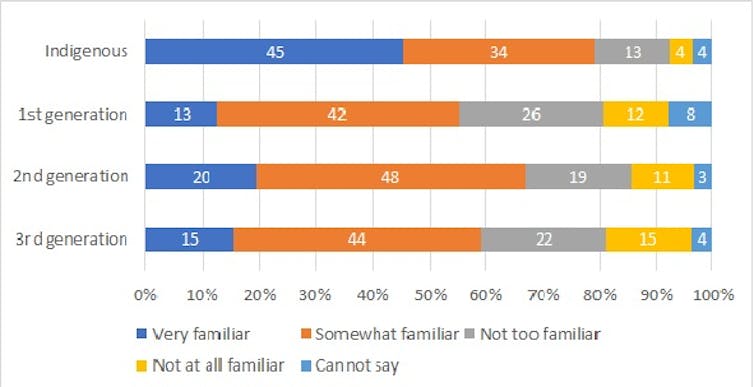
  1. How familiar do you feel you are with the history of Indian Residential Schools in Canada?
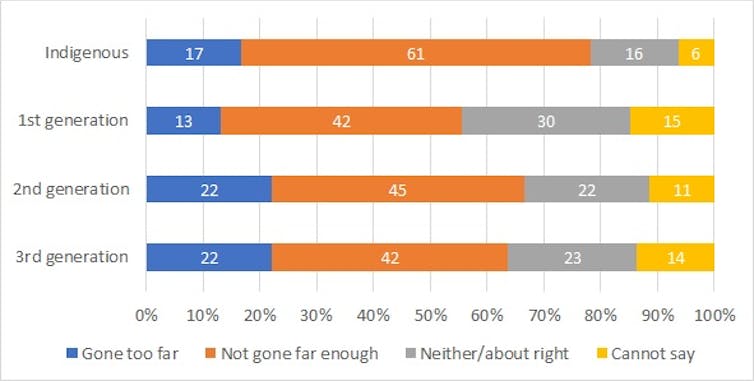
  2. In your opinion, have governments in Canada gone too far or have they not gone far enough in trying to advance reconciliation with Indigenous peoples?
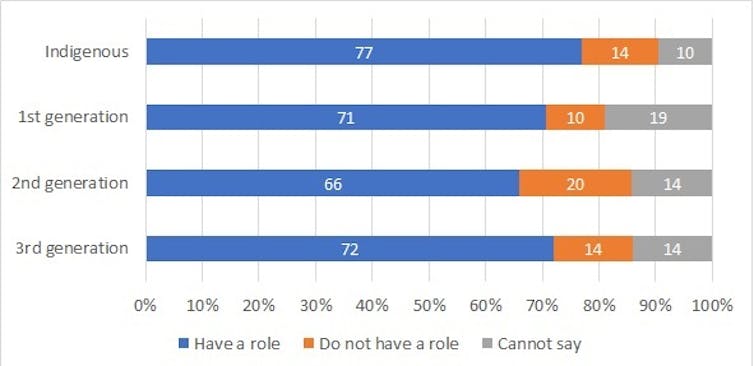
  3. Do you believe that individual Canadians do, or do not, have a role to play in efforts to bring about reconciliation between Indigenous and non-Indigenous people? 

The survey results generally show that, despite less familiarity or certainty about these issues among new immigrants compared to those born in Canada, they are more likely to support Indigenous Peoples.

Gap in knowledge

The survey shows a big gap between how familiar Indigenous Peoples and non-Indigenous people — both immigrants to Canada and non-immigrants — are with the history of Indian Residential schools.

The findings suggest first-generation immigrants are less likely than non-Indigenous Canadians to say they’re “very familiar” with this history, and are more likely to express no opinion.

These results indicate that first-generation immigrants don’t know as much as other Canadians about the history of Indian Schools in Canada. It is notable, however, that second-generation Canadians are more likely than third-generation Canadians to feel “very familiar” with the history of Indian Residential Schools.

A graph shows how familiar immigrants to Canada feel they are with the history of Indian Residential Schools in Canada compared to Indigenous Peoples.
A graph shows how familiar newcomers to Canada feel they are with the history of Indian Residential Schools in Canada compared to Indigenous Peoples. Author provided, Author provided

This lesser familiarity among first-generation immigrants, however, does not translate into lower support for efforts to advance reconciliation. 

Government response

This support is evident when they were asked about whether governments have gone too far, or not far enough, to advance reconciliation. 

The most striking difference — not surprisingly — is that Indigenous Peoples are much more likely than non-Indigenous Canadians to say that governments have failed to go far enough to advance reconciliation. 

But first-generation immigrants are just as likely to hold this view than second- or third-generation Canadians. First-generation immigrants are also less likely to say that governments have gone too far in their efforts to promote reconciliation — a result that’s significant when controlling for education (which is an important step since first-generation immigrants are more likely to be university-educated than the rest of the population). 

First-generation immigrants are also less likely to take a definitive position either way, and are more likely to say “neither” or “cannot say.”

A graph shows whether Canadians believe governments have gone far enough in trying to advance reconciliation with Indigenous Peoples.
A graph shows whether Canadians believe governments have gone far enough in trying to advance reconciliation with Indigenous Peoples. Author provided, Author provided

The role of Canadians

Similarly, Indigenous Peoples are unsurprisingly the most likely to say that individual Canadians have a role to play in reconciliation. 

But first-generation immigrants are just as likely as second- or third-generation Canadians to hold this view (although first-generation immigrants are also more likely to have no opinion on this question). 

A graph shows whether individual Canadians have a role to play to bring about reconciliation between Indigenous and non-Indigenous Peoples.
A graph shows whether individual Canadians have a role to play to bring about reconciliation between Indigenous and non-Indigenous Peoples. Author provided, Author provided

These results are encouraging because they suggest that even if immigrants aren’t socialized in Canada at a young age, that’s not an obstacle to building understanding and support for reconciliation. 

Indigenous support for immigration

Interestingly, the survey also allows us to explore the other side of the relationship between immigrants and Indigenous Peoples in Canada, namely support among Indigenous Peoples for immigration. 

This is a potentially contentious issue. On the one hand, diverse sources of immigration in the post-Second World War period have already disrupted the narrative of Canada as a nation of two founding peoples (British and French). That in turn suggests a view of Canada that is not only multicultural but multi-national, and inclusive of Indigenous Peoples and nations. 

In this sense, the interests of immigrants and Indigenous Peoples could be aligned. But at the same time, the ongoing arrival of newcomers can be seen as a continuation of the settler/colonization process. 

Thoughts on immigration

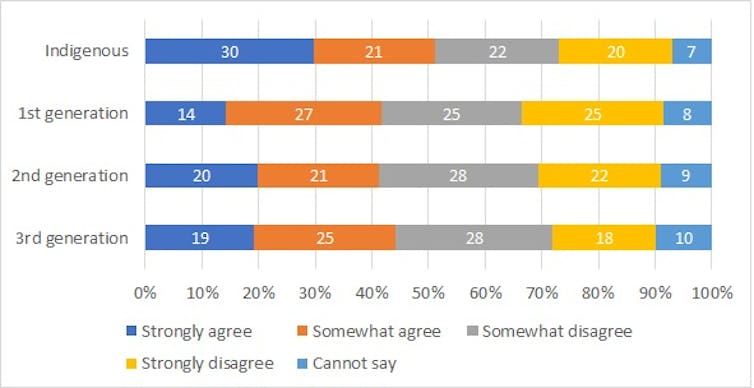
We can explore this issue by referring to a question in the survey asking Canadians whether they agree or disagree that “overall, there is too much immigration to Canada.” 

The results show that there are significant differences in attitudes about immigration between the general population and Indigenous Peoples. Thirty per cent of Indigenous peoples “strongly agree” with the statement, the highest proportion among all groups. 

A graph shows whether Canadians and Indigenous people believe there is too much immigration to Canada.
A graph shows whether Canadians and Indigenous people believe there is too much immigration to Canada.Author provided, Author provided

However, this general difference about immigration levels is driven in large part by the difference in views between Indigenous Peoples and first-generation immigrants. While Indigenous Peoples, compared to first-generation immigrants, are more likely to strongly agree than strongly disagree that there is too much immigration to Canada, there are no statistically significant differences between Indigenous Peoples and second- or third-generation Canadians.

This suggests that the key factor influencing attitudes towards immigration might not be Indigenous identity, but being born in Canada.

Nonetheless, this finding is important because it’s a reminder to proponents of more immigration that they should be open to and engage with Indigenous Peoples’ perspectives on this issue. Immigration, as a policy objective, should be pursued with an eye on how it might be perceived by those who were displaced by the earlier arrival of settlers.

Source: Newcomers to Canada are supportive of Indigenous Peoples and reconciliation