Nicolas: Ô Canada… quoi?

Of interest:

La star du R&B canadien Jully Black refusait de chanter l’Ô Canada dans des événements sportifs depuis déjà quelques années. En entrevue à la CBC, elle raconte avoir été profondément ébranlée par les nouvelles entourant la découverte présumée de tombes non identifiées d’enfants autochtones sur les terrains d’anciens pensionnats. Depuis, les mots ne venaient plus.

Le week-end dernier, elle a toutefois accepté d’interpréter l’hymne national pour un match des étoiles de la NBA… à sa façon. Plutôt que de prononcer les paroles anglaises habituelles « our home and native land » (« notre maison et terre natale ») , elle y est plutôt allée d’un « our home on native land » bien senti. Notre maison en terre autochtone. Il n’en a pas fallu plus pour que tout le pays réagisse.

D’un côté, sur les médias sociaux, son geste a suscité beaucoup d’admiration, notamment de plusieurs personnalités autochtones. De l’autre, des Canadiens très attachés à l’Ô Canada ont cru qu’elle avait outrepassé son rôle. La division dans les réactions n’est pas sans rappeler la tempête qu’a déclenchée le genou à terre de Colin Kaepernick en 2016. L’ex-joueur étoile de la NFL avait ainsi voulu attirer l’attention sur le problème de la brutalité policière aux États-Unis.

Sauf que nous ne sommes pas aux États-Unis. Et ici, l’hymne national a une histoire très particulière. On a presque envie de sourire devant un chroniqueur conservateur de Toronto qui croit qu’on ne peut pas toucher aux paroles de l’Ô Canada.

On a envie de lui rappeler que la musique originale est de Calixa Lavallée, et que le poème est d’Adolphe-Basile Routhier. Que l’hymne a été chanté pour la première fois le 24 juin 1880, pour les fêtes de la Saint-Jean-Baptiste. Que le mot « Canada », à l’époque, était encore largement synonyme du Canada français. Et que les traductions anglaises (oui, au pluriel — il y en a eu plusieurs) constituent déjà une forme de récupération politique d’un chant qui a été conçu pour parler de tout autre chose que ce qu’il représente aujourd’hui.

Au fond, le geste de Jully Black représente l’appropriation d’une appropriation d’une oeuvre. En en modifiant les paroles dans son interprétation, Black a posé un geste politique sur un chant dont la trajectoire est déjà liée intimement à l’évolution sociale du pays.

Ce n’est qu’en 1980, juste avant le rapatriement de la Constitution par Pierre Elliott Trudeau, que l’Ô Canada est devenu par loi l’hymne national du pays. Avant, des générations d’enfants avaient dû entonner God Save the Queen (ou King) dans les écoles du Dominion. Et en 2018, les paroles anglaises ont été modifiées par le Parlement, pour que le « true patriot love in all thy sons command » devienne un « true patriot love in all of us command », moins genré.

L’Ô Canada porte donc en lui les traces du nationalisme canadien-français du XIXe siècle, de l’autonomisation progressive du pays par rapport à l’Empire britannique au cours du XXe siècle, et de l’égalité des genres du XXIe siècle.

La réflexion sur la place des peuples autochtones au pays et sur l’histoire de la colonisation, qui a pourtant largement avancé dans les dernières années, se trouve encore absente du texte. Par son interprétation, Jully Black a repris une suggestion qui avait d’ailleurs été faite à maintes reprises auparavant, notamment sur nombre d’affiches dans les manifestations des dernières années.

Reste à savoir si, au-delà du moment viral, quelque chose de concret restera de son geste.
• • • • •
La réflexion ci-haut pourrait apparaître à première vue complètement futile. En effet, il y a mille et une crises urgentes dans le monde : un hymne national n’est certainement pas une priorité. Et même modifiées, les paroles d’un chant symbolique restent nécessairement symboliques. « Our home on native land » entonné avec la plus belle voix du monde ne fait absolument rien, concrètement, pour changer les rapports de force entre Autochtones et non-Autochtones au pays. On aurait raison, donc, de pointer du doigt les limites des discussions sur des sujets aussi complexes que la colonisation qui portent seulement sur des questions de représentations abstraites.

Ce qui est intéressant ici, c’est que le débat sur l’Ô Canada advient parce qu’il y a eu transformation — ou du moins, évolution — des mentalités canadiennes. C’est parce qu’il y a une réflexion de plus en plus répandue sur le rapport de l’État canadien à ses territoires que le geste de Jully Black trouve un écho. Ce qui est intéressant ici, c’est donc moins la modification des paroles elle-même que la manière dont elle résonne.

La politique québécoise a longtemps été principalement divisée entre souverainistes et fédéralistes. Et le « fédéralisme », dans ce contexte, sous-entendait une défense du statu quo.

Le Canada qui a organisé le love-in de 1995 était un Canada convaincu de ses propres vertu, grandeur et perfection. Pour bien des Canadiens, dont Black s’est en quelque sorte fait la voix le week-end dernier, ce Canada-là n’existe plus.

La critique du nationalisme canadien n’est plus, depuis plusieurs années déjà, une question politique qui émane presque exclusivement du Québec. Bien sûr, les peuples autochtones ont aussi critiqué le pays depuis sa fondation même. Mais il se trouve aussi maintenant de plus en plus d’alliés sensibilisés à ces perspectives qui utilisent leur voix (ici, littéralement) pour remettre en question des idées pourtant centrales à l’édifice idéologique sur lequel le Canada s’est construit.

Parfois, cette évolution politique s’exprime sous forme de débat sur les statues présentes dans l’espace public ou sur le nom d’un édifice. Maintenant, c’est de l’hymne national dont il est question. Mais l’important, dans ces moments d’éclat, ce n’est jamais la statue, l’édifice ou le chant. L’essentiel de l’affaire réside toujours dans le récit qu’on se raconte, comme société, pour faire corps.

Source: Ô Canada… quoi?

Ibbitson: Why should Sir John A. take all the blame for Canada’s injustices to Indigenous peoples?

Valid points:

In the latest indignity visited upon the memory of Canada’s first prime minister, Ottawa’s National Capital Commission has announced plansto substitute an Indigenous name for what is now the Sir John A. Macdonald Parkway.

Why does everyone pick on Sir John A. and not Sir Wilfrid?

Wilfrid Laurier, one of Canada’s most beloved prime ministers, expanded the residential-school system and suppressed a 1907 report that revealed the schools were cruel and unsafe. His interior minister, Clifford Sifton, dispossessed First Nations of their lands in order to promote settlement in the Prairies. His governments also blocked Black and Chinese immigrants from entering Canada.

But although Ryerson University has been renamed Toronto Metropolitan University on the grounds that Egerton Ryerson helped establish the residential-school system, Wilfrid Laurier University has no plans to change its name. Laurier streets across the nation remain untouched. Renaming Ottawa’s Chateau Laurier hotel is unthinkable.

Macdonald’s likeness has been banished from the 10-dollar bill, replaced by Viola Desmond. Laurier remains on the five.

Macdonald statues have been toppled or removed in Charlottetown, Montreal, Kingston, Hamilton, Regina, Victoria and elsewhere. But I can find no record of a Laurier statue being carted off to storage.

Tearing Indigenous children from their parents and forcing them to attend schools far from their communities, where they were subjected to disease, abuse and efforts at assimilation, and where some died, was an act of cultural genocide by our lights. But by the lights of both Macdonald and of Laurier – and, for that matter, of Robert Borden, Mackenzie King, R.B. Bennett, Louis St. Laurent, John Diefenbaker and Lester Pearson – it was sound policy. And newspapers across the land, including this one, agreed.

King’s governments deserve particular scrutiny. Not only did his administration maintain the residential-schools system, the King government in 1923 enacted legislation banning Chinese immigration. The act was rescinded in 1947 but King continued to maintain that “large-scale immigration from the Orient would change the fundamental composition of the Canadian population.” He also turned away Jews fleeing Europe on the St. Louis; an estimated 254 of its passengers later died at the hands of the Nazis. And his government dispossessed more than 21,000 Japanese Canadians during the Second World War.

Pierre Trudeau’s government began phasing out residential schools. But that same government produced a white paper under Indian Affairs minister (and future prime minister) Jean Chrétien that would have eliminated special status for First Nations, converted reserves into private property and wound down treaty rights. The government retreated in the face of First Nations outrage.

Injustice toward Indigenous peoples long predated Confederation and continues to this day. The record of racism toward non-European immigrants is lengthy and sordid. What makes Macdonald more culpable than the rest?

The answer could be that, as the first prime minister and a Father of Confederation, Macdonald personifies Canada. In pulling down his statue, some people are not simply protesting the legacy of residential schools – they are pulling down the symbol of an oppressive, colonizing state.

In that sense, to pull down a Macdonald statue is to pull down the statue of every prime minister and every leader who contributed to oppression of Indigenous peoples. And given what they’ve been put through, who could blame them?

But Macdonald and a handful of others also gave us Canada. They crafted a dominion unique in its balance of powers between federal and provincial, English and French. Immigrants from Britain and Eastern Europe came here. Italians and Portuguese and Chinese and South Asians and Filipinos came here. Muslims and Jews came here. Refugees came here, the latest from Afghanistan and Ukraine.

Canada is far from perfect, but it is arguably the least imperfect country on Earth, if the embrace of diversity is your measure.

There are lots of John A. Macdonald things in Ottawa. Replacing one of them with an Indigenous name won’t hurt anyone. Reconciliation will take time and be hard, but we must reach for it.

Let’s be careful, though. Sir John A. is part of who we are, good and bad. Let’s talk to each other about that. Talking is always better than tearing down.

Source: Why should Sir John A. take all the blame for Canada’s injustices to Indigenous peoples?

Métis Nation of Ontario to determine who is a Métis citizen with …

Of interest:

Métis Nation of Ontario members are voting to determine who the organization should recognize as a Métis citizen.

Some 28,000 members across the province are able to cast their “yes” or “no” vote in a plebiscite, as to whether or not the Métis Nation should continue to represent around 5,400 people with incomplete documentation about their ancestry.

In 2003, a landmark Supreme Court of Canada decision determined Métis people have rights under Section 35 of the Canadian Constitution, which pertains to Indigenous treaty rights.

Métis Nation of Ontario president Margaret Froh said that decision meant Métis people were recognized in the same way as First Nations and Inuit people.

In 1993, Ontario conservation officers charged Steve and Roddy Powley, both members of the Sault Ste. Marie Métis community, for harvesting a bull moose outside of the city.

The Supreme Court determined the Powleys could exercise a Métis, and Indigenous, right to hunt.

In 2019, that recognition from the Supreme Court of Canada led to the country’s first Métis self-government agreement.

With that recognition, Froh said it’s time for the Métis Nation of Ontario to take the next step.

“One of the very first things that any Indigenous people do when they are pushing for that recognition of their inherent rights is they determine who it is that they represent,” Froh said.

Source: Métis Nation of Ontario to determine who is a Métis citizen with …

Diversity lags in provincial and territorial legislatures but is improving

My latest analysis:

How does diversity in the provincial and territorial legislatures compare with diversity in the federal Parliament? Federal Parliament diversity has been tracked systematically since 1993 by Jerome Black, but little comparative analysis has taken place at the level of the legislatures. This analysis aims to fill that gap by contrasting the most recent elections with the previous ones for all provinces and territories, looking at the percentage of women, visible minorities and Indigenous Peoples elected among the total of 772 provincial and territorial legislature members.

Just as diversity in the federal Parliament has increased over time, the last two provincial/territorial election cycles have shown an increase in diversity in most legislatures.

For a benchmark, the percentage of visible-minority citizens from the 2021 census is used rather than the percentage of visible-minority residents. This narrow approach reflects the fact that only citizens can become members of legislatures, whereas the population approach recognizes that non-residents also participate in supporting candidates and political parties. For Canada, visible minority citizens make up 21.4 per cent of the total population, compared to 26.5 per cent for all visible minorities, but there is considerable variation among provinces.

Table 1 compares overall representation to citizens. Underrepresentation of women ranges from almost 30 per cent in Newfoundland and Labrador to only four per cent in Quebec. Underrepresentation of visible minorities ranges from nine per cent in British Columbia to around five per cent or less for other provinces. Nova Scotia is the only province with greater representation of visible minorities (seven per cent) than their share of the population, in part because of a significant African Nova Scotian population. Underrepresentation of Indigenous Peoples ranges from a high of 14 per cent in Saskatchewan to two per cent in Ontario, Quebec and Prince Edward Island, with only Nunavut, not surprisingly, having representation reflecting the population.

https://e.infogram.com/2023-01-griffith-figure-1-1hmr6g7r3vmpo6n?live?parent_url=https%3A%2F%2Fpolicyoptions.irpp.org%2Fmagazines%2Fjanuary-2023%2Fdiversity-lags-in-provincial-and-territorial-legislatures-but-is-improving%2F&src=embed#async_embed

Table 2 contrasts representation at both the member and cabinet levels, highlighting overall representation of women, visible minorities and Indigenous members. Given that governments often factor diversity into cabinet formation, the third set of columns assesses the degree that provincial and territorial governments have compensated for underrepresentation of their caucus. It is clearly the case with Alberta for both visible minorities and Indigenous members, and for Ontario in the case of visible minorities. It is striking that Saskatchewan and Manitoba cabinets have not done so for both visible minorities and Indigenous Peoples, whereas it is less surprising that Quebec has not done so for visible minorities.

https://e.infogram.com/2023-01-griffith-figure-2-1hnq410ejrv0k23?live?parent_url=https%3A%2F%2Fpolicyoptions.irpp.org%2Fmagazines%2Fjanuary-2023%2Fdiversity-lags-in-provincial-and-territorial-legislatures-but-is-improving%2F&src=embed#async_embed

Table 3 contrasts the most recent provincial and territorial elections with the previous election. Representation of women increased in all provinces save Alberta, Ontario, and Newfoundland and Labrador. Similarly, representation of visible minorities remained stable or increased in all provinces save Newfoundland and Labrador. However, Indigenous Peoples’ representation decreased or remained stable in all provinces save Manitoba, Newfoundland and Labrador, and The Northwest Territories.

https://e.infogram.com/2023-01-griffith-figure-3-1h984wor7jl9z6p?live?parent_url=https%3A%2F%2Fpolicyoptions.irpp.org%2Fmagazines%2Fjanuary-2023%2Fdiversity-lags-in-provincial-and-territorial-legislatures-but-is-improving%2F&src=embed#async_embed

Table 4 examines the intersectionality between gender and visible minorities. Visible minority women members made up a larger share of the total number of visible minority members than their respective non-visible minority counterparts, and by 9.5 per cent overall. Notable exceptions are Alberta, Saskatchewan and Yukon. (Provinces with no visible minority members are excluded.) In short, visible minority women were more likely to contribute to greater gender diversity in most provinces.

https://e.infogram.com/2023-01-griffith-figure-4-1h984wor7jeyd6p?live?parent_url=https%3A%2F%2Fpolicyoptions.irpp.org%2Fmagazines%2Fjanuary-2023%2Fdiversity-lags-in-provincial-and-territorial-legislatures-but-is-improving%2F&src=embed#async_embed

While there is no clear political alignment between parties at the provincial/territorial levels, table 5 attempts an approximate ideological lens between left-leaning, centrist and right-leaning parties. Left-leaning parties have the strongest representation of women, visible minorities and Indigenous Peoples followed by centrist parties for women and visible minorities. Right-leaning parties have lower representation for all groups save men.

https://e.infogram.com/2023-01-griffith-figure-5-1h9j6qgery0n54g?live?parent_url=https%3A%2F%2Fpolicyoptions.irpp.org%2Fmagazines%2Fjanuary-2023%2Fdiversity-lags-in-provincial-and-territorial-legislatures-but-is-improving%2F&src=embed#async_embed

Provincial and territorial legislatures, like the federal Parliament, have considerable underrepresentation of women, visible minorities and Indigenous Peoples with the exceptions noted above. In general, greater diversity can be found in parties leaning left compared to parties leaning right. However, compared with the previous election, representation is improving for women and visible minorities in most provinces and territories, with a more mixed record for Indigenous Peoples.

For the four largest provinces, Quebec has the least underrepresentation of visible minorities and Indigenous Peoples while British Columbia has greatest underrepresentation of visible minorities and Alberta has the greatest underrepresentation of Indigenous Peoples.

The 2021 census has highlighted an ongoing increase in immigrants and visible minorities. Parties at the provincial level, like their federal counterparts, are clearly taking this into account in their candidate selection and campaign strategies. The increase in representation, while uneven and partially dependent on which party wins an election, indicates the degree to which this is so.

Methodology

Women, visible minorities and Indigenous Peoples are identified through name, photo and biographical analysis. MLA lists come from provincial and territorial election organizations and legislatures. 

For the ideological lens, we classified parties as follows, recognizing that there is considerable variation among the provinces:

Left-leaning: NDP, Québec solidaire, Parti québécois, Green

Centrist: Liberal, Independent Liberal, Independent

Right-leaning: Conservative, CAQ, UCP, Saskatchewan Party, B.C. Liberal (now B.C. United), People’s Alliance

Source: Diversity lags in provincial and territorial legislatures but is improving

Order of Canada 2013-22 Diversity Analysis

For the last ten years, I have been tracking the diversity of Order of Canada appointments, from the perspective of gender, visible minorities and Indigenous peoples, along with regional and occupational backgrounds.

In many ways, these appointments are emblematic of other recognition and award programs in that they generally reflect the views and perspectives of those nominating and, in the case of the Order, a medium and longer-term track record and contribution in contrast to awards programs focussed on new talent.

In many ways, this results in an understandable backward looking perspective. Moreover, unlike employment equity programs where managers are empowered to factor diversity in hiring and promotion decisions, awards programs have less latitude to do so as they have to make their assessments based upon the nominations received.

The Governor General’s Office has over the years made several attempts to encourage more diverse nominations, including funding under the Conservative Government in 2015 to encourage more nominations for more business and regional nominees. The data suggests that these efforts had limited effect in the longer term.

The most striking findings of this analysis are that women appointees average around one third of the total, ranging from a low of 29 percent (2019, 2022) to a high of 46 percent in 2015 and visible minority appointees have increased from a low of 4 percent in 2014 to an exceptional high of 13 percent in 2021 before reverting to a more typical 7 percent. The two groups that are over-represented in comparison of their share of the population are men and, more recently, Indigenous peoples in 2021 and 2022 at eight percent.

Of note, while visible minority appointments are 71 percent men, Indigenous peoples appointments are equally balanced between men and women.

Occupation data ranges from categories that are clear such as arts, health and sports, and those that have less clear “boundaries” such as business and philanthropy and I have tried to be as consistent as possible.

Advisory council correction.

For those interested in the nomination process and the review committee the links are: Nominate someone, Advisory Council. The Advisory Council has gender balance, 20 percent visible minorities and 10 percent Indigenous. In terms of the Office of the Governor General (the public servants) which review nominations for the Advisory Council, 14.9 percent are visible minorities with the number of Indigenous public servants is 5 or less (out of a total of 141).

ICYMI: Is the Art World Entering the Age of ‘Anti-Woke’ Backlash? Here’s …

Of interest, particularly in the context of the National Gallery of Canada controversy:

We are in a backlash period—or, at least, the early stages of it, with new consensus about the “excesses” of the social justice movements of the past few years percolating through the discourse. Whether this backlash will look like previous ones is what I have been asked to comment on in this article.

The nostalgia cycle is about 30 years—long enough for the past to feel fresh again as a new generation ages (hence: That ‘90s Show). There is also an edgier kind of political nostalgia cycle. Contemporary debates about representation in the museum are experienced as a repeat of debates over “multiculturalism” from the 1990s, themselves experienced as a return to the combative confrontations of the 1960s. Indeed, so much of the politics of the present feels like a kind of replay of the ‘90s—alt-right “culture wars” as an even darker reboot of Pat Buchanan’s classic ‘90s version; the debates over “wokeness” replaying early-‘90s panics over “political correctness,” etc.

The Trump administration touched off dramatic debates, changing the texture of the conversation within the U.S. art world. Blue-chip galleries added Black artists to their programs, important overlooked female artists have been rediscovered at a brisk clip, museums shook up their schedules, and biennials reversed polarities so that the once-drastically overrepresented white Euro-American male demographic has been rendered a near non-presence in almost every such recent survey, from New York to New Orleans, and from Arkansas to Italy.
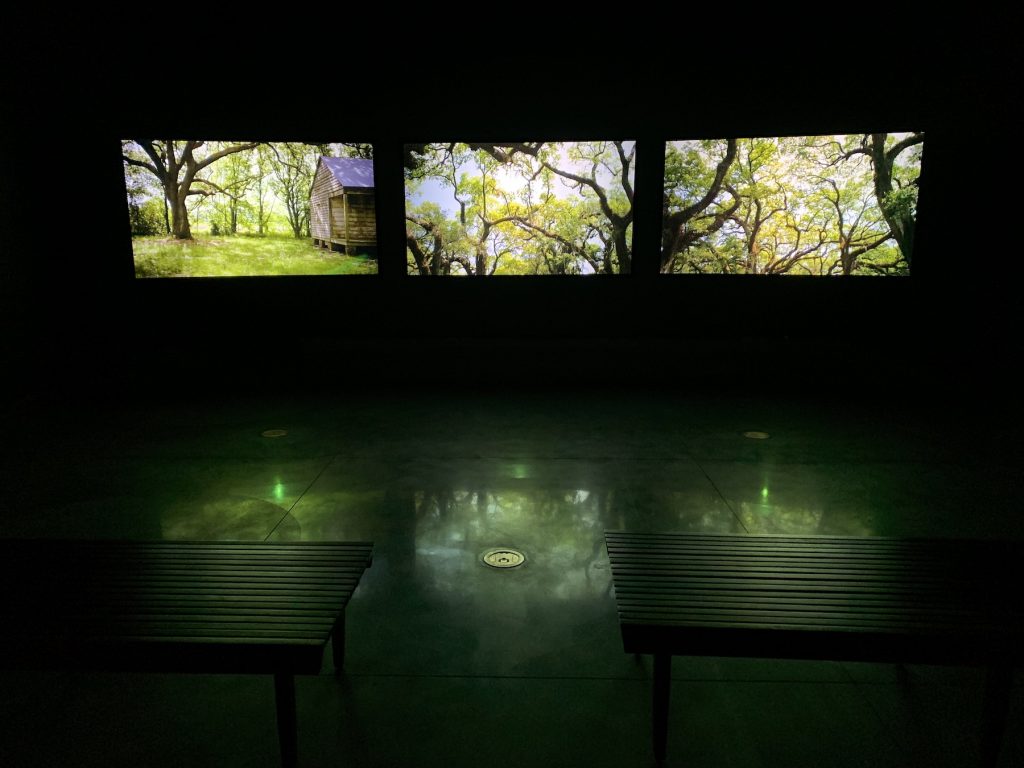
Video by Dawoud Bey at the Historic New Orleans Collection. Photo by Ben Davis.

Video by Dawoud Bey at the Historic New Orleans Collection during Prospect New Orleans. Photo by Ben Davis.

Yet from the beginning, all this has been haunted by an awareness that backlash is incoming. For art observers looking at the intense focus on identity in recent biennials, the obvious reference is the 1993 Whitney Biennial, the so-called “identity politics biennial” (in fact, the recent 2022 Whitney Biennial self-consciously returned to many of the artists from 1993). This event remains a touchstone, having surfaced a large number of non-white, queer, and feminist voices. The ’93 biennial caught the angry zeitgeist of a liberal art world at the end of 12 years of Reaganite rule, in the wake of the most intense period of the AIDS crisis and the ‘92 conflagration in L.A. (VHS footage of Rodney King being beaten by the LAPD was included in the show.)

It was a watershed. But it was also a high-water mark, signaling the inflection point after which backlash officially took the wheel.

The ’93 biennial was panned by critics. Conceptual artist Daniel J. Martinez produced a series of pins given to Whitney visitors that read “I Can’t Imagine Ever Wanting to Be White.” In Who We Be, Jeff Chang’s history of the rise and cooption of multiculturalism, he quotes Martinez on what came next: “’93 was the last shot of the war. We lost right at the moment we thought we were winning.” Coco Fusco, another star of that show, remembered recently the shift that marked the second half of the decade: “In the art world of the late ‘90s and early ‘00s there was a shift away from the moral argument about empowerment and civil rights, which was widespread in the 1980s and early ‘90s, to an emphasis on visual talent and success.”

Daniel Joseph Martinez created these entry badges for the Whitney Museum of American Art's 1993 biennial exhibition.

Daniel Joseph Martinez created these entry badges for the Whitney Museum of American Art’s 1993 biennial exhibition.
Photo courtesy the artist and Simon Preston Gallery, New York.

What can we learn from this moment? How is today different or the same?

An uncomfortable fact is that periods of advance tend to coincide with moments when the kinds of cultural liberals who make up the base of the art world feel that they are in crisis, politically. The spectacle of conservatives in power puts more pressure on culture, as rage at political disempowerment is channeled into gestures of cultural activism and symbolic atonement. The ’90s wave came out of the anger with Reagan and Bush, just as the recent climate grew out of reaction to Trump’s election. (There was some of this vibe under Bush II, but 9/11 and the Iraq War really defined the politics of that period in a different way.)

Conversely, while it flatters the liberal art world to focus on right-wing culture warriors as the driver of regression, it was actually Bill Clinton’s ascent to power in 1992 that was the harbinger of the quietist turn in 1990s cultural discourse. He and the Democratic Leadership Council had made it their mission to represent the Democratic party as pro-business, distancing it from unions and social movements. Toni Morrison may have quipped that Clinton was “the first Black president” in the New Yorker, but during the campaign, Clinton staged his own version of the “culture wars” on Democratic party terrain, deliberately baiting Jesse Jackson into a battle over rapper Sister Souljah and making a big show of condemning “anti-white” rhetoric to prove that he was the safe hand for mainstream (read: white, pro-business, and business-as-usual) America.

As a parallel, more recent talk of a “vibe shift” in culture following the #Resistance moment coincides with the election of Joe Biden, who literally promised on the campaign trail that, were you to elect him, you wouldn’t have to think about politics too much anymore. “The 2010s were such a politicized decade that I think the desire people have to be less constrained by political considerations makes a lot of sense,” Sean Monahan, whose blog 8Ball touched off the “vibe shift” talk, told New York Magazine.
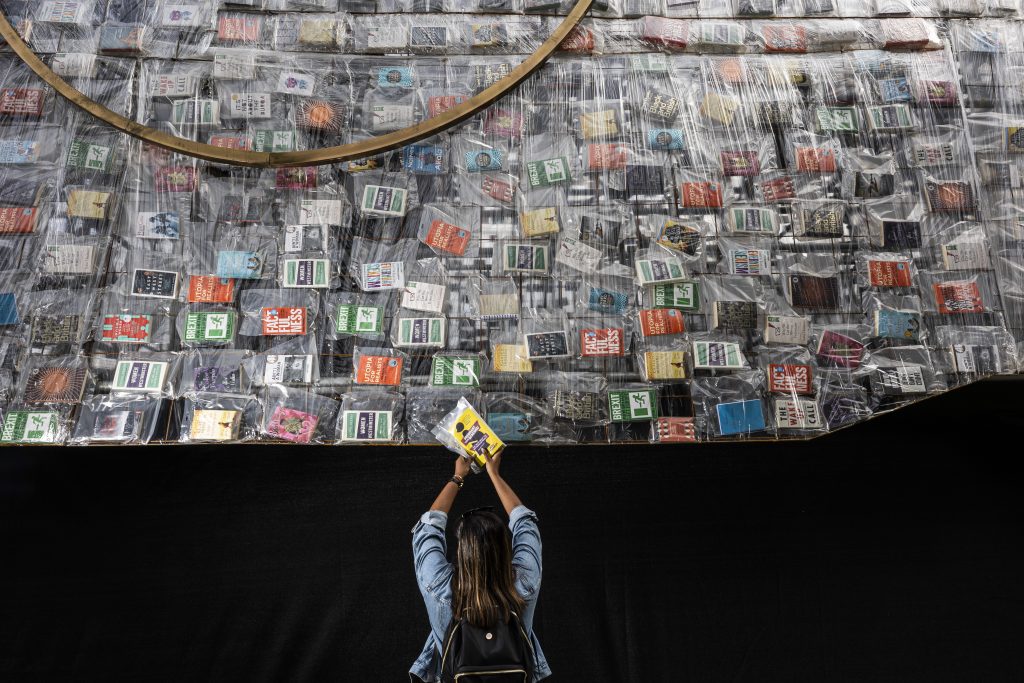
Claire Govender adds the 20,000th book to "Ben Ben Lying Down with Political Books" by Marta Minujin, Photo: Fabio De Paola/PA Wire.

Claire Govender adds the 20,000th book to “Ben Ben Lying Down with Political Books” by Marta Minujin, Photo: Fabio De Paola/PA Wire.

The Burns Halperin Report shows just how vulnerable to rollback recent advances in representation may be. Permanent collections, they show, are not so deeply affected by the social justice zeitgeist—indeed, they are little affected (although contemporary museums seem to be making solid progress towards gender parity in collecting, at least). As one mechanism for this inertia, the report points to the fact that 60 percent of the objects that enter museum collections come from gifts or bequests; these, in turn, presumably form the basis of exhibition programs. Among other things, the blockage thereby represents the embedded malaise and biases of wealth, and its accumulated power (a point theorist Nizan Shaked also argues in her important treatise from this year, Museums and Wealth).

Researching the 1990s backlash, I found this quote from David Lang, the cofounder of the Bang on a Can festival: “If you’re giving an organization $10,000, you can say, ‘In return to that we expect you to have a social face.’ If you’re cutting them from $10,000 to $1,000, you can’t say, ‘Oh by the way for this $1,000 we’d like you to change your organization.’” Lang was speaking about how arts funding cuts took the wind out of the sails of diversification efforts in the mid-‘90s, but the line could also apply to the contemporary challenge of turning arts institutions around despite the considerable reputational and commercial incentives to do so. Compared to the 1990s, even big museums today are actually much more crisis-ridden, symbolized by the last year of protests and strikes over barely livable conditions for ordinary staff.

Without money behind social justice demands, you are left with fleeting gestures and moralistic browbeating, ultimately preparing the ground for cynicism and backlash.

The United States is much less white than it was in 1990s, meaning there is more of a self-interested business case for institutions to change. But on the other hand, inequality is much worse than in the 1990s. Private wealth has today accumulated much more power and is thus even more arrogantly disconnected from the experiences of ordinary people and convinced of its own rightness. How these two dynamics interact is going to shape what the future of what museums look like. My feeling is that they point to an intensified fragmentation of the arts rather than a return to the ideological status quo.

The long-term movement towards a more diverse country is a fact. Even if you are very cynical, it is not impossible to think that bequest patterns will evolve, with a time lag to account for changing generational sensibilities. Since the huge Black Lives Matter protests of 2020, it does feel as if diverse cultural consumption has been firmly established as a virtue for high-status individuals (whether it is embedded remains to be seen).

Last year’s strange, guilt-ridden Sex in the City reboot, And Just Like That…, had the merit of unintentionally underlining this newly mainstream mindset for premium cable consumers. Erstwhile gallery owner Charlotte proves her good ally status—and relieves the anxiety she and her husband Harry feel at a dinner where they are the only white people—when she explains to her friend’s critical mom that the Black artists her daughter collects are truly investment quality (including “an early Derrick Adams!”)

Still, there is a very real limit to guilting patrons into “Doing Better” on voluntaristic moral grounds. It alienates as many would-be patrons as it moves.

Burns and Halperin write, “At the current rate of change, it may be a simpler task to build entirely new museums and market structures than to create the necessary change within the existing systems.” Melissa Smith has reported on one of the most intriguing developments of the past years: Black artists, experiencing an unprecedented market windfall, are putting funds into building up their own alternative institutions, from Titus Kaphar’s NXTHVN to residencies from Derrick Adamsand Mcarthur Binion.

But alternative institution-building is also happening on a much bigger scale—and it is not necessarily progressive. As Georgina Adam writes in her recent book The Rise and Rise of the Private Art Museum, the major trend of the past decade around the world has been stagnation in public museums, and the parallel creation of new personal founder-driven museums (the so-called “ego-seum”), born out of “a distrust of public institutions, and in some cases more problematic aims: self-aggrandizement, hyping the value of their collection, getting better access to desirable art and getting whopping tax breaks.”

Here’s a case study for the limits of the moral appeal to patrons in an age of runaway inequality. Back in 2008, billionaire Eli Broad first backed L.A. MOCA when it needed a bailout, prompting fears, from New York Timescritic Roberta Smith, that he would merge “the museum’s exemplary collection of art with his own, more predictable, market-driven one.” That turned out not to be what happened at all. After debates over the museum’s direction, Broad simply withdrew from supporting L.A. MOCA to build his own glitzy Broad Museum across the street—with free admission and Jeff Koonses galore.
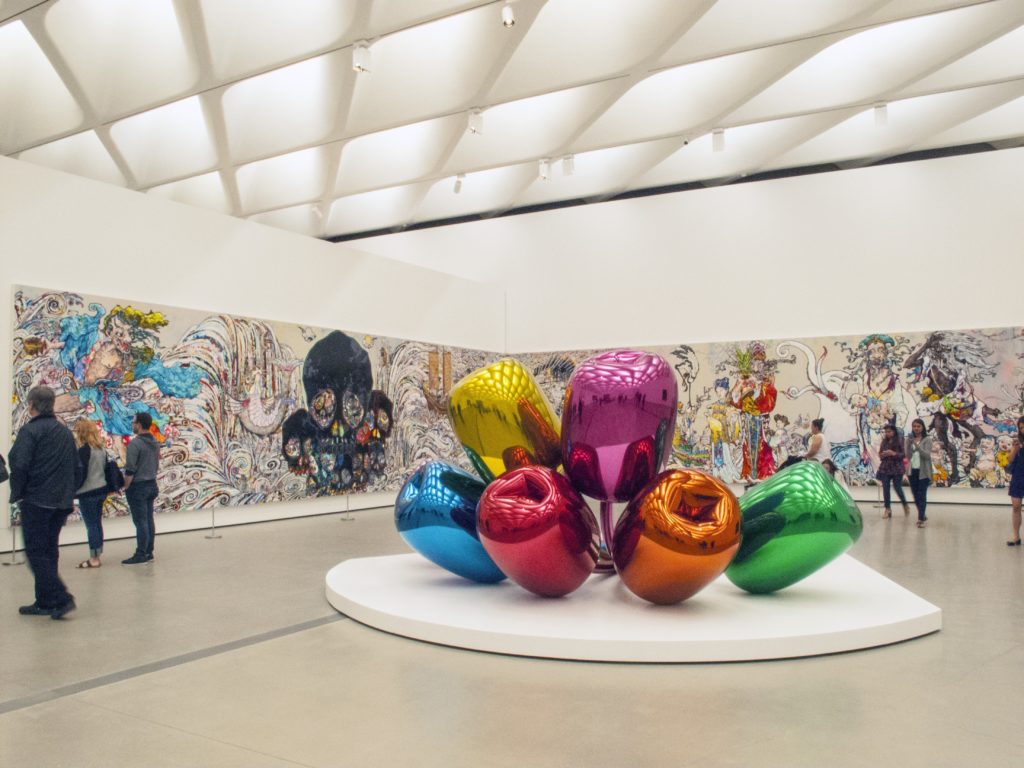
Jeff Koons’s tulips sculpture at the Broad. Photo by Santi Visalli/Getty Images.

The new political demands on culture from one direction are likely to produce new cultural moves that are equally unprecedented in the other. Until very recently, you used to be able to assume that Silicon Valley was a lock for liberals. But the kinds of new tech fortunes that the art industry has been unsuccessfully courting for over a decade—the bulk of new wealth creation, before the recent tech downturn—now seem to be flirting with reaction. In opposition to the Bernie Sanders-style social-democratic wave, Black Lives Matter, and #MeToo, techie libertarianism seems to be mutating into a turbo-charged Nietzschean neo-monarchism, militantly hostile to traditional liberal institutions, creating a new political bloc with the alt-right trolls.

Contemporary cultural backlash may not look like a return to a cozy, oblivious cultural center. It may take its cues more from Elon Musk buying Twitter to “defeat the woke mind virus” or Peter Thiel funding an “anti-woke” downtown film festival out of his pocket change.

When art observers think of backlash in the 1990s, they often think of the 1995 Whitney Biennial. It is often considered a “return to beauty” biennial, where representation snapped back towards the historical norms after the aberration of ‘93. The Guerrilla Girls printed fliers and posters summing up the feeling, declaring ironically, “Traditional Values and Quality Return to the Whitey [sic] Museum.”
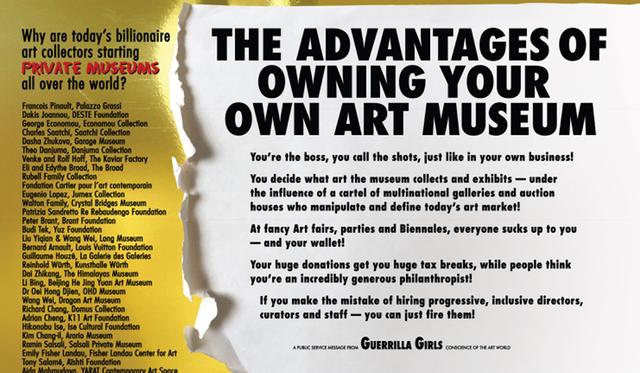
A translation of the Guerrilla Girls’ banner. Photo: Courtesy Guerrilla Girls.

But the more relevant example of culture-wars backlash for today possibly came one year later: the 1996 founding of Fox News. Its boss Roger Ailes had served as a media guru to George H.W. Bush in the period of the infamous, race-baiting Willie Horton ad. He officially ejected himself from politics after Bush’s defeat in the 1992 election. And yet, all that reactionary political energy, instead of being neutralized, deflected into the cultural sphere. In Fox News, Ailes masterminded the creation of a free-standing ideological universe, one that openly challenged the idea that you could assume a mainstream “liberal media bias.” We know what its effects have been.

Given this potential shape of backlash and the structural flaws at the heart of the traditional art system, where to look for hope for real progress? I’ll give the last word to Cornell West. In his 1990 essay on “The New Cultural Politics of Difference,” West described the “double bind” of cultural producers within academia and museums, critical of institutions that they were nevertheless materially dependent on.

I think invoking it here is the opposite of nostalgia—it may be even more apt in the 2020s than it was in 1990s:

Without social movement or political pressure from outside these institutions… transformation degenerates into mere accommodation or sheer stagnation, and the role of the “coopted progressive”—no matter how fervent one’s subversive rhetoric—is rendered more difficult. In this sense there can be no artistic breakthrough or social progress without some form of crisis in civilization—a crisis usually generated by organizations or collectivities that convince ordinary people to put their bodies and lives on the line. There is, of course, no guarantee that such pressure will yield the result one wants, but there is a guarantee that the status quo will remain or regress if no pressure is applied at all.

Source: Is the Art World Entering the Age of ‘Anti-Woke’ Backlash? Here’s …

Native Americans recall torture, hatred at boarding schools

As in Canada:

After her mother died when Rosalie Whirlwind Soldier was just four years old, she was put into a Native American boarding school in South Dakota and told her native Lakota language was “devil’s speak.”

She recalls being locked in a basement at St. Francis Indian Mission School for weeks as punishment for breaking the school’s strict rules. Her long braids were shorn in a deliberate effort to stamp out her cultural identify. And when she broke her leg in an accident, Whirlwind Soldier said she received shoddy care leaving her with pain and a limp that still hobbles her decades later.

“I thought there was no God, just torture and hatred,” Whirlwind Soldier testified during a Saturday event on the Rosebud Sioux Reservation led by U.S. Interior Secretary Deb Haaland, as the agency confronts the bitter legacy of a boarding school system that operated in the U.S. for more than a century.

Now 78 and still living on the reservation, Whirlwind Soldier said she was airing her horrific experiences in hopes of finally getting past them.

“The only thing they didn’t do was put us in (an oven) and gas us,” she said, comparing the treatment of Native Americans in the U.S. in the 19th and 20th centuries to the Jewish Holocaust during World War II.

“But I let it go,” she later added. “I’m going to make it.”

Saturday’s event was the third in Haaland’s yearlong “Road to Healing” initiative for victims of abuse at government-backed boarding schools, after previous stops in Oklahoma and Michigan.

Starting with the Indian Civilization Act of 1819, the U.S. enacted laws and policies to establish and support the schools. The stated goal was to “civilize” Native Americans, Alaska Natives and Native Hawaiians, but that was often carried out through abusive practices. Religious and private institutions that ran many of the schools received federal funding and were willing partners.

Most closed their doors long ago and none still exist to strip students of their identities. But some, including St. Francis, still function as schools — albeit with drastically different missions that celebrate the cultural backgrounds of their Native students.

Former St. Francis student Ruby Left Hand Bull Sanchez traveled hundreds of miles from Denver to attend Saturday’s meeting. She cried as she recalled almost being killed as a child when a nun stuffed lye soap down her throat in response to Sanchez praying in her native language.

“I want the world to know,” she said.

Accompanying Haaland was Wizipan Garriott, a Rosebud Sioux member and principal deputy assistant secretary for Indian affairs. Garriott described how boarding schools were part of a long history of injustices against his people that began with the widespread extermination of their main food source — bison, also known as buffalo.

“First they took our buffalo. Then our land was taken, then our children, and then our traditional form of religion, spiritual practices,” he said. “It’s important to remember that we Lakota and other Indigenous people are still here. We can go through anything.”

The first volume of an investigative report released by the Interior Department in May identified more than boarding 400 schools that the federal government supported beginning in the late 19th century and continuing well into the 1960s. It also found at least 500 children died at some of the schools, though that number is expected to increase dramatically as research continues.

The National Native American Boarding School Healing Coalition says it’s tallied about 100 more schools not on the government list that were run by groups such as churches.

“They all had the same missions, the same goals: ‘Kill the Indian, save the man,’” said Lacey Kinnart, who works for the Minnesota-based coalition. For Native American children, Kinnart said the intention was “to assimilate them and steal everything Indian out of them except their blood, make them despise who they are, their culture, and forget their language.”

South Dakota had 31 of the schools including two on the Rosebud Sioux Reservation — St. Francis and the Rosebud Agency Boarding and Day School.

The Rosebud Agency school, in Mission, operated through at least 1951 on a site now home to Sinte Gleska University, where Saturday’s meeting happened.

All that remains of the boarding school is a gutted-out building that used to house the dining hall, according to tribal members. When the building caught fire about five years ago, former student Patti Romero, 73, said she and others were on hand to cheer its destruction.

“No more worms in the chili,” said Romero, who attended the school from ages 6 to 15 and said the food was sometimes infested.

A second report is pending in the investigation into the schools launched by Haaland, herself a Laguna Pueblo from New Mexico and the first Native American cabinet secretary. It will cover burial sites, the schools’ impact on Indigenous communities and also try to account for federal funds spent on the troubled program.

Congress is considering a bill to create a boarding school “truth and healing commission,” similar to one established in Canada in 2008. It would have a broader scope than the Interior Department’s investigation into federally run boarding schools and subpoena power, if passed.

Source: Native Americans recall torture, hatred at boarding schools

Canada’s Governor General to speak about immigration and reconciliation at event in Calgary

Of note:
Canada’s Governor General will speak at an event in Calgary on Thursday about the complex relationship between immigration and reconciliation.
Calgary was chosen as the location for this year’s LaFontaine-Baldwin Lecture, hosted by the Institute for Canadian Citizenship (ICC), because of the city’s exceptional work connecting Indigenous people and newcomers, said the ICC’s CEO Daniel Bernhard.

Source: Canada’s Governor General to speak about immigration and reconciliation at event in Calgary

New immigrants to Canada are building bridges with Indigenous Peoples. Here’s why that matters

Small scale and personal, along with a mix of practical and woke:

At the South Vancouver Neighbourhood House, Indigenous Elders Al Houston and Travis Angus are taking centre stage.

The pair walk into the full meeting room and smudge it, with the ritual burning of sacred plants.

“If we’re going to listen to one another, we’re going to be able to keep going forward,” Houston, president of the Greater Vancouver Native Cultural Society, tells those in attendance. “Your perfect example is right here in front of you. You’re asking questions and we are responding.”

Their audience at the community hub is a couple of dozen eager newcomers from Afghanistan, Egypt, Hong Kong, Nepal and the Philippines, who sit in a circle.

For the new immigrants, this “info and orientation circle” is their first look at the Indigenous past of the land where they have just settled.

For Houston, an Ojibwe Cree, and Angus of the Nisga’a Nation, this community program, The First Nations of Canada, is part of the mending of a broken relationship.

It is an example of reconciliation at its most essential, person-to-person level. For both communities, Indigenous Peoples and newcomers, it is uncharted territory.

Generations of immigrants settling in Canada have been kept away from the country’s horrific Indigenous history. For generations, Indigenous communities have been blamed by those unfamiliar with the history of this land for their social ills, whether it’s their poverty, substance abuse, health or relationship issues.

That distrust is often mutual. Some in the Indigenous communities view immigrants as continuing the relentless colonization of their ancestral lands.

But recent years, in the wake of the racial reckoning that made headlines in 2020 and the shock over the discovery of probable unmarked graves near residential school sites, have spurred the interest in relationship building with Indigenous people among new immigrants, the latest wave of settlers if not colonists.

“It’s kind of a watershed moment,” said Antje Ellermann, founding director of the University of British Columbia’s Centre for Migration Studies. “A lot of things are coming together. I’m hoping that and I do think that there will be a real generational difference.

“There is a lot of positive energy coming from newcomers, and openness and less defensiveness, because they don’t have family going back generations with that kind of pioneer spirit.”

And Vancouver — the unceded territory of the Musqueam, Squamish or Tsleil-Waututh peoples — seems to be leading the way.

Elders Houston and Angus both sit on the Indigenous Advisory Council at the South Vancouver Neighbourhood House and facilitate the orientation circle with newcomers, where they go over cultural practices and the travesties, such as residential schools, faced by Indigenous people in Canada.

“Let’s talk protocol,” Houston said. “In our culture, we can appreciate the applause, but technically in our culture we don’t like to clap because the spirits are awakened.” In the evening, whistling is also avoided, for the same reason.

Much of these teachings, he said, are passed down from Elders, but much of this culture was lost, due to the residential school system.

He tells bits of his own personal history, starting with his mother’s stay in a residential school and his own situation of being taken from his mother during the Sixties Scoop.

It was supposed to be for a short period while she dealt with her own challenges from her time in residential school, but Houston said the ordeal lasted years. Authorities told both the children and the mother they each did not want to be reunited. He did not see his mother again until she showed up at his hospital bed after he’d been hit by a car.

The accident made the newspaper and was the only reason his mother knew where to find him.

Silence settles down over the circle of chairs in the room.

“I looked at her and said, ‘I’ve waited all my life for this day to happen,’ ” said Houston. “That was the relationship rekindled right there because of the hope we never let go of.”

It used to make the 44-year-old man angry when he saw other Canadians taking more interest in newcomers and their culture than the issues faced by the first people on this land.

“We’ve become a minority in our own country. There’s still that stigma of First Nations that we’ve lived through,” noted Houston, who has become a regular guest in community events to talk about residential schools, history and cultures.

“People now are seeking us out. It never used to be like that. It’s a great feeling. Now we are getting a lot of compassion. People are wanting to understand and ask, ‘How can we help?’ ”


Toronto Metropolitan University geography professor Harald Bauder, himself an immigrant from Germany, has published numerous papers about immigration, settlement, colonialism and indigeneity.

He said he’s surprised immigration policy has garnered little attention within the Indigenous communities.

Among the 94 recommendations by the Truth and Reconciliation Commission, the last two address “newcomers to Canada” — revising the citizenship study guide and test to include more Indigenous content, and updating the oath of citizenship to observe treaties with Indigenous Peoples — and none deals with immigration policy.

“To me, as an immigration researcher, this is a core issue because immigration policy and selection is what has led to the conflict that we’re dealing with in settlement and colonialism to begin with,” he said. “Without immigration, you wouldn’t have settler colonialism. So why is the underlying force always just an afterthought?”

Bauder said immigrants and Indigenous people can forge great alliances with their respective experiences of colonization. While not every newcomer is a colonist, he adds, many themselves have lived the colonial legacies or have been displaced and oppressed due to their race and ethnicity.

“There’s a great deal of potential to forge alliances and I think there are some alliances being forged already in some cases.”

Born and raised in East Vancouver, Norm Leech has ancestry in the T’it’q’et community of the St’at’imc Nation and has been a frequent speaker on the Indigenous experience with colonization.

He likes to start his talk with the land acknowledgment because the land is a “relative” and “ancestor” that came before all humans and has provided people with everything. In his presentation, he always stresses the need to care for the land just like their kin.

He explains how that relationship with the land has been disrupted by colonization and replaced by systems that reduced it to property to be owned and abused.

“Colonization teaches us that we only have five senses,” said Leech. “We know we have a sense of connection to our land. We have a sense of connection to our ancestors. We have a sense of connection to our family. We know we are connected to everything, everywhere, all the time.

“We are absolutely part of this planet and everything on it. We are not separate at all. To be separate is essentially the roots of western philosophy … We’re in this colonized system that separates us and divides us and isolates us and tells us you’re alone.”

Leech said many immigrants come from places with a much longer history of colonization than Canada, suffering different forms of “intergenerational trauma,” and his workshop attempts to help participants re-imagine their relationship with the land and relating to one another before colonists came.

“The more we can have the conversation, extend and magnify the conversation, the better. Immigrants are going to be our greatest pool of allies once we make them understand we’re not their enemies.”

Binish Ahmed was 11 when she and her family fled to Canada in the 1990s from Kashmir, a disputed region under the control of India, Pakistan and China ever since the partition of India in 1947, when British colonial rule ended.

An Indigenous Kashmiri, the Toronto Metropolitan University doctoral student says foreign powers seized the land of her people and still oppress them under their rules, much like what happened to the Indigenous people in North America and around the world.

“I did not voluntarily want to come here as a kid,” said Ahmed, who lives in Toronto. “I wanted to stay with my relatives, with my cousins, with my friends on my land. My land is very sacred to me. I love the smell of my land, I love the birds, the bees, the flowers, the lakes, the mountains.

“We consider ourselves gardeners. In our language, the land is called ‘mouj Kasheer,’ which means ‘mother Kashmir.’ We feel pride and a sense of fulfilment in caring for Mother Earth.”

It was around 2010 when Ahmed, then a university student, saw smudging performed at an equity conference in Toronto. It reminded her of “isband,” a similar ceremony in her own culture.

Ahmed began reading about Indigenous history, culture and traditions, and contacting Indigenous leaders and activists. That inspired her to pursue a doctoral degree in Indigenous governance and policy, immigration and migration, anti-racism and anti-colonial practice.

In her activism, she and friends always take a stand for their Indigenous kins in Canada.

There’s a lot of self-education required of new immigrants, said Ahmed, especially those who come from a privileged background, who can’t expect the Indigenous community to teach them.

“My responsibility here is to be in good relations with people whose land I’m on. What immigrants and newcomers should do is learn about the campaigns that are led by Indigenous Peoples themselves and lend your support,” she said. “We don’t have to come up with something new.”


The Punjabi word for Indigenous people — “tiake,” which means a relation of my father’s older brother — was originally coined in small towns in B.C., where a lot of Indigenous people and Punjabi migrants worked in lumber mills.

To Vancouver-based activist Harsha Walia, the hundred-year-old word that is now in the Punjabi language expresses the relationship with Indigenous Peoples.

“Those are the kinds of historic alliances and solidarities and relationships and kinship that I think we have to actively work to unearth because they’ve been buried,” said Walia, who came to Canada in the 1990s as an international student.

Born in Bahrain to Punjabi parents, Walia has been involved in grassroots immigrant rights, migrant justice and social movements, but soon decided it’s not enough just to fight for citizenship rights for immigrants and refugees.

“That anti-racist fight cannot erase settler colonialism,” Walia explained. “It cannot erase the realities of genocide against Indigenous Peoples. The home that I am building is built on top of the home of other peoples. It is built on the dispossession of other peoples. The safety and the life that I am seeking for myself and for my family cannot be built on the ruins of other people.

“That is part of the ethical orientation that compels me to be in relationship to Indigenous Peoples fighting for their homes, fighting for their homelands, fighting for clean water and the right not to be dispossessed.”

But there is so much learning to do in the process.

Walia remembers joining others in an Indigenous land blockade in Ontario and offering her service along with other non-Indigenous supporters. They showed up in the community kitchen and worked there but soon sensed that it wasn’t received well.

“We just thought to ask, ‘Should we be somewhere else?’ In that instance, we got the feedback that us being there was displacing some Indigenous people who took their role in their kitchen and in serving food and providing for the front line seriously,” she recalled.

“And that was really eye-opening. We thought ‘we’re going with good intentions,’ ” she said, adding that solidarity is “going to look different in each context. Always being humble, never assuming.”

Elder Angus, whose traditional name is Niis Miou, says neighbours in the Little India area of Vancouver were not friendly to him and his family when they first moved into the neighbourhood, possibly because he’s an Indigenous, two-spirit single parent of three.

But he insisted on getting involved in the community and making it clear he wasn’t going to leave, till one day when neighbours asked him why he was there.

“I’d ask them the same thing, ‘Why are you here?’ It’s just being who you are as an individual, no matter where you live, and really recognizing that strength and that power that you have to stand up … to carry on with the community and to be able to help,” said Angus.

At the onset of the pandemic, Angus became aware of the food-security needs among his neighbours and started providing others with non-perishables from his own pantry and fresh vegetables from his garden. Soon, South Vancouver Neighbourhood House approached him and offered its support, which started a trusting partnership.

Angus was then invited to speak and perform traditional ceremonies.

That intent to initiate and build a relationship has to be genuine and authentic, he said. He gave the example of land acknowledgments that have slowly become a feature at the beginning of hockey games, community events and parliamentary meetings.

While it’s great to see the recognition, he said what’s more important goes beyond the manifestations of those practices but the meanings behind them.

“By explaining it to the newcomers, it gives them more of an understanding in that perspective of Indigenous people.”

It’s a steep learning curve but being consistent in offering the support to the community is key to sustaining the fledgling relationship, said Angus. “Don’t do it just because it’s filling up a week in our calendar.”


When reports from the Truth and Reconciliation Commission and the National Inquiry into Missing and Murdered Indigenous Women and Girls emerged, community members and staff at the neighbourhood houses in B.C. — which provide local social, educational and recreational activities — were shocked and asked how they should respond.

As the Association of Neighbourhood Houses of B.C. was developing a new strategic plan, it seized on the opportunity to achieve the transformation that they had already been pushing toward.

“We’re being really intentional about evolving as an anti-racist organization and actively learning what decolonizing our work needs to look like. And so that has accelerated,” said its CEO, Liz Lougheed Green.

“Another big accelerant was the discovery of mass graves. There’s no way that you can come away from that and not be completely moved to action.”

The strategic plan focuses on creating “brave spaces” to talk about racism, recognizing the harm of colonization and taking a stand against injustice.

Despite the commitment, Green said it’s a long journey and no one knows it is going to take the community.

“I’d love to be able to say we’re going to be done in two months but what we’re learning is it takes what it takes because everybody is at a different place.”

It also took a different mindset from the traditional management approach of pinning down the budget, steps, timeline and outcomes.

“What I’m learning more than anything is that there is an incredible importance to dialogue, to getting in and tucking into all these pieces deeply and trying to understand with each other … It’s going to be the journey and that’s where it’s going to take time.”


Neeham Sahota, CEO of DIVERSEcity Community Resources Society, said it’s key to create a safe space to “unlearn” what has been learned in a colonial system.

Last year, the Surrey First Peoples Guide for Newcomers was launched as a resource about First Peoples in Canada created from an Indigenous perspective on protocols, histories and government policies toward the community.

“This type of curriculum that is developed by Indigenous communities to welcome those that are the newest citizens of our land is such a strong, powerful bridge,” says Sahota of the 32-page guide that’s been translated into Chinese, Punjabi and Tagalog.

“We hope future generations are going to have less unlearning to do.”

Source: New immigrants to Canada are building bridges with Indigenous Peoples. Here’s why that matters

Douglas Todd: How does Indigenous reconciliation square with big business?

Understandable on the one hand that residents are critical of the lack of consultation but ironic that settlers did not consult Indigenous communities when establishing farms and cities:
Leaders of the 4,000-member Squamish Nation, who are behind one of the most dense property developments in Canadian history, have signed an agreement with Vancouver councillors saying one of the five aims of its 11-tower Senakw project is to “promote further reconciliation between the Nation and the City.”
But to what extent will this Indigenous-controlled multi-billion-dollar skyscraper project, which is unprecedented in North America, actually contribute to reconciliation between Indigenous and non-Indigenous peoples?

Source: Douglas Todd: How does Indigenous reconciliation square with big business?