Lederman: There’s a lot not to like about the new anti-hate council

Never was convinced that these two positions were effective in reducing hate but they did provide assurances to the specific groups. We will see if the council will be more or less successful (don’t envy the officials responsible…):

…The group replaces Canada’s Special Representative on Combatting Islamophobia and the Special Envoy on Preserving Holocaust Remembrance and Combatting Antisemitism. That was the government’s first mistake. Why not keep those positions (and perhaps set up others) and have the various representatives sit on a wider council? 

The problem is urgent, but beyond this announcement, it’s unclear what is happening. In responding to an interview request, one council member indicated they had not yet been officially onboarded and was waiting to have a better sense of specifics. 

Meanwhile, Canadian youth are being hired by a foreign entity to shoot up synagogues

Government bureaucracy is notoriously snail-paced. This is no time for dawdling or endless committee discussions, but for meaningful action. This week’s passing of the anti-hate bill will offer some protection. But hate must be targeted at its root, not just its activation. It’s going to be a massive challenge. Let’s go.

Source: There’s a lot not to like about the new anti-hate council

Canada gave these former refugees a chance. Now they’re pushing back against anti-refugee claims

Of note:

…While success stories like hers are common, she said they have been overshadowed by narratives in recent years that portray refugees as a drain on Canada, rather than contributors. The surge of refugees in the country is just a reflection of the rising global displacement as a result of wars and unrest, she noted.

A 2024-25 public opinion poll by the Immigration Department found that just a third of Canadians felt that the impact of refugees on Canada was positive. Forty-eight per cent of respondents said Canada was admitting too many asylum seekers, while 41 per cent said the country was resettling too many refugees from abroad. Just over half agreed that “accepting refugees is part of Canada’s humanitarian tradition.” 

“The more you feed into this negative narrative, the more fearful society and the politicians become, and the more restrictive these policies become,” said Faizi, who was a corporate lawyer specializing in intellectual property rights, before switching to refugee law in 2021. 

That’s why the council has launched a week of action to highlight refugee contributions and show solidarity across Canada with them, leading up to the World Refugee Day on Saturday. It comes in the wake of Ottawa’s new law to restrict eligibility for asylum and rules to limit health-care coverage for refugees

The campaign — including an open letter to Prime Minister Mark Carney, highlighting local events organized by its 200 member organizations across Canada and a tool kit to promote the message “We are Better Together” — also followed a report released by UNHCR Canada in early June that looked at the social and economic benefits of welcoming displaced people in need of protection….

Source: Canada gave these former refugees a chance. Now they’re pushing back against anti-refugee claims

Geoff Russ: Sorry, Carney, but the idea that newcomers don’t bring hatreds with them is a fiction

More on values in right-leaning media, overly comparing to UK:

…If the prime minister means what he says, he should follow it up with action, such as instituting a Canadian values test for newcomers. It’s true that not every migrant will become an extremist or give a second thought to history. However, highly motivated individuals can have an outsized effect and it is the government’s duty to ensure that extremism does not continue to gain a foothold in this country.

The once-mighty Great Britain, currently racked by ethnic and religious violence caused in part by irresponsible mass immigration, is our future if Canada doesn’t abolish its myths about “blank slates.” People do not always forget the past when they get off an airplane.

Source: Geoff Russ: Sorry, Carney, but the idea that newcomers don’t bring hatreds with them is a fiction

Are Your Ancestors Canadian? Here’s What to Know About Becoming a Citizen.

More on C-3 implications and interest, this time in NYT. But not convinced that many will move compared to those who want it for security. Not clear whether we will have accurate data re moves however:

…There are about 63,200 citizenship applications for review ahead of the one submitted by Abbey Campbell, who started a TikTok account from her home in the Hudson Valley region of New York, to document her process and educate others on immigration rules.

“What surprised me was how many people were looking for information, and how I wasn’t the only one that felt overwhelmed,” she said. “A lot of people just didn’t know where to start.”

Information crowdsourcing efforts have appeared on social media as applicants search for relatives, share tips about parish records and exchange notes about timelines. There is an extensive Google spreadsheet, hosted on Reddit, with data from hundreds of applicants who have shared their information about their timeline for a response.

Ms. Campbell has continued to make weekly videos and answer questions from the community of potential Canadians, a space that has come to represent hope and excitement, she said. The estimated wait for her application is 11 months.

“A lot of people are planning to move there as soon as they get their citizenship,” Ms. Campbell said. “It’s a gift.”

Source: Are Your Ancestors Canadian? Here’s What to Know About Becoming a Citizen.

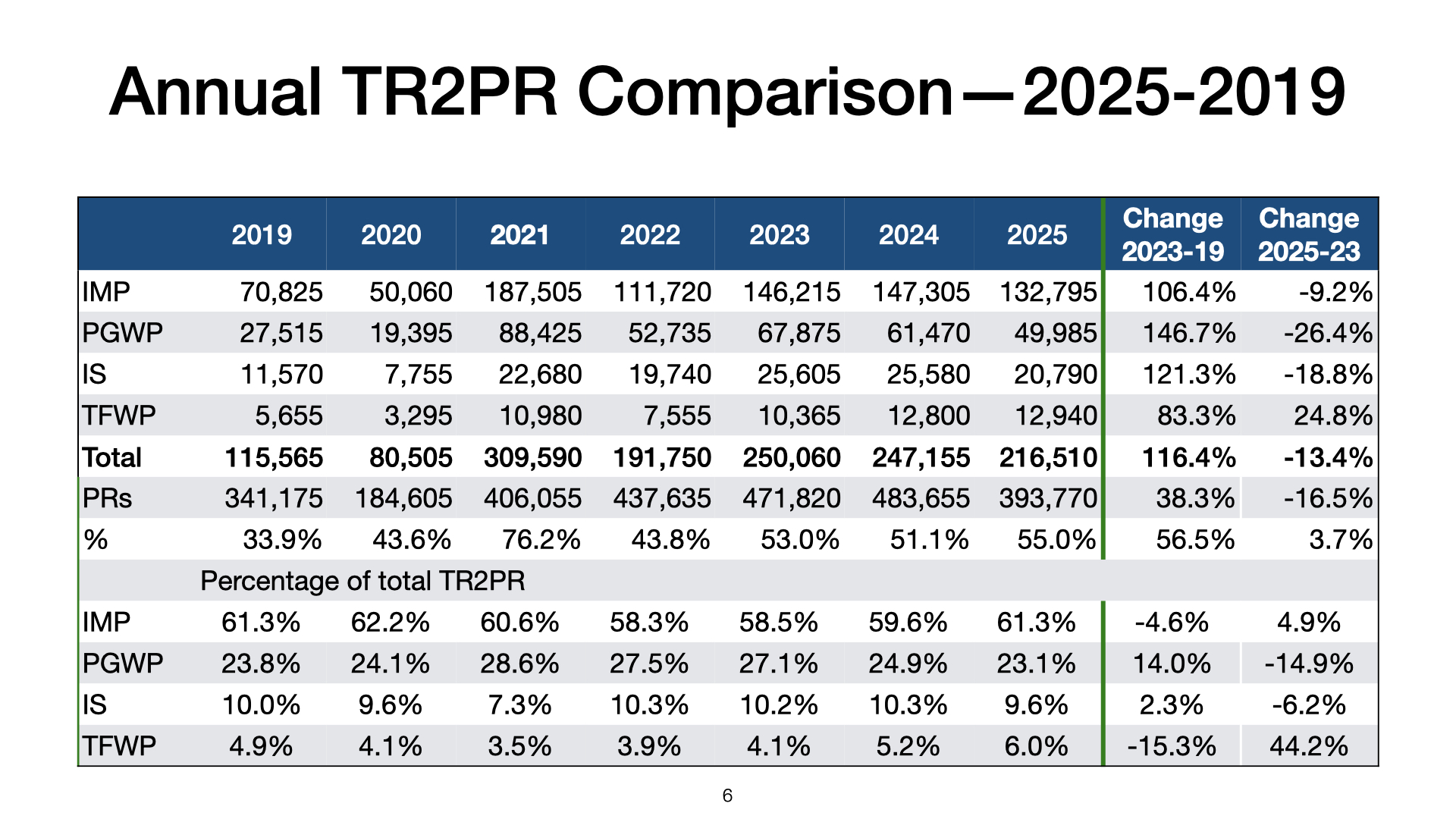
Annual Summary of TR2PR

Further to my earlier post providing an annual summary of total immigration: Permanent Residents, IMP, TFWP and international students, did a comparable table for TR2PR, that highlights their comparatively higher increase rates compared to Permanent Residents since 2019 and their higher decrease since the peak of 2023:

LILLEY: Jamil Jivani campaigning to end ‘Liberal racism’ in public service

Numbers vary of course by level and occupational group but overall, the annual reporting framework (pride and shame motivators) has largely worked well to ensure a public service more representative of the overall Canadian population.

Harper government weakened annual reporting but did not change the Act. Unclear whether Carney will follow up on the Trudeau era task force recommendations or not, as they very much reflected that government’s philosophy and approach:

…The Employment Equity Act was passed in 1986 to attempt to reduce barriers to employment for some groups. It was a success, but the special treatment for these select groups continues even though they are now, for the most part, overrepresented in the federal civil service.

Women are one of the protected groups given special access to government jobs. According to Statistics Canada, women make up 47% of the overall labour force, according to the most recent jobs report from Statistics Canada, but women make up 57% of the federal workforce.

Indigenous Canadians make up 4% of the available workforce, according to federal data, and yet they account for 5.5% of the federal civil service. According to federal data, visible minorities make up 22.7% of the available workforce and hold 23.9% of all jobs in the federal government.

None of these groups are underrepresented and yet they are getting special treatment for jobs. Jivani is right: This is a form of discrimination, this is a form of racist policy and it shouldn’t be allowed.

Chances are that if you asked most Canadians if these types of practices should be allowed, they would say no. In a world where Liberals MPs

Source: LILLEY: Jamil Jivani campaigning to end ‘Liberal racism’ in public service

Canada’s misguided mosaic metaphor

Not convinced by the arguments. Multiculturalism operates within the Canadian legal framework, which includes of course hate speech restrictions. It is not an anything goes given the legal framework but allows for accommodations to facilitate participation in Canadian society.

One can argue, as I myself as done, that sometimes this leads to more divisive policies than integrative ones, but the framework remains valid IMO. I think the bigger issue with respect to antisemitism is that lack of moral courage by leaders to call out unacceptable behaviours, whether at universities, schools, neighbourhoods etc and the general reluctance of the police to preserve the public space.

…Our immigration system—and our political class—for years lacked the vocabulary to say so, because saying so would require admitting that the mosaic has conditions. It would require treating the shared core, the mortar, as more important than any individual tile.

Carney’s Dublin speech is the kind of thing a prime minister says when he wants to feel, and to make others feel, that Canada is a generous idea. His Toronto speech was the kind of thing a prime minister says when the generous idea has produced bullet holes in synagogue windows. The distance between those two speeches is the distance between Canada’s self-conception and Canada’s actual crisis.

That distance will not close until we are honest about what the mosaic requires to hold together, and honest about what it cannot, and must not, accommodate.

Stephen Staley is the Director of Fault Lines and a longstanding contributor to The Hub on Canadian policy, culture, and civic life. He is a senior advisor at the Oyster Group, one of Canada’s leading communications and public affairs firms.

Source: Canada’s misguided mosaic metaphor

Elkouri: Allégations de racisme au SPVMLe #metoo du racisme, Nicolas: Sinon, nous nous répéterons

Valid critique:

…Dans le cas qui nous concerne, devant la gravité des actes racistes allégués ayant mené au démantèlement d’une équipe de patrouilleurs montréalais, le gouvernement caquiste concède que l’on ne parle pas de quelques pommes, mais bien d’un panier pourri au complet. Mais ce qui est inquiétant, c’est que l’on refuse encore obstinément d’examiner le sol contaminé du verger. Pas question de reconnaître la nature systémique du problème, répète-t-on.

Pour rétablir la confiance, on n’aura toutefois pas d’autre choix que de sortir du déni comme on l’a fait dans la foulée du mouvement #moiaussi.

Comment ? Comme Yves Boisvert et Fabrice Vil, je crois qu’une enquête publique indépendante s’impose2, 3. C’est aussi l’avis de Massimiliano Mulone, professeur agrégé de criminologie à l’Université de Montréal et coauteur d’un rapport alarmant sur les interpellations policières et le profilage racial au SPVM dont la seule et unique recommandation a été ignorée.

Les problèmes de discrimination raciale dans les pratiques policières ne sont pas circonscrits à quelques individus ou à un quartier. L’enjeu central, c’est la nature systémique du problème. D’où l’utilité de prendre un pas de recul pour analyser la chose en profondeur….

Source: Allégations de racisme au SPVM Le #metoo du racisme

… In the case that concerns us, given the seriousness of the alleged racist acts that led to the dismantling of a team of Montreal patrolmen, the Caquist government admits that we are not talking about a few apples, but about a complete rotten basket. But what is worrying is that we still stubbornly refuse to examine the contaminated soil of the orchard. There is no question of recognizing the systemic nature of the problem, we repeat.

To restore confidence, however, we will have no choice but to get out of denial as we did in the wake of the #moiaussi movement.

How? Like Yves Boisvert and Fabrice Vil, I believe that an independent public inquiry is necessary2, 3. This is also the opinion of Massimiliano Mulone, associate professor of criminology at the University of Montreal and co-author of an alarming report on police arrests and racial profiling at the SPVM whose one and only recommendation was ignored.

The problems of racial discrimination in police practices are not limited to a few individuals or a neighborhood. The central issue is the systemic nature of the problem. Hence the usefulness of taking a step back to analyze the thing in depth….

Nicolas | Sinon, nous nous répéterons

…Ce que moi-même et bien des gens qui s’y connaissent un peu voudrions voir, c’est une enquête publique sur le racisme systémique dans la police, un moratoire sur les interpellations et une révision en profondeur du règlement municipal, question d’éliminer les autres « poignées » sur lesquels les policiers pourraient se rabattre pour continuer à harceler indûment les citoyens de nos communautés.

On verra si on préfère les « solutions » qui n’en sont pas, et qui n’ont jamais fonctionné, mais qui donnent l’impression d’avoir « fait quelque chose » après une « onde de choc ». Si c’est le cas, dans quelques années, le Québec sera à nouveau « surpris » qu’il subsiste du racisme dans les corps policiers et que les droits de la personne de citoyens soient bafoués.

Alors, nous nous répéterons. Poze.

Source: Chronique | Sinon, nous nous répéterons

What I myself and many people who know a little about it would like to see is a public inquiry into systemic racism in the police, a moratorium on arrests and a thorough revision of the municipal by-law, a matter of eliminating the other “handles” on which the police could fall back to continue to unduly harass the citizens of our communities.

We will see if we prefer “solutions” that are not, and that have never worked, but that give the impression of having “done something” after a “shock wave”. If this is the case, in a few years, Quebec will again be “surprised” that racism remains in police forces and that citizens’ human rights are flouted.

So, we will repeat ourselves. Poza.

Silberstein: Rank Islamophobia in Congress is a crisis for American Jews

Of note:

A growing caucus in the House of Representatives is targeting Muslims, and American Jews should be deeply concerned.

The Sharia-Free America Caucus, established in December, now boasts more than 60 members, all of whom are Republican. In announcing its establishment, one of its founders, Rep. Chip Roy of Texas, warned that, “from Texas to every state in this constitutional republic, instances of Sharia adherents masquerading as ‘refugees’ — and in many cases, sleeper cells connected to terrorist organizations — are threatening the American way of life.”

His language was reminiscent of past xenophobic claims made about Irish and Jewish immigrants flooding the country with, respectively, Catholicism and communism. And the fact that the caucus has expanded in influence speaks to the continued radicalization of the Republican Party and the growing threat of American Christian nationalism. The attacks on our Muslim neighbors from the party in power call for Jews to stand up in defense of the value of religious pluralism in the United States.

American Muslims are the right’s immediate targets. But Muslims and Jews both stand to lose if the U.S. becomes an even less liberal and more strictly Christian nation than it is today.

A fictional threat

No one should dismiss the Sharia-Free America Caucus as a flash in the pan. Its membership includes a member of the Republican House leadership, Majority Whip Tom Emmer of Minnesota, who has said that “Sharia is completely incompatible with the American way of life and threatens the very fabric of our society.”

The caucus has introduced a number of pieces of legislation to combat the fictional threat of Sharia law, prompting a public letter signed by 119 Democrats demanding the House leadership not allow a vote on these ridiculous bills.

The Democrats are right to be drawing attention to this appalling demonstration of rank bigotry by dozens of Republican members of Congress. It should go without saying that there is no threat of Sharia law supplanting secular American law. Such talk is nothing but the crude fantasy of demagogues.

Instead, the caucus is twisting ordinary religious practices to demonize millions of Americans.

Sharia law, like Jewish halacha, is an unsettled body of religious law that has been interpreted, reinterpreted, and debated for centuries. In the U.S., scholars of Islamic law can weigh in on certain kinds of civil cases such as business disputes. This is exactly how batei din operate for many observant Jews: not as structures that replace American law, but as mechanisms that specific communities turn to voluntarily to help decide internal questions.

Just as the establishment of a Halacha-Free America Caucus would be an illegitimate and plainly hateful assault on the dignity of American Jews, so the existence of this caucus is an insulting act of bigotry toward American Muslims. The message being sent to them is clear: You do not belong here, and if you want to stay out of trouble, you can only practice your faith in ways the majority religious group finds acceptable.

A dark American history

These attacks against Muslims are continuous with a strain of illiberalism and xenophobia in the history of the U.S. with which Jews should be familiar. Yes, this country welcomed ships of Eastern European Jewish refugees at Ellis Island; but it also enacted the 1924 Johnson-Reed immigration quotas — which ultimately helped trap Jews in Nazi-occupied Europe.

After the Sept. 11, 2001 terrorist attacks, American Muslims faced widespread discrimination in the name of national security — including illegal detainments and unconstitutional invasive police surveillance of communities. Once the terrorism panic subsided, Islamophobia became a standard part of the right-wing playbook….

Abe Silberstein is the Associate Director, North America, of The Abraham Initiatives, an Israel-based NGO working to achieve equality between Jewish and Palestinian citizens of Israel.

Source: Rank Islamophobia in Congress is a crisis for American Jews

PROC report: Challenges Regarding Special Voting [Recommendations]
In general, sensible recommendations with my comments below each one. On a personal note, both of our children are expats, one’s ballot arrived in time (from the USA) the other not (from Europe):

Recommendation 1: That the Government of Canada should consider introducing legislation to amend the Canada Elections Act so as to require electors residing abroad to provide proof of their last place of Canadian residence as part of their application to be added to the International Register of Electors. 

Agree. While the current honour system has merit, given the potential for significant increases in expatriate voting due to C-3 expansion of citizenship transmission beyond the second generation, this would enhance the integrity, and perceived integrity, of expatriate votes.

Recommendation 2: That the Canada Revenue Agency and Elections Canada consider pursuing closer cooperation in order to determine, where possible, the most recent Canadian addresses of voters living abroad so as to assign them the electoral district in which they may vote, and improve the delivery of election information to voters living abroad. 

Worth considering as part of integrity measures and complements recommendation 1. Would only apply to those who submitted tax returns.

Recommendation 3: That for elections held on a fixed date under 56.1(2) of the Canada Elections Act, voters should be allowed to apply for a special ballot at least 45 days before election day, even if the writ has not yet been issued. Elections Canada would then be able to send a special ballot to the elector as soon as the writ has been issued. 

Makes sense. Unfortunately, given fixed election dates are more notional than real so likely little practical impact.

Recommendation 4: That the Canada Elections Act be amended to set the deadline for candidate nominations to close three days earlier than at current (i.e., on day 24 before election day, instead of on day 21 before election day). 

Would help. Not supported by Conservatives.

Recommendation 5: That Elections Canada should use couriers, when it deems appropriate, to send ballots to voters living abroad who are on the International Register of Electors. They should also provide voters with a return label to return their ballot via courier. 

Given that most expatriates don’t pay Canadian taxes, should Elections Canada pick up the tab? Alternatively, Elections Canada could offer a fee-based expedited delivery service, as it does for passports.

Recommendation 6: That Elections Canada should undertake further study of the hybrid ballot delivery systems that are used elsewhere in the world, such as printing a ballot at home to assess the feasibility of implementing them in Canada. 

Never argue about further study but found Elections Canada testimony convincing in terms of some of the issues. Conservatives expressed considerable concerns regarding possible negative impact on integrity.

Recommendation 7: That the Government of Canada should not consider any measures which would see special ballots cast by electors electronically. 

Clear response, based on integrity concerns.

Recommendation 8: That, at present, the Committee does not hold the view that electors, who cast their vote by special ballot, ought to be permitted to write the name of a political party instead of writing the name of a candidate, as was proposed in Bill C-65, An Act to amend the Canada Elections Act of the 1st Session of the 44th Parliament. 

Interesting that they ended up here. But the logic is sound, even if one’s vote is party-based, MPs are elected individually. Also required expatriate voters to research the names of candidates, not just indicate the party they support.

Recommendation 9: That the Government of Canada should undertake a study to assess the feasibility of embassies providing ballots and/or acting as polling stations during Canada’s federal general elections. 

No issue with studying the issue but suspect some integrity and operational issues.

Recommendation 10: That the Government of Canada should ensure that, subject to security and logistical considerations, Canada’s embassies, high commissions and consulates provide opportunities for Canadian electors abroad to submit their special ballots for expeditious return to Elections Canada. 

Easier than Recommendation 9, but given the “subject to security and logistical considerations” and the impact on regular mission operations, even the mailbox function would raise complications in terms of meeting ballot deadlines and when they would be counted.

Recommendation 11: That having conducted a comprehensive review of the testimony, the Committee holds the view that there is no consensus on the creation of extraterritorial electoral ridings. 

Fair enough. Good discussion on issue and various complications.

Recommendation 12: That the Committee believes that candidates and political parties bear the greatest responsibilities for motivating electors, including those residing abroad, to turn out to exercise their franchise. For greater certainty, this recognition does not remove or diminish from the responsibilities borne by Elections Canada and Global Affairs Canada to provide information to Canadian electors residing abroad on how to exercise their right to vote. 

Agreed!

Source: PROC report: Challenges Regarding Special Voting [Recommendations]