On the broadening of refugee definitions and the risk of UNHCR (along with some advocacy groups IMO) not recognizing the political and practical limits in refugee receiving countries:
…For Washington to achieve the reform it seeks, it needs to encourage greater candour from other governments concerned about migration control, and call for more realism from stakeholders. Canada could play a constructive role here. Instead, Ottawa used the Executive Committee meeting to proudly boastthat its delegation included “refugee voices,” before voting for the General Assembly draft resolution last week. The dissonance of such showboating is particularly obvious given that earlier this year, Ottawa quietly adopted Bill C-12, a law that introduces tighter eligibility rules in domestic asylum procedures after recent record numbers.
If the UNHCR is unable to help donor governments with their immediate migration crises – from boat crossings on the Mediterranean Sea and the English Channel to surges at the U.S.’s southern border and Quebec’s Roxham Road – then it has shifted too far toward a development approach that essentially distributes aid to poor countries housing many of the world’s refugees. It would also suggest that many humanitarians are treating recent Western funding pullbacks as a temporary pause led by a lame-duck U.S. administration, rather than a fundamental global reset. This would be misreading the room: Both the German and Canadian governments, for example, have contributed to the UNHCR’s multibillion-dollar funding cut amid real fiscal pressures and new defence priorities.
Serious UNHCR reform would recognize that its mandate involves solving tough asylum dilemmas, allowing it to remain relevant to both rich and poor countries. Should UNHCR refuse to change course, it will inevitably decline into a diminished, marginalized bystander. Canada has a chance to help stop this – but only if it stops using the refugee issue as an opportunity for self-promotion on the world stage and does the work that’s really needed.
Will be interesting to hear comments from refugee advocates on this suggestion:
…To avert a crippling U.S. funding freeze or a complete American withdrawalfrom the UNHCR executive committee, the agency must prove it can be reformed, and member states must broker a compromise. Canada can play a constructive role in finding a face-saving solution that maintains U.S. engagement. With the committee holding its annual general session in October, Canada – an influential member of UNHCR’s executive committee, as the sixth-largest donor in 2025 – has an opportunity to bring its middle-power strategy to life with a bold initiative to save one of the UN’s largest operational programs.
The best way to prove UNHCR is reformable would be to split the deputy position into two distinct roles: one to oversee humanitarian operations and field execution, which Mr. Salih’s current choice could retain, and the other dedicated strictly to resource management and budgeting, which would go to Mr. Trump’s nominee. This would satisfy Washington’s oversight and audit concerns, and mirror structures already used in other UN bodies like UNICEF and the UN Population Fund.
Rather than thumbing their noses at the White House, other major members of the executive committee should also admit they share American concerns about a misguided asylum system that is fuelling uncontrolled mass migration. This reality was highlighted in the recent Chisinau declaration, where all 46 members of the Council of Europe – including staunchly progressive Western European nations – agreed that the current asylum system must be reined in to be saved. This non-binding political text explores the self-inflicted dilemmas resulting from overly generous judicial decisions, implicitly acknowledging the Trump administration’s migration-related criticisms of Europe and indicating that Washington’s stance is far from isolated. U.S. pressure has already pushed Ottawa to tighten border controls and amend its asylum procedures. …
…While success stories like hers are common, she said they have been overshadowed by narratives in recent years that portray refugees as a drain on Canada, rather than contributors. The surge of refugees in the country is just a reflection of the rising global displacement as a result of wars and unrest, she noted.
A 2024-25 public opinion poll by the Immigration Department found that just a third of Canadians felt that the impact of refugees on Canada was positive. Forty-eight per cent of respondents said Canada was admitting too many asylum seekers, while 41 per cent said the country was resettling too many refugees from abroad. Just over half agreed that “accepting refugees is part of Canada’s humanitarian tradition.”
“The more you feed into this negative narrative, the more fearful society and the politicians become, and the more restrictive these policies become,” said Faizi, who was a corporate lawyer specializing in intellectual property rights, before switching to refugee law in 2021.
The campaign — including an open letter to Prime Minister Mark Carney, highlighting local events organized by its 200 member organizations across Canada and a tool kit to promote the message “We are Better Together” — also followed a report released by UNHCR Canada in early June that looked at the social and economic benefits of welcoming displaced people in need of protection….
Forced displacement from wars and persecution around the world fell for the first time in a decade, according to the United Nations refugee agency.
The latest data showed the number of people who were forced to leave their homes and remained displaced at the end of 2025 dropped by four per cent to 117.8 million from 123.2 million a year ago, the UNHCR said in a report released Thursday.
The decline reflected a sharp increase in the number of international refugees and internally displaced individuals who returned home last year in some of the countries with the largest displacement such as Afghanistan, the Democratic Republic of Congo, Sudan and Syria.
In 2025, almost 5.4 million people had to flee and seek safety across borders, predominantly in neighbouring countries. The majority came from eight countries: Sudan (952,700), Ukraine (788,100), Venezuela (455,300), South Sudan (232,800), Burkina Faso (221,300), Afghanistan (191,400), Mali (177,200) and Myanmar (165,400).
Meanwhile, returns of both internationally and domestically displaced people rose by 50 per cent, reaching 14.7 million, the second highest level since records began 60 years ago. Returnees to the Democratic Republic of Congo (3.6 million), Sudan (3.6 million), Syria (3.3 million), Afghanistan (two million), Ukraine (718,300) and Myanmar (415,200) accounted for 92 per cent of all returns.
Canada has moved up one spot to become the fourth largest recipient country of asylum seekers, according to the United Nations Refugee Agency.
Last year, Canada received a record 174,000 new refugee claims, of the 3.1 million new claims reported worldwide, said the agency’s 2024 global trends report released on Thursday. Canada was behind the U.S. (729,100), Egypt (433,900), Germany (229,800). In fifth was Spain at 167,400.
This country was also the second-largest resettlement country globally, welcoming 49,300 refugees in 2024, and led the world in granting permanent residence to 27,400 refugees.
On the eve of the three-day G7 summit that starts in Kananaskis, Alta., on Sunday, the agency’s representative in Canada said this is a unique opportunity to lead peace efforts and rally global support for those forced to flee for safety.
“Canada’s leadership in refugee resettlement and integration shows what’s possible when compassion and commitment come together,” said Tracey Maulfair. “At a time of global uncertainty, this leadership is more important than ever.”…
The UN refugee agency says it is concerned about the impact of Canada’s immigration backlog on the federal government’s commitment to resettle the world’s most vulnerable people, including Afghans who risk being targeted by the Taliban as they await refugee protection.
Gillian Triggs, assistant high commissioner for protection at the United Nations refugee agency, said Canada’s immigration backlog of more than two million applications is “very distressing.”
Refugee advocates and the opposition parties in Ottawa have repeatedly expressed concern that Canada’s overrun immigration system is delaying resettlement for refugees.
Ms. Triggs, who met senior government officials in Ottawa Wednesday, said refugees face increased risks the longer their cases are stuck in government processing.
“I will be raising with the relevant deputy ministers and others our concerns about that backlog. What it does, of course, is expose people to the kind of dangers that you’re raising, of torture, attacks – the very dangers, of course, that underpin why they have refugee status in the first place,” Ms. Triggs said in an interview.
“The whole point of the need for refugee protection is that that needs to be fast. You cannot leave people in backlogs and pipelines for many months or, in some cases in some countries, for years.”
Earlier this month, The Globe and Mail reported that Afghans who aided Canada’s military and diplomatic missions in Afghanistan have been tortured by the Taliban while they struggle to navigate federal government red tape.
Concerns grew further on May 14 when a 24-year-old Afghan man who was urgently seeking protection from Canada was shot dead by the Taliban. While Ms. Triggs was careful not to comment on specific cases, she expressed concern about the fate of Afghan women, who now face more restrictions under Taliban rule.
Ms. Triggs said the COVID-19 pandemic bogged down immigration processes in many resettlement countries, such as Canada, which are now trying to catch up amid an “unsustainable” increase in the number of forcibly displaced people worldwide. An unprecedented 100 million people have been forcibly displaced by conflict, violence, human-rights violations and persecution, the UN refugee agency announced Monday.
“Part of the advocacy that we will engage in is to encourage governments to look at their processes to see if they can be made what we call fair and fast,” Ms. Triggs said.
She said she is not qualified to suggest specific system changes for Immigration, Refugees and Citizenship Canada (IRCC), but cited instances in which other countries have forgone their “cumbersome” immigration policies in the interests of urgency. For example, she said Poland, Slovakia and Moldova immediately opened their borders to Ukrainian refugees earlier this year when Russia invaded.
She also said a move toward digital application systems will speed up processing in resettlement countries.
IRCC did not respond to a request for comment Wednesday. Immigration Minister Sean Fraser has previously said the Liberal government’s investments in additional resources, including $85-million to help reduce the backlogs and 500 new processing staff, should help IRCC return to its prepandemic processing times by the end of the year.
Ms. Triggs said resettlement programs are available to less than 1 per cent of globally displaced people, which is why she said governments need to work to address the root causes of mass displacement. She said Canada can be a leader on this front, particularly in Central America, where violence and persecution have forced hundreds of thousands of people to flee their homes.
“Canada can play a role in looking at root causes in the region, at stabilizing populations, advocating for investments for finding ways to deal with gender inequality, with the abuse of women and girls, poverty and of course, instability,” she said.
Ms. Triggs is in Ottawa for a meeting of the Comprehensive Regional Protection and Solutions Framework Support Platform, a multicountry initiative that encourages greater responsibility sharing on forced displacement in Central America and Mexico. Canada is currently chairing the platform, with a focus on the needs of women and girl refugees and migrants.
The year 2020 will go down as the worst for refugee resettlement in recent history, says the UN refugee agency’s Canadian representative.
With nearly 168 countries implementing border and travel restrictions, millions of displaced people around the globe were stuck, unable to either return to their home countries or move to others.
Canada, however, was one of only a few that did listen to urgent pleas from the United Nations High Commissioner for Refugees, said Rema Jamous Imseis, the UNHCR’s Canadian representative.
Even at the height of the pandemic, when most countries were looking entirely inward, Canada did accept emergency cases and as travel has resumed continues to take in more, she told The Canadian Press in an interview.
“It hasn’t, unfortunately, been at the levels that we had planned for prior to the pandemic, but it still is offering that critical lifeline to people who desperately need it,” she said.
“And we hope that next year actually is going to bring us a very different context and an ability not only to meet those targets, but to perhaps even exceed them.”
Canada had planned to resettle around 30,000 refugees in 2020.
By the end of September, just under 6,000 had arrived, and a spokesman for Immigration Minister Marco Mendicino said the end-of-year figure will be closer to 7,000.
The target for resettlement next year is 35,000, but how realistic that goal is considering the unknowns around the end of the pandemic is unclear.
Mendicino’s spokesman said in an email that the entire resettlement “ecosystem” continues to operate at a reduced capacity, but is slowly spooling back up.
“While our operations have been affected, we’ve come a long way since the onset of the pandemic and are now processing nearly six times as many refugee cases as in a similar period last year,” Alexander Cohen said in an email.
The border closures weren’t the only challenge this year for refugees, said Jamous Imseis.
Many of the world’s displaced people were just scraping by economically before the pandemic hit, but their sources of income completely dried up, she said.
“The ability to sustain themselves and their families has been wiped out,” she said.
“So you saw entire populations going from vulnerable, but with the ability to sustain themselves overnight to becoming really vulnerable.”
There’s also been a massive blow to the ability of children to be in school. A pivot to online learning possible in some developed nations just isn’t applicable elsewhere, she said.
Some studies suggest more than half of refugee girls may never go back to post-secondary education after the pandemic, she said.
“They haven’t been at school this whole time, and they may never go back because life circumstances have changed so dramatically,” she said.
Monday is the UNHCR’s 70th anniversary. It was created to help displaced Europeans after the Second World War and originally was only supposed to exist for a few years.
“But sadly, we’re still here and it signals the failure of the international community to really address long-standing issues, and drivers of displacement globally,” said Jamous Imseis.
“We look forward to the day when our services are no longer needed.”
Have been following the various reactions to date regarding the government’s (overly) ambitious targets for the next three years. Relatively few op-eds and commentary, possibly due to the focus on COVID and the US presidential election which are taking up most of the oxygen.
And much of the commentary focusses overly on the administrative issues, not the more substantive issues related to economic integration of immigrants during an economic recession, one that is likely to linger for a few years.
Have grouped these by constituency:
Business-oriented
The plan was welcomed by the business sector.
“There is widespread agreement across party lines that immigration is essential to long-term economic growth,” said Goldy Hyder, president and CEO of the Business Council of Canada, which represents some of the country’s largest businesses.
“Newcomers bring energy, skills, new ideas and entrepreneurial spirit. They start companies, fill skill shortages, buy houses and pay taxes, … The minister’s plan will allow Canada to make up lost ground as the pandemic eases. It will inject new dynamism into our economy.”
The Canadian Manufacturers and Exporters even went one step further, saying Ottawa’s objectives were too modest and will not allow the country to catch up quickly enough over the coming months to compensate for the reduced number of immigrant admissions this year.
“Manufacturers are increasingly using immigration to supplement their workforce but there are not enough immigrants to meet the demand,” said Dennis Danby, its president and CEO, who represents 2,500 leading manufacturers in the country.
“If manufacturing is to be at the core of the economic recovery following the COVID-19 crisis, we must do more in prioritizing immigration from the economic stream.” (Toronto Star)
As Canada’s leading voice on smart population growth, Century Initiative continues to advocate not just for increasing our population, but for policies to support that growth through investments in education and in the national and urban infrastructure that will allow our communities to grow in a sustainable manner. We also need to prioritize supporting parents with a national childcare strategy, and our children with early education programs.
Now is the right time to invest in growing our population. Environics Institute’s recent Focus Canada survey shows that a record two-thirds (66%) of Canadians reject the idea that immigration levels are too high, and that Canadians recognize the critical contribution immigrants make to our economy and our social fabric. We have a tremendous opportunity before us and welcome the opportunity to continue working with gover(nment to seize it in the interest of future generations of Canadians. (Century Initiative)
Opposition critics
Opposition MPs took aim at the way the government has handled immigration throughout the pandemic and questioned how the new targets would be achieved.
Conservative immigration critic Raquel Dancho said the government is announcing new levels without a plan for how they will be safely implemented.
Jenny Kwan, immigration critic for the NDP, said she believes the numbers are “a bit of a hoax” because the backlog to process applications is so great that the targets will be hard to meet.
Christine Normandin, the Bloc Québécois immigration critic, said in French that Ottawa is taking the opposite approach to the Quebec system. She said the province takes only as many immigrants as it can process in one year, while Ottawa sets goals without taking into account its capacity to do the paperwork. (Globe)
That lower-end target is actually below the low end of the number of immigrants, pre-pandemic, the Liberals had planned to admit in 2021, pointed out NDP immigration critic Jenny Kwan.
“The Liberals demonstrate a lack of conviction in their targets and left the door wide open for immigration levels to decrease,” she said in a statement.
It’s also not clear how unused room is being carried over.
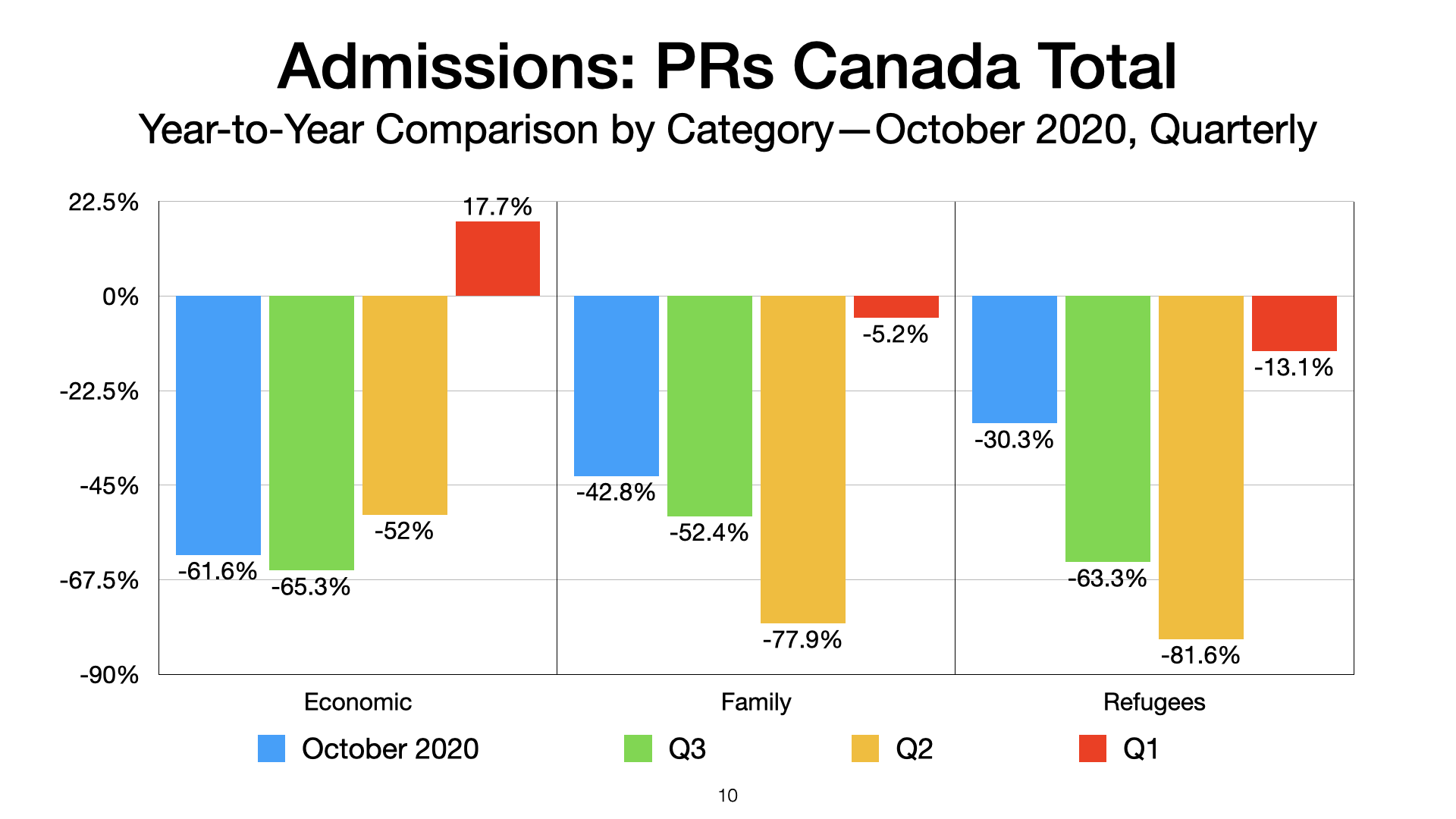
For example: the Liberals had planned to admit 49,000 refugees this year. Next year, according to Friday’s plan, they are aiming for 59,500.
While that looks like an increase of 10,000, the number of refugees who have actually arrived in the first eight months of this year was down nearly 60 per cent from 2019 arrivals.
So it’s possible that the 2021 figures merely incorporate the shortfall from this year, as opposed to being an overall increase. Mendicino wasn’t clear when asked about that issue Friday. (Canadian Press)
NDP immigration critic Jenny Kwan said the government must not overlook the compassionate aspects of the immigration system, such as removing travel restrictions for asylum seekers and ensuring permanent residence status for migrant workers in recognition of their contributions during the pandemic.
“The immigration department’s processing abilities is still spotty at best and serious investment in staffing, far beyond what we’ve seen so far, is needed,” said Kwan.
“Without these investments, applicants are to expect significant increases in processing times for years to come, which were already long before the pandemic.” (Toronto Star)
Tweets from CPC critic Dancho:
The Liberals have failed to layout a plan to bring in newcomers to Canada safely. No widespread access to rapid tests and the 14 day quarantine is not a financial option for many people. #cdnpoli https://twitter.com/RaquelDancho/status/1322270115921055746?s=20
They have no plan to better resource immigration department to fulfil the levels promised. Liberals are simply adding to their massive, years-long immigration backlogs that fail to provide potential newcomers with certainty, dignity or respect. #cdnpoli https://twitter.com/RaquelDancho/status/1322270117384851456?s=20
The ministers announcement did not acknowledge the economic devastation caused by COVID-19 or the hundreds of thousands of Canadians facing unemployment since the pandemic hit and how these new ambitious immigration numbers will impact them. #cdnpoli https://twitter.com/RaquelDancho/status/1322270118290903040?s=20
International organizations
Either way, that Canada even continues to open its arms is welcome, said Rema Jamous Imseis, the UN refugee agency’s Canadian representative.
“In an era of travel restrictions and closed borders, refugees continue to be welcomed by Canadians,” she said in a statement.
“The significance of this lifeline and the deep generosity of Canadians cannot be overstated.” (Canadian Press)
Academics
While experts had expected Ottawa to stay the course with its immigration goals — given the government had publicly stated immigration would be key to restarting the post-COVID-19 economy, they were surprised the Liberals would decide to take it up a notch.
Although critics have raised concerns about high immigration given that the country’s jobless rate hovered at nine per cent in September — after peaking at 13.4 per cent in May — from 5.6 per cent before the pandemic, some experts say the government is on the right track.
“The timing for expanding the program now is good. But I’m surprised how high the targets are they have set. I don’t know how realistic it is from a bureaucratic administrative perspective,” said Carleton University economist Chris Worswick, who specializes in the economics of immigration.
“I commend the government for thinking about immigration again. I was worried that it wouldn’t happen. I wonder if they’re being too ambitious. I’m cautiously optimistic that we’ll end up at a good place.” (Toronto Star)
Immigration lawyers and advocates
Immigration and refugee experts welcomed the move to grant permanent residency to those already in the country.
“I’ve always thought, even before COVID, that it makes a lot more sense to target people who are already educated here, or have work experience here, or at least have lived here. … These are people who are already demonstrating their genuine interest in Canada,” immigration lawyer Chantal Desloges said.
Janet Dench, executive director of the Canadian Council for Refugees, said her organization has urged the government to give permanent residency to those in Canada.
“What we need to see is that realization actually reflected in actual operations, actual policies, because at this point, the way the Immigration Department is working is running in completely the opposite direction,” she said. (Globe)
Contrary to what the government is saying, there is NO INCREASE in IMMIGRATION LEVELS. Instead, there was a 150,000 shortfall in immigrants in 2020, and the government is trying to catch up for it by increasing 50,000 each year for the next three years. But as COVID-19 continues, these promises are unlikely to be kept.+
The overall proportion of new immigrants remain the same, with the primary focus on “high waged” immigrants. However, to qualify for these immigration programs, migrants must show 12-24 months of high-waged work. With COVID-19-related job losses disproportionately impacting racialized people, many migrants don’t have access to these jobs and won’t qualify. No plan has been announced to ensure full and permanent immigration status for all migrant and undocumented people right now.+ Many migrants — including care workers and former international students — were not able to complete requirements for permanent residency in 2020 due to COVID-19. However, there is no meaningful increase in numbers on fixing of rules for these migrants in today’s announcement. (Migrant Workers Alliance)
On the right
Recent polls have shown that Canadians are weary about increasing immigration levels in the wake of the coronavirus pandemic.
A poll commissioned by True North found that an overwhelming 76% of Canadians strongly agreed with the idea of a temporary pause until a coronavirus vaccine is developed and unemployment drops to pre-coronavirus levels. Note: Polling firm unknown and thus is not credible
The poll results show a surprising consensus among political parties as well with 67% of Liberals wanting to impose a temporary pause, 66% of NDP voters and 89% of Conservatives.
“Given today’s global circumstances of a public health pandemic and severe economic crisis, now is the perfect opportunity to revert back to our successful historic immigration model, listen to the majority of Canadians, and take another pause,” True North’s founder Candice Malcolm wrote when the poll was released.
“It’s time for our leaders to listen to the people and do what’s best for our country.” (“True” North)
While the government touted the need for migrants to strengthen the economy, the unemployment rate in Canada, the unemployment rate currently stands at 9%, from an all-time high of 14% in May. Over 8 million Canadians applied for emergency COVID relief benefits in the form of the CERB. Canada’s unemployment rate was around 5% prior the pandemic. (Rebel Media)
This has been discussed for some time with some organizations advocating for this (Talent Beyond Boundaries) and the government is piloting the Economic Mobility Pathways Project (EMPP):
Canada should consider letting in some skilled refugees as economic immigrants, says Canada’s new United Nations High Commissioner for Refugees, and with it, establish a new avenue for refugees to resettle, which could be used to help people in dire need in countries in crisis, like Venezuela.
Doing this would open up a track beyond the resettlement quota and the typical pathway for refugees, said Rema Jamous Imseis.
Canada plans to expand the number of immigrants accepted to 350,000 by 2021, including 51,700 protected persons and refugee programs, and 202,300 through economic and skills programs, according to Immigration, Refugees and Citizenship Canada’s (IRCC) 2019 plan.
“This is something entirely different. It’s recognizing that refugees come with skill sets; you have a lot of highly educated people who already speak English and [have] years of rich work experience in different parts of the world,” she explained. “Why not look at some of these people?”
Any efforts to increase the number taken out of harm’s way and also benefit Canada, is “a win-win,”she added. While qualified, she noted a refugee fleeing a country may not have the expected documents; some may be missing copies of degrees, or birth certificates, or may be missing experience in a relevant field in recent years.
Even if the economic immigration stream is expanded to include one per cent of refugees in its total, it’d make a difference addressing the massive amounts of displacement globally, which over the past few years has reached “epic proportions,” she said.
“I don’t use that word lightly,” Ms. Imseis said during a Feb. 14 interview less than two weeks on the job. She’d spent that week immersed in resettlement discussions, including co-hosting an international meeting on the subject.
Canada recently launched a very small pilot to start and while it’s too early to put a timeline on introducing such system changes, she said she’s encouraged by the fact that “there’s a lot of interest and facilitation” from the government. For good reason, it’s initially going to be a slow process, she said.
“You can’t dramatically change a system overnight.”
IRCC spokesman Rémi Larivière said Canada is known for its leadership in developing innovative programs that support refugees seeking protection.
Canada has been exploring labour mobility as a complementary pathway, he said, and IRCC’s first step was to establish the Economic Mobility Pathways Project (EMPP). Research with partners demonstrated that there are skilled refugees in Kenya and the Middle East who meet the requirements of Canada’s economic immigration programs, he said.
The need is so great for those living in extreme vulnerability, and yet so few get the “life-saving and life-changing” chance at resettlement, Ms. Imseis said. Of the 1.4-million people in need of resettlement in 2019, only about 64,000 refugees were resettled, according to theUNHCR.
In Canada, so far four applicants, along with nine family members, have arrived through the project and another four applicants and their families are expected to arrive shortly, Mr. Larivière said, with an expected 10 to 20 to arrive over the next year. A second research face will begin in April 2020, with results available by early 2021.
The hope is to use those case studies to “see if there are opportunities to finesse [the] system and maybe overcome some of these hurdles,” said Ms. Imseis, while keeping the same standards and targeting in-demand professions.
“Nobody’s lowering the threshold for them, it’s just about now trying to find ways to deal with the reality of being a refugee and how we can support applications under this track.”
Such changes could widen the opportunity to bring in migrants where the need is most, she said, including those affected by the unfolding crisis in Venezuela, where almost five-million have fled in the face of increasing food shortages and political unrest, with the Nicolas Maduro regime still in power despite world leaders, like Canada, supporting Juan Guaidó.
In Nepal while there is a debate ongoing over whether to grant the women the right to confer citizenship to their children without any exception and limitation. South Asia Check has examined the citizenship laws and gender equality in the global context.
According to a survey report on Gender Equality, Nationality Laws and Stateless 2018 prepared by the Office of the United Nations High Commissioner for Refugees (UNHCR), equality between men and women relating to conferral of nationality upon children has not yet been attained in 25 countries. The majority of these states are in the Middle East and North Africa (twelve countries) and Sub Saharan Africa (six countries). In Asia and the Pacific there are five countries and in the Americas two countries that do not grant mothers equal rights as fathers to confer their nationality on their children. It is important to note that an additional group of states grants equality to men and women with regard to the nationality of children but not with regard to acquisition, change or retention of nationality upon change in civil status.
The classification of countries that limits women to confer nationality to their children
The table below uses a color scheme to divide the laws of the 25 countries into three categories. The laws of the first group of countries (red) have nationality laws which do not allow mothers to confer their nationality on their children with no, or very limited exceptions. These laws create the greatest risk of statelessness. The laws of the second group of countries (orange) have made some exceptions for mothers to confer nationality if the father is unknown or stateless. The laws of the third group of countries (yellow) also limit the conferral of nationality by women but additional guarantees ensure that statelessness will only arise in very few circumstances.
Table: Courtesy of UNHCR report
The law in Qatar doesn’t allow mothers to confer nationality on their children, without exception. According to the law of Kuwait, if a Kuwaiti mother has a child with a father who is unknown or whose paternity has not been established, the individual concerned may apply for Kuwaiti citizenship at majority. In such cases, nationality is granted by decree based on the discretionary recommendation of the Minister of Interior. However, this is an extraordinary measure that occurs rarely in practice.
The nationality law of Lebanon also allows only Lebanese fathers to confer their nationality on their children in all circumstances. Women can only confer their citizenship if the child is born out of marriage and recognized while a minor by the Lebanese mother.
The nationality laws of Jordan, Libya, SaudiArabia and the UnitedArabEmirates do not allow women nationals married to foreign nationals to pass their nationality to their children. However, they do permit women nationals to confer their nationality on their children in certain circumstances such as where fathers are unknown, stateless, of unknown nationality or do not establish filiation.
In Iraq, although the Iraqi Constitution of 2005 establishes gender equality by providing that nationality is acquired by descent from either men or women, Iraq’s 2006 nationality law limits the ability of Iraqi women to confer nationality on children born outside the country. For such births, the child of an Iraqi mother may apply for Iraqi nationality within one year of reaching majority, providing that the child’s father is unknown or stateless and the child is residing in Iraq at the time of the application.
According to the nationality law of Syria, mothers can only confer nationality if the child was born in Syria and the father does not establish filiation in relation to the child. The law of Bahrain allows mothers to confer their nationality on their children born either in their home countries or abroad if the fathers are unknown or stateless. Under the law of Oman, mothers confer nationality on their children born either in their home countries or abroad if the fathers are unknown or are former Omani nationals.
In Mauritania, mothers can confer nationality on children when the father is unknown or stateless. Children born in Mauritania to Mauritanian mothers and foreign fathers, or to mothers who were born in Mauritania themselves, also acquire Mauritanian nationality. Children born abroad to Mauritanian mothers and foreign fathers can opt for Mauritanian nationality in the year before majority.
The laws of Somalia and Swaziland do not allow mothers to confer their citizenship on their children under the same conditions as fathers. Under the 1962 Somali Citizenship Law, only children of Somali fathers acquire Somali citizenship. Swaziland’s Constitution of 2005 stipulates that any child born inside or outside Swaziland prior to 2005 to at least one Swazi parent acquires Swazi citizenship by descent. However, children born after 2005 only acquire Swazi citizenship from their fathers, unless the child was born out of wedlock and has not been claimed by the father in accordance with customary law.
In Burundi, the 2000 Nationality Code does not allow mothers to transfer nationality to children except when maternal filiation is established when they are born out of wedlock to unknown fathers or if disowned by their fathers.
In Liberia, the Aliens and Nationality Law of 1973 allows children born in Liberia to acquire Liberian citizenship at birth. Children born abroad to Liberian mothers, however, are excluded from acquiring Liberian citizenship. In case of Togo, the 1978 nationality grants citizenship to children born in its territory who cannot claim the nationality of another state, it only allow mothers to confer their nationality on their children if the father is stateless or of unknown nationality.
In Sudan the amended law in 2005 allows a child born to a Sudanese mother to acquire Sudanese nationality by birth by following an application process.
In BruneiDarussalam and Iran, only fathers can confer their respective nationalities on their children in all circumstances.
In Kiribati, children born in the country to an i-Kiribati father or mother can acquire nationality of Kiribati; however, only children born abroad to i-Kiribati fathers, not mothers, acquire the nationality of Kiribati. In Malaysia, children born in the country to either Malaysian mothers or Malaysian fathers automatically acquire Malaysian nationality. But children born to Malaysian mothers outside of Malaysia may only acquire Malaysian citizenship at the discretion of the Federal Government through registration at an overseas Malaysian consulate or at the National Registration Department in Malaysia.
In Nepal, children born to Nepali fathers acquire Nepali citizenship in all circumstances. Children born in Nepal to Nepali mothers and foreign fathers can apply to acquire citizenship through naturalization, provided they have permanent domicile in Nepal and have not acquired the foreign citizenship of their fathers.
In The Bahamas, children born in the country to either a Bahamian father or mother acquire Bahamian nationality; however, only children born abroad to Bahamian fathers, not mothers, can acquire Bahamian nationality. The same applies in Barbados, where children born in Barbados to either Barbadian mothers or fathers acquire Barbadian nationality, but Barbadian mothers cannot confer nationality on their children born abroad, whereas Barbadian fathers can.