Another informative survey by Pew. Canada tends to have lower perceptions of conflict than the median (as one would expect) except for urban/rural:
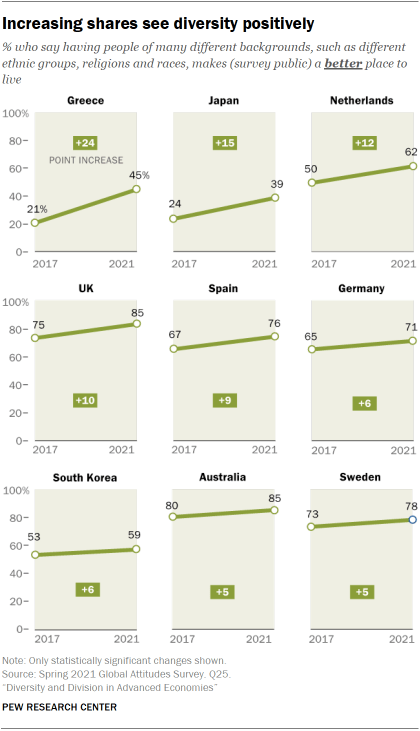
Wide majorities in most of the 17 advanced economies surveyed by Pew Research Center say having people of many different backgrounds improves their society. Outside of Japan and Greece, around six-in-ten or more hold this view, and in many places – including Singapore, New Zealand, the United States, Canada, the United Kingdom, Australia and Taiwan – at least eight-in-ten describe where they live as benefiting from people of different ethnic groups, religions and races.
Even in Japan and Greece, the share who think diversity makes their country better has increased by double digits since the question was last asked four years ago, and significant increases have also taken place in most other nations where trends are available.
Alongside this growing openness to diversity, however, is a recognition that societies may not be living up to these ideals: In fact, most people say racial or ethnic discrimination is a problem in their society. Half or more in almost every place surveyed describe discrimination as at least a somewhat serious problem – including around three-quarters or more who have this view in Italy, France, Sweden, the U.S. and Germany. And, in eight surveyed publics, at least half describe their society as one with conflicts between people of different racial or ethnic groups. The U.S. is the country with the largest share of the public saying there is racial or ethnic conflict.
Notably, however, in most societies racial and ethnic divisions are not seen as the most salient cleavage. Rather, in the majority of places surveyed, more people identify conflicts between people who support different political parties than conflicts between people with different ethnic or racial backgrounds. Political divisions are also seen as greater than the other two dimensions tested: between those with different religions and between urban and rural residents. (For more on the actual composition of each public surveyed on each of these dimensions, see Appendix A.)
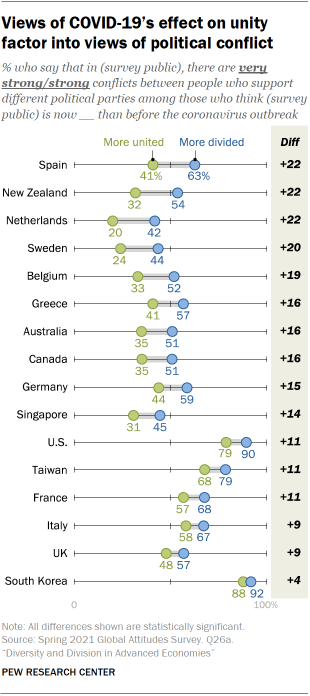
In the U.S. and South Korea, 90% say there are at least strong conflicts between those who support different parties – including around half or more in each country who say these conflicts are very strong. In Taiwan, France and Italy, around two-thirds say the political conflicts in their society are strong. Still, in around half of the surveyed publics, fewer than 50% say the same.
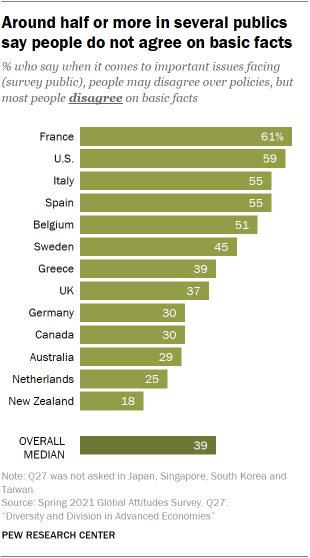
In some places, this acrimony has risen to the level that people think their fellow citizens no longer disagree simply over policies, but also over basic facts. In France, the U.S., Italy, Spain and Belgium, half or more think that most people in their country disagree on basic facts more than they agree. Across most societies surveyed, those who see conflict among partisans are more likely to say people disagree on the basic facts than those who do not see such conflicts.
Views on the topic are also closely related to views of the governing party or parties in nearly every society (for more on how governing party is defined, see Appendix B). In every place but the U.S. and Italy, those with unfavorable views of the governing coalition are more likely to say most people disagree on the basic facts than those with favorable views of the government.
Although divisions between racial and ethnic groups as well as between partisans are palpable for many, other types of conflicts are less commonly perceived. For example, in no place surveyed does a majority think there are strong conflicts between people who live in cities and people who live in rural areas. Similarly, only a minority in most countries say there are divisions between people who practice different religions – though around half or more do sense such conflicts in South Korea, France and the U.S.
Beyond divisions between specific groups, there is also a widespread – and growing – sense that societies are more divided now than they were before the COVID-19 pandemic. A median of 61% across the 17 advanced economies say they are now more divided than before the outbreak, and in all but one of the 13 countries also polled in summer 2020, the sense that societies are more divided than united has risen significantly since last year. Those who describe their society as more divided than before the global health emergency are also significantly more likely to see conflicts between different groups in society and to say their fellow citizens disagree over basic facts.
One perspective within the Chinese Canadian community, largely aligned with Beijing:
A group representing Conservatives of Chinese descent is urging Erin O’Toole to resign as federal leader, charging that his call for a tougher approach to China alienated Chinese-Canadian voters and cost the party three seats in last month’s election.
The Chinese Canadian Conservative Association is advocating a less-confrontational stance toward Beijing, saying immigrants from the Mainland don’t like the Communist Party but still feel affection for China as a nation.
At a surprising news conference for local press recently, spokesman Joe Li — a regional councillor north of Toronto and three-time former Tory candidate — said the two Michaels were detained after “Canada started the war,” that China had a right to fly its planes into Taiwan’s air-defence zone and Canada should not publicly criticize Beijing’s human-rights abuses.Such views echo stances taken by the Chinese government itself on key issues.
The association and Li cited other problems with O’Toole’s leadership, too, including a shift toward the centre politically, a lack of outreach to Chinese Canadian voters and failure to embrace Peter MacKay, who lost the Tories’ last leadership race to O’Toole.
But the group focused largely on what it alleged was a “hatred message” toward China in the Conservative election platform. Li said the party suggested he run again this time but he declined, saying “I just don’t see myself able to win with this anti-China policy.”
“When you keep on attacking China, it sometimes translates as attacking the Chinese community,” the York Region councillor, who supported MacKay’s failed leadership bid, told the news conference. “Why don’t we leave the destiny of China to the Chinese people who live inside?… Any time you’re interfering, what happens? You just raise the nationalism.”
A spokesman for O’Toole’s office was unable to provide comment by deadline.His leadership has come under question generally since the party failed to make major gains in the Sept. 20 election, though O’Toole says he has enough support in caucus to avoid a leadership review.
After a campaign during which Liberal support in the polls dropped, the Conservatives lost three ridings with large Chinese-Canadian populations — two in Richmond, B.C., and one in Markham, Ont.
But those vanquished incumbents don’t necessarily blame the platform itself.
Former MP Kenny Chiu, defeated by 3,000 votes in Steveston-Richmond East, said Chinese-language news and social media were full of disinformation about the party’s position on China and his own private member’s bill to set up a registry for foreign agents. He suspects an organized campaign to distort the party’s message, while state-run media in China accused O’Toole of having an anti-Chinese agenda.
Chiu said Tuesday he spoke to Canadian Security Intelligence Service agents about his concerns but “by that time it was too late.”He said the party’s stance on China is part of its longstanding tradition of standing up for human rights in other countries, noting that then-prime minister Brian Mulroney helped lead opposition to South Africa’s apartheid regime in the 1980s.
Chiu did admit the Conservatives could have done a better job of counteracting misinformation, driving home to the Chinese community it was opposed to the Chinese government, not the nation.
“We should have anticipated that kind of dirty tricks,” he said.
The Tory platform document said the Chinese Communist Party represented a “clear and rising threat” to Canada and recommended a number of measures, from “de-coupling” some China trade to banning Huawei from 5G networks and urging universities against partnering with Chinese state-controlled companies.
But the preamble stressed that “our quarrel is not with the people of China — part of an ancient civilization that has contributed much to humanity. We stand especially with Chinese Canadians whose contributions to Canada are immeasurable and who are enduring an appalling rise in anti-Asian hate and discrimination.”
The association was founded in 1983 to encourage Chinese Canadians to get involved in Conservative politics and boasts about 1,000 members across Canada, said executive director Eric Wen in an interview. Members include Alice Wong, who lost the Richmond Centre riding to the Liberals last month, and other former MPs.
Wen said WeChat, the Chinese-owned social-media network, was full of posts during the election suggesting the Tories were anti-Chinese, a message reinforced by Chinese-language media.
“This is the concern that was expressed to me by many Mainland Chinese (immigrants),” said Li in an interview. “They’d call me: ‘What’s going on with the leader?’”At their news conference, he and Wen advocated a more dovish approach, saying that interference in China’s internal affairs only invites backlash.
Many experts believe Beijing’s detention in harsh conditions of Canadians Michael Spavor and Michael Kovrig was a case of “hostage diplomacy” after Huawei CFO Meng Wanzhou was arrested on a U.S. extradition request. Li suggested it was a natural response from Beijing, and praised Prime Minister Justin Trudeau for using “quiet diplomacy” to end the crisis.
“Who started the war first? Canada did. They arrested Meng Wanzhou. Then China arrested the two Michaels.”
Li said he personally favours peaceful unification of Communist China and Taiwan and said Beijing’s sabre-rattling toward Taipei is just a response to the United States sending warships through the international waters of the Taiwan Strait. China recently flew a record number of military planes into Taiwan’s air-defence zone, as President Xi Jinping makes increasingly aggressive vows to unite the two territories.
“If China feels that Taiwan is part of China, they have a right to fly their planes over,” the councillor said.
He noted that Western countries generally do not officially recognize Taiwan as a separate nation. However, many maintain quasi-diplomatic relations with Taipei and have increased their support recently in response to Xi’s unification rhetoric.
Taiwanese President Tsai Ing-wen was elected in a landslide last year on a pledge to stand up to Beijing and said Sunday her country was “on democracy’s first line of defence.”
On s’inquiète beaucoup, à juste titre, devant les autodafés et les livres expédiés au nouvel enfer où croupissent les damnés. Mais ces ouvrages ne brûlent-ils pas davantage dans les mémoires ? Qui pousse à lire les trésors du passé tant que ça, au fait ? Faute de nombreux emprunts dans les bibliothèques, plus vite des chefs-d’œuvre se feront pilonner. À force de lever le nez sur la culture générale, taxée d’élitiste, vrai garde-fou pourtant et fanal d’éclaireur dans nos nuits, l’ignorance devient la norme et l’aveuglement, son terme.
Prenez les antivaccins défilant dans la rue avec leurs pancartes qui associent l’imposition du passeport sanitaire au sort des Juifs sous la botte nazie. Ils croient sentir le poids historique de l’étoile jaune sur leur t-shirt ou sur leur veste en s’en bricolant des récentes. Toute une coquetterie ! « Même oppression ; même combat pour les parias d’hier et d’aujourd’hui ! » crient-ils dans les manifs. À tous ceux-là, pour qui l’Holocauste ne fut qu’une répétition générale destinée à paver la voie aux supplices d’une vaccination générale réclamée au nom du bien commun, on dit : faites vos recherches. Voyez ! Lisez !
Le Troisième Reich est assez loin derrière pour verser nuit et brouillard sur les annales de l’humanité en ne laissant à des générations montantes que de vagues clichés de persécutions, récupérés pour mieux s’en draper. Mais les familles des survivants des camps de concentration, toute la communauté juive par extension, ne l’entendent pas de cette oreille et hurlent à l’indécence. On n’était pas là quand les Juifs de tant de pays d’Europe se sont fait imposer l’étoile infamante comme au bétail le sceau du maître. Pas là, quand ils se firent entasser dans des stades, puis des trains bondés, avant de se voir recrachés dans des camps pour être asservis ou brûlés. Mais comment plaider l’innocence ?
Pas là, mais transformés par certains témoignages à l’écran, à l’écrit. Du moins ceux d’entre nous qui s’y sont branchés. Que de nouveaux lecteurs se lèvent ! Car le nazisme aura brisé des illusions humanistes à jamais. Ces fringants SS torturant et tuant en série des foules d’innocents avant de repartir écouter du Wagner et du Brahms étaient des êtres dits sophistiqués ! La barbarie fleurit partout, clame ce terrible épisode et n’a pas fini d’obscurcir nos esprits. L’histoire récente en témoigne sous tous les méridiens. Reste que l’Holocauste, par sa démesure, s’inscrit comme le record du pire à dépasser.
À ceux-là qui font des amalgames entre le vaccin apte à sauver des vies et le processus d’extermination d’un peuple entier, on conseille la plongée en eau profonde dans les œuvres écrites jadis à l’encre rouge.
Bien sûr, les documentaires sur le règne d’Hitler sont présentés à la télé, des films de fiction en témoignent encore, mais les rescapés se font de moins en moins nombreux au fil des décennies. Se mettre à l’écoute de leur voix, c’est toucher du bout du doigt l’impensable et s’incliner devant la mémoire de ceux qui l’affrontèrent.
On n’était pas là, mais l’Italien Primo Levi, survivant d’Auschwitz, nous fait entrer par la petite porte dans le quotidien d’un camp d’extermination à travers son témoignage Si c’est un homme. Sans y avoir été, on saisit en fragments noirs, la peur infinie face aux bourreaux, le manque de solidarité des détenus affamés, même si l’auteur lui-même s’estimait incapable de traduire pareille expérience de déshumanisation ; voire de l’envisager : « Nous ne reviendrons pas, écrivait-il. Personne ne sortira d’ici qui pourrait porter au monde, avec le signe imprimé dans sa chair, la sinistre nouvelle de ce que l’homme, à Auschwitz, a pu faire d’un autre homme. »
Pas là, mais Elie Wiesel y était, lui. Et pénétrer ses souvenirs dans La Nuit, où il décrivait également Birkenau-Auschwitz, ses cheminées, l’odeur de la chair brûlée, le camp de Buna, puis la grande marche finale des morts-vivants entourés de nazis fuyant les troupes alliées, c’est ressentir un peu dans notre chair de quoi se nourrit une déchéance programmée. En effet, Elie Wiesel s’était même détourné de son père mourant qui implorait sa présence, pour s’éviter des coups, et la honte de son attitude ne l’a plus jamais quitté.
Pas là, mais on aura vu en plusieurs volets au cinéma Shoah, de Claude Lanzmann, sans voix hors-champ, sans images d’archives, sans experts commentant la chose ; juste des entrevues de survivants et de leurs bourreaux, qui glaçait le sang. Tout est accessible sur Internet, même ce documentaire de plus de neuf heures par les voix des témoins directs. Après avoir vu ça, qui oserait encore s’y référer pour se comparer ? On n’était pas là, piètre excuse ! La culture de l’ignorance est le principal cimetière des œuvres capables d’éclairer l’humanité.
The coroner’s report into the preventable death of Atikamekw woman Joyce Echaquan in a Joliette, Que., hospital last year is one long, illustrated definition of “systemic racism.” It describes a system that functions off implicit assumptions (this Indigenous woman is agitated, maybe she’s on drugs) and differential treatment (let’s just strap her to the bed; no need to give her options), all of which, according to coroner Gehane Kamel, led to Ms. Echaquan’s death.
The same forces of structural discrimination and bias killed 45-year-oldBrian Sinclair of the Sagkeeng First Nation, who languished in a Winnipeg emergency room for 34 hours with a treatable infection in 2008. And they explain why staff at a Northwest Territories care home assumed Aklavik elder Hugh Papik was drunk when he was actually having a massive stroke in 2016.
Individual acts of anti-Indigenousracism certainly contributed to each outcome. But nurses don’t mock patients crying out in pain without someone intervening, as happened in Ms. Echaquan’s case, unless bias and racism have seeped into the walls.
And yet, Quebec Premier François Legault has refused to yield to the coroner’s finding that systemic racism contributed to Ms. Echaquan’s death. His intransigence is odd, not only because the evidence presented in Ms. Kamel’s report is so unequivocal, but because the remedies Mr. Legault’s government has instituted are distinctly systemic in nature. Indeed, there would be no reason to introduce mandatory sensitivity training for all employees at the Joliette hospital, or to name a representative of the Manawan community to the board of the health authority overseeing the hospital, if the problem was just a couple of rogue nurses.
Clearly, Mr. Legault understands there is a systemic problem in Quebec’s health care system, but the phrase “systemic racism” is to the Premier what Macbeth is to theatre actors: It cannot be said aloud.
For Mr. Legault, this goes beyond bog-standard political stubbornness. The Premier has been largely successful in building a new brand of Quebec nationalism, which is less about traditional sovereignty and more about autonomy within Canada, protection of the French language and a collectivist, shared identity for Quebeckers. His government introduced Bill 96, which seeks to amend the 1867 Constitution Act to recognize that “Quebecers form a nation.” Mr. Legault also got the party leaders in recent federal election campaigns to yield to his demand to let the province control its immigration agenda and succeeded in making Conservative Leader Erin O’Toole promise to respect Quebec’s “distinct system” of child care.
Mr. Legault’s popularity among Quebeckers – which did drop last month but has nevertheless remained remarkably high throughout the pandemic – is rooted in this unapologetic nationalist pride and perceived control over the players in Ottawa. And he’s made headway in the perennial struggle to have Quebec recognized as a distinct society within Canada.
But to admit that the province’s health care system is systemically racist, even in response to a coroner’s report that pretty much spells it out, is to yield to the idea that Quebec’s distinct society is a broken one. It’s off-brand for Mr. Legault. He couldn’t say it after the Viens Commission report was tabled in 2019 – and he still can’t say it now.
The other impediment to Mr. Legault stating the obvious is that it would be somewhat contradictory for the Premier to acknowledge systemic racism in Quebec health care while defending legislation, Bill 21, that enshrined systemic racism in law in regards to hiring and employment practices in the public sector. Mr. Legault knows that prohibiting people in certain jobs from wearing religious symbols is unconstitutional, which is why his government pre-emptively invoked the notwithstanding clause when it introduced the bill. And it’s unmistakable that the law disproportionately affects certain groups of people – such as Muslim teachers who wear hijabs – which renders this policy of state-imposed secularism not universally oppressive but systemically discriminatory.
Anyone with eyes and a modicum of reading comprehension skills would come away from Ms. Kamel’s report with an understanding of how systemic racism contributed to Ms. Echaquan’s death. Mr. Legault has both, but he also has a brand to protect. And as long as that brand is thriving off the Premier’s unapologetic nationalism and lack of introspection, the words “systemic racism” cannot leave his lips.
Of note, both the hesitancy and the means taken to overcome it:
By the time vaccines for the coronavirus were introduced late last year, the pandemic had taken two of Lucenia Williams Dunn’s close friends. Still, Ms. Dunn, the former mayor of Tuskegee, contemplated for months whether to be inoculated.
It was a complicated consideration, framed by the government’s botched response to the pandemic, its disproportionate toll on Black communities and an infamous 40-year government experiment with which her hometown is often associated.
“I thought about the vaccine most every day,” said Ms. Dunn, 78, who finally walked into a pharmacy this summer and rolled up her sleeve for a shot, convinced after weighing with her family and doctor the possible consequences of remaining unvaccinated.
“What people need to understand is some of the hesitancy is rooted in a horrible history, and for some, it’s truly a process of asking the right questions to get to a place of getting the vaccine.”
In the first months after the vaccine rollout, Black Americans were far less likely than white Americans to be vaccinated. In addition to the difficulty of obtaining shots in their communities, their hesitancy was fueled by a powerful combination of general mistrust of the government and medical institutions, and misinformation over the safety and efficacy of the vaccines.
But a wave of pro-vaccine campaigns and a surge of virus hospitalizations and deaths this summer, mostly among the unvaccinated and caused by the highly contagious Delta variant, have narrowed the gap, experts say. So, too, have the Food and Drug Administration’s full approval of a vaccine and new employer mandates. A steadfast resistance to vaccines in some white communities may also have contributed to the lessening disparity.
While gaps persist in some regions, by late September, according to the most recent survey by the Kaiser Family Foundation, a roughly equal share of Black, white and Hispanic adult populations — 70 percent of Black adults, 71 percent of white adults and 73 percent of Hispanic adults — had received at least one vaccine dose. A Pew study in late August revealed similar patterns. Federal data shows a larger racial gap, but that data is missing demographic information for many vaccine recipients.
Since May, when vaccines were widely available to a majority of adults across the country, monthly surveys by Kaiser have shown steady improvement in vaccination rates among Black Americans.
How the racial gap was narrowed — after months of disappointing turnout and limited access — is a testament to decisions made in many states to send familiar faces to knock on doors and dispel myths about the vaccines’ effectiveness, provide internet access to make appointments and offer transportation to vaccine sites.
In North Carolina, which requires vaccine providers to collect race and ethnicity data, hospital systems and community groups conducted door-to-door canvassing and hosted pop-up clinics at a theme park, a bus station and churches. Over the summer, the African American share of the vaccinated population began to more closely mirror the African American share of the general population.
In Mississippi, which has one of the country’s worst vaccination rates and began similar endeavors, 38 percent of people who have started the vaccine process are Black, a share that is roughly equal to the Black share of Mississippi’s population.
And in Alabama, public awareness campaigns and rides to vaccination sites helped transform dismal inoculation rates. A store owner and county commissioner in Panola, a tiny rural town near the Mississippi border, led the effort to vaccinate nearly all of her majority Black community.
Today, about 40 percent of Black Alabama residents — up from about 28 percent in late April — have had at least one dose, a feat in a state that has ranked among the lowest in overall vaccination rates and highest in per capita deaths from Covid-19. About 39 percent of white people in the state have had one dose, up from 31 percent in late April.
Health officials and community leaders say that those who remain unvaccinated have pointed to concerns about how quickly the vaccines were developed and what their long-term health effects might be, plus disinformation that they contain tracking devices or change people’s DNA. The damage wrought by the government-backed trials in Tuskegee, in which Black families were misled by health care professionals, also continues to play a role in some communities, helping to explain why some African Americans have still held out.
“It’s less about saying, ‘This racial ethnic group is more hesitant, more unwilling to get vaccinated,’ and more about saying, ‘You know, this group of people in this given area or this community doesn’t have the information or access they need to overcome their hesitancy,’” said Nelson Dunlap, chief of staff for the Satcher Health Leadership Institute at the Morehouse School of Medicine.
When the U.S. Public Health Service began what it called the “Tuskegee Study of Untreated Syphilis in the Negro Male,” 600 Black men — 399 with syphilis and 201 without the disease — were told they would be treated for so-called bad blood in exchange for free medical exams, meals and burial insurance. In reality, treatment was withheld. Even after penicillin was discovered as an effective treatment, most did not receive the antibiotic.
The experiment began in 1932 and did not stop until 1972, and only after it was exposed in a news article. The surviving men and the heirs of those who had died were later awarded a settlement totaling about $10 million, and the exposure of the study itself eventually led to reforms in medical research. Still, the damage endured.
“Few families escaped the study. Everyone here knows someone who was in the study,” said Omar Neal, 64, a radio show host and former Tuskegee mayor who counts three relatives in the study and who wavered on a vaccine before finally getting one, his mind changed by the rising number of deaths. “And the betrayal — because that is what the study was — is often conjured whenever people are questioning something related to mistrusting medicine or science.”
Rueben C. Warren, director of the National Center for Bioethics in Research and Health Care at Tuskegee University, said the study served as a real example in the long line of medical exploitation and neglect experienced by Black Americans, eroding trust in the government and health care systems.
“The questions being asked about the vaccine should be understood in the larger context of historic inequities in health care,” Dr. Warren said. “The hope, of course, is they finally decide to get the vaccine.”
A national campaign led by the Ad Council and Covid Collaborative, a coalition of experts, tackled the hesitation. This summer, a short-form documentary including descendants of the men in the Tuskegee study was added to the campaign.
When Deborah Riley Draper, who created the short-form documentary, interviewed descendants of the Tuskegee study, she was struck by how shrouded it was in myths and misconceptions, such as the false claim that the government had injected the men with syphilis.
“The descendants’ message was clear that African Americans are as much a part of public health as any other group and we need to fight for access and information,” she said.
In Macon County, Ala., which has a population of about 18,000 and is home to many descendants of the Tuskegee trials, about 45 percent of Black residents have received at least one vaccine dose. Community leaders, including those who are part of a task force that meets weekly, attribute the statistic, in part, to local outreach and education campaigns and numerous conversations about the difference between the Tuskegee study and the coronavirus vaccines.
For months, Martin Daniel, 53, and his wife, Trina Daniel, 49, resisted the vaccines, their uncertainty blamed in part on the study. Their nephew Cornelius Daniel, a dentist in Hampton, Ga., said he grew up hearing about the research from his uncle, and saw in his own family how the long-running deception had sown generational distrust of medical institutions.
Mr. Daniel, 31, said he overcame his own hesitation in the spring because the risks of working in patients’ mouths outweighed his concerns.
His uncle and aunt reconsidered their doubts more slowly, but over the summer, as the Delta variant led to a surge in hospitalizations across the South, the Daniels made vaccination appointments for mid-July. Before the date arrived, though, they and their two teenage children tested positive for the coronavirus.
On July 6, the couple, inseparable since meeting as students on the campus of Savannah State University, died about six hours apart. Their children are now being raised by Mr. Daniel and his wife, Melanie Daniel, 32.
“We truly believe the vaccine would have saved their lives,” Ms. Daniel said.
One of the better articles on his work and contribution:
Ten years after the Mariel Boatlift brought more than 125,000 Cuban immigrants to Florida, an economist named David Card wrote about the immigrant influx and its impact on Miami’s labor market.
Card determined there was “virtually no effect” on wages and jobless rates of the city’s less skilled workers. Three years after those conclusions, Card’s work on immigration — as well as other research on hot-button topics like minimum wage — have landed him the honor of a 2021 Nobel Prize in economics.
“His studies from the early 1990s challenged conventional wisdom, leading to new analyses and additional insights,” the Royal Swedish Academy of Sciences said. The other award recipients were Joshua Angrist of the Massachusetts Institute of Technology and Guido Imbens from Stanford University.
It’s often difficult to see the immediate implications of research, Card said in a press conference held hours after learning he was one of three people receiving the prominent prize.
Big-picture questions
But for some who focus on big-picture questions of immigration and economic competitiveness, the impact of Card’s research at the University of California, Berkeley, and previously at the University of Chicago and Princeton University is clear to see, even as the debate over immigration reform continues.
“He was the rock from which we all started,” according to Jeremy Robbins, executive director of New American Economy. The organization — founded 11 years ago by Michael Bloomberg, the data-driven former New York City mayor — focuses on the ways to grow local economies that meld immigration reform and access for people coming to America.
Immigrants or their children founded 40% of Fortune 500 companies, according to New American Economy’s first report.
When New American Economy works with local leaders in places where new immigrants are arriving, Robbins said they start with scrutiny of the facts on the ground. “The first thing we always do, we show who is there, where they work. In the same insight of David Card, you have to show with data what impact immigrants are having in the communities where they are living.”
Card’s impact has been “enormous,” according to Alex Nowrasteh, director of immigration studies at the Cato Institute, a libertarian think tank. “He really does show the cost of immigration has been systemically exaggerated over the years and decades.”
But still immigration debates continue — and that’s because, Nowrasteh said, “people don’t know or care about what the actual research says and they rely on stereotypes or anecdotes.” There are other other academic methods to show larger immigrant impacts on wages, but Card’s formulas and approaches, Nowrasteh said, set the real standard.
“People seem to want to choose the messages that confirm their opinion,” he said.
Card’s academic recognition on immigration topics stems back to the Mariel Boatlift, which unfolded between April and October of 1980. Fidel Castro allowed Cubans who wanted to flee his repressive regime to exit via the port of Mariel. Approximately 125,000 people fled.
The events were just the type of “natural experiments” Card searched for. In a 1990 paper for Industrial and Labor Review, he said Miami’s labor force jumped 7%, but that growth showed “virtually no effect on the wage rates of less skilled non-Cuban workers.”
Card observed Miami’s job market had been absorbing immigrants into its unskilled labor force from Cuba, Nicaragua and elsewhere long before the boatlift, and the local economy was “well suited” for the situation with its textile and apparel industries.
‘The [immigration] debate isn’t about facts anymore. It’s about a bunch of feelings. That is something statistics can’t explain.’
— Alex Nowrasteh, Cato Institute
Other data-driven studies followed, hitting on the money angle of immigration and challenging the idea that immigrants cut into the job prospects of people already situated in a labor market.
He’s focused on other labor-market topics, including the effect on gender preferences in job listings.
At Monday’s press conference, Card said his research and the research of fellow economists are inputs to an understanding of a complex matter. “The kinds of knowledge we can bring are not necessarily the whole story,” he said.
However, Card said, it would be helpful if lawmakers could evaluate evidence on topics like minimum-wage levels and immigration policies from a “scientific view” and not from “an ideological view” — but he’s “not particularly optimistic.”
Last month, the Senate’s parliamentarian, whose role is nonpartisan, said Democrats could not include a pathway to citizenship in a reconciliation bill geared toward improving the social safety net. At the time, Senate Majority Leader Chuck Schumer said leaders would be holding future meetings with the parliamentarian, Elizabeth MacDonough. (Bills passed via the budget reconciliation process require only a Senate majority, rather than a filibuster-proof 60 votes, but have to meet standards as interpreted by the parliamentarian.)
Like Card, Nowrasteh doesn’t express optimism that change to immigration laws will come swiftly in Washington, D.C. “The debate isn’t about facts anymore,” said Nowrasteh. “It’s about a bunch of feelings. That is something statistics can’t explain.”
Looks like a success story for this approach even if numbers are relatively small:
With years of experience in IT and surveillance systems, Omar Taha could easily transfer his skills and knowledge anywhere if an employer would give him a chance.
But being a refugee in Lebanon, the Syrian man didn’t know where to start to find an international employer to sponsor him to another country, let alone have the money and proper documentation such as university transcripts for relocation.
Then a fellow Syrian refugee told him about the recruitment drive by Talent Beyond Boundaries, a global non-profit organization that matches skilled refugees with employers around the world in need of their skills.
“It was in October 2018 when I contacted them. Honestly, I thought my chances of getting a job through them was one in a million,” said Taha, who has a master’s degree in computer engineering and years of work experience in IT and system operations in Syria and Lebanon.
“Then they reached out to me in 2019 and told me there’s this job opportunity with a company called Shopify in Canada and asked if I would be interested. And I was like, ‘Hell, yeah!’”
The 31-year-old man finally ended a life in limbo in January when he and his accountant wife, Roula Dannoura, arrived in Hamilton as permanent residents — among 18 former refugees (plus 27 family members) who came under Ottawa’s pilot program to resettle refugees here based on Canada’s labour market needs.
“A lot of the refugees I know in Lebanon have all sorts of skills and knowledge. But we don’t know how, when or where to start,” said Taha, who now works as a support adviser for Shopify, a multinational e-commerce company headquartered in Ottawa.
“I always dreamed of going to Europe or Canada or the U.S. to work there. But it’s very, very hard. How would I go through the process? Why would an international company be interested in someone who was a refugee in Lebanon and didn’t have any Canadian experience?”
With the resounding success of the pilot, Ottawa has expanded the program to recruit up to 500 skilled refugees from around the world.
“We have on a daily basis employers across different sectors now reaching out to us. We’re seeing a significant increase in the private sector engagement,” said Patrick O’Leary, Talent Beyond Boundaries’s Canada director.
“So it’s no longer a proof of concept. And this is really being seen as truly an untapped talent pool in Canada and around the world.”
Since its inception in 2016, the organization has vetted and developed skill profiles of refugees. Its international talent pool currently has 32,000 candidates — in backgrounds from engineering to health care and IT among others — including some 350 Afghans who have registered recently.
Over the last three years, through partnerships with different countries, more than 312 refugees, including 141 principal applicants, have resettled based on this model. While Australia has committed to welcoming 100 skilled refugees, the U.K. is set to usher in 205 refugee nurses in the next six months.
“In terms of the current pandemic, the biggest thing that we’re hearing across sectors in Canada is we need skilled workers,” said O’Leary, whose organization will launch a new online platform soon to allow Canadian employers to glean candidates’ professional profiles directly.
“We are providing a solution that hasn’t been on the table before and employers are coming out now.”
Under Canada’s expanded program, candidates with a job offer are waived permanent residence application fees and biometrics fees. They also have their pre-departure medical services and the immigration medical exam covered.
Those without enough initial settlement fund for their move to Canada are eligible for government loans to help with travel and start-up costs. To make the program more appealing to Canadian employers, immigration officials also aim to process 80 per cent of the cases within a standard of six months through a dedicated team.
Glen Haven Manor, a long-term care facility in New Glasgow, N.S., which has recruited talent locally and globally, welcomes the expanded program. It successfully brought two skilled refugees on staff under the original pilot.
“The long-term care sector throughout Nova Scotia and Canada has been chronically understaffed for many years now,” says Janice Jorden, employee relations specialist at Glen Haven Manor.
“Added pressures from the pandemic have escalated this critical need as well as the growing demands from the constantly increasing care levels of residents. For many nursing homes, being in rural Canada compounds the critical nature of this situation.”
One of the most recent additions to her team is Lamis Alhassan, a former Syrian nurse and nursing instructor, who joined the home in July after living in limbo in Lebanon with her husband, Abd Alazeez Alabaas, also a nurse, and two young daughters for six years.
The 31-year-old registered with Talent Beyond Boundaries in 2016 and spent three years upgrading her English to meet the required language standards before she was offered a job by Glen Haven in late 2019. Due to the visa processing disruption caused by COVID-19, her family received their Canadian visas in April.
“My bosses, colleagues and the residents here really welcomed us with open arms,” said Alhassan, who was matched with a co-worker on the same shift so she can be picked up and dropped off for work because the town only has one bus.
“Life is so quiet and peaceful here. I’m so happy that Canada is expanding this program so more refugees can have a better future and use their skills to make a contribution.”
Alhassan said both she and her husband plan to study toward being licensed to practise nursing in Canada once they are settled.
Brian Mulroney was the prime minister the first time Michael Wernick sat at the back of a cabinet committee room, taking notes. One time the young civil servant found himself transcribing John Crosbie’s remarks as the powerful fisheries minister recited arguments Wernick himself had put into Crosbie’s briefing notes. That particular ouroboros of influence was “quite exciting for a young desk officer,” Wernick said in an interview shortly before the recent federal election.
The venue was my back yard. The occasion was the release of Wernick’s new book, Governing Canada: A Guide to the Tradecraft of Politics (UBC Press). Wernick was a senior official for decades in Ottawa, a deputy minister under Paul Martin and Stephen Harper. Justin Trudeau made him Clerk of the Privy Council, a position from which Wernick retired amid the SNC-Lavalin controversy in 2019, after Jody Wilson-Raybould released a surreptitious recording of a conversation with Wernick.
Wilson-Raybould, clandestine recordings, and the doctrines of independence for attorneys general are not topics of Wernick’s book, and he made it clear he preferred that they not figure in our interview. I relented, mostly. I’ve known Wernick for 26 years. He’s been learning how Ottawa works for longer than that. The lore he’s accumulated, poured between the covers of a slim volume aimed at students of political science, is a valuable contribution to Canadians’ understanding of how they’re governed.
“I didn’t want to write a memoir,” Wernick said. What came out instead is “a kind of an amalgam of many experiences with different ministers and three prime ministers that I got to work with reasonably closely. I was trying to capture those conversations—what it’s like to sit across from the new minister after swearing in, or some of the conversations that go on. Particularly in the early days of a government as they’re finding their feet or learning their skills.”
For the longest time he couldn’t settle on a format. He finally found a model in Renaissance Florence.
“I have a daughter who’s studying political science at U of T. She was doing a political theory course. And she was home for Christmas, but still working on a paper. And one of the things on that second-year political science course, that I took umpteen years ago, is [Niccolo Machiavelli’s] The Prince. It’s second-person advice on statecraft. It’s held up for a long time. And that gave me that sort of lightbulb moment. ‘Oh, I can do something that way. I could do it direct and second-person advice to somebody who’s coming into that position.’ That unlocked the whole thing for me.”
The resulting book is nearly devoid of juicy insider gossip—never Wernick’s style—but full of pithy advice to political leaders in general. “If you can end a meeting early and gain a sliver of time,” he tells prospective prime ministers, “get up and leave.” And, elsewhere, “It is rarely to your advantage to meet the premiers as a group.” And, ahem, “The longer you are in office, the more courtiers you will attract.”
From various perches in the senior ranks of the public service, Wernick watched three prime ministers land in the top job and try to figure out how to govern. “There is a skill set involved in governing,” he said. “We seem to expect people to learn that skill set on the job quickly, without a lot of help.”
And yet the days after a gruelling election campaign are nearly the worst time to be starting a new job. “One of the things I try to emphasize is the human element of it. People come in off an election campaign, exhausted. Physically exhausted. And in a state of considerable disruption. Often they’re new to being a minister. They’re also new to being an MP. They have to make decisions about their family, relocate or not to Ottawa. They’re changing locations. They’re changing careers, fundamentally. And I was always warning public service colleagues, ‘You have to allow for that. Allow for some of that exhaustion and shock.’”
New governments have only a few weeks to get up to speed. And habits that are formed early are not likely to be substantially revised later, with the benefit of hindsight. By then it’s too late. “The Prime Ministers I saw settled into the job very quickly. But then it’s hard to change. They get into a comfort zone or routines and patterns. It’s a very human thing to do. So part of my purpose in the book is just to say, ‘Pause and be a little bit mindful of the how of governing before it all gets locked in.’”
One of the recurring themes in Wernick’s book is how little time everyone has. A federal cabinet will have 100 hours in a year for all of its plenary discussions. Maybe 120. It’s never enough. “It’s overbooked from day one until the day they leave. And you’re always making choices: to do one thing means not doing something else. And mindful management of the allocation of time is really important. It can get away on you.”
The cabinet is going to need a lot of help. That was Wernick’s job, and that of all his bureaucratic colleagues, as well as countless political staff, operating with different aims and methods. “When it works well, you have a certain balance in what I call a triangle between the decision-maker—could be the PM, could be a minister—the support network they get from the public service, and the support network that they get from the political side.”
Sometimes the triangle gets out of balance. “The system gets into trouble when the public service tries to anticipate politics too much. And it clearly gets into trouble when the political side starts trying to run departments administratively. If people keep in their swim lanes and understand each other’s roles, each can add something. I always found it irritating when people chided ministers for being political. They’re supposed to be political in a democracy.”
I asked Wernick about a favourite Ottawa worry, that the public service is losing its ability to generate new ideas and policies. He didn’t bite. “I think there’s a little bit of a mythology that there was some other time when the great and good mandarins of the town—all white males, by the way—generated the ideas and pushed them towards the political system,” he said.
“I think there’s a competing narrative that the policy space is much more open and inclusive than it ever was. The costs of entry are much lower. Anybody with a laptop and a Google account can be a policy analyst. When I joined government, we had a quasi-monopoly on the ability to run big simulation models on income-security programs. Now many university professors can do it better.”
Besides, “I don’t think it’s really the role of the public service to be the originator of new ideas. Those usually come from democratic politics: ‘We wish to decriminalize cannabis.’ And then you work through the problem of how to do it competently.”
Governing Canada includes some pointed advice to cabinet ministers about the fact that they’re probably not going to get a chance to choose the date of their departure from politics. Prime ministers and voters have a way of making those decisions quickly and at inconvenient moments. Did I detect an autobiographical element to these passages?
“That’s largely true of clerks and public servants as well,” Wernick said. “Or hockey coaches. Like, there’s a lot of job jobs where you can’t arrange a perfectly-timed departure. I’m not the only person who’s been backed into a corner where it was impossible to continue to do the job. It’s unfortunate, but it happened.”
“But it’s happened to other people. Circumstances get away on people. People fall into all sorts of things that make it untenable for them to continue in the job.”
When things got weird for Wernick, did he draw any comfort from those earlier examples?
“No. I mean, that’s not the way I’d put it. I was conscious, during those last few months, that I was drifting towards a zone where I couldn’t do the job anymore. I was becoming part of the story. You have to enjoy at least some basic level of trust from the opposition leaders. I didn’t have that. And that just made it impossible to carry on.”
If he had a do-over, would he handle SNC-Lavalin differently? “That’s probably for another day, in another interview. I did not pick up on some of the warning signs about the trouble that was coming…. But I don’t spend a lot of time thinking about that. You work and live in the moment and you do the best you can at the time.”
I tried one more question that was a little closer to the concrete example of the current government than to the trends and aphorisms Wernick’s book prefers. In the book, he writes to a hypothetical prime minister: “You will not be successful if you hang on to the same closed circle of close advisors and confidants for your whole time in office. There is an inevitable drift into a comfort zone and a form of groupthink that can create blind spots and put you at risk.”
Gee, did he have anyone in mind?
Butter would not melt in Wernick’s mouth as he told me he had no examples from current events. “The example I was actually drawing on was Stephen Harper in 2011. You know, the opposition leaders [Erin O’Toole and Jagmeet Singh, in the election that had not yet happened when Wernick and I spoke] probably have a transition team, who will give them some advice on how to set things up. And I worked with Derek Burney from the Harper team, and Mike Robinson from the Martin team, and Peter Harder from the Trudeau team.” Those new governments are always “very conscious and mindful about how they want to set things up.” But re-elected prime ministers “tend to just start up again, with the same people in the same processes. People have argued, and I think I agree, that Stephen Harper missed an opportunity in 2011, to pause and think.
“I would say to any Prime Minister, when they’re going into a second or third mandate: ‘You should pause. It’s going to be different. Think about the processes and the people.’”
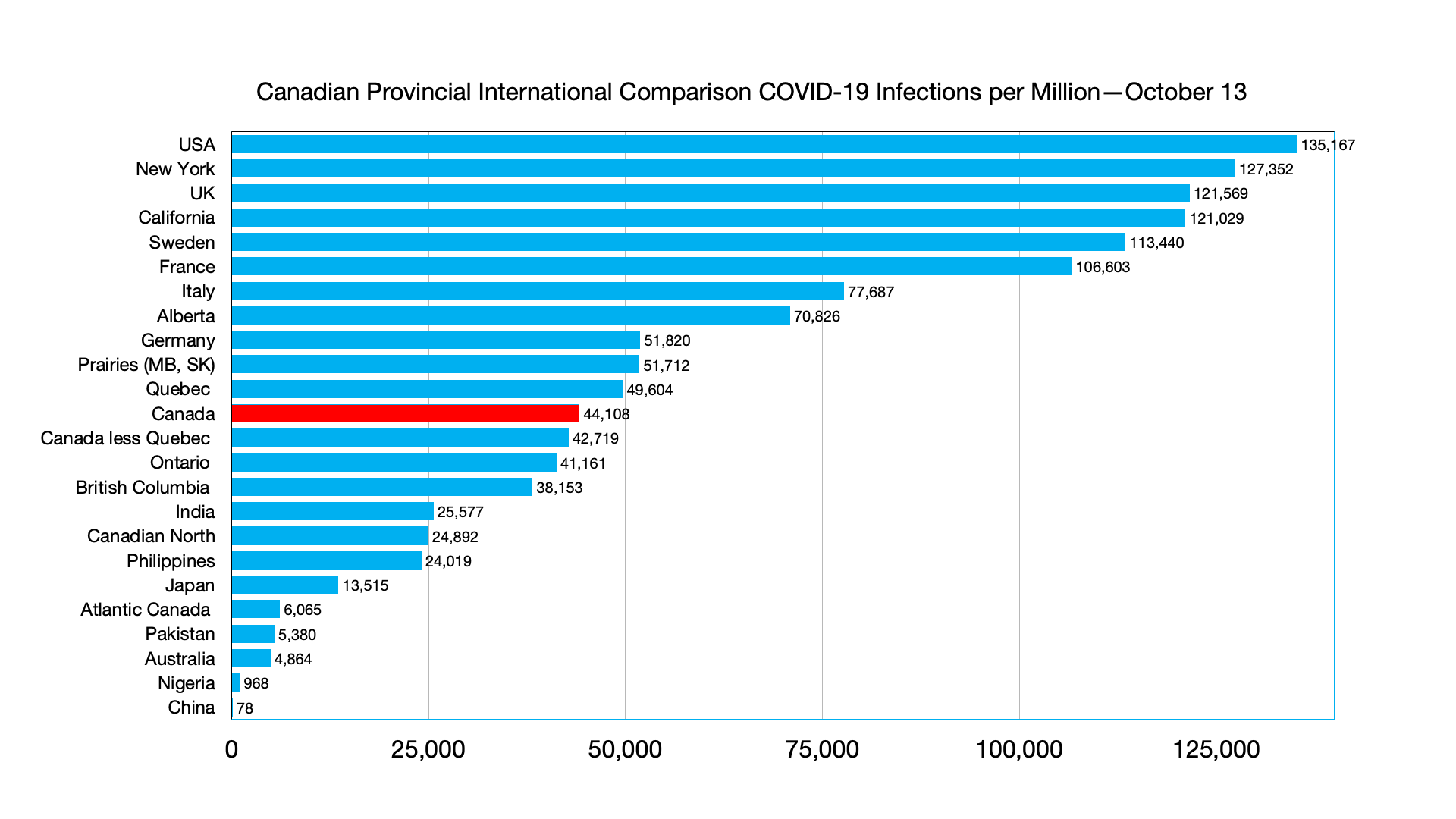
The latest charts, compiled 13 October. Canadians fully vaccinated 73.2 percent, higher than USA 57.2 percent and the UK 67.6 percent).
Vaccinations: Minor changes in Canada, with Ontario ahead of the Canadian North. France and Italy are now ahead of the UK, Japan is ahead of the Prairies, and Sweden and Australia are ahead of the USA. China fully vaccinated 75 percent (unchanged), India 20 percent.
Trendline Charts:
Infections: UK now has more than California, and the Canadian North has more than the Philippines. The chart also shows the number of infections in Alberta starting to level off.
Deaths: New York and the USA have more infections than Italy, with California having more than France. Alberta deaths, along with the Prairies albeit to a lesser extent, continue to climb.
Vaccinations: Alberta vaccinations have surpassed the Prairies.
Multiculturalism is working when the top Canadian health officials giving a recent national briefing on COVID-19 were Dr. Theresa Tam, Dr. Howard Njoo and Dr. Supriya Sharma.
Multiculturalism is working when our top-selling Canadian authors include Thomas King, Dionne Brand, Esi Edugyan, Souvankham Thammavongsa, Michelle Good, Joy Kogawa and Jesse Wente.
Multiculturalism is working when our top Canadian athletes include Andre De Grasse, Leylah Fernandez, Patrick Chan, Mo Ahmed, Bianca Andreescu, Felix Auger-Aliassime and Milos Raonic.
Multiculturalism is working when our Members of Parliament have included Marci Ien, Navdeep Bains, Lori Idlout, Olivia Chow and Ya’ara Saks.
When merit is allowed to work all sorts of talent rises to the top.
Fifty years ago on Oct. 8, 1971 Canada ushered in the world’s first Multiculturalism Policy. As a federal initiative it has always been small as government programs go, but has always punched well beyond its weight.
Importantly, it has created an ethic, a value, a defining characteristic of Canada that is known across Canada and also across the world.
Take the TTC bus along Wilson or Jane Sts. and you see a veritable reflection of the world. Take a walk through a food court in a Bay St. office tower, same thing. But it’s not the world, it’s Canada.
Often times people point to the colourful symbols of diversity as its great benefit to Canada: the song and dance, the food and restaurants, the summer festivals, and exclaim how wonderful it is.
To be fair, multiculturalism did begin as a fairly celebratory idea. “Celebrating our differences” was one of the early slogans. And politicians of all parties, then, as now, are always only too happy to attend cultural and religious events.
But a lot of our success exists because of immigration and the multicultural society we have built. Our health care and seniors care systems only exists because immigrants are the undisputed backbone of it, with doctors, nurses, pharmacists, personal support workers pulling together to save Canadian lives.
The bulk of low paid grocery store and plant workers are immigrants from many countries, working to get our food packed and on store shelves. And all these diverse people work together relatively harmoniously, because they accept the diverse society we have built.
That’s the good story.
Then there’s another side. Here are the questions worth asking:
Why are all the low-wage and essential professions filled by immigrants?
Why do many of these workers still face racism in the workplace?
Why is there still systemic racism in so many systems — police, armed forces, health care to name three.
While many racialized Canadians are highly qualified, why are there many fields where they cannot advance, in the public and private sectors?
Multiculturalism was designed to be an organizing principle that allows for diverse peoples to thrive together, respecting the diversity that exists, while also focusing on the common ties that bind. And that’s not simple. And despite its shortcomings it still works
So here we are at 50? A multicultural society that does work well in many ways and is a beacon to many societies. But which also has many flaws and many unfinished initiatives towards equality.
Today in 2021, we find a world where divisions with countries the world over are more divided than ever before.
And here’s the growing chasm in Canadian society and many other societies: On the one hand is the assimilationist view point … make us great again! Time to stand up for our history (the predominant version of it), and stop catering to the growing number of calls for equality.
On the other hand is the growing determination for the rights of the nonprivileged. There are number of calls for equality from different perspectives and they add up to a sizable number of people who more strongly and loudly articulating their demand to be heard and responded to.
As we get more serious about who we are as a country and about our values, we find lip-service isn’t enough. A starting point is acknowledging our past, be that residential schools, or slavery. Yes it existed in Canada.
It means sharing the economic pie, paying better wages, stopping the systemic racism, so that we can have more Theresa Tams, Patrick Chans, Michelle Goods and Olivia Chows.







 Multicultural Meanderings