Quebec employers group worried ‘politicized’ immigration debate will hurt jobs

Legitimate worry, if debate becomes xenophobic rather than the impact of housing, healthcare, infrastructure:

The latest spat between Quebec and Ottawa over immigration is based on politics and not the reality of the labour market, says the head of a major employers group.

“In some ways, it’s deplorable,” said Karl Blackburn, president and CEO of the Conseil du patronat du Québec.

His comments come as Quebec Premier François Legault is threatening to hold a “referendum” on immigration if the federal government doesn’t take rapid action to stem the rising number of temporary immigrants, which include foreign workers, international students and refugee claimants.

“The majority of Quebecers think that 560,000 temporary immigrants is too much,” Legault said last week. “It’s hurting our health-care system. We don’t have enough teachers, we don’t have enough housing.”

Provincial Immigration Minister Christine Fréchette said the province’s demands include stronger French-language requirements in immigration programs managed by the federal government and a reduction in the number of asylum seekers and temporary workers.

While Prime Minister Justin Trudeau rejected the province’s bid for full control over immigration — currently a shared responsibility — Legault said in March that his federal counterpart had showed openness to some of the province’s demands, and agreed with him on the need to reduce temporary immigrants.

Blackburn, however, disagrees that there are too many temporary workers, who he said are “working in our businesses producing goods and services.” Their numbers, he added, reflect the needs of the labour market and of an aging society.

He said he supports the Legault government’s call to reduce the number of asylum seekers in the province because Quebec has received a disproportionate share in recent years. But he denounced the federal government’s “improvised” decision to suddenly reimpose visas on some Mexican nationals earlier this year, a measure Quebec had pushed for as a way of reducing asylum claims.

He said that’s already having “direct effects” on businesses by restricting their ability to bring in workers. Any subsequent measures to reduce the number of temporary workers will further hurt Quebec’s economy as well as consumers who will no longer have access to the same goods and services, he said.

“It’s as if our governments knowingly agreed to cause companies to lose contracts for reasons of political partisanship and not based on economic growth, which is nonsensical in a way,” Blackburn said.

Politicians are unfairly blaming immigrants for shortages of housing, daycare spaces and teachers, when the real problem is government failure to invest in those areas, he added.

The long-running debate between Quebec and Ottawa has flared in recent months. Earlier this year, the premier wrote to Trudeau about the influx of asylum seekers entering Quebec, which has welcomed more than 65,000 of the 144,000 would-be refugees who came to Canada last year.

Quebec has demanded Ottawa reimburse the province $1 billion — the amount Quebec says it has cost to care for asylum seekers over the last three years.

Federal Immigration Minister Marc Miller said this week that no country would ever give up total control over immigration. But he said he and his provincial counterpart are having good discussions and agree on many matters, including limiting visas to Mexicans and protecting French.

While Legault has blamed the federal government for the “exploding” number of newcomers, the director of a research institute and co-author of a recent study on temporary immigrants says both Ottawa and Quebec have brought in measures in recent years to facilitate their arrival.

Emna Braham says the surge in temporary immigrants is due to a combination of factors, including a tight labour market, post-secondary institutions recruiting internationally, and programs by both Ottawa and Quebec to allow companies to bring in more workers.

She said numbers have now climbed higher than either level of government expected, likely because temporary immigration is administered through a series of programs that are separate from one another.

“We had a set of measures that could be justified individually, but there was no reflection on what the impact will be of all these cumulative measures on the flow of immigrants that Quebec and Canada accept,” she said in a phone interview.

Both Braham and Blackburn point out that the high number of temporary workers in Quebec is also a result of the province’s decision to cap the number of new permanent residents it accepts each year to around 50,000, creating a bottleneck of people awaiting permanent status.

“If the government of Quebec had set its thresholds at the level they should be to meet the needs of the labour market, we wouldn’t be in this situation where (there) is a significant increase in temporary workers,” Blackburn said.

Braham said the moment is right for provinces and the federal government to develop a coordinated approach to immigration, and to ensure a system is put in place to ensure both long- and short-term needs are met.

Source: Quebec employers group worried ‘politicized’ immigration debate will hurt jobs
Devant les annonces prébudgétaires d’Ottawa, Legault rebrandit le référendum en immigration 

Sigh although his concern regarding the excessive increases in temporary workers is legitimate and likely more political positioning. But a referendum on immigration, even if narrowly focused, will likely not be conducive to reasoned discussion:

Le premier ministre François Legault n’en peut plus d’entendre son homologue à Ottawa, Justin Trudeau, faire un « feu d’artifice d’annonces » prébudgétaires à l’intérieur des champs de compétence du Québec. Il invite le fédéral à se concentrer plutôt sur la hausse du nombre d’immigrants temporaires et ravive l’idée d’un référendum sectoriel en immigration.

« Au lieu de faire des annonces dans les champs de compétence du Québec, occupez-vous de vos propres responsabilités, en particulier l’immigration », a lancé l’élu caquiste, mardi, lors d’un point de presse tenu quelques minutes avant la période des questions, à l’hôtel du Parlement.

M. Legault réagissait à une série d’annonces effectuées dans les dernières semaines par lesquelles le gouvernement de Justin Trudeau a fait connaître ses intentions de débourser des milliards de dollars pour le logement. Il y a deux semaines, l’annonce de la création d’une Charte canadienne des locataires et de l’équivalent d’un bail uniforme pour tout le Canada avait fait fulminer les ministres du gouvernement Legault.

« Ce que je dis à M. Trudeau, c’est : écoutez les Québécois. Puis, au lieu de […] dire “on va vous donner de l’argent en santé, on va vous donner de l’argent pour le logement”, allez donc à la racine du problème. Il y a trop d’immigrants temporaires », a soutenu le premier ministre caquiste.

M. Legault reproche à son homologue au fédéral d’avoir « laissé exploser leur nombre à 560 000 », selon le dernier décompte. Après l’avoir écartée en février, le premier ministre revient donc avec l’idée d’un référendum sectoriel en immigration, en fonction du « résultat des discussions » avec son homologue, qui aboutiront à une rencontre au sommet sur le sujet d’ici la fin juin.

« On va rentrer dans le détail. Est-ce que les immigrants temporaires devraient être préapprouvés par le Québec ? Si c’était le cas, ça voudrait dire qu’un, on contrôlerait le nombre, et deux, on contrôlerait les exigences en français », a-t-il dit mardi. « Est-ce qu’on fait un référendum là-dessus éventuellement ? Est-ce qu’on fait un référendum plus large sur d’autres sujets ? »

Exclu, puis considéré

En février, pourtant, François Legault avait écarté un éventuel référendum sectoriel en immigration. « Je ne pense pas qu’on a besoin de faire un référendum pour demander aux Québécois s’ils souhaiteraient qu’on rapatrie les pouvoirs à Québec », avait-il dit.

Or, Justin Trudeau a une « obligation de résultat » en vue de sa réunion de juin, a fait valoir M. Legault mardi. Après une rencontre le mois dernier, le premier ministre québécois avait affirmé ressentir chez M. Trudeau une ouverture à ce que le Québec puisse décider du nombre de travailleurs temporaires admis sur son territoire et qu’une « partie » d’entre eux se voient refuser le renouvellement de leur permis de travail.

Sans quoi, « il faut voir, là, est-ce qu’on a besoin de faire un référendum pour s’assurer que la majorité des Québécois appuient », s’est interrogé M. Legault à voix haute.

À Ottawa, mardi, le ministre fédéral de l’Immigration, Marc Miller, a assuré que les discussions avec Québec allaient bon train. « J’ai vraiment senti dans les dernières semaines de la ministre [québécoise de l’Immigration Christine] Fréchette une ardeur au travail, une volonté de vraiment trouver des solutions à nos défis », a-t-il dit.

S’il convient avoir des « points de divergence » avec le gouvernement Legault, l’élu libéral entend oeuvrer sur « la langue commune du Québec » et sur le désir de Québec « de réduire les gens qui sont ici de façon temporaire ». L’idée de confier tous les pouvoirs en immigration au Québec comme l’avait demandé le gouvernement caquiste le mois dernier n’est toutefois pas sur la table.

« Un pays qui donne tous ses pouvoirs à quelqu’un d’autre n’est plus un pays », a-t-il maintenu.

Québec demandera des compensations sans conditions pour l’ensemble des programmes fédéraux s’immisçant dans les pouvoirs du Québec, a indiqué M. Legault mardi. « Il n’est pas question d’accepter ça. » Le dépôt du budget fédéral est prévu le 16 avril.

Source: Devant les annonces prébudgétaires d’Ottawa, Legault rebrandit le référendum en immigration

English version:

Premier François Legault on Tuesday threatened to hold a referendum on immigration if he doesn’t get what he wants from Prime Minister Justin Trudeau.

Legault is pressing Ottawa for more power over immigration. Trudeau slammed the door on giving the province full control last month. “Will we hold a referendum on (getting full power over immigration) eventually? Will we do it more broadly, on other subjects?” Legault said. “It will depend on the results of discussions” with the federal government. “Don’t forget, Mr. Trudeau promised me a meeting by June 30 at the latest. So, I expect results there.”

Speaking to reporters in Quebec City, Legault complained the province has received more than 500,000 temporary foreign workers and asylum seekers over the past eight years.

“The federal government has allowed the number of temporary immigrants to explode to 560,000,” he said.

“This causes enormous problems for Quebecers. We lack teachers, nurses, housing, and (immigrants and asylum seekers) pose a real challenge for the future of French, particularly in Montreal.”

Legault said a referendum is “not in our plan, short term.”

However, he added: “Do we need to hold a referendum so that Mr. Trudeau is convinced that a majority of Quebecers are saying that it doesn’t make sense (to allow) 560,000 immigrants” to come to Quebec.

He said Quebecers “have always been welcoming, will always be welcoming” toward immigrants. “But now we can’t do it anymore. Our capacity to receive has been exceeded.”

He said Trudeau recently admitted Canada has welcomed too many immigrants.

“It’s the first time he’s said that,” Legault noted.

Last week, Trudeau said temporary immigration has to be brought “under control.” He said the number of temporary foreign workers and international students has ”grown at a rate far beyond what Canada has been able to absorb.”

Legault said the problem could be solved if Ottawa granted Quebec the power to pre-approve all temporary immigrants. That way, Quebec could control the number of arrivals and set French language requirements, he said.

After a March 15 meeting with Legault, Trudeau said: “No, we are not going to give more power (to Quebec) on immigration. Quebec already has more powers over immigration than any other province because it’s very important to protect the French language.”

At the time, Legault said Trudeau has privately expressed openness to discussing the idea of giving Quebec a say on the admission of temporary workers and would consider new rules ensuring more workers speak French.

The Coalition Avenir Québec government is under pressure to crack down on immigration. The party’s most significant rival is the poll-leading Parti Québécois.

After last month’s Legault-Trudeau meeting, PQ Leader Paul St-Pierre Plamondon said Trudeau’s response proves Legault is unable to win more powers for Quebec.

“This resounding No is evidence of a completely absent level of bargaining power,” the leader of the pro-sovereignty party said at the time. “It’s embarrassing for Quebec. We deserve more than this perpetual humiliation.”

Source: Legault threatens immigration referendum if Trudeau doesn’t relent

ICYMI: Nouvelle hausse des immigrants temporaires au Québec

Ongoing focus of Quebec discussion and debates:

Le nombre de résidents non permanents au Québec a de nouveau grimpé à la fin de l’année 2023, une hausse qui s’explique notamment par l’arrivée massive de demandeurs d’asile, dont le gouvernement Legault réclame de nouveau une meilleure répartition à travers le Canada.

Le dernier décompte de Statistique Canada, rendu public mercredi matin, fait état de plus de 560 000 immigrants temporaires résidant au Québec au début du premier trimestre de 2024 (1er janvier). C’est une augmentation de 32 000 personnes depuis la dernière mise à jour de l’agence statistique, rendue publique en décembre.

On compte parmi ces nouveaux arrivants près de 177 000 demandeurs d’asile, en hausse de 16 000 depuis le dernier décompte. « Clairement, il faut que le fédéral prenne ses responsabilités et répartisse les demandeurs d’asile dans l’ensemble du Canada, dans les autres provinces », a réitéré la ministre québécoise de l’Immigration, Christine Fréchette, quelques instants après avoir pris connaissance de ses nouvelles données.

Les données laissent toutefois entrevoir un ralentissement de la croissance des immigrants temporaires. Il s’agit de l’augmentation la moins importante du nombre de résidents non permanents depuis un an. Quant aux détenteurs de permis de travail et d’études, ainsi que leurs proches, ils étaient plus de 383 000 au premier jour de l’année.

La publication de ces statistiques survient à quelques heures d’une rencontre entre la ministre Fréchette et son homologue au fédéral, Marc Miller. L’élue caquiste compte bien profiter de cet entretien pour « aborder la répartition des demandeurs d’asile ».

En plus d’exiger des gestes d’Ottawa sur cette question, Québec demande que le fédéral lui verse environ 1 milliard de dollars pour compenser les services offerts aux personnes en attente d’asile depuis 2021.

Source: Nouvelle hausse des immigrants temporaires au Québec

Keller: The Liberals broke the immigration system at high speed. They’re repairing it by baby steps

Hard not to agree:

…In all of this, the Trudeau government is caught in a bind of its own making. It found, to its evident delight, that sharply ramping up the number of people arriving on notionally temporary permits was easy. To govern is to choose, but the government discovered that the less choosing it did – and the more rubber-stamping of visas it encouraged – the easier governing appeared to be.

It is now discovering that unwinding things, even a little, is more difficult. It will be lobbied heavily to eviscerate its modest promises, and to quietly reverse this course reversal.

That is also where Liberal predilections reside. They didn’t just break the immigration system. They broke it with great enthusiasm. And their repair job is still mostly blueprints, drawn up haltingly and under the duress of public opinion.

Compared with Europe and the United States, Canada has long had a wider immigration door, but also far more control – an aspect of the “order” in peace, order and good government – over who enters. That is what underpinned public support for immigration.

And controlling the door was important because once somebody gets into Canada, whether as a temporary worker, student or even tourist, it isn’t easy to get them to leave. Not if they don’t want to. Ottawa decides who gets in but has much less control over, or information about, how many people whose visas have expired, and who are no longer legally allowed to reside in Canada, nevertheless remain.

In the months and years to come, that is likely to be the final aftershock of Liberal immigration policy.

Restoring sense and sanity to the system won’t be easy. Breaking is easier than repairing.

Source: The Liberals broke the immigration system at high speed. They’re repairing it by baby steps

Un programme «totalement dénaturé», tonne un leader syndical

On the steep rise in the number of temporary workers. Not much similar messaging from Canadian unions unless I’ve missed it:

Québec a fait entrer plus de personnes munies d’un permis de travail fermé que de résidents permanents l’an dernier. La majorité d’entre eux sont arrivés sans que leur poste soit d’abord affiché pour les travailleurs locaux. C’est donc une mesure d’exception qui est devenue la norme, déplorent des syndicats.

« Le programme est totalement dénaturé. Il a été remplacé par un fast track pour les employeurs, une autoroute pour la précarisation », lance Dominic Lemieux, directeur québécois du syndicat des Métallos. Il s’inquiète que les employeurs n’aient plus « aucune pression » pour donner des conditions de travail compétitives s’ils peuvent se tourner vers les travailleurs temporaires « sans rien avoir à faire pour trouver des gens locaux ».

En 2023, ce sont 63 % des dossiers de travailleurs temporaires qui ont pu passer par le « traitement simplifié », en dehors de l’agriculture, selon des données obtenues par Le Devoir dans le cadre d’une demande d’accès à l’information. Cette mesure réclamée par Québec fait en sorte que les employeurs ne sont pas obligés d’afficher l’emploi au préalable et donc de faire la démonstration qu’ils ont cherché à recruter quelqu’un localement.

En principe, le Programme des travailleurs étrangers temporaires (PTET) permet aux employeurs d’embaucher ailleurs « lorsqu’aucun Canadien ou résident permanent n’est disponible », est-il pourtant expliqué à la première ligne du feuillet d’information fédéral.

Embaucher des travailleurs à l’étranger, même avec un traitement simplifié, « est un parcours du combattant », rétorque quant à elle Véronique Proulx, présidente-directrice générale de Manufacturiers et exportateurs du Québec (MEQ). « Le premier choix est de recruter localement », car il est « excessivement complexe et long » de franchir toutes les étapes pour recevoir des travailleurs temporaires.

Mécanique

Les permis dits « fermés » sont liés à un seul employeur. Plusieurs les trouvent trop restrictifs, voire controversés parce qu’ils peuvent rendre les travailleurs étrangers temporaires « vulnérables », comme l’a souligné un rapporteur spécial des Nations unies l’automne dernier. Deux actions collectives contre le gouvernement fédéral afin de les abolir sont aussi en attente d’être autorisées par les tribunaux. 

Ce sont 58 885 permis fermés qui ont été octroyés en 2023 avec l’aval de Québec, selon les données d’Immigration, Réfugiés et Citoyenneté Canada (IRCC). Pendant cette même année, ce sont 52 790 personnes qui sont devenues résidentes permanentes dans la province. 

Depuis 2021, le gouvernement caquiste a fait de nombreuses démarches à Ottawa pour qu’il assouplisse le programme. Résultat : la liste des professions admissibles au traitement simplifié s’est allongée de quelques dizaines à plus de 300 aujourd’hui.

Le fédéral avertit en ligne que les employeurs « devraient faire de leur mieux pour recruter des citoyens canadiens », mais ils n’ont plus à fournir de preuve qu’ils l’ont fait.

Ce changement est « majeur », selon M. Lemieux, des Métallos. Il s’exprimait en nos pages au mois de janvier, mais les chiffres obtenus confirment selon lui le « détournement » du programme. 

Le Conseil du patronat du Québec parle quant à lui d’une forme de « voie de contournement », puisque l’immigration permanente est bouchée. 

Pour faire partie de la liste des métiers et professions admissibles au traitement simplifié, « le déficit de main-d’oeuvre doit être vraiment confirmé », indique Denis Hamel, vice-président des politiques de développement de la main-d’oeuvre au Conseil. L’affichage est une « barrière administrative » dans des domaines où « il est évident que les gens ne se bousculeront pas » pour l’embauche. 

La liste est préparée par la Commission des partenaires du marché du travail (CPMT) à l’aide d’un diagnostic élaboré à partir d’études, explique M. Hamel. Si le nombre de permis fermés augmente, « c’est le reflet du marché du travail », affirme-t-il. 

« Oui, on a besoin de l’immigration, on est d’accord là-dessus. Mais il faut baliser et aussi leur offrir la possibilité de devenir des citoyens à part entière. […] La pénurie n’est pas temporaire », affirme Dominic Lemieux.

Le leader syndical craint que « l’abondance du cheap labor », à terme, « tire les conditions de travail à la baisse ». La précarisation affecte aussi la santé et la sécurité au travail, ajoute-t-il. « C’est beaucoup plus difficile de revendiquer ton droit de refus de travailler si tu as peur de te faire mettre un timbre dans le front et retourner dans ton pays. »

Rupture historique

Il y a en effet un « risque de distorsion » des conditions de travail si elles ne sont plus évaluées dans un secteur ou une région, selon Dalia Gesualdi-Fecteau, professeure à l’École des relations industrielles de l’Université de Montréal. 

« Si l’on regarde dans le rétroviseur, on voit que la politique d’immigration au Canada a historiquement été une politique d’emploi », expose cette spécialiste du droit du travail. Dès le début du XXe siècle, les entreprises ferroviaires identifient à l’étranger des candidats à l’immigration. Après la Deuxième Guerre mondiale, les autorités canadiennes mettent en place un système fondé sur l’existence d’un contrat de travail, et l’employeur doit formellement démontrer qu’il y a pénurie. 

« Mais la grande différence est qu’à l’époque [cette politique] menait à une réinstallation définitive », et non pas à un permis temporaire comme maintenant. « C’est un changement de paradigme, dit-elle. Aujourd’hui, on est vraiment ailleurs. Le marché du travail a encore des besoins qu’on va chercher à combler, mais en large partie par des gens qui ont une possibilité beaucoup plus limitée de rester ici, surtout quand on est dans des emplois dits à bas salaire. »

Des discussions « difficiles »

À la demande de la ministre de l’Immigration, Christine Fréchette, un groupe de travail de la CPMT se penche en ce moment sur les permis de travail fermés. En septembre dernier, le gouvernement se disait « interpellé par les situations d’abus rapportées ». 

En coulisses, plusieurs sources parlent de discussions corsées entre les membres des syndicats et ceux des organisations patronales. Les réunions se tiennent à huis clos, mais plusieurs parties ont déjà fait état de leurs positions. Les quatre centrales syndicales ont réclamé l’abolition des permis fermés en septembre dernier. « Oui, on peut nommer notre préjugé favorable pour les permis ouverts », dit Luc Vachon, président de la Centrale des syndicats démocratiques (CSD). « Il faut être capables ensemble de dire que le niveau de vulnérabilité des travailleurs temporaires n’est pas souhaitable ni adéquat. On pourra ensuite réfléchir pour réduire ce niveau », dit-il. 

Le Conseil du patronat du Québec « s’oppose au principe de l’ouverture tous azimuts des permis », indique Denis Hamel, craignant une « déstabilisation » du marché du travail. 

Il en coûte de 12 000 $ à 15 000 $ pour recruter à l’étranger, avance Véronique Proulx, de MEQ. « Le programme est essentiel pour assurer la pérennité et la croissance des entreprises. Il fonctionne très bien, mais ça ne veut pas dire qu’il n’y a pas des choses à améliorer », résume-t-elle. Ainsi, si les besoins changent, les permis ne devraient pas rester figés dans un seul poste pour un seul salaire, donne-t-elle comme exemple.

Source: Un programme «totalement dénaturé», tonne un leader syndical

Prime Minister Trudeau failed to follow his own advice on temporary foreign workers

Always easier in opposition than in government but valid reminder of how soon they forget once in government. Trudeau in 2014 had it right:

Massive growth in Canada’s non-permanent resident streams of immigration (including temporary foreign workers and international students) has led to growing calls on the Trudeau government to reform the system. Immigration Minister Marc Miller recently announced a two-year reduction to student visas. The government has so far been silent on possible reforms to the temporary foreign workers stream. 

One unlikely source of advice on such reforms might be Prime Minister Justin Trudeau himself. In 2014, the then-Liberal Party leader wrote a scathing op-ed in the Toronto Star that excoriated the Harper government for the growth of the Temporary Foreign Workers Program (TFWP) under its administration and highlighted the need to “scale it back dramatically.”

He wrote: 

“As a result [of Harper-era policies], the number of short-term foreign workers in Canada has more than doubled, from 141,000 in 2005 to 338,000 in 2012. There were nearly as many temporary foreign workers admitted into the country in 2012 as there were permanent residents — 213,573 of the former compared to 257,887.

At this rate, by 2015, temporary worker entries will outnumber permanent resident entries.

This has all happened under the Conservatives’ watch, despite repeated warnings from the Liberal Party and from Canadians across the country about its impact on middle-class Canadians: it drives down wages and displaces Canadian workers.”

Fast forward a decade and the Trudeau government’s own record on the TFWP has failed to adhere to these sensible insights. 

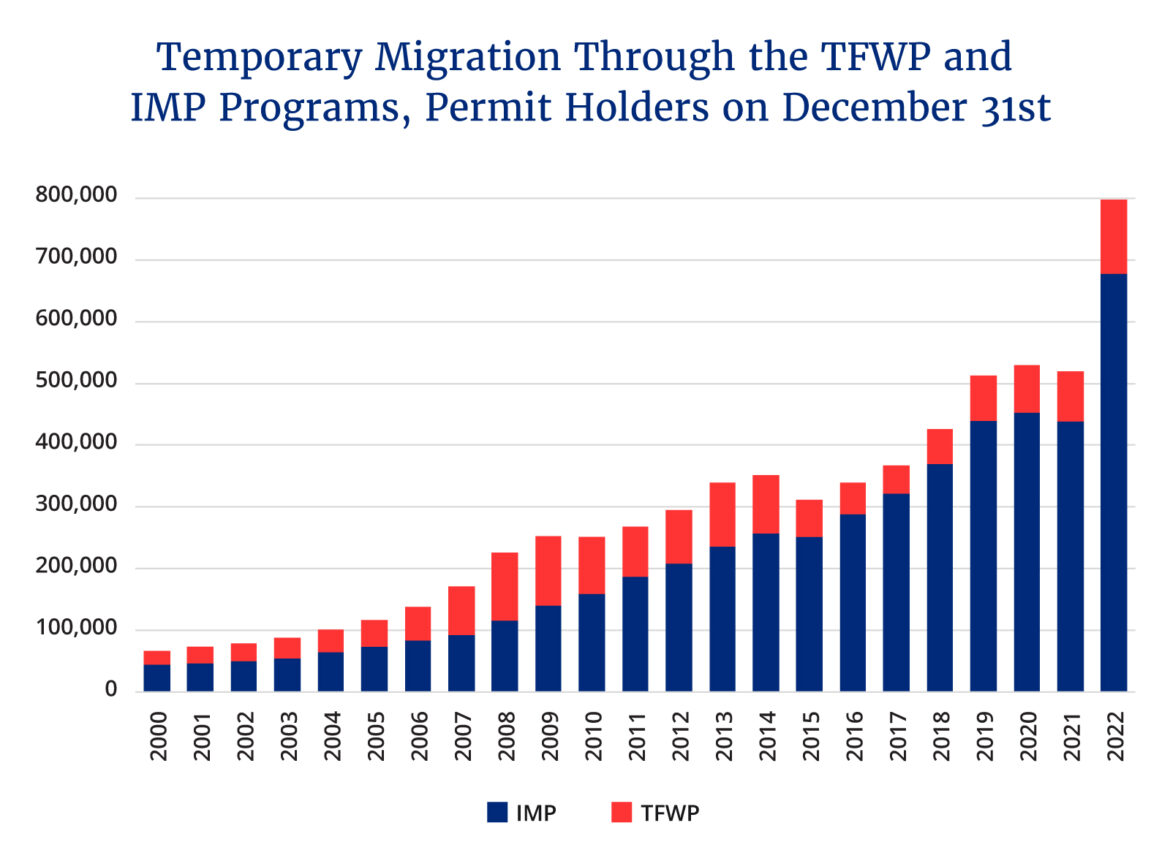
The figure below displays the number of work permit holders at the end of 2022 through Canada’s two temporary labour migration streams—the TFWP and the International Mobility Program (IMP). The TFWP covers migration programs that require a Labour Market Impact Assessment to receive a work permit such as the live-in caregiver program and various agricultural programs. The IMP does not require labour market assessments and includes individuals working on visas related to trade agreements such as the Canada-U.S.-Mexico Trade Agreement, individuals on post-graduate work permits, and so on. 

Mr. Trudeau was correct in 2014 to observe that there was a more than doubling of the program under the Conservatives before a slight reduction owing to policy changes later that year that included a partial moratorium on new permits and visas.

Graphic credit: Janice Nelson.

Under Trudeau’s tenure as prime minister, however, the number of temporary work permits has grown dramatically—far outstripping those during the Harper government. In 2015, there were a little more than 310,000 temporary work permits. By 2022, the number had more than doubled to almost 800,000. Partial data from 2023 indicate that there was a further increase last year. 

One way to understand this massive increase in the number of temporary foreign workers is to use Trudeau’s own standard of the share relative to permanent residents. He warned in 2014 that the ratio was approaching 1:1. In 2022, there were roughly 440,000 permanent residents admitted into Canada compared to the almost 800,000 working on temporary visas.

This significant growth not only conflicts with Trudeau’s chief recommendation in his op-ed that the TFWP needed to be constrained but also his broader concerns about the risks of an over reliance on temporary foreign workers. 

He concluded: 

“It cuts to the heart of who we are as a country. I believe it is wrong for Canada to follow the path of countries who exploit large numbers of guest workers, who have no realistic prospect of citizenship. It is bad for our economy in that it depresses wages for all Canadians, but it’s even worse for our country. It puts pressure on our commitment to diversity, and creates more opportunities for division and rancour.

We can and must do better.”

Source: Prime Minister Trudeau failed to follow his own advice on temporary foreign workers

Most Canadians support bringing in temporary foreign workers to fill jobs, says poll

Bit surprising that the housing impact, which factors into recent declines in support for current levels, has not impacted the support for temporary workers and students, which also has an impact:

Most Canadians support employers bringing in temporary foreign workers to fill jobs they can’t find Canadians to do, according to a poll for The Globe and Mail, despite growing numbers opposed to increased immigration.

The survey also found that more than eight in 10 Canadians feel that temporary foreign workers are important to the country’s economy.

And over two-thirds show support for temporary foreign workers who wish to remain in Canada becoming citizens, according to the Nanos Research poll.

The findings are released as a growing proportion of Canadians say they want the country to accept fewer immigrants in 2024 compared to 2023, with opposition to more immigration growing since September, according to other Nanos polling.

Nik Nanos, chairman of Nanos Research, said Canadians are increasingly against more immigration, but are more supportive of migrants coming to do specific jobs….

Source: Most Canadians support bringing in temporary foreign workers to fill jobs, says poll

Migrant farm workers pay into EI, but can’t access it. Now they’re suing the federal government

Yet another possible class action suit. Another to watch:

Migrant agricultural workers in Canada pay into employment insurance (EI), but they are not able to access it when their contracts expire and they return to their home country.

They also have employment contracts that are tied to one employer, preventing them from changing their employer while they’re in Canada.

A proposed $500-million class action lawsuit is aiming to challenge those regulations.

“It’s an issue that has been around for some time now,” said Jody Brown, a partner at Goldblatt Partners LLP, the law firm that filed the statement of claim. “The time is now for workers to come forward and try and make a change to this program.”

Kevin Palmer and Andrel Peters, seasonal migrant workers from the Caribbean who worked for companies in Leamington, Ont., are the lead plaintiffs in the suit, filed last month at the Ontario Superior Court of Justice in Toronto.

It was filed on behalf of workers in the Seasonal Agricultural Worker Program and the Temporary Foreign Workers Program-Agricultural Stream for the last 15 years.

“They’re seeking to bring a case not just on their own behalf, but on behalf of 10s of thousands of other workers who have been in a similar situation,” said Brown.

Class action lawsuits have to be certified by a judge in order to proceed. The allegations in the proposed lawsuit have not been proven in court.

A 2022 report from Statistics Canada stated that Canada is “increasingly reliant on TFWs to fill labour shortage gaps” and that the number of TFWs in Canada increased by 600 per cent from 2000 to 777,000 in 2021.

An advocate for migrant workers says the suit is important in the fight to get more rights for migrant workers.

“The feedback from workers has been quite positive,” said Chris Ramsaroop, an organizer with Justice for Migrant Workers. “The biggest concerns that they’ve got are around immigration and around employment insurance and that in their time of need, they can’t claim or access this benefit.”

In an emailed statement to CBC News, a spokesperson for Employment and Social Development Canada says the government does not comment on ongoing cases or “an individual’s personal circumstances,” but said that it takes “its responsibilities with respect to the protection of temporary foreign workers very seriously and the safety and protection of workers is paramount…

Source: Migrant farm workers pay into EI, but can’t access it. Now they’re suing the federal government

Mahboubi and Skuterud: Canada must stem the surge in temporary foreign workers and international students

More needed analysis and commentary:

Recent years have seen an unprecedented increase in Canada’s non-permanent resident population, far surpassing increases in annual admissions of new permanent residents. The unbalanced growth in Canada’s temporary and permanent migration inflows will inevitably result in a growing undocumented population and forced deportations. Both developments risk inflaming Canada’s immigration politics and undermining public confidence in the immigration system.

It is imperative that the government take immediate steps to stem the continuing growth in foreign student and temporary foreign worker entries.

Several factors have contributed to the non-permanent resident (NPR) population surge, including ad-hoc programs aimed at expanding eligibility for permanent resident (PR) status, increasing postsecondary reliance on international student tuition revenue and eased employer access to temporary foreign workers, most notably those in low-wage occupations.

Statistics Canada estimates that by the third quarter of 2023 Canada’s NPR population had reached 2.2 million, while entries of new permanent residents remained below 500,000 and which the government has announced will stabilize in 2025. The tightening bottleneck in temporary-to-permanent residency flows is, in fact, worse, because most PR slots continue to be filled by applicants residing abroad, not from Canada’s NPR population.

A key factor driving the growth in NPR inflows is the government’s repeated announcements of ad-hoc programs aimed at easing the pathway to PR status for lower-skilled migrants who would otherwise struggle to clear the hurdle of the Express Entry skills-based points system. Allocation of PR slots has increasingly become a lottery incentivizing large numbers of migrants to try their luck at obtaining Canadian PR status.

But given the limited number of PR admissions, large numbers of justifiably hopeful NPRs will be unable to realize their dreams. As their study and work permits expire, many will be unable or unwilling to return to their home countries. These migrants will become increasingly vulnerable to workplace exploitation, distorting wage outcomes in lower-skilled labour markets, and poverty, which government supports are unable to address because of their ineligibility.

Canada urgently requires a multipronged strategy to stem the continuing growth of the NPR population and restore the stability and integrity of the immigration system. In our view, policies should be aimed at augmenting migrants’ own incentives to seek NPR status in Canada.

On the international student front, we recommend reintroducing the cap on foreign students’ off-campus work hours at 20 a week; it was waived in October, 2022, and recently extended to April 30, 2024. The punting of this issue down the road is unhelpful in restoring predictability for prospective foreign students. Study permits have become de facto work permits incentivizing migrants whose primary objective is accessing Canadian jobs, not human capital investments.

We also recommend restricting study permits to institutions of a certain standard. Too many private colleges are essentially used as stepping stones to residency. Designated learning institutionswhose students are currently ineligible for postgraduation work permits should also be ineligible for study permits. The government should also seek to undesignate institutions based on the measured immigration and labour market outcomes of their graduates. Moreover, these metrics should be regularly published by Immigration, Refugees and Citizenship Canada (IRCC) to help prospective migrants make informed decisions and to combat false dreams pushed by education recruiters.

On the temporary foreign worker front, the government must reconsider extended measures allowing, for example, 30 per cent of the work forces of employers in specific industries to be composed of low-wage temporary foreign workers. Stemming the growth in the low-wage stream of the Temporary Foreign Worker Program and restoring the pre-2020 hiring regulations would recognize recent evidence of the adverse effects of this program on wages and local unemployment rates.

Most important, the government needs to bring back predictability in its system for allocating PR admissions in the economic-class applicant pool. Though well-intentioned, ad-hoc programs aimed at easing the pathway to PR status are contributing to growth in TR inflow. IRCC needs to return to relying on the Comprehensive Ranking System (CRS) for allocating PR admissions, as it did before 2020. Given the transparency of the CRS “points system” and a stable CRS cutoff over time, unsuccessful applicants can see what human capital investments they need to be successful, thereby advancing the objectives of our skilled immigration program.

If these policy levers are collectively applied, they can stem growth in Canada’s NPR population, restore fairness and transparency in the PR system and secure the immigration system’s integrity and sustainability. In doing so, we can ensure that Canada continues to be a welcoming and prosperous country for all.

Parisa Mahboubi is a senior policy analyst at the C.D. Howe Institute. Mikal Skuterud is a professor of economics at the University of Waterloo, director of the Canadian Labour Economics Forum and a fellow-in-residence of the C.D. Howe Institute.

Source: Canada must stem the surge in temporary foreign workers and international students

Yalnizyan: Canada’s Temporary Foreign Worker program is ballooning — creating a new class of wage slaves from abroad

Good commentary with reasonable recommendations:

This time last year, the media buzz about the labour market was over The Great Resignation, a bigger phenomenon in the United States but occurring here too, as workers took advantage of record-high job vacancy rates to abandon suboptimal jobs for better ones.

This year there’s an emerging made-in-Canada phenomenon that has barely generated a whisper, let alone a buzz: wage slaves from abroad. It’s a result of public policy.

The idea of owning workers seems like an abomination from another time and place. In Canada, in 2023, it’s difficult to comprehend how any worker could be beholden to a single employer.

Nonetheless, this year the government of Canada has issued more than 142,000 permits to employers to hire temporary foreign workers who are not allowed to work for anyone else. It’s the highest number ever issued, and that figure only covers up to August. Intake through the Temporary Foreign Worker Program has grown by 45 per cent across Canada this year compared with the same eight months in 2022, a record-breaking year of population growth, almost exclusively (96 per cent) due to newcomers.

Permits are issued to employers who make the case that they cannot find a Canadian to do the job — at “prevailing wage rates,” that is. When the federal government finds the reasons provided on the Labour Market Impact Assessment form acceptable, it permits a foreign worker to enter Canada to work only temporarily, and only for that employer.

Just since August 2021, the federal government has expanded the categories of occupations eligible for such a permit and increased the allowable proportion of migrant workers working for an individual employer to 30 per cent from 10 per cent. That gives such employers huge influence over not just their migrant workers but all their workers. It is far from clear this was necessary policy reform. It should be reversed.

Ontario’s employers are escalating their dependence on the permanently temporary in sectors such as warehousing and transport trucking, personal care workers in long-term-care facilities, restaurants and fast food outlets, and farm workers.

The vast majority of employers are moral. But tying permits to a single employer increases the odds of exploitation and abuse.

Although the federal government conducts investigations of employers using the Temporary Foreign Worker Program, employers are often given a heads-up before the inspection takes place. Last year, more than 2,100 inspections were carried out. Only 116 were found non-compliant.

Of the 766 employers on a public registry of employers who broke the rules over the past seven years, the most frequent violation was wage theft — not providing the pay promised in the contract. Only seven employers were banned even temporarily from hiring migrant workers through this program; 23 were just given warnings.

Wage theft is not the only issue. Farm workers had an extraordinarily high incidence of disease and death during COVID because of their living conditions. Abuse and assault of workers providing care to people in their homes and institutions remains all too common. These are the very categories of migrant workers least likely to find a pathway to permanence.

Migrant workers may have the same rights as Canadian workers on paper but are less likely to know what those rights are and even less likely to exercise them for fear of jeopardizing their jobs and futures. That kind of contagion needs to be contained. It spreads rapidly in an uncertain world.

The Standing Senate Committee on Social Affairs, Science and Technology is studying this area of public policy. Last week, Tomoya Obokata, the UN Special Rapporteur on contemporary forms of slavery, presented testimony to the committee about his recent visit to Canada, expressing concern for “low-wage and agricultural streams of the Temporary Foreign Worker Program as the workers at the higher risk of labour exploitation, which may amount to forced labour or servitude.”

I appeared before the committee as well and presented some ideas for policy reform.

First: end the practice of tying work permits to an employer. An open work permit, tied to a region (for example, in parts of the country that are aging more rapidly) or in an industry or sector with high vacancies (such as hospitality or long-term care) would mean workers could leave terrible workplaces without risking deportation. This change could reduce the number of bad jobs and improve the quality of life in communities. Addressing potentially crippling labour shortages, while limiting the abuse of workers, seems a promising avenue of reform.

Second: create simpler pathways to permanent residency for all those who seek it and make those pathways clear before people arrive. Canada has developed an incredibly complex system, with more than 140 types of temporary permits in the immigration database, according to Rupa Banerjee of Toronto Metropolitan University.

In 2022, three times as many people were permitted temporary resident status versus permanent resident status in Canada. Less than a third of those who came here to work or study for a restricted period transitioned to permanent status, even after 10 years of temporary residency; but many more will grab at the chance, without knowing the odds.

There is a whole industry designed to lure international students and migrant workers here on what often turns out to be the false hope of permanent residency; and the relationship between temporary and permanent admissions to Canada is getting more lopsided every year.

Although Canada’s job creation rate has been remarkable, including for Canadian-born and landed immigrant workers, the fastest-growing rate of job creation has been among migrant workers: 61 per cent more jobs than pre-pandemic levels.

We are expediting the intake of migrant workers for entrenched needs, not temporary ones.

Increasing reliance on temporary foreign workers to do the work that needs doing, while not allowing them to form families, get sick, age or retire may be an employer’s dream and a labour market “solution.” But it risks creating a dystopian future for Canadian society.

Armine Yalnizyan is a leading voice in Canada’s economic scene and Atkinson Fellow on the Future of Workers. She is a freelance contributing columnist for the Star’s Business section. Follow her on Twitter: @ArmineYalnizyan. You can write to her at ayalnizyan@atkinsonfoundation.ca.

Source: Canada’s Temporary Foreign Worker program is ballooning — creating a new class of wage slaves from abroad