Quebec announces reduced immigration targets, fuelling tensions with Ottawa

To watch.

Any reopening of the agreement to provide Quebec a role in family reunification and refugees would need to be accompanied by reopening the block grant of $490 million provided to Quebec (2017-18) for selection and integration (see Chantal Hébert’s earlier column By campaigning to cut immigration, Quebec’s opposition parties are playing politics with their province’s future):

Quebec plans to slash the number of immigrants it accepts next year, delivering on an election promise by Premier François Legault and setting the province on a collision course with Ottawa.

The Quebec government announced targets on Tuesday to reduce the number of newcomers to 40,000 in 2019, 24 per cent fewer than the 53,300 anticipated this year.

The plan is turning into the first major source of tension between the federal Liberals and the new Coalition Avenir Québec (CAQ) government, just three days before a federal-provincial meeting in Montreal.

While the biggest drop in numbers would occur among qualified workers and other economic immigrants, which are under provincial control, Quebec also wants to cut into two streams of newcomers that fall under federal control: family reunifications involving spouses, children and parents, which would see 2,800 fewer immigrants, and refugees and asylum seekers, which would be cut by 2,450 people.

Groups working with immigrants and refugees called the CAQ plan “cruel” and said it is already stirring panic among families in Quebec who fear they will not be reunited with loved ones abroad.

The CAQ is also facing criticism for the cuts because Quebec is struggling with a chronic manpower shortage.

In Ottawa on Tuesday, Prime Minister Justin Trudeau raised questions about the timing of the plan.

“What I hear from business people across Quebec is that companies are worried about a labour shortage. I’m not sure that this is the best moment to reduce the intake of newcomers,” he told reporters.

Mr. Legault campaigned on a pledge to reduce immigration, arguing that one in five immigrants ends up leaving Quebec. He has framed the cuts not just in terms of better matching newcomers to the needs of the labour market, but as a way of safeguarding Quebec’s identity, values and French language.

The federal government said it will continue to hold discussions with the Quebec government on the issue, including defending the integrity of the family reunification program.

“We are disappointed,” Dominic LeBlanc, the federal Minister of Intergovernmental Affairs, told reporters in Ottawa on Tuesday. “We don’t want a two-tier system in which families in Quebec need more time to bring in their spouses and parents than those in New Brunswick or Ontario. That’s not an ideal situation.”

Mr. LeBlanc added that both the Quebec and Canadian governments should make sure they meet their international obligations in terms of taking in refugees.

Mr. Legault said his government was elected after campaigning on lower immigration levels.

“We have a clear mandate from the population,” he said outside the National Assembly. “The population clearly understood that a CAQ government will reduce the number of immigrants to 40,000. … I trust the good judgment of the federal government.”

Quebec says the reduction will be temporary, with Immigration Minister Simon Jolin-Barrette calling it a “transition.”

“Faced with the difficulties of integration for a large number of immigrants, we had to act and have the courage to take the means to favour their long-term settlement in Quebec,” he said at a news conference.

In the legislature, he said: “What we want to do is deploy the resources to ensure each person who chooses Quebec succeeds.”

The government’s plan was denounced by an umbrella organization for groups working with immigrants and refugees in Quebec. The Table de concertation des organismes au service des personnes réfugiées et immigrantes called the plan “cruel” and unprecedented in Quebec’s history of immigration policy.

“This decision of the government is creating a wind of panic among numerous families that we are meeting in our organization,” said Lida Ahgasi, co-president of the Table, in a statement. “It’s a totally counterproductive decision, since we know that successful integration can only be accomplished within the family. If we want to take care of newcomers, we especially have to respect and protect the integrity of their family unit.”

At their first meeting after the Oct. 1 Quebec election, Mr. Trudeau and Mr. Legault tried to negotiate a deal on immigration. However, Quebec decided on numbers without informing the federal government of its intentions ahead of time. Under the 1991 Canada-Quebec immigration deal, federal funding to facilitate the integration of immigrants in Quebec will still go up next year, even though the intake numbers will go down.

Source: Quebec announces reduced immigration targets, fuelling tensions with Ottawa

Nearly two-thirds of Quebecers support public-sector ban on religious symbols, poll finds

Not much new here:
Most Quebecers are in favour of banning public-sector workers from wearing religious symbols, according to a CROP poll released ahead of the first legislative session under a Coalition Avenir Québec government.

But a separate survey by Vox Pop Labs, conducted following the Oct. 1 election, suggests Quebecers may be more divided when it comes to the details of how such proposals should be implemented.

Premier François Legault indicated after last month’s election that he will seek to bar civil servants in positions of authority from wearing religious symbols such as the kippa and hijab.

Not only would this apply to police officers, judges and Crown prosecutors, but also to school teachers, Legault said.

He justified his decision by saying it was the “position of a majority of Quebecers.”

The CROP poll, taken between Nov. 14 and 19, estimated that 72 per cent of Quebecers supported banning visible religious symbols for judges, 71 per cent supported banning them for prosecutors and police officers and 65 per cent backed extending the ban to public-school teachers.

CROP also found widespread support (55 per cent) for leaving the crucifix in the National Assembly, another of Legault’s promises. Twenty-eight per cent wanted to see it removed.

More divided on specifics

Alain Giguère, CROP’s president, said the results indicated unprecedentedly high levels of support for banning religious symbols.

“I think we can conclude that the average Quebecer really wants to remove religion from the public sphere, especially for people who hold positions of authority,” Giguère said.

“The numbers are high but they are the product of a public discussion that has lasted since Bouchard-Taylor,” he said, referring to the public commission into reasonable accommodation that wrapped up in 2008.

One of the commission’s key recommendations was that civil servants in positions of authority shouldn’t be allowed to wear visible religious symbols. That, however, did not include teachers.

CROP’s findings are based on an internet panel of 1,000 people. They were asked which government professions should be subject to a ban on religious symbols. The questionnaire did not specify which symbols would be at issue.

When data science firm Vox Pop Labs recently asked Quebecers more detailed questions by about the specific religious symbols they object to, and in which professions, the answers varied widely.

More divided on specifics

Vox Pop, which operates Vote Compass for CBC and Radio-Canada, surveyed 4,000 people about identity issues in the month after the election.

Respondents were shown images of various types of religious clothing and symbols and asked to choose different situations where they should be banned.

The results suggested high levels of support — 87 per cent — for preventing police officers and judges from wearing the burka, a full body covering with only a mesh screen for the eyes.

But that number dropped to around 65 per cent for the turban and kippa.

The Vox Pop findings also suggested Quebecers are, in fact, divided about what religious symbols teachers should be allowed to wear in the classroom.

The kippa was opposed by 49 per cent, the turban by 51 per cent, the hijab by 52 per cent and a large cross by 53 per cent.

Vox Pop summarized its findings by noting a majority of survey participants — 55 per cent — backed the so-called Bouchard-Taylor consensus.

The research firm, though, also concluded that there is little support — only 41 per cent — for extending those limits to teachers, which the CAQ is proposing to do.

Moreover, the Vox Pop findings found higher levels of support for removing the crucifix from the National Assembly than CROP.

They recorded 50 per cent of respondents saying they opposed its presence in the legislature, compared to 45 per cent who were OK with it there.

A Mainstreet poll published two weeks ago, meanwhile, found 42 per cent support for removing the crucifix, compared to the 50 per cent who preferred that it remain.

The National Assembly will begin a two-week session on Tuesday that will be the first opportunity for the CAQ to advance its legislative agenda since it was elected in October with a decisive majority.

Legault said recently his government will likely wait until next year to table legislation on religious symbols.

CROP poll. Results published by CBC Nov. 26, 2018. (Roberto Rocha/CBC)

Source: Nearly two-thirds of Quebecers support public-sector ban on religious symbols, poll finds

Québec ne pourra limiter le nombre de réfugiés reçus, affirme Hussen

Reality intrudes:

Le gouvernement du Québec ne pourra pas limiter le nombre de réfugiés qu’il reçoit chaque année, contrairement à ce qu’avait promis François Legault en campagne électorale.

Dans une entrevue à La Presse canadienne, le ministre fédéral de l’Immigration, Ahmed Hussen, a précisé que l’Accord Canada-Québec permet au gouvernement québécois de choisir le nombre d’immigrants économiques qu’il reçoit annuellement, mais que c’est Ottawa qui détermine combien de réfugiés sont accueillis au pays. Ceux-ci peuvent ensuite s’installer dans la province de leur choix et le Québec doit en accueillir 20 % en 2018.

Le gouvernement fédéral détermine également le nombre d’immigrants issus du programme de réunification familiale.

Le ministre a déposé à la Chambre des communes, mercredi un plan échelonné sur trois ans qui prévoit une augmentation graduelle du nombre d’immigrants chaque année. Ce nombre atteindrait 350 000 en 2021 pour l’ensemble du pays, ce qui correspond à près de 1 % de la population canadienne.

Le ministre a insisté sur le fait qu’une très large proportion de ces immigrants seront admis par l’entremise des programmes économiques existants.

Il s’est toutefois abstenu de se prononcer sur la contradiction entre ce nouveau plan et la promesse du gouvernement caquiste de réduire le nombre d’immigrants accueillis au total au Québec de 50 000 à 40 000 par année, avec des baisses dans les trois catégories, soit les immigrants économiques, les réfugiés et ceux issus du programme de réunification familiale.

« Nous n’avons reçu aucune communication officielle à ce sujet, donc, en ce qui nous concerne, rien ne change jusqu’à ce que nous ayons un autre son de cloche », a affirmé M. Hussen tout en précisant qu’il était prêt à travailler de près avec le Québec.

Source: Québec ne pourra limiter le nombre de réfugiés reçus, affirme Hussen

Signes religieux: le feu sous la cendre

Good commentary:

La mairesse Valérie Plante et le chef de l’opposition à l’Hôtel de Ville de Montréal, Lionel Perez, ont eu la sagesse de refuser de se lancer prématurément dans un débat sur les signes religieux, mais ce n’est que partie remise.

La motion du conseiller indépendant de Snowdon, Marvin Rotrand, qui semble se complaire dans le rôle du boutefeu, était d’ailleurs sans objet. La CAQ n’a jamais évoqué la possibilité d’interdire le port de signes religieux aux élus, que ce soit à l’Assemblée nationale ou au niveau municipal. La charte de la laïcité du gouvernement Marois ne le prévoyait pas non plus.

M. Rotrand soutient avoir obtenu l’assurance que les élus de Projet Montréal et d’Ensemble Montréal auraient appuyé sa motion si celle-ci avait été mise aux voix. Cela est en effet probable, mais quel aurait été l’intérêt d’enfoncer une porte ouverte, sinon d’envenimer un débat qui est déjà suffisamment explosif ?

M. Rotrand n’en est pas à sa première intervention du genre. Au printemps dernier, il avait demandé au Service de police de la Ville de Montréal (SPVM) d’autoriser ses agents à porter le hidjab ou le turban, comme c’est le cas dans de nombreux corps policiers municipaux ailleurs au Canada, que ce soit à Toronto, Vancouver, Calgary ou Edmonton, ou encore dans la GRC.

Aucun policier en service au Québec n’avait manifesté l’intention d’en porter, mais une jeune étudiante en techniques policières du collège Ahuntsic, Sandos Lamrhari, qui souhaite faire carrière au SPVM ou au Service de police de la Ville de Laval tout en portant le hidjab, avait été érigée en symbole par le premier ministre Couillard, qui voyait en elle l’incarnation d’un Québec confiant dans l’avenir, où tout le monde peut participer.

Là encore, il était permis de s’interroger sur l’opportunité de provoquer ce débat, puisque le gouvernement libéral refusait d’interdire à qui que ce soit de porter des signes religieux, pour autant que le visage soit découvert, contrairement à la recommandation de la commission Bouchard-Taylor. Il entendait plutôt laisser à chaque corps policier le soin d’établir son propre code vestimentaire. Or, la direction du SPVM se disait ouverte à toute demande, tout comme la mairesse Plante.

Le changement de gouvernement rend cependant le débat inévitable. Si le premier ministre Legault n’exclut pas que les enseignants puissent échapper au projet de loi que présentera éventuellement le ministre de l’Immigration, de la Diversité et de l’Inclusion, Simon Jolin-Barrette, il n’y aura pas de recul dans le cas des agents de l’État exerçant un « pouvoir de coercition », notamment les policiers.

La constitutionnalité du projet sera contestée à coup sûr. M. Jolin-Barrette se dit convaincu que son projet passera le test des tribunaux. Sinon, M. Legault a réitéré dès le lendemain de l’élection qu’il était prêt à invoquer la disposition dérogatoire (« clause nonobstant ») prévue dans les chartes des droits. D’une manière ou d’une autre, l’interdiction du port de signes religieux finira donc par avoir force de loi.

Ce débat risque d’accentuer encore davantage le clivage entre l’île de Montréal et le reste du Québec, dont la dernière élection a donné une illustration spectaculaire. Le feu couve sous la cendre et il ne faut pas sous-estimer le risque de dérapage. Il y a à peine deux semaines, le maire de l’arrondissement de Pierrefonds-Roxboro, Dimitrios Jim Beis, s’en est pris férocement à la CAQ, dont il dénonçait les « politiques perçues comme racistes ».

« La CAQ instrumentalise la laïcité comme un cheval de Troie pour la mise en oeuvre de politiques d’exclusion et de division. Aucun Québécois ne devrait avoir à choisir entre sa carrière et sa foi », écrivait-il sur Facebook. Des propos qui avaient un désagréable accent de déjà entendu.

On peut légitimement plaider que, dans une ville aussi multiethnique que Montréal, la population fera davantage confiance à son corps policier si sa composition reflète la diversité ambiante. La commission Bouchard-Taylor avait pris cet argument en compte, mais avait néanmoins conclu que la nécessité d’incarner pleinement la neutralité de l’État l’emportait dans le cas des policiers.

À l’Hôtel de Ville de Montréal, on trouvera sans doute cette interdiction excessive, même si le projet de loi de M. Jolin-Barrette sera nettement moins contraignant que l’était celui de Bernard Drainville, qui visait, au terme d’une période de transition, l’ensemble des employés d’une municipalité.

Le gouvernement Couillard accordait aux divers corps policiers, donc aux municipalités, le droit de définir leurs propres règles. On ne parle cependant pas ici d’aménagement urbain, mais d’un principe directeur applicable à toute la société québécoise. L’expression de la neutralité de l’État ne peut pas être à géométrie variable. Que cela leur plaise ou non, il n’appartient pas aux municipalités d’en fixer les paramètres, mais au gouvernement élu par l’ensemble de la population du Québec.

Source: Signes religieux: le feu sous la cendre

Quebec wants to expand religious symbol ban, blocking Muslim garments in civil service

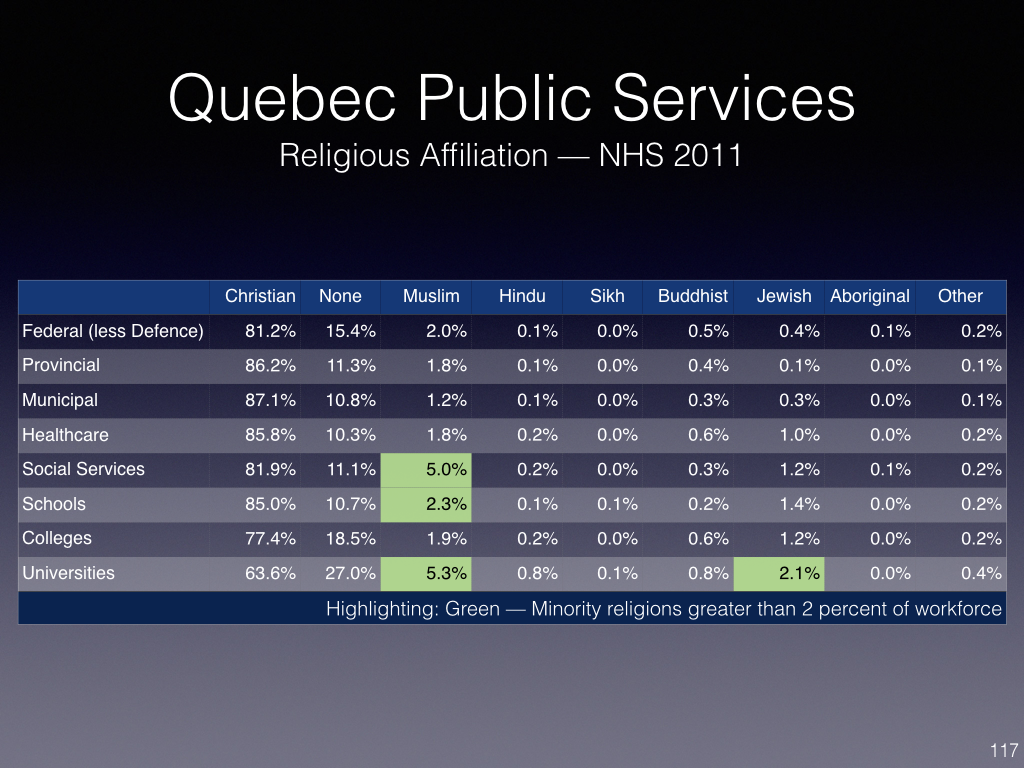
The 2011 National Household Survey, indicated a very small number of Muslim Quebecois in the public service (along with other religious minorities):

Quebec’s new government is planning to block Muslim women who work in the civil service from wearing the chador, a shawl-like piece of clothing that covers the head and body, and the niqab, which also covers the face.

Coalition Avenir Québec ​Premier François Legault has already made clear his intention to prohibit those who hold positions of authority including teachers from wearing religious symbols, such as the hijab, a Muslim headscarf.

The ban on the chador and niqab, however, would extend to all employees in the public sector. A representative from the CAQ couldn’t say how many people such a ban would affect.

Immigration Minister Simon Jolin-Barrette, the government’s point person when it comes to ensuring the secularism of the state, said Wednesday the government plans to “move quickly” to introduce a law.

“It was always our position to prohibit the chador in the public service,” said Jolin-Barrette, in response to questions following a report in the Journal de Montréal about the government’s stance.

There is no mention of banning the garments in the CAQ’s online platform, but the party has played up its commitment to such a policy in the past.

In 2016, the CAQ said on Twitter that it would “defend Quebec values” by banning the chador, unlike its rivals, the Liberals and the Parti Québécois.

Jolin-Barrette said it was too early to provide details on exactly how and when the law would be implemented.

Later on Wednesday, Legault said a law prohibiting religious symbols isn’t “a priority” for the CAQ, which created some confusion about the issue.

“One important value is equality between men and women, so we want to protect that. Now, is this a priority? No,” he said.

‘Surreal’ debate

Montreal lawyer Shahad Salman, who wears a hijab, said she is discouraged the new government — and the media —  continues to focus on identity issues “rather than talking about real issues.”

“It’s so surreal that we’re talking about this again, honestly,” she said. Salman said such debates are counterproductive if politicians want minorities to become more integrated into Quebec society.

As it stands, when it comes to minorities in Quebec’s civil service, the percentage doesn’t reflect the overall population.

Visible minorities made up 9.4 per cent of the province’s public workforce in 2017, although they constitute 13 per cent of the overall population, according to a study by the Institut de recherche et d’informations socio-économiques,

The chador, which covers the head and body but leaves the face exposed, is a garment commonly worn in Iran, where this photograph was taken. (Hasan Sarbakhshian/Associated Press)

The CAQ’s planned ban on religious symbols has been criticized by civil rights advocates who contend the policy will further marginalize vulnerable minorities.

Charles Taylor, author of a landmark 2008 report on the accommodation of religious minorities in the province, called the proposal “either very ignorant or very intellectually dishonest.”

In a recent interview, he pointed out that his report explicitly recommended against including teachers in a ban on the wearing of religious garb.

“We meant it to apply only to people with functions that we called ‘coercive authority’ — police and judges. Functions that can put you in jail,” Taylor said.

Lacking ‘coherent plan,’ Liberals say

The CAQ won a decisive majority in the Quebec election earlier this month, beating out Philippe Couillard’s Liberals.

Pierre Arcand, the interim leader for the Liberals, said the CAQ doesn’t appear to have a “coherent plan” when it comes to religious symbols.

The new government appears to be floating a new trial balloon every day, he said.

Arcand said he would reserve comment until a bill is tabled.

Source: Quebec wants to expand religious symbol ban, blocking Muslim garments in civil service

The CAQ wants to create two tiers of Quebeckers: Sheema Khan

Khan looks at the individual impact. Will be interesting to see the actual legislation and whether some of the initial backtracking – existing employees would be grandfathered – continues or not:

Imagine having a job that you love. You believe you can make a positive difference to society through your chosen career. You have invested heavily in education to arrive at your current position. You can’t imagine yourself elsewhere. Then one day, you are threatened with dismissal.

Not due to a bad performance review – in fact, quite the contrary. Not because of downsizing. Not for lack of qualifications. No, the reason is your expression of faith – although you have never proselytized at work. In fact, you have contributed towards a respectful, inclusive workplace. Your co-workers are like family; you’re closer to some than others. Along the way, you’ve collectively shared life’s burdens and joys, as you try to build a stable life for you and your family.

But your new employer has decided that you are no longer welcome. Is it a foreign multinational, eager to impose its own vision at the expense of local workers?

No. It’s a new provincial government making good on its promise to impose an exclusionary brand of laïcité. And it is willing to fire individuals from certain professions whose attire falls outside its definition of state “neutrality.” Unfortunately, through no fault of your own, your chosen career is a central target. The government is even eager to trample on your individual Charter rights. And there is nothing that you – a law-abiding, tax-paying, individual – can do about it. What’s more vexing is that some of your co-workers and neighbours have voted for this government and its policies that are harmful for you.

It doesn’t matter if you’re a recent immigrant or if you’ve lived here for generations. It doesn’t matter that you believe in the future of this province, having made the conscious decision to build roots here. It is either your faith or your job.

Welcome to Quebec, where the preceding scenario is a distinct reality. The recently elected Coalition Avenir Québec announced that it would invoke the notwithstanding clause to ban religious symbols for employees in “positions of authority” – including teachers, police officers and prison guards. Examples of offending attire include kippahs, turbans and hijabs.

Following a huge outcry against its plan to fire teachers who wear religious symbols, the CAQ backtracked, offering a kinder, gentler version of discrimination: It will only ban new hires from any expression of faith. Imagine putting yourself through teacher’s college or a police training program, preparing to dedicate yourself to a profession you hold in high esteem – only to be told to discard an integral part of your identity, or choose a different career path.

The CAQ is the third consecutive governing party to threaten a ban of religious attire in the public service. The PQ proposed its infamous Values Charter in 2013, while the Liberal Party’s restrictions on face-coverings were suspended by a provincial court in June.

These efforts reflect the wider debate of defining laïcité, which is distinct from secularism – partly due to the different philosophies of Jean-Jacques Rousseau and John Locke. According to Rousseau, the individual gains freedom through the state, which has the right to regulate the public sphere of religion. Locke, on the other hand, placed freedom of conscience as the cornerstone of individual rights, which guarantees freedom from the state. These opposing views have permeated societies with French and British roots.

The CAQ’s approach will create two unequal classes of citizens. An overwhelming majority will be free to choose any field of employment, while a minority will have its choices restricted. There was a time not too long ago when women were barred or discouraged from certain professions. Why is the government repeating the folly of denying employment based on an individual’s identity, while ignoring a worker’s abilities and qualifications?

Furthermore, employment restriction is a slippery slope. What’s next? Use of the notwithstanding clause to override the suspension of Bill 62, thus denying niqab-wearing women access to library privileges, public transportation and health-care clinics?

However, the larger question is: Why create two tiers of Quebeckers in the first place? It sends a dangerous message of fundamental inequality enshrined as government policy. No wonder the CAQ has been lauded by European xenophobic parties.

The people of Quebec have an opportunity to forge a distinct version of laïcité, shaped by cultural heritage, linguistic identity and the contemporary reality of living in a fully anglicized North American milieu shaped by Lockean roots. The question is whether it will be inclusive or exclusionary.

Opinion The CAQ wants to create two tiers of Quebeckers: Sheema Khan

Seuils d’immigration: le Québec aura moins de poids, prévient Ottawa

While I don’t advocate for more immigration for immigration’s sake, the overall demographic and eventual political impact of the Legault government’s reduced immigration levels is clear:

Le gouvernement Legault risque d’accélérer la chute du poids démographique du Québec au sein de la fédération canadienne – et, par ricochet, son poids politique – en voulant réduire le nombre d’immigrants qui s’installent au Québec.

Telle est la mise en garde qu’a poliment lancée le gouvernement Trudeau à de proches collaborateurs du nouveau premier ministre du Québec, François Legault, au cours des derniers jours, alors que le gouvernement de la Coalition avenir Québec (CAQ) a officiellement pris les commandes de l’État jeudi.

Selon des informations obtenues par La Presse, le gouvernement Trudeau a entrepris de sensibiliser le gouvernement caquiste aux répercussions possibles de son intention de réduire le nombre d’immigrants qui élisent domicile au Québec sur le poids démographique de la province au sein de la fédération. Au lendemain des élections québécoises, qui ont vu la CAQ remporter 74 des 125 sièges à l’Assemblée nationale, François Legault a réitéré la promesse électorale de son parti de faire passer le nombre d’immigrants de quelque 50 000 à 40 000 dès 2019.

Le nouveau ministre de l’Immigration du gouvernement caquiste, Simon Jolin-Barrette, a obtenu le mandat de réaliser cette promesse qui a suscité de vifs débats durant la campagne électorale, d’autant plus que le gouvernement fédéral a son mot à dire en matière d’immigration et que les entreprises doivent composer avec une pénurie de main-d’oeuvre au Québec.

Rappelons que le gouvernement fédéral, quant à lui, s’est donné pour objectif d’accueillir 310 000 immigrants en 2018, 330 000 en 2019 et 340 000 en 2020.

Durant les trois premiers mois de 2018, l’Ontario a accueilli presque autant d’immigrants que la cible annuelle que propose François Legault dès l’an prochain, soit 35 222 personnes, selon des données du ministère des Finances de l’Ontario obtenues par La Presse. L’Ontario comptait 14 374 084 habitants au 1er avril 2018 (contre 8,4 millions au Québec) et avait aussi accueilli 44,1 % de tous les nouveaux arrivants au Canada durant le premier trimestre de l’année. En 2017, pas moins de 121 915 immigrants ont installé leurs pénates dans la province la plus populeuse.

Les nouveaux sièges en fonction du poids

Dans les coulisses, on a tenu à rappeler que c’est à partir du poids démographique d’une province que l’on distribue de nouveaux sièges à la Chambre des communes – de plus en plus dominée par l’Ontario, qui détient 121 des 338 sièges. À titre de comparaison, le Québec détient 78 sièges, alors que la Colombie-Britannique (42) et l’Alberta (34), mis ensemble, en ont presque autant (76) depuis la réforme de la carte électorale de 2011.

« Quand on décide de réduire le nombre d’immigrants qui s’installent au Québec, cela va avoir un impact sur le poids démographique du Québec par rapport au reste du pays. Et cela pourrait aussi avoir un impact sur son poids politique à long terme », a-t-on fait valoir dans les rangs libéraux à Ottawa.

Au cours du dernier siècle et plus, le poids démographique du Québec est passé de 30,7 % de la population canadienne en 1901 à 22,6 % en 2018.

Le poids démographique de l’Ontario, lui, s’établit à 38,7 % aujourd’hui. Le gouvernement ontarien prévoit qu’il atteindra 39,8 % en 2026 et qu’il franchira le cap des 40,3 % en 2031 si la tendance actuelle se maintient.

Au cours des dernières années, la population de l’Ontario a donc crû fortement, ce qui lui a permis d’obtenir davantage de sièges à la Chambre des communes et d’augmenter du même coup son influence sur les décisions qui sont prises dans la capitale fédérale.

Des inquiétudes

Dans les coulisses, des députés libéraux fédéraux du Québec ont aussi exprimé leurs inquiétudes quant aux répercussions de la politique du gouvernement caquiste en matière d’immigration. « Je suis un député du Québec et je ne veux pas que le Québec en vienne à perdre de son influence politique à Ottawa au profit de l’Ontario », a résumé un député libéral, qui a requis l’anonymat pour s’exprimer plus candidement sur cette question qui pourrait devenir une pomme de discorde entre les deux capitales.

En 2011, l’ancien gouvernement conservateur de Stephen Harper avait annoncé l’attribution de nouveaux sièges à l’Ontario, à l’Alberta et à la Colombie-Britannique afin de tenir compte de la forte croissance démographique dans ces trois provinces. La Chambre des communes est passée, aux élections de 2015, de 308 à 338 sièges. L’Ontario a obtenu 15 de ces 30 nouveaux sièges, tandis que l’Alberta et la Colombie-Britannique se sont vu donner six nouveaux sièges chacun. Le gouvernement du Québec et le Bloc québécois sont montés au créneau pour décrier la baisse du poids politique du Québec à la Chambre des communes. De proches collaborateurs québécois de Stephen Harper l’ont alors convaincu d’accorder trois nouveaux sièges au Québec, même si la croissance de sa population ne justifiait pas une telle mesure.

Le Québec détient aujourd’hui l’équivalent de 23 % des sièges à la Chambre des communes, soit une proportion plus élevée que son poids démographique (22,6 %).

Douglas Todd: Will the new leader of Quebec kill its immigrant-investor program?

Good sharp and pointed commentary:

The new premier of Quebec has promised to reduce immigration to his province by 20 per cent, require newcomers to learn French in three years and restrict some public servants from wearing religious symbols.

Premier-designate Francois Legault won a majority on Oct. 1 in large part because he professed to be committed to better “integrating” newcomers into the francophone province. But so far Legault has not hinted at ending Quebec’s divisive immigrant-investor program, one of the world’s biggest wealth migration schemes.

The Quebec Immigrant Investor Program — which attracts nine out of 10 of its millionaire applicants from Asia, mostly China — does the opposite of integrating immigrants into a distinct culture. Only one in 10 of the well-to-do migrants who take advantage of Quebec’s investor program choose to live in that province.

Most of the roughly 5,000 migrants a year who exploit Quebec’s buy-a-passport program immediately move to Metro Vancouver and Toronto, where their foreign-sourced dollars pump up the cities’ already high-priced real estate. The decades-old Quebec Immigrant Investor Program is a cynical scheme that doesn’t do what it claims.

And it’s made possible because Quebec is the only Canadian province allowed to set its own immigration policies. (The country’s other premiers in 2016 asked Ottawa for the right to also establish their own immigration rules, but so far their plea has gone nowhere. That could be unfortunate.)

Everyone who signs up for Quebec’s investor program has to hand over an $800,000 interest-free, five-year loan to the government and sign a document citing their firm intention to make their home in Quebec. But only 10 per cent of the 58,000 people who used the program, and remain in Canada, live in the province.

Half of Quebec’s investor immigrants who remain in Canada (many just return to their homeland, with their second passport safely in hand) have set up in the Vancouver region, with most of the rest in Greater Toronto.

Despite Quebec politicians’ oft-professed dedication to Quebec culture, they have for decades shown no signs of caring about the millionaire migrants’ lack of loyalty. The bizarre unintended consequence is that, since Canada’s charter gives everyone mobility rights, the Quebec program has become a key contributor to the unaffordability that is devastating so many residents of Metro Vancouver and Toronto.

One of the many perplexing things about the program is that Quebec’s media, which is normally ruthless at exposing political deception, has almost entirely ignored the province’s farcical investor program since it was instituted in 1986.

Many countries have brought in similar investor schemes, but immigration lawyers say Quebec’s program remains the world’s easiest and most generous, since it asks so little of investors and they get a tremendous amount in return. As a popular website founded by immigration lawyer Colin Singer says: “Successful candidates get permanent residency, which offers access to Canada’s social support network and the right to live anywhere in the country.”

Will Quebec’s new premier, Francois Legault, cancel his province’s immigrant-investor program? He wants immigrants to better integrate. But only 10 per cent of the 58,000 investors who used the program and still remain in Canada actually reside in La Belle Province. Half end up in Metro Vancouver.

Why has the program not been cut? Why is it not on the agenda of the new Coalition Avenir Quebec government or even of most of the French and English-language media, where Quebec news this month has been dominated by Legault’s more symbolic intention to stop allowing judges, police officers, teachers and other key public servants to wear religious symbols?

Part of the explanation for the near-complete silence must be that the program serves the self-interest of Quebec’s business sector. The immigration website of Singer, a longtime booster of investor programs, boasts that the program has made it possible for Investment Quebec, a provincial government corporation, to provide $714 million to 4,737 businesses in Quebec from 2001-2016.

In other words, Quebec’s businesses get the migrants’ cash, but the province doesn’t get the immigrants. Nor does Quebec bear the cost of providing their families with education or other social programs. Is that what Quebeckers want? And is that acceptable to Legault, who came into power on his promise to help immigrants better integrate into the province of which he is so proud?

It gets worse. In a rare exception by Quebec’s media, Radio Canada journalists last month teamed up with the South China Morning Post’s Vancouver-based Ian Young and reported that fraud, forgery, money laundering and corruption is rife in the Quebec Immigrant Investor Program. Their investigative piece revealed that the trans-national subterfuge often begins with shady immigration lawyers in Hong Kong who mostly serve clients from China.

The influential Economist magazine last month published an extensive feature exploring the widespread corruption inherent in many immigrant investor programs, which often make it possible for so-called high-net-worth individuals to evade taxes and in many cases the law-enforcement officials trying to track dirty fortunes.

It’s hard to know what Legault and his party will do. As the co-founder of Air Transat and a gung-ho entrepreneur, he may hold his nose and convince himself that offshore millionaires’ handouts to Quebec businesses are needed to boost the economy. Or he could live up to his commitment to integration. On the surface, he seems a man of integrity, comfortable with adopting pragmatic policies from both the right and left. So British Columbians could end up pleasantly surprised.

It wouldn’t be unprecedented for Quebec’s premier to kill the province’s investor scheme, since they’re under attack around the globe. After all, the federal Conservatives cancelled Canada’s program in 2014, noting few investors paid significant income taxes in Canada and most didn’t want to permanently settle in the country anyways. Most rich investors are seeking a Canadian passport as an insurance policy in case things go sideways in their country of origin.

Deciding the future of the Quebec Immigrant Investor Program will be a profound test of Legault’s character. Will he hypocritically take millionaire migrants’ money and let them run to English-speaking regions of the country? Or will he stand up for his vision and the dignity of his beloved province?

Source: Douglas Todd: Will the new leader of Quebec kill its immigrant-investor program?

Le Québec réussit mieux à garder ses immigrants

Encouraging trend:

Le Québec réussit de mieux en mieux à garder ses travailleurs et aussi les immigrants qu’il accueille chaque année. Depuis trois ans, l’écart entre le nombre de personnes qui s’installent au Québec et celles qui le quittent vers d’autres provinces a presque diminué de moitié.

Le phénomène coïncide avec le resserrement du marché du travail, analyse Hélène Bégin, l’économiste principale de Desjardins qui s’est penchée sur le solde migratoire du Québec. « II y a d’autres facteurs qui entrent en ligne de compte, mais en général, les gens se déplacent en fonction du taux de chômage », explique-t-elle lors d’un entretien avec La Presse.

Qu’ils viennent d’ailleurs ou qu’ils soient nés au Québec, les travailleurs qui ont entre 25 et 64 ans ont de moins en moins de raisons d’aller voir ailleurs.

L’écart entre le taux de chômage des immigrants et celui de la population née au Québec s’est rétréci. Le taux d’emploi des immigrants, soit la proportion des immigrants de 25 à 54 ans qui travaillent, était de 77,8 %, soit à peu près le même qu’en Ontario (78,4 %).

Avec l’étranger, le solde migratoire du Québec est largement positif depuis une quinzaine d’années, souligne l’économiste de Desjardins. Et ces immigrants restent de plus en plus au Québec. Cinq ans après leur arrivée, 84,3 % y sont encore, un taux de rétention qui ira en augmentant avec l’amélioration du marché du travail, prévoit-elle.

« Ça fait un bout de temps que les régions sont en concurrence pour recruter des immigrants et on est maintenant rendus au stade d’essayer de les garder. Et il semble qu’on réussit de mieux en mieux », constate Hélène Bégin.

D’AUTRES FACTEURS

La main-d’oeuvre québécoise, immigrante ou non, a aussi moins tendance à partir vers d’autres provinces, surtout vers l’Ontario, pour améliorer son sort. De ce côté, le solde migratoire du Québec a pratiquement toujours été déficitaire. Mais ce déficit se résorbe : il était de 11 000 personnes en 2017, presque deux fois moins qu’il y a trois ans.

« Le manque d’emplois disponibles dans certains secteurs incitait une partie de la main-d’oeuvre à se déplacer dans la province voisine. Cette époque est révolue, le taux de chômage des deux provinces est désormais semblable et avoisine 5,5 %. »

Ce sont surtout les 25 à 64 ans qui quittent la province et, en plus du marché du travail, d’autres facteurs peuvent influer sur leur décision. Le taux d’imposition, l’accès aux garderies et les programmes sociaux pèsent aussi dans la balance, souligne l’économiste de Desjardins. « Le coût de la vie, et surtout le prix des maisons, est aussi un facteur important. La maison de 300 000 $ au Québec peut coûter 1 million en Ontario », illustre-t-elle.

Le déficit migratoire avec l’Ontario devrait continuer à se résorber, avec un taux de chômage au Québec comparable à celui de l’Ontario et le vieillissement accéléré de la population du Québec.

« C’est une excellente nouvelle, mais ça reste insuffisant pour pourvoir les emplois disponibles actuellement dans le secteur privé », dit Hélène Bégin. D’autres mesures, comme la rétention des travailleurs âgés et des horaires de travail flexibles, sont nécessaires pour combler le déficit de main-d’oeuvre.

Le nombre de postes à pourvoir dans les entreprises du Québec a grimpé en flèche depuis deux ans. Il y aurait actuellement 109 600 emplois disponibles, selon la Fédération canadienne de l’entreprise indépendante.

Source: Le Québec réussit mieux à garder ses immigrants

Signes religieux: le gouvernement élu ouvre la porte à un droit acquis

Starting to face the reality of implementation:

Le gouvernement Legault s’est montré ouvert à assouplir son projet d’interdire les signes religieux aux fonctionnaires en position d’autorité, mardi. Le député Simon Jolin-Barrette a évoqué la possibilité que les employés actuels puissent bénéficier d’un droit acquis.

La Coalition avenir Québec a été élue sur la promesse d’interdire les signes religieux chez les juges, les procureurs et les agents de la paix, tel que le recommandait le rapport Bouchard-Taylor. Le parti de François Legault souhaite aussi élargir cette politique aux enseignants.

M. Legault s’est engagé à légiférer dès la première année de son mandat pour clore cette question une fois pour toutes.

Mais pour y parvenir, le nouveau gouvernement est prêt à mettre de l’eau dans son vin, a indiqué son porte-parole, le député Simon Jolin-Barrette.

«Notre position a toujours été de s’assurer que les personnes en situation d’autorité et les enseignants ne portent pas de signes religieux, a dit M. Jolin-Barrette. Mais très certainement, on veut collaborer avec les partis de l’opposition et on veut s’assurer qu’on puisse passer enfin à autre chose parce que c’est important d’adopter une loi qui va consacrer la laïcité de l’État.»

«Il y a une chose qui est sûre, c’est que le consensus du rapport Bouchard-Taylor est présent au Québec, a-t-il toutefois ajouté. Les Québécois s’attendent à ce que les personnes en situation d’autorité ne portent pas de signes religieux.»

Le gouvernement élu avait envoyé un signal beaucoup plus ferme la semaine dernière. Son autre porte-parole, la députée Geneviève Guilbault, avait prévenu que les récalcitrants pourraient perdre leur emploi s’ils refusent de se soumettre aux nouvelles règles.

Le gouvernement élu n’est pas encore assermenté que, déjà, cet engagement se heurte à de vives résistances. Une manifestation a rassemblé plusieurs centaines de personnes à Montréal en fin de semaine et un conseiller municipal de la métropole a qualifié de «racistes» les politiques caquistes.

Crucifix

S’il se dit prêt à faire preuve de souplesse quant au port des signes religieux, le gouvernement Legault se montre ferme sur le maintien du crucifix à l’Assemblée nationale. Le rapport Bouchard-Taylor recommandait de le retirer du Salon bleu, où les députés légifèrent.

Mais la CAQ s’en tient à sa «position historique»: elle souhaite qu’il reste où il est car il s’agit d’un «objet patrimonial».

«Ce n’est pas dans le cadre des discussions de déplacer le crucifix», a indiqué M. Jolin-Barrette.

Source: Signes religieux: le gouvernement élu ouvre la porte à un droit acquis