Don Wright: Will Trudeau make it impossible for Eby to succeed?

Valid arguments:

It is three-and-a-half months since David Eby took the reins of power in B.C. There is no denying the energy and ambition he has brought to the role. Announcement after announcement has rolled out of the Premier’s Office since December 8 across a broad spectrum of initiatives in health care, housing, energy, infrastructure, increases in affordability tax credits and family benefits, and many, many more.

This column isn’t going to analyze the pluses and minuses of this ambition. Instead, I will argue that Premier Eby’s success on the big questions that will ultimately determine his political success may well be largely out of his control.

The most recent polling in B.C. shows that the most important issues are housing affordability, inflation/rising interest rates, and health care. Inflation and rising interest rates are overwhelmingly determined by federal monetary and fiscal policy, so largely outside the control of Premier Eby.  What about the other two big issues – health care and housing affordability?  While these two areas look to be within the domain of the provincial government, B.C.’s success in addressing the public’s concerns here will be largely hostage to the federal government’s immigration policy.  Let me explain.

Since it came to office, the current federal government has increased the level of immigration into Canada significantly.  Most of the attention has been focused on the increase in new permanent residents.  Last year, 438,000 people were granted permanent resident status, a 60% increase over 2015.  The federal government plans to raise this to 500,000 by 2025.

What receives less attention is another category of people coming to Canada – “non-permanent residents.”  This category includes Temporary Foreign Workers, International Students, and the International Mobility Program, which provides multi-year permits to live and work in Canada.  This category has been growing as well.  In fact, this category has been growing at a faster rate than permanent residents.  Last year there was a net increase of 608,000 in non-permanent residents. 

So, in total, the federal immigration policy resulted in an additional 1.045 million people coming to Canada – far and away the largest number of newcomers to Canada in one year ever.  Last year 160,000 of the 1.045 million came to B.C.

The rationale for these unprecedented numbers is that Canada has a “worker shortage.”  This rationale is almost entirely fallacious, but that is a subject for another column.  Let’s focus here on what this means to Premier Eby.

What is the basic problem in health care?  An inability to meet the public’s demands for medical services.  One million British Columbians don’t have a family doctor.  Waiting lists to get to see specialists and to get necessary surgery continue to get longer.  No doubt part of the problem is a result of the Covid pandemic.  But that rationalization is buying less and less forbearance by the public as we get further and further away from those dire days in 2020 and 2021.

The federal government’s prescription for this?  A rapid increase in the number of people who will need services from our health care system!

A story is spun is that the government will use the higher immigration numbers to bring in more health care professionals.  But this would only work if the proportion of qualified doctors, nurses and allied health workers in the more than one million new Canadians is significantly larger than the existing proportion of those professionals in the current Canadian population, and that they could get licenced immediately to practice in Canada.  Neither of these conditions will be met. 

The net result of this?  Premier Eby is going to have even more difficulty in delivering improved health care accessibility to British Columbians.

And then there is housing.  Almost all of the narrative around the shortage of affordable housing focuses on the supply side.  If only we could force municipalities to make permitting easier and faster, and to zone more density, our housing affordability would be solved.  The fact is, we build a lot of homes in B.C.  In Greater Vancouver – ground zero in our housing affordability problem – 365,000 homes were built in the 20 years between 2001 and 2021.  And there has been ample densification, as a walk through any of the redeveloped neighbourhoods in Vancouver shows. 

But supply is only half of the equation. Demand matters too.  And as quickly as we have built new homes, the population in our major urban centres rises as well. 

The Federal Government’s prescription for this?  Ramp up immigration numbers!

Again, a story is spun that this will actually increase housing supply because we are going to bring in more trades workers to build the houses we need.  Suffice it to say there are some pretty heroic assumptions here.  It is not going to work.

Of the 160,000 new British Columbians last year, more than 95% settled in the Lower Mainland, Southern Vancouver Island, and the Okanagan – where affordable housing was already acutely unavailable.

The net result?  Premier Eby is going to have even more difficulty in delivering more affordable housing.

This is all good for one group of British Columbians – those that are fortunate enough to already own a home.  So, thank you, Mr. Trudeau for making me wealthier and my fellow boomers wealthier. 

But if I were Premier Eby, I don’t think I would be quite as grateful.

Don Wright was the former deputy minister to the B.C. Premier, Cabinet Secretary and former head of the B.C. Public Service until late 2020. He now is senior counsel at Global Public Affairs.

Source: Don Wright: Will Trudeau make it impossible for Eby to succeed?
Où sont passées les clés de notre système d’immigration ?

Good article in La Presse (translation below):

Aujourd’hui, le Canada perd la face sur la scène internationale.

La mécanique qui permet aux employeurs canadiens de faire venir des travailleurs étrangers à bas salaire crée un « terreau fertile » pour l’esclavage contemporain, déplorait le rapporteur spécial l’ONU, Tomoya Obokata, cette semaine1.

Le constat est dur. Mais il ne révèle qu’une partie du problème. En fait, le Canada a perdu le contrôle de l’immigration temporaire.

Au fil des ans, Ottawa comme Québec ont laissé émerger un système d’immigration à deux vitesses, dans la plus grande hypocrisie.

Devant les projecteurs, Québec impose des plafonds chiffrés et des critères précis pour l’immigration permanente. « En prendre moins, mais en prendre soin », clamait la Coalition avenir Québec (CAQ) quand elle a été élue pour la première fois. 

Mais en coulisses, le gouvernement laisse entrer sans compter les résidents non permanents qui ont été trois fois plus nombreux à arriver au Québec (174 000) que les permanents (52 800), en 2023.

Devant les micros, Québec fait grand cas de l’augmentation des demandeurs d’asile. Il est vrai que la province fait plus que sa part et on se réjouit de voir Ottawa réfléchir à un plan pour mieux répartir l’effort à travers le pays. Mais Québec se garde bien de dire que la croissance dans les autres catégories de résidents non permanents (étudiants, travailleurs temporaires) a été encore plus forte (+44 %) que celle des demandeurs d’asile (+37 %) depuis un an.

Cela fait l’affaire des cégeps et universités sous-financés par l’État, qui ont trouvé là un filon pour regarnir leurs coffres et maintenir en vie des programmes en manque d’étudiants locaux. Cela fait aussi le bonheur des employeurs, qui veulent des bras pour accomplir des tâches ingrates au salaire minimum.

Mais pour l’ensemble de la société, c’est contre-productif.

Qu’à cela ne tienne, Québec et Ottawa ont accordé une série d’assouplissements, sans considérer leur effet cumulatif, qui a fait exploser l’immigration temporaire depuis 2015.

Ils ont en quelque sorte donné les clés de notre système d’immigration aux établissements d’enseignement et aux employeurs qui déterminent le nombre et le profil des étrangers qui arrivent chez nous, selon leurs besoins à eux.

Cela a fait dévier le système d’immigration de son objectif d’attirer des travailleurs qualifiés. Et c’est ainsi qu’on se retrouve avec un niveau de vie à la baisse, comme en témoigne le PIB par habitant, qui descend depuis plusieurs trimestres.

Le ministre fédéral de l’Immigration essaie maintenant de remettre le dentifrice dans le tube. En mars, Marc Miller a annoncé son intention de réduire d’environ 20 %, d’ici trois ans, le nombre d’immigrants temporaires qui atteint 2,8 millions au Canada.

Ce ne sera pas simple.

Va-t-on leur montrer la porte ? Il y a un risque que les non-résidents qui perdent leur permis restent au Canada quand même, sans papiers, un statut qui peut mener à des abus encore pires. Et cela ne réduirait pas le nombre d’étrangers sur le sol canadien… à moins de mettre en place un système de déportation à l’américaine. Franchement, ça ne serait pas chic.

Va-t-on leur accorder la résidence permanente en vrac ? Cela ferait en sorte que des immigrants temporaires qui n’ont pas le meilleur profil passeraient devant les candidats plus qualifiés. Pas fort. 

Remarquez, on pourrait aussi relever les plafonds d’immigration permanente pour leur faire de la place. Mais dans ce cas, on ne réduirait pas réellement la croissance de la population.

On le voit, il n’y a pas de solution magique pour diminuer rapidement le nombre de non-résidants déjà au Canada.

Voilà pourquoi il est crucial d’agir en amont, en resserrant les critères d’immigration temporaire.

Auparavant, les demandes d’immigration permanente étaient acheminées de l’étranger. Quand les immigrants étaient acceptés au Canada, ils entraient par la grande porte, avec des services structurés. 

Désormais, les étudiants et les travailleurs arrivent avec un statut temporaire, dans l’espoir de rester à long terme. On ne peut plus continuer avec ce système à deux étapes qui crée des frustrations et des goulots d’étranglement.

Il est crucial de mieux arrimer les immigrations temporaire et permanente, qui sont des vases communicants.

Il est aussi nécessaire de sevrer graduellement les employeurs de la main-d’œuvre étrangère à bas coût, une solution de dernier recours. C’est une chose de recruter des travailleurs saisonniers dans le secteur agricole. C’en est une autre quand le secteur manufacturier, la restauration ou le commerce de détail pourvoient avec des immigrants temporaires… des postes permanents.

Le recours trop facile à la main-d’œuvre bon marché peut avoir l’effet pervers de freiner les investissements en technologie et en machinerie qui permettraient d’améliorer la productivité du Québec, souligne un rapport de l’Institut du Québec2.

Il est temps de donner un bon tour de vis à l’immigration temporaire.

Québec, qui a favorisé abondamment le recours aux immigrants à bas salaire, a le devoir de présenter une vision d’ensemble, claire et logique. Il ne suffit pas d’attendre les mesures d’Ottawa pour ensuite crier à la victime en réclamant les pleins pouvoirs.

Source: Où sont passées les clés de notre système d’immigration ?

Today, Canada is losing face on the international scene.

The mechanism that allows Canadian employers to bring in low-wage foreign workers creates a “fertile breeding ground” for contemporary slavery, lamented the UN Special Rapporteur, Tomoya Obokata, this week1.

The observation is hard. But it only reveals part of the problem. In fact, Canada has lost control of temporary immigration.

Over the years, both Ottawa and Quebec City have allowed a two-speed immigration system to emerge, in the greatest hypocrisy.

In the spotlight, Quebec City imposes numerical ceilings and precise criteria for permanent immigration. “Take less, but take care of it,” said the Coalition avenir Québec (CAQ) when it was first elected.

But behind the scenes, the government lets in without counting non-permanent residents who were three times more likely to arrive in Quebec (174,000) than permanent residents (52,800), in 2023.

In front of the microphones, Quebec City makes a big case for the increase in asylum seekers. It is true that the province is doing more than its part and we are delighted to see Ottawa thinking about a plan to better distribute the effort across the country. But Quebec is careful not to say that growth in other categories of non-permanent residents (students, temporary workers) has been even stronger (+44%) than that of asylum seekers (+37%) over the past year.

This is the case of CEgeps and universities underfunded by the state, who have found there a vein to replenish their chests and keep programs alive in need of local students. It also makes employers happy, who want arms to perform ungrateful tasks at the minimum wage.

But for society as a whole, it is counterproductive.

Never mind, Quebec and Ottawa have granted a series of relaxations, without considering their cumulative effect, which has exploded temporary immigration since 2015.

They have somehow given the keys to our immigration system to educational institutions and employers who determine the number and profile of foreigners who arrive with us, according to their needs.

This has diverted the immigration system from its objective of attracting skilled workers. And this is how we find ourselves with a declining standard of living, as evidenced by GDP per capita, which has been falling for several quarters.

The Federal Minister of Immigration is now trying to put the toothpaste back in the tube. In March, Marc Miller announced his intention to reduce by about 20%, within three years, the number of temporary immigrants to reach 2.8 million in Canada.

It won’t be easy.

Will we show them the door? There is a risk that non-residents who lose their license will still remain in Canada, without papers, a status that can lead to even worse abuses. And this would not reduce the number of foreigners on Canadian soil… unless an American-style deportation system is set up. Frankly, it wouldn’t be chic.

Will they be granted permanent residence in bulk? This would ensure that temporary immigrants who do not have the best profile would pass in front of more qualified candidates. Not strong.

Note, we could also raise the permanent immigration ceilings to make room for them. But in this case, population growth would not really be reduced.

As we can see, there is no magic solution to quickly reduce the number of non-residents already in Canada.

This is why it is crucial to act upstream, tightening the criteria for temporary immigration.

Previously, permanent immigration applications were sent from abroad. When immigrants were accepted into Canada, they entered through the big door, with structured services.

From now on, students and workers arrive with a temporary status, in the hope of staying in the long term. We can no longer continue with this two-step system that creates frustrations and bottlenecks.

It is crucial to better stick up temporary and permanent immigration, which are communicating vessels.

It is also necessary to gradually wean employers of low-cost foreign labor, a solution of last resort. It is one thing to recruit seasonal workers in the agricultural sector. It is another when the manufacturing sector, catering or retail supply temporary immigrants… permanent positions.

The too easy use of cheap labor can have the perverse effect of slowing down investments in technology and machinery that would improve Quebec’s productivity, says a report from the Institut du Québec2.

It’s time to give a good turn of the screw to temporary immigration.

Quebec, which has widely favored the use of low-wage immigrants, has a duty to present an overall, clear and logical vision. It is not enough to wait for Ottawa’s measures and then shout to the victim by demanding full powers.

Jena: As an immigrant, I’ve experienced Canada’s promise — a promise now at risk

Another legitimate warning:

…Despite these mounting crises, the federal government fixates on arbitrary immigration targets. It’s clear that the government needs to invest more in its health-care system, and in getting more homes built to meet the needs of a growing population. But it should also slow immigration growth until these investments take hold. Each year, more than half a million new permanent residents and hundreds of thousands of temporary workers and students arrive. This relentless, poorly planned surge deepens our crises. With 97 per cent of Canada’s population growth driven by newcomers. In 2023, Canada’s population growth rate was higher than the average of the world’s top 38 economies, the OECD countries….

Dr. Debakant Jena is a first-generation immigrant, an Orthopaedic Surgeon in Medicine Hat, Alberta, and an assistant professor at the University of Calgary. 

Source: As an immigrant, I’ve experienced Canada’s promise — a promise now at risk

Moffatt: Ontario experienced a decade’s worth of population growth in just three years. We can’t support that growth without building way more homes

More on housing pressures and noting the importance of curbing demand in terms of numbers of immigrants, permanent and temporary and current government changes (further reductions needed IMO):

…On the population growth side, the federal government has committed to lowering the number of non-permanent residents (NPRs), including international students and temporary foreign workers, living in Canada. They have committed to reducing the proportion of non-permanent residents to under 5 per cent of Canada’s population over the next three years, a reduction of nearly one million people. If achieved, it would ease pressure on rents and ensure that the students we are inviting to the country have the best possible experience while here. However, the Bank of Canada recently called into question the federal government’s commitment to their non-permanent resident growth targets, stating  “it will take longer for planned policies to reduce NPR inflows to achieve the 5% target”. The federal government must release a credible plan, or risk having Ontario’s population grow faster than the housing supply.

Ontario’s housing crisis can be fixed. We have the solutions on both the supply and demand sides, many of which governments have already committed to implementing. They simply need to do so.

Source: Ontario experienced a decade’s worth of population growth in just three years. We can’t support that growth without building way more homes

Don Kerr: Canada’s population growth is exploding. Here’s why

Good analysis but late to the party like a number of others:

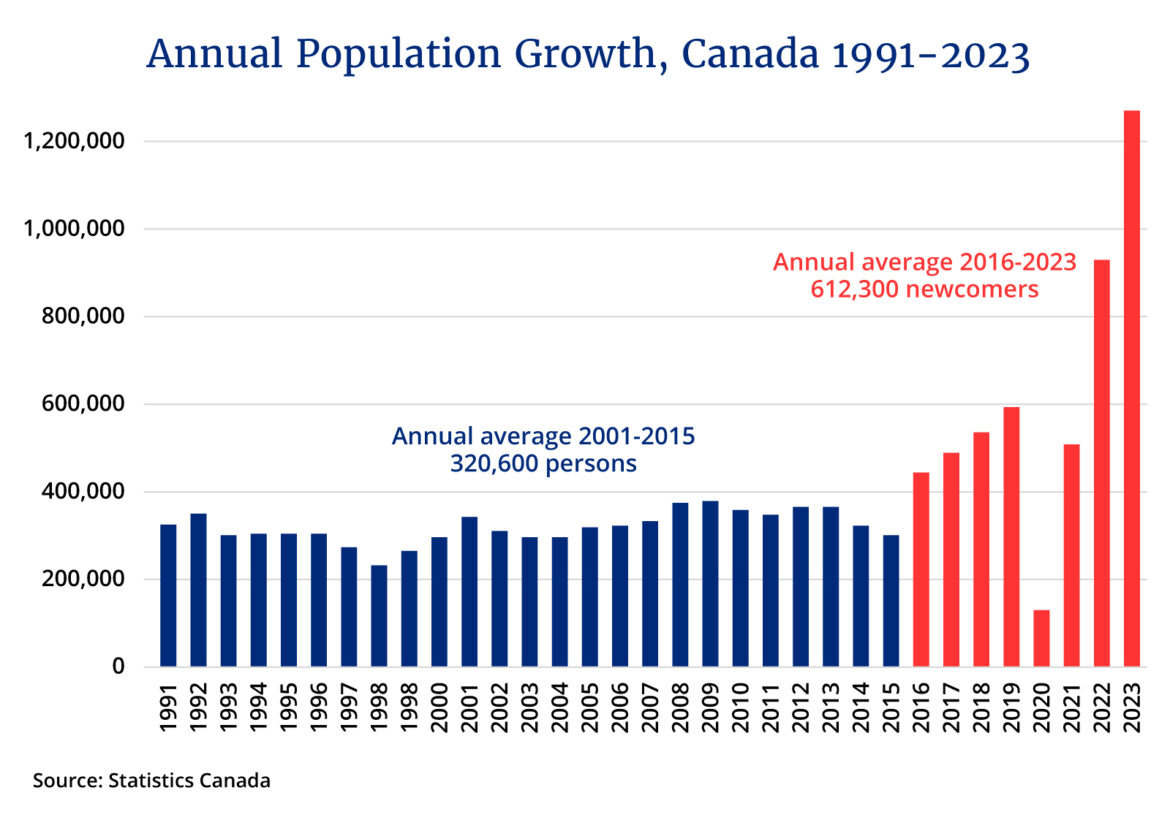
As a professional demographer who has carefully followed Canada’s demographic evolution over the past three decades, I am shocked by some of the most recent demographic data released by Statistics Canada. From 1991 through to 2015, the year in which the current government was first elected, the annual growth in Canada’s population grew in a predictable manner at an average of roughly 320,000 persons per year. 

Following 2015, that growth has rapidly accelerated. Following a temporary dip in population growth due to the outbreak of the COVID-19 pandemic in 2020, Canada’s population growth reached just over half a million in 2021 (509,285 persons), close to a million in 2022 (930,422), and then an astronomical 1.27 million persons in 2023. 

Put another way, whereas for several decades Canada’s population growth rate hovered at about 1.0 percent annually, this rate has more than tripled in a few short years, up to 3.2 percent in 2023. 

In even starker terms, the 2023 rate of population growth is like adding a new Saskatchewan to Canada’s total population in slightly less than a single calendar year. As of 2023, there is not a single country in the G7 or in the OECD that has a population growth rate even close to Canada’s. Population growth in the U.S., for comparison, is currently at about 0.5 percent. Even prior to the recent upturn, Canada’s rate of population growth was actually the highest in the G7 and among the highest in the OECD. 

Most astoundingly, in making international comparisons, Statistic Canada now points out that Canada in 2023 is among the 20 fastest-growing countries in the world, ranked beside several very high fertility countries, largely situated in sub-Saharan Africa. While Canada’s current population growth of 3.2 percent is obviously not sustainable, a constant growth rate of 3.3 percent would imply a doubling in Canada’s total population in under 25 years.

The last time Canada saw a growth rate comparable to this was fully 67 years ago. In 1957, Canada was close to the height of its baby boom, with a birth rate close to four births per woman. Slowly over decades this growth rate gradually declined as fertility rates fell (no abrupt shifts here).1  

Most recently, Canada’s growth has almost entirely been the result of international migration (97.6 percent) as the rate of natural increase (births minus deaths) has continued to decline steadily. Hence, the pace at which Canada’s population grows, in a predictable manner, can be seen as a function of Canada’s immigration policy—meaning, then, that this is a policy problem that the federal government, in consultation with the provinces, can solve itself by setting and regulating immigration targets. This includes both permanent immigration (economic, family, and refugee classes) as well as the increase in non-permanent residents (international students, temporary work permits, and asylum claimants). 

The question remains as to how we have gotten into this situation in the first place. When Sean Fraser was first appointed to the Trudeau cabinet as immigration minister in the fall of 2021, Canada’s growth rate was roughly 1 percent. By the time he was shifted from immigration to housing and infrastructure in the summer of 2023, Canada’s growth rate had climbed to its current heights. As many commenters have pointed out, it is somewhat ironic that the minister appointed to fix the issue of housing affordability was the minister of immigration who allowed this unprecedented growth in population. 

In the summer of 2023 when Canada’s population was growing at a rate that had not been seen for almost 70 years, Fraser attempted to downplay the link between population growth and rising housing costs, saying that the solution to the country’s housing woes should not involve closing the door to newcomers. 

The data from both Statistics Canada and the Canadian Housing and Mortgage Corporation (CMHC) belie the minister’s baffling assertion. Canada’s demographic growth has clearly outpaced its housing stock. Coming out of the pandemic, housing starts climbed to 271,000 in 2021, the highest number recorded for half a century, only to drop slightly in 2022 and 2023. In total, Canada witnessed about 800,000 housing starts over the 2021-2023 period, whereas over this same period, Canada’s population grew by over 2.5 million. The fact that the CMHC forecasts fewer than 224,000 starts in 2024 and only 232,000 in 2025 does not bode well for housing affordability in Canada, particularly in the context of continuing rapid population growth. 

Having said all this, it seems that the federal government has finally woken up to this issue and is now committed to reducing this growth. Current immigration minister, Marc Miller, has made overtures towards slowing Canada’s population growth—even potentially back down to historically sustainable levels. Most importantly, Miller recently announced that the proportion of “non-permanent residents” (NPRs) in Canada will be reduced from its current level of fully 6.2 percent of the total Canadian population down to 5.0 percent over the next three years. For context, NPRs were only about 3.1 percent of Canada’s population in 2021. [mfnBy NPRs, the federal government is referring to international students, persons in Canada on temporary work permits, as well as asylum claimants.[/mfn]

As the government has already capped and reduced the number of international students, a sizeable share of this reduction will occur among persons with temporary work permits. Over 60 percent of Canada’s population growth in 2023 was a by-product of the increase in the number of NPRs. If immediately implemented, Canada could shift from admitting an additional 800,000 NPRs in 2023 to seeing a decline in the number of NPRs by perhaps -160,000 in 2024 (serving to reduce Canada’s rate of growth). Merely with this reform, and continuing with its current commitment to welcoming roughly half a million landed immigrants yearly over the next several years, Canada’s growth rate could return to sanity. The issue remains as to how successful the government will be in implementing this reform.

The dramatic shift in Canada’s rate of population growth has inevitably had important consequences, and not all of them positive. Take, for example, the increasing strain on the country’s already-burdened health and social services. In policy terms, a steady, gradual upturn in population growth is far better for planning future labour force, housing, and infrastructure needs.

Overall, Canada will be well served into the future by returning to and maintaining a predictable rate of population growth and avoiding the rather abrupt shifts experienced most recently. A majority of Canadians have long been supportive of Canadian immigration policy. The recent mishandling of this file has jeopardized this consensus. Hopefully not irreparably. 

Don Kerr is a demographer who teaches at Kings University College at Western University. From 1992-2000 he worked in the demography division at Statistics Canada.

Source: Don Kerr: Canada’s population growth is exploding. Here’s why

Keller: The Liberals broke the immigration system at high speed. They’re repairing it by baby steps

Hard not to agree:

…In all of this, the Trudeau government is caught in a bind of its own making. It found, to its evident delight, that sharply ramping up the number of people arriving on notionally temporary permits was easy. To govern is to choose, but the government discovered that the less choosing it did – and the more rubber-stamping of visas it encouraged – the easier governing appeared to be.

It is now discovering that unwinding things, even a little, is more difficult. It will be lobbied heavily to eviscerate its modest promises, and to quietly reverse this course reversal.

That is also where Liberal predilections reside. They didn’t just break the immigration system. They broke it with great enthusiasm. And their repair job is still mostly blueprints, drawn up haltingly and under the duress of public opinion.

Compared with Europe and the United States, Canada has long had a wider immigration door, but also far more control – an aspect of the “order” in peace, order and good government – over who enters. That is what underpinned public support for immigration.

And controlling the door was important because once somebody gets into Canada, whether as a temporary worker, student or even tourist, it isn’t easy to get them to leave. Not if they don’t want to. Ottawa decides who gets in but has much less control over, or information about, how many people whose visas have expired, and who are no longer legally allowed to reside in Canada, nevertheless remain.

In the months and years to come, that is likely to be the final aftershock of Liberal immigration policy.

Restoring sense and sanity to the system won’t be easy. Breaking is easier than repairing.

Source: The Liberals broke the immigration system at high speed. They’re repairing it by baby steps

Article of interest recap

For the 1st time, Canada will set targets for temporary residents After trimming growth in Permanent Residents, imposing caps on international students, Minister Miller reverses course again and reduces the number of temporary foreign workers. Taken together, marks a significant repudiation of previous decisions and ministers, ironically making it easier for a possible future conservative government to impose further limits should it choose to do so. And including temporary foreign workers and international students in the annual levels plan is long overdue.

The Coalition for a Better Future’s report Fragile Growth: An Urgent Need to Get the Basics Right reiterated productivity and related economic challenges.

Scotia Bank’s Raising the Bar, Not Just Lowering the Number: Canada’s Immigration Policy Confronts Critical Choices makes the case for a charter focus on economic immigration and increasing productivity.

Parissa Mahboubi’s Canada’s immigration system isn’t living up to its potential. Here’s how to fix it provides a familiar list of recommendations, along with the puzzling one for more business immigrants given that government is notoriously bad is assessing entrepreneurship as previous programs have indicated.Life in Canada is ‘more expensive’ than most immigrants expected, new poll finds. Not surprising findings from Leger, highlighting a declining value proposition for immigrants.

Daniel Bertrand of the ICC argues Stop undervaluing the contributions that international students make to Canada, noting the need for “a much more strategic approach, modelled after the economic immigration process, with a points system that prioritizes these more valuable areas of study.”

No surprise that Trudeau rules out Quebec’s request for full control over immigration (Trudeau dit non à confier les pleins pouvoirs en immigration au Québec) with Michel David noting the Les limites du bluff. More detailed explanations of the reason behind the refusal in Marc Miller émet de fortes réserves sur les demandes de Québec en immigration, my favourite being, with respect to family class, « C’est très difficile de légiférer l’amour, [et de] demander à quelqu’un d’épouser quelqu’un qui parle uniquement français ».

Citizenship

Using coercion, Russia has successfully imposed its citizenship in Ukraine’s occupied territories, horrific example of citizenship as an instrument of war and denial of identity.

India’s new citizenship law for religious minorities leaves Muslims out, confirms the Modi governments overall approach of Hindu nationalism.

Omar Khan, in Ramadan heralds a political awakening for Canadian Muslims, notes the need for political responsibly among Muslim and other Canadians “it’s a responsibility to recognize that proper understanding between communities comes through dialogue, not ultimatums. There should be no litmus tests for elected officials wishing to address Muslim congregations. Those with divergent opinions should be engaged, not frozen out.”

David Akin assesses A closer look at the growing diversity of Conservatives under Poilievre, highlighting the party’s recruiting efforts (and quoting me).

Other

John McWhorter continues his contrarian streak in No, the SAT Isn’t Racist, making convincing arguments in favour of standardized testing.

Marsha Lederman highlights the increased censorship in the Exodus from literary magazine Guernica reveals the censorship the Israel-Hamas war has wrought in terms of free and honest artistic expression.

Ottawa pourra contourner les seuils de Québec en réunification familiale [Ottawa says it will bypass Quebec’s immigration cap to speed up family reunification]

Provocative move but understandable given the impasse:

Impatient devant les retards en réunification familiale, le fédéral menace maintenant de contourner les seuils imposés par Québec. Un « affront direct » à la nation québécoise et à l’Accord Canada-Québec sur l’immigration, rétorque le gouvernement de François Legault.

Le ministre fédéral de l’Immigration, Marc Miller, a envoyé dimanche une lettre à son homologue québécoise, Christine Fréchette, pour l’avertir de ses intentions. Affirmant avoir « le devoir moral de trouver une solution à cet enjeu », il écrit que les fonctionnaires d’Immigration, Réfugiés et Citoyenneté Canada (IRCC) auront désormais l’autorisation de traiter les demandes en réunification familiale, même si le plafond de 10 400 personnes appliqué par Québec pour 2024 est dépassé.

« J’aurais idéalement souhaité trouver une solution en collaboration avec votre gouvernement », souligne l’élu libéral dans sa missive. « Cependant, étant donné que nous n’avons pas trouvé un terrain d’entente à la suite de votre refus de revoir vos seuils à la hausse pour réunir les familles plus rapidement, […] j’ai décidé de donner l’instruction à mon ministère de traiter les demandes de résidence permanente des demandeurs du regroupement familial ayant reçu un CSQ [certificat de sélection du Québec] émis par votre ministère. »

Environ 20 500 personnes correspondent actuellement à cette description. Marc Miller assure pouvoir traiter leurs dossiers en concordance avec les quotas de Québec, mais seulement si le gouvernement Legault n’augmente pas le fardeau du fédéral en émettant de nouveaux CSQ….

Source: Ottawa pourra contourner les seuils de Québec en réunification familiale, Ottawa says it will bypass Quebec’s immigration cap to speed up family reunification

Près de 60 000 dossiers d’immigration approuvés s’empilent à cause des cibles de Québec

A noter:

Alors que les ministres de l’Immigration se défient et se déchirent, la pile de dossiers d’immigration déjà approuvés pour la résidence permanente ne cesse de s’épaissir à Ottawa. Créé par la divergence entre les demandes acceptées et les seuils de Québec, le goulot d’étranglement s’épaissit aussi de plus en plus vite.

La mécanique peut paraître complexe entre les deux ordres de gouvernement, mais il reste que le ministère fédéral de l’Immigration, des Réfugiés et de la Citoyenneté (IRCC) s’efforce « de respecter les demandes du Québec quant au nombre de nouveaux résidents permanents », nous écrit-on. Une personne qui a été jugée éligible à la résidence permanente par toutes les instances est donc en attente d’une place parmi les seuils de la province.

Il y a ainsi 38 000 réfugiés déjà reconnus qui vivent au Québec pour un seuil maximum de 3700 places fixé par le gouvernement de François Legault pour 2024 et 2025. Au rythme actuel, il leur faudra donc plus de 10 ans pour avoir accès à la résidence permanente pleinement. Entretemps, ces personnes ont accès aux services et peuvent travailler, mais elles ne peuvent pas demander de carte de résidence permanente. Ces années compteront-elles avant d’obtenir la citoyenneté ? IRCC reste muet sur ces éléments malgré nos questions.

« Il n’existe aucun délai maximal », nous écrit aussi ce ministère.

Il ne s’agit plus d’une simple antichambre de l’immigration, puisque la personne a déjà vu sa demande d’asile acceptée par Commission de l’Immigration et du statut de réfugié (CISR). Après une décision favorable, le demandeur d’asile approuvé se tourne vers le ministère provincial de l’Immigration, qui lui décerne un certificat de sélection du Québec.

La personne est donc ironiquement « sélectionnée » par Québec, mais sa demande de résidence stagne à Ottawa, car le ministère respecte les maximums établis par la province. Cet arriéré de résidents permanents en attente a aussi augmenté de 8000 individus en six mois, selon les chiffres déjà publiés par Le Devoir en août dernier….

Source: Près de 60 000 dossiers d’immigration approuvés s’empilent à cause des cibles de Québec

John Ivison: Poilievre signals he’s willing to take a hatchet to runaway immigration levels

Still vague but signals. But as I have argued, a Conservative government will face some of the constraints and pressures that have resulted in the current mess, What changes a Conservative government might make to Canada’s immigration policies:

…Poilievre, on the other hand, has resisted pressures to demonize immigrants, even as Canada has witnessed a significant increase in the number of people who think the country accepts too many newcomers.

That said, at a press conference in Kitchener, Ont. on Wednesday, Poilievre gave his clearest indication yet that he will crack down on the number of new immigrants if he forms government.

He said a Poilievre government would apply a “mathematical formula” that links population growth to the growth in the supply of housing. “It’s the only way to eliminate the housing shortage — adding homes faster than we add population,” he said.

It’s not clear what he means exactly, but the facts are that Canada brought in nearly 1.3-million newcomers last year: 471,550 permanent residents and around 800,000 new non-permanent residents (students and temporary foreign workers). At the same time, Canada built 223,513 new homes, a 10-per-cent drop from the previous year thanks to expensive materials and a shortage of labour.

A logical mathematical formula would be two newcomers for each house built, given units usually accommodate two adults. That would almost account for the Liberal immigration target of 500,000 new permanent residents in 2025, but it would mean a new government would have to freeze work and student visas — unlikely, given the economic constraints.

One way or another, Poilievre is going to have to dramatically reduce the number of immigrants far beyond the 364,000 new student visa cap imagined by the Liberal government….

Source: John Ivison: Poilievre signals he’s willing to take a hatchet to runaway immigration levels