Nicolas | L’absurde mathématique des générations

Would have thought she would understand the practical reality of generation data in terms of understanding economic and social outcomes and how well different groups and generations are doing. Of course, in her case, as in others, it is not simple given mixed ancestries which of course, become more mixed over generations:

Il faut avouer que, quand le terme « immigrant de deuxième génération » a fait irruption dans la campagne électorale cette semaine, ça fut pour moi, et pour un grand nombre d’entre nous, une étrange expérience. Par « nous », je veux dire celles et ceux que les mots concernent au premier chef.

D’abord, il était fascinant de constater que le terme même — « immigrant de deuxième génération » — ne frappe pas le gros bon sens de tous comme un oxymore. Si je suis née à l’hôpital de Hull, comment puis-je être une immigrante ?

Ensuite, j’ai compris qu’un glissement de sens et de vocabulaire s’opère sans même que la plupart ne le remarquent. La nation serait-elle en train de faire évoluer ses mathématiques ? Parce que moi, qui suis née ici, j’ai pensé toute ma vie qu’une personne qui venait vivre ici était un immigrant qui devenait Québécois. Et, donc, un Québécois de première génération. Et que les enfants de cette première génération de Québécois étaient des Québécois de deuxième génération. Tout comme on peut être Québécois depuis cinq, sept ou douze générations.

Parler d’« immigrant de deuxième génération » (ou, pire, d’« immigré »), c’est un vocabulaire beaucoup plus répandu en France. À droite, voire à l’extrême droite, on nous parle d’« immigrés de troisième génération » pour éviter de nommer comme Français des gens dont la famille est venue en France, pour la plupart, plusieurs générations après que la France elle-même les eut envahis chez eux.

Vous savez, la France n’est pas forcément extraordinaire en tout. Nous sommes tout à fait libres de choisir judicieusement ce qui nous inspire dans ce pays. Tout comme on laisse les Français s’imaginer que le deuxième étage d’un immeuble est en fait le premier, je crois qu’on peut tout à fait les laisser compter à leur manière et garder la nôtre sur un ensemble d’aspects de la vie sans que ça pose problème.

Source: Nicolas | L’absurde mathématique des générations

It must be admitted that when the term “second-generation immigrant” broke into the election campaign this week, it was a strange experience for me, and for many of us. By “we”, I mean those whose words concern in the first place.

First, it was fascinating to see that the very term – “second-generation immigrant” – does not strike everyone’s common sense like an oxymoron. If I was born at Hull Hospital, how can I be an immigrant?

Then, I understood that a shift in meaning and vocabulary takes place without even most noticing it. Is the nation changing its mathematics? Because I, who was born here, thought all my life that a person who came to live here was an immigrant who was becoming Quebecer. And, therefore, a first-generation Quebecer. And that the children of this first generation of Quebecers were second-generation Quebecers. Just as you can be Quebecers for five, seven or twelve generations.

Talking about “second generation immigrant” (or, worse, “immigrant”) is a much more widespread vocabulary in France. On the right, or even on the extreme right, we are called “third-generation immigrants” to avoid naming as French people whose family came to France, for the most part, several generations after France itself had invaded them at home.

You know, France is not necessarily extraordinary in everything. We are completely free to choose wisely what inspires us in this country. Just as we let the French imagine that the second floor of a building is actually the first, I believe that we can completely let them count in their own way and keep ours on a set of aspects of life without it being a problem.
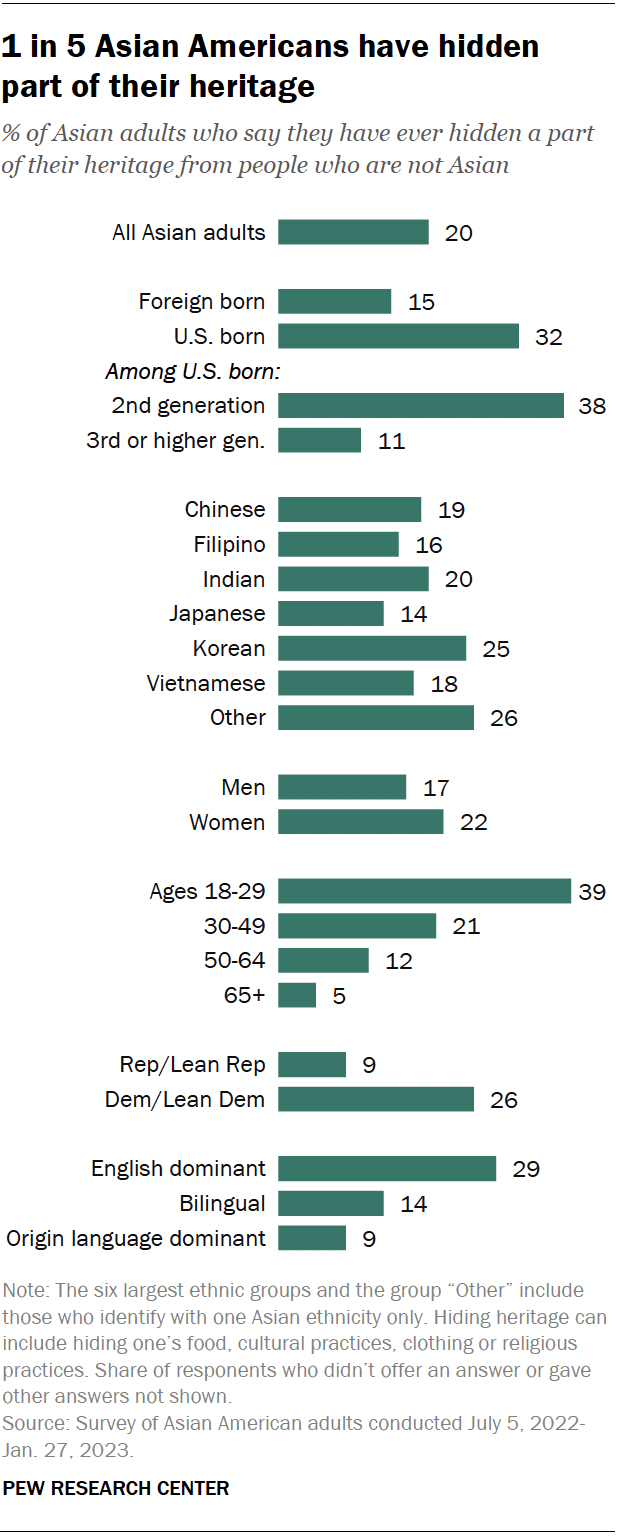
Among Asian Americans, U.S.-born children of immigrants are most likely to have hidden part of their heritage

Noteworthy. Also of interest is that it sharply declines in the third or higher generations, along with being highest in the second generation, where many of the integration and identity struggles are:

One-in-five Asian American adults say they have hidden a part of their heritage – cultural customs, food, clothing or religious practices – from non-Asians at some point in their lives. Fear of ridicule and a desire to fit in are common reasons they give for doing this, according to a Pew Research Center survey of Asian adults in the United States conducted from July 2022 to January 2023.

How we did this

A bar chart showing that 1 in 5 Asian Americans have hidden
part of their heritage.

Birthplace and immigrant roots play a role in who is most likely to hide their heritage: 32% of U.S.-born Asian adults have done this, compared with 15% of immigrants. Among those born in the U.S., second-generation Asian adults (in other words, those with at least one immigrant parent) are more likely than third- or higher-generation Asian Americans (those with U.S.-born parents) to have hidden their culture from non-Asians (38% vs. 11%).

Second-generation Asian Americans make up 34% of the U.S. Asian population, at approximately 7.9 million people, according to a Center analysis of the 2022 Current Population Survey. The majority of this group (66%) is under age 30. And according to our survey, they also primarily speak English.

Aside from generational differences, here are other survey findings about who is most likely to have hidden their heritage from non-Asians:

  • Korean Americans are more likely than some other Asian origin groups to say they have hidden part of their heritage. One-in-four Korean adults (25%) say they have done this, compared with smaller shares of Chinese (19%), Vietnamese (18%), Filipino (16%) and Japanese (14%) adults.
  • Asian Americans ages 18 to 29 are about twice as likely as older Asian adults to have hidden their culture. About 39% of Asian adults under 30 have hidden their culture, food, religion or clothing from non-Asians. About one-in-five Asians ages 30 to 49 (21%) have done this, as have 12% of Asians 50 to 64 and 5% of those 65 and older.
  • Asian adults who are Democrats or lean Democratic are much more likely than those who identify with or lean toward the Republican Party to have hidden their identity. Among Asian adults, 29% of Democrats have hidden their culture from others, compared with 9% of Republicans.
  • Asian Americans who primarily speak English are more likely than those who primarily speak the language of their Asian origin country to have hidden part of their heritage. Some 29% of English-dominant Asian adults have hidden their heritage, versus 14% of those who are bilingual and 9% who primarily speak their Asian origin language.

Why some Asian Americans hide their heritage

Asian Americans who said they have hidden part of their heritage also shared why they did so. Some of the most common reasons were a feeling of embarrassment or a lack of understanding from others.

However, different immigrant generations also cited various other reasons for hiding their culture:

  • Many recent Asian immigrants said they have tried to fit into the U.S. and fear that others may judge them negatively for sharing their heritage.
  • U.S.-born Asian Americans with immigrant parents often said they hid their heritage when they were growing up to fit into a predominantly White society. Some in this generation mentioned wanting to avoid reinforcing stereotypes about Asians.
  • Some multiracial Asian Americans and those with more distant immigrant roots (third generation or higher) said they had at times hidden their heritage to pass as White.

What U.S.-born Asian Americans say about growing up in the U.S.

In 2021, the Center conducted 17 focus groups in which Asian Americans born in the U.S. answered questions about their experiences growing up. Some second-generation Asian Americans shared distinct examples of hiding their heritage and having to balance their family’s cultural practices with the culture of broader American society:

“[It] was kind of that stigma when you were little, a teen, or you were younger that [you] don’t want to speak Chinese … because people would think that you’re a FOB [fresh off the boat] or an immigrant.” – Early 30s man with Chinese immigrant parents

“I remember in elementary school, I don’t even know what my mom brought me, [but] it was some Taiwanese dish. I guess it just had a more pungent smell to it. The kids would just be like, ‘Oh, what is that smell? You guys smell that?’ I would just cover my lid and be like, ‘Okay, I’m not going to eat my lunch.’” – Early 20s woman with Taiwanese immigrant parents

“[I] used to roll as Asian/Hispanic because I was too scared of my identity to say I was Pakistani. I remember 2011 or 2012, when [U.S. special operations forces] killed [al-Qaida leader Osama] bin Laden in Pakistan, after that happened, I was like, ‘Yeah, I’m definitely not saying I’m Pakistani,’ because people were coming up to me and they’re like, ‘Oh my God, they killed your uncle. They found him in your homeland.’” – Early 20s man with Pakistani immigrant parents

Alongside these struggles, many second-generation Asian Americans talked about being proud of their cultural background and wanting to share it with non-Asians:

“[W]hen I go to Cambodia and speak the language, it’s like connecting with an old friend … or meeting somebody from my past because so many of those ideas of what love is, of what it is to be part of a community, and even to live by example comes from having that language still alive within me.” –Early 30s man with Cambodian immigrant parents

“[T]here are going to be ups and downs. Definitely one of the downs is being labeled by other people for our differences. But one of our ups is that we have culture and language that we can always rely on; we have some diversity in customs and cultures that we could go back to. And if people are willing to experience these new differences, we can definitely pass it on and spread awareness of different cultures.” –Early 20s man with Korean immigrant parents

Source: Among Asian Americans, U.S.-born children of immigrants are most likely to have hidden part of their heritage