Jennifer Rubin: The illegal immigration ‘crisis’ is Trump-made

Good column by Rubin:

Those in the reality-based discussion about immigration have pointed out for years that the “crisis” of illegal immigration isn’t a crisis at all and, in fact, that the outflow of people along the southern border has topped the inflow. Pew Research has released a new study confirming exactly this — and demonstrating that the progress in thwarting illegal entries was made under the George W. Bush and Obama administrations (which did not resort to child separations):

“The number of unauthorized immigrants in the U.S. fell to its lowest level in more than a decade, according to new Pew Research Center estimates based on 2016 government data. The decline is due almost entirely to a sharp decrease in the number of Mexicans entering the country without authorization. … The total is the lowest since 2004. It is tied to a decline of 1.5 million people in the number of Mexican unauthorized immigrants from 2007 to 2016.”

Illegal immigration from Central America remains an issue (“Central America was the only birth region accounting for more U.S. unauthorized immigrants in 2016 than in 2007”), but the total number of unauthorized immigrants living in the United States hasn’t been this low in 14 years.

The biggest deporter was — ready? — President Barack Obama. (“Deportations rose during the George W. Bush and Obama administrations — from 211,000 in 2003 to a record 433,000 in 2013, according to Department of Homeland Security statistics.”)

The composition of the population of illegal immigrants is increasingly made up of longtime residents (i.e., people connected to the workforce and in their communities) and those with children who are American-born U.S. citizens. “Today’s unauthorized immigrant population includes a smaller share of recent arrivals, especially from Mexico, than a decade earlier,” Pew reports. “Increasingly unauthorized immigrants are likely to be long-term U.S. residents: Two-thirds of adult unauthorized immigrants have lived in the country for more than 10 years. … As their typical span of U.S. residence has grown, a rising share of unauthorized immigrant adults — 43% in 2016 compared with 32% in 2007 — live in households with U.S.-born children.”

Anti-immigrant zealots have maintained that with enforcement the numbers of illegal immigrants could be greatly reduced, leaving just those who really are part of American society and the American workforce. Well, they’re right — and we’re at that point now! Of course, instead of recognizing that we’ve made huge progress in controlling illegal immigration and moving on to consider how to legalize those with substantial ties to the United States, the anti-immigrant crowd paints a dire picture, invents a crime wave (for which they hold immigrants responsible) and wants to cut the number of legal immigrants and/or repeal birthright citizenship.

This is precisely the kind of issue of which the Trump GOP cares not one wit about the facts. Tell them (truthfully) that immigrants commit fewer crimes than native-born citizens, are catching up with native-born Americans on homeownership rates and are overrepresented among high-tech entrepreneurs, and they’ll scoff, dig up some worker who says “an illegal” took his job (more likely automation eliminated his position) and falsely insist that immigrants are a drag on the economy and responsible for high crime in Chicago because it is a “sanctuary city.”

It’s not possible to have a reasoned debate unless immigration opponents are ready to admit to facts. Like climate-change deniers, the anti-immigrant crowd resents elites who tell them they are wrong or uninformed. Well, sometimes reality isn’t what you’d like it to be. Nevertheless, the rest of us shouldn’t turn our economy inside out, engage in inhumane practices, waste billions on a wall, misuse our military and fan bigotry to preserve these people’s fantastical view of immigration, essentially a fictional creation that allows President Trump and his ilk to whip up their base.

It’s time to engage in good faith with those who demonstrate good faith — and that means agreement on a set of indisputable facts.

Source: Jennifer Rubin: The illegal immigration ‘crisis’ is Trump-made
Ethnic media on birth tourism (2): Spanish, Chinese (4 articles), Korean

MIREMS, Multilingual International Research and Ethnic Media Services, kindly shared what they are picking up on birth tourism in the ethnic media:

Federal government wants to better understand ‘birth tourism’ – Spanish

Description: A study shows that in 2016, many more babies were born to non-resident mothers in Canada than what official statistics indicate, which has led the federal government to analyze the phenomenon in order to better understand why women are coming to give birth here and make their babies Canadian citizens. Using data from the Canadian Institute for Health Information (CIHI ), researcher Andrew Griffith found that in 2016, 3,200 babies were born in Canada whose mothers were not residents of this country. Statistics Canada’s data shows that there were only 313. The CIHI records invoicing and payment information directly from the hospitals and this is how the statistics were obtained. According to the findings, the numbers are not only higher than what was believed, but there is an increasing trend.
WEB – Noticias Montreal (30000 – Daily6) – Montreal, 26/11/2018 – NEWS, 1/2 page web, 1st Top, Spanish

Ottawa is finally paying attention to maternity tourism – Chinese

Description: Ottawa is now studying so-called “birth tourism” in the hope of better understanding how many women travel to Canada to have babies so that the babies can be born as Canadian citizens. New research shows that more babies are born in Canada to foreign residents than Statistics Canada realized. Using numbers from the Canadian Institute for Health Information, which captures billing information directly from hospitals, researcher Andrew Griffith found that over 3,200 babies were born here to women who were not Canadian residents in 2016 — compared with 313 babies recorded by Statistics Canada. The finding suggests not only that the numbers are higher than previously reported but that it is a growing trend, Griffith said.
PRINT – Epoch Times (54000 – Daily5) – Toronto, 26/11/2018 – News, 1/4 page, p. A4, Chinese

The birth rate of anchor babies in Canada is being significantly underestimated – Chinese

Description: RCI Ya Ming – Immigration Minister Ahmed Hussen promised to study the issue of birth tourism. Researcher Andrew Griffith used numbers from the Canadian Institute for Health Information, which captures billing information directly from hospitals, and found that more than 3,200 babies were born here to women who aren’t Canadian residents in 2016, compared with only 313 babies recorded by Statistics Canada. Griffithsaid that this finding not only suggests that the numbers are higher than previously reported, but that it’s a growing trend. This trend exists in all Canadian provinces, with the exception of Quebec.
WEB – iask (Daily7) – Markham, 23/11/2018 – NEWS, 1 page web, 1st Top, Chinese

Birth tourism seeking citizenship is hiking up – Korean

Description: A new study shows that the number of births in Canada by nonresidents, known as “birth tourism,” is much higher than previously reported. The level of birth tourism nationally in Canada is at least five times greater than recorded by Statistics Canada while the number of babies in the case has been increased to 3,628 in 2017 from 1,354 in 2010. The majority of birth tourists are from Asia, including China, and prefers B.C. as the destination.
PRINT – Canadian Korean Times Weekly (Weekly) – Toronto, 26/11/2018 – NEWS, 1/4 page, 1st Top, Korean

Two thousand anchor babies are born every year; Metro Vancouver residents want to ban them from getting Canadian citizenship – Chinese

Description: Amy – Birth tourism figures in Canada are around 1,500 to 2,000, five times higher than Statistics Canada had estimated. Richmond resident Kerry Starchuk twice launched petitions to call on Parliament to ban anchor babies from automatically acquiring Canadian citizenship. One of the petitions she launched was supported by Alice Wong. Starchuk emphasized that the purpose of launching the petition was not to target babies born in the country. She is concerned that the large number of anchor babies will become a heavy burden on public spending in future. This August, the federal Conservative Party passed a motion that seeks to amend the law and ban anchor babies from automatically acquiring citizenship.
WEB – Vansky (Daily7) – Vancouver, 22/11/2018 – NEWS, 1 page web, 1st Top, Chinese

2,000 anchor babies are born in Canada every year – Chinese

Description: Sing Tao – A recent report pointed out that about 1,500 to 2,000 anchor babies are born in Canada (every year). Of the 25 hospitals where most such births occur, six are in Ontario, while two are in B.C. Among them, the Richmond Hospital recorded the largest number of anchor babies. The report made three recommendations, including requiring foreign female visitors to disclose the purpose of their visit to Canada, and considering a baby’s citizenship to be obtained through fraud if the mother came for birth tourism.
WEB – CFC NEWS (Daily4) – Ottawa, 22/11/2018 – NEWS, 1 page web, 1st Top, Chinese

BC MLA aims to address birth tourism as new data shows high non-resident birth rates

Given that most actions to curb the practice require at a minimum provincial cooperation if not collaboration, something to watch:

A new study came out last week suggesting the number of “anchor babies” in Canada, especially in Richmond, is much higher than previously expected, and MLA Jas Johal [Liberal, from Richmond] said he will introduce a petition to the B.C. government to “address the problem.”

An anchor baby is a term used to refer to a child born to a non-citizen mother at the time of the child’s birth in a country that has birthright citizenship.

Policy Options magazine published a new study last Thursday from the Institute for Research on Public Policy, suggesting every year, there are 1,500 to 2,000 “anchor babies” born in Canada.

Among all the hospitals in Canada, Richmond Hospital has the highest volume of babies born to non-resident mothers – 469 last year, taking up Richmond’s number of such births to 21.9 per cent of the total births in the hospital.

“I’m glad this national organization was able to shed light on this issue. It acknowledges for the first time everything everyone suspected and builds on the reporting the Richmond News has done,” said Johal.

“Every level of government has to acknowledge the issue and work together. We can’t just be polite Canadians and not deal with it. It has nothing to do with political correctness, but got everything to do with our healthcare system, for and by Canadians. Period.”

Johal said he is very concerned about the birth tourism industry, which “is not only allowed to exist, but to flourish.” He is working with some local residents to put together a petition, which he will introduce to the province in spring.

“There is a whole industry built on marketing these practices, attracting these individuals, housing these individuals, making sure they get proper medical treatment and care services,” said Johal.

“What are the companies being set up to bring these women here? How much do they charge? What’s the money they make? We need to shine some sunlight into an industry that’s being done in the shadows.

“And there is cost to taxpayers. I know they pay for natural birth and C-section, but the potential capacity could be used for somewhere else in the health care system in Richmond.”

The petition, according to Johal, will ask the provincial government to acknowledge that birth tourism exists and have a public say that the government does not support it.

“It will also ask the government to take concrete measures, to eliminate or very much reduce the practice,” he said.

Johal said as an immigrant moving from India when he was little, this issue upsets him on the personal level.

“I value the Canadian passport more than anything in my life, but this fundamentally debases the value of Canadian citizenship,” said Johal.

Source: MLA aims to address birth tourism as new data shows high non-resident birth rates 

John Ivison: Budget officer finds illegal migrants entering via a ‘loophole within a loophole’

The loophole, allowing those in the asylum process who arrived as irregular arrivals to sponsor their relatives during the determination process, should be relatively easy to close, in contrast to the provision in the Safe Third Country Agreement that it doesn’t apply to those not arriving at official border crossings, which would require highly unlikely agreement with the Trump administration:
While a politician may wish something to be true, simply saying it in the House of Commons does not make it so.

Bill Blair, the newly minted minister for border security, made a claim about the refugee system in question period Thursday that cannot be supported by the available facts.

“The system is working,” he said.

He was responding to questions about a new report by the Parliamentary Budget Officer, which pegged the cost of “irregular” — for which read “illegal” — migration at $340 million for the cohort of migrants who arrived in Canada in 2017-18 – a cost-per-migrant to the federal government of $14,321. (That does not include provincial expenses, which Ontario claims come to around $200 million. The PBO estimated a similar amount for Quebec. The federal government has reimbursed the provinces a total of $50 million.)

Technically, Blair is correct. The refugee system is working — in much the same way the Russian military’s Antonov Flying Tank worked during the Second World War.

In that case, the plane could leave the ground and drop a tank by parachute, albeit without crew, fuel or armaments. It worked. It just didn’t work well — and the project was rapidly abandoned.

A Royal Canadian Mounted Police officer in Saint-Bernard-de-Lacolle, Que., advises migrants that they are about to illegally cross the border from Champlain, N.Y., and will be arrested, on Aug. 7, 2017. Charles Krupa/AP

The federal government should adopt a similar approach and go back to the drawing board.

The PBO report is revealing, and not just for the cost estimates. In fact, it emerges in a footnote the costs are likely more than $14,321 per migrant — Immigration, Refugees and Citizenship Canada estimates the number at $19,000.

But during its investigation, the PBO team elicited some interesting responses from government departments that show how bizarre the migrant story has become.

Another footnote revealed that Canada Border Services Agency officers have identified a phenomenon where one claimant enters Canada illegally and acts as an “anchor relative” for other family members. Those family members can then enter at a port of entry and not be considered illegal migrants. (The PBO asked for data but CBSA said it is not currently being tracked).

But think about that for a minute — a practice Conservative immigration critic Michelle Rempel has called a “loophole within a loophole.”

This means a migrant can cross into Canada from the U.S. between official entry points, avoiding the Safe Third Country Agreement that would have otherwise made them ineligible. (The agreement between Canada and the U.S. states that migrants seeking refugee status must make their claim in the first “safe” country they arrive in — either Canada or the U.S.)

Once a claim has been made, the migrant can access Canada’s generous welfare system as he or she navigates the asylum claims process that gives them multiple hearings and appeals. In the meantime, they can effectively sponsor other members of their family, who can then arrive as regular migrants — also avoiding the Safe Third Country Agreement.

Blair tried to sanitize this blatant abuse of process by pointing out that 40 per cent of migrants crossing illegally are children — postulating that this is a question of humanity and human rights obligations.

But due process should work both ways, and in this case the integrity of the system is being violated.

The anchor relative provision does not just apply to nuclear families but to parents, grandparents, siblings, aunts, uncles, nephews and nieces.

The obvious solution is to close both loopholes in the Safe Third Country Agreement — amend it so it applies between official points of entry, and more tightly define who migrants can bring in.

But there appears to have been little progress in persuading the U.S. to change an agreement that sees people it clearly does not want within its borders effectively deporting themselves.

There are other reforms that could be undertaken. Experts who have looked at the system talk about the “failure of finality” — the endless appeals process that effectively gives migrants a new hearing at the Refugee Appeal Division if their claim is rejected by the Refugee Protection Division, and still another one at the Federal Court if the appeal fails.

The Liberals have done little beyond what they do best — throwing money at the problem. In response to the new arrivals, budget 2018 allocated $173.2 million over two years to “manage the border.”

But the PBO report gives lie to Blair’s claim the “system is working.”

In the 2017-18 fiscal year, the Immigration and Refugee Board had capacity to hear 24,000 claims. During that period there were 52,142 new asylum claims, of which illegal migrants represented 23,215. The system was flooded with claims beyond its capacity, creating a backlog of 64,929 cases.

More than half of the refugee claims were made by irregular migrants from Nigeria and Haiti. That is not a dog-whistle for swivel-eyed racists, or “fear-mongering,” as one senior Liberal put it. It is a fact.

They are flooding from those countries because word has got out that the Canadian system can be gamed with great ease — that an entire family can set up in the Great White North for the cost of a plane ticket from Lagos to New York City and a bus ride to the Quebec border.

Canada has seen similar surges in refugee claims before. In 2010, the Conservatives introduced visa requirements for Mexicans and Czechs, after a flood of bogus claims. The intake of refugees fell from 25,783 in 2010 to 10,227 in 2013 and the backlog halved. For the 2017 calendar year, claims were at 47,427 and the backlog was of a similar magnitude.

If the system was working, as Blair claimed, it would be fast, fair and final.

Currently, it is the very opposite — sluggish, arbitrary and inconclusive.

Source: John Ivison: Budget officer finds illegal migrants entering via a ‘loophole within a loophole’

And John Ibbitson on the potential electoral implications of the costs:

The problem of people crossing the Canada-U.S. border illegally and then seeking asylum just became a bigger headache for the Liberals, one they emphatically do not need less than a year before the next election.

The situation at the border appeared to be improving. In 2017, more than 20,000 asylum-seekers crossed illegally into Canada from the United States. In the early months of 2018, the flow was actually increasing, compared with the year before. But then the numbers started to taper off – at least on a year-over-year basis. Ottawa seemed to have things under control.

“There is a challenge, but it is not a crisis,” Public Safety Minister Ralph Goodale insisted in July.

But if the numbers aren’t increasing, the cost sure is. In a report released Thursday, the Parliamentary Budget Officer estimated that handling the claims of asylum-seekers cost the federal government more than $14,000 a case in the last fiscal year, will cost almost $15,500 this year and will cost $16,700 next year. By that time, taxpayers will be doling out $400-million a year to handle these claims and to provide the migrants with health care.

As the Tories quickly pointed out, the accumulated costs will be more than $1-billion by the end of the next fiscal year.

“Justin Trudeau’s failure to address the crisis he has created has real consequences for Canadians,” Conservative Leader Andrew Scheer said in a statement, “and this report brings those consequences into sharp focus.”

These sums don’t include the cost of sheltering, feeding, clothing, educating and otherwise caring for the needs of these asylum-claimants, which are largely borne by provincial and municipal governments, and which has set the Ontario government back an estimated $200-million.

It gets worse. Asylum-claimants who cross the border illegally are overwhelming the tribunals established to hear refugee claims, creating a current backlog of 65,000 cases. It will take about three years to handle the claim of someone arriving this year. Next year, the backlog could stretch to four years.

Each individual claim is unique. Each person seeking asylum in Canada has a story to tell, and that story can be heartbreaking. But, on its face, most of the people crossing into Canada illegally from the United States appear to have a weak case.

Last year, many of the migrants were Haitian citizens who feared being forced to return to Haiti by the Trump administration. To be blunt, that’s not Canada’s problem.

This year, many of the claimants were Nigerians who obtained a visa to enter the United States and then headed straight for the border. These appear to be economic migrants, whose claims for protection as refugees should not be accepted.

What will happen next year? Will a fresh crop arrive at our border seeking asylum – Latinos who fear deportation from the United States, or nationals from Caribbean or African countries seeking a chance for a better life? Will the ever-lengthening wait times for hearings, which allow asylum-seekers to stay in Canada, convince more and more migrants that they have nothing to lose and everything to gain – including free health care – by crossing the border illegally? Or will the numbers drop down below 2017 levels? No one knows.

What we do know is that the problem of people crossing the border illegally corrodes confidence in Canada’s immigration and refugee system. This country’s future well-being depends on a robust intake of immigrants to compensate for a low natural birth rate. If people conclude that bogus refugee claimants are gaming the system, they could lose confidence in the entire program, which would be a disaster for Canada.

None of this is lost on the Conservatives, who will accuse the Liberals of failing to secure the border – which is, it must be said, one of the core responsibilities of any sovereign government.

Of course, the Tories have no good explanation for how they would handle things if they were in charge. But that may not matter. The opposition mantra will be: The Liberals can’t get a pipeline built. They can’t balance their budget. They can’t even secure the border.

Not a pleasant narrative for a governing party to confront in an election year.

Douglas Todd: Wooing the ultrarich with ‘Golden Passports’ and flattery

Good column on citizenship-by-investment schemes:

I regret to inform readers that few of you are likely to receive an alluring invitation to buy a “Golden Passport.” That is because you are not a “High-Net-Worth-Individual,” also known as an “HNWI.”

Chances are you are just not moneyed enough to be targeted by the glossy magazines, online ads and emails designed to entice a certain class of people to join the elite club of “global talent” eager to purchase their way into a new “opportunity oases,” or, as some of us still like to call them, nations.

No, since you are not worth many millions, if not billions, of dollars, you are not the market for the jargon, euphemisms and flattery that would otherwise urge you to advance the interests of yourself and family by becoming an international “investment expatriate” or “investor immigrant,” while being lauded as “the best and brightest.”

Instead, this exclusive circle of passport and visa purchasers is for the super-rich, especially those who don’t trust their own governments, who seek the “competitive advantage” of multiple passports, who are keen on avoiding taxes and who are looking for a haven for their families. Stable, clean welcoming Canada, and Metro Vancouver, are among the most sought-after destinations of this jet-setting club.

Alas, watchdog agencies are beginning to warn that some of these trans-national migrants also want to hide their ill-gotten gains. They are collecting second, third and more passports, or at least permanent resident cards, from multiple nations as they strive for an immigration status that can provide the real-world equivalent of what the game of Monopoly calls a “Get Out of Jail Free” card.

The number of investor migrants is expanding rapidly. Economist magazine says “thousands of passports are bought and sold every year, almost always by the wealthy. The number of commercially acquired residence permits runs into the hundreds of thousands.” It’s an industry that the public widely suspects of diminishing the rights and privileges of citizenship.

There is also gnawing worry the governments busy selling passports and visas — typically in exchange for an “investment” in government bonds, businesses or real estate in the value of anywhere from $200,000 to $2.5 million — are playing into the hands of international crooks, terrorists, money launderers and oligarchs.

The European Union has gained nearly 100,000 rich new residents and 6,000 new citizens in the last decade through poorly managed, semi-secret passport-sale schemes, says Transparency International and Global Witness. The watchdog organizations have concerns about Spain and Britain, but they’re especially alarmed by the European Union’s smallest countries, Cyprus and Malta — because anyone who buys a passport from one of these yacht-filled nations gains access to all 26 countries of the EU.

Canada designed one of the first investor-immigrant schemes in the late 1980s, which soon became known for luring hundreds of thousands of affluent Hong Kong residents to the country. And, along with the United States, Canada remains among the most popular destinations for ultrarich trans-nationals hunting for extra visas and passports.

Thousands of lawyers and immigration specialists now strive to ingratiate themselves with these upper-crust clients. The most influential firm promoting the value of trans-nationalism is Henley and Partners, founded by Swiss lawyer Christian Kalin, which has offices in 20 nations and claims to have created “the concept of residence and citizenship planning.”

Kalin is editor in chief of The Global Residence and Citizenship Review, a glossy magazine that sings the praises of the “aspiring migrants” who take advantage of extra passports and the mobility they provide. One glowing ad in his magazine pumps the value of paying to “secure your family’s future with European citizenship.” It features a posh father knotting the private-school-like tie of his son. Arguably the world’s second biggest firm centred on securing a safe haven for investor migrants is Arton Capital, which has its headquarters in Canada.

Vancouver-based Johann van Rooyen, who runs the Citizenship by Investment Research Consultancy, says the global rich are buying “powerful passports” because they want to have the potential to escape political problems, preserve their wealth, reduce their taxes and travel more freely to more countries.

“While political instability and violence forces most investor-class emigrants to physically move to their host countries, for many others a second passport is seen as an insurance policy against future risks. They prefer to stay in their home countries, but like to have an alternative in case things go wrong,” says van Rooyen, citing how high-net-worth migrants are worried about rising political danger, crime, pollution and authoritarianism in places such as the Middle East, Russia, China and South Africa.

“Many Hong Kong residents who left before the China takeover in 1997 returned within a few years, after they obtained a second passport (mainly from Canada),” says van Rooyen, explaining how a lot of migrants don’t actually move to the country they bought their way into. “And thousands of Lebanese Canadians returned to Lebanon after obtaining Canadian citizenship.” More than 250,000 people now living in Hong Kong, and at least 50,000 in Lebanon, have a Canadian-passport lifeline.

The federal Conservatives finally stopped Canada’s immigrant-investor program in 2014, after determining most of the affluent who took advantage of it didn’t intend to live in Canada and those who did paid few taxes while receiving free health care and subsidized higher education.

But Quebec’s buy-a-passport scheme continues to this day.

The Quebec Immigrant Investor Program — which attracts nine out of 10 of its millionaire applicants from Asia — does not actually lure many foreign rich to the French-speaking province. Instead, the vast majority of the roughly 5,000 migrants a year who exploit Quebec’s plan move to Metro Vancouver and Toronto, where their foreign-sourced dollars pump up the cities’ already high-priced real estate.

Radio Canada journalists this fall reported that fraud, forgery and money laundering are rife in the Quebec Immigrant Investor Program. And this appears to be the norm with many Golden passport schemes. More media outlets are beginning to detail the corruption in such programs, which often make it possible for high-net-worth individuals to evade taxes and in many cases the law-enforcement officials trying to track dirty fortunes.

Trans-national scoundrels, for instance, can dodge tax reporting rules in their home country by taking citizenship or residency in a second country and opening a bank account in a third, claiming tax residency in the second. The list of scams goes on. One Chinese investor caught up in a rare crackdown on immigration fraud in Vancouver was found with seven different passports.

The passport-for-sale industry needs to be more diligent in corralling abuse and pitfalls, say watchdogs. And so do receiving and sending countries. The Economist recently speculated about a possibly bad fate, for instance, befalling some of the tens of thousands of newly wealthy Chinese nationals, who have become the world’s leaders at snapping up Golden passports and visas

“Only about half the countries in the world allow their citizens to hold dual nationality. China is not one; and it has strict exchange-control rules,” warns the Economist. “It seems unlikely that all Chinese investment migrants have alerted the authorities to their plans, or gained permission to take their money out.”

Many politicians in the West have gone wild for passport-buying schemes, most of which are new. But law enforcement officials, the public and even the investor immigrants themselves are only learning now about the real price that may have to be paid for such dubious schemes.

Source: Douglas Todd: Wooing the ultrarich with ‘Golden Passports’ and flattery

Hungary backs $1.7 million to combat anti-Semitism in Europe

Hard to take seriously given their campaign against Soros and the overall xenophobic tenor of the government:

The Hungarian government says it will spend 1.5 million euros ($1.7 million) a year to support programs countering anti-Semitism in Europe.

Government spokesman Zoltan Kovacs said Thursday that funds have been earmarked for a Hungarian Jewish civic group — the Europe Action and Protection League. It will have an office in Brussels and operate a hotline to report anti-Semitic incidents.

Other activities of the group will include evaluating local justice systems within the EU, advising on unified legislation to effectively combat anti-Semitism and a comprehensive analysis of state curricula and educational materials used in EU states.

Hungary’s government has been criticized for campaigns against billionaire George Soros which were seen as having anti-Semitic overtones and for views which seemingly diminished Hungarians’ involvement in the Holocaust.

Is India waging a ‘war’ on Islamic names?

Never like what appears to be politically-driven name changes:

What’s in a name? For India’s cities and villages, seemingly plenty.

More than 100 of them, including the most prominent, have been renamed since Independence – Bombay to Mumbai, Calcutta to Kolkata, Madras to Chennai.

Names mangled by British rulers have been corrected, and colonial names rejected.

Identity pride, cultural assertion, linguistic nationalism and plain whimsy have all led to renaming in the past. And now, to appease its Hindu nationalist base, Narendra Modi’s ruling BJP appears to have embarked on a new renaming frenzy.

It began in July with the renaming of Mughalsarai, an iconic British-era railway station in the BJP-ruled state of Uttar Pradesh, after its ideologue Deendayal Upadhyaya.

Last month, the city of Allahabad in the same state was renamed Prayagraj,apparently to restore the city’s ancient identity as a major Hindu pilgrimage centre. (The city is located at the confluence of three holy rivers.) More significantly, BJP leaders were peeved by the fact that the city’s 435-year-old name was given by a Muslim ruler.

As if that was not enough, the local government, led by a controversial Hindu religious leader, has changed the name of Faizabad district to Ayodhya, best known as the birthplace of the Hindu god Ram

It was in Ayodhya that hardline Hindu mobs razed an ancient mosque in 1992, sparking one of the worst episodes of religious violence in which nearly 2,000 people were killed across the country.

Now BJP leaders want to give more Hindu-friendly names to the city of Agra in Uttar Pradesh, home to the iconic Taj Mahal, and to Ahmedabad in the western state of Gujarat. Earlier this year, BJP-ruled Rajasthan changed the “Islamic-sounding names” of three villages.

The new names heap glory on what the BJP calls India’s “glorious” Hindu past, and pour scorn on its Islamic heritage. With general elections barely a year ago, the renaming is seen by critics of Mr Modi as a blow to India’s fabled syncretism – the merging of different faiths and cultures.

Gaganpreet Singh, who teaches at Delhi University, says the politics of renaming in India is often “rooted in the nationalisation of heritage”.

To be fair, in 2014, Mr Modi’s government renamed a road called after Mughal ruler Aurangzeb in central Delhi, instead honouring former president APJ Abdul Kalam, who also pioneered the country’s military missile programme.

“This was the BJP replacing the name of a Muslim villain with a Muslim patriot,” remarked Aatish Taseer, author and columnist.

It is difficult to see why India’s majority Hindus should be feeling besieged by a lack of representation, or why the BJP sees them as a persecuted majority. More than 7,000 of India’s 677,000 villages are named, for example, after Ram and Krishna, two popular deities. Mughal king Akbar, by comparison, had barely 234 villages in his name.

The renaming of cities and places goes on elsewhere in the world for a variety of reasons, some of them similar to India’s.

But critics say erasing Islamic names is another way to disempower India’s Muslims and deny them a stake in the country’s history.

They compare it to what has happened in neighbouring Pakistan, where most roads and spaces have been renamed to be associated with Muslim heroes or personalities. History, as historian Irfan Habib says, is always the “first victim of politics”.

With crucial general elections barely five months away, the BJP’s name-changing moves can be seen as an attempt to woo voters. A home ministry official told parliament in March that it had received 27 proposals from different states requesting a change of names for various villages, towns and railway stations. Most of the requests had came from the BJP-ruled states of Rajasthan and Haryana.

But there’s no evidence that renaming places draws more votes for the party pushing the purge. There have been no recent agitations for name changes, and no great relief among people that they are happening.

“In the absence of broader improvements in actual welfare, name-changing also gives a sense of things changing,” sociologist Sanjay Srivastava told me.

“I am not sure who cares. It doesn’t appear to be a vote-winning issue. Except that it consolidates the BJP’s image as ‘decisive’ across all spheres. It is really the politics of spectacle.”

Source: https://www.bbc.com/news/world-asia-india-46191239

Revoking birthright citizenship would affect everyone: Jamie Liew

Jamie Liew, an immigration lawyer and law professor, responds to my article, providing the “what’s the problem” perspective, noting the relatively small number as percentage of total births (and immigrants) and the likely impact on all Canadians.

However, the only option she mentions is that of requiring all Canadians to apply for citizenship. Yet when the previous government pressed unsuccessfully to abolish birthright citizenship, the other option of having the provinces apply the policy through the birth registration process was favoured at it would not impose that burden on all Canadians (see What the previous government learned about birth tourism). The provinces refused given the smaller numbers at the time (estimated at 500) and the associated costs.

However, just as the provinces were able to issue enhanced drivers licences with citizenship status as a way to make it easier for Canadians to travel to the US without a passport following 911, the provinces could do the same with birth certificates, although this would also be costly given the operational implications.

Of course, any such change would require addressing statelessness, as the previous government did with respect to citizenship revocation in cases of terrorism or treason. The examples cited of the number of persons possibly being effected are, in my opinion, exaggerated.

I find it somewhat tiresome to hear arguments that such a policy is inherently divisive, discriminatory and arguably racist. Even if some opposed to birthright citizenship may be driven by xenophobia, advocating such a policy or other changes to reduced the practice is not inherently xenophobic. It simply aims at avoiding abuse of birthright citizenship of those who come simply to give birth, obtain citizenship for their child, and then return to their country of origin.

One can argue on whether or not such a fundamental change to birthright citizenship is warranted (I don’t favour this option at present) but largely dismissing the issue and overstating collateral impacts are less than helpful to informed public discussion.

It is encouraging that the government has acknowledged the issue, agreed to study the issue, and engage the same organization to conduct the study that I obtained the numbers cited in my article (Canadian Institutes of Health Information):

There has been a lot of talk about getting rid of birthright citizenship in Canada and the United States. President Trump recently announced he will issue an executive order that would do away with automatic citizenship for babies born in the US. Conservative Party of Canada members passed a motion last August that would end birthright citizenship unless one parent is a citizen or permanent resident, should the party form government. And Liberal MP Joe Peschisolido has sponsored a petition to eliminate birthright citizenship.

In the US, the president will have to contend with the fact that he cannot just unilaterally eliminate a right in the 14th Amendment of the Constitution. In Canada, however, the story is different: birthright citizenship can be eliminated simply by amending or repealing parts of the Citizenship Act.

In both the US and Canada, the preoccupation with ending birthright citizenship is tied to the argument that migrants are engaging in “birth tourism” and challenging the integrity of citizenship. But the facts say otherwise.

Andrew Griffith, a former director general at Immigration, Refugees and Citizenship Canada recently analyzed hospital financial data for Policy Options, and noted that a sharp rise in birth tourism in some Canadian hospitals can no longer be considered “insignificant.” Still, Griffith found that only 1.2 percent of births can be attributed to mothers who reside outside of Canada. The figure might actually be lower if births to other temporary residents such as corporate transferees and international students and Canadian expatriates returning to give birth are factored in.

While there appears to be an increasing trend, the low overall levels suggest there is no business case for changing Canada’s citizenship policy. Eliminating or even creating a “graduated” birthright citizenship on this basis would be akin to an enormous hammer hitting a tiny nail.

The elimination of birthright citizenship would affect not just migrants, but all of us. A citizenship application will need to be made for every person born in Canada. More tax dollars would be needed to process the applications. Clerks would suddenly have the power to make substantive and legal determinations about the status of every person that applies for citizenship. Like any administrative system, mistakes would be made. Bad or wrong decisions would be challenged in the courts at great expense to both the state and the people affected. People would struggle with the fact that they are stateless in the interim.

Undoubtedly, doing away with birthright citizenship would increase the number of stateless persons in Canada. Being stateless has serious implications. Stateless persons have difficulty accessing education, employment, health care, social services and freedom of movement. Simple things like obtaining a bank account, cell phone account or registering birth, marriage or death are complicated if not impossible. Stateless persons would be subject to arrest, detention and potential removal to places they may never have been before.

The elimination of birthright citizenship would have the greatest impact on the most vulnerable: the indigent, those with mental illness, and children who are in precarious family situations or are wards of the state. These are the people that may not have the appropriate paperwork or proof that they do qualify for citizenship or do not have support for obtaining citizenship. For example, parents (who are Canadian citizens or permanent residents) of persons seeking citizenship may have lost paperwork, may not want to cooperate, may not be in the country, or may find out they are not the biological parent of that child.

This one policy would create an expensive social problem for the state.

The elimination of birthright citizenship is not an act to preserve or protect the integrity of citizenship. The policy would be a dividing tool. Ending birthright citizenship would legitimize the argument that racialized persons are less deserving of citizenship, even though there is no evidence to show that children born of foreign mothers do not stay in Canada and do not contribute to society. The policy would also fuel discrimination against those of different socio-economic classes, because the most vulnerable and marginalized would have the most difficulty in accessing citizenship, or if they are citizens proving that they are. These administratively stateless people would be treated like foreigners and outsiders, even though they are eligible and qualify for citizenship. It is a tool to delegitimize people who have a genuine and effective link to Canada. It would create barriers to important rights that come with citizenship, including the right to vote.

We only need to look at how stripping citizenship and the denial of citizenship elsewhere in the world has encouraged discrimination, persecution and violence against stateless people. For example, the oppression of Rohingya and the genocide against them was precipitated by their being denied citizenship in Myanmar, a country they called home for generations.

Canadians should be cautious when considering the idea of getting rid of birthright citizenship. It would not stop migrants from coming. Instead of making it harder to get citizenship, we should trust our well-oiled immigration system to deal with the entry of people into our country. If there are issues with the authorization of persons entering our country, it is immigration law that should be tweaked, not citizenship law.

Canada has signed both the Convention on the Reduction of Statelessness and the Convention on the Rights of the Child, which obligate Canada not to create situations of statelessness. My father was born stateless because the state he was born into did not confer birthright citizenship. It affected his opportunity for education and employment, as well as his mental health. Being a child of a previously stateless person, I am proof enough that welcoming stateless people to Canada with the conferral of citizenship is the best way to build a nation.

Source: Revoking birthright citizenship would affect everyone

Hate crimes reached all-time high in 2017, Statistics Canada says


The latest numbers from Statistics Canada, showing a substantial increase compared to previous years, most notably for religiously-motivated hate crimes:

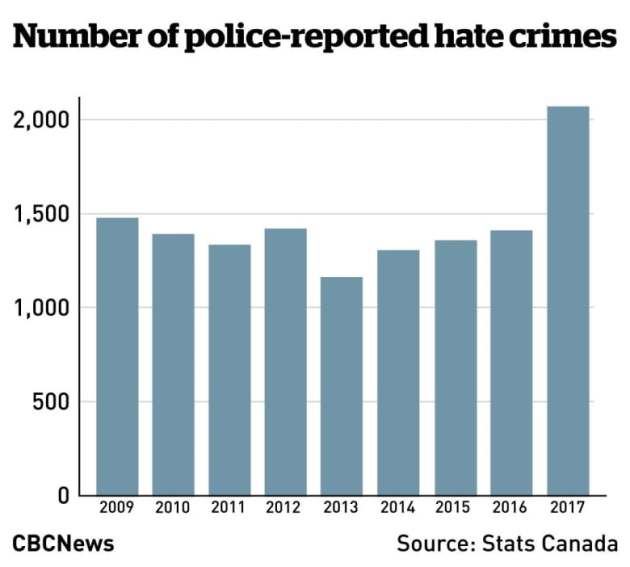
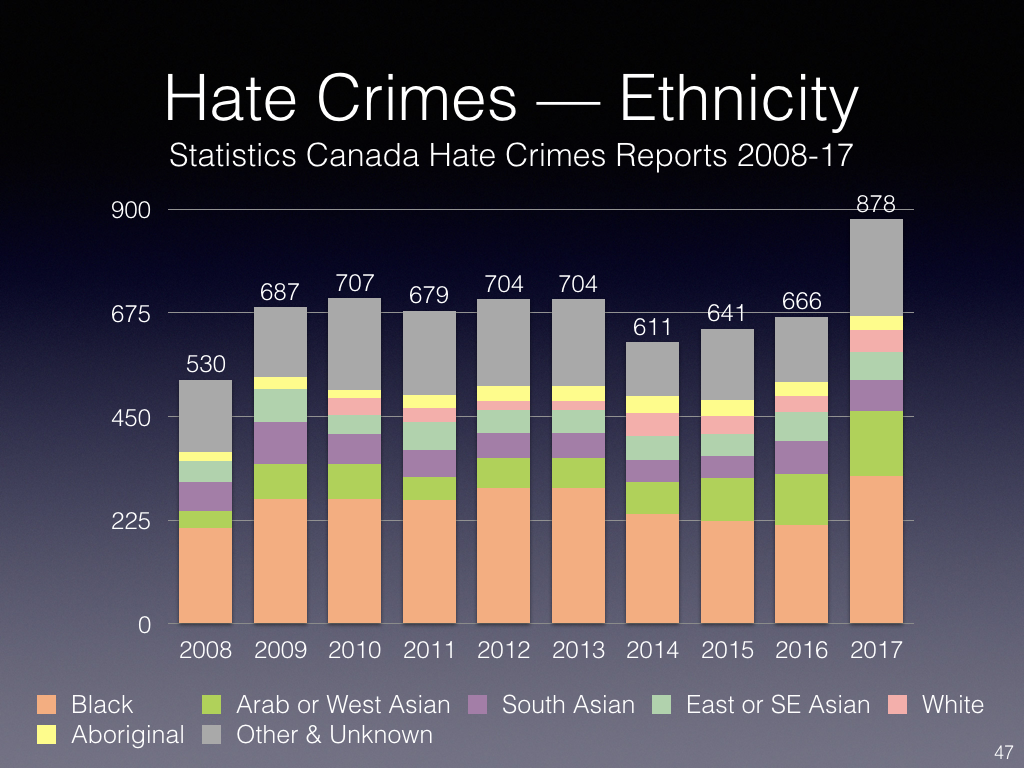
The number of police-reported hate crimes reached an all-time high in 2017, largely driven by incidents targeting Muslim, Jewish and black people, according to Statistics Canada data released Thursday.

The federal agency said hate crimes have been steadily climbing since 2014, but shot up by some 47 per cent 2017, the last year for which data was collected. In total, Canadian police forces reported 2,073 hate crimes – the most since 2009, when data became available.

The increases were largely driven by incidents in Ontario and Quebec, Statistics Canada says. The agency said the increase may have been driven by more people reporting hateful incidents to police, although it says that many likely go unreported.

In the worst incident in the country, six Muslim men were shot to death and others were seriously injured during an attack on a Quebec City mosque in January 2017. This spring, 28-year-old Alexandre Bissonnette pleaded guilty, but said he was not Islamophobic and instead “carried away by fear and a horrible form of despair.”

Quebec reported a 50 per cent increase in the number of hate crimes in the month after the mass shooting, mainly driven by incidents with Muslims as the victims.

There was a record set in 2017 for the number of police-reported hate crimes in Canada. (CBC)

Police are also dealing with an increase in smaller incidents like hate-related property crimes.

Toronto police’s hate crime unit said it investigated 186 incidents — largely vandalism and graffiti — in 2017. In nearby Hamilton, police reported an 18 per cent increase in the number of what the force calls hate and bias incidents.

Overall, Ontario saw a 207 per cent increase in hate crimes against Muslims, an 84 per cent increase in crimes against black people and 41 per cent increase on incidents against Jewish people.

Alberta and British Columbia also reported increases in the number of incidents.

Community leaders call increase disturbing

Brittany Andrew-Amofah, of the Toronto-based Urban Alliance on Race Relations, said the increase in hate crimes is making communities feel less safe.

“It’s time for political leaders to unequivocally speak out against hate and intolerance and in support of a multicultural society where everyone feels safe to participate and contribute,” she said in a news release.

Avi Benlolo, President and CEO of Friends of Simon Wiesenthal Center for Holocaust Studies, issued a statement saying while the new statistics aren’t surprising, they are alarming.

“It’s disturbing to hear that hate crime continues to increase in Canada and that the Jewish community – a community that is integrated into the Canadian mosaic — is still victimized,” he said.

Black people major targets, StatsCan reports

Across Canada, black people remained the most common targets of hate crimes based on race or ethnicity. Some 16 per cent of all incidents involved black victims.

Two per cent of police-reported hate crimes involved Indigenous people, according to the report, but it suggests a large number of all victims — possibly as high as two in three — didn’t file reports with authorities.

Hate crimes account for 0.1 per cent of the more than 1.9 million non-traffic crimes reported by Canadian police services in 2017. The agency defines hate crimes as “criminal incidents that, upon investigation by police, are found to have been motivated by hatred toward an identifiable group.”

Source: Hate crimes reached all-time high in 2017, Statistics Canada says

ICYMI: Invoke the Holocaust if you must: Teitel

A variant of Godwin’s law and Teitel makes a convincing case that it is appropriate in the current political climate:

Is it ever OK to invoke the Holocaust in a discussion about modern political events, and if so when? This question has a way of surfacing again and again and again in the era of U.S. President Donald Trump and its answer is almost always the same.

If you’re a person condemning the dehumanization of marginalized groups, the answer is a hard yes: Hate and violence do not manifest overnight. There are signs. Invoke the Holocaust if you must.

But if you’re someone on the other side of the debate, someone with a tendency to defend the dehumanizing tactics of the Trump administration, your answer to this question is a hard no: the Holocaust should never be invoked because this (the recent tear-gassing of migrants at the U.S.-Mexico border, children among them) is not that (the systemic mass murder of millions by the Nazis during WWII).

By now, you’ve probably seen the photo (captured by photojournalist Kim Kyung-Hoon) of Honduran migrant Maria Lila Meza Castro running away from tear gas at the border this month, holding onto her small daughters, both of whom are barefoot in diapers. However, it’s Castro’s state of dress that’s most striking. The 39-year-old mother is wearing a T-shirt bearing the faces of characters from the blockbuster Disney film Frozen; i.e. an American movie whose core lesson is learning to accept other people’s differences.

So much for that. Needless to say, the photo has shocked and enraged a lot of people, among them U.S. Congressmember-Elect, Alexandria Ocasio-Cortez. In fact, it was Ocasio-Cortez, a rising star in Democratic politics, who brought the aforementioned invocation debate back into public discourse this week, when she tweeted the following, advocating on behalf of migrants trying to enter the United States and condemning an administration that routinely vilifies them: “Asking to be considered a refugee & applying for status isn’t a crime. It wasn’t for Jewish families fleeing Germany. It wasn’t for targeted families fleeing Rwanda. It wasn’t for communities fleeing war-torn Syria. And it isn’t for those fleeing violence in Central America.”

Ocasio-Cortez may have invoked several atrocities to make her point but it was her allusion to the Holocaust in particular that offended Republican Senator Lindsey Graham. He clapped back on Twitter: “I recommend she [Ocasio-Cortez] take a tour of the Holocaust Museum in DC. Might help her better understand the differences between the Holocaust and the caravan in Tijuana.”

What happened next is the only proof you need that social media can be a source of great good in the world. Guess who entered the debate (albeit indirectly) after Graham? None other than the Auschwitz Memorial itself. The official account of the Polish concentration camp memorial tweeted the following only a few hours after Graham and other outspoken Republicans took Ocasio-Cortez to task for her remarks. “When we look at Auschwitz we see the end of the process. It’s important to remember that the Holocaust actually did not start from gas chambers. This hatred gradually developed from words, stereotypes & prejudice through legal exclusion, dehumanization & escalating violence.”

It’s hard to believe this was a coincidence. Assuming it’s not — assuming the staff of the Auschwitz Memorial itself are of the belief that Ocasio-Cortez was in the right — Lindsey Graham and other like-minded Republicans should probably be alarmed that a memorial and museum dedicated to preserving the history of a horrific event does not appear to share their view. When a Holocaust memorial seems to suggest your opinions about the event in question are incorrect it may be time to step back and re-evaluate those opinions. But defenders of Trumpian policy are not known for their introspection nor for their interest in facts. Indeed, what’s so infuriating about this reoccurring Holocaust invocation debate is that it is precisely the keepers of facts who appear to not only condone but also encourage invocation and yet they are consistently ignored. As Orthodox Jewish writer and activist Elad Nehorai points out, again, on Twitter, “Holocaust scholars, Holocaust museums, Holocaust survivors … they all want us to be able to apply the Holocaust to modern-day situations, even if they don’t 100% align. And yet, somehow, there has been a widespread idea that *nothing* is comparable. So much for “Never Again.”

Nehorai is right. What’s happening at the U.S.-Mexico border is vastly and profoundly different from any of the atrocities mentioned in Ocasio-Cortez’s tweet but the common thread through every one of these events — from Rwanda, to Germany, to the modern United States — is the dehumanization of certain people. Invoking the Holocaust is appropriate in this moment because the president of the United States regularly dehumanizes refugees with rhetoric that sounds at times like it was written by a Nazi propagandist. Will someone in the Trump administration be the architect of the next Auschwitz? I seriously doubt it. But wherever dehumanization begins, it’s not a bad idea to point out where it can end.

Source: Emma Teitel: Invoke the Holocaust if you mustInvoking the Holocaust is appropriate in this moment because the president of the United States regularly dehumanizes refugees with rhetoric that sounds at times like it was written by a Nazi propagandist, Emma Teitel writes.