USA: Citizenship Question May Be ‘Major Barrier’ To 2020 Census Participation

Evidence-based:

The controversial new citizenship question the Trump administration added to the 2020 census may turn out to be a “major barrier” to the country’s full participation in the upcoming national head count, according to a national study commissioned by the Census Bureau.

The Constitution requires every person living in the U.S. — both citizens and noncitizens — to be counted once a decade. Those population numbers are used to determine how many congressional seats and Electoral College votes each state gets.

For the upcoming 2020 census, the Trump administration is planning to include a question it says the Justice Department needs to better enforce Voting Rights Act protections against racial discrimination. The question asks, “Is this person a citizen of the United States?”

In focus groups conducted in March and April to inform the government’s outreach efforts for the census, some participants identified that question as a significant reason why they would avoid taking part in the head count.

“They tended to both believe that the purpose of the question was to find undocumented immigrants and that the political discourse is targeting their ethnic group,” explained Sarah Evans, a lead researcher at PSB, a firm that is affiliated with census contractor Young & Rubicam. “This was an idea we heard across audiences,” she added.

The administration announced the addition of the question in late March, after the study had already begun. The 30 groups asked about the question represent populations the bureau consider to be among the hardest to count, including Spanish speakers, Vietnamese speakers and people of Middle Eastern or North African descent.

This preliminary finding of the 2020 Census Barriers, Attitudes and Motivators Studywas announced Thursday at a public meeting of the bureau’s National Advisory Committee on Racial, Ethnic, and Other Populations. It comes as the Trump administration is fighting six lawsuits from dozens of states, cities and other groups around the country over Commerce Secretary Wilbur Ross’ decision to add the citizenship question to forms for the upcoming head count. A trial for the two lead lawsuits in New York City is set to start on Nov. 5.

Federal law prohibits the Census Bureau from releasing any information it collects that identifies individuals until 72 years after it’s collected, although the agency can share information with the public about specific demographic groups at a level as detailed as a specific neighborhood. Census Bureau officials emphasize that individuals’ information cannot be shared with law enforcement agencies such as the FBI and Immigration and Customs Enforcement.

Still, the study, which also included a nationwide survey distributed between February and April, found that many participants did not believe that the government will keep that promise of confidentiality. The fear is particularly high among Asian and black participants, as well as those who do not have a high school diploma and those with low proficiency in English or the internet.

Close to half of the survey participants (47 percent), researchers noted, incorrectly answered a question about whether the census is used to find people living without documentation, including more than a third that responded with “don’t know.” Some U.S. citizens surveyed may feel “endangered” by the political discourse surrounding the citizenship question, the researchers’ presentation at the bureau’s headquarters in Suitland, Md., also highlighted.

Making people “panic”

Latino “participants worried that their participation in the census could harm them personally or others in their communities/households they care about,” the researchers wrote in their presentation’s slide deck.

During a focus group of Spanish speakers, a participant described the current climate as a “hunt” for Latinos.

“Latinos are going to be afraid to be counted because of the retaliation that could happen,” the participant reported. “It’s like giving the government information, saying, ‘Oh, there are more here.’ ”

During another focus group of people of Middle Eastern or North African ancestry, one participant said: “ICE is working with different groups on deportation sweeps, and it would make me feel like I’m aiding in that. They’re doing a lot of illegal stuff, and so I wouldn’t fill out any of the questions.”

The citizenship question’s purpose, a Vietnamese-speaking focus group participant said, was “to make people panic,” especially those who are afraid of deportation.

Asked by NPR how the Census Bureau plans to incorporate these findings into the communications plan for the 2020 census, spokesperson Naomi Evangelista did not provide any details but instead pointed to a blog post written by the agency’s acting director, Ron Jarmin.

“The extensive research effort yielded rich insights that will inform the subsequent stages of the communications campaign,” Jarmin wrote, adding that the study’s findings will guide advertising, social media and other efforts to encourage people to respond to the census.

The latest findings underline previously released research from the bureau that suggested that asking about citizenship status will discourage noncitizens, including immigrants living in the country illegally, from participating in the census. As a result, that could undermine the accuracy of the information gathered for the head count. Before Ross announced his decision to add the citizenship question, Census Bureau researchers advocated for a different way of producing citizenship information for the Justice Department that would generate data more accurate and less expensive than self-reported responses to a question on the census.

Source: Citizenship Question May Be ‘Major Barrier’ To 2020 Census Participation

Asylum seekers entering Canada outside legal border points cost an average of $14K each: PBO

Interesting to have the cost data. Doesn’t surprise me terribly given the nature of the determination processes and related costs:

The federal government spends an average of about $14,000 for each asylum seeker crossing into Canada outside of legal border points — a cost that’s expected to rise as the case backlog grows, says Canada’s budget watchdog.

In a report released Thursday — Costing Irregular Migration Across Canada’s Southern Border — Parliamentary Budget Officer Yves Giroux said the total cost for the asylum claims process was about $340 million in 2017-2018 and is expected to rise to $396 million in 2019-2020.

He said some of the accounting is based on average costing for all refugee claimants, because the federal government does not track separate data for “irregular” asylum claimants. Aside from some added costs for RCMP interventions, the average costs for claimants crossing illegally would be same as those for all refugee claimants.

The federal government set aside an extra $173 million over two years in this year’s budget to cover the additional costs related to asylum seekers crossing into Canada outside of legal border points. Giroux said that sum “falls short significantly.”

“Our estimates suggest that they have not budgeted enough, which will result in increased backlog at the Immigration and Refugee Board,” he said.

The $173 million was based on an annual influx of 5,000 to 8,000 individuals, rather than the actual number of 23,000 per year, Giroux said.

The costs tallied in the report are for federal organizations such as the RCMP, Canada Border Services Agency, Immigration, Refugees and Citizenship Canada and the Immigration and Refugee Board. They do not include expenses incurred by the provinces, territories or municipalities, which pick up costs related to social services.

Ontario, for example, has estimated its costs related to asylum seekers arriving outside official border points at about $200 million a year.

The report comes after the City of Toronto made a new request for an additional $64.5 million from the federal government to deal with the “unsustainable” operational and financial pressures associated with refugee and asylum claimants.

The city says that about 40 per cent of Toronto shelter users are refugees or asylum claimants — a jump from 11 per cent in early 2016 and 25 per cent in late 2017.

Toronto asks for $64.5M

Toronto is asking for $64.5 million to reimburse its costs and ongoing, stable funding of $43 million a year starting in 2019.

“The city can’t do this alone. The federal government has come forward with initial help but we need the continued assistance of our federal and provincial partners to ensure that Toronto remains a safe, welcoming and accessible place for all,” said Mayor John Tory in a statement.

In June, the federal government pledged $50 million for Ontario, Quebec and Manitoba. Ontario’s share of $11 million went directly to Toronto after the provincial government scoffed at the amount.

Doug Ford’s Progressive Conservative government has asked Ottawa for $200 million to defray the costs of social assistance, housing and education associated with asylum seekers.

The cost per asylum seeker varies from about $10,000 for a simple case — where the claim is accepted — to about $34,000 for a more complex case ending in the claimant exhausting all appeals and being deported.

Giroux said that as the number of asylum seekers rises, the cost increases because of the backlog in cases. Costs are driven up, in part, because the refugee claimants are entitled to the interim federal health benefit, which covers certain health-care costs for refugee claimants until they’re eligible for provincial or territorial health insurance.

“Increasing the backlog means individuals have to stay in limbo for a number of years, and we estimate that could rise to five or six years in some cases,” he said.

Figures ‘absolutely shocking’

Conservative immigration critic Michelle Rempel said some of the figures in the report are “absolutely shocking,” given that the total costs for a single asylum seeker could be in the range of a gross salary of a minimum wage worker in Canada.

“It just blows my mind that between 2017 through the next fiscal year this prime minister is choosing to spend $1.1 billion on essentially what amounts to the abuse of our asylum system,” she said.

Rempel said the Conservatives will make a formal request to the federal auditor general for a comprehensive audit of the broader costs of illegal border-crossers to government.

She blamed Prime Minister Justin Trudeau for driving the trend by refusing to close a “loophole” in the Safe Third Country agreement with the U.S., which requires that asylum seekers make their claim in the first ‘safe’ country they arrive in. The Conservatives have been urging the government to end an exception that allows people to sidestep that rule if they cross outside official border points.

Rempel also referenced Trudeau’s Jan. 28, 2017 tweet in which he welcomed to Canada those fleeing persecution, terror and war in response to U.S. President Donald Trump’s immigration crackdown.

It was retweeted more than 400,000 times, and liked by more than 750,000 people.

Border Security Minister Bill Blair insisted the government is giving the refugee system the resources it needs while making improvements to reduce the number of people presenting outside official border points.

He said Canada is just one of many countries hit by the surge in global migration.

“Our obligation is to ensure that we manage that in a cost effective, efficient way according to Canadian law and our international obligations, and as well in accordance with Canadian values,” he said. “I think that’s what’s expected of us.”

Tens of thousands of people have crossed into Canada outside of official border points in the last year, mostly in Quebec and Manitoba.

The costs of housing them, and the question of who should pay, have become major political issues in cities such as Toronto and Montreal, which are under pressure to shelter and support the new arrivals.

The PBO agreed to a request from Conservative MP Larry Maguire last June for a global accounting exercise to add up the costs incurred to date from these migrants, and to indicate how much the stepped-up pace of irregular migration might cost Canada in the future.

Source: Asylum seekers entering Canada outside legal border points cost an average of $14K each: PBO

My updated deck: Multiculturalism in Canada: Evidence and Anecdote fall 2018

Being presented today at Ryerson’s Centre for Immigration and Settlement Studies:

PDF available here: Multiculturalism in Canada: What Census 2016 and Other Data Tells Us

Ethnic media coverage of birth tourism: Cantonese, Chinese, Punjabi, Haitian

MIREMS, Multilingual International Research and Ethnic Media Services, kindly shared what they are picking up on birth tourism in the ethnic media:

Study shows birth tourism much more prevalent in Canada than reported by StatsCan – Cantonese

Description: A new study shows that the number of births in Canada to non-residents, known as “birth tourism,” is much higher than previously reported by Statistics Canada. The study was done by Andrew Griffith for Policy Options, a policy think tank. It was found that the level of birth tourism nationally in Canada is at least five times greater than the 313 births recorded by Statistics Canada in 2016, sitting at 3,223. Immigration Minister Ahmed Hussen said they will look into the number of people coming into Canada to give birth and will investigate “immoral birth consulting services.” Conservative Leader Andrew Scheer said at the time one of the goals would be to end the practice of women coming to Canada simply to give birth to a child who will automatically have Canadian citizenship.
TV – Fairchild TV Ontario (400000 – Daily7) – Toronto, 23/11/2018 – News, 1 – 2 min, 02/05, Cantonese

Federal government to investigate impact of “maternity tourism” on the country – Chinese

Description: Based on the figures from the Canadian Institute for Health Information (CIHI), researcher Andrew Griffith found that in 2016, there were 3,200 babies born to “maternity tourism” mothers in Canada; that number is 9 times higher than the 313 babies recorded by Statistics Canada. Immigration Minister Ahmed Hussen said that his department has commissioned CIHI to conduct a study to fully understand the extent of the impact of maternity tourism on Canada.
WEB – Ming Pao Toronto (227000 – Daily7) – Toronto, 23/11/2018 – NEWS, 3/4 page web, 2nd, Chinese

Ottawa probes birth tourism as new data shows higher non-resident birth rates – Punjabi

Description: With new research showing that more babies are born in Canada to foreign residents than Statistics Canada realized, the federal government is studying the issue of “birth tourism” in the hope of better understanding how many women travel to Canada to have babies who are born Canadian citizens. Using numbers from the Canadian Institute for Health Information (CIHI), which captures billing information directly from hospitals, researcher Andrew Griffith found over 3,200 babies were born here to women who weren’t Canadian residents in 2016. Ontario immigration lawyer Gordon Scott Campbell said he’s had several clients in recent years who have given birth while in Canada while in the middle of legitimate refugee or immigration processes. For example, he said some women with visitor status live with their spouses while applying for spousal sponsorship, and some refugees arrive pregnant or become pregnant while waiting for their claims to be processed. But it doesn’t mean that birth tourism is a widespread practice, Campbell added. Immigration Minister Ahmed Hussen responded by saying his department has commissioned research to get a better picture of the scope of the issue in Canada.
RADIO – Red FM 106.7 Good Morning Calgary (Daily5) – Calgary, 23/11/2018 – News, 1-2 mins, 12/14, Punjabi

Tendance à la hausse au pays pour le tourisme de naissance – Haitian

Description: François Jean Denis – Une nouvelle étude démontre que plus de bébés sont nés au Canada d’une mère vivant à l’étranger que ne le croyait Statistique Canada. Les statistiques affichent une hausse croissante du nombre et du pourcentage de ce genre de naissances dans toutes les provinces, sauf au Québec. Le gouvernement fédéral étudie ce qu’il appelle le « tourisme de naissance » dans l’objectif d’avoir une idée plus précise du nombre de femmes qui voyagent au Canada pour avoir des bébés qui naissent citoyens canadiens. Le chercheur Andrew Griffith a utilisé des données de l’Institut canadien d’information sur la santé (ICIS) qui obtient des informations de facturation directement des hôpitaux. Elles ont révélé qu’en 2016, plus de 3200 bébés étaient nés ici de femmes qui n’étaient pas résidantes canadiennes, comparativement aux 313 bébés enregistrés par Statistique Canada. Ces femmes viennent au Canada pour donne la citoyenneté canadienne à leurs enfants. La découverte suggère non seulement que le nombre est 10 fois plus élevé que celui précédemment rapporté, mais que c’est une tendance à la hausse, selon M. Griffith. Le député libéral Joe Peschisolido a récemment déposé à la Chambre des communes une pétition appelant le Canada à prendre des mesures plus énergiques pour mettre fin au tourisme de naissance, affirmant qu’il porte atteinte au système de protection sociale du Canada. Est-ce que cela va remettre en question le droit du sol ? Désormais, plusieurs pays ont mis au point ou modifié leurs lois sur le droit de naissance, notamment le Royaume-Uni, l’Australie, l’Irlande, la Nouvelle-Zélande, l’Inde, la République dominicaine, la Thaïlande et le Portugal. Auparavant, des femmes venaient au Canada et partaient sans payer les frais d’hospitalisation. Aujourd’hui, les hôpitaux ont pris des dispositions pour empêcher ce problème. Aujourd’hui, c’est impossible pour des femmes étrangères d’accoucher sans payer parce qu’avant même de les admettre, on leur demande de payer. En tout cas, on ne va pas contester le droit du sol au Canada.
RADIO – CPAM 1410 AM – Immigration (Weekly) – Montreal, 24/11/2018 – NEWS, 3 mins, 02/04, French

Nearly two-thirds of Quebecers support public-sector ban on religious symbols, poll finds

Not much new here:
Most Quebecers are in favour of banning public-sector workers from wearing religious symbols, according to a CROP poll released ahead of the first legislative session under a Coalition Avenir Québec government.

But a separate survey by Vox Pop Labs, conducted following the Oct. 1 election, suggests Quebecers may be more divided when it comes to the details of how such proposals should be implemented.

Premier François Legault indicated after last month’s election that he will seek to bar civil servants in positions of authority from wearing religious symbols such as the kippa and hijab.

Not only would this apply to police officers, judges and Crown prosecutors, but also to school teachers, Legault said.

He justified his decision by saying it was the “position of a majority of Quebecers.”

The CROP poll, taken between Nov. 14 and 19, estimated that 72 per cent of Quebecers supported banning visible religious symbols for judges, 71 per cent supported banning them for prosecutors and police officers and 65 per cent backed extending the ban to public-school teachers.

CROP also found widespread support (55 per cent) for leaving the crucifix in the National Assembly, another of Legault’s promises. Twenty-eight per cent wanted to see it removed.

More divided on specifics

Alain Giguère, CROP’s president, said the results indicated unprecedentedly high levels of support for banning religious symbols.

“I think we can conclude that the average Quebecer really wants to remove religion from the public sphere, especially for people who hold positions of authority,” Giguère said.

“The numbers are high but they are the product of a public discussion that has lasted since Bouchard-Taylor,” he said, referring to the public commission into reasonable accommodation that wrapped up in 2008.

One of the commission’s key recommendations was that civil servants in positions of authority shouldn’t be allowed to wear visible religious symbols. That, however, did not include teachers.

CROP’s findings are based on an internet panel of 1,000 people. They were asked which government professions should be subject to a ban on religious symbols. The questionnaire did not specify which symbols would be at issue.

When data science firm Vox Pop Labs recently asked Quebecers more detailed questions by about the specific religious symbols they object to, and in which professions, the answers varied widely.

More divided on specifics

Vox Pop, which operates Vote Compass for CBC and Radio-Canada, surveyed 4,000 people about identity issues in the month after the election.

Respondents were shown images of various types of religious clothing and symbols and asked to choose different situations where they should be banned.

The results suggested high levels of support — 87 per cent — for preventing police officers and judges from wearing the burka, a full body covering with only a mesh screen for the eyes.

But that number dropped to around 65 per cent for the turban and kippa.

The Vox Pop findings also suggested Quebecers are, in fact, divided about what religious symbols teachers should be allowed to wear in the classroom.

The kippa was opposed by 49 per cent, the turban by 51 per cent, the hijab by 52 per cent and a large cross by 53 per cent.

Vox Pop summarized its findings by noting a majority of survey participants — 55 per cent — backed the so-called Bouchard-Taylor consensus.

The research firm, though, also concluded that there is little support — only 41 per cent — for extending those limits to teachers, which the CAQ is proposing to do.

Moreover, the Vox Pop findings found higher levels of support for removing the crucifix from the National Assembly than CROP.

They recorded 50 per cent of respondents saying they opposed its presence in the legislature, compared to 45 per cent who were OK with it there.

A Mainstreet poll published two weeks ago, meanwhile, found 42 per cent support for removing the crucifix, compared to the 50 per cent who preferred that it remain.

The National Assembly will begin a two-week session on Tuesday that will be the first opportunity for the CAQ to advance its legislative agenda since it was elected in October with a decisive majority.

Legault said recently his government will likely wait until next year to table legislation on religious symbols.

CROP poll. Results published by CBC Nov. 26, 2018. (Roberto Rocha/CBC)

Source: Nearly two-thirds of Quebecers support public-sector ban on religious symbols, poll finds

Islamophobia is a form of racism – like antisemitism it’s time it got its own definition

From the UK All-Party Parliamentary Group on British Muslims. The definition:“Islamophobia is rooted in racism and is a type of racism that targets expressions of Muslimness or perceived Muslimness.” :

In recent years, British Muslim communities across the UK have experienced an increase in Islamophobia. To eradicate the deep-rooted nature of Islamophobia from our society, each of us has a responsibility to tackle prejudice wherever it occurs.

But the absence of a clear understanding of Islamophobia has allowed it to become normalised within our society and even socially acceptable, able to pass what Baroness Warsi described as the “dinner table test”. The consequences have been horrific.

The killing of grandfather Makram Ali outside Finsbury Park mosque in 2017, the murder of another elderly Muslim male, Muhsin Ahmed in Rotherham in 2015 and the brutal stabbing of Mohammed Saleem in Birmingham in 2013, serve as grave reminders of the perils of what can happen when Islamophobia goes unchecked.

The attacks on hijab wearing women in the street, the bombs threats made to places of worship, through to the coining of “Punish a Muslim Day”, has left vulnerable Britons feeling unsafe to go about their daily lives.

Islamophobic hate crime is a growing problem. Recent statistics highlight how attacks on Muslims have seen the highest increase. Nevertheless hate crime is the just the tip of the iceberg in terms of the underlying causes which remain hidden from sight. While we can tackle the overt manifestations of Islamophobia in the form of hate crimes, we are less conscious and less clued up about tackling that which lies beneath the waterline.

Last year marked the 20th anniversary of the Runnymede Commission’s first report, which brought Islamophobia into the English lexicon. And 2019 will mark the 20th anniversary of the MacPherson Report. Between these two landmark events and in the backdrop to the growing phenomenon of Islamophobia, the All-Party Parliamentary Group on British Muslims, which we chair, initiated the inquiry into a working definition on Islamophobia as a catalyst for building a common understanding of the causes and consequences of Islamophobia. If we can define the problem, we stand a better chance of properly addressing it.

Our six month long inquiry heard from academics, lawyers, activists, victim groups and British Muslim organisations, as well as first-hand accounts from communities in Manchester, Sheffield, Birmingham and London. Today we publish our report, Islamophobia Defined, which provides a working definition of Islamophobia:

“Islamophobia is rooted in racism and is a type of racism that targets expressions of Muslimness or perceived Muslimness.” 

The definition is further exemplified by case study examples and real life incidents, presented within a framework resembling the IHRA definition of antisemitism, providing guidelines on how the definition can be applied.

This isn’t about protecting a religion from criticism, but about protecting people from discrimination. The APPG on British Muslims received countless submissions detailing the racialised manner in which the Muslimness of an individual was used to attack Muslims or those perceived to be Muslims. The racialisation of Muslims proceeds on the basis of their racial and religious identity, or perceived identity, from white converts receiving racialised sobriquets such as “p*ki”, Muslim women attacked due to their perceived dress, bearded men attacked for the personification of a Muslim identity or even turban wearing Sikhs attacked due to the perception of Muslimness.

The adoption of this definition provides an opportunity to help the nation turn the tide against this pernicious form of racism, enabling a better understanding to tackle both hate crimes and the underlying institutional prejudices preventing ordinary British Muslims from achieving their level best across different aspects of our society.

By and large British Muslims feel able to practice their religion freely in Britain, and most believe that Islam is compatible with the British way of life. In recent years, we have seen British Muslims make huge strides from the first Muslim home secretary and Mayor of London, to the first female Muslim British Bake Off champion, through to the ordinary doctors, teachers, business leaders, police officers and the service men and women of our nation. These few examples demonstrate the huge potential for Muslims to flourish in Britain, but these few examples can’t take away the huge barriers ordinary Muslims face to reach such positions.

We strongly encourage the government, political parties, statutory bodies, public and private institutions to adopt this definition in helping to achieve a fairer society for all, as we believe the conclusion to the inquiry will become the benchmark for defining and tackling the scourge of Islamophobia.

The mistakes of this past summer and the denial of political parties to accept a definition of antisemitism must now not be repeated with another minority community. We need to get to the point where it is as socially unacceptable to be Islamophobic as it is to be homophobic or sexist. The adoption of this definition does just that.

Anna Soubry and Wes Streeting are Conservative and Labour MPs respectively, and co-chairs of the All-Party Parliamentary Group on British Muslims

Source: Islamophobia is a form of racism – like antisemitism it’s time it got its own definition

Islam – Tunisia Sharia put aside: women will inherit like men

Encouraging:

A wind of freedom is sweeping across North Africa, in Tunisia to be exact. This small, Muslim majority country (over 98 per cent) is on the road to legally recognise equality for both sexes in matters of inheritance. This is a brave step and the first time in the history of the Muslim world since the early Caliphate era.

In general, women are placed in inferior conditions in Muslim countries. Under the Sharia, women (sisters, daughters, etc.) inherit half of what men get (sons, brothers, etc.) in terms of inheritance.

Last Friday, Tunisian President Caid Essebsi announced with clarity and courage that Tunisia will be a democratic and secular state, not a theocratic one. For this reason, he noted that “the Personal Status Code must be changed. This has no link to religion or the Quran.” Citing Article 2 of the Constitution, he said “We are a civil state and we must respect the Constitution”.

Caid Essebsi proposed that gender equality in inheritance be recognised in law, modifying the Personal Status Code. In his opinion, this step should have taken place in 1956, but the Constitution of that time did not provide for it, unlike the current one.

Thus, two days ago, the cabinet agreed to legalise equality between the two sexes in matters of inheritance. This makes Tunisia the first Muslim country to break from Sharia, Islamic (Sunni) law.

I am very happy for this because it is a good start to ending the unjust and misogynistic Islamic Sharia that has ruled the Islamic world since the Middle Ages. The new law does not contradict the Quran. Contemporary Qur’anic interpretations by the exegete Mohamed Shahrour, like those of current Quranist thought, explain with great clarity that women must have the same proportion of inheritance as men.

This kind of law and interpretations will certainly unleash waves of outrage on the grounds that they offend the precepts of Islam and deviate from the words of God. In other words: Islamists will see themselves as defenders of God himself. But is God so powerless that he needs to be defended?

As a Muslim and because I am interested in all the issues that touch the Islamic world, I think that the adoption of this type of law will play a fundamental role in the emancipation of Muslim women, held for centuries under male rule. This is justified in the name of God and his prophet.

I find we must break the taboo with courage and in depth, to allow women, religious minorities and peaceful and modern Muslims to free themselves from the yoke of the Sunni dictatorship.

Based on Islamic jurisprudence (Sharia), adopted centuries ago, Tunisia applied these medieval and rigid religious laws. Now, this country, which little by little has set itself on the path of modernisation, is gently but securely breaking away from the theological foundations laid down by ancient Sunni scholars and has chosen a modern and contemporary vision. And if we want to meet the objections of Sunni Muslims, by referring solely to the Quranic text, we realise that by establishing the equality of the two sexes, Tunisia has respected the religious text.

Tunisia today deserves to be celebrated and encouraged for this courageous achievement and for its challenge to everything concerning the Sunni religious dictatorship. It is another step that follows the adoption last year of the law that allows Tunisians to marry non-Muslims.

On my behalf and that of all the Muslims of the 21st century who want to modernise, update and free our religion from irrational readings, I would like to congratulate the Tunisian people for this result and thank them infinitely for this glimmer of hope sown in our hearts – even if the path will certainly be hard and full of obstacles – to be able to be completely free one day from the Sunni dictatorship. Things will be possible where there is the political will.

Other Muslim peoples must take Tunisia as an example and wake up before it is too late.

Source: ISLAM – TUNISIA Sharia put aside: women will inherit like men

And the counter reaction begins with Egypt’s grand mufti:

Mufti of Egypt Shawki Allam stressed on Monday that granting women and men equal inheritance rights violates Islamic Sharia.

In a statement, the Mufti said the concept of gender equality in inheritance is against Islam’s teachings.

Islamic Sharia allows men to inherit double what a woman would receive.

In Islam, Ijtihad is not employed where authentic texts (Qur’an and Hadith) are considered unambiguous with regard to the matter in question, he said.

All inheritance laws are detailed in Quran in a clear way, he added.

The remarks came after Tunisia’s president on Monday proposed giving women equal inheritance rights in a clear challenge to Islamic law.

Source: Granting women, men equal inheritance rights violates Islamic Sharia: Egypt’s mufti

Evidence of massive fraud surfaces in St Kitts-Nevis citizenship programme

No surprise, these programs are almost designed for fraud:

Allegations of fraud in the citizenship by investment programme of St Kitts and Nevis have followed revelations supported by documentary evidence that agents in Dubai are selling passports at substantially below government-sanctioned rates.

Caribbean News Now is in possession of a copy of a letter purportedly sent by the Citizenship by Investment Unit (CIU) of St Kitts and Nevis to a local authorised agent. The letter states that “the application via real estate option” in a named development for a specified individual “has been approved in principle for Citizenship by Investment”.

The letter goes on to say that “payment of US$150,000 must be made within six months”. However, the minimum amount required by law under the real estate option is an investment of $200,000, not $150,000 as stated in the letter.

The citizenship agents concerned told Caribbean News Now that the firm “has never received such a letter from the unit and has never forwarded such a letter to anyone.”

“On learning of this development, we have met with the CIU and have written officially to request that the unit fully investigate this matter,” the firm said in a written statement.

In response to a request for clarification and comment, Les Khan, CEO of the CIU, told Caribbean News Now that there are no government sanctioned discounts on any of the investment options. He insisted that the unit does not accept applications for any of its offerings below the price that is published in the regulations.

“Any letters from the unit will reflect the amounts as published,” he said. “In the case of the contribution, our letter will stipulate the contribution amount and whether it was the Hurricane Relief Fund, the Sustainable Growth Fund or the SIDF [Sugar Industry Diversification Foundation].”

Khan went on to state that the “contribution letters will not stipulate any development. In terms of the real estate offering, an approval letter will have the real estate fees required for the investment,” adding that “This letter will have the name of the development.”

Given that the letter in question purports to be an approval letter under the real estate option, “the real estate fees required for the investment” are conspicuous by their absence. It appears instead to be based on a “contribution letter” that has been tampered with in some way, including the somewhat curious turn of phrase “the application via real estate option”.

According to Khan, the matter is currently under investigation by the CIU but, in the meantime, the flurry of agents in the Middle East offering St Kitts and Nevis citizenship at the greatly reduced rates outlined above has yet to be explained.

This revelation follows allegations at a recent press conference by leader of the opposition, Dr Denzil Douglas, that the government is allowing St Kitts and Nevis economic citizenship to be sold for as little as US$37,500,

In a press statement last week, Khan said he had just returned from a marketing trip to Abu Dhabi and Dubai, where he took the opportunity to have a series of one-to-one meetings with agents across those territories in order to reinforce that the investment options remain unchanged at US$400,000 and US$200,000 for real estate and US$150,000 for the Sustainable Growth Fund (for a single applicant).

However, the allegations by Douglas have been reinforced, and Khan’s denials contradicted, by a number of advertisements appearing on social media in the Middle East, confirmed by direct messages from the citizenship consultants involved seen by Caribbean News Now.

For example, Savory & Partners explicitly offer St Kitts and Nevis citizenship for a single applicant for $113,347 “all inclusive”, which presumably refers to the government’s additional due diligence fee of $7,500.

This compares to the government’s published total of $167,500 ($150,000 + $7,500) and, according to Savory & Partners, represents a “limited time offer for our valued clients”.

Another firm, Citizenship Invest, offers an even lower “limited offer” rate of $100,000.

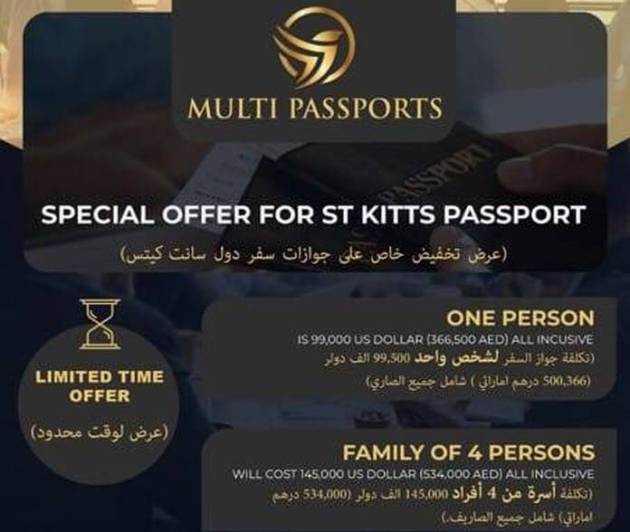
Multi Passports offers yet another lower rate of $99,000 “all inclusive” for a single applicant, as well as $145,000, again “all inclusive”, for a family of four, compared to the rate stated on the CIU website of $195,000 plus due diligence fees.

AAA Associates advertises a family rate of $155,000, also confirmed by direct messages seen by Caribbean News Now, compared to the official rate of $195,000 plus due diligence fees.

It is not yet clear what prompted at least four agents, and reportedly many more, to start offering St Kitts and Nevis citizenship at these substantially reduced investment requirements when the CIU is saying that such options are not in fact available.

Major stakeholders in the economic citizenship industry are now demanding answers, as pressure grows on the St Kitts and Nevis government to explain the contradictions between its exculpatory statements and the available evidence.

Source: Evidence of massive fraud surfaces in St Kitts-Nevis citizenship programme

Chris Selley: Maybe Canada has a ‘birth tourism’ problem after all

My Policy Options article (Read Story) prompted more comment. I agree with Selley in his critique of the over-reaction by the Liberals and the NDP to the CPC policy resolution calling for an end to birthright citizenship and the reflexive labelling of the proposal as racist or xenophobic rather than a measured response.

Which, as Selley notes, the government now has in its plans to study the issue using the same data from CIHI that I used in my article:

Well, here’s something curious. Last week the Liberal government announced it has commissioned research on “birth tourism” — that is, the practice of coming to Canada with the sole intent of giving birth, then returning home with a child who’s a Canadian citizen. “The government of Canada recognizes the need to better understand the extent of this practice as well as its impacts,” Citizenship Minister Ahmed Hussen wrote in a response tabled in Parliament.

It’s in reaction to new research by Andrew Griffith, a former senior official at Citizenship and Immigration Canada, published last week in Policy Options. It suggests the practice may be far more widespread than had previously been thought.

Earlier reported numbers from Statistics Canada, based on provincial records, suggested there might be 300 such births in a year. But a single hospital in Richmond, B.C., was reporting more. Griffith turned instead to the Canadian Institute for Health Information’s discharge abstract database, and found that 1.2 per cent of births between 2010 and 2017 in Canada, excluding Quebec, were to non-resident mothers.

That excludes refugee claimants and permanent residents who aren’t yet eligible for their province’s medical insurance; they are categorized separately. It includes people who aren’t birth tourists as we commonly think of them: Foreigners posted to Canada by their employers, international students, and Canadian expats returning home to give birth.

Even if just half of those are “birth tourists,” though — a conservative estimate, in Griffith’s view — it’s still more than five times what had been reported. We might be granting citizenship to more birth tourist babies than Prince Edward Islander babies. The numbers grew steadily from 1,354 in 2010 to 3,628 in 2017.

None of that is to say this is a massive problem. I say it’s curious because earlier this year, when Conservative Party of Canada members approved a resolution in favour of the most superficially obvious solution — don’t grant automatic citizenship to Canadian-born children of parents who aren’t citizens or permanent residents — the Liberals, along with much of the Canadian media, went absolutely bananas.

“The NDP unequivocally condemns the division and hate being peddled by Andrew Scheer and the CPC,” leader Jagmeet Singh tweeted. Gerald Butts, Prime Minister Justin Trudeau’s principal secretary, lamented that the Conservatives “committed to give the government the power to strip people born in Canada of Canadian citizenship.”

Media consumers were told the policy would create stateless children. But Canada is bound by treaty not to create stateless people, as are the majority of countries around the world that do not grant absolute birthright citizenship. Even the Conservatives’ law stripping convicted terrorists of Canadian citizenship respected obligations regarding statelessness; there’s every reason to believe these changes would as well.

“(It’s a) shame to see the Conservatives going back down the path established by the Harper government, which seeks to strip away the citizenship of people who have only ever known Canada as a home,” a spokesperson for Citizenship Minister Ahmed Hussen fulminated.

You would never know it was Richmond MP Joe Peschisolido, a Liberal, who sponsored a petition asking the government to condemn birth tourism and figure out how to stop it. And you would certainly never know lawyers for Hussen’s department were in court arguing not to grant citizenship to two Canadian-born children of Russian spies.

“Only 34 countries grant the automatic acquisition of citizenship through birthplace regardless of parents’ nationality or status,” the federal submission argued (noting none of the 34 are in Europe). “This practice is not consistent and uniform enough to ground a rule of customary international law.”

This is a trick only Liberals can pull off: Deny a problem exists; denounce those who suggest it exists as despicable human beings trying to foment social unrest; later accept there may actually be a problem without the slightest bit of humility, and if possible continue denouncing those who think there’s a problem even while trying to solve it. It speaks ill of our political arena that they get away with it so often.

None of the potential solutions are especially palatable. Griffith suggests asking visa applicants whether they intend to give birth in Canada; misrepresentation could lead to revocation of the child’s citizenship, as it would have been acquired fraudulently. He suspects enforcement would be “virtually impossible,” however. And asking visiting women about their reproductive intentions is the sort of thing Liberals would scream bloody murder about in opposition.

The Conservatives examined the idea of limiting birthright citizenship but ultimately rejected it for reasons of cost and practicality. But after studying the problem more in depth, if the problem really is five times or more bigger than we thought, there is no reason not to consider it again. This is something nearly every country comparable to Canada does without violating human rights. It makes perfect sense: We don’t grant citizenship to children of foreign diplomats; why grant it to others whose parents have no personal link to Canada? There is something more than a bit weird about a country where such a normal idea can be met with such hysteria.

Source: Chris Selley: Maybe Canada has a ‘birth tourism’ problem after all

In Ireland, Bid to Restore Birthright Citizenship Gains Ground

More on Irish birthright citizenship debates, where the case of a young boy has helped shift opinion:

Ireland, which seems intent on bucking the illiberal tide in the West, is at it again: As other countries move to tighten restrictions on immigration, the Irish public is overwhelmingly in favor of a proposal to reinstate birthright citizenship.

A proposed law on the subject passed a preliminary vote in the Irish Senate on Wednesday, three days after an opinion poll for the Irish edition of The Sunday Times of London showed that 71 percent of respondents favor birthright citizenship. Nineteen percent were opposed and 10 percent undecided.

Should it be enacted, the proposed law would grant the right to citizenship to any person who is born in Ireland and subsequently lives in the country for three years, regardless of the parents’ citizenship or residency status. It would largely reverse the effect of 2004 referendum in which 79 percent of voters supported the removal of a constitutional provision granting citizenship to anyone born in Ireland.

This remarkable swing in public opinion, at a time when President Trump has called for ending birthright citizenship in the United States, follows a high-profile case in which Eric Zhi Ying Xue, a 9-year-old boy who was born in Ireland, was threatened last month with deportation along with his Chinese mother.

His teachers and classmates at St. Cronan’s School in County Wicklow rallied around him, and a petition asking the government not to deport Eric or his mother collected 50,000 signatures within a few days. The family was instead given three months to make a case to be given legal permission to remain in the country, a possible route to full citizenship.

As popular as it may be, the birthright citizenship proposal has one critical opponent: the Irish government, which says it will seek to defeat the new bill.

The government’s opposition is based on the special relationship between Ireland and Northern Ireland, said a spokesman for the Department of Justice and Equality, which has responsibility for immigration matters.

Although Northern Ireland is part of the United Kingdom, its people are legally entitled to both British and Irish citizenship. The Irish government fears that people living illegally in Britain could move to Northern Ireland, give birth to a child there and obtain Irish citizenship for their child after living there for three years.

The parents could then use the child’s citizenship to obtain residency anywhere in Ireland or the United Kingdom which, though separate countries, confer extensive mutual residency and travel rights on each other’s citizens.

There are also concerns that British residents seeking to retain European rights to free movement after Britain leaves the European Union might use the same mechanism to obtain citizenship in the Republic of Ireland, which will remain in the bloc.

The case of Eric Zhi Ying Xue, who was born in Ireland and threatened with deportation, galvanized public opinion in favor of birthright citizenship.
The spokesman also said that the present path to citizenship for those born in Ireland was aligned with the provisions in most other European Union member states, and that the government had the discretion to make exceptions in difficult cases. Under the current system, the Irish-born individual must have at least one Irish parent, or several years of legal residency in Ireland by a parent, to qualify for citizenship.

Ivana Bacik, the senator who introduced the bill, said that the current immigration system was too slow and too dependent on the opaque decisions of officials.

“Over the last few years, we’ve seen a number of cases of children born and raised in Ireland, yet who are threatened with deportation because their parents’ immigration cases have dragged on for years and years,” Ms. Bacik said.

“In cases like Eric’s, the ministers tend to intervene under public pressure and give leave to remain,” she said. “But it shouldn’t be up to the classmates of frightened children to mount campaigns to have them stay in the country.”

Ms. Bacik said that her bill had the support of the three main opposition parties, and that she was confident it would pass all stages in the Senate. But its prospects in the more powerful lower house, the Dail, are less certain.

“Whether it can pass in the Dail remains to be seen, but I’m hopeful,” she said. “The government is more trenchant in its opposition than we expected. Their talk in the Senate about new waves of immigrants was almost Trumpian. But even if they can defeat this bill, they will still have to do something to regularize people in this position.”

The Irish Council for Immigrants, an independent nongovernmental organization, said that Eric’s case was part of a broader problem relating to the registration and legalization of children who were either born in Ireland to undocumented immigrants or brought to the country when they were very young.

This year, pupils, teachers and parents at a school in Tullamore, County Offaly, successfully fought the deportation of Nonso Muojeke, a 14-year-old who was born in Nigeria but has lived in Ireland since the age of 2.

“It is really the classmates of these children who are standing up for them,” said Pippa Woolnough, a spokeswoman for the Irish Council for Immigrants. “It’s people saying, ‘Hang on, this is Eric or Nonso; I play with him after school and he’s part of our community. He’s as Irish as I am.’”

Immigrant support groups complain that Ireland’s immigration system is intimidating, inconsistent, slow and difficult to navigate. They want the government to make the system more streamlined and transparent, so that children threatened with deportation do not have to lobby in the hope that someone with influence will take an interest in their case.

Maeve Tierney, the principal of St. Cronan’s, where Eric is a student, said that she had heard from other schools that there could be several hundred more cases similar to those of Eric and Nonso, and that the government may have opposed the proposed changes for fear of setting a precedent.

But she said the current system was unfair and unsustainable.

“I’m not saying open the doors to everyone and anyone,” she said. “Any system can be exploited. But this is just wrong.”

Source: In Ireland, Bid to Restore Birthright Citizenship Gains Ground