John Ivison: Unilateral regulatory changes could be answer to Canada’s border problems

Interesting series of suggestions from former immigration officials and Conservative staffers, some more well thought out than others (Ivison and I spoke briefly regarding this option).

But fundamentally, I am unconvinced that unilateral approaches, without US cooperation or at least acquiescence, will work. Will the US accept back those refused asylum seekers? And if not, then what.

Not to mention the likely legal challenges that will emerge. After all, the government lost one Federal Court decision regarding appeals to negative refugee rulings and unclear whether an appeal would have changed that decision:

In his State of the Union address in 1995, Bill Clinton said the U.S. is a nation of immigrants but also a nation of laws. It is wrong and self-defeating to permit abuse of those laws at the border, he said.

In his recent interview with the National Post, Justin Trudeau sounded more concerned with rationalizing the surge of migrants on Canada’s southern border than regaining control of the flow of asylum-seekers crossing from the U.S.

He offered no new ideas on how to stop those entering Canada illegally between official ports of entry and suggested the new arrivals will be an economic boon for the country.

“The fact that we have extremely low unemployment, we’re seeing labour shortages in certain parts of the country, (means) it is a good time to reflect that we are bringing in immigrants who are going to keep our economy growing,” he said.

The government has paid lip-service to modernizing the Safe Third Country Agreement with the U.S. that states migrants claiming refugee status must make their claim in the first “safe” country they arrive in – Canada or U.S.

A loophole in the pact with the Americans means it does not apply between official points of entry.

But there has been no progress in actually closing that loophole. The Trudeau government appears to have thrown up its hands in the face of American intransigence.

But Canadians’ faith in an immigration system that is legal, secure and economically-driven has been shaken. There is disbelief that the federal government can do nothing to take back control of Canada’s borders.

With good reason. There is no question that the political and legal environment has limited the government’s room for manoeuvre. But it is also true that the Liberals have not shown the will to reinforce the integrity of the refugee system. For example, once elected, the Trudeau government decided not to appeal a Federal Court decision that ruled it was unconstitutional for the government to strip asylum-seekers from countries designated as “safe” from appealing negative refugee rulings.

James Bissett was head of Canada’s immigration service and is a former Canadian ambassador. He suggested that by passing new regulations under the current Immigration Act, the government could act unilaterally and prevent applications for asylum from people residing in a “safe” country (apart from citizens of that country).

“Designating the U.S.A. a ‘safe’ country and passing an order-in-council accordingly would stop the flow across the border. I don’t see this as a violation of the Safe Third Country agreement, but if it is, then we should unilaterally end the agreement,” he said. “But I’m afraid the government doesn’t want to stop the flow and hopes a large portion of the population will agree to keep the flow coming.”

Andrew House, a lawyer at Fasken and a former chief of staff to successive Conservative public safety ministers, called Bissett’s idea a “sound approach” but said that there is “virtually no possibility” of it being adopted by the Liberal government that dropped the legal appeal on refugees.

Howard Anglin, Jason Kenney’s former chief of staff when he was immigration minister, agreed that building on the existing designation of the U.S. as a safe third country would be legally possible but would likely face major practical problems. While the 1951 Refugee Convention ruled out asylum shopping, the U.S. is unlikely to take back claimants who don’t have legal status in the States, he said.

But Anglin said Canada could at least pass a regulation making anyone with legal status in the U.S. (either temporary or permanent) ineligible to claim asylum. It could include anyone who has been denied asylum in the U.S., after having gone through its asylum process.

“There is some risk the U.S. might consider this a unilateral expansion of the Safe Third Country agreement, and thus a violation of it, and that they could become difficult in administering it on their end, or even cancel it altogether,” he said. But, despite the likely outcry from refugee lobbyists, he said most Canadians would understand why Canada should not encourage asylum shoppers.

Andrew House was more enthusiastic about another of Bissett’s suggestions – that those who cross illegally be brought to an official port of entry and have their case examined there. House suggested that this could be done without abrogating the Safe Third Country agreement.

“There is no sensible reason why Canada would not choose to view the geography in imminent proximity to a port of entry as the port of entry.

“The language in the STCA is clear: ‘country of last presence’ means that country being either Canada or the United States, in which the refugee claimant was physically present immediately prior to making a refugee status claim at a land border point of entry.

“Consider the geography of many Canadian ports of entry – they are not right on the border, they’re often set back several hundred metres. And yet we deem the ‘country of last presence’ to be the U.S., not Canada. Why doesn’t Canada choose to interpret the STCA in such a way that a person attempting to cross 100 metres to the left of a port of entry is simply apprehended, brought to the port of entry and processed per the intended operation of the STCA – that is, turned back to the U.S.?”

If Canada is to live up to its aspiration to be a nation of laws, it’s high time it started exploring some of these regulatory changes. The lack of action smacks of a clash between the administrative will and the political won’t.

Source: John Ivison: Unilateral regulatory changes could be answer to Canada’s border problems

ICYMI: Some parties matter. The Islamic Party of Ontario doesn’t.

Good column by Michael Coren:

It’s not difficult to establish a political party in Canada. A few forms and signatures, a handful of supporters, and any of us can pretend to be aspiring premiers and prime ministers. Some parties matter, while others simply don’t. I’m reminded of Monty Python’s “Election Night Special” with its Silly Party, Sensible Party, and Very Silly Party. Now we have something called the Islamic Party of Ontario, which, according to the usual suspects on the political hard right, is an existential threat to all we hold sacred.

Well-known journalist Tarek Fatah wrote a column in the Toronto Sun about the new party, claiming that its founder, Jawed Anwar, had previously condemned him as an enemy of Islam who therefore deserved to die. If this is so, it’s deplorable. The column was syndicated throughout Canada, and picked up and commented on abroad. But it all seems a little tenuous, and the so-called party something of an illusion.

When this story broke, Anwar had a derisory 60 followers on Twitter, most of them conservatives, anti-Muslims, and bots. After Fatah’s column appeared, and various conservative writers and hard-right social-media warriors had screamed about this terrible foe of Canadian values, his followers increased to 160, including bizarre nationalist Faith Goldy, other well-known right-wing figures, and even some branches of the Conservative Party.

It all seems rather curious and odd, especially since Anwar has publicly and aggressively supported Ontario Premier Doug Ford. It’s also significant that Anwar and his party seem to be largely anonymous within the Muslim community, and when Muslim leaders have been informed about the new organization, they condemn it, not support it.

There is something else, and something that is deeply disturbing. A video purporting to be in support of this new party suddenly featured on social media, and was viewed numerous times. It labels itself a “Message for LGBTQ from the Islamic Party of Ontario,” and is hosted by a man dressed in what appears to be cartoon Muslim dress. He speaks of murdering gay people by fire or by sword, or throwing them from the tops of tall buildings. He purposefully mispronounces English words, and declares there is nothing to fear from Islam.

Truly awful stuff. But this man is actually someone called Eric Brazeau, a notorious Islamophobe who has long appeared at demonstrations and meetings, and who has even served time in jail for his dreadful and hateful activities. For this, he’s considered a martyr by some anti-Muslim zealots. They surely must have recognized him from the video, but said nothing about his true identity.

Yet none of this prevented a number of leading alt-right commentators from blogging and broadcasting about this new party and about the danger it posed to Canadian peace and democracy. Candice Malcolm, for example, is the founder and a senior fellow of the True North Initiative. She wrote, “Let’s talk about the Islamic Party of Ontario. They’re already threatening journalists and dissenting Muslims,” then broadcast about what she saw as impending doom.

It’s all a tempest in a teacup, really, and while the party’s ultra-conservative policies are grim, hardly anybody has even read them, let alone given them any credibility. It’s worth noting that the Christian Heritage Party has existed for more than 30 years, opposes abortion, euthanasia, and equal marriage, wants to eliminate secular education and to introduce “biblical values” into Canada. Very few people vote for it, which is what democracy and the right to choose and decide is all about. Perhaps it can form a working alliance with the Islamic Party of Ontario!

It’s one thing to expose and condemn the very real threat of genuine Islamist violence, but another to insist that support for such violence is ubiquitous, and to imply that the vast majority of Muslims support it. This is horribly unfair, downright racist, and plays into the hands of the authentic zealots who want to divide society and convince Muslims they’re not welcome in the West. There is nothing new about such politics, and it stinks of the approaches taken by historical despots against various ethnic and religious scapegoats.

By the way, in Monty Python’s political parody sketch, the Silly Party and the Very Silly Party split the silly vote. Someone should alert right-wing commentators; it could be a story.

Source: Some parties matter. The Islamic Party of Ontario doesn’t.

Fiji casts fresh doubt on decision to strip terrorist Neil Prakash of Australian citizenship

Almost comical in the Australian government’s ineptitude. A reminder of the challenges in determining whether or not someone slated for revocation is actually a citizen, or entitled to the citizenship, of another country:

Fijian officials have rejected claims Australian-born terrorist Neil Prakash is a citizen of their country, leading the Federal Opposition to label Home Affairs Minister Peter Dutton as an embarrassment to the country.

Last month Mr Dutton revealed the Federal Government had revoked Prakash’s rights as an Australian citizen because of his affiliation with the Islamic State (IS) terrorist group.

The Federal Government argued it could strip his citizenship because it had “clear advice” he had, or was entitled to, Fijian citizenship.

Prakash was born in Melbourne to a Fijian father and Cambodian mother. He is currently in jail in Turkey, awaiting trial on multiple terror charges.

Now Fiji’s Immigration Director Nemani Vuniwaqa has told the ABC there is no evidence of Prakash or his parents ever being Fijian citizens.

“[There are] no records of Mr Prakash being a Fiji citizen,” he said.

“We do not have any records of his immediate family either, unless if it was provided to the Department.”

Fijian law states the children of a former citizen can apply for citizenship, provided that one of their parents was still a citizen at the time of their birth.

In an indication of how Canberra has handled the matter, Mr Vuniwaqa said he had not received any communication from the Australian Government about Prakash’s case.

“I first received info from a local media source who quoted that Mr Prakash had been stripped off his Australian citizenship,” he said.

“There was no formal communication with regards to the plans by the Australian Government.”

The ABC understands the Federal Government communicated with the Fijian Foreign Ministry about the case.

Prime Minister Scott Morrison is making an official visit to Fiji next week, where the matter will likely be discussed.

Shadow Immigration Minister Shayne Neumann said Mr Dutton had badly mishandled the situation.

“Peter Dutton didn’t consult, or have his department consult with the Fijian Government before he announced that he was stripping this terrorist of citizenship.

“Peter Dutton is a shameless, self-serving media tart on this issue and what he’s done is embarrassed himself, has embarrassed the Prime Minister, embarrassed our country, and in a week’s time Prime Minister Morrison has to go to Fiji to sort out Peter Dutton’s mess.”

The Federal Government is standing by its decision.

“Home Affairs Minister Peter Dutton has been very clear in his comments about Neil Prakash, he’s made it clear what the Government’s position is,” cabinet minister Paul Fletcher said.

“He’s also made it clear he’s not going to be providing a running commentary on this matter.”

Legal experts said if Prakash was not Fijian, the Australian government’s decision would be invalid.

“If he isn’t a citizen or a national of another country other than Australia then it’s beyond statutory authority,” Rayner Thwaites, a senior law lecturer from the University of Sydney said.

“It’s as if the citizenship deprivation hadn’t happened, it would not have effect.”

Source: Fiji casts fresh doubt on decision to strip terrorist Neil Prakash of Australian citizenship

Toronto Sun Editorial: Immigration concerns about the process, not people

Ongoing conservative theme, one that has a certain resonance given the importance of perceptions of border management to public support of immigration (polling responses depend in part on how the question is formulated as illustrated by this famous Yes, Minister episode 1:38Survey (Yes, Prime Minister S1E2).

And while the “hectoring” of the PM is not helpful, neither is some of over-hyped rhetoric of the Conservatives, as both understand some of the complexities involved and the lack of simple solutions:

Canadians have largely been supportive of immigration for many years. How can they not be? So many Canadians are either immigrants themselves or have parents or grandparents who were born elsewhere.

So it’s concerning that public support for immigration has started to slip.

A new Ipsos Global Public Affairs poll shows that while Canadians back immigration more broadly, they’ve have significant concerns about how immigration is being managed.

The poll reveals 44% of people say that there are now too many immigrants coming to Canada. And a majority of respondents believe Canada is too welcoming to new arrivals.

Where is this coming from? What drives this perspective?

Brian Lilley explained in a Sun column that “a full 57% of Canadians agree with the statement that “immigration has placed too much pressure on public services in Canada.” That includes 77% of Conservative voters but also 51% of Liberal voters and 48% of NDP voters.”

In other words, at a time when people are anxious about issues, such as their economic future and the rising cost of living, they also worry about the economic costs and tax burdens that come with increased immigration.

Prime Minister Justin Trudeau has taken to hectoring those who express such concerns, last month divisively rejecting as immigration concerns as “fear-mongering” and anti-immigrant bias.

This is a naked, political smear tactic — aimed in an election year primarily at federal Conservatives — because the Trudeau Liberals have so utterly botched the care and settlement of refugees who are arriving daily at our borders.

But whether it’s the various measures the Liberals have taken to make it easier to get citizenship to Canada or their failure to take financial responsibility for migrants, Canadians increasingly are losing confidence in our immigration system.

We highly doubt frustrations with immigration are about the immigrants themselves. It’s about the way things are being done. It’s not about people but process.

One of the best ways we can enhance the popularity of immigration in Canada is being enhancing the integrity of the immigration system in Canada.

If the system has holes, if it looks like it’s easy to game, if the government acts like borders don’t matter, confidence will erode.

Let’s have a welcoming but well-managed immigration system that will make everyone proud.

Source: EDITORIAL: Immigration concerns about the process, not people

Martin Patriquin: Outrage over Bye bye India trip skit is misplaced

I agree. There is too much of an “outrage” industry on both right and left, and an apparently inability to understand context and intent:

Comedians are a particularly vulnerable bunch in this time of viral outrage and weaponized conceit. Strip the context, nuance, delivery, message and intent from the schtick of Dave Chapelle, arguably one of the funniest people on the planet, and the resulting transcript would read like the ramblings of either a deranged racist or an unrepentant homophobe — or both, with a soupçon of misogyny to boot.

Judging comedians solely on their onstage words and actions is reductive and misleading, the rough mental equivalent of thinking Christian Bale is actually Batman, or Kate Winslet really tumbled from the Titanic into the North Atlantic in 1912.

Which brings us, somewhat reluctantly, to the most recent Bye bye, Radio-Canada’s comedic send-off of the year that was. The 90-minute show, an enduring institution in this province, generates belly laughs by slaying the year’s sacred cow brigade of politicians, artists, media personalities and vedettes. It is usually funny and sometimes extremely so. And it almost always pisses someone off.

This year, the outrage stemmed from literal sacred cows — or at least cutouts of sacred cows, supposedly located in India, punched by a gorilla with Donald Trump hair. Then the gorilla does the floss. Before this, Justin Trudeau smoked a joint and ventured into an Indian-themed dreamscape where he donned a Kurta and danced a lazy Bollywood-ish boogie amid other costumed dancers.

Again, explaining in print a joke that aired just over a week ago is a lesson in absurdity. Equally absurd were the complaints resulting from the skit, which came within the first days of 2019. “It’s not the first time I’m experiencing some sort of prejudice or racism. I see it as racism,” dancer Ashwin Nair told Global News. “The way the actor playing Trudeau was dancing was very mocking.”

So, too, was the sacred cow bit and the part where Trudeau, as a snake charmer, coaxed gas pumps from woven baskets, which fellow dancer Ina Bhowmick categorized as “very insulting” and “a mockery of an ancient tradition.” The outrage continues to percolate online as I write these words.

This outrage is understandable only if the critics had divorced the skit of its intent — which, in the world of comedy, is the most important bit. It would have been one thing had the Bye bye writers actually been satirizing India, but they weren’t. It’s a bit tedious to have to explain this, but the skit’s intent wasn’t to mock Indian culture, but to pillory Trudeau’s own co-opting of it for political purposes.

In February, Trudeau travelled to India for a trade mission. While there, he made a very conspicuous show of embracing Indian culture, complete with frequent wardrobe changes, public making of chapati flatbread and Namaste prayer greetings en famille alongside his wife Sophie Grégoire Trudeau and their kids.

It was the cringeworthy worst of Trudeau: a cultural dilettante flouncing about a country in clothes that clearly weren’t his in a tone-deaf stab at worldliness. The trip seemed to indicate that Trudeau has a somewhat simplistic take on multiculturalism, in which individual cultures can be boiled down to the clothes on their bodies and the food in their mouths. Coincidentally or not, the Indian-Canadian diaspora constitutes an important voting bloc for the Liberal Party of Canada.

In baseball, they call this sort of easy pitch a meatball. The Bye bye writers hit it out of the park in exactly two minutes and 29 seconds.

Claiming her feelings were hurt by the skit, Bhowmick, who teaches Bollywood dance, says she is considering filing a complaint with the CRTC, the body that oversees Radio-Canada and other broadcast media entities. It’s her right, and I hope she receives a fair hearing should she go through with it.

I also hope that hurt feelings and misplaced outrage aren’t the death knell of good satire in this province.

Source: Martin Patriquin: Outrage over Bye bye India trip skit is misplaced

Douglas Todd: How Chinese, Filipino and other immigrants differ

I am a great fan of Dan Hiebert’s work and Todd’s article only whets my appetite to check out the interactive website:

Chinese and Filipino immigrants come to Canada with equally solid levels of education — but beyond that they’re remarkably different.

A revealing new “super-diversity” website created by a University of B.C. geographer, Daniel Hiebert, shows nine of 10 recent Chinese immigrants arrive in Metro Vancouver with enough money to immediately buy homes. But only half hold down jobs during their first five years in Canada, while four of 10 report they’re surviving on low incomes.

In sharp contrast, as Hiebert points out while showing his data-rich charts and maps on his interactive website, nine of 10 Filipino immigrants have jobs within five years of arriving in Metro Vancouver. Less than 10 per cent of Filipinos say they are on low incomes, and just four in 10 own their homes.

This is just a sample of the almost endless array of demographic insights about Canadian immigration, refugees, ethnicity, economic class and religion that can be readily discovered on the website, www.superdiv.mmg.mpg.de.

With a team of international scholars, Hiebert has been designing the site to help Canadian policy-makers, academics, journalists and the public “get a factual sense of how the world is changing. So that they can make their own interpretations.”

The website’s graphics quickly reveal nuggets about “super-diversity” in Canada, including that Metro Vancouver Muslims come from an astonishing 117 different ethnic backgrounds, and that initially disadvantaged refugees eventually do well in terms of education, income and housing after about two decades in Canada.

The super-diversity website democratizes immense pools of data from 1980 on, which have long been difficult or impossible for most Canadians to tap. The site provides the basis for an informed Canadian debate on immigration, which has so far been held back by exaggerated claims by both skeptics and advocates.

The website, created in collaboration with German and other scholars (thus the country code “.de” in the domain name), includes interactive maps that break Metro Vancouver down into 3,400 small chunks. Viewers can analyze each for such things as ethnicity, income, mobility, language and education levels.

This snapshot of a chart created by Prof. Daniel Hiebert shows the economic and housing outcomes of recent adult immigrants, those who arrived in Metro Vancouver between 2011 and 2016. It shows an amazing 90 per cent of new ethnic Chinese immigrants bring enough wealth to quickly buy a home in Metro Vancouver, in contrast to patterns in Sydney and Auckland. (Source: http://www.superdiv.mmg.mpg.de)

Since Hiebert’s Canadian research for the first time correlates 2016 census information with “landing data” provided by the federal immigration department, he was able to discover that immigrants in general, but ethnic Chinese in particular, move unusually quickly into Metro Vancouver’s housing market.

“The Chinese story is one of a great transfer of wealth” into Canada from offshore, he said. “Home ownership rates reflect that wealth transfer.”

The interactive online charts show the overall rate of home ownership by ethnicity — with nine in 10 ethnic Chinese owning their homes in Metro Vancouver, compared to eight in 10 South Asians, seven in 10 Caucasians and Koreans, six in 10 Filipinos and just four in 10 blacks, Arabs and Latin Americans.

The maps and charts created by Hiebert, Steven Vertovec, Alan Gamlen and Paul Spoonley also show the most “mobile” regions of Metro,the neighbourhoods in which people are more likely to move frequently. They tend to be in the north end of the City of Vancouver (from Kitsilano to Strathcona), New Westminster, parts of North Vancouver and around the City of Langley.

Hiebert’s maps also reveal which neighbourhoods come with the widest range of incomes, which he considers healthy. “You get more vibrancy in neighbourhoods in which you get to know people from other income levels. Gated communities are the worst. Nobody understands each other’s lives.”

While the west side of Vancouver tends to have a high ethnic mix, it has low diversity of incomes. In contrast, residents of the east side of Vancouver and south Burnaby have a range of incomes. “There’s a kind of upstairs-downstairs phenomenon” in the latter neighbourhoods, Hiebert said, with reasonably well-off homeowners serving as landlords to renters in basement suites.

Even though the amount of data on display in the “super-diversity” website is immense, Hiebert’s task in the next couple of months is to add more user-friendly statistics — this time on the often-ignored number of temporary residents and international students in Canada.

Their numbers have doubled in a decade to almost one million, with almost 200,000 in B.C., mostly Metro Vancouver. Hiebert, who is often asked to advise politicians and civil servants, acknowledged policy-makers rarely take into account this significant cohort of newcomers, who some say add to the intense pressure on the city’s rental market and transit system.

One of the aims of the super-diversity website is to compare migration issues in Canada with those in Australia and New Zealand. They are three of the five English-language countries (the others are Britain and the U.S.), that Hiebert says are magnets for “millions of millions of people around the world who want to learn English.”

Asked to compare migration to Sydney and Auckland with that to Metro Vancouver, Hiebert said each has large populations of Chinese immigrants.  But Metro Vancouver receives the most educated ethnic Chinese, he said, and far more who are ready to buy homes.

While the rate of home ownership among recent Chinese immigrants to Metro Vancouver is about 90 per cent, the rate is only about 50 per cent in Sydney and just 20 per cent in Auckland.

Source: Douglas Todd: How Chinese, Filipino and other immigrants differ

What’s behind the confidence of the incompetent? It’s not a disease, syndrome or mental illness

Worth reading:

You may have witnessed this scene at work, while socializing with friends or over a holiday dinner with extended family: Someone who has very little knowledge in a subject claims to know a lot. That person might even boast about being an expert.

This phenomenon has a name: the Dunning-Kruger effect. It’s not a disease, syndrome or mental illness; it is present in everybody to some extent, and it’s been around as long as human cognition, though only recently has it been studied and documented in social psychology.

In their 1999 paper, published in the Journal of Personality and Social Psychology, David Dunning and Justin Kruger put data to what has been known by philosophers since Socrates, who supposedly said something along the lines of “the only true wisdom is knowing you know nothing.” Charles Darwin followed that up in 1871 with “ignorance more frequently begets confidence than does knowledge.”

Put simply, incompetent people think they know more than they really do, and they tend to be more boastful about it.

To test Darwin’s theory, the researchers quizzed people on several topics, such as grammar, logical reasoning and humor. After each test, they asked the participants how they thought they did. Specifically, participants were asked how many of the other quiz-takers they beat.

Dunning was shocked by the results, even though it confirmed his hypothesis. Time after time, no matter the subject, the people who did poorly on the tests ranked their competence much higher. On average, test takers who scored as low as the 10th percentile ranked themselves near the 70th percentile. Those least likely to know what they were talking about believed they knew as much as the experts.

Dunning and Kruger’s results have been replicated in at least a dozen different domains: math skills, wine tasting, chess, medical knowledge among surgeons and firearm safety among hunters.

During the election and in the months after the presidential inauguration, interest in the Dunning-Kruger effect surged. Google searches for “dunning kruger” peaked in May 2017, according to Google Trends, and has remained high since then. Attention spent on the Dunning-Kruger Effect Wikipedia entry has skyrocketed since late 2015.

There’s also “much more research activity” about the effect right now than immediately after it was published, Dunning said. Typically, interest in a research topic spikes in the five years following a groundbreaking study, then fades.

“Obviously it has to do with (President Donald) Trump and the various treatments that people have given him,” Dunning said, “So yeah, a lot of it is political. People trying to understand the other side. We have a massive rise in partisanship and it’s become more vicious and extreme, so people are reaching for explanations.”

Even though Trump’s statements are rife with errors, falsehoods or inaccuracies, he expresses great confidence in his aptitude. He says he does not read extensively because he solves problems “with very little knowledge other than the knowledge I [already] had.” He has said in interviews he doesn’t read lengthy reports because “I already know exactly what it is.”

He has “the best words” and cites his “high levels of intelligence” in rejecting the scientific consensus on climate change. Decades ago, he said he could end the Cold War: “It would take an hour and a half to learn everything there is to learn about missiles,” Trump told The Washington Post’s Lois Romano over dinner in 1984. “I think I know most of it anyway.”

In this file photo taken on October 09, 2018, US President Donald Trump talks to the press as leaves the White House by the South lawn and boards Marine One en route to Council Bluffs, Iowa, for a ‘Make America Great Again’ rally in Washington DC.

“Donald Trump has been overestimating his knowledge for decades,” said Brendan Nyhan, a political scientist at the University of Michigan. “It’s not surprising that he would continue that pattern into the White House.”

Dunning-Kruger “offers an explanation for a kind of hubris,” said Steven Sloman, a cognitive psychologist at Brown University. “The fact is, that’s Trump in a nutshell. He’s a man with zero political skill who has no idea he has zero political skill. And it’s given him extreme confidence.”

Sloman thinks the Dunning-Kruger effect has become popular outside of the research world because it is a simple phenomenon that could apply to all of us. And, he said, people are desperate to understand what’s going on in the world.

Many people “cannot wrap their minds around the rise of Trump,” Sloman said. “He’s exactly the opposite of everything we value in a politician, and he’s the exact opposite of what we thought Americans valued.” Some of these people are eager to find something scientific to explain him.

Whether people want to understand “the other side” or they’re just looking for an epithet, the Dunning-Kruger effect works as both, Dunning said, which he believes explains the rise of interest.

The ramifications of the Dunning-Kruger effect are usually harmless. If you’ve ever felt confident answering questions on an exam, only to have the teacher mark them incorrect, you have firsthand experience with Dunning-Kruger.

On the other end of the spectrum, the effect can be deadly. In 2017, former neurosurgeon Christopher Duntsch was sentenced to life in prison for maiming several patients.

“His performance was pathetic,” one co-surgeon wrote about Duntsch after a botched spinal surgery, according to the Texas Observer. “He was functioning at a first- or second-year neurosurgical resident level but had no apparent insight into how bad his technique was.”

Dunning says the effect is particularly dangerous when someone with influence or the means to do harm doesn’t have anyone who can speak honestly about their mistakes. He noted several plane crashes that could have been avoided if crew had spoken up to an overconfident pilot.

“You get into a situation where people can be too deferential to the people in charge,” Dunning explained. “You have to have people around you that are willing to tell you you’re making an error.”

What happens when the incompetent are unwilling to admit they have shortcomings? Are they so confident in their own perceived knowledge that they will reject the very idea of improvement? Not surprisingly (though no less concerning), Dunning’s follow-up research shows the poorest performers are also the least likely to accept criticism or show interest in self improvement.

Source: What’s behind the confidence of the incompetent? It’s not a disease, syndrome or mental illness

Immigrant kids in U.S. deliberately build STEM skills


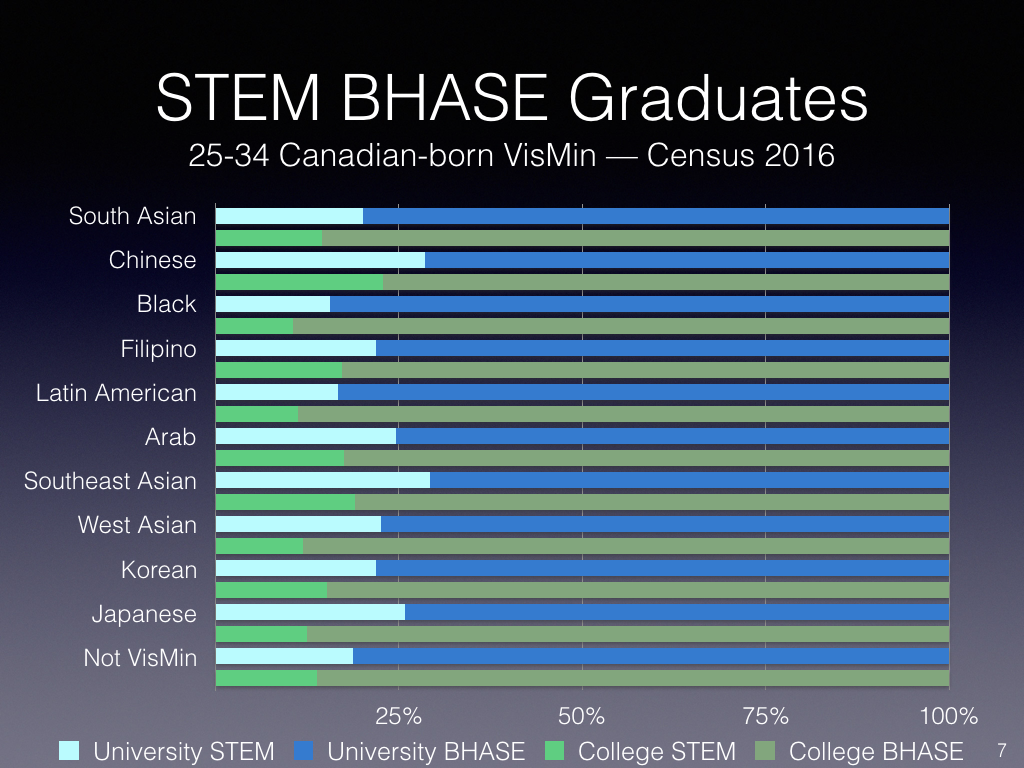
Similar pattern in Canada (chart above looks at Canadian-born visible minority university and college graduates compared to Not VisMin):

U.S. immigrant children study more math and science in high school and college, which leads to their greater presence in STEM careers, according to new findings from scholars at Duke University and Stanford University.

“Most studies on the assimilation of immigrants focus on the language disadvantage of non-English-speaking immigrants,” said Marcos Rangel, assistant professor at Duke’s Sanford School of Public Policy. “We focus instead on the comparative strength certain immigrant children develop in numerical subjects, and how that leads to majoring in STEM subjects in college.”

About 20 percent of U.S.-born college students major in STEM subjects. Yet those numbers are much higher among immigrants — particularly among who arrive the U.S. after age 10, and who come from countries whose native languages are dissimilar to English, Rangel said. Within that group, 36 percent major in STEM subjects.

“Some children who immigrate to the U.S., particularly older children from a country where the main language is very dissimilar to English, quite rationally decide to build on skills they are relatively more comfortable with, such as math and science,” said Rangel.

Those older immigrant children take more math and science courses in high school, the authors found. Immigrant children arriving after age 10 earn approximately 20 percent more credits in math-intensive courses than they do in English-intensive courses.

This focus continues in college, where immigrant children are more likely to pursue science, technology, engineering and math majors. Those majors, in turn, lead to careers in STEM fields. Previous research has shown that immigrants are more highly represented in many STEM careers.

“Meaningful differences in skill accumulation … shape the consequent contributions of childhood immigrants to the educated labor force,” the authors write.

Source: Immigrant kids in U.S. deliberately build STEM skills

Fact-checking immigration: Boustan uses big data to explore myths about the past

Some interesting work here:

“When the horns started to blow and we saw the Statue of Liberty, I thought I was in heaven. Really. She’s up there and saying, ‘Come on in. From now on you are a free person.’”

These are the words of Turkish immigrant John Alabilikian, who came to the United States in 1922, collected by the Ellis Island Foundation in 1985 as part of its oral history library. In his interview, Alabilikian described escaping the Armenian genocide and journeying to America.

Personal anecdotes like these serve as a rich source of data for economist Leah Platt Boustan, who brings modern statistical analysis and big-data tools to the study of historical events and trends. With the recent digitization of first-person accounts and other documents, Boustan can uncover insights from people’s personal experiences in ways previously not possible. “It’s almost as if we can conduct surveys of people who lived in the past,” she said.

Statue of Liberty with quote from Leah Boustan, Professor of Economics; “Many people imagine that [19th-century] immigrants from Europe very quickly climbed the economic ladder and adopted U.S. behavior norms, and that immigrants today are slower to do so. That’s not the case.”

Boustan, who joined Princeton as a professor of economics in 2017, has an impressive record of proving and disproving ideas that people believe based on anecdotes or “gut feelings.” In the past, economists and historians had few data tools, but with today’s powerful computers and mathematical approaches, historical perspectives can be tested against hard numbers.

“Often what we think we know, we don’t really know,” Boustan said. “If you start to introspect, and ask, ‘Where do my beliefs come from?’ you might realize they come from your family’s experience or from relatively few anecdotes. We rarely test our beliefs with thousands of cases.” Boustan tries to rediscover that lost nuance, giving economists and historians a statistical footing for their research.

One of the questions Boustan has tackled is the issue of “white flight.” Between 1940 and 1970, white Americans left cities in large numbers, but historians have debated whether this exodus was motivated by the desire to pursue opportunities in suburbs or because of an influx of black Americans. Boustan’s analysis, published in the Quarterly Journal of Economics in 2010 when she was on the faculty at the University of California-Los Angeles, suggests that both were true.

Another of Boustan’s recent projects is on the age of mass migration, a period from around 1850 to about 1920, when more than 30 million Europeans moved to the United States. Working with longtime collaborators Ran Abramitzky at Stanford University and Katherine Eriksson at the University of California-Davis, and with support from the National Science Foundation, Boustan compared historical data to today’s records, asking: Are immigrants today assimilating more slowly than they did in the past?

“Many people imagine that immigrants from Europe very quickly climbed the economic ladder and adopted U.S. behavior norms, and that immigrants today are slower to do so,” Boustan said. “That’s not the case.”

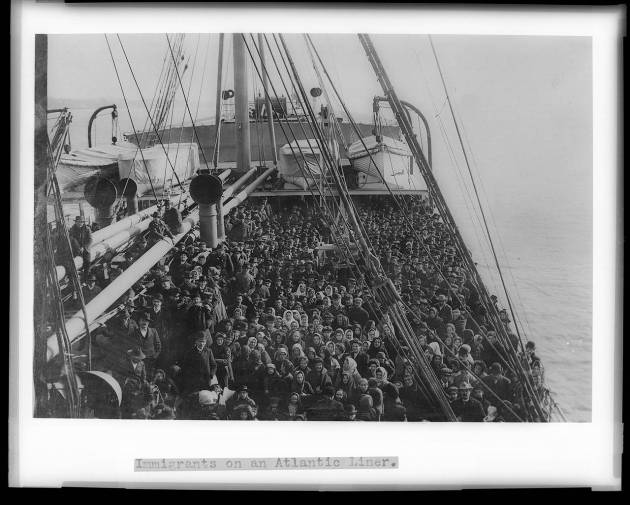
Crowds on 19th century immigrant ships

Leah Boustan, professor of economics, uses digitized historical records and other sources — like this 1906 photograph of immigrants on an Atlantic liner — to give researchers a statistical footing for studies on immigration, past and present.

Prior work suggested that European immigrants during the age of mass migration were paid less than native-born workers upon first arrival, but then quickly caught up. Boustan and her collaborators tracked the occupations of 21,000 natives and immigrants over two decades, and, in work published in 2014 in the Journal of Political Economy, showed that this common wisdom does not fit the facts in two different ways. Many recently arrived immigrant groups did not have lower earnings than natives and, overall, the income of immigrants and natives rose at close to the same rate.

Slow rates of economic assimilation are consistent with the experiences of recent immigrants, according to studies by other researchers, Boustan said. “There is nothing special — or necessarily alarming — about economic convergence that takes more than one generation,” Boustan said. “We have been there before.”

One measure of cultural assimilation that Boustan looked at was how immigrants named their children. Because selecting a child’s name costs nothing, and thus is independent of socio-economic status, Boustan argued that names indicate a family’s eagerness to adopt American culture. In work supported by a grant from the Russell Sage Foundation, she and her colleagues used millions of entries from recently digitized census records to calculate a “foreignness index” for each name in the early 1900s. She conducted a similar exercise using birth certificate records from California today. In both cases, she found that immigrants shift away from foreign-sounding names as they spend more time in their adopted nation, and at the same rate.

“What was striking about those two sets of analyses — the past and present — is that the speed of cultural assimilation, by this measure, is almost identical in the past and present,” Boustan said. The study is detailed in an NBER Working Paper posted in July 2016.

Boustan’s work is part of a growing trend in economics toward harnessing large data sets to explain historical observations, said her colleague and former mentor, Henry Farber, Princeton’s Hughes-Rogers Professor of Economics. Farber met Boustan when she was an undergraduate at Princeton in the late 1990s. Boustan later earned a Ph.D. at Harvard University in 2006 and then became a professor at the University of California-Los Angeles.

Today, Boustan’s office is only a few doors down from Farber, who is next door to his own dissertation adviser, Orley Ashenfelter, the Joseph Douglas Green 1895 Professor of Economics — three generations of empirical economics in one hallway. “Princeton is lucky to have her on the faculty,” Farber said.

Boustan is also part of the trend toward increasing female participation in a historically male-dominated discipline. When a leading journal recently asked her how the field might attract and train more women, she was caught off guard. “I realized that I didn’t know much about the overall situation of women in economics — I only knew anecdotes from my personal experiences,” Boustan said.

So she began investigating the problem with her characteristic big-data approach. “It is a very important question, and the best way to work on big questions is to take a look at the data,” she said.

She paired with graduate student Andrew Langan to collect data on the male-female graduate student ratios in economics departments at leading research universities and learn more about why some programs have more success than others in training women. Graduate programs in economics are on average 30 percent female across the nation, with some as low as 10 percent female and others achieving a 50-50 balance, Boustan and her team found.

“The average picture looks gloomy, but there are some bright rays,” Boustan said. For example, even departments with high numbers of male students and faculty can serve female students well if they provide opportunities for training and mentoring, they found.

Boustan keeps this in mind as she mentors and advises students in Princeton’s economics department. One advisee, Ji Won Choi, said, “I hope I can be an example, like Leah, for others in the future.”

Until recently, Princeton’s Department of Economics had few women in senior faculty positions, but the department has doubled its number of female faculty members over the past four years, said Janet Currie, the Henry Putnam Professor of Economics and Public Affairs at the Woodrow Wilson School, who was department chair until June 2018. “Nevertheless,” Currie said, “we are not where we would like to be, and we’ll need continuous effort not to lose the gains we have made and to diversify the faculty and student body in other dimensions.”

With so many charged topics facing society today, from the equitable treatment of women in the workplace to the role of immigrants in building the nation, Boustan’s data-driven approach to controversial issues is more relevant than ever. To explain the importance of this work, Boustan quotes her former mentor, the Harvard economic historian and labor economist Claudia Goldin: “The best historical questions are the ones that speak to the world we live in today.”

Source: Fact-checking immigration: Boustan uses big data to explore myths about the past

ICYMI – Chris Selley: Police carding ought to be an anathema in a free society. How is it still up for debate?

Good commentary:

In the debate over if, when and how police should be able to stop, question and compel identification from citizens, and then store the information they receive in databases, those arguing to allow officers maximum discretion tend to defer to public safety. The more info police have, the more crime and violence and misery they can avert. Conveniently for that view, in the two years since more restrictive rules took effect in Ontario, Toronto has experienced a significant spike in homicides.

Coincidence? Justice Michael Tulloch thinks so. In his 300-page report on the Independent Street Checks Review he oversaw, officially released Friday, Tulloch does a pretty good job busting causation down to correlation.

In 2013, he observes, Toronto police agreed to ramp down “street checks” (an interaction producing “identifying information … concerning an individual … that is not part of an investigation”) and “carding” (when “a police officer randomly asks an individual to provide identifying information when there is no objectively suspicious activity,” and the individual isn’t suspected of or to have knowledge of any offence, and the information winds up stored in a database).

Despite that, the city’s homicide count held steady at 57-59 per annum until 2016, when it spiked to 75. In 2017, the year the rules came fully into effect, the number dropped to 65, before soaring to 96 in 2018 — the highest in a decade.

The number of shooting incidents, meanwhile, has hardly budged since the new rules came into force: There were 406 in 2016, 390 in 2017 and 424 in 2018. Furthermore, some areas of the city where carding was most prevalent — Jane and Finch, Rexdale, Lawrence Heights — saw dramatic decreases in shooting incidents. Whereas getting guns off the street is a common justification for intrusive police tactics, such as New York City’s stop-question-and-frisk, firearm seizures in Toronto skyrocketed after the new regulations came into place. And other Ontario municipalities reported no similar surges in crime. Overall, homicides in Ontario dropped from 2016 to 2017.

In short, it’s far easier to make a case that carding has no effect at all on serious crime than that it has a huge one. But even if previous carding practice had “worked,” even if the new regulation had stopped it from working, it barely even amounts to a defence. As Tulloch notes, “the regulation simply gives effect to the existing law that people do not have to provide their identification when there are no reasonable grounds to believe the person has committed an offence.”

If carding “worked,” in other words, it relied on citizens not knowing or caring about their already-existing right to be left alone whilst minding their own business, or being too intimidated to exercise that right — as well they might be. Politely refusing an armed man or woman’s request to identify yourself is no small thing, all the more so if you have “nothing to hide.”

The problems inherent in such a situation are myriad. There are quantifiable harms: People were denied jobs and security clearances, and in at least one case menaced by child services, thanks to information stored in police databases that implicated them in nothing other than being included in a police database. And there are more existential harms. Imagine growing up with a squeaky-clean nose yet constantly feeling like a person of police interest. It’s profoundly alienating, especially when targets quite logically conclude, based on well-documented statistics if not their own intuition, that they’re being harassed because of their race, skin colour or some other innate characteristic. It’s no less insidious if the bias is unconscious; it might even be more so.

Nothing good can come from it, and plenty bad. It hinders police in solving crimes, for one thing: “When a segment of society believes that it has been unfairly targeted by the police,” Tulloch writes, “it will delegitimize the police in their eyes.” All those desperate calls for witnesses to come forward will be met more skeptically. Tulloch cites research showing “inappropriate interaction with police” can even “desensitize young people from guilt regarding potential acts of crime.”

Tulloch has scores of recommendations, including clarifying what he argues are overly complex rules for officers; requiring officers to tell people when a conversation is voluntary; including written reasons for the existence of any database record; and destroying those records automatically after five years.

As he says, the police have lots of powers at their disposal — including the power to stop and question people if officers have a legitimate, articulable “reason to believe the identifying information would be valuable police intelligence.” That still goes too far for some civil libertarians. But it’s maddening there are still people who object to the very idea of eliminating truly random stop-and-question policies; people who can’t grasp just how anathema that idea ought to be in a free society, how profoundly it undermines the social contract that underpins modern Western policing; people who could actually take issue with Tulloch’s most fundamental recommendation: “No police service should randomly stop people in order to collect and record identifying information and create a database for general intelligence purposes.”

Well, obviously.

Source: Chris Selley: Police carding ought to be an anathema in a free society. How is it still up for debate?