Visible minorities form majority in 41 federal ridings, but experts say immigrants are politically diverse

Overview of some of the issues:
Abdikheir Ahmed vividly remembers casting his ballot for the first time in Winnipeg’s 2010 municipal election. Not only was he excited, he had an entourage.

“I brought my family. I brought my kids. I brought everyone,” Ahmed said. “It was the first time in my life that I voted.”

The 39-year-old Winnipeg resident arrived in Canada from Somalia as a refugee in 2003. It took several years before he could legally vote as a Canadian citizen, but he was eager to do so.

“I feel that I have a responsibility to decide the direction that this country goes in,” said Ahmed.

Now, he runs Immigration Partnership Winnipeg, an organization that helps immigrants and refugees get settled in that city. Visible minorities make up one-quarter of the population in Winnipeg, according to Statistics Canada, though not all are recent immigrants.

Volunteers with Immigration Partnership Winnipeg launch the ‘Got Citizenship? Go Vote!’ campaign in August 2018. (Submitted by Immigration Partnership Winnipeg)

It’s become conventional wisdom in Canadian politics that immigrant voters can have a powerful influence in elections.

According to Ahmed, immigrants — new or long-settled — are a potentially powerful block of voters.

“It actually makes sense to court the so-called immigrant vote because that is the determining factor, and it’s a growing population,” said Ahmed.

But as the battle begins for this year’s federal election, experts say no party has a monopoly on any particular ethnic group or religious minority.

Myth or reality?

Canada’s major parties have been competing for immigrant voters since the 1960s, according University of Toronto political science professor Phil Triadafilopoulos.

“The main sources of immigration were different then, but the dynamics were very similar. It’s an urban Canadian story,” said Triadafilopoulos.

In the 2019 federal election, ridings in Toronto and Vancouver are considered key battlegrounds that can make-or-break a party. Both have high Chinese and South Asian populations.

But they aren’t the only cities where politicians are courting ethnic voters.

Certain very racist policies, like the Barbaric Cultural Practices Act and tip line … woke up communities to actually say, ‘We cannot tolerate this in our country.’– Abdikheir Ahmed, Immigration Partnership Winnipeg

Andrew Griffith, a fellow of the Canadian Global Affairs Institute and the Environics Institute, says data on immigration and ethno-cultural diversity from the 2016 census shows many Canadian communities now have a larger percentage of visible minority residents than in 2011.

Of 338 federal ridings in Parliament, 41 have populations where visible minorities form the majority, compared with 33 five years earlier.

“Parties, when they’re developing their electoral strategies, take that into account in terms of how they advocate policies and programs to attract them,” said Griffith.

What’s more difficult is pinning down whether immigrant voters have partisan preferences.

New Canadians could once be counted on to vote Liberal, ever since Pierre Trudeau opened the door to more immigration in the 1970s, but that unwavering endorsement became less pronounced over the past decade.

Griffith says recent polling data suggests some ethnic communities still lean toward certain parties. Sikh-Canadians, for example, have a “general tendency” to vote Liberal and NDP, while Conservatives enjoy more support among Chinese-Canadians.

But, Griffith cautions, “We should never make the assumption that all members of the community are identical and behave the same way, whether it be in the polling booth or in other aspects.”

Encouraging newcomers to vote

In Winnipeg, Ahmed says it shouldn’t even be assumed new immigrants will exercise their franchise. He’s working to mobilize visible minority and newcomers who have earned citizenship to vote in this year’s federal election.

“Many newcomers have never voted in their own countries or have engaged in electoral processes that are not transparent, so do not actually trust the process and don’t see the importance of voting in it,” said Ahmed.

To encourage refugees and immigrants to vote in last fall’s municipal election, Ahmed’s non-partisan group launched a electoral campaign with the slogan “Got Citizenship, Go Vote.”

Immigration Partnership Winnipeg developed posters and videos on how and where to vote that were translated into 12 different languages, and concentrated on ethno-cultural community organizations to get the message out.

Ahmed’s impression is that immigrants don’t vote in blocks, but he says ethnic communities will respond electorally if they feel targeted by an issue.

For example, when the federal Tories campaigned in 2015 on policies such as banning the niqab at citizenship ceremonies or setting up a “barbaric cultural practices” tip line, Ahmed says it spurred newcomers to vote against them.

“The messaging from the Conservative Party came across as anti-immigrant,” said Ahmed.

“Certain very racist policies like the Barbaric Cultural Practices Act and tip line … woke up communities to actually say, ‘We cannot tolerate this in our country.'”

It’s a point echoed by Triadafilopoulos, who suggests large numbers of immigrant voters is one of the reasons Canada has not experienced the same kind of xenophobic populism sweeping Europe and the United States.

“The demographic and institutional facts [in Canada] just make it a losing proposition,” he said.

Source: Canadian politicians will court the ethnic vote, but will it benefit any one party?For years, the Liberals could count on votes from immigrant communities, but with visible minorities a majority in 41 federal ridings, experts say that newcomers are politically diverse — and offer no guarantees for any one party.Cross Country Checkup |3 hours ago|

NP View: Racism lurks in the supposedly ‘woke’ Liberals’ new impaired driving laws

Valid parallel to the biases of carding:

Has the self-styled “party of the Charter,” as Prime Minister Justin Trudeau still, curiously, calls the Liberals, actually even read the Charter? Have the Liberals, for that matter, paid much attention to what their own prime minister has been saying?

Canada’s impaired driving laws underwent a major overhaul last month, courtesy of the federal Liberal government. Some of the changes were necessary to recognize the changed reality of legalized cannabis. Others were simply intended to further reduce rates of impaired driving, by drug or alcohol, on our roads. This is a goal everyone shares — impaired driving is the leading criminal cause of death in Canada, way ahead of anything else. It’s a stubborn problem that governments are right to try to address, particularly a government that has recently legalized a whole new category of intoxicant.

But the new laws have given to police significant new powers. In a free society, that’s never something to be done lightly. And in this particular case, what is being done is especially bizarre because the Liberals are now insisting that such powers will not be abused even while insisting, in a slightly different context, that they inevitably will be.

One of the new powers given to police is the right, under certain circumstances, to demand a breath sample from someone who has not provided any sign that they might be impaired. Previously, a police officer needed at least some grounds to insist on such a test — the officer could have observed erratic driving before pulling the car over, for instance, or suspected a whiff of alcohol on a driver’s breath. Under the new law, a driver stopped by police for any lawful reason whatsoever (which is a very low bar) may be subjected to a breath test. Refusing to provide one is itself a criminal offence. Canadians effectively have no choice but to comply.

This is a meaningful expansion of police search powers, and it will absolutely be challenged — hopefully successfully — as a violation of Canadians’ fundamental protections against unreasonable searches. This is also an expansion of police authority that the Liberals were explicitly warned would result in abuses of power, most likely taking the form of racial discrimination. “There will be nothing random with this breath testing,” defence lawyer Michael Spratt told a parliamentary committee reviewing the bill before it became law. “Visible minorities are pulled over by the police more often for no reason. That’s what is going to happen here.” The Canadian Civil Liberties Association sounded a similar warning in its own filing, writing, “Experience has also unfortunately demonstrated that ‘random’ detention and search powers are too often exercised in a non-random manner that disproportionately targets African-Canadian, Indigenous, and other racial minorities.” It continued, “… the reality of racial profiling and the increased invasiveness that attends a mandatory alcohol screening means that the practice will adversely impact those disproportionately targeted by police for vehicular stops, in particular African-Canadian, Indigenous, and other racial minorities.”

The ratcheting-up of systemic racism might normally be an issue you would expect the gloriously woke federal Liberals to be falling all over themselves to fix, or at least to tweet piously about. That’s not the case here. The Liberals have readily acknowledged that they expect that this new law will be challenged in court, but say they will defend it, and are confident it will survive the challenges.

There’s reason enough to be alarmed at the expanded use of police powers, even if they weren’t bound to be targeted disproportionately at racial minorities. Random, groundless searches conducted by whim of the authorities are manifestly a gross violation of Canadians’ fundamental rights. Now that the law is finally being used, there are already unsettling stories of such mandatory searches starting to emerge: Global News reported this week that a Toronto-area man, who was not in the slightest bit impaired, was given a breath test after a police officer observed him returning empty beer bottles to a store for recycling, as if he’d knocked them all back on the way over in his car.

But the thing that makes this so especially strange is how the Liberals, not long ago, were embracing the very same arguments they now say concern them not at all. During the run-up to the legalization of cannabis, no less an authority on right-thinking Liberal values than Justin Trudeau himself explained that it was important that Canada legalize cannabis because of — wait for it — racial factors, that saw police applying marijuana laws with disproportion and discrimination against minorities. The prime minister even shared an anecdote about how his own late brother, Michel, after being arrested for possession of cannabis, was able to have that charge quietly taken care of. It helps to be a powerful white guy, the prime minister confessed, especially one as well-connected as the son of a prime minister. “That’s one of the fundamental unfairnesses of this current system is that it affects different communities in a different way,” he said in 2017, acknowledging that random screenings are rarely truly random, and that discretion is rarely equally applied.

The prime minister was right. So was Mr. Spratt and the CCLA. Beyond the basic offence to everyone’s rights constituted by such random and baseless searches, these expanded police powers will obviously be applied unevenly, and that is fundamentally unfair. Why was that so true for cannabis that the prime minister used it to justify why legalization was necessary, but the Liberals deem it to be of no concern whatsoever for impaired driving?

Source: NP View: Racism lurks in the supposedly ‘woke’ Liberals’ new impaired driving laws

Doug Saunders: The politics of border-crossing bogeymen are unwise – and dangerous

Valid points:

There’s a trick, long known to certain politicians, to get an electoral boost when you’re down in the polls: You declare that dangerous people are about to come across the border, and you latch onto a conspiracy theory claiming that the other political party, or some dark forces associated with them, are responsible.

It can be an effective tactic. Immigration is often a popular election issue, especially when it’s mixed with atavistic fears of mysterious predators entering your territory. It is also a profoundly dangerous tactic.

On Wednesday night, we heard the U.S. President attempt this trick, for the umpteenth time. Americans, Donald Trump declared in an address, are being “raped, murdered and beaten to death with a hammer” by nefarious figures streaming across the southern border, and “thousands more lives will be lost if we don’t act right now” to build his wall.

Never mind that the threat is an utter fiction – illegal border crossings from Mexico to the United States are at their lowest rate in almost half a century, and those who make the crossings are measurably less murder-prone than Americans.

It’s also based on a wild conspiracy theory. Mr. Trump has repeatedly told voters that migrants approaching the U.S. border include “criminals and unknown Middle Easterners,” as well as terrorists, even though his own immigration officials deny this. He’s said that their march on the border is being funded by mysterious Democratic-linked forces; in October, he publicly endorsed an anti-Jewish conspiracy theory blaming Hungarian-American philanthropist George Soros for the “caravan.”

But Canadians can’t watch this with any sense of superiority. For the first time in decades, this tactic has crept into mainstream Canadian politics.

Conservative leader Andrew Scheer shocked many members of his own party last month by taking up a cause that had emerged from the fringes, denouncing a United Nations document known as the Global Compact for Safe, Orderly and Regular Migration.

That document, if you bother to read it, is an anodyne, purely symbolic statement of principles intended to reduce overall immigration numbers, and especially to discourage irregular – that is, illegal – immigration. Like other such UN compacts, its main purpose is to provide principled-sounding statements for preambles of other documents.

Instead, Mr. Scheer claimed that the Compact “gives influence over Canada’s immigration system to foreign entities.” He then denounced the “crisis at our borders” and “chaos at our borders” caused by “illegal border crossers” – suggesting that cross-border chaos, danger and criminality would be products of this document.

Where did this weird theory come from? As Laurens Cerulus and Eline Schaart found out in an investigation this week for Politico, it was the product of a calculated social-media campaign by “a coalition of anti-Islam, far-right and neo-Nazi sympathizers” based in Europe. It was taken up in September by far-right parties in Europe, and by figures in Mr. Trump’s circle.

Mr. Scheer’s decision to join Mr. Trump in picking up this ugly thread might have seemed like an expedient way to turn immigration fears into anti-Liberal sentiment. Yet, the larger danger of such conspiracy theories is not just that they are absurdly false – but that some people really believe them.

In October, 11 people were shot to death in a Pittsburgh synagogue by a man shouting anti-Semitic slogans. To judge by his social-media posts and statements, the alleged shooter, Robert Bowers, had come to believe that criminal migrants headed to the Mexico-U.S. border were being funded and supported by Mr. Soros and other Jewish figures and organizations – the same conspiracy theory Mr. Trump endorsed. A few days earlier, a Trump supporter in Florida had sent pipe bombs to Mr. Soros and other Democratic-linked figures in apparent support of this theory.

These incidents, and others like them, followed a 2011 massacre in Norway orchestrated by Anders Breivik, who killed 77 people – many of them children – because he had come to believe a theory, promoted by European right-wing politicians, that “globalists” and “cultural Marxists” (including his victims) were conspiring to bring in threatening Muslim immigrants.

That conspiracy theory has now reached Canada. In January, 2017, Alexandre Bissonnette walked into a Quebec City mosque and shot 19 people, killing six. In his police interview, he said he had been spurred to action after watching reports about Mr. Trump’s proposed Muslim ban, and after hearing conspiracy theories about Canada’s Syrian refugees. “I saw that and I like lost my mind,” he said. “I don’t want them to kill my parents, my family.”

Nobody but these killers themselves are responsible for their actions. But they all had been led to believe fictions about border-crossing bogeymen and the figures who supposedly back them. Given the dangerous implications of such inventions, to amplify them in the name of momentary political gain wouldn’t just be profoundly unwise. It would be absolutely reckless.

Source: The politics of border-crossing bogeymen are unwise – and dangerous

Trump Claims There Is a Crisis at the Border. What’s the Reality?

Good analysis of the numbers:

President Trump has frequently called the situation at the southern border with Mexico a crisis and insists that building his long-promised border wall will fix it. Here are some of Mr. Trump’s most common assertions of a crisis, and the reality of what we know about immigrants and the border.

“We can’t have people pouring into our country like they have over the last 10 years.”

THE REALITY Illegal border crossings have been declining for nearly two decades. In 2017, border-crossing apprehensions were at their lowest point since 1971.

Total number of arrests for illegally crossing the Mexican border

Undetected illegal border crossings have dropped at an even faster rate, from 851,000 in 2006 to approximately 62,000 in 2016, according to estimates by the Department of Homeland Security.

However, there is one group of migrants that is on the rise: families. A record number of families have tried to cross the border in recent months, overwhelming officials at the border and creating a new kind of humanitarian crisis.

Number of arrests for illegally crossing the Mexican border

Asylum claims have also jumped, with many migrant families telling officials that they fear returning to their home countries. Seeking asylum is one way to legally migrate to the United States, but only 21 percent of asylum claims were granted in 2018, and many cases can take years to be resolved.

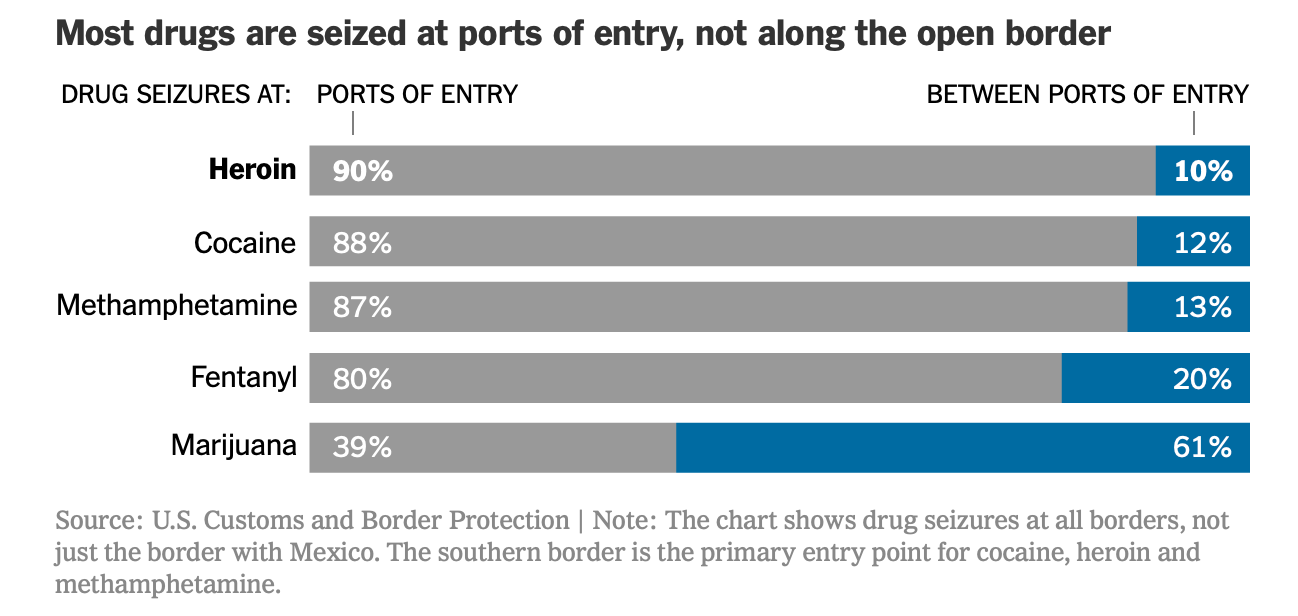
“Every week, 300 of our citizens are killed by heroin alone, 90 percent of which floods across from our southern border.”

THE REALITY It is true that the majority of heroin enters the United States through the southern border, according to the Drug Enforcement Administration. But the D.E.A. also saysthat most heroin is brought into the country in vehicles entering through legal border crossings, not through the areas where walls are proposed or already exist.

Most drugs are seized at ports of entry, not along the open border

There are more than two dozen ports of entry along the southern border. Barriers are already present in Border Patrol sectors with the highest volumes of heroin seizures.

“Over the years, thousands of Americans have been brutally killed by those who illegally entered our country, and thousands more lives will be lost if we don’t act right now.”

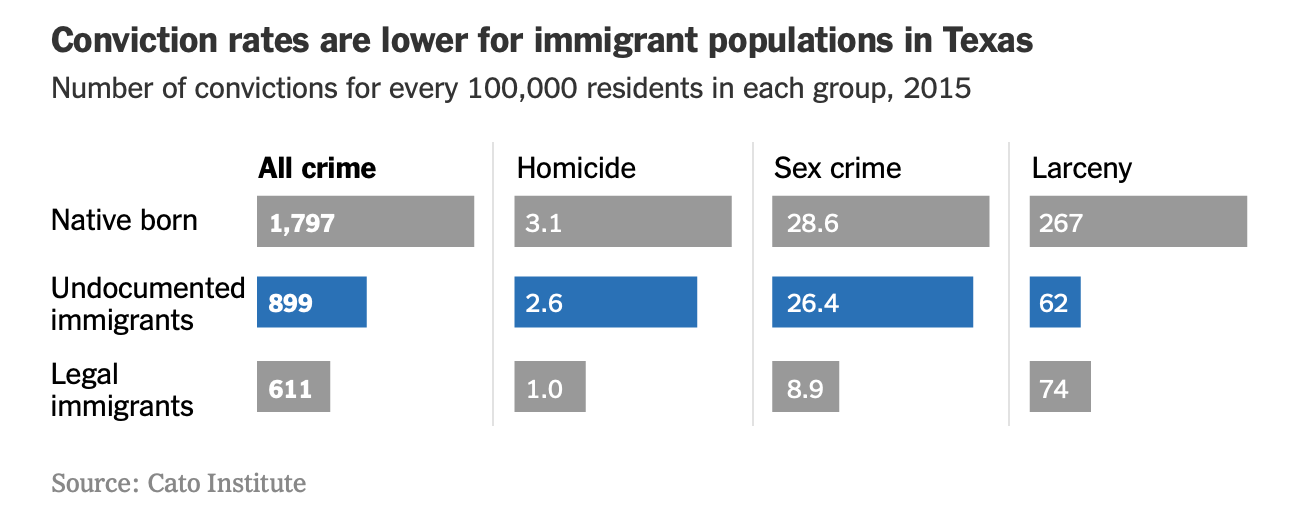
THE REALITY It is difficult to assess the president’s claims that illegal immigration leads to more crime because few law enforcement agencies release crime data that includes immigration status. However, several studies have found no link between immigration and crime, and some have found lower crime rates among immigrants.

Texas, which has the longest border with Mexico and has one of the largest populations of undocumented immigrants of any state, keeps track of immigration status as part of its crime data. The Cato Institute, a libertarian research center, analyzed the Texas data in a 2015 study and found that the rate of crime among undocumented immigrants was generally lower than among native-born Americans.

Conviction rates are lower for immigrant populations in Texas

Some critics of the study argued that the reason undocumented immigrant conviction rates were low was because immigrants were deported after they served their sentences, which prevented them from committing another crime in the United States, reducing their rate of crime relative to native-born Americans.

Alex Nowrasteh, senior immigration policy analyst at the institute, addressed the complaint by comparing first-time criminal conviction rates among undocumented immigrants in Texas and native-born Americans in Texas. He found that undocumented immigrants still committed crimes at a rate “32 percent below that of native-born Americans.”

President Trump frequently tells the stories of Americans who have been killed by undocumented immigrants as examples of criminal behavior. These terrible crimes have happened, but there is no comprehensive data that shows whether these killings are happening at crisis levels.

Trump touts plan to change visas for skilled foreign workers

All those articles contrasting Canada vs US policies under Trump have provoked a reaction (factually incorrect as per usual practice):

U.S. President Donald Trump said on Friday he plans changes to the H-1B program that grants temporary visas for specialty occupations such as technology or medicine, but his administration said later he was referring to changes that were proposed last year.

“H1-B (sic) holders in the United States can rest assured that changes are soon coming which will bring both simplicity and certainty to your stay, including a potential path to citizenship,” Trump said on Twitter. “We want to encourage talented and highly skilled people to pursue career options in the U.S.”

It was unclear what Trump meant by a “potential path to citizenship” for H-1B visa holders, who already are eligible to be sponsored by employers for legal permanent residency, which would then make them eligible to become U.S. citizens.

When asked about Trump’s tweet, U.S. Citizenship and Immigration Services spokesman Michael Bars provided a statement about a formal proposal in December for changes to the H-1B process, which are likely to become final later this year.

The proposal is designed to increase by 5,340, or 16 percent, the number of H-1B beneficiaries who hold advanced degrees from American universities. It would also streamline the application process with a new electronic registration system.

“These proposed regulatory changes would help ensure more of the best and brightest workers from around the world come to America under the H-1B program,” Bars said.

Critics questioned why Trump tweeted about a month-old proposal at a time when he is battling with congressional Democrats over spending legislation to fund the federal government. Trump wants to include $5.6 billion for a wall along the border with Mexico, which he says will stem illegal immigration.

Democrats call the proposed wall expensive, ineffective and immoral. The dispute has led to a partial shutdown of the U.S. government that is now in its 21st day.

Doug Rand, a former White House official in the Obama administration who worked on immigration issues, said the proposed changes to the lottery selection process were at best modest and at worst could cause chaos. Some immigration experts do not believe the new registration system will be ready in time for the next lottery, which occurs in the spring.

“The odds that a complicated new electronic processing system will be effectively launched by DHS in time for the next lottery on April 1 is low probability and has nothing to do with a potential path to citizenship,” Rand said.

Trump backs off emergency declaration – for now

Throughout his presidency, Trump has sought to stem illegal immigration and to deport more immigrants living in the United States illegally. His administration has also worked to limit legal immigration, including through a proposal that would penalize aspiring immigrants who use public benefits.

Trump has also derided visas granted to family members of U.S. residents or citizens as “chain migration,” and backed a Republican proposal in 2017 that would have slashed legal immigration in half.

“The devil is in the details, said Todd Schulte, president of FWD.us, a nonprofit group which advocates for pro-immigration policies. He said his group, which was founded by tech executives including Facebook founder Mark Zuckerberg, remains “skeptical of vague pronouncements given the administration’s track record.”

U.S. companies often use H-1B visas to hire graduate-level workers in specialized fields including information technology, medicine, engineering and mathematics. But the visa program has also drawn criticism for being used heavily by foreign outsourcing companies that squeeze out American firms.

Source: Trump touts plan to change visas for skilled foreign workers

Supreme Court rules voting restrictions on expatriate citizens are unconstitutional

Well, that settles it, even if I disagree with the decision (Opinion: What should the voting rights of Canadian expatriates be).

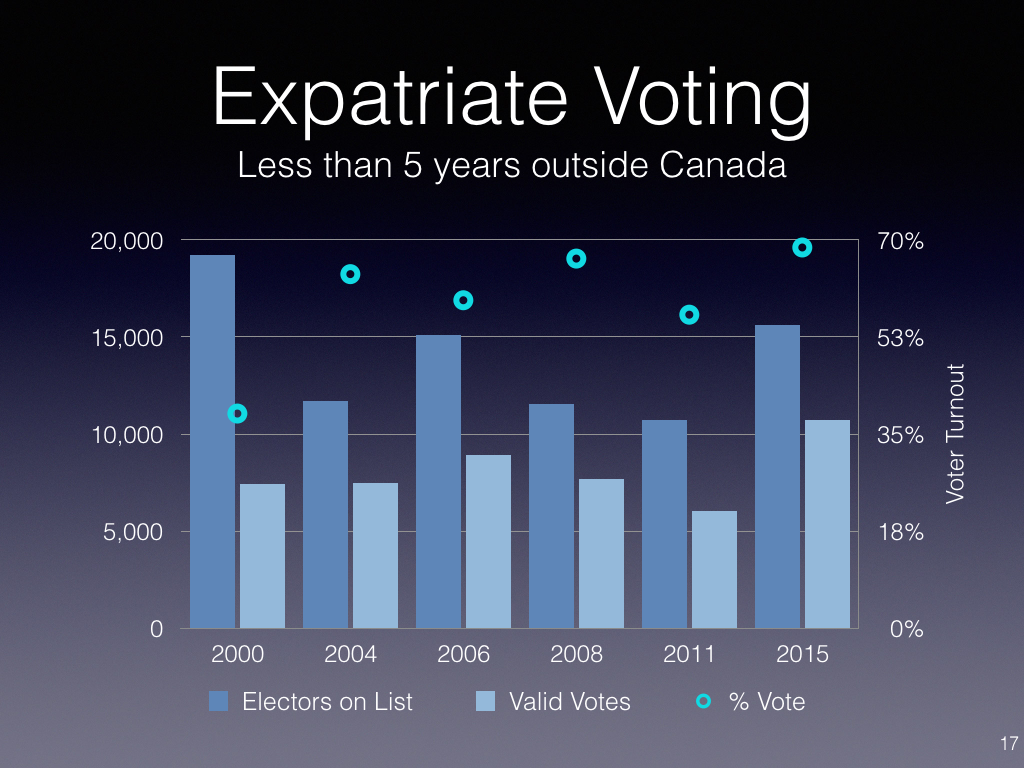
We will find out just how many of these previously disenfranchised citizens vote in the 2015 election (the chart above covers previous elections):

The Supreme Court of Canada has ruled voting restrictions on expatriate citizens are unconstitutional.

Two Canadians working in the United States, Gillian Frank and Jamie Duong, challenged federal voting restrictions after being unable to vote in the federal election of 2011. At the time, the law said non-resident citizens could not vote if they had lived more than five years abroad.

In December, a Liberal bill extending voting rights to long-term expatriates received royal assent. But at stake in the Supreme Court ruling was whether those voting rights could be taken away by a future government.

Dr. Frank, who was born in Toronto and was a Canadian Forces member, and now teaches American Studies at the University of Virginia, explained in an interview with The Globe and Mail on Thursday what it felt like not to be able to vote: “To watch democracy from the outside, it’s sort of like an injury, that acts up every once in a while.”

The court ruled 5-2 that the now-repealed law was unconstitutional. “The disenfranchisement of these citizens not only denies them a fundamental democratic right, but also comes at the expense of their sense of self-worth and their dignity,” Chief Justice Richard Wagner wrote for four of the judges in the majority. (A fifth judge wrote concurring reasons.) “These deleterious effects far outweigh any speculative benefits that the measure might bring about.”​

Mr. Duong, who left Canada in 2001 and works at Cornell University in Ithaca, N.Y., told The Globe on Thursday that he has a strong attachment to his native land. “I was born and raised in Canada; my parents still live in Canada. I’m a Canadian, and it’s my obligation to vote and participate in our democratic process.”

A lower-court judge had found the voting prohibition unconstitutional. But the Ontario Court of Appeal then ruled 2-1 that the law could stand, saying that non-residents do not live with the consequences of their votes on a daily basis. The dissenting judge said the restrictions had the effect of making non-resident Canadians second-class citizens. Dr. Frank and Mr. Duong appealed to the Supreme Court.

They are among 1.4 million Canadians who – as of 2009 – had been living abroad for more than five years.

The 1982 Charter of Rights and Freedoms says without qualification that every Canadian citizen has the right to vote.

Canada has always had residency restrictions on voting. During the First World War, the restrictions were eased to allow soldiers to vote. Advance voting was established in 1920 for salespeople and sailors. In 1945, proxy voting was allowed for prisoners of war. In 1970, diplomats and other public servants living abroad, and their dependents, were allowed to vote remotely. And in 1993, the vote was extended to citizens who had lived abroad for fewer than five years.

The federal Attorney-General’s office, in its Supreme Court filing, said the limit on expats’ right to vote is fair. “The legal responsibilities of long-term non-resident citizens under Canadian domestic law are much less than the responsibilities of resident Canadians,” it said. It added that similar limits on voting rights are common in other parliamentary systems derived from the British tradition.

Lawyers for Dr. Frank and Mr. Duong, in their written argument filed with the Supreme Court, said that Canadians who leave the country tend to do so for work-related reasons, but maintain their connection to Canada. “The inability to vote leaves them with no voice in the direction or well-being of the country, even though many of them have strong connections, including family in Canada, and wish to return.” Many of them have no right to vote anywhere, they said. They added that the voting restrictions harm the dignity and sense of belonging of expatriates.

The last major case on voting rights was in 2002, and it was one of the Supreme Court’s most controversial in the Charter era. The court ruled 5-4 that federal prisoners could not be denied the right to vote. “Denying citizen law-breakers the right to vote sends the message that those who commit serious breaches are no longer valued as members of the community, but instead are temporary outcasts from our system of rights and democracy,” then-Chief Justice Beverley McLachlin wrote for the majority.

Source: Supreme Court rules voting restrictions on expatriate citizens are unconstitutional
Ironically, the same day as this decision, the Globe published yet another op-ed (think it is the fourth) arguing against limiting voting rights for longer-term expatriates without the author, Yasmin Rafiei, or the Globe, acknowledging that the government had already changed the legislation.
Hardly a demonstration of being connected to Canadian political discourse and developments:

One of Justin Trudeau’s 2015 federal-election campaign lines was, “A Canadian is a Canadian, is a Canadian.”

Unless you live outside of Canada, it seems.

This Friday, the Supreme Court will decide if the democratic franchise of Canadians living overseas should be subject to a five-year limit. A voting ban – which denies Canadians the right to vote in elections after five years living overseas – was legislated in 1993 under Jean Chrétien, enforced under Stephen Harper, and has not yet been overturned under Mr. Trudeau. His government sought to repeal the five-year limit in 2016 via Bill C-33, but in the two years since its introduction, the bill has only achieved a first reading. Its tepid progress in Parliament has ushered the case into the hands of the Supreme Court, where it rests today.

The voting ban raises a fundamental question: What makes a Canadian a Canadian?

It’s a question I contend with in my daily life outside my homeland. I was born and raised in Canada and had only ever studied and worked in Canada until last year. If I have a personal geography, it is tied to my parents, whose immigration to Edmonton from Iran involved embracing every aspect of their new country. My dad had me on skis as soon as I could walk; we hosted neighbourhood street hockey on our driveway; Edmonton’s river valley was, to my mother’s consternation, my second home.

I was raised in our city’s public schools, graduated from the University of Alberta and delivered the faculty address at graduation. However, it was in leaving Canada that I fully came to terms with my national identity.

In 2017, I received a scholarship to study at University of Oxford, where I regularly encounter my identity, as it is perceived outside our national borders. Abroad, my primary identifier is no longer the province I grew up in or where my parents come from, but my nationality as a Canadian. Limiting my right to vote indicates I’ve lost touch with this national identity when, in fact, I renegotiate it every day against its reflection, mirrored to me in my international colleagues’ perceptions of Canada.

I’m hardly alone. A 2010 report by the Asia Pacific Foundation estimated that 2.8 million Canadians live abroad. Comprising about 9 per cent of our national population, our expat community is proportionately larger than that of Australia, the United States, China or India. This group, both substantial in size and highly skilled, should not be treated as a demographic anomaly.

The court’s coming decision demands our collective attention. Our citizenship is enshrined in our constitutional right to vote – in our ability to decide, at election time, what we would like the future of our country to be. By stripping this right away after five years, our government makes a resounding judgment that expatriates are less Canadian because we live abroad.

Limiting voting rights also discourages valuable expatriates from returning to Canada. My departure was incited by educational opportunity: After two years studying politics at Oxford, I’ll spend four years studying medicine at Stanford University. Despite my time away, my right to vote enables me to decide the state of the home I plan on returning to. Under the current legislation, I will have effectively exchanged my graduate and doctoral degrees for that right.

The critique frequently levelled against extending voting rights is that expats have broken the social contract: We do not pay taxes (although most do). But at the heart of this critique rests a dangerous assumption: that constitutional rights ought only to be afforded to those who can pay for them. By this logic, should the impoverished not vote? Do we give the rich more votes? This thinking could set an odious precedent for further excisions of voting rights.

And it would be to Canada’s benefit to expand voting rights beyond geographic boundaries. My status abroad, for instance, facilitates my work on the Ebola virus and antimicrobial resistance, biosecurity threats that don’t know borders. I study and work alongside Canadian expats driven to resolve climate change, cyberattacks, and mass migration – issues demanding global co-operation. A postnational Canada that enables citizens to vote outside of its borders provides international depth to civic engagement – but also supports citizens living overseas and confronting global challenges.

Beliefs that Canada is a nation-state bounded by its geography do more harm than good. Being Canadian is not about where you live: It’s about contributing to, improving, and stewarding a community forward through challenges, domestic and abroad. Whatever Canada is in the future, it is ours together – and our voting rights need to reflect that.

Source: Why should Canadian expats suffer for suffrage?

School agents benefit both Canada and China – The Conversation

The analysis of the numbers and practices is more interest than what appears to be shilling for education consultants while indicating a possible regulatory gap:

China is the No.1 source country of international students who come to study in Canada. According to the Canadian Bureau for International Education, 150,000 international students from China studied in Canada in 2017.

Any political impact on Canadian and Chinese relations is potentially serious for a wide global network with something at stake related to Chinese students in Canada — including students and their families, universities and services related to international study, such as education agents.

Education agents play a significant role in counselling and referring students to international education providers. They connect the people involved in international education, linking students, parents, education providers, visa offices, professional service providers such as language training institutions, academic program evaluation agencies, travel and accommodation providers and finance institutions to each other in order to facilitate study in another country.

As an education researcher focused on studying trust and leadership, and as part of my university’s recruitment efforts, I have studied how students and their families decide to invest in international education, including through using education agents.

I also supervised a student’s research project that investigated the role of education agents in China. The student, Haiying Li, helped to inform this article. Li worked as an education agent between 2001 and 2014 in various capacities: among her roles, she worked for our university, and as a consultant for Beijing-, and Guangzhou-based firms and at a program supporting Masters students based in Vancouver and Shanghai. This was before she became a student in Canada.

What I have seen is that education agents play a significant role in helping international students come from China to Canada, and the agents’ work benefits both countries’ economies and people.

How agents work

The agents provide services such as identifying the institution and course of study that meet the student’s needs, helping the students finish applications, submitting grade records and serving as a liaison. Some agencies may also provide training for required language proficiency tests. In some cases, after the student enrols the agent can play the role of cultural mediator.

Based on research conducted in 2014, 60 per cent of international students used an education agent to apply to Canadian colleges and universities.

Among the three different types of education agents, the first is an institution representative who receives a commission by the school they represent. The second type is the student’s representative; the student pays for advising services typically to apply to academic programs offered by the best-ranked universities.

The third type of agent may be remunerated by both a student and an institution. The student pays for the agent’s professional overseas study consulting service; the agent may also receive commission from schools who she or he works for.

Canada benefits

I teach and supervise many international students, including Chinese students. Students’ eagerness and wonder in a new place is common, yet no less beautiful each time it unfolds, reinforcing the significance of intercultural experiences.

International students bring Canadians the opportunity to begin to understand cultural differences and similarities and to become better equipped to live successfully in a multicultural global economy.

International students bring both more money and jobs to Canada, contributing more than $15.5 billion to Canada’s economy annually. They bring knowledge, information and skills to Canada.

The federal government reports that international student spending directly and indirectly supported 168,860 jobs in Canada in 2016, an increase of 38 per cent over 2014. Thus international students have direct impacts on GDP, jobs and tax revenue.

Agents working for schools recruit students to Canadian institutions but if they perform their role successfully, they also raise the brand image of the institutions.

These agents also market Canada. They show the advantages of Canada amid other prospective countries of study, empahsizing the quality of education, the multicultural nature of Canada, safety, the beautiful Canadian environment, the potential for new economic development, the high-quality life style and immigration pathways for international students.

A 2013 report commissioned by the Council of Ministers of Education Canada based on a voluntary survey of 145 elementary, secondary and post-secondary Canadian educational administrators, and government officials in education says that how schools use and manage agents varies significantly (of note: Québec survey responders reported minimal use of agents). More research about agents’ work in Canada would be helpful.

Agents in China

Consultants EY Parthenon report that the total agent market size in China is USD$1.2 billion. In 2017, according to the Chinese Ministry of Education, 608,400 Chinese students were going abroad.

Students who leave China to study internationally come from across the country, including from what China classifies as first-, second- and third-tier cities. China ranks these cities based on five indicators: availability of business resources, urban hubs, activity of urban people, lifestyle diversity and future plasticity.

From the perspectives of parents and international students, the education agent is a conduit. Working with an education agent is reassuring because the agent can understand parents, students and their families and speak their language and thus help navigate a huge emotional and financial decision.

Trustworthiness

Some existing studies suggest that students and their families often choose the institutions that the agents recommend.

But researchers Mengwei Su and Laura M. Harrison argue this reliance has not always been beneficial to students: they argue that in our globalized economy students may be exploited for economic gain and that “delegating recruitment to overseas agencies causes mismatches between host institutions and the Chinese students.”

In a context where Chinese study abroad has grown rapidly and not every country agrees on regulatory practices (Canada is not a signator to an 2012 agreement signed by the U.K., Australia, Ireland and New Zealand for best practices agents’ trustworthiness is a significant issue for families and schools.

Eight interviews recently conducted with people knowledgeable about agent work (one agent in China, one director of international marketing representative from a Canadian university, three mothers of international students and three international students) suggested some values and standards that could be probed in further research.

In creating trustworthy relationships between clients and agents, positive feedback from the client’s friends was significant: in other words, a word-of-mouth referral. Successful experiences shared by previous clients, coupled with objective comparisons of service price, service quality and personal qualities of the agents all mattered.

With the growing markets in international education, high-quality services by trustworthy professionals are essential.

Source: School agents benefit both Canada and China – The Conversation

Unlikely new residents are reviving Australian country towns

A reminder of the contribution some lower skilled immigrants can make to rural communities and a caution regarding the limits of encouraging more high skilled immigrants to settle there:

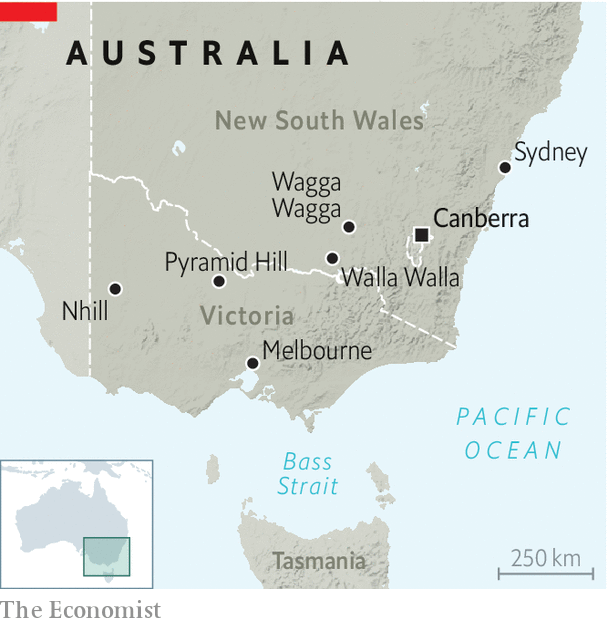
First came the Burmese, then the Afghans and the Africans. Since 2016, 400-odd Yazidis have washed up in Wagga Wagga, a regional centre south-west of Sydney. Its primary school has had to hire interpreters to communicate with families (fully a fifth of its students are refugees). The local college teems with parents learning English and new trades. Doctors have had to brush up on illnesses rarely found in the area. Few locals seem fussed about the changes. And to those fresh out of war zones, “Wagga” is an idyll. “My children are safe,” says Ismail Darwesh, a Yazidi who fled Islamic State’s attempt to wipe out his people, a religious minority in Iraq and Syria. “Everything you want you can get here.”

The refugees have been sent to Wagga Wagga under a scheme which brings beneficiaries from foreign camps to rural Australia (most settle in urban areas). The hope is that they can offset the population decline that threatens many outback settlements with extinction, as birth rates fall and youngsters head for cities. Wagga Wagga’s Multicultural Council says the population is only growing thanks to the new arrivals. Immigrants are helping to stem shrinkage in another 150 localities.

The scheme helps big cities, too, by easing the pressure on roads, schools and hospitals there. Thousands of Iraqis and Syrians descended on Sydney’s western suburbs after extra visas were dished out to them in 2016 and 2017. Many have struggled to find work, and conservatives grumble about ghettoisation. A recent report from the Centre for Policy Development, a think-tank, found that just 17% of “humanitarian entrants” have jobs after 18 months in Australia. Yet remote towns are crying out for people to fill vacancies on farms, in abattoirs and to look after the elderly. The cost of living is lower than in Sydney or Melbourne and, for farmers like Mr Darwesh, a quiet life is appealing anyway.

To stay afloat, some outback towns have taken to recruiting migrants for themselves. A piggery in Pyramid Hill, in northern Victoria, started sponsoring workers from the Philippines a decade ago. They now make up a fifth of its 500-odd population, keeping not just the business afloat, but also the local school. Another town in the same state, Nhill, lured 160 Burmese refugees from Melbourne with jobs at a food company, adding perhaps A$40m ($28m) to its economy. A group of residents in Walla Walla, a dot in New South Wales, is now scouting for refugees from Sydney. “We have jobs, we have housing and we have education,” says Andrew Kotzur, who runs the local steelworks. “We just need more people to sustain them.”

Asylum-seekers and farm labourers make up a tiny portion of the immigrants pouring into Australia. The conservative coalition government is keen to rusticate others, too. Scott Morrison, the prime minister, has suggested that some of Australia’s 500,000 foreign students could be sent to regional universities. The population minister, Alan Tudge, added that visa restrictions and incentives could be used to push skilled migrants out of Melbourne and Sydney. Almost all the best-qualified arrivals settle in those two cities, but luring them out will not be easy. It is partly owing to migration that Sydney and Melbourne are thriving. Foreign accountants and it geeks choose them for well-paid work and swanky suburbs. Rob them of both, and far fewer would come to Oz at all.

Source: Unlikely new residents are reviving Australian country towns

Trump’s immigration policy has foreign tech talent looking north of the border

These articles keep on coming in the US press (less so in conservative medias like Fox):

Over dinner at a noodle bar, a Canadian entrepreneur pitched a table of U.S. tech executives: Your foreign workers should trade sunny California for snowy Calgary, he told them. And they listened.

Highly skilled foreign workers and the American firms that employ them are in a bit of a visa panic. President Trump has vowed to crack down on the H-1B visa program, which allows 85,000 foreigners per year to work in “specialty occupations” in the United States. But there are no new rules yet, creating climate of uncertainty and fear, particularly in Silicon Valley.

Canadian businesses sense an opportunity. The Canadian tech scene has sought for years to compete with Silicon Valley, trying to lure talent north. In the early days of the Trump administration, “moving to Canada” talk surged among Americans, but most foreign workers waited.

Now some are making the move.

Though it is hard to track how many foreign nationals have moved from the United States — the Canadian government tracks newcomers by country of citizenship, not residence — immigration lawyers and recruiters on both sides of the border say the number of inquiries from nervous H-1B holders has skyrocketed since 2017.

A small group of Canadian entrepreneurs are dropping into Silicon Valley to persuade companies that rely on foreign tech workers to move them across the border.

Irfhan Rawji, the Canadian entrepreneur trying to sell U.S. tech executives on Canada over dinner, last year founded a company called MobSquad that helps tech companies move software engineers and other highly skilled workers to Canada. He travels regularly to Silicon Valley to promote his Canadian “solution.”

“Our turnaround to bring a foreign worker to Canada is under four weeks,” he said. “It’s typically longer for them to pack up their stuff.”

For Akshaya Murali, an Indian national who spent nearly a decade in the United States working for companies such as Microsoft and Expedia, moving to Toronto meant an end to living visa to visa.

She and her family applied for permanent residence in Canada and were approved.

Her employer, Remitly, then worked with MobSquad to move her job north. MobSquad signed a contract with Remitly and then hired her to do the same job — senior product manager — for Remitly from Toronto.

MobSquad’s cut is the difference between her total compensation in pricey San Francisco and the cost of the same work in Toronto, which is lower.

Remitly’s chief product officer, Karim Meghji, said the process went so smoothly that he will probably do it again. “My next step is thinking through, ‘What else can I do in Canada?’ ” he said.

Murali landed in Toronto in October and is settling in. “It’s a nice place to bring up our son, really family-friendly,” she said. “The only thing is the weather.”

Seeking stability

Silicon Valley’s visa anxiety did not start with Trump, but his policy moves and anti-immigrant rhetoric have compounded the problem, according to tech executives, immigration lawyers and people who have moved.

Months into his presidency, Trump issued a “Buy American and Hire American” executive order that ordered the Department of Homeland Security to review the H-1B visa program with the intention of more closely vetting applicants.

In the wake of the order, there were reports of an uptick in visa denials and requests by immigration officials for additional information, turning the issue into a topic of conversation for big U.S. companies and immigrant communities alike.

In August, chief executives from top U.S. firms including Apple, Cisco and IBM sent a letter to DHS expressing concern about the changes. “Inconsistent immigration policies are unfair and discourage talented and highly skilled individuals from pursuing career options in the United States,” it said.

Asked to comment on these reported changes, United States Citizenship and Immigration Services spokesman Michael Bars said, “Increasing our confidence in who receives benefits is a hallmark of this administration.”

Bars said proposed changes now under review would make the H-1B process more efficient and ensure the best applicants get visas.

Many have found the uncertainty over the changes to the H-1B program confusing and costly.

S. “Sundi” Sundaresh, the chief executive of Cinarra Systems, a start-up that provides location analytics based on mobile data to businesses, says getting U.S. work visas is a significant challenge.

His company employs 55 people worldwide, including 15 in the United States. He has three people on H-1Bs but would hire more if the process were easier.

Recently, an employee who was working remotely and waiting on a U.S. visa quit in frustration. When a second worker reached the same point, he started looking for options and is now talking to MobSquad about Canada. “We can’t lose a second one,” he said.

Michael Tippet, a Canadian entrepreneur who founded a company that helps U.S. firms set up satellite offices in Vancouver as a buffer against uncertainty in the United States, said highly skilled, foreign-born workers feel anxious and frustrated.

“From the company’s perspective, the primary motivation is that they can continue to attract top talent,” he said. “To have those people work for you, you have to show you’ve got their back.”

If you don’t have their back, they may leave.

Amogh Phadke, an Indian citizen with a master’s degree in computer science, an MBA and work experience at FedEx and Fannie Mae, wanted to build his life in the United States.

“I was struggling for 10 years with my immigration status,” he said. His breaking point was the Trump administration’s as-yet-unrealized threat to stop granting work visas for spouses of H-1B holders.

His wife, an Indian national who was studying in Canada, no longer wanted to join him stateside. “She said, ‘It’s here, or we are going back to India.’ ”

He decamped to Edmonton, the chilly capital of Alberta, last year.

The pitch for Canada

While the debate over immigration roils the United States, Canada’s major political parties are broadly supportive of increasing the number of immigrants, as long as they are skilled.

In 2017, Prime Minister Justin Trudeau’s government launched the Global Talent Stream, a program designed to fast-track work authorization for those with job offers in high-demand realms of science and tech.

Successful applicants can get a work permit in a matter of weeks. Spouses and children are eligible for work or study permits.

More than 2,000 companies have applied to hire Talent Stream workers, the department for Immigration, Refugees and Citizenship Canada said in an emailed statement.

With the door wide open, the Canadian government’s biggest challenge may be actually making the case for Canada.

Recent arrivals said the country is not really on the radar. When Phadke told Americans he was moving to Edmonton, they were shocked. “My colleagues were like, ‘Oh, my God, nobody lives in the middle of Canada. Are there going to be roads there?’ ”

When people heard how quickly he could move, he was met with more skepticism. “They asked, ‘Is it a scam?’ ”

“Canada is really bad at marketing itself,” said Vikram Rangnekar, a former software developer for LinkedIn who recently moved from the Bay Area to Toronto.

When he landed, he was so impressed with the city that he started writing about it. He later started Mov North, a site for people thinking about moving.

The site includes information on dressing for the cold — “The adage ‘There’s no such thing as bad weather, only bad clothes’ is entirely true” — and information about benefits like paid maternity leave. It also tries to connect software engineers with Canadian companies.

Hugo O’Doherty, an editor at Moving2Canada.com, a website catering to would-be immigrants and new arrivals, said Canada can’t often compete with Silicon Valley salaries, but that tech types make good money relative to the cost of living.

They also gain peace of mind. Noncitizens in the United States “don’t know if they will able to stay, if their spouse will be able to work, if their kids will have a pathway to citizenship,” he said. In his experience, Canada appeals to people who want stability.

For MobSquad’s Rawji, it is all about seeking out the best and brightest and putting them on a path to citizenship. “Our social mission is to change the Canadian economy,” he said.

To those wondering about their status in the United States, he says: Come north.

Source: Trump’s immigration policy has foreign tech talent looking north of the border

Is India Becoming a Hindu Pakistan?

Have been following some of the Indian media regarding this issue and found this commentary in Bloomberg of interest. Not sure how much this is being taken up in the Canadian South Asian media:

India is, and has been since independence in 1947, a liberal secular democracy. Its first generation of leaders resolutely refused to accept the argument of Pakistan’s founder Muhammad Ali Jinnah that the Hindus and the Muslims of the subcontinent represented two different nations. Thus, while Pakistan became a Muslim homeland, India insisted it was a state for citizens of all creeds. Whatever else might have changed in the seven decades since, that much has remained true.

Till now. For the first time, India’s leaders have sought to redefine the country effectively as a home for South Asians that aren’t Muslims — and they’re enshrining the distinction into law. That’s the underlying message of a bill that was passed this week by the lower house of India’s Parliament, in which Prime Minister Narendra Modi’s Hindu nationalist Bharatiya Janata Party has a majority.

The new law amends the religion-blind Citizenship Act written in the early years of Indian independence “to facilitate acquisition of citizenship by six identified minority communities namely Hindus, Sikhs, Jains, Buddhists, Christians and Parsis from Afghanistan, Pakistan and Bangladesh.” Calling them “persecuted migrants,” the government minister who introduced the amendment said “they have nowhere to go but India.”

Sadly, that may well be true. Many of India’s neighbors have a far worse record dealing with their religious minorities than India has with its own. And India must certainly welcome them.

Yet, in spite of its claims, India’s government is not in fact acting purely on humanitarian impulses. After all, at the moment the most persecuted minority on India’s borders are the Rohingyas who have fled Myanmar; being Muslim, they’re very obviously not welcome. Neither are the Shias and Ahmadis who are the focus of everyday violence in Pakistan — or, for that matter, the atheist bloggers of Bangladesh that have been threatened by machete-wielding extremists. As one commentator put it, the amendment could be summed up in one phrase: “No Muslims please, this is India.”

Not surprisingly, electoral politics — and the complex history of India’s eastern states — are also playing a role. The state of Assam has been convulsed in the past by violence supposedly directed at migrants from next-door Bangladesh, but in fact targeting anyone of Bengali ethnicity, regardless of national or religious background.

A decades-old accord set the date beyond which cross-border migration became illegal at 1971, the same year that Bangladesh won independence from Pakistan. Now, the government is demanding people prove they or their parents arrived before then — an absurd process that, if carried to its logical end, would require India to set up internment camps for literally hundreds of thousands, perhaps millions, of people. (Some camps have alreadybeen built.) The government hopes, through the new citizenship rules, to ensure that no non-Muslims are caught up in this sweep of “foreigners.”

Assam’s sub-nationalists are furious: They don’t want to welcome any outsiders, Hindus included. Yet the government is facing a tight reelection later this year, and at least some BJP strategists appear to hope that anti-Muslim sentiment will serve as a wedge issue elsewhere in India — especially in nearby West Bengal state.

Personally, I doubt that will work; like Assam, West Bengal is one of those parts of India where ethnicity has traditionally counted for more than religion. In the religiously polarized north and west of India, however, the law might help the BJP mobilize a few million extra voters.

Surely even a few million votes aren’t worth allowing India to lose a seven-decade old argument and accept that Jinnah’s “two-nation theory” was correct after all? Is an election victory worth making India’s 170 million Muslims feel unwelcome in their own country?

I would argue that, for the BJP, it isn’t just about the votes. It’s precisely about changing what India has represented for 70 years. That’s why the party has repeatedly invoked the memory of Partition when discussing the new law. The BJP’s most popular leader in Assam called Assam’s Muslims “Jinnahs.”

Modi himself put things bluntly: The new law, he said, was meant as penance for errors committed at the time of Partition. Contrary to the official histories of India, many in the BJP don’t believe dividing the subcontinent in 1947 was a tragic error. Modi told a Muslim journalist in 2012: “You people find your mouth watering because you think by combining India, Pakistan and Bangladesh … the country would have a lot of Muslims.”

In India, disputes over decades-old history can still determine elections. But, the country has held together and stayed largely peaceful precisely because the muddled secular liberalism that united most of India’s founding generation was enshrined in its laws. If India abandons those principles, it will become a darker and more dangerous place.

Source: Is India Becoming a Hindu Pakistan?