York Centre, Eglinton-Lawrence could be most affected by not moving election date

More details and assessments of the election date and its likely impact on orthodox Jewish voters. Based on the 2011 National Household Survey, Canadian Jews form 5 percent or more of the population in 14 ridings (RM Ridings Jewish 5 percent):

Experts say they will be watching a few key ridings in and around Toronto as they try to gauge how Canada’s Chief Electoral Officer Stephane Pérrault’s decision not to recommend moving the Oct. 21 election date to accommodate Orthodox and other observant Jewish voters will affect the election outcome.

“The chief electoral officer is an independent official. None of the parties are accountable for the decisions made by his office, so I don’t imagine that there will be much, if any, political fallout,” said Frank Graves, president of Ekos Research, in an email statement to The Hill Times. “The impact for the Liberals and other parties might be if the Jewish vote turnout is dampened by this decision. I am not certain that will be the case, but I don’t think that would be an important factor in the next election, although it might be a modest factor in a few ridings.”

Mr. Graves said in past elections, Jewish Canadians primarily voted Liberal, but “that has not been the case for some time. The Conservatives did quite well with the Jewish vote under Harper, and I am guessing they will continue to do so.”

Mr. Graves added that the Liberals also do “fairly well” and that he is unclear how “a relatively small vote, which does not lean dramatically one way or the other, which may or may not have reduced turnout, will have much impact in October.”

According to data collected over the past six months by Campaign Research, Jewish Canadians favour Liberals over Conservatives, 42 per cent to 36 per cent. This data is not broken down by riding, or whether those polled strictly observe every holiday. A 2018 study titled “2018 Survey of Jews in Canada“ by the Environics Institute, the University of Toronto, and York University reported Jewish Canadians preferring the Liberals over the Conservatives by 36 per cent to 32 per cent. This data is also not broken down by riding or religiosity.

Eli Yufest, CEO of Campaign Research, and Quito Maggi, CEO of Mainstreet Research, said that statistically, the more religious an individual is, the more likely they are to vote for a Conservative Party. An article published in the Canadian Political Science Review by Sarah Wilkins-Laflamme, a University of Waterloo sociology professor, found that in 2011 “religious citizens were overall more likely to vote Conservative.”

Finding accurate statistics on the number of Jewish Canadians, and their level of religiosity, in a given riding is difficult because the census only asks about religion every 10 years. The 2011 census asked about religion, and reported 309,650 Jewish Canadians. The 2016 census did not, nor was Jewish included as a checkable box in the ethnic origin section. There was, however, a space where respondents could write in ethnicities that weren’t listed. As a result, the 2016 census reported only 143,665 Jewish Canadians, a 53.6 per cent decline in just five years. Though the percentage of Jewish Canadians has been steadily declining since 1991, the rate of decline is much lower than that, according to Statistics Canada.

On July 26, Statistics Canada released a report that sought remedy the errors of the 2016 census. The report estimated that if past response patterns remained consistent, the number of Jewish Canadians would be between 270,000 and 298,000.

Further complicating the effort to accurately count the number of Jewish-Canadians is the 2018 report by the Environics Institute, the University of Toronto, and York University. It estimated there were 392,000 Jewish-Canadians in 2018.

In the report, the authors said because “Canadian Jews constitute only about one percent of the Canadian population, the use of standard survey research methods was not a feasible option given the high costs of using probability sampling to identify and recruit participants.”

To try and produce as accurate a report as possible within the available budget, they surveyed 2,335 individuals online or over the phone between Feb. 10 and Sept. 30, 2018. It focused on Toronto, Montreal, Vancouver, and Winnipeg, the cities with the largest Jewish populations in Canada. The data were weighted according to population, age, gender, and marital status. The study was not fully based on probability sampling, meaning a margin of error cannot be calculated.

The Environics study breaks down the Jewish population by city, not riding, like the census does. The 2011 census reports the five ridings with the largest percentage of Jewish residents as Thornhill (22.04 per cent), Mont-Royal (22.07 per cent), Eglinton-Lawrence (16.87 per cent), York Centre (14.37 per cent), and Toronto-St Paul’s (12.11 per cent).

The 2016 census has the same ridings in the top five, but with lower numbers in a slightly different order. It reports Thornhill (13.4 per cent), Mont-Royal (8.4 per cent), York Centre (7 per cent), Eglinton-Lawrence (6.6 per cent), and Toronto St. Paul’s (4.5 per cent).

Of those five ridings, four are held by Liberals. Thornhill is the only Conservative riding, held since 2008 by Peter Kent. 338 Canada’s Philippe Fournier categorizes Mont-Royal, held by Liberal MP Anthony Housefather, as the only truly safe seat. In 2015, Mr. Housefather beat Conservative nominee Robert Libman by just under 14 percentage points, or 5,986 votes. Thornhill and Toronto-St. Paul’s, held since 1997 by Minister of Crown-Indigenous Relations Carolyn Bennett, are considered likely to stay in Conservative and Liberal hands, respectively.

Despite 338 Canada’s projection, Mr. Maggi said he is going to be watching Thornhill.

“If the Orthodox community votes in substantially lower numbers, given where we see the overall Liberal numbers in Toronto and the GTA right now, that riding could be competitive,” he said.

The 2011 census reported 34,956 Jewish Canadians in Thornhill, while the 2011 census reported 15,025. Mr. Kent won by just under 15 percentage points in 2015, or 13,516 votes.

Mari Canseco, president of Research Co, and Mr. Maggi both said York Centre will be the riding most affected by the decision given the close 2015 election and the number of voters who could be affected.

Liberal incumbent Michael Levitt, who is Jewish, won by just 1,238 votes in 2015, and 338 Canada has it leaning Conservative heading into October. The 2016 census reported 7,270 Jewish Canadian residents, whereas the 2011 census reported 14,551.

Mr. Canseco said the margin of victory in 2015 already meant York-Centre would be competitive in 2019. He hesitated to say if lower turnout in the observant Jewish community would benefit a single party, though, because “it’s tough to try to look at the decision as something that is going to bring down turnout for a specific party and not others, because we just don’t have the data for it.”

The 2018 Quebec provincial election coincided with the same Jewish holiday, Shemini Atzeret. The election was also not moved, and the heavily-Jewish riding of D’Arcy-McGee saw turnout drop by 26 points, from 72 per cent in the 2015 provincial election to just 46.5 per cent in the 2018 election.

338 Canada lists Eglinton-Lawrence as a toss up. In 2015, Liberal Marco Mendicino won Eglinton-Lawrence by 3,490 votes, or 6.25 percentage points. The 2011 census reported that there were 19,903 Jewish Canadians living in the riding, while the 2016 census reported just 7,490.

Mr. Mendicino is running again, and is being challenged by Conservative candidate Chani Ayreh-Bain. Ms. Aryeh-Bain is Orthodox Jewish herself and was one of the lead plaintiffs in the original case that sought to get Elections Canada to move the election date.

Ms. Aryeh-Bain said she was disappointed by Mr. Perrault’s decision, and that she is dedicating a “fair amount of resources to the Orthodox community.”

She said she will focus on informing voters of the various options available to them. Elections Canada also said in a statement that they would be working with Jewish organizations and members of the Jewish community to inform voters of their options. Ms. Areyh-Bain said that even though there are alternative options, it will still be difficult for members of the observant and Orthodox Jewish community to access them.

“The options aren’t great, because the advanced poll days all fall on either the Sabbath or a holiday, or the eve of Sabbath or the eve of a holiday, so they’re really pressed for time,” she said. “The only other option is to vote at a returning office, or use an absentee ballot. It’s really not ideal.”

Mr. Maggi said he didn’t expect the fact that the government did not move the election date could be used as political ammunition against the Liberals.

“It’s important to remember the Jewish community, just like any other community, has other ballot box questions. I don’t think this issue of the election date is going to be the single ballot question. Those people still care about the same things that most of the general population care about, education, health care, the economy and jobs, the environment. Those are much more likely to be ballot box questions for any group, regardless of their ethnicity.”

Source: York Centre, Eglinton-Lawrence could be most affected by not moving election date
Canada’s Populist Party Introduces Trumpian Immigration Plan

Strong endorsement by the American right. Not sure how this will help the Bernier in Canada:

Donald Trump’s influence has crossed the border into Canada. Last week, the populist People’s Party of Canada unveiled its immigration plan. The plan echoes the America First agenda and would provide a solid immigration model for American patriots to imitate.

The PPC’s plan would reduce immigration, combat multiculturalism, focus on high-skilled immigrants, and emphasize assimilation.

Maxime Bernier, a member of Parliament from Quebec and PPC’s leader, delivered the plan along with “Muslim dissident” and long-time critic of multiculturalism, Salim Mansur. Bernier is a former state minister who nearly became the leader of Canada’s more establishment right-wing party, the Conservative Party of Canada, two years ago. He left the Conservatives last year over their cowardice in addressing vital policies, such as immigration. Word is, he was pushed out by way of a rigged vote. He labelled the Conservatives “intellectually and morally corrupt” before leaving.

“For decades now, there has only been one acceptable position among our political and intellectual elites: more, and more, and more immigration,” Bernier said in a speech last week. “There is a taboo around this topic. As soon as you raise a concern about the level of immigration, someone will accuse you of harboring anti-immigrant views and being racist or xenophobic.”

Bernier singled out Conservatives for their weakness on immigration: “[Conservative Party leader] Andrew Scheer gave a speech on immigration a few weeks ago. He did not say anything relevant or significant. He did not mention any number. Instead, he spent half an hour pleading that he is not racist.”

Bernier said he needed only 30 seconds to dispel media smears his party is racist. He pointed to minority candidates in PPC and the party’s emphasis on “shared values, culture and identity,” not skin color. He told any journalist who may call them racists to “take a hike!”

The PPC’s plan to reduce immigration puts them on the side of most Canadians. Nearly 50 percent of Canadians want immigration reduced, while only 6 percent want it increased. “The Liberals are the extremists! We are the mainstream!” Bernier declared.

At the heart of the PPC’s plan is the extraordinary idea that “Canada’s immigration policy should be to economically benefit Canadians and Canada as a whole.”

Bernier says that “mass immigration, open borders, unvetted immigration, [and] extreme multiculturalism” fails to fulfill this obligation. “On the contrary, it’s a very dangerous type of social engineering. It amounts to large-scale government intervention in society and culture,” he said of Canada’s current policies. “It will bring increasing cultural balkanisation, distrust, social conflict, and potentially violence, as we are seeing in other countries where division has reached a critical level.”

Bernier also noted the economic costs of unrestricted mass immigration. He claims that nearly 74 percent of immigrants are subsidized by the government, which costs Canadian taxpayers between $16 billion and $24 billion every year. He also argues that immigrants, given their congestion in Canada’s major urban areas, cause housing prices and rents to skyrocket; a huge problem, especially in cities such as Vancouver and Toronto.

With these facts in mind, Bernier argues Canada should “stop being politically correct. We must recognize that not all values, not all social customs, not all cultures are equally valuable. Our distinct values are those of contemporary Western civilization.”

He accuses Prime Minister Justin Trudeau of being the “biggest peddler” of the lie “that all cultures are equal.” “[Trudeau] simply doesn’t care about Canada’s culture and identity, heritage and traditions. He sees himself as a citizen of the world.”

Trudeau drew outrage in 2017 when he told one interview he believed Canada had “no core identity” and was, he thought, the first “postnational state.”

Bernier says this “globalist” vision denies Canada’s identity and threatens to destroy it. The PPC plan aims to counter that threat.

The plan would address five key problems. The first is immigration levels: “A People’s Party government will substantially lower the total number of immigrants and refugees we accept every year, from 350,000 to between 100,000 and 150,000, depending on economic and other circumstances.”

The second is multiculturalism: “A People’s Party government will repeal the Multiculturalism Act and eliminate all funding to promote multiculturalism. We will instead emphasize the integration of immigrants into Canadian society.”

The third is economic immigration. The PPC wants to reform the country’s point system to favor skilled immigrants, limit the number of migrants accepted under family reunification, and eliminate birth tourism

The fourth area is assimilation. Bernier’s plan calls for a tougher screening process to ensure migrants “share mainstream Canadian values.” Those who are found to not have Western values will be rejected.

The final area is refugees. The PPC will put more barriers on the border, accept fewer refugees from the United States and abroad, reduce the government subsidization, and end Canada’s reliance on the United Nations for refugee selection.

Bernier promised that his party “will unite Canadians with an immigration policy designed to benefit all of us.”

The plan is similar to immigration proposals President Trump has touted. Both the RAISE Act and the immigration plan Trump announced in May would make America’s immigration system more merit-based and cut down chain migration. Both plans would make it tougher to gain asylum and strengthen border security. Both American plans favor English-speaking immigrants who can easily integrate and contribute.

However, the PPC’s plan goes much further than the two plans Trump proposes. It calls for a reduction in immigration from close to 400,000 under Trudeau to between 100,000 and 150,000, depending on the economy. Trump’s new plan does not reduce immigration in contrast to the RAISE Act.

And neither American plan addresses multiculturalism or the cultural effects of immigration. Then again, America does not have a Multiculturalism Act. Thanks to the efforts of Justin Trudeau’s father, Pierre, Canada made multiculturalism official federal policy, thus supplanting English and French bicultural nationalism.

Most American immigration hawks typically avoid the cultural effects of mass immigration in favor of focusing on its economic effects. There are notable exceptions, such as Tucker Carlson and U.S. Representative Steve King (R-Iowa). Bernier demonstrates a bolder path that attacks mass immigration on both cultural and economic grounds.

The PPC’s immigration plan is a brilliant set of policy proposals and would make Canada great again. Republicans should take notes.

Source: Canada’s Populist Party Introduces Trumpian Immigration Plan

India government revokes disputed Kashmir’s special status

Will be interesting to see how this is interpreted by the different Indo-Canadian communities in both mainstream and ethnic media:

The Indian government has used a presidential order to revoke the special constitutional status of Kashmir, in a bid to fully integrate its only Muslim-majority region with the rest of the country, the most far-reaching political move on the troubled Himalayan territory in nearly seven decades.

Some political leaders in Kashmir warned in recent days that any such move by Prime Minister Narendra Modi’s administration — through the repeal of the constitution’s Article 370 — will trigger major unrest as it would amount to aggression against the region’s people.

Authorities, meanwhile, have launched a new clampdown in the state of Jammu and Kashmir by suspending telephone and internet services, and putting some leaders under house arrest.

The security measures include thousands of newly deployed soldiers, who are camping in police stations and government buildings in the Indian-controlled portion of Kashmir. The deployment in recent days adds at least 10,000 troops in Kashmir, already one of the world’s most militarized regions.

India also has ordered thousands of tourists and Hindu pilgrims to leave.

The decision to repeal Article 370 will mean an end to restrictions on property purchases by people from outside the Indian state of Jammu and Kashmir, and state government jobs and some college places will no longer be reserved for state residents.

The Muslim-majority Himalayan region has been at the heart of more than 70 years of animosity, since the partition of the British colony of India into the separate countries of Muslim Pakistan and majority Hindu India.

Two of the three wars India and Pakistan have fought since their independence from British rule were over Kashmir.

Pakistan’s Foreign Ministry has rejected the revocation of a special status for the portion of disputed Kashmir that it controls. The ministry said in a statement Monday that under UN Security Council resolutions, India cannot change the status of Kashmir, which is claimed by both India and Pakistan.

The ministry said the people of Pakistan and Kashmir will not accept the Indian action, and Pakistan will “exercise all possible options” to block it.

The scenic mountain region is divided between India, which rules the populous Kashmir Valley and the Hindu-dominated region around Jammu city — Pakistan, which controls a wedge of territory in the west — and China, which holds a thinly populated high-altitude area in the north.

Here are some facts about the region and the constitutional change:

Partition

After partition of the subcontinent in 1947, Kashmir was expected to go to Pakistan, as other Muslim majority regions did. Its Hindu ruler wanted to stay independent, but, faced with an invasion by Muslim tribesmen from Pakistan, acceded to India in October 1947 in return for help against the invaders.

Article 370

This provision of the Indian constitution that provided for Jammu and Kashmir’s autonomy — except for matters of defence, finance, communications and foreign affairs — was drafted in 1947 by the then prime minister of the state, Sheikh Abdullah, and accepted by India’s first prime minister Jawaharlal Nehru. It was, though, only classified as a temporary provision, and in October 1949 was included in the Indian constitution by the constituent assembly.

Article 35A

This was added to the constitution in 1954 under Article 370, and empowers the Jammu and Kashmir state parliament to provide special rights and privileges to permanent residents of the state. It will die with the repeal of 370, which means outsiders will likely be allowed to buy property in the region and state residents will likely lose their control of state government jobs and college places.

Wars

The dispute over the former princely state sparked the first two of three wars between India and Pakistan after independence 1947. They fought the second in 1965, and a third, largely over what become Bangladesh, in 1971.

Divisions

A UN-monitored ceasefire line agreed in 1972, called the Line of Control (LOC), splits Kashmir into two areas — one administered by India, the other by Pakistan. Their armies have for decades faced off over the LOC. In 1999, the two were involved in a battle along the LOC that some analysts called an undeclared war. Their forces exchanged regular gunfire over the LOC until a truce in late 2003, which has largely held since.

The insurgency

Many Muslims in Indian Kashmir have long resented what they see as heavy-handed New Delhi rule. In 1989, an insurgency by Muslim separatists began. Some fought to join Pakistan, some called for independence for Kashmir. India responded by pouring troops into the region. India also accused Pakistan of backing the separatists, in particular by arming and training fighters in its part of Kashmir and sending them into Indian Kashmir. Pakistan denies that, saying it only offers political support to the Kashmiri people.

Indian Kashmir

Governed as the northernmost state of Jammu and Kashmir. It has two capitals, Jammu in winter (November-April), Srinagar in summer (May-October).

New Delhi claims the whole of Jammu and Kashmir as an integral part of India.

Pakistani Kashmir

Consists of the smaller Azad Kashmir (“Free Kashmir”) and the Northern Areas, which also formed part of the state before independence. Pakistan says a UN-mandated referendum should take place to settle the dispute over the region, expecting that the majority of Kashmiris would opt to join Pakistan.

Geography

Parts of Kashmir are strikingly beautiful, with forest-clad mountains, rivers running through lush valleys and lakes ringed by willow trees. The western Himalayan region is bounded by Pakistan to the west, Afghanistan to the northwest, China to the northeast, and India to the south.

Population and area

Ten million in Indian Kashmir and more than three million in Pakistani Kashmir. About 70 per cent are Muslims and the rest Hindus, Sikhs and Buddhists. With an area of 222,236 square kilometres, it is slightly bigger than the U.S. state of Utah and almost as big as Britain.

Economy

About 80 per cent agriculture based. Crops include rice, maize, apples and saffron. The area is also known for handicrafts such as carpets, woodcarving, woolens and silk. Tourism, once flourishing, has been badly hit by the conflict.

Source: India government revokes disputed Kashmir’s special status

China and the Difficulties of Dissent (University of Queensland)

Lessons and implications for Canada, particularly universities and academics:

…The University Takes Sides

Following a successful social media campaign, these confrontations caught the attention of local and internationalmedia, and the pro-Hong Kong camp decided to protest again. Amid Facebook and Twitter wars freely available to the reader (particularly UQ Stalkerspace), it became clear that Chinese nationalists were making threats of violence against pro-Hong Kong protestors. Even the Chinese consulate in Brisbane got involved, sending a message of support to “patriotic” Chinese protestors, a clear indication of how Beijing likes to deploy its “soft” power.

Quite rightly, the University of Queensland decided to act. Unfortunately, UQ shares a great deal of commercialised intellectual property with fascist China. It has even promoted a Chinese diplomatic representative to the post of adjunct professor without advertising the fact. It was therefore not entirely surprising that, when the university did finally act, it was against free speech.

First, they attempted to shut down future protests by threatening the enrolment of the protest’s student leaders. The pro-Hong Kong students would be “held responsible” for any violence in a future protest and potentially expelled. In effect, Chinese nationalists were handed a “heckler’s veto”—they were free to cause disruption, secure in the knowledge that the university would silence the speakers, not those disrupting them. The university said it was acting in the interests of safety. Fortunately, the protestors refused to be intimidated, and plans went forward for the protest.

In a final gambit, the University of Queensland decided it would allow the protest but wanted it moved, away from everyone else and away from the plaque commemorating the Tiananmen Square Massacre, which is where it was due to be staged. Again, the protestors refused to back down and the protest went ahead. By now, the issue had become wider than Hong Kong.

The Fragility of Collective Action

The media attention generated by the first two groups of students and their allies caused other dissidents to emerge from the shadows. Free speech advocates, Taiwanese, Uighurs, Falun Dafa practitioners, and Tibetans came out in support of the Hong Kongers and their protest, and soon formed a tiny but determined coalition. Their enemy, however, had changed.

Originally, the enemy had been the Confucius Institute on campus and the extradition bill in Hong Kong; now, it was now the University of Queensland, the Confucius Institute and its propaganda, the lack of transparency regarding Chinese Communist Party (CCP) influence, Vice-Chancellor Peter Høj, and the Chinese nationalists on campus. By the time the protestors gathered a second time, they had various speakers arranged from China’s persecuted minorities, Australia’s own left-wing political parties, and a woman from Hong Kong. As if that wasn’t broad enough, the Taiwanese (ROC) flag was hung above a nearby building, emphasising the common struggle of those threatened by the CCP.

Chants were directed against the oppression of the Uighurs, Tibetans, Hong Kong, and Falun Dafa. Former Greens senator Andrew Bartlett said in his speech that these events should be understood in the broader context of Chinese influence, UQ and freedom of speech, digital surveillance, and colonialism. There were land acknowledgements to the Aboriginal people of Australia, who were neither present nor lending any support to the protest. There were party policies on free speech read aloud to little fanfare or resonance. And there was a speech on the executions and organ harvesting of Falun Dafa practitioners which (if I read the mood correctly) was treated with incredulity and disbelief.

China’s government teaches its people that all dissent against its policies is ultimately directed towards the breakup of the country, and the protest served that narrative perfectly. Protestors really did shift from “close the Confucius Institute” and “withdraw the Hong Kong extradition bill” to “free Hong Kong, free Xinjiang, free Tibet, free Taiwan, free Falun Dafa” in a single move. I agree with all of those aims, but that is exactly why the Chinese nationalists on campus are hypersensitive to any protest movement, to any sense of dissent, to anyone who dares delegitimise the CCP, to anyone who opposes the dictatorship.

In such circumstances, even more moderate Chinese nationalists, who may not be enamoured by many of China’s internal policies, will line up to defend the regime. The status quo seems much more attractive to the average Chinese person than the anarchy they (falsely) think is demanded by liberalisation protest movements. Collective action is fragile and vulnerable to fragmentation, and leftwing protestors who had initially shown solidarity with Hong Kong broke away. UQ’s Socialist Alternative student group refused to back the protest, fearing that somehow it would be hijacked by racists, a fear which proved unfounded.

The Protestors Lose Control of the Narrative

As protestors gathered for the second protest, I saw two curious and unrelated things which I suspected would become related and consequential. First, I watched a man with a deliberately insulting, profane, homophobic sign directed at China’s dictator, Xi Jinping, being led away by police. Second, I watched a Caucasian reporter conduct interviews which appeared to be aimed at creating a pro-China angle.

The interviewer was a left-wing, pro-communist journalist eager to conflate protests against China’s government with racism, and to ignore the depredations of Chinese fascism. The protest, he reported, was “ugly,” and the presence of a former Greens senator was a “cynical effort to put on a more favourable face” on Australian racism. When the protestor with the profane sign was arrested, no one from the protest movement followed him, supported him, or attempted to interfere with his arrest. Indeed, when someone pointed out the arrest taking place, two of the protest organisers urged people to “ignore him” and reiterated “he’s not with us.” However, because the arrest was the only piece of action that day, a media scrum ensued and the headlines followed.

The pro-China Left had a field day, and used that protestor to tarnish everyone else as racists and homophobes, and, naturally, fascists. The Tibetans and Greens in attendance had been duped and used, the argument went. This was all dismayingly predictable. No matter how often the speakers reiterated their commitment to universal human rights and their opposition to the CCP not the Chinese people, their reassurances only succeeded in making them sound defensive. The pro-Hong Kong protestors had been drawn into a bitter squabble with the leftists who ought to have been their allies against Chinese fascism. Their battle has been lost.

A similar argument now prevails in academia, where scholars cannot shake the reputation of being “anti-Chinese” or racist simply for criticising China’s rather open attempts to influence Australian politics. Their battle is probably also lost.

The Danger is Real

Interestingly, and contrary to expectations, the pro-Beijing counter-protestors and most of the Hong Kongers decided to stay away from the second protest. This was not providence—at least, not in every case. Several Hong Kongers were told by family or friends not to attend. Several people reported visitations by the local branch of China’s party representatives. These representatives are either Australian residents or Chinese students who act as informants and messengers for the regime. The message from the Chinese government seemed to be that it was best to stay away entirely, rather than create more publicity in defence of the regime. The absence of the counter-protestors was, in its own way, a fascinating look into Beijing’s ability to discipline its own people in other countries.

Of course, this isn’t new or surprising. Chinese students have been known to report anti-Beijing activists directly to their embassy, and there have been concerns about China’s leverage of its students here for a long time. China’s diplomats in Australia have even been recorded explaining to a Chinese-Australian audience in great detail how “they are at war” and their job as soldiers for China is to influence the Australian political system. The danger is real. Given that China is a country that arrests you if you want to vote, unionise, or criticise the Party, it would be rather surprising if there were no risk involved in allowing China unfettered access to our politicians, academics, infrastructure, and markets.

Source: China and the Difficulties of Dissent

With female and LGBTQ prayer leaders, Chicago mosque works to broaden norms in Muslim spaces

Of interest:

The story of Rabia al-Basri is one that Muslim kids learn early.

She ran through her hometown of Basra, Iraq, with a torch in one hand and a bucket of water in the other. When townspeople asked her why, she said she wanted to burn down heaven with the torch and put out hellfire with the water so that people could worship without fear of punishment or desire for reward, for the sake of God alone.

“The story defines this space,” said Mahdia Lynn, who co-founded the mosque in 2016 in the Loop that bears the name of Rabia, and, more importantly, she said, the responsibility that comes with it.

At Masjid al-Rabia, the difference from mainstream mosques is immediately apparent. Every Friday, a handful of men and women pray shoulder to shoulder. The khutbah, or sermon, is a discussion, and congregants participate in a group circle. There is no consistent imam, or leader in prayer; rather, anyone can volunteer to stand in the front to lead. It is one of very few public mosques in the world that allows and encourages women to lead prayer in a mixed-gender prayer space.

“Our approach says that wanting to lead a prayer in that moment, that is what makes a person equipped to lead,” Lynn said.

In mainstream mosques where men lead the prayer, men pray in the front and women pray behind them, or in some cases, behind a barrier. Sometimes, women pray in a separate room with an audiovisual setup.

While women-only mosques have existed for hundreds of years in China, it is only in the past several years that imams and scholars have begun to organize more inclusive mosques in Indonesia, Europe and the United States — all with varying styles and levels of success. In 2015, the first women’s-only mosque in the U.S. opened in Los Angeles, according to news reports.

Though men and women often attend private prayer groups together, it is difficult to find any mosques in the world that publicly advertise having a prayer space with no barriers to gender, like Masjid al-Rabia.

“Most of the places it is happening, people are organizing based on who wants to worship and not because they want to publicize it,” said Amina Wadud, an Islamic scholar who has worked for decades at the intersection of Islamic theology and women-centric movements. “Sometimes you do a thing because you feel the thing is good and you don’t need any attention for it. Sometimes you have to combine that intention with some advertisement because how else do you open people up to the story?”

In Chicago, Lynn said the group is moving to a larger space that, in addition to hosting prayers, will serve as a hub for the social justice work the mosque began several years ago. The most important work the mosque does, Lynn said, is its prison ministry, which has grown to more than 600 participants in the past two years.

“Like Muslims who are queer and trans, (incarcerated people) are our family members who are forgotten. And the fact that they are forgotten is both unacceptable and changeable,” said Lynn, who is transgender. “In the faith tradition, there is a strong idea of freeing prisoners and serving those who are oppressed. You are ultimately helping the oppressor by preventing them from oppressing people.”

‘Embodied ethics’

Lynn’s work is only the latest in a long tradition of global attempts to broaden mainstream prayer norms.

Twenty-five years ago in Cape Town, South Africa, Wadud, who is retired and lives in Indonesia, for the first time led a part of the Friday prayer, which is generally performed by a male leader.

She waited more than 10 years to do anything as public as that again, though she was asked. She said she took time in the interim for “spiritual reflection and intellectual research,” to figure out her own intentions. The next time she led a Friday prayer service, it was in New York in 2005 and it made headlines because of the size of the congregation — more than 100 people participated — and a protest was held outside.

She said it was important to take a public step at that time.

“It was about embodied ethics, where it’s not enough to say, ‘I believe women are equal to men.’ I have to demonstrate it with my body,” Wadud said. “Sometimes you have to do that.”

Imam Ibrahim Khader of the Muslim Community Center organization, which has three locations in the Chicago area, said the separation of men and women in a prayer space is based on hadith, or sayings, of the Prophet Muhammad, one of which states that, in a congregation, the best place for a man during prayer is the front row, and the best place for a woman during prayer is the back row. He also pointed to the requirement of Muslim men to attend Friday prayers, which, according to hadith, does not exist for Muslim women.

“At the end of the day, these are narrations,” Khader said. “We can try and reason with these and understand the context, but we still follow them.”

Scholars, particularly those who say they prioritize inclusion over other ideas, lean on the Quran, which they say has higher authority than either the words or the actions of the Prophet Muhammad, to make their case.

“In Muslim patriarchies, men’s authority is underwritten by specific interpretations of ‘Islam.’ I put ‘Islam’ in quotes because, if we are speaking about the Qur’an, then there is nothing in it — not a single verse — that says women cannot lead a prayer and only men can,” Ithaca College professor Asma Barlas, who studies patriarchal interpretations of the Quran, said in an email. “Nor is there a single statement to the effect that men are morally or religiously or ontologically superior to women. Not one.”

Chicago activist Hind Makki runs a blog called Side Entrance, through which she encourages Muslim women to document women’s prayer spaces in mosques around the world: “the beautiful, the adequate and the pathetic.”

“Certain prayer spaces can be spiritually abusive, and we need to collectively create our own spaces,” Makki said.

As some Muslim communities struggle with inclusion, Makki encourages people to create third spaces, away from mainstream mosques and the secular world, where they can follow their faith without some of the cultural baggage.

“In the here and now, people have shown that they need to create their own spaces that are healthy and welcoming for spiritual sustenance, which you can’t get at mosques where your spirituality is not part of the picture,” she said. “Whether that’s creating a mosque like Masjid al-Rabia, or just gathering in someone’s living room, it’s so important for your spiritual health.”

An interfaith environment

Lynn, 31, who is from southeast Michigan, said she has always had an instinct toward community organizing, and she found Islam in her early 20s, at a time when she was living a very different kind of life than now.

“I was not good at being a human being. I was just not understanding what my place in the world was. Who to be, how to live, what to do,” she said. “Islam gave me an understanding and an order.”

She said the first year of being Muslim was a journey she took alone, but in 2014, she attended an LGBT Muslim retreat in Philadelphia.

“It felt like I was among people who knew the importance of the tradition, what it meant to be a transgender woman practicing Islam, what it means to be someone on the outside looking in,” she said. “That got me back into the community organizing and activism, back to troublemaking.”

This year, Lynn conducted her first nikkah, or wedding ceremony, and the masjid’s (mosque’s) first one — for two queer Muslim men in a prison hundreds of miles away. It was a wedding, she said, that ended up being a stack of papers an inch or two thick mailed to Lynn that contained some of the essentials for an Islamic wedding: written statements from witnesses, an exchange of vows, a mahr statement (a financial agreement in the case of separation). Later, she and others from the mosque threw a party that doubled as a proxy wedding with stand-ins for the grooms.

This week, the masjid, which is run by Lynn, who is a part-time employee, and a few other volunteers, moved into a space at GracePlace in the South Loop, sharing a prayer hall with Christian congregations, and hosted its first Friday prayer. At the final prayer before the move, congregants discussed their new home.

“Are they also progressive?” asked one attendee.

“Yeah, we had to make sure they were OK letting all the gay Muslims in,” said Hannah Fidler, a volunteer program coordinator at the mosque. The group laughed, even though for a community like this, security can be a real concern.

The move to a more public forum is a big change for the community, and Lynn said she hopes it will allow Masjid al-Rabia to become more established in Chicago. The focus for the past couple of years has been mission-based activities, like the prison ministry, a joint Eid and Pride celebration, and Quran study groups, she said. But with a larger space, it’s possible to intentionally grow Friday attendance and make sure it’s accessible to everyone.

Wadud, the Islamic scholar, said this kind of space marks an evolution.

“We are seeing, what does it take to start a movement? What does it take to spread a movement?” she said. “What does it take for it to no longer be a movement because it’s just par for the course?”

Source: With female and LGBTQ prayer leaders, Chicago mosque works to broaden norms in Muslim spaces

As he readies for new role, 1st Mountie to wear turban reflects on RCMP career

Thoughtful reflections of a trailblazer:

Baltej Dhillon has kept a scrapbook during his nearly three-decade career with the RCMP.

There are photos of him standing proudly in the red serge in the early 1990s, the iconic Stetson hat replaced by a tan turban. There are newspaper clippings — both positive and negative. And there’s a schoolyard poem, filled with nearly every ignorant stereotype about Sikhs one could imagine.

“I’ll dress up in my coat of red / And wear my laundry on my head,” part of the poem reads. “It’s much better, they’ll decide / If we ride camels in the musical ride.”

It was written by a child and shared around the schoolyard, but it’s a dark reminder of some of the attitudes the trailblazing officer has faced over the years.

This week, Dhillon, 53, retired from the RCMP after a career that saw him rise to the rank of inspector, as he took part in high-profile cases, including the investigations into serial killer Robert Pickton and the Air India bombing.

“When I first got involved in the Air India task force, I wasn’t trusted. I wasn’t included in some of the meetings,” said Dhillon. “I was told that it was because there was concern that I might compromise the file.”

That mistrust is something Dhillon experienced before he ever donned the red tunic.

Born in Malaysia, a teenage Dhillion and his family moved to British Columbia in 1983. After high school, he studied criminology and initially wanted to be a lawyer. But he sought to become a Mountie after volunteering with the RCMP as a translator for Asian immigrants.

Dhillon formally applied to the force in 1988 and passed all the entrance requirements. But at the time, the RCMP dress code banned both turbans and beards — key components of his Sikh faith.

A CBC News story from 1989 shows a spandex-clad Dhillon exercising, as he waits for the regulations to change, allowing him to serve with a uniform that doesn’t clash with his religion.

A petition calling for the exclusion of turbans in the RCMP circulated at the time, with thousands of signatures. A Calgary businessman had pins made that clearly express opposition to turbaned Mounties.

In 1989, Baltej Dhillon, 23, had passed the tests required to begin training as an RCMP officer, but his refusal to stop wearing a turban, an article of faith for Sikh men, kept him on the sidelines. 1:54

But the young prospect had supporters, including mentors and the RCMP commissioner, and the regulations were ultimately changed to allow Mounties to serve with a beard and turban.

“The RCMP commissioner came face to face with the Charter of Rights [and Freedoms] in Canada, which clearly states that one cannot be discriminated for practising their faith,” said Dhillon.

When he went for training in Regina, Dhillon said other members of his troop were cordial. But the first time he entered the mess hall, the room fell completely silent.

“When I walked in, there were 1,200 eyes looking at me … it was very intimidating,” he recalled.

The young constable’s first assignment was in Quesnel, B.C., where he was greeted with a large plywood sign that said, “Welcome to Quesnel, Turbocop.” Dhillon decided to assume it was a welcoming message.

But he soon learned that his partner had told other officers that he wouldn’t back Dhillon up, because he was wearing a turban.

“All you’ve got is your partner, and if your partner’s saying, ‘I’m not backing you up,’ well, there goes your lifeline,” said Dhillon, adding that his staff sergeant soon took care of the situation.

For seven years, Dhillon was the only Mountie to wear a turban, until another Sikh man was posted in Burnaby, B.C., in the late 1990s.

“It was incredible … I certainly picked up the phone right away and shared with him my excitement and glee of seeing him in the ranks,” he said.

While Dhillon is leaving the RCMP, he’s not leaving law enforcement. He’s beginning a new role with the Combined Forces Special Enforcement Unit of British Columbia, an integrated police agency focused on gang activity.

As he looks back on his career as a Mountie, Dhillon chooses to focus on the service he provided for the communities where he worked — not the death threats he received in the mail from across the country.

Diversity is now more visible in the RCMP and, according to Dhillon, the racism isn’t as prevalent — either inside the force or in the broader community. But it certainly hasn’t disappeared.

“Racism exists in our country,” Dhillon said. “It takes a toll on all of us.… It takes energy away from being better Canadians, being better citizens, being better neighbours and working toward something more for our children and our future.”

Source: As he readies for new role, 1st Mountie to wear turban reflects on RCMP career

Trump’s Impact On Federal Courts: Judicial Nominees By The Numbers

Significant longer-term impact:

President Trump can be a master of distraction, but when it comes to judges, his administration has demonstrated steely discipline.

In the 2 1/2 years that Trump has been in office, his administration has appointed nearly 1 in 4 of the nation’s federal appeals court judges and 1 in 7 of its district court judges.

The president recently called filling those vacancies for lifetime appointments a big part of his legacy. Given the relative youth of some of his judicial picks, experts say, those judges could remain on the bench for 30 or even 40 years.

Legal observers say Trump and his Republican allies in the Senate have placed an unmistakable stamp on the federal judiciary, not only in ideology but in identity.

“What stands out to me is that President Trump is deliberately nominating the least diverse class of judicial nominees that we have seen in modern history,” said Kristine Lucius, executive vice president for policy at the Leadership Conference on Civil and Human Rights. “It is stunning to me that 2 1/2 years in, he has not nominated a single African American or a single Latinx to the appellate courts.”

In all, around 70% of Trump’s judicial appointees are white men. Dozens of those nominees have refused to answer whether they support the Supreme Court’s holding in Brown v. Board of Education, the 1954 opinion that said racial segregation of public schools is unconstitutional.

Civil rights advocates say those nonanswers should be disqualifying. But with Republicans holding 53 seats in the Senate and on board with Trump’s program to confirm as many judges as possible, these nonanswers usually aren’t.

Conservative legal analyst Ed Whelan said there are good reasons why some judicial candidates balk at those questions.

“I think there’s a game being played here, and the critics are part of that game,” said Whelan, who leads the Ethics and Public Policy Center in Washington, D.C. “It’s quite clear that what Democratic senators aim to do with that questioning is say, ‘Well, if you can answer questions about Brown, why won’t you answer questions about Roe?”

Whelan was alluding to Roe v. Wade, the decision that legalized abortion.

Consequences of courts transformed

Abortion-rights groups worry that Roe is now in peril from the new generation of judges with ties to the conservative Federalist Society, whose leader has consulted with the White House to select two Supreme Court justices and many other candidates for the lower courts.

With all his judicial appointees, however, Trump has not transformed the courts as much as he could have, legal analysts say. If more Democratic vacancies had been open, Trump’s impact could have been even more dramatic.

Russell Wheeler, a visiting fellow at the Brookings Institution, said Trump has mostly replaced judges appointed by Republican presidents with his own candidates, adding to conservative majorities in courts based in the South and narrowing the margin in the 9th Circuit in San Francisco — a frequent target of the president’s attacks.

All the same, Wheeler said, the new judges of the Trump era are generally more conservative than the older ones winding down their careers.

“When you replace a 70-year-old George W. Bush appointee who is slightly to the right of center with a 45-year-old movement conservative, obviously you’re not trading apples for apples,” Wheeler said.

A high-water mark?

Trump and Senate Majority Leader Mitch McConnell, R-Ky., may have reached a “high-water mark” on the federal appeals courts, Wheeler said.

They may have filled vacancies so quickly that there are unlikely to be many more openings on the circuit courts in the year ahead — unless judges appointed by Democrats decide to retire in large numbers.

That means attention is turning to the lower courts, which handle cases on civil rights, the environment, financial regulation and federal crimes.

On July 30 and 31, the Senate confirmed 13 district court judges before leaving the Capitol for its August recess. The Senate Judiciary Committee, run by Chairman Lindsey Graham, R-S.C., is poised to pick up the district court judge process again this fall.

Whelan, of the Ethics and Public Policy Center, said evangelicals and other conservatives are delighted with that pace — and with the White House for delivering on its promises to prioritize the judiciary.

In a few cases, Republican senators have brought down the president’s own nominees, getting the candidates to withdraw sometimes because they’re not conservative enough.

For progressive activists, that only highlights the need for Democrats to take judicial appointments more seriously. The subject has so far not been a focus in any of the Democratic presidential debates, in which 2020 hopefuls are making the case for why they should be the Democratic Party’s nominee to take on Trump.

But as Brian Fallon of the group Demand Justice pointed out, the Democratic presidential candidates are campaigning on ambitious ideas — climate change policies, health care and financial regulation.

Those things, he said, will be disputed in court and will need to survive judicial review in front of judges — many of whom were appointed by Trump.

Fallon has this to say to Democrats vying for the White House: “They actually owe it to the voters to explain very clearly what they’re going to do to take back the courts and who they’ll nominate in order to do that.”

Source: Trump’s Impact On Federal Courts: Judicial Nominees By The Numbers

Visitors from India face high rejection rates on visa applications

Good analysis of the data and indication that the government is addressing fraud and applying risk management to different applications:

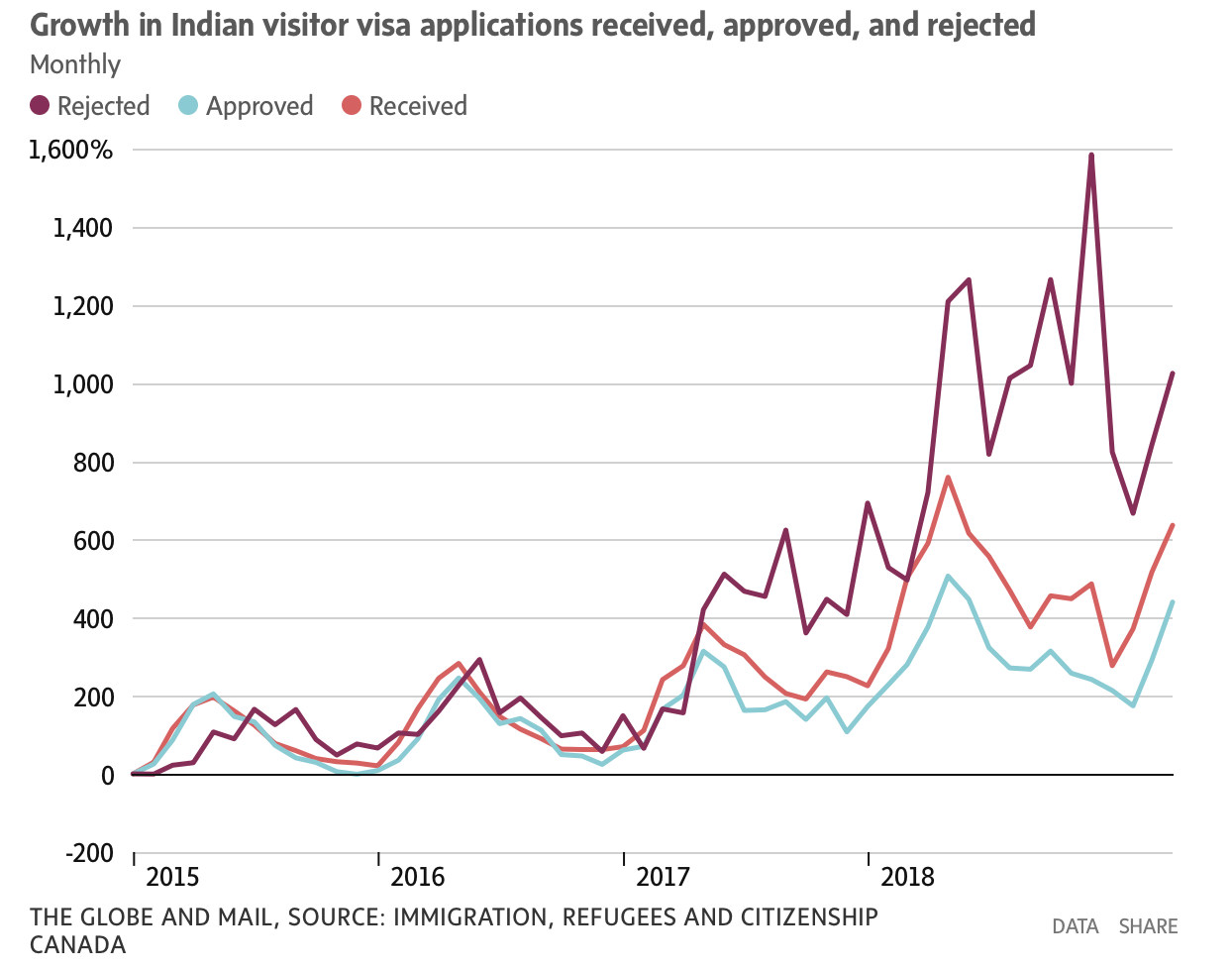
Refusals on visitor applications from India due to fraud and misrepresentation are soaring, which Ottawa and immigration experts say is in part due to unscrupulous “ghost consultants.”

While the number of Indian visitor visa applications has increased significantly, refusals are growing at an even faster clip. Data provided by the federal government show that the percentage of refusals due to an applicant misrepresenting themselves – through fraudulent submissions, for instance – has nearly tripled. In 2017, 0.9 per cent of all Indian visitor visa rejections were for misrepresentation; from January to May this year, the number jumped to 2.5 per cent.

Immigration, Refugees and Citizenship Canada (IRCC) refused 1,477 applications due to misrepresentation in 2017. Between January and May of this year, that number had already reached 3,709. The department could see close to a 500-per-cent increase in fraud refusals by year’s end compared with 2017 if current trends hold.

In response to the increasing number of refusals for Indian applications, in June the federal government rolled out an information campaign targeting Indians applying for visas. The effort includes resources on identifying and reporting fraud throughout the process, including by ghost consultants – unscrupulous, unlicensed immigration consultants.

“We anticipate that this campaign will help address some of the spinoff effects of circulating misinformation, such as high refusal rates and abuse of the asylum system,” Mathieu Genest, a spokesperson for Immigration Minister Ahmed Hussen, said in an e-mailed statement. Mr. Genest said the problem of ghost consultants is “particularly acute” in India.

Bank statements, income taxes, medical files, education histories, funeral home letters and even letters of support from members of Parliament are some of the types of fraudulent documents received by IRCC in recent years. Aside from fraud, Mr. Genest said the government is also seeing an increase in repeat applications from Indians previously denied and an overreliance on paper applications, which take longer to process, but noted that the increase in refusals should not affect legitimate applicants.

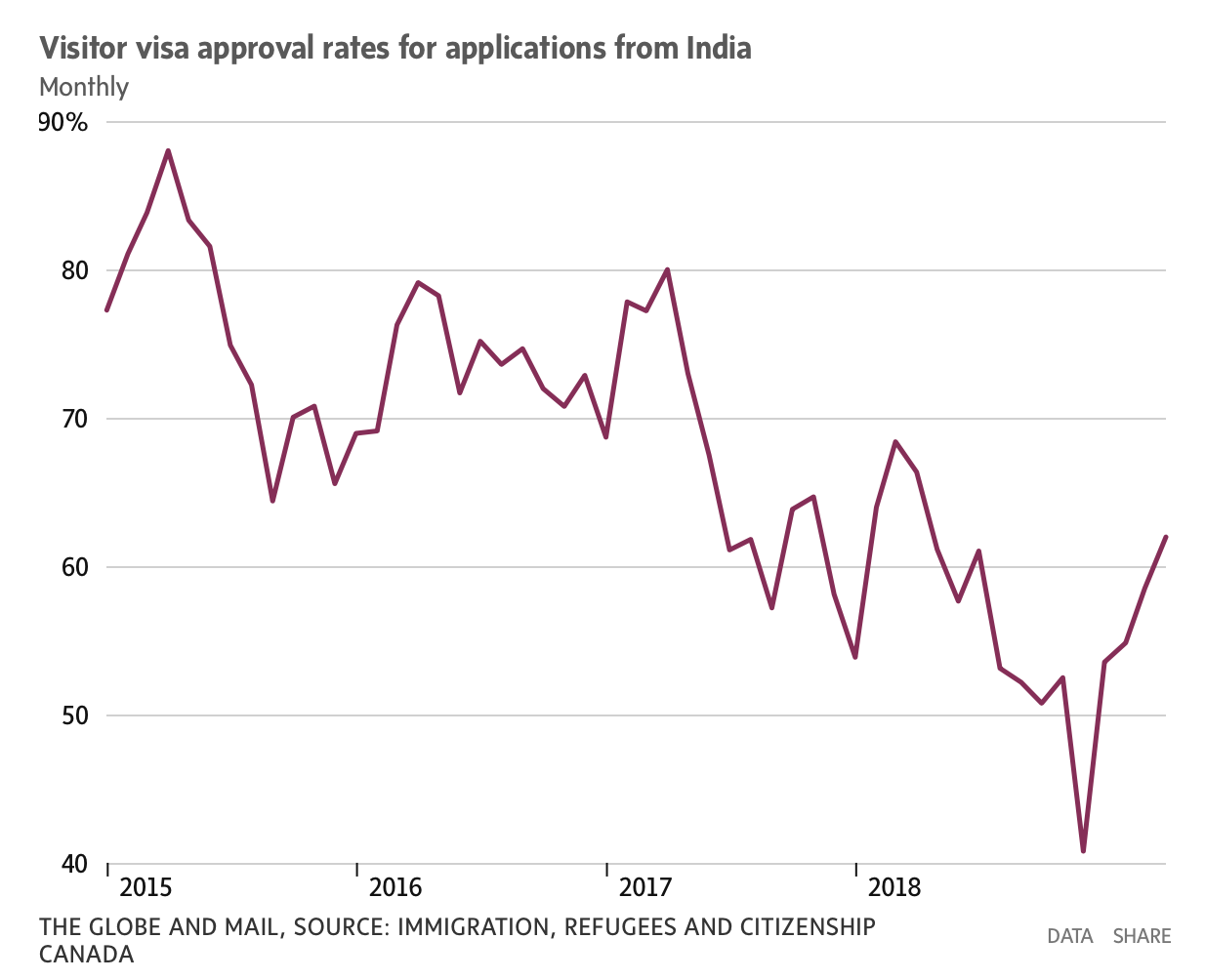
Partly owing to the increase in misrepresentation refusals, approval rates on Indian visitor visa applications have plummeted.

In April, 2015, 88 per cent of visa applications from India were approved – Ottawa received 27,600 applications that month. But by December of 2018, Canadian immigration authorities were receiving more than 58,000 applications each month and approval rates had dropped to 40.8 per cent.

The drop in India’s approval rates comes as the federal government has worked to streamline the visa process. According to documents obtained by The Globe and Mail through access-to-information requests, IRCC is using artificial-intelligence tools to review temporary resident visa applications from China and India as they come in.

Online applications predicted by AI models to be low-risk are sent to an immigration officer for review, simplifying the process. According to IRCC, 30 per cent to 40 per cent of China’s visitor visa applications are are now handled through this streamlined process; however, only 3 per cent to 5 per cent of Indian applications meet that low-risk threshold.

As of April, India was the top source of visitor visa applications to Canada. The country recently surpassed China, where applications have declined in recent months, which some attribute to the continuing diplomatic dispute between Ottawa and Beijing.

According to data from IRCC, Indians submitted 73,457 temporary resident visa applications that month, accounting for nearly a third of the worldwide total. China came in second place, with 46,646 applications.

Visitor visas are required for anyone from a non-visa-exempt country and looking to visit, work or study in Canada. As such, they’re often the first step in the immigration process.

Prashant Ajmera, an immigration lawyer in India who has an office in Montreal, was surprised to hear that the approval rate for visas from India had decreased so dramatically. He said the Canadian government has been touting the growing number of visitors from India, drawing attention to the fact that Canada welcomed nearly 300,000 visitors from that country last year. (There is no cap on how many visitor visas Canada issues each year.)

However, Mr. Ajmera said the Canadian government’s information campaign in India will not solve the problem, as applicants already know about visa fraud and immigration scams.

“They are aware of it but they’re taking calculated risks, most of them,” Mr. Ajmera said. “It’s a very common story.”

He said it would be a better use of Canada’s time to work with other like-minded governments, such as the United States, Britain and Australia, to encourage the Indian government to better regulate its immigration consultants in an effort to stem visa fraud.

One Canadian immigration lawyer thinks that the immigration consultant industry itself may be to blame. Ravi Jain, a Toronto-based immigration lawyer at Green and Spiegel LLP, said that lawyers are taking on clients who first worked with an Indian immigration consultant, only to find that the client’s visitor visa application was riddled with mistakes.

In some cases, unlicensed immigration consultants impersonate applicants throughout the process. “Often times, those people will even make up e-mail addresses. I’m not kidding, they do this,” he said.

Unscrupulous immigration consultants are not the only possible explanation for the decline in India’s approval rates.

Vancouver-based immigration lawyer Richard Kurland said he believes visa fraud, particularly relating to study permits, is the main reason for the decline in the approval rate of temporary resident visas from India. He said study permits are the “number one threat to Canada’s immigration system today” because there is no cap on the number of permits the government can issue, allowing foreign immigration consultants to take advantage of the program.

A recent Globe and Mail investigation revealed that private colleges in Canada are being accused of paying overseas agents to persuade international students that paying tens of thousands of dollars in tuition to study in Canada is the easiest way to get into the country and work toward becoming a permanent resident.

Statistics of anti-Semitism in US are misleading

Good serious comparison of the various datasets available. The observations regarding the limitations of ADL statistics also apply to B’nai Brith as to those on FBI data also apply to StatsCan complication of police reported hate crimes.

With respect to the National Crime Victimization Survey, the closest Canadian equivalent is the currently underway General Social Survey – Canadians’ Safety (GSS) which includes self-reported victimization, to be released winter 2020-21:

On Sunday, a Jewish man standing outside a synagogue was shot in the leg in what police are investigating as a possible hate crime. It was only the latest in a string of anti-Semitic attacks this year.

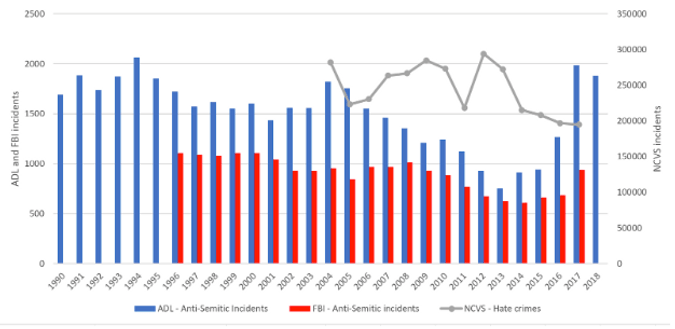
These attacks have brought in their wake headlines declaring “a spike in hate crimes” and “increased anti-Semitic attacks all across this country,” based on episodes like Sunday’s as well as data. Earlier this year, the FBI reported the largest increase in hate crimes since 2001, and the Anti-Defamation League reported that anti-semitic incidents rose by 57% in 2017.

As a result, a consensus has developed around the idea that hate crime and anti-Semitism are rising, and that Jews are no longer safe in the U.S. Leaders across the political divide agree.

But I’ve found myself skeptical of these claims of rising hate. Partly, this is because of a rather personal reason: Since moving to the US over a decade ago, I have never personally experienced hate or a hate crime.

But I was skeptical for a professional reason too. As a mathematician by training, I spent my PhD years working with messy crime data. And the truth is, it cannot be trusted at face value.

I couldn’t help but wonder if the data on hate crimes, especially those pertaining to the Jewish community, might have similar problems.

And it does. Big time.

To dig deeper, I looked at all the available data on hate crimes, which included incidents of hate by year, surveys, and reports. I sought out datasets, what are in their ideal form collected methodically year after year by faceless government statisticians. I also downloaded spreadsheets and mined the numbers myself.

What I found will probably surprise you: We have a real anti-Semitism problem in this country. But it’s not getting worse.

It’s important to keep in mind that hate crimes are not a leading cause of injury or death; in the same year 37,000 people were killed on the roads, and 2.3 million injured or disabled.

But you can’t compare hate crimes to road accidents; with a hate crime, like with terrorism, the victim is targeted because of their group identity, and the entire group feels threatened. Hate crimes select symbolic targets, such as community buildings, whose significance far exceeds their property value.

And research indicates that being in a targeted group is not just discomforting but can have a tangible effect how people behave. We know from Europe that attacks on Jews can trigger a wave of immigration to Israel, and it should not be assumed that the same cannot happen to American Jews.

Even more disturbingly, research on fertility data from 170 countries found that during waves of terrorism there is a decline in births.

All of this made me even more anxious to find out if there was actually a wave of anti-Semitism sweeping through America. So I sought out the two most frequently-cited sources of hate crime data: reports from the ADL and the FBI.

Let’s start with baselines. According to the FBI’s most recent data, 2017 saw 7,175 hate crimes nationwide, including 15 hate murders. Anti-Jewish hate crime incidents represented 13% of all incidents – 923 – coming in second only to Anti-Black hate crimes, which numbered 2,013 incidents.

There were also more anti-Semitic incidents than “anti-gay” crimes, for example. Most importantly for our purposes, because Jews make up just 1-2%of the US population, these numbers mean that the Jewish community is targeted by hate crimes disproportionately to its numbers by a factor of ten.

The ADL has been tabulating data on anti-Semitic hate crime for an impressive 40 years, and it receives data both from the police and the public. The ADL has built out a modern data center and has interactive online visualizations.

In its most recent audit, the ADL reported that 2018 had the third-highest number of incidents of the past four decades, with 1,879 incidents. The 2018 total is 48% higher than the number of incidents in 2016, and 99% higher than in 2015. Both 2017 and 2018 had far more incidents than typical for the previous eight years. This is, indeed, alarming.

However, these numbers should be taken with a mild dose of the proverbial salt. The problem with hate data is that only 20% of hate crimes are reported to the police, and, one suspects, even fewer to the ADL. So the statistics give just the tip of an iceberg; the majority of hate times are not included in this count.

This makes them somewhat unreliable. To rely on 20% of the data to determine if there is a wave of anti-Semitic hate crimes would be like looking at the top shelf of your fridge, and finding it overflowing, deciding that you need to buy a larger fridge (I would suggest looking at the other four shelves first).

And you can’t just compare the 20% of reported crimes each year to the 20% from last for the simple fact that the reporting rate is not a constant 20% of all crimes. Reporting goes up and down along with public concern. An increase in concern about hate crimes can increase the number of reports by the public, and even the number of police investigations, making more of the “iceberg” (or fridge) visible and inflating the numbers.

To put it plainly, if many people started to believe, fairly or not, that we are in the midst of a wave of hate, they would also start to report more hate crimes, making the data inconsistent with the past.

This is not to say that the jump in anti-Semitic hate crimes reported by sources like the ADL is a statistical mirage. But the reality is probably different from what the numbers suggest.

Independently of the ADL, the FBI has been reporting hate crime data since the 1990s through its Hate Crime database. It has developed impressive guidelinesto judge if a crime incident is indeed a hate crime, and its reports are available online. Surely, here we can expect to finally find deep databases processed by standard and reliable statistical methods!

But alas, the FBI’s numbers also need to be taken with a little grain of kosher salt. The problem is that crimes are generally reported to the local police department and not to the FBI directly, so the FBI’s data is only as good as the reports it receives.

In some states, less than 10% of the police agencies bother to report to the FBI at all, and likely only report the more severe crimes. As a credit to the system, the FBI provides consistent data that goes back to the 1990s, and thus is well-suited to recording if there are any national trends.

But charting the FBI data from 1996 to 2017 suggests that we are far from having achieved new heights of anti-Semitism. Rather, anti-Semitic incidents peaked in 1999 at 1,109 per year, then declined from 2008 to 2014, and have been trending up since then, reaching 976 in 2017.

As with the ADL numbers, the data quality is not great, thanks to under-reporting. But even taking that into account, we appear to still be well below the numbers of the 1990s.

Fortunately, there is another government crime tracking program that has been all but forgotten by the press: the National Crime Victimization Survey. Unlike the ADL and the FBI, who collect reports, the NCVS goes out to the communities and interviews some 160,000 people every year, asking them if they were victims of various crimes.

Because the NCVS uses a representative sample, it can reliably estimate the number of crimes in the entire country, including hate crimes. If there is a wave of hate in America, the NCVS would detect it in its survey.

In its most recent report, NCVS estimated that 204,000 hate crimes occur in the US annually, of which just 15,000 are confirmed by the police.

The NCVS also shows that hate crime rates have been steady every year since 2015, and were probably higher ten years ago.

There is no data specifically on anti-Semitism in NCVS, but if we assume per the FBI’s estimate that about 13% of hate crimes are anti-Semitic, then there are a staggering 26,000 anti-Semitic crimes every year in the US — 30 times more than reported by the FBI and 14 times more than the ADL.

What we can learn from these statistics is both good and bad. For all the problems of the last few years, there is no reason to fear a wave of hate, because the wave, if it exists, is a small one.

Today’s Jewish America has probably the safest existence of any Jewish community in history. In this generation, a Jew is much more likely to suffer a car accident than a hate crime.

But to believe naively in the American utopia is to ignore the truth: Hate is alive and well in America, and Jews are often the target of it.

Source: Statistics of anti-Semitism in US are misleading

Canada’s Immigration Minister on Tackling Rise of ‘Anti-immigrant’ Rhetoric

Newsweek profile:

As the U.S. government continues a hardline crackdown on immigration across the country and along the southern border, its northern neighbors have been keeping a watchful eye, wary of how a rise in anti-immigrant rhetoric south of the border might affect the daily discourse in Canada.

In an interview with Newsweek, Ahmed Hussen, Canada’s Minister of Immigration, Refugees and Citizenship, said that while Canada is lucky to have a population that “generally supports immigration,” it is not immune to the “anti-immigrant narratives” being espoused in the U.S. and around the world.

“I think we’re very lucky in Canada, by and large, to have a population that generally supports immigration, understands the positive role that immigration has had on our country and understands the positive contributions of immigrants,” Hussen said on Wednesday, following a roundtable discussion organized by the Concordia Forum at Canada House in London.

“However,” he said, “we cannot take that for granted and we are being bombarded with a lot of anti-immigrant narratives right now.”

With Canada’s looming federal election set to take in October, Prime Minister Justin Trudeau’s government has sought to resolidify its commitment to welcoming migrants, asylum seekers and refugees into the country. Earlier this year, the Trudeau administration announced plans to attract one million immigrants to Canada over three years.

Hussen, who came to Canada as a refugee himself at the age of 16 after he and his family were forced to flee Mogadishu in Somalia, said he was well-aware of the way anti-immigration rhetoric in a country like the U.S. can shape the discourse around the world.

To counter that, the immigration minister said, the Canadian government has made a conscious effort to “shore up” support for pro-immigration initiatives “by sharing success stories.”

“Not just success stories of the newcomers themselves,” Hussen said, “but also of Canadians who have been transformed by the experience.”

Pointing to Canada’s Private Sponsorship of Refugees Program, now in its 40th year, as one key example, Hussen noted that “over the last 40 years, over two million Canadians have personally sponsored a refugee.”

“Now, that really does something,” he said. “It transforms people… Because we find that not only are those two million Canadians who are signed on to sponsor transformed by that experience, but their networks also get involved with embracing that refugee family.”

“So, for a big substantial percentage of the Canadian population, refugees and immigrants are not an abstract issue. It’s a member of their new family and so, there’s a resilience there,” he said.

Further, he said, that “resilience” is something that more countries have been working towards building, despite the rhetoric coming out of the U.S. Britain, for example, has not only joined Canada in promoting the private sponsorship model, but also in offering a “community sponsorship program.”

“Now, the UK and Canada are jointly promoting this to other countries, so there’s now about 12 countries that have either adopted…or are about to launch…a program in places like Germany, or places you wouldn’t expect, like Belgium,” Hussen said.

When it comes to countering anti-immigration sentiments, the immigration minister said: “I think that’s the way you do it, because that helps to increase the places [for refugees], but it also helps to change perceptions.”

Another way that the Canadian government is seeking to “change perceptions” around refugees, Hussen said, is through a new pilot scheme that allows refugees to enter the country through economic immigration programs.

Run by Talent Beyond Boundaries, a non-government organization that has partnered with the UN Refugee Agency to help match refugees with employers in Canada and Australia, Hussen said the program is aimed at giving refugees more agency.

There are several competitive economic immigration programs in Canada, he said, and “for those spots, people are selected based on their human capital, skills, education, work experience and so on.”

“It doesn’t matter who you are, where you’re from, your religion, or your background, but refugees, right now, are not eligible for those programs because they’re displaced,” the immigration minister said.

“What I’m saying is that’s not fair to many refugees who have skills, so why don’t we allow them to compete here?” he said. “You know, not just giving them a spot the way we do with the refugee program, because that is not based on skills, it’s based on vulnerability… We’re saying for those who can contribute, and a lot of them can, why not allow them to compete with everyone else here?”

Already, Hussen said, a number of refugees have started working in the country under the program, including a Syrian refugee who was living in Lebanon before being recruited to work for a technology firm in Kitchener-Waterloo earlier this year.

“He used this program to come through the economic skilled immigration competition and he came through the highest federal skilled worker program,” the immigration minister said. “He has the human capital… He just happens to be a refugee.”

Despite the positive influence that Hussen is confident initiatives like the one run by Talent Beyond Boundaries will have on both the economy and perceptions on immigration in Canada, recent public opinion polls have suggested a hardening of Canadian views towards immigrants and refugees.

A recent poll commissioned by the Canadian Broadcasting Corporation (CBC) and conducted by Public Square Research and Maru/Blue found that of the 4,500 adults participating in the online survey, 57 percent felt that Canada should not be accepting more refugees.

Of those surveyed, 64 percent also said they believed illegal immigration is becoming a serious problem in Canada, while 56 percent said they felt that accepting too many immigrants into the country will change the nation. Meanwhile, 24 percent said they felt too many immigrants are visible minorities.

Despite signs of anti-immigration sentiments growing in Canada, Hussen said his government was determined to stay the course in keeping its commitments to migrants, asylum seekers and refugees.

Source: Canada’s Immigration Minister on Tackling Rise of ‘Anti-immigrant’ Rhetoric