Always a challenge with AI, ensuring that the algorithms do not replicate or create bias:
Immigrant rights campaigners have begun a ground-breaking legal case to establish how a Home Office algorithm that filters UK visa applications actually works.
The challenge is the first court bid to expose how an artificial intelligence program affects immigration policy decisions over who is allowed to enter the country.
Foxglove, a new advocacy group promoting justice in the new technology sector, is supporting the case brought by the Joint Council for the Welfare of Immigrants (JCWI) to legally force the Home Office to explain on what basis the algorithm “streams” visa applicants.
The two groups both said they feared the AI “streaming tool” created three channels for applicants including a “fast lane” that would lead to “speedy boarding for white people”.
The Home Office has insisted that the algorithm is used only to allocate applications and does not ultimately rule on them. The final decision remains in the hands of human caseworkers and not machines, it said.
A spokesperson for the Home Office said: “We have always used processes that enable UK Visas and Immigration to allocate cases in an efficient way.
“The streaming tool is only used to allocate applications, not to decide them. It uses data to indicate whether an application might require more or less scrutiny and it complies fully with the relevant legislation under the Equalities Act 2010.”
Cori Crider, a director at Foxglove, rejected the Home Office’s defence of the AI system.
“The Home Office insists its ‘visa streaming’ algorithm has no racial bias, but that claim is pretty threadbare. We’re told the system uses nationality to ‘stream’ applicants green, yellow and red – and it’s easy to guess who ends up in the green queue and who gets pushed to the back of the bus in red. If your algorithm singles out people for a digital pat-down and offers speedy boarding to white people, well, that’s unlawful.”
In its pre-action legal letter this month to the home secretary, Priti Patel, the Joint Council for the Welfare of Immigrants argues that even the streaming process will affect the final decision on visas.
The case is being backed by a gofundme.com page titled “Deported by algorithm”.
Its letter to the home secretary states: “An individual visa applicant allocated by the streaming tool to the ‘Red’ category because of their nationality might still be granted a visa. However, their prospects of a successful application are much lower than the prospect of an otherwise equivalent individual with a different nationality allocated to the ‘Green’ category. To similar effect, the same ‘Red’ application is likely to take much longer than the ‘Green’ one, again involving less favourable treatment of the applicant because of their nationality.”
Among the information the JCWI seeks from the Home Office is all “policy and guidance documents that deal with the process of streaming visa applications and the use of the streaming tool”.
It is also demanding all the technical details that drive the streaming tool be revealed, along with further information such as case-working targets into each of the three categories, and if there have been any complaints about the deployment of the algorithm.
The JCWI argues that the use of the streaming tool is a more modern version of a visa entry system ruled unlawful by the House of Lords in 2005. It concerned Roma applicants who were said to have been treated with more suspicion and subjected to more intense and intrusive questioning than non-Roma applicants. The Lords concluded that the “stereotyping of Roma as being less likely to be genuine visitors” to the UK was unlawful.
The Home Office has emphasised that the new system is fully compliant with the Equalities Act 2010.
It added that out of more than 3.3m visa applications to the UK by the end of June this year, 2.9 million people were given entry into Britain.
Look forward to seeing the questions and, in a few years, any government or other evaluations on the effects:
La décision, publiée mercredi dans la Gazette officielle, indique que les ressortissants étrangers et les membres de leur famille qui souhaitent s’établir au Québec (à l’exception d’un enfant à charge de moins de 18 ans ou d’une personne ayant une condition médicale) devront obtenir une « attestation d’apprentissage des valeurs démocratiques et des valeurs québécoises exprimées par la Charte des droits et libertés de la personne ». Le score minimum pour réussir l’évaluation est fixé à 75 %.
En vertu d’un accord entre Québec et Ottawa, le gouvernement du Québec est responsable de la sélection des immigrants économiques qui s’établissent sur son territoire. Pour immigrer au Québec en vertu du programme régulier des travailleurs qualifiés, un ressortissant étranger doit soumettre son intérêt au ministère de l’Immigration du Québec, qui évalue les candidatures selon une liste de critères socio-économiques. Un travailleur qualifié dont le profil correspond aux besoins du Québec est ensuite invité à présenter une demande formelle pour obtenir un certificat de sélection du Québec (CSQ), un document essentiel pour obtenir d’Ottawa le statut de résident permanent afin d’immigrer au Québec.
Dès janvier, Québec exigera désormais qu’un travailleur qualifié qui souhaite immigrer au Québec réussisse également son test des valeurs dans les 60 jours suivant sa demande de CSQ.
Qu’arrive-t-il en cas d’échec ?
Un ressortissant étranger qui ne réussirait pas son test des valeurs une fois qu’il a été invité par Québec à présenter sa demande pour obtenir un CSQ pourrait reprendre l’évaluation une première fois. Dans le cas d’un deuxième échec, il pourrait refaire l’examen une deuxième fois ou suivre, au Québec, un cours administré par le ministère de l’Immigration.
Or, si le ressortissant étranger choisit toutefois de tenter sa chance en passant le test une troisième fois, sans suivre le cours, celui-ci renoncerait à son droit à suivre le cours, explique-t-on dans la Gazette officielle.
L’imposition d’un test des valeurs aux immigrants est une promesse de longue date du gouvernement Legault. En campagne électorale, François Legault promettait toutefois d’imposer ce test aux immigrants une fois ceux-ci arrivés sur le territoire québécois. Ceux qui auraient échoué l’examen auraient été expulsés du territoire canadien. Or, Québec ne dispose pas de ce pouvoir et Ottawa a fermé la porte à un tel scénario.
La Gazette officielle ne présente pas mercredi des exemples de questions qui seront demandées aux ressortissants étrangers. Par le passé, le ministre de l’Immigration, Simon Jolin-Barrette, a affirmé que celles-ci seraient fondées sur les valeurs exprimées par la Charte québécoise des droits et libertés de la personne.
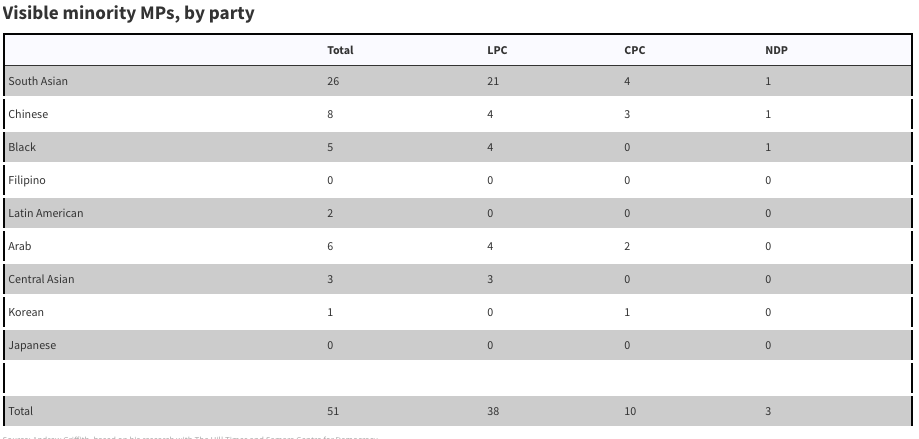
The 43rd Parliament will include 51 visible minority MPs, up from 47 after the 2015 election, while the number of Indigenous MPs will remain the same, at 10 out of 338, despite a record number running.
Parties have moved in the right direction when it comes to recruiting and selecting diverse political candidates, but more has to be done between elections to make federal politics accessible, say recent candidates and newly elected MPs.
“It’s not going to cut it,” if parties only focus on bringing in politicians that better reflect Canada’s makeup during pre-election candidate searches, said Liberal MP-elect Han Dong for Don Valley North, Ont.
“Between elections, all parties have to make a deliberate effort to reach out to communities to get them involved in policy discussions,” as a starting point, said Mr. Dong, a former Ontario MPP. “It is so important to generate that interest, to give a sense of involvement in decision-making. That’s how you’re going to get more people step forward and going for public office.”
For Andrea Clarke, who ran unsuccessfully as the NDP’s candidate in Outremont, Que., this year, the question of class and income disparity also makes running for Parliament less accessible to some, often racialized, Canadians.
How to make sure electoral politics are accessible and representative of the population isn’t something that should be discussed for just a few months each campaign season, she said.
“It’s something we need to intentionally build into how we hold our elections, and unfortunately folks who are the farthest have to fight the hardest to make the case that this is what we should be doing,” she said, adding that a lack of representative politics means losing out on having “different voices at the table, advocating for their communities, and their lived experience.”
Source: Andrew Griffith, from dataset created by The Hill Times, The Samara Centre for Democracy, and research partners.
The next Parliament will see a slight increase in visible minority representation in the House, with 51 MPs compared to 47 in 2017. The 43rd Parliament has 26 South Asian MPs, eight Chinese, five Black, six Arab, three West Asian, two Latin American, and one Korean, according to data pulled by researcher Andrew Griffith, based on a candidate database he created with The Hill Times, The Samara Centre for Democracy, and researcher Jerome Black, drawing from candidate biographies, media articles, social media, and photo analysis. The data may be missing some MPs, as it’s gleaned from publicly available information, and largely based on self-reported details.
Improving representation means striking a balance between “having candidates that run that reflect the composition nationally and yet making sure nominations are grassroots,” said Conservative MP-elect Marc Dalton, who is Métis and among the 10 MPs who identify as Indigenous in this Parliament.
Though a record number of 65 Indigenous candidates ran this election, the number who made it into the House didn’t budge from the 10 elected in 2015.
That amounts to three per cent of MPs, while 4.9 per cent of Canada’s population identified as Indigenous in the 2016 census. The party make-up has slightly changed, with six MPs in the Liberal caucus, two new MPs for the NDP, one Conservative, and Liberal turned Independent Jody Wilson-Raybould (Vancouver Granville, B.C.) remaining in the House.
The number of visible minority MPs is out also of line with the Canadian population, according to the 2016 census, which puts the visible minority population at 22.9 per cent—compared to 15 per cent of MPs in the 43rd Parliament. The Liberals lead with 38 MPs, followed by 10 in the Conservative Party, and three with the NDP. None of the Green Party’s three MPs or the Bloc Québécois’ 32 MPs are visible minorities.
If that’s the benchmark, Canada has “a serious underrepresentation problem,” said Mr. Griffith, a researcher at the Canadian Global Affairs Institute, who uses a narrower comparison, looking instead at the level of Canadian citizens, rather than residents, who are visible minorities—17.2 per cent.
In that respect, he said parties are doing “reasonably well” especially compared to other political systems.
There were also small gains in the number of visible minority candidates who ran overall this election, from 12.9 per cent of candidates running for the main parties in 2015, to 15.7 per cent, including the new People’s Party of Canada, which had more visible minority candidates than the Green Party.
As with women, Samara researcher Paul Thomas said there’s a similar problem with visible minorities being less likely to run in seats where parties have a strong chance of winning. Gains in diversity are more likely made through seats that open up each election when incumbents leave, said Mr. Thomas, but his analysis found that the most competitive seats weren’t as open to diverse candidates.
This was especially true for the Conservative Party, which ran three visible minority candidates out of 42 competitive ridings—those with no incumbent running for re-election, or which were lost by a margin of five per cent or less in 2015.
Mr. Thomas also noted the Bloc’s “very poor performance” on this front. Despite its caucus tripling in size, only four of its 78 candidates were visible minorities, none of whom were ultimately elected.
When breaking down the results by ethnic background, a better picture emerges, noted Mr. Griffith, one that shows clear gaps in federal representation by community. For example, Filipino-Canadians are the fourth-largest visible minority group, but parties fielded only four candidates with that background overall, and none were elected. At 1.5 per cent of the House, Black representation is also low, he said, with five elected of the 49 candidates nominated across the major parties, despite making up 3.5 per cent of Canada’s population.
Mr. Dong is one among a record eight Chinese-Canadians elected to Parliament this year, but he noted it’s still half what it should be to reflect the Chinese-Canadian population, which makes up 4.6 per cent of the country.
“I think all parties, when it comes to candidate searches, are stepping towards the right direction,” said Mr. Dong. “In the beginning, it’s always hard, but when you start generating interest” and bringing candidate numbers into the double digits, as was the case with his community this election, he said it means there’s less of a mystery to political candidacy, and that more will come. Based on Mr. Griffith’s assessment, there were 38 Chinese-Canadian candidates in the running this past election.
Another reminder of how the 2020 International Metropolis conference in Beijing will be presented as legitimization of the regime’s repressive policies towards minorities (e.g., “re-education camps” for Uighurs, Tibet) and general human rights abuses.
How DND and others attending didn’t think or consider how this would be presented hard to understand.
If you haven’t already, please consider signing the petition a number of us initiated against the holding of the conference in Beijing: http://chng.it/kfzPmtVk
Beijing’s embassy in Canada says the fact the Canadian military just sent a “big delegation” to a sporting competition in China is more evidence the Asian power is not losing friends.
Canada-China relations are in a deep freeze after Beijing locked up two Canadians in apparent retaliation for Ottawa’s detention of a Chinese high-tech executive on an extradition request from the United States. China banned Canadian pork and beef and severely curbed purchases of Canadian canola seed and soybeans.
China has also come under heavy criticism for how the Beijing-backed administration in Hong Kong is handling unprecedented protests there, and in the mounting scrutiny of the internment of an estimated one million Uyghur Muslims in Xinjiang Province.
But the Chinese government, through its representatives in Canada, wants Canadians to know Beijing is not isolated or losing support.
It posted a statement on the website of its embassy in Canada to criticize a column published in The Globe and Mail last week, titled How China Loses Friends and Alienates People. The guest column by a U.S. academic discussed the backlash from China after Daryl Morey, general manager of the NBA’s Houston Rockets, tweeted remarks in support of the protests in Hong Kong and said bullying is self-defeating behaviour that will cost Beijing support.
The embassy said the list of China’s friends is growing. “More and more countries commend China’s foreign policy and development path. China’s friends are all over the world. This is a fact that can neither be obliterated nor changed by some people’s groundless accusations,” the Chinese embassy said.
“In the future, we will have more and more friends in various fields.”
It highlighted the presence of Canada and other nations in the World Military Games, held in China from Oct. 18 to 27.
International participation in the games, which attracted “9,308 military athletes from 109 countries, including a big delegation from Canada, speaks volumes in this regard,” the embassy said.
Ottawa didn’t issue any news release before or during the games to draw attention to Canada’s participation.
Daniel Le Bouthillier, head of media relations at the Department of National Defence, said Canada sent 114 athletes, 57 coaches and support staff.
Guy Saint-Jacques, a former Canadian ambassador to China, said he’s surprised Canada sent soldiers.
He said Canada must rethink how it engages with Beijing. “Now that we have seen the dark side of China, we have to have a much more realistic approach to China. Yes, we have to engage them … but at the same time we have to take into account they can be very brutal if we do something they don’t like.”
Mr. Saint-Jacques said China’s pressure on other countries and companies to avoid criticism of its conduct is growing: “Their list of red lines is getting longer all the time. It used to be Falun Gong and Tibet and Taiwan. Now it’s Hong Kong and Xinjiang too.”
The Defence Department did not directly answer when asked why Canada sent athletes to China even as Foreign Affairs Minister Chrystia Freeland accuses Beijing of arbitrarily detaining former diplomat Michael Kovrig and entrepreneur Michael Spavor.
The department said Canada “remains deeply concerned by China’s actions, including the arbitrary detention,” added that it hoped the games foster friendship.
“The spirit of the World Military Games is to create a space for friendly competition among armed forces,” Mr. Le Bouthillier said.
China expert Charles Burton, who served in the Canadian embassy in Beijing, said National Defence should not have participated in the military sports games.
“At this time, there shouldn’t be any celebratory activities going on between Canada and China, and I would suggest a major sports competition is about celebrating friendship and therefore I think it was a mistake for our military to go,” he said.
Mr. Burton said Canada’s participation “must be quite offensive” to the families of Mr. Kovrig and Mr. Spavor. The two were arrested and later charged with stealing state secrets after Canada detained senior Huawei Technologies Co. Ltd. executive Meng Wanzhou last December. They have been in prison for almost a year.
Canada’s new ambassador to China, Dominic Barton, undertook consular visits with Mr. Spavor and Mr. Kovrig over the last week.
Mr. Burton, a senior fellow at Centre for Advancing Canada’s Interests Abroad, said he hopes the Canadian government will not send athletes to the Beijing Winter Olympic Games in February, 2022, because that would be signalling “that relations are normal and passively accepting what China is doing.”
Conservative MP Peter Kent said it was inappropriate to send athletes to Beijing.
“It is unacceptable. Basically, the government should be curtailing completely collegial events at a time when Canadians are held hostage and where trade embargoes have been improperly placed on contracted Canadian sectors,” he said.
Mr. Kent also said Canada should also consider boycotting the Olympics.
The far-right Alternative for Germany party on Sunday celebrated a strong showing in the former Communist East, more than doubling its support in a state election held two weeks after an attack on a synagogue that some tied to the party’s use of hateful language.
The party won 23.5 percent of the vote in Thuringia, according to preliminary returns, up from 10.6 percent in 2014. That left it in second place, behind the Left Party but ahead of Chancellor Angela Merkel’s conservatives.
The party, known by its German initials AfD, has no hope of governing, since all the other parties have ruled out cooperating with it. But its strong showing is likely to reverberate in other ways. The election outcome could further strengthen the power of Björn Höcke, the party’s leader in Thuringia and its most notorious figure.
It has been described by people both in China and outside as the best propaganda film that country has ever produced and it may be the first Chinese-produced film to earn more than US$1 billion.
So it’s not surprising that parents and others are questioning the appropriateness of the trailers for My People, My Country being used as teaching material in Grade 10, 11 and 12 Mandarin language classes at a high school in Richmond.
The film is a 254-minute, patriotic review of seven historic high points since Mao Zedong and the Communist Party came to power 70 years ago.
Co-produced by a state-owned company, there is no mention of the Cultural Revolution or the 1989 Tiananmen Square crackdown. The return of Hong Kong to Chinese control is portrayed as a triumph.
The South China Morning Post’s review described the film as a “jingoistic anthology,” while the Chinese news agency Xinhua said the film’s aim was to “awaken shared memories of Chinese people around the world.”
“After 70 years, our culture and propaganda departments finally figured out how to combine propaganda with art,” Yan Feng, a Chinese literature professor at Shanghai’s Fudan University wrote in a Weibo post quoted by the New York Times.
Even without English translation, the YouTube trailer is nothing like what you might imagine propaganda looks like — aside perhaps from the Hollywood patriot movies like Top Gun.
That’s what makes it so powerful.
There are seven trailers in all for the film and four were shown to Grades 10, 11 and 12, Mandarin-language classes at Steveston-London Secondary School.
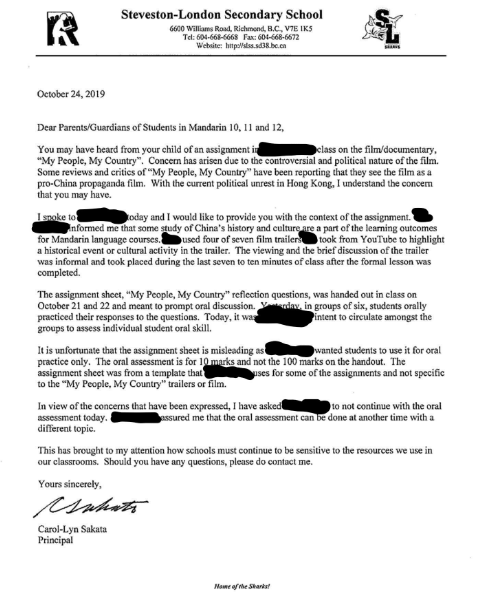
After viewing them, students had a brief informal chat about what they saw before being handed written questions as a prompt for another discussion the following day, according to an Oct. 24 letter that principal Carol-Lyn Sakata sent to parents.
A copy of the principal’s letter with the teacher’s name redacted that was posted to the Canada Hong Konger Facebook page.
That discussion was cancelled because of parents’ concerns about using Communist Party propaganda in the school.
“We believe the teacher intended to engage students in an informal and open discussion to ‘analyze personal, shared, and others’ experiences, perspectives, and world views through a cultural lens,’ as contemplated in the provincial curriculum,” Richmond School District spokesman Dave Sadler wrote in an emailed response.”
But is propaganda culture? Or is it simply politics?
There’s a plausible argument to be made that My People, My Country is a cultural and even historic phenomenon. Certainly, it’s being widely shown and widely seen.
Released on Oct. 1 to coincide with 70th anniversary celebrations, it had 135,000 daily screenings on the first weekend, earning US$102 million, according to Variety. Online reviewers in China scored it as high as 9.7 out of 10, but as Variety diplomatically pointed out “in the past there has been doubt about the reliability of such scores.” Still, Variety suggests, it may be the first Chinese film to earn US$1 billion.
But if the teacher’s intent was to talk about it as cultural phenomenon, that’s not evident from the principal’s letter or from the assignment itself.
Under the Chinese caption “I love my motherland,” students were given “reflection questions.” Among them were: How did this movie make you feel? What words or phrases made you feel good? What was your favourite part? What four adjectives would you use to describe the movie? Does it remind you of your life?
Further down, there were questions about what they thought the movie’s message is and why it was produced.
Sakata noted the “controversial and political nature of the film” in her letter to parents. “With the current political unrest in Hong Kong, I understand the concern that you may have.”
There’s no doubt that that may be what has made parents and students more acutely aware of what is being taught in Mandarin classes.
But to suggest that is the only reason for concern is a disservice to both students and parents who are raising important questions far beyond a single teacher, some trailers and three classrooms.
What is being taught under the guise of Mandarin language learning in British Columbia’s public and private schools? How are teaching materials chosen? Who chooses them? Are they being supplied at no cost by the Chinese government?
While the provincial government sets curriculum, it doesn’t choose the resources used in local schools. That’s up to the school districts using the province’s rather vague criteria.
According to an education ministry spokeswoman, teaching materials must: support learning standards and outcomes of the curriculum; make connections with real-life examples; be age appropriate; meet copyright and privacy requirements; and, content must be socially acceptable.
There’s enough leeway that the Coquitlam School District, for example, has partnered directly with the Chinese government to set up a Confucius Institute with teachers and teaching resources provided by China at no cost.
It’s not clear how the choices are made in Richmond. Sadler wasn’t able to provide the answers Friday as it was a professional development day and the people who deal with curriculum issues were away.
But it begs the question of the province’s responsibility.
Canadian students and foreign students studying in Canada deserve an education untainted by political influence or interference especially from another country’s government. And that should be something the province is doing.
About 15 percent of the PPC candidates were visible minority:
Kulbir Singh Chawla really doesn’t like when he’s connected with a customer service representative with a foreign accent.
This, despite having a accent himself.
“Here in Canada, I would say don’t even employ Kulbir,” Chawla said of customer service jobs.
“Because I still don’t have that Canadian way of (speaking) fully.”
The most recent federal election saw a small but distinct cadre of people of colour and immigrants such as Chawla supporting and in some cases even running for far-right populist parties such as the People’s Party of Canada, the National Citizens Alliance and the Canadian Nationalist Party.
All of these parties wanted to reduce immigration and scrap Canada’s official multiculturalism policy.
Despite being an immigrant himself, Chawla says he supports these policies.
Chawla, an industrial engineer, came to Canada from India with his wife and daughter in 1999. He currently lives in Nova Scotia and calls himself a Canadian nationalist. When he first moved here, he considered himself left-leaning, but over the past two decades, he’s experienced what he calls a political awakening.
It led to him attending yellow vest rallies at the movement’s peak, where he would wear a matching yellow turban. And people would call him racist.
“The left media would say this is a racist movement. And there I am with my turban. And it just breaks their narrative,” he said.
He was first drawn toward the Conservatives, then toward far-right, fringe parties such as the National Citizens Alliance, which in addition to advocating for lower taxes and the abolishment of the Bank of Canada Act, wants to reduce immigration levels to about 50,000 a year. Chawla previously ran for the National Advancement Party of Canada, the NCA’s predecessor, in Calgary Midnapore in a 2017 byelection.
He says some reasons his political stance shifted are political correctness and liberal “indoctrination” about issues such as white supremacy and racial profiling (the former he says doesn’t exist, the latter he believes is valid in some cases).
“It started with the yellow vest movement … It’s come up as a big, I will say wake-up movement for Canada and Canadians. It brought them together as well. So there’s a great deal of populism and nationalism going on,” Chawla said.
He compares nationalism to working for a corporation; the ultimate goal should be the betterment of the company, rather than advancing one’s own personal fortune. The same goes for living in a confederation.
It’s where his deep distaste for call centres that employ people with accents stems from. He said he believes it hurts Canada both economically and in terms of its national identity.
In particular, he is opposed to customer service being outsourced to other countries, for economic reasons — it takes jobs out of Canada and hurts the country’s GDP. It inspired him to create a Change.org petition urging the government and corporations to “Create call centres in Canada!”
But he acknowledges there’s an important cultural component as well.
“When I come here, if I found my own type of people speaking on the call … then it’s no different from being in India,” he said.
“We immigrants came to Canada for a whole different outlook on life. And we find it’s all changing, back to the same old Punjabi style.”
For parties such as the People’s Party of Canada that were accused of harbouring racist candidates and policies, there’s an obvious benefit to having candidates and supporters of colour, says Akaash Maharaj, a former senior resident at Massey College and CEO of the Mosaic Institute, an organization that helps bring together immigrants who have come to Canada from countries affected by conflict.
“There has been an effort by extreme right parties to try and play a game of blackface and brownface to inoculate themselves against accusations of racism by demonstrating that they have at least one or more members of their parties or candidates who are not white,” Maharaj said.
But the allure of anti-immigration policies for immigrants themselves is more complex.
“On the face of it, it looks absurd and I think it is absurd … I wouldn’t say it’s widespread,” Maharaj said. “But it’s more common than one might expect.”
“It’s the old pull-up-the-ladder syndrome,” he added. “Now that they have made it in, they want to protect themselves from people exactly like themselves that harbour the same ambitions. They are afraid more people benefiting from Canada means that their share of the pie will somehow diminish.”
This phenomenon is even more common among recent immigrants when compared to first-generation Canadians or the descendants of immigrants, Maharaj noted.
Peter Loewen, a populism expert at the University of Toronto’s Munk School of Global Affairs and Public Policy, said when immigrants move to Canada, integrate into mainstream society and accept the status quo, there’s a quick transition to viewing themselves as Canadian — and therefore, different from the rest of the people coming here.
He points to the 2015 federal election, where the support for a niqab ban was higher among immigrants than native-born Canadians.
“That’s largely underwritten by a sense that immigration is tough and once you’ve gone through it, you expect people to go through it without any more accommodations than you’ve had,” he explained.
Populism sells well to immigrant communities because at its heart, it’s about a deep disaffection with the political class who are seen as unsympathetic or even antagonistic toward everyday people. Immigrants can often come from countries with political corruption.
But populism comes in different forms, says Drew Fagan, professor of public policy at Munk School and a former deputy minister in the Ontario government.
“The new strain of right-wing populism increasingly pits itself against subsets of the population like immigrants and minorities. Whereas left-wing populism pits itself against what is viewed as an unfair system,” he said. “It’s about structure as opposed to people.”
And what is emerging around the world, and in Canada, is far-right populism, Fagan added. Its members are largely religious, have reservations about diversity, and are disdainful of institutions or perceived elites.
From there, populism can devolve into nativism, a policy of promoting the interests of native inhabitants of a country against those of immigrants.
As you may have noticed, I have been critical of the planning committee for the International Metropolis Migration conference decision to select Beijing as the site despite the country’s regime has been a producer of refugees and the UN and Amnesty International recognizing it is actively supressing China’s ethnic minority populations.
Examples can be seen with the Muslim Uighur minority through prison camps as well as suppression of the Tibetan minority.
The regime also regularly interferes with academic freedom both at home and abroad and uses such venues to legitimize its practices.
For these reasons, Howard Ramos and I have started a petition the International Metropolis conference steering committee to reconsider the location of the next conference.
We write to you to consider signing and endorsing our petition. More information and the petition can be found here:http://chng.it/PR5HX5ZsyH
Juan Hernandez-Villafuerte’s parents identified as Christian, so he didn’t understand why, by family tradition, they abstained from pork, washed their hands thoroughly before and after meals and covered the mirrors in the home after someone died.
“You had to do it, but you never knew why,” he says at age 41. “I wasn’t aware of my Sephardic heritage at (any) point, even though I knew there was something different about us.”
Before immigrating to Canada in 2012, he grew up in northeastern Mexico. His mother suspected they might have Jewish roots, so this fall, he left his home in Montreal and spent most of his vacation in the municipal archives of Mexico City. He found police and church records, as well as a yellowish paper — a property record from the year 1610 — bearing the name of his great-great-great-great-great-great-great-great-great-great-great grandfather.
“I was actually able to touch it,” he says. “I always wanted to know who I was.”
He was prompted to begin his research after the Spanish Parliament unanimously passed a law in 2015 to grant citizenship to the descendants of Sephardic Jews, meaning Jews with Iberian roots. The deadline for applications passed at the end of September, at which point the Ministry of Justice said it had received more than 130,000 applications, of which approximately 6,000 had been approved.
Spain’s initiative is part of a trend across Europe to repatriate Jewish families who faced persecution. Beginning in the 1300s, Sephardic Jews were forcibly converted to Catholicism, and during the Spanish Inquisition beginning the 1400s, the converts were investigated under suspicion that they may be continuing to practice judaism. Some historians estimate 2,000 converts were burned alive, while others faced different punishments, and after the Inquisition was established, an estimated 100,000 remaining Jews were expelled. Portugal also enacted a similar citizenship law in 2015, and countries including Germany, Austria and Poland have been granting citizenship to the descendants of Jews persecuted in the lead up to the Holocaust and during the Holocaust.
Spain’s initiative has led people to discover their family identities, but many of them have spent $6,000 on the application process, and the program is politically and economically charged. While some people commend Spain’s gesture as a way to rectify historical violence — or at least a way to secure a passport to the European Union — critics point out the expense of the application and question the country’s motives.
“They took everything from us — our identity, our possessions, any property that we had,” says Maria Apodaca, a Sephardic Jew who lives in Albuquerque, NM. “I don’t have $6,000 a pop to do this, and I don’t see how it would benefit me,” she says. “I was planted in the United States, and in the United States I’ll stay.”
Applicants do not need to be practicing Jews, but they do need to prove Sephardic heritage with evidence such as census documents and records of birth, baptism, marriage and death. Applicants must have these records translated by a translator recognized by the Spanish government, and they must travel to Spain to sign with a Spanish notary.
“It’s almost like a huge, many, many months-long scavenger hunt,” says Daniel Romano, a lawyer in Montreal who applied for citizenship with his wife. In his legal profession, he recently worked on an immigration case of a Venezuelan refugee, and he says her refugee claim was “100 times more simple” than his Spanish citizenship application.
Romano has always identified as a Sephardic Jew, and he had a sense of duty to accept the Spanish government’s offer of reconciliation. “It’s odd, but I felt the need to reciprocate. They cannot make amends through our mutual ancestors … if the descendants do not take up the offer,” he says.
Some applicants have sought rabbis to vouch for their heritage. Shlomo Gabay, the rabbi at Beth Hamidrash, a Sephardic synagogue in Vancouver, says he received eight or more requests per month to write letters for Spanish citizenship applications. The requests came mainly from South Americans, Mexicans and the occasional Canadian, with some people showing him original scripts from the time of the Inquisition.
“People really, really took this seriously,” says Gabay.
Though not subject to the Inquisition, Jews who refused to convert or leave Spain were called heretics and could be burned to death on a stake.Henry Duff Linton (1815-1899)/Creative Commons
In Britain, some Jews have seen repatriation programs as a ticket to work, study and travel in the European Union after Brexit. Ben Shapiro, a 26-year-old man who works at an interfaith charity in London, considered applying for Spanish citizenship but instead applied for German citizenship because the process was easier given that his relative was already applying, and it achieves the same access to the E.U.
“There’s definitely a lot of Jewish people that feel like their Spanish or Sephardic expression of Judaism is important to them, so being validated by Spain is something that’s pleasing,” says Shapiro, “but I think also Brexit is just having a big (impact on) young, liberal European-liking people who don’t want to give that up if they don’t have to.”
Spain could be taking this measure as an effort to boost its population and economy. The country’s fertility rate is far below replacement level at 1.3 children per woman, and its population is predicted to decline by 9.4 million between 2000 and 2050, according to the United Nations Population Division in 2000. The country has introduced pro-natal policies to encourage Spaniards to have more children and has accepted increasing numbers of refugees. Since applicants for the Jewish repatriation program must pass a language and citizenship test — and in many cases must hire a lawyer and genealogist to help with their claim — the initiative could attract migrants of affluence, as could repatriation programs elsewhere in Europe.
“There’s a sense certainly toward the Jews of some sort of historical debt, some sort of reckoning,” says Howard Adelman, an associate professor of history at Queen’s University, specializing in Jewish history, “but if I can be more cynical, I think there’s also an element of an attempt to bring people with assets and affluence to the countries and also to offset some of the refugees that are arriving at these countries.”
An original land grant from 1610 given to Marcos Alonso de la Garza in northeastern Mexico. His descendant, Juan Hernandez-Villafuerte, searched for the document to prove his Sephardic Jewish heritage.Juan Hernandez-Villafuerte
He notes that Muslims also endured forcible conversion in Spain, and in the 1600s, he says, hundreds of thousands of converts, known as Moriscos, were expelled. Yet, “no country has it on the table to talk about repatriating Muslims.”
Adelman says some Jews are disillusioned by antisemitism during the Trump administration, while some Jews are leaving Israel due to its unstable democracy.
“Many of them are having an awakening that they have to have another place to go, and I think that Israel used to be that escape hatch, but now Israel is in as much chaos as the United States,” he says.
Applications for Spanish citizenship surged at the time of Donald Trump’s election, says Schelly Talalay Dardashti, who works with the Spanish Citizenship Committee of the Jewish Federation of New Mexico, which received 50 to 75 calls per day before the deadline from people inquiring about Spanish citizenship. Some applicants have showed up at her office and cried, she says, having observed family customs all their lives but never having understood that the customs were Jewish.
“That is a bombshell that goes off in someone’s head. That is a real identity crisis,” she says. “Citizenship is like getting this badge: yes, we are who we are.”
When Dardashti meets with people, she asks them to write down family customs related to death, food and even cleaning the home, but many applicants get DNA testing and hire genealogists to help their claim.
Dennis Maez, a genealogist in New Mexico, was so overwhelmed with requests from Sephardic applicants that he had to put on hold his day job, running businesses that sell cars and cattle. He researched family trees for approximately 250 applicants, tracing some families back as far as the year 910.
As the deadline approached, he was “absolutely burnt out,” he says. “I would just work tremendous hours putting the (genealogies) together. I just finally had to quit.”
In Montreal, Hernandez-Villafuerte did his genealogy research himself. Even if his application is approved, he never intends to live in Spain.
“I think this is something I had to do for my ancestors,” he says. “They went through a lot of pain. They were expelled from their land … To me, it’s not about, What I can do with that citizenship? It’s more about restoring something that I love, or we loved, hundreds of years ago.”
Some interesting data. Have not looked at recent Canadian citizenship pass rates to know if there is a similar pattern here.
But we do know that Chinese immigrants have a relatively lower naturalization rate than many other groups: 77.2 percent compared to the overall naturalization rate of for those who immigrated to Canada 2006-10 (Census 2016):
One in three migrants from mainland China has failed to acquire Australian citizenship since 2012 amid the growing political debate over Chinese influence.
The figure, the highest of any nation in the top 10 sources of new Australian citizens, follows a collapse in the number of Chinese residents approved last financial year, when only 11 per cent of these applicants were granted citizenship as Home Affairs struggled to keep up with demand.
The department pulled that figure back up this year, with 42 per cent of Chinese applications between 2017 and 2019 approved overall.
But figures, given in response to questions on notice in Parliament show that, since 2012, just 64 per cent of applicants from China were approved, compared with 69 per cent from the Philippines, 77 per cent from Britain and India, and 90 per cent from South Africa. The figures exclude migrants from Hong Kong and Taiwan.
Up to 390 Chinese migrants have had their citizenship put on hold for three years, while 9600 have been waiting for two years despite already being permanent residents for several years. At the same time, 2350 Afghani migrants have been waiting since 2015 to have their citizenship applications processed.
A Home Affairs spokesperson said the department did not treat citizenship applications from people from certain backgrounds more favourably than others.
The spokesperson said processing times could vary due to individual circumstances, including the time it takes to receive additional character and national security information from external agencies and the time it takes for the applicant to attend a citizenship ceremony or receive a citizenship certificate.
The Morrison government has blamed the delays on an increase in the complexity of applications. An Auditor-General’s report dismissed this in February, finding that “overall, the relative complexity of the applications lodged has decreased” and the backlog was due to tighter security screenings.
The Home Affairs spokesperson said the department had implemented a number of strategies to improve processing times and reduce the on-hand caseload of applications, without “compromising on national security” or “program integrity”.
The figures come amid a decline in Chinese applications overall. The absolute number of applications for Australian citizenship by residents of Chinese heritage has halved since 2017, when there were 14,707 applicants, compared with 7999 last year.
Political tension between the Chinese and Australian governments has grown since 2017, when former prime minister Malcolm Turnbull angered the Chinese government by introducing foreign interference laws. Mr Turnbull last year banned Chinese telco giant Huawei from building Australia’s 5G network due to national security concerns.
Scott Morrison, who is yet to visit Beijing since becoming prime minister in August last year, has become more aggressive in his differences with China on global trade policy since visiting US President Donald Trump in September. Foreign Affairs Minister Marise Payne has also sharpened her criticism of the deteriorating situation in Hong Kong.
The chair of the Federation of Ethnic Communities Councils of Australia, Mary Patetsos, said the federation hoped people from all backgrounds and nationalities would receive equal treatment in relation to the processing of their citizenship applications.
“I think this is what an overwhelming majority of Australians would expect as citizens of a country that strives to be fair, equitable and democratic,” she said.
“We must also remember that unwarranted delays in the processing of citizenship applications cause significant hardship for families.”
Labor MP Julian Hill, who asked for the figures from Home Affairs and has launched a parliamentary inquiry into the citizenship audit, said the delays had caused widespread anxiety among migrants in his Melbourne electorate of Bruce.
He said some applicants were unable to travel where they needed to without an Australian passport, or apply for jobs in the public service or defence force.
“Then of course there is the big issue of family reunions. People are in my office weekly because they are desperate,” he said.
“Until they are citizens, their family reunion applications will get no priority. That means they have not been able to see their wife, husband or kids for years. The sheer inhumanity of that is astounding.”
 A Flourish data visualisation