Australia to settle more immigrants outside major cities

Different approach than Canada, which relies more on provincial nomination programs and regional ones like the Atlantic Immigration Pilot (to be made permanent) and the Rural and Northern Immigration Pilot to encourage and facilitate immigration:

The Australian government said on Saturday it is increasing the number of visas for skilled workers willing to migrate to the country’s regions in a bid to ease pressure on major cities, where populations are growing twice as fast as elsewhere.

The government will increase the intake under its regional migration programme to 25,000 from 23,000, according to a statement issued by the Prime Minister Scott Morrison’s office.

That does not mean, however, that Australia will be taking more immigrants.

Morrison’s conservative government cut the annual immigration intake to 160,000 people as of July 1, versus 190,000 before. The 25,000 visas for those willing to live in smaller cities and regions are part of the annual migration cap.

Nearly a third of Australia’s resident population were born overseas, according to the Organisation for Economic Co-operation and Development, or OECD.

Australia, a highly urbanized country with one of the highest population growth rates in the OECD, has about two-thirds of its population living in the capitals of states and territories, according to the 2016 government census data.

Between 2017 and 2018 the number of people living in those cities increased at twice the rate the number of people living outside them, recent government data show. Capital city growth accounted for 79% of Australia’s total population growth.

“We’re using our migration programme to back our regions to grow to take the population pressure off our major capital cities and by supporting strong regions we’re creating an even stronger economy for Australia,” Morrison said.

Migrants willing to live in locations outside of Melbourne, Sydney and Brisbane will have access to priority processing and international university graduates who live in these locations will be eligible to apply for more time in Australia on a post-study work visa.

Source: Australia to settle more immigrants outside major cities

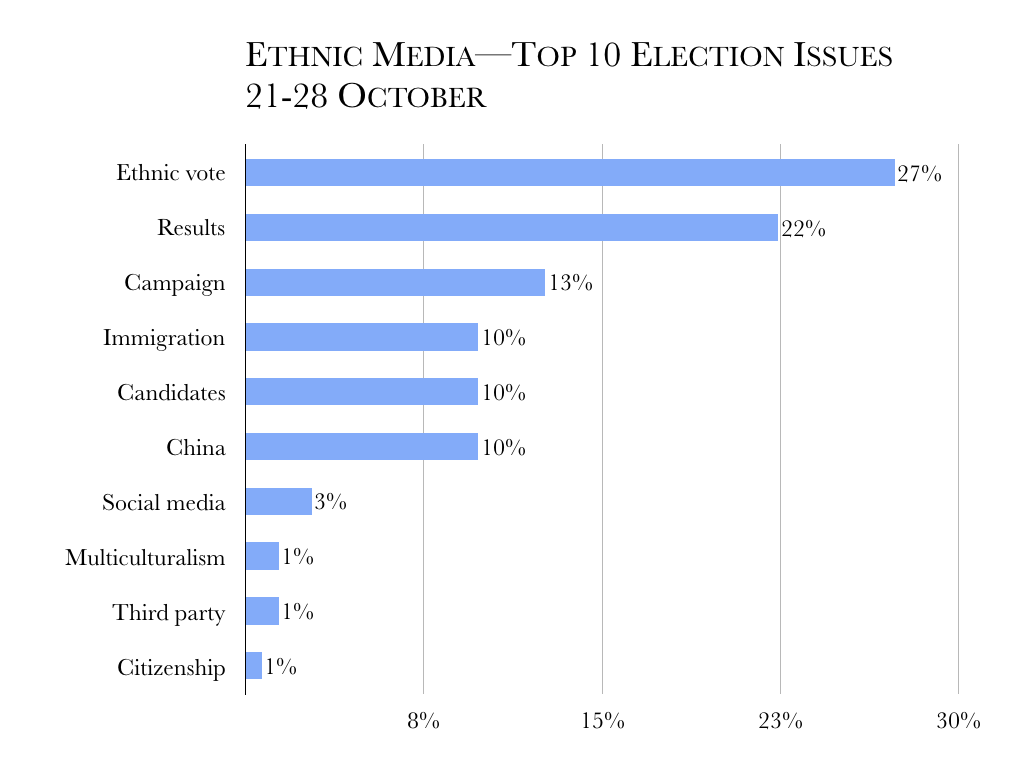
Ethnic media election coverage 21-28 October

Latest weekly analysis of ethnic media coverage. For the analytical narrative, go to Ethnic media election coverage 21-28 October:

Black families twice as likely to go hungry as white households, study shows

Disturbing findings:

Black households in Canada are almost twice as likely as white households to have trouble putting food on the table due to lack of money, according to groundbreaking new research based on Statistics Canada’s community health survey.

This is the case even when Black people are homeowners and have the same income, education levels and household makeup as white people, said Leslie Campbell, director of programs for FoodShare, which partnered with the University of Toronto on the research.

The data shows for the first time that there is a direct correlation between race and food insecurity, independent of all other factors, said Campbell, who presented the findings at a FoodShare conference on food justice and equity on Wednesday.

“When you look at the whole population, there are certain factors that are seen as being protective,” Campbell said in an interview. “But when you look only at the Black population … all of a sudden, they don’t apply.”

“For example, while it matters greatly for white folks whether your household is headed by a single parent, for Black households, you have a significantly higher probability of food insecurity regardless of your household composition,” Campbell said.

The study suggests “there are other factors — structural barriers that Black communities are having to navigate — that mean the rules don’t apply in the same way when it comes to protection,” he said.

The findings impact everyone, he told the conference. That is because people in households struggling to pay for food cost Ontario’s health care system an average of $3,930 annually, more than twice as much as those in households where food is plentiful, who cost the system an average of $1,608.

The findings are based on data pooled from five Canadian community health surveys from 2004 to 2014 and include responses from almost 500,000 individuals. The study focuses on respondents who answered all the questions on household food security and who reported their ethno-racial identity as either Black or white.

The survey, which asks 18 questions related to food and hunger, defines “food insecurity” as marginal, moderate or severe.

People in households that are marginally food-insecure are worried about running out of money to buy food. Moderate food-insecure households may struggle to buy enough food, or have to skimp on quality and nutrition. People in households experiencing severe food insecurity are missing meals due to lack of income.

According to the analysis, one in eight Canadian households — or four million people — is experiencing food insecurity. But when broken down into white and Black households — before adjusting for income, education and other factors — just 10 per cent of white households are food-insecure, while more than 28 per cent of Black households have trouble affording the food they need, the study found. After adjusting for external factors, Black households are still 1.88 times more likely to have trouble paying for the food they need, the study found.

The picture looks even bleaker for kids. While just over 12 per cent of white children are food-insecure, almost 34 per cent of Black kids — one in three — are struggling, the data shows. Food insecurity among children is linked to learning problems, greater difficulty recovering from illness and long-term health problems such as depression and asthma, according to the study.

“I have to say, I was a bit heartbroken to see how bad it was, in particular for Black children,” said Valerie Tarasuk, principal investigator for U of T’s PROOF Food Insecurity Policy Research program.

“Even after taking into account things like income and home ownership and education, we still find a substantial differential” between Black and white households, she said in an interview.

“This study says it matters for us to get a grip on race issues in Canada,” she said.

“I think our study really screams that there needs to be much, much more attention (paid) to the ways in which governments at all levels can use their policy levers to offset what has to be a fairly significant level of race-based discrimination in the workplace, the housing market, the education system, in corrections and other places,” she added.

Home ownership is seen as a buffer to food insecurity because households facing a sudden loss of income or an unexpected expense can borrow against the value of their homes to make ends meet.

“But when you compare the Black homeowner to the white, they have way less protection,” Tarasuk said.

In fact, the study found the risk of food insecurity among Black homeowners was the same as for a white renter, she noted.

The only explanation is that Black households have lower-value homes or carry higher mortgages, or both, she said.

“It’s another illustration of the ways in which accumulated wealth in our country is racialized,” Tarasuk said.

Among all Canadians who experience food insecurity, the study found that 62 per cent are employed.

Since income is the largest single protective factor that determines whether a household has trouble paying for food, Campbell said the study findings point to the lower quality of Black employment.

Jobs without benefits and part-time, contract and other forms of precarious employment impact a household’s ability to afford food, he said.

Quality of employment isn’t just about whether people are contract or full-time employees, Campbell added. It also relates to a worker’s position and salary.

FoodShare advocates for equitable access to fresh, healthy, affordable food for everyone and partners with schools and community groups to provide low-cost, locally sourced fruits and vegetables through student nutrition programs, neighbourhood gardens, local markets and other initiatives.

The non-profit organization recently raised the salaries of its lowest-paid employees by 25 per cent to reduce pay inequities, said executive director Paul Taylor. The agency also tries to ensure diverse populations are included in recruitment efforts.

A universal basic income would help people experiencing severe food insecurity, Taylor said.

“But more holistically, we really need to look at systemic discrimination in housing, education, policing and employment that all disproportionately, it seems, have an impact on Black folks,” he said.

The collection of more race-based data — particularly related to employment — would be a good place to start, he added.
Source: Black families twice as likely to go hungry as white households, study shows

Bipartisan bills proposed on Capitol Hill to help children of service members overseas acquire citizenship automatically

One of the even less explainable citizenship policy changes of the Trump administration:

A bipartisan effort on Capitol Hill is underway to make the children of service members stationed overseas automatically Americans, responding to a new federal policy that forces some parents to apply for their child’s U.S. citizenship.

In August, Department of Homeland Security’s U.S. Citizenship and Immigration Services announced a new policy addressing the definition of “residence” in the Immigration and Nationality Act. It affects children of service members and civilians living abroad who did not acquire citizenship at birth or while they were living in the United States.

Under section 320 of the Immigration and Nationality Act, a child born outside the United States can automatically become a citizen if they are physically living in the United States with their parent who is a citizen. With the new policy that goes into effect Tuesday, these children will no longer be considered “residing in the United States” as they had been in the past and a parent will have to apply for their child’s citizenship before the child turns 18 years old.

When the policy was announced, President Donald Trump’s administration was criticized for its immigration policies and how the change would negatively impact military families. There was also widespread confusion about what the change actually meant and who was affected, with some initial reporting interpreting the policy to mean that military children were being denied citizenship.

On Wednesday, Sens. Tammy Duckworth, D-Ill., and Johnny Isakson, R-Ga., announced they have introduced a bill called the Citizenship for Children of Military Members & Civil Servants Act that would modify section 320 of the Immigration and Nationality Act so children of service members who are stationed overseas can automatically acquire U.S. citizenship.

“Children of Americans serving their nation abroad are just as worthy of automatic citizenship as any other children,” Duckworth said in a prepared statement. “Forcing military families to jump through bureaucratic hoops and spend hundreds of dollars applying for citizenship on behalf of their children is not right.”

The USCIS policy change would force families to pay an application fee of $1,170 per child, according to the senators’ statement.

The policy change was estimated to affect between 20 and 25 people annually, based on data compiled by the USCIS during the last five years from overseas applications with Army or Air Force Post Office and Fleet Post Office mailing addresses, according to a USCIS official in August who spoke about the issue on the condition of anonymity.

Isakson called the bill “commonsense legislation” to help military families that is overdue.

“We should be doing all we can to ease the lives of our all-volunteer force, not add needless hurdles for them and their families,” he said in the prepared statement.

A bipartisan companion bill was also introduced in the House by Jerrold Nadler, D-N.Y., and Doug Collins, R-Ga., according to the statement.

Source: Bipartisan bills proposed on Capitol Hill to help children of service members overseas acquire citizenship automatically

Harvard paper blasted for seeking immigration agency comment

Silly. Normal journalist practice, even if one does not like the policies of the Trump administration or government agency:

For student and professional journalists alike, it’s a matter of ethical standards: The Harvard Crimson student newspaper, in its coverage of a campus protest against a federal immigration agency, reached out to the agency to ask for comment.

To student activists, the request showed a disregard for students living in the country illegally. Student groups circulated a petition demanding an apology and some, including the Harvard College Democrats, said they would refuse to speak to the publication.

The Crimson said this week it was standing by the decision despite the criticism in the latest example of heightened political sensitivity on college campuses that many say reveals an intolerance for different — often conservative — points of view. On several campuses, invitations to conservative speakers have been rescinded, and debates have raged over how to protect free speech.

At the Sept. 12 rally in Harvard Yard, representatives of several campus organizations called for the abolition of the U.S. Customs and Immigration Enforcement agency. In its article on the demonstration, the Crimson said the agency did not immediately respond to a request for comment. That kind of line is typical in news reports to demonstrate that reporters have attempted to get someone’s side of the story but have not yet heard back.

But the 11 student groups behind the petition charged that the effort was tantamount to calling the agency on the students. They wrote that the correspondence with ICE jeopardized students on campus who are living in the country illegally.

“We are extremely disappointed in the cultural insensitivity displayed by The Crimson’s policy to reach out to ICE, a government agency with a long history of surveilling and retaliating against those who speak out against them,” the petition says. “In this political climate, a request for comment is virtually the same as tipping them off, regardless of how they are contacted.”

The groups, including the college Democrats, Act on a Dream and Divest Harvard, called on the student newspaper to apologize and agree not to contact the agency for future stories. As a student publication, they said, the Crimson must prioritize students’ safety.

In a note to readers this week, Crimson leaders Kristine Guillaume and Angela Fu noted the reporters contacted the agency after the protest and did not share the names of anybody in attendance. They also defended the application of journalistic standards.

“At stake here, we believe, is one of the core tenets that defines America’s free and independent press: the right — and prerogative — of reporters to contact any person or organization relevant to a story to seek that entity’s comment and view of what transpired,” they wrote.

A spokesman for the immigration agency, Bryan Cox, said claims that the agency targets protesters for arrest are false and needlessly spread fear.

“Should the Harvard community wish to have a fact-based discussion as to what ICE does and does not do we would be happy to take part in that conversation,” he said.

Campuses across the country have been roiled by protests over controversial speakers and questions about political intolerance — a reflection, some say, of the hardening divide between the left and the right in American discourse. Where some see an effort to shelter students from any objectionable ideas, others see efforts to be more respectful of students’ varied backgrounds experiences.

In one case, at Wesleyan University in Connecticut, the student government moved to strip the campus newspaper of funding in 2015 after some students objected to an opinion piece published critical of the Black Lives Matter movement. At Middlebury College in Vermont in 2017, hundreds of students protested a lecture by Charles Murray, a writer who critics say uses pseudoscience to link intelligence and race, forcing the college to move his talk to an undisclosed location from which it was live-streamed.

Some political demonstrations have turned violent, including a 2017 riot at the University of California, Berkeley, over an appearance planned by conservative firebrand Milo Yiannopoulos that was canceled.

Student journalists and their advisers across the country regularly report efforts by students and school administrators to influence their coverage decisions, according to Chris Evans, president of the College Media Association. But he said it is rare to see efforts as blatant as those at Harvard.

“There’s absolutely nothing wrong with protesting,” Evans said. “The thing that can’t happen is that the student newspaper backs down. Let people debate whether certain voices should be heard. But it’s not the journalist’s job, with some exceptions, to decide what can and cannot be heard.”

Source: Harvard paper blasted for seeking immigration agency comment

The parties went negative, and the media enabled them

Good reflections on election coverage:

It is hard for outsiders to understand how gruelling, exhilarating, exciting, frustrating and physically demanding it can be for journalists covering an election. In the modern multi-media, multi-tasking universe in which journalists live, reporters on campaign planes may be tweeting, doing live interviews and writing several stories in the course of 18-hour days, often eating crappy food at irregular hours without proper exercise and with inadequate sleep. All while trying to be fair and accurate. On election night, columnists like the Toronto Star’s Chantal Hébert and the National Post’s Andrew Coyne were writing their pieces for the next day’s papers while simultaneously appearing on live TV shows.

Ordinary reporters broke stories in this campaign and exhaustively documented the statements of the leaders. Analysts and commentators took apart the platforms. And despite what you may have thought or heard, they collectively produced reams of copy on policy issues. Every time I saw someone complaining that no one was writing about some specific issue, I went online and found deeply reported stories. There were policy pieces on housing affordability and the dependency ratio, and examinations of party platforms on child care and the environment, just to offer a few examples.

But for all the individual excellence and all the expenditure of energy and intellectual capital from journalists, this was a deeply dissatisfying election for many Canadians, and the media played a part in that.

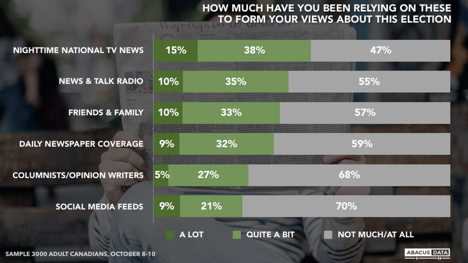
First, let’s be clear. Despite talk that the mainstream media have been displaced by social media, they continue to play a dominant role in the way most Canadians experience a campaign. More than half of Canadians relied on the evening national TV news to form their views on the election, according to a survey by Abacus Data. That was followed by talk radio. Both of these old-fashioned news sources were ahead of social media, as was the influence of “family and friends.”

Not surprisingly, the picture was quite different when it came to the youngest cohort, those 18-29 years of age. For them, the most important source of election information was not social media, though, but family and friends. True, social media were more important to this group than mainstream media; nonetheless, TV news, talk radio and newspapers were all important sources of election information for more than 40 percent of them. What this suggests is that the grip of the mainstream media might continue to diminish over time, but the day of its irrelevance has surely not yet come.

So, the coverage mattered. And the coverage, certainly as it was experienced by many voters, was predominantly negative. We have some interesting data on this from Greg Lyle at Innovative Research Group. He asked respondents mid-campaign whether they had read, seen or heard anything in recent days about each leader. Among those who had heard anything about Liberal leader Justin Trudeau, they said it led them to think less favourably of him by a margin of two-to-one. Almost precisely the same was true of Conservative leader Andrew Scheer.

This is very much in keeping with the unprecedently negative tone of the entire 2019 campaign in which both major parties trended down in the polls and which produced a government with the lowest-ever share of the popular vote.

Like any campaign, so much happened in such a short time that it can be easy to forget the way it began. In the first few days after the writ was dropped, it felt like a formless void, a space without narrative. And this was a vacuum that was gleefully filled by the Liberal war room. The Liberals had obviously accumulated a little video storehouse of horrors: Conservative candidates saying controversial or outright offensive things on abortion, Quebec, homosexuality and race. In that first week, they dropped bits of what they had found onto social media with deliberate menace just hours before Scheer made campaign appearances with particular candidates.

They did this before Scheer appeared with Rachel Willson in York-Centre (her call for anti-abortion legislation). Boom! When he was about to appear with Arpan Khanna in Brampton North (his homophobic Facebook posts). Boom! When he was on his way to see Justina McCaffrey in Kanata-Carleton (her friendship with far-right commentator Faith Goldy). Boom! (Each of these candidates ultimately lost, by the way.)

So, it was the Liberals, not the media, who set the tone of the campaign in its first week. Gloomy Ways! But they did so by performing a sort of hack on the media, exploiting their weakness for novelty and tension. Because it was in video form, it took little or no effort to verify on the fly.

What reporter rushing to a constituency event where the less-than-electric Scheer was slated to address some small-bore policy idea recycled from Harper 2015 could resist the lure of the video the Liberals had just dropped on Twitter? Particularly when the Tory candidate obliged the Liberal war room by running away from the camera, as Justina McCaffrey did.

So, the media did not set the tone, but their weakness for a particular kind of story enabled and amplified it. This kept everyone occupied until that blackface photo appeared on Time’s website, giving Justin Trudeau his time in the barrel (and forcing the Liberals to cage in the residents of their war room for a while). Two weeks later, though, the media dug up information about Andrew Scheer’s resumé and then his citizenship, swinging the narrative back to him.

Of course, the media are not helpless in the face of the narratives that campaigns present any more than the parties themselves are. Indeed, every day is a struggle among the parties themselves and between them and the media to decide what the election should be about. On the very first day of the campaign, the Globe and Mail dropped a story on the RCMP looking into the SNC-Lavalin affair that the paper may have hoped would set the frame for the entire campaign. It did set the frame, but for only a day. Later it seemed plain that many people in the media expected the blackface controversy to dominate the rest of the campaign, until it seemed it had not made much of a dent in the Liberals’ polls, at which point they moved on.

Neither of those narratives would have elevated the tone of the election campaign, it has to be said. You could argue in contrast that the Toronto Star strove admirably to frame the election around climate change, which if you believe is real, as I do, is surely as worthy a subject to debate at election time as free trade in 1988 or cutting the GST in 2006. The Star published a series of vividly reported stories that helped remind those who read them of the stakes if we do not act. But it was Swedish activist Greta Thunberg’s journey to North America that raised the profile of the issue in the media more generally, at least for a week, along with an assist from the Liberals on the hustings anxious to move on from blackface. But then climate change, too, faded into the cacophony.

In the last week, it was the most familiar of media narratives that dominated: who is ahead in the polls; can anyone get a majority; if not, who will play with whom in the new Parliament? This emptied the election of most of its policy content and opened up a mostly negative conversation among the parties about which voters should fear the most. Should we be more afraid of Liberal/NDP profligacy or of Conservative budget cuts?

It would be wrong to say that the media alone were responsible for the negativity of this campaign. What we witnessed was rather a cycle, much of it beginning with the parties themselves, turbo-charged by the media, spun through social media, then picked up again and further amplified by the politicians. This cycle could have been broken had the parties presented big ideas or divided more clearly on issues of principle or policy, but for the most part they chose not to. And there were signs of resistance in the media — reporters and columnists who worked mightily to bring us back to what mattered, or should matter: climate change, the economy, taxes and deficit, systemic racism, the scandal of the condition of Indigenous people, foreign policy even. But in the end, all their efforts to save us from this dismal election were in vain.

Source: The parties went negative, and the media enabled them

Tragedies deepen Jewish-Muslim bonds to fight hate crimes

Of note:

Muslim groups helped raise hundreds of thousands of dollars to help Pittsburgh’s Tree of Life synagogue recover after a gunman killed 11 people there, one year ago this week. The Jewish congregation mounted its own fundraiser for New Zealand’s Muslims after a white supremacist shooter killed 51 people at two mosques there in March.

Such outreach between Jews and Muslims often draws widespread attention only in the immediate wake of tragedy. But as both faiths grapple with a rise in reported hate crimes and fears within their communities of being attacked for their beliefs, Jews and Muslims are forging bonds that rely on shared personal values to help combat anti-Semitism and Islamophobia.

For Sheryl Olitzky, 63, the “aha moment” that inspired her focus on Jewish-Muslim connections came almost a decade ago on a trip to Poland, when she asked a guide why she saw no locals in the head-covering garb of devout members of either faith.

Olitzky, who was married at Tree of Life synagogue, recalled being stunned by the exclusionary response she heard and telling herself that “I could not change history, but I could rewrite it by changing the future” and working to prevent further episodes of discrimination against Jews and Muslims.

When the grandmother of seven returned home to New Jersey, however, it took several months for her to realize that, despite living in an area with “a fairly substantial number of Muslims and Jews,” she had no Muslim friends.

“I said, ‘I believe ignorance is a primary driver of hate, and it’s time, if I want to make change that I get to know Muslim women’,” Olitzky said.

When Olitzky was introduced to Atiya Aftab, a Muslim attorney and adjunct professor at Rutgers University, their partnership took off as the nonprofit Sisterhood of Salaam Shalom. What began as a meeting of six Muslim and six Jewish women at Atfab’s home now counts more than 170 chapters in 32 states and Canada, according to Olitzky.

The Sisterhood devotes much of its attention to education and shared experiences that can deepen ties between its members, with its fourth annual trip this year taking dozens of Muslim and Jewish women and teenage girls to Germany and Poland. But a vow to fight hate crimes that target their respective communities is also woven into the group’s foundation, with a “rise and respond” primer for speaking out against anti-Semitism and Islamophobia released this year .

Other members of the two faiths have created formal alliances as well. The Muslim-Jewish Advisory Council was established by the American Jewish Committee and the Islamic Society of North America in the first days after President Donald Trump’s 2016 election — following a campaign where Trump repeatedly stoked public fears of Muslims.

MJAC is co-chaired by two business executives, one Jewish and one Muslim. The group opened regional affiliates after a 2017 spike in reported hate crimes that included the death of Heather Heyer, killed while demonstrating against a white supremacist rally in Charlottesville, Virginia.

AJC Director of U.S. Muslim-Jewish Relations Ari Gordon said that some themes common in episodes of anti-Semitism and Islamophobia are “definitely linked.” The same man who allegedly attacked a synagogue in Poway, Calif., this spring was also linked to a fire set at a nearby California mosque, Gordon pointed out.

Hate crimes reported to the FBI have risen for three years running, according to official statistics, with Jews and Muslims ranking as the top two targets of religiously motivated incidents. But underreporting is seen as a significant obstacle to effective tracking of the problem. Heyer’s death, for example, was not included in the federal database although the man who drove his car into the crowd where she stood pleaded guilty to hate crimes charges.

MJAC has championed bipartisan legislation in Congress designed to improve the tracking of hate crimes — but its work has stayed in that domestic policy lane, steering clear of U.S. policy toward the Israel-Palestine conflict that has been a longtime divider of Jews and Muslims.

“We don’t put that issue on the side because it’s not important; quite the opposite,” Gordon said, adding that MJAC aims to demonstrate that the two faiths “can work together for mutual benefit and build trust despite this disagreement.”

Wa’el Alzayat, CEO of the Muslim advocacy group Emgage Action, and Halie Soifer, executive director of the Jewish Democratic Council of America, took a similar approach when they co-authored a columnafter the New Zealand mosque attacks that described their faiths as battling the “common enemy” of white supremacist violence. The duo first got to know each other as colleagues on the staff of Samantha Power, who served as U.S. ambassador to the United Nations under former President Barack Obama.

“We can work together on issues that unite us, and that doesn’t mean we have to agree on every issue,” Soifer said. Alzayat, also a member of MJAC, agreed that the alignment to discuss their faiths’ struggles against hate crimes does not mean “you let go of your principles.”

If the two communities can successfully find that “common ground,” Alzayat said, “over time, the really difficult stuff becomes easier to talk about.”

The partnerships between Muslim and Jewish groups have extended beyond battling hate crimes. AJC held an event last week to show support for the majority-Muslim Syrian Kurds as they grapple with the fallout from Trump’s decision to withdraw troops from the country’s northeast and Turkey’s subsequent attacks on Kurdish-held territory.

But even when it comes to the unifying issue of preventing hate crimes against their respective faiths, not every Muslim-Jewish partnership agrees on how publicly to discuss Trump’s role in the problem. Alzayat and Soifer used their op-ed to label Trump “a symbol of rising Islamophobia, anti-Semitism and other forms of racial and religious intolerance,” and Olitzky also said she views Trump’s muddled rhetoric about white nationalists as having “given permission for them to come out” further into the open.

MJAC, for its part, takes a more positive approach toward an administration whose support it needs to get further hate crimes legislation passed into law under Trump. The president signed a bipartisan bill strengthening penalties for threats against religiously affiliated institutions into law last fall. Gordon praised the Justice Department’s work on anti-Semitism and said that the group would not pull back on “criticism where we think it’s due.”

Source: Tragedies deepen Jewish-Muslim bonds to fight hate crimes

Une touchante inquiétude

Interesting column and the irony of Premier Legault’s comments on national unity:

Après l’avoir vu souffler sur les braises du nationalisme durant toute la campagne, il était savoureux d’entendre le premier ministre Legault s’inquiéter des divisions reflétées par les résultats de l’élection fédérale de lundi et conseiller Justin Trudeau sur la meilleure façon de « garder le pays uni ».

Cette préoccupation pour l’unité de la fédération est touchante, même si on ne peut pas dire que M. Legault y a beaucoup contribué avec la loi sur la laïcité, que son vis-à-vis manitobain, Brian Pallister, a déclarée contraire aux valeurs canadiennes, ni avec ses propos sur « l’énergie sale » produite par le pétrole de l’Ouest, qui ont fait bondir l’Albertain Jason Kenney.

En réalité, s’il y a une chose sur laquelle le Canada anglais est unanime d’un océan à l’autre, c’est que le Québec demeure l’enfant gâté de la fédération, comme le premier ministre du Nouveau-Brunswick, Blaine Higgs, l’a encore déclaré cette semaine. Selon lui, le Québec constitue un facteur de division en profitant de la péréquation sans rien vouloir concéder en retour.

Le hasard fait bien les choses. En 2020, c’est M. Legault qui assumera la présidence du Conseil de la fédération. Du 22 au 24 juillet, il sera l’hôte de ses homologues provinciaux au Château Frontenac. Il aura là une occasion en or de leur expliquer à quel point il est désireux de favoriser l’harmonie au sein de la fédération et de leur exposer ses idées sur la façon d’y parvenir. La perspective de séjourner dans la « capitale nationale » du Québec doit certainement les combler de joie. Un coup parti, M. Legault pourrait les emmener à Baie-James pour leur montrer ce qu’est une énergie propre.

Cela dit, M. Legault a raison de penser que l’octroi d’une plus grande autonomie serait de nature à apaiser la frustration des provinces de l’Ouest. Un mégasondage pancanadien effectué en début d’année par six instituts de recherche dans le cadre d’une analyse sur la « Confédération de demain » indiquait que les Albertains (49 %), les Québécois (48 %) et les Saskatchewanais (44 %) étaient de loin les plus nombreux à souhaiter que leur province obtienne plus de pouvoirs.

On a souvent du mal à prendre au sérieux les velléités indépendantistes dans l’Ouest. Pourtant, en Saskatchewan et en Alberta, à peine 33 % des personnes interrogées étaient d’avis que le fédéralisme comporte plus d’avantages que d’inconvénients, alors que cette proportion était de 46 % au Québec. Le PLC a été incapable de faire élire un seul député dans ces deux provinces. Cela n’améliorera certainement pas cette perception, même si des non-élus sont nommés ministres.

Vu de là-bas, un gouvernement libéral appuyé par le NPD était sans doute le pire scénario imaginable. La politique n’est pas faite pour les âmes trop sensibles, mais la civilité a quand même ses droits. À de multiples reprises, Andrew Scheer s’est permis de traiter ouvertement M. Trudeau de menteur et d’imposteur. On peut penser que cela traduisait les sentiments que le premier ministre inspire dans la province d’adoption du chef conservateur. Au Québec, où tous ne tiennent pourtant pas M. Trudeau en haute estime, on fait généralement preuve de plus de retenue.

M. Trudeau a confirmé mercredi que son gouvernement triplerait la capacité du pipeline Trans Mountain, tout en reconnaissant qu’il faudra faire davantage pour calmer la colère de l’Ouest. Jason Kenney tient toujours mordicus à un pipeline vers l’est, et c’est le Québec qui constitue le principal obstacle. Si M. Legault veut lui faire la leçon sur la façon de renforcer l’unité canadienne, M. Trudeau aura beau jeu de le lui rappeler.

Minorité oblige, le premier ministre a promis de faire un effort pour collaborer avec les autres partis représentés à la Chambre des communes et avec ses homologues provinciaux afin de mieux répondre aux préoccupations des Canadiens, mais il n’a pas donné le moindre signe qu’il envisageait de diminuer un tant soit peu le rôle du gouvernement fédéral au profit des provinces.

De toute évidence, il n’a pas tiré des résultats de l’élection les mêmes conclusions que M. Legault, selon qui les Québécois lui ont clairement envoyé le message de ne pas contester la loi sur la laïcité. M. Trudeau a refusé d’en prendre l’engagement encore plus fermement qu’il l’avait fait durant la campagne.

« Le message est clair : si vous voulez plus d’appuis la prochaine fois, soutenez la loi 21 », a déclaré M. Legault. Cela reste à voir. S’y opposer n’a pas empêché le PLC de demeurer le premier parti fédéral au Québec, aussi bien en nombre de sièges qu’en nombre de suffrages exprimés. La prochaine fois, M. Legault trouvera bien un autre grief à lui faire.

Source: Une touchante inquiétude

Abuses in Nigerian Islamic Schools Spark Regulation Demands

Pretty horrifying:

Nearly 1,000 people have been freed in the past month from Islamic schools in northern Nigeria where they reportedly experienced abuse.

In one such case, police sources said hundreds of men and boys had been freed from a school in Katsina, many of whom had been chained to walls, beaten and sexually abused.

The four raided schools, all in predominantly Muslim northern Nigeria, have much in common.  All had managers who portrayed themselves as Islamic clerics teaching students how to be good Muslims.

All the facilities also operated as reform centers to discipline misbehaving children. And all were in poor communities, drawing little attention — until now.

Activists have sought regulation of private Islamic schools for years, but strong traditions have stood in the way.

One such tradition involves a concept among Nigerian Muslims called almajiri.

“Almajiris, according to Islam, means those who migrated to somewhere in search of Islamic knowledge,” said cultural historian Bukar Chabbal. “That is the original conception — one under a strict teacher who teaches them.”

Almajiris are usually boys. A parent will send a son to live with an Islamic scholar, known as a mallam, for many years in the hope that the child will receive a sound education in Islamic doctrine.

There are an estimated 10 million almajiris in Nigeria, often seen on the streets begging for food. According to their Islamic teachers, begging helps the students learn humility.

But Chabbal and others say parents are abusing the system, giving their children away to Islamic clerics because they can’t afford to raise them themselves.

Discipline

Sending unruly children to Islamic schools to be disciplined is another traditional practice.

Aliyu Mohammed Tonga, an activist for almajiri children, said that “as I can recall, when we were young, what our parents used to tell us is that someone has been taken to so-and-so person and has been corrected.”

Muslim groups in Nigeria are condemning the raided schools, saying the owners are not real clerics and the schools are not true almajiri schools.

Activists like Aliyu say regulation is necessary, to separate the good from the bad.

“Anybody can come in, even the criminal can come in in disguise and say, ‘I’m a mallam,’ and he can do what he can do, and that is what happened,” Aliyu said.

President Muhammadu Buhari has directed Nigerian police to find abusive so-called Islamic schools and disband them.

Source: Abuses in Nigerian Islamic Schools Spark Regulation Demands

From UK ex-pat to EU citizen: A huge rise in Brits getting another EU passport

Good summary of the numbers. Would be interesting to see the percentages of UK citizens applying for EU member citizenship:

A new study conducted by Oxford in Berlin and the WZB – Berlin Social Science Center has revealed that the number of Brits receiving German citizenship has risen by over 1000% since the Brexit referendum in 2016: While 622 British citizens received German citizenship in 2015, numbers jumped dramatically to 7,493 ‘naturalisations’ in 2017 and predictions for 2019 are higher than all previous years.

Figures released by the OECD for the whole continent show a similar trend of Brits acquiring another EU citizenship with a rise of 600% in ‘naturalisations’. With Brexit, deal or no–deal, all British citizens living in the UK or elsewhere stand to lose their European citizenship rights such as freedom of movement or recognition of qualifications. Obtaining the nationality of an EU member state is a way for British citizens to guarantee maintaining EU citizenship rights that many peoples professional and personal livelihoods over the years have come to depend on.Rachel from Loughborough who gained dual citizenship in 2018 and now lives in Berlin says:

“Getting German citizenship has given me a whole new confidence and security that I had lost.”

The study conducted by Oxford in Berlin and the Berlin Social Science Center (WZB) interviewed British citizens who have arrived in Germany over the last decade with a wide sample in social background, age and profession. The huge spike in post-2015 naturalisations (both UK citizens in the EU and EU citizens in the UK) is marked by the survey data as almost entirely motivated by the Brexit referendum.

According to migration researcher and co-author of the study Dr. Daniel Auer:

“These dramatic jumps tell us we’re onto a significant social phenomenon here whose implications are yet to be understood.”

If there were to be a no-deal Brexit at the end of this month, new applications for German citizenship from British citizens would require them to give up their UK citizenship because German law stipulates that only EU citizens can acquire dual-nationality.    Therefore, those Brits that want to maintain their European citizenship rights will have to give up their British citizenship, a heart-breaking and impossible prospect for many.

Alex, a start-up business owner who moved with his wife and two children from the UK to Germany in 2013 said:

“We are being hung out to dry by the politicians from both sides. With my German language level, I’d have no chance of securing German citizenship and even if I could in the future, I wouldn’t want to give up my British passport. I just have to trust the German Government to keep their word and not kick us out.”

While the legal consequences of Brexit remain so uncertain, people like Alex and Rachel – along with more than 5 million other EU or UK migrants on both sides of the channel – are taking often large risks to do whatever they can to mitigate the pending impact of Brexit on their lives.

Source: From UK ex-pat to EU citizen: A huge rise in Brits getting another EU passport