Exclusive: Cyprus sold passports to criminals and fugitives

Not surprising given earlier stories and the kinds of people these programs can attract:

Convicted fraudsters, money launderers and political figures accused of corruption are among dozens of people from more than 70 countries who have bought so-called “golden passports” from Cyprus, according to a large cache of official documents obtained by Al Jazeera’s Investigative Unit.

The Cyprus Papers is a leak of more than 1,400 passport applications approved by the government of the island nation between 2017 and 2019, and it raises serious questions about the Cyprus Investment Programme.

Passports from the Republic of Cyprus can be important for individuals from countries that have restricted access to Europe, as Cyprus is a member of the European Union (EU) and a passport offers its holder access to free travel, work and banking in all 27 member states.

In the coming days, Al Jazeera will reveal the identities of dozens of people who acquired Cypriot citizenship who, according to the country’s own rules, in many cases should not have received a passport.

Security risk

To apply for a Cypriot passport, applicants must invest at least 2.15m euros ($2.5m) in the Cypriot economy, usually by buying real estate, and have a clean criminal record.

However, applicants provide their own proof of eligibility, and although Cyprus claimed to check applicants’ backgrounds, the documents obtained by Al Jazeera prove that this did not always happen.

Since its inception in 2013, the programme has received repeated criticism from the EU, which has called for it to be closed down.

“It’s high value for everyone who comes from a country where there’s a lot of dirty money involved”, German MEP Sven Giegold, a strong critic of the programme, told Al Jazeera.

“You open a bank account, a business relationship and less questions asked, no visa requirements, easier to get access to get everywhere to travel than if you are from Russia, China or even more doubtful countries.”

Since 2013, when the passport programme started, the country has made more than 7 billion euros ($8bn), used to keep afloat the nation’s failing economy.

Burisma and Gazprom officials

Between 2017 and 2019, the countries with the highest number of people applying were Russia, China and Ukraine.

Among the approved applications seen by Al Jazeera was Ukrainian tycoon Mykola Zlochevsky, owner of the giant Burisma energy company.

When Zlochevsky bought his Cypriot passport in 2017, he was already under investigation for corruption in his home country.

In June 2020 Ukrainian prosecutors said they were offered $6m in cash to drop the investigation.

Zlochevsky and Burisma deny any knowledge of the bribe.

Like many on wanted lists in their home country, Zlochevsky’s Cypriot passport allows him to live beyond the reach of Ukrainian law enforcement.

A similar application came from Russian national Nikolay Gornovskiy, former boss of the state-owned energy giant Gazprom.

Gornovskiy was already on Russia’s wanted list for abuse of power when Cyprus approved his passport in 2019 and has so far thwarted all attempts to extradite him.

Other applications were approved even after the applicant had been arrested and sometimes even served their time in prison.

Ali Beglov, a Russian national, bought his passport despite serving a prison sentence for extortion, which should not have been possible according to Cyprus’s rules.

Chinese businessman Zhang Keqiang also received a Cypriot passport, despite having spent time in prison for a fraudulent share deal.

Vietnamese businessman Pham Nhat Vu’s passport was approved a month after he was charged with giving millions of dollars in bribes in a telecoms deal.

He is now serving three years in jail.

According to Laure Brillaud, Senior Policy Officer with Transparency International, an NGO focused on combatting international corruption, these results are worrying but not surprising.

“These programmes bear inherent risks of money laundering, corruption and tax evasion. They were designed to attract people just looking for a fast track to the EU,” she told Al Jazeera.

Stricter rules

In May 2019, Cyprus introduced tougher rules on who was eligible for citizenship, which banned anyone under investigation, wanted, convicted or under international sanctions from buying a passport.

Cypriot parliamentarians in July finally passed a law that gave the country the power to remove citizenship after several scandals involving notorious golden passport investors, but politicians voted against any move to publish the names of those who buy Cypriot citizenship.

The new stricter law applies to anyone who commits a serious crime, is wanted by Interpol or subject to sanctions in the 10 years after they bought their passport.

Cyprus is reviewing all past applications and announced about 30 unnamed people face losing citizenship, but The Cyprus Papers reveal many more may fall foul of the new law.

They include people such as Venezuelan Leonardo Gonzalez Dellan, an ex-banker, who was sanctioned by the United States for laundering millions in illegal currency deals for the Venezuelan government.

Another person who could lose his passport is Oleg Bakhmatiuk, under investigation in Ukraine for embezzlement and money laundering relating to his giant agricultural firm.

He called the charges “a complete fabrication and politically motivated”.

Although Bakhmatiuk told Al Jazeera the proceedings against him had ended with the charges dropped, the country’s official prosecutor confirmed he is still on Ukraine’s wanted list.

Embezzlement and money laundering

Some other examples of passport holders facing serious charges are Russian brothers Alexei and Dmitry Ananiev, who bought citizenship in 2017.

They are accused in Russia of embezzling from the bank they once owned.

Another person who received Cypriot citizenship is Chinese national Li Jiadong, who was sanctioned by the US for laundering $100m in cryptocurrency related to North Korean hackers.

Lastly, there are Maleksabet Ebrahimi and his son Mehdi, who are both on Interpol’s most-wanted list for money laundering and fraud in Iran and facing similar charges in Canada.

Maleksabet Ebrahimi denies the charges against him and says he complied at all times with Iranian and Cypriot laws.

‘Cyprus should be ashamed’

In response to questions from Al Jazeera, Cypriot Member of Parliament Eleni Mavrou said: “The way the programme was implemented the last few years was obviously a procedure that allowed cases for which the Republic of Cyprus should be ashamed.”

“I believe that the new regulations will not leave room for foul play or for stepping over the boundaries that a state should respect,” she added.

The Minister of the Interior, Nicos Nouris told Al Jazeera: “No citizenship was granted in violation of the regulations in force at the given time.”

Source: Exclusive: Cyprus sold passports to criminals and fugitives
Nesrine Malik: British hypocrisy is to blame for the deadly plight of migrants

Of note:

It is often argued that once it became clear that the Sandy Hook elementary school shooting wasn’t going to tip the United States towards adopting national gun control laws, that was the moment the gun control argument was lost for good. The equivalent moment, as far as British and European attitudes towards refugees and asylum seekers is concerned, was when the body of Alan Kurdi washed up on the shores of Turkey, almost five years ago.

Despite the global grief, the front pages, the renderings of Kurdi’s little body in paintings, his elevation into a symbol of a world that had lost its way, nothing happened. In fact, EU migration policies became even harsher. Last week, the British public was again moved when the body of a Sudanese migrant, Abdulfatah Hamdallah, was found on French shores, drowned after trying to make it to Britain. In the same time frame, another more fortunate migrant made it safely to Kent, and was immediately assaulted.

This duality lies at the heart of our attitudes towards migrants, asylum seekers and refugees: an outpouring of grief one minute, a political pummelling the next. We like to think of ourselves as kind, and touched by the tragedy of specific cases, but we do nothing beyond expressing sympathy. We are horrified by the treatment of Windrush victims, but not the hostile environment and the policies that led to the scandal. We are haunted by the desperation of people who take treacherous and fatal journeys to the UK, but many of us are complicit in their fate by voting for politicians who pledge to make those routes “unviable”.

Source: British hypocrisy is to blame for the deadly plight of migrants

Bouchard: La souveraineté du Québec, plus nécessaire que jamais

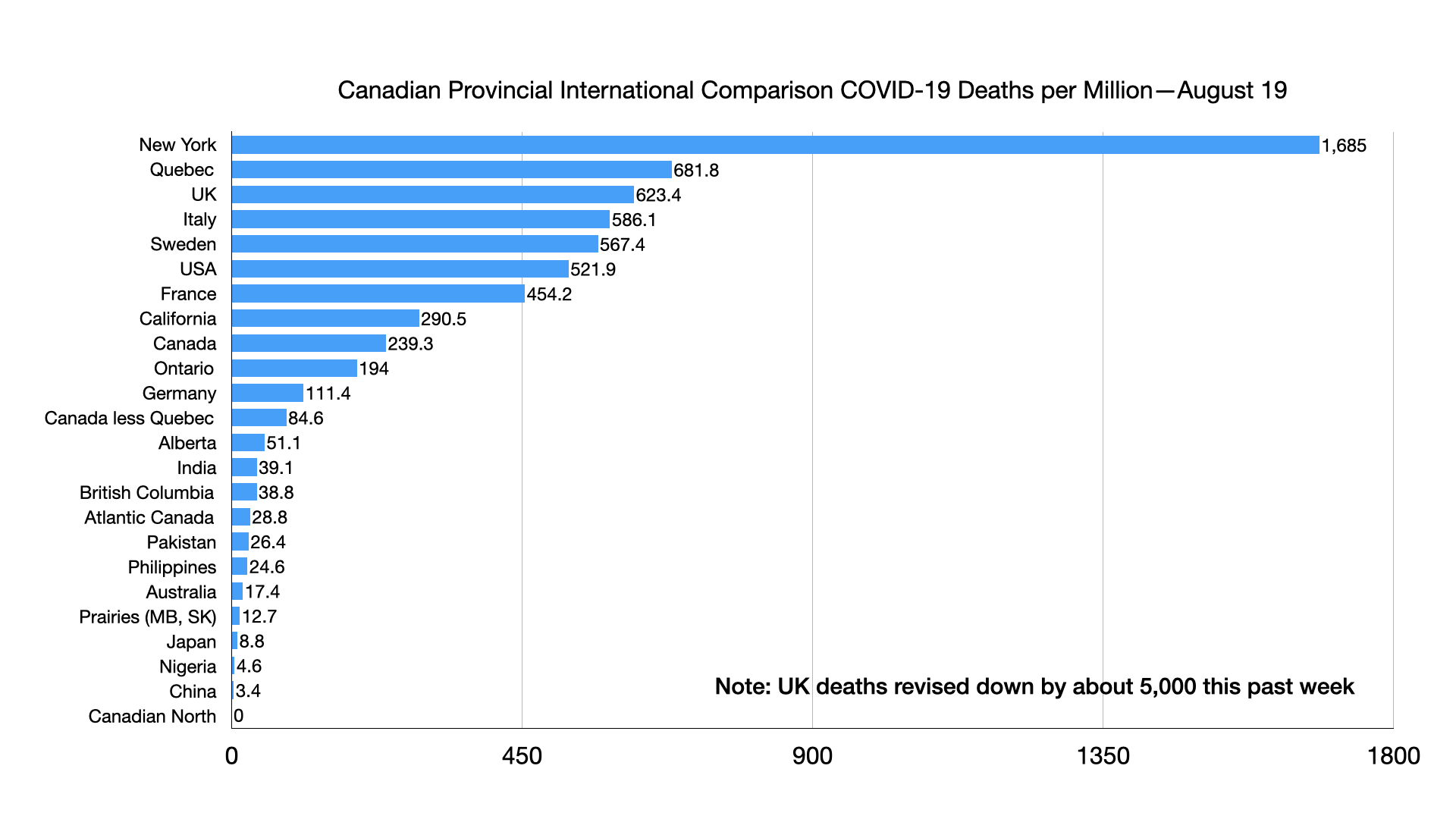
Ironic to cite COVID-19 as a justification for Quebec independence while ignoring that Quebec has the highest number of infections and deaths per million of all Canadian provinces and on par with the most affected European countries.

And of course, both multiculturalism and interculturalism are similar models of civic integration, with more semantic rather than substantive differences:

Du point de vue de notre avenir politique, deux leçons peuvent être tirées de l’actuelle pandémie. Nous avons pu constater que, presque partout, les populations plongées dans l’insécurité se sont tournées vers leur nation pour se protéger. Les instances supranationales, à commencer par l’Union européenne, se sont montrées étonnamment impuissantes à mettre en œuvre des initiatives efficaces pour contrer la pandémie.

Chacun a pu ainsi prendre conscience du recours indispensable que l’État-nation continue de représenter comme rempart dans un contexte de crise. Cette enceinte a montré une grande capacité à susciter une solidarité, montrant ainsi qu’elle est loin d’avoir perdu sa pertinence. Il y a intérêt à la soutenir et à la perpétuer. C’est la première leçon.

La pandémie a aussi révélé la fragilité des réseaux supranationaux. La mondialisation ne s’en trouve pas pour autant condamnée, loin de là, mais elle a accusé d’inquiétantes carences. Il sera prudent de mieux définir nos engagements et nos articulations avec cette sphère qui demeure largement chaotique et imprévisible. On voit l’importance de pouvoir se reposer sur un État doté de tous les pouvoirs essentiels. C’est la deuxième leçon.

Les raisons profondes qui ont toujours motivé le mouvement souverainiste restent d’actualité : le combat pour le français, l’émancipation économique, sociale et culturelle de notre société, le renforcement d’une francophonie nord-américaine et, plus généralement, une plus grande liberté collective pour traiter à notre façon, suivant nos traditions et nos choix, les grands problèmes de l’heure. Ces raisons sont clairement rappelées et mises à jour dans le dernier numéro de la revue Action nationale. La pandémie en fait voir d’autres : renforcer la nation-refuge et procurer à l’État une marge de manœuvre accrue qui lui permet de mieux naviguer à travers les écueils de la sphère planétaire.

Sur l’enjeu identitaire

Tout cela survient au moment où le Parti québécois, occupé à se redéfinir, se donnera bientôt un nouveau chef. J’aimerais, dans ce contexte, soumettre trois réflexions. La première concerne la thématique identitaire, toujours bien vivante au sein de ce parti. Écartons d’abord un malentendu. Il est incontestable qu’une nation a besoin d’une identité comme expression d’une appartenance et source de solidarité. On imagine mal comment, privée de ces ressorts, elle pourrait mobiliser ses citoyens et ses citoyennes autour d’idéaux et de projets communs.

Le danger, c’est lorsque la quête d’une identité glisse vers une auscultation de soi qui l’appauvrit et rétrécit le « nous » de la nation. Un déplacement de ce genre est néfaste pour une société diversifiée. Il tend aussi à diminuer la place d’une dimension essentielle, celle de l’action collective, des grands projets que nous pourrions réaliser tous ensemble comme Québécois. Or, la mémoire de ces réalisations contribue justement à fortifier l’identité.

La population québécoise est de plus en plus diversifiée et le vieux noyau francophone jadis largement majoritaire se contracte progressivement (de 79 % en 1971, sa proportion serait passée à 64 % en 2014). Il est donc nécessaire d’ajuster la définition de la nation et de l’identité à la nouvelle réalité.

Est-ce là succomber au multiculturalisme ? On en est loin. Premièrement, il s’agit simplement de reconnaître les droits de tous les citoyens du Québec, en particulier là où ils sont compromis. Cette règle n’est pas copiée du multiculturalisme, elle fait partie de l’héritage général de toutes les horreurs commises durant la première moitié du XXe siècle en Occident. L’éthique qu’elles ont engendrée invite à respecter la diversité plutôt que de la broyer. Le multiculturalisme canadien en est lui-même une expression parmi bien d’autres, tout comme l’interculturalisme québécois.

Deuxièmement, le modèle canadien en matière de relations interculturelles est très différent de l’approche québécoise. Dans le premier cas, les groupes ethnoculturels se voient accorder une latitude exceptionnelle, si bien que le souci de cimenter ces minorités devient quasiment secondaire.

Au Québec, au contraire, c’est une priorité. Nous sommes une petite nation constamment soucieuse d’intégration, de solidarité, de concertation, de rassemblement — et de survie. Troisièmement, le multiculturalisme canadien reconnaît l’existence de minorités mais nie celle d’une majorité. Comment ce modèle pourrait-il s’appliquer ici ?

Le prochain chef du PQ

Je reviens au Parti québécois. La recherche d’une identité forte, au sens défini plus haut, et la promotion d’une conception vraiment inclusive de la nation ne sont nullement incompatibles. Il suffit de revenir à la tradition instaurée par le parti à ses années glorieuses. La loi 101 en est une parfaite illustration. D’un côté, elle servait les intérêts de la majorité en renforçant le français. De l’autre, elle servait les intérêts des minorités en leur procurant le moyen de mieux s’intégrer à la société et d’y faire leur chemin.

Dans l’intérêt du parti et de celui du Québec, il est éminemment souhaitable qu’il renoue avec cette philosophie qui lui a valu une grande partie de ses succès. Cette tradition est toujours porteuse d’avenir parce qu’elle est étroitement alignée sur le Québec en devenir que les fondateurs avaient remarquablement anticipé.

Concernant la course à la chefferie, ces réflexions invitent à favoriser le candidat qui incarne le mieux à la fois la grande tradition et l’avenir du parti suivant les voies esquissées ici. Parmi les candidatures en lice, celle de Sylvain Gaudreault me semble la plus proche de ce profil.

Source: La souveraineté du Québec, plus nécessaire que jamais

Immigration fraud in Canada, foreign workers should be cautious

Yet another instance:

When the video call ended, Rami Al-Americani felt confident he would get the job.

The four people who had interviewed him for a position at a Montreal-based construction company had asked him detailed questions, but Al-Americani owned and operated an engineering consulting firm in Lebanon. He knew he could do the work.

The address for Montreal Construction Group corresponds to a non-existent lot that would be in the middle of René-Lévesque Blvd., near Place Ville Marie. Workers in the area say they have never heard of the company. It isn’t real.A Montreal Gazette investigation has confirmed that the firm is part of a network of ghost companies concealing an elaborate immigration scam. Those who orchestrate the network use the prospect of living and working in Montreal, and in Canada, as a lure to target educated workers in the Middle East, gaining their trust with a lengthy application period before requesting money to pay for the immigration process.

The scam is convincing. The network operates under the guise of three interlinked companies: a recruitment agency, a construction firm and an immigration consultant firm. Multiple people act out different roles, from human resource representatives to hiring managers. The jobs they offer and the companies they purport to run are not real. They have websites that mimic those of real firms and use the stolen identities of real immigration consultants to assure victims of their legitimacy.

Those who fall victim to the scam have little recourse. The network exists largely in a jurisdictional vacuum online. Even when regulators do catch on, the network just shuts down and restarts under a new name.

“It’s a big network,” Al-Americani said. “It’s amazing that they took the time to do a fake website and some of them act as the recruitment, the other ones act as the company people, operations, HR. Another part acts as the immigration consultants.”

A chance for a job in Canada

For Al-Americani, it began in October 2019, when a woman who said her name was Mellissa Luke called him. She worked for a company called Nova Recruiters, based in Ottawa, she said, and wondered if he was interested in an opportunity to work in Canada. She sent along forms and arranged an interview with Montreal Construction Group.

The application process was thorough, Al-Americani recalled. He did several interviews, including one video call with four people.

“The people who interviewed me are people who understand construction,” he said. “I was interviewed by a so-called senior guy in operations and people who understand the terminology that we used in construction, who understand projects, so they prepared for it and they seemed professional.”

Between the initial phone call and the time Al-Americani was hired, a few weeks had passed. He filled out human-resources forms and Montreal Construction Group transferred him to Canada Immigration Hub, their approved immigration consultant, ostensibly based in Alberta. A man reached out. He said his name was Craig Jackson and that he was a certified immigration consultant. He sent along forms and asked for payment.

It worked. Al-Americani was hopeful about the move to Canada. He had researched the country and was tempted by the prospect of a good education for his children. The process was going to be expensive — Al-Americani knew that. He paid.

The money, $1,000 as an initial fee, was wired to a U.S. bank, which bothered Al-Americani. When he caught on to the scam, he seethed at the thought that someone could go to such lengths to prey on his family’s hopes of moving to Canada.

Others who have fallen — or nearly fallen — for the scam report noticing red flags, but sometimes ignoring them, blinded by the prospect of a new life abroad.

Eslam Emara, a Saudi man with 10 years of experience in transportation and logistics, caught on to the fraudsters. He was skeptical at every turn. He asked for proof of identity, scrutinized the companies’ websites, asked around on online forums and noticed holes in the Montreal Construction Group facade.

When the man calling himself Jackson asked for money, Emara said no. “That’s the time I had to say to them, ‘That’s bulls—. I’m not buying.’ ”

But it hurt him. A little part of him had been holding out hope, despite the red flags.

“It seems ridiculous, because I knew that it’s a fraud, but I was just dreaming on,” he said in a recent interview from Riyadh, uttering a laugh, then a sigh. He had hoped to immigrate to Canada with his wife and child. “It was one of our dreams to do something like this, so they gave us much disappointment.”

A convincing online network

The fake companies’ websites present a facade that at first is convincing to those targeted by the scammers.

But the slick sites don’t stand up to scrutiny. The Nova Recruiters site lists jobs that don’t exist. The Montreal Construction Group site is an exact imitation of a site belonging to a New Zealand company. It lists projects ostensibly completed by Montreal Construction Group that were completed by other firms. And the Canada Immigration Hub website features testimonials from satisfied clients — who aren’t real.

Raghib, from Saudi Arabia, says on the site: “No matter how easy or straightforward Canadian immigration process might look like, it isn’t easy at all. … After getting in touch with CIH, things were different and much better.”Surender, from Bangalore, says: “These people explained to me how studying in Canada can help me with my career and eventually getting a permanent residency.”

But the photo for Surender is really a stock image, available online, titled “Portrait of a middle-aged Indian with folded hands.” The photo of Raghib is another stock image: “Horizontal portrait of young smiling Arab man.”

Perhaps the most convincing tactic used by Canada Immigration Hub is the name of the person they use to contact their potential victims: Craig Jackson.

An identity stolen with impunity

Craig Jackson is a real immigration consultant, registered with the Immigration Consultants of Canada Regulatory Council (ICCRC), a non-profit organization that has been mandated by the federal government to regulate immigration advising services. But he does not work for Canada Immigration Hub. The fraudsters used his identity to gain their victims’ trust.

The real Craig Jackson said he began receiving emails in late 2019 and early 2020 from people who were being strung along by Montreal Construction Group, signalling that his name was being used as part of an elaborate fraud.

“My initial reaction was of outrage and anger, followed by wonder,” Jackson said. “(I) was curious as to why they targeted my identity.”

The ICCRC had advised him to report the fraud to the Canadian Anti-Fraud Centre (CAFC) — so he did.Al-Americani also reported the fraud. He emailed the Canadian embassy in Beirut, but received a generic response. Emara said he was considering reporting the scam to Saudi police.

But the international nature of the scam hinders law enforcement efforts.

Jeff Thomson, a senior RCMP intelligence analyst at the CAFC, said well-trained, resourceful groups are likely behind the Montreal Construction Group fraud.

“People ask, ‘Who’s behind this stuff?’ It’s organized crime at the end of the day,” Thomson said. “When you look at the level of organization involved — the multiple countries where the money is going, the websites — the sophistication, the steps they set up to run the scams.”

The CAFC has received multiple complaints about Montreal Construction Group, but Canadian authorities lack the ability to investigate and prosecute those behind the fraud, in part because there is little connecting the perpetrators to Canada.

“What we see with a lot of these things is oftentimes the fraudsters use Canadian government entities or business names … but none of the money ends up coming here,” Thomson said. “They’re just using Canadian entities because people want to come to Canada for our reputation.”

Though the Montreal Construction Group fraudsters — and others like them — often avoid prosecution, Canadian authorities can make it more expensive for them to do business by targeting their websites and bank accounts.

But immigration fraud is rampant. It keeps the authorities busy, and shutting down websites and bank accounts only delays the scammers. They tend to crop back up.An Immigration, Refugees and Citizenship Canada spokesperson said in a statement that the government had earmarked $51 million to improve enforcement and public awareness of immigration fraud and establish systems to better crack down on fraudulent immigration consultants.

“The government of Canada takes any kind of citizenship or immigration fraud seriously,” the statement reads. “Immigration, Refugees and Citizenship Canada urges clients to use the official departmental website to obtain information about its programs in order to avoid becoming victims of fraud.”

An ICCRC spokesperson said the agency could not investigate the activity of those who had impersonated Jackson, because the perpetrators were not real immigration consultants. But he said the organization was aware of the situation: “We’ve been looking into the matter and are working with enforcement authorities to combat these schemes.” He also said criminal fraud of the kind displayed by the Montreal Construction Group scams is rare, but that the ICCRC is slated to soon become a new body that would have more power to prevent such fraud.

A hidden network

It is unclear who is behind the fraud, but banking information from an account associated with the fraud points to a man named Nabeel Ahmed, ostensibly living in Wichita, Kan. Phone records also link the listed number for Montreal Construction Group — a Montreal landline — to a man named Nabeel Ahmed.

In 2012, Windsor police arrested a man they said was a prolific fraudster named Nabeel Ahmed, who had a criminal history of committing identity and credit card fraud. He was convicted on fraud-related charges and was sentenced to 10 months in prison.
The Montreal Gazette could not confirm that the Nabeel Ahmed convicted in Windsor is the same person linked to the fraud-connected bank account and the Montreal landline. Attempts to reach Nabeel Ahmed were unsuccessful.

One of the fake company websites — the Nova Recruiters site — is listed as registered to someone in Ontario, suggesting the fraudsters may have some physical connection to Canada, but besides that, little is known about their physical location.

A game of whack-a-mole

Even if authorities succeed in shutting down Montreal Construction Group’s website, or if enough people catch on to the scam, those behind it may well restart the scam under a new company.

A Montreal Gazette analysis has found that an eerily similar fraud network operated in the spring of 2019 — before the Montreal Construction Group scam. The earlier scam offered victims employment on Canada’s West Coast instead of in Montreal, but the similarities between the operations suggest that those who run the Montreal Construction Group scheme have experience rebuilding their network when officials begin to catch on to them.

The earlier scam used the same methods as Montreal Construction Group, and much of the language the fraudsters use in emails from both the old and the new scam is identical.

Instead of Montreal Construction Group, the earlier scam used Richmond Construction Group. Instead of Nova Recruiters, the earlier scam used Oakville Recruiters. Instead of Canada Immigration Hub, the earlier scam used Canada Shores.
Instead of Craig Jackson, the fraudsters impersonated Gregory Batt, another registered immigration consultant.

The real Gregory Batt said he began receiving emails and phone calls in late April 2019 from people asking him when they would receive their permanent residence. “All the guys who contacted me were well educated and articulate, mostly engineers,” he said. “I told all the folks who contacted me that they had been cheated, that Canada Shores was a fake company.”

Ahmed Rashed, an experienced purchase manager from Saudi Arabia who nearly fell for the Richmond Construction Group scam, said the organization and co-ordination astounded him. He was close to paying an initial $1,000 fee to immigrate to Canada, but had a friend in Vancouver check the address of Richmond Construction Group. There was no company.

“I deal with the internet all the time and I was about to fall for this,” Rashed said. “You know why they chose Canada? They chose Canada because they know everybody likes Canada. … That will help them to fool more people. This is because Canada has a good reputation.”

Dreaming of Canada

While wrapped up in the scam, victims spend weeks — sometimes more than a month — planning to move their families, their lives, to a new country.

For Al-Americani, the loss of the $1,000 he paid is secondary to the pain of having his immigration hopes dashed.

“For a month and a half we were living this dream of going to Montreal and having this new life,” he said, “and having our kids become Canadians and ourselves becoming Canadians.”

When he came to the realization that the company was a lie — that there was no job offer, no prospect of working in Canada — Al-Americani was crushed. “We felt really bad about it,” he said. “For like two, three weeks we were depressed.”

The scam also tends to leave its victims distrustful of immigration processes. But Al-Americani is still holding out hope. He said his family has recently begun once more to mull over the idea of coming to Canada.

“You know, it’s been a few days since it’s passed through my head to do the process a second time,” he said. “I think we’re going to do it.”

No one answers the phones at any of the fake companies and, as of publication, their websites are still active.

Source:  Immigration fraud in Canada, foreign workers should be cautious

Royson James: Be careful who gets the honour of a memorial

Good reflections by Royson James on the need for reflection before erecting or removing monuments:

Be slow to tear down; slower to erect.

Heroes and villains are too often aligned — in the same body. So beware the memorials and monuments we construct.

That should be a direct lesson from the mound of past sins now being excavated and tossed on the sculpted images of our once shining heroes.

Once a hero, always a hero — in somebody’s mind. But the conquering coloniser is a miserable picture of pain and suffering to the victims of imperial conquests.

So, rip ‘em down. Tear down that statue. Remove the monument. Behead that statue that causes us so much pain. But be willing to square off against a phalanx of counter-protesters brandishing “Hands off our heritage” placards. America is Exhibit A — raw, extreme, seemingly irreconcilable, attempting to confront the past and a study in how not to get there in the first place.

It doesn’t have to be so, of course. Reasonable human beings can study the lives and contributions of the people our forebears honoured with monuments and memorials and reconsider their place of honour in light of modern norms and practices.

We learn. We grow. We listen to our neighbour. We may have to change our minds.

A tear-down doesn’t have to be a whitewash or a blackout. It can be an opportunity to present an era or person or people in wider context. Still, in real life, on the street, it doesn’t play out that neatly.

Toronto is not a city of statues and monuments. There are a few at Queen’s Park and along University Avenue and on university campuses, but nothing like the affinity found in Europe or the American south.

Maybe it’s because we are so young, compared to ancient cities. Maybe the paucity of public statues serve as a natural inhibitor to erecting new ones. After all, who are you to tower over us when so many before you have not been awarded that honour? Why this hero when we can name another 10 or 20 worthy competitors?

Count me among those who have advocated for more piazzas, grand boulevards, fountains and statues. Maybe we are fortunate not to have a proliferation because it is so difficult to install perfect human beings. Prime Ministers and presidents owned slaves. The British monarchy sponsored slave-ship expeditions. The Anglican Church owned slaves and branded them on the Codrington estate in Barbados.

In the midst of this tangled time stamp, affirming the victims, confronting the ugly truths and moving towards reconciliation and reparations is no easy feat. Denial is the worst option. So is a blanket erasure of evidence of the past.

We could be Richmond, Virginia, where the mother of all statues — the 21-foot high horse and rider General Robert E. Lee, head of the pro-slavery Southern Confederate states in the U.S. civil war — is coming down after years of protest that it is a symbol of white supremacy and racism. Opponents see it as symbol of southern heritage. The work, completed in Paris in 1890 is considered an artistic “masterpiece.” It took 10,000 people to transport the pieces from port to platform. Dismantling it and its granite base that’s almost twice as high as the stature itself, is a feat.

Here, we worry about spray paint on the King Edward VII statue at Queen’s Park.

Here, the city of Vaughan is embarrassed when a citizen pointed out that by changing the name of its August civic holiday in 2013 to Benjamin Vaughan Day, the city was celebrating a man of who not only owned hundreds of slaves in Jamaica but fought against the abolition of slavery. (Educated, Vaughan city council dropped the holiday name this year, returning to Simcoe Day.) There’s no word on the fate of the city’s name itself, cut from the same cloth.

Clearly, we pay scant attention to the names we give our streets. So many streets to name in so many subdivisions. Developers name your street address after their girlfriends. Architects throw in ninny names to satisfy whatever fantasy overcame them. Who’s to know?

Maybe Toronto city planners were a bit more fastidious when they laid out the old city by name. You can’t go wrong with Front or Lakeshore, er Lake Shore, or King, Queen, Princess, John and Jane. Who would suspect Mr. Bathurst or Mrs. Dufferin of having damaging secrets that might render them unfit to adorn our boulevards? Dundas? Harmless.

Oops. Apparently, only as harmless as Ryerson and Macdonald — names and esteemed people now under scrutiny for questionable racial history.

Toronto’s city manager has issued a brief committing to “broadly understand and respond to how systematic racism and discrimination are embedded in city assets, commemorative programs and naming policies.”

Chris Murray says “this might ultimately touch all named city streets, parks and facilities, public monuments, and civic awards and honours, potentially leading to a variety of actions (e.g., renaming streets, removing monuments, revoking awards or reinterpreting any of these).

“Addressing the historical legacy of Dundas Street is one of these steps” necessary in challenging systemic institutionalized racism and build a more inclusive Toronto,” Murray writes.

If these are more than just words — and if city council next month adopts the philosophy and true intent — we are in for a turbulent period that will test our maturity as a city. If the effort doesn’t get messy, it’s a sure sign it isn’t real.

We honour people who touch us and move us to dream and aspire to greatness. When the very visage of our “heroes” evoke the image of “villains” in our neighbour, this clash of vision can only crash at our feet — assuming we are equally invested and rooted and valued.

How we clean up the mess will define our future. It will also remind us: Be slow to tear down; slower to erect.

Liberals appealing ruling striking down Canada-U.S. asylum agreement

Not surprising given that the ruling reflected in part the particular circumstances of asylum seekers that were at the heart of the case:

The Liberal government is appealing last month’s Federal Court decision that ruled the Safe Third Country Agreement — Canada’s asylum agreement with the United States — infringes upon the Canadian Charter of Rights and Freedoms.

In a decision released July 22, Justice Ann Marie McDonald said the agreement — which stops people from entering either Canada or the U.S. at official Canada-U.S. border crossings and asking for asylum — violates the section of the Charter guaranteeing “the right to life, liberty and security of the person.”

McDonald suspended her invalid ruling for six months to allow Parliament to respond.

Public Safety Minister Bill Blair said in a statement Friday the government filed an appeal today because they believe there are factual and legal errors in some of the court’s key findings.

“There are important legal principles to be determined in this case, and it is the responsibility of the government of Canada to appeal to ensure clarity on the legal framework governing asylum law,” reads the statement.

“Canada has a long and proud tradition of providing protection to those who need it most by offering refuge to the world’s most vulnerable people, and the government of Canada remains firmly committed to upholding a compassionate, fair and orderly refugee protection system. The STCA remains a comprehensive vehicle to help accomplish that, based on the principle that people should claim asylum in the first safe country in which they arrive.”

The 16-year-old agreement, which remains in effect, recognizes both countries as “safe” countries for migrants and states that refugee claimants are required to request refugee protection in the first country they arrive in — meaning Canadian border officials would send back to the U.S. any would-be refugee claimants arriving at an official border crossing into Canada.

The Canadian Council for Refugees, Amnesty International, the Canadian Council of Churches and a number of individual litigants brought the original case forward and argued that by returning ineligible refugee claimants to the U.S., Canada exposes them to risks — including detention and eventual deportation to countries where they could face harm.

Conservative MP and immigration critic Peter Kent immediately issued a statement supporting the appeal.

“While we are pleased the government has decided to appeal this ruling, Canadians’ confidence in the immigration system has been rocked by years of Justin Trudeau’s failure to address these concerns, and his failure to restore integrity and compassion to the immigration process,” he said in a statement.But the NDP’s critic Jenny Kwan called the move the a “heartless and shameful act.”

“By appealing this ruling, the federal Liberals are saying they’d rather let people seeking the safety of asylum here in Canada suffer under Donald Trump’s rules, than stand up for human rights and Canadian values,” she wrote in a statement Friday afternoon.

“It’s un-Canadian.”

Source: Liberals appealing ruling striking down Canada-U.S. asylum agreement

Immigrants in America: Current Data and Demographics

Good reference source (MPI also has a great reference collection):

There were a record 44.8 million immigrants living in the U.S. in 2018, making up 13.7% of the nation’s population. This represents a more than fourfold increase since 1960, when 9.7 million immigrants lived in the U.S., accounting for 5.4% of the total U.S. population. Click the link below each summary table to download the data.

To find more context on the figures below, visit the blog post “Key findings about U.S. immigrants,” and for a downloadable version of the tables below, see the PDF and the Excel workbook. For facts on Latinos in the United States, see our profile on U.S. Hispanics.

For details on our regional grouping of countries, see our “Countries by regional classification” document (PDF).

Nativity of U.S. immigrants

Foreign-born population total 44,760,622
Percent born in Mexico 25.0%
Percent who are citizens 50.7%

Download Excel sheet with all population and nativity findings


Race of U.S. immigrants

Percent who are white alone, not Hispanic 17.7%

Download Excel sheet with all race findings


Language use among U.S. immigrants

Percent speaking English at least very well
(ages 5 and older)
53.2%

Download Excel sheet with all language findings


Age and gender of U.S. immigrants

Median age of foreign-born population (in years) 45
Percent of foreign born who are female 51.8%

Download Excel sheet with all age and gender findings


Marital status and fertility of U.S. immigrants

Percent who are married
(ages 18 and older)
61.2%
Percent who are women ages 15-44 giving birth in past year 7.5%

Download Excel sheet with all marriage and fertility findings


Education of U.S. immigrants

Highest degree completed, ages 25 and older

High school or less 49.2%
Two-year degree/Some college 18.8%
Bachelor’s degree or more 32.0%

Download Excel sheet with all education findings


Work status and occupations of U.S. immigrants

Ages 16 and older

Percent in labor force
(among civilian population)
66.6%

Download Excel sheet with all work findings


Earnings and income of U.S. immigrants

Ages 16 and older

Median annual personal earnings
(in 2018 dollars, among those with earnings)
$31,900
Median annual household income
(in 2018 dollars)
$59,000

Download Excel sheet with all income findings


Poverty and health insurance among U.S. immigrants

Percent living in poverty 14.6%
Percent uninsured 19.6%

Download Excel sheet with all poverty and insurance findings


Homeownership and households of U.S. immigrants

Percent in family households 82.3%

Download Excel sheet with all homeownership and household findings


Region and top states of residence of U.S. immigrants

West 33.9%
California 23.7%
South 33.7%
Texas 11.0%
Florida 10.0%
Northeast 21.2%
New York 10.0%
New Jersey 4.6%
Midwest 11.3%

Source: Immigrants in America: Current Data and Demographics

WES Survey: Are Intentions to Immigrate to Canada Changing in the Face of COVID-19?

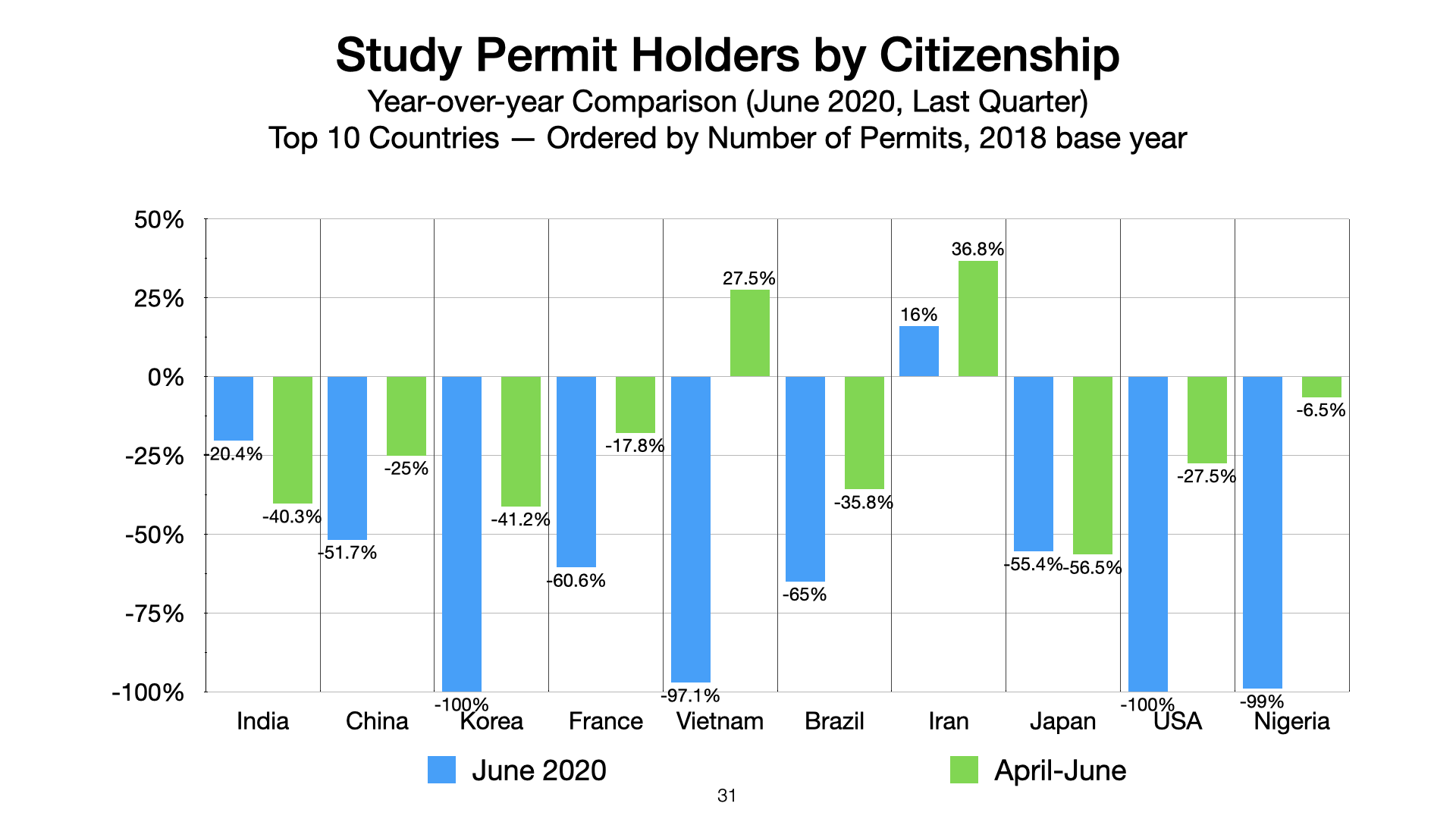
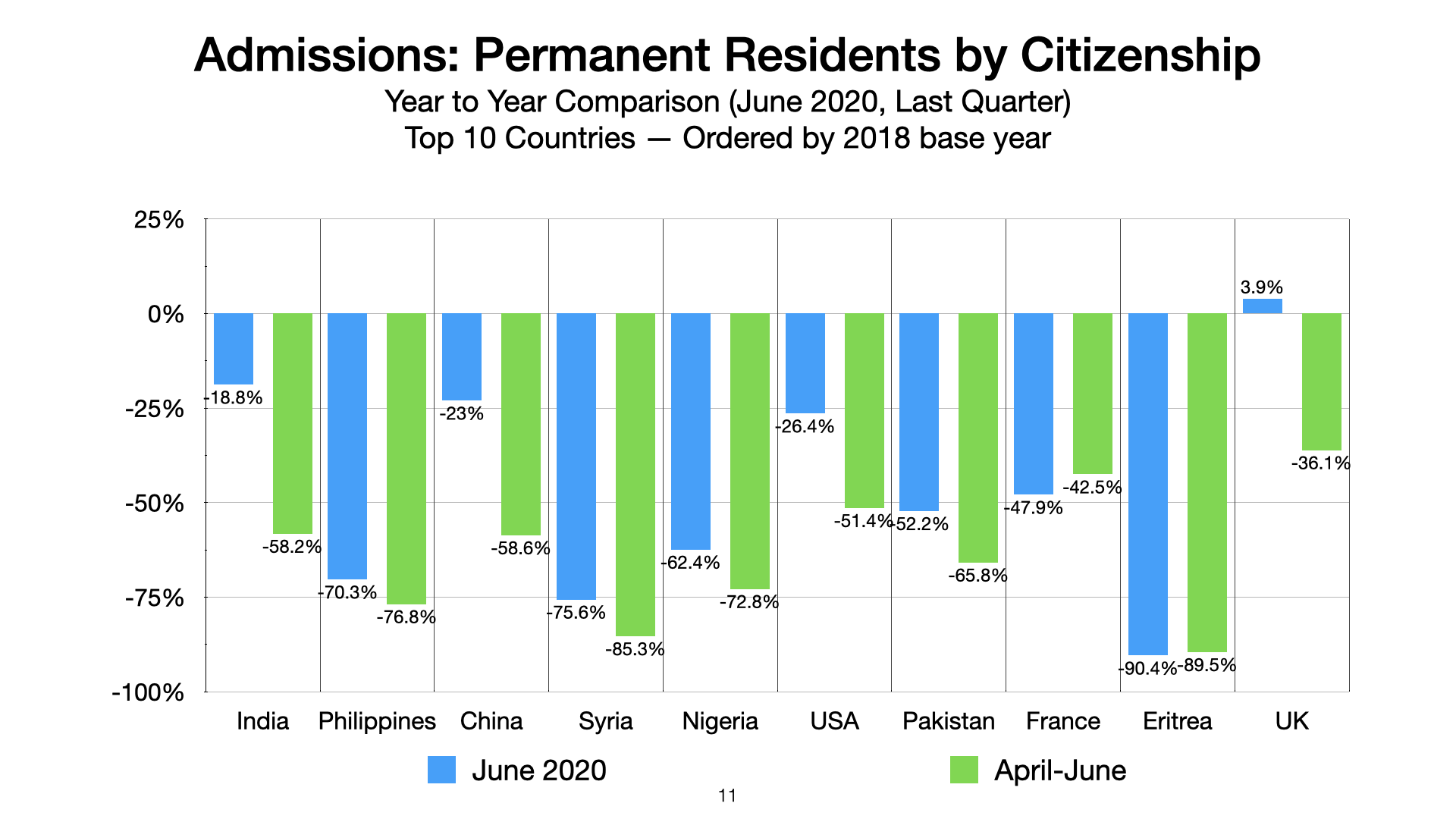
The second survey, showing increased interest in immigrating to Canada. Like all surveys, it is a snapshot, and interest doesn’t necessarily translate into action. The chart above highlights the year-over-year change in study permit holders for the 10 top source countries. As this quarter – July to September – is the historic peak, August numbers will be particularly important to assessing the impact:

What impact will COVID-19 and the resulting global economic recession have on prospective immigrants’ interest in moving to Canada? Recent research from World Education Services (WES) shows how these twin crises have affected the intentions of aspiring immigrants, shedding some light on this question.

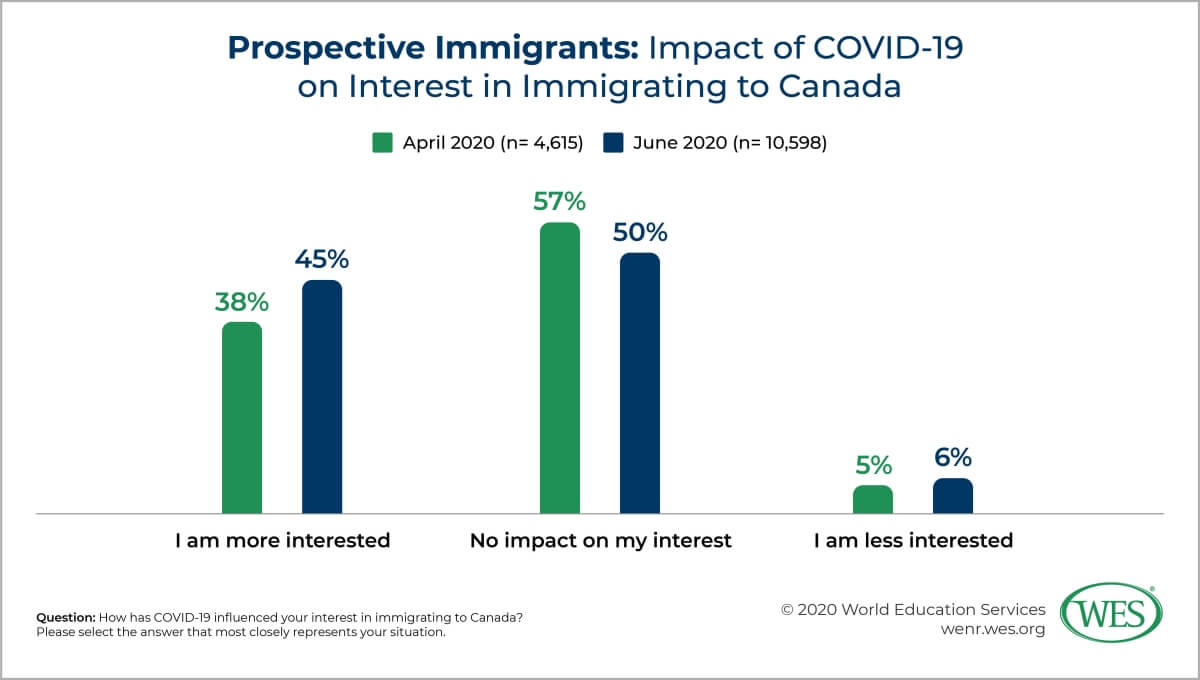
Fully 45 percent of respondents to a June 2020 survey reported that COVID-19 had increased their interest in immigrating to Canada, up from 38 percent in a similar survey in April. The survey will be sent out again in late August.

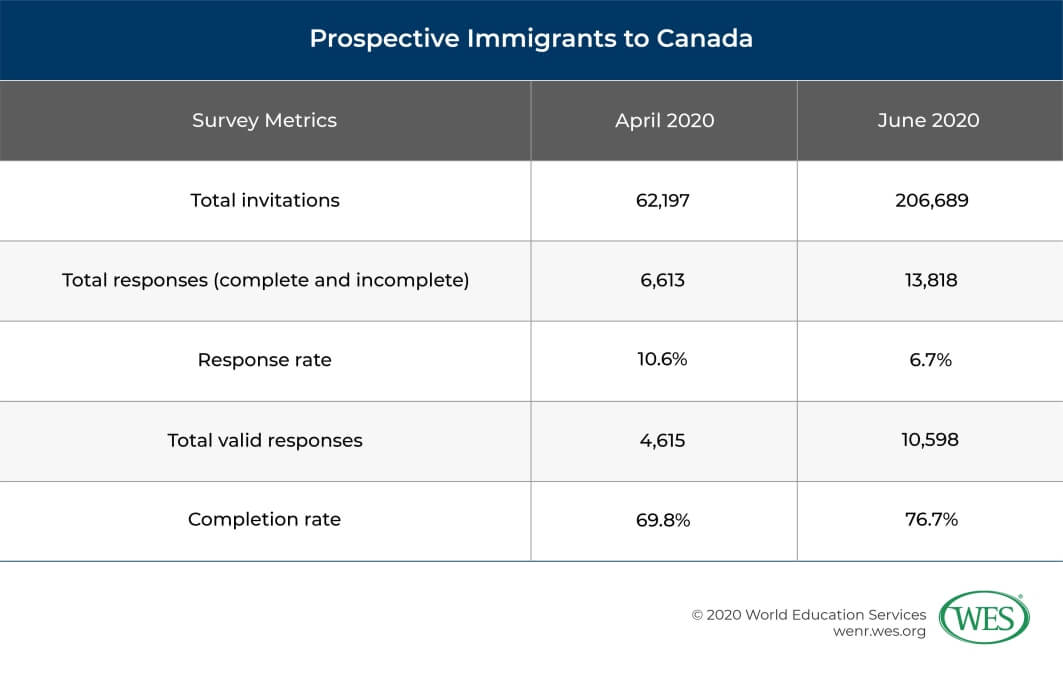
As a designated provider of the educational credential assessments required for those invited to apply to immigrate to Canada under one of the country’s economic immigration categories, WES is uniquely positioned to gauge the intentions and motivations of aspiring immigrants. Each week, WES interacts with thousands of prospective immigrants who apply for an educational credential assessment. This work gives us ready access to a pool of prospective immigrants who, by completing our surveys, can provide insight into their aspirations. What we’ve learned in these surveys may prove helpful to Canada’s immigration advocates, policy makers, and employers as they plan for a successful economic recovery.

INTEREST IN IMMIGRATING TO CANADA IS INCREASING AS A RESULT OF THE PANDEMIC

Despite COVID-19’s severe disruptions to international mobility and the global economy, both surveys reveal that the pandemic has increased interest in immigrating to Canada among a high and rising percentage of immigrant hopefuls, as noted above. Far fewer—just 5 percent in April and 6 percent in June—reported that the pandemic had decreased their interest in immigrating to Canada.

Are Intentions to Immigrate to Canada Changing in the Face of COVID-19? Image 1: Bar chart showing the impact of COVID-19 on the interest of prospective immigrants in immigrating to Canada

Image 1: Prospective Immigrants: Impact of COVID-19 on Interest in Immigrating to Canada

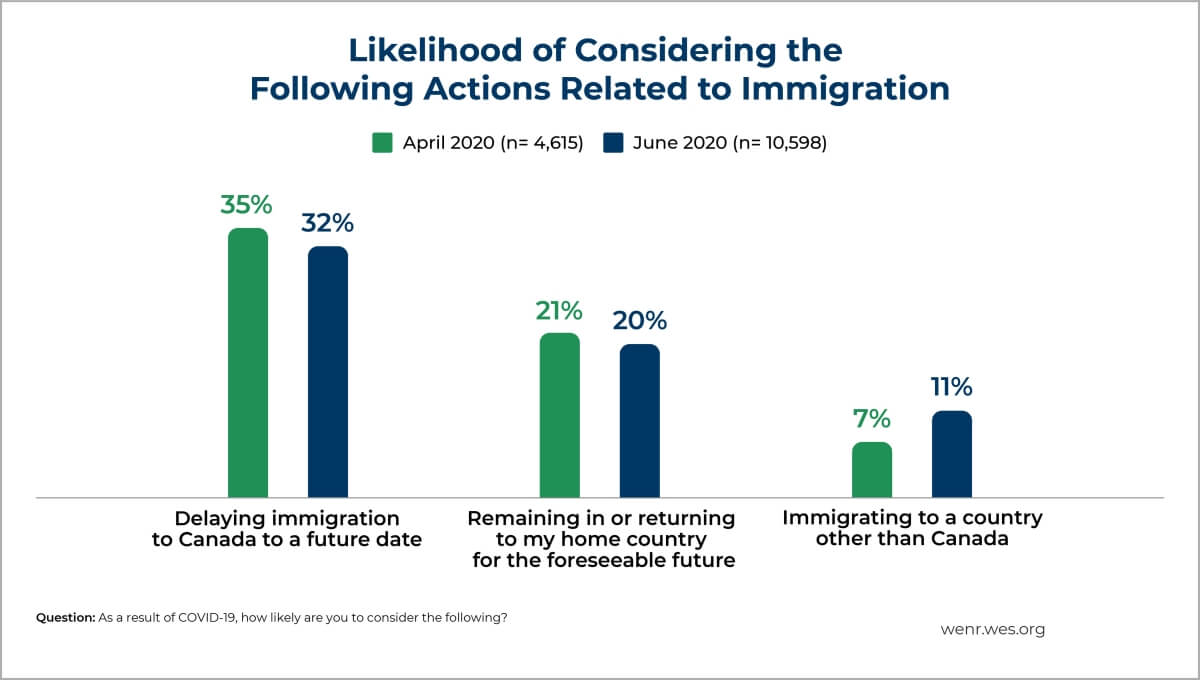
Respondents also reported that they were reconsidering their immigration plans and timelines in response to the pandemic. In June, around a third (32 percent) reported that they were considering delaying their immigration to Canada, a slight decline from the percentage in April (35 percent). A smaller proportion—11 percent of respondents in June, up from 7 percent in April—said they would consider immigrating to a country other than Canada.

Are Intentions to Immigrate to Canada Changing in the Face of COVID-19? Image 2: Bar chart showing the likelihood of prospective immigrants to consider certain immigration-related actions

Image 2: Likelihood of Considering the Following Actions Related to Immigration

ECONOMIC CONDITIONS IN CANADA AND ABROAD MAY BE DRIVING INTEREST

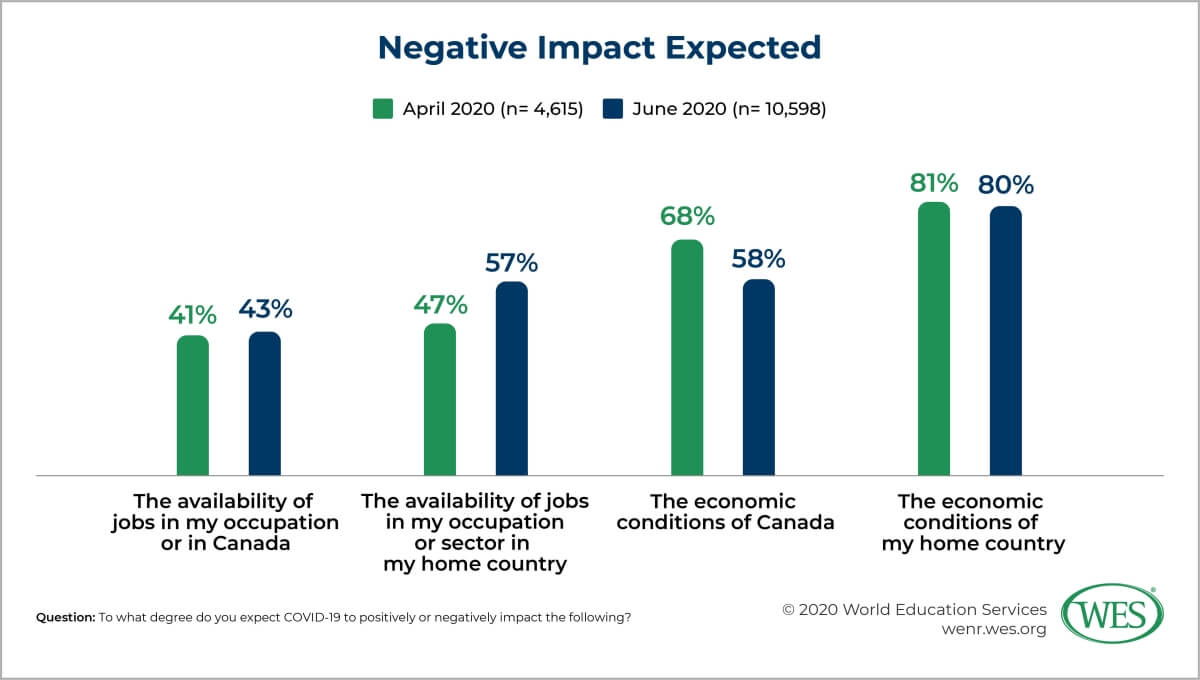
The relative resilience of Canada’s economy may be driving some of the interest in immigrating. While the surveys found that COVID-19-related economic concerns were widespread among immigrant hopefuls, our research also revealed that many respondents expected the economic impact in Canada to be less extreme than in their home country. The difference in expectations has grown greater over time. In April, 81 percent expected a negative impact on economic conditions in their home country, while fewer, 68 percent, expected a negative impact on conditions in Canada. In June, that expectation remained roughly the same for the respondents’ home country (80 percent), but by then only 58 percent expected a negative impact in Canada.

Similarly, by June, 57 percent of respondents expected a negative impact on jobs in their occupation or sector in their home country, up considerably from 47 percent in April. Far fewer—43 percent in June, up from 41 percent in April—expected a negative impact on jobs in their sector in Canada. This overall expectation of a less negative impact in Canada in terms of both overall economic conditions and the availability of sector-specific jobs may help to explain why by June nearly half of the respondents were more interested in immigrating to Canada as a result of COVID-19.

Are Intentions to Immigrate to Canada Changing in the Face of COVID-19? Image 3: Bar chart showing the prospective immigrants' expectations of the negative impact of COVID-19 on economic conditions in Canada and their home countries

Image 3: Negative Impact Expected

IMMIGRANTS WILL PLAY A VITAL ROLE IN CANADA’S RECOVERY

Canada’s continued attractiveness to those looking to settle there is good news for the country. Newcomers will play a critical role in the nation’s recovery. Despite high unemployment rates brought on by the pandemic, Canada still faces long-term talent shortages due to high rates of retirement and a shrinking pool of individuals entering the workforce each year. In the coming years, studies projecting workforce composition and growth estimate that immigrants will make up 100 percent of the net growth of the country’s labour force. Newcomers will be vitalboth to reenergizing and sustaining Canada’s post-pandemic economic recovery.

APPENDIX

Are Intentions to Immigrate to Canada Changing in the Face of COVID-19? Image 4: Table displaying survey metrics

Image 4: Survey Metrics

RBC report says immigration slowdown due to COVID-19 threatens Canadian economy

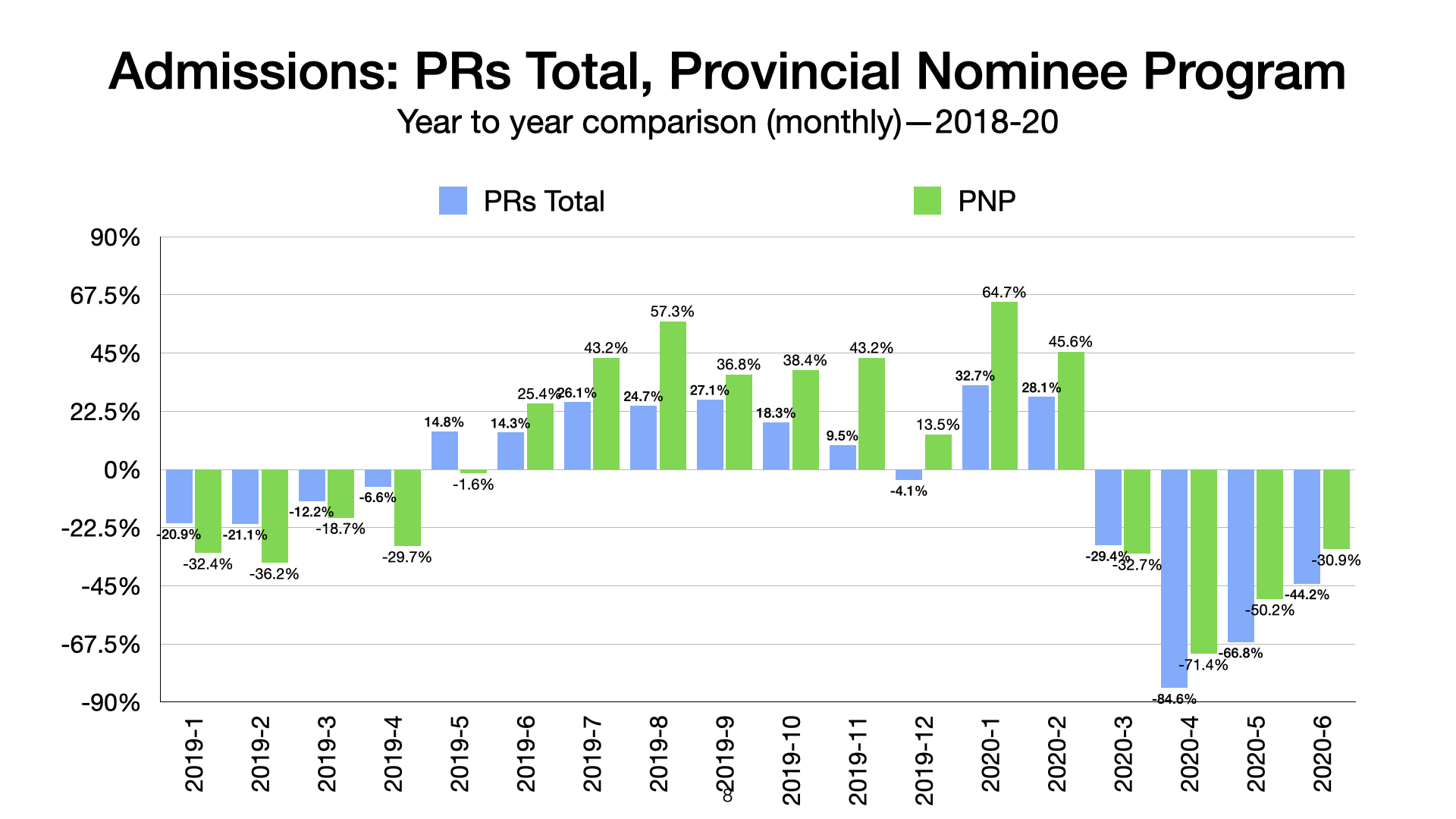
Not much new, but still a reckoning for Canada. The charts below show the year over year for immigrants (economic, family and refugees) as well as the subset coming under the various Provincial Nominee Programs, along with the top 10 countries:

A slowdown of immigration to Canada due to the COVID-19 pandemic threatens to derail a major source of economic and labour force growth, according to a report from the Royal Bank of Canada.

The shortfall jeopardizes the ability of the country to find employees needed in sectors such as health and elder care as the baby boom generation moves into retirement over the next few years, the report says.

It calls on the federal government to find new ways to encourage more immigrants to move to Canada.

“Canada does rely on having large numbers of people coming to the country to fuel growth and, if we see these large declines, one concern could be that people may decide maybe they don’t want to come to Canada anymore,” said report author Andrew Agopsowicz, a senior economist for RBC who studies labour trends.

“I think it’s really important for Canada to ensure the process is clear and that we still put out this attitude that we are open and we want people from the rest of the world to come to our country.”

Canada added 34,000 permanent residents in the second quarter, down 67 per cent from the same period last year, the RBC study said.

Meanwhile, new permanent residency applications to Canada were down 80 per cent and just over 10,000 new study permits were processed, down from 107,000 a year earlier.

Despite a recent recovery in the pace of immigration, the bank expects to see only 70 per cent of the originally targeted 341,000 new permanent residents at the end of the year, a decline of about 100,000 people.

The shortfall is particularly bad news for elder care as labour shortages have gotten worse in the wake of the pandemic’s deadly sweep through the country’s nursing homes, said Dr. Samir Sinha, director of health policy research at the National Institute on Ageing at Ryerson University and director of geriatrics at Mount Sinai Hospital.

“We’ve been having a huge struggle finding workers and retaining workers in this sector for years … and we were only keeping it afloat by often recruiting immigrants who are willing to take on these jobs that we as Canadians didn’t want to do,” he said.

“The fact it’s low paid and not valued also speaks to one of the reasons it’s been incredibly hard retaining (staff).”

Sinha said higher wages are needed not only to recruit Canadian-born workers but also to keep ambitious immigrants on the job longer.

Canada’s ability to attract immigrants with meaningful work as the economy struggles to rebound from the pandemic may be difficult.

A Statistics Canada report published Thursday finds that recent immigrants were harder hit by pandemic-related job losses, with 17 per cent becoming unemployed from March to April compared with 13.5 per cent of workers who are Canadian-born or immigrants who have been in Canada more than 10 years.

The percentage was higher, almost 20 per cent, for recent female immigrants.

The difference is significant, said Statistics Canada analyst Feng Hou, adding it is attributed mostly to recent immigrants having less work experience and earning lower wages.

“From past experience, when immigrants come during hard times, they tend to have a hard time finding jobs,” he said, adding there’s no data as yet to tell if that will happen in the current environment.

Travel restrictions that began in March and continue today make it difficult for people to physically come to Canada, Agopsowicz said.

At the same time, the lockdowns in the early days of the pandemic slowed processing of applications in Canada and prevented potential immigrants from accessing programs to ease application in their home countries.

An unknown is whether the COVID-19 virus, which hits senior citizens hardest, will have a dampening affect on the desire of foreigners to come to Canada and leave behind their vulnerable elderly relatives, Agopsowicz said.

“There’s a lot of uncertainty, I think, when people arrive already during normal times, so I think people are starting to work through what that means,” he said.

“This may be somewhat of a lost year (but) is this going to be easy to recover from next year in terms of bringing increased numbers back?”

Only about 20 per cent of new permanent residents are former students or temporary workers, he pointed out, suggesting Ottawa could do more to try to convince those people to permanently reside in Canada to bolster numbers.

Source: RBC report says immigration slowdown due to COVID-19 threatens Canadian economy

H-1B Visa Guidance Means Trump Likely Expects To Lose In Court

Interesting interview with immigration lawyer  H. Ronald Klasko and Stuart Anderson (Canadian tech immigration advantage):

Recent guidance issued by the U.S. Department of State to provide more exceptions to a presidential proclamation that banned the entry of H-1B and L-1 visa holders signals the Trump administration likely expects to lose in federal court. Examining a chronology of events supports this view.

–        On June 22, 2020, the Trump administration issued a presidential proclamation (P.P. 10052) that suspended the entry of foreign nationals on H-1B, L-1 and certain other temporary visas until at least December 31, 2020. The proclamation extended another proclamation, P.P. 10014, which suspended the entry to the United States of most immigrant visa applicants.

–        On July 15, 2020, Wasden and Banias, LLC filed a motion for preliminary injunction on behalf of 174 Indian nationals, asking a court to compel the State Department “to issue decisions on the plaintiffs pending requests for H-1B and H-4 visas.”

–        On July 31, 2020, the American Immigration Lawyers Association, Justice Action Center and Innovation Law Lab filed a motion for a preliminary injunction to enjoin the presidential proclamations on behalf of families, employers and organizations.

–        On August 10, 2020, 52 prominent companies and organizations filed an amicus brief in a lawsuit against the June proclamation brought by the National Association of Manufacturers, the U.S. Chamber of Commerce, the National Retail Federation, TechNet and Intrax. In the amicus brief, companies provided examples of how the proclamation harmed U.S. employers by blocking access to talented professionals, executives and others.

–        On August 12, 2020, just two days after the amicus brief from companies was filed, the State Department issued new guidance that broadened the “national interest exceptions” to the June 22nd proclamation (and P.P. 10014) to provide, at least in theory, more ways that foreign nationals and their employers could overcome the suspension on entry contained in the proclamations.

To explore the reasoning and implications behind the Trump administration’s legal maneuvers, I interviewed H. Ronald Klasko, managing partner and founding member of Klasko Immigration Law Partners, LLP. Klasko has practiced immigration law for more than three decades.

Stuart Anderson: Why do you think the State Department issued a guidance memo on August 12th that added more exceptions to the proclamation’s ban on H-1B, L-1 and other visa holders?

H. Ronald Klasko: In my opinion, the answer is obvious. The government’s attorneys likely advised that there is a very good chance that an injunction enjoining the implementation of the nonimmigrant (temporary) visa ban will be issued by one or more of the federal court judges in the pending litigations challenging the legal authority for the issuance of the ban.

The guidance memo appears to be an attempt to address many of the specific issues raised in the declarations and the amicus briefs regarding the prejudice and irreparable harm that this ban is inflicting on companies and foreign nationals. To me it is a clear sign that the administration is cognizant of the likelihood that it will be unsuccessful in avoiding the preliminary injunction unless it attempts to ameliorate the most harmful effects of the proclamation.

I do not believe that this tactic will be successful in preventing the issuance of an injunction because it does not address the legality of the ban. I believe the arguments challenging the legality of the ban are strong.

In addition, I assume that the lawyers involved in the various lawsuits challenging the ban will raise a number of issues, including some or all of the following: 1) the State Department guidance is not binding; 2) its issuance violates the Administrative Procedure Act (APA); and 3) the guidance is an attempt to impose the administration’s wish list for new H and L requirements, which it had planned to issue through regulation, by imposing these new requirements at the consular level as ways to be granted national interest exceptions to avoid the visa ban.

Presently there are no separate H or L requirements at the consular level. Rather, qualifications for these visas are based on a set of regulatory requirements at U.S. Citizenship and Immigration Services (USCIS) that can be reviewed by the courts. The State Department guidance memo creates a new set of requirements for the issuance of these visas that do not exist in the regulation.

By placing the requirements in a State Department guidance memo, it puts them in the context of national interest exceptions that are discretionary determinations and arguably non-reviewable in the courts. In contrast, USCIS adjudications and regulations can be challenged in court.

Anderson: Are there other reasons why the administration issued these measures on H-1B and L-1 visas in the guidance memo rather than in a regulation through the Department of Homeland Security?

Klasko: If the guidance were done through Administrative Procedure Act (APA) rulemaking, the process for notice and comment would be very lengthy time-wise. If the regulation were issued without notice and comment, it would be immediately challenged in the courts. In addition to the timing issue, many of the changes contained in the guidance memo would be subject to challenge as being inconsistent with the statute. (See here.)

Anderson: How would recent immigration memos and regulations be affected if Chad Wolf and Ken Cuccinelli are found to have been unlawfully holding their posts at the Department of Homeland Security and U.S. Citizenship and Immigration Services as the Government Accountability Office concluded?

Klasko: It likely will not impact the nonimmigrant visa ban and the immigrant visa ban, which were implemented through presidential proclamations rather than through memos or policies issued by the Department of Homeland Security (DHS) or USCIS. However, it could definitely be an issue in litigation challenging policies emanating from DHS or USCIS, such as public charge, asylum changes and possibly challenges to possible H-1B regulations.

Anderson: Do think the State Department guidance was helpful to companies and visa applicants?

Klasko: The State Department guidance is helpful in that it creates some possibilities for ameliorating the impacts of the nonimmigrant visa ban for at least some foreign nationals and companies. However, it is an example of a memo where there is less than meets the eye. It creates out of whole cloth an extremely document-intensive process with new requirements completely independent of the (document-intensive) process necessary to obtain USCIS approval of the H or L petition. Companies will have to document conformity with all new standards and requirements with no interpretations and with no certainty if, when and how the consular officers will adjudicate the national interest exceptions (NIEs).

Let’s look at how this will work. First, before there can be an adjudication of the NIE, the foreign national will have to be approved for an emergency appointment at the consulate, which requires proof that the travel is of an emergent nature.

Second, the consular officers will have to adjudicate the national interest exception application subject to no standards or guidance. Who knows how long it will take consular officers to complete these adjudications given that they already have extremely lengthy backlogs from 5 months of closure and they have never had to adjudicate these types of applications previously? This doesn’t even mention the fact that travel bans are still in effect for Schengen, UK, Ireland, China and Brazil.

None of this even addresses how difficult it will be to meet the language of the guidance memo. Most H-1Bs who are not resuming ongoing employment in the U.S. must meet a very difficult standard: their travel must be “necessary” to facilitate the “immediate and continued economic recovery of the U.S.” Think about it, how many H-1Bs are necessary to facilitate the immediate and continued economic recovery of the U.S.?

If the applicant meets those requirements, he then must show that he is making a “significant” and “unique” contribution to an employer meeting a critical infrastructure need. Uniqueness has never been a requirement of the immigration law. If it is really interpreted as requiring that the H-1B be the only person who could possibly do the job, the entire memo may be illusory. One other note: If the applicant is performing or could perform the functions of the position remotely from outside the U.S., he apparently doesn’t qualify.

For L-1s, it is not enough to be a manager or executive, which is the statutory and regulatory requirement. Under the State Department guidance, it is necessary to be a “senior level” executive or manager, which has no definition or guidance. Also, the statutory and regulatory requirement for an L-1 is that the transferee has been employed by the employer for at least 1 year. The State Department guidance requires multiple years of employment. How many years is multiple years?

In summary, the State Department guidance is better than no guidance at all, but possibly not much better.

Anderson: What do you think will happen between now and the end of the year on high skill immigration?

Klasko: I think in the coming months there is a good chance that the nonimmigrant ban and the immigrant ban will be enjoined by at least one federal court. I think that it is possible, and even likely, that there will be additional presidential proclamations of highly questionable legality attempting to implement further restrictions on high skilled immigration. I also think it is possible, or even likely, that there will be an effort to restrict high-skilled immigration through the regulatory process, possibly avoiding the notice and comment rulemaking required by the Administrative Procedure Act. I think litigators will be busy.

Source: https://www.forbes.com/sites/stuartanderson/2020/08/19/h-1b-visa-guidance-means-trump-likely-expects-to-lose-in-court/?utm_source=newsletter&utm_medium=email&utm_campaign=follow&utm_campaign=follow&cdlcid=5e4bc7f55b099ce02faa6b40#69373e5f15ab