Australia: ‘Depressed, anxious, bored, frustrated’: Christmas Island detainees struggle with isolation

Speaks for itself:

More than 30 people transferred to a remote immigration detention facility on Christmas Island have little access to internet and are struggling to contact their families.

The controversial North West Point detention centre on Christmas Island was reopened in August to relieve pressure on the onshore detention network, which had been nearing capacity.

At least 31 people have so far been transferred to the facility. The Australian Border Force declined to confirm the current detainee population on Tuesday.

One of the detainees is Les Reilly, who was transferred to Christmas Island from the Yongah Hill detention centre outside Perth in early August.

He said there were four computers with no video-calling software at the Christmas Island facility, but “you’re lucky if one works at a time”.

Quebec won’t use COVID-19 notification app for now

Again, surprising given Quebec’s overall poor performance in managing and containing the pandemic. And another kudos to Premier Ford for his plain language messaging “Just do it…”:

Quebec won’t use a smartphone application to notify the public about potential exposure to COVID-19 for now, arguing its testing and contact-tracing capability are sufficient at this stage of the pandemic.

While the province is not closing the door on using an app in the future, Premier François Legault says he would rather use one that was developed in Quebec.

“We would prefer a Quebec company, but I don’t think this is our main argument,” Legault said Tuesday afternoon in Saint-Hyacinthe, Que.

He says there is a lack of broad support for such an app in the province, due to privacy concerns.

“Maybe in six months we will come to another decision,” he said.

The decision puzzled the federal Health Ministry. Thierry Bélair, a spokesperson for Health Minister Patty Hajdu, pointed out that the app offered by the federal government, COVID Alert, does not track a user’s location nor collect any other personally identifiable information.

“It’s also an additional tool we can use as we prepare for a possible increase in cases this fall. So why not make it available now in Quebec?” said Bélair.

COVID Alert, which uses open-source technology built by a volunteer team of engineers at Ottawa-based Shopify, is designed to warn users if they’ve spent at least 15 minutes in the past two weeks within two metres of another user who later tested positive for the coronavirus.

It was launched at the end of July and currently only works in Ontario, where it has been downloaded more than two million times.

Adoption of one app across Canada would be “very helpful” to ensure those who travel between provinces are notified of possible exposure to the virus, Dr. Theresa Tam, Canada’s chief public health officer, said at a Tuesday news conference.”From the federal perspective, we want as many Canadians as possible to be participating,” she said.

Experts in both technology and public health stress that the more people who use the app, the better it will be.

Canada’s Chief Public Health Officer Dr. Theresa Tam says more widespread adoption of the COVID Alert app is one more layer of protection. This comes as Quebec announces it will not sign on to the app for now. 1:03

Éric Caire, Quebec’s minister responsible for digital transformation, said the government is interested in a made-in-Quebec app and is also running tests on the federal app to ensure it is secure.

He said the province has learned from public consultations and legislative hearings that a solid understanding of the technology used in an app makes Quebecers more open to installing it.

“The more that people are told what it does and does not do, the more they will be reassured,” said Caire.COVID Alert relies on Bluetooth technology to detect proximity to other users, instead of GPS data.

The province heard from 16,456 Quebecers in online public consultations about the use of a COVID-19 notification app. Seventy-seven per cent believed such an app would be useful, and 75 per cent said they would install it, the province said in a statement.

But the voices heard at hearings, held by the Institutions Committee in Quebec City, about a possible contract-tracing app were more skeptical.

“Quebec’s legal framework is inadequate in terms of data and personal information protection and access to information, informed consent and the fight against discrimination,” said a report prepared by the committee once those hearings concluded.

Committee members acknowledged that almost all of the 18 experts who testified at the hearings expressed serious reservations about the effectiveness and reliability of the technology.

Dr. David Buckeridge, an epidemiologist at McGill University’s School of Population and Global Health, said the right time to start using such an app would be before the number of daily new cases reaches the crisis levels seen in the spring.”I think the risks, frankly, from this app are relatively quite low, and it was designed in that way,” he said.

“The main issue here is going to be trust and adoption.”

Caire said the province will continue to watch how widely the app is used in Ontario and that Quebec will consider using an app in the event of a second wave.

Ontario Premier Doug Ford said he would ask Legault to reconsider his government’s decision.

“Just do it. It protects everyone,” he said to reporters Tuesday afternoon. “It’s not a big deal.”

Source: Quebec won’t use COVID-19 notification app for now

Fact Check And Review Of Trump Immigration Policy

Good summary:

At the Republican National Convention, Donald Trump and his supporters have given the impression that Trump administration policy, while tough on illegal immigration, has been welcoming to legal immigrants, people trying to become American citizens and refugees fleeing government persecution. Below is a review of Trump administration policies on legal immigration from 2017 to the present.

Legal Immigration Cut in Half, Most Categories Blocked: By 2021, Donald Trump will have reduced legal immigration by 49% since becoming president – without any change in U.S. immigration law, according to a National Foundation for American Policy analysis. An April presidential proclamation blocked the entry of legal immigrants to the United States in almost all categories.

Reducing legal immigration most harms refugees, employers and Americans who want to live with their spouses, parents or children, but it also affects the country’s future labor force and economic growth: “Average annual labor force growth, a key component of the nation’s economic growth, will be approximately 59% lower as a result of the administration’s immigration policies, if the policies continue,” according to the National Foundation for American Policy.

The Most Highly Skilled Foreign-Born Blocked or Denied at High Rates: The denial rate on new H-1B petitions for high-skilled foreign nationals has increased from 6% in FY 2015 to 30% in FY 2020. A June 2020 presidential proclamation suspended the entry of foreign nationals on H-1B and L-1 (intracompany transferees) visas.

As reported in August, “Today, even the most highly skilled individuals in the world cannot enter America under the Trump administration’s immigration policy. Reports from attorneys and a statement from the State Department confirm that U.S. consular officers in Europe are denying O-1 visas for individuals with ‘extraordinary ability’ based on a health pretext.”

Refugees and Asylum Seekers, including from Venezuela, Denied:At least one speaker at the convention discussed the protection Americans once offered Cuban refugees and spoke sympathetically about the victims of Venezuela’s socialist government. For FY 2020, the Trump administration established an annual ceiling for refugees 84% lower than the final year of the Obama administration (from 110,000 down to 18,000). As of July 17, 2020, only 7,848 refugees have arrived in the United States in FY 2020.

As of December 2019, 24,451 Venezuelans were in U.S. immigration court facing removal, an increase of 277%, from 6,492 in September 2018, reports the Syracuse University Transactional Records Access Clearinghouse (TRAC). “Rather than make things easier for fleeing Venezuelans, the Trump administration has tightened asylum standards,” according to Miami New Times reporter Manuel Madrid, who writes that many Venezuelans consider being deported to Venezuela to be a death sentence.

Despite pleas from religious leaders, the administration has not designated Venezuelans for Temporary Protected Status and has continued to deport people back to Venezuela. Immigration and Customs Enforcement (ICE)removed more than 900 people to Venezuela between 2017 and 2019. In FY 2016, the last full year of the Obama administration, 182 Venezuelans were removed, compared to 327 in FY 2019 under the Trump administration, an 80% increase.

Asylum seekers from Cuba and Venezuela (and Central America) who try to enter the United States and apply for asylum would be unlikely to obtain a hearing under current administration policies at the U.S. border. New asylum regulations also make it difficult for those fleeing persecution to be approved if they receive a hearing.

A Significant Increase in Denials for Military Naturalizations: The denial rate for military naturalizations increased from 7% in FY 2016 to 17% in FY 2019, a 143% increase in the denial rate, according to a National Foundation for American Policy analysis. Due to policy decisions, between FY 2016 and FY 2019 the number of immigrants in the military who naturalized dropped by 54%, from 8,606 in FY 2016 to 3,987 in FY 2019.

On August 25, 2020, the same day a naturalization ceremony was held at the White House, a federal court ruled against the Trump administration’s efforts to make it more difficult for active-duty service members to become American citizens. “A federal court today ruled that the Trump administration’s policy of depriving military service members of an expedited path to citizenship is unlawful,” reported the American Civil Liberties Union (ACLU). “The ruling comes in a lawsuit, Samma v. U.S. Department of Defense, filed by the ACLU on behalf of eight non-citizen U.S. service members who represent a class of thousands in uniform.”

Naturalization Slowed and Ceremonies Stopped for Many Applicants: The five people who received naturalization at the White House on August 25, 2020, were fortunate. Over 100,000 immigrants have been waiting to become U.S. citizens due to administration policies. In March, in response to the coronavirus pandemic, U.S. Citizenship and Immigration Services (USCIS) closed offices and for months would not provide alternative methods for completing the citizenship process, such as administering oaths virtually or incorporating social distancing in naturalization ceremonies.

While naturalization ceremonies slowly came back, it is likely many immigrants will not be citizens in time to vote in the November election, due, in part, to long delays in processing. (See also this report from Boundless, which has estimated as many as 300,000 immigrants may not gain citizenship before November.)

On August 3, 2020, the administration significantly increased the fees for immigrants to become American citizens, increasing the cost of the application (N-400) to become a U.S. citizen by more than 80%, from $640 to $1,160 (for online filings, although a separate $85 biometrics fee would be eliminated).

Some have wondered about the Trump campaign’s motivations for presenting a picture of its immigration policies that differs from the policies the administration implemented over the past three and a half years. The Washington Post’s Fact Checker Glenn Kessler asked, “Hmm, wouldn’t a speech by Stephen Miller at this point better reflect the president’s immigration policies in the past three years than this naturalization ceremony?” Washington Post columnist Catherine Rampell replied, “Exactly. If Trump’s (anti-)immigration agenda is so great, why not defend it on the merits? Why misrepresent what it actually does, by pretending Trump welcomes political refugees and newly-naturalized immigrants?”

Source: Fact Check And Review Of Trump Immigration Policy

#COVID-19: Comparing provinces with other countries 26 August Update and Globe editorial on Quebec’s handling of the pandemic

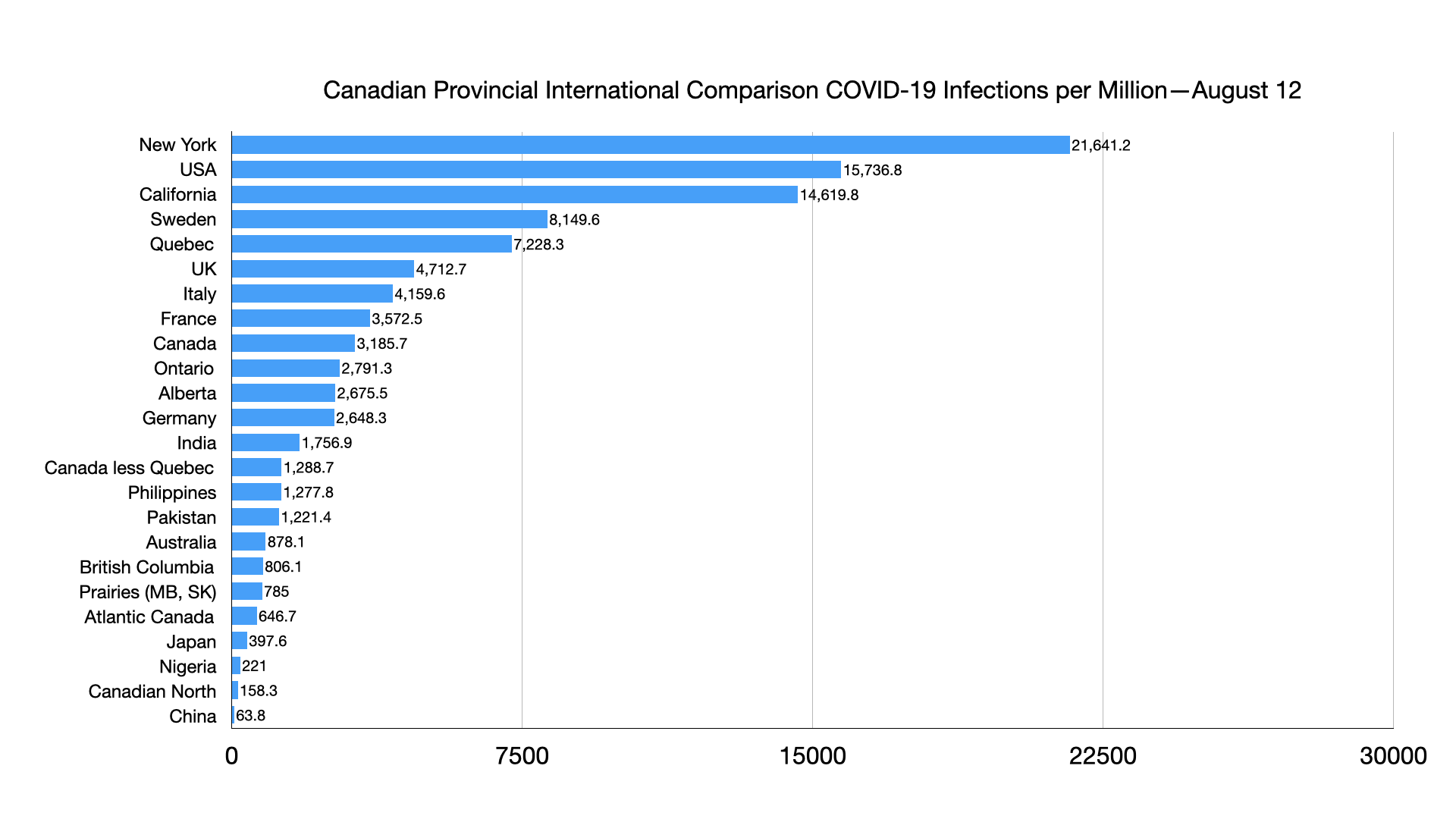
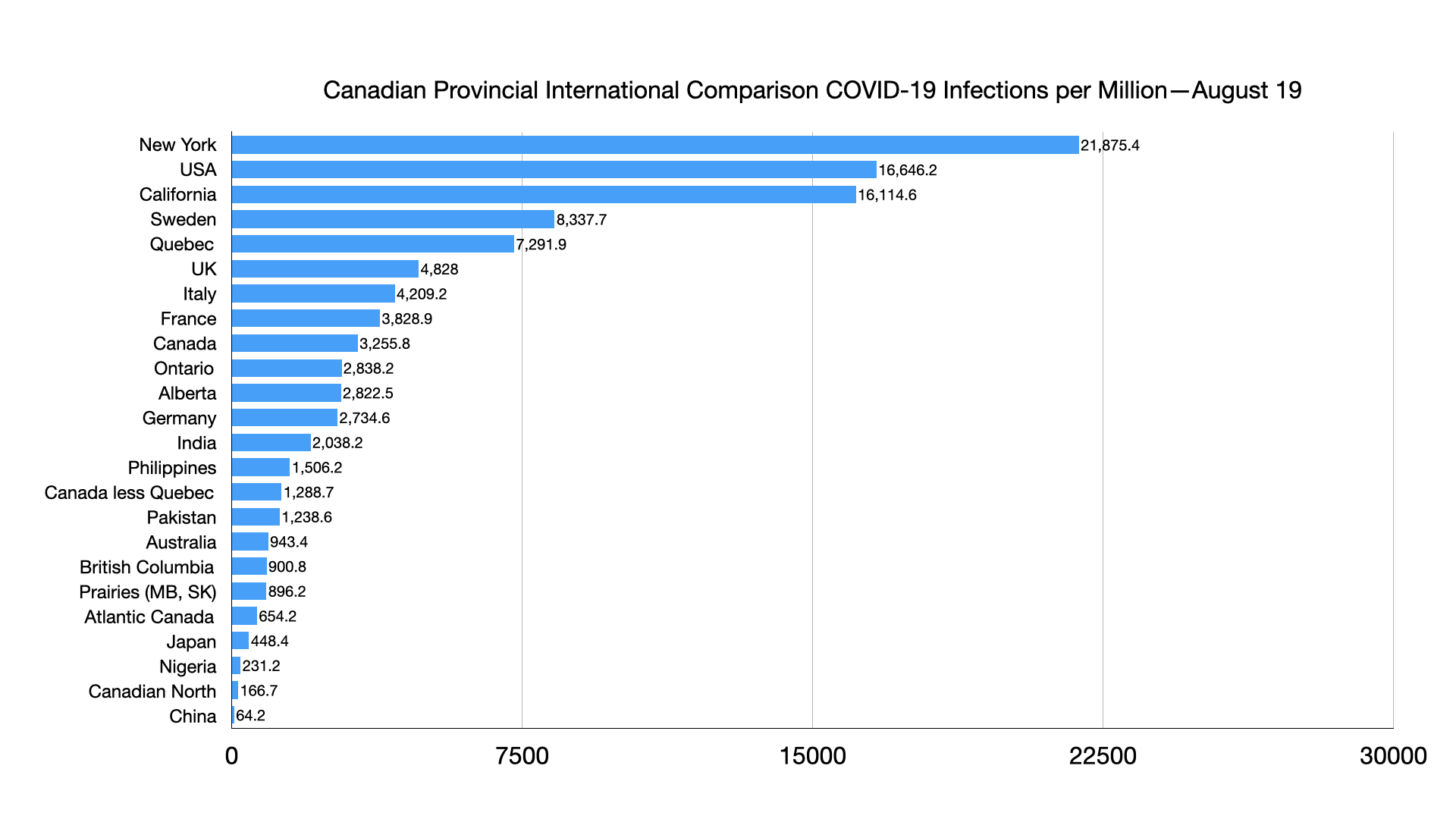
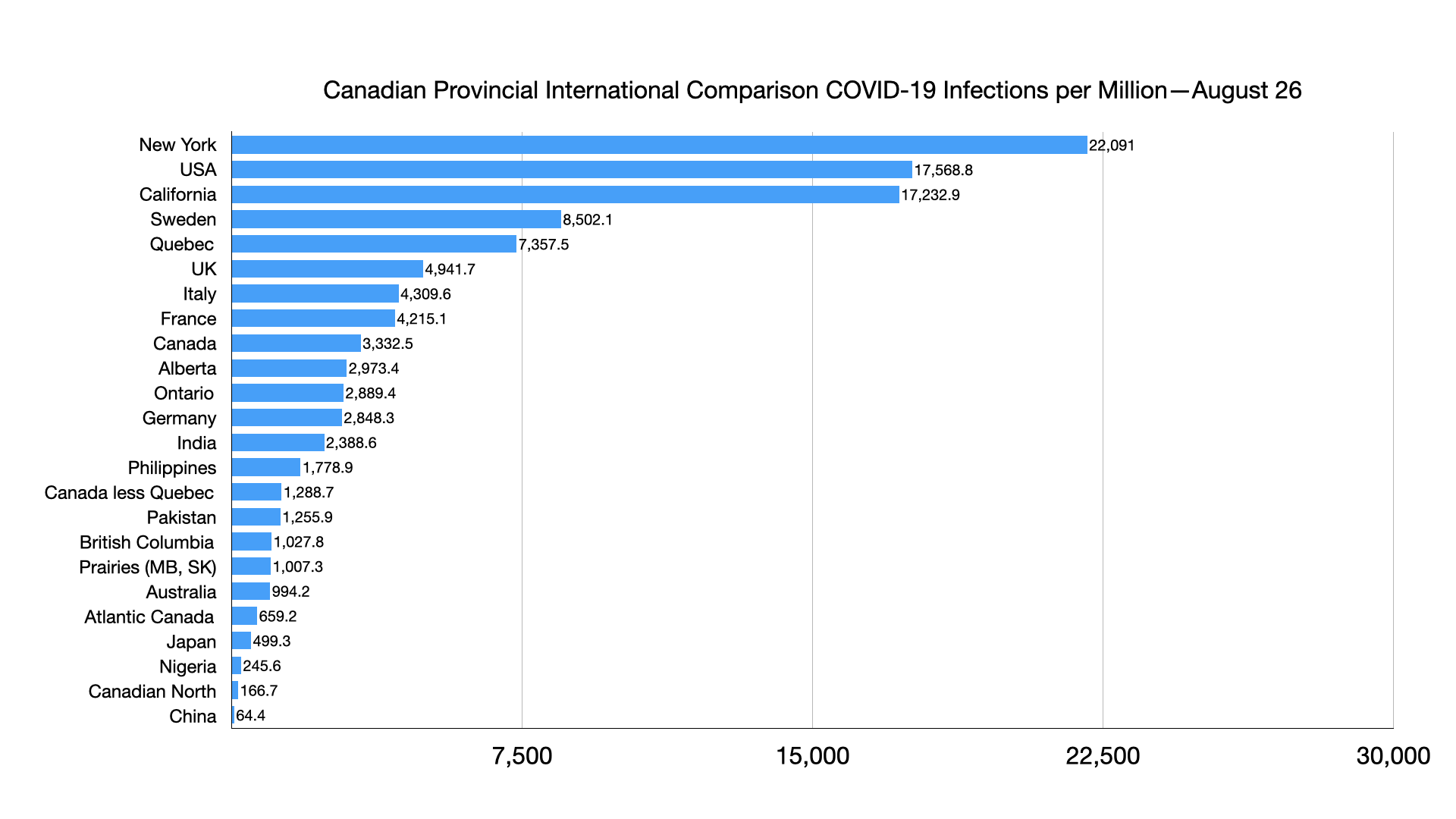
Changes of interest include Alberta now has a higher number of infections per million than Ontario, with India and the Philippines having higher infection rates than Canada less Quebec.
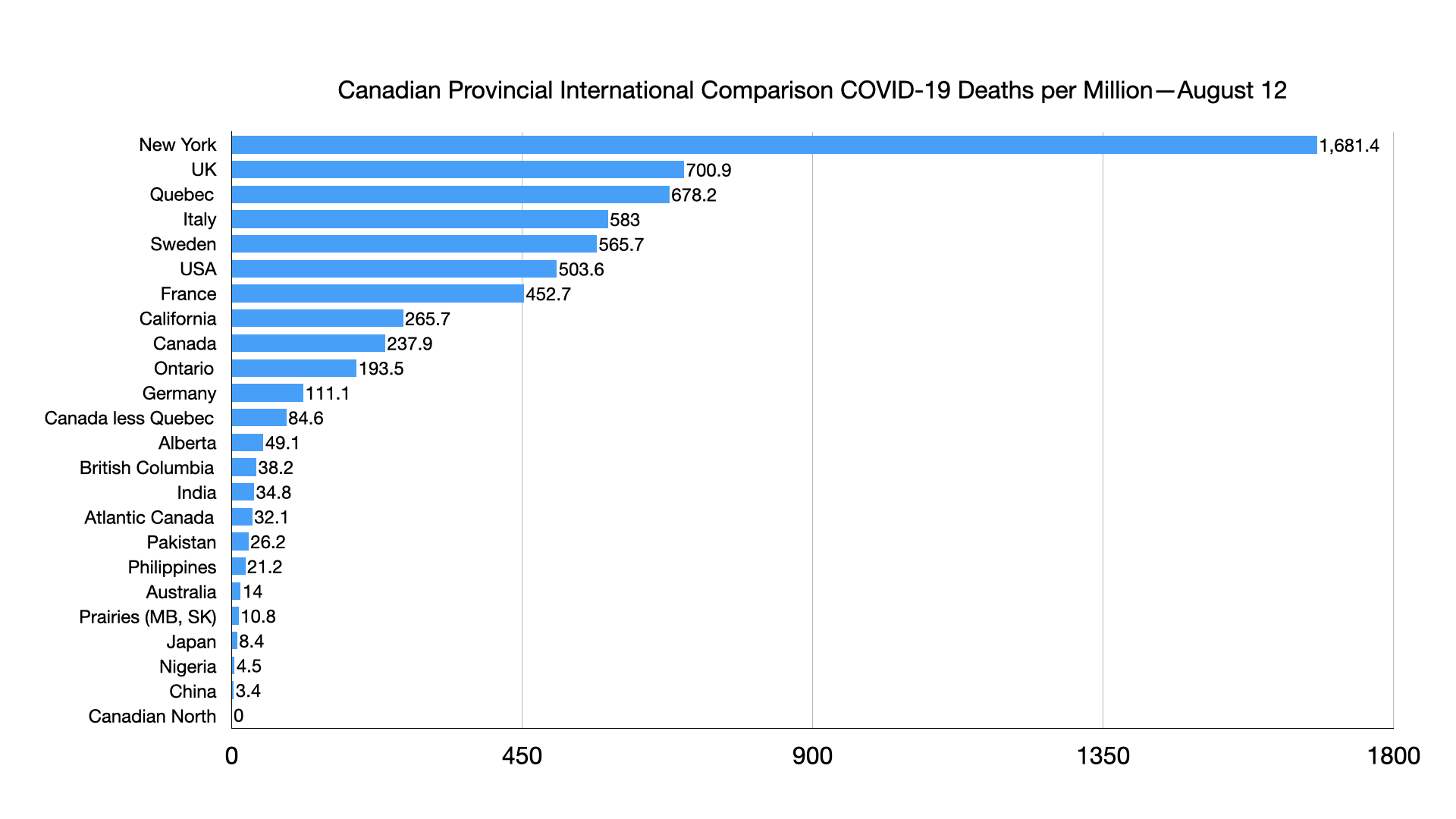
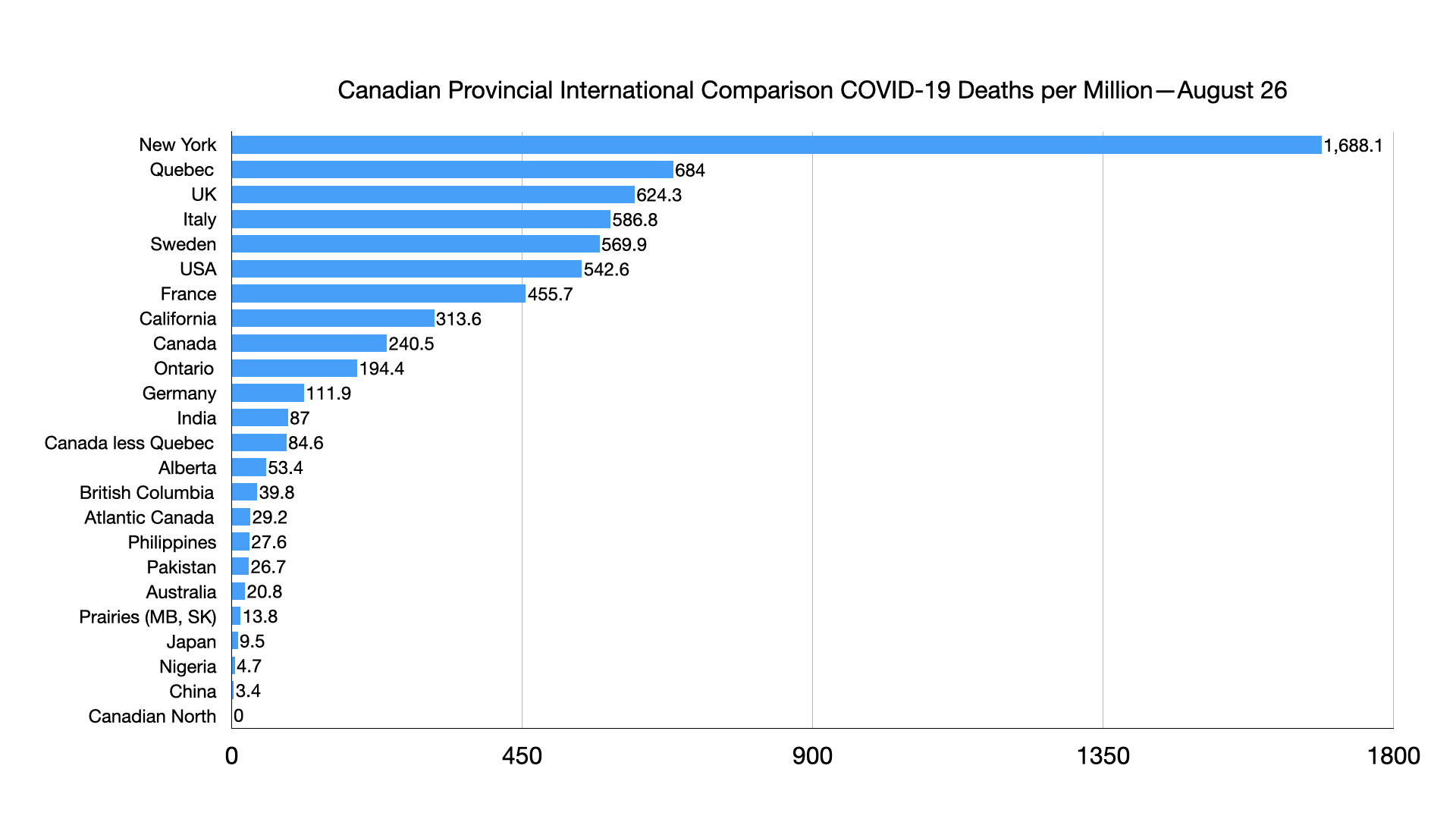
India’s death rate per million now exceeds Canada less Quebec.


Lastly, a good Globe and Mail editorial on the failures of the Quebec government in managing the pandemic (Quebec’s COVID-19 death toll is Canada’s highest, and one of the worst in the world. No, that’s not fake news):

There is no province in Canada that has done a perfect job of limiting the spread of the COVID-19 virus. But there is one province that stands out as having done the least perfect job of all, and that is Quebec.

As of Tuesday, Quebec had recorded 724 confirmed cases of COVID-19 per 100,000 people. The national average is 332 per 100,000. The province with the next highest rate, Alberta, stood at 295 on Tuesday.

The same gaps exist in the number of deaths per capita. Quebec has had 67 deaths per 100,000 people – one of the highest death rates in the world, and well above Italy, Spain or the United States. The next highest province, Ontario, is at 19 deaths per 100,000.

It may not be entirely fair to compare across jurisdictions, but Quebec Premier François Legault has invited such scrutiny by resorting to divisive tactics to distract from the painful reality of the crisis in his province.

Last week, he once again accused the veteran health reporter at The Gazette, Montreal’s English-language daily newspaper, of being biased. It was the third time he has claimed that Aaron Derfel is trying to undermine his government with false reporting.

The Premier also said that, if anglophones in Quebec are more worried about catching COVID-19 than francophones, as at least one poll suggests, it must be because they are spending their time reading Mr. Derfel’s tweets and watching CNN and other American news channels.

Attacking journalists and taking cheap shots at a minority group is no way to address a crisis that has claimed the lives of more than 5,700 Quebeckers. Columnists in the province’s French-language newspapers have rightfully pilloried Mr. Legault for trying to shoot the messenger.

Mr. Legault’s tactic has backfired in another way, too, by shining a spotlight on his government’s handling of the crisis. It’s fair to say the Premier has not had a good pandemic.

Not that it’s entirely his government’s fault. Quebec had the misfortune of scheduling its annual school spring break in late February, a week ahead of the rest of the country. Many Quebeckers holidayed in the United States and Europe just as the pandemic was picking up steam. Some experts believe Quebec’s early spike in cases was mostly bad luck.

But the curve of new cases continued to climb after lockdown was imposed in March. And Quebec’s outbreaks in long-term care homes were bigger, longer and deadlier than anywhere else in Canada.

The government’s most glaring misstep occurred on June 24, a provincial holiday, when Quebec’s public-health agency announced it would no longer release data about new cases and deaths on a daily basis – a practice common around the world – and would instead only make them public once a week.

The surprise decision came after Horacio Arruda, Quebec’s chief public-health officer, attended a provincial cabinet meeting at which the issue was discussed, raising concerns that Dr. Arruda had yielded to demands from the Legault government.

Dr. Arruda denied there was any political interference. But three days later, after much criticism from epidemiologists and francophone commentators, the decision was reversed.

In the midst of all that, Mr. Legault demoted his health minister, Danielle McCann, and replaced her with Treasury Board president Christian Dubé.

Firing your lead minister in the middle of a major crisis is never a good look, but Mr. Legault was reportedly fed up with the endless bad news battering his government.

The government has also come under fire for reopening bars in late June, causing a fresh spike in cases, and for raising the maximum number of people at an indoor public gathering to 250 from 50 as of Aug. 3, a move that has backfired in European countries and many American states.

This week it’s the government’s back-to-school plan that is drawing fire. Unlike most other provinces, Quebec students will not have to wear masks or physically distance in classrooms. And parents will not have the option of keeping their children at home to learn remotely, unless they provide a “valid medical note.”

Mr. Legault is not the only premier facing tough questions about their handling of the COVID-19 pandemic. But he’s the only one trying to make a farce of this tragedy, by blaming a reporter for reporting the news.

Source: https://www.theglobeandmail.com/opinion/editorials/article-quebecs-covid-19-death-toll-is-canadas-highest-and-one-of-the-worst/

Birth Tourism: Non-resident births 2019-20 numbers show steady increase

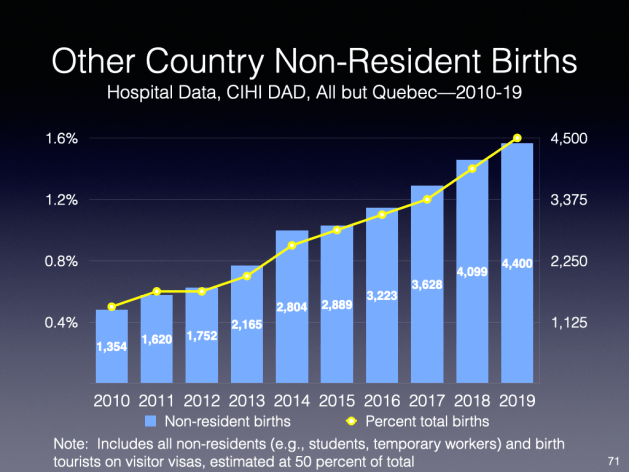
The 2019-20 numbers, obtained from the Canadian Institute for Health Information (CIHI) for all provinces save Quebec, show an overall increase of about 7 percent compared to the previous year, with British Columbia showing an increase of more than 20 percent.

Quebec does not authorize CIHI to release their comparable data, unfortunately.

As non-resident numbers are a broader measure than those on visitor visas coming to give birth (e.g., students, temporary workers), my estimate is that about 50 percent are likely birth tourists.

It appears that the efforts underway by IRCC, CIHI and Statistics Canada to link healthcare and immigration data, that would allow identification of those on visitor visas from other non-residents, has stalled given shifting priorities due to COVID-19.

So these numbers remain the best we have.

Vancouver area hospitals (Richmond General: 24 percent, St. Pauls and Mount St. Joseph: 14.1 percent) continue to have the largest percentages of non-resident births, with an active cottage industry supporting women coming to give birth from China. While awareness of COVID-19 in China was greater and earlier than elsewhere, with a corresponding decrease in visitor visas issued and air travel, this did not impact non-resident births, likely given that plans were set.

2020 numbers, of course, are expected to reveal a sharp decline reflecting travel restrictions, particularly with respect to birth tourists on visitor visas.

Hopefully, the work to link healthcare and immigration data will resume shortly, not only to provide more accurate numbers with respect to birth tourism but to improve our understanding of healthcare and immigrants more generally.

My original article on how non-resident birth data provides a better indication of birth tourists, which provoked the government commitment for the aforementioned study, can be found here An analysis of hospital financial data shows that birth tourism is rising, and not just in British Columbia. Two of the critiques are: Revoking birthright citizenship would affect everyone and Birth tourism and the demonizing of pregnant migrant women.

Citizenship - Slide Gallery 2018.071Citizenship - Slide Gallery 2018.072Citizenship - Slide Gallery 2018.073

Ontario students say business schools foster hostile environment

While more anecdotal that evidence-based, still of note given that visible minorities are more prevalent than not visible minorities in business and administration studies as shown above:

Business school students in Ontario are sounding the alarm about what they call outright racism from fellow students and a lack of equity and diversity training among faculty.

A number of social media accounts have popped up in recent months, anonymously recounting stories of racism happening in universities across the province.

Schools such as Queen’s University in Kingston, Ont., and York University in Toronto are among those that have come under fire.

Kelly Weiling Zou, a 20-year-old Singaporean-Chinese student studying commerce at the Smith School of Business at Queen’s, said the racism she witnessed pushed her to create a platform for students to vent about their experiences.

Zou created the Instagram account, stolenbysmith, which has amassed more than 12,000 followers and shared more than 300 stories, ranging from tales about barriers to career opportunities, social ostracism based on students’ backgrounds and encounters with discrimination from faculty.

“The Smith administration has historically failed to respond to students’ call to action in addressing issues of discrimination within the school,” Zou said in an interview. “We can’t change systemic barriers. Only they can as they have the power.”

Meena Waseem, a second-year business student at Queen’s, said her first brush with racism at the school came on her second day of orientation week last fall.

The 19-year-old said one student leader, also in the business program, used the “N-word” in a song to a room full of students.

“Witnessing this was disappointing, and it made me feel unsafe,” Waseem said. “This was the first of many experiences, which made it clear that racism is normalized here.

“For me personally, being a visibly Muslim brown woman at this school is exhausting. Being a lower-income student doubles that exhaustion. I have to consistently advocate for my needs.”

Incidents described as ‘unacceptable and deeply troubling’

Brenda Brouwer, interim dean at the Smith School of Business, said the university is working on addressing concerns raised by its students. She called the incident detailed by Waseem “completely unacceptable and deeply troubling” and said it would be a clear violation of the school’s code of conduct.

“Improving diversity and increasing inclusion is an urgent priority,” Brouwer said. “While progress has been made, we know there is more work to be done, and we will continue to actively foster a culture of inclusion, dignity and respect.”

Aba Mortley, co-chair of the council of anti-racism and equity at Queen’s, said she works as a bridge between faculty and students in order to bring about discussions on campus and in the wider Kingston community.

“There is no denying that these issues regarding Black and Indigenous people are clear and present,” Mortley said.

“No one can say that racism isn’t happening when it is out in the open.”

She said the school is in a better position to work on these discussions now, thanks to the recent momentum of the Black Lives Matter movement.”With all these stories coming out, it is forcing the school to take action,” Mortley said.

Students say schools foster a ‘hostile environment’

Sara Reza, a student at York University’s Schulich School of Business, said discrimination and racism are also present on her campus.

Reza is the founder of a social media account called SilencedatSchulich, which, like Zou’s account, highlights the stories of Black, Indigenous and students of colour at York’s business school.

“Business programs rarely integrate diversity and inclusion, which fails to address the persistent inequality that exists in our communities and worldwide,” she said.

Reza said business university programs foster a “hostile environment” in which topics of privilege, inequality and race are rarely brought up in the classroom.

Humera Dasu, a third-year York student, said she was left feeling uneasy when a white professor and group of students allegedly made inappropriate comments when discussing Islam.”The professor implied to a class of 50 students that she thinks the religion is oppressive to women,” said Dasu, 20.

“I was deeply offended and hurt.… Islamophobia has been normalized to the point that such a comment can be made in a classroom environment.”

‘More needs to be done,’ says interim dean

Detlev Zwick, interim dean at Schulich School of Business, said the school is aware of concerns brought forward recently by students and graduates.

“The Schulich School of Business does not tolerate or excuse discrimination and racism of any kind. As one of the most diverse business schools in North America, Schulich has a long tradition of actively encouraging and supporting inclusivity and diversity,” he said.

“Obviously, more needs to be done, and we have already begun taking action in various ways to ensure greater awareness surrounding issues of racism, especially anti-Black racism, as well as sexism and discrimination.”

Zwick said the school is also currently in talks with other leading business schools in Ontario regarding several joint initiatives to tackle barriers for Black and Indigenous students, particularly from high schools in economically disadvantaged communities.

Source: Ontario students say business schools foster hostile environment

How the U.S. asylum system’s biases affect migrants’ chances

Good data-based analysis, showing how outcomes depend upon nationality, where seekers wait (what part of the country, whether in detention or not), and the judge assigned. Sean Rehaag continues his annual analysis with respect to outcome differences, showing wide variations between IRB Members, some explicable, some not:

For the world’s most vulnerable, protection in the United States has all but disappeared.

Wait times for asylum seekers at the U.S.-Mexico border that already seemed indefinite now seem impossible. Families struggle to find food and shelter to outlast a pandemic order with no end date.

Those who cross north are sent back to Mexico in a matter of hours — or even put onto planes back to the countries from which they fled — without any opportunity to explain why they came.

In its response to COVID-19, the Trump administration achieved what it long sought, a shutdown of the U.S. asylum system. And with new regulations introduced this summer, the administration has moved to squeeze out any real chance at refuge in case the pandemic order is lifted.

But even before the current president began his campaign against asylum in the United States, people often struggled to win protection — no matter how strong their cases appeared to be.

In its 40-year history, the system has chronically fallen short of its promise of safety.

The Trump administration has used statistics about grant rates to justify closing off access to asylum, saying that those who lose their cases are illegitimate asylum seekers.

The facts show a different story: Thousands of people turned away based not on the merits of their cases, but on the capriciousness of a system so riven with inequity that many outcomes seem little more than arbitrary.

A San Diego Union-Tribune analysis of 10 years of court outcomes uncovered many symptoms of the system’s biases — shortcomings that date to the system’s creation.

Numerous factors can sway a case’s result, calling into question the administration’s assertion that a denial means an asylum seeker was lying.

Where asylum seekers wait for their day in court can mean the difference between protection and deportation.

That “where” depends on two decisions mostly out of asylum seekers’ control — whether they are held in detention and in which part of the country their hearings are scheduled.

It can ultimately influence several other important factors: their chances of finding legal representation, the judge assigned and what legal precedents the judge must follow.

Outcomes also vary by nationality, discrepancies that cannot be fully explained by the human rights violations that vary from country to country.

Mixed into all of this are the tendencies of each judge. Even among judges at the same court, grant and deportation rates vary widely.

Stories of different outcomes for similar cases, even for family members fleeing the same danger, are common.

Not a simple yes or no

When people ask for protection at the border, they enter a maze of bureaucracy that is the U.S. asylum system.

Herding them along are thousands of federal employees and contractors — asylum officers, detention center guards, deportation officers, immigration judges, court interpreters and government attorneys.

The process is an adversarial one, with a goal of determining whether the person is deportable from the United States, not whether that person merits protection.

U.S. asylum law, based on international agreements, protects people who flee persecution based on race, nationality, religion, political opinion or membership in a social group such as the LGBTQ community. Persecution must come directly from the government or from someone whom the government cannot or will not control.

In the decade of cases analyzed by the Union-Tribune, immigration judges granted asylum about 19% of the time.

These findings are based on roughly 146,300 immigration court cases with asylum applications filed that reached initial decisions from fiscal 2009 through 2018, excluding some asylum requests that didn’t originate at the border.

But asylum is not always a simple yes or no.

About a quarter of cases were closed without judges making decisions on the merits of the asylum applications. These closures generally meant that asylum seekers were allowed to stay, at least temporarily, in the United States.

Judges ordered deportations in nearly half of the total cases.

The Executive Office for Immigration Review, the agency within the Department of Justice responsible for immigration courts, did not respond to a request for comment about the various findings of the Union-Tribune’s investigation.

Where they wait

Asylum seekers often have little control over where their cases end up — and it’s not necessarily tied to where they arrived at the border.

Though the Trump administration drastically changed where asylum seekers wait beginning in 2019, during the decade analyzed by the Union-Tribune the federal government had two main options.

If immigration officials decided to keep asylum seekers in custody, they were sent to detention centers around the country depending on bed space.

If released, they went wherever someone was willing to help them — a cousin in New York, a friend in Colorado, or an unknown sponsor linked to an advocacy group.

Where this fateful combination of circumstances takes an asylum seeker can make a big difference.

Based on the 10 years of case data analyzed by the Union-Tribune, a detained asylum seeker in Texas was 9.3 times more likely to be ordered deported than a non-detained asylum seeker in New York.

Nationwide, asylum seekers who remained in custody were ordered deported at a higher rate — in 74% of cases — compared with 44% for those who were never detained. Those who were initially detained and then released were ordered deported in 37% of cases.

Being detained doesn’t necessarily reflect anything about the legitimacy of an asylum seeker’s case or hint at a criminal past. Rather, Immigration and Customs Enforcement, the agency responsible for immigration detention, has longstanding policies to keep many asylum seekers in custody regardless of their circumstances.

In or out of custody, the region where an asylum seeker ends up dictates what legal precedents will be used to decide their cases.

The example most widely cited by attorneys is the debate over the definition of what constitutes a “social group” for asylum purposes. The 5th U.S. Circuit Court of Appeals, which governs Texas, along with Louisiana and Mississippi, has long used a narrow interpretation.

How courts define which categories count as social groups makes a difference for people whose persecution claims are based on their membership in a family, or as part of a broader group such as women fleeing domestic violence in countries that don’t protect them or as young men targeted for gang recruitment, among others.

Records show judges under the 5th Circuit ordered 3 in 4 asylum seekers deported from fiscal 2009 through 2018 — more than any other circuit in the country.

At the other end of the spectrum, judges in the 2nd Circuit, which guides case law in New York, Connecticut and Vermont, ordered fewer than 1 in 3 deported.

Judges in the 9th Circuit, which includes California, ordered just over 2 in 5 asylum seekers deported.

Location also dictates how many immigration attorneys, particularly those willing to work pro bono, are available. It is notoriously difficult for asylum seekers held in rural detention centers to find attorneys.

Asylum seekers who did not have representation were ordered deported in 60% of cases in the Union-Tribune analysis, compared with 42% for those with legal help.

Unlike cases in criminal courts, attorneys are not provided to those who cannot afford them — not even when the asylum seeker is a child.

Where they’re from

Geography plays a role in another way — the Union-Tribune’s analysis revealed disparities in outcomes based on nationality.

Part of that has to do with conditions in the country and whether they create reasons to flee that are clearly defined under asylum law.

But another part may have to do with biases and preconceptions in U.S. culture about that country.

This may help explain why asylum seekers from China are much more successful than those from Somalia.

Out of the 10 nationalities with the most asylum applications filed, those two countries of origin, both with long histories of human rights violations, are near the top of the list for grant rates. China ranks second, and Somalia ranks third.

And yet, the odds of asylum seekers from China being granted asylum were 2.2 times higher than those from Somalia, according to the Union-Tribune analysis.

This disparity might be explained by the outsized focus on China in U.S. media coverage and in federal government. China’s notorious treatment of Uighurs — an ethnic minority — and the country’s violent repression of pro-democracy protests in Hong Kong are just the latest examples of human rights violations in the public eye.

In contrast, the decades-long rampant human rights abuses in Somalia that have created hundreds of thousands of refugees do not often make front-page headlines.

Add in racism and xenophobia toward people from certain regions of the world, as well as potential anti-Muslim bias, said Karen Musalo, director of the Center for Gender & Refugee Studies at UC Hastings College of the Law, and the potential for discrepancy grows.

“The relationship between the United States and the country you’re from is a big factor,” said Jeremy Slack, a University of Texas at El Paso professor and author of the book “Deported to Death.” “Chinese people get asylum right now much, much easier than most other countries because we like to poke China as a human rights abuser.”

China’s affiliation with communism is another likely influencer, especially after Congress, in 1996, made it easier for people fleeing the country because of its one-child policy to claim asylum.

These kinds of systemic biases regarding nationality have been in place since the asylum system was created.

In the early days, immigration officials who processed asylum requests relied on U.S. State Department recommendations for each individual case, guidance that was heavily influenced by U.S. foreign policy — in particular, the country’s war on communism.

Under the Reagan administration, Central Americans fleeing powerful communist leaders were granted asylum far more often than those fleeing right-leaning strongman governments because of the United States’ involvement in proxy wars in their countries.

“There was a refusal to recognize that the governments we were supporting were engaging in human rights violations,” said Lucas Guttentag, who teaches immigration law at Stanford University and Yale University.

This meant that Nicaraguan migrants, who were fleeing the left-wing Sandinistas, were granted asylum at a rate of 26%, according to a report published in the book “Threatened Peoples, Threatened Borders: World Migration Policy” in 1995, compared with Salvadorans at 2.6% and Guatemalans at 1.8%, who were fleeing right-wing regimes.

Guttentag was one of the lead attorneys in a lawsuit calling for an end to systemic discrimination based on U.S. foreign policy.

A 1990 settlement in the case allowed Salvadorans and Guatemalans to have their claims reassessed, and Congress made other changes to try to account for the system’s shortcomings.

But as the Union-Tribune’s data analysis suggests, systemic bias based on country of origin has not disappeared.

“It’s cynical to say this, but it needs to be said, which is even though the refugee definition is supposed to be applied in a neutral way, the same way to all nationalities, that has never been the case in the U.S.,” Musalo said.

The difference a judge makes

Even for nationalities with higher grant rates, family members fleeing the same persecution can be split apart by different results.

There are glaring examples among many Chinese families that sought asylum based on the country’s former one-child policy. On multiple occasions, immigration judges granted asylum to the father who was seeking refuge from forced abortions, but not the mother.

“It is difficult to imagine how a rational system of law could tolerate such inconsistent results,” appellate judges in the 2nd Circuit wrote in changing the outcome for a mother in one such case.

The difference for many of these families came down to which judges decided the cases.

The Union-Tribune found large differences in decisions among judges at the same immigration court, even when taking into account that asylum seekers held in detention facilities tend to be ordered deported at higher rates.

Take, for instance, the three judges in San Diego who heard mostly detained cases over the course of the decade analyzed by the Union-Tribune.

Judge Robert McSeveny had the highest deportation rate and ordered about 81% of asylum seekers before him deported. He also had the lowest grant rate at 13%.

Judge Carmene “Zsa Zsa” DePaolo ranked somewhere in the middle, ordering 41% deported. She granted asylum in about 55% of cases.

Judge Anthony Atenaide ordered about 20% deported and granted about 76% asylum.

These gaps between judges — some well over 60 percentage points — exist in courts across the United States.

“There shouldn’t be that much difference,” said Paul Schmidt, a former immigration judge. “It’s hard to make sense out of the system because there are so many variables superimposed on each other.”

Ashley Tabaddor, president of the National Assn. of Immigration Judges, said that different rates among judges should be expected.

There might be details in cases of two people fleeing the same harm in the same country that lead to different outcomes depending on how good their attorneys are — if they have them — as well as how much the government attorneys push back and what the judges’ own previous courtroom experiences are, she said.

Even in cases where details are exactly the same, Tabaddor said, judges can have different opinions.

“It’s not unusual for people looking at the same set of facts and same set of rules to have differing opinions about how much weight to give evidence and what the conclusion should be. That’s in every court,” Tabaddor said, pointing to differences among U.S. Supreme Court justices.

Judges’ grant rates are also influenced by their work history, according to a study from 2007 titled “Refugee Roulette” by researchers from Temple University and Georgetown University Law Center.

The Union-Tribune analysis corroborated this finding. Judges who previously worked as ICE attorneys — generally arguing in immigration court against asylum seekers and other immigrants requesting to stay in the U.S. — were about 1.4 times more likely to order asylum seekers deported during the decade analyzed.

A little more than half of immigration judges who heard cases analyzed by the Union-Tribune previously worked for ICE.

When they make the career switch, they go from one federal agency to another.

That’s because, like ICE employees, immigration judges work for the executive branch rather than the judicial branch.

The judges’ boss is the attorney general, the nation’s highest-ranking prosecutor in the Department of Justice.

Tabaddor and other leaders of the judges’ union have long argued that immigration courts should be part of the judicial branch instead — a solution that could help reduce the mistrust that many critics have toward the system.

“Why don’t you trust the judge?” Tabaddor said, addressing those critics. “It’s because you know the court is run by a law enforcement agency. You feel like the court is stacked. You feel like there’s something inherently wrong. And on those grounds I say, ‘You’re absolutely right.’”

A family separated

For one asylum seeker from Central Asia, this fateful lottery of circumstances could mean that he is deported while his family stays in the United States.

The Russian-speaking man, Mr. U, declined to fully identify himself, as well as the country that he fled, to protect family members he left behind. But he allowed the Union-Tribune to review his case files.

His experience navigating the system presents a striking example of how an asylum seeker’s physical location can impact other factors in a case — and ultimately the outcome.

Mr. U first entered the asylum system in San Diego.

He was separated from his 13-year-old son, as well as his adult stepson and his stepson’s wife, shortly after the family arrived at the San Ysidro Port of Entry in 2017.

The physical separation meant their immigration court cases were split, as well.

Though their asylum claims were all tied to the stepson’s political activities, their separation would ultimately result in dramatically different asylum outcomes.

Mr. U would spend the remainder of his case locked up at Otay Mesa Detention Center while his son was taken to a facility for unaccompanied migrant children in Chicago.

His adult stepson and the stepson’s wife ended up at a detention facility in Adelanto, a few hours north. Mr. U did not know where they were.

The day before his trial, Mr. U got some of the best news he’d received since his arrival. He finally found a pro bono lawyer willing to take his case.

“I was very happy,” Mr. U told the Union-Tribune through a translator. “I had a new hope to see my son sooner.”

On the day of his trial, he handed the judge a written statement explaining that the attorney, who then worked at Catholic Charities, was unable to be in court that day because another client had a hearing.

The statement added that Mr. U’s adult stepson was also in immigration custody and that their cases were related. Mr. U hoped that his stepson could be a witness in his case.

Mr. U asked to postpone his trial for about a month and a half.

“I do not wish to prolong my case any longer than necessary,” Mr. U said in his statement. “My young child has been taken from me and is in the custody of the government far away. He is alone and without me, and I need to get back to him.”

Immigration Judge Scott Simpson insisted that Mr. U proceed with his trial that day without the attorney and without his stepson as a witness.

“You’ve been detained for over eight months,” Simpson told Mr. U, according to court records. “That’s ample time to find an attorney. So, there’s no good cause to continue any longer.”

On his own, Mr. U, who has a high school education, struggled to explain his story clearly to the judge.

The Russian interpreter also struggled to understand him, frequently interrupting the dialogue between Mr. U and Simpson to get clarifications.

Both Simpson and ICE attorney Guy Grande called out details from his testimony that were slightly different from what a fellow detainee had translated into English for Mr. U’s asylum application.

For instance, Mr. U testified that his wife had loaned money to someone, but his application said, “I lent” the money.

He also testified in court about an incident in which police threatened him that he did not mention in his application. His application did mention other instances of threats.

In the end, Simpson did not find him credible. He ordered Mr. U deported.

Mr. U felt fear flood his body, terrified what might wait for him in his country.

“It was a big shock and a hit for me. I immediately felt bad,” Mr. U said. “My blood pressure spiked, and my heart was hurting because I cannot return home.”

Simpson had the highest deportation rate of judges at Otay Mesa Detention Center, according to the Union-Tribune analysis.

The judge, who previously worked as an ICE attorney, ordered asylum seekers deported in more than 80% of the cases he heard. He granted relief in about 15%.

About a month after Simpson decided Mr. U’s case, the stepson and the stepson’s wife were granted asylum by a different judge. They did not have a lawyer either.

That judge, Ian Simons, had the highest grant rate and one of the lowest deportation rates among judges who heard cases at Adelanto at the time. He granted asylum in more than 30% of cases and ordered asylum seekers deported in over 60%.

Holding out for appeal

Appeals are an increasingly important part of the path toward protection, a reality often reflected in high reversal rates among some judges.

The Board of Immigration Appeals, or BIA, part of the same agency in the Department of Justice that employs immigration judges, is the first step in the process.

In the cases analyzed by the Union-Tribune, the BIA told more than 1 in 5 judges nationwide that their decisions were wrong at least 20% of the time.

Judges with fewer than 25 appealed cases were not included in the analysis.

A reversal rate of 20% is a common measure when looking for red flags with judges’ decisions, according to University of San Diego law professor Shaun Martin.

Four judges had reversal rates of 40% or higher.

“A consistently high reversal rate like that would cause you to look very closely to see if the judge was doing something systemically wrong,” Martin said.

Cases appealed beyond the BIA go to the federal circuit courts of appeal, leaving the immigration court system and entering the traditional legal process in the judicial branch. Data analyzed by the Union-Tribune did not include those court decisions.

Attorneys worry that more and more asylum seekers will have to go to the circuit courts to be granted relief. Under Trump, most recent appointees to the BIA are former immigration judges who had some of the highest asylum denial rates in the nation.

Ten members of the current 23-person board are former immigration judges appointed to their positions during the Trump administration.

All but one had deportation rates of more than 70% in at least one of the courts where they heard cases during the decade analyzed by the Union-Tribune. Eight of them had asylum grant rates below 10%, including two judges who didn’t award a single grant of asylum while at a particular court.

The board includes two other Trump appointees who worked in the Office of Immigration Litigation in the Department of Justice, which argues against asylum seekers who have appealed their cases to federal circuit courts, and one Trump appointee who worked for ICE before the administration hired her as an assistant chief immigration judge and ultimately a board member.

Six board members were appointed under the Obama administration, and four were appointed by earlier administrations.

So much is riding on appeals that attorney Dree Collopy, who wrote a 1,680-page legal guide on asylum, encourages lawyers to make sure that the record created in immigration court is incredibly thorough.

“We honestly can’t depend on immigration courts or the Board of Immigration Appeals to give any kind of due process or meaningful review of asylum cases anymore,” Collopy said.

But navigating the appeals process can be daunting and often takes years. Those who are already detained usually stay in custody for the duration. Many give up before they get that far.

Mr. U is better positioned than many.

Because of the outcry over family separation at the border and a class-action lawsuit in San Diego, he was released from detention and reunited with his family in Chicago. And he has a pair of attorneys — Bardis Vakili with the American Civil Liberties Union of San Diego and Imperial Counties and Luis Gonzalez, the attorney who’d originally agreed to take his case — working on his appeal.

They argued that Simpson denied Mr. U his right to an attorney, as well as his right to present evidence.

The BIA sided with Simpson.

Now Mr. U is waiting to find out if the 9th Circuit will change the outcome in his case.

He’s not allowed to work while he waits, so he has to depend on his stepson, who already has a green card.

He hopes to learn English and one day find a profession that will allow him to be useful to the country he wants to call home.

And he worries about the family members left behind.

Dwindling odds

Though asylum has become an increasingly polarized topic, building enough political will to make the system more equitable has historically been difficult.

“Asylum was always a political football,” said Ruth Wasem, who specialized in immigration policy at the nonpartisan Congressional Research Service before becoming a professor at the University of Texas at Austin.

The asylum system is part of a worldwide effort that grew out of failures to protect Jewish migrants during the Holocaust. It took the United States decades to fully codify its commitment to help victims of future atrocities.

Larry Gollub, a retired asylum officer, said that low grant rates are not proof that asylum seekers are filing frivolous or fraudulent claims.

“It’s just proof that they can’t meet the high standard for asylum,” Gollub said.

And they are struggling with the obstacles built into the system that make it less likely for them to win.

Methodology

Immigration court records are collected, tracked and released monthly by the Executive Office for Immigration Review within the Department of Justice. The San Diego Union-Tribune used the June 2019 release in its analysis.

Since case information is entered manually, various columns throughout the more than 50 million rows of data in the various tables contained slight inconsistencies, and the Union-Tribune cleaned these entries when necessary.

The analysis includes any cases with asylum applications that were completed from fiscal 2009 through fiscal 2018. Cases flagged as legal permanent residents, rider cases, cases originating with U.S. Citizenship and Immigration Services, and cases that did not include either a charge of being present without admission or arriving without a valid entry document were excluded from the analysis. Cases with incomplete information on these distinctions remained in the analysis.

Judges who heard less than 50 cases in a particular location and nationalities with less than 100 cases during the 10-year period were excluded to prevent skewed results.

Judge work histories were gathered by the Union-Tribune based on summaries released by EOIR when the judge was hired. When necessary, histories were confirmed or clarified using news clippings, court records, law firm biographies, law school newsletters, and in some cases, contacting individuals directly.

With guidance from statisticians, the Union-Tribune performed various statistical tests, including logistic and multivariate regressions, to determine the significance of findings.

Case data and analyses steps can be found on the Union-Tribune’s GitHub page.

With few exceptions, most of the changes to the system since it was created have made the process more difficult for asylum seekers, particularly for those who come to the border.

Among recent changes is the Trump administration’s “Remain in Mexico” program, which forces many asylum seekers to wait for their cases across the border.

Most recently, the administration published new rules that would narrow longstanding definitions in parts of asylum law and fundamentally shrink what options asylum seekers have if they manage to get their cases into immigration court. A second set of proposed rules would allow the government to bar people from asylum because of the pandemic.

The changes would further erode access to a system that is meant to function as part of an international screening process, one that determines which migrants should be recognized as refugees.

“I see our current moment as one of real crisis,” said Denise Gilman, co-director of the immigration clinic at the University of Texas at Austin School of Law. “Even as limited and paltry as the system was, we’re experiencing a moment of doubt as to whether it will even exist in any meaningful way.”

The Trump administration has argued that because the majority do not win their cases, many people applying for asylum do not have valid reasons to ask for help. Recent outcomes appear even lower than in previous years, partly because the administration changed the way outcome statistics are calculated in official reports.
Source: How the U.S. asylum system’s biases affect migrants’ chances

Bangladeshi blogger faces death threats for criticizing Islamic fundamentalism

Sigh:

Asad Noor, an outspoken Bangladeshi blogger, has been facing threats and intimidation from both state and non-state actors for supporting minorities and criticizing Islamic fundamentalism.

The atheist blogger crossed the Bangladesh-India border illegally on February 14, 2019, with the help of an agent after intelligence officers confiscated his passport. He has been living in India ever since.

“In my YouTube and Facebook videos, I have been criticizing Islam and Prophet Mohammad, referencing the Quran and the Hadith. At the same time, I am critical about political Islam. That’s why Islamists are angry with me,” Noor told DW.

“Local police frequently search our house (in Bangladesh) to try and arrest me … my family has been paying the price for my activism,” he added.

Alleged attack on monastery

In July, Noor published several video blogs protesting the persecution of Bangladesh’s minority Buddhist community in Rangunia, a town in the southeastern part of the country.

A local leader of the country’s ruling party Awami League (AL) sued the blogger in July 2020 under the Digital Security Act, accusing him of “hurting religious sentiments” and “running propaganda against the spirit of the liberation war.”

One of Noor’s video blogs featured the apparent vandalism of a Buddhist statue under construction in a Buddhist monastery in Rangunia. Noor claimed that the attackers were supported by forest officials and the local MP of the AL party because they wanted to evict the monks from the area.

After Noor published his videos, local Islamist groups protested against the blogger and accused him of damaging religious harmony between Muslims and Buddhists.

Police raided Noor’s family house in Rangunia and allegedly harassed his family members while he was in India. “On the early morning of July 18, police forcefully picked up my parents as well as four other family members, and kept them in illegal detention for nearly 48 hours,” Noor said.

‘Nothing to do with religion’

Both the Buddhist monastery and an AL leader claim ownership over the disputed land in Rangunia.

Abu Jafar, a former official in the disputed area, told DW that the land belongs to the government and “has nothing to do with religion.”

“The Buddhist monastery was built two years ago without any permission from the government. Some local political leaders also use some parts of the area without any permission,” he said.

Noor said he wanted to support the area’s minority Buddhist community and “save Rangunia from another Ramu incident.” He referred to the September 2012 attack on a Buddhist community in the southeastern town of Ramu. A mob of Islamist fundamentalists vandalized at least four temples and set fire to dozens of homes after a photo they considered defamatory to Islam was circulated online.

Life on the run

Noor’s stance against Bangladesh’s religious fundamentalists has triggered numerous protests in the past.

Hefazat-e-Islam, a radical Islamist group in the country, has called for the blogger’s arrest and the death penalty for blasphemy.

Noor was first detained in December 2017 while he was trying to travel abroad after an Islamic religious clergy sued him for creating and spreading content on social media that “hurt religious sentiments.” He was then released on bail in August 2018, only to be detained again one month later by the military intelligence agency.

The blogger was eventually released mid-January 2019 and decided to leave Bangladesh and continue his online activism. Now in India, Noor still receives frequent death threats from fundamentalists.

He said some bloggers critical of religious fundamentalism in the past had been hacked to death by religious fanatics.

“Although serial killings of bloggers have stopped, it doesn’t mean that Bangladesh has become a safe haven for bloggers. No one can guarantee that it will not start again,” Noor said.

Bangladeshi bloggers critical of religious fundamentalism have often faced attacks

Recaptured in India

After living in India for over 3 months, Noor was arrested on May 19 and detained in prison for six months. He awaits bail and hopes his court appearance will be rescheduled “when the pandemic crisis ends.”

“My fate might be decided then,” he said.

Paris-based rights organization Reporters Without Borders (RSF) has urged Bangladeshi authorities to immediately withdraw all charges against Noor and return his passport. The organization ranked Bangladesh 150th out of 180 countries in its 2020 World Press Freedom Index.

Human rights NGO Amnesty International released a statement on July 21 urging Bangladeshi authorities to “stop the harassment and intimidation of the parents of Asad Noor, who have been targeted because of their son’s human rights activism.”

It added, “human rights defenders must be able to carry out their important work freely and without fear.”

Source: Bangladeshi blogger faces death threats for criticizing Islamic fundamentalism

In Italy, legal migrants renew fight to be true citizens

Restrictive second generation citizenship policies compared to jus soli:

Inspired by the Black Lives Matter movement, Italy’s second generation of immigrants is renewing the fight for automatic citizenship in a land where migration is at the heart of the political debate.

“Jus soli!”, the Latin term which literally means “right of soil,” or birthright citizenship, has become the new rallying cry among the children of Italy’s 5.3 million legal immigrants.

In early June, thousands of demonstrators marched in Rome in memory of African American George Floyd, who died on May 25 when a white policeman kneeled on his neck for more than eight minutes, triggering an outcry in the United States and around the world.

The march spurred renewed vigour among the children and grandchildren of migrants in Italy, who share the language and country’s cultural references but do not have the right to citizenship until they turn 18.

Even then, it is subject to strict conditions and often gained only after a lengthy and heavily bureaucratic process.

“In this country, citizenship is treated not as a right, but a concession,” said Fatima Maiga, who was born in Italy but is of Ivorian origin.

Legal immigrants say their plight has been overshadowed by the migrant crisis in the Mediterranean Sea, which since 2014 has seen more than half a million new immigrants arriving on Italy’s shores.

They claim their fight for citizenship is also weighed down by anti-immigrant sentiment at home, fomented by the far-right League party, which left government in 2019 after only a year in power.

Of the 5.3 million foreigners living in Italy in 2019, around 1.3 million were under 18 and three quarters of those were born in the country.

Among those most affected are the children of Albanians, Moroccans, Chinese, Indians and Pakistani immigrants.

– Italian/not Italian –

Maiga, 28, co-founded Italiani Senza Cittadinanza, or Italians Without Citizenship, in 2016 to help second-generation migrants — known as the G2 — become Italian.

Under a 1992 law, anyone born in Italy can apply for citizenship at the age of 18, on condition of having legally lived here “without interruption”.

However, the process must be launched before they turn 19.

Up until that point, they are given residence permits.

If that window is missed, people can also become a citizen on the grounds of legal residency for a decade and on the condition of a minimum income of 8,500 euros ($10,000) a year over three years.

Nevertheless, the process can take a long time and involve complicated paperwork.

“I applied when I was 18. I had to wait for four years before getting my papers,” Marwa Mahmoud, 35, told AFP.

“I know what it’s like to live as an Italian in everything but in law,” Egyptian-born Mahmoud said.

Mahmoud and others also worry the ongoing migrant crisis — in which hundreds continue to arrive on Italy’s shores every day — is pushing their own struggle further down the agenda.

The numbers of people arriving in this way have risen by nearly 150 percent over the past year, the majority coming by boat from Tunisia, Italy’s interior ministry said last week.

“Our situation is being passed over in silence,” Mahmoud lamented.

“Since Italy started getting embroiled in the migrant crisis it’s like we’re starting at zero again,” she said, adding that Italians “tend to put everyone in the same basket”.

“But the situation of an unaccompanied minor who arrived yesterday is not comparable with that of an immigrant child born and raised here,” she said.

– ‘Not a priority’ –

During his year-long tenure in 2018-2019 as interior minister, Matteo Salvini, the head of the League party, pushed through new rules extending the waiting time to process Italian nationality applications from two to four years.

“Nationality is not a ticket to the funfair,” Salvini said in 2017.

Supported by the G2 network, Italy’s governing centre-left Democratic Party (PD) is now pushing for reforms — among them, advocating for five-year continuous residency to qualify for citizenship.

But so far, the PD’s coalition partner, the anti-establishment Five Star Movement, has been non-committal.

Still, a fairer birthright citizenship system is under discussion in parliament.

But “it’s not a priority”, said Giuseppe Brescia, a Five Star deputy, who heads parliament’s committee on constitutional affairs.

The G2 movement now plans to hold a demonstration on September 19 in the hope of advancing the cause of what it calls Italy’s “forgotten non-citizens.”

Source: In Italy, legal migrants renew fight to be true citizens

A Radical German Program Promised a Fresh Start to Yazidi Survivors of ISIS Captivity. But Some Women Are Still Longing for Help

Interesting and somewhat dispiriting, given the mixed results of the program, long read:

When Hanan escaped from Islamic State captivity, there wasn’t much to come back to.

She and her five children had survived a year in a living nightmare. After her husband finally managed to arrange their rescue in the summer of 2015, they joined him in a dusty camp in Iraq where he lived in a tent. The Islamic State of Iraq and Syria (ISIS) still controlled the territory they called home, and they were unsure if they could ever go back. And Hanan was unsure if she could ever escape the darkness she felt inside.

So when, in the fall of 2015, Germany offered her the promise of safety and a chance to heal from her trauma, it wasn’t a difficult decision. Accepting a place in a groundbreaking program for women and children survivors of ISIS captivity did mean leaving her husband behind in the camp, but she was told he could join her after two years. So she and her children boarded the first flight of their lives, out of Iraq and away from their tight-knit community, in search of safety and treatment for what still haunted them.

Hanan, now 34, was one of 1,100 women and children brought to Germany in an unprecedented effort to aid those most affected by ISIS’s systematic campaign to kill and enslave the ancient Yazidi religious minority. (TIME is identifying Hanan by her first name only for her safety.) Launched by the German state of Baden Württemberg in October 2014, the program aimed to help survivors of captivity receive much-needed mental-health treatment and support. In Iraq, there had been a rash of suicides among the heavily-traumatized survivors, who had minimal access to mental-health care and faced an uncertain future. In Germany, far from the site of their suffering, state officials hoped the women and children could find healing and a fresh start.

But for Hanan, those promises remain unfulfilled. German officials never granted visas to any of the women’s husbands, leaving families, including Hanan’s, indefinitely torn apart. Like most of the women, she’s not undergoing promised trauma therapy. She often thinks about killing herself. The only thing stopping her, she says, is her children.

Not all the women are desperate. Some are thriving in Germany, and others have become global advocates for their community, like 2018 Nobel Prize winner Nadia Murad. She is the most prominent face of a program that was so ambitious and well-intentioned it inspired other countries, like Canada and France, to follow suit. But Hanan’s experience illustrates how parts of the program failed to live up to their full potential, and shows how difficult it is for refugees to gain access to mental health services, even in a program designed for just that. Michael Blume, the state official who led the program, sees it as a “great success” overall. But he is troubled by the state’s failure to bring the women’s husbands to Germany. “A great humanitarian program should not be sabotaged by bureaucracy,” he says. “But that’s what is taking place.”

Before she left Iraq, Hanan said she was given a piece of paper with information about what awaited her in Germany. “I wish I could find that paper now,” she says, “because the promises they gave us, they didn’t keep all of them.”

By the time ISIS swept across Sinjar, the area in northwest Iraq that is home to most of the world’s Yazidis, Hanan had already endured more than her share of hardship. Her parents were murdered in front of her when she was six. She and her two siblings went to live with their grandfather and his wife, where they were beaten, starved, and forced to work instead of going to school. Her baby sister died soon after.

In her early twenties, she escaped the torturous conditions at home by marrying Hadi. It was the first good fortune of her life, she says; they loved each other. Over the course of about seven years, they had four daughters and then a son, who was just a few months old in August 2014, when ISIS captured Sinjar and unleashed its systematic campaign to wipe out the Yazidis.

In conquered Yazidi towns, fighters executed the men and elderly women. Boys were sent off for indoctrination and forced military training. Women and girls weresold into slavery, traded among fighters like property and repeatedly raped. Hanan and her children were among more than 6,000 people kidnapped. Hadi, who was working as a laborer in a city beyond the reach of ISIS when their village was captured, was frantic when he learned his family was gone.

Within days, President Barack Obama launched U.S. airstrikes on ISIS militants, and U.S. forces delivered food and water to besieged Yazidis trapped on Sinjar mountain. In the following months, as Yazidi women and children started emerging from captivity—some escaped, while others were rescued by a secret network of activists—with tales of horror, Yazidis pleaded for more international action. Former captives were severely traumatized. Mental-health care in Iraq was limited. And because the Yazidi faith doesn’t accept converts or marriage outside the religion, the women raped and forcibly converted to Islam by ISIS members feared they were no longer welcome in the community.

In Germany, home to the largest Yazidi population outside of Iraq, officials in Baden Württemberg decided to act. In October 2014, state premier Winfried Kretschmann decided to issue 1,000 humanitarian visas and earmark €95 million ($107 million) for what became known as the Special Quota Project for Especially Vulnerable Women and Children from Northern Iraq. The state recruited 21 cities and towns across the southwestern state to host the refugees, agreeing to pay municipalities €42,000 ($50,000) per person for housing and other costs, while the state would cover the cost of their healthcare. Two other states agreed to take an additional 100 people.

Program officials interviewed survivors of ISIS captivity in Iraq, selecting those with medical or psychological disorders as a result of their captivity who could benefit from treatment in Germany. The project was not restricted to Yazidis, and a small number of Christians and Muslims also were chosen. That was when the officials told each woman that after two years, immediate family members like husbands could apply for a visa under German rules for family unification.

The program was groundbreaking. No German state had ever administered its own humanitarian admission program. And instead of waiting for asylum-seekers to make dangerous journeys across the Mediterranean, officials were seeking out the most vulnerable and bringing them to safety. The first plane arrived in March 2015. The last of the flights—including the one carrying Hanan—landed in January 2016.

Hanan, along with 111 others, was sent to a pleasant hilltop town of about 25,000 people at the edge of the Black Forest. (Officials asked that the town not be named to protect the survivors, whom they fear could be targeted by ISIS members.) For the first three years, she lived with about half of the group in an old hospital in the town center that had been converted into a communal residence.

Hanan and her five children occupied two rooms off a central corridor—one they used for sleeping, and the other, with a sink along one wall and a worn leather sofa along another, as a living room. They shared a bathroom and a kitchen with a large family next door.

“The neighbors are worse than Daesh,” she joked with a grimace, using a pejorative name for ISIS. It was May 2017, more than a year after her arrival. She sat on the floor to breastfeed her youngest child, Saber. At three, he was small for his age, but Hanan was small too. Her long dark hair was pulled back, and she wore a long blue skirt and a dark hoodie. Her next youngest, Sheelan, climbed into a wardrobe in the corner, peeking out from underneath thick black bangs. Haneya, her oldest at 10, and Hanadi and Berivan, eight and seven, were fighting with the neighbor’s children, their shrieks competing with the Kurdish music videos blaring from the television. Hanan yelled at them to stop.

Caring for her five children alone was wearing Hanan out. She was often sick, but found it difficult to go to the doctor because she didn’t have help with childcare. She complained about painful and unresolved gynecological issues from being repeatedly raped. She wanted to go back to the doctor, but she relied on social workers to make appointments for her and said they were blowing off her requests. And most days, she suffered debilitating headaches.

A trauma therapist came once a week to the shelter for a group session with the women, but Hanan usually wasn’t able to attend because of the children. And she didn’t want to talk about her experiences in front of the other women. When she slept, nightmares came. One night she dreamed she was back in captivity and an ISIS fighter was trying to take her oldest daughter, Haneya. Hanan woke herself and the children up with her screams. The older girls talked about their time in captivity often and sometimes had nightmares too. “They’re not like normal kids,” Hanan said. “When it’s nighttime, they ask me, ‘Mama, do you think Daesh is going to come to get us?’”

A year earlier, around six months after her arrival, that nightmare had become reality. She was out shopping for food when she spotted him. He had trimmed his hair and beard, and exchanged his tunic for a blue T-shirt. But it was him—the ISIS member who had been her captor for a month.

She stared, frozen in place. He saw her, too: His eyes widened in recognition and surprise. Panic shot through her and then her feet were moving, carrying her out of the store and around the corner. By the time she went to the police, he was gone. She said they treated her as if she had mistaken a random refugee for her former tormenter. But she knew what she saw. “How could I forget the face of the man who raped me?”

Germany was supposed to be a sanctuary. Now, inside the old hospital walls was the only place Hanan felt safe. She rarely ventured out, remembering threats from her captors that they would find her if she ran away.

She worried the man she’d spotted might come back to harm them. The only identifying information she could give police was his nom de guerre. And though police were stationed outside the shelter for some time after she made the report, Markus Burger, head of the department for refugees and resettlement in the town’s social office, said his office eventually received a report stating there was no direct threat. The police referred questions about the incident to the federal public prosecutor, and a spokesman for the prosecutor said the office was aware of the incident but could not comment further. At least one other woman in the programsaw her own captor in Germany, and she later returned to Iraq because she no longer felt safe.

Hanan couldn’t understand why the police couldn’t find the man. She began to see threats anywhere she went. Muslim people speaking Arabic terrified her. Once at a park with her children, a bearded man on a bench called out to her. Though she had never seen him before, she was afraid. She gathered the children and rushed back to the shelter.

Yazidis are no strangers to trauma. The religious minority has endured centuries of persecution and attacks, from the Ottoman empire to Saddam Hussein to Al Qaeda. Jan Kizilhan, an expert in psychotraumatology and transcultural psychotherapy who was the program’s chief psychologist, was born to a Yazidi family in Turkey and immigrated to Germany as a child. Survivors of ISIS captivity are dealing not only with their own individual trauma from the violence and family separation they endured, he said, but also the historical trauma borne by their people, and the collective trauma from ISIS’s attempted genocide.

But after the women arrived in Germany as part of the program, trauma therapy wasn’t a top priority. At first, most of the refugees were focused on adjusting to life in Germany, said Kizilhan. They were also following the situation back home, where a multinational coalition was wrestling territory away from ISIS. With every victory, Yazidi families waited for news of their missing relatives, hoping they would not be among the bodies discovered in mass graves. Most had family members in camps, and others still in captivity. They weren’t ready to work through past trauma in therapy, because it was still part of their present.

There was another, more basic, obstacle to treatment: Most of the women were unfamiliar with the concept of psychotherapy. “To even help them understand why they would need this or how it would help, it takes time,” said Kizilhan. In many Middle Eastern cultures, including the Yazidi community, psychological trauma is often expressed somatically, he explained — many women complained of a burning liver, headaches, or stomachaches when the root was a psychological, rather than physiological, problem.

In 2017 and 2018, Tübingen University Hospital and the University of Freiburg, which were also involved in psychotherapeutic care for program participants, carried out surveys of 116 of the women in the program. Ninety-three percent of those surveyed fulfilled the diagnostic criteria for post-traumatic stress disorder during the first survey, and the number remained the same a year later. That makes the fact that just 40% of the women have received trauma therapy, years after their arrival, striking.

But Kizilhan insists the figure does not represent a failure. Some women simply don’t want therapy, he says, and it can’t be forced. He expects that an additional third of the women will be ready for therapy in the coming years. “And then we will be there to help them,” he says. “Each person is individual, different, and needs different timing.” The state decided to cover the cost of the womens’ healthcare indefinitely—initial plans were to foot the bill for three years—after it spent only €60 million ($71 million) of the allocated €95 million ($113 million) on the program.

Kizilhan acknowledges the challenges, including finding enough therapists and translators to work with the women. Kizilhan and Blume, who led the Special Quota project, say the program was an emergency intervention, and that a more long-term solution is building capacity for mental health care in Iraq. The state of Baden Württemberg has put resources toward that, too—donating €1.3 million ($1.5 million) to help establish the first master’s program for psychotherapy in Iraq, started by Kizilhan at the University of Duhok in 2017.

Kizilhan and Blume say the program in Germany has been successful despite the challenges. In the Tübingen University study, 91% of the women surveyed said they were satisfied to be in Germany, and 85% said they were satisfied with the program. When asked if they were satisfied with the psychosocial care, the number who said yes dropped to 72%. Hanan was among those who found it lacking.

Her struggle to access medical care and therapy were two of the ways she felt let down by the program. For her first three years in Germany, Hanan received minimal therapy, even though she wanted it. She rarely attended the group sessions, both because she found them unhelpful and because of the ongoing childcare issues. She said she was not offered individual sessions. Burger said when social workers saw some women were unhappy with group sessions, they arranged for individual therapy, and Hanan began talking with a therapist every few weeks. She said it helped a little, but she felt the same after each session.

***

On a Wednesday in July 2018, Hanan left German class early to shop for food. Before leaving home, she pulled on a fitted black blazer over her beige shirt and leggings. The clothes were new; she had recently cast aside the long, dark skirts and sweaters that she had worn ever since her escape for a more modern wardrobe. Friends had urged her to make the switch, teasing her that she dressed like she was still living under ISIS. Hanan walked to the store, passing traditional timber-frame buildings and window boxes overflowing with geraniums and petunias. She spotted a friend outside the supermarket and stopped to chat before buying chicken legs and vegetables. Managing the family’s budget alone—something she had never done in Iraq—was challenging. Sometimes she didn’t have enough money at the end of the month.

Two years on from encountering her former captor, the town was beginning to feel less threatening, though Hanan still didn’t like going out at night. She attended German language class four mornings a week. She’d never learned how to read or write as a child, so learning German was doubly hard, but she was making slow progress. She was also making a few German friends, and she’d found a way to decipher their text messages even though she couldn’t read. When she received a message, she’d paste it into the Google Translate app and press the audio button. A robotic voice would read it aloud and she’d reply via voice note.

Back at home, she put a pot of rice on the stove and began browning the chicken, preoccupied by the logistics of her upcoming trip to Iraq to visit her husband, Hadi. She’d learned through her social worker that her stipend would be paused while she was away, and Hanan wasn’t sure how she would make it through the month without the money.

It would be the second time she had to travel to see Hadi. (The women were admitted as humanitarian refugees, rather than asylum seekers, which spared them the process of applying for asylum and meant they were allowed to return to visit family in Iraq, unlike asylum holders.) Saber, now four, had spent most of his life separated from his father, and didn’t recognize him. The girls no longer even missed him. He was becoming a faraway memory.

Two and a half years had now gone by since she left Iraq, well past the two years after which Hadi had been promised he could apply for a visa. Hanan’s social worker helped her file papers related to his visa application. But whenever Hanan asked what was happening, she was given the same answer: Not yet.

What she didn’t know was that Germany’s position toward refugees had shifted. The welcoming stance the country adopted when more than a million people poured into the country seeking asylum in 2015 had hardened amid a backlashfueled by far-right anti-immigration parties. When he interviewed the women in 2015, and told them their husbands could apply for a visa after two years, Kizilhan was in line with the rules at the time. But now laws governing refugees and family unification visas were tightened. German courts even began ruling against Yazidiswho requested asylum, saying it was safe for them to go back to Iraq.

To date, no husbands of women in the Special Quota Project have received visas. It’s hard to know how many are waiting: Kizilhan says he has identified 18. According to the study, 28 percent of the women surveyed had husbands in Iraq.

A spokesman for the Baden Württemberg Ministry of Interior, Digitalization and Migration said that “special rules” apply to family reunifications for those granted humanitarian admission, and may only be allowed “for reasons of human rights, on humanitarian grounds or to protect political interests.” The special rules “must be considered on a case by case basis,” he said, and added the federal authorities are responsible for issuing visas, not the state.

Kizilhan said the ministry could intervene to make sure the family members are issued visas. But the political will behind the creation of the Special Quota Project has evaporated. In January, Kizilhan said he had recently met with state interior ministry officials to ask that they find a way to bring the husbands to Germany, but that they told him the change in federal law made it difficult to do so. “This is ridiculous,” Kizilhan says. “If you can take 1,100 with the special quota, you can take 18 people in one day.”

On trips back to Iraq, Kizilhan said he’s been confronted by husbands demanding answers, and is distressed that the state has not followed through. He notes that bringing the women’s immediate family to Germany would improve their psychological health—the goal of the program—by helping to reduce post-traumatic stress symptoms and easing their integration into society. Hanan often spoke of waiting for Hadi’s arrival to move into an apartment on her own. She was fearful of handling all the responsibilities of living in a new country without him. And she desperately needed help caring for the children, help she thought would be provided in the program. They’d spent a year separated from Hadi in captivity. Now, they were once again separated, once again waiting for their family to be reunited.

After Hanan’s visit to Iraq, months went by with no news about Hadi’s visa. They both began to despair that it would ever materialize, their frustration compounded by a dearth of information about the delay.

In the spring of 2019, after waiting three years, Hadi decided he could wait no longer. He borrowed money and set out for Germany along irregular migration routes. It took him eight months—he was detained in Greece on the way—but eventually he made it to Hanan. Their reunion, though, was far from perfect. After his arrival in Germany, the once-happy couple separated. Hanan would not discuss the details of their estrangement except to say that it took root because of their physical separation and left her distraught. He is now in a relationship with another woman and Hanan said he is not in touch with his children. His future in Germany is uncertain, too—it is unclear whether he will be permitted to stay.

Last summer Hanan moved into a light-filled two-bedroom furnished flat rented for her by the municipality in a quiet residential neighborhood. It’s decorated brightly in orange—a peach wall, tangerine dining chairs, an ochre shag carpet, and a sofa the color of carrots. While there’s a bunk bed in the kids’ room, they usually end up sleeping in Hanan’s king-size bed every night, a tangle of arms and legs. She was finally able to see a doctor to resolve her lingering gynecological health problem, although the daily headaches are still there. She’s no longer afraid of going out at night.

On a Sunday morning in January, she awoke late, groggy from hosting friends the night before. Saber, now six, and Sheelan, seven, plopped on the sofa to watch Tom and Jerry on the television as Hanan made bread in the kitchen. Squeezing small lumps off the dough, she quickly slapped each one from hand to hand, stretching it into a thin disc. In Iraq, she would have baked the loaves in an outdoor clay oven. Here, she used a small metal box oven, heated with an electric coil, placed on the countertop. She placed each loaf on top to let it brown, then baked it inside the oven before stacking the finished loaves on the windowsill.

When she was done, the children gathered at the table, scooping up fried eggs, yogurt, tahini, and cheese with the fresh bread. They chattered together in German; they rarely spoke Kurdish with one another anymore. Saber, impish and sensitive, speaks German with a near flawless accent. After breakfast, the three older girls clear the table, wash the dishes, and sweep the floor unbidden. Hanadi, now 11, and Berivan, now 10, both with round cheeks like their mother, are learning how to swim at school. Haneya, now 13, reads and translates the mail and types messages in German for her mother.

“Sometimes I look at my kids and think ‘OK, I’m all right.’ But I just feel bad,” Hanan said, lowering herself onto the sofa. “It’s a bad feeling inside of me, I don’t know how to explain it. Sometimes I want to hit myself, because of this bad feeling inside, and I don’t know how to deal with it. Many times I thought about killing myself, but then I remember my kids, that they need me.”

The situation with Hadi has her so upset she doesn’t think about ISIS anymore, Hanan said, adding that she doesn’t know what to do or where to turn. She’s spent hours crying with a Yazidi friend, another survivor, who lives nearby. That’s the closest she gets to therapy now.

After Hanan moved into the apartment, her therapy sessions ended. A few months later, social workers took her to an appointment at a new therapist’s office, but she hadn’t gone back. She said the appointment time of 7 p.m. was impossible as there was no one to watch the children at home. But she knows she needs help. “It’s too much for me,” she said. “I can’t hold all these problems alone.”

Burger, of the town’s department for refugees and resettlement, said that as more of the women moved into private apartments last year—all but 10 now live on their own—it became harder to arrange therapy sessions. Some therapists have waiting lists, and there is always the problem of timing, he said. “It’s difficult finding a time when the trauma therapist and the translator both are available, and also when someone can take care for the children, and when the German classes aren’t at the same time. But we are working on it.” He could not give a number for how many of the women in the town were undergoing therapy, saying it was constantly changing, but said therapy was available to all who wanted it. “We can only offer it,” he said. “In the end it is the decision of the women if they want to take part in the programs, and we don’t want to and can’t force anyone to take part.”

Hanan knows it was right to come to Germany. She’s better off than she would be in Iraq, where despite the territorial defeat of ISIS, most Yazidis are still displaced, and their future is uncertain. She feels safe now in Germany, and she can see bright futures for her children here.

But she can’t muster any of that hope for herself, not after losing Hadi. The darkness she had hoped to escape never went away. “Maybe I’m going to go crazy, or I’m going to kill myself. Maybe I won’t find a solution for myself except to die,” she said. “Now I’m 34, and I didn’t see any hope in my entire life. And for the future also, I don’t have any hope. Only God knows.”

Source: A Radical German Program Promised a Fresh Start to Yazidi Survivors of ISIS Captivity. But Some Women Are Still Longing for Help