Quebecers and other Canadians display similar concepts of national identity, according to Concordia researcher

Good summary of an interesting survey, with some similar conclusions as the 2020 Survey of Canadians: REGIONAL PERSPECTIVES on the ECONOMY and CLIMATE CHANGE regarding regional differences being somewhat less pronounced than public and political discourse would have one believe:

It is no secret that Quebec distinguishes itself through its unique culture, particularly its historical and linguistic background.

In a recent study, Antoine Bilodeau, professor of political science in the Faculty of Arts and Science, and University of Ottawa professor Luc Turgeon wanted to address the topic of national identity in Quebec and the rest of Canada. They tackled the question of whether Quebecers hold a more exclusive sense of identity than other Canadians.

Their article, published in Nations & Nationalism, the Journal of the Association for the Study of Ethnicity and Nationalism, examines how majority-group members in Quebec and the rest of Canada define members of their respective political communities.

“We wanted to see how Quebecers define what it means to be a true Quebecer and compare it to how other Canadians define what it means to be a true Canadian,” Bilodeau explains.

The co-authors analyzed a set of “boundary markers,” which Bilodeau explains consist of traits people use to characterize members within their national communities.

“These are mental boundaries that we use to define who belongs inside the national group and who does not,” he says. “Boundary markers are images that people have in their head, so it’s not because you’re a Canadian citizen that other people might see you as such.”

Bilodeau and Turgeon examined two types of boundary markers — ascriptive and attainable characteristics. Ascriptive markers of identity are more hereditary or non-acquirable traits such as ancestry, religion and birthplace. Whereas attainable markers are developed traits such as feelings of belonging, respect for the laws and institutions of the political community and knowledge of national languages.

The researchers examined three ways Quebec and the rest of Canada might differ. Their conclusion? Quebecers and Canadians are quite similar in their approach to defining a member of their national community.

More importance attributed to attainable traits

A total of 3,688 individuals were surveyed — 551 respondents from Quebec with a French mother tongue and 3,137 respondents from the rest of Canada with an English mother tongue.

First, they examined how each group would separate ascriptive and attainable characteristics. Bilodeau explains that Quebecers and other Canadians give relatively more importance to acquired characteristics than other traits.

“In both communities, the main emphasis in defining group membership appears to be on attainable characteristics,” he notes.

“Increasingly, people are putting emphasis on criteria such as feeling like a Canadian or speaking the language, rather than being born or having ancestors from the country.”

Similar value of language

The second aspect they examined was the importance attributed to language.

“We found out that language was not a major point of differentiation between Quebec and the rest of Canada,” Bilodeau notes.

Given the historical and cultural significance around language in Quebec, Bilodeau was surprised to see that it was attributed almost the same importance in Quebec as in the rest of Canada, in the context of defining national identity.

Comparable views on immigration

Bilodeau also points out that group members in Quebec and elsewhere in Canada expressed somewhat similar views toward immigration.

“Respondents expressing a stronger attainable conception of national identity did not provide more positive attitudes toward immigration,” reports Bilodeau. “The effect is not significantly different in Quebec than in the rest of Canada.”

However, respondents who focused on ascriptive traits to determine national identity, such as ancestry and birthplace, tended to have less positive attitudes toward immigration.

“It was quite interesting to see the distinction between those two aspects.”

A rather rigid sense of identity

“The way Quebecers define what it means to be a Quebecer was not fundamentally different than the way other Canadians define what it means to be a true Canadian,” Bilodeau concludes.

And despite the fact that attainable characteristics were overwhelmingly more important than ascriptive ones in both groups, the researchers were extremely surprised by the relatively high support for the ascriptive characteristics overall.

“There is a significant residue of a more exclusive definition of national identity that really puts emphasis on being born here, having spent a lot of time in the country, but also even having ancestry in both Quebec and the rest of Canada,” Bilodeau says.

“For a country that is so proud of its inclusive definition of national identity and its policy of multiculturalism, I’m not sure we’re really there yet.”
Source: Quebecers and other Canadians display similar concepts of national identity, according to Concordia researcher

How Netflix’s Immigration Nation shows the true horror of Ice agents

One of the better articles on the Netflix series, a must see:

The initial main draw of Immigration Nation, the six-part documentary series on immigration enforcement under Trump released on Netflix this month, was that US authorities did not want you to see it. After viewing a final cut, US Immigration and Customs Enforcement (Ice), which had allowed the film-makers, Christina Clusiau and Shaul Schwarz, to embed with agents for over two years, attempted to intimidate the production team into delaying the release. The agency threatened Clusiau and Schwarz with lawsuits, according to a New York Times report, and to use the “full weight” of the federal government to block publication of certain Ice scenes usually invisible to the American public.

It didn’t work, and watching the six-hour series, it is clear why the agency did not want the footage to become public. Immigration Nation, more than any other documentary of the Trump administration’s immigration crackdown, allows Ice agents and officials to explain their perspective. And thus more than any other documentary, Immigration Nation reveals how a government agency upholds and perpetuates evil. Two-plus years of Cops-style embedment doesn’t glorify Ice agents, but instead reveals the agency to be populated by, in some cases, callous people who gloat over arrests; more often, affable people fulfilling their small part of the contract as directed, with the compartmentalization it requires.

StatCan/IRCC Study: Selecting economic immigrants from among temporary foreign workers and labour market outcomes by admission programs

Another insightful data-based analysis by StatCan and IRCC, showing the importance of Canadian work experience from being former temporary foreign workers:

Canada selects economic immigrants through various programs, including the Federal Skilled Worker Program (FSWP), the Provincial Nominee Program (PNP) and the Canadian Experience Class (CEC).

Previous research has shown that the last two groups fare better in the labour market than the first one, at least in the initial years after immigration. The difference stems largely from the fact that proportionately more economic immigrants selected from the PNP and the CEC were former temporary foreign workers, according to the first study released today.

The study, titled ‘Two-step immigration selection: Why did immigrant labour market outcomes vary by admission programs?,’ shows that from 2009 to 2016, about two-thirds of immigrants selected from the PNP and essentially all immigrants selected from the CEC were former temporary foreign workers, i.e. had employment earnings in Canada before obtaining their permanent residence.

In contrast, about one-quarter of their counterparts selected from the FSWP were former temporary foreign workers.

Since having worked in Canada before obtaining one’s permanent residence is associated with higher employment incidences and earnings, the fact that a relatively high proportion of immigrants selected from the PNP and the CEC worked in Canada in the past explains to a large extent their better labour market outcomes.

For example, 93% of immigrants selected from the PNP and 95% of immigrants selected from the CEC found employment in the first full year after obtaining permanent residency. The corresponding percentage for their FSWP counterparts was substantially lower, at 80%.

The study shows that the greater propensity to have worked in Canada in the past accounts for about 40% of the 13-percentage-point difference observed between immigrants selected from the PNP and the FSWP. It also accounts for about two-thirds of the 15-percentage-point difference observed between immigrants selected from the CEC and the FSWP.

The relatively high proportion of PNP and CEC immigrants who had previous work experience in Canada also explains why these groups earn more than their FSWP counterparts. It accounts for at least 94% of the earnings differences observed between these groups, on the one hand, and immigrants selected from the FSWP, on the other hand, during the first year after immigration.

Likewise, the greater propensity to have worked in Canada in the past accounts to a large extent for the differences in employment incidences and earnings observed between the three groups, five years after immigration.

The second study, titled ‘Two-step immigration selection: Skilled work experience vs. pre-arranged jobs,’ focuses on the economic immigrants who were selected under Canada’s Express Entry system in 2015 and 2016. It compares the degree to which Canadian work experience before immigration and pre-arranged employment at the time of application predict the initial labour market outcomes of these economic immigrants.

Both Canadian work experience and pre-arranged employment are key criteria underlying Canada’s Express Entry system of economic immigration selection.

The study shows that Canadian work experience appears to be a better predictor of initial labour market outcomes than pre-arranged employment.

Economic immigrants who had pre-arranged employment displayed, in the first two years after immigration, employment incidences that were similar to those of other economic immigrants selected under the Express Entry system.

In contrast, economic immigrants who had worked in Canada before immigrating and who had received relatively high annual earnings while doing so (over $50,000 in 2017 dollars) had employment incidences that were 8 percentage points higher than those of other economic immigrants without Canadian work experience.

Canadian work experience was also a stronger predictor of initial earnings after immigration than pre-arranged employment.

Even after controlling for education, among other factors, immigrants with a pre-arranged job earned 15% more than those without a pre-arranged job in the first two years after immigration. However, immigrants who had received high earnings in Canada before immigrating earned almost twice as much as those who had no Canadian work experience.”

View or download the full reports:

Two-step Immigration Selection: Why Did Immigrant Labour Market Outcomes Vary by Admission Programs?

Two-step Immigration Selection: Skilled Work Experience vs. Pre-arranged Jobs


UK must restore ISIL bride Shamima Begun’s citizenship

Echoes of previous debates regarding citizenship revocation under C-24, repealed by the Liberal government. Challenge, of course, remains in successfully prosecuting those involved in ISIS.

And of course, given that those involved in ISIS range from immigrants, second generation and “old-stock” citizens, revocation has a broader impact than just immigrants and their children.

Moreover, there is a risk of viewing those involved in ISIS only as victims, without any agency or responsibility:

ISIL bride Shamima Begum, whose British citizenship was revoked in 2019 on national security grounds, can return to the UK from Syria to plead her case to restore her citizenship, according to a UK court. The Court of Appeal ruled on July 16 that Begum had been denied a fair hearing because she could not properly defend herself from Syria. The verdict means that the UK government is now required to find a way to coordinate the return of Begum, who is currently being held in Camp Roj, a refugee camp in northern Syria.

This case could set a precedent for Canada and the rest of the Western world.

At the age of 15, Begum travelled to Syria to marry a Dutch jihadi who had converted to Islam and joined ISIL. After four years with ISIL, Begum, nine months pregnant, revealed her identity to war correspondent Anthony Loyd. “I am a sister from London,” she told him. “I’m a Bethnal Green girl…I’m scared that this baby is going to get sick in this camp…That’s why I really want to get back to Britain, because I know it will get taken care of, health-wise at least.”

By then, Begum’s two other children had died in ISIL territories, reportedly due to malnutrition. Loyd’s story appeared on the front page of The Times and created a social media storm.

In under a week, the UK government stripped Begum of her citizenship. While the Geneva Conventions prohibit making citizens stateless, the government justified taking away citizenship by pointing out that Begum’s mother is Bangladeshi, which means Begum might be eligible for Bangladeshi citizenship. However, in May 2019, the Bangladeshi foreign minister, Abul-Kalam Abdul-Momen, stated that Begum has “nothing to do” with Bangladesh and would be denied entry, and if she did find her way there she would face capital punishment due to zero-tolerance policies for terrorist activities. “The British government is responsible for her,” he said. Three weeks after her citizenship was revoked, Begum’s baby died of a respiratory infection. She continues to be effectively stateless.

Loyd described Begum as emotionless and awkward, with no discernible sympathy. Begum revealed she was not disturbed by the sight of decapitated heads of fighters in a trash can in Raqqa, by other atrocities or by the torture and murder of Western journalists by ISIL. After hearing this, anyone would see Begum as someone who does not deserve empathy. Scholar Lisa Downing has argued that it should not matter how we feel about Begum. Even so, if Begum’s intention has been to return, why has she not at least pretended to be remorseful?

Begum’s statements are precisely what I would anticipate from an indoctrinated child, spending years living within the reach of ISIL’s extreme propaganda machine. Her demeanour and lack of emotion and remorse may be a response to emotional trauma. We don’t know the full story because she has not undergone a proper evaluation with a trauma specialist. Begum’s lack of emotion matches that of many born-again insurgents whom I have interviewed.

In my fieldwork, an ex-combatant with Jundallah, an insurgent group in Iran, told me about the first time he was assigned to execute a hostage to prove his devotion to the cause. “The man was weltering around, fighting for his life, screaming.” It took multiple bullets to kill the prisoner, not the single shot he had imagined. “It killed me inside…After that experience, nothing fazes me anymore…I am dead inside.” The reality of what it means to fight for the cause shook him, and he eventually escaped to Turkey to help with a disillusionment, deradicalization and disengagement initiative. He explained that many foreign recruits want to prove themselves, to be considered insiders. They take their assignments seriously and cling strongly to the ideology to remove any remnant of hesitation, doubt or guilt.

Putting aside Begum’s lack of penitence, the first question should never have been “Where are her parents from?” but rather “What is the right thing to do?” It was much easier to strip her of citizenship and reframe the discussion in the media than to ask the hard question: Why do men and women join extremist organizations? Western-born members often have the opportunity to enjoy comfortable, middle-class lives, with the chance to advance in admired, conventional careers. Instead, they choose terrorism and commit heinous acts of violence against their fellow citizens, often at the price of their own lives. We need to rewind and ask what went wrong.

During my 2018 fieldwork, I met Jabbar, a 32-year-old barbershop owner in Paris. While he disdained acts of terror, he told me that he understood why people join extremist groups. When he was younger, with no job, and “constantly getting harassed by everyone on every occasion,” he internalized vast challenges with his identity and harboured a deep sense of alienation. He was accepted neither in France nor in Algeria, where his parents emigrated from. To be accepted as French, “you have to change your hair, switch your name to Pierre, eat pork, drink wine, and in the end, they still call you a cosmopolitan Muslim.” He was also ridiculed in Algeria and was not considered a true Algerian because of his accent and clothing. He asserted that was why second-generation youths feel alienated and excluded.

Begum’s case is an example of how citizenship, along with other rights often taken for granted by the majority, is variable and portrayed as a privilege for those whose parents or grandparents are immigrants.

In a story that made headlines recently, a sales manager named Mohamed Amghar described being coerced to change his name to Antoine, a traditional French name, at work. He is suing his former firm for 440,000 euros and filing a discrimination complaint. He was pressured into using the name on business cards, conference badges, plane tickets and even performance awards. “If people like me, who did what was necessary to get good jobs, to get training, to live as citizens, are besmirched and denied our rights, where are we going?” Amghar said. “I only have one name, I only have one nationality,” he added. “My name is Mohamed, and I am French.” The systemic nature of micro-aggressions, discrimination, racism and xenophobia has been documented throughout most of Western Europe, the United States and Canada. This narrative was common across my fieldwork and may be applicable for young recruits who have gone on to conduct terrorist activities, recruited by a group that claimed to finally accept them in all aspects of their being.

As part of Western governments’ obligations to fix their counterterrorism strategies, Western countries need to create an effective response for returnees. Begum’s case is an example of how citizenship, along with other rights often taken for granted by the majority, is variable and portrayed as a privilege for those whose parents or grandparents are immigrants. Insurgent groups appeal to this notion. An ISIS magazine  stated, “They never will consider you an equal to the white man,” and claimed you will always be considered second-class citizens. Efforts have continued to “other” Begum for her mother’s immigrant status. All the while, politicians have riled up the public, framing her case as a decision about whether to “welcome back a terrorist.”

I am not saying Begum shouldn’t be held accountable. I firmly believe that she should be subject to criminal prosecution, if appropriate, along with rehabilitation. As I have argued before, bringing back returnees may provide the opportunity to enhance counterterrorism intelligence by drawing upon them as a resource on extremist recruitment and radicalization strategies. Perhaps even more importantly, bringing back returnees would allow the UK and other Western nations to uphold human rights by pursuing justice through the judicial system and by providing the appropriate rehabilitation. Instead, we are seeing an acceleration and cultivation of separate justice for separate peoples. Consider this: Would Begum have lost her citizenship if her parents were from Leeds?

Revoking citizenship based on parents’ immigration status sidesteps the ethical obligations that states have toward their citizens and alienates second-generation immigrants, deepening prejudices they are already well accustomed to experiencing. The UK has the opportunity to change its course and set an example for Canada and the rest of the world. Begum should have a fair trial in the only country where she has ever held citizenship.

Western nations should reconsider their stance on repatriation despite the challenges involved. They should bring home their citizens to demonstrate their commitment to justice for all and prevent the secondary effects of the cycle of alienation, isolation and othering that leads to extremism in the first place. This is part of any proper justice system and could reduce radicalization in youth in the long run. It could foster belonging, which is something the politics of fear cannot do. Western nations must look upstream and deconstruct the systems and policies in place that are riddled with micro-aggressions, structural xenophobia and outright racism to reconstruct an inclusive society that would eliminate the breeding ground for radicalization that currently exists.

Source: UK must restore ISIL bride Shamima Begun’s citizenship

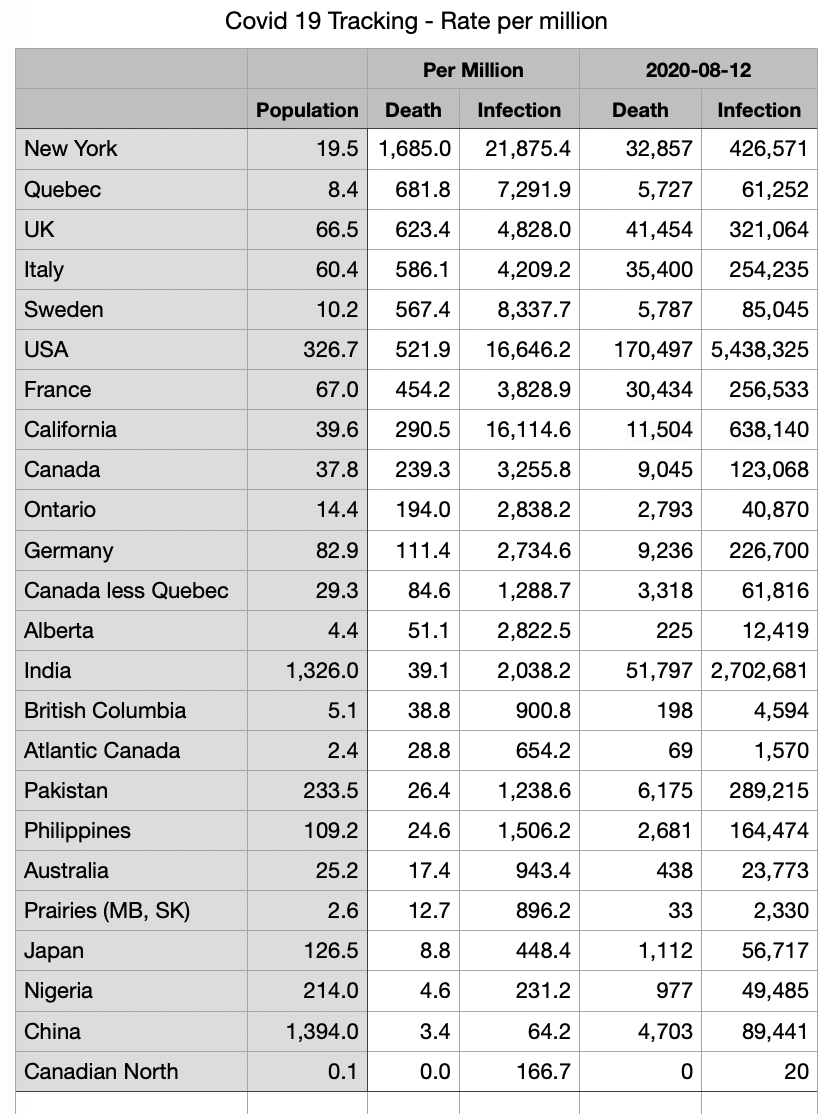
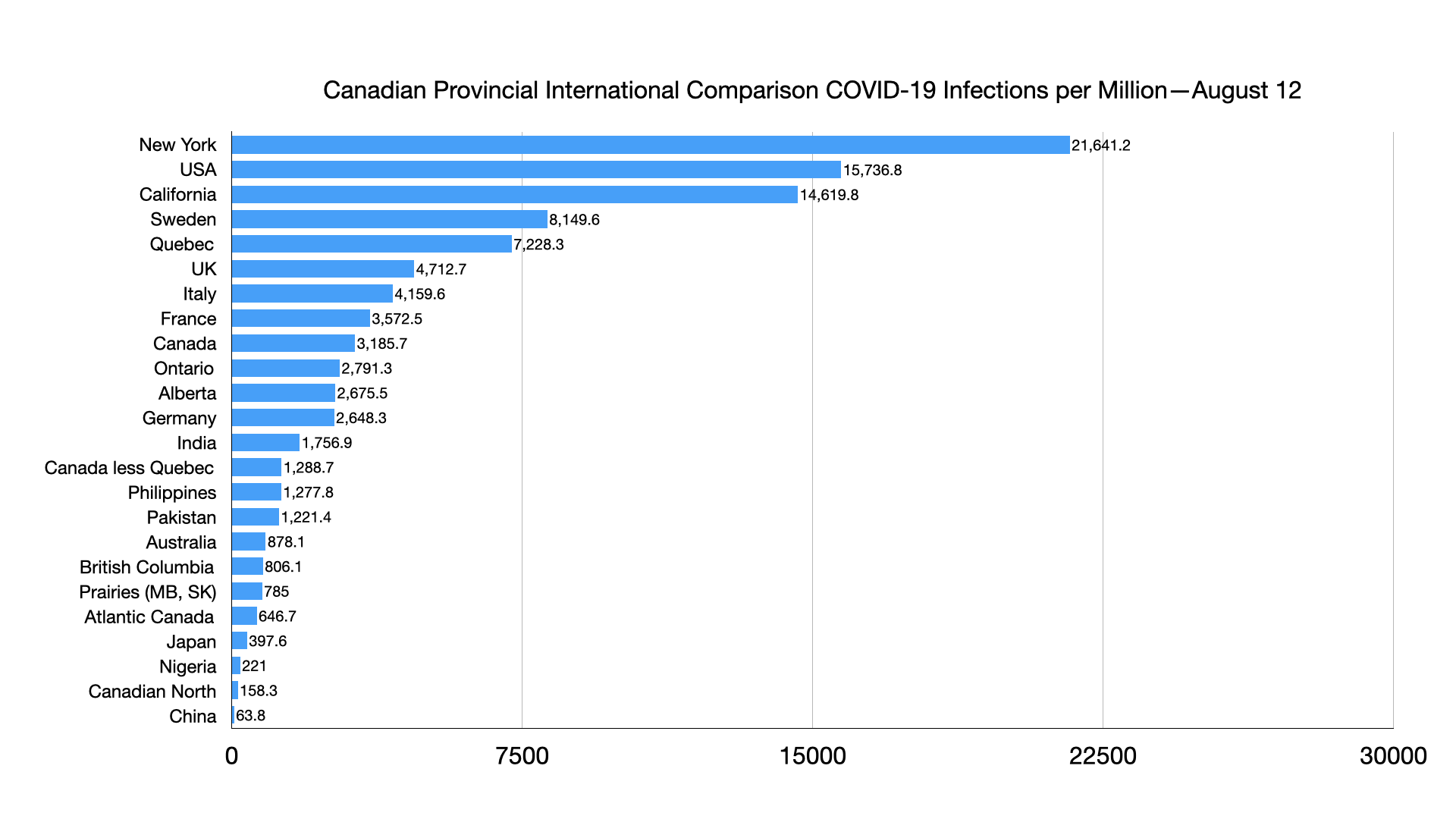
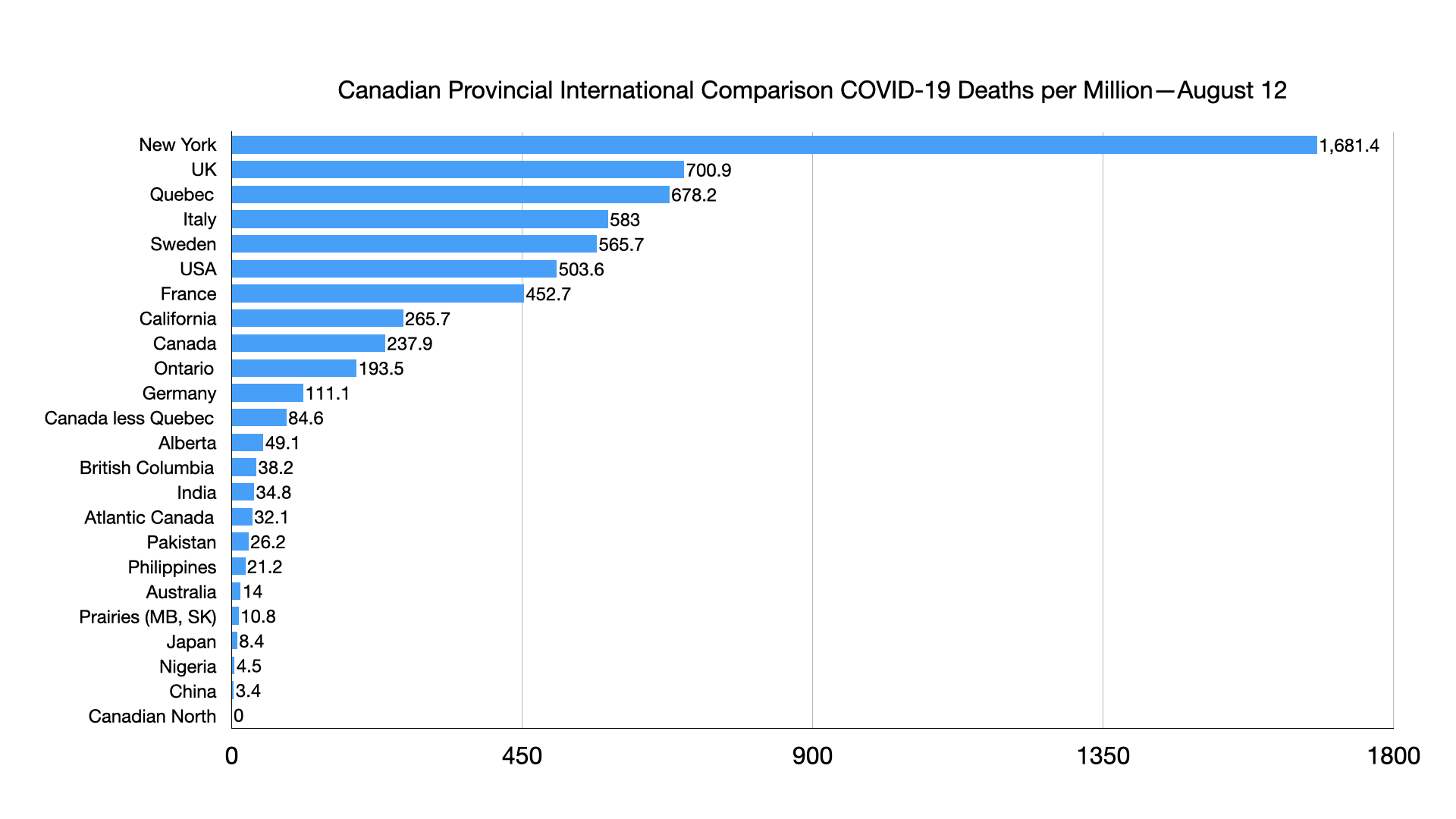
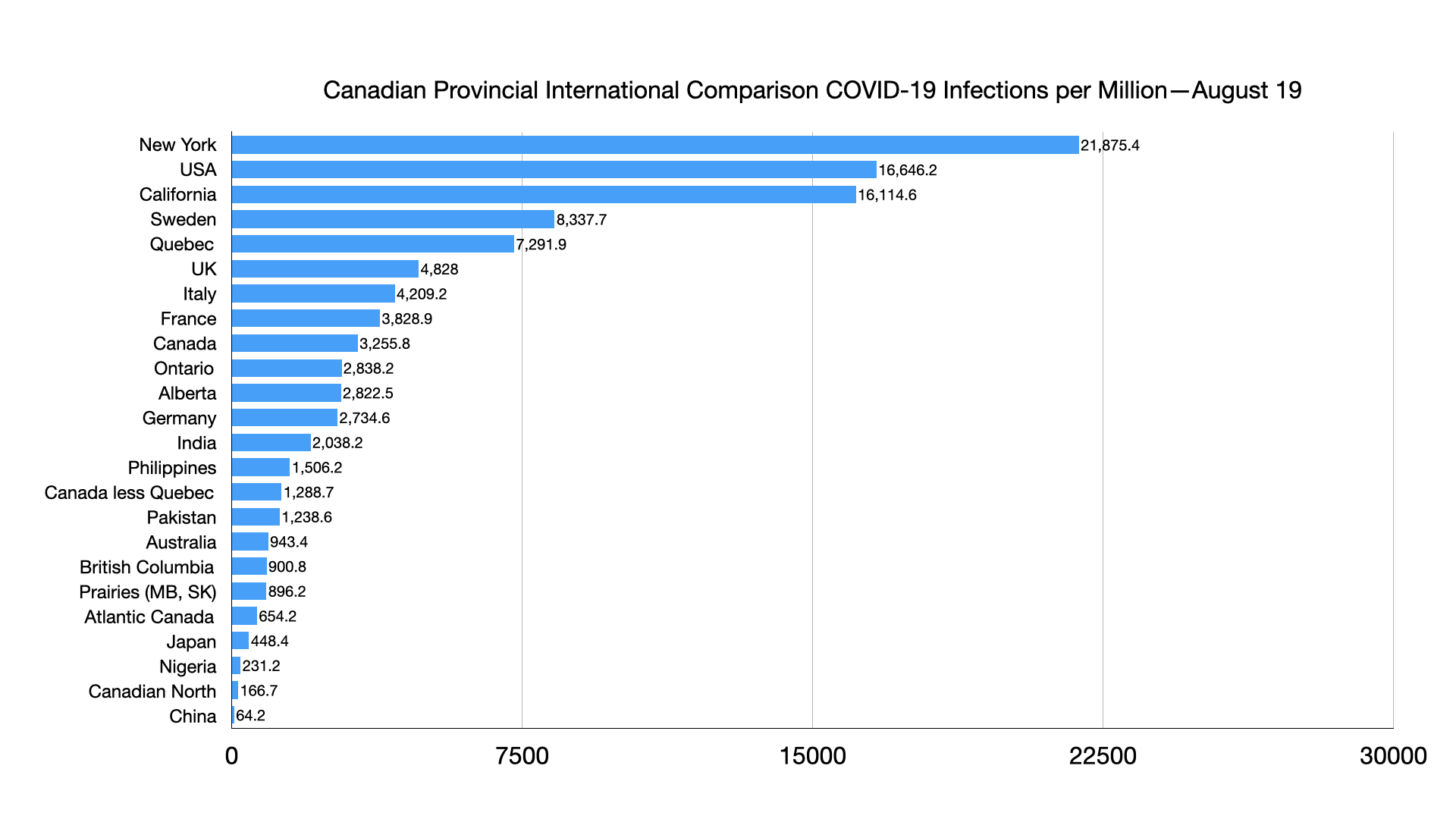
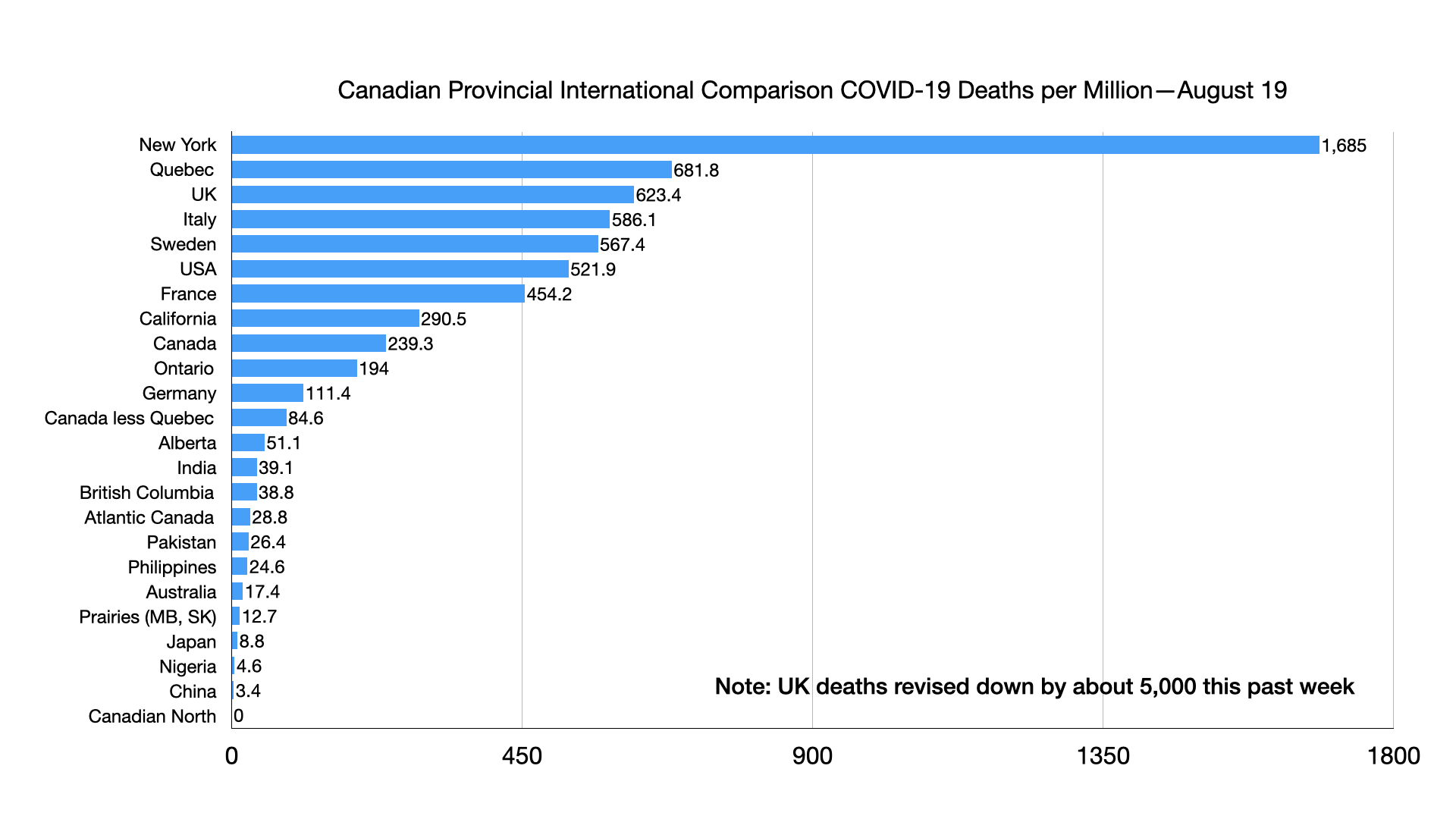
#COVID-19: Comparing provinces with other countries 19 August Update

Latest update. As UK revised the number of deaths by about 5,000, Quebec now has the highest death rate per million. Overall infection and death numbers continue to increase given the impact of some of the opening up measures.

Wealthy turn anti-immigrant when their riches are threatened

Interesting psychological study, with the fear of loss (absolute or relative) being the motivator (association/correlation, not necessarily causation):

Anti-immigration sentiment rises when affluent people fear losing their wealth, a psychological study has found.

The University of Queensland’s Professor Jolanda Jetten said harsh attitudes towards immigrants were found in times of economic downturn and relative deprivation—and also in prosperous times.

“Affluent people who fear losing in the short or long term experience collective angst about their group’s future vitality and wealth status,” she said.

“Our research found this fuels negative attitudes toward immigrants and minorities. Even though may have a lot, their fear of falling is associated with opposition to immigration.”

Professor Jetten said the research turned accepted wisdom on its head, showing that society’s most economically vulnerable were not always the most supportive of anti-immigration calls.

“In explaining the rise of right-wing populism, many have pointed to the 2008 Global Financial Crisis as the root cause of rising anti-immigrant sentiments,” she said.

“Experts had long believed that economic downturns triggered perceptions of relative deprivation and chances of civil conflict. Moreover, , so the argument typically goes, increase fear and frustration among poor working-class voters. These dynamics are typically referenced when discussing Trump’s victory in the 2016 US presidential elections, and the success of populist parties like One Nation in Australia. The assumption that economic crises combined with individual relative deprivation provide for populism, dominate many of the discussions on the origins of right-wing populism and anti-immigrant sentiments more generally.”

But the new research highlighted wealthier people who might be attracted to such populist parties, said Professor Jetten from the UQ School of Psychology.

“It seems that if you have a lot of money, you feel you have a lot to lose and the fear of falling makes you feel vulnerable and concerned about the future,” she said.

The research team, including Dr. Frank Mols and Dr. Nik Steffens, found an association between opposition to immigration and fear of losing wealth, individually or collectively, across four studies involving a total of more than 1000 people.

“In the laboratory, when we made people feel wealthy they were more opposed to immigration when they were made to feel that they might lose some of their wealth in the future than the group who felt their wealth was secure,” Professor Jetten said.

“In a study among Australian participants we found the their own financial future, or that of Australia’s, will be worse than the present, was associated with more opposition to immigration. The results may help us to explain why support for political parties with anti-immigrant messages sometimes comes from the wealthiest in society. This is important at a time when populist parties and leaders with strong anti-immigrant stances are a force to be reckoned with in many countries.”

Source: Wealthy turn anti-immigrant when their riches are threatened

Elsewhere they get it but the Australian media is still living in White Australia

Haven’t seen anything as comprehensive with respect to Canadian media although there have been partial samples showing underrepresentatioon:

Few would argue that Australian media does well at representing cultural diversity. Certainly not in a way you’d expect when we are a multicultural society, often trumpeted as the most successful of its kind in the world.

Now, for the first time, we have the numbers that show us just how representative – or rather, unrepresentative – the state of play is.

In our report, Who Gets to Tell Australian Stories?, we gathered data to provide the first comprehensive picture of who tells and produces stories in Australian television news and current affairs. We examined about 19,000 news and current affairs items broadcast on free to air television during two weeks in June 2019.

In their frequency of appearance on screen, we found that more than 75 per cent of presenters, commentators and reporters have an Anglo-Celtic background. While about 18 per cent have a European background, only 6 per cent of those on screen have an Indigenous or non-European background. Within our sample, none of the commercial networks had more than 5 per cent of presenters, commentators and reporters who have a non-European background.

Compare this with the Australian general population. Based on the 2016 Census figures on ancestry, the Australian Human Rights Commission has previously estimated that 58 per cent of Australians have an Anglo-Celtic background, 18 per cent have a European background, 21 per cent have non-European backgrounds, and 3 per cent identify as Indigenous.

It has been nearly five decades since an official multiculturalism was adopted in Australia. Yet that has had limited visible impact on our media.

To be fair, Australian media isn’t the only arena where this is the case. Anglo-Celtic and European backgrounds dominate the leadership ranks of politics, business, the public service and our universities. Our institutions fail to make the most of the talents within our society.

Diversity is often embraced only in name, and not in norms. If there’s a glass ceiling that many women in work hit, then those from minority backgrounds hit a cultural one. According to a survey we conducted as part of our research, more than 85 per cent of non-European background journalists believe having a culturally diverse background represents a barrier to career progression.

Representation, though, matters. It particularly matters for our television media: the medium shows us who we are as a people and as a culture. News and current affairs media have a special role in identifying and telling stories about issues of importance to all Australians.

Yet it’s overwhelmingly journalists who have Anglo-Celtic backgrounds who report, select and produce these stories. The result? Too often, media does a poor job of covering race issues.

For example, just about every time there’s a panel discussion about racism on commercial breakfast television, it involves an all-white panel that has minimal understanding of what has happened. Worse, commercial breakfast television currently seems to thrive on stoking prejudice. For sections of the media, racism is part of their business model.

Even our public broadcasters have their blind spots. For the past 10 years, the ABC’s Insiders program had no journalist who was a person of colour on its panel – something it has only rectified last month. Multicultural broadcaster SBS has recently been criticised for how it treated Indigenous journalists, and for the lack of cultural diversity within its senior management.

It’d be unthinkable for any television network to have a football commentary team on air, where not a single commentator would have experience playing the sport. By the same logic, networks should understand it’s a problem, in a multicultural society, when there’s little or no diversity within its news and current affairs.

Media elsewhere seem to get it. Indeed, Australian media lags significantly behind English-speaking counterparts. What we look like on screen can seem decades behind the United States and the United Kingdom. While they are themselves far from perfect, US and British media organisations have better collection and monitoring of data on their diversity. They’ve also been bolder at setting targets for minority talent.

For change to happen here, Australian media organisations will need to take similar steps. But more than that, there needs to be a cultural change in mindset. Too often, there is unwarranted defensiveness about criticisms concerning diversity. People can wrongly feel that a critique of systemic patterns of under-representation amount to personal attacks, or even a form of “reverse racism”. Deflections and denials come all too easily.

Talk about diversity and race will always spark debate. But it’s hard to argue with the evidence. In the case of our media, the numbers tell us we are still living in a White Australia, even if the White Australia policy was dismantled nearly 50 years ago.

Source: Elsewhere they get it but the Australian media is still living in White Australia

Le PLQ et QS dénoncent un programme de régularisation discriminatoire

Appropriate criticism over the narrowness of the program;

Le Parti libéral du Québec et Québec solidairejugent trop sévères les conditions d’admission au Programme spécial visant à faciliter l’octroi de la résidence permanente aux demandeurs d’asile qui, au plus fort de la crise sanitaire, suaient sang et eau dans les résidences pour personnes âgées assaillies par la COVID-19.

« On circonscrit l’accès à la mesure à un secteur [la santé], et à l’intérieur du secteur, même si tout le monde a eu un risque [de contracter le coronavirus], on circonscrit encore plus… Ça, ça ne serait pas discriminatoire ? » a demandé l’élu libéral Gaétan Barrette en commission parlementaire lundi.

Le Programme spécial des demandeurs d’asile en période de COVID-19 (PSDAPC) s’adresse aux « anges gardiens » qui étaient « sur la ligne de front » à prodiguer des « soins directs à la population pendant la pandémie », a expliqué la ministre de l’Immigration, Nadine Girault. « Ceux qui ont pris le plus de risque », a-t-elle résumé.

Le PLQ et QS se sont tour à tour désolés de voir les autres travailleurs du secteur de la santé — les préposés à l’entretien des résidences pour aînés frappés de plein fouet par le coronavirus, par exemple — laissés en plan par le PSDAPC. Un « vrai, vrai, vrai geste d’humanité » serait de « remercier […] tous les gens qui ont pris un risque ». « Que je sois préposé à l’entretien ménager ou gardien de sécurité, quand le virus je l’attrape, puis que je meure, c’est moi qui suis mort, c’est ma famille qui pâtit. C’est ça un risque », a souligné M. Barrette.

On circonscrit l’accès à la mesure à un secteur [la santé], et à l’intérieur du secteur, même si tout le monde a eu un risque [de contracter le coronavirus], on circonscrit encore plus…

« On a envoyé au combat […] une armée de gens sans arme », a-t-il ajouté, tout en rappelant l’absence d’équipements de protection individuelle en quantité suffisante dans les milieux de vie pour personnes âgées après l’arrivée de la COVID-19 en sol québécois.

L’ex-ministre de la Santé soupçonne le gouvernement caquiste d’avoir « mis un frein » à la volonté du gouvernement fédéral de régulariser les employés du réseau de la santé en situation de précarité afin de respecter les seuils d’immigrationqu’il s’est fixés.

Le député solidaire Andrés Fontecilla a suggéré lundi d’accroître la portée du Programme spécial afin que les préposés à l’entretien, les agents de sécurité, les travailleurs agricoles, les travailleurs d’abattoirs ou d’entrepôts en situation de précarité puissent aussi s’y inscrire.

La ministre de l’Immigration, Nadine Girault, a dit être en paix avec sa décision de permettre seulement aux demandeurs d’asile ayant prodigué des soins directs à des patients — dont des préposées aux bénéficiaires et des aides-infirmières — de s’inscrire au PSDAPC, ce qui leur permettra de s’établir au Québec. « Ce n’était pas un programme discriminatoire. C’était un programme pour remercier les gens qu’on voulait remercier chez les “anges gardiens” qui ont pris soin de nos gens. C’est tout simplement ça », a-t-elle fait valoir.

Puis, elle a cédé, sans avertissement, la parole au nouveau sous-ministre de l’Immigration, Benoit Dagenais. Béant de surprise, le haut fonctionnaire s’est mis à la tâche d’énumérer les 10 orientations de la Planification pluriannuelle de l’immigration 2020-2022 léguée par l’ex-ministre Simon Jolin-Barrette.

Il a par la suite mentionné que le Plan d’immigration du Québec 2021 sera établi à la lumière de la situation économique du Québec, qui a été fragilisée par l’arrivée du coronavirus en sol québécois le printemps dernier. « La crise sanitaire, évidemment, on va la prendre en considération », a souligné M. Dagenais.

De son côté, Mme Girault a indiqué qu’« il n’y aura pas de baisse des seuils d’immigration ».

Lutte contre le racisme

Le PLQ a aussi jeté le doute sur la volonté du gouvernement de lutter contre le racisme au Québec, lundi, après que Mme Girault eut refusé net de nommer les groupes rencontrés jusqu’à aujourd’hui par le Groupe d’action contre le racisme (GACR), dont elle assure la coprésidence.

Le « groupe des sept » élus de la Coalition avenir Québec, qui a été mis sur pied au lendemain de la mort de l’Afro-Américain George Floyd sous le genou d’un policier de Minneapolis, doit présenter une série d’actions visant à faire reculer le racisme au cours de l’automne.

« C’est malheureux et c’est décevant de ne pas avoir l’information », a dit la députée libérale Jennifer Maccarone, tout en invitant le GACR à solliciter sans délai l’avis de la Ligue des Noirs, du Congrès maghrébin au Québec, de la Ligue des droits et libertés…

Source: Le PLQ et QS dénoncent un programme de régularisation discriminatoire

New controversy flares up over Lynn Beyak’s Senate-appointed anti-racism training

Hard to see this ending:

The “flames of negativity” that were stirred up by Lynn Beyak’s racist statements as a senator are being “reignited” by a controversy at the University of Manitoba, according to a residential school survivor.

Garnet Angeconeb questions the suitability of the man tasked with overseeing Beyak’s second attempt at cultural awareness and sensitivity training after Jonathan Black-Branch quietly left his post as dean at the University of Manitoba.

The university is not saying why. In an email to CBC news, a spokesperson said Black-Branch is no longer employed by the University of Manitoba and that his leave began on June 5, but would not elaborate.

Black-Branch was also removed from his position on the governing body of the Law Society of Manitoba, a position reserved for the dean of the law school.

Both moves speak to the need for a wider probe into the handling of Beyak’s discipline and the qualifications of the man tasked with educating her, said Angeconeb who is from Lac Seul First Nation in northwestern Ontario.

“The issue with Lynn Beyak continues to throw flames on a fire that was under control,” Angeconeb said of the harm the on-going saga is causing. “It stirs up unresolved trauma for survivors.”

Beyak, who has publicly praised residential schools as “well-intentioned”, was first suspended from the Senate in 2019. The move came after she declined to remove letters from her website that described First Nations people as lazy and inept and refused to apologize for posting them.

She was ordered to complete education and training to improve her understanding and awareness of Indigenous issues before returning to her senate seat.

Beyak failed her first attempt, when the Ontario Federation of Indigenous Friendship Centres said Beyak created an “unsafe learning environment” with false claims to a Metis identity and other comments. Beyak denied making those claims.

In May, the Senate appointed Black-Branch as an “eminently qualified” person to design and deliver a new training program for Beyak.

After delivering a total of 24 hours of training, by video, Black-Branch concluded that “Senator Beyak is now better equipped ‘for approaching her professional work and her personal beliefs'”, according to the report of the Senate ethics committee, in June.

Senators are set to discuss the report on September 22.

‘Racism is a disease’

“There are a lot of questions about how this training was delivered, how meaningful it was,” said Danielle Morrison, a spokesperson for the Coalition to Remove Lynn Beyak from Senate, of which Angeconeb is also a member.

Residential school survivors should have the final say when it comes to determining whether Beyak’s training was a success, she said.

“Racism is a disease. It is one of the biggest pandemics affecting our world right now,” Morrison said. “This is a moment when people should ask themselves ‘am I on the right side of history?’

“How do you measure someone’s success in being an anti-racist? That assessment has already been made by survivors.”

‘Political fluff’

Angeconeb said Beyak could show her training was a success through her actions. For him that means another apology, beyond the carefully scripted ones she gave in the Senate.

“It needs to come from somewhere in her home-town of Dryden, in front of Anishinaabe people,” he said. “Otherwise these are just apologies of convenience to save her Senate seat. It’s just political fluff.”

After decades of anti-racism work and advocacy on behalf of survivors, Angeconeb said he is heartened that residential schools are “at the forefront of the conversation” about reconciliation in Canada.

But he said “side-bar issues” such as Beyak’s behaviour and the on-going legal wrangling over compensation for survivors of St. Anne’s residential school are “really hurtful.”

“I continue to be upset and I continue to be angered by that,” he said.

Source: New controversy flares up over Lynn Beyak’s Senate-appointed anti-racism training

Ralentissement économique: Québec ne réduira pas les seuils d’immigration

Small step in their overall more restrictive immigration policies in ruling out further decreases to their already announced lower levels:

Le gouvernement Legault poursuivra l’augmentation du nombre d’immigrants admis annuellement, malgré la hausse du taux de chômage et le ralentissement économique causé par la COVID-19.

«Il n’y aura pas de baisse des seuils d’immigration dans les cartons pour les prochaines années», a déclaré la ministre de l’Immigration, Nadine Girault, au premier jour de l’étude des crédits à l’Assemblée nationale lundi.

«C’est évident qu’avec la COVID, on a eu moins d’immigrants qui sont rentrés, les frontières étaient fermées, a souligné Mme Girault. Mais ça n’a pas affecté les seuils d’immigration et ça n’affectera pas les seuils d’immigration pour les prochaines années.»

La ministre répondait aux préoccupations du député solidaire Andrés Fontecilla, qui s’inquiétait d’un retour à la baisse, comme ce fut le cas au début du mandat du gouvernement caquiste. Le nombre d’immigrants admis était alors passé de 51 118 à 40 546 et doit maintenant remonter graduellement au seuil original d’ici 2022.

Le 14 avril dernier, le premier ministre François Legault avait évoqué la possibilité d’accepter moins de nouveaux arrivants si la pandémie devait mener à une hausse importante du taux de chômage. «On n’est pas rendus là, mais effectivement, c’est quelque chose qu’on va regarder, avait-il déclaré dans les premières semaines de la pandémie. Je pense qu’il faut tout revoir puis, entre autres, le nombre d’immigrants avec le taux de chômage élevé qu’on va avoir dans les prochains mois. On pourrait effectivement réduire le nombre.» Au mois de juillet, le taux de chômage atteignait 10,7% au Québec.

Mais la ministre Girualt fait valoir que, même si le Québec ne sera plus en situation de plein emploi, «on va avoir quand même des gros manques au niveau de certains secteurs d’emploi».

D’autres «anges gardiens» à risque

Toutefois, c’est l’entente avec Ottawa pour permettre aux demandeurs d’asile du réseau de la santé de régulariser leur statut qui a surtout retenu l’attention du PLQ et de QS durant l’audience de quatre heures. Les deux partis d’opposition reprochent à Québec d’avoir restreint l’accès au programme uniquement à ceux qui ont donné des soins directement aux patients entre le 13 mars et le 14 août, et ce, sur une période d’au moins 120 heures.

«Je suis persuadé que les gens comprennent que ce qu’on fait, c’est parce qu’on voulait s’occuper et prendre soin de nos anges gardiens qui, eux, ont pris soin de nos gens», a martelé la ministre Girault.

Mais le critique libéral Gaétan Barrette fait valoir que le risque est le même de contracter le virus pour tous les employés d’un établissement de santé. «Que je sois préposé à l’entretien ménager ou gardien de sécurité, quand j’attrape le virus et que je meurs, c’est moi qui suis mort et ma famille qui en pâtit», a-t-il souligné.

Source: https://www.journaldequebec.com/2020/08/17/ralentissement-economique-quebec-ne-reduira-pas-les-seuils-dimmigration