Richmond, B.C. politicians push Ottawa to address birth tourism and stop ‘passport mill’

More British Columbia media coverage of birth tourism, following a recent poll and my release of the CIHI data:

One in four births taking place at Richmond Hospital involve an international mother, according to new statistics.

So-called “birth tourism” is a controversial phenomenon in which expectant mothers from other countries come to Canada for the purpose of accessing a Canadian passport for their newborn babies and skipping the standard immigration processes.

“It’s perceived as an abuse of birthright citizenship,” said Andrew Griffith, a former director of Immigration Refugees and Citizenship Canada who is currently a fellow at the Environics Institute.

“Birthright citizenship was really designed for people who moved to Canada, who immigrated to Canada, gave birth to their children, so their children would automatically have Canadian citizenship,” Griffith said. “It was never designed for a world where you could stay in a birth hotel or a hostel, give birth and fly back to your country of origin.”

Over the last couple of years, Griffith has been collecting numbers from the Canadian Institute for Health Information, which compiles data from hospitals across the country, excluding Quebec.

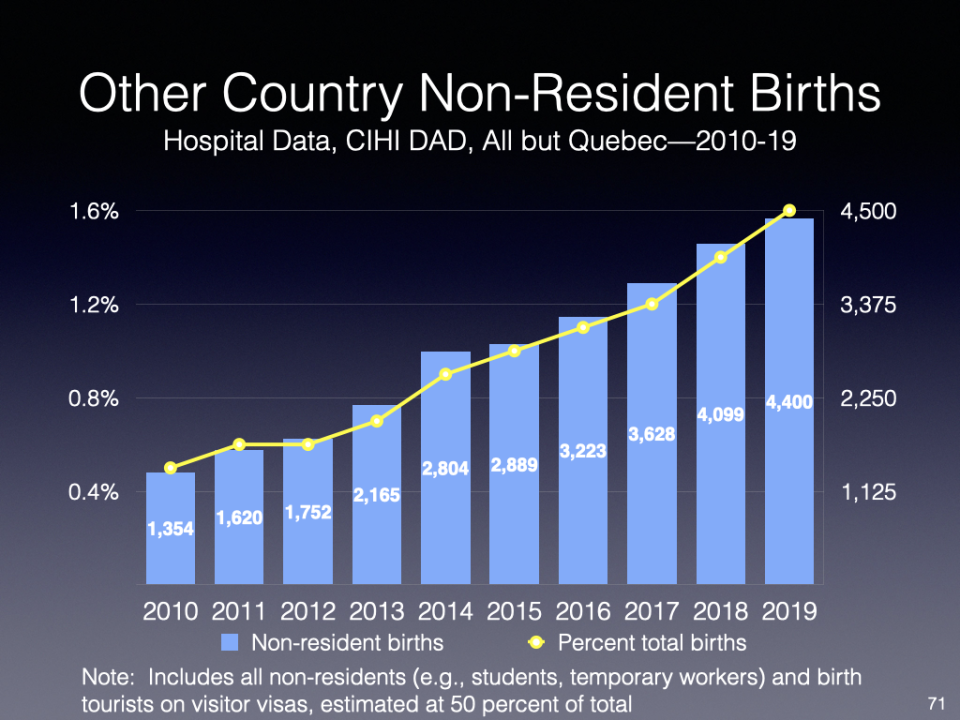
Non-resident births chart

A chart Griffith created shows a 10-year trend of births by non-residents and reveals an upward curve of the practice.

Griffith notes that the term “non-resident,” in this data can also refer to international students and foreign workers. He estimates birth tourists account for roughly half of the non-resident births.

The new numbers show the 2019-2020 fiscal year and don’t include the majority of the months during the COVID-19 pandemic.

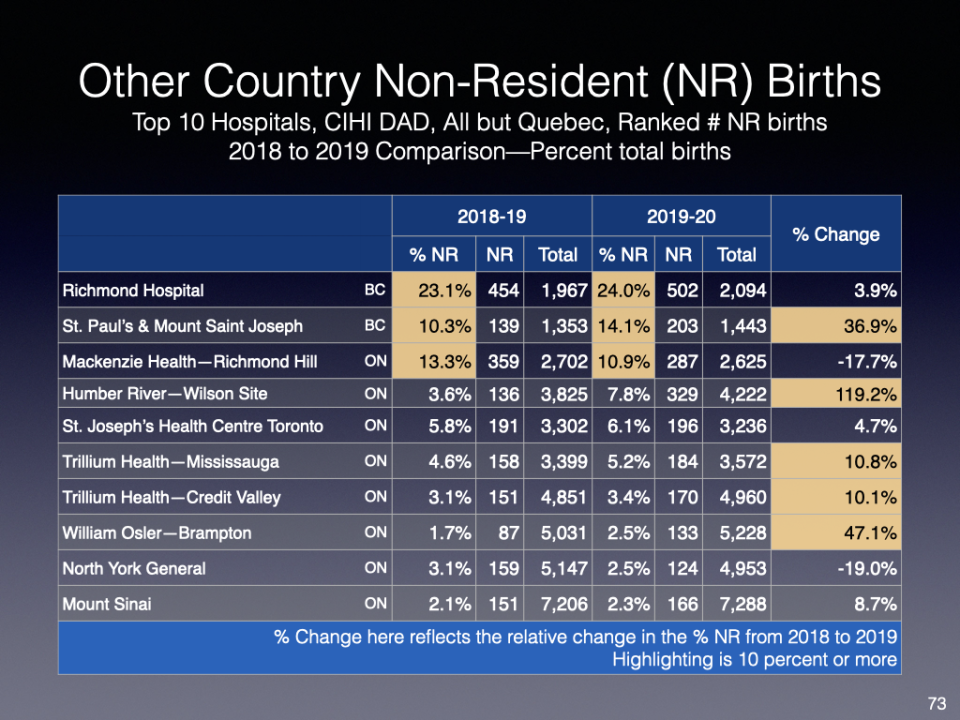
They reveal that births by non-residents made up 24 per cent of the deliveries at Richmond Hospital, a slight uptick from the year before.

The numbers jumped by more than a third for St. Paul’s and and Mount Saint Joseph hospitals in Vancouver, where non-residents made up 14 per cent of the total births.

Non-resident births data

“What I find interesting is that I haven’t seen really any similar outcry in any other community – even in those centres where there seems to be fairly high numbers of non-resident births – and I’m just not quite sure why that is, because it seems like the focus always is on Richmond,” he said.

Politicians from all three levels of government in Richmond have been pushing Ottawa to do more to stop the practice.

“We just feel that that is not fair, it really degrades the citizenship that we all enjoy,” said Richmond Mayor Malcolm Brodie.

He said the municipal government has been advocating that birth tourism be addressed, but those requests seem to have fallen on deaf ears.

“We can insist that those practices that are operating a business to house the birth tourists have a business licence. There’s not all that much more that we can do, other than keep highlighting the problem,” Brodie said.

Jas Johal, the BC Liberal MLA for Richmond-Queensborough, said the province can step in by increasing fees for international mothers to discourage the practice, but the responsibility lies with the federal government.

“One out of four children born at our hospital are foreign nationals – that’s not a hospital anymore, it’s a passport mill,” he said. “If you’re coming here to have a child on a tourist visa, well, guess what? That application for citizenship is null and void. A simple change like that would probably reduce, and probably eliminate, birth tourism in Canada.”

The two Conservative members of parliament for the area, Kenny Chiu and Alice Wong, have also voiced their objection to the practice.

Chiu’s office has been encouraging people to write letters to the immigration minister and offering to help deliver them.

A recent survey also found a majority of people would like the federal government set up a committee to address birth tourism.

CTV News Vancouver reached out to Immigration Refugees and Citizenship Canada regarding birth tourism, but did not receive a response before deadline. This story will be updated if a response is received.
And the poll from Researchco that prompted the coverage (IMO, questions are tendentious and leading, and the methodology is not that rigorous:
Many B.C. residents are tuned into the practice of birth tourism in Canada and most want the federal government to launch an investigation into it, a new poll suggests.

According to a survey conducted by Research Co., 49 per cent of B.C. residents have been following media coverage of birth tourism – a practice of travelling to a specific country for the purpose of giving birth and securing citizenship for the child.

Canada is one of fewer than three dozen countries that follow the practice of citizenship based on birthplace and some – including Australia and Britain – have modified or ended automatic birthright citizenship in recent years

“Almost half of British Columbians (49 per cent) are following stories about ‘birth tourism,’ compared to just 34 per cent of Albertans.”

But most B.C. residents polled don’t have favourable views of the practice.

According to the survey, 77 per cent of British Columbians say they feel birth tourism can be unfairly used to gain access to Canada’s education, health care and social programs. Meanwhile, 64 per cent worry that birth tourism could displace Canadians from hospitals.

Additionally, 67 per cent of those polled feel birth tourism “can degrade the value of Canadian citizenship,” while 71 per cent agree with the statement that the practice of granting birthright citizenship may have made sense at one point, “but now people have taken advantage of existing rules.”

With that, 82 per cent of B.C. residents said they agree with the federal government establishing a committee to investigate the extent of birth tourism in the country. Just eight per cent disagreed with the idea, while 12 per cent said they weren’t sure.

According to the nation-wide poll, however, support for a new approach to birthright citizenship in Canada is highest in Manitoba and Saskatchewan at 66 per cent. Alberta follows at 60 per cent, with B.C. standing at 56 per cent hoping for new regulations.

Results are based on an online study conducted from Aug. 28 to Aug. 30, 2020, among 1,000 adults in Canada. The margin of error—which measures sample variability—is plus or minus 3.1 percentage points, 19 times out of 20.

Source: https://bc.ctvnews.ca/more-than-half-of-b-c-residents-think-birth-tourism-degrades-value-of-canadian-citizenship-poll-1.5093202

Link to poll data: https://researchco.ca/wp-content/uploads/2020/09/Tables_BirthTourism_CAN_04Sep2020.pdf

Ibbitson: COVID-19 is severing a lifeline of immigration Canada needs to survive. Here’s what we can do to repair it

Ibbitson makes the case to accelerate the transition of temporary residents to Permanent Residents, as they are already in Canada and thus travel restrictions are not an issue.

To a certain extent, this is already happening. This past June, almost 70 percent of new Permanent Residents were previously temporary residents. July numbers should be out sometime next week.

However, once we get through the “inventory” of qualified temporary residents, the lack of new arrivals will become more of an issue:

Tens of thousands of future Canadians are missing. Because of closed borders brought on by COVID-19, only a fraction of those who were supposed to become new permanent residents this year and next will actually arrive.

This country relies on immigrants to sustain its population and expand its economy. But Canada admitted only 34,000 permanent residents in the second quarter of this year, down 67 per cent from the same period in 2019. Most new permanent residents were already in Canada on work or study permits.

And lockdowns and closed visa offices overseas could suppress immigration for years to come.

There is a fix, though only for the short term. Tens of thousands of international students, temporary foreign workers and asylum claimants who are in Canada right now could be fast-tracked to permanent residency.

“We’ve got all these people that are here,” Janet Dench, executive director of the Canadian Council for Refugees, said in an interview. “And if we give them permanent residence, they’re going to be able to contribute to Canada. So we end up benefiting from it.”

Converting students, temporary foreign workers and asylum claimants into permanent residents could ease the shortfall of immigrants until Ottawa can get the overseas applications process back on stream, air travel fully resumes and barriers between countries come down.

If they come down.

In an August report, the International Organization for Migration warned “the age of migration itself may now be coming to an end.” More than 90 per cent of the world’s population live in countries with pandemic-related restrictions on new arrivals.

A recent report from the Royal Bank of Canada estimated that, best case, immigration in 2020 will be down 30 per cent from the target of 341,000 set by Immigration, Refugees and Citizenship Canada.

“The worry is that what happens in the short run may turn into the long run,” said Andrew Agopsowicz, a senior economist at the bank and author of the report.

Consider the situation of international students. There were 642,000 of them studying in Canada in 2019. Only the United States and Australia take in more foreign students. As well as contributing $22-billion to the Canadian economy and helping to sustain 170,000 jobs, they serve as one of the main sources of new permanent residents each year. But not this year. In the second quarter, the Immigration department issued just over 10,000 new study permits, compared with 107,000 a year earlier.

The University of Waterloo, with its strong reputation in engineering and computer sciences, plays host to about 7,000 international students each year, along with about 35,000 Canadian students.

But apart from the roughly 2,000 students who are already here, almost all foreign students will be taking their courses online from their home country, said Christine McWebb, the university’s assistant vice-president responsible for international operations.

Those international students who are in Canada and wish to remain provide a pool of applicants who could be fast-tracked to permanent residency. And those who can’t get here this year can be encouraged to come as soon as conditions permit.

Ottawa agrees. Last week, the Immigration department announced new measures that will make it easier for students to study from abroad while still being able to later obtain a work permit in Canada.

Another potential pool of permanent residents can be found among temporary foreign workers. Although the federal government took special measures to ensure agricultural workers were admitted this year, TFW permits were down about 50 per cent in the second quarter. These workers are critical to sustaining not just agriculture, but health care, construction, transportation and other sectors.

“We call them temporary foreign workers but the work they are doing is neither temporary nor superfluous,” said Usha George, director of the Centre for Immigration and Settlement at Ryerson University. “These people are called unskilled, but they are essential workers.”

A third group of potential permanent residents might be more problematic, at least to some.

In 2019, just over 16,500 people sought asylum in Canada by making use of unauthorized border crossings, such as Roxham Road in Quebec. But as of the end of July, this year, just over 3,100 asylum seekers had been intercepted by the RCMP, owing to the closing of the border between Canada and the U.S. and the severe reduction in international travel.

The majority of claims referred to the Refugee Protection Division are eventually approved, although the process can take years. Many claimants are already working. They speak or are learning English or French, have housing, and have forged ties within the community. Expediting their claims would provide new permanent residents to make up for those not arriving from overseas, while eliminating the backlog.

“We’d be better off saving the money of the refugee claim process,” Ms. Dench said. “And the sooner they can obtain permanent residence, the sooner they can get on with their lives and really contribute to Canadian society.”

Ottawa has already announced that some asylum claimants working in the health sector may apply to become permanent residents.

Immigrants to Canada tend to be better educated than the native-born and they start more businesses. As Canada’s population ages, they will be vital to providing both the labour and the taxes needed to care for older citizens.

With luck, either a vaccine or effective treatments will arrive next year, weakening the impact of COVID-19 to the point where borders can reopen. In the meantime, the opportunity exists to convert as many students, foreign workers and asylum seekers into permanent residents as possible, to make up for the shortfall.

Whatever their background, we can expect the new arrivals will make splendid Canadians. They almost always do.

Source: https://www.theglobeandmail.com/politics/article-covid-19-is-severing-a-lifeline-of-immigration-canada-needs-to-survive/

Islamic State: Giant library of group’s online propaganda discovered

Highlights the degree of sophistication and resources:
One of the largest collections of online material belonging to the group calling itself Islamic State has been discovered by researchers at the Institute of Strategic Dialogue (ISD).
The digital library contains more than 90,000 items and has an estimated 10,000 unique visitors a month.
Experts say it provides a way to continually replenish extremist content on the net.
But taking it down is difficult because the data is not stored in one place.
And despite counter-terrorism authorities in Britain and the US having been alerted to this growing repository, it continues to grow.

‘Better terrorist’

The discovery came after the death of the prominent IS leader Abu Bakr al-Baghdadi, in October 2019.
At the time, many social media posts supporting the organisation contained a short link.
It led researchers to documents and videos in nine different languages.
They included details of attacks, including those on Manchester Arena on 22 May 2017, in London on 7 July 2005 and in the US on 11 September 2001.
“[There’s] everything you need to know to plan and carry out an attack,” said ISD deputy director Moustafa Ayad, who discovered the archive.
“Things that teach you how to be a better terrorist essentially.”
The ISD named the library the Caliphate Cache.
For months the institute’s researchers have studied how it evolves, how it is being administered and who is visiting it.
The data is spread across a decentralised system, rather than a single computer server.
Anyone can share the content across the web, via servers based at multiple locations.
And this hampers any effort to take it offline.
But as long as the Caliphate Cache remains live, it aids IS by providing a means to continuously seed out content.

Pop singer

The material is added to social-media comments pages and spread via bot accounts.
Another technique has been to target Twitter accounts linked to celebrities and athletes.
For example, IS hijacked an account belonging to a fan of the pop singer Justin Bieber and used it to promote material from the cache.
In another case, the group managed to fool the English rugby team’s account into following one of its own by masquerading as a supporter.
“They understand how not just to game platforms, they understand the power of the content that is contained within the Caliphate Cache,” Mr Ayad said.

Runaway brides

Not all the cache’s content is violent.
Visitors also encounter philosophies of IS, religious texts and propagandised versions of what an IS lifestyle looks like.
The researchers say this includes material runaway brides such as Shamima Begum would have seen.
Most of those drawn to the Caliphate Cache are 18- to 24-year-old males in the Arab world, with 40% of the traffic coming from social media, largely via YouTube.

Extremist groups

The ISD has also discovered the Caliphate Cache is not unique.
There are smaller repositories belonging to other extremist groups, many of which are also using decentralised platforms.
“The attraction for jihadists of these platforms is that the developers of these decentralised platforms have no way of acting against content that is stored on user-operated servers or content that’s shared across a dispersed network of users, ” BBC Monitoring senior jihadi specialist Mina Al-Lami said.
“It’s really all about privacy, freedom and encryption.
“That’s what attracts jihadists.”
The researchers have alerted the US Attorney’s Office for Eastern District of New York, which prosecutes counter-terrorism cases, as well as the Met Police.
The authorities in New York have not commented.
But the Met acknowledged receiving the referral and said it was being assessed by specialist officers.

Source: Islamic State: Giant library of group’s online propaganda discovered

Racial authoritarianism in US democracy

Bit of a dense read but nevertheless a reminder of the lingering influence of the past on the present:

Recently, casual and savage violence of police against peaceful protesters and images of police in military gear sweeping up residents into unmarked vans has led journalists to question whether U.S. democracy is in peril. Many observers described these recent actions as authoritarian. But racial authoritarianism has been central to citizenship and governance of race-class subjugated communities throughout the 20th and early 21st centuries. It describes state oppression such that groups of residents live under extremely divergent experiences of government and laws. Yet when police engage in excessive surveillance, incursions on civil liberties, and arbitrary force as a matter of routine patrol, many scholars of American politics are reluctant to consider it a violation of democracy and instead deem them aberrations in an otherwise functioning democracy. This mischaracterization is not limited only to intellectual discourse but also affects the public sphere. By obscuring evidence of racial authoritarianism, reforms will not land where needed. Procedural reform is useful when we are simply improving policing, not ridding democracy of authoritarian practices.

Racial authoritarian governance has deeply shaped our institutions, political arrangements, and state development, and virtually every racial justice movement over the past 100 years has tried to expose its operation, challenge it, and seek freedom from it (1). Coterminous with democracy in the United States, racially authoritarian patterns are reproduced and innovated after periods of democratic expansion in the United States. Since the 1960s, policing has been the primary administrative tool of racial authoritarianism: One segment of the population effectively lives under a different set of rules and, as a result, experiences differential power and citizenship.

Although many Black intellectuals and citizens have understood how authoritarian power operates on citizens within a democracy, scholars of U.S. politics largely overlook state power to coerce, surveil, and enact violence often by police authorities and treat it as unimportant to theorizing our democracy. Starting from the assumption of a liberal tradition and examining deviations from a mostly pluralistic polity, they document evidence of democratic retreat only when political competition is curtailed and trust in governing institutions erodes, despite overwhelming evidence of racial authoritarianism. This view, stretching from the field’s defining scholars to the present day, is housed within a polity that was increasingly turning to, and expanding, its coercive instruments of surveillance, predation, violent intimidation, and confinement, concentrated on race-class subjugated residents.

The result is a substantive and substantial narrowing: By failing to consider the possibility of widespread, coherent, and racially targeted authoritarian practices, the focus in academic debates becomes improving aspects of democratic quality and the distribution and delivery of democratic goods—more representation, more votes, more responsive policy—while rendering invisible the lack of autonomy and freedom, and the vulnerability to state violence and illegal takings, that characterizes the experience of U.S. democracy for those experiencing its more authoritarian aspects. We should augment our understanding, theories, and measurement to encompass or reconcile the presence of such authoritarian practices within U.S. democracy. In addition to measuring democratic performance through national indicators such as free and fair elections, we should also include local coercive practices concentrated on subgroups of the population.

A Trenchant Rebuttal

Once we look beyond democracy’s formal structures, institutions, and rules to the lived experiences of political authority, we see that they pose a sharp contrast, and a trenchant rebuttal, to the conventional understandings of liberal democracy. For example, drawing on the largest database of narrative accounts of policing in U.S. cities after the Baltimore uprising of 2015, we see that U.S. residents have a sophisticated understanding of the actual operation of democracy and are witnesses to its relationship to authoritarian practices (2). Stopped by police, subject to violation of privacy and displays of force, routine seizure of resources, and unable to freely assemble because of police occupation of their neighborhoods, they described being effectively outside the provisions of the main text of U.S. democracy—the Constitution:

“But every black and every Hispanic that gets stopped, especially here in LA, they asked to get out their car…okay. And it’s a difference. When you’re telling me, you’re going to go and say, ‘Oh you’re just nitpicking, you’re crying, you’re complaining.’ But we live this. You see? We live it” [(2), p. 1162].

“They’re paid to protect and serve but they’re not protecting us, they’re not serving us, they’re killing us and eliminating us” [(2), p. 1160].

Police have long proscribed the movement of Black communities and engaged in racial and social control. When historians interviewed several thousand Black Americans who had lived under Jim Crow (state and local laws that enforced racial segregation and disenfranchisement in the U.S. South) in the 1930s and 1940s, police were understood to be guardians of white democracy (3). They described orientations similar to conversations about life decades later. For example, how police goaded Black people into displays of force: “They would come and mess with you in order for you to say something … This gave them an excuse to hit you, you know” (3). State violence through police was witnessed, as well as the absence of accountability when police executed Black people.

When we look to narrative accounts and the undemocratic practices they reveal, we may be better equipped to anticipate critical ruptures in political life. State practices of policing, surveillance, and impunity that are quotidian for racially subjugated people, when popularized, become worrying signs of an authoritarian turn.

Hiding in Plain View

Despite racial authoritarianism’s glaring presence in experiential accounts of U.S. democracy, it has been hiding in plain view in the field of political science. In a field responsible for constructing metrics on democratic stability and political behavior, our failure to theorize racial authoritarianism has had consequences for how U.S. democracy is conceived by the public and policy-makers.

There are several reasons why racial authoritarianism in the United States has, for so long, gone unnamed by our field. One reason is because scholars tend to discount knowledge derived from a bottom-up approach (actual citizen experience), which may obscure our understanding of how government authority is actually experienced. Empirical research on democracy leans heavily on quantifiable indices (such as the Polity Index) and nationally representative survey samples. These measures are useful tools for comparative analysis and standardized snapshots for change over time, but they do not leave room for citizens to define democratic deficits on their own terms or through their own experiential accounts. When we use narrative accounts as the lens through which we view U.S. democracy, racial authoritarianism comes clearly into focus.

Relatedly, scholars tend to fixate on nationally representative institutions and political activities such as voting and operate from an overly narrow definition of authoritarian practices (executive power grabs, direct police collusion, and limited political competition). But the focus on executive overreach can be misleading in a political system as decentralized as the United States, where local governments have high levels of autonomy over police authority in particular. Without a focus on the local or subnational level, it is easy to overlook the ways in which U.S. federalism facilitates racial authoritarianism.

Third, for scholars who have written about modern policing practices, there is no shortage of analysis of their racially disparate outcomes (1). But students of political science have tended to examine the coercion, occupation, subjectivity, and extraction that constitute what we call racial authoritarianism in isolation from democracy. We tend to analyze racialized policing within a separate literature on incarceration and criminal justice; but why should we not also analyze it in the literature on democratic transitions, subnational or group-based authoritarianism, and political violence?

If the field of political science sequestered police repression from questions of democracy, historical Black thinkers did not. An understanding of racial authoritarianism—although completely absent in mainstream scholarship—animated historical Black theorizations that contested U.S. democracy’s hard line boundary from authoritarian modes of governance. They saw police violence and power as a central instrument upholding the differentiated citizenship key to the operation of democracy in the United States. For example, in 1966 James Baldwin wrote, “I have witnessed and endured the brutality of the police many more times than once—but, of course, I cannot prove it. I cannot prove it because the Police Department investigates itself, quite as though it were answerable only to itself. But it cannot be allowed to be answerable only to itself. It must be made to answer to the community which pays it, and which it is legally sworn to protect, and if American Negroes are not a part of the American community, then all of the American professions are a fraud” (4).

This brings us to the final reason, which is that we have been working from foundations of a discipline that has segregated and isolated Black knowledge. For example, our field’s most vaunted scholar of American democracy, Robert Dahl, theorized civic life through a case study in New Haven during a period of mass racial upheaval across northern U.S. cities (5). Yet, Dahl’s account portrayed a democracy that subjugated Black citizens did not live and had never taken part in. Political science scholars have typically examined democratic deficits as a question of who is represented and how; they tend to focus on exclusion from political participation or social citizenship, or hindrances on the ability of citizens to have equal influence (6).

Scholarly treatises flowed from Dahl’s conceptions but stood uneasily alongside a chorus of Black intellectuals, folk leaders, and activists that contested the clean distinction between democracy and authoritarian rule. Instead of describing pluralism, polyarchy, and liberalism, they called attention to undemocratic legacies, visible and unapologetically practiced on their streets.

That mainstream approaches have hardened into deep scholarly grooves has had consequences. Today, students learn about authoritarianism abroad. We are taught American exceptionalism, the idea that the United States is singular for its old constitution, institutional arrangements such as federalism, lack of feudalism, and weaker welfare state, not because we have a racial authoritarianism distinct from any other nation in the western world. When we do recognize authoritarian governance in the United States, it is a past relic, confined to the post-emancipation U.S. South where Black disenfranchisement, one-party rule, and explicit political violence reigned but was eventually overcome. And when scholars present evidence of democratic backsliding in contemporary U.S. politics, they ignore the expansion of racial repression, focusing instead on polarization, distrust in institutions, and extreme income inequality—all of which themselves derive from or are linked to racial authoritarianism.

Promising Frameworks

How can scholars study authoritarian modes of governance within democratic states? What can attending to racial authoritarianism teach us about the nature and evolution of U.S. democracy? Fortunately, there are promising theories on which we can build. A few scholars have pointed to the possibility that authoritarian practices co-exist within formally democratic states and institutions. King and Smith have argued that U.S. democracy was formed through the contestation of liberal egalitarian ideologies and illiberal, ascriptive hierarchy (7). Miller describes “racialized state failure” in which U.S. federalism and racism interact to create conditions comparable with those of failed states (such as extreme levels of homicide, state violence, and imprisonment) (8). Hanchard reminds us that the most celebrated democracies, back to ancient Athens, had the longest histories of racial slavery, subjugation, imperialism, police terror, and highly unequal labor regimes (9). He argues against typical stances in our field that tend to ignore the coexistence of democracy and ethnoracial hierarchy and that the former’s institutional development was shaped by the latter: “The seemingly straightforward genealogy that reduces democracy to its formal and performative elements ignores how coercion, empire, and forced labor have been deeply intertwined in democratic experiments in the Greek city-states and in contemporary societies” [(10), p. 68].

The literature on the relatively recent democratization of the United States also offers an opening. Scholars of U.S. and comparative political development have long understood one-party rule in the South before the Second Reconstruction (1945–1968) as authoritarian. Mickey has analyzed these “authoritarian enclaves,” that “created and regulated racially separate—and significantly unfree—civic spheres” [(10), p. 5]. Gibson has described subnational authoritarianism in the United States as compatible with, and enabled by, federal democratic institutions before the Second Reconstruction (11). However, scholars stop shy of theorizing the persistence or reemergence of authoritarian practices after the fall of territorial subnational authoritarianism in the 1960s.

Last, we can learn from scholars working outside the United States who have analyzed and provided theories to explain conditions that aid the endurance of coercive institutions in democracies, including the police, who further “stratify citizenship” along the dimensions of race, class, and geography by failing to protect citizens, serving instead the interests of the state and engaging in extralegal force (12). In countries with histories of military rule, norms of police violence endure in the transition to democracy. During dictatorships, even the middle classes are subject to state and police repression, but this falls away under democratic reforms; ironically, the rise of democracy helps concentrate police violence on poor and raced groups. Citizens being “outlaws” in Bolivia—unprotected by police and law but also subject to its capricious regulation—draws parallel to Black communities in the United States experiencing “legal estrangement” (13, 14). How might scholars better connect racial authoritarianism across democracies?

Unlike Latin American cases, where authoritarian practices predated and then survived democratic openings, in the United States, authoritarian policing tended to develop after democratic expansions. State power to surveil and confine citizens increased in response to a wave of democratization in both the First (1863–1877) and Second Reconstruction . On the heels of the abolition of slavery, new forms of repression evolved, including the leasing of Black convict labor; after the voting, civil rights, and fair housing acts of the 1960s, racially targeted policing practices grew on nearly every indicator (1). Scholars should account for whether and why police power and Black mass imprisonment have tended to grow in relation to periods of formal democratization.

Anemic, Distorted, Dire

The United States is now and has historically been characterized by high levels of state control of and violence toward racially subjugated groups alongside formal political freedom. Just as racial slavery defined U.S. democracy historically, racial authoritarianism continues to define the practices of our democracy. In the current political moment, recognition of the fraying of democratic institutions has collided with a movement for Black liberation from police atrocities. Scholars often do the work of making such a connection legible more broadly. But if scholars continue to keep the former separate from the latter by ignoring racial authoritarianism, we will continue to have an anemic and distorted conception of U.S. democracy, with potentially dire consequences for policy. It is perhaps unsurprising that the media has followed suit, presenting racialized policing as distinct from democratic backsliding, linked only by the executive’s rhetoric and actions.

Political scientists prepare and educate the next generation of civic leaders, teachers, policy-makers, pollsters, and change agents; by representing to them democracy in this way, we give them a half-truth, a flawed understanding of U.S. democracy, which may shrink policy agendas and political discourse more broadly. The analysis and description of democratic frameworks—and, for example, backsliding—influences the media and carries weight in policy circles (15). Thus, it is essential that political scientists continue to offer theories for understanding democracy with attention to its actual practice in heavily policed communities, so as not to squander an opportunity to improve it.

Source: Racial authoritarianism in US democracy

Why the Coronavirus More Often Strikes Children of Color

Mainly linked to lower socio-economic status:

One of the notable features of the new coronavirus, evident early in the pandemic, was that it largely spared children. Some become severely ill, but deaths have been few, compared to adults.

But people of color have been disproportionately affected by Covid-19, the illness caused by the coronavirus, and recent studies have renewed concern about the susceptibility of children in these communities.

They are infected at higher rates than white children, and hospitalized at rates five to eight times that of white children. Children of color make up the overwhelming majority of those who develop a life-threatening complication called multisystem inflammatory syndrome, or MIS-C.

Of more than 180,000 Americans who have died of Covid-19, fewer than 100 are children, according to the Centers for Disease Control and Prevention. But children of color comprise the majority of those who have died of Covid-19.

The deaths include 41 Hispanic children, 24 Black children, 19 white children, three Asian-American children, three American Indian/Alaska Native children, and two multiracial children.

The unique vulnerabilities of these youngsters are coming to light even as the number of infections in children is rising and schools and parents around the country are grappling with nettlesome decisions about reopening safely.

The susceptibility of minority children to the disease is not unique to the United States. Black children hospitalized in the United Kingdom were more likely than whites to be transferred to critical care and to develop MIS-C, according to a study published last week in the journal BMJ.

“Children don’t exist in a vacuum,” said Dr. Monika K. Goyal, a pediatric emergency medicine specialist at Children’s National Hospital in Washington.

Among 1,000 children tested for Covid-19 at a site in Washington in March and April, nearly half of the Hispanic children and nearly one-third of the Black children were positive for the coronavirus, Dr. Goyal found in a recent study.

Australian values are the focus of new citizenship test questions

Back to values-based testing.

Will see with the final version is, and the degree to which it has any nuance or not (the question below, given its absence of any discussion of reasonable accommodation, suggests unlikely):

If there’s a clash between a religious so-called law and a parliamentary law, which trumps the other?

That’s just one example of the new types of questions which will appear in the slightly updated citizenship test from November this year as aspiring Austrlaians face a tougher vaules test amid challenges to address social cohesion and foreign interference.

Acting Immigration, Citizenship, Migrant Services and Multicultural Affairs Minister Alan Tudge said on Friday that the questions are being inserted to address “our liberal democratic values as opposed to kids facts”.

A new booklet guide will be released to inform people of the changes to the multiple choice test.

Understanding that language acquisition is important for social cohesion and belonging, Mr Tudge announced last week that permanent residents and citizens with poor English skills would be given unlimited language classes but he said there are no plans to introduce an English language test as part of the citizenship process.

Mr Tudge said the questions will be easily understood by anyone who has been in the country for a period of time and who shares Australian values.

Source: Australian values are the focus of new citizenship test questions

UK: Culture wars now a proxy for political debate

UK perspective on culture wars and how they debase political debate and discussion:

Should those Shelbourne Hotel statues have remained in situ? Was Winston Churchill a great statesman or should he be viewed as a callous racist? Are the lyrics of Rule Britannia offensive or should Britons sing the patriotic number with pride? Are mandatory face masks a crude imposition on our basic civil liberties?

If you care about the answers to these questions you have – perhaps unwittingly – embroiled yourself in the latest instalment of the culture wars.

It seems nothing of late can escape our fervour for mud-slinging and social media spats over the cultural values we hold dear. Most recently the BBC has found itself at the epicentre of the tedious charade – with the broadcaster’s new director general, Tim Davie, reportedly believing the BBC’s comedy output is too one-sided and in need of a “radical overhaul”, thanks to its supposed left-wing slant (pray tell, what is a “right-wing joke”?).

For politicians, the answer to this question is an easy one

And only weeks earlier, when the BBC announced an orchestral-only version of Rule Britannia! would be played on the Last Night of the Proms, an almighty row was triggered over the propriety of the anthems lyrics (“Britons never, never, never shall be slaves” is the line that draws the most ire).

The BBC said the decision was due to the fact there will be no audience to sing along to the song (due to Covid-19 restrictions), while conflicting reports emerged that the conductor believed the lyrics to be inappropriate in view of Black Lives Matter protests.

In his first week on the job Davie reversed the decision and scrapped the orchestral-only version in favour of singers on the screen – in what has been gleefully described by right-wing pundit Dan Wootton as the “first major anti-woke move” by the new boss.

What is it with our inclination to reduce everything to a culture war? In the case of the Proms, what could have been a gentle dialogue about history, philosophy and patriotism is instead siphoned into a vituperative conflict between two groups: the anti-Woke brigade versus the enlightened progressives; the bleeding heart liberals versus the true patriots.

For politicians, the answer to this question is an easy one. The Proms was too good of a moment for Boris Johnson to pass up. Wading into the debate he said: “I think it’s time we stopped our cringing embarrassment about our history, about our traditions and about our culture, and we stopped this general bout of self-recrimination and wetness”.

As the culture wars emerge as a proxy for political debate, Johnson was smart to capitalise on the row. He could signal his political values, bolster his conservative credentials (credentials that, so far, have been lacking throughout his tenure), all the while avoiding substantive discussion on his patchy track record in government.

That the culture wars can provide a compelling distraction from the substance of politics might be true but there is something more sinister going on. Johnson’s political primacy may so far leave a lot to be desired, but this is a sacrifice his electorate ought to make (he might argue). Rule Britannia may just be a song, but what the row symbolised was something far greater. Patriotism, British values, a history to be proud of – these things require protecting at all costs, and Johnson is the only man who can do it. The deluge of policy failings that might come along with this brave stance will have to be tolerated for the greater good.

Way of life

If you were to ask Johnson why he was so keen to make his case on Rule Britannia he might reply: this is not just politics at stake, but our very way of life.

The Remainer vs Leaver divide, which emerged in a meaningful way in 2015, has consolidated this notion that our politics and our cultural values are inseparable.

“Remainer” emerges not just as a position you might hold on the function of the European Union to the British State, but as shorthand for the exact person you want to present as: liberal, urban, a champion of multiculturalism, you name it. No matter that this has eradicated vast swathes of nuance from the political landscape of the Brexit vote – nuance is the enemy of the culture warriors.

As the battleground before the electorate has becomes songs at the Proms, or the cultural capital you gain by being a Leaver or a Remainer, we are witnessing in real time cultural arguments overtaking economics and policy “as the driving force of our political debate” (as Helen Lewis put it two years ago in the Financial Times).

It is unedifying at best, dangerously and myopically divisive at worst. But it seems the nation’s favourite pastime is simply too tempting (for politicians, pundits and the electorate alike) to pass up.

Source: Culture wars now a proxy for political debate

UK: Hostile environment has fostered racism and caused poverty, report finds

Of note:

The “hostile environment” policy has fostered racism, pushed people into destitution and wrongly targeted people who are living in the UK legally, a study has concluded.

The measures formally introduced by Theresa May while she was home secretary have also failed to achieve their key objective of increasing the numbers of people choosing voluntarily to leave the UK, according to the report published by the Institute for Public Policy Research (IPPR).

Instead, the policy has “severely harmed the reputation of the Home Office” and caused a climate of “policy paralysis” within the department, where officials remain in principle committed to the objectives of the hostile environment approach but are “increasingly uncomfortable about its practical implications”, the thinktank says.

“It is clear that despite the wide-ranging impacts of the hostile environment on individuals and communities, there is no evidence to suggest that it meets its primary objective to increase voluntary returns. The available evidence suggests that the hostile environment forces people into poverty and destitution, denying them rights to essential goods and services, but it does not necessarily encourage them to leave the UK in greater numbers,” the report says.

“Restrictions on access to benefits can force people without immigration status into destitution. There is evidence of malnutrition, cramped and substandard accommodation, and mental ill-health among undocumented migrant families unable to access public funds … The hostile environment does not appear to be working for anyone: for migrants, for the Home Office, or for the wider public.”

The number of people voluntarily returning to their country of origin has fallen considerably since 2014, when some of the key hostile environment measures were introduced. According to the research, around 12,000 more people without immigration status were voluntarily leaving the UK in 2014 than they were in 2018.

A series of measures have been introduced over the past decade aimed at making life harder for people who are unable to prove that they have the right to live in the UK. The hostile environment, since rebranded as the compliant environment, makes it harder for individuals without proof of their right to be in the UK to take up employment, rent property, open bank accounts, get driving licences, and access welfare and public services.

Employers, landlords and frontline workers are now frequently expected to conduct immigration checks, as well as immigration officials. This shift of responsibility has prompted “discrimination against people from minority ethnic backgrounds by leading to new forms of racial profiling,” according to the IPPR.

Healthcare workers have expressed unease at having to perform immigration checks on patients, the report states, and some patients with uncertain immigration status have been discouraged from seeking vital healthcare as a result of the policy.

“There is anger over what frontline workers are being asked to do. People in the NHS are already exhausted from the underfunded, under-resourced conditions, and they are overworked,” an NHS worker told IPPR researchers.

Amreen Qureshi, a researcher for the IPPR and the report’s lead author, said:“The hostile environment is a policy based on ideology, not evidence. Our report finds that it has forced people into destitution without encouraging them to leave the UK, highlighting both its poisonous impacts and its ineffectiveness.”

The report Access Denied, the Human Impact of the Hostile Environment – is the latest in a series of detailed and critical studies of the Home Office’s hostile environment policy, following damning reports by the public accounts committee, the home affairs select committee and the National Audit Office, among others.

Last year the high court found that the hostile environment’s rental checks, which require landlords to assess whether a prospective tenant is living in the UK legally, were racially discriminatory. On appeal, however, the measures were ruled justified.

An inquiry into the Windrush scandal, in which thousands of legal UK residents were classified as illegal immigrants and denied the right to work, rent property, access healthcare and benefits, also criticised the workings of the Home Office’s hostile environment.

The present home secretary, Priti Patel, has committed to implementing all the recommendations in the Wendy Williams Windrush review, including a requirement to commission “a full review of the Home Office’s hostile environment policy”, and to “develop a major programme of cultural change within the Home Office”.

The IPPR report is timely, since that review is expected to begin this autumn.

A Home Office spokesperson said: “The Windrush generation suffered unspeakable injustices and institutional failings spanning successive governments over several decades. The government is implementing the findings of the Wendy Williams review.”

Source: Hostile environment has fostered racism and caused poverty, report finds

China’s Population To Drop By Half, Immigration Helps U.S. Labor Force

Of note:

China’s population is projected to drop by half by 2100, calling into question the country’s future economic growth in the face of a sharp decline in its labor force. In contrast, America’s population and labor force is likely to be sustained if the Trump administration’s policy of reducing U.S. immigration level is reversed.

The population of China is projected to decline from 1.4 billion in 2017 to 732 million by 2100, a drop of 48%, according to a new report published in the medical journal The Lancet and authored by University of Washington School of Medicine Professor Stein Emil Vollset and 23 coauthors. The number of people of working age in China is expected to plummet. The report forecasts a decline of 64% for China’s population aged 20–24 years. That is the prime age for a country’s military, the authors note.

“In raw numbers, China’s labor force has been declining over the last decade, but they have more than made up for numbers with higher levels of education,” said Mark Regets, a labor economist and senior fellow at the National Foundation for American Policy. “They cannot keep doing that as their population falls by half.”

Regets notes that population size is only one source of national power, but it makes a difference whether your population is slowly increasing or is declining. “A falling population has serious implications for the average age in society,” said Regets. “In percentage terms, the size of the labor force will fall even more than the size of the population.”

Much of the Trump administration’s response to China is based not only on the country’s size but concern about the Chinese government’s ability to direct investment through industrial policy. Economists who study China believe such “ability” has harmed the country’s economy.

Economist Nicholas Lardy, the author of The State Strikes Back, writes that a significant factor in China’s economic slowdown “is the slowing pace of economic reform, reflected in the growing role of the state in resource allocation and deteriorating financial performance of state companies.” Lardy notes, “Under the leadership of President Xi, state industrial policy increasingly displaced the market-oriented economic reform program advanced in the Third Plenum document.”

Trump administration efforts at implementing a U.S. industrial policy during the coronavirus pandemic have so far resulted in scandal and questionable use of taxpayer money. White House adviser Peter Navarro, who has been a chief critic of China, has attempted to implement what some would consider a Chinese-style direction of resources during the pandemic.

“On Monday, the administration terminated one contract that Navarro had directly negotiated – for 42,900 Philips ventilators,” according to the Washington Post. “A Department of Health and Human Services spokesperson said the cancellation was ‘subject to internal HHS investigation and legal review.’ The contract had been criticized by a House oversight subcommittee, which concluded that the government had overpaid for the ventilators by $500 million. The cancellation came after another transaction Navarro championed, a government loan to fund Eastman Kodak’s transformation into a drugmaker, unraveled and became embroiled in a securities investigation. The watchdog panel says it is broadening its inquiry to examine all of Navarro’s deals.”

Like China, America faces its own aging population issues but immigration can address many of them if immigration levels are returned to those in place before Donald Trump took office. The number of legal immigrants will decline by 49% (or 581,845) between FY 2016 and FY 2021 due to Trump administration policies, according to an analysis from the National Foundation for American Policy. “Average annual labor force growth, a key component of the nation’s economic growth, will be approximately 59% lower as a result of the administration’s immigration policies, if the policies continue,” concludes the analysis. “Economic growth is crucial to improving the standard of living, which means lower levels of legal immigration carry significant consequences for Americans.”

Economists Pia Orrenius and Chloe Smith of the Federal Reserve Bank of Dallas found that without immigration, the U.S. economy would struggle to grow: “The economy expands with growth in the labor force and its productivity. Due to the retirement of baby boomers and population aging in general, immigration will play an even larger role in workforce growth going forward than it has in the past. Absent offsetting increases in productivity growth, less immigration will, therefore, translate directly into slower gross domestic product growth.”

The Lancet study, which is based on pre-Trump immigration projections for the United States, estimates the U.S. population will increase slightly from 325 million in 2017 to 336 million in 2100: “In our reference scenario, despite fertility rates lower than the replacement level, immigration sustained the U.S. workforce.”

“[L]liberal immigration policies in the USA have faced a political backlash in recent years, which threatens the country’s potential to sustain population and economic growth,” according to the authors of The Lancet study. “The optimal strategy for economic growth, fiscal stability, and geopolitical security is liberal immigration with effective assimilation into these societies.”

In discussing economic size and global political influence and power, TheLancet authors write, “Nations that sustain their working-age populations over the long-term through migration, such as Canada, Australia, and the USA, would fare well.” Observers cannot miss the irony that the Trump administration’s self-described “nationalist” immigration policy would severely weaken America’s future and the country’s place in the world.

Source: China’s Population To Drop By Half, Immigration Helps U.S. Labor Force

Colleges, universities expecting large financial losses from drop in international students

We shall see over the next month or so when IRCC study permit data for July and August becomes available (July data should be out sometime next week):

Colleges and universities say they’re anticipating financial losses possibly in the billions of dollars due to a drop in international enrolments caused by the global pandemic.

The government of Canada last week took additional steps to make it easier for students to study online from abroad, but the national associations that represent universities and colleges say the losses are still likely to be significant. The associations are lobbying the federal government to make money available for postsecondary institutions.

Denise Amyot, president of Colleges and Institutes Canada, said a mid-June survey showed colleges expected their new international enrolments to fall by two-thirds this term, from about 90,000 to 30,000. It’s still unclear whether those fears will be realized, as data are not yet available, but colleges are hoping the impact will be less than expected, Ms. Amyot said.

“Administrators are worried right now. They’re worried about the financial impact. They’re worried they’ll have fewer programs to offer domestic students,” she said. “Every student counts right now. I can’t think of a better way to put it.”

International students are crucial to university finances because they represent half of all tuition revenue. The impact of the pandemic may be more pronounced for colleges, though, as they tend to offer shorter programs that result in more frequent student turnover.

International students contribute nearly $22-billion a year to the Canadian economy, according to federal government estimates, with billions flowing from postsecondary tuition fees alone. Ms. Amyot said an analysis conducted on behalf of the colleges estimates between $1.8-billion and $3.5-billion in lost revenue, depending on the length and severity of the pandemic.

Universities Canada said it does not yet know the extent of losses across the sector. Some universities, including the University of British Columbia and the University of Alberta, said international acceptances are in line with previous years, but numbers aren’t firm as students still have a month to withdraw. And the picture may be quite different from one institution to another.

“We are in active discussions with federal government departments about how we can work together to stabilize from the potential loss of international students,” said Cindy McIntyre, assistant director, international relations at Universities Canada.

Education is primarily a provincial responsibility. Ontario provided an additional $25-million to postsecondary institutions early in the pandemic to cope with some of the additional associated costs. Quebec gave $75-million to institutions and made more money available in student assistance. But the national postsecondary associations are aiming to persuade the federal government to contribute some pandemic-specific funds to the sector, as they did with the $2-billion recently announced for elementary and high schools.

Innovation, Science and Economic Development Canada (ISEDC) said Wednesday that Ottawa is having conversations with the provinces and territories regarding the types of supports that are needed. And Ottawa has since taken steps to ease some of the concerns of institutions, including a two-step process to speed approval for those who want to start their studies online. It has also allowed U.S. students to cross the border as long as they quarantine for 14 days on arrival and increased federal student financial aid.

At the moment only those with permits issued before mid-March whose travel is deemed essential and those from the U.S. are allowed to enter Canada.

Last week, Immigration, Refugees and Citizenship Canada (IRCC) announced measures that will allow students to complete one-year programs online without being penalized on the length of their postgraduate work permit. But the decision many institutions are waiting on is whether other international students with visas processed after mid-March will be allowed to enter the country. At the moment provincial and federal health officials are assessing plans submitted by institutions for the safe isolation of arriving students.

“It’s now too late to get international students here for the start of the fall semester, but many of our institutions still have an interest in seeing international students arrive over the course of the fall,” Ms. McIntyre said.

When asked whether Ottawa would step in with more funding to address the shortfall, ISEDC did not answer the question directly, but pointed to changes the government has already brought in, including $450-million in funding for academic research. IRCC also cited previous measures to help international students.

“Recently, changes were brought forward to give international students more certainty about their ability to enter Canada once travel restrictions are eased in Canada and their home countries,” said Mike Jones, a spokesman for Immigration Minister Marco Mendicino. “Students who have submitted a complete application will receive priority processing to make sure they can begin their classes while outside Canada, and complete up to 50 per cent of their program from abroad if they can’t travel sooner.”

There were more than 700,000 international students at all levels in 2018, a number that has grown rapidly over the past decade. Normally tens of thousands of new students would be arriving in September, but not this year. At the moment only those with permits issued before mid-March are allowed to enter Canada.

Gautham Kolluri, who runs an international student recruitment company, said students and families are apprehensive about starting an expensive degree at a time when it’s unclear when they will be able to travel to Canada. Many international students pay tuition fees of $20,000 or more, which many plan to partly fund by working part-time while studying.

Mr. Kolluri said he has a few hundred clients who have been accepted by Canadian institutions but he believes a majority will either defer admission or drop those programs in the next month. He thinks only a quarter will pursue their programs online from their home countries.

“They will lose networking opportunities and they will lose the Canadian experience they want, so they will delay and wait and see,” Mr. Kolluri said. “Investing $30,000 without knowing what will happen is a big gamble.”

He said Canada remains a top destination country, as political developments in the U.S. have made it a less desirable option.

Source: https://www.theglobeandmail.com/canada/article-colleges-universities-expecting-large-financial-losses-from-drop-in/?utm_medium=email&utm_source=Morning%20Update&utm_content=2020-9-3_6&utm_term=Morning%20Update:%20U.S.%20cable%20company%20Altice%20and%20Rogers%20table%20$10.3-billion%20bid%20for%20Cogeco&utm_campaign=newsletter&cu_id=%2BTx9qGuxCF9REU6kNldjGJtpVUGIVB3Y