Isak | The day my children and I became Canadian, our long journey finally felt complete

Although I still believe that in-person ceremonies are more meaningful, even the virtual moves new Canadians:

…Becoming a Canadian citizen was one of the most emotional moments of my life. The ceremony was online, not in a courthouse, but it still felt powerful. We dressed respectfully for the day and sat together as a family in front of the computer. Around us on the screen were people from different countries, each with their own story, each waiting to take the same oath. As I listened to the ceremony, my emotions overwhelmed me. I thought about the years of uncertainty, the waiting, the fear, and the sacrifices. I felt proud, relieved, and grateful.  Citizenship may feel like paperwork or ceremony for some people. For us, it meant much more. It meant safety. It meant dignity. It meant belonging.

As someone who came from Somalia and lived through insecurity, I know the value of peace in a way that is hard to explain to those who have never feared losing it. I grew up around conflict, armed groups, displacement, and fear. I know what it meant when schools closed because of fighting, when people can’t plan their future because the next day is uncertain. I also worked as a journalist and later in security and political analysis during a time when violence and instability were part of daily life. I know what it means to leave behind home in search of a better life. That is why becoming Canadian was not just a legal milestone. It was a deeply human one….

Source: Opinion | The day my children and I became Canadian, our long journey finally felt complete

Conservatives call for end to ‘one-click citizenship,’ return to in-person ceremonies

The last public data, from the Minister’s transition briefing book, indicated 45 percent of ceremonies were in person. A significant increase from earlier years but agree, as readers will know, the default should be an in-person ceremony, as citizenship ceremonies are not just about convenience but mark and celebrate becoming a citizen with others joining the “Canadian family:”

The Conservatives are asking the Liberal government to end “one-click citizenship” and return all citizenship ceremonies to in-person events. 

“Last year over half of the people who became Canadian citizens did so by clicking a box online. That’s crazy,” Conservative MP Michelle Rempel Garner said Wednesday. 

“There is no way to justify this practice,” she said. “With support for immigration at an all-time low, returning to inclusive, nation-building ceremonies is a no brainer.”

Describing the in-person citizenship ceremony as the “essential unifying bedrock of Canada’s civic life,” Rempel Garner said the move would restore the ceremony’s “community significance.” 

New Canadians began taking their citizenship oaths through virtual ceremonies in April 2020 in order to adhere to social-distancing guidelines. 

In July 2022 the federal government resumed holding in-person ceremonies but kept the virtual option to help get more people through the system.

The federal government said the option took off in popularity; less than 10 per cent of new Canadians availed themselves of in-person ceremonies in the last six months of 2022.

Cutting down wait times

Virtual ceremonies are not exactly “one-click” affairs. According to Immigration, Refugees and Citizenship Canada (IRCC), they require a number of steps

IRCC provides a videoconference link where the person seeking citizenship meets with an official to have their identity verified and watch them cut their permanent resident card up with scissors.

Once that’s done, the person joins a virtual ceremony where they take the oath of citizenship, sign a document affirming they took the oath and send it to IRCC.

In 2023, the federal government floated the idea of having people self-affirm their citizenship oath. But when that idea went out for public consultation, 61 per cent of respondents were against it, and only 36 per cent supportive. 

Conservative MP Tom Kmiec endorsed a petition calling for IRCC to revert to in-person citizenship ceremonies as the default.

The parliamentary secretary to the minister of immigration, refugees and citizenship, Paul Chiang, responded to the petition saying virtual ceremonies have helped IRCC cut down wait times for citizenship ceremonies.  

Source: Conservatives call for end to ‘one-click citizenship,’ return to in-person ceremonies

Citizenship: A partial return to in-person ceremonies

During the pandemic, IRCC shifted by necessity to holding virtual citizenship ceremonies. Once the pandemic was largely over, a shift back to in-person ceremonies occurred gradually. But the majority new citizens still become citizens through virtual ceremonies.

Reflecting this trend, the department published a Canada Gazette notice allowing for self-affirmation of the citizenship oath (“citizenship on a click”). The petition to Parliament I launched opposing that change, along with considerable negative commentary and likely then Minister Miller’s questioning this proposed change, resulted in it not being implemented.

In response to that petition, the government indicated that approximately two-thirds of all new citizens participated in a virtual ceremony (” From January 1, 2023 to September 30, 2023, the Department has held on average 50 in-person ceremonies and 224 video ceremonies per month with an average of 79 and 135 invited participants per event, respectively.”)

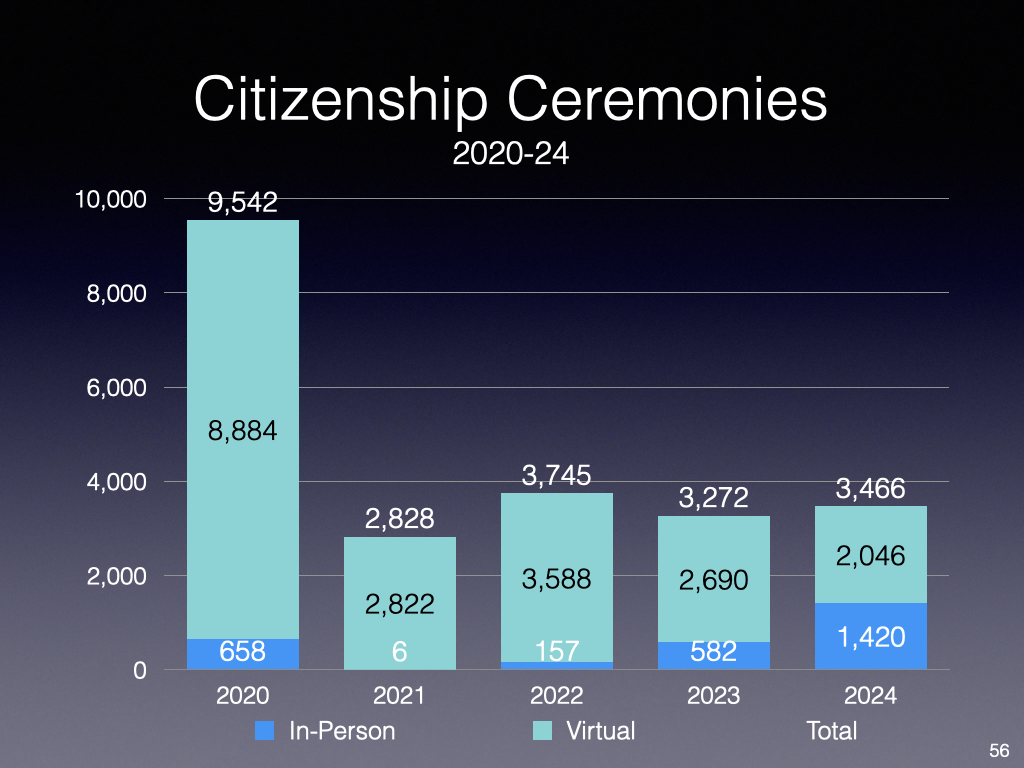
Subsequently, IRCC provided me with citizenship ceremony data from 2020 (start of pandemic) to 2024. The following charts summarize the change over the years.

Figure 1: Number of citizenship ceremonies by type
Figure 2: Relative percentages of in-person and virtual ceremonies

Using the same percentage breakdown between in-person and virtual ceremonies from January to September 2023 (IRCC was unable to provide breakdowns for this dataset), the following chart contrasts the number of new citizens by ceremony type.

IRCC does provide the option for applicants to specify their citizenship ceremony preferences:

The petition recommended that “Most citizenship ceremonies should be in-person.” However, this data highlights that while over 40 percent of 2024 ceremonies are now in-person, it still remains the fact that the majority of new Canadians participate in virtual ceremonies, reflecting the larger average size of virtual ceremonies.

Given the importance of citizenship ceremonies in immigrant integration and citizenship meaningfulness, any future government should continue and accelerate the shift back to in-person ceremonies.

Lisée: Identité canadienne, après l’éclipse [change of emphasis and tone, citizenship ceremonies]

Lisée also notes Poilievre’s commitment to restore in person citizenship ceremonies, a welcome change given that the vast majority are virtual:

….Poilievre a dégainé le premier, dans son discours de refondation de ses thèmes électoraux, le 15 février, sous le slogan « Canada d’abord ». Il fut question de pipelines et de baisses d’impôt, mais pas seulement de ça. Il a annoncé la fin de « la guerre contre notre histoire », en particulier la guerre contre le fondateur du pays, John A. Macdonald, qui a eu le grand mérite d’être conservateur. Son successeur, s’il est élu, veut « renforcer les sanctions contre ceux qui détruisent ou dégradent nos symboles ». Il annonce aussi le retour des héros et des symboles canadiens sur les pages de notre passeport, évincés comme on le sait par l’équipe postnationale de Justin.

Il peste, avec raison, contre l’introduction par le désormais ancien régime de cérémonies d’assermentation à la citoyenneté à distance. Non seulement il rétablira l’obligation de se présenter en personne, mais il ajoutera un passage au serment. Le voici : « Je témoigne ma gratitude à ceux qui ont travaillé, se sont sacrifiés et ont donné leur vie pour défendre la liberté dont je me réjouis aujourd’hui et pour bâtir le pays que j’appelle maintenant mon chez-moi. Comme eux, je m’engage à remplir mes devoirs de citoyen canadien. »

Pour mémoire, car c’est difficile d’y croire, le serment actuel est : « Je jure que je serai fidèle et porterai sincère allégeance à Sa Majesté le roi Charles III, roi du Canada, à ses héritiers et successeurs ; que j’observerai fidèlement les lois du Canada, y compris la Constitution, qui reconnaît et confirme les droits ancestraux ou issus de traités des Premières Nations, des Inuits et des Métis, et que je remplirai loyalement mes obligations de citoyen canadien. »

Avouez que cette simple lecture fait douter de l’existence d’une identité canadienne, du moins autre qu’indigène et royale.

Mark Carney n’a pas voulu être en reste. Dès son premier jour, il a créé un ministère de l’Identité canadienne. Pour un pays qui n’en avait officiellement aucune la veille, la chose est immense. Parmi ses premiers mots prononcés, notre nouveau chef de gouvernement a affirmé que « notre identité bilingue et la langue française enrichissent notre culture », car le Canada est « un pays construit sur le roc de trois peuples : indigène, français et britannique ». Le mot « multiculturalisme » ne fut pas prononcé. C’est à peine si fut mentionnée, au passage, la diversité. On sent donc une réelle volonté de se recentrer sur les fondamentaux. D’autant que Carney a de suite pris l’avion vers les trois pôles identitaires désignés : Paris, Londres et Iqaluit.

Mais à part nous annoncer que nous avons désormais une « identité bilingue », en quoi consiste celle-ci ? Il a choisi un Québécois, Steven Guilbeault, pour chapeauter le nouveau ministère, qui n’a pas dans son intitulé la responsabilité des langues officielles, mais qui y gagne au change, car il obtient la gestion des parcs du Canada. Le lien avec l’identité vous échappe ? Pas au premier ministre, qui explique que « la question de l’identité canadienne est beaucoup plus large que seulement les langues officielles. C’est beaucoup plus que notre héritage. Nous construisons l’identité canadienne, et c’est vraiment la clé ». Oui, car, dit-il, elle « inclut la nature ». Le ministre Guilbeault est chargé de « mettre ensemble toutes les responsabilités qui concernent la nature, les océans, la biodiversité, et de s’assurer que toutes ces choses sont protégées et promues ».

Résumons. Notre identité est bilingue, assise sur un roc, alliage de riches veines françaises, britanniques et indigènes, mais inclut la nature, les océans et la biodiversité. Cela fait un peu bouillabaisse, convenons-en. Mais on campe résolument dans l’anti-postmoderne, ce qui est archinouveau, non ? Reste à insérer le tout dans le serment.

On sent que Steven Guilbeault va bientôt s’ennuyer d’un dossier bien plus simple : rendre vert un pays producteur de pétrole.

Source: Identité canadienne, après l’éclipse

…. Poilievre drew the first, in his speech of refoundation of his electoral themes, on February 15, under the slogan “Canada first”. There was talk of pipelines and tax cuts, but not only that. He announced the end of “the war against our history”, in particular the war against the founder of the country, John A. McDonald’s, who had the great merit of being conservative. His successor, if elected, wants to “strengthen sanctions against those who destroy or degrade our symbols”. He also announces the return of Canadian heroes and symbols on the pages of our passport, ousted as we know by Justin’s post-national team.

He rightly plagues against the introduction by the now old regime of ceremonies of oathing to remote citizenship. Not only will he reinstate the obligation to appear in person, but he will add a passage to the oath. Here it is: “I express my gratitude to those who worked, sacrificed themselves and gave their lives to defend the freedom I look forward to today and to build the country that I now call my home. Like them, I am committed to fulfilling my duties as a Canadian citizen. ”

For the record, because it is hard to believe, the current oath is: “I swear that I will be faithful and pledge sincere allegiance to His Majesty King Charles III, King of Canada, to his heirs and successors; that I will faithfully observe the laws of Canada, including the Constitution, which recognizes and confirms the ancestral or treaty rights of First Nations, Inuit and Métis, and that I will faithfully fulfill my duties as a Canadian citizen. ”

Admit that this simple reading makes us doubt the existence of a Canadian identity, at least other than indigenous and royal.

Mark Carney didn’t want to be left behind. From his first day, he created a Canadian Ministry of Identity. For a country that officially had none the day before, the thing is immense. Among his first words, our new head of government said that “our bilingual identity and the French language enrich our culture”, because Canada is “a country built on the rock of three peoples: indigenous, French and British”. The word “multiculturalism” was not pronounced. It is hardly if diversity was mentioned, in passing. We therefore feel a real desire to refocus on the fundamentals. Especially since Carney immediately flew to the three designated identity poles: Paris, London and Iqaluit.

But apart from announcing that we now have a “bilingual identity”, what does it consist of? He chose a Quebecer, Steven Guilbeault, to oversee the new ministry, which does not have responsibility for official languages in its title, but which wins in exchange, because it obtains the management of Canada’s parks. Does the link with identity escape you? Not to the Prime Minister, who explains that “the issue of Canadian identity is much broader than just official languages. It’s much more than our legacy. We’re building Canadian identity, and that’s really the key.” Yes, because, he says, it “includes nature”. Minister Guilbeault is responsible for “putting together all the responsibilities that concern nature, the oceans, biodiversity, and ensuring that all these things are protected and promoted”.

Let’s summarize. Our identity is bilingual, sitting on a rock, an alloy of rich French, British and indigenous veins, but includes nature, oceans and biodiversity. It’s a little bouillabaisse, let’s agree. But we camp resolutely in the anti-postmodern, which is arch-new, right? It remains to insert everything into the oath.

We feel that Steven Guilbeault will soon get bored of a much simpler file: making an oil-producing country green.

There hasn’t been an in-person citizenship ceremony in Thunder Bay for years. A petition aims to change that

A reminder of the importance of in-person ceremonies vs virtual “marginalized to such a small and lackluster event”:

Greta Piazza says becoming a Canadian citizen in Thunder Bay, Ont., was a great feeling — but the moment would have felt more significant had the ceremony been held in person.

Piazza, who is from Arona, Italy, has been living in the northwestern Ontario city for about five years. She’s lived in a number of countries, including Spain, Portugal and Ireland, but was drawn to Canada by her husband, Tim Van Reenen.

She passed her Canadian citizenship test last year, but had to take her oath online.

“I would have been more happy to have it in person because it’s a different feeling,” Piazza said. “I could have been there with the other new citizen[s] and with the judge in person, the flags, the officials.”

“After the ceremony, you receive a citizen certificate. Receiving that in person probably would have … made the experience more real.”

The Thunder Bay Multicultural Association (TBMA), which offers classes to help people prepare for the citizenship test, helped organize the city’s ceremonies, which saw between 100 and 120 candidates each.

“They often had two ceremonies per year just because of the demand,” said the TBMA’s executive director, Cathy Woodbeck. “There were candidates from across northwestern Ontario.”

The ceremonies have been held virtually by video call since the COVID-19 pandemic. Last week, Thunder Bay resident Julie Hutka started a petition in the hopes of changing that.

“I think that it’s so important to have that opportunity to celebrate this major step in front of one’s family and friends and with other people who are stepping onto this journey, that it really should be in person,” Hutka said.

“Things can be streamlined for bureaucracy, but I don’t believe this is one of them that should be.”

Candidates may request format change: IRCC

Hutka has a family member going through the process of becoming a Canadian citizen. Her relative’s friend recently took the oath, and Hutka said she was shocked to learn it happened on a laptop at the kitchen table.

“I thought really, this is such a monumental moment in the long process to becoming a Canadian, that it is marginalized to such a small and lackluster event,” she said.

“My mother became a Canadian citizen many, many, many years ago and it was a real moment of pride just to watch my mother take this oath.”

CBC News reached out to Immigration, Refugees and Citizenship Canada (IRCC) and received an emailed statement on Tuesday.

“The Government of Canada is committed to continue delivering meaningful, celebratory and inclusive in-person and virtual ceremonies, in all regions of the country. Candidates are invited by the department to either an in-person or virtual ceremony based on operational considerations,” the statement says.

“Candidates may request a change of format (e.g. from virtual ceremony to in-person ceremony and vice-versa) and the department makes best efforts to accommodate their preference.”

However, the government’s webpage on citizenship ceremonies says “IRCC primarily holds citizenship ceremonies via video, and occasionally in-person.”

“In-person ceremonies are often organized when there is demand and/or multiple applicants from an area awaiting a ceremony,” the department said in its statement.

For Woodbeck, in-person citizenship ceremonies were always the highlight of her work.

“These are probably the best things we get to attend. We have such a good time. A lot of the staff here at the association have gone through this process, have come from other countries, have become Canadian citizens, so they remember that,” Woodbeck said.

The government’s response about in-person ceremonies is encouraging, she said, and she hopes to be able to plan an in-person event soon.

When she first arrived, Piazza received support from the TBMA in completing her temporary residency application and then permanent residency application. Now, she’s giving back by helping other newcomers in the city as a language interpreter services worker there.

She loves living in northwestern Ontario and spending time at Thunder Bay’s marina and nearby Kakabeka Falls, she added.

“Sometimes for a newcomer here, it’s really challenging to know how to go through processes, and [the TBMA] have always been a good support to me,” Piazza said. “It’s a very great support for all newcomers.”

Source: There hasn’t been an in-person citizenship ceremony in Thunder Bay for years. A petition aims to change that

Fact check: Was this Conservative MP censored by a government department? [Citizenship ceremony]

Needed fact check:

What was said: On July 20, Conservative MP GARNETT GENUIS shared a video of a speech he gave at a citizenship ceremony in his Sherwood Park-Fort Saskatchewan, Alta., riding. “SHOCKING,” the MP wrote. “Officials in this NDP-Liberal Government wanted to be able to vet and censor my remarks at a Citizenship Ceremony for my own riding.” 

In a later post, he said he was asked to submit his remarks to IRCC officials before the ceremony, claiming that was the first time that had occurred in his nine years in office. He accused the department of asking for the remarks “very clearly with the intention of reserving the right to approve them or not approve them. This is an attempt to change protocol and control what MPs say,” he posted in his replies. 

In the video itself, Genuis said he was “disappointed” at being asked to submit his speech in advance.  

The facts: Immigration Minister MARC MILLER’s press secretary AISSA DIOP told Politics This Morning that IRCC officials request all MPs—no matter the political affiliation, and including the minister himself—to share their remarks before the event for review. She said this is not to censor anyone, but to ensure that the remarks at a citizenship ceremony remain non-partisan. Diop’s comments were backed by a departmental spokesperson, who said the practice is “long-standing.” 

“Let us be clear: these ceremonies go far beyond ridings, far beyond our political affiliations, and far beyond our personal views. They are about the people in the audience with their family members, and the joy they feel at the end of their immigration journey,” Diop said in a statement.

Verdict: Lotsa spin. We can’t say for sure why Genuis may have never encountered this practice before, but it is not a new practice. One could argue it is intended to “censor” politicians, insofar as the intent behind the practice does manage the nature of their remarks. But MPs have many other avenues to embrace partisan speech, so the effect of the review is unlikely to amount to actual “censorship.” Think of it instead as a procedural requirement. MPs don’t consider keeping their remarks within the confines of “parliamentary language in the House of Commons to be censorship, do they? 

Source: Fact check: Was this Conservative MP censored by a government department? [Citizenship ceremony]

Fewer immigrants are deciding to become Canadian citizens: Institute for Canadian Citizenship

More coverage:

Abisoye Akinpelu and her children were among the 25 immigrants at a Calgary citizenship ceremony on Saturday, ready to become Canadian citizens.

“I feel so accomplished. It’s a long journey for us and it’s been filled with ups and downs, but it’s worth it,” Akinpelu, who came to Canada from Nigeria, said.

Akinpelu says she enjoys Canada’s multicultural community, and how Canadians from different backgrounds can live peacefully together. Immigration Minister Marc Miller was also at the citizenship ceremony where he said citizenship is not a choice to be made lightly.

“This is the best country in the world to be in. I think you know that … Otherwise, perhaps you wouldn’t have made that choice.”

However, the 2021 and 2016 Census reported fewer immigrants are choosing to become Canadian citizens. According to new data released by the Institute for Canadian Citizenship (ICC), the proportion of people becoming citizens within 10 years of their arrival in Canada has dropped by 40 per cent.

“People are less interested in becoming Canadian. Let that sink in,” Daniel Bernhard, the ICC’s CEO, said. “It’s not because they are not interested or not grateful. It’s in many cases because they are trying to contribute and we’re not allowing them to.”

The numbers indicate citizenship uptake is the lowest among highly educated economic immigrants, and Bernhard said it’s because they are weighing their options before taking the oath.

“Not feeling welcome is not just whether your neighbours are nice to you, or whether your kids have a good place in school, but whether your employer thinks that you have something important to contribute,” Bernhard said.

“The cost-of-living crisis in Canada continues to bite, and (their) skills and experience are not recognized in the labour force here,” Bernhard said, adding that many immigrants may feel frustrated and potentially decide to move on from the idea of becoming Canadian citizens.

As well, a recent poll by Angus Reid found the housing affordability crisis is forcing more newcomers to rethink their place in Canada and consider moving to a different province, or a different country altogether.

Bernhard said the lack of affordability is already having an impact on citizenship uptake, but confirmed the ICC is calling on Ottawa to provide more opportunities for people to celebrate and appreciate the value of citizenship, and to put a cap on virtual citizenship ceremonies.

Source: Fewer immigrants are deciding to become Canadian citizens: Institute for Canadian Citizenship

“In Demand Yet Unprocessed: Endemic Immigration Backlogs” – Citizenship Government response

The section of the government response to CIMM’s study of backlogs, citizenship ceremonies and oath. My understanding, however, is that in practice applicants are assigned the ceremony type automatically (virtual being the default) but can request an in-person if they prefer. Last time I checked based upon public IRCC data, about 90 percent of applicants had virtual ceremonies.

And of course, IRCC’s “seeking to increase the percentage of clients that complete the Oath in-person in 2024-2025” is meaningless unless its open data operational data includes the numbers of new citizens by virtual and in-person ceremonies:

7. That IRCC make clear to all individuals that it is their choice to choose the citizenship ceremonies process best suited to their needs; and that while in-person ceremonies should be the default option, virtual ceremonies should also be allowed; and further, that any self-administered oath of citizenship be subject to robust integrity measures. Agree in Principle

The Government agrees in principle with the recommendation that the Department make it clear to clients that they may choose the citizenship ceremony format best suited to their needs, and that any self-administered oath of citizenship be subject to robust integrity measures. Canada welcomed a record number of 364,166 new citizens in 2022-2023, compared to approximately 248,000 in 2019-2020 (pre-pandemic), enabled in part by the implementation of virtual ceremonies (also called video ceremonies) and related efficiencies.

As of July 2022, IRCC resumed holding in-person ceremonies while maintaining virtual ceremonies, as a stream of service delivery that provides efficiency, timely service, and flexibility to clients as they can accommodate more clients from coast to coast to coast, including those in rural and remote regions. Clients are invited by the Department to either an in-person or virtual ceremony, based on operational considerations, but can request a change of format (e.g. from virtual ceremony to an in-person ceremony or vice-versa) and the Department makes best efforts to accommodate client preference.

Virtual ceremonies have contributed to a significant reduction in grant inventories, while modernization initiatives, such as online electronic applications for most grant of citizenship applications and electronic citizenship certificates, have reduced and continue to reduce processing times with a return to service standards projected for spring 2024.

A number of factors, including volumes of clients served and costs would be impacted if in- person ceremonies were set as the default option. Instead, the Department is seeking to increase the percentage of clients that complete the Oath in-person in 2024-2025 as well as clarify that all individuals have the opportunity to request the citizenship ceremony format that best suits their needs, subject to availability.

In addition, the Department continues work to modernize Canada’s Citizenship Program to improve client service, increase processing efficiencies and enhance program integrity. As the Citizenship Program continues to modernize, the Department will reflect on the feedback received from Canadians, and incorporate this into the assessment of options and decisions on a way forward.

Source: “In Demand Yet Unprocessed: Endemic Immigration Backlogs”

Articles of interest: Citizenship

Starting up my blog again, highlighting some of the articles I found of interest.

Past Imperfect: J. L. Granatstein’s prescient warning

Agree, both the good and the bad:

Also regrettable is that Granatstein did not offer a more pointed rationale for learning hist­ory. He argued that an understanding of the subject was “the prerequisite of political ­intelligence” but without going further. The cost of not knowing history is much deeper, in my view. It creates a real disquiet and robs the community of its ability to find nuance in any dispute. Indeed, one could argue that the incoherence of a vast array of policy areas in this country — from cultural and global affairs to housing and homelessness — can be explained only by a general loss of historical consciousness.

To talk historically about any episode — a court case, a medical issue, a construction problem, even a love dispute — is to inquire about “what really took place last time.” It ­naturally invites subtlety, attention to context, and storytelling that can lay the groundwork for compromise. It calls for clarity in sequencing events and necessarily examines what’s behind the story: “Well, we didn’t have the tools” or “Our thinking was wrong” or “We simply didn’t know.” It can build respect and, not least, modesty. But it can also bridge solitudes and open the road to cooperation, better understanding, and perhaps even reconciliation and forgiveness. No one who studies history seriously can be insensitive to the anxieties and cruelties of humanity or unimpressed by its resilience, ­creativity, and kindness.

But that sort of discipline has been evacuated from popular culture. For over a dozen years now, history departments have seen their student numbers decline. Consequently, new hires are even rarer than before. Governments seldom consider the failures and successes of previous policies; museums dedicated to the past are shrivelling without money for new exhibits and programs. Historians, terrified of being misunderstood, refuse to engage in public debates that could bring nuance to policy issues. Canada is not in a state of post-nationalism but is rather a place of hiber‑nation — a country that has fallen asleep and forgotten its past.

This is dangerous. Historical awareness bolsters democracy and democratic instincts. Take away history and you undermine the ability to discuss, to debate, and to share knowledge on how things evolved. Without such skills and knowledge, democracy as we know it will wither and die

Source: Past Imperfect: J. L. Granatstein’s prescient warning

Local citizenship judge wins Community Impact Award – Thorold News

A reminder of the power of in-person ceremonies:

The ceremonies to which she is referring are citizenship ceremonies. For just over five years Ivri has been a citizenship judge with Immigration Refugees and Citizenship Canada. In an average week in this role she swears in between 1,200 and 1,500 new Canadians.

In the relatively short time that she’s been one of nine judges in the Niagara and Hamilton offices of the department, she has welcomed more than 100,000 newcomers to Canada. Besides her family – husband Eldean and children Elijah, Zachariah, Ezekiel and Michaiah – she says it’s the most rewarding thing she’s ever done.

Ivri herself comes from an immigrant family. Her mother Valerie came to Canada to visit an uncle in 1967, leaving behind her husband Roosevelt and their son back in Jamaica. On leave from her job as a customs officer there, Valerie went to a Canadian immigration office to extend her visa. An officer there suggested she instead apply for citizenship, so she did.

Source: Local citizenship judge wins Community Impact Award – Thorold News

Shawn Taylor: Are Immigrants Falling out of Love with Canada? (And is it Because We Feel the Same?)

Overly negative but not without merit:

The evident decline in Canada’s citizenship rates may say more about the attitudes and habits of existing Canadians than those of newly-arriving immigrants. The federal bureaucracy’s failure to meet its own published service standards is certainly a self-inflicted wound. As is the proposal to solve this problem by eliminating much-loved citizenship ceremonies. The effect of both situations is to debase the perceived status of Canadian citizenship by emphasizing the transactional over the transformational. Then there’s the Roxham Road debacle, which offers migrants the opportunity to illegally sneak into our country via a dead-end road rather than at a regular border crossing and still be recognized as refugee claimants, with all the official support and standing this entails. If Canadian citizenship is supposed to be so valuable, it seems foolish to further cheapen the reputation of the entire immigration system in this way.

Beneath these obvious failures of governance and policy, however, lurks an even deeper and more insidious problem. As Bernhard explains, becoming a citizen is akin to joining a team with all other Canadians. A “club,” so to speak, that is exclusive to those who wish to be identified as Canadian and who intend to participate in its promotion and maintenance by voting and performing other civic duties. If we accept such an analogy, then it clearly matters how we advertise and promote this club to new members. So what sort of stories do Canadians tell about their own country these days? And do they amount to an effective marketing strategy?

 “The story of Canada that our major institutions tell has increasingly become one that focuses on only the most negative aspects of our country, such as oppression, racism, discrimination and dispossession,” observes Christopher Dummitt, an historian at Trent University’s School for the Study of Canada in Peterborough, Ontario. Common examples of this new tendency are factually-dubious claims, often from officially sanctioned sources, that Canada has committed and continues to commit genocide against the Indigenous population, is systemically racist towards black people, was once a slave country, and on and on. “It is a deliberate distortion of our actual history,” says Dummitt in an interview.

This sense of national self-loathing has become so encompassing that official multiculturalism, once billed as an unquestionable Canadian value, is now considered evidence of an “unjust society premised on white supremacy,” as two University of Calgary education professors absurdly argued last year. Even professed supporters of Canadian identity, such as ICC co-founder Ralston Saul, now casually declare that “Canada has failed on many fronts.” As for how such a perspective might work as a branding exercise, Dummitt says, “If the story about Canada is that it was an institutionally corrupt nation beset by the original sin of colonialism, then why would anyone want to become a citizen of that?”

Dummitt has been pushing back against the now-pervasive narrative that Canada is, at its core, morally bankrupt. In 2021 he organized a rebuttal signed by many eminent Canadian historians condemning the Canadian Historical Association’s (CHA) unilateral declaration that Canada’s treatment of Indigenous peoples was “genocidal.” In making such a claim, Dummitt’s rebuttal stated, the CHA was “insulting the basic standards of good scholarly conduct.” He has also spoken out against the practice of tearing down statues honouring Canada’s founding fathers, and is currently fighting Toronto’s plans to scrub the name of 18th century British parliamentarian Henry Dundas from its streets and public squares on the (entirely bogus) assertion that he was an ally to the slave trade. “We need to call out these nonsensical claims,” Dummitt states determinedly. “And we need politicians who are willing to celebrate the Canadian nation in diverse ways.”

With this sort of self-hatred being expressed by current citizens, is it any wonder immigrants are having second thoughts about joining Club Canada

Peter Shawn Taylor is senior features editor at C2C Journal. He lives in Waterloo, Ontario. 

Source: Are Immigrants Falling out of Love with Canada? (And is it Because We Feel the Same?)

Is Portugal’s Golden Visa Scheme Worth It?

No:

On Nov. 7, the same day that Portugal’s Prime Minister António Costa resigned amid corruption allegations pertaining to lithium contracts, federal officers in Brazil raided the Portuguese Consulate in Rio de Janeiro.

The Brazil raids were not connected to the Lisbon investigation, a spokesperson said. Instead, according to Brazilian police, they were part of a separate investigation into the falsification of documents in collusion with applicants seeking Portuguese visas and citizenship. Since the 1990s, amid periods of economic downturn and social instability, large numbers of Brazilians have struck out for Portugal. When the country began its “golden visa” program in 2012, wealthy Brazilians became the second largest group to take advantage of it.

Portugal’s golden visa grants European Union access to foreigners in exchange for investment. From its inception in the wake of the 2008 global financial crisis, it has faced backlash, and the criticism has only grown more vocal in recent years. Chiefly, it is blamed for contributing to a severe housing crisis that has made affordable housing unattainable for most Portuguese.

In early October, Costa’s Socialist government finally passed a law that took aim at the issue, removing the real estate investment pathway from the golden visa program. Previously, people who invested in a qualifying property worth at least 280,000 euros (about $305,000) were eligible. The change, almost a year in the making, has ricocheted around the world of global elites, many of whom had come to regard Portugal as a foothold into Europe. Although more than 30,000 foreigners have benefited from Portugal’s golden visa, its benefits for the Portuguese themselves are less clear.

Source: Is Portugal’s Golden Visa Scheme Worth It?

German State Saxony-Anhalt: No citizenship without supporting Israel’s existence 

Hard to see how this will work in practice:

The decree instructs authorities to pay close attention to whether an applicant exhibits antisemiticattitudes and states that “obtaining German citizenship requires a commitment to Israel’s right to exist.”

In a letter to local authorities, the Saxony-Anhalt state Interior Ministry said naturalization is to be denied to foreigners who engage in activities directed at Germany’s liberal democratic order as outlined in the country’s Basic Law. The denial of Israel‘s right to exist and antisemitism are included among such activities.

Local authorities have been instructed to deny an applicant’s naturalization request if they refuse to sign the declaration. A refusal is also to be documented in the individual’s application filing for future reference.

Source: German state: Citizenship applicants must support Israel
Proud to be Canadian: Families reflect following Canadian citizenship ceremony in Battleford

Good example of why in person ceremonies matter:

Nearly 40 people from nine different countries became Canadian citizens Thursday at a special Canadian citizenship ceremony held at Battleford’s Alex Dillabough Centre.

Annette McGovern, executive director at the Battlefords Immigration Resource Centre said the day couldn’t have gone better, with a great turnout all around.

“I thought it was fantastic; everything went really well, and the people were so impressed to have received their certificate in person and be able to celebrate with other people,” she said.” It was just a fantastic turnout with really great people.”

Marking the first time a citizenship ceremony has been held in person in the Battlefords since before the COVID-19 pandemic, Manmeet Randhawa was among those receiving his Canadian citizenship, along with his family, after first moving to Canada from India in 2009.

“There was some struggle [over the years], but we found it very good to be a part of this country and now we are very happy that we are citizens here, it’s a great moment,” Randhawa said.

While currently residing in Saskatoon, the family made the trip to the Battlefords for Thursday’s event so they could share in the ceremony with others, something Randhawa said they felt was an important aspect of the experience.

“They gave us two options, to either do online or in person, so we chose in person because we need the emotions we can feel at the ceremony,” he said, letting out a smile. “That’s why we travelled all the way from Saskatoon to Battleford for this ceremony and we are very happy to be here, it was a great time.”

Leah Grace Robles and her family, who are from Manila – the capital of the Philippines – were also among those making a dream come true with Thursday’s citizenship ceremony.

Having moved to Canada about a decade ago, Robles said that her younger brother is now approaching his 18th birthday and her family decided it was time they became official Canadian residents, something she too had felt was important to do together.

“My dream [was] doing it with the whole family,” she said with a smile. “I am a real Canadian now, and it is very different if you have your citizenship, it is a different feeling… I am more proud [than ever] right now.”

When asked what it is about Canada that brought the family overseas, Robles said it was the opportunity life in the country presents.

“Firstly, it’s the chance for us to be together for a long time,” she said. “And to be honest, the education, the health system, and the future of their kids – speaking on behalf of my parents – that is the most important thing for them.

“The blessing [of] having this and being with your family is the most important thing.”

Source: Proud to be Canadian: Families reflect following Canadian … – battlefordsNOW