Three contrasting narratives regarding statues of Sir John A and other historical figures

Three contrasting narratives: the first by Martin Regg-Cohn, of the Star (keep most statues but provide historical and social context), the second by Erica Ifill in the Globe (tear them down, lacking perspective) and the third, by Tom XXX in The Tyee, (focus on building monuments and statues to commemorate Indigenous history). In Hegelian terms, think thesis, antithesis and synthesis.

Focussing on the symbolic, while important, can divert attention away from the long and difficult tasks of improving conditions for Indigenous peoples and can be seen as one form of virtue signalling. If there were easy and simple solutions, we wouldn’t be in this space now.

Starting with Regg-Cohn:

The tug of war over public statues keeps exposing our blind spots — not just our blinkered view of history, but of democracy in all its complexity.

Sir John A. Macdonald is merely the latest historical figure to be pulled down and covered up, his head lopped off or layered with painted graffiti. Protestors in Montreal toppled our founding prime minister last weekend, and Macdonald’s visage is visible no more at Queen’s Park — protected and padlocked in a massive wooden shell after demonstrators hurled paint at his statue this summer.

Unpopular statues, like unpopular governments, ought not to be toppled in a democracy — just put in their place, placed in context, or put in storage.

Controversies over politicians of the past — like those of the present — are as old as history itself, and rarely as simple as they appear on protest placards. How we deal with them, how we heal over them, also matters in the crusade to right historical wrongs.

Sometimes the decision is obvious — like removing Confederate statues that celebrate those who lost the civil war but still succeeded in keeping Blacks down. More often it’s complicated.

Shall we remove the monument to Mahatma Gandhi at Carleton University, given latter-day criticisms of the Indian independence leader for harbouring anti-Black views? What about the monument in Toronto’s Riverdale Park to Sun Yat-sen, the revered leader who brought China into the modern era?

“Other monuments, such as to Sir Winston Churchill, to Sun Yat-sen, have also been called into question,” Wayne Reeves, chief curator of Toronto’s culture division, told the city’s Aboriginal affairs advisory committee last month.

Which raises the question of who decides. Protestors deserve to be heard but not automatically heeded. A representative democracy defined by pluralism, mindful of minority rights and majority sentiments, requires consultation and conciliation, debate and deliberation.

A statue of Edward Cornwallis, founder of Halifax was a festering sore given his infamous Scalping Proclamation of 1749 offering a bounty for any Mi’kmaq adult or child. Ultimately, the statue was removed when elected representatives took a vote in 2018 (they voted again last month to erase his name from city streets and relocate the statue in a new museum of Mi’kmaq history).

That may not be as satisfying as spray painting, or as gratifying as graffiti. But the decision is more enduring.

The controversy over Macdonald is complicated — and in many ways intertwined with the debate over Egerton Ryerson, whose statue at Ryerson University was covered in pink paint by the same protestors this summer. As one scholar looking into Ryerson’s relationship with residential schools noted, his name is “incorrectly linked to the ‘architect’ label;” instead, wrote Sean Carleton, “Macdonald must be understood as its architect.”

(Full disclosure: as a visiting practitioner at Ryerson’s Faculty of Arts, I walk by his statue on campus; I see his visage again inside the legislature when I walk by the Ryerson bust perched just outside NDP Leader Andrea Horwath’s office).

Perhaps that’s why Ryerson University added a plaque in 2018 introducing more context: “As Chief Superintendent of Education, Ryerson’s recommendations were instrumental in the design and implementation of the Indian Residential School System,” it reads.

That he also pioneered the modernization of Ontario’s educational system remains beyond dispute. The question is how to reconcile conflicting legacies for people like Ryerson, Macdonald, Churchill, Gandhi, and others.

At Queen’s Park, Macdonald lies boarded up. What’s interesting is that few other statues, such as one honouring Queen Victoria — who presided over so much of our complicated colonial history — get much attention.

A few steps away, a monument honours the “memory of the officers and men who fell on the battlefields of the North-West in 1885,” which surely invites historical context and Indigenous input. The previous speaker of the legislature, Dave Levac, campaigned for years to erect a new to monument to the Métis leader Louis Riel, who led the Northwest Rebellion and was later executed during Macdonald’s time as PM.

Surely the answer to our complicated historical record is to clarify and contextualize it, rather than censor it — which is why the recent addition of anonymous historical plaques adding context to some of Toronto’s most problematic landmarks and street names is so interesting and educational. Far better to fill in the gaps of history rather than create new historical vacuums in a country where few of us have taken the time to learn it.

“The problem I have with the overall approach to tearing down statues and buildings is that is counterproductive,” said Sen. Murray Sinclair, who headed the Truth and Reconciliation Commission investigating the Residential Schools disaster. “We are trying to create more balance in the relationship.”

That’s similar to the approach taken by Nelson Mandela, who launched a pioneering truth and reconciliation commission when he became the first president of post-apartheid South Africa. As president, he avoided reflexively razing the statues of his racist predecessors, opting for a more deliberative approach (some came down, others remained).

Mandela, like Gandhi, understood the frailty and flaws of all humans, not least our leaders. Let he who is without sin cast the first bronze.

Ifill:
In a classic example of what the late John Lewis called “good trouble,”Montreal demonstrators removed the statue of Sir John A. Macdonald from a public space without injury at a protest to defund the police last Saturday. And the outrage from the white Canadian men in whose image Canadian history is taught was swift.

But context has been missing from so many pearl-clutching responses. In this second civil rights movement, where Black Lives Matter has brought global attention to police violence and death wrought on Black people, the traditional framing of criminality is being challenged. Even our current Prime Minister has engaged in at least the pageantry of it; just months earlier, Justin Trudeau attended an anti-police brutality march in Ottawa, going so far as to take a knee reminiscent of former NFL quarterback Colin Kaepernick’s years-long protest over the same issue.

Fast forward to his response to the statue toppling, and his tone has changed. Much like his reaction to the protests in support of some Wet’suwet’en hereditary chiefs, Mr. Trudeau has morphed from white ally to condescending white settler colonialist. “We are a country of laws, and we are a country that needs to respect those laws even as we seek to improve and change them,” he said on Monday. “Those kinds of acts of vandalism are not advancing the path towards greater justice and equality in this country.”

With allyship like this, who needs enemies?

In doing this, Mr. Trudeau was eager to show off his law-and-order bona fides. But if he is still seeking to advance “greater justice and equality,” he undermines his own allegedly progressive message by vaunting the very laws that underpin many of the problems being protested – including laws Macdonald helped establish at the start of Confederation. (And imagine having the temerity to scold Canadians about respecting the law after proroguing Parliament to avoid judgement from those same laws, in your second ethics scandal in as many years.)

It’s not as if this issue came out of nowhere for Mr. Trudeau, either. The removal of monuments exalting the father of Confederation has been in the national discourse for years. However, Canadians like to engage in the vanity exercise of cherry-picking the history we’re comfortable with, leaving out the icky bits that don’t uphold our worldview of being “good people.” The reality, though, is that Canada’s first prime minister was an oppressive colonist whose deployment of state violence was instrumental in the formation of the nation. These aren’t “mistakes made by previous generations who built this country,”as Mr. Trudeau falsely characterized them; rather, this was a man who committed real atrocities that formed and informed how the Canadian state interacts with Black, Indigenous and people of colour, to this day.

Here are just a few achievements on his résumé: The creation of the federal residential school system, which was used as a form of genocide against Indigenous peoples; the creation of the pass system, a program of social control requiring Indigenous people to attain permission to leave the reserve (and which was then exported to South Africa, where it was used to control Black South Africans during apartheid); the execution of Louis Riel; a starvation policy to clear Indigenous people off their lands and make way for the Canadian Pacific Railway; the largest mass execution in Canadian history, when eight Indigenous men fighting that starvation policy were hanged in what is known as the Frog Lake Massacre; the implementation of the Chinese Head Tax; and the passage of the Electoral Franchise Act, which denied Black and Indigenous people the vote.

Those same racialized groups targeted by MacDonald in the formation and dominion of Canada continue to be the targets of systemic racism and oppression today.

Ignoring inconvenient truths makes for bad leadership. And the paucity of leadership from Mr. Trudeau is evident, or else there wouldn’t have needed to be a protest in Montreal in the first place. Five years after the Truth and Reconciliation Commission’s report, we are still waiting on this government to implement its recommendations. Nearly three months after Mr. Trudeau took the knee, we are no closer to systemic reforms, despite the credible plans on the table. And in June, the Parliamentary Black Caucus called on the federal government to dedicate real resources toward ending anti-Black systemic racism: “This is not a time for further discussion – the Afro-Canadian community has spoken for many years and is no longer interested in continued consultation or study. Extensive reports and serious proposals already exist.” That call appears to have gone unheeded.

Unfortunately for the Prime Minister, his ability to deliver on promises of transformational change has long been in dispute. Now, he has condemned protesters on the destruction of property more than he has the RCMP, for the gratuitous violence against Black and Indigenous people.

The time for double-talk is over. The time for action is now – and it’s not being well used in defending Canadian history’s leading man.

Source: https://www.theglobeandmail.com/opinion/article-in-rebuking-john-a-macdonald-protesters-trudeau-undermines-his-own/

Lastly, and I think most useful, Tom McMahon:

Every so often, the removal of a statue or place name causes a minor media moment in Canada. Like this weekend, when protesters in Montreal pulled down a statue of the country’s first prime minister, the notorious racist John A. Macdonald, and beheaded him.

The media dove in. “Trudeau ‘deeply disappointed’ after demonstrators topple John A. Macdonald statue” read one headline. The prime minister’s thoughts on this “act of vandalism” filled papers across the country.

Rarely does news coverage of such stories place the topic of statues in a broader context. And political parties are usually completely silent about it too.

What is the broader context? It’s that while we can seemingly talk forever about whether a statue or place name should exist, we never seem able to discuss what does not exist. And why that might be.

What doesn’t exist in Canada, for the most part, are statues and monuments highlighting great Indigenous leaders, or highlighting exactly which Indigenous groups live in a particular place and their contributions to Canadian life. What doesn’t exist is any effort to create these monuments.

Justin Trudeau is deeply disappointed that a headless John A. Macdonald was put on the ground? Well, I’m disappointed that Trudeau has not lived up to his promise to implement the Calls to Action of the Truth and Reconciliation Commission. Specifically, Call to Action #81:

We call upon the federal government, in collaboration with [Residential School] Survivors and their organizations, and other parties to the Settlement Agreement, to commission and install a publicly accessible, highly visible, Residential Schools National Monument in the city of Ottawa to honour Survivors and all the children who were lost to their families and communities.

I see that the Minister of Environment and Climate Change Jonathan Wilkinson, responsible for Parks Canada, has announced that the residential school system is an event of national historical significance and that two residential school buildings in relatively remote, unpopulated areas will be designated national historic sites.

Not in the capital cities. Not particularly publicly accessible or highly visible.

Alberta Premier Jason Kenney volunteered to bring the statue of the headless racist to his province. But who will ask Kenney what he is doing to implement TRC Call to Action #82?

We call upon provincial and territorial governments, in collaboration with Survivors and their organizations, and other parties to the Settlement Agreement, to commission and install a publicly accessible, highly visible, Residential Schools Monument in each capital city to honour Survivors and all the children who were lost to their families and communities.

In Winnipeg, we have a monument to the Holodomor in the Ukraine in front of our city hall. A monument to the Winnipeg Rifles who were sent to put down the Riel Rebellion in Saskatchewan in 1885 is across the street.

Or for a more exhaustive example, look at Manitoba. On its legislative grounds alone you’ll find a massive monument to Queen Victoria and a smaller one to Queen Elizabeth II; one for General Wolfe who led England’s takeover of New France from France; two to Lord Douglas, to whom the London governing committee of the Hudson’s Bay Company gave a huge grant of land to settle Scots in Manitoba; one to Scottish poet Robert Burns; one to the Sieur de La Verendrye, the first European to travel to Manitoba from Lake Superior; one to Father Ritchot, Louis Riel, Marc-Amable Girard and John Norquay as early Manitobans who got the province included in Canada through the Manitoba Act (and a monument to George-Étienne Cartier who worked with them); several memorials to Manitoba soldiers killed in wars and to others who served the war efforts; one to the internment during the First World War of Ukrainian and other eastern Europeans as potential enemies of Canada; one to Taras Shevchenko, a Ukrainian poet and symbol of the important contributions of Ukrainians to the Canadian West; one to Jewish victims of the Holocaust; one to Jon Sigurdsson who led the country of Iceland to be independent from Denmark, symbolizing the important contributions of Icelandic immigrants to Manitoba; a B.C. totem pole to commemorate the 100th anniversary of B.C.’s entry into Confederation; and a commemoration of the tenth year of an exchange program between Manitoba and Japanese students.

Plus, there’s a monument to the controversial Famous Five, who won the right for propertied, well-connected women to be appointed to the Senate. Some of the five were also famous for their racism, support of eugenics and advocacy of racist drug laws.

The Famous Five should be controversial because support for being appointed to the Senate did almost nothing for women’s equality generally, and Indigenous women and children in particular are still fighting for equality in various ways nearly 100 years on.

At the University of Minnesota football stadium in Minneapolis there is a marvellous plaza showing the names, maps and a summary of information about each Tribal Nation that is in Minnesota. I have never seen a similar plaza in Canada.

Go to any provincial capital city and see what monuments there are, especially on legislative grounds. How are Indigenous peoples included in those monuments? Are they there at all?

Now go ask your premier what is happening with Call to Action #82.

Every time there’s a news article about monuments to John A. Macdonald, Cornwallis, Amherst, Langevin, Wolseley, Osborne, Douglas, Begbie, Vancouver, etc., do the media show any awareness of what monuments are not there?

Do the media have any awareness of TRC Calls to Action #81 and #82? Do the media ask the first ministers and leaders of the opposition about those Calls to Action?

Did the media ask the federal government: thanks for the announcement about the new Portage la Prairie and Shubenacadie residential school sites, but what is happening with Call to Action #81 for the capital cities?

Let’s get on with building a publicly accessible, highly visible, residential schools monument in each capital city to honour survivors and all the children who were lost to their families and communities.

Let’s get on with building prominent public monuments that show exactly which Indigenous peoples live in a specific region, showing the extent of their traditional territories and the dates and contents of the treaties that we signed with them.

Let’s get on with building prominent public monuments to Indigenous contributions to our lives and to Indigenous heroes.

It’s history by addition.  [Tyee]


Should you be civil to a racist? Yes, but you should still call them out

Right approach but difficult to implement. Requires good faith on both sides, and a willingness to listen and related ground rules:

This summer, Americans’ treatment of marble and bronze statues has exemplified an important divide in how we judge public discourse. In the name of anti-racism, statues of Confederate heroes like Robert E. Lee, former Canadian prime ministers like John A. Macdonald and colonial murderers like Christopher Columbus have been torn down, supported by the argument that these are painful reminders to many of our citizens.

Are these actions acceptable? Do they cross a line? Why does that line matter? These are the questions of civility, and some of the most urgent of the current moment.

Statues celebrating slavery are an assault on descendants of enslaved people and a reminder of a time when lynching was all too common. If these statues celebrate slavery, then civility — which requires equal treatment of all — demands their removal. Strong civility also demands a public conversation about southern racial history, and how these statues figure into it.

Democracy is a way of life

Democracy is not just a system of government that preserves rights and freedoms and allows for voting and public consultation. It is also a way of life. Democracy requires that we learn how to live well with others who are different from us. Those differences can range from skin colour to religious affiliation and beliefs about progressive taxation.

We build a democracy so that we can find peaceful ways to co-exist in the face of real, deep differences. If we build a democracy well, then those differences, painful as they may seem, can actually be resources for more effective decision-making and innovation.

But we need a way to preserve enough social cohesion, in the face of all of those differences, to create change and work toward an anti-racist future. That means we have to be willing to be made uncomfortable, and to make others uncomfortable. As American comedian Larry Wilmore has pointed out:

Civility isn’t just being nice, it isn’t just showing manners. Civility is coming together as a civil society, and making people uncomfortable, and doing the right thing, and yelling at people who are not doing the right thing when you have to.

Toxic behaviours

Toxic incivility — threatening to assault others and destroy property — threatens the social fabric that preserves democracy as a way of life. Examples include Tucker Carlson’s acrimonious rants on Fox News (“Black Lives Matter is coming for YOU,”) and sociologist James Thomas’s suggestion that students ruin legislators’ lunches because “They don’t deserve your civility.”

We’re in a dangerous moment right now because our social fabric has been so badly strained and torn by partisan incivility, led by a president whose central communication strategy is to insult and demean those who oppose him and a cable news network that profits from the demonization of others.

Deep engagement

Civility matters for democracy because it offers us a set of communication practices for engaging our differences without recourse to violence. Yet sometimes there are ideas at play that undermine a basic sense of equality. Engaging in debates about the humanity of others is uncivil and pointless.

But shunning or cancelling is not the only alternative. Our aim ought to be to persuade others, to change their minds and to transform the social world we inhabit. To do this, we must engage deeply with others that are different from us, which is a risk for any of us.

We’re not talking about “mere civility” as a practice of being polite in order to make people feel comfortable, which can be used as a weapon of oppression. We’re talking about a kind of radical civility, a set of practices that can engage differences in ways that will deepen a sense of community and help create possibilities for change.

Radical civility

This requires careful listening, respect, openness to dialogue and other-centred communication practices. Yes, even with someone who we clearly think is racist, whether it’s a friend, acquaintance or your inappropriate uncle. Often radical civility is most important for those in traditionally privileged social positions.

Meeting people where they are, regardless of how noxious we might believe that place to be, is necessary for persuasion. Any teacher of rhetoric, and we’ve both spent our careers teaching and writing about rhetoric, knows this.

So that brings us to the big question: Why be civil to a racist?

Our willingness to see others, even racists, as multi-dimensional human beings, capable of change and transformation, is central to living in a democracy. Radical civility can, and often does, include conflict. We should call out a racist and challenge their beliefs, but we should do so in a manner that deepens engagement; that is tough, demanding work.

Change through dialogue

Violence toward statues is debatable in the context of trying to collectively figure out how to change a racist system. What matters is the way we choose to communicate with one other, and the methods and practices we use, so that our relationships with others can become resources for change.

Whether on the left or on the right, when communication practices demonize, objectify and belittle others, we forgo the possibility of persuasion or even empathy. The question facing our democracy right now is whether we can find ways to treat others with respect and consideration, draw them into public conversation and change their minds.

This is a task for strong civility, and it will mean that tearing down the monuments to slave owners will produce durable social and political change instead of animosity and division. Strong civility offers us the best set of communication practices for repairing the torn social fabric and making possible what’s next for our democracy.

Without it we’re just deepening the cycles of polarization and anger.

Source: Should you be civil to a racist? Yes, but you should still call them out

Software likely to blame for CSC’s ‘unfortunate’ failure to report solitary confinement data, says watchdog

Hard to understand why, if technical issues were the problem, why the radio silence to the independent panel. Hard to blame it only on incompetence. Look forward to an update by Paul Wells on his previous piece (Another farce on Bill Blair’s watch – Macleans.ca:

Technical issues and a new “Cadillac” software system to track inmates likely explains the Correctional Service of Canada’s failure to provide promised data to an independent panel monitoring the new system meant to end solitary confinement, says Canada’s prison watchdog.

The challenge rests primarily with a new tracking technology the Correctional Service of Canada picked that doesn’t yet blend with its existing “antiquated” software, though it was ultimately the right choice, said Correctional Investigator of Canada Ivan Zinger, echoing the CSC’s public defence after outcry last week over the panel’s term having ended without any work done.

In September, a volunteer panel was struck to track the prison system’s adoption of Structured Intervention Units (SIUs)—the Liberal government’s response to the court-mandated end to the use of administrative and disciplinary segregation in all federal correctional institutions. The legislation, Bill C-83, guaranteed prisoners a right to four hours daily outside of cells, and two hours of meaningful human contact. The United Nations defines solitary confinement as 22 or more hours a day in a cell without human contact, and 15 straight days in such conditions as torture.

A scathing report released Aug. 19 by the SIU Independent Advisory Panelwarned that the eight expert appointees were unable to complete any work.

“We cannot equate the fact that CSC cannot give the data with that there was no compliance or, or there was ill motive on the part of the service to provide the data,” said Mr. Zinger.

He said it’s often difficult to get information from the CSC, and it’s “very unfortunate” that was the experience of the panel, which he hoped could assure his office the service was living up to its promise. He remains concerned and critical of the “flawed” SIU model, which he said affects approximately 225 to 250 inmates and will likely face a court challenge, but his job is to ensure compliance with the law.

“CSC did the right thing initially, purchasing a computer system and software to ensure they could demonstrate compliance, they went for a Cadillac model,” he said, complete with cellphone technology and a remote keyless system at every cell door. “I think eventually it’ll be bulletproof.”

Nearing a year since the units came into use, panel members and critics argue the CSC should be able to prove compliance and report even basic data for the relatively small number of inmates, and say oversight is essential to ensure conditions the UN defines as torture aren’t occurring in Canada’s prisons. The CSC was not forthcoming throughout the now-shutteredpanel’s lifespan since launching in September 2019, said its chair Anthony Doob, a professor emeritus of criminology at the University of Toronto.

For example, the panel had expected its first data dump in February, with information like the average and shortest number of hours inmates were out of their cells, with updates every two months to determine improvements. By February, the CSC informed the panel that might not be coming. The panel in turn notified Public Safety Minister Bill Blair’s (Scarborough Southwest, Ont.) office, but got no response, only to later get a “useless” batch of bad data, and then learn from the CSC that its information-management technology was out of date and it ultimately wouldn’t be sharing the requested information.

CSC spokesperson Marie-Pier Lécuyer said by email Sept. 1 that the CSC continues to “actively work” on the panel’s requests. She said the service has technology in place to track “what we set out to track,” but the two systems, one older and one launched for the SIUs, “limit the integration of the data, and we continue to work through this.”

Mr. Zinger said his office’s investigators have observed the system tracking data that he believes will eventually be available to the public—though he’s also not clear on when that CSC will have that capability, and neither the service nor the minister responsible, Mr. Blair, have committed to a timeframe.

Having the data in-hand is the only way Prof. Doob said he’ll be back on the job, pushing against Mr. Blair’s promise to renew the panel’s appointments so it can complete its work in the wake of the fallout.

Mr. Blair told The Hill Times by email he had spoken to Prof. Doob about the panel’s “serious concerns” and has asked his officials “to develop a work plan that will help ensure the panel gets all the information it needs to complete its work in a timely manner.”

That statement “was a little vague, to put it politely,” said panel member Ed McIsaac, who previously spent 18 years as executive director of the Correctional Investigator’s office.

There’s “no question” Mr. Blair shares some of the blame for the CSC’s failure to hand over data, said Mr. McIsaac. But while he was “terribly disappointed” the CSC failed to provide the needed data, he said he wasn’t surprised.

Panellist Alexander Simpson, chief of forensic psychiatry at the Centre for Addiction and Mental Health, said he’s willing to come back because he believes the work is important, but the minister needs to provide public assurances that the issues will be addressed and make it “absolutely clear that the problem that we’ve encountered will not continue.”

The CSC also reiterated in its Sept. 1 statement that it gave the panel some data, an assertion Prof. Doob said is misleading when the agency months ago admitted the data it provided was essentially useless. It feeds into a feeling—shared by two other panelists The Hill Times spoke with—that they’ve been “jerked around,” he said.

“CSC has said a number of different contradictory things about the data and it’s unfortunate,” and the explanations don’t add up, he said. “We don’t have data… Nobody has any information about the way these units are actually operating. And we don’t even know when we’re going to get it.”

How CSC tracks compliance

Ms. Lécuyer stressed the SIUs have “not gone unchecked since their implementation,” as independent bodies were set up ahead of the new units, as required by the enacting legislation to work as oversight and accountability measures. One is a group of Independent External Decision Makers, who provide oversight related to an inmate’s conditions and duration of confinement in an SIU and review cases, she noted, and the correctional investigator also follows up on complaints.

Asked if it’s complying with the new laws surrounding the structured intervention units, Ms. Lécuyer said the service has “worked hard to implement the SIUs” which are a brand-new correctional model.

She pointed to more than 1,100 decisions and reviews completed by the Independent External Decision Makers, of which 75 per cent determined that the inmate should remain in an SIU. Of the IEDM reviews, less than 25 per cent led to recommendations that the CSC “take additional steps,” and less than 2.5 per cent resulted in an order to remove an inmate from the SIU.

As for how it records compliance, she said an application tracks several different data points, including every inmate who is transferred into and out of an SIU.

That application is loaded onto a guard’s handheld device so they track in real-time the number of hours an inmate spends out of their cell as well as their activities, such as participating in correctional programs, receiving interventions from parole officers or health services, or interacting with other inmates.

“Policy requires a daily review by a manager of all information that is logged in the application about an inmate’s daily time out of cell and their activities,” she said.

Record likely ‘abysmal’ amid COVID

If the data for the last six months had been turned over to the panel, Mr. Zinger said it would likely show failure to meet the requirements of the new law—at least four hours every day out of cell and “meaningful” human contact—a development he said is a separate, and troubling, matter tied to the pandemic.

“Since November [the CSC has] been struggling to train and comply, and they’ve put a lot of effort in place to get to a desirable level,” he said, and most prisons with SIUs were complying with the majority of their obligations.

“As soon as the pandemic hit, compliance went back to zero,” and by mid-March the SIU’s were on lockdown, said Mr. Zinger, whose office has made two COVID updates, the last in June, warning the new units had returned to their former function. “It was solitary confinement, [prisoners] were lucky to have an hour outside their cell, let alone the yards.”

The numbers will likely show implementing the SIUs, in part because of COVID-19, has been an “abysmal failure,” agreed Catherine Latimer, executive director of the John Howard Society of Canada.

“I think it’s a rampant, flagrant violation of the law in terms of isolated confinement. They will try to justify this on the back of COVID,” she said, but “nothing, not even a pandemic justifies the wholesale violation of prisoner’s rights and that’s what we believe we’re seeing now.”

Many prisoner advocates were concerned the legislative regime the Liberals introduced was inadequate and lacked safeguards, said Ms. Latimer, and the government used the promise of an independent panel of respected people to allay those concerns.

She doesn’t accept the technology defence, saying it’s “absolutely essential” that data be provided to the advisory panel to verify and validate the extent to which the structured intervention units are following the law.

“If they’re not getting the data then we all need to be worried,” she said.

It leaves the public and prisoners in “a rather precarious situation,” agreed Mr. McIsaac, because if the CSC is proclaiming it’s running the units in compliance with the law, but there’s no data to support that, he’s not sure where to turn.

“I think there needs to be public concern expressed [and] perhaps a revisiting at the court level what is currently going on within these units,” he said.

If Prof. Doob doesn’t get the requested data and doesn’t return to the panel, Ms. Latimer said Canada likely needs a judicial review of isolated confinement at the CSC, and not just structured intervention units.

“We’ve just taken a giant step backwards and in a way that’s inconsistent with judicial rulings in Canada,” she said, calling the situation so serious that she considers Canada to be in the worst corrections crisis in the last 50 years.

“The challenge is that this is less visible to the public, and damage to individuals is less visible but  it is horrific.”

Source: https://www.hilltimes.com/2020/09/02/software-likely-to-blame-for-cscs-unfortunate-failure-to-report-solitary-confinement-data-says-watchdog/261887

In China’s Xinjiang, Forced Medication Accompanies Coronavirus Lockdown

News from China and the Uighurs gets worse and worse:

When police arrested the middle-aged Uighur woman at the height of China’s coronavirus outbreak, she was crammed into a cell with dozens of other women in a detention center.

There, she said, she was forced to drink a medicine that made her feel weak and nauseous, guards watching as she gulped. She and the others also had to strip naked once a week and cover their faces as guards hosed them and their cells down with disinfectant “like firemen,” she said.

“It was scalding,” recounted the woman by phone from Xinjiang, declining to be named out of fear of retribution. “My hands were ruined, my skin was peeling.”

The government in China’s far northwest Xinjiang region is resorting to draconian measures to combat the coronavirus, including physically locking residents in homes, imposing quarantines of more than 40 days and arresting those who do not comply. Furthermore, in what experts call a breach of medical ethics, some residents are being coerced into swallowing traditional Chinese medicine, according to government notices, social media posts and interviews with three people in quarantine in Xinjiang.

There is a lack of rigorous clinical data showing traditional Chinese medicine works against the virus, and one of the herbal remedies used in Xinjiang, Qingfei Paidu, includes ingredients banned in Germany, Switzerland, the U.S. and other countries for high levels of toxins and carcinogens.

The latest grueling lockdown, now in its 45th day, comes in response to 826 cases reported in Xinjiang since mid-July, China’s largest caseload since the initial outbreak. But the Xinjiang lockdown is especially striking because of its severity, and because there hasn’t been a single new case of local transmission in over a week.

Harsh lockdowns have been imposed elsewhere in China, most notably in Wuhan in Hubei province, where the virus was first detected. But though Wuhan grappled with over 50,000 cases and Hubei with 68,000 in all, many more than in Xinjiang, residents there weren’t forced to take traditional medicine and were generally allowed outdoors within their compounds for exercise or grocery deliveries.

The response to an outbreak of more than 300 cases in Beijing in early June was milder still, with a few select neighborhoods locked down for a few weeks. In contrast, more than half of Xinjiang’s 25 million people are under a lockdown that extends hundreds of miles from the center of the outbreak in the capital, Urumqi, according to an AP review of government notices and state media reports.

Even as Wuhan and the rest of China has mostly returned to ordinary life, Xinjiang’s lockdown is backed by a vast surveillance apparatus that has turned the region into a digital police state. Over the past three years, Xinjiang authorities have swept a million or more Uighurs, Kazakhs and other ethnic minorities into various forms of detention, including extrajudicial internment camps, under a widespread security crackdown.

After being detained for over a month, the Uighur woman was released and locked into her home. Conditions are now better, she told the AP, but she is still under lockdown, despite regular tests showing she is free of the virus.

Once a day, she says, community workers force traditional medicine in white unmarked bottles on her, saying she’ll be detained if she doesn’t drink them. The AP saw photos of the bottles, which match those in images from another Xinjiang resident and others circulating on Chinese social media.

Authorities say the measures taken are for the well-being of all residents, though they haven’t commented on why they are harsher than those taken elsewhere. The Chinese government has struggled for decades to control Xinjiang, at times clashing violently with many of the region’s native Uighurs, who resent Beijing’s heavy-handed rule.

“The Xinjiang Autonomous Region upheld the principle of people and life first….and guaranteed the safety and health of local people of all ethnic groups,” Chinese Ministry of Foreign Affairs spokesman Zhao Lijian said at a press briefing Friday.

Xinjiang authorities can carry out the harsh measures, experts say, because of its lavishly funded security apparatus, which by some estimates deploys the most police per capita of anywhere on the planet.

“Xinjiang is a police state, so it’s basically martial law,” says Darren Byler, a researcher on the Uighurs at the University of Colorado. “They think Uighurs can’t really police themselves, they have to be forced to comply in order for a quarantine to be effective.”

Not all the recent outbreak measures in Xinjiang are targeted at the Uighurs and other largely Muslim minorities. Some are being enforced on China’s majority Han residents in Xinjiang as well, though they are generally spared the extrajudicial detention used against minorities. This month, thousands of Xinjiang residents took to social media to complain about what they called excessive measures against the virus in posts that are often censored, some with images of residents handcuffed to railings and front doors sealed with metal bars.

One Han Chinese woman with the last name of Wang posted photos of herself drinking traditional Chinese medicine in front of a medical worker in full protective gear.

“Why are you forcing us to drink medicine when we’re not sick!” she asked in a Aug. 18 post that was swiftly deleted. “Who will take responsibility if there’s problems after drinking so much medicine? Why don’t we even have the right to protect our own health?”

A few days later she simply wrote: “I’ve lost all hope. I cry when I think about it.”

After the heavy criticism, the authorities eased some restrictions last week, now allowing some residents to walk in their compounds, and a limited few to leave the region after a bureaucratic approval process.

Wang did not respond to a request for interviews. But her account is in line with many others posted on social media, as well as those interviewed by the AP.

One Han businessman working between Urumqi and Beijing told the AP he was put in quarantine in mid-July. Despite having taken coronavirus tests five times and testing negative each time, he said, the authorities still haven’t let him out – not for so much as a walk. When he’s complained about his condition online, he said, he’s had his posts deleted and been told to stay silent.

“The most terrible thing is silence,” he wrote on Chinese social media site Weibo in mid-August. “After a long silence, you will fall into the abyss of hopelessness.”

“I’ve been in this room for so long, I don’t remember how long. I just want to forget,” he wrote again, days later. “I’m writing out my feelings to reassure myself I still exist. I fear I’ll be forgotten by the world.”

“I’m falling apart,” he told the AP more recently, declining to be named out of fear of retribution.

He, too, is being forced to take Chinese traditional medicine, he said, including liquid from the same unmarked white bottles as the Uighur woman. He is also forced to take Lianhua Qingwen, a herbal remedy seized regularly by U.S. Customs and Border patrol for violating FDA laws by falsely claiming to be effective against COVID-19.

Since the start of the outbreak, the Chinese government has pushed traditional medicine on its population. The remedies are touted by President Xi Jinping, China’s nationalist, authoritarian leader, who has advocated a revival of traditional Chinese culture. Although some state-backed doctors say they have conducted trials showing the medicine works against the virus, no rigorous clinical data supporting that claim has been published in international scientific journals.

“None of these medicines have been scientifically proven to be effective and safe,” said Fang Shimin, a former biochemist and writer known for his investigations of scientific fraud in China who now lives in the United States. “It’s unethical to force people, sick or healthy, to take unproven medicines.”

When the virus first started spreading, thousands flooded pharmacies in Hubei province searching for traditional remedies after state media promoted their effectiveness against the virus. Packs of pills were tucked into care packages sent to Chinese workers and students overseas, some emblazoned with the Chinese flag, others reading: “The motherland will forever firmly back you up”.

But the new measures in Xinjiang forcing some residents to take the medicine is unprecedented, experts say. The government says that the participation rate in traditional Chinese medicine treatment in the region has “reached 100%”, according to a state media report. When asked about resident complaints that they were being forced to take Chinese medicine, one local official said it was being done “according to expert opinion.”

“We’re helping resolve the problems of ordinary people,” said Liu Haijiang, the head of Dabancheng district in Urumqi, “like getting their children to school, delivering them medicine or getting them a doctor.”

With Xi’s ascent, critics of Chinese traditional medicine have fallen silent. In April, an influential Hubei doctor, Yu Xiangdong, was removed from a hospital management position for questioning the efficacy of the remedies, an acquittance confirmed. A government notice online said Yu “openly published inappropriate remarks slandering the nation’s epidemic prevention policy and traditional Chinese medicine.”

In March, the World Health Organization removed guidance on its site saying that herbal remedies were not effective against the virus and could be harmful, saying it was “too broad”. And in May, the Beijing city government announced a draft law that would criminalize speech “defaming or slandering” traditional Chinese medicine. Now, the government is pushing traditional Chinese remedies as a treatment for COVID-19 overseas, sending pills and specialists to countries such as Iran, Italy, and the Philippines.

Other leaders have also spearheaded unproven and potentially risky remedies – notably U.S. President Donald Trump, who stumped for the malaria drug hydroxychloroquine, which can cause heart rhythm problems, despite no evidence that it’s effective against COVID-19. But China appears to be the first to force citizens – at least in Xinjiang – to take them.

The Chinese government’s push for traditional medicine is bolstering the fortunes of billionaires and padding state coffers. The family of Wu Yiling, the founder of the company that makes Lianhua Qingwen, has seen the value of their stake more than double in the past six months, netting them over a billion dollars. Also profiting: the Guangdong government, which owns a stake in Wu’s company.

“It’s a huge waste of money, these companies are making millions,” said a public health expert who works closely with the Chinese government, declining to be identified out of fear of retribution. “But then again – why not take it? There’s a placebo effect, it’s not that harmful. Why bother? There’s no point in fighting on this.”

Measures vary widely by city and neighborhood, and not all residents are taking the medication. The Uighur woman says that despite the threats against her, she’s flushing the liquid and pills down the toilet. A Han man whose parents are in Xinjiang told the AP that for them, the remedies are voluntary.

Though the measures are “extreme,” he says, they’re understandable.

“There’s no other way if the government wants to control this epidemic,” he said, declining to be named to avoid retribution. “We don’t want our outbreak to become like Europe or America.”

Source: In China’s Xinjiang, Forced Medication Accompanies Coronavirus Lockdown

‘They are just buying time’: Lawyers weigh feds’ appeal of judgment suspending Canada-U.S. asylum agreement

From the legal critics:

The Liberal government’s appeal of a recent “damning” Federal Court decision striking down Canada’s 16-year asylum agreement with the United States is disappointing and will likely end up before the Supreme Court, say lawyers and a Senator who once practiced refugee law.

Justice Ann Marie McDonald was “bang-on,” said Independent Senator Mobina Jaffer, when she found the Safe Third Country Agreement (STCA) violates Section 7 of the Canadian Charter of Rights, which guarantees everyone “the right to life, liberty and security of the person.” In July, Justice McDonald ruled the agreement, which halts people entering Canada at official border crossings because they must instead claim asylum in the U.S., is “over-broad” and the risks of detention and loss of security of the person is “grossly disproportionate” to the administrative benefit of the agreement.

The B.C. Senator said during her 20 years practicing refugee law—before the 16-year-old agreement was brought into force—she worked on many cases where refugees crossed the U.S. border seeking asylum. None in government can be “blind or deaf to what is happening in the United States,” she said, where reports continue of parents being separated from their children and placed in cages, according to Human Rights Watch, which has called the practice a human rights violation.

Sen. Jaffer took issue with the government’s argument that ending the agreement would cause an uptick in claims and put Canada’s refugee system at risk, saying that fear was likely pushing its appeal.

“This is a fairly new thing we are doing [with the agreement]. I find it almost insulting to say we will be overwhelmed with applications… so we don’t need to follow Section 7, that’s how I see it,” she said, highlighting the contradiction in Canada’s experience compared to other nations. Before the pandemic, she travelled to Lebanon and Turkey, which each house millions of refugees, while Canada has seen 58,255 irregular crossings from the U.S. since the beginning of 2017.

“I just think they are buying time to continue the same system because they know they don’t have a strong case,” Sen. Jaffer said.

The evidence presented to Justice McDonald was “damning,” said Jamie Liew, an associate professor at the University of Ottawa, and it was the most evidence presented that Sharry Aiken, an associate law professor at Queen’s University, had seen in 30 years practicing and teaching immigration and refugee law.

“It is curious to me that the government has chosen to ignore all this evidence and instead find that there is still grounds in this agreement to operate as usual… to operate as if the U.S. is acting as an honest partner in meeting its obligations under the Refugee Convention, which it clearly isn’t,” said Prof. Liew.

The appeal means that the STCA is in effect indefinitely now, and a decision is likely years off. The Federal Court of Appeal doesn’t have “a great track record in recognizing the rights of refugees,” explained Prof. Liew, and the applicants would likely appeal an unfavourable ruling.

She and her University of Ottawa colleague Errol Mendes, a professor of constitutional law, both said they think the case is destined for the Supreme Court.

“The issues at stake are so complex, it may require a final court determining some critical issues not only relevant to this case but many other cases that involve the Charter and in particular Section 7,” Prof. Mendes said by email.

Errors in judge’s findings, feds say

The government took a month to appeal the July 22 ruling, and Public Safety Minister Bill Blair (Scarborough Southwest, Ont.) explained in a statement Aug. 21 it was because there are “important legal principles to be determined in this case” and it’s necessary to appeal ”to ensure clarity on the legal framework governing asylum law.”

Asked for more clarity on the legal groundings of that appeal, Mr. Blair’s spokesperson, Craig MacBride, said by email that the government is appealing the ruling because it believes there are errors in some of the key findings of fact and law.

“The decision suggests all asylum claimants who are ineligible under the Safe Third Country Agreement and turned back to the U.S. are automatically detained as a penalty,” he said. “This is not the case. The U.S. remains a party to the UN Refugee Convention.”

Prof. Mendes said he expects the government to attack a “crucial” part of the court decision, in which Justice McDonald said that with the agreement, the risks of detention and loss of security of the person “are grossly disproportional to the administrative benefits of the STCA,” and that the impact on a refugee of being found ineligible is “out of sync” with the objective of the legislation, and responsibility sharing between the countries “cannot be positively balanced against imprisonment or the deleterious effects of cruel and unusual detention conditions,” including solitary confinement.

The federal government may attack Justice McDonald’s assessment that the STCA’s main objective is in fact an administrative benefit of sharing responsibility for refugees, he suggested.

“Instead, they will claim that getting rid of it will destabilize the entire present refugee system in Canada, given that the present system with the STCA is already backlogged with those that are not caught by the STCA,” said Prof. Mendes, though he thinks this defence likely would not succeed. “The Court has said on the many cases that it would be undermining the Charter if all that [the] government had to do to violate Charter rights is to proclaim the administrative burdens that come from living up to them.”

Prof. Liew said she hopes the Supreme Court takes up the issue, especially the question of an “alternative remedy,” which she said is often a legal argument the government invokes when it comes to Charter challenges. In this case, she said the government argues there are other avenues open to refugee claimants, when in reality most aren’t aware of their rights and when turned back to the U.S. are immediately detained.

“Once a Charter right is infringed… can it be affected by what the government calls alternative remedies? I think that’s where I anticipate their argument will rest,” she said. “If you want to look at taking Charter right infringements seriously, we should be really looking at how it operates on the ground.”

The only Charter argument Prof. Mendes could imagine the government using is a point the government has already asserted: that the U.S. has a fair detention review system, which can allow for due process and release from detention.

The experience of one of the applicants in the case, Nedira Mustefa, directly challenged that claim. She was detained in the U.S. after trying to enter Canada and spent a week in solitary confinement, which Justice McDonald said meets the test that a foreign law would “shock the conscience.”

“So the government will argue theoretical fair detention review possibilities [versus] the ‘Trumpian era’ reality of harsh treatment of refugees and increased risk of deportation to countries where life, liberty, and security of the person is endangered,” said Prof. Mendes

“Here, the appeals court will have to factor into what I call real-time realities of the life of refugees in Trump’s America versus the theoretical due process safeguards under the STCA.”

That Justice McDonald declared the STCA invalid based on the treatment of a couple refugees could also be contested by the government, he added, but the Supreme Court has said in the past—in rulings on assisted dying or anti-prostitution laws—that if a process violates the Section 7 rights of even a few people, or a small number disproportionately, the law can still be struck down, he noted.

Political issues likely at play

Prof. Aiken called Mr. Blair’s rationale that legal principles are in play a “specious” argument, seeing the choice to appeal instead as a “very transparent commitment” to a Liberal political agenda to not only maintain, but extend, the STCA.

“It is a highly charged political issue and in my view it’s almost been served up as a kind of marker or proxy for a wider political discourse on refugees and border security in a way that completely distorts the impact and implications of this agreement,” she said.

“Every day it continues in effect is another day of refugee rights being violated.”

When the agreement was brought in following 9/11, Prof. Liew said it was in part to address backlogs at the Immigration and Refugee Board of Canada. There are more innovative ways to expedite that process and address policy problems than putting people at risk of returning to places where they could endure persecution or death, she said.

“I’m very perplexed, if we’re concerned about that policy rationale, why it has to be done with a heavy-handed manner in a way that’s totally ignorant to the dire situations that refugee claimants face in the U.S.,” she said, who stressed this is not a “temporary problem” unique to Trump’s America.

The Conservative Party supports the government’s decision to appeal, said immigration critic and MP Peter Kent (Thornhill, Ont.), but he expressed surprise it took so long. He said there are a number of “inconsistencies” in the ruling, which he also expects will ultimately make its way to the Supreme Court.

There are clearly issues with the agreement, said Mr. Kent, but those mainly lie in the “loophole” that those who don’t cross at official ports of entry don’t fall under the agreement.

Justice McDonald’s ruling is based on the specific experiences of three claimants, that he said are “exceptions to the broader context” of the agreement, which he called part of a “fair and compassionate and orderly” immigration system.

“There is the issue of those in the United States who fear and may have legitimate concerns that if they’re discovered in the United States, they will experience improper treatment, but the broader intent of the Safe Third Country Agreement addresses those like the overwhelming majority of illegal border crossers,” who he said had the economic means and visas to pass through the U.S. and enter the border improperly.

NDP MP Jenny Kwan (Vancouver East, B.C.), her party’s immigration critic, called the government’s decision “horrendous” and its rationale for appeal “nonsense.”

She said she sees it as the Liberals catering to a Conservative-leaning perspective on borders and a “backdoor way” to close them.

“Has our federal government completely set aside the need for Canada to do the right thing, abide by our international obligations, and to be on the right side of history? Is their politics and the gamesmanship in politics more important than the lives of people facing persecution?”

Source: ‘They are just buying time’: Lawyers weigh feds’ appeal of judgment suspending Canada-U.S. asylum agreement

‘The Plot Against America’: A Dire Warning For Election Season

Having watched the series, agree:

The one problem with Philip Roth’s tour de force 2004 novel, “The Plot Against America,” is that it’s too feel-good.

I know this is a strange accusation to make about an alternative history about a fascist United States. In Roth’s version of the 1940 presidential election, Americans choose the Nazi-sympathizing aviator Charles Lindbergh, who goes on to institute insidious and then overt programs of authoritarianism and anti-Semitism. The nation is riven and people are killed.

But in the end, everything is set right. In 1942, Lindbergh goes missing while flying his airplane, a special election is called, and Franklin D. Roosevelt is re-elected against Lindbergh’s vice president, Burton K. Wheeler. The United States enters the war against the Axis, and history continues, more or less, on the track that we know.

It’s a sober, unsettling story, but it ends on a note of optimism in America’s ability to right itself — too easily, I would argue, given everything we saw before it.

Earlier this year, HBO aired “Plot” as a six-part series, adapted by David Simon, who is not known as one of TV’s great optimists. His best-known series, “The Wire,” was a five-season lament for American cities. His website is titled “The Audacity of Despair.”

Simon’s confident, chilling adaptation stuck largely to Roth’s story, with few changes. The biggest was to that ending, which he reimagined in ways that get more unsettling and relevant as our own election season goes on.

The final sequence begins on Election Day, 1942, which, because history has a sense of humor, was Nov. 3, just like this year’s. On the soundtrack, Frank Sinatra croons “The House I Live In (That’s America to Me).” Citizens line up in the Weequahic High School gym in Newark. They go into the booths and cast their ballots. The citizenry is turning out. America is showing its best side.

As Old Blue Eyes keeps singing (“A certain word / Democracy”), a few discordant notes begin to sound. A man with an F.D.R. pin is told he is “not on the list” at the precinct where he has voted for 20 years and is hustled out by police. More officers wheel away a voting machine, telling puzzled onlookers, “It’s broken.” In a country field, men open a car trunk, unload ballot boxes — marked with the number of an election district in which we just saw lines of Black voters — and burn the contents.

We cut to that evening, in the living room of the Levins, the Jewish family the story was told through. A host on the radio reports on the first returns from precincts on the East Coast. Herman Levin (Morgan Spector) — a mainstream F.D.R. supporter who believes the system is ultimately good and self-correcting — leans in toward the set. “We are seeing some conflicting results early on,” the announcer says.

When we debate complex legacies such as Sir John A.’s, we must not be ahistorical

Good commentary:

These are perilous times to have been a monumental historical figure from the 19th century. The list of names of those under reconsideration is long and growing, with the country’s first prime minister, Sir John Alexander Macdonald, regularly at the top of it.

The latest disgrace to be inflicted upon Macdonald – a leader without whom the very existence of this country may be questioned – occurred on Saturday when protesters in Montreal disdainfully toppled a statue of our first prime minister. A debate quickly ensued around Macdonald and his legacy. In predictable fashion, there has been no middle ground.

That legacy is currently subject to the death of a thousand cuts. Just last month, Queen’s University – an institution from Macdonald’s own hometown – wrote to its community to ask for input on a consultation process about the name of Sir John A. Macdonald Hall on its Kingston campus. Et tu, Brute?

The continued targeting of Macdonald is really as much about our own times as his. But that has always been the case with history. As renowned University of Toronto historian Margaret MacMillan – a continuing voice of reason in our challenged times – once wrote: “We argue over history in part because it can have real significance in the present.”

Canada’s continuing work toward reconciliation with Indigenous peoples, as well as the systemic racism and violence in all its forms that has been a part of the lived experience of many Canadians, are the issues of our times. But defacing and vandalizing statues of a former prime minister is not going to advance any of those causes. Nor is it justified by history – although it may make some feel better.

“For those who do not have power or who feel they do not have enough,” Prof. MacMillan wrote in The Uses and Abuses of History, “history can be a way of protesting against their marginalization.”

The debate over statues in general, and of Macdonald in particular, also reveals the polarity of 2020 writ large. There are only extremes. In the place of dialogue and tolerance, there is more shouting at each other and less listening. This is not the Canadian way. Nor is tearing down a statue – which, by the way, is illegal.

Critics of Macdonald act as though his regrettable actions against Indigenous peoples in the West were happening now. But his policies, which we rightly chafe against today, took place primarily in the 1880s. “Quite unlike Canadians of today,” wrote the late Richard Gwyn in his two-volume biography of one of this country’s greatest prime ministers, “nineteenth-century Canadians felt no guilt about their country’s treatment of Indians.”

The real historical vandalism is not so much the destruction of public property, but in the singular and contemporary lens with which people are trying to judge actors from the past such as Macdonald. Unlike statues of Confederate “heroes” in the United States, which were raised in homage to the South’s support for slavery and to remind people of it, the statues of Macdonald were not put up in celebration of his genuine and ugly mistakes but for his larger legacy: his undeniable contribution to creating the Dominion of Canada.

It is ahistorical to take Macdonald out of his times and thrust our causes and our fights for justice onto him. “Macdonald has been unfairly abused for being a man of the 19th century,” University of Toronto historian Robert Bothwell told Maclean’s magazine in 2016. “He had moral failings, and was sometimes indifferent to or negligent of serious problems. He did not have our sensibilities, and had many of the characteristics of his period that at the time passed without comment because they were so widely held.”

So, where does that leave us in 2020 as these debates continue? For starters, let’s agree there are complexities to history and this issue – significant ones when you are evaluating someone who was prime minister from 1867 to 1891, save for four years from 1874-78.

Let’s continue to be sure we educate ourselves about not only historical legacies, but also about the nature of history itself. Let’s not cherry-pick the unsavoury parts, but rather add contextual plaques to statues that explain the many facets to readers.

The world is not black or white. And history is as grey as a late November sky.

J.D.M. Stewart is a Canadian history teacher and the author of Being Prime Minister.

Source: https://www.theglobeandmail.com/opinion/article-when-we-debate-complex-legacies-such-as-sir-john-as-we-must-not-be/

New policing technology may worsen inequality

Good discussion of the risks involved, although not convinced that a judicial enquiry is the best way to address the many policy issues involved:

The Canadian Charter of Rights and Freedoms guarantees the right to equal protection under the law. It is a beautiful thing and a hallmark of a free democracy. Unfortunately, the freedom to live without discrimination remains an unrealized dream for many in Canada. Worsening this problem, the growing use of algorithmic policing technology in Canada poses a fast-approaching threat to equality rights that our justice system is ill-equipped to confront.

Systemic bias in Canada’s criminal justice system is so notorious that Canadian courts no longer require proof of its existence. Indigenous and Black communities are among the worst affected. The critical question is: what can be done? The right to equality under section 15 of Canada’s Charter, a largely forgotten right in the justice system, should serve to remind governments and law enforcement services that bold change is not merely an option. It is a constitutional imperative.

Most often, courts respond to discrimination in the justice system by granting remedies such as compensation, or exclusion of evidence from court proceedings. But these case-specific remedies seem to operate as pyrrhic victories, while systemic change remains elusive. A case-by-case approach to remedying rights violations is also costly for the public and burdensome to the very individuals wronged.

Making matters worse, Canadian police services are beginning to explore the use of algorithmic technologies that may exacerbate systemic discrimination.

As described in a recent report jointly published by the University of Toronto’s Citizen Lab and International Human Rights Program (co-authored by myself), the widespread use of algorithmic policing technology would be deeply problematic. Predictive policing technology is used to attempt to forecast individuals or locations that are most likely to be involved in crimes that have not yet occurred (and may well never occur). Data sets (including data sets created by police) are fed into algorithms that are then supposed to produce “predictions” through machine-learning methods.

Given the continuing over-representation of Black and Indigenous individuals in policing data caused by over-policing and discrimination in the justice system, using such data to forecast potential crime risks perpetuating or amplifying existing inequality. As scholar Virginia Eubanks describes, policing algorithms can operate as “feedback loops of injustice.”

In the report, we call for moratoriums on these controversial technologies, and urge Ottawa to convene a judicial inquiry on the legality of repurposing police data for use in algorithms. Section 15 may well prohibit police decision-making that is guided by algorithmic predictions that are rooted in biased data.

A judicial inquiry is important because section 15 is under-utilized and rarely applied in Canadian courts. Its scope is not well understood. There are substantial costs and legal hurdles that must be overcome to bring a discrimination claim in court. Despite some recent signs of hope, in-court litigation is slow and has not ended the cyclical harm experienced by vulnerable groups.

In theory, the public does not need to wait for courts to painstakingly deliberate these problems over decades. Section 15 prohibits all government action taken in the criminal law enforcement system that has the adverse effect of disproportionately disadvantaging racialized and Indigenous communities (or other groups protected by section 15). The constitutional prohibition operates automatically and is in effect right now.

Section 15 also requires governments and police services to move beyond circular debates as to whether the justice system’s damage is caused by overt racism, historic racism, institutional bias, poverty, or depleted mental health-care systems. It is all of the above. But section 15 prohibits much more than overt racism. It prohibits all government activity that has the purpose or effect of disproportionately disadvantaging protected groups.

When the Charter was enacted in 1982, governments were given a three-year grace period to comply with section 15 in particular — a concession granted in recognition of the hard work and substantial legal reform that would be required by governments to fulfil their new obligations. Nearly 40 years later, it is time for the burden of that hard work to be taken up and completed.


Germany: Coronavirus protests increasing anti-Semitism

Of note:

The Central Council of Jews in Germany has warned of increased anti-Semitism due to the protests against coronavirus measures.

“For months, conspiracy theories with anti-Semitic tendencies have been deliberately stirred up in the coronavirus debate,” Council President Josef Schuster told German daily newspaper Bild.

“If, for example, the Rothschilds are blamed for the pandemic, then this is a synonym for Jews,” said Shuster.

He added that not everyone who protested in Berlin in August was anti-Semitic or racist, “but they walked among them.”

Two recent protests have drawn tens of thousands from across the country to Berlin. The demonstrations were mainly peaceful, but at one point, hundreds of demonstrators broke through a blockade in an attempt to storm the Reichstag building.

Police also see uptick

The police trade union, the GdP, said it has also seen a rise in radicalization of protesters against coronavirus protective measures.

“Since the first demonstrations, right-wing groups have influenced the corona protest movement,” GdP vice-chairman Jörg Radek told newspapers of the Funke Media Group. “The right-wingers are there and are about to completely take over the movement.”

Some protesters have used signs and flags associated with far-right politics, from the Reichskriegsflagge (Imperial War Flag) to costumes comparing themselves to Holocaust victims.

“Nobody can say they are just a follower now. Anyone who stays with the movement must ask themselves whether they want to join forces with right-wing extremists and combine personal concerns in the coronavirus crisis with the extremists’ anti-democratic goals,” said Radek.

Source: Germany: Coronavirus protests increasing anti-Semitism

New U.S. Citizens Were One Of The Fastest-Growing Voting Blocs. But Not This Year.

One of the (intended) effects of Trump administration policies:

On a Wednesday morning in late February, Annie Johnson Benifield was already through the doors of the M.O. Campbell Education Center, in Houston by 5:30 a.m.

The occasion was a once-a-month naturalization ceremony, where anywhere between 1,700 to 2,600 legal permanent residents swear a 140-word oath in order to become U.S. citizens. The ceremony wouldn’t begin until later in the morning, but Benifield and the 40 or so volunteers from the League of Women Voters (LWV) had arrived early to set up.

The League is the official registration partner for many naturalization ceremonies across the country. And before the pandemic, these events happened frequently, taking place once, or sometimes twice, each month at U.S. Citizenship and Immigration Services (USCIS) field offices as well as some federal courthouses. The League had predicted that, in 2020, it would interact with up to 200,000 new citizens and their family members in 1,000 events across the country.

The Houston chapter specifically had an 85 to 90 percent success rate in new voter registrations, for an annual average of 30,000 new voters, according to Benifield. But this year, with the widespread interest in the presidential elections, she thought registrations might crack 40,000.

“I was getting excited and feeling giddy about it,” she told FiveThirtyEight, “but COVID-19 had a different plan.”


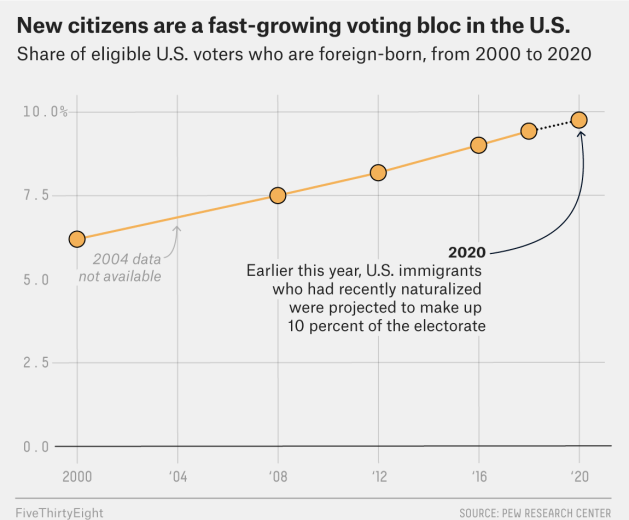
Newly naturalized citizens are one of the fastest-growing voting groups in the United States. In February, the Pew Research Center published a report that found that 23.2 million naturalized citizens would be eligible to vote in November’s presidential elections, making up a record 10 percent of the total electorate. And according to a February analysis by the National Partnership for New Americans (NPNA), a coalition of immigrant advocacy organizations, 860,000 new Americans were expected to have naturalized by November before the pandemic brought things to a halt.

But not all eligible voters actually vote, and naturalized Americans have historically trailed native-born Americans at the polls.1 In 2016, for example, 54 percent of naturalized citizens voted in the general election compared with 62 percent of native-born citizens. According to studies, one explanation is an element that could be missing again this year: voter registration. It’s not a lack of desire to participate, the study finds, but rather it’s an unfamiliarity with how or where to register, registration deadlines, and language issues. Once these barriers are overcome and new Americans are registered, they tend to vote at the same rates as native-born members of their demographic group.

Take someone like Raz Ahmadi, a new U.S. citizen from Afghanistan. For the past five years, he has worked as an organizer registering voters and advocating for progressive environmental policies in Virginia. And this year, after completing the naturalization process, which had been interrupted by COVID-19, in mid-July, Ahmadi will finally be able to cast his own ballot.

Though he has already been involved in politics, Ahmadi says that being able to actually participate is a whole new feeling for him. Being “empowered to vote, mentally, it gives you a lot of power,” he says. “It just personalizes a lot of things. Now you’re more involved in the community.”

But even before COVID-19, the wait time for citizenship applications had hit new highs under the Trump administration. According to USCIS numbers, the naturalization process averaged 8.8 months in 2020, compared with 5.6 months in 2016 and a peak of 10.3 months in 2018,2 though in some cases, it could take up to three years.

COVID-19 exacerbated this delay. On March 18, USCIS temporarily shut down all public-facing activities, including interviews for visas, asylum and naturalization as well as oath ceremonies. The agency did not make plans for virtual alternatives, bringing much of U.S. immigration to a halt.

For each day that USCIS remained closed, 2,100 potential new voters would be disenfranchised, according to a frequently cited report by Boundless, an immigration-services company co-founded by an Obama administration official.

USCIS field offices reopened on June 4 and prioritized in-person oath-swearing ceremonies. Some field offices held drive-through ceremonies, while others held more frequent, but smaller, indoor or outdoor ceremonies. By the end of July, the agency says that it has cleared the backlog of 110,000 oath ceremonies delayed by its closures, as well as an additional 7,905 oath ceremonies not scheduled before the pandemic.

Still, these 7,905 new naturalizations in July represent a twelve-fold decrease than the typical 95,850 naturalizations completed each month. So even though in-person oath ceremonies are continuing, “the fact of the matter was that there was already a backlog of people waiting to be naturalized,” says Jeanette Senecal, who oversees voter-engagement programs at the League of Women Voters, “so unless USCIS is both increasing the number of people who are getting naturalized at each one and offering more ceremonies, there’s really no way they can make that up.”

From the outset of USCIS’s closure, a diverse group of bipartisan policymakers, immigration lawyers, community advocates, and third-party voter-registration organizations like the League of Women Voters have called on USCIS to follow in the footsteps of other federal government agencies in moving activities online. In June, the USCIS Ombudsman’s Office, a small, independent office in the Department of Homeland Security that appeals specific immigration cases and suggests improvements for USCIS, weighed in, calling remote oath ceremonies, held via video teleconferencing, “a legally permissible and operationally feasible solution” for the agency in the short term and a potential long-term solution to “increase efficiencies” in its annual report to Congress.

But still, the USCIS rejected a virtual option. Spokespeople told FiveThirtyEight repeatedly, both before and after the Ombudsman’s report, that “the statutory language mandated by Congress contains certain requirements that are logistically difficult for USCIS to administer naturalization oaths virtually or telephonically.”

USCIS says that they’ve taken steps to clear the backlog in oath ceremonies, but these ceremonies are not the only steps in the naturalization process that are delayed.

Sarah Pierce, a policy analyst with the Migration Policy Institute, calls USCIS’s emphasis on clearing the backlog in oath ceremonies “really misleading” because it wasn’t just oath ceremonies that were paused during this time. “It was also interviews, which meant that naturalization applications weren’t being processed,” said Pierce. She added that unless USCIS was also trying to expedite processing of naturalization applications, there was “no way” the agency was going to be able to naturalize the same number of people by the election.

By the end of March, there were more than 700,000 naturalization applications waiting to be processed.

Dan Hetlage, a USCIS spokesperson, told FiveThirtyEight that the agency has also “prioritized rescheduling interviews for naturalization and adjustment of status that were postponed,” but as of early August, immigration lawyers I spoke with said that their clients had not been contacted to schedule naturalization interviews.

There are currently 315,000 naturalization applicants awaiting their interviews, which on average occur two months before an oath ceremony, according to a Boundless analysis. In two months it will be October, which is the deadline for voter registration in many states. That means an unknown but likely significant number of those 315,000 applicants will not naturalize soon enough to register by October and vote in November.

It’s not just USCIS that has changed as a result of the pandemic. A recent report from the Migration Policy Institute cataloged 63 executive actions undertaken by the Trump administration since March that have further restricted immigration.

Pierce, who co-authored the report, says that these changes represented some of the Trump administration’s “boldest actions on immigration to date” that, in some cases, they had long been pushing but had been unable to achieve. This includes a travel ban on 31 countries, the end of asylum at the southern border, and the suspension of immigration for many family- and employment-based categories as well as four temporary-worker programs.

“During an unprecedented pandemic, which includes both public health and economic crises, you would expect immigration to take a backseat,” says Pierce, “but rather, the opposite has been true.”


When USCIS offices reopened on June 4, organizations like the League of Women Voters scrambled to help with voter-registration efforts. Benifield, from LWV-Houston, recalls reaching out multiple times to the local field office. “We were prepared to go and set up in the parking lot … if they allowed us,” she said.

In the end, her persistence paid off. “The branch chief … agreed that we could actually bring cards” for officials administering the naturalization ceremony to give out. The League cannot be on-site to register applicants directly because of the continued threat the pandemic poses, but they can drop off folders containing voter-registration packets to the local field office to be distributed at the socially distant ceremonies. USCIS is legally mandated to provide, at a minimum, voter-registration forms at each naturalization ceremony.

Benifiled said she was glad they could distribute materials, but she remained unsure how effective this form of voter registration would be. “Clearly, it will not be 30,000 like … last year.”

This is affecting the League’s activities across the country. “Spring and summer are usually really busy seasons for voter registration, but especially in presidential years, we usually see massive increases… [in] naturalization ceremonies,” says Senecal, from the League’s national office.

Volunteers understand the public health prerogatives that prevent them from conducting registrations in person, especially since many are older and at higher risk for COVID-19, but many, like Benifield, are concerned about the effect on registration numbers and broader civic engagement.

“The opportunity cost is not just registration,” adds Senecal, “it’s also voter education.”

At a basic level, in-person voter registration provides necessary information in native languages, says Nancy Xiong, the communications director for Hmong Innovating Politics, a California-based nonprofit that aims to increase civic participation among Southeast Asian Americans.

Native language materials are essential, since many new citizens, especially in already marginalized communities, have challenges with English. Even when they are provided with translated voting materials, Xiong adds, these materials “may not always be helpful because county/state offices do a word-to-word translation, without much context.”

This can create the perception that these communities are uninterested in politics, leading to “big campaigns never or rarely contact[ing] the Southeast Asian community,” Xiong says, even though 92 percent of the 310,000 Hmong Americans are citizens, one of the highest rates among Asian Americans, and 45 percent are eligible to vote. And this perpetuates a cycle of disenfranchisement, at the very moment when immigrant voters might be especially incentivized to vote, if previous elections in which immigration was a hot topic are any indication. In 2008, presidential candidate Mitt Romney’s suggestion that immigrants should “self-deport” and hardline views on DACA, for example, have been linked to a jump in voter registrations between 2008 to 2012.

Sundrop Carter, the executive director of the Pennsylvania Immigration and Citizenship Coalition (PICC), which partners with the Philadelphia USCIS field office as its official third-party registration organization for naturalization ceremonies, told me part of the problem is that: “[B]y definition new Americans have no voter history.” As a result, she said, they’re often bypassed by most get-out-the-vote efforts. “New voters … they’re just invisible.”

This is despite the fact that in many battleground states, like Pennsylvania, where Carter is based, as well as Michigan, Florida and Nevada, the number of new Americans who are eligible to vote now is larger than the margin of victory in the 2016 elections, according to the June 2020 report from the NPNA. “Newly naturalized citizens could help to sway the outcome of national elections,” says Diego Iñiguez-López, the NPNA’s policy and campaigns manager. But more importantly, he adds, “what’s at stake is the political empowerment of newly naturalized citizens … and for the democratic ideals of this country to be fully realized and exercised.”

Community organizations have always tried to fill in the gap — and this year, just as the need for their services ramp up, COVID-19 has made them more difficult to deliver.

Hmong Innovating Politics (HIP), in California, and the nonprofit Bonding Against Adversity in Houston, which works mostly with Latin American immigrants, are doing their best to adapt by moving their activities online. HIP has switched to a text-messaging platform, which uses current friends-and-family circles to encourage contacts to register to vote. Bonding Against Adversity, meanwhile, has expanded another SMS-based communications platform to provide real-time immigration application help, and plans to restart an online version of their 14-session “citizenship college” civic-education program and application workshops in August.

Meanwhile, LWV-Houston members have paid for a QR code that brings up voter-registration information, which it is sharing on signs and, for a while, in person at public libraries, community and faith-based organizations, protests and even a taco chain restaurant.

But still, many organizations are afraid that some of the most vulnerable communities, who already feel left out of the political process, will fall through the gaps. “A lot of the communities that we work with have elementary education, are not computer-savvy, and don’t speak good English,” says Mariana Sanchez, a co-founder of Bonding Against Adversity. That’s why she says in-person registration and education is essential.

But the pandemic has put these in-person services on pause, and as a result, the applicants who need the most support are unable to access it.

COVID-19 shows little evidence of slowing down. By June, hospitals in states like Texas that had avoided the early wave of infections were warning that hospital beds were close to full, and in-person voter-registration activities, which the League of Women Voters had just restarted alongside USCIS’s reopenings, were put on indefinite pause.

In the meantime, smaller oath ceremonies continue, with USCIS spokespeople emphasizing their adherence during the ceremonies to public-health guidelines, including masks and social distancing. But it is not clear if USCIS has any contingency plans in place for alternatives to in-person activities.

The potential of more stay-at-home orders at a local level is also a possibility, which would affect which activities USCIS could continue. Guam’s USCIS office, for example, was shut down for a week as the territory’s COVID-19 case count led the governor to issue orders to shelter in place. Hetlage, the USCIS representative, did not respond to a specific question on contingency plans but reiterated that virtual oath ceremonies weren’t possible.

This has many immigration advocates perplexed. “Almost every business, school district, university and government agency across the country has made adjustments to keep their organizations — and the country — moving,” says Eric Cohen, the executive director of the Immigrant Legal Resource Center, an advocacy group. “Why should USCIS be any different?”

The question represents an ongoing frustration: Yes, there is an unprecedented public-health crisis, but there is also a human-made immigration crisis stemming from the administration’s policies and USCIS’s decision-making during the pandemic.

“It’s hard to look at the actions the administration has taken that result in decreased immigration, and not think that there was some intent there, especially when you’re talking about an administration that is historic in its stance on legal immigration.” says Pierce, of MPI, on whether the immigration agency’s decision-making could be political. Beyond the 63 actions taken during the pandemic, Pierce’s report identified over 400 executive actions by the Trump administration taken in the past four years that have shifted the immigration system toward removing suspected undocumented immigrants, and away from processing applications for naturalization and legal immigration.

It stands in stark contrast with the second night of the Republican National Convention, when Trump naturalized five new citizens at the White House in a prerecorded video. The president welcomed them to “a family comprised of every race, color, religion and creed united by the bonds of love,” as he said in his concluding remarks. “We are one people sharing one home, saluting one great American flag.”

USCIS representatives did not respond to a request for comment on whether the five were given voter-registration forms, as required by law.


Since early summer, USCIS has warned that if it does not receive $1.2 billion in emergency funding, the agency would furlough 13,000 workers – 70 percent of its workforce — and slow or pause many immigration processes. On August 25, after months of back-and-forth, Congress and USCIS reached an agreement that would avoid the furlough.

That agreement would not, however, avoid further delays in processing, as Joseph Edlow, deputy director for policy at USCIS, told The Washington Post: “Averting this furlough comes at a severe operational cost that will increase backlogs and wait times across the board, with no guarantee we can avoid future furloughs.”

In an effort to increase its financial sustainability, USCIS will increase fees by an average of 20 percent across the board, and more than 80 percent for naturalization applications. For groups like Bonding Against Adversity and Hmong Innovating Politics, which were already under-resourced before the pandemic, these changes will only add to their immediate workload.

Sanchez says she’s already received more inquiries from people who want to apply for citizenship before application fees for naturalization increase. “The immigration laws are so difficult,” says Sanchez, that “the only way, for some of the people we serve to help their families is through citizenship…and voting.”

But USCIS is making the process more difficult. That’s why the NPNA sees naturalization delays as an issue of voting rights.

“It’s part of the larger anti-immigrant agenda that the Trump administration has pursued over the last few years,” says Iñiguez-López. “Keep immigrants feeling unwelcome, keep them afraid, keep them intimidated, and keep them away from knowing and asserting their rights, including their right to vote.”

In other words, while these would-be citizens are trying to follow the rules of the U.S. immigration system to naturalize and effect change through the established democratic processes, the system has itself become the barrier.

Source: New U.S. Citizens Were One Of The Fastest-Growing Voting Blocs. But Not This Year.