Likely fewer disparities in Canada given medicare but some commonaliyies:
Two decades ago, only 9 percent of white Americans rated their health as fair or poor. But 14 percent of Hispanic Americans characterized their health in those terms, as did nearly 18 percent of Black Americans.
In recent years, access to care has improved in the wake of the Affordable Care Act, which reduced the number of uninsured Americans across all racial and ethnic groups. But the racial health gap has remained, according to a series of studies published on Tuesday in the journal JAMA.
A dismal picture of persistent health disparities in America was described in an issue devoted entirely to inequities in medicine. The wide-ranging issue included research on spending and patterns of care, comparative rates of gestational diabetes and the proportion of Black physicians at medical schools.
The journal’s editors committed to a sharper focus on racism in medicine after a controversy in June, in which a staff member seemed to suggest that racism was not a problem in health care. The ensuing criticism led to the resignation of the top editor and culminated with a pledge to increase staff diversity and publish a more inclusive array of papers.
“The topics of racial and ethnic disparities and inequities in medicine and health care are of critical importance,” Dr. Phil B. Fontanarosa, interim editor in chief of JAMA, said in a statement. He noted that JAMA has published more than 850 articles on racial and ethnic disparities and inequities in the past.
The new issue offers studies on disparities in the utilization of health care services and in overall health spending. Together, the findings paint a portrait of a nation still plagued by medical haves and have-nots whose ability to benefit from scientific advances varies by race and ethnicity, despite the fact that the A.C.A. greatly expanded insurance.
The racial health gap did not significantly narrow from 1999 to 2018, according to one study whose author said it was tantamount to “a comprehensive national report card.”
“We’re failing,” added Dr. Harlan Krumholz, the study’s senior author.
“If our national goals are to improve the population’s health and promote more health equity, then we have to admit that whatever we’re doing now is not doing the trick,” he said. “This should wake us up, and spark us to think of new and better approaches.”
Other studies in the journal teased apart factors that may be contributing to the gap, including different patterns of care-seeking. White Americans, for example, are more likely than members of minority groups to visit primary care physicians and specialists in the community, rather than a hospital or emergency room.
In the midst of the pandemic, Vanuatu’s “cash for passports” scheme is helping to keep its economy afloat.
With its tourism industry smashed, the Pacific nation last year generated $175 million — 35 per cent of total government revenue — from its “honorary citizenship programs”.
Vanuatu’s first citizenship by investment scheme, known as “cash for passports” locally, was introduced in 2014 and has had several iterations since, including one intended to raise money after Cyclone Pam caused widespread devastation in 2015.
Many countries have similar schemes, including Australia, but usually, applicants are required to become permanent residents first and then only after a number of years do they become eligible to become a citizen.
Under Vanuatu’s scheme, successful applicants can become citizens within a matter of months and there is no requirement to reside in the country or even set foot on Vanuatu soil at all.
It costs around $US150,000 ($200,000) for a single application and more for couples and families. Most of the passports, which allow free access to any EU country, are sold to people from mainland China.
It has long been controversial, but the scheme came under increased scrutiny in July after the Guardian investigation was published.
Last week, the Vanuatu government revealed that the Vanuatu citizenship of a Syrian businessman referred to in the report, Abdul Rhama Khiti, had been revoked.
Vanuatu’s Citizenship Commission chair Ronald Warsal told the ABC’s Pacific Beat program the US government had imposed sanctions against Mr Khiti’s businesses just weeks after he had made his application.
“After the article came out in The Guardian and during the course of the investigation by our Financial Intelligence Unit [FIU] it was decided to have it revoked and money he has paid to be forfeited into government coffers,” Mr Warsal said.
He said the government was investigating more of those mentioned in the article and others that were not.
“It’s an ongoing thing,” he said.
“We want to ensure that people who come to Vanuatu, who obtain Vanuatu citizenship, are not wanted abroad [and] are not fugitives.”
Transparency International Vanuatu chief executive Willie Tokon said it was worrying that the Syrian businessman was able to get approval in the first place and that his citizenship was only revoked when the matter was raised in the media.
“My worry is how come we have all these allegations but the screening by [the] Citizenship Commission and Financial Intelligence Unit didn’t come up with this allegation,” Mr Tokon said.
He said if Vanuatu did not have the capacity to thoroughly vet applicants, it should seek help from Interpol and other agencies.
“If there’s no other way to do it, do it properly. If we don’t have the capacity, we have very strong support from the Australian government in terms of the AFP, they’re providing a lot of support. It needs to be done properly,” he said.
But Mr Warsal said the government had systems in place to do character checks.
“We do [make] the final decision but … it goes through certain processes,” he said, saying it was down to teamwork between immigration, the FIU and the police.
Economics professor Stephen Howes, from the Australian National University, said mishandling of the citizenship programs could have a couple of negative consequences for Vanuatu.
Mr Howes said Vanuatu could become seen as a “risky” country for banks to operate in, or even get added to international money laundering grey or blacklists, which would threaten the country’s ability to access international finance.
“That would further isolate the country and make it harder to form international financial links,” he said.
It could also diminish the value of Vanuatu passports, making it more difficult for Vanuatu citizens to travel.
“Vanuatu citizens might suffer as well if other countries decide that they don’t trust that someone with a valid Vanuatu passport is actually a bonafide Vanuatu citizen,” he said.
On the flip side, if Vanuatu did decide to scrap the citizenship schemes, then they would lose the revenue the country needs to support the population during the pandemic-related economic crisis.
Mr Howes said it was more likely the government would bring in reforms and tighten up the application process.
He said actions like cancelling the citizenship of those like Mr Khiti would show they “won’t take just anyone”.
“If they can show [they have a serious vetting process], that will instil more confidence into the scheme,” he said.
He said abandoning the “unorthodox” source of revenue would be a “really extreme step”.
Not everyone who wanted citizenship of another country and could afford to buy it was necessarily of bad character, he said.
“Think about the uncertainties in China, some people just want a safety net,” he said.
“The world’s a very uncertain place. So I don’t think it means you’re a criminal [if you want to buy citizenship].
“I think it could also mean you’re worried about the future of your country.”
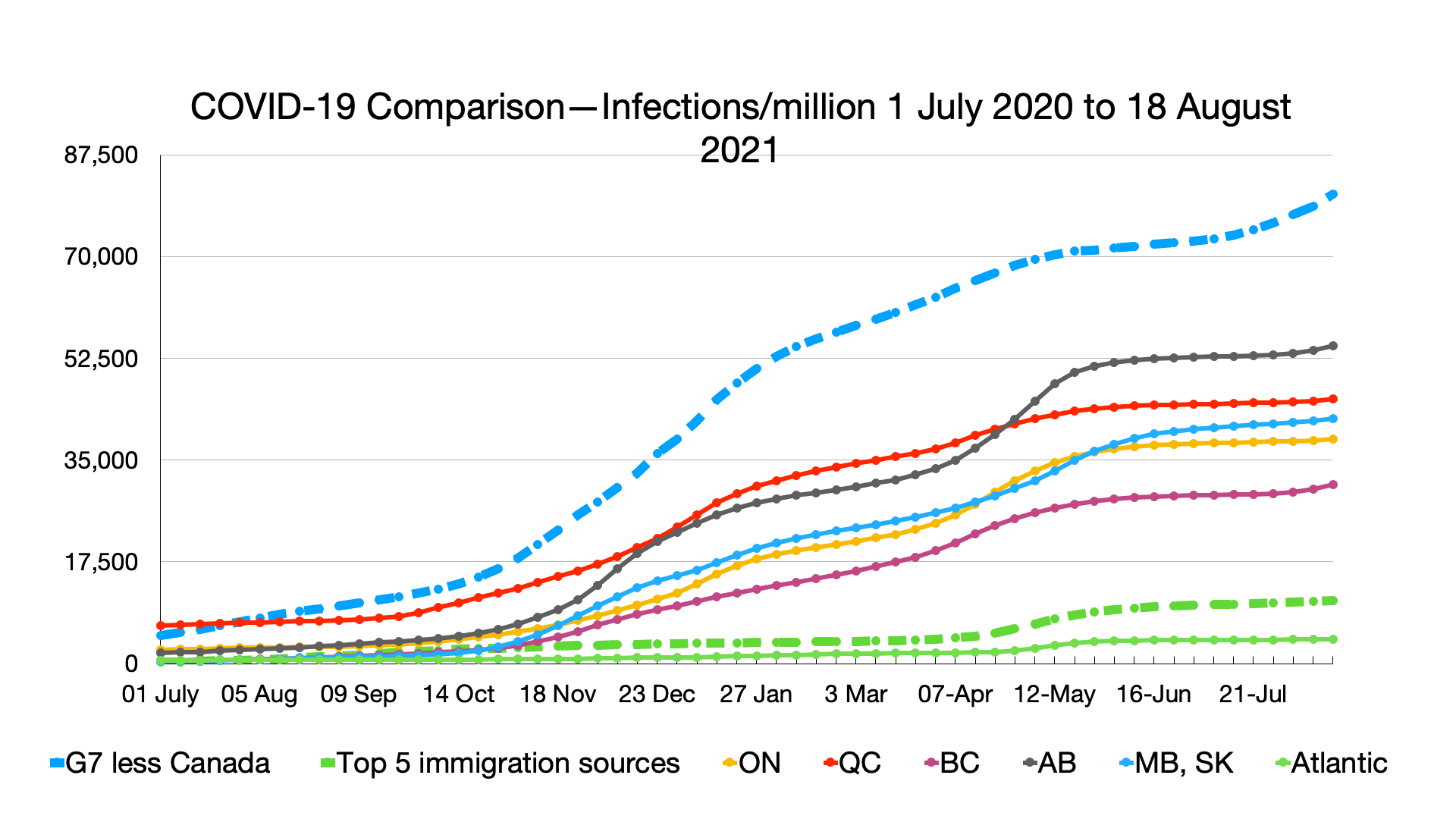
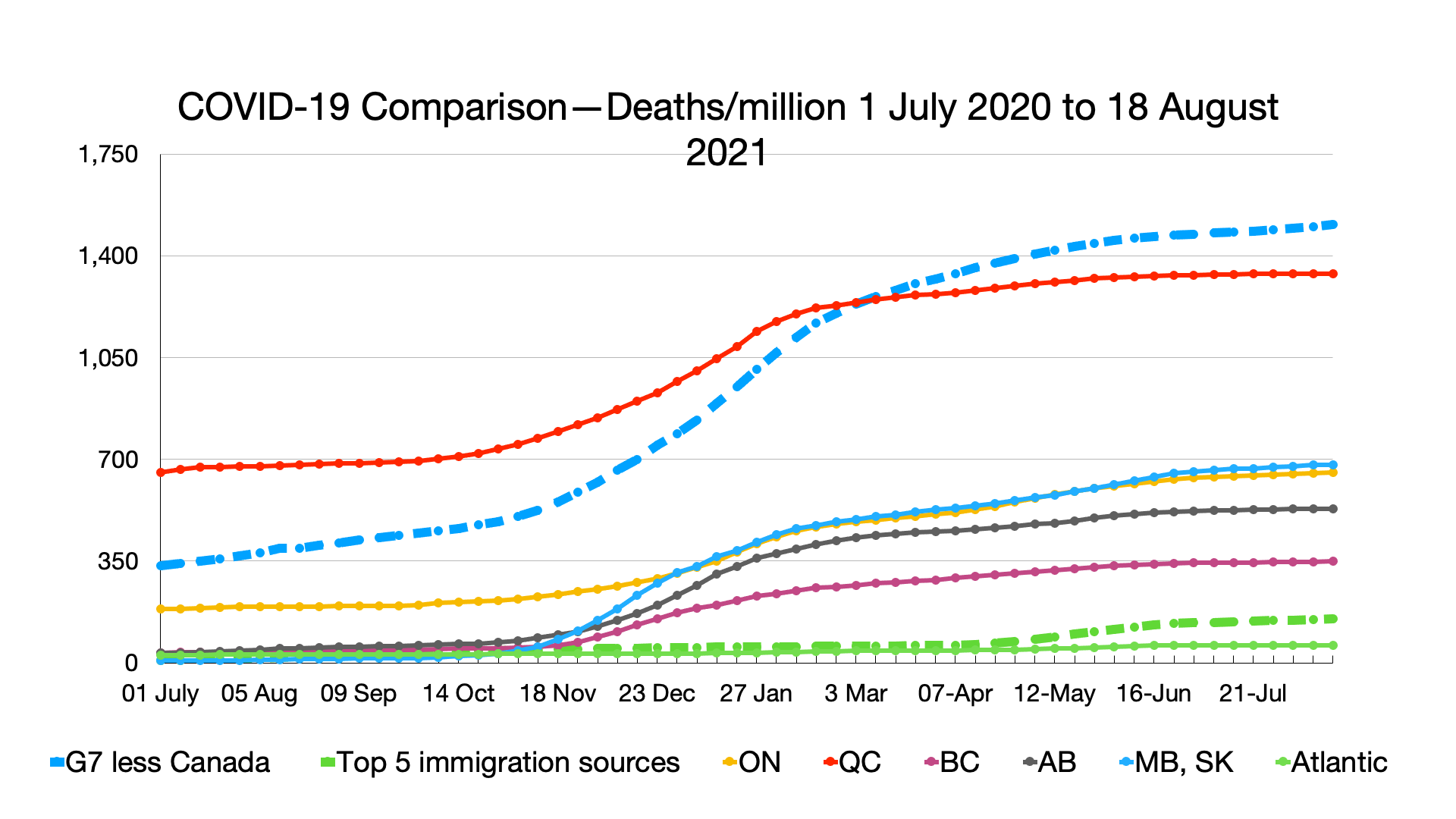
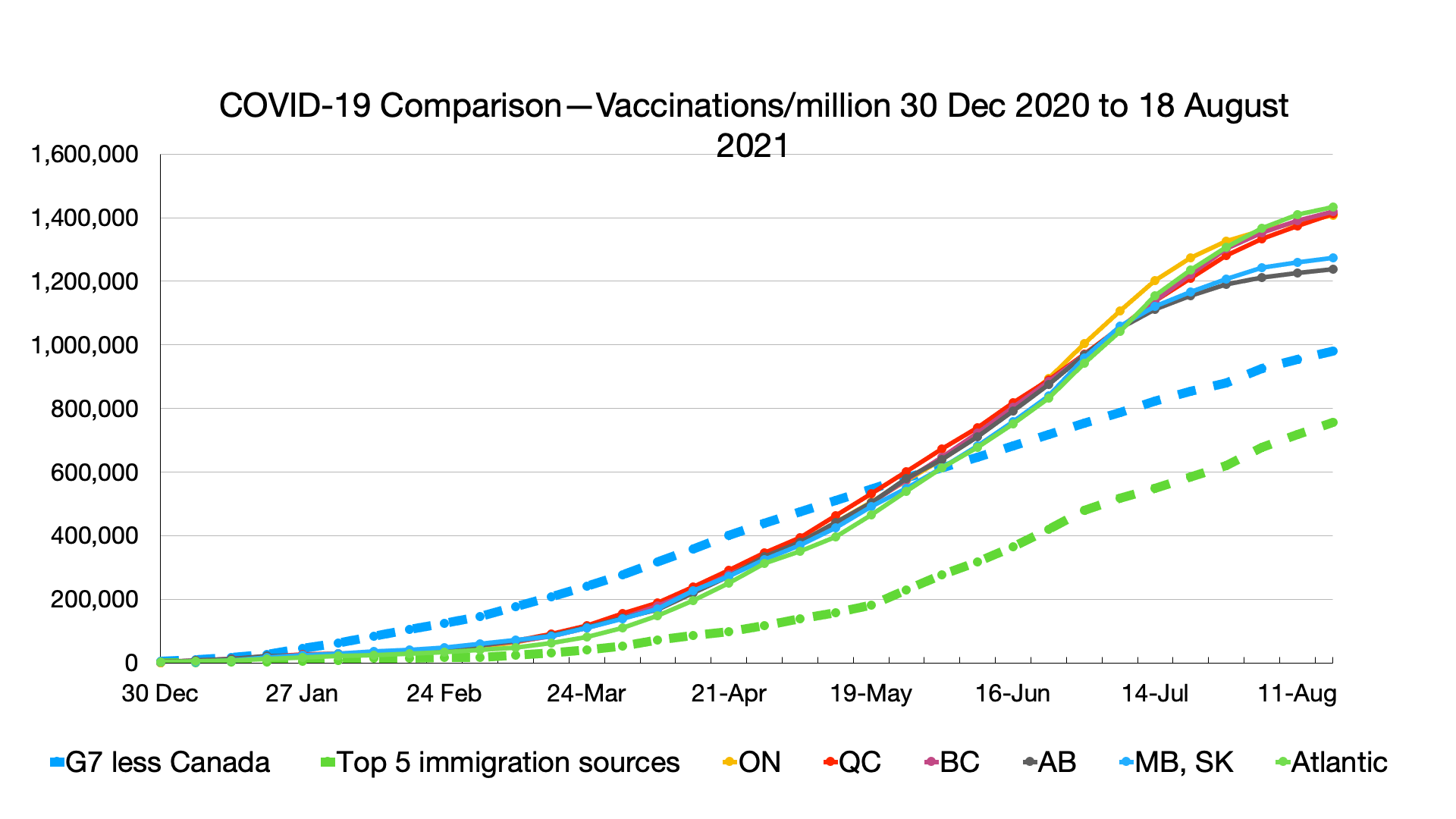
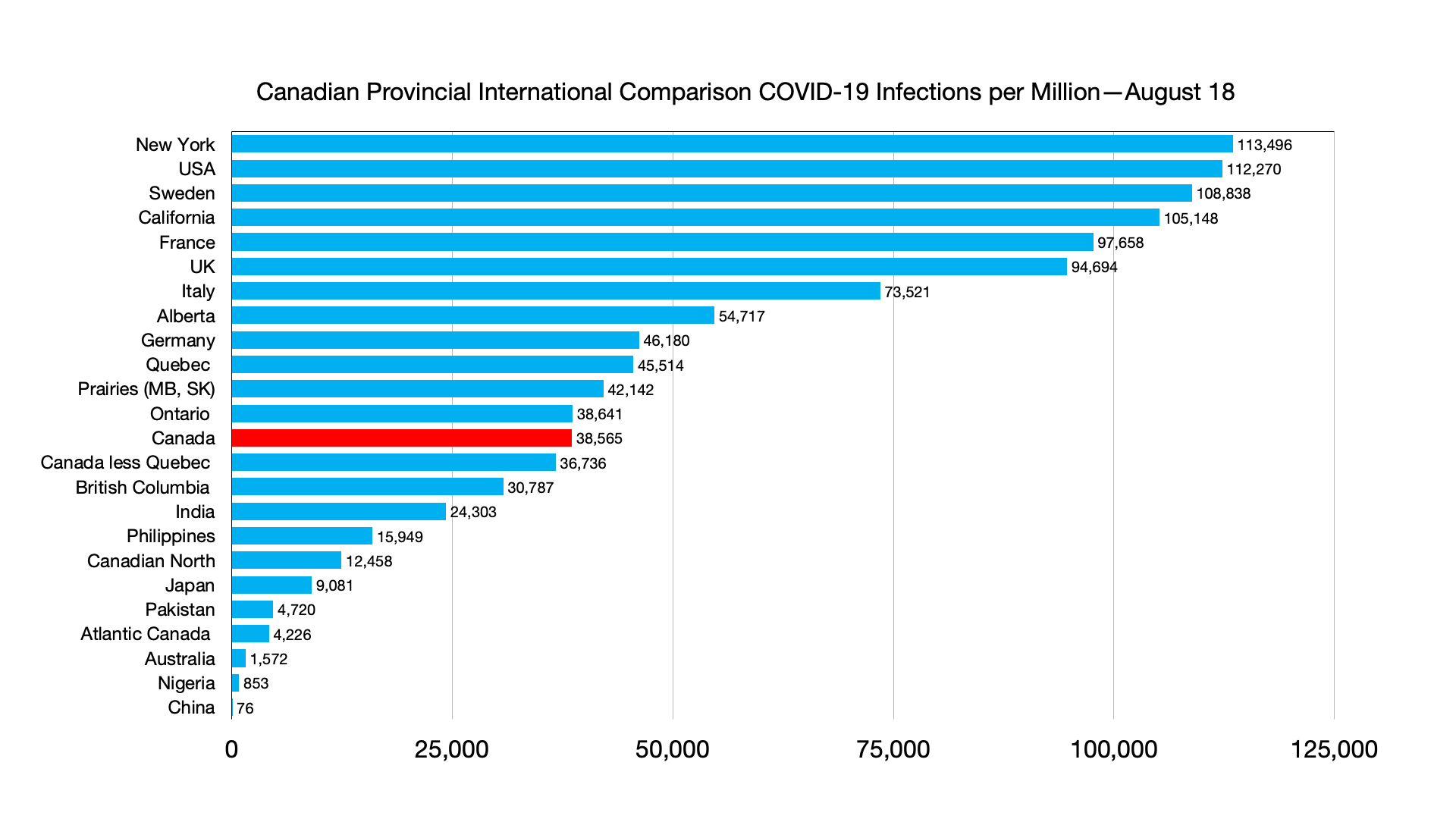
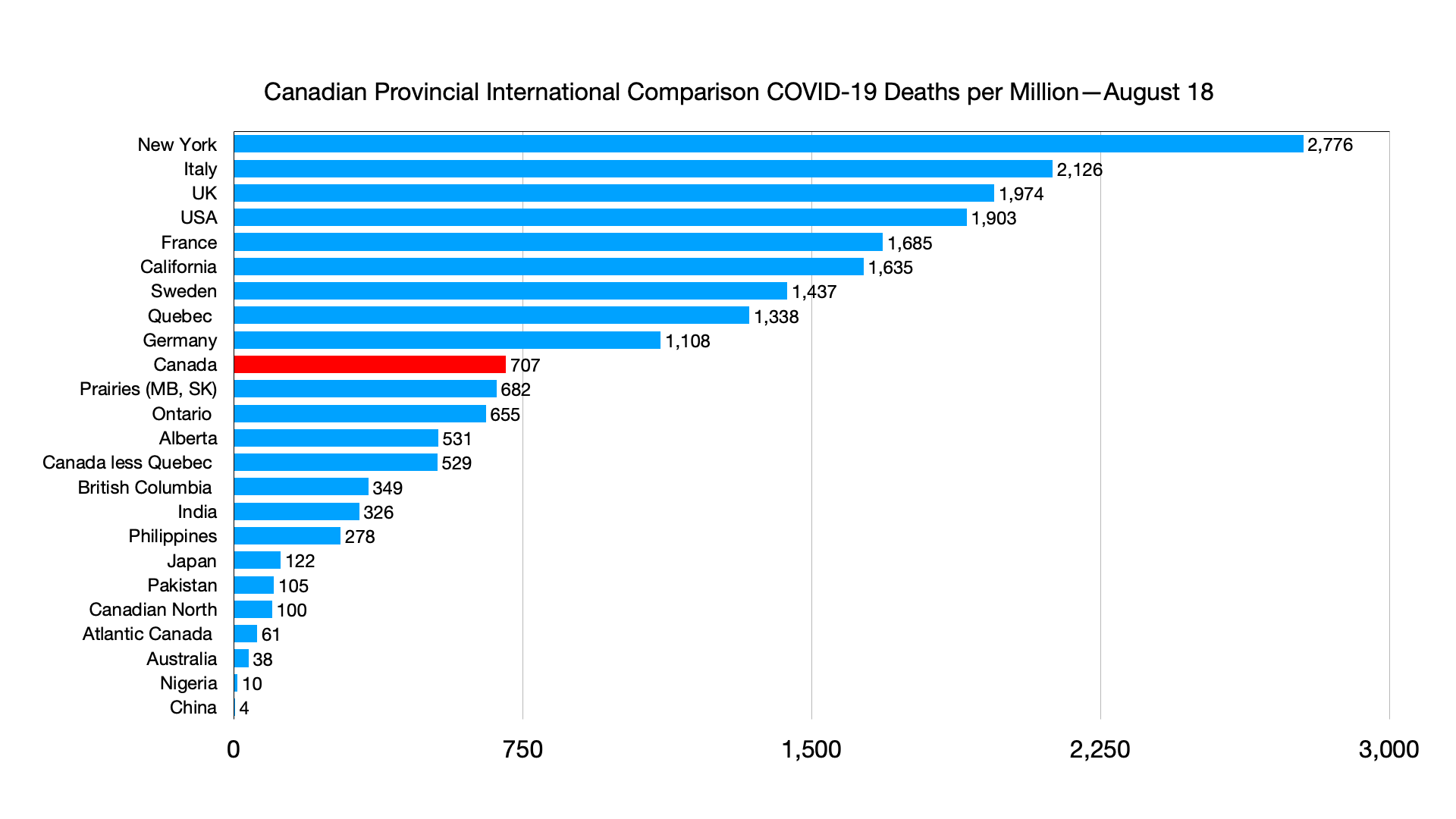
The latest charts, compiled 18 July as overall rates in Canada remain relatively stable but with slight increases due to the variant. Canadians fully vaccinated now 64.8 percent, higher than USA 51.5 percent and the UK 61.1 percent).
Vaccinations: All Canadian provinces ahead of USA and EU countries, China ahead of UK, Alberta and Prairies.
Trendline charts
Infections: Same trends as last week: More pronounced uptick in G7 less Canada (driven largely by USA). While all provinces showing increased infections, greater upticks in Alberta, British Columbia.
Deaths: No significant change.
Vaccinations: Ongoing steady gap between Canadian provinces and G7, immigration source country increase continues to be driven by China (fully vaccinated 55.6 percent, very steep rise since last week) and India (fully vaccinated 9 percent). Flattening of Canadian vaccination rates as reported elsewhere.
If you spend any amount of time on social media engaging about COVID-19, you will know discussions tend to get personal and ugly pretty fast.
Encourage vaccination of young people, and you’re labelled a pedophile.
Support masking in indoor settings? You’re a goose-stepping fascist.
Laud vaccination as a way out of the pandemic, and you are Joseph Goebbels and should brace yourself to be on trial for crimes against humanity at the fictional Nuremberg 2 tribunal.
Acknowledge that lockdowns are sometimes necessary to control the spread of a pandemic virus, and brace yourself for the onslaught of Hitler images.
These types of responses are predictable to a certain degree.
Godwin’s law (coined by U.S. lawyer Mike Godwin in 1990) holds that as an online discussion grows longer, the probability of a comparison involving Nazis or Hitler becomes more likely.
These days, debates go from zero to Hitler in about a nanosecond.
Some may want to dismiss this kind of over-the-top rhetoric as laughable, the work of a tiny minority of extremists and their bots.
But it’s obscene, and obscenely commonplace.
The Nazi-fication of public discourse is no longer the sole purview of pathetic man-boys holed up in their basements.
Enabled by social-media giants hiding behind freedom-of-speech arguments, trolls can now spread their misogynist, racist and anti-social views readily and mercilessly.
The goal here is to muddy the waters between fact and fiction, between truth and lies, and to undermine democratic institutions.
The grunts of a few can be turned into shouts that unfortunately have a growing audience, especially among the disgruntled and disenfranchised.
Playing the victim card appeals to them.
The ragtag collection of conspiracy theorists who gather at anti-mask, anti-vaccine, anti-lockdown rallies is fascinating – a stinking potpourri of grievances, with denunciations of everything from vaccines to “fake news,” to 5G, to the so-called “deep state.”
These rallies – which are getting bigger as pandemic frustrations grow – have more than their fair share of Hitler talk and imagery. They also include people wearing the yellow Star of David, implying that being told to wear a mask or get a jab is a level of persecution comparable to Jews who were rounded up and shipped in cattle cars to death camps.
Clearly some people have lost the plot.
Yet, they are being encouraged by politicians who embrace rhetoric suggesting that a position is invalid because the same view was held by Hitler.
A case in point is odious Ontario MPP Randy Hillier, who claims that lockdowns, mask rules and vaccine mandates are forms of Nazi-like tyranny.
His perverse version of freedom holds that individual rights are absolute, and that, for example, unvaccinated people have a God-given right to do as they please up to and including infecting others with the coronavirus.
Mr. Hillier and his acolytes have made a habit of casually tossing around Nazi analogies and Hitler images.
This mainstreaming of hateful images and thinly veiled hate speech should alarm us on a number of levels.
First of all, it betrays a profound ignorance of the Holocaust.
There can be no comparisons made between the state-sponsored mass murder of six million people and the temporary shutdown of the local mall.
Those who have the unmitigated gall to wear yellow stars to anti-mask rallies offend the memory of the victims of the Shoah and their descendants.
It is worth noting that Mr. Godwin, when he fashioned his adage, actually wanted people to think harder about the Holocaust and why Nazi comparisons should not be casually tossed into conversation.
Thinking is certainly not what’s happening here.
What we’re seeing is a lot of projection, the psychological impulse to project on other people what you’re actually feeling.
Former U.S. president Donald Trump, sometimes called the “Projection President,” was the embodiment of this phenomenon.
Mr. Trump, a chronic liar who wallowed in corruption, routinely attacked his opponents as corrupt liars. He also frequently described his opponents in a derogatory fashion, a lynchpin strategy of hate-mongers, and now a mainstay of social media.
Next time you hear the claims of Nazi-like tyranny and oppression, think about what is really being said.
Those who don’t want masks under any circumstances – those who not only want to refuse vaccines but prevent others from getting them – are actually the tyrants.
Their use of Hitler images and analogies are not a caution, but an embrace, one we should call out, not dismiss casually.
Women executives earned about 56 per cent less on average than men executives and this pay gap widened even further for racialized women, who earned about 32 per cent less than non-visible minority women, according to a new study from Statistics Canada that underscores the sweeping disparities in Corporate Canada.
Translated into dollar figures, there was a $600,000 difference between the average woman executive’s income ($495,600) and the average executive man’s ($1.1-million). The average compensation for visible minority women was $347,100, while visible minority men took home $681,900.
The research included data from the Corporations Returns Act, which collects financial and ownership information on mid-size to large corporations, and census information from 2016.
In unpacking the gender divide at the most senior levels, researchers looked at marital status, number of children, education, backgrounds, sector of work, job title and professional networks.
One of the study’s most shocking findings concerned the number of racialized women in executive roles. There were so few Indigenous executives – both men and women – that Statistics Canada was limited in what could be reported over concerns about violating the individuals’ privacy. About 1 per cent of executives were Indigenous, although this group represents about 4 per cent of the working population. Most of the women Indigenous executives worked at large corporations.
Over all, about one in 10 women executives identified as a visible minority. The most common groups represented were South Asian and Chinese, with fewer executives being Black and Filipino.
Paulette Senior, the president and CEO of the Canadian Women’s Foundation, said the report’s findings were extremely concerning.
“It’s worse than I thought,” she said. “This makes me wonder what have we been doing? What have decision makers been doing in addressing [these issues] – whether it’s a leaky pipeline, or who is sitting at tables during hiring. What has been going on that this is the picture in 2021?”
Statistics Canada’s findings are in keeping with an analysis that The Globe and Mail conducted as part of its Power Gap investigation, which has been examining gender inequities in the modern work force. The series found that among women in the top 1 per cent of earners, just 3 per cent were racialized. In general, women were found to be outnumbered, outranked and out-earned by almost every measure examined.
Elizabeth Richards, who co-authored the Statistics Canada paper, said one of the most intriguing findings concerned companies that operate in Canada but are American owned. The researchers found that visible minority women were five times more likely than non-visible minority women to work at one of these American-controlled companies. The same trend – to a lesser degree – was also found with visible minority men, she said.
“That’s a key takeaway,” Ms. Richards said. “That to me says there’s some more country-specific influences that maybe we don’t fully understand and we should dig into further in future research.”
The analysts also examined the family status of the executives. Women were less likely to be in a relationship – about 80 per cent of women executives were married or in a common-law relationship, compared with 90 per cent of men – or to have children. When they did have children, they had fewer of them. About 36 per cent of women executives had two or more children, while about 44 per cent of men did.
The report also found that women executives were, on average, younger than the men – 51 years old compared with 54 years old respectively.
Economist Marina Adshade, an assistant professor with the University of British Columbia, said the finding about age was interesting and perhaps a clue as to the cause of the pay gap. In her own research, she’s found that women are retiring early, perhaps before they can fully reach their potential on the corporate ladder.
Prof. Adshade said that, as a country, the focus has been on keeping women with young children in the work force – which is important – but there hasn’t been enough attention paid to what’s happening at the other end of the career spectrum.
“We are starting to lose women in the work force at 45, 55, 65,” she said. “Why are women leaving the work force? … They have other caregiving responsibilities: caring for parents, spouses, grandchildren, for example. Older women are so undervalued that literally no one wants to think about why they’re not in the work force.”
Prof. Adshade noted that the average age of a senior manager in the federal government is 53, so if women are starting to retire at 45, it’s not surprising they are underrepresented at the top.
Another rationale for the executive wage gap that has been suggested is that women’s networks are smaller. Ms. Richards said that she and her co-author Léa-Maude Longpré-Verret were interested in seeing whether this held true with their dataset – it didn’t.
“There is some previous research that suggests that being connected to more executives leads to higher pay,” Ms. Richards said, “but what we found is that women actually had more extensive networks of colleagues.”
The reason is that women were more likely to sit on large boards with more members. On average, women directors were found to be connected to 7.5 colleagues through their board positions, while men were connected to 6.7 colleagues. Women were also more likely to be connected to other women directors.
Ms. Richards said that in their report, the goal was to quantify the extent of the imbalances in as many ways as possible, but the root causes will be for someone else to explore.
“Hopefully this provides some valuable information for other researchers,” she said. “We wanted to leverage everything that we could from the analysis and share our findings, but it is preliminary and it is exploratory so we would recommend that the academic business community or other researchers continue to really provide more insights in this space.”
A contrary view to the role that large scale immigration plays a role in high housing prices. While the pandemic provides reasons for questioning the arguments, longer-term trends and analysis shows that it does in our largest cities. And citing long-term GDP per capita growth is misleading, as this growth was largely before 2008, with the past years characterized by fluctuations with no significant increase:
A recent commentary suggested that the demand for new housing directly results from the net increase in population, which is mainly driven by immigration. According to Statistics Canada, “international migration has accounted for more than three-quarters of the total population growth since 2016, reaching 85.7 per cent in 2019.”
One can argue that if immigration is the reason behind population growth, which determines the demand for shelter, perhaps Canada should reconsider the number of immigrants it admits each year to ease the pressure on housing and infrastructure.
Canada’s economy has grown over the years, almost in step with the increase in its population. World Bank data show that the country’s gross domestic product (GDP) per capita has more than doubled since 1990. Canada’s GDP per capita used to be similar to that of the United States, but the gap has widened since 2012.
Some argue that growing the economy by increasing the population is not the right approach. They say Canada should focus on increasing economic productivity by exploring ways to increase its GDP per capita, which may require a lower increase in population to sustain economic growth. One result of that, some believe, is that housing prices would become more affordable because there would be less demand.
But the argument that immigration is the primary driver of housing prices in Canada ran into a serious challenge in 2020 when immigration levels considerably declined because of pandemic-driven restrictions. Canada’s population in 2020 increased by 0.4 per cent, one-quarter of the increase observed a year earlier, according to Statistics Canada.
To put those numbers in perspective, consider that 2020 had “the lowest annual growth since 1945 (in number) and 1916 (in percent), both periods in which Canada was at war,” Statistics Canada said. Furthermore, immigration played a much smaller role in population growth, such that the “population increase through international migration in 2020 was over 80 per cent lower than it was in 2019.”
Those who argue that immigrants and foreign investors are the primary determinants of housing price inflation would have a tough time explaining what role, if any, new immigrants played in the record escalation of housing prices during the pandemic. Borders were mostly shut, immigration numbers were down and the international flow of capital choked because of the economic uncertainty.
Hiding beneath the rhetoric for and against population growth is how the demographic landscape is uneven across Canada. While the nation’s population grew, hundreds of small and mid-sized cities shrank. Even Montreal’s population dropped to 1.7 million in 2016 from 1.77 million in 1971 (the city’s peak population year).
Maxwell Hartt, a professor of geography and planning at Queen’s University in Kingston, Ont., explored the uneven population growth in cities and towns with declining populations in a recently published book, Quietly Shrinking Cities: Canadian Urban Population Loss in an Age of Growth. The book presents a meticulous study of why people leave a city or have fewer children, causing the population to decline.
Hart said immigration was critical in stabilizing Canada’s population growth. Without it, the population would have shrunk, because Canadians have not had enough children to replace themselves since 1972. He also noted that “Canada’s immigration policies have led to reduced levels of population loss and abandonment in Canadian shrinking cities.”
The differences and similarities between shrinking cities and others are intriguing. For example, Hart observed that both shrinking and growing cities were similar in terms of their Aboriginal population and the percentage of adults with post-secondary education.
What set shrinking cities apart was that their population was older and had fewer immigrants and visible minorities. The share of immigrants in growing cities was 83 per cent higher than that in shrinking cities, while the percentage of visible minorities in growing cities was more than double that in shrinking cities.
Shrinking cities do not experience demand-side pressures on housing. Relative to income, housing is far more affordable there than in towns with growing populations. Yet shrinking cities continue to shrink. The relative affordability and the absence of population pressures do not make a place desirable enough for residents to stay and keep population levels stable.
The demand-side pressures on housing and infrastructure are just one consideration when determining adequate levels of immigration. Another consideration is how many workers are needed to keep the economy growing and to replace a rapidly aging workforce.
The discussion about housing demand is relevant, but it should not attempt to hide that Canada has a supply problem. Fewer homes have been built in recent years than in the early 1970s when there was a much smaller population.
More buyers chasing fewer homes to buy and rent is at the core of housing price inflation. Removing supply-side alternatives from the mix of solutions will only make matters worse.
Murtaza Haider is a professor of Real Estate Management at Ryerson University. Stephen Moranis is a real estate industry veteran. They can be reached at the Haider-Moranis Bulletin website, www.hmbulletin.com.
Will be preparing a comparative table when the platforms of other parties are out. While Conservatives have five priority themes: jobs, accountability, mental health, strategic stockpile of vaccines and PPE, and economy, the platform contains a myriad of commitments across most areas.
The immigration section is also detailed, covering the following themes: “addressing administrative backlogs, fixing a broken visitor visa system, innovation efficiency and cultural sensitivity, strengthening credential recognition, family reunification, super visas, pathways to permanence, advancing Canada’s interests, reforming Canada’s broken refugee system, and securing our border.”
Striking what is missing: no reference to citizenship and multiculturalism, racism reference pertain to Diefenbaker), no substantive references to diversity and inclusion, no reference to employment equity, no reference to antisemitism or Islamophobia, discrimination references limited to the CAF and (again) to Diefenbaker. Anti-Asian hate including in section “Standing up to China’s aggression.”
The other initial observation is the platform is silent on the question of levels, likely given that any suggestion of reduced levels would provide the other parties an opportunity to paint the CPC as anti-immigrant (unfairly, IMO).
Increasingly I think detailed campaign platform documents are terrible for governance.
They shackle entire governments, struggling with the unimaginable realities of life three years from now, to the best guesses a few campaign strategists were able to make last month. They crowd out the civil service’s policy-development function, because the first thing a new PM’s transition team says to the Privy Council Clerk who greets them is, “Shush. Do all of this.” They discourage agility amid changing circumstances because everyone’s busy ticking off stale boxes so they can run for re-election on “promise made, promise kept.” They practically guarantee fiscal trouble because who’d ever campaign on an appropriately pessimistic outlook for the economy?
Fie on the whole mess. The best way to run for high office would be to say, “You know me. Meet my team. Do we seem solid? Count on us to handle whatever comes our way.”
Of course I’m outvoted. Constantly. Whatever their worth as blueprints for government, thick platforms often work a charm in campaigns, especially if the goal is to rebut widespread worry that the leader in question is a lightweight or a nutbar. Modern campaign credibility-building was invented by Jean Chrétien’s Liberals in 1992 with Creating Opportunity: The Liberal Plan for Canada, instantly dubbed the Red Book. It transformed Chrétien from a yesterday’s man without a clue to a big thinker with an eye for detail. “It’s in there. Read it,” he’d say. Ontario’s provincial Conservatives under Mike Harris won power back in 1995, after a decade of Liberal and NDP governments, with the Common Sense Revolution pamphlet. And Justin Trudeau did a lot in 2015 to parry perceptions that he was a lightweight with Real Change: A New Plan For a Strong Middle Class (.pdf here). And even though each of those documents would have occasion to cause grief for its authors, they all worked, so they’ve spawned a hundred more or less successful imitators over the years.
This year the emerging novelty is a preference for early platform launches, a repudiation of the notion that you should dribble out your announcements for weeks on end, maintaining suspense and keeping campaign reporters from getting bored. Jagmeet Singh’s NDP went for a big bang last week with the release of the party’s entire platform, Ready For Better. And on Monday Erin O’Toole did the same, releasing the entire platform (Canada’s Recovery Plan) on the campaign’s first full day. Well, all of it except the costing: since it’s up to the Parliamentary Budget Office to check costing claims, and they couldn’t do that in a timely fashion because of the snap election, the costing will come later, Conservative campaign strategists told reporters on Monday. Meanwhile, apparently everything O’Toole is promising is free! I kid.
The problem O’Toole seeks to address is that, to borrow the language I used a few paragraphs ago, lots of people worry he’s a lightweight and a nutbar. A lightweight because a lot of his public pronouncements until now have been comically low on detail—Justin Trudeau got NAFTA wrong, we need a plan, the debate is over, whatever random combination of fridge magnets you want to assemble. A nutbar because he campaigned as a “True Blue” and then discovered his party doesn’t believe the Earth is round, or some such.
Canada’s Recovery Plan (rejected title: Erin O’Toole’s Hail Mary Pass) is an attempt to answer every question anyone will ever have about O’Toole and his party. Surely a doomed attempt—it’s always easy to come up with more questions, this week often featuring the words “nasal swabs”—but ambitious in the trying nonetheless. It starts out a little pre-school (Actual quote from the first page of text: “What is Canada’s Recovery Plan? It’s a plan. A very detailed plan.” Gee thanks, Einstein). But before it’s done it sprawls across nearly twice as many pages as Trudeau’s 2015 platform. The word “detail” and its derivatives appears 54 times, often in chapter titles that read like so much grim found poetry: “A Detailed Plan to Lift Up Working Canadians/ A Detailed Plan to Support Working Families/ A Detailed Plan to Lower Prices/ A Detailed Plan to Tackle Home Prices,” and on and frickin’ on.
Another word frequently spotted in the thing is “support,” also a favourite of the Trudeau government, especially since COVID-19. In Trudeauspeak, “support” means “give money to,” and I suspect O’Toole swiped it to convey the impression this year’s Conservatives are more spendy than previous generations. “Support” and its derivatives appear 190 times in the CPC platform, including a record 23 appearances over the four pages from 108-111. What’s the beneficiary of this four-page burst of support? I was surprised to discover it’s the rest of the world, for it’s in his platform’s foreign-policy section that O’Toole feels most, um, uplifting.
Among the very many things he wants to support: “Taiwan’s participation in multilateral fora”; “a climate-conscious, clean alternative to the Belt and Road Initiative;” “regional security” across “Pakistan, Bangladesh, Nepal, Sri Lanka and beyond;” “Israel’s existence as a sovereign democratic Jewish state” and “the aspirations of the Palestinian people and a two-state solution leading to a Palestinian state;” and “East Africa with data and infrastructure development.”
So the gauntlet is thrown. If you don’t vote Conservative this year, I guess you just don’t want a digital East Africa. It’ll be interesting to see whether this brick dominates O’Toole’s campaign or whether, having dropped it, he never mentions it again. I’ve seen both happen in various campaigns. It’s a drag that the Parliamentary Budget Officer hasn’t checked the Conservatives’ math, though they swear they’ll fix that in future editions, once the PBO reports. It’s close to a sure thing that amid all these words, there’ll be something to upset Conservatives’ opponents and probably also some supporters. Whatever happens next, at least, O’Toole can tell himself he left everything on the field, and indeed that he put it out there early.
When ideology runs against the reality of international travel:
A change in federal policy allowing traditional Indigenous names on passports and other travel documents is a step in the right direction, but doesn’t go far enough, says the vice-president of the Nuu-chah-nulth Tribal Council.
Mariah Charleson notes that the Nuu-chah-nulth language uses special characters and letters to help with the pronunciation of words, but currently, Immigration, Refugees and Citizenship Canada can only print in the Roman alphabet, with some French accents.
“If I just tried to anglicize [the words] and write them in English or French text, it wouldn’t be the same,” said Charleson. “It wouldn’t sound the same.”
Charleson said many First Nations people want to reclaim their names, and recognizing the special characters is important. “A lot of our culture and who we are is enshrined in our language.”
The move, which came into effect in June, was in response to a Truth and Reconciliation Commission call to action, which appealed to the government to allow residential school survivors and their families to use their Indigenous names on government documents.
Immigration, Refugees and Citizenship Canada took it further to include travel documents, citizenship certificates and permanent resident cards, for all Indigenous peoples.
IRCC’s systems are developed in accordance with the International Civil Aviation Organization, which set the requirements to “help ensure all passports and travel documents are machine-readable,” said Nancy Caron, spokesperson for Immigration, Refugees and Citizenship Canada.
“All systems that handle passenger data, including personal identity information, follow the ICAO standards,” she said. “This makes sure no matter where you travel, your passport or travel document works across computer systems.”
For the next five years, any Indigenous person can apply to reclaim their Indigenous names on travel documents, citizenship certificates and permanent resident cards free of charge.
“Supporting First Nations, Inuit and Métis peoples in reclaiming and using their Indigenous names is an integral part of the shared journey of reconciliation,” said Minister of Immigration, Refugees and Citizenship Marco Mendicino.
“Traditional names are deeply connected to Indigenous languages and cultures, and an individual’s identity and dignity. This change means that Indigenous peoples can proudly reclaim their name, dismantling the legacy of colonialism and reflecting their true identity to the world.”
Layla Rorick, who prefers to be called by her traditional Hesquiaht name chuutsqa, said she will not be changing her government documents.
The Hesquiaht First Nation language teacher said she worries that if all her travel documents don’t match with corresponding names, she might be denied access to cross borders.
“I don’t feel that the border service agents will be educated enough to understand why my passport would have my traditional name on it,” she said.
In order to avoid any possible issues, Caron said the IRCC recommends travellers have other identification documents that match their reclaimed names.
chuutsqa received her traditional name from the late Simon Lucas when she got married in 2005. It is short for čuucqiłamuʔuqʷa, which was the name of her great-great-grandmother who lived in the Hesquiaht Harbour, where her parents continue to live today.
By using it, chuutsqa said she is helping to normalize the use of traditional names.
“It’s important to honour and remember the names that you’re given in your language,” she said.
While chuutsqa said she thinks it’s important for First Nations people to use their traditional names every day with their families and in their communities, “using it to cross borders” isn’t a priority for her.
“I really appreciate that [the government is] addressing a call to action,” she said. “It’s one more step towards reconciliation … it’s just not something that holds a lot of value for me.”
The Truth and Reconciliation Commission’s final report was published in December 2015. It outlined 94 calls to action to address the legacy of residential schools and to promote reconciliation in Canada.
According to IRCC, name change requests were being considered on a case-by-case basis until the formal process was established.
“A person’s name is fundamental to who they are,” IRCC said in a statement. “Indigenous names are endowed with deep cultural meaning and speak to Indigenous peoples’ presence on this land since time immemorial. Yet the impact of colonialism means that many Indigenous people’s names have not been recognized.”
Although chuutsqa said she doesn’t intend to change her government documents, she will continue to use her traditional name every day.
“It’s a way to reconnect to what our ancestors would have called us,” she said. “And to help others feel comfortable in knowing that using our language is safe, it’s fun, it’s part of living a good life.”
Regular monthly update of impact of COVID on the suite of immigration programs: Permanent Residents, Temporary Residents, Asylum Seekers, International Students, Settlement Services, Citizenship and Visitor Visas.
The major change is with respect to Permanent Resident Admissions, which have more than doubled from 17,085 in May to 36,625 in June for all three classes. Compared to June 2019, however, only the Economic class increased. (Minister Mendicino just revealed that July admissions are close to 40,000, indicating government was well on its way to meeting this year’s questionable target of 401,000 new Permanent Residents).
Close to three-quarters of new Permanent Residents were former Temporary Residents transitioning.
Temporary Residents (International Mobility Program) were up significantly while Temporary Foreign Worker Program was stable.
Study permit applications and permits also increased, both on a year-over-year basis as well as compared to 2019.
While the number of new citizens has increased compared to May, compared to 2019 the numbers are down by over half.
While arguably Canada has done better than Australia in recent times, some unfortunate common elements in our early history, ranging from our anti-Indigenous policies and practices to immigration and wartime restrictions against minority groups.
And, a memory from a high school English class where we looked at utopias in literature, Thomas More “coined the word ‘utopia’ from the Greek ou-topos meaning ‘no place’ or ‘nowhere’. It was a pun – the almost identical Greek word eu-topos means ‘a good place’.”
Roman Quaedvlieg standing tall in his smart black suit — medals glistening, insignia flashing — looked every bit the man-in-uniform from central casting when he posed between then Prime Minister Tony Abbott and Immigration Minister Peter Dutton on 1 July 2015 to launch a new paramilitary unit to protect Australia’s borders.
Australian Border Force was modelled on a similar agency created in Britain two years earlier but with a distinctive accent. Its Operation Sovereign Borders had changed the culture of military, policing and customs agencies in Australia as they were pushed out of their silos with a new shared priority: stop refugees arriving by boat.
Just 14 months earlier Scott Morrison, then the Immigration Minister, had announced the formation of the new armed and uniformed force, describing it as the “reform dividend from stopping the boats”.
The 70 year-old department had gained a new role: “Border Protection”. The old tags — “Multiculturalism”, “Citizenship” and “Ethnic Affairs” — were artefacts of other ages when population growth coupled with social cohesion had been the goal. The armed Border Force that had emerged out of the chrysalis of the old customs service, complete with new uniforms, ranks and insignia, on that mid-winter day was another sign of Canberra’s increasing preoccupation with security and militarisation.
He liked to reassure people that Australia would still be taking more than its share of refugees, but the proportion of overseas-born residents fell over the early years of his prime ministership. After decades of multiculturalism the Australian ear was once again being attuned to new arrivals as threat.
Taking it to the streets
By 2015, Australia’s proportion of overseas-born residents was nudging the all-time high of 30% reached in the 1890s, but multiculturalism was still a grubby word.
Without irony, Commissioner Quaedvlieg cut to the chase, reducing the new nearly 6,000-strong agency’s role to its essence: “to protect our utopia”. Decades before, the political philosopher Isaiah Berlin had elegantly demolished the idea of utopias, suggesting they were “a fiction deliberately constructed as satires intended to shame those who control existing regimes”.
A month after the launch of Border Force, its first big public exercise, Operation Fortitude, was announced. Officers were to walk the streets of Melbourne and seek proof of the right of residence of “any individual we cross paths with”. The warning was clear: If you commit border fraud you should know it’s only a matter of time before you are caught.
The residents of the Melbourne branch of “our utopia” fought back with a dose of theatricality, to prove Berlin’s point, and the joint operation with the Victorian Police was abandoned in a flurry of protests and press releases. Prime Minister Abbott declared, “Nothing happened here except the issue of a poorly worded press release”.
Within a couple of years, the uniformed commissioner from central casting had gone. The intent, however, remained clear. Immigration might be at an all-time high, but exclusion was still the key, and national security was at the centre of Australian public life.
Ills of the past and present
Deciding who could come and the circumstances under which they could enter the country has, as we have been again reminded during COVID times, been central to the management of the Australian utopia since 1901.
[…] idea of the perfect society is a very old dream, whether because of the ills of the present which lead men to conceive what their world would be like without them … or perhaps they are social fantasies – simple exercises in the poetical imagination.
Australia at the time of Federation was awash with bad poetry by mediocre poets. So if conceiving the nation as a utopia was an exercise of the poetical imagination, it was inevitably flawed.
The first step towards the creation of Australia’s white utopia was brutal and relentless. It depended on the humiliation and elimination, by design and neglect, of the million First Nations people who in 1788 still called the continent home as they had done for countless generations, managed with an elaborate, ancient patchwork of languages, social relations, trade and lore.
Although the Australian Constitution explicitly excluded them from the census, by the time the 3.7 million new arrivals became Australians in 1901, the First Nations population had been reduced, systematically and deliberately, to about 90,000 people.
The men who debated the legislation that would shape the new nation preferred to avert their eyes. They were not, however, ignorant of what had gone before.
Even in a world shaped by race there was argument, opposition and some shame. Months after Australia became legally, unequivocally white, the parliament debated whether to recognise the survivors who preceded them.
The senate leader and future High Court justice Richard O’Connor argued that just as the right to vote was being extended to women — because in some states, they already had the franchise — the same principle should apply to Aboriginal people who had the right to vote in four of the former colonies. “It would be a monstrous thing, an unheard-of piece of savagery”, he declared, “to treat the Aboriginals whose land we were occupying to deprive them absolutely of any right to vote in their own country”.
We are told we have taken their country from them. But it seems a poor sort of justice to recompense those people for the loss of the country by giving them votes.
This argument prevailed. White women and Maori were the only exceptions: “no aboriginal native of Australia, Asia, Africa or the Islands of the Pacific” could enrol to vote. Within its first two years, the parliament had failed two moral tests.
At the heart of the Australia embraced by those who met in Melbourne in the Federation Parliament was the idea of a model society populated by men like them. Utopian dreams had played out in many ways in shaping the new nation. A decade earlier, nearly 300 colonialists sailed to Paraguay in a flawed attempt to create a more perfect, and even whiter, society called New Australia.
Prime Minister Edmund Barton, in the middle of the first year of the century, firmly grounded the new nation in the “instinct of self-preservation quickened by experience”. Optimism tempered by fear.
What became known as the White Australia policy was necessary, he said, because “we know that coloured and white labour cannot exist side by side; we are well aware that China can swamp us with a single year’s surplus population”.
Future prime minister Billy Hughes spelt out the two steps of this dance when he candidly observed that having “killed everybody else to get it”, the inauguration of Canberra — which they considered calling Utopia — as the national capital “was unfolding without the slightest trace of the race we have banished from the face of the earth […] we should not be too proud lest we should too in time disappear. We must take steps to safeguard the foothold we now have”.
Fresh eyes
In 1923 Myra Willard — a recent graduate of the University of Sydney — paid Melbourne University Press to publish its first monograph, her book History of the White Australia Policy to 1920. She wrote with a contemporaneous eye.
The debates in the colonies before Federation were still close enough for the lines between them and the 1901 legislation to be thickly etched with detail. She grimly recounted the way each colony penalised and excluded “coolies” and “celestials”.
“The desire to guard themselves effectively against the dangers of Asiatic immigration was one of the most powerful influences which drew the Colonies together,” she wrote. She quoted with approval the now infamous speech by Attorney-General Alfred Deakin in which he described the principle of white Australia as the “universal motive power” that had dissolved colonial opposition to Federation. At heart, he declared, was “the desire that we should be one people and remain one people without the admixture of other races”.
The Australian utopia depended on a “united race”. This would be ensured by “prohibiting the intermarriage and association that could degrade”. As Deakin declaimed in September that year, “inspired by the same ideas and an aspiration towards the same ideals of a people possessing a cast of character, tone of thought … unity of race is an absolute essential to the unity of Australia”.
The legislation was finally, if somewhat reluctantly, signed by Governor General Lord Hopetoun just before Christmas 1901. London was discomfited by the determination of the new nation to exclude and proposed amendments to save face with her imperial allies in Europe and Japan. Willard wrote in 1923, “Australia’s policy does not as yet seem to be generally understood or sanctioned by world opinion”. It was, she maintained, despite the negative connotations, really a positive policy that ensured Australia would be a productive global contributor of resources and supplies.
By the time the legislation passed, those with Chinese heritage were fewer than they had been in the 19th century. It did not take long before Indian residents who had lived in Fremantle for years, as British subjects, were denied the right to return to Australia after visiting their homeland. Those of German heritage, who made up about 5% of the population at the turn of the century, soon became pariahs — wartime internment was followed by the deportation of 6,000 Australians of German heritage.
Gough Whitlam revoked the policy as one of his first acts as prime minister.
“Right up to our election in 1972”, he recalled, “there had to be, from any country outside Europe, an application for entry referred to Canberra and a confidential report on their appearance […] The photograph wasn’t enough, because by a strong light or powdering you could reduce the colour of your exposed parts. It was said that the test was in extreme cases, ‘Drop your daks’ because you can’t change the colour of your bum’.”
For Michael Wesley, now deputy vice chancellor international at the University of Melbourne, and thousands of others, this meant that his Australian-born mother could return home with her Indian husband and brown babies without fear of deportation.
The echoes still resonate. Fast forward to this year, when the average time in immigration detention rose to 627 days and the then Minister for Home Affairs, Peter Dutton, describeddeporting New Zealand-born long-term Australian residents who had been jailed as “taking the trash out”.
The suite of bills passed in that first parliament — at least as much as the Constitution — determined the social nature of Australia for much of the 20th century. As Deakin said a couple of years after the White Australia policy was adopted, “it goes down to the roots of our national existence, the roots from which the British social system has sprung”.
By the time he was prime minister, the bureaucratic method of exclusion was even clearer: “the object of the [language] test is not to allow persons to enter the Commonwealth, but to keep them out”. John Howard could not have asked for a better crib sheet than the speeches of the Federation Parliament when preparing his 2001 election campaign.
Survival against the odds
That Australia has emerged as a cohesive multicultural society, with people drawn from hundreds of different countries — and increasingly from those that were once explicitly excluded — is a remarkable achievement. That the First Nations people have survived is in many ways even more remarkable.
But the foundation story of our notional utopia is still undigested and recurs unwittingly in policy language and political rhetoric, in legal and administrative practice and personal abuse.
The brutal speed and wilful political rejection of the Uluru Statement from the Heart would have shamed even the members of the Federation Parliament; the failure to turn enquiry into action on the oldest issue in the land — treaty, truth-telling and settlement with the descendants of those who have always been here — is unconscionable.
Methods of border control are now more likely to be couched in the convoluted small print attached to visas, employment conditions and bureaucratic processes, but at some level the old order prevails — there has been no national apology to those who were humiliated by the White Australia policy, no formal truth-telling to address these sins of the past at a national level. It has taken 23 years for the compensation recommended by Stolen Children inquiry to be parsimoniously granted.
Hands are thrown up in mock astonishment when another example of institutional or official racism, discrimination or maltreatment makes the headlines. Over a decade, the cost of detaining (and breaking) those refugees who felt compelled to leave their homeland reached double-digit billions. International criticism is once again worn with bravado as a badge of honour rather than a mark of shame. It was surprisingly easy to jettison 50 years of careful relationship-building with China.
Ever since those first debates in the Federation Parliament there has been a moral deficit in Australian politics, a reluctance to go back to first principles, to meaningfully make amends. Until this is addressed there will always be an action deficit. The big public health campaigns have not extended to addressing the lingering racism that has equally pernicious consequences.
No national political leaders rose to the defence of Adam Goodes when the 2014 Australian of the Year was called “an ape” and booed off the footy field. None came to the defence of Yassmin Abdel-Magied when she sought to contribute to public life. The response to the never-ending list of Aboriginal deaths in custody is couched in mealy-mouthed administrivia.
When Prime Minister Julia Gillard was battered by misogynist hectoring, the message to other women was clear: don’t get ideas above your station. Almost every week a woman dies at the hands of her intimate partner, but overwhelmed police seem powerless to help.
Our treatment of refugees attracts a global condemnation that is dismissed as readily today as it was in 1901. Behrouz Boochani will probably never set foot in the country he described so searingly in his much awarded No Friend but the Mountains, and despite public support, the Murugappans — the Biloela family — spent nearly three years in costly detention on Christmas Island.
Yet when the government banned Australian citizens and permanent residents who happened to be in India as COVID raged from returning home under threat of fines and jail terms, the outcry was impossible to ignore.
The brutality of the old ways still lives in the memory. A colleague recalled her traumatic fear, during the family’s first trip to India with their Pakistani-born father, that the White Australia policy would be reintroduced and they would be denied re-entry. It had happened to those returning to Fremantle Harbour a century earlier — and, astonishingly, again in 2021.
Utopia out of step
Public sentiment is at odds with that of those who are most committed to the old status quo. Survey after survey shows a populace willing to embrace change that means people are treated better. But there are few leaders willing to make the case, fearful of an imagined backlash, rather than embracing the need for big tough conversation. Transformation is left to the slow accretion of a new normal.
Tens of thousands turned up at the football waving “I stand with Adam” banners years before the AFL officially apologised to Goodes.
Those affronted by official treatment of refugees engage in endless protest campaigns, travel to detention centres, provide support and lobby. The Black Lives Matter movement has galvanised some of the biggest demonstrations seen in the country, despite COVID, and the calls for action on the unfinished business of the 33-old Royal Commission into Aboriginal Deaths in Custody and the other inquiries are becoming impossible to ignore.
There is much to be learnt from First Nations people. Their survival and generosity is an inspiration that needs to be taken seriously and acted upon. Without righting this foundational wrong, this country will be forever stuck on a political treadmill, running but going nowhere.
Art speaks volumes
It is striking that one of the most important Aboriginal artists to have captivated the world came from a place called Utopia. Hers was the land of the Alyawarr people for millennia before its brief life as a cattle station. It is a place as impoverished as any of the remote settlements in northern Australia, returned to their traditional owners with only grudging support from the state. But the semi-arid country is the source of dreaming and a culture that speaks to the world when brought to life on canvas. Emily Kame Kngwarreye’s paintings are displayed in galleries, palaces and private collections around the world.
They are more than great works of art. It is what Australian art always aspired to be. In the words of the influential Aboriginal scholar and advocate Marcia Langton, Emily’s paintings
[…] fulfil the primary historical function of Australian art by showing the settler Australian audience, caught ambiguously between old and new lands, a new way to belong in this place rather than another […]
Creating a utopia, or at least an aspiration to do better, requires more imagination and courage than our current system of professional politics permits.
It needs more art and better faith. Politics, like everything else, is now in thrall to corporate modes of organisation and communication.
The emphasis is on the mission (to get elected) and KPIs (to deliver on promises). The headline of every corporate plan is the “vision”. It is always the hardest thing to define. But without a vision, any plan is meaningless. Our utopia needs a new vision, one not tinged by shame. The old ones have failed the test of time.
This is an edited extract of Facing foundational wrongs — careful what you wish for, republished with permission from GriffithReview73: Hey Utopia!, edited by Ashley Hay.