Will India hijab ruling be used for wider curbs on Islamic expression?

More on India’s hijab debates:

On Tuesday, a high court in the southern Indian state of Karnataka upheld a government orderthat had banned headscarves in classrooms, ruling that wearing them is not an integral part of religious practice in Islam.

The court’s decision and the hijab controversy are part of a volatile cultural debate in India over the place of Islam in a political environment that is becoming more and more dominated by Hindu nationalism.

The controversy over headscarves in Karnataka began in January after six female Muslim students at a college in the city of Udupi said they had been barred from attending classes because they were wearing hijabs.

On February 5, the Karnataka government issued an order banning clothes that “disturb equality, integrity and public order” in educational institutions. Several schools and colleges used this order to deny entry to Muslim girls wearing the hijab.

Karnataka then became the stage for a series of protests by Muslim students and counterprotests by Hindu students and activists. As demonstrations intensified and spread to other colleges and districts, schools were forced to temporarily close.

A group of female Muslim students eventually took the case to the state’s high court, seeking to overturn the government’s ruling.

‘Reasonable restriction’ on freedom of expression

After the high court rejected their appeal, the young women spearheading the hijab protests vowed to continue fighting their case in India’s Supreme Court.

Some of them have said they will not attend classes if they are not allowed to wear a hijab, even if it jeopardizes their education.

“The court has let us down and disappointed so many of us. The court is wrong in stating that the hijab isn’t essential to Islam,” a student from the city of Shimoga told DW.

In explaining its decision, the Karnataka high court said that the freedom of religion under India’s constitution is subject to certain limitations.

“We are of the considered opinion that wearing of the hijab by Muslim women does not make up an essential religious practice in Islamic faith,” the court ruled.

It added that the state has the right to require school uniforms, which amounts to a “reasonable restriction” on constitutional rights.

Legal scholars say the case has now taken on a larger dimension with the high court ruling over freedom of expression in India, where wearing religious symbols is widespread.

Although there is no central law regulating school uniforms in India, the Karnataka court ruling has raised fears over a precedent being set to prompt more states to issue similar restrictive dress codes for students.

What’s behind communal tensions in India’s Karnataka state?

Mihira Sood, a professor at Delhi’s National Law University, said the court’s decision did not provide guidelines for how the law can equally uphold principles of secularism enshrined in India’s constitution, which would apply to any religion.

“Students of other religions wear symbols that are not part of the uniform like turbans and tilaks [the mark worn by Hindus on the forehead],” Sood told DW.

She added the situation in Karnataka was linked to the Hindu-nationalist agenda of the ruling Bharatiya Janata Party (BJP), which has a governing majority in the state.

“We have already seen reports of similar restrictions in Uttar Pradesh and elsewhere, and this will likely have an effect in several states. This is just the beginning,” Sood added.

BJP spokesperson Shazia Ilmi said the hijab was not part of religion, and that the party was doing a lot for empowerment of the Muslim women.

“The court verdict is in sync with the constitution. The Quran does not mandate wearing of hijab or headgear for Muslim women,” Ilmi told DW.

Is Indian law singling out Muslims?

Some activists say tensions over headscarves are part of a wider trend in India cracking down on its minority Muslim population since the Hindu-nationalist BJP came to power nearly eight years ago.

“This is a clear case of interference with the girls’ religious and fundamental rights. Issues like the hijab ban are very easy to polarize the entire community,” lawyer Mohammed Tahir, who is representing one group of petitioners in court, told DW.

Author and activist Farah Naqvi told DW that the hijab ruling is part of a wider agenda to drive away our Muslim culture.

“This is not a gender debate or about headscarves and veils … so many fundamental rights are at stake. All this could have been easily resolved if the schools had made a simple adjustment,” she said.

Muslim women say India’s secular constitution protects their right to wear a hijab

Mehbooba Mufti, the former chief minister of Jammu & Kashmir, said the court decision upholding the hijab ban is deeply disappointing.

“On one hand we talk about empowering women, yet we are denying them the right to a simple choice. It isn’t just about religion but the freedom to choose,” she said on Twitter.

In 1986, India’s Supreme Court upheld the right of three school children to remain silent while the Indian national anthem was sung. The children belonged to the Jehovah’s Witness, a Christian sect, and said singing the anthem was against their faith.

Their school expelled them, and the family filed an appeal, saying the expulsion was in violation of freedom of expression and freedom of religion.

India’s Supreme Court famously ruled that the school must readmit the children, arguing that their choice not to sing did not affect anyone else.

The girls affected by the hijab ruling now have said they will take their case to the Supreme Court and asked for an early hearing so a decision can be made in time for their exams.

Source: Will India hijab ruling be used for wider curbs on Islamic expression?

Ukrainians fleeing war can stay in Canada for three years, Immigration Minister Sean Fraser says

Including for some of the messaging and commentary:

The federal government has extended the amount of time Ukrainians fleeing the war with Russia can stay in Canada through a streamlined visa program.

Immigration Minister Sean Fraser had previously said Ukrainians would be allowed to stay for two years. But in announcing the Canada-Ukraine authorization for emergency travel on Thursday, he said Ukrainians and their immediate family members of any nationality will be able to stay in Canada for three years.

“The stay was increased from two years to three, to give Ukrainian nationals the flexibility to stay longer, should they choose to do so,” Aidan Strickland, a spokesperson for the Immigration Minister, said in a statement.

Under the visa program, Ukrainians can leave and return to Canada any time while their visa is valid, Ms. Strickland said.

Overseas applicants will have to apply online for a Canadian visitor visa and provide their biometric data – which includes fingerprints and a photo.

Ukrainian workers, students and visitors, as well as their family members already in Canada, can either apply to extend their visitor status or work permit for three years, apply for a new work or study permit, or extend their existing permit.

All application fees are being waived.

On the shift to three years, Ihor Michalchyshyn, executive director of the Ukrainian Canadian Congress, said in a statement, “We view it positively.”

But Mr. Michalchyshyn said there’s a need for additional funding and support to make the transition to Canada work.

“Our community is committed to working with the government to welcome and support these Ukrainians,” he said.

The UN refugee agency says three million people have fled Ukraine since Russia launched its invasion.

This week, Canada’s border agency said 3,368 Ukrainians have arrived in Canada in that time.

Meanwhile, the federal government is under pressure to lower barriers for Ukrainians coming to Canada via such measures as lifting visa requirements and co-ordinating a special airlift from the region.

Prime Minister Justin Trudeau has not ruled out the airlift option. “If there is sufficient demand that requires us to do more like sending airlifts, we will look at that,” Mr. Trudeau said during a news conference this week.

Earlier this month, Mr. Fraser said the government has looked at waiving visa requirements, but decided against the option because it would take 12 to 14 weeks to make the change.

Conservative MP Jasraj Singh Hallan, the party’s opposition critic, said he was happy for the people of Ukraine that the minister was able to deliver on his timeline announcing the launch of a new temporary resident pathway.

“However, I continue to share the frustration I hear from far too many immigrants facing our broken immigration system’s endless backlogs, red tape and inflexibility; including Afghan refugees who are still waiting on previous special immigration programs promised by this government to fast track them into Canada,” Mr. Hallan said in a statement.

NDP immigration critic Jenny Kwan said the extension of the program to three years is a positive development.

“I would welcome that change so that people would have a longer time to contemplate their plans, and whether or not they want to stay in Canada or return to Ukraine when the conflict is over,” Ms. Kwan said in an interview.

However, Ms. Kwan said she is concerned that the government still requires people to go through a visa process, with the challenge of securing access to sites to provide their biometric data.

She said visa-free travel would be the best approach for the government to pursue because it would allow Ukrainians to fly to Canada without going through this process.

Ms. Kwan noted that, for example, Ireland implemented visa-free travel for Ukrainians within a few days.

Source: Ukrainians fleeing war can stay in Canada for three years, Immigration Minister Sean Fraser says

IRCC continues to evaluate Express Entry options, but will resume FSWP and CEC invitations in 2022

Useful and good analysis of memo and strategy. Backlog in citizenship processing will likely be much longer, looking at most recent operational numbers.

Remarkably short turn-around time for an ATIP request – less than two months:

CIC News obtained the memo today via an access to information request to IRCC.The memo was submitted to IRCC’s Deputy Minister on January 21, 2022. The Deputy Minister is the most senior non-political official in each Canadian government department. Unlike the Minister, who is an elected official tasked with carrying out the government’s political agenda, the Deputy Minister is responsible for providing the government with technocratic advice.

Key components of the memo include:

  • Invitation to apply rounds for Federal Skilled Worker Program, Canadian Experience Class, and Federal Skilled Trades Program (FSTP) candidates will resume later in 2022.
  • IRCC will extend its temporary pause on invitations to FSWP, CEC, and FSTP candidates until March 31st, while continuing Provincial Nominee Program (PNP) invitations.
  • The continued pause will allow IRCC to address its inventory backlogs. The full length of the pause will need to be determined by IRCC’s evolving priorities.
  • IRCC will return to the Deputy Minister in March with a plan on the future of Express Entry invitations to determine what timeline and volume will align with the Immigration Levels Plan 2022-2024 and processing time objectives.
  • IRCC acknowledges candidates in the Express Entry pool, including those holding work permits due to expire, will continue to face uncertainty in the short term.
  • The backlog growth of Express Entry applications is due to the pandemic and IRCC focusing on landing in-Canada candidates to achieve its 401,000 immigration target in 2021. The backlog has caused IRCC’s average application processing times to exceed its 6 month service standard for Express Entry.
  • IRCC would need to reduce the Express Entry backlog by more than half in order to achieve the 6 month service standard for new applicants.

It is important to note the IRCC website continues to tell applicants the processing standard for Express Entry is 6 months.

How we got here

Up until this year, Express Entry was the main way Canada welcomed economic class immigrants. Prior to the pandemic, IRCC typically held biweekly Express Entry draws inviting the highest-scoring candidates, irrespective of their eligibility program, to apply for permanent residence. Most invitations went to FSWP and CEC candidates, while only about one per cent went to FSTP candidates. IRCC aimed to process the permanent residence applications within 6 months.

At the start of the pandemic in March 2020, IRCC initially held draws where it only invited CEC and PNP candidates. The rationale was that in light of COVID-19 disruptions including Canada’s travel restrictions, IRCC felt it made sense to invite CEC candidates since they were mostly likely to be able to transition to permanent residence given they mostly lived in Canada. PNP draws occurred to help support the labour market needs of provinces and territories across the country. Later in the year, IRCC also invited FSWP candidates in its Express Entry draws.

However IRCC then stopped inviting FSWP candidates in January 2021, and issued large numbers of invitations to CEC candidates. We learned later the rationale for this change was because IRCC wanted to transition as many in-Canada immigration applicants as possible to permanent residence to achieve its ambitious 401,000 immigration goal for 2021. CEC candidates comprised one-third of the 405,000 immigrants Canada landed last year.

IRCC also implemented a Temporary to Permanent Residence (“TR2PR”) program between May and November of last year to allow more international graduates and essential workers living in Canada to apply for permanent residence. This was meant as another way to support its levels goal for 2021.

The focus on CEC candidates and the launch of the TR2PR program caused IRCC’s backlogs to swell, and has seen the department fall behind its service standard of processing Express Entry applications within 6 months. This resulted in IRCC also pausing invitations to CEC candidates in September 2021.

Last month, IRCC announced its new Immigration Levels Plan 2022-2024, which will reduce Express Entry admissions in 2022 and 2023 so the department can process all TR2PR program applications over these 2 years. This will relegate Express Entry to the second leading economic class admissions pathway after the PNP. In 2024, IRCC aims to return Express Entry to the leading economic class pathway by targeting over 110,000 immigrant admissions.

As noted in the memo, the pause in FSWP and CEC candidates is creating uncertainty for many prospective immigrants. The FSWP was Canada’s main source of skilled worker immigrants between its launch in 1967 and the start of the pandemic. Meanwhile, CEC candidates risk losing their status and being forced to leave Canada. IRCC has not provided indication if they will introduce a special measure to allow CEC candidates to extend their temporary status until Express Entry returns to normal.

IRCC has processed 4,000 people in the FSWP backlog in the past 2 weeks, something that took 7 months in 2021

Recent IRCC data obtained by CIC News indicates major progress is being made in tackling Express Entry backlogs. Based on its recent rate of application processing, IRCC could see the Express Entry backlog fall to half by this May. This does not guarantee Express Entry invites to FSWP and CEC candidates will resume by then, but it would represent a milestone IRCC continues to note as one they want to achieve to be able to more strongly consider resuming FSWP and CEC invitations.

IRCC has processed more FSWP applications over the past 2.5 months than it did in all of 2021. In February, it processed the FSWP applications of over 4,300 people, compared to the roughly 600 people it was processing monthly for much of 2021. As of March 15, 2022, there were about 41,300 people in the FSWP inventory, a decrease of 4,000 people over the past two weeks. To put this figure into context, in the past 2 weeks, IRCC achieved what it took it 7 months to do in 2021 (i.e., process 4,000 people in the FSWP backlog).

Its current processing rate suggests it could bring the existing FSWP backlog to an end by the close of 2021, if not sooner.

CEC backlog could reach 0 by this spring

Meanwhile, there are just over 10,000 people left in the CEC backlog. IRCC processed 2,000 people in the CEC backlog over the past two weeks. At its current rate, IRCC could draw down the CEC backlog by the spring.

Minister Sean Fraser: Express Entry draws to resume in the “near term”

While this latest IRCC memo remains coy on when Express Entry will return to normal, there are some positive signs out there for FSWP and CEC candidates. IRCC is planning to resume invites to them this year, it is processing FSWP applications more quickly, and Immigration Minister Sean Fraser has gone on the record to say the draws will resume in the “near term.” In the meantime, Express Entry invitations to PNP candidates continue biweekly. Yesterday, IRCC invited 924 PNP candidates to apply for immigration through Express Entry.

Source: IRCC continues to evaluate Express Entry options, but will resume FSWP and CEC invitations in 2022

May: Never tweet. Social media is complicating the age-old neutrality of the public service

Easier in my time when the major worry was appearing in the press regarding a leaked document. Safer to never tweet on public policy issues and debates while in government, as tweets can give the perception that the public service is not neutral and impartial by the political level.

Public service did give the impression of not being impartial at times during the Harper government:

Social media is a part of life that is increasingly treacherous for Canada’s public servants, who may need better guidance to navigate their public and private lives online.

The blurring of that line was on display during the so-called freedom convoy protest that paralyzed downtown Ottawa. Some public servants took to social media to oppose or support the protest, sometimes with funds. Other public servants criticized colleagues who backed the protest as well as government mishandling of the nearly month-long blockade.

The storm of often anonymous allegations of misbehaviour on social media underlined an absence of transparency in the government agencies responsible for the ethical behaviour of bureaucrats. Neither the Treasury Board Secretariat nor the Office of Public Sector Integrity Commission were willing or able to say if any investigation or other action has been taken against any public servant.

On Reddit, members of public servant forums questioned the loyalty of federal workers who donated money to a convoy with an underlying mission to overthrow the government. Public servants on Twitter chided anyone who may have used government email to send a donation; accused them of ethical breaches. One suggested any of them with secret security clearances or higher should face a loyalty interview from CSIS, the Canadian Security Intelligence Service.

Some demanded they be investigated or have security clearances revoked. Others called for dismissal. One senior bureaucrat told Policy Options public servants should be dismissed if they funded anything to do with removing the elected government to which they pledged loyalty.

Meanwhile, eyebrows were raised when Artur Wilczynski, an assistant deputy minister for diversity and inclusion at the Communications Security Establishment, tweeted a stinging criticism of Ottawa police’s handling of the protest. As a rule, senior bureaucrats, especially from such a top-secret department, keep such opinions to themselves. The CSE called Wilczynski’s criticism a personal opinion, noting it would be inappropriate for the CSE to comment on matters that don’t fall within its mandate.

It’s unclear whether any public servants are being investigated or disciplined for an ethical breach – or an illegal act.

Public servants typically have a lot of latitude to engage in political activities before risking an ethical breach. That changed when the Emergencies Act was invoked, making a peaceful protest an illegal occupation.

The Treasury Board Secretariat, the public service’s employer, knows some public servants supported the protesters, a spokesperson said. But it is unaware of whether any were warned or disciplined by their departments for any public support online or offline.

“We do not collect information about complaints or disciplinary actions against employees,” the Treasury Board said in an email.

Social media users suggested at least a dozen public servantswent to the Office of Public Sector Integrity Commission to report the possibility that a handful of bureaucrats were on a leaked list of convoy donors that was exposed when a hackers took down the crowdsourcing website GiveSendGo. The commission investigates wrongdoings that could pose serious threats to the integrity of the public service.

Commissioner Joe Friday refused to say whether he has received or is investigating any complaints. His office sees a spike in inquiries and disclosures when hot-button public issues dominate the news, he said.

Social media is here to stay. But how public servants use social media to balance their duty of loyalty to government with their right to free speech and engage in political activity seems to be an open question.

Public servants have rules for behavior at work and during off-hours, though the line between on and off the clock has increasingly blurred after two years of working at home. The rules come from the Public Service Employment Act, the Values and Ethics Code and the codes of conduct for each department.

But some argue there’s a grey zone now that partisan politics and political activities have moved online.

Jared Wesley, an associate professor of political science at the University of Alberta, said governments have not done a good job updating their ethics protocols, standards of practice and codes of conduct to manage social media. They amount to deputy ministers offering a rule-of-thumb “if your boss wouldn’t like, don’t post it,” he said.

Carleton University’s Amanda Clarke and employment lawyer Benjamin Piper examined the gap in guidance in a paper, A Legal Framework to Govern Online Political Expression by Public Servants. Clarke, a digital and public management expert and associate professor, said this uncertainty about the rules cuts two ways.

“What we can learn from this incident is that there is already a grey area and it’s dangerous for public servants who are not equipped with sufficient guidance,” said Clarke.

“There are two outcomes. One: they over-censor and unnecessarily give up their rights to political participation …. The second is they go to the other extreme and abandon their obligation to be neutral, which can put them into dangerous positions, personally and professionally and, at the larger democratic level, undermine the public service’s credibility.”

In fact, public servants believe impartiality is important, a recent survey shows, and 97 per cent steer clear of political activities beyond voting. Eighty-nine per cent believe expressing views on social media can affect their impartiality or the perception of their impartiality. But it found only about 70 per cent of managers felt capable of providing guidance to workers on engaging in such activities.

Clarke argues the modernization of public service must address how public servants reconcile their online lives with their professional duties.

“You can’t expect public servants not to have online political lives. This is where politics unfolds today. So, anybody who is trying to say that is the solution is missing the reality of how we how we engage in politics today.”

More than 40 years ago, the Supreme Court’s landmark Fraser ruling confirmed public servants’ political rights – with some restrictions. They depend on factors such as one’s rank or level of influence in the public service; the visibility of the political activity; the relationship between the subject matter and the public servant’s work and whether they can be identified as public servants.

David Zussman, who long held the Jarislowsky Chair in Public Management at the University of Ottawa, said the rules should be the same whether a public servant pens an op-ed, a letter to the editor or a tweet.

“Public servants should be able to make personal decisions about who they support, but the overriding consideration is keeping the public service neutral and apolitical.”

Shortcomings of existing rules, however, were revealed in the 2015 election, when an environment scientist, Tony Turner, was suspended for writing and performing a protest song called “Harperman” that went viral on YouTube.

His union, the Professional Institute of the Public Service of Canada, argued he had violated no restrictions: he wasn’t an executive, his job was tracking migratory birds, he wrote the song on his own time, used no government resources and there was nothing in the video or on his website to indicate he was a public servant. He hadn’t produced the video or posted it to YouTube.

About the same time, a Justice Department memo surfaced, warning: “you are a public servant 24/7,” anything posted is public and there is no privacy on the Internet. Unions feared public servants could be prevented from using social media, a basic part of life.

Twitter, Facebook, LinkedIn and YouTube have complicated the rules for public servants posting an opinion, signing an online petition or making a crowdsourced donation, Clarke and Piper argue.

Social media can amplify opinions in public debate and indiscriminate liking, sharing, or re-posting can ramp up visibility more than expected.  Assessments of whether a public servant crossed the line have to consider whether they used privacy settings, pseudonyms or identified as public servants.

Clarke and Piper question whether public servants who never mention their jobs should be punished if they are outed as government employees in a data breach – like those who donated to the convoy protest. What about a friend taking a screenshot of a private email you sent criticizing government, sending it others or posting it online?

The Internet makes it easy to identify people, Piper said. Public servants who avoid disclosing their employer on their personal social media accounts can be identified using Google, LinkedIn or the government’s own employee directory.

So back to the convoy protest. Before the emergency order, would public servants have unwittingly crossed the line by supporting the protest or donating money to it?

The protest opposed vaccines and pandemic restrictions, though the blockade also became home to a mix of grievances. Many supporters signed a memorandum of understanding by one of the organizing groups calling for the Governor-General and Senate to form a new government with the protestors.

“It’s hard for me to see how a private donation by someone who has a job that has nothing to do with vaccine mandates or the trucker protest could attract discipline. That would be a really aggressive application of discipline by the government,” said Piper.

But Wesley argues that the convoy was known from the start as a seditionist organization and anyone who gave money to the original GoFundMe account should have seen the attached MOU. It was later withdrawn.

“Most public servants sign an oath to the Queen and should have recognized that signing or donating money to that movement was an abrogation of your oath,” he said. “I think a re-examination of who they are, who they work for and implications of donating to a cause that would have upended Canada’s system of constitutional monarchy is definitely worth a conversation with that individual.”

Perhaps part of the problem is the traditional bargain of loyalty and impartiality between politicians and public servants is coming unglued.

The duty of loyalty is shifting. The stability and job security that once attracted new recruits for lifelong careers in government aren’t important for many young workers, who like remote work and expect to work for many employers.

A recent study found half of the politicians surveyed don’t really want an impartial public service. Brendan Boyd, assistant professor at MacEwan University, suggests they prefer a bureaucracy that enthusiastically defends its policies rather than simply implements and explains them. However, 85 per cent of the politicians say that outside of work hours, public servants should be impartial.

“There will be further test cases, and how we define a duty of loyalty is going to either be confirmed or adapted or changed,” said Friday.

“But public servants are still allowed to communicate, hold or express views as a means of expression. And the pace at which the views, thoughts and opinions are expressed is so phenomenal that I think it fundamentally changes the playing field.”
Source: Never tweet. Social media is complicating the age-old neutrality of the public service

Turkey Turns Down Citizenship for Some Uyghurs – Voice of America

Of note:

Turkish authorities have rejected the citizenship applications of some Uyghur refugees, telling them they were suspected risks to Turkey’s “national security” or “social order,” some of the Uyghurs told VOA.

“Phone communication” was the reason Turkey rejected one Uyghur family for citizenship last year. While the family doesn’t know what that means, rights organizations say the term could mean that the person applying for citizenship has communicated with someone connected to an extremist organization in another country, such as Syria.

“My whole family’s application was rejected, including my wife and children,” the Uyghur refugee told VOA. He requested anonymity out of fear of reprisal in Turkey.

Erkin Ekrem, director of the Ankara-based Uyghur Research Institute, said Turkish Deputy Minister of the Interior Ismail Catakli told him and other Uyghur representatives last year that some foreign nationals in Turkey, including Uyghurs from China, were considered risks to national security.

“Catakli told us that it’s not only some Uyghurs. There are other foreign nationals as well,” Ekrem told VOA. “Catakli also said that it takes time to do background checks one by one.”

“He told us that people should wait patiently about their cases,” Ekrem said. ” ‘After we did a thorough background check, we will determine who is eligible and who is not.’ That’s what Catakli told us.”

The Turkish Embassy in Washington did not respond to multiple requests from VOA for comment on this story.

Uyghur foreign fighters have been known to operate throughout Central Asia and the Middle East, although the exact number has been difficult to pin down. In Syria alone, Uyghurs fighting for militant groups range in number from the hundreds to the thousands. Uyghurs have also carried out terror attacks in China in the past 20 years, according to a 2017 report from the International Centre for Counter-Terrorism.

Uyghurs in China

About 8,000 Uyghurs did become Turkish citizens last year, according to a rights group that wished not to be named for fear of reprisal.

Most of them were from China. In recent years, an estimated 50,000 Uyghurs fled to Turkey from western China’s Xinjiang Uyghur Autonomous Region, where rights groups say the Chinese government is committing human rights abuses on local Turkic populations such as Uyghurs and Kazakhs.

International rights organizations and some Western countries including the U.S. say China has arbitrarily detained more than 1 million Uyghurs and other Turkic ethnic groups in internment camps in Xinjiang since early 2017.

Beijing says the facilities are not internment camps but “vocational training centers” where people learn skills and the Chinese language. Beijing has also said it has taken measures to counter “the three evil forces in Xinjiang,” namely “ethnic separatism, religious extremism and violent terrorism.”

Alimjan Turdi, a Uyghur, left Xinjiang for Turkey in 2013 with his wife and three daughters.

“I came to Turkey escaping China’s assimilationist policies in pursuit of a better education for my children,” Turdi told VOA from the Netherlands.

He became a rights activist in 2017, after the Chinese government had arrested some of his relatives and former colleagues and had detained them in Xinjiang internment camps, Turdi said.

“Chinese police contacted me on social media and asked me to work for them,” Turdi told VOA. “They said that if I want to help my relatives [and] colleagues and have a profiting business, I should work for them.”

Turdi refused the request and, along with other Uyghurs, became a vocal activist in Turkey, demanding the release of family members from China’s internment camps in Xinjiang.

In October, he stopped his activism in Turkey and decided to leave the country after the Turkish government had rejected his application for citizenship.

“I got excited and thought that my application for citizenship was accepted, after they [Turkish authorities] asked me to bring two passport-size pictures and sign relevant papers,” Turdi said.

When he went to the immigration office in Istanbul, he was told his application for citizenship had been rejected.

“I asked for an explanation. They said they don’t know the reason,” Turdi said. “I thought that my activism wouldn’t be harmful to Turkey.”

In December, Turdi left Turkey for the Netherlands, where he is seeking political asylum.

Turkey’s Uyghur position

The Turkish people have been sympathetic to Uyghurs, observers say.

Uyghurs and Turkish people are ethnically related and have a lot in common, both culturally and linguistically, explained Ilyas Dogan, a Turkish human rights lawyer based in Ankara who is handling 18 Uyghur cases, including Turdi’s.

“Uyghurs are treated badly in China, and even genocide is carried out against them,” Dogan said. “And almost everyone in Turkish society reacts to the injustice [the] Uyghurs have suffered.”

When a 2009 Uyghur-led protest in the Xinjiang capital of Urumqi resulted in almost 200 dead, then-Turkish Prime Minister Recep Tayyip Erdogan described Beijing’s treatment of Uyghurs as genocide.

Western countries have also accused China of genocide in its treatment of Uyghurs, which China says is the “lie of the century.”

In recent years, however, Turkey has also developed closer ties with Beijing, relying heavily on China’s financial support, Dogan said.

The trade volume between Turkey and China increased from $1.1 billion in 2001 to $23.6 billion in 2018, according to the state-run Anadolu Agency. In that same span of time, Turkey’s gross domestic productgrew from $202 billion to $778 billion.

China’s growing influence on the Turkish economy has become the greatest obstacle to Turkey’s support of Uyghurs, Dogan said.

“China wants the Uyghurs who came to Turkey in recent years to leave Turkey,” Dogan said, “because there’s such a strong support for Uyghurs from Turkish society.”

According to Dogan, one reason given for the citizenship rejections is “risk to Turkey’s national security in the future.”

Source: Turkey Turns Down Citizenship for Some Uyghurs – Voice of America

Police-reported hate crime, 2020

Although numbers have been out for some time, here is the StatCan analytical note:

In the first year of the COVID-19 pandemic, police reported 2,669 hate crimes in Canada, up 37% from 2019. This marks the largest number of police-reported hate crimes since comparable data became available in 2009. In 2020, police-reported hate crimes targeting race or ethnicity almost doubled (+80%) compared with a year earlier, accounting for the vast majority of the national increase in hate crimes.

Today, Statistics Canada released a detailed analysis in the Juristat article “Police-reported hate crime in Canada, 2020” and the accompanying infographic “Infographic: Police-reported hate crime in Canada, 2020.”

The pandemic further exposed and exacerbated issues related to community safety and discrimination in Canada, including hate crime. According to a crowdsourcing initiative conducted early in the pandemic, respondents belonging to visible minority groups were three times more likely to have perceived an increase in race-based harassment or attacks compared with the rest of the population (18% vs. 6%). This difference was most pronounced among Chinese (30%), Korean (27%), and Southeast Asian (19%) participants. Furthermore, people designated as visible minorities and Indigenous peoples considered their neighbourhoods to be less safe during the pandemic.

Chart 1 
Number of police-reported hate crimes, Canada, 2009 to 2020

Chart 1: Number of police-reported hate crimes, Canada, 2009 to 2020

Hate-motivated crime rises sharply, while other crime drops

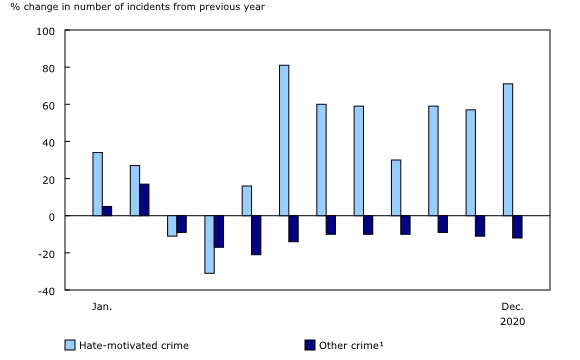
While police-reported hate crimes increased sharply, the overall police-reported crime rate (excluding traffic offences) decreased by 10% from 2019 to 2020. In the first month and a half of the pandemic, in which initial lockdown restrictions were in place, the number of police-reported hate crimes and other crimes was lower compared with the same period in 2019. From May to December 2020, however, other crimes remained lower month to month compared with 2019 (-12%), while hate-motivated crimes increased substantially (+52%).

Chart 2 
Percentage change in number of police-reported hate-motivated crimes compared with other crimes, by month of reporting, Canada, 2019 to 2020

Chart 2: Percentage change in number of police-reported hate-motivated crimes compared with other crimes, by month of reporting, Canada, 2019 to 2020

As with other crimes, self-reported data provide further insight into hate-motivated crimes as a complement to police-reported data. While the number of hate crimes rose sharply in 2020, this may still represent an underestimation. Self-reported data show that the majority of criminal incidents perceived to be motivated by hate are not reported to police. Specifically, according to the 2019 General Social Survey (GSS) on Canadians’ Safety (Victimization), Canadians were the victims of over 223,000 criminal incidents that they perceived as being motivated by hate in the 12 months that preceded the survey (3% of self-reported incidents). Approximately one in five (22%) of these incidents were reported to the police.

Most provinces and two territories report increases in hate crimes

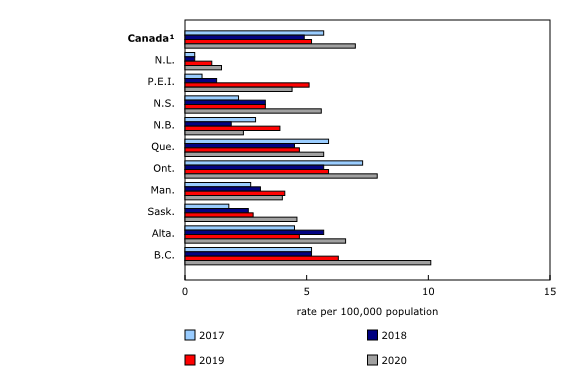
When population size is accounted for, the rate of police-reported hate crime in Canada from 2019 to 2020 rose 35% to 7.0 incidents per 100,000 population. The most notable increases in police-reported hate crime rates among the provinces were recorded in Nova Scotia (+70%; +23 incidents), British Columbia (+60%; +198 incidents), Saskatchewan (+60%; +20 incidents), Alberta (+39%; +84 incidents), and Ontario (+35%; +316 incidents). No increases were reported by Manitoba, Prince Edward Island, New Brunswick and the Northwest Territories. The relatively small population counts and number of hate crimes in the territories typically translate to more unstable rates, making year-over-year comparisons less reliable.

The rate of hate crime was highest in British Columbia (10.1 incidents per 100,000 population), Ontario (7.9 incidents per 100,000 population) and Alberta (6.6 incidents per 100,000 population).

While the majority (84%) of police-reported hate crimes in Canada occurred in large urban centres or census metropolitan areas (CMAs), rates increased the same (+35%) in CMAs and non-CMAs, which include smaller cities, small towns or rural areas.

Chart 3 
Rate of police-reported hate crimes, by province, 2017 to 2020

Chart 3: Rate of police-reported hate crimes, by province, 2017 to 2020

Non-violent and violent hate crimes up in 2020

More than half (57%) of all hate crime incidents reported by police were non-violent in 2020, while the remaining 43% were violent. These proportions were similar to recent years. Both non-violent (+41%) and violent (+32%) hate crimes increased compared with 2019, contributing fairly equally to the overall increase in hate crime in 2020.

The increase in non-violent hate crime was largely the result of more incidents of general mischief (+33%). The rise in violent hate crime was the result of more incidents of several violations, including criminal harassment (+70%), major or aggravated (level 2 and 3) assault (+58%), common assault (+23%) and uttering threats (+11%).

As is typical of police-reported hate crime historically, mischief (general mischief and mischief towards property used primarily for worship or by an identifiable group) was the most common hate crime-related offence, accounting for almost half (44%) of all hate crime incidents.

For all violent hate crimes reported by police between 2011 and 2020 and for which a victim was identified, 66% of victims were men or boys, and 34% were women or girls. Relative to other hate crime motivations, incidents targeting the Muslim population (47%) were more likely to involve women and girls. This was also the case for hate crimes targeting the Indigenous population, where 44% of victims were women or girls.

Crimes motivated by hatred of a race or ethnicity nearly double

The year 2020 was marked not only by the global pandemic, but also the rise of social movements seeking justice and racial and social equity. It is not possible to link police-reported hate crime incidents directly to particular events, but coverage and public discourse around particular issues can increase awareness and exacerbate or entice negative reactions from people who oppose the movement.

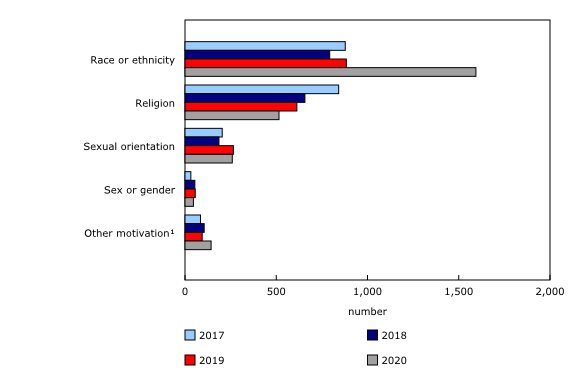
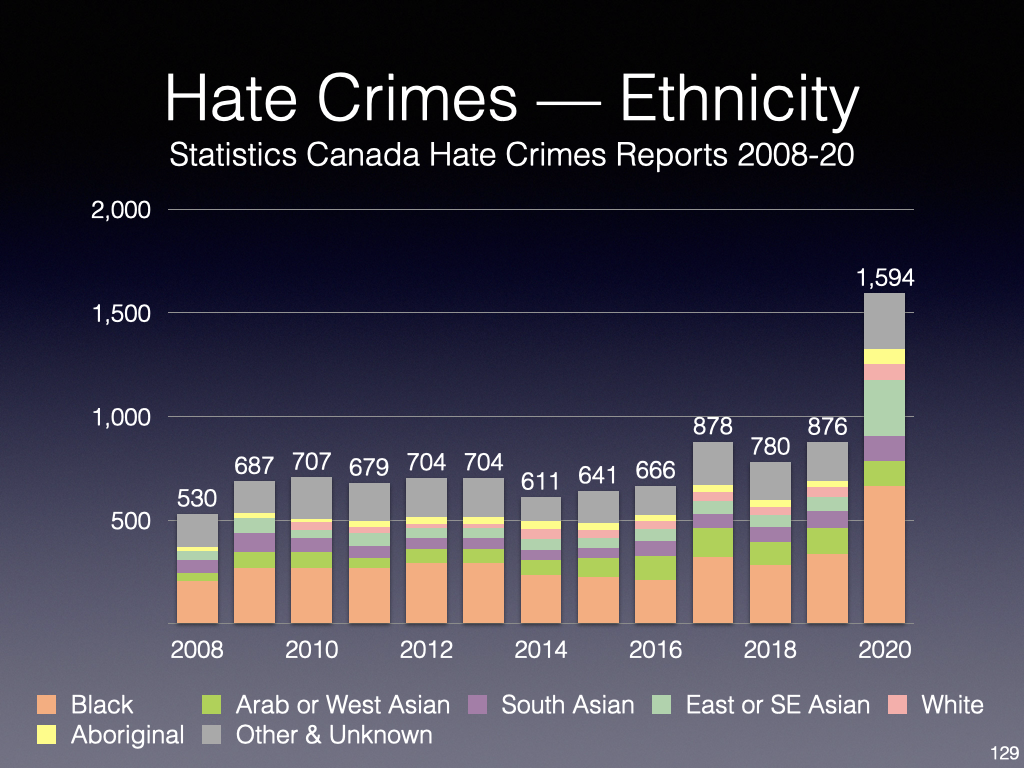
The number of police-reported hate crimes targeting race or ethnicity almost doubled (+80%) in 2020 compared with a year earlier, accounting for the vast majority of the national increase. Police reported 1,594 crimes motivated by hatred of a race or ethnicity. Much of the rise in these types of hate crimes was the result of crimes targeting the Black population (+318 incidents or +92%), the East or Southeast Asian population (+202 incidents or +301%), the Indigenous population (+44 incidents or +152%), and the South Asian population (+38 incidents or +47%). In 2020, police reported the highest number of hate crimes targeting each of these population groups since comparable data became available.

Chart 4 
Number of police-reported hate crimes, by type of motivation, Canada, 2017 to 2020

Chart 4: Number of police-reported hate crimes, by type of motivation, Canada, 2017 to 2020

Despite an increase, hate crimes targeting Indigenous populations continue to account for relatively few police-reported hate crimes

The number of police-reported hate crimes targeting Indigenous people—First Nations people, Métis or Inuit—more than doubled from 29 in 2019 to 73 in 2020. Despite the increase, incidents against Indigenous people continued to account for a relatively small proportion (3%) of police-reported hate crimes. Self-reported data indicate that rates of violent victimization among Indigenous people were more than double that among non-Indigenous people, but also showed that Indigenous people have lower confidence in police, the justice system and other institutions than their non-Indigenous counterparts. Different degrees of confidence in the police or other institutions among different populations may affect the likelihood that a particular crime is reported to the police.

Hate crimes targeting religion down for the third year in a row

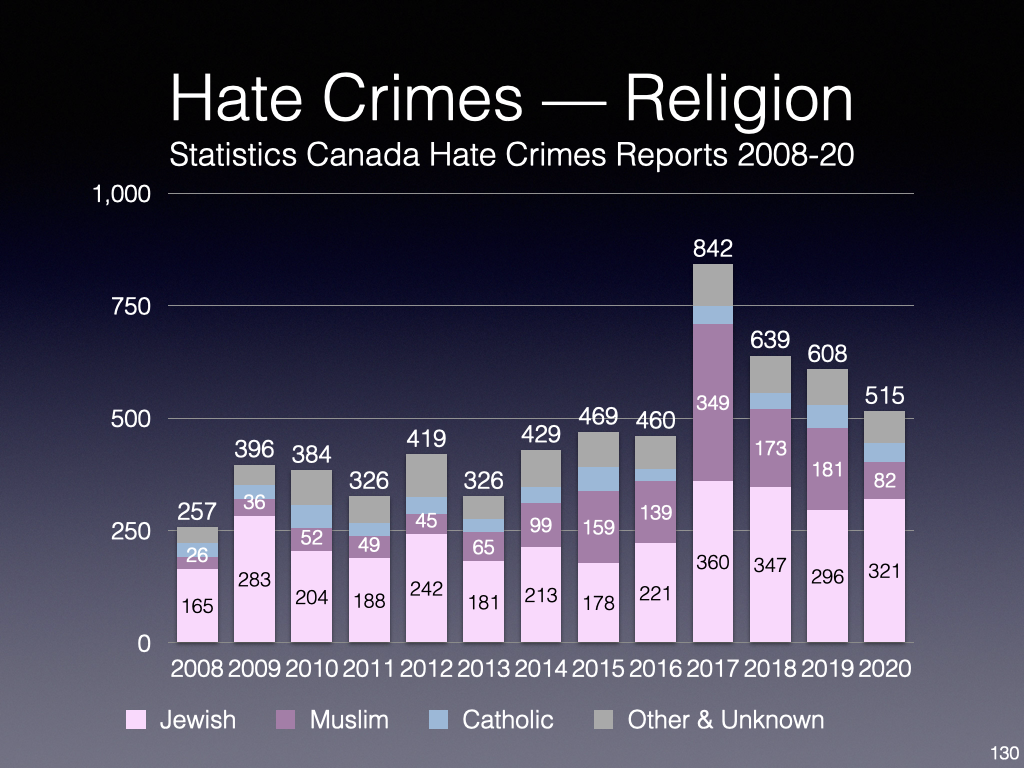
Following a peak in 2017, hate crimes targeting religion declined for the third year in a row, dropping 16% in 2020. Despite the recent declines, the 515 incidents targeting religion in 2020 remained higher than the number of incidents recorded annually prior to 2017. Among reported hate crimes targeting a religion in 2020, the Jewish and Muslim populations continued to be the most frequent targets, accounting for 62% and 16% of crimes against a religion, respectively.

These results mirror findings on self-reported discrimination from the 2019 GSS on Victimization. According to the GSS, the Jewish and Muslim populations were significantly more likely to report experiencing discrimination on the basis of their religion than most other religious affiliations.

The decrease in hate crimes targeting a religion was primarily because hate crimes targeting the Muslim population dropped by 55% in 2020, from 182 incidents to 82 incidents. Declines were mostly in Quebec (-50 incidents), Ontario (-27 incidents) and Alberta (-19 incidents).

In contrast, incidents targeting the Jewish population increased 5% in 2020, from 306 to 321 incidents. Among the provinces and territories, notable changes occurred in Ontario (+15 incidents), Quebec (+10 incidents) and Manitoba (-13 incidents).

Slight decrease in crimes motivated by hatred of a sexual orientation

According to the 2018 Survey of Safety in Public and Private Spaces, an estimated 1 million people in Canada reported their sexual orientation as lesbian, gay, bisexual, pansexual, asexual, a sexual orientation on the asexual spectrum, or a sexual orientation that is not otherwise classified. Compared with heterosexual Canadians, this population was more likely to report having been violently victimized in their lifetime and were more likely to have experienced inappropriate behaviours in public and online. At the same time, they were less likely to report being physically assaulted to the police.

Although the number of police-reported hate crimes targeting sexual orientation was down by 2% in 2020, the 259 incidents were the second highest reported since comparable data have been available since 2009. About 8 in 10 (81%) of these crimes specifically targeted the gay and lesbian community, while the remainder targeted the bisexual orientation (2%) and other sexual orientations, such as asexual, pansexual or other non-heterosexual orientations (9%). An additional 7% were incidents where the targeted sexual orientation was reported as unknown.

As was the case in previous years, violent crimes accounted for almost 6 in 10 (58%) hate crimes targeting a sexual orientation. In comparison, one-fifth (20%) of hate crimes targeting religion and less than half (47%) of those targeting race or ethnicity were violent.

Source: Police-reported hate crime, 2020

Saunders: The Christchurch massacre may have had a Canadian connection – but there’s a reason you may not know about it [Rebel Media]

Of note:

Three years ago this week, a young man drove to a pair of mosques in Christchurch, New Zealand, during Friday prayers and, strolling through them while firing an arsenal of military-style weapons at worshippers, killed 51 women and men. In the midst of the massacre, he posted an online manifesto that described the murders as acts of racially motivated terrorism intended to stop immigration, using phrases and ideas borrowed from a small circle of extreme-right and white-supremacist publications.

The young man – who we are not naming, in following New Zealand convention – had learned these ideas over a period of months. And one of the apparent sources of those ideas was a Canadian fringe-media outlet – something you may not know, as a result of that outlet’s determined efforts to use the courts to prevent you from reading about it in this newspaper and elsewhere.

Between January of 2017 – around the time he first “had a terrorist attack in mind” – and August of that year, when he moved from his native Australia to New Zealand to begin actively planning the attack, the future murderer spent months reading far-right literature and communicating with people and organizations that had inspired him. By the end of that summer, he possessed “a fully developed terrorist ideology.” Those were the conclusions of a detailed forensic report on the massacre published by the New Zealand Parliament in November, 2020, after the young man had been imprisoned for life on murder and terrorism charges.

We now have a sense of what ideas might have inspired him during those eight formative months. The investigation found that in August and September of 2017, while he was making active plans for the rampage, he made a series of donations to a small circle of publications and organizations. The recipients of his donations, all on the extreme right, had all published or promoted a similar set of then-obscure racially oriented ideas.

One of those organizations was Rebel Media, the Canadian right-wing publisher known for online video sites such as Rebel News. On September 15, 2017, the future terrorist made a donation of $106.68 from his personal bank account to Rebel News Network Ltd. of Canada, using PayPal. Around the same time, he made donations to organizations such as the neo-Nazi publisher Daily Stormer and the white-supremacist organization Generation Identity. It is reasonable to conclude that he felt influenced by those organizations, because they were among the few places in the world then publishing and publicizing the collection of ideas that would be at the core of his manifesto.

Canadians may not be aware of this connection between the Christchurch massacre and their country’s fringe media – and that’s because Ezra Levant, the publisher of Rebel Media, went to great lengths to ensure that it stayed out of the press. Around the time that the New Zealand parliamentary report became public, Mr. Levant launched a series of libel suits against journalists who had mentioned his organization’s possible influence on terrorists and violent individuals and groups. That included a suit against the author of this column for having mentioned the terrorist’s donation to Rebel Media on Twitter, after it appeared in the New Zealand report.

None of these lawsuits have been successful. In 2021, three of them were thrown out by Ontario judges, who agreed with the defendants that the suits were simply attempts to silence the media (or, in legal terms, “strategic lawsuits against public participation”). This January, a judge ruled that, in two suits, Mr. Levant and Rebel Media were “using litigation to silence critics” and ordered the outlet to pay more than $250,000 in costs. In late 2021, Rebel Media dropped its suit against me, too, with an agreement not to pursue its defamation claim against me with respect to my tweets or their contents, and not to pursue any claims against me relating to them.

What Rebel Media appears to have been trying to keep out of the public eye – and, to a large extent, successfully so – was any suggestion that their content could have influenced terrorists and violent figures in several countries.

In preparing my defence around the lawsuit, I found a string of articles and videos that were published on Rebel Media’s sites during those key months when the terrorist was gathering influences, shortly before he made his donation to the Canadian organization. Most have been subsequently deleted from their sites, but can be found on internet archives.

Central to many of those articles is Martin Sellner, an Austrian extreme-right figure who was arrested in 2006 for painting swastikas on synagogues and who, in the late 2010s, made declarations about the “Jewish question” and funded attacks on refugee ships using his extreme-right organization Generation Identity. He has popularized a racial conspiracy theory known as “the Great Replacement,” which holds that people in Western countries from racial or religious minorities are not simply fellow citizens, but the subjects of a plot to “replace” white and Christian people. He is also known for promoting the concept of “white genocide,” which holds that the immigration of racial minorities is a form of extermination.

The Christchurch terrorist was an admitted admirer of Mr. Sellner’s. He corresponded with the extremist repeatedly during those formative months of 2017, and he titled his manifesto “The Great Replacement,” filling it with Mr. Sellner’s quotes and concepts, including “white genocide.” The murderer’s donations appear to have all been directed to Mr. Sellner’s organizations or those that regularly published and advocated his ideas.

That includes Rebel Media. On June 22, 2016, Rebel Media published a post headlined, “Leader of Generation Identity Austria: We want to stop what we call the Great Replacement,” devoted to an adulatory video interview between a Rebel staffer and Mr. Sellner. The post remained visible until at least March of 2019, and carried the tagline, “Martin Sellner of the Austrian chapter of Generation Identity joined me to talk about Europe’s disastrous immigration policies, and why more people like him are fighting back.” Rebel Media’s main Twitter account promoted it with the line, “We want to stop the Great Replacement,” and a photo of Mr. Sellner with one of their staff.

Journalists have also identified at least one other Rebel interview with Mr. Sellner(which has since been deleted), as well as two other instances of posts that appeared during this period in which Rebel hosts reportedly express advocacy for Mr. Sellner. These were among the few places in the world, aside from the Daily Stormer and Mr. Sellner’s own sites, where his ideas could be found in any detail during this period.

The concept of “white genocide,” central to the terrorist’s manifesto, featured prominently on Rebel Media platforms during the time the young man was planning his terrorist attack. On May 31, 2017, Rebel published a much-discussed article, also later deleted, titled “White genocide in Canada?” which asked whether “diversity is just code for population replacement.” Another, published in December, 2016, claimed that a CBC show “celebrates white genocide.” During 2018, other Rebel posts and tweets promoted the “white genocide” concept.

I am not suggesting that this Canadian fringe-media site was responsible for, or approved of, the murderous violence of March 15, 2019; that is solely the responsibility of the man who committed the crimes. But it is quite reasonable to conclude that Rebel Media was an influence on his ideas during the time he was planning an attack, as were the people and concepts the outlet regularly and enthusiastically promoted during those years.

What does appear clear is that Mr. Levant and his colleagues at Rebel Media have devoted considerable effort and expense to ensuring that Canadians do not hear any discussion of their organization’s potential influence on people who commit horrible crimes in the name of baseless racial conspiracy theories.

While Rebel Media’s legal efforts were ultimately unsuccessful, they do mean that many Canadians have spent three years without hearing a word about what could be a Canadian connection to this, and other, atrocities. At a moment when the online publication of hateful fictions is having an increasingly damaging effect on the world, we need to be on guard against such attempts to silence the media.

Source: The Christchurch massacre may have had a Canadian connection – but there’s a reason you may not know about it

India concerned over elevating phobia against one religion to level of international day

Official speech reveals more than it tries to hide and ignore the background of anti-Muslim bias and hate in India that has increased under the Modi government. Theoretically, the case for pan religion and pan group anti-racism and discrimination is strong. But context matters, and the Indian Permanent Representative is not the one to make the case:

As the U.N. General Assembly adopted a resolution on Tuesday to proclaim March 15 as International Day to Combat Islamophobia, India expressed concern over phobia against one religion being elevated to the level of an international day, saying there are growing contemporary forms of religiophobia, especially anti–Hindu, anti–Buddhist and anti–Sikh phobias.

The 193-member General Assembly adopted a resolution, introduced by Pakistan’s Ambassador Munir Akram under agenda item Culture of peace, to proclaim March 15 as the International Day to Combat Islamophobia.

The resolution, introduced by the Organisation of Islamic Cooperation (OIC), was co–sponsored by Afghanistan, Bangladesh, China, Egypt, Indonesia, Iran, Iraq, Jordan, Kazakhstan, Kuwait, Kyrgyzstan, Lebanon, Libya, Malaysia, the Maldives, Mali, Pakistan, Qatar, Saudi Arabia, Turkey, Turkmenistan, Uganda, the United Arab Emirates, Uzbekistan and Yemen.

Reacting to the adoption of the resolution, India’s Permanent Representative to the U.N. Ambassador T.S. Tirumurti said in the General Assembly that India hopes the resolution adopted “does not set a precedent” which will lead to multiple resolutions on phobias based on selective religions and divide the United Nations into religious camps.

“Hinduism has more than 1.2 billion followers, Buddhism more than 535 million and Sikhism more than 30 million spread out around the world. It is time that we acknowledged the prevalence of religiophobia, rather than single out just one,” he said.

“It is important that the United Nations remains above such religious matters which may seek to divide us rather than bring us together on one platform of peace and harmony and treat the World as One Family,” he said.

Following the adoption of the draft resolution, Mr. Tirumurti said while India condemns all acts motivated by anti–semitism, Christianophobia or Islamophobia, such phobias are not restricted to Abrahamic religions only.

“In fact, there is clear evidence that over decades such religiophobias have, in fact, affected the followers of non–Abrahamic religions as well. These have contributed to the emergence of contemporary forms of religiophobia, especially anti–Hindu, anti–Buddhist and anti–Sikh phobias,” he said.

He noted that the Member States should not forget that in 2019, August 22 has already been proclaimed as the International Day commemorating the victims of acts of violence based on religion or belief, which is fully inclusive in nature.

“We even have an International Day of Tolerance observed on 16 November. We are not convinced that we need to elevate phobia against one religion to the level of an international day,” he said.

Mr. Tirumurti asserted that these contemporary forms of religiophobia can be witnessed in the increase in attacks on religious places of worship like gurudwaras, monasteries and temples or in the spreading of hatred and disinformation against non–Abrahamic religions in many countries.

He cited that several examples of these abound, including the destruction of the Bamyan Buddhas in Afghanistan by the Taliban, violation of gurudwara premises, massacre of Sikh pilgrims in gurudwara, attack on temples, glorification of breaking of idols in temples.

He said these contribute to the rise of contemporary forms of religiophobia against non–Abrahamic religions.

“It is in this context that we are concerned about elevating the phobia against one religion to the level of an international day, to the exclusion of all the others.

Celebration of a religion is one thing but to commemorate the combatting of hatred against one religion is quite another. In fact, this resolution may well end up downplaying the seriousness of phobias against all other religions,” Mr. Tirumurti said in his statement after the adoption of the resolution.

He said India is proud that pluralism is at the core of its existence.

“We firmly believe in equal protection and promotion of all religions and faith. It is, therefore, unfortunate that the word ‘pluralism’ finds no mention in the resolution and the sponsors have not found it fit to take on board our amendments to include the word “pluralism in the text for reasons best known to them”.

Mr. Tirumurti said as a pluralistic and democratic country that is home to almost all religions of the world, India has always welcomed, over the centuries, those persecuted around the world for their faith or belief.

“They have always found in India a safe haven shorn of persecution or discrimination. This is true whether they were Zoroastrians or Buddhists or Jews or people of any other faith,” he said.

Mr. Tirumurti expressed deep concern over the rise in instances of discrimination, intolerance and violence directed against members of many religious communities in various parts of the world.

He emphasised that it is with deep concern that India views the growing manifestation of intolerance, discrimination or violence against followers of religions, including rising sectarian violence in some countries.

France’s Permanent Representative to the U.N. Ambassador Nicolas de Riviere, speaking after Mr. Tirumurti, said that by creating an international day to combat Islamophobia, the resolution does not respond to the concern that “we all share to fight against all forms of discrimination”.

“Because they create division within the fight against religious intolerance by only selecting one religion to the exclusion of others without reference to the freedom to believe or to not believe,” he said.

He said society is made up of diversity, with individuals practising a variety of religions or not practising any at all.

“Must we expect the creation of days dedicated to each religion, to each degree of belief or non–belief. There may not be enough days in the year to satisfy all these demands,” Mr. de Riviere said.

He said the text of the resolution submitted on Tuesday did raise a number of difficulties with regard to the determination to fight against discrimination based on religion or belief.

“The term Islamophobia does not have any agreed definition in international law, contrary to the freedom of religion or belief,” he said, adding that the resolution is very ‘unsatisfactory’ as it stands and none of the proposals mooted by France were taken into consideration.

Source: India concerned over elevating phobia against one religion to level of international day

Israel: High Court rejects petition, allowing thousands of Ethiopians to immigrate to Israel

Of note:

The High Court of Justice has rejected an appeal that prevented the government from bringing over Ethiopians eligible for Israeli citizenship and thousands of Ethiopian refugees will arrive shortly, Immigration and Absorption Minister Pnina Tamano-Shata said Tuesday.

In November, the government approved a plan to let some 9,000 Ethiopians with first-degree relatives in Israel immigrate under the Law of Return. However, this effort was blocked by the right-wing Israeli Immigration Policy Center, which appealed to the High Court of Justice on the grounds that the Ethiopians in question were not themselves Jewish or the direct descendants of Jews.

While the court considered the matter, the government’s plan was not able to proceed.

On Tuesday, the court removed its injunction and rejected the Israeli Immigration Policy Center’s petition.

“These immigrants waited for no reason and were left separated from their families, their parents, their siblings, their children and more. The war in Ethiopia and the coronavirus pandemic made their situation worse and the time has come to bring them home to Israel,” Tamano-Shata said in a statement.

“Soon landing alongside the immigrants from Ukraine will be immigrants from Ethiopia,” she said.

She added: “All Israelis are brothers. As I promised, I will be a minister for everyone. I will fight to bring over Jews from Ukraine alongside immigration from Ethiopia and from anywhere in the Diaspora from which someone wants to immigrate to Israel.”

The decision and the remarks came a day after Tamano-Shata accused her ministerial colleagues of hypocrisy in fighting far harder to bring Ukrainian refugees eligible for citizenship who were fleeing a brutal war to Israel than they did to bring Ethiopians facing similar circumstances.

Source: High Court rejects petition, allowing thousands of Ethiopians to immigrate to Israel

Quebec students feel there’s ‘no future’ for them due to religious symbols law, study suggests

Of note. Interviews, not a poll, selection bias likely at play, but nevertheless of note (article in Le Devoir below):

A new study looking into how university students feel about Quebec’s religious symbols law is painting a bleak picture, with many saying they’ve lost faith in the province and plan to leave.

The study, completed by researchers from two Montreal-based universities, asked post-secondary students, recent graduates and prospective students about their feelings on Bill 21.

The bill, also known as Quebec’s Laicity Act, became law in June 2019. It banned some civil servants, including teachers, police officers and government prosecutors, from wearing religious symbols at work within the province.

The study acknowledged the sample size is “relatively small” — 629 respondents, polled from Oct. 2020 through to Nov. 2021 — and has a “strong possibility of selection bias,” as those who feel more strongly about Bill 21 are more likely to have responded to the survey.

However, the authors noted that respondents were “relatively diverse” and attended both French and English institutions from across the province.

Only about 28 per cent of respondents said they wore some form of religious symbol.

“We were expecting a more balanced diversity of responses. We thought we would get more people in favour of the law,” said Elizabeth Elbourne, an associate professor of history at McGill and one of the researchers behind the study.

“There’s a really interesting generational gap. We were quite struck.”‘I have no future in Quebec’

Respondents in Elbourne’s study were invited to write-in additional comments. Many said they experienced increased racism since the law was introduced.

“I think that the bill — despite the fact that many people don’t mean it this way — in practice, can give permission to discriminate,” she said.

Over 34 per cent of respondents — including those who did not wear a religious symbol — reported experiencing increased discrimination since the law was passed. That number jumps to 56.5 per cent for those who do wear religious symbols.

“It used to happen to me occasionally. Now it happens almost every time I go out,” said one Université de Montréal student who wears a hijab.

One McGill education student described seeing Bill 21 invoked in the classroom while on a work placement during their studies.

“[I] watched students and the teacher ridicule a Muslim girl for wearing a hijab. The teacher said with Bill 21, you can’t dress like that,” the respondent wrote. “The girl was mortified and silent and just 11 years old.”

Even those outside of law and education, the fields most impacted by the law, reported feeling its effects.

“I have had some job interviews where I could immediately tell that the person lost interest in my application as soon as they saw me with my headscarf,” said a Concordia engineering student.

Moving provinces seen as ‘only solution’

As a result, 69.5 per cent of the students polled who wear a religious symbol said they were likely to leave the province for work.

“I didn’t even get a chance to start my career properly,” lamented one McGill education student who wears a hijab.

“The only solution I am strongly considering is to move to another province.”

Weeam Ben Rejeb is one of those considering the move. The McGill law student hoped to become a prosecutor, but would be banned due to her hijab.

“Even though I could practice in the private sector, it’s more about what this law is saying about me,” she said.

Ben Rejeb described Bill 21 as an “insult,” saying it suggested that she wouldn’t be able to do her job because of what she chose to wear.

“It’s extremely offensive,” she said. “We are essentially saying we’re not intelligent enough or impartial enough to be able to be neutral judges or teachers.”

Can’t work with ‘clean conscience’

They’re not the only ones considering leaving.

Forty-six per cent of the students who don’t wear religious symbols said they were also planning to leave Quebec due to Bill 21, saying they don’t want to participate in a system that discriminates against their colleagues.

“I refuse to work in a place where my peers cannot or will be punished for expressing themselves,” said one education student.

“I don’t feel that I can be a teacher here in Quebec and have a clean conscience while doing so,” wrote another.

“I chose Canada because I believed their laws aligned with my liberal beliefs,” wrote a Concordia law student who does not wear a religious symbol. “Now I am very disappointed and rethinking everything.”

Elbourne, the researcher who worked on the study, said she sees the potential exodus of students having a “serious impact” on the province’s education system.

“I think it’s going to make it harder to recruit teachers. And I also think, if we’re looking at the people leaving — are people from the outside going to want to come to Quebec?” Elbourne said.

As for how they feel about Quebec, 70.3 per cent of all respondents said they had a worse perception of the province since the law passed.

“I despise Quebec now,” wrote one McGill education student who wears a hijab. “A province which has absolutely no respect for me or my people to the point that they’d like to take my livelihood away deserves no love.”

“We’re racist af (as f–k),” wrote another.

Some support for Bill 21, survey shows

Not everyone was against the law, however. While the study notes that the “vast majority of people … were critical or divided” on Bill 21, there were also those who supported the measure.

One McGill education student hoped the bill would “encourage all faiths to embrace secular civic life” in Quebec.

“Hopefully we will see a new era in which students are able to attend school without being subjected to symbols of patriarchal religious oppression on their teachers,” they wrote.

One McGill law student said their family “escaped” a country that forced women to wear the hjiab. “We are free here,” they wrote.

A PhD student in education at McGill said they came from a conservative and religious part of the United States and would like to see something similar there.

“[Bill 21] is a wonderful step towards women’s liberation and freedom,” they wrote. “I wish my state would pass a similar bill.”

Ben Rejeb, the law student, acknowledged that Bill 21 does have widespread support in the province — especially in more rural regions — but questioned why that was.

“If all that you know about Muslims is what you see on TV … then it makes sense why you might have these fears,” she said.

Ben Rejeb said that with more education, she believes that most Quebecers would change their minds about supporting the law, though she fears many have already moved on.

“I feel like most of my peers, and Quebec society in general, has kind of forgotten about this and is going on with their lives and not really thinking about it because it doesn’t affect them personally,” she said.

“All of us who are living in Quebec right now are complicit in allowing this bill to continue to exist.”

Source: Quebec students feel there’s ‘no future’ for them due to religious symbols law, study suggests

Un grand nombre d’étudiants en enseignement et en droit projettent de faire leur vie hors de portée de la Loi sur la laïcité de l’État québécois — en commençant par ceux portant un signe religieux, mais pas seulement eux.

Près de trois ans après l’adoption de la loi 21, 73,9 % des futurs, actuels ou anciens étudiants en enseignement qui portent un signe religieux et 54 % des futurs, actuels ou anciens étudiants en droit qui portent un signe religieux réfléchissent à l’idée de quitter le Québec, peut-on lire dans un rapport de recherche signée par les professeures Elizabeth Elbourne (Université McGill) et Kimberley Manning (Université Concordia).

Celles-ci se sont employées à mesurer l’incidence de la loi 21 sur les projets de vie d’étudiants et de diplômés en enseignement et en droit. Pour y arriver, elles ont notamment distribué un questionnaire sur les campus des collèges et des universités, que 629 personnes ont rempli entre le 13 octobre 2020 et le 9 novembre 2021. « L’échantillonnage est relativement petit et pas nécessairement représentatif de l’ensemble des étudiants du Québec en droit et en éducation », précisent-elles.

L’idée de tourner le dos au Québec trotte aussi dans la tête de plusieurs étudiants et diplômés qui ne portent pas de signe religieux. En effet, 46 % des personnes interrogées se disent être « très ou assez susceptibles de chercher du travail ailleurs qu’au Québec à cause de la loi 21 ».

« Ce ne sont pas seulement les gens qui portent un symbole religieux, mais ce sont les membres de leur famille, ce sont leurs amis, ce sont leurs camarades de classe qui repensent leur carrière, se demandent s’ils vont rester au Québec, et cela se répercute sur leur impression générale du Québec », soutient Kimberley Manning.

D’autres, moins nombreux, se résigneraient plutôt à revoir leurs plans de carrière, croyant — parfois à tort — ne pas pouvoir aller au bout de leurs ambitions professionnelles en raison de la loi 21.

« Au lieu d’aller en droit, je vais essayer de rentrer en psychologie. Je voulais être enseignante de droit au niveau universitaire », a souligné une collégienne portant le hidjab.

« Je comptais terminer mes études en droit ou enseigner à l’université, mais j’ai changé mes plans parce que je n’ai pas d’avenir au Québec dans ces domaines », a affirmé une étudiante inscrite au programme Droit et société de l’Université Concordia. La femme, qui porte aussi le voile islamique couvrant les cheveux, les oreilles et le cou, dit ne pas pouvoir se résoudre à demander à son mari de renoncer à son emploi et à déraciner leurs trois enfants de Montréal, « une ville que nous aimons et dans laquelle nous avons vécu la majeure partie de notre vie ».

La loi 21 interdit à certains employés de l’État québécois, dont les policiers, les procureurs, les gardiens de prison, les enseignants et les directeurs d’école primaire ou secondaire publique de porter un signe religieux dans l’exercice de leurs fonctions. Les avocats de pratique privée et les professeurs de cégep ou d’université ne sont pas assujettis à l’interdiction du port de signe religieux.

Épisodes de discrimination

Par ailleurs, les chercheuses notent une montée de l’islamophobie et de l’antisémitisme depuis l’adoption de la Loi sur la laïcité de l’État par l’Assemblée nationale, en juin 2019.

Pas moins de 76,2 % des femmes portant le hidjab ou un foulard interrogées dans le cadre du projet de recherche ont rapporté avoir subi de la discrimination. Elizabeth Elbourne dit avoir été « surprise par les expériences de discrimination vécue — harcèlement dans la rue, etc. » relatées par les étudiants au fil de ses travaux.

Les autrices prennent soin de signaler « une forte possibilité [de] biais de sélection en faveur de ceux opposés à la Loi » dans les résultats du sondage, qui serait causé par le « haut taux de réponse dans la région de Montréal, où se concentrent les minorités religieuses plus que partout ailleurs au Québec, et des personnes portant des signes religieux visibles ».

Cela dit, « le fait que peu de personnes aient répondu afin d’exprimer un fort soutien à la Loi est un élément significatif en lui-même », estiment-elles.

Source: La loi 21, source de craintes pour des étudiants en droit et en enseignement