EU Targets Golden Visas in Clampdown on Dirty Money

Long overdue:

European Union lawmakers voted to limit so-called golden visas, as countries across the region clamp down on cash-for-passport programs.

Wednesday’s European parliament vote, which passed with a 595 to 12 majority, aims to ban “golden passports” and set up EU-level regulation on visas that includes stronger background checks on applicants and the source of their wealth. After the vote, the parliament expects the European Commission to propose legislation to standardize programs across the common area.

“The commission has a duty now to act,” MEP Sophie In’t Veld said during a press conference in Strasbourg ahead of the vote. “The whole situation with the war in Ukraine has again put spotlight on the problem of people buying passports, buying residency, buying access to the EU.”

Parliament wants the Commission to come up with a legislative proposal that will ban golden passports, phasing them out by 2025 while regulating golden visas to ensure that investments flow into the real economy. Lawmakers are also asking for stringent background checks, including on family members and on the origin of funds. In addition, the parliament called on the EU Commission to ban Russian nationals who are subject to EU sanctions from all so-called residence-by-investment schemes.

European lawmakers also want to put pressure on third countries, such as Panama or Saint Kitts & Nevis, to abolish visa schemes that allow people who receive the documents to travel freely across the EU.

Thirteen member states currently have programs that allow citizens of non-EU countries to acquire an EU passport or residency permit in exchange for an investment such as real estate or bonds. Without any European-wide rules in place, the eligibility requirements vary greatly across the region, with the minimum investment ranging from 127,000 euros ($140,000) in Bulgaria to 1.2 million euros in the Netherlands. The golden visa programs have attracted about 3.5 billion euros per year from 2016 to 2019, according to European Parliament research.

In 2020, the European Commission opened legal action against Cyprus and Malta for their cash-for-passports schemes which grant EU citizenship to investors “without a genuine link” to the country.  Bulgaria, which also has a citizenship-by-investment scheme, has tabled a draft bill to end it.

Member states including Portugal, Greece and the Czech Republic have halted the issuance of visas to Russian nationals in light of the war in Ukraine. Last month, the U.K. scrapped its investor visa scheme to crack down on money laundering. Bulgaria also moved in that direction with a bill to drop golden passports altogether.

“We consider that operating investor citizenship schemes that systematically offer citizenship in exchange for pre-determined payments and investments, without a genuine link with the Member States concerned, violates EU law,” the commission said in a statement.

Source: EU Targets Golden Visas in Clampdown on Dirty Money

Russian-language propaganda stations spread hate in Canada for Ukrainians, say critics

Of note:

A group of Russian-language journalists in Canada are demanding the federal government remove from this country’s airwaves a pair of Russian-language television channels the journalists say spread hate and propaganda.

Last week, Canadian television providers pulled English-language network RT, formerly known as Russia Today, from their services. But Russian-language channels, RTR Planeta and Channel One Russia, are still available and spreading “weapons grade war-mongering,” says a letter from the Canadian Association of Russian Language Media.

“This aggressive propaganda is used to justify Putin’s invasion, spread anti-Ukrainian hate and radicalize parts of the Russian speaking community in Canada,” reads the letter, signed by 18 journalists from a number of outlets including Russian Canadian Broadcasting, Russian Infotrade LTD and Russianweek.ca.

“Even though we are fully committed and desperately trying to deliver to our viewers, listeners and readers the truth about unfolding events, in accordance with the international journalistic practises and standards, our voices are simply no match to the 24/7 Kremlin war propaganda machine.”

The organization has sent the letter to Prime Minister Justin Trudeau, Deputy Prime Minister Chrystia Freeland and Heritage Minister Pablo Rodriguez. It asks that a directive be issued to the Canadian Radio-television and Telecommunications Commission (CRTC) to pull all channels approved, controlled or owned by the Russian state from public airwaves.

RTR Planeta, an international service of Russian state-owned broadcaster VGTRK, and Channel One Russia are a source for Russians around the world of news and commentary in their language. However, the channels deliver mistruths more than anything, argues Alla Kadysh, a Russian-language radio and podcast host in Toronto who signed the letter.

“It’s been going on for years; it’s basically lies and projections,” Kadysh said of RTR Planeta, whose recent broadcasts have not been seen by the Star. “It’s basically hate-mongering. It’s got to the point where you can’t watch it three or four minutes, you’d go crazy.”

Earlier this week, Canadian television operators announced they were removingRT, the English channel, from their channel listings. That state-backed English-language news network has been accused by analysts of spreading disinformation meant to undermine democracies around the world.

But RTR Planeta and Channel One Russia are still carried by Rogers and Bell, according to the Canadian companies’ websites. (Neither Bell nor Rogers answered requests for comment.)

Critics of the channels say RTR Planeta is particularly sinister. Kadysh said she concerned it is radicalizing its viewers, as presenters frequently call Ukrainians “Nazis” and report false news about the Russian invasion of Ukraine. She fears it is stoking hatred that may lead to violence here in Canada as the war continues.

She said many in the Russian community have bought into the rhetoric.

“I talk to people like this every single day,” Kadysh said. “They don’t believe anything you say because they are already conditioned to believe only Russian propaganda. You talk to these people and there’s something wrong with them.”

RTR Planeta’s signal hasn’t been available since last week due to an unknown reason; a message on the screen blames technical difficulties. The channel’s website has also been down.

The Star has made attempts to speak to the channel’s representatives, but has not been successful.

Marcus Kolga, a disinformation expert with the Macdonald-Laurier Institute, shares Kadysh’s concerns. Often Russian news programming has engaged in a nationalistic stance meant to keep Russians abroad loyal, and uses distorted news as part of the approach, he said, adding that the channels are a major source for news.

“The shows that they have on there are using extremely inflammatory language to describe the Ukrainians today,” Kolga said, referring to RTR Planeta. “They’re calling them dogs, dogs that need to be put down, this is the kind of language you hear where governments and organizations are about to engage in genocide.”

Last week, the Star asked The Department of Canadian Heritage if it planned to address the concerns about RTR Planeta and was told in response that the government was requesting that the CRTC investigate RT, the English and French channels removed by Canadian satellite-TV providers earlier this week.

“We will continue to listen and be led by affected communities,” wrote David Larose of Canadian Heritage media relations. He pointed out the CRTC has said in a statement about its preliminary view of RT that the channel’s programming “may not be consistent with the Commission’s broadcasting regulations, in particular, the abusive comment provisions.”

The Star pointed out the question was about RTR Planeta, the Russian-language channel, and got no response. Some countries have already taken the step of banning RTR Planeta.

Last week, Lithuania banned the broadcaster along with a number of other Russian stations. A majority of the country’s population speaks Russian, causing the government concern.

Lithuania’s ambassador to Canada, Darius Skusevicius, told the Star the Lithuanian government didn’t want the country subjected to the “lies” of Russian television.

“We don’t want our population to get poisoned,” Skusevicius said. “Simple.”

He said during the invasion the network has reported the Russian military is being welcomed with open arms in Ukraine, even as the country maintains a ferocious resistance to Moscow’s troops.

“It’s just unacceptable, it’s a continuation of the glorification of Putin,” he said of the programming.

Meanwhile on Friday, Russia passed a draft law threatening 15 years in prison for those publishing information counter to Moscow’s version of events in Ukraine.

State media in Russia refers to its attack on Ukraine as a “special military operation” instead of calling it a “war” or “invasion.” Moscow also blocked Twitter and Facebook from Russian internet.

The move was no surprise to Kolga, who pointed out Russian leader Vladimir Putin has been working to silence dissent against his rule in the country for years.

Kolga not only wants the network removed from the airwaves, but said Canada needs to apply sanctions to dissuade people from participating in it. He said it’s not a matter of free speech, but one of national security.

Source: Russian-language propaganda stations spread hate in Canada for Ukrainians, say critics

Immigration Canada probing claims of systemic racism at two offices, union says

Notable that these complaints are related to the Montreal call centre, and the pressures described are likely common to most call centres. On the stereotyping mentioned by one staffer regarding “liars,” completely inappropriate but one has to recognize that fraud and misrepresentation occur, and that this may be more prevalent from certain source countries or areas:

Immigration, Refugees and Citizenship Canada (IRCC) is investigating claims of systemic racism at two of its offices, says the union representing its employees.

Meanwhile, the department has hired an outside company, Charron Human Resources, to conduct a workplace audit at IRCC’s call centre in Montreal — the department’s only Canadian call centre — where employees have been working to fulfil the federal government’s commitment to bring in 40,000 refugees from Afghanistan.

The Canada Employment and Immigration Union (CEIU) — which represents employees at IRCC, Service Canada, Employment and Social Development Canada (ESDC), and the Immigration and Refugee Board (IRB) — says the IRCC’s internal racism probes stem from complaints filed by employees.

The news comes after the IRCC released a damning report late last year. That report cited employees complaining of repeated instances of staff and supervisors using offensive terms with racialized colleagues, and of limited opportunities for advancement for racialized minorities.

“We are going to be proving that there is a national problem at the IRCC across the workplace,” said Crystal Warner, the CEIU’s national executive vice-president.

“IRCC is committed and believes in creating a workplace free from racism, harassment, discrimination and marginalization of any kind,” the department said in a statement, adding it could not comment on the probes due to confidentiality issues.

The union said workplace issues at the Montreal call centre — the subject of Charron Human Resources’ workplace audit — go back years but have been aggravated by Canada’s daunting commitment to bring in 40,000 Afghans after the Taliban took over Afghanistan.

“[Staff] are telling us that all the new employees that are getting hired are leaving within a few months because of the pressure to produce, to stay on the call and take the next call,” Warner said.

“You could be on the phone and you could hear someone telling you about a sibling being beheaded or a relative that had been raped and all these horrible situations,” she said, adding employees aren’t permitted to take a moment to decompress before taking the next call.

The investigations came as little surprise to two federal civil servants who, fearing workplace reprisals, spoke to CBC News on the condition they not be named.

One staffer — who is Black — started her career at the IRCC call centre in Montreal in 2017 and now works in a different federal department.

Pressure to produce

She described an office of overworked staff constantly being monitored by management — where the pressure to field as many calls as possible affected everything, even bathroom breaks.

“If you took more than the allotted surplus time that you had in order to do your bodily functions, you would get an email saying, ‘You’re really off your stats today, what’s going on?'” she said.

“Am I supposed to ask like in a kindergarten? Raise my hand and say, ‘Ma’am, can I please go to the bathroom?'”

She reported racist attitudes toward immigration applicants from certain countries — particularly those from Cuba and Nigeria.

“That came from the top, how we were instructed to deal with people from certain countries,” she said. “There was a lot of stereotyping going on … ‘People from this country, people from that country, they’re all liars, you know?'”

The report the IRCC released last October spoke of employees referring to a group of 30 African countries as the “dirty 30.”

‘Plebeian tasks’ left to people of colour, staffer says

The unnamed staffer also said there were few career advancement opportunities at the call centre for people of colour.

“The plebeian tasks were left to the people of obvious ethnic background and the higher-ups were homogeneous in their colour and culture,” she said.

The second employee who spoke to CBC — who is also Black — started his career at the call centre in Montreal in 1998 and now works as an immigration officer.

He said he noticed a reluctance to promote employees of colour within the department over the years. He said he went through about a dozen applications before he got a promotion.

“They would find ways to tell me, ‘You’re not qualified, come and we’ll discuss about the failure and we’ll tell you exactly what to do next,'” he said.

Farahldine Boisclair, director of the IRCC’s anti-racism task force, admitted the department has a lot of work to do.

“Racism is a factor in Canadian life,” Boisclair said.

The department created her position and the task force after George Floyd’s death at the hands of Minneapolis police in 2020 triggered widespread protests against police violence targeting people of colour.

She said the department has been working hard to stamp out workplace racism through training for managers. She said IRCC has introduced programs to help emerging talent from racialized minority groups move up the ranks.

“The higher you move up, the less diverse it gets at the top,” she said. “What we’re trying to do is really empower employees to share their experiences with us, in whatever fashion.”

External audit expands scope

According to emails seen by CBC News, the scope of Charron’s audit expanded over the past two months.

A message sent to staff by Charron on Jan. 6 explaining the nature of the audit was limited to employees who had lodged workplace complaints, as identified by an IRCC director-general.

A second email, dated Feb. 7, went to everyone at the call centre. Like the first, it promised to keep all information confidential and suggested interview dates for later in the month.

Charron did not return requests for comment.

The CEIU said it has little faith in the department’s internal processes or its impartiality.

“It’s like you’re your own judge and jury,” Warner said, adding that as a result, many staff choose not to report individual complaints. “If your complaint is founded, you basically get an email saying, ‘We agree that you have been harassed.'”

The union says it intends to file a collective grievance about workplace discrimination and harassment.

It said it has more faith in the external audit performed by Charron since it’s a third party.

Source: Immigration Canada probing claims of systemic racism at two offices, union says

Daphne Bramham: Canada needs a long-term immigration plan

Unfortunately, it is being overly influenced by the Century Initiative, Business Council of Canada and others rather than more independent and critical analysis (hence my recommendation for a royal commission or equivalent Increasing immigration to boost population? Not so fast.).

Refugee crises, and responses, on the other hand are harder to predict and manage:

Before Russia invaded Ukraine, Canada had already set the highest immigration targets in this country’s history, with the aim of increasing the population by one per cent a year, or by 1.3 million people within three years.

Those targets follow a record-setting 401,000 new permanent residents in 2021 — the highest rate since 1913 when there was an aggressive recruitment drive to “settle” the West.

Then, as now, the impetus isn’t humanitarian, it’s economic. With an aging population, Canada is depending on young, educated immigrants to ensure that we maintain our standard of living.

Immigration already accounts for almost all of the labour force growth and nearly three-quarters of our population growth.

The new targets favour the economic class — 60 per cent of newcomers are planned for that category, while 60,000 are in the refugee class.

Details about where they will go or how the provinces, municipalities and settlement service agencies will accommodate such levels of immigration against a backdrop of COVID and a national housing shortage have yet to be worked out.

Not that it matters now.Those targets were set aside with Canada’s open-ended promise last week that an unlimited number of Ukrainians are welcome for as long as they want in response to what is Europe’s largest migration since the Second World War.

As of Monday, two million Ukrainians were on the move, with estimates that as many as another two million may follow.

But that pales in comparison to the nearly seven million who have fled the long-running war in Syria. Canada fell short of its promise to settle 81,000 of them by the end of 2021, after initially bringing in 25,000 in little more than 100 days during 2016.

COVID is part of the reason, but there were also additional demands put on Immigration, Refugees and Citizenship Canada in the fall after Ottawa promised safe haven to 40,000 Afghans.

Now, there are the Ukrainians.If the Canadian government has any idea whether 100 Ukrainians or 40,000 might be arriving, that information hasn’t been shared with provinces, territories, cities or settlement service agencies.

How, where and when Ukrainians might be arriving, nobody’s been told. Many might want to settle in the Prairies where there is already a large Ukrainian-Canadian population, but refugees often prefer Toronto and Vancouver.

And who’s coming? Daily images from reception centres in Poland suggest that most are likely to be women and children, along with the elderly and, in the coming days, we may see more of the infirm. There are also reports of unaccompanied minors arriving in Poland.

Of course, these are early days. But information is essential to ensuring immigrants and refugees get what they need when they arrive.Most critically, it is anybody’s guess right now whether there are enough (affordable) roofs to put over their heads.

The B.C. government is in the dark. It is “looking forward to hearing more details from our federal counterparts and how best B.C. can respond to support Ukrainian newcomers under these new measures,” said an emailed statement from the Ministry of Municipal Affairs. The province doesn’t have an immigration ministry.

“B.C.’s priority is to ensure that everyone who arrives in the province receives the supports and resources they need to live a dignified, healthy and safe life.”

Among settlement service providers, there is an appreciation for what Canada is promising, but also “an anxiousness” about what Chris Friesen described as “a free-for-all”.Friesen is chief operating officer for the Immigrant Services Society of B.C., one of Canada’s largest settlement organizations.

Canada’s immigration system was under siege before the Ukrainian crisis. There were 1.8 million applications stacked up at Immigration, Refugees and Citizenship Canada as of October.

The backlog included 760,000 applications for spousal sponsorship, skilled worker and temporary-to-permanent-residency, and 550,000 for permanent residency.

It was exacerbated by “trade-offs” that needed to be made to Afghanistan resettlement objectives, according to an October memo obtained by immigration news website CIC News under access to information.

Canada promised last fall to resettle 40,000 Afghans who worked for the Canadian Armed Forces and international humanitarian organizations or as judges, journalists and senior officials in the former Western-backed government. So far, only 7,550 have arrived.To deal with Ukrainians, some Immigration, Refugees and Citizenship Canada staff are now being relocated and operations are being adjusted in offices in Europe, Canada and around the world to process the applications.

The applicants will include Ukrainians looking to come temporarily for an unspecified period or permanently; Ukrainians currently visiting, studying or working on temporary permits who are now also eligible for unlimited work permits; and under a special family reunification program.

And, of course, it’s expected that with 1.4 million Ukrainian-Canadians, there will be widespread interest in applying under the existing private refugee sponsorship program.

But with the country’s economic future reliant on immigration, Canada needs more than short-term targets and crisis management.

It needs a long-term blueprint that meshes economic aspirations with compassionate and humanitarian aims, as well as the resources to make that happen.

Provinces, territories and municipalities need similar plans. By the time people arrive, it’s too late to start building homes, hospitals, schools, libraries and other infrastructure.

Professional organizations and accreditation bodies also need to be engaged. It’s unfair to everyone when labour shortages exist to continue bringing professionals and skilled tradespeople without providing timely and accessible pathways for their qualifications to be recognized.

Canada has done well so far, stumbling along. But now there is too much at stake for everyone — newcomers, Indigenous people and multigenerational citizens.

Canada needs a plan not only for the next three years, but for the next generation.

Source: Daphne Bramham: Canada needs a long-term immigration plan

Inside Poland’s Drastic Immigration Reversal

Sharp contrast but understandable:

For the largely Middle Eastern migrants arriving in Poland during the fall 2021 border crisis with Belarus, the reception was chilly – in more ways than one. After trudging through freezing temperatures, many were met at the Polish border by armed soldiers who pushed them back, at times violently.

Following the crisis, in which Belarus President Alexander Lukashenko enticed thousands of Middle Eastern asylum seekers into his country and then funneled them west, the Polish government started construction of a fence spanning 115 miles along the Polish-Belarusian border.

The moves to strengthen the border were largely supported by the Polish public, which has generally opposed resettling Middle Eastern refugees in the country. In 2015, during the Syrian refugee crisis, thousands of Poles marched through Warsaw’s streets, chanting, “Today refugees, tomorrow terrorists!” In 2016, 73% of the Polish population said they viewed refugees from places like Iraq and Syria as a “threat to their country.”

Now, during the second full week of Russia’s invasion into Ukraine, Polish rhetoric surrounding refugees has taken a dramatic turn.

“We will do everything to provide safe shelter in Poland for everyone who needs it,” Poland’s interior minister, Mariusz Kaminski, said to journalists at the beginning of the crisis.

Poles have similarly lent their voices and even homes to support the roughly 1.2  million Ukrainians who have poured into their country. They have distributed food, raised funds, and organized medical convoys to give aid to their besieged neighbor and its residents.

In fact, relative to other EU member states – namely Italy, Germany, and Finland, France, Romania, and Sweden – Poland citizens indicated the greatest willingness to host Ukrainian refugees, according to a poll taken by the European Council on Foreign Relations in late January.

Why the radical shift? Experts attribute Poland’s initial embrace of Ukrainian refugees to the pre-existing Ukrainian population in the country, as well as to historical and cultural ties. In other words: proximity and similarity.

Despite the recent virulence aimed at Middle Eastern refugees, experts say anti-immigration attitudes aren’t long-standing in Polish society and have roots in the Syrian refugee crisis that shook the European Union just seven years ago.

“If you look at the 1990s and early 2000s, migration was not a politicized topic… At that stage, Poles were getting more and more open toward other nations,” says Marta Kindler, a sociologist and research fellow at the University of Warsaw’s Center of Migration Research.

Then came the 2015 migration crisis and the election the same year of Poland’s current right-wing, populist Law and Justice Party, whose platform stoked the flames of nationalism and xenophobia with alarmist tales of “severe diseases” from non-European migrants.

Following the party’s significant victory, Kindler says that “hostile attitudes, especially toward Muslim migrants” were allowed to openly proliferate among Poles, resulting years later, during the Belarusian conflict, in what she believes to be “racism at the border.”

The current migrant crisis, of course, is sending thousands of mostly white, mostly Christian refugees to the border. And while several factors are likely contributing to the warm embrace Poles are giving to Ukrainian refugees, race is likely one of them, Kindler says.

“It is clear that this is unfortunately on a racist and ethnic basis,” she says. “This is an issue that I think is right now really striking.”

Poles are fairly accustomed to seeing Ukrainians inside their borders, and experts say that familiarity as well as the cultural similarities shared by the countries may be the driving forces behind the altruism exhibited by Poles this time around.

Though Poland remains a fairly homogenous society, Ukrainians make up the largest group of foreigners in the country, at 57%. The Polish government says 300,000 Ukrainians currently hold residence permits in the country. However many more are likely in Poland through the visa-free agreement between the two countries. The New York Times put the total number of Ukrainian citizens in the country before the Russian invasion at around 1 million.

Many came for economic opportunities following the fall of the Iron Curtain. At the time, Poland in particular had developed a reputation as a country with ample economic opportunities and higher wages relative to some of its neighbors.

“[During the 1990s] the situation in Ukraine was very poor,” Kindler says. “It was not so much that people were unemployed in Ukraine, but that they earned so little that they were not able to support their households.”

Ukrainians once again set out for Poland in large numbers in 2014 and 2014 as a result of their country’s economic and security situation. The two countries also have some linguistic overlap. As of 2020, at least a third of Ukrainians had at least a basic command of the Polish language, according to a survey.

Another factor likely influencing how Poland is reacting to Ukrainian refugees is the shared concern both countries have about Russian expansion.

“There’s also the geographical proximity to the current events in Ukraine, which makes people also feel personally threatened,” says Hanne Beirens, a director at the Migration Policy Institute Europe. “There’s explosions only 70 kilometers away from the Polish border. I think that’s also feeding into how people are responding.”

For many Poles, the specter of Soviet oppression still takes a toll on the collective psyche.

“There’s also a historical dimension that weighs in into this, which is the memory of suffered repressions of Polish citizens [in the days of the Soviet Union]. So that’s very much still alive in the collective memory in Poland,” Beirens says. “Hence, there’s this kind of sympathy or empathy with what Ukrainians are experiencing at this very moment in time.”

But as the crisis continues to unfold and the numbers swell, many wonder whether the goodwill will persist.

Despite the current rapport between the countries, the relationship between them has historically been fraught. Tensions were briefly reignited in 2016 following a decision by Poland to label the killings of Poles by the Ukrainian Insurgent Army during World War II as a “genocide.” During 2016 and 2017, violence against Ukrainians escalated, with more than 44,000 cases of hate crimes against Ukrainians in a single Polish region.

“I’m just hoping for society in general, this solidarity that is being shown right now will not be temporary, and that it will not fade away,” Kindler says.

Source: Inside Poland’s Drastic Immigration Reversal

Why it’s hard to know how accurate the 2020 census was

Of interest:

No census in the U.S. has been perfect.

Exactly how imperfect the national head count was in 2020 may start to be revealed in a report the Census Bureau is set to release Thursday.

While the 2020 census may now seem like a distant memory, any confirmed over or undercounts carry both near and long-term implications on how political representation and federal money are distributed in the United States.

Disruptions from the coronavirus pandemic, historic hurricane and wildfire seasons and years of interference by former President Donald Trump’s administration made it especially difficult for the bureau to try to count every person living in the country. These extraordinary challenges have also made it harder to pinpoint the tally’s accuracy.

For the next decade, any census errors would be baked into the data used to reallocate each state’s share of congressional seats and Electoral College votes; redraw voting districts for every level of government; help distribute an estimated $1.5 trillion a year in federal funds for public services; and form the country’s understanding of who lives in the United States.

Here’s what else you need to know to decode the Census Bureau’s upcoming data quality report:

The over or undercount of the total population masks racial inequities

After the 2010 count, the bureau’s director at the time, Robert Groves, called the tally “an outstanding census” for having a net overcount of the total U.S. population of 0.01%, which translates into overcounting by about 36,000 people.

Focusing on just that sliver of a percent, however, would mean overlooking a stark flaw along racial and ethnic lines: Decade after decade, the U.S. census has overcounted people who identify as white and not Latino, while undercounting people of color. The 2010 tally was no exception.

Civil rights organizations and other census watchers are concerned this trend is likely to have continued in 2020, perpetuating inequitable distributions of political power and federal money for another 10 years.

COVID-19 made it harder to measure who was left out of the count

Just as the pandemic disrupted door knocking for the census, it also delayed in-person interviews for the follow-up survey the bureau relies on to determine over and undercounting rates by race, ethnicity and other demographic characteristics.

That has many census watchers worried about how accurate the results of the Post-Enumeration Survey will be.

Faced with many households’ reluctance to speak with strangers at their doors and general census fatigue, the bureau extended the survey’s interviewing schedule. The shifts raised the risk of households not accurately recalling who was living at their home address on Census Day, which was April 1, 2020.

Still, bureau officials have said that despite the challenges, they believe the survey’s estimates “will produce a helpful picture.”

Quality metrics at the state level and lower would tell a fuller story

The bureau says Thursday’s report – the first of a series on the quality of the 2020 census data based on Post-Enumeration Survey estimates – will provide only a national-level look.

Counting efforts can range greatly from neighborhood to neighborhood, which means to get a fuller story on the accuracy of the 2020 tally, metrics at the state level and lower are needed.

Estimates by state are expected from the bureau this summer. However, the survey is not conducted in remote areas of Alaska. It also does not include people experiencing homelessness or those living in college dorms, prisons or other group quarters, where residents were particularly difficult to count accurately in the early months of the pandemic.

In December, the bureau announced it is not planning to release new over and undercounting rates for counties and smaller local communities and needs to do more research on how to produce those quality metrics below the state level.

Source: Why it’s hard to know how accurate the 2020 census was

Why Citizenship for Undocumented Immigrants Matters for US Economic Recovery | Immigration

Of note:

There are 10.4 million undocumented immigrants working and living in the United States. Approximately 5 million of them are considered essential workers — serving as health care professionals and staff at hospitals, as agricultural and farm workers producing the country’s food, as delivery drivers and grocery store clerks, and in other industries that have helped keep the country afloat. Some of them are Dreamers, Deferred Action for Childhood Arrivals recipients, or Temporary Protected Status holders. Yet they were excluded from federal pandemic relief efforts and unable to receive stimulus checks and many do not have access to health care.

The Center for American Progress, a Corporation grantee, makes the case for the Biden administration and Congress to create a pathway to citizenship and permanent protections for undocumented immigrants as they continue to aid the country’s economic recovery from the COVID-19 pandemic.

The author, Trinh Q. Truong, writes that creating a pathway to citizenship for undocumented immigrants would help ensure a robust economic recovery for all Americans. Should congressional efforts fail, Truong urges the Biden administration to take immediate executive action to promote stability in the lives of undocumented immigrants, their families, and their communities.

Source: Why Citizenship for Undocumented Immigrants Matters for US Economic Recovery | Immigration

#COVID-19: Comparing provinces with other countries 9 March Update; New Zealand changes its tack on surging COVID-19 cases

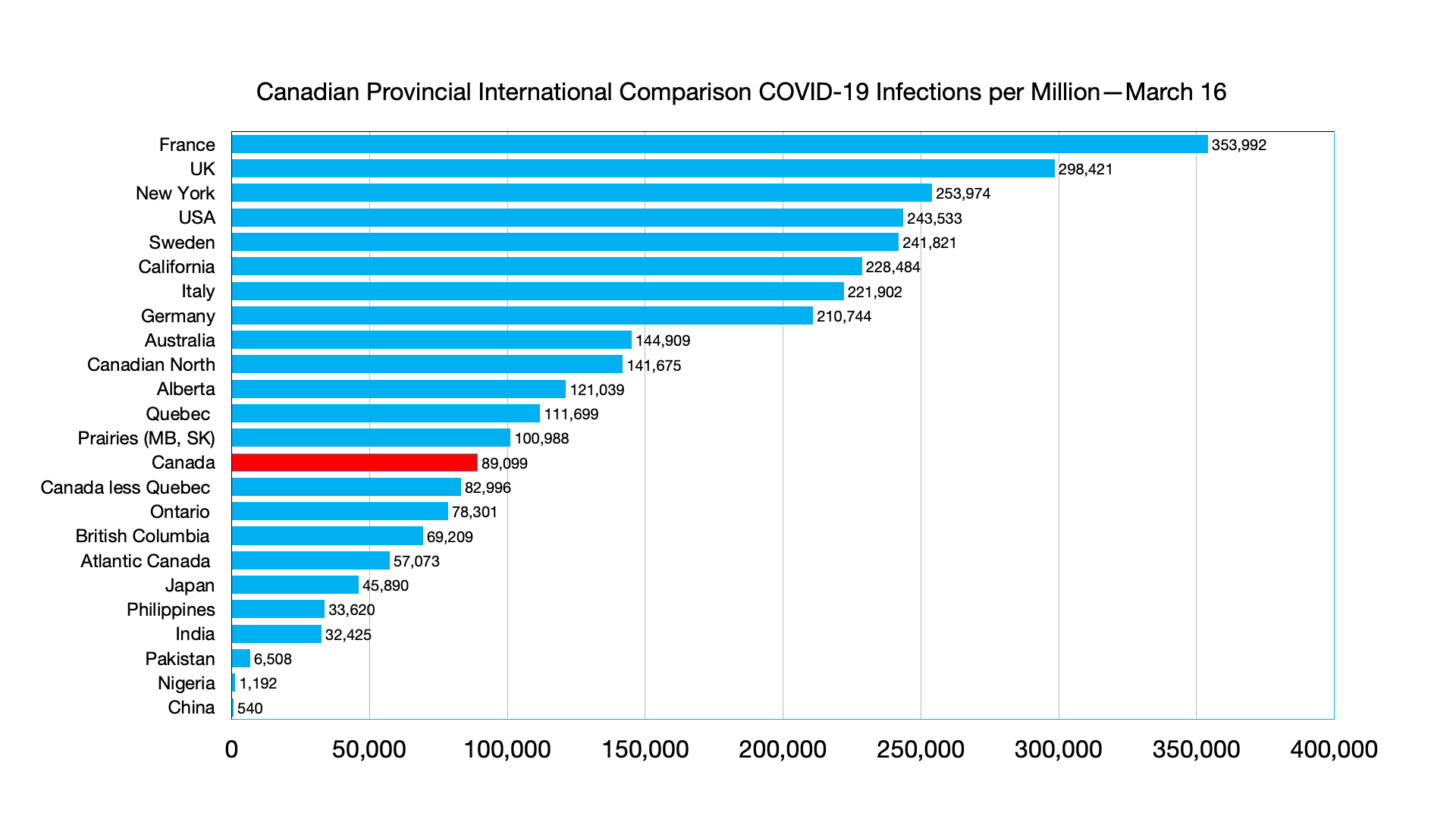
Overall decline in infections and deaths continues. Numbers from China have a further significant increase since last week, from 315,000 to 608,000 infections and from 5,380 to 6,923 deaths.

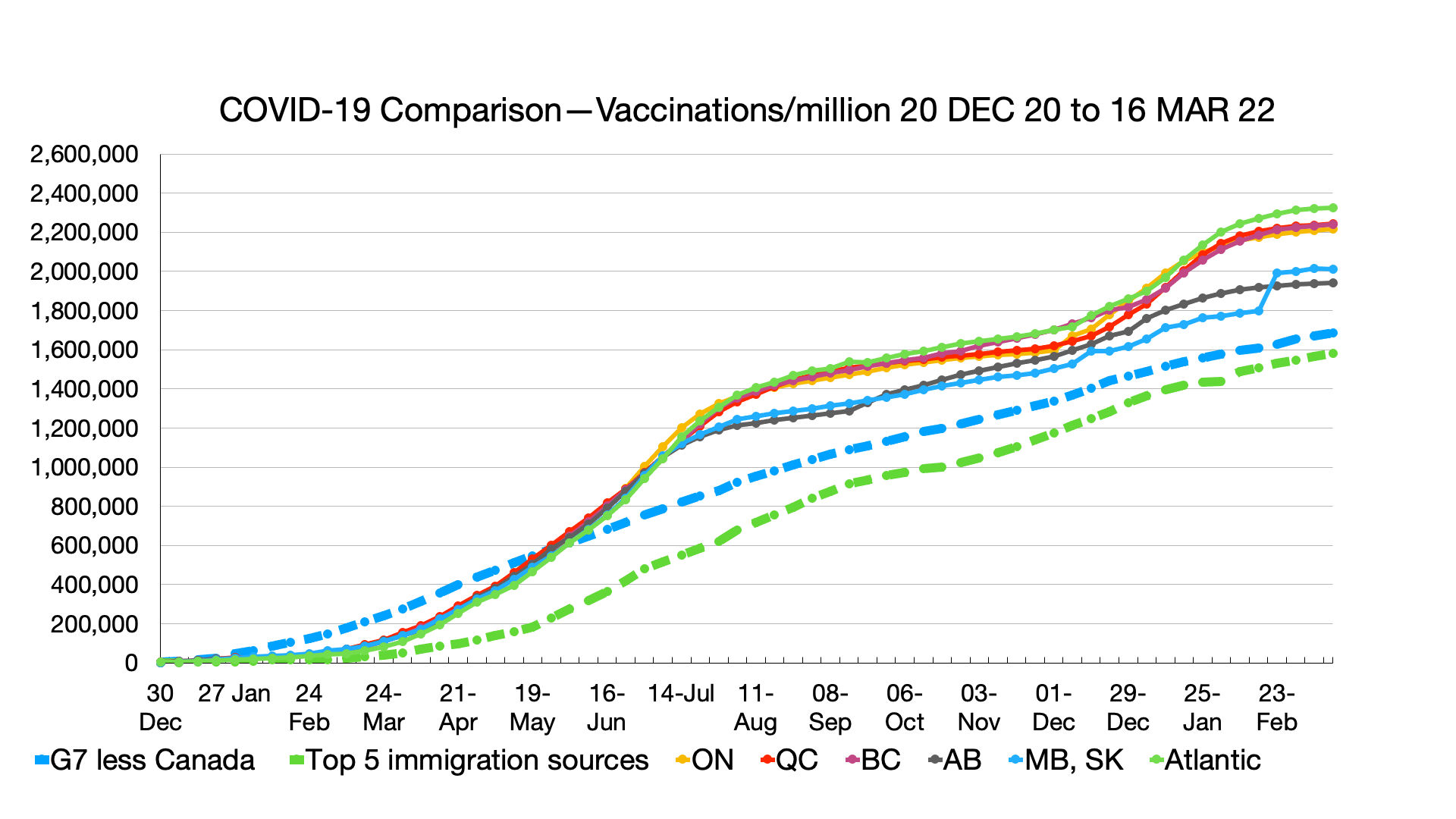
Vaccinations: Some minor shifts but convergence among provinces and countries. Canadians fully vaccinated 82.4 percent, compared to Japan 79.5 percent, UK 73.5 percent and USA 65.9 percent.

Immigration source countries are also converging: China fully vaccinated 88.3 percent (numbers have not budged over past four weeks), India 58.9 percent, Nigeria 4.2 percent, Pakistan 46.6 percent, Philippines 58.4 percent.

Trendline Charts:

Infections: Ongoing signs of omicron and other variants plateauing, more so in Canadian provinces than comparator groups.

Deaths: G7 still not plateauing.

Vaccinations: No major relative changes although Japan is now ahead of California.

Weekly

Infections: No relative changes. Infections per million in China have increased from 226 per million to 436 per million.

Deaths: Major change again is with respect to China with deaths per million increasing from 3.9 to 5 per million.

New Zealand changes its tack on surging COVID-19 cases

Back in August, New Zealand’s government put the entire nation on lockdown after a single community case of the coronavirus was detected.

On Tuesday, when new daily cases hit a record of nearly 24,000, officials told hospital workers they could help out on understaffed COVID-19 wards even if they were mildly sick themselves.

It was the latest sign of just how radically New Zealand’s approach to the virus has shifted, moving from elimination to suppression and now to something approaching acceptance as the omicron variant has taken hold.

Experts say New Zealand’s sometimes counterintuitive actions have likely saved thousands of lives by allowing the nation to mostly avoid earlier, more deadly variants and buying time to get people vaccinated. The nation of 5 million has reported just 65 virus deaths since the pandemic began.

But virus hospitalizations have been rapidly rising, hitting a record of more than 750 on Tuesday and putting strain on the system.

Across the country, the explosion in cases has left people stunned. Just a month ago, case numbers were around 200 per day. Now, the outbreak is affecting everyone from frontline workers to lawmakers.

Opposition Leader Christopher Luxon became the highest profile politician yet to announce he was infected on Monday, saying he felt fine and would continue working from home.

One factor that hastened the outbreak was the return of thousands of university students to campuses around the country last month.

Ralph Zambrano, the student president at Victoria University of Wellington, said the virus had spread rapidly through hundreds of students in residence halls, taking a toll on their mental health and well-being.

“The campus would usually be buzzing at this time of year but it has a very eerie feeling to it,” he said, adding that most students were opting to learn remotely. “There’s lots of anxiety and tension.”

He said the outbreak had strained the food supply system in the halls, with some students being offered only a protein drink for breakfast or a piece of cold meat and some peas for dinner.

The university said case numbers in the halls were now reducing as students recovered.

Professor Michael Baker, an epidemiologist at the University of Otago, said the variant had proved as ferociously infectious in New Zealand as it had in other countries.

He said cases appeared to be plateauing or even starting to dip in the largest city of Auckland, while still rising elsewhere.

While much of the world was breathing a sigh of relief after two years of terrible problems, Baker said, New Zealand was at its worst point yet in the pandemic and was coming to terms with the fact the virus would remain in the country permanently.

He said he was concerned health authorities had lost the ability to properly track the outbreak, as they struggled to shift from a system where they carefully monitored a few cases to dealing with thousands of self-reported results from rapid antigen tests.

Dr. Caroline McElnay, the director of public health at the Ministry of Health, told reporters the number of hospitalizations would grow, but that patients with omicron generally had less severe illnesses than previous patients had experienced with the delta variant.

She said the rising number of both patients and infected health workers had prompted the relaxation in the rules around when health workers could return to hospitals.

She said infected workers would only be allowed to work with patients who already had the virus, and if there were no other options.

“It’s an extra tool that enables our health system to keep running,” she said.

Source: New Zealand changes its tack on surging COVID-19 cases

Barutciski: Roxham Road — Canadians deserve honest talk about this country’s asylum policy

Needed on both sides of the spectrum:

Despite international travel restrictions, the number of asylum seekers entering Canada through the unofficial Roxham Road border crossing between Quebec and upstate New York has reached winter-month record levels. Recent statistics indicate 2,367 migrants entered during a month of January that was particularly cold. Almost 3,000 entered in December. At this rate, the RCMP will intercept a record number of asylum seekers on the land border this year.

We have not heard about these irregular migrants in recent years for a simple reason: after insisting during the first three years of the Trump administration that it was impossible to block the border, the Trudeau government simply invoked public health safety and prevented them from entering at the start of the pandemic. The special Order in Council preventing entry at Roxham Road was lifted last November and, unsurprisingly, the number of asylum claims immediately shot up.

We are back to the controversial double standard that created controversy and contributed to record levels of asylum claims from 2017 to 2019. If migrants arrive at the Lacolle port of entry, border officials invoke the Safe Third Country Agreement with the United States to prevent them from entering to claim asylum. However, if the migrants go a couple of kilometres to the west at Roxham Road, the RCMP allows them to enter because of a loophole in the agreement. There is, however, no protection principle that could justify treating asylum seekers differently based on which part of the land border they use to enter.

Instead of explaining the problem in a transparent way so that pro-immigration Canadians could grasp the dilemma, the Trudeau government focused on signalling a supposedly virtuous policy and promoting a humanitarian brand. Observers who sympathized with this apparent openness are missing the underlying political cynicism. Canadian asylum policy has always been anchored to the basic concept of interdiction with strict visa issuance policies and airline sanctions for undocumented travellers. Despite the rhetoric, governments of all stripes have done everything possible to prevent asylum seekers from reaching our shores. It is not by chance that many migrants from poor countries obtained U.S. visas to fly to New York City before taking the bus/taxi to Roxham Road. They would never have received Canadian visas. Seen in this light, the recent decision to grant visas quickly to Ukrainians will eventually be seen as another double standard.

The ideological battle regarding Roxham Road is therefore misleading to the extent it has become a symbol dividing Canadians into supposedly pro-refugee or anti-refugee camps. Part of this context is that activists have opposed any idea of an agreement with the U.S. since the late 1980s (when enabling legislation was initially proposed) because they do not believe U.S. standards are good enough.

Despite its branding efforts, a closer look reveals the Trudeau government has always argued before the courts that migrants can be returned to the U.S. because it is a “safe third country” where rights are respected (under both the Trump and Biden administrations). So far it has not said this too loudly outside the courtroom because it clashes with a pro-refugee image.

Similarly, the Trudeau government does not explain what is meant by the commitment “to modernize” the agreement with the U.S. that is included in the immigration minister’s mandate letter. This would logically mean removing the loophole, but clearly saying so goes against brand.

Although unfashionable on campuses, there is nothing wrong with communicating to the public that border control is a legitimate state function. It explains why the federal government has always preferred to select and resettle refugees from overseas rather than deal with asylum claimants who arrive irregularly and undocumented. An honest discussion acknowledges potential problems with such uninvited asylum claims. The challenge is reconciling the need to control borders with a humane and fair approach to asylum.

Canada is not the only country facing asylum dilemmas. Even prior to the Ukrainian outflow, the number of asylum seekers increased over the last few months in the European Union. Likewise, the problem at the Mexican border is getting worse despite a new administration in Washington that does not want to appear anti-refugee. In a post-pandemic context that will see increased international mobility, Canadians have an interest in rejecting superficial image-based approaches to asylum policy. The government could improve public trust by eliminating the incoherence in the way asylum claims are handled at Roxham Road and being more upfront about our actual position. It is time our leaders’ role in elevating the public discourse overrides the fondness for political marketing.

Michael Barutciski is a faculty member of York University’s Glendon College and associate editor of Global Brief magazine. He has taught refugee law and directed public policy programs in several countries.

Source: Barutciski: Roxham Road — Canadians deserve honest talk about this country’s asylum policy

After years of US population growth, it’s time for a pause | TheHill

Rare questioning of the conventional wisdom of growth strategies and raising of related issues:

In the long run, no substantial benefits will result from the further growth of America’s population. The gradual stabilization of the U.S. population through voluntary means would contribute significantly to America’s ability to solve its problems.

That statement from a half-century ago was the unequivocal central finding of the groundbreaking report by the U.S. Commission on Population Growth and the American Future, submitted to the president and Congress on March 27, 1972.

However, rather than moving toward a gradual stabilization, as was clearly recommended, America’s population over the past 50 years has grown to 334 million, an increase of 123 million (about 60 percent) since 1972.

In addition, America’s population is projected to continue growing over the coming decades. According to its main projection series, the Census Bureau expects the nation’s population to be close to 400 million around mid-century.

Preceding the commission’s establishment by several years, former President Richard M. Nixon remarked that “One of the most serious challenges to human destiny in the last third of this century will be the growth of the population… Whether man’s response to that challenge will be a cause for pride or for despair in the year 2000 will depend very much on what we do today.”

Nixon’s observations are even more prescient today. Given climate change, environmental degradation, biodiversity loss, pollution and congestion, population growth in America and the rest of the world remains among the serious challenges to human destiny in the 21st century.

Similarly and more recently, naturalist Sir David Attenborough remarked, “It’s not just climate change; it’s sheer space, places to grow food for this enormous horde. Either we limit our population growth, or the natural world will do it for us, and the natural world is doing it for us right now.”

Without a doubt, America’s population growth is a major factor affecting domestic demand for resources, including water, food and energy, and the worsening of the environment and climate change. There is hardly any major problem facing America with a solution that would be easier if the nation’s population were larger. On the contrary, population stabilization would help to resolve several.

Stabilizing the population would reduce pressures on the environment, climate and the depletion of resources and gain time for America to find solutions to its pressing issues. If the United States intends to address climate change, biodiversity loss, pollution, etc., it must consider how its population affects each issue.

In contrast to the commission’s central finding, some do not recognize the need to stabilize the population. Their reasons are largely based on profit, politics and power. They give little attention to the consequences of population growth on the nation’s future.

For instance, many economists contend that continued population growth is needed to fuel economic growth. Their “bigger-is-better” arguments simply ignore or dismiss the negative consequences for the country, which are threats to the wellbeing of today’s Americans as well as the long-term sustainability of the nation.

Others argue the nation would be “more happy” with more people. Slow population growth, they claim, hurts not only America’s economic growth but also the national mood. Concerns about climate change and the environment are omitted from their rhetoric.

Some advance nationalistic appeals for continued population growth, maintaining that the more patriotic one is the more one ought to believe in a large and growing America.

Another argument is the view that “America isn’t full” and can accommodate many more people, particularly more immigrants. Those advocates, however, rarely ever specify how large the population must become to be considered full nor do explain why America needs to be full.

Thousands of scientists worldwide take an opposing view. Among their major recommendations for governments to address the climate emergency is a call for the stabilization of the world population, or ideally, a gradually reduced population within a framework that ensures social integrity.

Gradually stabilizing America’s population will provide an exemplary model for other countries to emulate. Rather than racing to increase the size of their respective populations in a world with 8 billion humans and growing, nations would see America moving away from the unsustainable demographic strategy.

As American couples are having fewer children than in the past for a host of social, economic and personal reasons, the nation’s fertility rate is unlikely to return to the replacement level any time soon. And pro-growth calls for Congress or the administration to establish pro-natalist policies to raise fertility appear unlikely to be adopted.

Source: After years of US population growth, it’s time for a pause | TheHill