Is the ‘market value of becoming Canadian’ dropping? Fewer immigrants are becoming citizens

One discussion point that has arisen in social media is the extent that Harper-era changes, making citizenship “harder to get and easier to lose,” are responsible for the decline.

The 2021 study is based upon the 2011-15 period, when all immigrants have met the residency requirements (5-9 years since landing). So while the Conservative government changes to language and knowledge were implemented in 2010-11, increased residency requirements and fees were not implemented until 2015, thus not impacting this study.

One area that needs to be considered is for the settlement sector to provide citizenship test preparation courses, given that the study confirms that lower levels of language fluency and education attainment correlate with lower naturalization.

It is unlikely that the current government will implement its 2019 and 2021 election commitment to eliminate citizenship fees (virtue signalling) but there is a case to waive these fees, at least partially, for lower income applicants.

… The findings confirm the worrisome trends identified by the research of the Institute for Canadian Citizenship that found a strong decline in the “market value of becoming Canadian.”

“This study shows that some of the people who are most likely to naturalize are the wealthiest and best educated,” said the institute’s CEO, Daniel Bernhard. “But we saw just a few weeks ago from Statistics Canada that the (recent) immigrants who are most likely to leave the country are exactly those.

“No matter which way you look at it, it’s clear that Canada’s appeal in the eyes of immigrants is fading. And if our growth strategy continues to be dependent on immigrants, that’s a real problem for our future viability.” 

Although office lockdowns and public health restrictions have caused backlogs and contributed to the disruptions of citizenship application processing, Statistics Canada said that only accounted for 40 per cent of the decline between 2016 and 2021.

The study compared the citizenship takeup among recent immigrants who arrived in Canada five to nine years before each census. It found that 75.4 per cent did so in 1996 and it gradually declined from 2006, when the Conservatives took power.

In the decade with the Tories at the helm, the “knowledge of Canada” test was strengthened, language requirements increased, citizenship application fees rose and the physical presence requirements for citizenship were changed from three of four years preceding application to four of six years. The naturalization rate subsequently dropped to 60 per cent.

After Prime Minister Justin Trudeau’s Liberals came into power, the federal government restored the residency requirement to three of five years, and moved the upper age limit for the exemption to the language and knowledge test from 64 back to 54, the report notes. The citizenship fee for minors was also reduced in 2018.

However, these changes have failed to reverse the trends, with the citizenship naturalization rate falling a further 14.7 per cent between 2016 and 2021, said Statistics Canada, which, in an earlier report, also found a significant number of immigrants are leaving the country after initial arrival.

“Other more global events also likely play a role,” said the report. “Significant economic development in some source countries, such as China and India, could encourage immigrants from these regions to maintain their source-country passports and reduce their motivation to become Canadian citizens.”

The study also found the fall in citizenship rates over the past 25 years varied by demographics:

•Families with household income between $10,000 and $30,000 annual saw a 35.9-percentage-point drop, compared to a 13.5-point decline among those making over $100,000 a year;

•Those who did not complete high school saw a 39-percentage-point drop compared to 29 points for those with a university degree;•Newcomers whose mother tongue was not an official language registered a 32-percentage-point decline in naturalization rate versus just a 19-point fall among those with English or French as first language;

•Before 2006, StatCan calculated that the group of immigrants with all three characteristics of low income, education and language skills was more likely to acquire Canadian citizenship than the most advantaged group, but the pattern reversed after that; in 2021, the citizenship rate was 1.5 times higher among the most advantaged group than among the disadvantaged. 

•Immigrants from some non-western countries who traditionally were more likely to acquire Canadian citizenship now more closely resembled their counterparts from developed nations in citizenship uptake.

Bernhard said the report speaks to the need for greater policy intervention to address the question of why people want to become Canadian, as well as their experience here and commitment to the country, and what they’re getting from and giving to Canada.

Some advantages that used to be reserved for citizens such as jobs in the federal government and military are now open to permanent residents, which removes the incentive for some to acquiring citizenship, said Bernhard, adding that immigrants need to have positive experiences and strong connections to feel belonged.

“That’s the difference between residency and citizenship,” he said. “That’s the difference between, you know, Dubai and Canada, both of which have large foreign-born populations. Only one of them allows you to be an owner of the society.

“That’s Canada, where citizenship remains very accessible. And if that ownership is no longer desirable, that’s a really shocking signal to the rest of us that we have deeper issues to reflect upon and resolve.”

Source: Is the ‘market value of becoming Canadian’ dropping? Fewer immigrants are becoming citizens
Axworthy et al: Canada’s plan to require visas from some Mexicans is a dangerous overreaction

Predictable reaction but not doing so would be an even more dangerous under reaction. And there is no reason why the visa requirement cannot be combined with longer term measures to reduce the root causes (no matter how sceptical I am about their chances of success):

….Before Mr. Trudeau’s government lifted it, Mexicans were deeply offended by Canada’s cumbersome visa requirement, which required visitors to endure a frustrating process operated by an inadequately staffed bureaucracy. Canadian businesses, farmers, and tourist operators also suffered heavily. But the untold damage of visa requirements may be even more significant today: more than 350,000 Mexicans visit Canada annually, and 2 million Canadians – many of them vacationers – travel to Mexico; the country has become the 10th-largest destination for Canadian investment, with some 2,000 Canadian companies now doing business there. Fortunately, it appears that the reimposed visa restrictions won’t affect those coming to Canada on study or work permits, as seasonal workers from Mexico are the linchpin of our agricultural sector, and academic exchanges between Mexican and Canadian institutions of higher learning have grown dramatically.

Still, the federal government seems to have chosen the quick and easy way out – a short-sighted decision amid growing election fever that fails to address the real roots of the problem.

Source: Canada’s plan to require visas from some Mexicans is a dangerous overreaction

The decline in the citizenship rate among recent immigrants to Canada: Update to 2021

A valuable update to the earlier Statistics Canada study of 2019.

As someone who raised concerns over a declining naturalization rate since 2015, having these detailed studies confirming the trend with detailed breakdowns and analysis provides a basis to assess whether this simply reflects a global trend, given changing economic opportunities changing its value proposition, and/or, are there specific Canadian policies that had an impact (beyond the pandemic period).

There has always been a balance between the meaningfulness of citizenship, as seen through language and knowledge requirements, the Discover Canada study guide, the oath, and citizenship ceremonies, and facilitating citizenship through the same instruments (harder or easier language assessment, harder or easier citizenship test, a more or less rigorous citizenship study guide, in-person or virtual citizenship ceremonies).

The former Conservative government emphasized meaningfulness, the current Liberal government less so, as seen in its virtue signalling 2019 and 2021 election commitments to eliminate citizenship fees, its failure to issue a revised citizenship study guide announced four ministers ago, its proposal to allow self-affirmation of the citizenship oath (“on a click”) and the less meaningful virtual ceremonies for about 80 percent of new citizens. The government did, however, revise the oath to include reference to Indigenous peoples.

However, compared to most other countries, the current requirements compare favourably in terms of access to citizenship. But proposals like self-affirmation of the citizenship oath or the massive shift to virtual ceremonies undermine one of the few celebratory moments for immigrants, and arguably reduce their sense of being welcomed to the “Canadian family.”

Having experienced in-person ceremonies, both in my former official capacity, as well as celebrating with friends and family as they became citizens, their impact on new citizens and existing citizens is significant.

Citizenship should not be viewed simply as a government service (although it needs to ensure a quality service experience) but in the more fundamental sense of welcoming and belonging new citizens and assisting their integration journey.

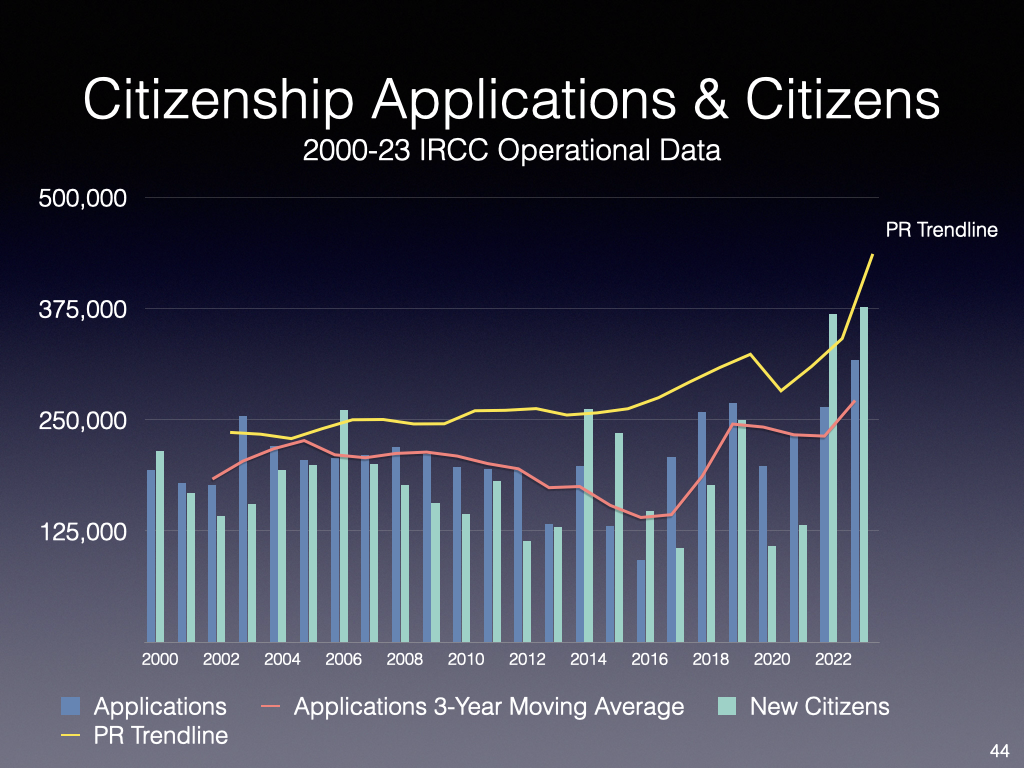
One last detail. This Statistics Canada study will force IRCC to address its current performance standard of 85 percent of all immigrants, no matter their period of immigration, become Canadian citizens, given that the rate in 2021 was only 81.7 percent. While the pandemic shutdown clearly had an impact, IRCC should revised its performance standard to refer only to recent immigrants, five to nine years after landing (90 percent of immigrants do so within that period), as it is the recent immigrant rate that is the meaningful benchmark, not those immigrants who arrived many years ago.

This article examines the trends in citizenship rates among recent immigrants who have been in Canada for five to nine years, based on census data from 1991 to 2021. The citizenship rate among recent immigrants has decreased significantly, dropping from 75.4% in 1996 to 45.7% in 2021, a decline of 29.7 percentage points. Almost half of this decline occurred from 2016 to 2021, with approximately 40% of the most recent decrease possibly related to COVID-19 pandemic restrictions. However, even after accounting for the pandemic effect, the citizenship rate declined at a faster rate from 2016 to 2021 than during any other five-year intercensal period since 1996. The decline in citizenship rates among recent immigrants from 1996 to 2021 was larger among those with lower levels of education, lower family income and lower official language skills. The decrease was also more substantial among recent immigrants from East Asia, Southeast Asia and West Asia than among their counterparts from the United States, Western Europe and Southern Europe. This article discusses possible explanations for these trends.

Source: The decline in the citizenship rate among recent immigrants to Canada: Update to 2021

Dave Snow: When political scientists get political

Believe not unique to political science and his conclusions based on extensive article analysis.

Some of my academic friends, in broad agreement with Snow’s depiction of the shift, point out however that most academics prefer to publish in higher profile international journals given greater weight in tenure and related decisions:

…. I draw three main conclusions. First, Canadian political science scholarship is clearly shifting in important ways. For better or worse, papers published in the Canadian Journal of Political Science reflect the discipline itself. While the discipline has not undergone a wholesale change (as seems to be the case in history), a sizeable proportion of Canada’s flagship political science journal is composed of papers using critical approaches and methodologies that place a greater emphasis on narratives of historical marginalization, particularly with respect to Indigenous Peoples and decolonization. 

Second, the journal’s openness to critical methodologies and identity diversity has been accompanied by a narrowing of its ideological diversity. While authors’ policy recommendations are by no means ideologically homogenous, they generally range from centre-left to far-left. This tilt is most obvious in papers that focus on decolonization, but it is present throughout the entire journal. Of 227 papers published over the last five years, I did not find a single one that provided anything approximating a conservative policy recommendation. By contrast, even the journal’s most empirically rigorous quantitative papers often contain recommendations such as “political parties should recruit and promote more women candidates” and “Policy tools specifically designed to problematize, target and alleviate racial economic inequality also seem needed.” Conservative scholars used to publish mildly conservative policy recommendations in the journal. Those days are now long gone.

Third, the journal editors’ statement is sadly reflective of similar statements made in Canadian higher education regarding equity, diversity, and inclusion, insofar as it refuses to acknowledge any previous progressive change. The Canadian Journal of Political Science had already clearly opened itself up to diverse perspectives and methodologies in recent years. Several papers in a 2017 special issue had already identified some of these changes. Yet this did not stop its new editors from claiming that the discipline was still engaged in “gatekeeping” on behalf of “white androcentric paradigms.” Thankfully, political scientists are well-equipped to use data to test the truth of such speculative arguments.

In spite of the challenges facing our universities, Canadians continue to profess high levels of trust in academics, including those in the social sciences and humanities. To retain such trust, we must demonstrate a commitment to the core purposes of the university: intellectual curiosity and the pursuit of truth. We do ourselves no favours when we abandon these goals in favour of political projects. 

Dave Snow is an Associate Professor in Political Science at the University of Guelph.

Source: Dave Snow: When political scientists get political

Maple Leafs Tavares Fight Over Tax Issue Raises Immigration Questions

Not a problem for most of us!

In the realm of professional sports, where contracts are inked with extravagance and fortunes are amassed overnight, taxation emerges as a critical factor influencing immigration patterns. A case in point is the ongoing legal saga involving Toronto Maple Leafs’ captain, John Tavares, and a $20 million signing bonus he received from the Maple Leafs in 2018.

The Heart Of The Issue

At the heart of the issue lies the structuring of Tavares’ compensation. The Canada Revenue Agency contends that his entire bonus should be categorized as salary, subjecting it to a higher tax rate, rather than being considered a lower-taxed inducement under the Canada-U.S. taxation treaty.

This legal battle spotlights a broader challenge facing Canadian professional sports teams. Over the years, they have grappled with attracting top-tier talent, especially when compared to their U.S. counterparts situated in jurisdictions with lower tax rates. This tax disparity puts Canadian teams at a disadvantage, hampering their ability to secure star players to bring them to Canada and compete on an equal footing.

Broad Implications For This Precedent

As the legal showdown unfolds, its implications extend beyond Tavares’ personal finances to the very core of Canadian competitiveness. The outcome of this case could establish a precedent for future contract negotiations in professional sports, influencing decisions on where elite athletes choose to pursue their careers and the financial viability of Canadian franchises.

Source: Maple Leafs Tavares Fight Over Tax Issue Raises Immigration Questions

Century Initiative Message

For the record as they try to respond to the dramatic shift in public opinion:

Vladimir Lenin famously characterized the slow-fast pace of human history by observing that, “there are decades where nothing happens; and there are weeks where decades happen.”

While hyperbolic, I couldn’t help but think of this pithy observation in the context of Canada’s quickly moving national conversation on immigration. Put simply, Canada has undergone one of the most significant debates about immigration in a generation, with a previously held consensus under fire from critics, journalists and politicians who are questioning the pace, volume and methodology of Canada’s immigration planning.

These questions do not come out of nowhere. Research from Century Initiative, conducted with Environics, shows that Canadians have not only become less satisfied with the direction and state of the economy, but a growing number of them believe that there is too much immigration in Canada. Having said that, this same research illustrates this waning support is not tied to nativism or xenophobia, but practical concerns about issues like housing, infrastructure, and health-care capacity. These concerns are valid.

The easy solution to any of these issues is to simply curtail population growth – but this is also the approach that would result in an aging, less-skilled work force, less foreign investment, less diversity and less influence on the global stage.

At Century Initiative, we have long argued not only for ambitious immigration targets, but for the long-term planning needed to achieve prosperity from coast to coast: immigration, infrastructure investments, economic management, support for children and families, and educational investments to name a few key pillars. The need for this planning is more pronounced than ever amidst this changing political and opinion environment. In these pivotal weeks, we haven’t been sitting on the sidelines.

Source: Century Initiative Message (email, not yet on their website)

Keller: The Trudeau government needs more than words to restore the immigration consensus

Keller continues his well founded critique of immigration policies and highlights, as others have done, the mismatch between immigration and housing (I would add healthcare and infrastructure) timelines and the need to downsize temporary migration and other measures:

… Ending the severe mismatch between housing demand and supply, in this decade rather than the next (or the one after that), means addressing the cause of the spike in demand. It means significantly downsizing the temporary foreign worker program, downsizing and smartening up the student visa program, and things like reintroducing visa requirements for Mexican tourists, which the Trudeau government removed in 2015, and which has led to tens of thousands of refugee claimants arriving at Canadian airports.

Canada had an immigration consensus from the 1960s to 2015. The Trudeau government broke it. Mr. Miller can restore it. But des belles paroles won’t be enough.

Source: The Trudeau government needs more than words to restore the immigration consensus

L’explosion de l’immigration temporaire crée «une impression de perte de contrôle»

Money quote: “Mais la multiplication des mesures a été faite sans prise en compte de l’impact cumulatif de ces mesures” (But the multiplication of measures was made without taking into account the cumulative impact of these measures):

L’appétit pour les immigrants dits « temporaires » plutôt que pour ceux dits « permanents » bouleverse le marché du travail au point où « ça donne aujourd’hui une impression de perte de contrôle », selon une étude de l’Institut du Québec (IDQ) parue lundi.

L’explosion du nombre d’immigrants temporaires sur le sol québécois n’est plus un secret. Il s’est accru de 46 % l’an dernier, pour un total de 528 034 personnes installées au Québec et de plus de 2,5 millions au Canada. Cette augmentation massive n’est pas le fruit du hasard, mais celui d’une multiplication des voies d’entrée autorisées par les gouvernements.

« Il y a un cumul de mesures pour faciliter la venue d’immigrants temporaires à l’intérieur de programmes bien connus. Mais la multiplication des mesures a été faite sans prise en compte de l’impact cumulatif de ces mesures », explique la coautrice de l’étude, Emna Braham, aussi directrice générale de l’IDQ. « Ça donne aujourd’hui une impression de perte de contrôle. Sauf que les leviers existent pour corriger le tir, autant à Québec qu’à Ottawa. »

Qualifiés ou non, formés ici ou non, bon nombre de ces immigrants temporaires espèrent un jour s’installer pour de bon au Québec. Et puisque devenir un résident permanent passe de plus en plus par le statut de temporaire, « on risque de se retrouver avec des goulots d’étranglement », prévient Emna Braham….

Source: L’explosion de l’immigration temporaire crée «une impression de perte de contrôle»

Cape Breton U tripled its international recruitment. Students say they pay the price.

A poster child for how education institutions have gone overboard in international student recruitment and numbers:

…Figures obtained through access to information legislation show that in 2018, Cape Breton University hired 53 agents to recruit international students. The next year, that number leapt to 142, and then in 2020 it hit 179. The school cut back to 102 recruitment agents in 2021, and then to 70 and 53 in the following years.

In 2018, the year Nguyen arrived from Vietnam, there were 1,982 full-time international students at the school, making up 48 per cent of the university’s population, figures from the Association of Atlantic Universities show. Now, there are nearly 7,000 international students at the school, three-quarters of the university’s population.

That’s more than a fifth of the entire population of Sydney, N.S., the coastal community where the university is located.

The university doubled its revenue in that time, from $69.1 million in 2018 to $139.5 million last year, according to financial statements available online. International students pay around $20,000 each year in tuition and fees at the school.

Nguyen said the community quickly became strained as more students arrived. Jobs became scarce and students crowded into rentals, many of which were in need of repair. CBC News reported that Rajesh Gollapudi, a business analytics student at the school, died in a fire in 2022 in a house he shared with seven other people. Court documents show the landlords have been charged with several fire safety infractions, and they are scheduled to enter a plea in March in provincial court.

Public buses between Cape Breton towns became packed with students, who had to live farther away and plan their days around sporadic rural bus schedules and long commutes, Nguyen said. Some live in their cars because they can’t find housing, or they live in Halifax and make the long drive to Cape Breton….

Source: Cape Breton U tripled its international recruitment. Students say they pay the price.

Groups fighting anti-Black racism file complaint against Canadian Human Rights Commission

No surprise:

A coalition of human rights groups advocating for Black and racialized Canadians has lodged a formal complaint against the Canadian Human Rights Commission (CHRC) for discriminating against its own employees.

The coalition also outlined a number of actions Monday it wants the federal government to take to combat what it calls “systemic discrimination within its structures.”

“We’re relying on the Canadian Human Rights Commission to play a role in the fight to dismantle systemic discrimination, not to be the perpetrator in all of this,” Nicholas Marcus Thompson, executive director of the Black Class Action Secretariat (BCAS), said in Ottawa Monday.

The coalition said it has asked the Global Alliance of National Human Rights Institutions (GANHRI) to review the CHRC’s accreditation with the group.

GANHRI is an umbrella organization that coordinates policy and action between the United Nations and domestic human rights organizations.

The coalition said it wants Canada’s human rights body reviewed by GANHRI for violating international human rights law and failing to adhere to the Paris Principles.

Adopted by the UN General Assembly in 1993, the Paris Principles are a set of principles national human rights organizations have to follow to access the United Nations Human Rights Council and other bodies.

The CHRC receives and investigates complaints from federal departments and agencies, Crown corporations and private sector organizations such as banks, airlines and telecommunication companies. It decides which cases will proceed to the Canadian Human Rights Tribunal.

Racism within the CHRC

Last spring, the Canadian government’s human resources arm, the Treasury Board of Canada Secretariat (TBCS), reported that the CHRC had discriminated against its own Black and racialized employees.

The TBCS came to that conclusion after nine employees filed a policy grievance through their unions alleging that “Black and racialized employees at the CHRC face systemic anti-Black racism, sexism and systemic discrimination.”

“The organizations remain hopeful that this action will lead to significant reforms within the CHRC, ensuring it can effectively safeguard human rights and foster an inclusive society,” the coalition said in a statement released Monday.

The coalition said it does not wish to see CHRC’s funding cut but wants it to fulfil its role of combating systemic racism.

“We would like to see appropriate funding, and the government not cut funding for the [CHRC] as any type of remedy to address any shortfalls,” Thompson said.

The coalition is calling on the federal government to amend the Canadian Human Rights Act to allow complaints to go directly to the Canadian Human Rights Tribunal, rather than through the CHRC.

The coalition also wants the CHRC’s role changed so that it acts to support people making complaints before the tribunal.

The group said it wants the Employment Equity Act amended “to better reflect intersectionality and to specifically include Black and other equity-deserving groups as designated groups.”

The coalition said it also wants the federal government to appoint a Black equity commissioner to serve as an officer of Parliament with powers akin to that of the Auditor General of Canada. The commissioner would be tasked with ensuring equity across “all levels of government and the public service,” the coalition said.

The coalition said it also wants public servants found to have committed acts of discrimination to be held accountable for their actions.

Criticism of the federal action plan

Last week, President of the Treasury Board Anita Anand announced the first steps of the Liberal government’s action plan to support Black public servants.

It includes boosting the number of Black counsellors providing mental health support to public servants and their family members to 60 across the public service.

Anand also announced the launch of an executive leadership program for Black executives to improve career development services for Black public servants.

The coalition criticized the move on mental health services, saying it would have preferred for the department to work with Black public servant groups to develop the initiatives.

“Black employee networks within the federal government [as well as unions] were not consulted on that … announcement about the employee assistance program,” Thompson said. “We’re very, very concerned about that. That approach has to change.”

The coalition includes the BCAS, the Canadian Black Nurses Alliance, the Public Service Alliance of Canada, the Red Coalition, the National Union of Public and General Employees, the Federation of Black Canadians and the Black Canadians Civil Society Coalition.

Later Monday, Anand conceded that her government has “a lot of work to do in terms of building trust with public servants from the Black community.” She said she did reach out to the community before her announcement last week.

“In advance of that announcement, I and my team engaged in consultations with a number of Black public servants,” she said. “Consulting with Black public servants is at the heart of what we are doing as we come forward with supports for Black public servants.”

Source: Groups fighting anti-Black racism file complaint against Canadian Human Rights Commission