ICYMI: Canada’s immigration loophole abused by an airline employee who allegedly admitted Indians with no visa

Ever wonder why there are secondary checks from CBSA officials or contractors?

A former British Airways employee has allegedly fled to India after being arrested for allegedly helping Indian citizens get around immigration laws so they could claim asylum in Canada.

As initially reported in The Times of London on Tuesday, the employee who worked at Heathrow airport in London, U.K., is said to have enabled people without proper documentation to get on flights to Canada so that they could claim asylum upon entering the country. He allegedly charged £25,000 per person or about $43,000. The alleged scam is estimated to have made 3 million pounds or over $5.1 million.

After taking the money from the Canada-bound asylum seekers, the 24-year-old former employee allegedly told them to fly from India to the U.K. on a temporary visa.

According to the Times of London, Canadian immigration officials raised concerns after noticing an influx of people flying to Toronto or Vancouver without proper documentation, and claiming asylum.

Normally, airline employees would check if passengers are eligible to fly to their destination, but, using his position at British Airways, the 24-year-old was allegedly able to falsely claim that his victims had the proper documentation for travel to Canada. The former employee’s process was allegedly to make sure that the prospective immigrants came to his check-in desk at the airport. Later, he would allegedly meet them again during the boarding process and falsely report they had the correct documents a second time.

The former British Airways employee was arrested on Jan. 6, but after making bail, he and his partner, who also worked for British Airways, allegedly fled to India, where he reportedly owns multiple properties and is still on the run from U.K. and Indian authorities. If he is captured, India and the U.K. have an extradition treaty.

British Airways, said in a statement to National Post that they “are assisting the authorities with their investigation.”

This is not the first time that Indian citizens have entered Canada on false pretences. Over the past half-decade, dozens of Indian students faced deportation after unknowingly using falsified acceptance letters to Canadian universities.

National Post reached out to Immigration, Refugees and Citizenship Canada for comment, but did not hear back before publication.
Source: Canada’s immigration loophole abused by an airline employee who allegedly admitted Indians with no visa

Quebec’s latest Bill 21 ruling fuels debate on notwithstanding clause

Next likely stop Supreme Court of Canada, which would oblige the government and political parties to take less equivocal public stand, and reinforce the political and public divisionss:

….For groups that challenged the law, the ruling was a disappointment.

“I think it’s important for everybody that we take note of the devastating impact the notwithstanding clause has when it’s used by a government to violate the rights of marginalized communities in a particular location,” said Noa Mendelsohn Aviv, the executive director of the Canadian Civil Liberties Association.

Mendelsohn Aviv said that while there were a number of reasons the clause was included by drafters of the Constitution — “it was never meant as anything other than a last resort. We don’t think it’s a legitimate use of the notwithstanding clause to use it to violate fundamental rights of minorities.”

But for supporters of the religious symbols ban, the decision was a victory for democracy.

“The Court of Appeal is explicitly saying that this is about democracy, that the notwithstanding clause is not something that violates rights, it’s not something that goes against democracy,” said Guillaume Rousseau, a lawyer for Mouvement laïque québécois, a group that intervened in the case to support the government. “It’s part of our democracy and it’s up to the elected officials to decide.”

Source: Quebec’s latest Bill 21 ruling fuels debate on notwithstanding clause

ICYMI: Federal minister calls ‘garbage’ on Ontario’s complaints it was blindsided by international student cap

Not diplomatic but he is a relatively direct speaking politician and largely correct on this and some of this other comments like “puppy mill” colleges:

Immigration Minister Marc Miller said his government gave provinces ample notice that international student numbers would be capped and any suggestion otherwise is “complete garbage.”

This after Ontario’s College and Universities Minister Jill Dunlop told the London Free Press Monday she was “very disappointed” with what she said was the federal government’s “unilateral decision, without any consultation” to limit international students.

“This was dropped on us,” Dunlop said.

Miller announced a cap on international student numbers earlier this year. Universities and colleges across the country have brought in increasing numbers of international students in recent years, rising to nearly 900,000 this year.

On Tuesday, Miller rejected any suggestion provinces weren’t fully informed.

“That’s complete garbage,” he said. “We said quite clearly they need to get their houses in order. We spoke specifically about Ontario that has the largest number of international students. They should have known it. They’ve had auditor general reports. We’ve spoken quite publicly about it.”

Miller said his government invited provincial counterparts to meetings that they did not attend.

“It’s beneath me to share text messages with journalists, but the reality is that there was communication that just was never followed up on,” he told reporters….

Source: Federal minister calls ‘garbage’ on Ontario’s complaints it was blindsided by international student cap

La capacité d’accueil, un concept qui rebondit à travers l’histoire

Good discussion and analysis of absorptive capacity. Le Devoir’s Champagne is one of the few Quebec journalists focussing on immigration with considerable understanding and nuance:

Il n’y a pas de consensus scientifique sur la capacité d’accueil, une expression qui résonne de plus en plus souvent à Québec. À travers l’histoire et les idéologies politiques, des concepts analogues ont souvent été utilisés pour poser des limites à l’immigration et exprimer des malaises, voire de l’hostilité, disent deux politologues et un historien.

« Le concept est remis au goût du jour, ça revient cycliquement dans les débats, mais c’est vrai que ce n’est pas nécessairement nouveau », dit d’emblée Mireille Paquet, politologue à l’Université Concordia.

La capacité d’accueil n’appartient pas qu’au domaine mathématique, elle oscille plutôt entre « des discours d’opinion et des dialogues qu’on voudrait baser sur les données », selon elle. Au-delà de l’obsession pour les chiffres ces dernières années, c’est aussi une manière de « projeter beaucoup d’insécurité par rapport à l’immigration, sans utiliser les mots ou les concepts moins acceptables dans le discours public ».

C’est avant tout une expression liée à l’émotion, selon l’historien Pierre Anctil. « Souvent, les perceptions, les notions abstraites sont cachées sous un vocable rationnel, mais au fond, il y a une émotion négative. » Avec les expressions autour de « l’accueil », « on cherche une manière de déclarer notre hostilité sans être hostile », souligne aussi ce professeur émérite de l’Université d’Ottawa. Il y a aujourd’hui un amalgame de cette capacité avec des mots lourdement chargés, comme « menace », mais cette fois, elle est tournée principalement vers la langue.

Historique

Durant la première décennie du XXe siècle, la plus importante vague migratoire se déploie au pays, et Montréal y participe vigoureusement. Il arrive alors plus de deux millions de personnes au Canada. Entre 1911 et 1931, la proportion d’immigrants dans la population est alors de 22 %, et il faudra près d’un siècle (en 2021) pour retrouver un pourcentage aussi élevé.

Les communautés non catholiques et non chrétiennes sont alors perçues comme « menaçantes », explique M. Anctil, et il n’est pas besoin d’aller très loin pour comprendre « cette hostilité générale à toute forme d’immigration ». Cette méfiance est particulièrement exprimée dans Le Devoir, et de façon parfois très virulente, comme sous la plume du directeur Georges Pelletier dès 1913. Les Juifs sont alors décrits comme « les déchets de l’Europe » qui « vont nous nuire et qu’on ne réussira jamais à assimiler », raconte l’historien. Même à l’aube de la Seconde Guerre mondiale et après, les élites et la population ne souhaitent pas recevoir les victimes du régime nazi.

Il n’y a alors aucun effort qui est fait pour la francisation ou pour intervenir auprès des populations immigrantes afin de les aider à trouver un emploi ou un logement, « parce qu’essentiellement, on jugeait que c’était impossible », note M. Anctil. Il faudra attendre la Révolution tranquille, la création d’un ministère provincial de l’Immigration et la loi 101 pour que le Québec tente de trouver des solutions. Une fois le « quotient religieux retiré », il devient possible de devenir Québécois sans devoir se convertir. La situation globale du français s’est aussi améliorée, soutient le professeur. On le voit lorsque l’on compare les statistiques d’aujourd’hui avec celles des années 1970 et 1980, dit-il.

De concept en concept : absorption, intégration, accueil

Mais pour arriver à l’expression « capacité d’accueil », il faut encore reculer dans le temps. Cette idée que la société, le territoire ou le gouvernement peut recevoir un volume donné de nouveaux arrivants a surgi dans les années 1930 sous l’expression « absorptive capacity ». Elle est principalement utilisée par Mackenzie King, premier ministre du Canada durant trois mandats entre 1921 et 1948, qui cherche à justifier des limites posées à l’immigration.

Mais le terme est alors « vague et indéfini » et prend en compte les naissances en plus de l’immigration, signale Catherine Xhardez, professeure de science politique à l’Université de Montréal. Il n’est alors pas question de tenter d’en faire la comptabilité.

À l’époque, l’expression est aussi tout près des discours sur la possibilité ou non « d’assimiler » culturellement de grandes populations (voir l’encadré). « Dans l’histoire, ce concept de capacité d’absorption se basait sur l’ethnicité, sur la capacité à absorber ces gens non anglo-saxons dans la culture, par exemple », expose quant à elle Mme Paquet, aussi directrice scientifique de l’Équipe de recherche sur l’immigration au Québec et ailleurs (ERIQA).

Ce n’est qu’en 1962 que le Canada élimine les critères raciaux explicites dans sa politique d’immigration. Celle-ci devient alors encore plus foncièrement économique, même si elle cherche déjà depuis la fin du XIXe siècle à pourvoir des emplois précis. Dans ces mêmes années apparaît aussi peu à peu le concept de « capacité d’intégration », surtout au travail, dans le discours. Le taux idéal dépend alors du pouvoir de l’économie à fournir des emplois aux immigrants aux salaires qui ont cours.

En 2010, c’est au tour du Vérificateur général du Québec de reprocher au ministère provincial de l’Immigration de ne pas utiliser « d’indicateurs socioéconomiques pour bien cerner la capacité réelle » d’accueil de la province. « Vous n’évaluez pas les programmes d’immigration et il n’y a pas de suivi », disait en gros le rapport, selon Catherine Xhardez.

« Évidemment, il y a tout un champ d’évaluation des politiques publiques », rappelle-t-elle à propos de sa discipline. Les immigrants ont-ils accès aux mêmes emplois que les natifs ? Ont-ils les mêmes perspectives ou la même qualité de vie ? « Il y a des programmes qui fonctionnent très bien et des résultats sur le terrain. […] Moi, je crois à l’évaluation », dit la professeure.

Mais le débat sur la capacité d’accueil « semble dire autre chose », à savoir qu’un calcul permettrait de faire une prédiction, et non pas d’évaluer des politiques passées. « Il y a des politiques qui fonctionnent bien, il faut le dire, il y a des résultats sur le terrain. Mais il faut aussi pouvoir évaluer des systèmes qui ne fonctionnent pas et dire : “Ici on a investi, mais ça ne donne pas de résultats” », expose-t-elle.

L’insistance sur la capacité d’accueil « vient surtout chercher notre rêve de se dire : l’immigration, c’est compliqué, mais peut-être que si on trouvait la bonne formule, la bonne équation, ce serait mieux », explique Mireille Paquet.

Dans la littérature scientifique, rien ne semble indiquer qu’un « seuil magique » existe ou non, notamment quant à la réaction de la population. « Les backlashs ou les retours de flamme, ce n’est pas un nombre absolu à partir duquel les gens sont fâchés », note Catherine Xhardez. C’est plutôt le rythme d’arrivée, les augmentations subites, et surtout leur médiatisation accrue.

Politisation plutôt que calcul

Les partis politiques jouent un grand rôle en influençant et en donnant les termes du débat, disent ces deux spécialistes. Ensemble, elles ont étudié les programmes des partis politiques entre 1991 et 2018. Elles ont conclu que la Coalition avenir Québec (CAQ) a été un « agent de politisation » de l’immigration dès 2012, lorsque le parti a introduit dans son programme l’idée de diminuer les niveaux d’immigration.

La réduction proposée est de 20 %, pour que ces seuils reflètent « notre capacité d’accueil et d’intégration », est-il inscrit dans son programme.

Dès 2018, la CAQ reproche aussi au gouvernement libéral d’avoir « ouvert la porte à une forte remontée des immigrants temporaires, sans planifier d’aucune façon leur accueil et les impacts sur la langue, le logement ou les infrastructures ». Ce sont d’ailleurs les mêmes critiques qui sont maintenant adressées au gouvernement, alors que les résidents non permanents ont atteint des records.

Ces mêmes critiques leur sont maintenant adressées puisque le sujet de l’immigration temporaire rattrape le gouvernement depuis au moins un an, le nombre de résidents non permanents ayant atteint des records.

Y a-t-il une manière de sortir de la politisation ? La plupart des experts consultés sont incertains quant à la possibilité de calculer la capacité d’accueil. Doit-on la calculer sur une année ? Sur 10 ans ? Jusqu’à quel point les indicateurs peuvent-ils devenir objectifs ? L’appel récent aux projets de recherche diffusé par le ministère de l’Immigration répondra peut-être à certaines de ces questions, mais pour l’instant, ni Mme Xhardez ni Mme Paquet ne connaissent de chercheurs qui se sont lancés.

Source: La capacité d’accueil, un concept qui rebondit à travers l’histoire

Keller: Economically speaking, we’re all living in Brian Mulroney’s Canada [immigration]

Fair observation. Harper conservatives also maintained levels during 2008 financial crisis. Unclear whether Poilievre will maintain current plan of 500,000 new Permanent Residents by 2015 or not, not to mention curbing the steep rise in temporary workers and international students:

…There’s one more legacy of the Mulroney era that never gets talked about: immigration.

Until the early 1960s, immigration to this country was largely restricted to Europeans and Americans. Then, under John Diefenbaker’s Progressive Conservatives, Canada for the first time opened itself to the world, adopting a race-neutral immigration policy.

A quarter-century later, Mr. Mulroney’s PCs made a second big change to immigration, by moving to permanently increase annual immigration levels, regardless of economic conditions. Until then, Canada’s quotas had fluctuated year-to-year. In the boom times of 1967, for example, a Liberal government admitted 223,000 new Canadians. But numbers were sharply reduced under Pierre Trudeau, reaching a low point of just 84,000 arrivals in 1985.

The Mulroney government decided to not only steeply raise the annual targets, but to keep them there. In 1993, Canada accepted just shy of 257,000 immigrants.

The Chrétien Liberals would scale back those numbers, but only slightly. For most of the Chrétien era, the number of immigrants remained north of 200,000 a year, and at around 0.7 per cent of the population. That continued through the Harper era.

The Mulroney decision, paired with the Diefenbaker decision, slowly changed this place. The Canada of a couple of generations ago often talked about itself as the product of two founding peoples, British and French. Such phrasing now sounds anachronistic, and it is. But in the early 1980s, the visible minority population was less than 5 per cent of the national population.

Today, that figure is closer to 30 per cent. The mayors of Toronto, Vancouver, Edmonton and Calgary are all visible minorities, three of them are immigrants – and nobody cares. That too is part of the Mulroney legacy.

source: Economically speaking, we’re all living in Brian Mulroney’s Canada

Rahim Mohamed: National Muslim group demands MPs denounce Israel or face wrath

We shall see the extent the relevant priority that this issue has in 2025 in relation to other issues, and what percentage of Muslim voters decline to vote or vote NDP (CPC harder pro-Israel line). Seen some analysis of the Michigan results that the absolute number of uncommitted not out of line with traditional numbers.

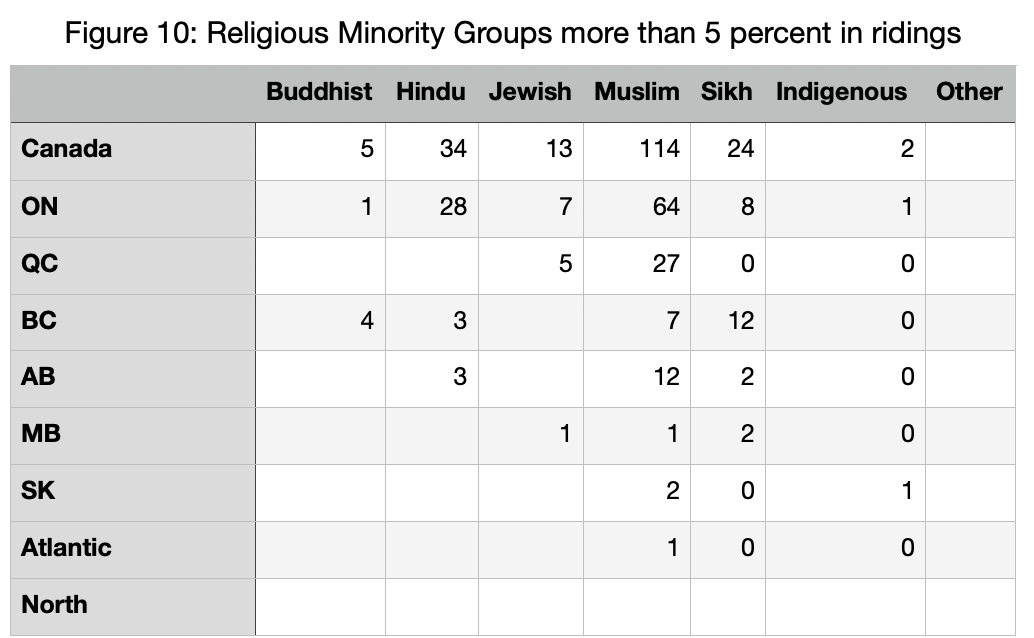
That being said, there are 114 ridings where Muslims form more than 5 percent of the electorate.

… Liberal party insiders were no doubt looking at the Michigan primary results with trepidation. The backlash among Muslim voters to the Stephen Harper government’s niqab ban for citizenship ceremonies and “barbaric cultural practices” hotline likely played a role in helping the Justin Trudeau-led Liberals secure a surprise majority in 2015. Since then, the party has made relations with the community a priority. Trudeau himself stages regular photo-ops at mosques, no doubt savouring every chance he gets to flex his sock game in a setting where shoes are prohibited.

But Trudeau, who appeared to be losing his touch with Muslim Canadians even before Oct. 7, now looks to be in freefall with the community. His multiple calls for a “sustainable ceasefire” in Gaza haven’t been enough to placate intransigent pro-Palestinian activists, who’ve even mobbed the prime minister in public settings. Trudeau has likewise found mosques to be less receptive to him than normal in recent months.

For now, Trudeau doesn’t appear to be too worried about the prospect of a Ramadan mosque ban. When asked on Thursday about the open letter, Trudeau said he’d visit any mosque that would extend him the invitation and gave no indication that he’d publicly commit to the terms enumerated in the statement. Yet Trudeau can’t be overjoyed about the prospect of having to keep his socks firmly in shoe during Islam’s holiest month, especially after seeing Biden’s humiliation in Michigan.

The results of Michigan’s just-held Democratic primary hint that the war in Gaza has triggered a rising tide among Muslim voters in the U.S. Whether electorally vulnerable members of Parliament cede to the demands of the NCCM and its affiliates or risk being shut out of mosques during a critical month for Muslim outreach could be an indication of just how strong the pull of this tide is in Canada.

Source: Rahim Mohamed: National Muslim group demands MPs denounce Israel or face wrath

Douglas Todd: Population growth squeezing Canada’s young adults like never before

More on the generation squeeze and immigration with good quotes from Wright and Skuterud:

… But that hasn’t stopped politicians and business people from constantly raising the spectre of aging baby boomers, with Ottawa making it the primary rationale for “supercharged levels of immigration,” Wright said.

“Sometimes I talk about the ‘baby boom derangement syndrome.’ So much of public policy has been driven by this apprehended catastrophe of the baby boom retiring and then putting great demands on the public purse,” he said. The trouble is it’s creating a population bubble of people under 40.

“We should not be at all surprised that all of a sudden housing markets are under great stress now. It’s absurd that politicians pretend to be surprised by it,” Wright said, pointing to a February report revealing then-Immigration Minister Sean Fraser had been warned that Canada was accepting newcomers at a far higher rate than houses could be built. Early last year Wright predicted this would affect public opinion about immigration, and that has been borne out.

“What Ottawa is doing is making it damn difficult for young people to get a proper start in life,” Wright said. “That’s primarily in the housing market, but in the labour market as well, because you’re competing with a lot of people your age.”

Ontario’s University of Waterloo labour economist, Mikal Skuterud, has been among those tracking how the federal Liberals have drastically hiked the number of guest workers and study-visa-holders, most of whom work while in Canada and intend to apply for permanent resident status.

Last year more than one million foreign students were in Canada, three times the number when Prime Minister Justin Trudeau was first elected. (B.C. had 176,000 in post-secondary schools). While wages in some sectors are up, gross domestic product per capita has been flat for six years. Skuterud suggested low-skill workers, whose wages are actually declining, could be the most impacted by the surge of new residents.

In regard to life choices, Wright also wonders how much the country’s housing crunch — including the prospect of “living in a 700-square-foot hamster cage” — might be a significant factor behind why some young Canadians aren’t having larger families.

Cardus, a think-tank, commissioned the Angus Reid Institute to conduct a poll last year of 2,700 women in Canada ages 18 to 44. It found nearly half have fewer children than they desire. Canadian women intend to have, on average, 1.85 children per woman, but desire 2.2 children.

Given such personal strains, especially for millennials and Gen Z, the National Bank’s economists have declared Canada is caught in a “population trap” in which the population is growing faster than can be absorbed by the economy, society and infrastructure.

With so many facing stagnant wages and housing distress, National Bank economists Stéfane Marion and Alexandra Ducharme said: “At this point we believe that our country’s annual total population growth should not exceed 300,000 to 500,000.”

Source: Douglas Todd: Population growth squeezing Canada’s young adults like never before

Pearce: How open source tech can make Canada’s immigration system fairer

Bit of an odd piece, as hard to see that it would if would necessarily make the system “fairer” and the extent to which the government could assess objectively open source tech, not to mention the risks of gaming the system. And some of his choices of headers and assertions suggest a limited knowledge of the demographics of immigrants and how the current system works (it’s complicated!):

Federal immigration minister Marc Miller recently announced the government is implementing a two-year cap on the number of international students admitted into Canada. 

This comes amid the government’s broader changes to the immigration system to streamline the types of people who can settle in Canada. Last year, Immigration, Refugees and Citizenship Canada introduced category-based draws for permanent residence applicants. The new requirements are designed to prioritize applications from health-care and STEM professionals, and other in-demand workers.

While Canada has plans to welcome 485,000 permanent residents this year, these recent policy shifts signal the government wants to restrict the type of people who can come here. 

However, does Canada’s immigration system unfairly exclude the people who could make meaningful contributions to our society and economy? 

Immigration policies favour the rich

Governments, businesses and universities might be tempted to roll out the red carpet for richer immigrants who bring their wealth to Canada and benefit the country by simply spending their money here. However, policy should be focused on attracting smart and innovative people, regardless of their net worth, as they are far more valuable in the long term. 

Research shows that skilled workers boost the productivity of their local peers. It is also well known that immigrants play an important role in creating value for firms and can also attract foreign companies to a country. 

Research from the United States indicated that more than 25 per cent of tech companies established between 1995 and 2005 had an immigrant as a key founder. Similarly in Canada, semi-skilled and high-skilled immigration have a positive effect on our economic growth.

Canada has a number of immigration streams. Perhaps the most straightforward is Canada’s investor visa, which allows foreign entrepreneurs to gain permanent residency and, eventually, citizenship. Immigration programs like Express Entry require applicants to demonstrate they have a minimum amount of money. Others like the skilled worker program favor those who have attained certain levels of higher education.

This means that current immigration policy can often favor the rich because it is easier to assess a person’s bank statements than it is to assess their talents or intelligence. 

Despite Canada’s points-based system that ranks potential immigrants, smart, capable people can easily fall through the cracks if they don’t meet financial, employment or formal educational requirements. These are people who lack the money and educational certificates to earn a lot of immigration points.

Yet some of them may have already created millions of dollars of value with their contributions to open source (OS) technology that you and I use every day.

Open source to the rescue

A new study by my colleague Jun-Yu Qian from Western University and I shows that there is another way to find the value of contributions of people wishing to come to Canada. Immigrants could be assessed based on their contributions to open source development.

Free and open source software (FOSS) refers to programs that can be used, studied, copied, modified and redistributed with few or no restrictions. The core idea of open source development is that if you make an improvement in software or hardware, you must share it back with the community. The result is often rapid churn in innovation in a wide array of areas.

Open source tech developed by people from all over the world has enormous impact on the economy. Today, open source software is in supercomputers, 90 per cent of cloud servers, 82 per cent of smartphones and most artificial intelligence. 

More than 90 per cent of Fortune 500 companies use the open-source software. To put it plainly, if you use the internet, you use open source technology every day. 

On the hardware side, there are now millions of free designs that consumers can download and 3D print or digitally manufactureto save money compared to conventionally manufactured products. 

In our paper, we calculated the value on an individual open source project based on how many times it was downloaded and multiplied that by what the substituted cost is on the open market. Similarly, we calculated the fraction of the total value an individual contributor made to a massive collaboration project, like Linux, Android, Arduino or RepRap.

We found that even modest contributions to open source technology can result in substantial value and high societal return on investments. These values could be used to determine the contribution an individual has made to open source tech development when assessing their ability to live in and support themselves in Canada.

Investing in immigrants

Studies have shown how immigrants are consistently providing positive return on investment for their adoptive countries. Simply put: immigrants bring more economic value than they cost. 

In the study, we found the median contributor to Open Office (a free office suite that can replace Microsoft’s offerings) made only a tiny contribution to the code (0.00716 per cent) but provided significant financial savings.

The mechanisms we introduced could serve as tools to utilize contributions by potential immigrants. Making this kind of change to immigration policy would go some way to benefiting smart people willing to work hard and make open source contributions, and the countries lucky enough to attract them.

With the help of the open source development, countries like Canada can widen the net and attract highly innovative people to come and live here, even if they don’t have the formal qualifications.

Source: How open source tech can make Canada’s immigration system fairer

Lanctôt | Une «belle victoire» pour la Loi sur la laïcité

A critical perspective:

Il s’agit, à n’en point douter, d’une grande victoire pour le gouvernement Legault dans le dossier de la Loi sur la laïcité de l’État. Jeudi, la Cour d’appel du Québec a confirmé la validité de la Loi, affirmant les conclusions de la Cour supérieure quant à l’application des dispositions de dérogation et en annulant l’exception qui avait été accordée par la Cour supérieure au système scolaire anglophone.

« La Cour vient confirmer le droit du Québec de prendre ses propres décisions, c’est vraiment une belle victoire pour la nation québécoise », déclarait le premier ministre, François Legault, en conférence de presse, quelques heures après la publication du jugement.

En 2021, le juge Marc-André Blanchard de la Cour supérieure du Québec avait déjà maintenu l’essentiel de la « loi 21 » en concluant à la validité de l’utilisation préventive de la disposition de dérogation aux droits fondamentaux garantis par les chartes canadienne et québécoise des droits et libertés.

Toutefois, le jugement formulait des commentaires inquiets quant à une utilisation aussi large de la disposition de dérogation. Le juge Blanchard notait que la loi 21 constituait le premier texte législatif dérogeant simultanément aux articles des deux chartes garantissant presque l’ensemble des droits et libertés dans la province. « Peu importe la perspective que l’on entretient face à la loi 21, notait-il, il faut souligner qu’il ne s’agit pas là d’une mince affaire. »

Sur le fond, il notait par ailleurs qu’il semblait « incontestable » que plusieurs dispositions de la loi violent non seulement les droits garantis par les chartes, mais aussi les droits découlant des instruments internationaux dont le Québec est signataire, notamment le Pacte international relatif aux droits civils et politiques, et le Pacte international relatif aux droits économiques, sociaux et culturels.

Là encore, dira-t-on, pas une mince affaire. Or, l’état du droit canadien, et c’est ce dont le gouvernement Legault et les défenseurs de la loi 21 se réjouissaient jeudi, le permet. Pour le dire vite, et reprenant l’analyse qu’ont fait tant la Cour supérieure que la Cour d’appel, en vertu de l’arrêt Ford de 1988, il suffit aux législatures des provinces d’inscrire les dérogations désirées dans la loi pour les soustraire au contrôle judiciaire.

Cet outil, quoique pertinent, est particulier au droit constitutionnel canadien : il tempère, d’une part, l’équilibre entre les provinces et le gouvernement fédéral. Il permet aussi de préserver l’autonomie de la législature face aux tribunaux.

Le Québec n’est pas la seule province à faire usage des dispositions de dérogation : le gouvernement de Doug Ford l’a fait en 2022, et plus récemment, la Saskatchewan aussi. Au Québec, en revanche, cet instrument, on le voit ces jours-ci, est chargé politiquement : déroger à cette vilaine Charte canadienne « qu’on n’a pas signée », ou encore à cette Charte québécoise qui, soi-disant, confère aux tribunaux un pouvoir démesuré, est devenu un marqueur politique clair, un appel du pied pour un certain électorat.

Ironiquement, la décision que le gouvernement Legault applaudit aujourd’hui témoigne que les tribunaux font preuve d’une grande déférence à l’égard de la législature. La décision de la Cour d’appel formule des remarques intéressantes à ce titre, en rappelant qu’il ne lui appartient pas de juger des motifs de suspendre les droits fondamentaux des citoyens ; et que le débat sur la portée des dispositions de dérogation a déjà eu lieu.

La Cour note ensuite qu’il revient aux citoyens, à la société civile, de décider si cette façon de faire du législateur lui convient. Votez en conséquence, dit-on en gros, cela n’est pas l’affaire des tribunaux.

Je crois qu’il s’agit en effet de la question fondamentale qu’il faut se poser en tant que citoyen.

Si les dispositions de dérogation agissent comme un contre-pouvoir face à Ottawa, face au contrôle judiciaire des lois en général, les droits fondamentaux, entre les mains des citoyens, constituent aussi un contre-pouvoir. On parle de préserver l’autonomie du législateur face aux tribunaux, mais qu’en est-il de protéger les citoyens face aux dérives législatives ?

L’équilibre est-il atteint ici, alors que l’on suspend la quasi-totalité des droits garantis par la Charte québécoise, pour une seule loi visant une affirmation nationale abstraite plus qu’elle ne répond à un enjeu réel ?

Dans ce dossier, on parle souvent de la nécessité de tempérer les droits individuels au profit des droits collectifs. Sauf que les droits collectifs sont toujours conditionnés par la possibilité d’exercer les droits individuels. Ces droits collectifs ne s’exercent pas dans l’abstrait, ils sont la somme des droits et des conditions d’existence que l’on garantit aux citoyens. Cela étant dit, est-on à l’aise avec l’érosion manifeste des droits des minorités religieuses provoquée ici ?

La réponse, on le comprend, est oui — en témoigne l’appui, auprès d’une certaine génération du moins, à la loi 21.

Je pense au contraire que nous nous tirons dans le pied et que nous fragilisons le tissu social en nous comportant de manière aussi ouvertement méprisante à l’égard des droits des minorités — pas juste religieuse, d’ailleurs. Construire, affirmer une identité collective « contre » quelque chose n’a jamais mené à de belles choses.

Le feuilleton de la « laïcité » (insistons sur les guillemets) a déjà laissé des cicatrices profondes dans la société québécoise, parce que ce « débat » a été mené sans égard à son effet stigmatisant sur l’ensemble des minorités. On prétend que l’affirmation du « nous » de la majorité y a gagné au change, alors au diable les dégâts collatéraux. Il me semble au contraire que les divisions n’ont jamais été aussi profondes, de toutes parts.

Aurélie Lanctôt, Chroniqueuse spécialisée dans les enjeux de justice environnementale, l’autrice est doctorante en droit à l’Université McGill.

Source: Chronique | Une «belle victoire» pour la Loi sur la laïcité

‘We Fear For Our Lives’: Foreign spies threaten Australia’s multicultural communities

The federal government has set up a counter-foreign interference taskforce, which together with ASIO and the Australian Federal Police, aims to disrupt any suspicious activity — but also inform the community about how to report it.
In his annual threat assessment, ASIO director-general Mike Burgess said more Australians are being targeted for espionage and foreign interference than ever before, revealing details of a foreign interference operation which involved a former politician.
“We have a responsibility to call it out. Australians need to know that the threat is real. The threat is now. And the threat is deeper and broader than you might think.”
In a statement to SBS, a spokesperson for the Department of Home Affairs said: “culturally and linguistically diverse (CALD) communities face unique threats and issues arising from foreign interference”, with “some foreign powers or their proxies seeking to silence, intimidate, monitor or harass members of CALD communities that they see as dissidents”.
In February 2023, Home Affairs Minister Clare O’Neil singled out Iran as an offending government when it came to foreign interference, revealing ASIO had disrupted an operation on Australian soil targeting an Australian-Iranian critic of the regime.
No, foreign interference from Iran here is not relevant. By no means, under no circumstances.

Ahmad Sadeghi, Iran’s ambassador to Australia

In an exclusive interview with SBS Persian, the Iranian ambassador to Australia, Ahmad Sadeghi, denied foreign interference is being carried out in Australia from the Iranian government.
“No, foreign interference from Iran here is not relevant. By no means, under no circumstances,” he said.
Opposition assistant foreign affairs spokesperson Claire Chandler urged the Iranian ambassador to read the results of the Senate inquiry into human rights implications of recent violence in Iran.
“I would urge them to read the submissions from the Iranian diaspora that were provided to that committee,” Chandler said.
“All I’m hearing … is that Iranians within Australia are very concerned about the monitoring, the surveillance, the harassment, and the intimidation that they are having to deal with at the hands of this regime.
“The [Australian] government needs to be clear-eyed and transparent about its interactions with embassy officials here in Australia, the government needs to list the IRGC as a terrorist organisation, we also believe the government should be utilising the full suite of sanctions it has available to it.”
In response to a question from SBS about the government’s reluctance to list the IRGC as a terrorist organisation, Prime Minister Anthony Albanese said: “We have vigilant processes, through the listing of organisations. We go through those processes appropriately, including through the national security, based upon advice.”

Threats of kidnapping: operatives targeting Iranian-Australians

Sydney-based activist Mohammad Hashemi’s cousin Majid Kazemi was executed in Iran last year, after being arrested during a Woman, Life, Freedom protest.
Before he was killed, Kazemi’s family says Iranian authorities interrogated Kazemi about his relatives’ activities in Australia.
“We know they have their spies here and we know they are watching us and monitoring us,” Hashemi told SBS News.
“They have people in many countries, they are trying to control our people, scare people … they don’t have any border for that, they will do anything.”
Mohammad Hashemi started a campaign to save his cousin, Majid Kazemi, from execution in Iran last year. Source: SBS News / /

On 29 January, The United States and the United Kingdom slapped sanctions on a network that targeted Iranian opposition activists. The US Treasury said this network was related to Iran’s Ministry of Intelligence and Security.

Hashemi’s campaign in Australia, an attempt to save his cousin, has instead landed him and his family, who are in Iran, a separate sentence of surveillance.
“They told my father, ‘We know everything about Mohammad, what he is doing in Australia, where he lives, what his job is,'” he said.
“[They said] ‘If he won’t stop, [we] have a mission to go to Australia and kidnap him and take him back to Iran.'”

Source: ‘We Fear For Our Lives’: Foreign spies threaten Australia’s multicultural communities