Thousands of temporary residents are being squeezed out by Canada’s shifting immigration reality. Here’s what the country could lose

The human impact of the needed policy reversals and shame on those policy makers, federal and provincial, along with institutions that did not think ahead:

They’ve spent months and years living, studying and working toward the Canadian dream, once touted as the “economic engine” for this country’s post-COVID-19 recovery and future growth.

But after all their toil to build a new life here, their journeys have stalled. 

An IT specialist, a special-needs teacher, an engineer with two master’s degrees: They’re among hundreds of thousands of temporary residents who have been left in limbo by Canada’s immigration pivot.

After cranking out study and work permits to welcome the world to Canada after the pandemic, the government has reversed course, vowing to “take back control of the immigration system.”

Not only has Ottawa let in significantly fewer international students and foreign workers since 2024, it has also pulled the rug out from under hundreds of thousands of temporary residents already in Canada.

“Our plan is working,” Immigration Minister Lena Metlege Diab told a parliamentary committee recently. “It is to ensure that we have a sustainable immigration system for the future.”

Prime Minister Mark Carney’s government is trying to speed up transitioning 33,000 temporary workers to permanent residents while overhauling Canada’s signature “point system” for economic immigrants.

It’s a drop in the bucket: Nearly 1,940,000 study, work and visitor permits are slated to expire by the end of 2026 — with another 1,039,840 in 2027. And the annual number of permanent resident spots has been slashed from half a million to just 380,000.

So many temporary residents are living in uncertain and frustrating situations, even when they have Canadian work experience or education and have made huge investments to come here and boost their odds of staying. Processing delays, point systems that leave them at a disadvantage and bureaucratic obstacles are leading some to look elsewhere….
Source: Thousands of temporary residents are being squeezed out by Canada’s shifting immigration reality. Here’s what the country could lose

Globe editorial: Looking beneath the myths of Alberta separatism [citizenship]

Yes, the citizenship and passport issue, and the assumption that dual citizenship would be automatic, becomes less likely in the case of separation:

…The Canadian passport is ranked as one of the most desirable in the world, allowing unfettered access to more than 180 countries. It’s understandable that Albertans voting for independence might want to keep such a valuable document. And under a recent Canadian law granting citizenship to descendants – even great-grandchildren – of Canadians, they would appear to be able to do so.

However, that presupposes the law is not changed. There’s no reason to believe it won’t be.

For starters, political entities rarely split up amicably. Alberta leaving Canada is more likely to be a rancourous process that produces unhappy people on both sides. The idea that the federal government would then allow millions of people from what is – let’s remember – another country retain their privileges as Canadians is nonsensical. 

Several 20th-century examples are worth noting here. 

When East Bengal split from Pakistan in 1971, Islamabad passed a law to strip residents of the newly independent state of their Pakistani citizenship. And when Panama seceded from Colombia in 1903, residents of the new country became dual citizens only if they had specific ties to the old country. Most became, simply, Panamanians.

Separatists claim that, under current law, it would be possible for seceding Albertans to remain Canadians as well. Perhaps.

But the law would inevitably be changed, as history demonstrates….

Source: Looking beneath the myths of Alberta separatism

Jamie Sarkonak: Progressive judge spares violent loan shark criminal record to avoid deportation

Part of her ongoing series:

…Mandhane treated a case of loan-shark violence by a foreigner against a petite, young woman in a dark street as if it were a toy-sharing dispute between children at a daycare. Every day, courts see a good number of low-stakes, wrong-place-at-wrong-time cases where a conditional discharge is appropriate; this was absolutely not one of them.

The suitable result would have been jail, or at least house arrest or probation. That’s what you see when crime is committed in the course of debt collection: for example, a man in Newfoundland was sentenced to one year in jail in 2022 for participating in a group break-in during which “PAY THE DEBT” was written on the victim’s walls (among other acts of vandalism) and during which he stole some cannabis from the house; the organized crime factor worsened his case, but he was a young, first-time offender like E.A., and he didn’t physically attack anyone. He was a citizen though, and he was evidently not before a soft judge, resulting in a much more appropriate sentence.

“But what stings most about E.A.’s case is the Crown prosecutor’s failure to pursue a proper punishment. No one at court that day stood up for the public interest — not even the guy whose job was specifically that.

This can change, but it’s going to take Ontario’s attorney general toughening up his prosecutions, Parliament prohibiting immigration status from being considered in sentencing, and people making sure that judges know when their decisions bring the administration of justice into disrepute. If we tolerate authorities who do everything they can to keep violent non-citizen rulebreakers in Canada, it’s going to keep happening.

Source: Jamie Sarkonak: Progressive judge spares violent loan shark criminal record to avoid deportation

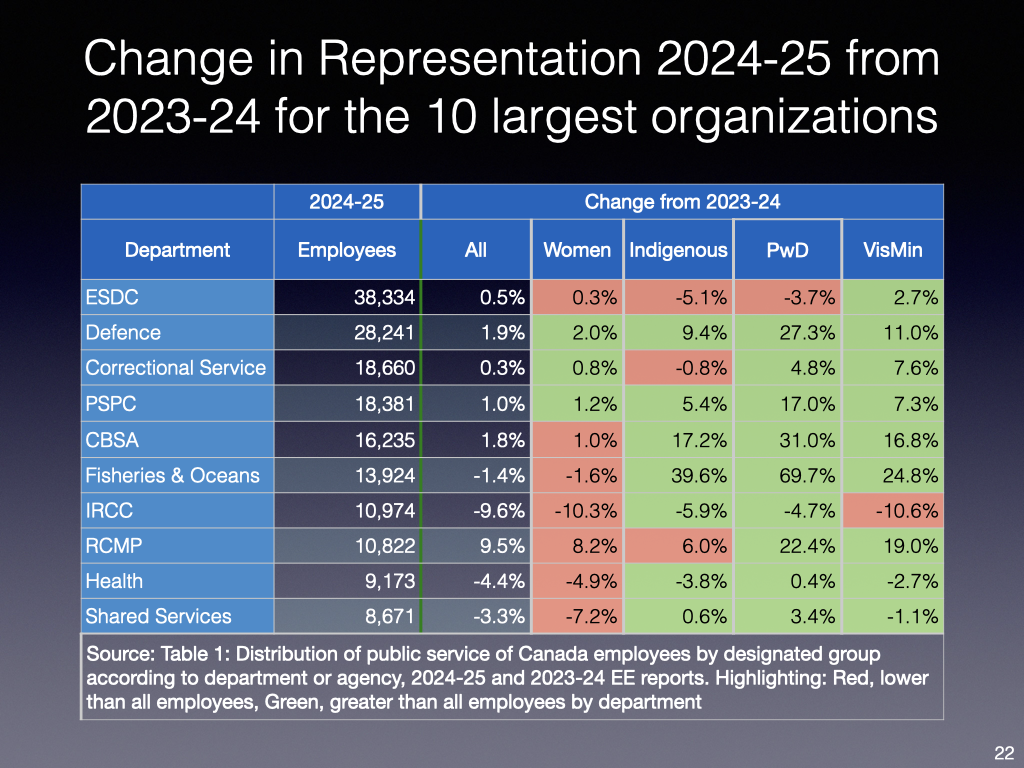
Dissecting 2024-25 data on the public service, early cuts, and equity goals (paywall)

My latest analysis. Short version in the Hill Times.

Source: Dissecting 2024-25 data on the public service, early cuts, and equity goals

Full detailed version below:

HEC: The Selection of Recent High-Skilled Immigrants to Canada

Noteworthy study. Interesting that the government has adopted the recommendation to “reweighting current selection criteria to predict earnings” while at the same time implementing sectoral draws that are lower ranked with lower earnings in some cases:

We study economic integration, intentions, and selection using a new survey of recent high-skilled immigrants to Canada (arrivals 2015–2025), linked to native-conditional earning percentile ranks. We document five main results. First, high-skilled immigrants experience large earnings gains from migration, with average earnings roughly doubling within one year of arrival. Second, entry status strongly predicts early outcomes: immigrants on closed work permits outperform direct permanent residents, while students and open-permit entrants start lower, with students catching up faster. Third, nonpermanent residents do not, on average, integrate faster than permanent residents relative to natives, except for former students. Fourth, intentions to stay are more closely related to earnings growth than to income levels. Fifth, reweighting current selection criteria to predict earnings improves expected outcomes and shifts selection toward high-performing non-permanent residents, particularly those on closed permits.

Source: HEC: The Selection of Recent High-Skilled Immigrants to Canada

Why this Toronto man is being flooded with requests from Americans about their Canadian ancestors

More on the demand to prove citizenship links under C-3:

…Unlike record seekers before the new citizenship rule, Pugh said the people who reach out these days don’t usually have much information on their Canadian ancestors to guide the search. It creates more work for archivists.

“Because they don’t know where their baptism or that marriage took place, sometimes they don’t even know the city, they might just say, ‘I have a relative who was baptized in Ontario in 1850. Can you find it?’” he noted.

“It takes so much longer to prove a negative because we keep saying well, it could just be in this next register and so we have to look. So it’s much more time intensive than somebody who knows exactly which register it’s in.”

Also, records could be lost after being passed around multiple congregations as local churches amalgamated and separated over time, Pugh said. Variations of spelling, such as when a silent letter was missed or a name ended with an “ie” instead of a “y,” can all make the search that much more difficult, he added.

Where to start your genealogy search for citizenship

So far, Pugh estimated that his office has a 20 per cent success rate in searches based on the number of people that have come forward and the number of certified documents issued.

Due to the volume and complexity of requests, the United Church of Canada Archives has started to charge a $25 research fee and raised the fee for the certification of a pre-1900 certificate to $50 from $30 in order to hire a student archivist….

Source: Why this Toronto man is being flooded with requests from Americans about their Canadian ancestors

Griffiths: Canada’s AI debate has a mile-wide blind spot. It’s our immigration policy

Good commentary and flagging a real issue that will become more important as AI develops. Just as our trade strategy has been slow to address IP and AI implications, so has immigration:

…But the labour market we are barreling toward is anything but normal.

If the AI thesis is even half-right, the bottleneck for Canadians over the next five years will not be a shortage of workers. It will be a shortage of jobs that AI cannot do—almost all of them physical, hands-on, or relational. Trades. Eldercare. Construction. Skilled installation. Personal services. The very segments where displaced white-collar Canadians, suddenly competing for “hands-on” work, will exert powerful downward pressure on wages. Adding hundreds of thousands of newcomers per year who will struggle to compete in either the contracting knowledge economy or in a skills economy experiencing a surfeit of labour, multiplies the AI disruption rather than relieving it.

The radical idea—and it is radical only because no one in Ottawa is willing to say it out loud—is that an AI-dominated economy may make Canada’s high-immigration model not just unnecessary but actively harmful to the workers we already have. The composition of intake, in such a world, would also need to flip towards ultra specialists, veritable immigrant unicorns, and away from generalist knowledge worker credentials in fields AI can now do at a hundredth of the cost.

Make no mistake: this argument is not nativism dressed in economic clothing. It is the opposite. It is the argument that immigration policy, like every other major lever of state, must respond to the actual economy in front of it—and the economy in front of us is being rewritten in real time by machines that, on a benchmark designed by the companies building them, now do the work of 44 professions about as well as the people who trained for 14 years to do it.

Canada’s policy elites have so far met this once-in-a-century technological inflection with something between a “let it rip” shrug and a quiet hope that the transition to an AI-dominated economy will be slow enough to manage the wrenching structural adjustment. It will not be. The AI dislocation looks set to be wider, deeper, and faster than the prepared playbook anticipates, and immigration policy will be the first of many non-labour files to get caught up in it.

Far better to have the difficult conversation now than after the displacement has begun in earnest. Time, as it has a habit of doing in moments like this, is fast running out.

Source: Canada’s AI debate has a mile-wide blind spot. It’s our immigration policy

The CAF recruitment system is failing everyone: J.L. Granatstein for Inside Policy

Not the principle but the details need to be fixed:

…Very simply, the problems with the CAF’s recruiting system have not yet been remedied. Yes, permanent residents and naturalized citizens should be encouraged to join the military, but not until they can speak, read, and understand French and/or English and are adapted to Canadian life and the military’s expectations. Yes, those with medical problems should be enlisted, but only if they have been properly screened in the recruitment process. And certainly, the CAF should not accept candidates who cannot read, write, or comprehend instruction at an acceptable standard.

To judge by his long memorandum with its substantiated recommendations, Kieley is a very able officer doing his best to deal with the difficulties he and his understrength staff face. The generals in Ottawa had changed the rules to speed up recruiting with good intentions but had failed to consider the possible consequences. The recruiting officers across the country too often pushed the unqualified to Saint-Jean, and Kieley had to clean up the mess. It’s almost as if NHL scouts sent those who cannot skate to training camp. This cannot work.

This matters because such applicants at the CAF’s Leadership and Training School cost DND money and take spots from better-qualified candidates. It also matters because General Carignan is studying options to expand the CAF to as many as 85,500 regular force members. “In the next month or so,” the CDS told the CBC in April, “we will be able to present various options, and the discussion is going very well,” Carignan said. “There is a lot of interest in doing this.”

Canada needs a bigger and better Canadian Armed Forces, and the Carney government is putting much money (and much of its credibility) into getting this program right. But if the recruitment process does not speed up and function properly, that investment will achieve little. The generals at National Defence Headquarters and officers in recruiting centres across Canada must fix these problems now.

Source: The CAF recruitment system is failing everyone: J.L. Granatstein for Inside Policy

Isak | The day my children and I became Canadian, our long journey finally felt complete

Although I still believe that in-person ceremonies are more meaningful, even the virtual moves new Canadians:

…Becoming a Canadian citizen was one of the most emotional moments of my life. The ceremony was online, not in a courthouse, but it still felt powerful. We dressed respectfully for the day and sat together as a family in front of the computer. Around us on the screen were people from different countries, each with their own story, each waiting to take the same oath. As I listened to the ceremony, my emotions overwhelmed me. I thought about the years of uncertainty, the waiting, the fear, and the sacrifices. I felt proud, relieved, and grateful.  Citizenship may feel like paperwork or ceremony for some people. For us, it meant much more. It meant safety. It meant dignity. It meant belonging.

As someone who came from Somalia and lived through insecurity, I know the value of peace in a way that is hard to explain to those who have never feared losing it. I grew up around conflict, armed groups, displacement, and fear. I know what it meant when schools closed because of fighting, when people can’t plan their future because the next day is uncertain. I also worked as a journalist and later in security and political analysis during a time when violence and instability were part of daily life. I know what it means to leave behind home in search of a better life. That is why becoming Canadian was not just a legal milestone. It was a deeply human one….

Source: Opinion | The day my children and I became Canadian, our long journey finally felt complete

Century Initiative: Strategic Immigration Levels Planning for Canada’s Short and Long-Term Future

Summary of lessons and recomendations from the Century Initiative consultations on immigration planning. I was part of those consulted. Further reflection of CI’s efforts to distance itself from its earlier overly simplistic approach to immigration. My quick comments in italics.

As for the IRPA recommended changes, unclear whether the government is planning to make any amendments to IRPA given other priorities although the CIMM immigration study may suggest otherwise:

Key Lessons for Immigration Levels Planning

  1. Misinformation and disinformation pose growing risks to the integrity of immigration levels planning. True, but arguably also applied to a number of pro-immigration advocates.
  2. Significant investments are needed in Canada’s data ecosystem to provide the evidence needed for effective immigration levels planning. While IRCC and StatsCan generate a wealth of data, there still remain significant gaps, particularly with respect to integrating different data sets.
  3. Immigration levels planning requires deeper analysis at the local and regional level. Challenge is balancing local and regional with national levels, recognizing mobility rights mean that immigrants may relocate to pursue opportunities.
  4. Immigration levels planning requires longer time horizons to avoid sudden system shocks. In principle yes, but the famous line, “in the long run, you’re dead.”
  5. Immigration levels planning must combine quantitative and qualitative analysis to determine what types of immigrants are needed to meet Canada’s economic, demographic, and social objectives and how to improve outcomes for recent arrivals. Challenge is in the doing.
  6. Immigration levels planning must reflect Canada’s short and long-term absorptive capacity and social and economic objectives, rather than responding reactively to changing national and global dynamics. Good reference to absorptive capacity but there will always be political pressures to be reactive.

Recommendations

  1. Amend s. 94(2)(b) of IRPA to require the Minister of Immigration, Refugees and Citizenship to include the total number of annual arrivals in the immigration levels plan (permanent and temporary). Long overdue.
  2. Amend s. 3 of IRPA to explicitly recognize permanent residence and citizenship pathways as core objectives of Canada’s immigration system and require that immigration levels planning account for expected transitions from temporary to permanent status. Also overdue. Always struck me as odd no reference to citizenship in the plan.
  3. Amend s. 94(2) of IRPA to require the Government of Canada to consider Canada’s absorptive capacity in the immigration levels planning process. Also overdue.
  4. Amend IRPA to introduce accountability and reporting mechanisms to the immigration levels planning process. Would be nice! Particularly with respect to outcomes, not just outputs.
  5. Develop a core set of indicators to inform immigration levels planning across short-, medium-, and long-term horizons, and provide transparent public information on how these indicators are used in future immigration levels plans. To a certain extent, the core CRS human capital criteria provides the basis for the indicators and the CRS and any indicators should be coherent and mutually reinforcing.
  6. Strengthen collaboration with other orders of government by more transparently reflecting regional priorities and realities within the national immigration levels planning process. Arguably, regular fed-prov consultation provide for this.
  7. Establish a formal long-term immigration planning framework that defines Canada’s demographic, economic, and nation-building objectives and explicitly guides future immigration levels plans. Again, in the long run we’re dead.
  8. Clarify and harmonize the Government of Canada’s language regarding immigration levels and targets. Always an area for improvement.
  9. Strengthen research and data infrastructure on two-step migration to better inform immigration levels planning. Agree.
  10. Increase the time horizon of immigration levels plans beyond 3 years, recognizing that longer-term projections are a forecast and subject to adjustment over time. In theory, yes, in practice not sure how meaningful given electoral cycles and events.
  11. Make strategic investments in the data ecosystem on immigration-related issues to better inform policy and planning. Always in favour of better data and analysis.
  12. Increase the depth, rather than breadth, of the Government of Canada’s immigration levels planning consultation process. Makes sense.

Source: Strategic Immigration Levels Planning for Canada’s Short and Long-Term Future