ICYMI: Myanmar Begins Controversial Citizenship Verification Process

Disturbing. Linking citizenship to ethnicity and religion in Myanmar:

Many Rohingyas are skeptical that a government that already classifies them as Bengalis will grant them citizenship based on the testimonies of village elders.

Washington has, in the past, pressured the Myanmar government on the 1982 Citizenship Law. And in its 2014 report on religious freedom, called on authorities to promote the rights of Rohingya Muslims and provide “durable solutions” for refugees outside the country.

Matthew Smith, director of the international human rights group Fortify Rights, says giving Rohingya equal access to citizenship rights is crucial to preventing the conflict in the future. He says foreign nations should press the government more on the issue.

“The fact that the immigration department is handling this issue is indicative of the perception that all Rohingya come from Bangladesh,” Smith said. “Immigration is an issue on all of Myanmar’s borders, but the wholesale denial of Rohingya citizenship, Rohingya ethnicity, has contributed to these abuses that we’ve been documenting now for two years.”

Have not seen much Canadian government representation on the citizenship issue although Andrew Bennett, the Ambassador for Religious Freedom, routinely mentions Rohingyas in his speeches.

Casts a blemish on Aung San Suu Kyi and Myanmar’s democratization.

Myanmar Begins Controversial Citizenship Verification Process.

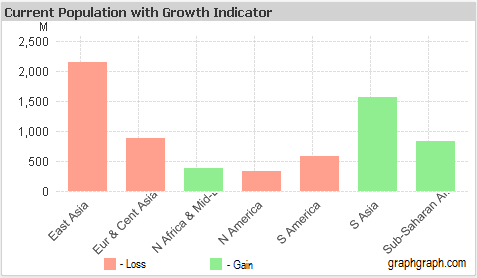
Pie Charts Are Terrible | Graph Graph

PieCharts_WorldBarColor


I am doing more and more charting to illustrate citizenship and multiculturalism issues and in consulting with those who have a better graphic sense than I, came across this convincing article and illustration against the use of pie charts.

Means I have to redo a number of what I have been working on but always good to learn something new that helps tell the story (I haven’t read his recommended book yet):

Let’s start this off with some honesty.  I used to love pie charts.  I thought they were great, just like the way I used to think Comic Sans was the best font ever.

But then I had some #RealTalk, and I’ve been enlightened in the error of my ways, and I want to pass on what I’ve learned to show people why pie charts aren’t the best choice for visualization.  For my day job, part of my work involves creating visualizations out of business data for our customers.  I picked up a copy of “Information Dashboard Design” a book by Stephen Few of Perceptual Edge.  If you’re at all interested in data visualization, I highly recommend his books, and on this site we attempt to use a lot of the principles in creating the visualizations we present to you.

Pie Charts Are Terrible | Graph Graph.

Convert, pay tax, or die, Islamic State warns Christians

Depressing – and another legacy of the Gulf War of 2003:

In the statement, Isis said Christians who wanted to remain in the “caliphate” declared earlier this month in parts of Iraq and Syria must agree to abide by terms of a “dhimma” contract – a historic practice under which non-Muslims were protected in Muslim lands in return for a special levy known as “jizya”. “We offer them three choices: Islam; the dhimma contract – involving payment of jizya; if they refuse this they will have nothing but the sword,” the announcement said.

….Mosul, once home to diverse faiths, had a Christian population of around 100,000 a decade ago, but waves of attacks on Christians since the 2003 US-led invasion to topple Saddam Hussein have seen those numbers collapse.

The Mosul residents who saw the Islamic State announcement estimated the city’s Christian population before last months militant takeover at around 5,000. The vast bulk of those have since fled, leaving perhaps only 200 in the city.

Convert, pay tax, or die, Islamic State warns Christians | World news | theguardian.com.

‘Hawking index’ charts which bestsellers are the ones people never read

Fun example of innovative analysis (and for all those of you who claim to read Piketty or other similar tomes):

Jordan Ellenberg, a mathematician at the University of Wisconsin, Madison, has just about proved this suspicion correct.

In a cheeky analysis of data from Kindle e-readers, Mr. Piketty’s daunting 700-page doorstopper emerged as the least read book of the summer, according to Prof. Ellenberg, who calls his ranking the Hawking Index in honour of Mr. Hawking’s tome, famous as the most unread book of all time.

As a result, he is tempted to rename it the “Piketty Index,” because Mr. Piketty scored even worse than Mr. Hawking.

As such, both stand as extreme case studies in aspirational reading. Like the Economist magazine’s Big Mac index of hamburger prices around the world, which is both silly and serious, Prof. Ellenberg’s Hawking Index is funny, in that it reveals the vanity of many book choices. But it also offers an interesting psychological perspective on reading that is born of good intentions, and dies of boredom on the dock or beach.

The calculation is simple, and as Prof. Ellenberg says, “quick and dirty.” It exploits a feature of Kindle that allows readers to highlight favourite quotes. It averages the page number of the five most highlighted passages in Kindle versions, and ranks that as a percentage of the total page count. Although it does not measure how far people read into a book, it makes a decent proxy for it.

“Why do you buy a book? One reason is because you know you’re going to like it,” Prof. Ellenberg said. “Another reason might be, ‘Oh, I think this book will be good for me to read.’”

….. He said his formula illustrates what mathematicians call the problem of inference, meaning he cannot say for sure these books are going unread, just that he has strong evidence for it.

“You can make some observation about the world, but there’s some underlying fact about the world that you’d like to know, and you want to kind of reverse engineer. You want to go backwards from what you observed to what you think is producing the data you see,” he said.

Other books reveal different insights into why people buy books they start but do not finish. Michael Ignatieff’s political memoir Fire And Ashes, for example, scores comparatively well for non-fiction at 44%, far better than Hillary Clinton’s Hard Choices, which barely cracked 2%. Lean In, the self-help book by Facebook executive Sheryl Sandberg, scored 12.3%.

In fiction, The Luminaries, by Canadian-born New Zealand author Eleanor Catton, which won last year’s Man Booker Prize, scores a mere 19%, and would score a lot lower if not for one highlighted quote near the end.

Prime Minister Stephen Harper’s book on hockey, A Great Game, curiously has no highlighted passages, so cannot be ranked on the Hawking Index (or, equivalently, ranks as low as is theoretically possible).

Fiction tended to score higher, likely reflecting the tendency for non-fiction authors to put quotable thesis statements in the introduction. The only novel that was down in the range of the non-fiction books was Infinite Jest by David Foster Wallace.

Prof. Ellenberg does not mean to disparage the low ranking books, he said, noting that the reason people buy them in the first place is that they are rich in content.

“I think it’s good to do back of the envelope computations as long as you do them with the appropriate degree of humility, and understand what it is that they’re saying,” he said. “I think any statistical measure you make up, you take it as seriously as it deserves to be taken.”
‘Hawking index’ charts which bestsellers are the ones people never read

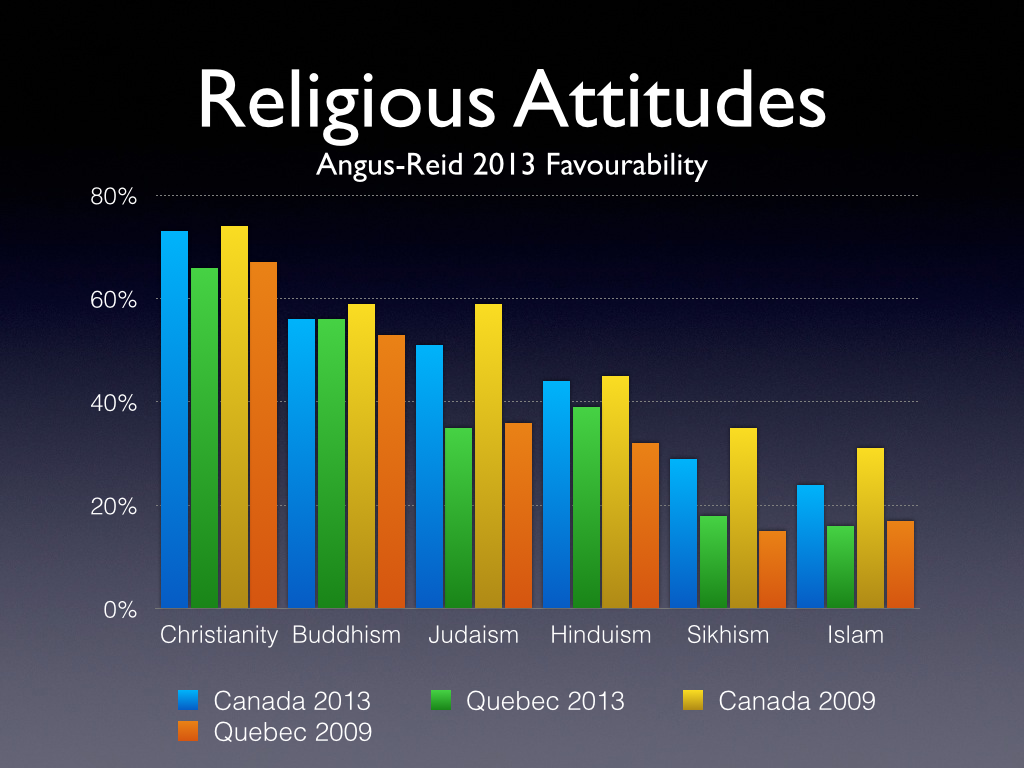
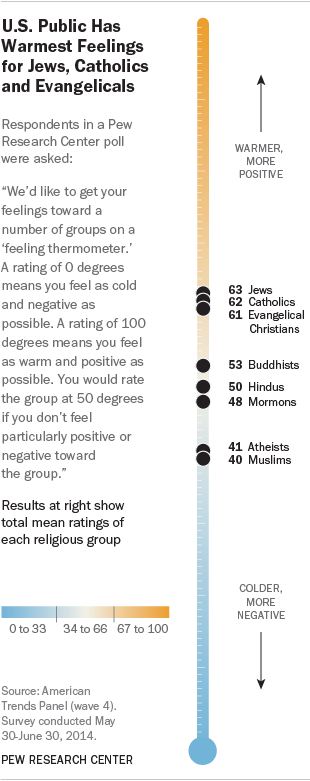
Chart of the Day: Religious Attitudes – USA, Canada and Quebec

Although not strictly compatible, the just issued Pew Research survey of US attitudes towards religions can be compared with a 2013 Angus-Reid Survey.

No real surprise in the relative ranking, Christianity on top, Islam on the bottom.

But in US, Jews are comparable to Christians but not so in Canada. US survey also includes attitudes towards atheists (tied at the bottom with Muslims) but does not include Sikhs.

Pew PF_14.07.16_interreligiousRelations_totalRatings1

Religiious Attitudes Angus Reid.001

Expatriates: The Unofficial Ambassadors

More good thought-provoking commentary from Victoria Ferauge on expats. While written from an American perspective, relevance to Canada given the large number (close to 3 million) Canadians abroad:

The Face of Americans Abroad:  7 million people with very different reasons for being abroad and of every color, creed, class.  Some are indeed missionaries.  Many are teachers or professors.  There are retirees, economic and marriage migrants, true expatriates sent by their companies, and so much more.  The Peace Corps, for example, is still around.  There is also the military and former military.

There is an almost infinite number of combinations here that begin with who these people were before they left the US, why they went abroad, what they do and where they went or were sent and with whom.

[David] Kuenzi [author of Wall Street Journal Op-Ed] qualifies his statement by referring to three categories:  “businesspersons, scholars or trailing spouses” but these are only a small fraction of the Americans living abroad.

I think that the largest group of Americans abroad looks like this:  they don’t want any or minimal contact with the US government and other Americans while they are living abroad, they do not want to join any American organization be it Democrats Abroad, Republicans Overseas, AARO or ACA: they are keenly interested in being good denizens of their countries of residence, and these days more and more of them aspire to become citizens of those states.  They make no demands on the United States while they are abroad.  In many cases the very minimal protection of the US government is neither attractive nor relevant to them since they know the limits of the local consulates assistance a list of local lawyers who speak English and they understand that the US government will not expend political capital on their behalf to get them out of trouble.    And if it weren’t for the fact that they have to have a passport to enter the US to see family, they would probably forgo that as well.  What they want is to be left alone to go about their business and their lives.

Are these people good “unofficial ambassadors”?  I have no idea and neither does anyone else.

For those Canadian expatriates, or former expatriates among you, Victoria would appreciate your help in the following:

And for those of you who are members of other diasporas, I’d be very interested in knowing if a similar situation exists between you and your home country.

The Franco-American Flophouse: The Unofficial Ambassador.

Multiculturalism, Britishness, and Muslims | openDemocracy

A somewhat (over) lengthy piece by Tariq Madood on British multiculturalism and Islam, but nevertheless interesting and rich in its reflections:

The Islamic-modernity argument counters by positioning the sharia not as a body of unchanging law, but as a set of ethical principles with legal conclusions that apply only to specific places and times and thus have to be continually reinterpreted; the effect is to place the ethical over the legal and the political see Ziauddin Sardar, The Future of Muslim Civilization [Mansell, 1987] and Tariq Ramadan, Western Muslims and the Future of Islam [Oxford University Press, 2005. This is an example of how scholarship can draw on extra-European heritages and reinterpret them in a context of a democratic citizenship.

As Muslims’ discussion of these matters develops, and as their discourse becomes an integral part of British debates, one positive effect could be that a broader range of Muslim voices or civic participants are able to contribute. Such a development would reflect a healthy internal variety among Muslims as within any group, part of which is that different individuals or members will want to locate themselves variously across the representational landscape secular, religious, close to government, distant from political parties. That, after all, is true integration; new groups should have similar opportunities to old groups and do not need to conform, or feel obliged to conform, to a special “minority” perspective.

These discursive and institutional processes have two implications. The first is that an increasing acceptance that Muslims can politically organise “as Muslims” without any sense of illegitimacy – in raising distinctive concerns or having group representation in public bodies, for example – means allowing them to choose the paths they think appropriate at different times, in different contexts and for different ends.

The result will be a democratic constellation of organisations, networks, alliances and discourses in which there will be agreement and disagreement, in which group identity will be manifested more by way of family resemblances than the idea that one group means one voice.

The second implication is that where there is “difference” there must also be commonality. That commonality is citizenship, a citizenship seen in a plural and dispersed way. There is no contradiction here, for emphasising and cultivating what we have in common is not a denial of difference – it all depends upon what kind of commonality is arrived at, something that cannot be taken for granted. Difference and commonality are not either-or opposites but are complementary and have to be made – lived – together, giving to each its due.

More than that, commonality must be difference-friendly, and if it is not, it must be remade to be so. This does not mean as a corollary weak or indifferent national identities; on the contrary, multiculturalism requires a framework of dynamic national narratives and the ceremonies and rituals which give expression to a national identity. Minority identities are capable of generating a sense of attachment and belonging, even a sense of a “cause” for many people. If multicultural citizenship is to be equally attractive to those people, it needs a comparable and counterbalancing set of emotions; it cannot be merely about a legal status or a passport.

A sense of belonging to one’s country is necessary to make a success of a multicultural society. An inclusive national identity is respectful of and builds upon the identities that people value and does not trample upon them. So integration is not simply or even primarily a “minority problem”. For central to it is a citizenship and the right to make a claim on the national identity in the direction of positive difference.

Multiculturalism, Britishness, and Muslims | openDemocracy.

Temporary Foreign Workers: Film, TV industry assured timely permits

Another sector adversely affected but whose concerns appear reasonable for the Government:

Christian Allen, the chair of the Commercial Production Association of Western Canada, has been calling on the government to give the film and TV industry the same exemption it recently gave musicians.

“The meeting was incredibly positive. The government is very aware of the issues and is responding by working with us to correct the problems as quickly as possible.”

A spokesperson for Alexander would not say what action the minister agreed to take but said he acknowledged the economic contribution the film and TV industry brings to the Canadian economy.‎

“Minister Alexander met with representatives from the television and film industry in Vancouver yesterday [Wednesday] because he understands the sector creates jobs and economic opportunity for Canadians.

It was clear that some of their concerns predate our government’s reforms to the Temporary Foreign Worker Program,” Codie Taylor told CBC News in an email Thursday.

Temporary Foreign Workers: Film, TV industry assured timely permits – Politics – CBC News.

Overstating Citizenship “Fraud” – New Canadian Media

Citizenship Fraud.037My take on citizenship fraud, with analysis of released numbers to date:

Some may argue that any fraud is unacceptable.

But the quest for perfection has to be balanced with the realities of efficient management and good service delivery.

There are more fraud issues with citizens originating in certain countries, both in terms of country of birth and likely country of application. From a risk management perspective, that is where the focus should be and likely is.

As the government addresses the backlog and implements the new Citizenship Act, we will see starting in 2016 whether it has achieved a reasonable balance between reduced fraud, efficiency, and accessibility of citizenship, meeting the Minister’s commitment of a one-year processing time.

Overstating “Fraud” – New Canadian Media – NCM.

Methodological Note: A number of readers have asked regarding the source of the numbers and analysis:

  • An ATIP request provided to me by a student listed the countries of birth for the 3,194 investigations;
  • Beyond the fact that this number was as of 31 March 2012, no details on which years were included (i.e., did all the cases of suspected misrepresentation pertain to citizenship applications in one year or, as I suspect, a number of years);
  • Other numbers were pieced together from public statements and communications material from the past few years. I integrated as best I could;
  • the percentage figures were calculated against the 5 year annual average of new citizens (2008-12);
  • I asked CIC to confirm and update these numbers. CIC declined, suggesting I file an ATIP request and sending along some communications material.


The Benefits of Failing at French – NYTimes.com

On the benefits of learning a second language in terms of brain training and “fitness.”

So for all those public servants who struggled to learn French, think of the fringe benefits as you get older:

Last year researchers at the Chinese University of Hong Kong and Northwestern University in Illinois hypothesized that language study should prove beneficial for older adults, noting that the cognitive tasks involved — including working memory, inductive reasoning, sound discrimination and task switching — map closely to the areas of the brain that are most associated with declines due to aging. In other words, the things that make second-language acquisition so maddening for grown-ups are the very things that may make the effort so beneficial.

The quest for a mental fountain of youth, pursued by baby boomers who fear that their bodies will outlive their brains, and who have deeper pockets than Juan Ponce de León, has created a billion-dollar industry. There is some evidence that brain exercise programs like Lumosity and Nintendo’s Brain Age can be beneficial, but if my admittedly unscientific experience is any indication, you might be better off studying a language instead. Not only is that a far more useful and enjoyable activity than an abstract brain game, but as a reward for your efforts, you can treat yourself to a trip abroad. Which is why I plan to spend the next year not learning Italian. Ciao!

The Benefits of Failing at French – NYTimes.com.