Consumers More Borderless Than Multinationals – New Canadian Media – NCM

Environics Canada USFascinating market research and comparison between Canadian and American acculturation models and behaviours by Robin Brown of Environics.

The cliché of the melting pot versus the cultural mosaic appears to still apply, at least for those of Chinese and South Asian origin (two of the largest communities in Canada):

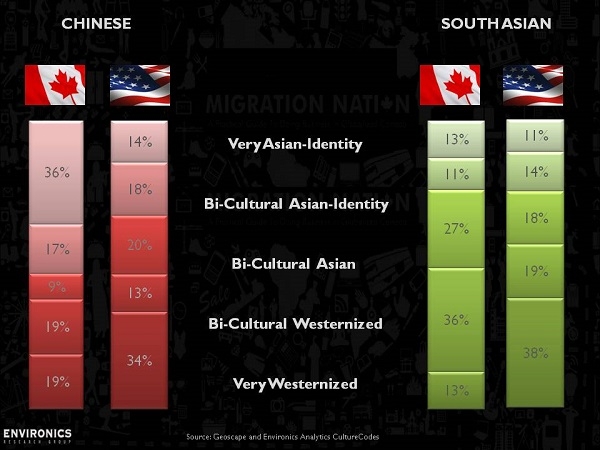
Our recent research compared Chinese and South Asian Americans and Canadians’ level of acculturation using Geoscape and & Environics Analytics CultureCodes see graph. These analytical tools classify the population into five categories of acculturation based on their home language, knowledge of English/French and period of immigration. We found much higher levels of acculturation in the U.S. than in Canada for both groups. This results from a number of factors, including the “melting pot” vs. multicultural culture of each country. Of course, this means that these populations will differ and marketing efforts to reach them must navigate that difference.

But, understanding the diasporas may not be the biggest challenge faced by multinationals. The current reality for many multinationals is that many of their consumers are in some respects more global than they are. There may be good business reasons why an Asian Canadian cannot find Nescafe iced coffee here in Canada, but consumers are not aware or don’t care about the constraints of separate business units, tariffs and supply chain logistics. They are connected globally and informed of products and services that are used by their ethnic diaspora across the world.

Consumers More Borderless Than Multinationals – New Canadian Media – NCM.

Filipino Canadians fear end of immigrant dreams for nannies

Nicholas Keung’s article on the future of the Live-in Caregivers program:

Critics of the government’s approach, including some Conservative loyalists, warn that the growing Filipino Canadian vote could also be at stake in next year’s federal election if the government removes access to immigration from the live-in caregiver program LCP — 90 per cent of those participating are from the Philippines.

Family separation, lost skills the biggest challenges for immigrant nannies“This is a defining issue for the Filipino Canadian community,” said Chris Sorio of Migrante Canada, an international advocacy group for Filipino migrants.

“This is something very close to our hearts. It is worrying us because we feel this could be a smoke-screen for changes that are coming to the LCP program. Our concern is they are going to further restrict family reunification under the program.”

In recent meetings with the media to discuss Ottawa’s planned reforms to the controversial temporary foreign workers program, Employment Minister Jason Kenney criticized the LCP as being “out of control” and having “mutated” into a program of family reunification.

… Findings of the nanny study [by Ethel Tungonan of U of Alberta]

Researchers surveyed 631 Filipina caregivers about their jobs, recruitment, education, use of community supports and health, in the first national study of Canada’s live-in caregivers.

It found:

  • Caregivers’ average age on arrival was 34

  • 86% had university education or above.

  • Nearly 90% arriving in the past five years were recruited by employment agencies or directly hired by unrelated employers.

  • Two-thirds had children; about half experienced continued separation because their children had grown too old to be considered dependants for immigration.

Filipino Canadians fear end of immigrant dreams for nannies | Toronto Star.

Mideast conflict affects all Muslims and Jews: Marmur

Interesting column by Dow Marmur, rabbi emeritus at Toronto’s Holy Blossom Temple, and the need to focus on relations between Jewish and Muslim communities at home, as some of the recent tensions at demonstrations attest:

Christians act as catalysts here. Thus the proposed centre is to be built on a site where churches had stood since the Middle Ages; the last was damaged in the Second World War and subsequently demolished. Berlin is now to have a home promoting religious tolerance erected on Christian ground.

Christians in post-war Germany have a history of trying to bring Jews and Muslims together without meddling in the politics of the Middle East. Already more than 40 years ago, Christian institutions in what was then West Germany helped to create an organization called Jews, Christians and Muslims in Europe. To this day JCM promotes fruitful interfaith encounters, particularly between theology students. The Berlin House of Prayer and Learning would be a logical and more far-reaching extension of this work.

Toronto has a sizeable Jewish community and an even larger Muslim minority. Canada is known for its commitment to multiculturalism and peace. This city may, therefore, be the right place to imitate and fine-tune what’s being done in Berlin, not by seeking to import the Palestinian-Israeli conflict but by bringing together committed Christians, Jews and Muslims who would help to enrich our lives here despite the tensions there.

The Canadian Association of Jews and Muslims is already engaged in this kind of non-political work. What I know of it suggests that it could benefit from active Christian involvement and resourcefulness reflecting Canada’s commitment to peace and coexistence. Where Chicago and Los Angeles failed, Toronto taking its cue from Berlin might succeed.

Mideast conflict affects all Muslims and Jews: Marmur | Toronto Star.

Calgary mom targeted by jihadist blogger after her radicalized son killed in Syria

Not exactly a nice gesture to a grieving mother seeking explanation for her son, Damian Clairmont’s, turn to radical Islam and death in Syria:

Chris Boudreau has been reeling for months after learning her son died fighting with a terrorist group overseas. Now, a self-proclaimed jihadist is urging the Calgary mother to embrace an extremist ideology she suspects was used to brainwash her son.

On his blog, Abu Dujana al-Muhajir claims he was among a group of young men who left Calgary to join “various fronts of Jihad” after forming a study group at a downtown mosque. Damian Clairmont, Boudreau’s son who was also part of the group, was later killed during rebel infighting in Syria.

Clairmont’s death devastated and confounded his mother, who continues to struggle with how her boy, raised in a loving Canadian family, could adopt radical views and die fighting for them.

In his latest blog post, Abu Dujana writes an open letter to Boudreau in which he explains the ideology behind her son’s path to violence and encourages her to become sympathetic to the cause.

“The attempt to get me to fall for the same thing just made me shake my head,” said Boudreau, who has branded herself an advocate against homegrown radicalization, and has met with officials across Canada and abroad to advance her cause.

“At least it means I must be getting to somebody enough that they are trying to find another way to get me to see their point of view, so that I don’t continue what I’m doing.”

… Boudreau recently returned from Europe, where she met with three other mothers whose sons had also died fighting alongside radical Islamic groups. One of those sons was killed just two months before Clairmont in the same Syrian town northwest of Aleppo.

She was able to build a bond with the other women, something she had been searching for, and learned their sons spouted the same kind of rhetoric she read in Abu Dujana’s blog.

“After talking to these mothers and hearing the exact same story over and over again, you know that (radicals are) using the same verbiage with everybody.”

… The blog posts offer an apparent window into the group’s ideology and their path to violence.

The latest missive advances a form of Islam based on a selective reading of the Qur’an, ignoring verses that contradict its point of view, said Aaron Hugues, an author who has written extensively on religion and holds a PhD on Islamic studies.

“What these guys do is they have very little understanding of the tradition … and they tell themselves these ludicrous stories that they’re waging jihad and that if they die they’ll go to paradise, and it’s brainwashing,” said Hughes, who used to teach at the University of Calgary but now lectures at the University of Rochester.

“In many respects, I think this radical Islam is a cult, and these kids need to be deprogrammed,” Hughes said.

“This thing that he wrote is really meant to unsettle us, Canadians, because it’s very articulate … and he’s trying to say, we know full well what we’re doing and we’re not brainwashed,” he said.

Mubin Shaikh, a former Muslim radical who joined CSIS as an undercover operative in a Toronto terrorism investigation, said he was considering a formal response to the blog post on behalf of Boudreau, whom he’s been helping.

He called the open letter propaganda that “cherry-picks” verses of the Qur’an to promote a radical version of Islam.

He said the missive is simply an attempt to justify Clairmont’s “indoctrination.”

“These guys are relative nobodies, and they put on this hero costume and they want people to follow them,” Shaikh said. “He’s wrong on so many levels.”
Calgary mom targeted by jihadist blogger after her radicalized son killed in Syria

Opinions on Rob Ford divide Toronto’s black community | Toronto Star

Interesting article on Rob Ford and the black community in Toronto and how his “retail politics” as well as follow-up to specific requests by constituents continues to resonate with some:

[Ken] Bryan, raised in foster homes in some of the city’s most impoverished neighbourhoods, says he “gets” Ford’s support in communities ignored by other politicians unless they are “pandering for votes.”“

Ford shows up and helps someone fix their door that’s been broken for three months and they say, ‘Hey, this guy is a great guy,’” Bryan said. “His sort of populism appeals to that … ‘I’m just this poor little guy and there are these downtown elites who hold their noses up at us; they don’t come into our communities.’”

But Bryan bristles when he hears claims that Ford has done more for black people than any other politician, or that youths, as Ford has said, would be “dead or in jail,” if it weren’t for him and his football charity.

“It’s patently false,” said Bryan, “but he believes it and he says it and the people who don’t know any better believe it. And that’s unfortunate.”

…. Those struggling to eke out a living in Toronto may not have the time, or inclination, to follow the decision-making at city hall closely enough to realize the inconsistencies between Ford’s words and his policy positions, says Bryan.

“It is low information, not necessarily low education,” he said.For that reason, it’s up to those who are paying attention to bring those who feel left out “into the fold,” and get them involved in the political process, Bryan adds.

“The question to be asked is why do all these black people feel disenfranchised? The answer is larger and has to do with a lot more than Rob Ford.”

Opinions on Rob Ford divide Toronto’s black community | Toronto Star.

Don’t call it diversity, call it real life

ABC President Paul Lee on diversity in television programming:

ABC is not on a mission to change TV, Lee insisted. He sees it as reflecting society as it is today.

“We think that’s our job,” he said. “Its not so much diversity as authenticity, if you’re reflecting America. We think these shows are deeply relatable, When I watch Black-ish or when I watch Cristela, I am one of those families.”

……ABC president Lee said his own background as an outsider – a British immigrant who studied Portuguese at Oxford and worked in Brazil before settling down in the U.S. – has helped give him a different perspective.

“Being an outsider is sometimes a great advantage and sometimes a disadvantage,” Lee said. “Sometimes you gain more than you lose from that perspective. It gives me a chance to look at things from another angle. The reality is, great stories resonate in the heart and gut of the audience, and that’s true anywhere in the world.

“I was brought up on American shows as much as I was on British shows,” Lee said. “My job isn’t to sit here as a Brit, commissioning American shows. My job is to see whether these shows move me, whether they move me to laughter or tears. If they do, and they do it in an authentic way, then we have a chance to resonate in the U.S. and beyond.”

Don’t call it diversity, call it real life.

Finance Canada survey finds Canadians at odds with Conservatives’ priorities

Interesting but not necessarily surprising. Those Canada’s Economic Action Plan ads may have not been as good value for money, let alone for taxpayers:

Public-opinion research for the federal Finance Department suggests key government policies are out of step with Canadians’ priorities, including the Northern Gateway project.

Members of focus groups consulted prior to the February budget had “little enthusiasm” for the proposed bitumen pipeline to the British Columbia coast — even those who said they support the controversial project.

And among the 12 groups consulted — from Coquitlam, B.C., to Bridgewater, N.S. — the economy itself was not a top-of-mind concern.

Rather, the groups spontaneously raised education, health care, pensions and veterans as their key issues.

They also called for more processing and refining of Canada’s oil resources at home, and to do so in a more environmentally safe manner.

The findings of the January focus groups, commissioned from NRG Research Group, suggest the Harper government’s central policy themes — trade and the economy, with an emphasis on energy exports — are resonating less with ordinary Canadians.

http://www.ipolitics.ca/2014/07/20/finance-canada-survey-finds-canadians-at-odds-with-conservative-government-priorities/ (pay wall)

Angry Second-generation Immigrants – New Canadian Media

Richard Landau on radicalization and second-generation immigrants. Not very conclusive, understandably, as there are no simple solutions.

And Leiken, the author of a recent Foreign Policy article cited, fails to link to the broader social and economic context of the various approaches to diversity:

And here we have arrived at a dangerous intersection. While young men may find an international conflict exotic, I have seen enough disaffected youths drawn to religious cults and extremism to know that it, too, has a special idealistic lure. Young men, drifting and unaccustomed to lives of prayer, obligation and fasting, may find the rituals alluring. Ritual + an exotic overseas conflict + romanticism may equal something like catnip for young men who are not well grounded. Et voila, radicalization!

Yes, there are extremist pied pipers who prey upon the young, the lonely and disaffected, telling them they are being disrespected and that the society at large hates them. Extremists like the late Anwar Al Awlaki tell young men that they will finally find meaning in their lives when they take up arms against the West. Simple, uneducated minds buy this drivel. The Boston Marathon bombers had a cult-like belief they were doing the Almighty’s will. The thing about fundamentalism, be it religious conversion or political, is that converts have an unending reservoir of zeal.

So how should Western societies deal with the roots of homegrown terrorism? With only limited successes, they have tried three approaches for dealing with immigrant populations:

  • Multiculturalism: Promotion and financing of integration, and equality of opportunity;
  • Assimilation: Forced assimilation/melting pot that leads to resentment;
  • Avoidance: Laissez faire benign neglect that produces a Balkanized and segregated society.

Writing in a Foreign Affairs article “Europe’s Angry Muslims,” Robert S. Leiken observed: “Yet it is far from clear whether top-down policies will work without bottom-up adjustments in social attitudes. Can Muslims become Europeans without Europe opening its social and political circles to them? So far, it appears that absolute assimilationism has failed in France, but so has segregation in Germany and multiculturalism in the Netherlands and the United Kingdom.”

It appears there is no simple, proven answer that will assuage the angry second generation. The answers may involve an amalgam of the three approaches and an educational system that addresses the issues of this generation head on.

Angry Second-generation Immigrants – New Canadian Media – NCM.

ICYMI: For Israelis and Palestinians, Separation Is Dehumanizing – NYTimes.com

Interesting commentary on how Israelis and Palestinians have moved further apart by Ethan Bronner of the NYTimes:

Israelis — especially in the heartland around Tel Aviv, where two-thirds of the country lives — can now go weeks without laying eyes on a Palestinian or ever having to think about one. In Gaza, Israelis do not exist except in a kind of collective nightmare. In the West Bank, the Israelis are mostly settlers and soldiers. Apart from a few pockets of industry and shopping where Palestinians are employed, interaction is highly limited.

At the height of the peace efforts, in the 1990s, Israeli and Palestinian leaders, locked in rooms negotiating with one another, built a poignant bond and developed a form of trust that they then sought to spread — not always successfully — to their peoples.

Yossi Beilin, then an Israeli official, and Mahmoud Abbas, who went on to become the president of the Palestinian Authority, wrote a peace plan together. In the early 2000s, Sari Nusseibeh, a Palestinian official and intellectual, joined with Ami Ayalon, a former head of the Israeli Shin Bet security services, and gathered hundreds of thousands of Palestinian and Israeli signatures for a two-state solution. They traveled together for months. They got along famously.

The relationship between Prime Minister Benjamin Netanyahu and Mr. Abbas is one of mutual loathing, according to Martin S. Indyk, who resigned last month as American envoy for peace negotiations after nine months of futile efforts. The two sides and their leaders have become total strangers. Each vilifies the other and imagines its own people to be morally superior, forced to defend itself against the cruel predations of the other.

A generation ago, there were plenty of causes for tension and concern. But Palestinians building what they hoped would become their state, and Israelis working with them, had an often moving sense of shared purpose. Some discovered that they liked one another and looked forward to working together. Today, those feelings are virtually dead. And while mixing the populations in those years was no panacea, divorcing them has only made things worse.

For Israelis and Palestinians, Separation Is Dehumanizing – NYTimes.com.

ICYMI: Myanmar Begins Controversial Citizenship Verification Process

Disturbing. Linking citizenship to ethnicity and religion in Myanmar:

Many Rohingyas are skeptical that a government that already classifies them as Bengalis will grant them citizenship based on the testimonies of village elders.

Washington has, in the past, pressured the Myanmar government on the 1982 Citizenship Law. And in its 2014 report on religious freedom, called on authorities to promote the rights of Rohingya Muslims and provide “durable solutions” for refugees outside the country.

Matthew Smith, director of the international human rights group Fortify Rights, says giving Rohingya equal access to citizenship rights is crucial to preventing the conflict in the future. He says foreign nations should press the government more on the issue.

“The fact that the immigration department is handling this issue is indicative of the perception that all Rohingya come from Bangladesh,” Smith said. “Immigration is an issue on all of Myanmar’s borders, but the wholesale denial of Rohingya citizenship, Rohingya ethnicity, has contributed to these abuses that we’ve been documenting now for two years.”

Have not seen much Canadian government representation on the citizenship issue although Andrew Bennett, the Ambassador for Religious Freedom, routinely mentions Rohingyas in his speeches.

Casts a blemish on Aung San Suu Kyi and Myanmar’s democratization.

Myanmar Begins Controversial Citizenship Verification Process.