Coyne: Conservatives’ incoherence really shows with Charter of Rights discontent

Good column by Coyne on the Courts, the Conservatives and recent cases:

“Judges don’t always get it right,” colleague Ivison observes. No, they don’t — neither do politicians, if you’ve noticed. But governments have lots of options in the face of an inclement ruling. They can redraft the law, for starters: It’s usually possible to preserve its purpose while removing the offending provisions. Beyond that? Amend the constitution. Appoint better judges. Make the case for a more restrained theory of jurisprudence. Change how the law is taught. Conservatives used to pride themselves on taking the long view of things.

Meantime, if Conservative MPs are so concerned about the powers of Parliament being usurped, I suggest they look closer to home. As defenders of Parliament, they’d be a lot more convincing had they not spent the past many years meekly surrendering one ancient Parliamentary prerogative after another, not to the courts, but to a far more voracious usurper: the executive.

Or if it’s the courts they’re worried about, there’s a simple way to remove them from the equation: Stop passing laws that are so clearly and flagrantly in violation of the Constitution see, for example, the prostitution bill. Insist, as the political scientist Emmett Macfarlane has suggested, that ministers screen bills for charter compatibility before introducing them in the House. Better yet, have committees of Parliament do the same.

As things stand, MPs seem content to abdicate this responsibility to the courts, so they can pick fights with them later. “Why elect people and pay them to do something the courts are doing,” Miller grumbles. Why, indeed.

Coyne: Conservatives’ incoherence really shows with Charter of Rights discontent.

Adapt to a New Culture – but Don’t Go Too Far – Harvard Business Review

Good piece on the intricacies and challenges with cultural adaptation. I think mentoring, either formal or informal, can be particularly beneficial:

Individuals need to take steps to avoid over-switching and decrease the likelihood that it will interfere with their success abroad. One essential strategy is to develop a detailed sense of the “cultural code” — the correct and appropriate interpersonal style — for whatever key situations you’re working in. How assertively are you expected to act in your role in this setting? How directly are you expected to communicate, and with how much emotional expressiveness?

Of course, the rules for how to behave are not the same in all situations you encounter in a foreign culture. Taking Cheng’s case as our example, some work cultures are extremely informal with very high expectations for assertiveness on the part of employees. Others are much less so. Some bosses also have styles that are more or less conducive to the behavior that Cheng exhibited in this situation. The overall goal is not to just learn how the new culture is different from yours. It’s to calibrate the specific level of difference and to learn how to acclimate your behavior to that particular level.

But even if you do work hard at mastering the cultural code, mistakes are still inevitable. You must also find ways to mitigate the brunt of these inevitable faux pas. Do what you can to develop a sense of rapport or, when possible, a relationship with the person you’re interacting with. Express genuine interest in the new culture and bond over areas of mutual interest, such as sports or family. And in certain cases, if the relationship allows, see if the other person might even be able to mentor you about cultural differences and the appropriate level of accommodation.

Over-switching is a natural part of the adaptation process. The trick isn’t to make it go away; it’s to try your best to convert these inevitable errors into valuable learning opportunities.

Adapt to a New Culture – but Don’t Go Too Far – Andy Molinsky – Harvard Business Review.

India: Liberal immigration norms make Canada new destination for techies

Nice to see positive messaging for a change:

But Alexander was clear the popular reaction is positive. “We are an immigration country. We have built our success on immigration and we have protected that legacy through the economic crisis of 2008-09. We are still a growth play, whether in the technology and resource sectors or finance.”

For many reasons – English education and skills – Indians score high in the acceptability chart. “We have three countries that are in a league of their own as sources of immigration – China, India and the Philippines.”

In 2013, over 33,000 Indian immigrants came to Canada, Alexander said. Around 60 per cent were economic migrants, rest were families.

Alexander is clear that unlike the US, Canada has had a more positive evolution of its immigration systems. “We have reformed, we have evolved.”

It is far easier to get permanent residence in Canada. Alexander said, “It only requires you to be in Canada for two years out of five. So someone who is global and wants to go back and forth can do that – be a Canadian permanent resident while doing some part of business here in India.”

Liberal immigration norms make Canada new destination for techies – The Economic Times.

Tightening of foreign worker rules affecting supply of doctors – The Globe and Mail

A small part of the Temporary Foreign Workers program that most Canadians would not have problems with but nevertheless affected by the changed rules:

A tightening of the rules in the last three years – including the most recent overhaul, announced last month – has convinced some recruiters to give up on the TFW program altogether.

“Many, many, many recruiters that were doing this work back in 2011 have dropped off,” said Joan Mavrinac, head of the regional physician recruitment office for Essex County, which includes the border city of Windsor, Ont.

“Then, with the changes in 2013, we’ve become far fewer and now the changes in 2014, I think, are going to effectively kill the program [for doctors.]”The TFW program had been under fire for more than a year when Employment Minister Jason Kenney and Immigration Minister Chris Alexander announced sweeping reforms designed to prevent unscrupulous employers from importing low-wage foreign workers to displace Canadian employees.

The reforms include a 10-day turnaround time to process applications for highly skilled, high-wage workers, but they do not address any of the unique concerns of doctors, many of which stem from the fact MDs are generally self-employed.

Tightening of foreign worker rules affecting supply of doctors – The Globe and Mail.

‘Shopping for Votes:’ Baird gets tetchy with CBC reporter over Middle East Twitter gambit

A rather amusing exchange between Minister Baird and Valerie Boyer of the CBC:

Boyer: “Why has the Conservative Party decided to use this conflict in advertising to gain supporters?

Baird takes a drink of water: “I haven’t seen that.”

Boyer: “There’s been a few tweets out there saying, ‘You know we’re on ….’”

Baird interrupts: “So, is it the position of the CBC that a tweet is advertising?”

Boyer: “Well, I mean it’s a form of getting out to supporters though.”

Baird: “I just don’t … If the CBC calls tweets advertising, it doesn’t …”

Inaudible – Baird and Boyer try to talk over each other

Boyer: “It’s a form of getting out to people.”

Baird: “In fairness, you’re a member of our national broadcaster. We deserve better questions than that.”

While the Government’s full-throated support of Israel is deeper than diaspora political calculations, this exchange allowed Baird to reiterate support to Canadian Jews (not all share the Government’s position) while attacking the CBC, and playing to the Conservative base.

Neat trick, but the obvious retort to “We deserve better questions than that.” is “We deserve better answers.”

Baird gets tetchy with CBC reporter over Middle East Twitter gambit (pay wall)

Leonard Cohen on Creativity, Hard Work, and Why You Should Never Quit Before You Know What It Is You’re Quitting

For something lighter and yet deeper today, and for the Leonard Cohen fans among us, a nice selection of Cohen quotes on the creative process:

I’m writing all the time. And as the songs begin to coalesce, I’m not doing anything else but writing. I wish I were one of those people who wrote songs quickly. But I’m not. So it takes me a great deal of time to find out what the song is. So I’m working most of the time.[…]

To find a song that I can sing, to engage my interest, to penetrate my boredom with myself and my disinterest in my own opinions, to penetrate those barriers, the song has to speak to me with a certain urgency.

To be able to find that song that I can be interested in takes many versions and it takes a lot of uncovering.

Leonard Cohen on Creativity, Hard Work, and Why You Should Never Quit Before You Know What It Is You’re Quitting | Brain Pickings.

Cultural communities feel left out of Toronto Pan Am Games

Seems like it may be a repeat of the Vancouver Olympics which were put to shame by London’s relentless upbeat and upfront multiculturalism:

But a marketing consultant involved in the outreach efforts said only a few thousand dollars had been earmarked to buy ad space in dozens of small outlets.

Milind Shirke, director of Ethos Communications, which specializes in marketing to diverse communities, said organizers need to find “respectable amounts” of money to spend on advertising in multicultural newspapers and television, because that’s where many immigrants get their news.

“There’s definitely a strong media consumption of their own media versus the mainstream media,” he said.

In order to attend, those communities “would need to be provided some basic information in terms of pricing, venues, options, discounts, because they’re also value-conscious…. That’s where the media comes in.”

Shirke said it’s also important to include other communities, such as the Toronto region’s large south Asian population, whose home countries are not competing in the Games.

Cultural communities feel left out of Pan Am Games.

How Politics and Lies Triggered an Unintended War in Gaza – Forward.com

I don’t normally post on the Mid-East, but given the current events, a few articles worth reading which may have escaped attention, including the Government’s.

Starting with J.J. Goldberg in the Jewish Daily Forward on how the crisis escalated and Netanyahu’s role:

In the flood of angry words that poured out of Israel and Gaza during a week of spiraling violence, few statements were more blunt, or more telling, than this throwaway line by the chief spokesman of the Israeli military, Brigadier General Moti Almoz, speaking July 8 on Army Radio’s morning show: “We have been instructed by the political echelon to hit Hamas hard.”

That’s unusual language for a military mouthpiece. Typically they spout lines like “We will take all necessary actions” or “The state of Israel will defend its citizens.” You don’t expect to hear: “This is the politicians’ idea. They’re making us do it.”

Admittedly, demurrals on government policy by Israel’s top defense brass, once virtually unthinkable, have become almost routine in the Netanyahu era. Usually, though, there’s some measure of subtlety or discretion. This particular interview was different. Where most disagreements involve policies that might eventually lead to some future unnecessary war, this one was about an unnecessary war they were now stumbling into.

Spokesmen don’t speak for themselves. Almoz was expressing a frustration that was building in the army command for nearly a month, since the June 12 kidnapping of three Israeli yeshiva boys. The crime set off a chain of events in which Israel gradually lost control of the situation, finally ending up on the brink of a war that nobody wanted — not the army, not the government, not even the enemy, Hamas.

The frustration had numerous causes. Once the boys’ disappearance was known, troops began a massive, 18-day search-and-rescue operation, entering thousands of homes, arresting and interrogating hundreds of individuals, racing against the clock. Only on July 1, after the boys’ bodies were found, did the truth come out: The government had known almost from the beginning that the boys were dead. It maintained the fiction that it hoped to find them alive as a pretext to dismantle Hamas’ West Bank operations.

The initial evidence was the recording of victim Gilad Shaer’s desperate cellphone call to Moked 100, Israel’s 911. When the tape reached the security services the next morning — neglected for hours by Moked 100 staff — the teen was heard whispering “They’ve kidnapped me” “hatfu oti” followed by shouts of “Heads down,” then gunfire, two groans, more shots, then singing in Arabic. That evening searchers found the kidnappers’ abandoned, torched Hyundai, with eight bullet holes and the boys’ DNA. There was no doubt.

Prime Minister Benjamin Netanyahu immediately placed a gag order on the deaths. Journalists who heard rumors were told the Shin Bet wanted the gag order to aid the search. For public consumption, the official word was that Israel was “acting on the assumption that they’re alive.” It was, simply put, a lie.

How Politics and Lies Triggered an Unintended War in Gaza – Forward.com.

Secondly, former head of Shin Bet, 2005-11, Yuval Diskin’s A Prayer of a Father in a War of No Choice? (The Gatekeepers captures the hard-headed assessment of six former heads of Shin Bet, including Diskin):

My heart is with my brothers and sisters and the masses of Israeli citizens currently under attack from rockets and missiles. My heart is also with those Palestinians in the Gaza Strip that did not choose this war, have become, against their wills, human shields for the terrorists of Hamas, Islamic Jihad, and the other terror organizations, and have absorbed hundreds of tons of explosives from the air.

My heart is with all the parents whose sons are on the front and who may – in a few more hours or days – enter this miserable place whose name is the Gaza Strip. Everyone who has seen and spent days and nights with sewage flowing in the streets of the miserable refugee camps in Gaza, the West Bank (or for those who want, Judea and Samaria), and Lebanon is able to understand how much we must find a way to resolve this bloody conflict at least partially.

And yes… in the current situation, I think that it is necessary to do everything possible in order to the stop the rockets from the Gaza Strip. And, if there is no other choice, also a ground invasion provided the invasion will have real goals and will not be intended just for the consumption of the incited masses in the hands of the religious fanatics and cynical politicians.

Whoever is familiar with this endless cycle of bloodshed and hatred knows how much the next war is already filled with the blood of the current war. I know and remember this frustrating sense before every operation or war. It is the moment when you realize deep inside yourself the futility and the foolishness of it and, especially, how much in war there are not really any winners…as much as the war escalates and continues, one can see more and more clearly how much it is unnecessary and how much one could have been spared from it if only we had been truly talking out of a desire to solve the conflict, to compromise and build a better future for all of us…

I pray that after everything is finished, we will remember that really at that moment everything starts anew…And when the hourglass is turned over and we begin to count down until the next war, I hope that we will remember that is forbidden for us and for our enemies to pay attention to the same religious fanatics and war-mongering politicians seeking to satisfy the lust of their supporters – on both sides. And how much it is preferable to sit and to resolve what is possible in this bloody conflict.

Until then, I offer a deep prayer that peace and quiet will return quickly to the citizens of Israel in the south, the center, and the north, and that all our regular, reserve, and career soldiers return home in peace, including our four beloved sons. Let it be.

Diskin’s Prayer: On Israel, Gaza, and the next war

And from Gaza, a youth manifesto expressing their frustration:

“Fuck Hamas. Fuck Israel. Fuck Fatah. Fuck UN. Fuck UNWRA. Fuck USA! We, the youth in Gaza, are so fed up with Israel, Hamas, the occupation, the violations of human rights and the indifference of the international community!

“We want to scream and break this wall of silence, injustice and indifference like the Israeli F16s breaking the wall of sound; scream with all the power in our souls in order to release this immense frustration that consumes us because of this fucking situation we live in…

“We are sick of being caught in this political struggle; sick of coal-dark nights with airplanes circling above our homes; sick of innocent farmers getting shot in the buffer zone because they are taking care of their lands; sick of bearded guys walking around with their guns abusing their power, beating up or incarcerating young people demonstrating for what they believe in; sick of the wall of shame that separates us from the rest of our country and keeps us imprisoned in a stamp-sized piece of land; sick of being portrayed as terrorists, home-made fanatics with explosives in our pockets and evil in our eyes; sick of the indifference we meet from the international community, the so-called experts in expressing concerns and drafting resolutions but cowards in enforcing anything they agree on; we are sick and tired of living a shitty life, being kept in jail by Israel, beaten up by Hamas and completely ignored by the rest of the world.

“There is a revolution growing inside of us, an immense dissatisfaction and frustration that will destroy us unless we find a way of canalising this energy into something that can challenge the status quo and give us some kind of hope.

“We barely survived the Operation Cast Lead, where Israel very effectively bombed the shit out of us, destroying thousands of homes and even more lives and dreams. During the war we got the unmistakable feeling that Israel wanted to erase us from the face of the Earth. During the last years, Hamas has been doing all they can to control our thoughts, behaviour and aspirations. Here in Gaza we are scared of being incarcerated, interrogated, hit, tortured, bombed, killed. We cannot move as we want, say what we want, do what we want.

“ENOUGH! Enough pain, enough tears, enough suffering, enough control, limitations, unjust justifications, terror, torture, excuses, bombings, sleepless nights, dead civilians, black memories, bleak future, heart-aching present, disturbed politics, fanatic politicians, religious bullshit, enough incarceration! WE SAY STOP! This is not the future we want! We want to be free. We want to be able to live a normal life. We want peace. Is that too much to ask?”

Gazan youth issue manifesto to vent their anger with all sides in the conflict | World news | The Observer.
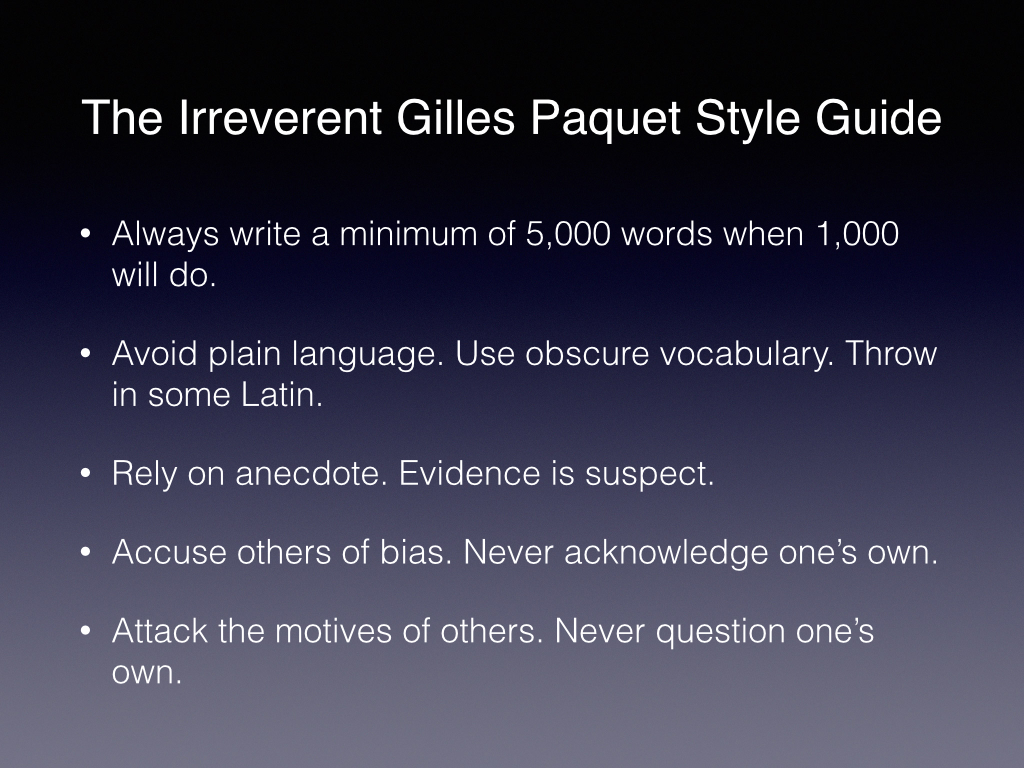
‘Mental Prisons,’ the Public Service and Gilles Paquet

In the spirit of Paquet's call for the "highest and best use of irony and irreverence" and "methodological and intellectual cruelty."

In the spirit of Paquet’s call for the “highest and best use of irony and irreverence” and “methodological and intellectual cruelty.”

My review of Gilles Paquet’s Super-Bureaucrats as Enfants du siècle in the Hill Times:

Ralph Heintzman provoked considerable debate in his Canada 2020: Renewal of the Federal Public Service arguing for an independent, arms-length public service. Ruth Hubbard countered it with The real problem with the public service, arguing that the real problem is competency, not the relationship between the political and bureaucratic levels. Maryantonett Flumian reminds us that politicians are elected, officials are not, and they have to implement government priorities as long as they do not break the law in How public servants support democracy: a response to latest Canada 2020 study.

Gilles Paquet adds his voice in Super-Bureaucrats as Enfants du siècle, which, while focused on officers of Parliament, casts his critique more broadly.

Paquet’s language, as always, pulls no punches. The “tribe” of super-bureaucrats form an “oligarchy.” They have a “sense of superior expertise and total infallibility.” They are agents of “counter-democracy” and impose their “technocratic and ideological views … usurping the role of elected officials.”

Officials practise “active or passive disloyalty” and are guilty of “sabotage.” The “fairy tale” of political reliance on anecdotes versus official reliance on anecdotes led to a “destructive … misuse of power,” which “translated in subterranean efforts to block, derail, or deflect the efforts of fairly able politicians.”

But apart from the tone, what is Paquet’s argument?

That super-bureaucrats, starting with officers of Parliament, but including adjudicatory bodies and the courts, have largely usurped the authority of the government and Parliament through “mandate creep with gusto.”

Their ideology or “diktats of indiscriminate compassion” allow them to portray themselves on the “side of the angels” while pursuing an “unlimited increase of the resources dedicated to the bureaucracy.”

“Super-bureaucrats and higher courts judges have often made unwarranted claims based much more on hubris than on superior competence, and couched in drama-queenesque rhetoric …”

Media and academics have been “defending tooth and nail the sacredness of the super-bureaucrats.”

Other critiques of officers of Parliament have been expressed more in terms of the diminished role of Parliament than of deference to the government (Donald Savoie).

But let’s take Paquet’s argument at face value that the super-bureaucrats and others, including “low-level bureaucrats” like he mentioned, have been actively undermining the government.

I wrote Policy Arrogance or Innocent Bias: Resetting Citizenship and Multiculturalism as more critical of the public service than the government because I felt that we had failed in our role to provide neutral and impartial advice.

We did not acknowledge our ideological and value biases, our evidence base was too slanted towards these biases, and we clung to a narrow interpretation of risk.

But the government also shares some responsibility. It arrived to government with a stronger ideological focus, one that often coloured its perception of evidence and preference for anecdotes (e.g., labour market shortages), and its willingness to discount risk (e.g., recent number of Supreme Court defeats).

But more fundamentally, Paquet is arguing for little or no constraints upon the government of the day.

He devalues the balance that officers of Parliament, adjudicatory bodies, and the courts provide in a context where Parliament no longer plays that role, given increased partisanship, expanded use of time allocation, and omnibus legislation. These trends predate the Conservative government, but have expanded under it.

Moreover, Paquet is also silent on the government’s silencing of those whose statutory role requires them to be a watchdog (e.g., starting with Linda Keen) or kills bodies that provide independent advice (e.g., National Round Table on the Environment on the Economy).

And does he really believe that the original version of Bill C-23, the Fair Elections Act, should not have been challenged?

Reading this paper alongside his companion article, On Critical Thinking, one is struck by just how much Paquet, so critical of others being trapped by their “mental prison,” falls into the same trap.

Is he as mindful of his own biases, ideology, and assumptions as he accuses others of “disingenuity, sophistry, and bullshit?”After all, all three can be found in the left, centre, and right-wing versions of conventional wisdom.

Heintzman’s Canada 2020 report continues to provoke debate (pay wall)


C-24 – Ottawa gives itself new powers to share personal information

Funny, I don’t recall this being mentioned in any of the government communications material:

The powers are included in Bill C-24, an overhaul of citizenship law passed last month, though have drawn little attention. The changes amend the Citizenship Act to allow Stephen Harper’s cabinet to draft regulations “providing for the disclosure of information for the purposes of national security, the defence of Canada or the conduct of international affairs,” including under international deals struck by Citizenship and Immigration Minister Chris Alexander.

Cabinet will also now be permitted to allow the “disclosure of information to verify the citizenship status or identity of any person” to enforce any Canadian law “or law of another country.”

Ottawa contends the final regulations are still being developed and will comply with Canadian law. However, critics warn the changes could lead to Canada sharing citizenship and immigration details with foreign countries, whether verified or not, without oversight.

“This language gives them another legal basis for sharing information,” said immigration lawyer Lorne Waldman, who represented Maher Arar at a federal commission of inquiry a decade ago.

Mr. Waldman said the perils of unfettered information sharing are illustrated by that case. Mr. Arar, a Canadian of Syrian heritage, was jailed and tortured in his homeland, after RCMP wrongly flagged him as a terrorism suspect.

“Go back to Maher Arar,” said Mr. Waldman. “Sharing information is fine, but when you share information, make sure that the information sharing is accurate.”

But consistent with the Government’s approach to C-13 (cyber-bullying and surveillance).

Ottawa gives itself new powers to share personal information – The Globe and Mail.