Carding drops but proportion of blacks stopped by Toronto police rises

Likelihood_of_being_stopped_if_you_re_black_increases_halfway_through_2013___Toronto_StarToronto stats on carding (declining) and people stopped (increasing), and the police response. Having the data allows us to ask the appropriate questions; not having data reduced the potential for informed discussion on issues related to socioeconomic factors or biases:
It’s a pattern some police watchers describe as “disturbing” and a sign of “systemic discrimination.”

Toronto police, however, say they are working hard to eliminate prejudice in the force, but that the race of those carded will always be disproportionate because of factors such as socioeconomic disparity.

“This isn’t an exercise in social engineering,” Deputy Chief Peter Sloly said last week when asked why the proportion of black people being carded rose even as carding overall plummeted.

“We go where crime occurs. We go where the community calls us to go. And we go where our own sources of information tell us that crime or other safety issues are occurring.

”While acknowledging there is some element of racial bias in policing, Sloly said “we’re not going to take ownership of all of the social ills that befall us as a 24/7 service provider.”

Carding drops but proportion of blacks stopped by Toronto police rises | Toronto Star.

How to Support Israel Without Being Racist/How to Criticize Israel Without Being Antisemitic

A practical guide to either supporting or opposing Israel in relation to Gaza and Palestinian issues, starting with supporters of Israel:

  1. Do go ahead and criticize Hamas.
  2. Don’t use racist or Islamophobic stereotypes or tropes.
  3. Don’t conflate Arabs, Palestinians, and Muslims as if they were interchangeable terms or groups.
  4. Don’t dehumanize Palestinians.
  5. Don’t erase their existence, history, or culture.
  6. Do engage Palestinians and their allies in conversation on the issues of Israel and of racism, rather than simply shutting them down for disagreeing.
  7. Do try to be sensitive to the fact that Palestinians are largely powerless, poverty-stricken, and violently oppressed, and that any “war” or negotiation between Israel and the Palestinians can in no possible way be construed as a meeting of equals.

For for Palestinian supporters:

  1. Do go ahead and criticize Israel.
  2. Don’t use anti-Semitic stereotypes or tropes.
  3. Don’t use overly expansive language that covers Jews as a whole and not just Israel.
  4. Don’t use lies to boost your claims.
  5. Do engage Jews in conversation on the issues of Israel and of anti-Semitism, rather than simply shutting them down for disagreeing.
  6. Do try to be sensitive to the fact that, fair or not, many people take verbal or violent revenge for the actions of Israelis on Diasporan Jews, and Diasporan Jews are understandably frightened and upset by this.

To these lists I would add:

  • protest outside Embassies and Consulates, not synagogues or mosques;
  • non-violent only.

Any other suggestions?

This Is Not Jewish How to Support Israel Without Being Racist.

This Is Not Jewish (How to Criticize Israel Without Being Anti-Semitic)


Adil Charkaoui obtient sa citoyenneté après 19 ans d’attente | Le Devoir

Given the long history of being suspected of terrorism-related activities, and the Government’s unsuccessful defence of the use of security certificates in his case, quite a remarkable denouement being granted Canadian citizenship.

It does clear his name in that the Government did not find a way to deny him citizenship. He has a lawsuit pending against the Government but hopes to secure an out-of-court settlement:

Adil Charkaoui est officiellement devenu citoyen canadien jeudi, la première de trois étapes dans son combat pour laver son honneur.

M. Charkaoui n’y croyait presque plus, surtout avec le durcissement du gouvernement Harper, qui ne voulait même pas reprendre Omar Khadr de la prison de Guantánamo. « Je suis agréablement surpris, surtout que ça ne vient pas d’un gouvernement modéré », dit-il.

Sa mère, son père, sa femme et ses enfants étaient tous citoyens canadiens. Adil Charkaoui a dû patienter 19 ans avant de pouvoir en dire autant.

M. Charkaoui a fait l’histoire du droit canadien. Il a combattu avec succès deux certificats de sécurité lancés contre lui par le ministre de l’Immigration, afin de le renvoyer dans son pays d’origine, le Maroc. Les autorités le soupçonnaient d’être un « agent dormant » du réseau terroriste al-Qaïda.

While this effectively ends the terror-related charges, from an integration perspective, it is strange that he invites provocative Islamic speakers with respect to women, and then complains of Islamophobia when they are denied entry.

Could he not find speakers with more positive messages?

Adil Charkaoui obtient sa citoyenneté après 19 ans d’attente | Le Devoir.

Stopping ‘terror tourism’: The behind-the-scenes struggle to keep would-be jihadists at home

Another case of homegrown radicalization, Ahmed Waseem, of Windsor, Ontario. Seems like his family and the local Imam did everything possible to dissuade him and alert the authorities on the risk that he would return to Syria:

Sgt. Cox said the RCMP “works diligently” with its partners to keep Canadians from joining terrorist groups and has been focusing on prevention programs to help communities counter the toxic narratives of extremists. “The RCMP cannot effectively counter the threat of radicalization leading to violence through detection and disruption alone.”

Imam Mahmoud said the mosque was cooperating fully with agencies conducting the investigation. But he put part of the blame on the authorities for letting Mr. Waseem slip away and not being more clear that fighting in Syria was illegal.

Recently, he said, the RCMP told Mr. Waseem’s mother to pass a message to her son. “They said, ‘If he comes back we’re going to arrest him,’” he said. But the imam said that was counterproductive, and could drive Mr. Waseem away knowing what he faces if he returns to Canada.

The imam sounded frustrated as he recounted all the community had done to get the young man back on track, efforts that were ultimately an unsuccessful match for the stubborn resolve of a determined youth. “He has free will,” he said. “If the government can’t stop him, what can we do?”

Stopping ‘terror tourism’: The behind-the-scenes struggle to keep would-be jihadists at home

RCMP charge Canadian for allegedly joining Islamist fighters in Syria

Yet another alleged jihadist charged. But given he is out of the country, no trial unless he returns to Canada:

What is known in the case against Mr. Yusufzai is reflected in the police statement, which was filed in a Richmond, B.C. courthouse on July 17. It is not clear why the RCMP singled out Mr. Yusufzai as a test of the new law, though the charge suggests detectives have amassed evidence they lack in other cases. It’s often extremely difficult for police to obtain witness statements and gather other evidence in foreign conflict zones.

“The individual is known to have travelled to Syria to join Islamist fighters,” is the only additional information that an RCMP spokesman, Corporal David Falls, would provide.

Family members in B.C. say Mr. Yusufzai is actually working in a restaurant in Turkey, and calls them on Skype. They say that he has been smeared. “He’s harmless,” a brother said.

Relatively little is known about the suspect, who appears to have been raised in Canada by immigrant parents. One neighbour outside his family’s rented apartment told The Globe that starting three years ago, the young man began to change – becoming more religious, dressing in more traditional Islamic clothing, and even mentioning “jihad.” “He changed 100 per cent,” that neighbour said.

If he is in Turkey working in a restaurant and calling home via Skype, he could presumably call the Globe reporters or others as well directly to tell his story.

RCMP charge Canadian for allegedly joining Islamist fighters in Syria – The Globe and Mail.

Nine things everyone should know how to do with a spreadsheet | Macworld

As I am starting to use spreadsheets to analyze demographic and related data, my basic knowledge of spreadsheets is being challenged. Another primer from Macworld (but applies to Excel and Google’s Sheets as well).

As I have been only using sum and average functions, these examples of other functions caught my eye:

=MAXRANGE and =MINRANGE: Return the largest and smallest values in a range. Related to these two, I also often use =RANKCELL,RANGE, which returns the rank of a given cell within the specified range.

=NOW: Inserts the current date and time, which is then updated each time the spreadsheet recalculates. In both Excel and Sheets, you need to add a set of parentheses: =NOW.

=TRIMCELL: If you work with text that you copy and paste from other sources, there’s a good chance you’ll find extra spaces at the beginning or end of some lines of text. The TRIM function removes all those leading and trailing spaces but leaves the spaces between words.

Nine things everyone should know how to do with a spreadsheet | Macworld.

Nine things everyone should know how to do with a presentation app | Macworld

Most of these are fairly familiar to people who use presentation software regularly but there is always a useful tip or two.  Tip that worked for me:

Menu commands in Google Docs, PowerPoint, and Keynote let you arrange objects by their center, top, bottom, or right/left margins. Keynote’s and PowerPoint’s Arrange menus include additional commands to distribute three or more objects top-to-bottom or side-to-side equally without affecting their positions in the other direction. A convenient option in Keynote 6.2 Arrange > Distribute Objects > Evenly spaces selected objects uniformly along an imaginary line using the objects closest to the edge of the slide as end points.

Nine things everyone should know how to do with a presentation app | Macworld.

Ten things everyone should know how to do with a word processor | Macworld

Macworld has published a useful series on the basic programs many of us use on a regular basis. Covers Apple, Microsoft and Google versions of word processing, spreadsheet and presentation software.

As will be travelling over the next few days, will post one of these articles per day for those interested.

Even though I am somewhat of a power user, particularly for word processing and presentation software (I use the Apple suite), usually learn something new from these articles.

The biggest timesaver is the use of shortcuts:

When I’m in the flow of writing, there’s nothing worse than having to lift my fingers from the keyboard, grab the mouse, and click to select, copy, cut, paste, or format text, or to save or print a document. But in most cases, my hands never actually need to leave the keys to take care of these things. I use keyboard shortcuts instead.

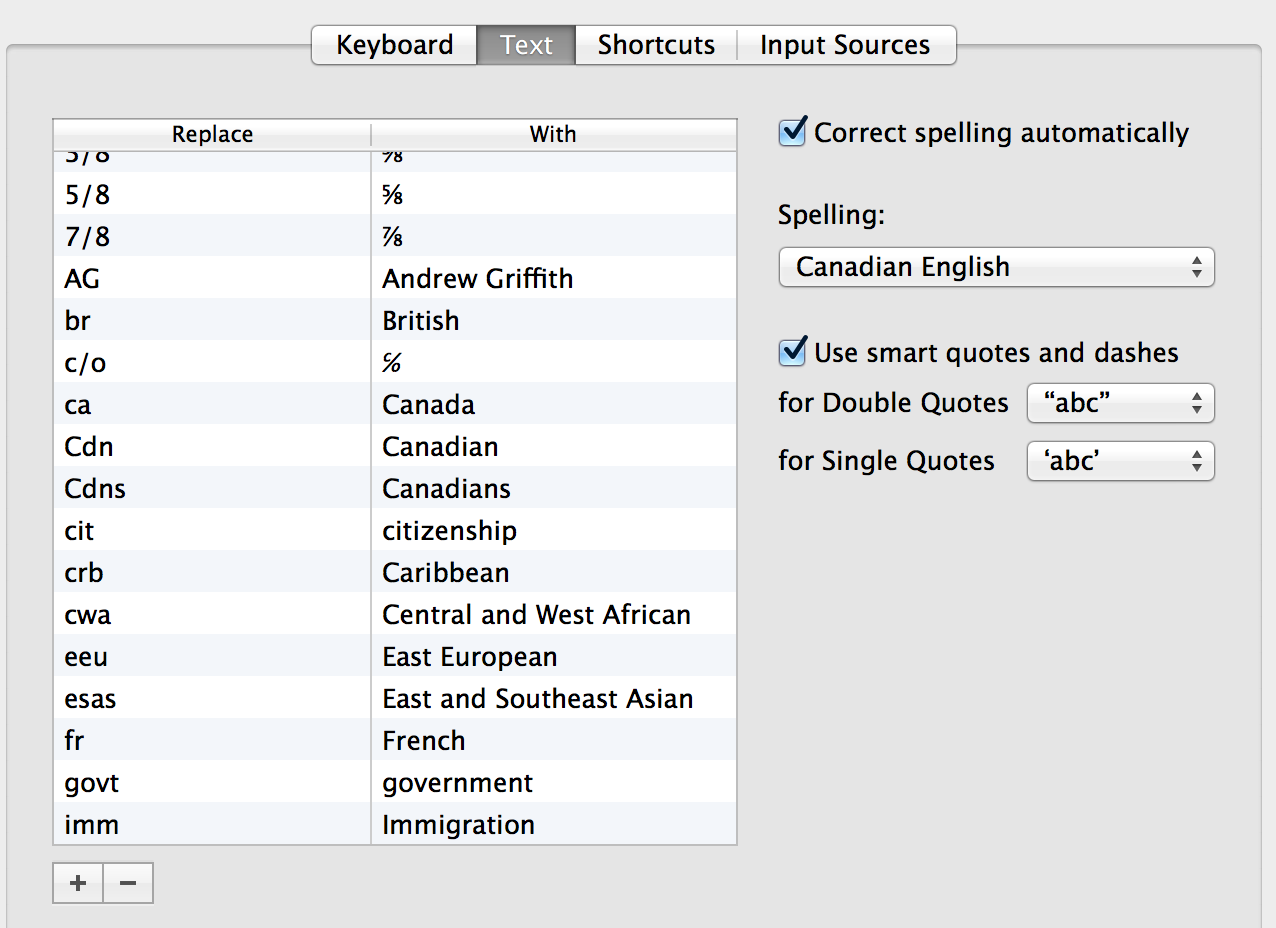
While outside word processing, I also use computer wide shortcuts for frequently used words (in my case, government, citizenship, multiculturalism, Temporary Foreign Workers etc). In the Mac world, go to System Preferences, Keyboard, Text and you will see the standard text shortcuts and can add your own.

Keyboard Text

Ten things everyone should know how to do with a word processor | Macworld.

Permanent Resident Voting: A Movement on the Rise – But does it make sense?

I am not a fan of allowing Permanent Residents to vote although I understand the rationale of supporters.

We have enough problems encouraging citizens to vote and it remains to be seen whether Permanent Residents would have significantly greater interest in voting.

More significantly, there are relatively few differences between citizens and Permanent Residents in terms of rights, social programs and other benefits (and responsibilities) and to a certain extent, if Permanent Residents can vote, this may reduce the incentive to become citizens.

Of course, in the context of the new citizenship act making citizenship harder to acquire, this may increase pressure to allow municipal voting. The old argument about Canadian citizenship being relatively easy to acquire in a relatively short period of time applies less and less:

Finally, we must connect with and support groups who are currently engaging other critical advocacy for newcomers. Earlier this year, the city of Hamilton proclaimed itself a sanctuary city – in other words, the city committed to ensure that every resident, regardless of immigration status, has access to city services. It is no coincidence that a similar proclamation in Toronto preceded the successful motion on permanent resident voting. City Vote must situate itself within the broader movement to ensure newcomers have equal rights and opportunities in Canada.

Thankfully, the campaign has a history of strong partnerships within this larger newcomer-serving community. Thorncliffe Neighbourhood Office, a multi-service community hub in central Toronto, incubated the campaign in 2008 and helped it grow. Maytree has been supporting policy development and hosting forums on the issue since 2007. Groups as large as the Canadian Civil Liberties Association and as small as warden Woods Community Centre have offered their time, energy and support. The foundation for growth is solid and diverse.

Permanent Resident Voting: A Movement on the Rise.

Serving in foreign militaries

Serving in the IDF or other foreign militaries raises sensitive issues related to dual loyalty (see my earlier article Which Country Would You Die For?).

Serving in a foreign military implies a greater loyalty to that country, given the risk of ultimate sacrifice.

But serving in a foreign military, with its own discipline, regulations and codes, is distinct from extremist irregular forces without such developed frameworks (even if there are some common elements).

In the former in democratic societies the broad frameworks and values are largely similar. Needless to say, the same could not be said for those fighting for ISIS or equivalents:

Two Americans serving as lone soldiers were among 13 Israeli soldiers and scores of Palestinians over the weekend who died during the first major ground battle in two weeks of fighting between Israel and Hamas. Max Steinberg, a 24-year-old sharpshooter in the Golani Brigade, was killed as well as Nissim Sean Carmeli, 21, from South Padre Island, Texas.

There were about 5,500 lone soldiers serving in the military in 2012, according to the Israel Defence Forces. Groups for families of lone soldiers, like the support group in Toronto, have recently started in Los Angeles and other cities, providing a support network as the fighting intensifies.

“Lone soldiers are a kind of star in Israel,” Jewish Journal reported. “For Israeli kids, army service is a rite of passage. But because it is a choice for the young members of the Diaspora who re-direct their own life paths to protect Israel, those enlistees are given a hero’s welcome — and a lifetime of Shabbat dinner invitations from their fellow soldiers, who become their surrogate families.”

‘I just want her to get through this in one piece’: Canadians serving with Israeli military amid Gaza conflict, parents say

And in LaPresse, a fairly critical look at Canadian Ambassador Vivian Bercovici’s one-sided perspective as seen through her tweets.

To be fair, she is simply expressing the Government’s policy on Israel and Palestine but given that she formally is the Ambassador to both Israel and the Palestinian Authority, she does seem to be even more one-sided than necessary:

Norman Spector, qui a été ambassadeur du Canada en Israël de 1992 à 1995 et chef de cabinet du l’ancien premier ministre Brian Mulroney, s’est dit surpris du «parti pris» de ces déclarations. «Cela me surprend de lire ses tweets et retweets», a-t-il affirmé.

«Par contre, à mon époque, l’ambassadeur était responsable pour les relations avec Israël et pour les relations avec les Palestiniens, ce qui n’est pas le cas aujourd’hui, si je ne me trompe pas», a-t-il ajouté.

Le bureau du ministre des Affaires étrangères, John Baird, a confirmé que cette dernière responsabilité incombe au Bureau de représentation du Canada auprès de l’Autorité palestinienne.

Le ministre John Baird n’a pas bronché lorsque La Presse lui a demandé de réagir. «Elle est là pour représenter les intérêts canadiens, les valeurs et la position canadienne, et elle le fait très bien», a déclaré un porte-parole par courriel. «Elle a tout notre appui.»

Des experts n’ont pas été particulièrement surpris en lisant ces propos. «Elle a été choisie au départ parce qu’elle avait ces convictions», a souligné Rex Brynen, professeur de sciences politiques à l’Université McGill.

«Je ne crois pas que cette distinction [entre diplomatie et activisme politique] existe réellement, a quant à lui noté le professeur Roland Paris, de l’Université d’Ottawa. Les diplomates ont plusieurs fonctions, et l’une d’elles est d’être un défenseur des positions de leur gouvernement.»

http://www.lapresse.ca/actualites/politique/politique-canadienne/201407/22/01-4785985-israel-les-tweets-de-lambassadrice-du-canada-font-jaser.php