Blatant lying loses family its citizenship — but earns them a $63K bill from Canadian government

Further to my article Overstating “Fraud” – New Canadian Media, an example of particularly egregious misrepresentation (polite term for lying) about residency:

Ottawa has stripped a Lebanese family of their Canadian citizenships — and handed them a $63,000 bill — after they were caught blatantly lying about living in Canada, part of a government crackdown on bogus citizens that could extend to thousands of cases.

The family — a father, mother and their two daughters — signed citizenship forms claiming they lived in Canada for almost all of the previous four years when they really lived in the United Arab Emirates, a fact even posted online in the daughters’ public résumés on LinkedIn.

The bold nature of the fabrications — that successfully won them citizenship in 2008 and 2009 — and their attempts to fight Ottawa’s decision brought rebuke from both the government and the Federal Court of Canada: not only have their citizenships been revoked, but they have been ordered to pay all of the government’s $63,442 in legal bills.

It is a punishment historically associated with only the most egregious cases, usually accused Nazi war criminals who hid their involvement in atrocities when fleeing to Canada after the Second World War.

This case is only the beginning. The RCMP has targeted about 11,000 people from more than 100 countries suspected of fraud by misrepresenting their residency in Canada.

RCMP identified more than 3,000 citizens and 5,000 permanent residents under suspicion in ongoing large-scale fraud investigations. Most are residency claims like in this case.After questions from officials, nearly 2,000 other people have withdrawn their applications, said Nancy Caron, spokeswoman for the Ministry of Citizenship and Immigration.

A few points to note:

  • If I am correct, it is the same Judge McTavish that threw out the Government’s elimination of refugee claimant health care, partly on grounds of lack of evidence. This case shows that when the Government has sound evidence, it can successfully defend policy before the Courts;
  • The new Citizenship Act makes such revocation decisions at the discretion of the Minister, not the Courts. Yet the Courts have handed the Government a significant victory;
  • My estimate of fraud, based upon numbers provided (no change in this article), was a maximum of 3 percent, calculated on the unlikely assumption (CIC not providing information to the contrary) that the number of fraud investigations pertained to a single year. This case dates from 2008, suggesting that the 3,194 fraud investigations cover multiple years, reducing the percentage of fraud considerably;
  • In addition to requiring the family to cover court costs (appropriate deterrent), the bigger financial risk is that the father will lose his Canadian expatriate status with his UAE employer, and the benefits that go with it. As a Lebanese national, his package will likely be significantly less. I expect he will not rush to tell his employer, however;
  • In addition to Hong Kong and Chinese nationals, the breakdown of fraud investigations reveals mainly Mid-East and Pakistani nationals, likely working in the Gulf, given the incentives mentioned above; and,
  • Lastly, the role of social media in exposing fraud provides another useful tool for CIC and the RCMP. I expect that some will likely be revising (i.e., scrubbing) their various profiles as a result.

It is appropriate for the Government to take a serious approach to reducing fraud and this, and likely other cases in the hopper, strengthen the Government’s case.

However, one can question whether the Government is casting the net too broadly in its review of current applications, and delaying too many applications of those following the rules, rather than focussing on the higher risk cases.
Blatant lying loses family its citizenship — but earns them a $63K bill from Canadian government | National Post.

For Somalia, “Team Canada” means more money, fewer jobs

Interesting profile in the Star about returning members of the Canadian Somali diaspora:

A study released last month by the Mogadishu think-tank Heritage Institute notes that “the relationship between returnees and locals in Somalia is complex.”

Security measures often keep the diaspora segregated since they are seen as influential, and therefore targeted by the Shabab. Also, as the report points out, “returnees often find it easier — and more advantageous from a professional networking point of view — to socialize disproportionately with other diaspora returnees.”

Of course the returning diaspora are not a cohesive group. “Generally, non-diaspora Somali communities grasp the diversity among the diaspora returnees,” writes report author Maimuna Mohamud. “They distinguish, for example, between the ‘good diaspora’ who have been successful in their host countries, and the ‘bad’ ones who failed to take advantage of the opportunities available to them.”

Al-Jazeera journalist Hamza Mohamed poked fun at the stereotypes of the returning diaspora by their country of citizenship, dubbing those from Canada who are not part of Mogadishu’s who’s who as “Team Canada YOLO you only live once.”

“They are everyone’s friends. This group treats life as a party and Somalia as a dance floor,” Mohamed wrote in a column that went viral. “They usually arrive with few things — like a minor criminal record and a Mongolian scripture tattoo they got while under the influence on a night out in Toronto. It’s hard to find them talking about serious issues. Don’t mention school — they have usually dropped out of school and are sensitive discussing this subject. If you want them to unfriend you on Facebook, tag them in photos from your graduation ceremony.”

For Somalia, “Team Canada” means more money, fewer jobs | Toronto Star.

Multicultural Britain: Conviviality The Sociological Imagination

Sadia Habib on a number of initiatives demonstrating a more open approach to multiculturalism than often mentioned in the media in the #ShareRamadan social media campaign:

Yet in spite of the politicians and the mainstream media falling short in highlighting examples of how British people experience multiculturalism amongst their friends, colleagues and family, there are glimpses of good that prove that difference and diversity are respected. There is much going on that contradicts this spiel that multiculturalism has failed. Here comes in social media democracy that allows the spread of stories illustrating the significance of small-scale social interaction between diverse Britons of diverse ethnic and religious backgrounds. One such example of Gilroy’s concept of conviviality in action is #ShareRamadan, which shows British people engaging in social practices that are beyond the confines of giving lip-service to tolerance and civility.

Ramadan 2014 is part-way through, and an interesting project aiming to #ShareRamadan with non-Muslims has been trending on social media. Those taking part in #ShareRamadan have been providing video logs of the experience of the fasts that British Muslims are experiencing this lunar year. Non-Muslims are getting to know first-hand how it feels to not eat or drink in daylight hours, and have been waking up at Suhoor time to eat a pre-dawn meal, and then breaking their fast with Muslim friends at sunset (around 9.40pm for most some parts of Britain). Throughout the world the lengths of the fasts vary according to the time of the Fajr and Maghrib prayers, with the fasts in Brazil and Australia being relatively short compared with Iceland and Britain. The Guardian online has provided a space for user-generated content where contributors from all around the world are sharing their photos and tales about Ramadan.

Multicultural Britain: Conviviality The Sociological Imagination.

Retour discret des toiles de Pellan aux Affaires étrangères | Le Devoir

li-pellan2-620Progress:

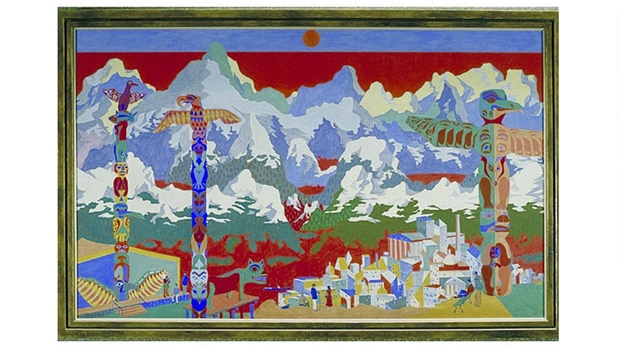
Alfred Pellan est de retour au ministère des Affaires étrangères. Les deux toiles du peintre québécois, qui avaient été écartées du hall d’entrée du ministère au profit d’un portrait de la reine Elizabeth II, sont de retour… timidement, sur un mur adjacent.

Les deux tableaux avaient été remplacés à la veille de la visite du prince William et de sa femme Kate, à l’été 2011. Plutôt que les peintures colorées du peintre québécois, les diplomates et visiteurs du ministère sont désormais accueillis par une grande reproduction d’un portrait de la reine, jonché au-dessus du comptoir de la réception — où se trouvaient les Pellan depuis l’inauguration de l’édifice par la reine en 1973.

I suspect that any change of government would result in a quick reversal of the current government’s fetish for all things related to the Monarchy, including in our missions abroad.

Retour discret des toiles de Pellan aux Affaires étrangères | Le Devoir.

Everyone line up: Canada’s tradition of orderly queuing ‘foreign and strange’ to many newcomers

Nice piece on Canadian queuing etiquette:

Nobody is quite sure why Canadians hold lineups so dear, although Westerners are prone to get quite jingoistic when justifying the practice.

In the 1959 book The Silent Language, anthropologist Edward T. Hall claimed that queuing reflected the “basic equalitarianism” of Western culture.

“To us it is regarded as a democratic virtue for people to be served without reference to the rank they hold in their occupational group,” he wrote.

At the Canadian School of Protocol and Etiquette, Ms. Mencel teaches her students that lining up is a holdover from class-conscious Britain. “People try to better themselves in society by learning all the rules of etiquette that the Upper Class knew, and line etiquette is part of that,” she said.

Marina Nemat is the Ontario-based author of Prisoner of Tehran, her memoir about being imprisoned and tortured as a teenager by Iranian Revolutionary Guards.

To explain her adopted country’s penchant for lining up all the time, she had a simply answer: Canadians — just like their line-upping counterparts in Germany, the United States and Britain — are rich.

“I see the lineups that we have in Canada as a luxury; an absolute luxury,” she told the National Post by phone.

Most Canadians, she noted, have never endured an eight-hour lineup for water, food or scarce medical supplies, situations where “if you start being polite, or if you stay at the end of the line, your child can die.”

“We can afford to be polite, we can afford to respect one another,” she said. “If we Canadians, heaven forbid, one day have to line up with our lives at stake, what then?”

Everyone line up: Canada’s tradition of orderly queuing ‘foreign and strange’ to many newcomers

Peacemaking through film and pastrami: Caplanskys signs on to sponsor Toronto Palestine Film Festival

Nice contrast with some of the ugliness in display during recent demonstrations supporting or opposing Israel’s actions in Gaza:

Caplansky’s desire to find common ground traces back to high school, when as president of York Mills Collegiate, he visited the home of the school’s vice-president, who was Palestinian.

“He had a map of Israel on the wall, and it said, ‘Palestine,’” he recalled. “I realized he has a different perspective, and we can still be friends.”

He said he made the decision several months ago to supply the film festival with one of his signature blue-and-white food trucks, emblazoned with the slogan, “Sometimes you just have to Jew it up.” “I’m not sure how well that’s going to go over,” he said, with a laugh.

On offer during the screening of Laila’s Birthday, a dark comedy by Palestinian director Rashid Masharawi, will be a selection of the Caplansky classics: smoked meat sandwiches; barbecue brisket; smoked meat poutine; maple beef bacon doughnuts.

“I hope they eat. I hope they enjoy,” Caplansky said. “I hope they understand that we’re in this together. This isn’t us and them. This is just us.”

Peacemaking through film and pastrami: Caplanskys signs on to sponsor Toronto Palestine Film Festival | Toronto Star.

I hate the hatred | Coren Toronto Sun

Michael Coren, whose writings I generally disagree with, nevertheless is worth reading in general for a different perspective, and particularly this piece on Israel and Gaza:

I hate the way some on the right and in Zionist circles refuse to listen to the Palestinian experience and believe Israel can do no wrong. I hate the way some evangelical Christians think the ghastly battle over Israel and Palestine is some sort of Biblical combat and modern Armageddon to be fought vicariously by Jews and Arabs. I hate the hatred.

I hate it when North African thugs in Paris attack synagogues in the name of Palestine, beat up Jews in the street and then scream about human rights. I hate it that kids from Pakistan will say not a word about their home country’s blasphemy laws and murder of Christians but roar their hatred of Israel when they probably couldn’t even find it on a map. I hate the hatred.

I hate the singling out of Israel for condemnation but the ignoring of the murderous regimes that surround it. I hate the fact that Iran can hang young gay men, Syria can murder tens of thousands and Turkey can occupy two countries and deny the Armenian genocide but there are no demonstrations. I hate the hatred.

I hate it that when supporters of Israel, like myself, argue that there has to be another way, that Palestine has to exist and that the settlements are wrong, we are mocked as compromisers – I actually wear that badge with pride. I hate it when the same people who welcomed Soviet diplomats, sportsmen and artists and now welcome diplomats, sportsmen and artists from repugnant Arab dictatorships, boycott Israeli kids who can kick a ball or play an instrument. I hate the hatred.

I don’t have a solution, I don’t even have much hope — and for someone who has spent so long in the Middle East, read so much, met so many people, listened to so many stories, I am I suppose a terrible disappointment. I’m obviously not as clever as those on both sides who know exactly how all of this can be settled. But I do know that I hate the damned hatred.

I hate the hatred | Coren | Columnists | Opinion | Toronto Sun.

UK: How I Passed the English Cricket Test – Kenan Malik

Kenan Malik on Britishness and belonging:

Craft a statement. Teach a lesson. Politicians may be the only people in the world who imagine that the creation of identities, or the forging of a sense of belonging, can be reduced to such simple formulas.

What most public debates ignore is the complexity, elasticity and sheer contrariness of identity. Whether personal or national, identities can never be singular or fixed because they are rooted largely in people’s relationships with one another — not merely personal but social relationships, too — and such connections are always mutating.

…. My parents were of a generation that accepted racism as part of life. I was of a generation that challenged it, politically and physically. We confronted far-right thugs, organized street patrols to protect black and Asian families, and stood up to police harassment. And this inevitably shaped our sense of who we were.

My generation did not think of itself as “Muslim” or “Hindu” or “Sikh.” We wanted to be seen as British. When Britain told us, “You don’t belong,” we responded both by insisting on our Britishness and by identifying with those who challenged British identity. Such is the contradictory character of belonging.

… Today, things are different. Neither racism nor racial violence has disappeared, and hostility to immigration has become a defining feature of British politics. Yet the savage, in-your-face racism that marked Britain a generation ago is, thankfully, relatively rare. The nature of Britishness has changed, too. No longer rooted in ideas of race and empire, it is defined as much by diversity as by jingoism. National identity is being recast in a host of new debates, from the fractious question of Scottish independence to the fraught relationship with the European Union.

Blacks and Asians have long since become an accepted part of Britain’s identity, as well as its sporting tapestry. And I have dropped my “anyone but England” attitude. I, too, now feel the pain of penalty shootout defeats and the rare joy of cricket match victories. Yet, if I am now willing to wave the flag at a cricket field or in a soccer stadium, I will not necessarily do so in all contexts. I may be tribal about sports, but I am not patriotic about Britain.

Unthinking, irrational support for one team over another is an essential part of the experience of sports. Patriots wish us to be equally unthinking in our attachment to the nation in every arena, from culture to war. The myth of nationalism is that “Britishness,” just like “Frenchness” or “Americanness,” comes as a single package. But identity does not work like that.

There are many aspects of British life that I admire, and many that I despise. I only have to visit a London street market to be reminded how open Britain is to foods and goods and influences from all over the world; I only have to stand in line in passport control at Heathrow Airport to remember how deep the suspicion of foreigners runs. Many British traditions resonate with me; many I find abhorrent. This is the nation that produced the Levellers and the Suffragettes, radical movements that helped shape the world; it is also a nation that still clings to a monarchy and the unelected, feudal House of Lords.

Many non-British traditions, too, have helped shape my views, values and ideals. To erase this complexity with the myths of patriotism is to diminish the very meaning of belonging.

How I Passed the English Cricket Test – NYTimes.com.

Thérèse Casgrain, feminist icon, quietly shunted by Harper government

Governments unfortunately have a tendency to remake history in their own image, as this vignette about the Thérèse Casgrain indicates:

Michèle Nadeau, Casgrains granddaughter, says her family and the Montreal-based Thérèse Casgrain Foundation, which she heads, were not consulted about whether the award should be eliminated.

“We were informed of a sort of internal review that was done by the Human Resources Department, and they decided to discontinue. But we were never consulted.

“Basically, we were advised that at some point the award would be discontinued … Members of the family, the grandchildren, etc., the great grandchildren, were rather upset.”

An image of Casgrain and her namesake volunteer-award medal also disappeared from Canadas $50 bank note in 2012, replaced by the image of an icebreaker on a new currency series.

An image of the so-called Famous Five women was removed from the same bank note.

The Casgrain Award was killed once before by the Progressive Conservative government of Brian Mulroney in 1990, but was revived in 2001 by the Chretien Liberals.

During preparations for Discover Canada, officials recommended including the Famous Five as part of the historical narrative and to reinforce the some of the values messages but this was not accepted.

Never completely understood why removal rather than appropriating but there is a consistent thread to these and related actions.

Thérèse Casgrain, feminist icon, quietly shunted by Harper government – Montreal – CBC News.

Australia: Imams warn against radicalism to Aboriginal inmates converting to Islam

Interesting article from Australia on radicalization and Aboriginals, and the role prison chaplains can play in reducing risks. Radicalization while in prison is a fairly common issue in a number of countries:

Australian National University researcher Clarke Jones, who is writing a book on prison radicalisation, said extremist conversions were rare because terrorism inmates tended to be at the bottom of the prison pecking order in Australia.

He cited the recent case of Sydney man Khaled Sharrouf, who posted images of himself fighting in Iraq and standing over slaughtered bodies, as an unusual case of an inmate committing acts of jihad upon release.

Sharrouf served four years for his role in the Pendennis terror plot and recently said on Twitter he received weekly lessons from al-Qaeda leader Abu Muhammad al-Maqdisi via the jail phone, a claim that had not been verified.

“The problem is a lot of these de-radicalisation programs are very generic … and tend to be a one-size-fits-all model,” Dr Clarke said.

Asmi Wood, senior research fellow at the National Centre for Indigenous Studies, was aware of Aboriginal conversions in prison and said elders were concerned that converts would join foreign jihad but he had seen no evidence of it.

Rod Moore, chaplaincy co-ordinator for Corrective Services NSW, told the conference NSW had “a long way to go” to increase chaplaincy services but the program led the way globally.

Imams warn against radicalism to Aboriginal inmates converting to Islam.