Kelly McParland: McCallum’s plan to rewrite guide book is a historical stumble

Predictably, and legitimately, concern has been raised regarding the plans to revise Discover Canada, the citizenship test study guide.

When providing advice to the Conservative government on the guide in 2009, I argued for greater balance in their choice and treatment of elements, along with messaging, aiming to ensure a guide that would survive any possible change in government (while there was an advisory committee, it never met together to have a fullsome discussion and debate).

In terms of McParland’s particular concerns, while military history is important (and not just the previous peacekeeping focus), so is social history, which Discover Canada largely downplayed. It was a deliberate political choice to downplay the Liberal narrative in favour of a more Conservative one.

The wording of  ‘barbaric cultural practices’ was largely chosen to attract media attention (it worked!). Arguably, it also was a precursor to the Conservatives use of identity politics, seen in the Zero Tolerance for Barbaric Cultural Practices Act and the late unlamented proposed ‘snitch’ line announced by former Ministers Leith and Alexander.

The same points can be made more effectively in the context of the history of women’s equality rights and how ‘honour’ killings and the like are against the law.

While Discover Canada was a marked improvement compared to the ‘insufferable lightness’ of its predecessor, A Look at Canada, my hope that the Liberal government, in revising and renaming the guide, doesn’t make the same mistake. Hopefully, it will keep some of the stronger points in Discover Canada while ensuring a broader narrative, one that lives up to the diversity and inclusion commitment, and speaks to those with both conservative and ‘progressive’ values:

Canadians continue to celebrate the people and events of the time despite the Liberal government’s apparent perplexity. Re-enactments are held each summer. Streets, schools and universities have been named in commemoration of its key figures. Reminders of the war are dotted across regions that are among Canada’s most popular tourist areas.

Handout

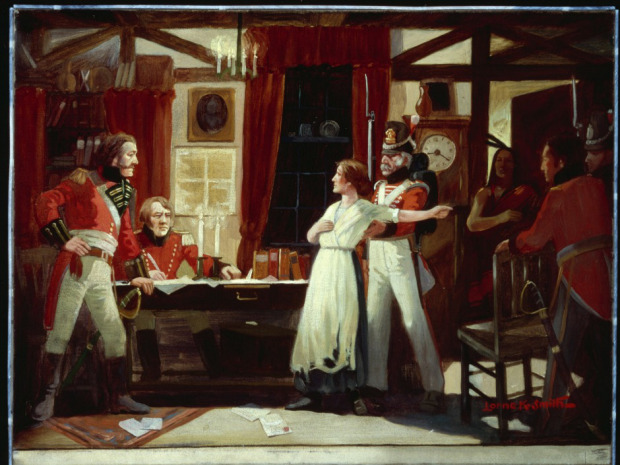
HandoutLaura Secord became one of Canada’s first heroes for warning of an impending American attack. featured in The War of 1812.

There is an unfortunate and dispiriting tendency in current culture to try and re-interpret the past. Oddly, it is deemed inappropriate to honour the events that made Canada a country and set the foundation for the culture we’ve become. We would prefer to condemn previous generations for lacking our own views, as if 19th century Canadians should somehow have shared the perspective of a future society they could never imagine.

The Liberals have shown an eagerness to roll back any initiative they view as too reflective of their Conservative predecessors. McCallum would do well to recognize that Canada’s history does not belong to any particular political party. He should be expanding efforts to acquaint Canadians with their history, not trying to erase it from guidebooks for the sake of a cheap political snub.
Source: Kelly McParland: McCallum’s plan to rewrite guide book is a historical stumble

Nine new MPs came to Canada as refugees or from current or past war zones |

Good profile of the backgrounds of this group of MPs:

Nine newly-elected MPs in the 42nd Parliament, which is considered the most diverse crop of MPs in Parliament’s history, came to Canada either as refugees or fled from war-torn countries.

Out of the nine, according to research conducted by John Chenier, former editor of <em>The Lobby Monitor</em> and now editor of ARC Publications, four came to Canada as refugees from war zones or suffered persecution and five immigrated to Canada from current and past troubled zones such as the Middle East or Pakistan.

The four MPs who came to Canada as refugees are: Liberals Arif Virani (Parkdale-High Park, Ont.) from Uganda; Gary Anandasangaree (Scarborough-Rouge Park, Ont.) from Sri Lanka; Maryam Monsef (Peterborough-Kawartha, Ont.) from Afghanistan and Ahmed Hussen (York South-Weston, Ont.) from Somalia.

The five first-generation immigrants from current and past danger zones include: Liberal MP Faycal El-Khoury (Laval-Les Iles, Que.) from Lebanon; Liberal MP Iqra Khalid (Mississauga-Erin Mills, Ont.) from Pakistan; Liberal MP Salma Zahid (Scarborough Centre, Ont.) from Pakistan; Liberal MP Eva Nassif (Vimy, Que.) from Lebanon, and Conservative MP Ziad Aboultaif (Edmonton Manning, Alta.) from Lebanon.

In total, there are 40 MPs from all parties who were born outside of Canada, according to Parliament of Canada website and research conducted by <em>The Hill Times</em>. Of these, 29 are Liberal, eight are Conservatives, two are NDP, and one from the Green Party.

Source: Nine new MPs came to Canada as refugees or from current or past war zones |

Time to rewrite Citizenship Act, ‘Lost Canadians’ advocate says

Don Chapman continues his crusade for the few remaining cases of ‘Lost Canadians.’

It appears that the main focus of his efforts is more with respect to posthumous recognition of Canadian citizenship and their descendants. There do not appear to be any hard numbers showing this is a significant issue (at least that I have seen) although there are a few anecdotes that he cites:

When it comes to immigration law, Prime Minister Justin Trudeau likes to say, “A Canadian is a Canadian is a Canadian” — but one advocate says it’s actually not that simple.

The Liberal government should be taking more steps to help law-abiding people whose road to citizenship is blocked by the existing law, said Don Chapman, a longtime champion for so-called “lost Canadians.”

It’s time for the Citizenship Act to be scrapped and rewritten, Chapman said — and he believes the upcoming 150th anniversary of Confederation is the perfect time.

For instance, a baby born to a Canadian woman outside the country’s borders would not have been deemed Canadian if the mother was married to a man of a different nationality, but would be if the mother was unmarried.

In 1977, an updated law created new issues. It established the concept of dual citizenship, but did not restore Canadian citizenship for those who lost theirs when they switched under the earlier law.

The consequences of these two pieces of legislation were people who became known as “lost Canadians” — mostly those who believed themselves to be citizens, but by law were not.

The act has been amended several times. There are now 18 definitions of what makes a person a Canadian citizen with more than a dozen caveats, linked to everything from what year they were born to whether their parents were Canadian diplomats or soldiers.

Still, Chapman said he hears from people nearly every day who have suddenly learned they aren’t citizens, or can’t get the decades-old birth certificates of their now-deceased parents to prove that they are. They end up in endless battles with the government or before the courts, and need a citizenship ombudsman who could help, speeding up the system at the same time.

And yet the first thing the Liberals did with the Citizenship Act was to restore the status of a convicted terrorist, Chapman said.

They did it with Bill C-6, introduced last month to revoke a provision of the existing law that allowed dual citizens to be stripped of their Canadian citizenship if convicted of terrorism or other crimes against the country.

A government spokesman said changes to the Citizenship Act in 2009 and 2015 restored or granted citizenship to the “vast majority” of lost Canadians.

And there are ways to address cases that weren’t covered, Immigration Department spokesperson Nancy Caron said in an email.

“The minister has the authority to grant citizenship on a discretionary basis to alleviate cases of special and unusual hardship,” Caron said. “Those cases are assessed on a case-by-case basis.”

Source: Time to rewrite Citizenship Act, ‘Lost Canadians’ advocate says | CTV News

Vision Vancouver pushes gender parity motion

One aspect of diversity but as the DiverseCityonBoard initiative makes clear, this challenge goes beyond gender given the increased (and increasing) ethnic diversity in our larger cities:

All City of Vancouver advisory committees could soon be required to have 50-per-cent female representation.

To mark International Women’s Day on Tuesday, Vision Vancouver Coun. Andrea Reimer plans to introduce a motion that would create a formal policy ensuring that at least half of all committee members are women.

Mayor Gregor Robertson indicated he’ll be supporting the motion, and hopes it will pass unanimously.

Reimer’s motion also calls for a review of how the city funds subsidized housing and social policy grants to make sure that women and girls are getting an equal share of services.

“While we often think of Vancouver as a progressive city, there’s more we could be doing to remove barriers to women and ensure that we are providing an equitable delivery of services,” Robertson said in a press release. “We continue to see women underrepresented in public life and in 2016 there’s no reason that should be acceptable.”

But unanimous support may not be possible. NPA Coun. Melissa De Genova said she has yet to decide which way she’ll vote on the motion, but she does have concerns about the 50-per-cent standard.

“We all would like to see more women become involved in our city and in our community, but I think perhaps we don’t agree on how we should get there,” she said.

Source: Vision Vancouver pushes gender parity motion

How do we fill the pipeline with board-ready women?

While the issues facing women are different, there may be some parallels with respect to increasing visible minority and indigenous representation:

On Tuesday, countries around the globe join in celebrating International Women’s Day, honouring the achievements of women and mobilizing with programs to close the gender gap. This year’s theme, Pledge for Parity, is a call to accelerate equality, with a special emphasis on shrinking the gender gap in leadership positions.

It’s time to consider what this means for Canada’s leadership landscape. We need to take a close examination of who our CEOs are and who is seated in our boardrooms.

It has been just over a year since new regulations required companies listed on the Toronto Stock Exchange to annually disclose the percentage of women on their boards of directors and in executive officer positions. Now companies must report their goals and the actions being taken to increase their figures, or provide reasons when no such targets exist.

Proponents of the legislation hope that the guidelines will raise the percentage of board seats held by women to 30 per cent – but even they acknowledge that progress beyond that level will require a more robust pipeline of female executive candidates. To truly achieve gender-balanced boards, we need to examine some of the root causes of the imbalance. While tremendous energy is being exerted on quick fixes, how do we take a long-term approach?

As someone who works closely with boards and CEOs to identify and develop the next generation of business leaders, I believe that we need to closely examine women in mid- to senior-leadership positions today to build a more robust executive pipeline – particularly since many companies are inadvertently hampering their own progress.

Consider what happens when a high-potential female executive returns from family leave, seeking a position that allows her to ease back into the workforce. Often, companies respond supportively by transitioning her from an operational role into a functional support role, allowing for career development that builds functional expertise and deepens her contribution and seniority without the time and travel demands of operational leadership.

At face value, this seems to be a win for all parties. But there’s a catch. These women with exceptional potential wind up in positions where they get overlooked for future growth or profit-and-loss leadership opportunities. Their steady success in transitional and functional roles limits their potential for future CEO or board roles.

As board positions become available and nominating committees seek new director candidates, they invariably prefer those who have been CEOs or heads of business units, bringing effective P&L management.

Our research shows that 21 per cent of the direct reports to the CEO of TSX 250 companies are women, while two-thirds of those women are leading support functions. Of the direct reports who have operating leadership roles, just 7 per cent are women. The pipeline of board-ready women doesn’t flow.

While we work to make the number of women in the boardroom rise above 30 per cent, both corporate Canada and female executives need to focus on building operational excellence. We must have more female contenders for CEO succession, and in order for this to happen, must collectively consider and thoughtfully engage in career-path decision-making.

Only by addressing these root issues can we hope to move toward full gender equality at the top of the corporate pyramid.

Source: How do we fill the pipeline with board-ready women? – The Globe and Mail

Annual Report on the operation of the Canadian Multiculturalism Act: Building a diverse and inclusive society

The 2014-15 report was released discretely (no press release, no announcement), given that it covers the period of the previous government. The only changes that could be made were largely cosmetic in nature.

The sub-title changes to Building a diverse and inclusive society, and Minister Joly picks up on the now standard language:

In Canada, we are recognized worldwide for our successful approach to multiculturalism, which focuses on building a diverse and inclusive society by promoting and encouraging awareness, understanding and respect for the many different cultures that contribute to the economic and social wealth of our country. While the Government of Canada sets the stage through the Canadian Multiculturalism Act, it is thanks to the full participation of our provincial and territorial partners, stakeholders and the Canadian public that we are able to find unity in our diversity and to learn from one another.

…As Canadians, we know that our country is made stronger because of our diversity, not in spite of it. By working together, we are advancing respect and appreciation for multiculturalism across the country while fostering a sense of inclusion and belonging in all Canadians.

In contrast, the previous report, consigned to Former Minister Kenney, reflects a different tone:

Our government is committed to promoting integration, intercultural understanding, peaceful pluralism as well as religious freedom—in Canada and abroad. I have been pleased to meet with many community organizations and international partners over the past year to advance our values and goals.

…By working together, we are making strides in celebrating our multicultural heritage, strengthening the value of citizenship and ensuring the successful integration of newcomers to Canada.

One of the disconnects or ironies is of course that the period under question, and thus the report, reflects the language, approach and activities for that period, with only really the Minister’s message reflecting the change. I was in a similar position when Minister Kenney had to sign-off on a report that largely reflected the priorities and language of the previous government.

No where is this more apparent than in the report’s vaunting of the changes to citizenship, both legislative and administration, many of which are being undone by the current government.

The other striking aspect is what appears to be under-spending in multiculturalism grants and contributions, $3.9 million, compared to the $8.5 million indicated in the DPR. This may reflect ongoing financial commitments in multi-year projects (which next year’s DPR will indicate).

Annual Report on the operation of the Canadian Multiculturalism Act: Building a diverse and inclusive society


Abolish office of religious freedom: Anthony Furey

Interesting that the call to disband the office is coming from the Toronto Sun which generally supported the previous government:

It really does look like the office is just multicultural pandering, letting various religious groups – and they’re well-represented on the office’s 23 member advisory committee – feel the government is going to bat for them around the world.

It’s not exactly a “Canada first” endeavour, is it? I’m rather uncomfortable with us encouraging religious leaders into thinking their priorities are automatically Canadian policy priorities.

It’s even in the mandate: “The office will promote freedom of religion or belief as a Canadian foreign policy priority.”

A good and true sentiment, but a priority? No thanks. Canada’s foreign priorities should be about geopolitical stability with a view to our economy and security interests. If religious freedom becomes a secondary goal in these ventures then fine, but it shouldn’t be a standalone one.

However Garnett Genuis, Conservative MP for Sherwood Park-Fort Saskatchewan, believes the office is doing good work and hopes the Liberals keep it.

“Religious persecution is increasing and there are religious undertones to a lot of conflicts that exist in the world today,” he told me in a phone interview.

“If you believe the government should be involved in development assistance to some point, this is a very effective way for the government to be contributing to global harmony,” Genuis adds. “It helps to elevate our reputation as a country that takes human rights seriously and is willing to put its money where its mouth is.”

If these activities are priorities for the government, they shouldn’t be undertaken by a secondary office, but directly championed by the foreign affairs minister. And if they’re not that important, then leave them to the NGOs. There’s really no compelling reason for the Liberals to maintain this office.

Source: Abolish office of religious freedom | Furey | Columnists | Opinion | Toronto Sun

Why stripping citizenship is a weak tool to fight terrorism: Roach and Forces

Usual good analysis and assessment:

First, even assuming that citizenship revocations produced the removal of dangerous people from Canada, that strategy would amount to anti-terrorism NIMBYism. More concretely, Canada would embark of a policy of catch and release – setting up today’s convicts as tomorrow’s foreign fighters, with travel to foreign locales facilitated by the Canadian government. It seems unlikely other countries would embrace the “return” of people converted to violence in Canada, and deposited on their doorstep because of a potentially tenuous residual link of nationality.

Nor would it be sensible to assume that deported former Canadians would thereafter be unable or uninterested in engineering acts dangerous to Canada and Canadians. Operating far from Canada and its security services, they would enjoy a greater freedom to do so than would those kept closer to home, under watch and potentially more invasive strictures, such as peace bonds.

Second, the provisions only applied to dual nationals. The rationale for this focus was simple – making someone stateless would violate Canada’s international obligations. But this focus on a small subset of Canadians encouraged the dangerous delusion that terrorism is (or can be made into) a foreign threat and problem. The so-called Toronto 18 plot, the terrorist attacks of October, 2014, and the 1985 Air India bombing underline the fact that terrorism is a Canadian phenomenon. Some of those plotters were dual nationals, others were not. In almost all of the recent terrorism cases, the violent radicalization of plotters was made-in-Canada, not the product of residence in some foreign locale.

Citizenship revocation for dual nationals is at best a capricious and close to arbitrary tool, focused not on a class of people who are the most objectively dangerous, but on a population most legally vulnerable to the extraordinary revocation power.

Third, the law now being repealed would in most cases commit Canada to long and costly battles about whether it can deport a convicted terrorist to countries such as Iran without the person running the risk of torture. This is a path we have been down before, with the infamous (and to date fruitless) security certificate disputes – legal proceedings that have consumed millions of taxpayer dollars and have yet to result in the removal of any of the five foreign-born men accused of terrorism and subjected to removal orders after the terrorist attacks of Sept. 11, 2001.

The costs here stem not only from the extensive litigation but also from the reputational hit Canada incurs when it risks complicity with torture. The O’Connor and Iacobucci inquiries into the role of Canadian authorities in contributing to the maltreatment of Canadians in foreign jails are now a decade old, but their lessons remain acute. Stripping someone’s nationality before sending him to a foreign jail in a torturing country does not change in the least the ethical or legal implications of such conduct.

Fourth, the prospect of deporting terrorists who have served their prison terms provides Canada with another excuse not to dedicate resources to problems of prison disengagement from terrorism and rehabilitation. The Western world is slowly awakening to the reality that many people convicted under broad, post-9/11 laws enacted to prevent terrorism before it happens will eventually be released. The idea of citizenship stripping encourages the illusion that Canada can displace the risk of terrorism, rather than take responsibility for fighting it through programs that counter violent extremism, including for people convicted of terrorist plots.

All of these points condemn citizenship revocation even without considering questions of constitutional law and principle. But those, too, are ripe – not least, the issue of whether our courts would have followed their U.S. counterparts and condemned citizenship revocation as an underhanded supplemental punishment for things a citizen did, while still a citizen.

Source: Why stripping citizenship is a weak tool to fight terrorism – The Globe and Mail

Canadian Heritage shows how public service seeks to foster innovation

Good initiative and equally good debate about its utility (I had tried equally to institute the Google 20 percent time set-aside – without much success):

As part of a push in the bureaucracy to find new ways to work, Canadian Heritage is one of a dozen departments taking a page from Google and letting employees spend up to 20 per cent of their time working on temporary projects outside their usual job descriptions and the usual procedures.

Deputy minister Graham Flack said the initiative – called “micro-missions” – was developed to bring some flexibility to the rigid organization of departments.

“The theory behind micro-missions is, in government, it’s actually very difficult with our traditional HR systems to move people around,” Mr. Flack said.

Mr. Flack also chairs a committee of top bureaucrats who work on new ideas, and the group invites junior employees to join their discussions to get fresh ideas and a better view on the ground.

“We operate in a very hierarchical organization, and sometimes [we have] to give them a reality check,” said Francis Nolan-Poupart, a 27-year-old policy analyst at Employment and Social Development Canada, who sits on the committee.

But just because an idea worked for Google does not mean it will work for the government – or even for other tech companies. Konval Matin, the director of culture at Shopify in Ottawa, and Anna Lambert, the director of talent acquisition, said their company – a rising star in Canada’s tech world – tried giving employees time every week for special projects, but it just did not work.

“We realized you would get so enthralled in your day-to-day that you wouldn’t actually set aside the 20-per-cent time,” Ms. Matin said.

Marianne Hladun, an executive who leads the Public Service Alliance of Canada’s young-worker file, said the union has some concerns that projects might just add work for already stressed employees.

“In a lot of cases, people are just trying to keep their heads above water,” Ms. Hladun said. “In some departments, which I believe Canadian Heritage falls into, … people are doing special assignments but they’re not being compensated at appropriate levels. That’s a bit of a concern to us.”

Leaders at both the political and bureaucratic level have warned that many areas of the federal public service are suffering from poor workplace environments that are hampering service delivery and the mental health of the work force. In her final annual report last year as the top bureaucrat in Ottawa, Janice Charette said there was an urgent need to create a “healthy, respectful and supportive work environment.”

Donald Savoie, a professor at the Université de Moncton and a leading expert on public administration, said he thinks some of the innovative projects are just “band aids” that do not fix deeper problems affecting morale in the public service. “For a government to say, we’re going to have hackathons, or collaborative events, or spaces, that, my friend, is the easy part. The much more difficult part is redefining the role of the public service so that it would resonate.”

Shopify holds townhalls on Fridays where employees are encouraged to share what they are working on, and talk about what is going well and what is more challenging than expected – just as Canadian Heritage tried to do with its pizza lunch.

Ms. Matin of Shopify said even the executive team takes part occasionally – and the exercises have been good not just for morale, but also for productivity as workers from different teams pick up tips from each other.

“The stuff that’s really easier said than done is the trust and the autonomy,” Ms. Matin said. “Not being afraid of letting people experiment and try new things and potentially fail. But the cool thing is, let them fail, let them talk about it.”

Traditionally, the public service is not known for taking risks. Mr. Brison acknowledges the potential for failure as more public institutions and individuals are empowered to try new things and make more decisions on their own. As a political leader, he could be held responsible if something goes wrong. But he says that is part of pushing the public service to do better.

“The only way to avoid ever making any mistakes is to do nothing,” he said.

Source: Canadian Heritage shows how public service seeks to foster innovation – The Globe and Mail

Canadian Citizenship: From “Harder to get and easier to lose” to a new balance

This presentation made at Metropolis 2016 analyzes citizenship test and take-up data, reviews the policy changes and impact of the 2010 and 2014 Conservative government changes and assesses the likely impact of the Liberal changes announced February 2016.

I will update some of the data when full-year 2015 stats are released.

Canadian Citizenship: From “Harder to get and easier to lose” to a new balance