Islam Makes Stronger Patriots, US Study – The Atlantic

American_Faith_GroupsWorth noting:

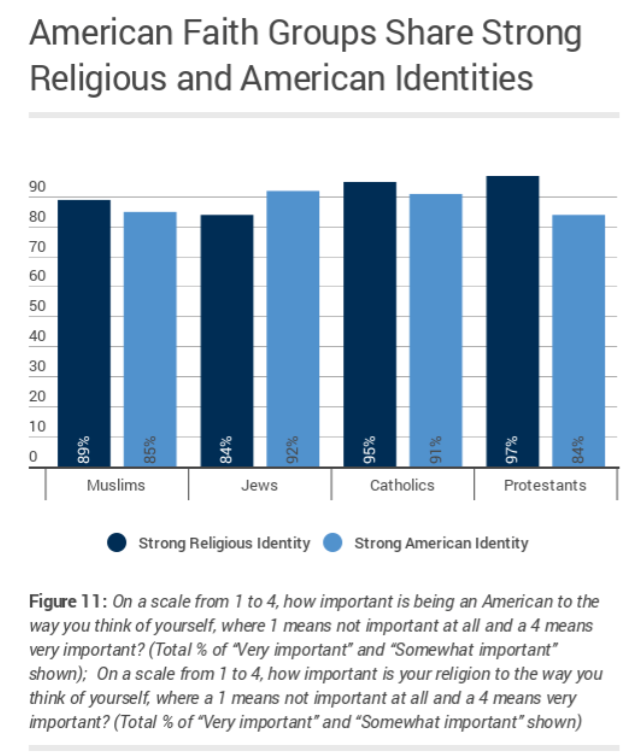
Donald Trump’s calls for a ban on Muslim immigration and the closing of American mosques seem to reflect suspicion that Islam and American citizenship are incompatible. But religion and patriotism are not opposing forces for American Muslims; in fact, they’re strongly correlated.

That’s one of the key findings of a first-of-its kind poll conducted by the Institute for Social Policy and Understanding, a non-profit focused on studying this section of the American population. The poll compares Muslims to American Jews, Protestants, and Catholics with respect to their levels of religiosity, patriotism, activism, and general outlook on the state of the country and on their lives. “In this election cycle, specifically, Muslims have been a topic of debate but seldom participants in that discussion,” said Dalia Mogahed, ISPU’s research director.

“We found that there was no correlation between mosque attendance and support of violence,” Mogahed said. On the contrary, she suggested, the results indicate that mosques are ideal places where community organizers might start engaging people because those who attend regularly “are more receptive to a message of civic engagement.”

“The research shows that mosques are actually a force for moderation. Muslims frequent a religious service as much as Protestants, and those who do go more frequently are not in any way more likely to condone violence,” Mogahed said. Muslims who said they attend services more frequently were more likely not to condone violence, with 65 percent saying “it is never justified,” compared to 45 percent of similarly devout Jews, 43 percent of Catholics, and 40 percent of Protestants.

The survey also found that American Muslims were more likely than members of other faith communities to reject attacks on civilians by the military, and as likely as any other group to also reject attacks on civilians by an individual or a small group, Mogahed said. They are “at least as likely as other faith communities to reject violence unequivocally,” she said.

Source: Islam Makes Stronger Patriots – The Atlantic

Marine Le Pen: l’accueil de 25 000 réfugiés syriens est «une folie»

Marine Le Pen’s visit to Quebec and reactions:

L’accueil de 25 000 réfugiés syriens par le gouvernement Trudeau est une « folie ». La classe politique d’ici subit une forme de « terrorisme intellectuel ». Les Québécois ne sont pas assez combatifs quand vient le temps de défendre leur langue. En visite au Québec, la présidente du Front national (FN), ce parti d’extrême droite de France, en a long à dire sur la politique canadienne et québécoise.

Marine Le Pen estime que son parti a des affinités avec le Parti québécois. Elle appuyait le projet de charte des valeurs, qui a soulevé une telle controverse. Elle croit que Pierre Karl Péladeau donnera un « nouveau souffle à la souveraineté ». La Presse l’a rencontrée.

Sa visite au Québec était à peine annoncée que tous les partis politiques provinciaux et fédéraux sont sortis sur la place publique pour déclarer qu’ils ne rencontreraient pas Marine Le Pen et qu’ils ne voulaient rien avoir à faire avec elle. À croire que la chef du FN est radioactive. Que pense-t-elle de ce traitement ?

« La classe politique québécoise semble vivre dans une forme de crainte. Et je trouve que quand il y a de la crainte dans une démocratie, c’est que la démocratie va mal. » Mme Le Pen, qui trouve la réaction des politiciens « puérile », affirme que des gens du milieu politique ont sollicité des rencontres avec elle, mais qu’ils ont eu « peur de le faire » ou qu’ils l’ont contactée « pour dire qu’ils [avaient] subi beaucoup de pression ». Elle refuse de divulguer leur nom ou leur allégeance.

« Il y a une forme de terrorisme intellectuel qui est très dommageable. Parce qu’une démocratie mature n’a pas peur du débat d’idées. Ça en dit long sur le poids du politiquement correct et de la pensée unique. Cela dit, ce n’est pas très grave. Je ne suis pas là pour faire la tournée des popotes politiques. Même s’il y a toujours intérêt, quand on est un responsable politique, à pouvoir échanger avec des gens qui peuvent sur certains sujets partager vos préoccupations. »

Source: Marine Le Pen: l’accueil de 25 000 réfugiés syriens est «une folie» | Gabrielle Duchaine | Politique

And:

Le chef du Parti québécois, Pierre Karl Péladeau, a tenu à dissocier sa formation politique d’une rencontre qui aurait eu lieu entre des militants du PQ et la dirigeante du Front national, Marine Le Pen, en visite au Québec.

M. Péladeau a dit, samedi, sur sa page Facebook, avoir été «choqué» en apprenant que des personnes, «s’affichant comme des “jeunes du Parti québécois”», avaient rencontré Mme Le Pen.

«Au nom du Parti québécois, je tiens à dissocier formellement notre formation politique et ses instances de toute activité ou rencontre, issue d’initiative personnelle, avec des représentants de ce parti dont l’histoire, la doctrine et les propositions sont aux antipodes des valeurs du Parti québécois», a-t-il écrit.

Sébastien Chenu, conseiller régional de Picardie-Nord-Pas-de-Calais et se présentant comme délégué national du Rassemblement Bleu Marine – un mouvement rattaché au FN -, avait publié une photo de Mme Le Pen avec quatre hommes, écrivant: «MLP rencontre les jeunes militants du Parti québécois! Échange passionnant!!»

La dirigeante du Front national, parti français d’extrême droite, débarquait à Montréal vendredi. Mme Le Pen annonçait sur son site officiel un voyage en Amérique du Nord débutant ce week-end.

La politicienne ne met aucune rencontre officielle à son agenda.

À Ottawa, au Parti conservateur, on affirmait, vendredi, ne rien savoir de la visite de la dame et on ne prévoyait pas de rencontres entre elle et des élus conservateurs. Même commentaire chez les néo-démocrates, les bloquistes et au gouvernement de Justin Trudeau. À Québec non plus, personne ne se préparait à l’accueillir.

Le député du parti de gauche Québec solidaire Amir Khadir a dit à Radio-Canada être prêt à rencontrer la présidente du Front National, en dernier recours, «par humanisme». Il disait vouloir démontrer à Mme Le Pen «que le Québec n’est pas un terrain xénophobe».

La présidente du Front National a rétorqué, également en entrevue à la télévision publique, qu’elle avait à faire à «plein d’Amir Khadir» en France, des gens qui estiment «que lutter contre l’immigration est faire preuve de xénophobie».

Des péquistes rencontrent Marine Le Pen, Péladeau s’en dissocie

Only Script In Shakespeare’s Handwriting Urges Compassion For Migrants : NPR

Worth watching, Ian McKellen’s reading of the speech (just before the 3 minute mark):

This week the world’s been treated to a commentary on immigration reform from a surprising source: William Shakespeare.

2016 being the 400th anniversary of the Bard’s death, many institutions are doing celebrations of one sort or another. The British Library, in hosting a major exhibition, has put online the only surviving scrap of a script in Shakespeare’s handwriting — a scene that finds eerily poignant echoes in today’s arguments about refugees and immigration on both sides of the Atlantic.

It’s a speech from a play, The Book of Sir Thomas More, that was not by Shakespeare. Nor was it produced in his lifetime, apparently for fear that it would incite unrest at a time of religious tensions that had created an unprecedented refugee crisis in Europe. The Bard and several other authors did rewrites, but while his own contribution was an impassioned plea for tolerance, the revisions weren’t enough to get the play produced, and its script languished for centuries.

When it was finally staged in London in 1964, a young Ian McKellen played Sir Thomas More (which has enabled him to joke in speaking engagements that he is “maybe the last actor who can say ‘I created a part written by William Shakespeare’.”)

A part only partly written by the Bard, but powerfully so. In the stirring speech penned in Shakespeare’s hand, it is More’s task to silence a mob that’s rioting about “strangers” in their midst. King Henry VIII had offered safe haven to too many refugees, scream the rioters. “They must be removed!”

More begins by pretending to agree, then points out that there’s a problem with mob rule when it denies clemency to the downtrodden. Though Shakespeare’s handwritten revisions to The Book of Sir Thomas More qualify as a rough first draft, they do not lack for eloquence in decrying the mob’s “mountainish inhumanity.”

You’ll put down strangers,/ 

Kill them, cut their throats, possess their houses,/ 

And lead the majesty of law in lyam/ 

To slip him like a hound. Alas, alas! Say now the King/ 

As he is clement if th’offender mourn,/ 

Should so much come too short of your great trespass/ 

As but to banish you: whither would you go?/

What country, by the nature of your error,/ 

Should give you harbour? Go you to France or Flanders,/

To any German province, Spain or Portugal,/ 

Nay, anywhere that not adheres to England:/ 

Why, you must needs be strangers.

Shakespeare’s original handwritten script is now on loan at the Folger Shakespeare Library in Washington. It is one of more than 300 texts being digitized as part of the British Library exhibition, Shakespeare in Ten Acts, that opens April 15 in London.

Source: Only Script In Shakespeare’s Handwriting Urges Compassion For Migrants : The Two-Way : NPR

Trudeau appoints seven new senators: Diversity and inclusion in this first batch

The first batch of Senate appointments provide initial confirmation of the Government’s intent to diversity and inclusion in appointments. The chart above contrasts appointments by previous Prime Ministers with those made Friday (former PM Martin made no appointments during his short tenure).

Prime Minister Harper made many visible minority Senate appointments, partially as part of its engagement strategy with new Canadian voters and to address representation gaps elsewhere.

In addition to the large share of women appointed, the presence of one visible minority, one Indigenous person, and one person with disability (although given her accomplishments, hard to consider Chantal Petitclerc as such), the regional balance of these initial appointments include three from Ontario and two each from Quebec and Manitoba.

The real challenge for the Government will be less with respect to these high profile announcements but the more mundane Governor-in-Council appointments that will be made over coming years (about 1,500 positions, currently just over 1,300 filled) and the range of judicial appointments that will emerge in coming years:

Prime Minister Justin Trudeau is appointing the head of his transition team and six other Canadians to the Senate in the first injection of fresh blood to the scandal-plagued institution in three years, sources said.

Mr. Trudeau is set to announce on Friday that he is calling on Peter Harder, a retired senior bureaucrat and high-level corporate adviser, to be the Liberal government’s leader in the Senate. In addition to Mr. Harder, the six new senators will be:

  • Raymonde Gagné, former president of Manitoba’s Université de Saint-Boniface;
  • Frances Lankin, a minister in the former Ontario NDP government and a national security expert;
  • Ratna Omidvar, an expert on migration and diversity, and executive director at Ryerson University’s Global Diversity Exchange;
  • Chantal Petitclerc, a champion Paralympic wheelchair racer and Team Canada chef de mission at the Rio Paralympic Games;
  • André Pratte, an award-winning editorial writer and federalist thinker from Quebec;
  • Murray Sinclair, a retired Manitoba judge and former chair of the Truth and Reconciliation Commission into residential schools.

Mr. Harder will face the tough task of moving government legislation through a fractious Senate in which the Liberal Party has no control over any other members. Still stinging from a recent spending scandal, the institution is also set to release on Monday a final report on the expenses claims of 14 senators who challenged the Auditor-General’s call for reimbursements.

Mr. Trudeau’s six other appointees will be expected to act as independent-minded legislators, as the Prime Minister aims to eliminate partisanship in the upper chamber and improve its reputation.

The Senate is currently composed of 42 Conservative senators, 26 Liberal senators (who are not part of the Liberal caucus of MPs) and 13 non-aligned senators.

Source: Trudeau set to appoint seven new senators – The Globe and Mail

In British Columbia, a real-estate rage gets real

Understandable anger and fears.

The negligence of governments in not addressing the issue, starting with failing to address data gaps that leave space for anecdotes, along with a real estate industry  whose commission-based model only abets property flipping and escalating prices, it is no wonder that people are angry and fearful:

In the last six months, Eby, who unseated Premier Christy Clark in the last election—the kind of brass-knuckled political play rarely seen outside B.C.—has become B.C.’s most-watched opposition figure by skillfully assuming control of the housing debate.

Last November, the 38-year-old Vancouver-Point Grey MLA and former head of the B.C. Civil Liberties Association helped a city researcher undertake a study showing that more than 70 per cent of homes sold in Vancouver’s West Side went to Mainland China buyers over a six-month period; remarkably, this was some of the first hard data illustrating the extent of foreign ownership in the local market.

For years, the debate relied mostly on anecdotal evidence. And anyone who dared suggest Chinese buyers were flooding the market was branded a racist—primarily by those with skin in the game, the city’s leading developers and condo marketers whose earnings soared as the market has climbed and climbed and climbed, unchecked. Screaming racism was an effective means to shutter the debate. Until now.

This could yet get ugly. Belcarra, and its “English-only” bylaw, is just the beginning. But in channeling rage over foreign buyers, wild speculative activity, shadow flipping, and realtor misconduct, Eby—rake-thin, young and passionate—has found a way to break the logjam, and tap into something deep and powerful in the psyche of residents of B.C.’s Lower Mainland, where the bulk of the province’s seats are found. There are few more powerful emotions in politics than anger. And for the first time in years, the NDP have found an issue with widespread appeal.

“People are really upset,” Eby said Wednesday night. “Their wages have no connection to the amount of money that is being charged for rent and for housing. People think their kids aren’t going to be able to afford to live here, they see the communities they love really no longer belonging to the community.”

“My younger child is sleeping in my bathroom,” said Jennifer Lloyd, a UBC researcher, who spoke after Eby. Lloyd and her husband, who both have PhDs and can only afford a tiny, rented condo for their family of four.

“This is not a generational issue, this is not a class issue,” said Lloyd. “I want to know that the virtues that I hold dear—hard work, educating ourselves, trying to better our lives—mean something in this city.”

It’s still far from clear that this surging anger risks unseating Clark, in an election slated for next spring. But right now, few are talking about the premier. And no one can seem to get enough of David Eby. One year before an expected election, that’s a dangerous place for the premier to be.

Source: In British Columbia, a real-estate rage gets real – Macleans.ca

How a comedian, a rap group and a separatist critic are slaying a sacred cow: Quebec’s language rules

Graeme Hamilton on one of the latest twists in the Quebec culture debates:

In Mauvaise Langue, Cassivi mocks University of Ottawa language professor Jean Delisle for an article Delisle wrote complaining about the rampant English in Xavier Dolan’s film Mommy. In an interview, Delisle said he expects the acceptance of English preached by Cassivi will go the same way as the joual slang Quebec authors incorporated into their work in the 1970s.

“Nobody reads those novels any more,” he said. “So in a few years, the Dead Obies will really be dead. It’s a fad.”

The danger of English terms becoming fashionable among French-speakers is that over time the language becomes eroded, he said. “If it continues, if these anglicisms persist, the French words will be forgotten. That’s a step toward the hybridization of the language.”

Ruel has no time for doomsayers nostalgic for the days when Quebec chansonniers were a driving force behind the nationalist project. He sees the Quebec cultural establishment’s conservatism, which shuts Dead Obies out of grants and awards galas because they use too much English, as the biggest threat.

“Some kids are starting to get bored with Quebec, and that’s how you kill a culture,” he said. “If everything is safe and everything is whitewashed, then people will be bored.”

Instead of an attack on Quebec culture, why not view Dead Obies as saviours? “You can see the glass half full or half empty,” Ruel said.

“Is it English culture that is invading ours? Or is it French Quebecers who are weaving French into rap culture, and suddenly you have French rap that gets played in bars alongside Kendrick Lamar and Kanye West because it has that same feel and authenticity?”

Source: How a comedian, a rap group and a separatist critic are slaying a sacred cow: Quebec’s language rules | National Post

Women to outnumber men on Ottawa’s influential council of economic advisers

Another sign of the Government’s commitment to diversity and inclusion:

Women will outnumber men on what could turn out to be the most influential group of people around Prime Minister Justin Trudeau and Finance Minister Bill Morneau.

The Canadian Press has learned that Morneau will unveil the federal government’s new advisory council Friday – a team that will help draw up a plan designed to get Canada’s economy out of a rut.

In total, the lineup of business and academic leaders will include eight women and six men.

The advisers, who will be paid a salary of $1, are responsible for helping the government prepare a long-term growth strategy that will be released by the end of the year.

The council members’ names are being made public just days before the release of the Liberal government’s first budget.

The budget, to be tabled next Tuesday, is expected to spell out much of Ottawa’s plans to spend billions of dollars on measures – such as infrastructure – aimed at boosting the country’s productivity and economic growth.

Last month, Morneau announced that the advisory council would be chaired by Dominic Barton, the global managing director of consulting giant McKinsey & Company.

At the time, Morneau said council members would meet with him regularly and provide advice “on concrete policy actions to help create the long-term conditions for economic growth focused on the middle class.”

The council will also include prominent business figures such as Canada Pension Plan Investment Board president and CEO Mark Wiseman and Michael Sabia, CEO of the Caisse de depot et placement du Quebec, the province’s largest pension fund manager.

Other council members:

  • Elyse Allen, president and CEO, General Electric Canada
  • Katherine Barr, general partner, Mohr Davidow Ventures
  • Jennifer Blanke, chief economist, World Economic Forum
  • Kenneth Courtis, chairman, Starfort Investment Holdings
  • Brian Ferguson, president and CEO, Cenovus Energy Inc.
  • Suzanne Fortier, principal and vice-chancellor, McGill University
  • Carol Anne Hilton, CEO, Transformation
  • Carol Lee, CEO and co-founder, Linacare Cosmotherapy Inc.
  • Christopher Ragan, associate professor of economics at McGill University and chair of the Ecofiscal Commission
  • Angela Strange, partner, Andreessen Horowitz
  • Ilse Treurnicht, CEO, MaRS Discovery District

“I look forward to working with the council members, whose diverse backgrounds and impressive expertise will inform our work as we develop and implement a strategy that will build on the foundation we will lay with budget 2016,” Morneau said in a statement.

One visible minority by my count.

Source: Women to outnumber men on Ottawa’s influential council of economic advisers – The Globe and Mail

Jobseekers resort to ‘resumé whitening’ to get a foot in the door, study shows

Further to earlier studies by Oreopoulos (How an ethnic-sounding name may affect the job hunt), additional confirmation of bias in resumé callbacks and the strategies being used by some visible minority applicants to improve their chances:

It’s a disturbing practice called “resumé whitening” and involves deleting telltale signs of race or ethnicity from a CV in the hopes of landing a job.

And it happens more often than you’d think.

According to a two-year study led by University of Toronto researchers, as many as 40 per cent of minority jobseekers “whiten” their resumés by adopting Anglicized names and downplaying experience with racial groups to bypass biased screeners and just get their foot in the door.

It’s when “Lamar J. Smith” becomes “L. James Smith” or “Lei Zhang” morphs to “Luke Zhang” — and the callback rates soar.

“It’s really a wake-up call for organizations to do something to address this problem. Discrimination is still a reality,” said Sonia Kang, lead author of “Whitened Resumés, Race and Self-Presentation in the Labour Market,” to be released in the Administrative Science Quarterly Journal Thursday.

“It shows us that racial minorities aren’t just passively receiving this discrimination. They are trying to do something about it.”

In the study, only 10 per cent of black job applicants — created by researchers based on real candidate profiles — received callbacks for job interviews if they stuck to their African names and experience with black organizations. However, the callback rate went up to 25.5 per cent if their names were “whitened” and their black experience was removed from their resumés.

In the case of the Asian applicants, only 11.5 per cent received callbacks if they used their Asian-sounding names and experience, compared to 21 per cent using whitened resumés.

When seeking jobs with employers known to have a pro-diversity image, minority job applicants were less likely to “whiten” their resumes, the study found.

But, perhaps most surprising, even with pro-diversity employers, the odds of getting called in for an interview were greater when a minority applicant took steps to hide their race, the research shows.

….In the third part of the research, 1,600 fictitious resumés — with no whitening, a whitened first name, whitened experience or a whitened first name and whitened experience — were sent in response to job ads.

In total, 267 or 16.7 per cent of the applications led to a job interview request. For black applicants, the callback gap between unwhitened resumés and those for which both the name and the experiences were whitened was 15.5 percentage points; for Asians, the gap was 9.5 percentage points.

Kang, an assistant professor of organizational behaviour and human resources management, said employers must go beyond the rhetoric of how they appreciate diversity in their workforce. “By creating a false sense of security, these (diversity) statements merely provide an illusion of diversity that might end up making things worse for minority applicants.”

How minority job applicants ‘whiten’ their resumés:

Unwhitened: Name of a black applicant on resumé appears as “Lamar J. Smith”;

Whitened: Changed to “L. James Smith”;

Unwhitened: Name of an Asian applicant on resumé appears as “Lei Zhang”;

Whitened: Changed it to “Luke Zhang”;

Unwhitened: Lists involvement as vice-president of Aspiring African American Business Leaders and peer counsellor of Black Students’ Association;

Whitened: Removes those organizations and replaces with causes such as “Give Kids a Smile Day” and first-year student orientation;

Unwhitened: Lists volunteer experience and interests that are exclusively within Korean community organizations;

Whitened: Removes them and replaces with hiking, snowboarding and activities common in Western culture;

Unwhitened: Being the political action chair of Black Students Association;

Whitened: Changes that to member of a generic minority business and entrepreneur group.

Source: Jobseekers resort to ‘resumé whitening’ to get a foot in the door, study shows | Toronto Star

Trump Voters’ Aversion To Foreign-Sounding Names Cost Him Delegates | FiveThirtyEight

Not surprising, given the focus of his campaign and the demographics of those who support him:

If Donald Trump somehow falls three delegates short of reaching the magic 1,237 delegates needed for the Republican nomination, he may be haunted by an obscure outcome from the primary voting in Illinois on Tuesday. There’s clear evidence that Trump supporters in Illinois gave fewer votes to Trump-pledged delegate candidates who have minority or foreign-sounding names like “Sadiq,” “Fakroddin” and “Uribe,” potentially costing him three of the state’s 69 delegates.

This pattern appears to be a phenomenon unique to Trump’s supporters.

Illinois Republicans hold a convoluted “loophole” primary: The statewide primary winner earns 15 delegates, but the state’s other 54 delegates are elected directly on the ballot, with three at stake in each of the state’s 18 congressional districts. Each campaign files slates of relatively unknown supporters to run for delegate slots, and each would-be delegate’s presidential preference is listed beside his or her name. As a result, the top presidential candidate in each congressional district usually claims all three of the district’s delegates.

Except on Tuesday, a handful of congressional districts split their delegates in ways that cast doubt on voters’ racial motivations. Did voters have genuine personal preferences for the mostly anonymous individuals running for these slots, or was it a case of “what’s in a name?”

A FiveThirtyEight analysis of the dozen highest vote differentials within district-level Trump slates reveals a startling pattern: In all 12 cases, the highest vote-getting candidate had a common, Anglo-sounding name. But a majority of the trailing candidates had first or last names most commonly associated with Asian, Hispanic or African-American heritages. Of the 54 Trump delegate candidates in the state, two of the three worst-trailing candidates were the only two Trump candidates with Middle Eastern-sounding names.

Source: Trump Voters’ Aversion To Foreign-Sounding Names Cost Him Delegates | FiveThirtyEight

Immigration: «Il faut faire les choses plus rapidement» | Interview with Minister McCallum

Quebec__Ontario__Canada_Comparison_2015Not much new in Minister McCallum’s messaging but interesting the emphasis on regionalization and his response.

Above chart highlights the ongoing employment challenges for immigrants in Quebec compared to Ontario and Canada in 2015 (Quebec government statistics. It was also one of more striking findings in Multiculturalism in Canada: Evidence and Anecdote):

Encourager les immigrants à demeurer en région, loin des grands centres comme Montréal et Toronto, est un important défi, reconnaît le ministre McCallum. Il note que de nombreux immigrants qui s’étaient d’abord installés en région finissent par s’établir dans les grands centres après quelques années seulement, une situation qu’il attribue aux difficultés à trouver du travail. «Oui, les logements sont abordables [en région]. Oui, les gens sont accueillants. Mais est-ce qu’il y a de l’emploi? Des services linguistiques?»

Intégration plus longue

Constatant que les immigrés affichent de plus hauts taux de chômage que les personnes nées au Canada, particulièrement au Québec, John McCallum croit que le pays intègre moins bien les immigrants que par le passé. «Le taux de chômage est plus élevé pour les immigrants que pour les Canadiens. Ça veut dire qu’on ne fait pas aussi bien aujourd’hui que dans le passé afin d’intégrer ces nouveaux immigrants», dit le ministre. Il ajoute que les immigrés trouvant du travail mettent des années à voir leurs revenus se rapprocher de ceux des personnes nées au Canada.

Source: Immigration: «Il faut faire les choses plus rapidement» | Pierre-André Normandin | Politique canadienne