Hoping to escape stigma, mother of Islamic State militant leaves Canada

Sad, given her courage in going public to encourage more open discussion on the radicalization process and related efforts to help reduce the risks (see Mother of fallen Canadian jihadi launches de-radicalization effort):

A Calgary woman whose son was killed while fighting for the Islamic State in Syria has left Canada, saying she was labelled “the mother of a terrorist” and unable to find full-time work.

Christianne Boudreau said she moved to France two months ago, hoping to escape what she called the stigma linked to the activities of her oldest son, Damian Clairmont, 22. His reported death in January, 2014, prompted Ms. Boudreau to ask questions in hopes of understanding his slow slide into extremism. She has done multiple media interviews and spoken with researchers delving into radicalization.

She also needs to work again to pay the bills that piled up during her bereavement. In search of a full-time job, Ms. Boudreau said she was met with a recurring theme: She would call for an interview and leave her name, only to be told there was nothing available – a possibility given Alberta’s slumping economy. But when she did secure an interview, she was told hours later that the company had changed its mind.

Ms. Boudreau hired a headhunter to find her work in Calgary and elsewhere across the country, but the results were no better.

“The headhunter told me it was because I was seen as the mother of a terrorist. [Companies] would say, ‘Something’s come up. We’ll call you back later.’ They’d be, ‘Yes, we know who you are. We’ve heard you on the radio,’” Ms. Boudreau said. “I never went through anger with that. I think it was more fear and frustration, not knowing where to turn next.”

What did happen was most unexpected. Ms. Boudreau was contacted by Eileen Thalenberg, a writer/director at Stormy Nights Productions in Toronto. She was looking to do a documentary on how young Canadians were being recruited to renounce their heritage and take up arms with the Islamic State or other smaller militant groups. In the pursuit of her story, Ms. Thalenberg looked to the families for answers. The only person who would talk was Ms. Boudreau, who is a central figure in an upcoming television documentary called A Jihadi in the Family. It airs Thursday night on CBC’s Firsthand.

“I started looking at questions: How vulnerable are we? What are we talking about, the number of kids going over there?” Ms. Thalenberg said. “And I went and looked at who I could speak to in terms of families, and nobody would speak to me, except Christianne. She is the only Canadian from the families who has spoken out about their kids going overseas.”

Source: Hoping to escape stigma, mother of Islamic State militant leaves Canada – The Globe and Mail
McCallum n’est pas surpris de l’accueil réservé à Le Pen

Reinforcing the message:

Le ministre fédéral de l’Immigration, John McCallum, croit qu’en refusant de rencontrer Marine Le Pen lors de son passage au Canada, les politiciens ont fait comprendre à la chef du Front national « qu’au Canada, on n’est pas d’accord avec elle ». Concernant l’accueil des 25 000 réfugiés syriens au pays — « de la folie », selon Mme Le Pen —, le ministre McCallum estime que le message est tout aussi clair. « Il y a un bon consensus parmi la classe politique au Québec et au Canada en faveur de ces réfugiés. Donc le fait que les politiciens ne veulent pas lui parler ne me surprend pas », a-t-il affirmé lundi.

De passage à Saguenay, le premier ministre Philippe Couillard a pour sa part rappelé que Mme Le Pen n’occupe aucune fonction au sein du gouvernement français et qu’il n’a pas l’intention d’entamer un débat avec elle.

Source: McCallum n’est pas surpris de l’accueil réservé à Le Pen | Le Devoir

To have meaning, ‘genocide’ must be protected from political exploitation: Erna Paris

Edna Paris on some of the cynicism involved with the use of ‘genocide’ in describing the war crimes of the Islamic State:

In his formal remarks, Mr. Kerry seemed notably vague on the subject. He spoke about threats to Christians, about crimes against humanity and war crimes – all indisputable facts, but unlikely to meet the threshold of genocide. He spoke of his belief that if IS were ever to create its hoped-for caliphate, “it would seek to destroy what remains of the ethnic and religious mosaic once thriving in the territory.” Tellingly, he distanced himself by saying he was “neither judge nor prosecutor nor jury,” and that potential charges against the extremists must result from an independent international investigation.

That, as Mr. Kerry certainly knew, was the crux of the matter. Genocide is the worst crime ever to be codified into law; as human beings we had to invent the category to contain the terrifying contents of the Nazi assault on the Jews of Europe during the Second World War. Mr. Kerry’s charge of genocide against Christians, made under heavy political pressure, with sparse evidence, degraded the crucial concept we must rely upon to punish the most vicious crimes.

In Britain, Prime Minister David Cameron bluntly labelled attempts to classify IS crimes as genocide, “politicization.” “These decisions must be based on credible judicial processes,” he said, lending credence to Mr. Kerry’s own words about the need for independent investigation. The government of Canada (typically more polite) also declined to join the United States, stating that it would stick with the designation of war crimes.

It’s hard to predict where the Kerry declaration will lead. What the Secretary of State did offer was refuge for Christian and other minority victims of IS brutality; however, many of those other victims are Muslims – and in the harsh world of Donald Trump, Muslims are less than welcome in America.

What matters most is the cynicism with which the singular term “genocide,” with its real and symbolic import, has been abused. If it is to continue to have purpose and meaning, the charge of genocide must be protected from political exploitation.

Diversity and Inclusion Agenda: Impact on the Public Service, Setting the baseline

My article in The Hill Times, slightly updated:

The Liberal government included in its mandate letters to all ministers a “commitment to transparent, merit-based appointments, to help ensure gender parity and that Indigenous Canadians and minority groups are better reflected in positions of leadership.”

While the focus is clearly with respect to political appointments, this commitment will likely extend to the senior ranks of the public service in a renewed emphasis on diversity. Deputy minister appointments are made by the Prime Minister upon the recommendation of the Clerk of the Privy Council. While the Foreign Affairs Minister recommends  ambassadorial appointments or equivalent, largely reflecting public service recommendations, the Prime Minister approves. The PM also has the power to select candidates for high-profile positions. ADM appointments in Canada, on the other hand, are by the public service only. All positions at this level are bilingual.

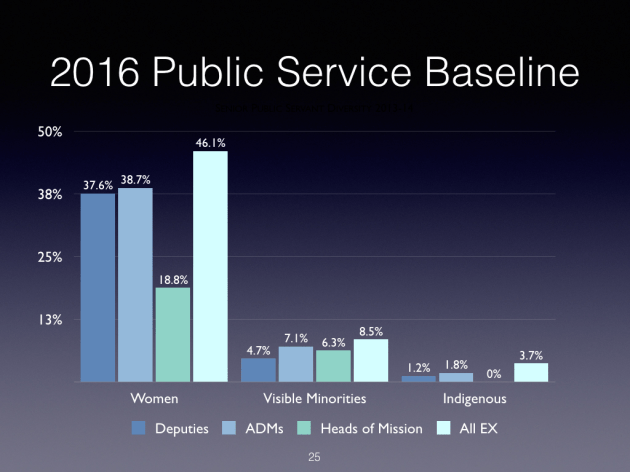
With this in mind, I have established the baseline for the current representation of women and visible minorities that will allow tracking of progress over time.

Overall, the Public Service is reasonably diverse with respect to women (54.1 percent), visible minorities (13.2 percent compared to the 15 percent who are Canadian citizens) and Indigenous Canadians (5.1 percent). For the executive ranks, women are almost at parity (46.1 percent) but visible minorities are under-represented (8.5 percent) as are Indigenous Canadians (3.7 percent). All figures are from the Treasury Board Secretariat report, Employment Equity in the Public Service of Canada 2013–14.

To determine representativeness, the government applies a labour market availability (LMA) benchmark (i.e., “the share of designated group members in the workforce from which the employers could hire”).  For ADMs and other members of the EX category,  the respective LMA is 45 percent for women, 7.5 percent for visible minorities and 4.5 percent for Indigenous Canadians.

Arguably, a more appropriate measure of inclusion is derived from comparison to the overall share of the population (or, in the case of visible minorities, the percentage of those who are also Canadian citizens – 15 percent).

However, these aggregate numbers — both actual and LMA — do not give a detailed sense of diversity within the senior ranks of the public service, defined as deputy and assistant deputy ministers (DM and ADM or equivalent).

Ministers and Parliamentary Secretaries are relatively diverse (41 percent women, 21 percent visible minority men or women).  The question is how diverse are those public servants at senior levels, with whom they work.

My information sources are reasonably accurate. For the 85 Deputies, their Associates and equivalents, public sources such as GEDS (the government electronic contact database), the Parliamentary website, cross-checked with PCO Deputy Committee lists, were used for both Deputies and Associate Deputies. This data does not include any of the recent changes announced by the Prime Minister.

For ADMs, Treasury Board Secretariat (TBS) provided official statistics for the 282 officials at the EX-4 or 5 rank for the 2013-14 year in the core public administration (77 organizations),  along with estimated labour market availability.

For senior heads of Mission (HoM), Global Affairs Canada provided a list of the 16 missions whose Ambassadorial and High Commissioner positions are currently classified at the EX4-5 level (these are a subset of the overall ADM numbers).

Some of these positions are over-filled by people at the DM level (e.g.,  Jon Fried at the WTO) or former politicians (e.g., Lawrence Cannon in Paris, Gordon Campbell in London, and Gary Doer in Washington). This data predates the announcement of the two Ambassador-designates in Washington and the UN (New York), both men replacing men.

While the data for gender is reliable, data for visible minorities is less so, given that official reports rely on self-reporting and that there are limits to using names and photos to identify visible minority status. However, this methodology is also used with respect to MP diversity.

Election 2015 and Beyond- Implementation Diversity and Inclusion.001What does the data show? As seen in the chart above, representation of women is relatively close to gender parity, save for Ambassadors and their equivalents (Heads of Mission and other ADM-equivalent officials abroad).

However, visible minorities are less than half of the percentage of those that are Canadian citizens (15 percent) or in the House of Commons (14 percent).

The ‘all EX’ category has more junior executive positions (EX1-3) and thus the greater diversity in these feeder groups suggests that over time, diversity  at more senior levels should naturally increase.

The public service may feel compelled to take a more active approach given the Government’s commitment.

Likely early tests of the Government’s commitment to increased diversity will occur as deputy ministers retire and are replaced along with changes to Heads of Mission over the course of the year.

13 new Deputies have been named to date by the Prime Minister including 6 women (46 percent, reflecting in part the four women: appointed on International Women’s Day!) and one visible minority (8 percent). Future appointments will indicate whether this portends a trend.

By tracking this on an annual basis, along with changes to ADM ranks, progress can be assessed.

Diversity and inclusion agenda: impact on the public service

Rudy and McKinney: Making government information more accessible

Valid points and practical suggestions made by Bernard Rudny of Powered by Data, a project of Tides Canada, and James McKinney.

My experience is mixed with respect to data requests.

Some departments (CIC/IRCC) have established procedures and protocols to access data, and have been very forthcoming in my requests (apart from the Comms folks who refused to provide polling data in spreadsheet form!).

TBS was similarly forthcoming with respect to diversity among ADMs but PCO was not able (or unwilling) to provide the public information on the more than 1,300 GiC appointments in spreadsheet form (like any database, this should be easily exportable):

ATI is simultaneously an invaluable and cumbersome system. Any record that is requested must be manually reviewed, regardless of how innocuous it may be, which makes the process slow and inefficient.

Consider a common example: you request a spreadsheet from a federal department. Its contents are neither confidential nor controversial. Under the present system, that spreadsheet will be printed, reviewed, scanned, then mailed to you as a PDF file on a CD-ROM. The whole process takes weeks, months or even years. By the time it’s complete, any functionality the spreadsheet had as a digital document — like being able to search for text, or add up the numbers in a column — is gone. Instead, you’re dealing with a low-grade image of something that was once useful data that could be searched and sorted.

This is a 20th-century approach to information. It treats every “record” like a paper document. That’s appropriate in some cases, but in the era of the Internet and databases, it’s out of step with the times. The alternative is to release information pro-actively — not just in response to requests — and to use formats that preserve the value of digital data. True openness is about eliminating barriers to access and going out of your way to publish open data.

To be fair, there has been some good news on that front: the Treasury Board Secretariat has done a laudable job of creating an open data program and the 2014 Directive on Open Government included a commitment to being open by default.

If the federal government is going to become more open, it needs to be transparent about the progress it is making

So where do we go from here? How can the government build trust and make progress on this issue? The first step is to inventory all the information of value the federal government holds. Canada has already committed to creating that inventory under the open government directive, but it’s not required to happen before 2020. Speeding up the process is essential.

As we write this, more than 245,000 datasets are available through the government’s open data portal. That’s an impressive number, but it raises a question: how many are still closed? The number is likely in the millions, but ultimately unknown. Without it, there’s no meaningful way to measure the progress being made.

Moreover, some federal departments have been better about releasing information than others. Of the open datasets mentioned above, about 236,000 come from Natural Resources Canada. Aboriginal Affairs and Northern Development, meanwhile, has released two datasets, Public Safety has released one. Inventories would help assess which departments need more help to open up their information.

Completing this inventory of information sooner rather than later would provide other benefits. Once the inventory is available, stakeholders — including researchers, communities, non-profit organizations and businesses — can provide informed input on what data to release first. That allows government departments to prioritize the opening of information that will enable positive social and economic impacts.

No one expects “open by default” to be implemented overnight. There are many steps to take — from reforming the ATI system to dealing with Crown copyright — and the road is long. Some information will also need to be kept within government for reasons of privacy and security.

Source: Rudny & McKinney: Making government information more accessible | National Post

Blame politicians for Metro Vancouver’s housing price crisis

More analysis by David Ley on the roots of Vancouver’s housing prices (likely some similarities in Toronto’s overheated housing market although the pressures likely come from a more diverse group):

Canadian politicians, keen to stimulate B.C.’s economy, are responsible for creating the conditions that created Metro Vancouver’s housing affordability crisis, according to a new study.

Politicians decided to “reboot a troubled regional economy through an infusion of activity from the growth region of the Asia Pacific,” UBC geographer David Ley says in a peer-reviewed paper published in The International Journal of Housing Policy.

Largely as a result of governments’ efforts to attract wealthy immigrants and investment from East Asia, “house prices have risen rapidly and the detached housing market is now unaffordable to most Vancouver residents,” writes Ley.

Given that federal, provincial and municipal governments have shown a “minimal response” to Metro residents’ housing difficulties, Ley concludes most politicians have accepted that astronomical prices and mortgage debt are just the “collateral damage” from expanding the B.C. economy.

One of the federal government’s key policy tools for attracting Asia-Pacific money to Metro Vancouver real estate was the business-immigration program, says Ley, a leading expert on how the world’s “gateway” cities are changing because of high in-migration.

The program, which gave preferential treatment to wealthy migrants, proved extremely popular in Hong Kong and Taiwan in the 1980s and 1990s and in Mainland China since 2000.

More than four out of five of the affluent people who took advantage of Canada’s business-immigrant program have arrived from Mainland China, Hong Kong and Taiwan, Ley found.

And roughly 200,000 of them moved to Metro Vancouver, where they account for almost nine per cent of the population, Ley estimates in his study, titled “Global China and the making of Vancouver’s residential property market.”

Repeated government trade missions to Asia in recent decades also effectively generated East Asians’ desire to invest in Metro Vancouver real estate, where Ley says deregulation meant local citizens would have virtually no legal protections from runaway housing costs.

Vancouver’s Expo 86, which took shape during the 1980s’ recession as a transportation fair, was a key event in Canadian governments’ strategy to market the city to Asians, Ley maintains.

The fair’s promotional power for enticing Asian money to Vancouver real estate, Ley said, boosted even higher when B.C.’s Social Credit government sold much of the Expo lands, at a low cost, to Hong Kong’s richest man, billionaire Li Ka-shing, owner of developer Concord Pacific.

The huge volume of Mainland Chinese multimillionaires who are coming to Metro Vancouver to buy property is out of proportion to the city’s relatively small size, Ley says.

“Vancouver, the closest major city to East Asia and with a high quality of life, is the most popular destination, especially for the wealthiest investor newcomers,” the vast majority of whom concentrate on real estate.

Source: Blame politicians for Metro Vancouver’s housing price crisis

Marine Le Pen the untouchable?

One of the better English summaries of her visit:

The proverbial 10-foot pole has become a popular approach for Quebec politicians in dealing with the leader of France’s far-right party, who arrived in Montreal on Friday.

Marine Le Pen may be among France’s most popular politicians — polls suggest she has enough support to make the run-off stage in the country’s next presidential election — but she has yet to secure a meeting with a mainstream political figure in Canada.

That hasn’t stopped her from wading into federal and provincial politics, sending politicians scurrying for cover.

Canada’s immigration policy an ‘error’

At a news conference in Quebec City on Sunday, Le Pen criticized Canada’s immigration policy, calling it an “error” to admit 25,000 Syrian refugees.

“A multicultural society is a conflicted society,” she said during the news conference.

Le Pen described the current situation in France as warning for Canadians.

“We put out a welcome sign, but what conditions await them? The slums of Calais? This is a policy that makes no sense and is dangerous,” she said referring to a large informal refugee camp near the tunnel underneath the English Channel.

Le Pen has had trouble finding a receptive audience since she arrived in Quebec. A small group of protesters disrupted her Sunday news conference, shouting and unfurling banners with anti-fascist messages.

“Away children, go back to bed,” she told the protesters, saying their behaviour was “unacceptable in a democracy.”

PKP ‘shocked’ at meeting

Le Pen did manage to meet with people claiming to be from the Parti Québécois on Saturday. She told Radio-Canada that she has supporters within the party.

“The PQ is diverse and vast,” Le Pen said. “It’s not monolithic.”

PQ’s leader Pierre Karl Péladeau quickly took to Facebook to dissociate himself from Le Pen, saying he was “shocked” that anyone from his party would meet with her.

The Front National’s values “are diametrically opposed to the values of the Parti Québécois,” Peladeau said.

Source: Marine Le Pen the untouchable? – Montreal – CBC News

My friend Arun shared this article about the coverage in France:

FIASCO – Imaginez le scénario. Vous traversez l’Atlantique, tout content de partir en voyage au Québec, espérant renforcer votre stature internationale et en pensant rencontrer des personnalités politiques locales de premier plan, la présidentielle de 2017 en tête. Vous communiquez même sur ce dernier point. Mais, à peine débarqué de votre avion, vous commencez à déchanter car personne ne veut vous voir. C’est ce qui se passe avec le voyage outre-Atlantique de Marine Le Pen.

D’après divers articles de la presse canadienne, la présidente du Front national, de passage au Canada pour six jours, le temps de passer par Québec et Montreal, n’est pas la bienvenue pour la classe politique locale. Pourtant, le FN avait fait savoir que la candidate à l’élection présidentielle de 2017 allait rencontrer des “politiciens fédéraux” sans plus de précision.

Sauf que Le Devoir a contacté la plupart des hommes et femmes politiques de premier plan et aucun ne veut rencontrer Marine Le Pen. “Tous les partis contactés vendredi, tant au niveau provincial que fédéral, ont indiqué qu’ils n’avaient pas prévu de rencontre avec la politicienne de 47 ans”, écrit de son côté La Presse le 19 mars.

“Au Québec, le porte-parole du premier ministre Philippe Couillard, Harold Fortin, a déclaré que personne au gouvernement n’a l’intention de rencontrer Marine Le Pen”, écrit encore le Devoir sur son site et qui détaille les réponses similaires de nombre d’autres partis. Et Antonine Yaccarini, la porte-parole de l’aile parlementaire du Parti québécois, de résumer le sentiment prédominant chez les politiques québécois :

Nous n’avons pas une minute à consacrer à cette personne-là.

Comme le note également le Devoir, un député a même conseillé sur Radio-Canada à Marine Le Pen de plier bagage et de rentrer en France. Sollicités, les parti “La Coalition avenir Québec” et “Québec solidaire” ont refusé de rencontrer la patronne du FN. Idem du côté du maire de Montréal. Un fiasco.

En déplacement au Québec, Marine Le Pen peine à rencontrer des élus canadiens

‘Religious freedom is under attack’: How a Canadian agency [Office of Religious Freedom] teaches respect where it’s tough to find | National Post

While likely partly orchestrated to keep the Office of Religious Freedom in its current form (rather than programming being folded into the overall human rights organizational and programming structures, some of the examples are nevertheless compelling.

Ironically, had public servants under the previous government carried out similar activities (some did), they were accused of disloyalty and not ‘loyal implementation’:

It’s those deep-seated problems that the Office — amid speculation the new government will shutter its doors — tries to tackle, according to its ambassador, Andrew Bennett.

Courtesy of Forum for Development, Culture and Dialogue

Courtesy of Forum for Development, Culture and Dialogue Children and mothers take part in a nine-day camp on religious dialogue in Latakia, Syria, in January 2016, funded by Canada’’s Office for Religious Freedom. 

“We’re talking about long-term, multigenerational change. Nothing is going to change in this countries overnight,” Bennett says in an interview.

Bennett describes his office as an advocate both abroad and within the Foreign Affairs department, amid more immediate initiatives like refugee resettlement and aid.

“Within government, in a highly secular country like Canada, we tend not to be very comfortable talking about religion or religious faith,” he says.

“Part of our work is to educate and raise awareness about the role that religious faith plays in foreign policy, and more generally in how people see themselves.”

In one case, Bennett’s staff invited the Mennonite Central Committee, which already runs development projects in Iraq, Syria and Lebanon, to submit a proposal in December 2014 — four months into Canada’s airstrikes in Iraq.

A Manitoba couple who oversees MCC’s regional work found groups in all three countries, and applied for $500,000 in funding. A fifth of that money supports the three Syrians’ projects, which teach youth to respect strangers. The couple helps the activists manage their budget, tallies their progress and offers moral support.

Laying a foundation for freedom

Though all three activists come from different religions, they all grew up with middle-class families and career goals. They’re now tackling the root of Syria’s conflict, and laying a foundation for when it finally ends.

Rami set up an interactive play that drew 1,200 people. The play starts with a Muslim and Christian neighbour who fall in love, and the end result is determined by the audience’s suggestions.

At one performance, a priest and a sheikh rose to give an impromptu speech on respecting others. At another, scores of displaced people who sleep in a nearby mosque talked about feeling alienated in their new city.

Despite sporadic water and electricity, for three days Rami got 400 people into the basement auditorium of a blown-out building last December.

Emma crisscrosses her country, including territory held by ISIL, to co-ordinate civil society groups.

“When the war ends, people will need to work together,” Emma says. “For peace to last, they have to trust each other.”

The 34-year-old trains groups in managing projects, securing foreign funding and evaluating whether participants are less likely to join terrorist groups. She’s abandoned her dreams of raising a family, and knows her work puts her life at risk.

Alex facilitated a nine-day choir camp in Latakia, one of Syria’s less dangerous cities, where many displaced people have settled.

His team taught 32 children and 22 mothers to respect people of different religions — almost all their fathers are on the frontlines — during the New Year break.

“At first it was difficult because they don’t have the concept of being together,” said the 28-year-old. “But at the end they were singing together.”

All three Syrians admit they won’t see any fruits of success for decades, but say they’re in it for the long haul.

The activists spoke with the Post during a recent regional conference in Beirut, which was funded by the grant. To get to there, each made dangerous taxi trips darting through rebel- and government-held territory toward the Lebanese border.

At the conference, the three learned from local activists who ran similar projects during the 15-year-long Lebanese civil war.

Looking at today’s Syria, Rev. Dr. Riad Jarjour recalls Lebanon crumbling in 1975 because adherents to 18 different sects lived parallel lives, building resentment and suspicion among neighbours.

“It’s so good to have children learn about living with each other, respecting each other, before they grow up and have something build in their minds because of no education,” says Jarjour, who founded the Forum for Development, Culture and Dialogue.

He believes Canada was ahead of the curve in opening the Office of Religious Freedom three years ago, modelled on a U.S. position created in 1998.

Source: ‘Religious freedom is under attack’: How a Canadian agency teaches respect where it’s tough to find | National Post

Unpacking conflict: “We don’t import conflict. But we do import trauma.”

Roma Berns-McGown, author of a Mosaic Institute on imported conflicts:

“What happens over time is that people come to re-understand the conflict. They re-frame it. People start to see that what they experienced was a function of an interest group or an ideology,” says Berns-McGown.

“It’s a revolutionary difference.”

It depends on how the conflict affected each person, says Berns-McGown. One interview subject said the conflict ‘was my childhood,’ she says. Others said they could see it still it being played out by their parents.

Berns-McGown then asked how they felt now. It opened the door to think about how they had changed.

“The most powerful thing was inclusion. If they really felt included, and they had a future and they belonged, that helped them to reframe the conflict,” she says. “The sense that they belong here, which they might not have felt at home. The more inclusion, the better.”

Berns-McGown’s own parents came to Canada from South Africa in the early 1960s because they opposed apartheid. In Canada, they did not associate with other South Africans. The major difference between her family story and the Syrian refugees, she says, was that her parents could choose to come to Canada on their own terms.

“This war in Syria is particularly complicated. You have a bunch of factions, all competing for power. We can view some of them as worse than others, but its not like there are good guys and bad guys. Everyone who is not an aggressor is a victim of that power struggle. Everyone is a victim. ”

Everyone who has come from Syria has experienced some form of trauma, she says.

“Moving to a place where there is no trauma doesn’t make it go away. We see it with military veterans and first responders,” she says.

“We don’t import conflict. We do import trauma.”

People have different ways of coping. Some choose to disassociate themselves. Others find solace in forming tight communities. Some find support in other people who have experienced similar trauma in a different context.

For young people in Toronto with roots in Eritrea, Ethiopia and Somalia, for example, the problem they perceive isn’t other black youths, it’s systemic racism, says Berns-McGown.

“They don’t see each other as the problem. One of the enormous advantages of Canada is that it helps them meet people from different parts of the world who have experienced similar conflict. It means they’re not alone.”

Source: Unpacking conflict: “We don’t import conflict. But we do import trauma.” | Ottawa Citizen

Ottawa needs to build on recent immigration reforms

Michel Beine, Robin Boadway and Serge Coulombe, authors of the C.D. Howe Institute publication, Moving Parts: Immigration Policy, Internal Migration and Natural Resource Shocks, argue for a return to the human capital approach to immigration, as per the original policy rational behind IRPA in 2001:

Finally, the new permanent immigration policy prioritizes skills in demand. That preference may decrease the immigration of workers whose skills may be more important in the longer term. The government should address these potential negative consequences as it plans its reforms. Immigration Minister John McCallum recently said he will adjust the express-entry system to facilitate the entry of recent international graduates of Canadian universities into the permanent immigration system. This fixes one of the unintended consequences of the previous government’s reforms.

More consideration should be given to attract immigrants with skills the Canadian economy may need in future, while in less demand today. And the government should continue to promote economic opportunities for Canadian residents seeking employment in their own province or moving to other provinces in search of better opportunities. That could mean policies such as reforming EI to encourage workers to move where the jobs are, or introducing more competition in the airline market to ease travel within Canada.

Canada has historically had an immigration system driven by evidence, not political dogma. The new government should continue with that approach and build on its predecessor’s immigration reforms to help both existing Canadians and businesses that need workers.

Source: Ottawa needs to build on recent immigration reforms – The Globe and Mail