Andrew Coyne: Politicians need to forget about polls and do the right thing

Great column by Coyne “rather trust the data:”

Liberals used to take a dim view of this sort of perception-based decision-making. When the Harper government claimed it didn’t matter if the official statistics showed crime rates falling to their lowest levels in decades, because people felt as if crime was rising, Liberals rightly scoffed. Now a similar fact-free feeling — the middle class is getting nowhere — is the foundation of their whole economic platform.

Liberals are by no means the only ones playing this game. Rather than answer questions raised by her signature proposal to subject every refugee, immigrant or tourist to a quiz on their belief in “Canadian values” — questions such as why this is needed, what it would accomplish, and what it would cost — Kellie Leitch refers to polls showing sizeable majorities of Canadians support the idea.

Likewise, those raising the alarm over Motion 103, unable to answer how a parliamentary motion with no legal force or effect could restrict free speech, have lately taken to citing polling data showing a majority of Canadians with varying concerns about the motion.

It’s easy enough to gin up a poll in support of just about anything, of course, depending on how you ask the question. The people waving them about today are in many cases the same ones who not long ago were railing ago about all the pollsters who failed to call Donald Trump’s victory (in fact, they called the vote to within a percentage point: Clinton beat him by two points, instead of the three points in the consensus forecast).

But let’s suppose these polls are genuine reflections of current public opinion. That’s a good answer to the question: what does the public think on these issues? It’s no answer at all to the question: are they right to think so? Yet that is how they are invoked: if that’s how the public feels, it must be true.

Skeptics are challenged, in tones of indignation: what, so you’re saying that millions of Canadians … are wrong?

Well, yes. What of it?

“Millions of people” are quite capable of believing things that aren’t true, particularly on matters to which they have given very little thought and with which they have little personal experience. The political science literature is filled with examples of people cheerfully offering their opinions to pollsters on entirely fictional events and people. As Will Rogers used to say, “there’s lots of things that everybody knows that just ain’t so.”

Climate skeptics rightly make the point that the overwhelming consensus of expert opinion on global warming is not enough, in itself, to prove it is right. Science is not a popularity contest: throughout history, individuals have stood against conventional opinion, and been vindicated, But let 1,340 randomly selected Canadians have their dinner interrupted to answer a question from a telemarketer about a subject they’ve barely heard of, and suddenly it’s gospel.

Experts, it is true, can sometimes be mistaken. But if experts can get it wrong, the public is at least as capable of it. And yet these days we are enjoined to reflexively reject the former, and just as reflexively to believe the latter. Perhaps we should rather trust the data.
Immigration et religion: Lisée blâme l’inaction de Couillard

Lisée is like a gnat, buzzing around these issues and changing his positions regularly.

A bit rich to blame all Quebec’s integration challenges and issues on Liberal governments, given the role of the PQ in recent years of playing identity politics, one that Lisée has also participated in:

Le gouvernement Couillard est responsable de l’insatisfaction exprimée par plusieurs citoyens quant à l’intégration des immigrants et au port de signes religieux, estime le chef péquiste Jean-François Lisée.

Le chef du Parti québécois a été invité, lundi à Montréal, à commenter les résultats d’un sondage Crop réalisé pour le compte de Radio-Canada.

Ce sondage indique notamment qu’une majorité de gens pensent que le port de vêtements religieux devrait être interdit pour les éducateurs (66%), les personnes en autorité (76%) et les autres employés des services publics (67%).

De même, 57% des Québécois qui ont répondu au sondage jugent que les musulmans sont mal intégrés, soit 38% «plutôt mal» et 19% «très mal». Ils sont 7% à estimer qu’ils sont très bien intégrés et 35%, plutôt bien intégrés.

Interrogé à ce sujet lors d’une conférence de presse à Montréal, après son retour d’un voyage à saveur économique en Europe, M. Lisée a blâmé le gouvernement Couillard et les gouvernements libéraux précédents pour leur inaction en la matière depuis des années.

«Les Québécois sont impatients face à l’incapacité du gouvernement Couillard d’agir sur les signes religieux, sur les accommodements religieux», a conclu M. Lisée.

Il s’est par ailleurs dit heureux de constater que pour bien des questions du sondage, les Québécois ont offert des réponses similaires aux autres Canadiens.

Source: Immigration et religion: Lisée blâme l’inaction de Couillard | Lia Lévesque | Politique québécoise

Europe’s high court rules workplace headscarf ban is not ‘direct discrimination’

Hard to see how this policy helps integration. Not as neutral as the Court ruled given that main focus was with respect to the hijab.

Will companies now also police any employee wearing a small crucifix?:

Private businesses in Europe can forbid Muslim women in their employ from wearing headscarves if the ban is part of a policy of neutrality within the company and not a sign of prejudice against a particular religion, the European Court of Justice said Tuesday.

Such a ban doesn’t constitute what Europe’s high court calls “direct discrimination.”

The conclusion by the highest court in the 28-nation European Union was in response to two cases brought by a Belgian and a French woman, both fired for refusing to remove their headscarves. It clarifies a long-standing question about whether partial bans by some countries on religious symbols can include the workplace.

The court’s response fed right into the French presidential campaign, bolstering the platforms of far-right leader Marine Le Pen, a leading contender in the spring election who wants to do away with all “ostentatious” religious symbols in the name of secularism, and conservative François Fillon, who hailed the court’s decisions. France already bans headscarves and other religious symbols in classrooms as well as face-covering veils in streets.

However, critics quickly voiced fears that the decision risks becoming a setback to all working Muslim women.

“Today’s disappointing rulings … give greater leeway to employers to discriminate against women — and men — on the grounds of religious belief,” said a statement by Amnesty International. “At a time when identity and appearance has become a political battleground, people need more protection against prejudice, not less.”

The Open Society Justice Initiative, which submitted a brief supporting the women, expressed disappointment.

“The group’s policy officer, Maryam Hmadoum, contended that the decision “weakens the guarantee of equality that is at the heart of the EU’s antidiscrimination directive,” which the Court of Justice cited in weighing the cases.

The European Court of Justice made separate decisions on the cases, but linked them.

In the Belgian case, Samira Achbita, a receptionist at a security firm, was fired in June 2006 for wearing an Islamic headscarf, banned in a new set of internal rules by her company that prohibited visible signs of their political, religious or philosophical beliefs. Belgium’s Court of Cassation sought guidance from the Luxembourg-based European court which rules on cases involving EU law, which applies to all EU members.

While the cases were linked by the European court, the French case differs and offers Asma Bougnaoui a reason for optimism because the reasons for her dismissal as a design engineer were based, not on internal rules, but on the complaint of a customer unhappy with her Islamic headscarf.

The court said that an employer’s readiness to take into account the wishes of a customer, not internal policy, don’t qualify for the measure set out by the European Union: a “genuine and determining occupational requirement.”

Source: Europe’s high court rules workplace headscarf ban is not ‘direct discrimination’ | Toronto Star

Reevely: Massive collection of race-based data part of Ontario’s anti-racism strategy

It all starts with having more and better data and ensuring that the data is consistent and reliable.

While there will be differing interpretations of what the data means, without having good data, society is flying blind when dealing with complex issues. While data and evidence are never perfect, they do provide a sounder basis for policy choices and political discussion:

Ontario will start collecting masses of race-based data on the programs in its biggest ministries this year, hoping to use the information to find and help stamp out systemic racism.

That’s a big deal in the provincial government’s new anti-racism strategy, a three-year plan that took a year to create.

Much of the strategy is high-level stuff, scooping together things particular ministries were doing and calling it a plan. That includes a training program for staff in the courts system so they better understand aboriginal culture, trying to make the boards of Children’s Aid Societies more diverse and having the first black judge on the Ontario Court of Appeal assess the way police forces are overseen. All of it noble, some of it genuinely consequential, most of it already underway.

There’s also this: “To address racial inequities, we need better race-based disaggregated data — data that can be broken down so that we further understand whether specific segments of the population are experiencing adverse impacts of systemic racism,” the strategy says.

They’re going to start with health, primary and secondary education, justice and child welfare. That is, in the areas where government policy really makes and breaks lives.

The systems in those various ministries generate boatloads of data already, from wait times for surgeries to rates of readmission for patients in particular hospitals, from school occupancy numbers to results from Grade 6 math tests, from trial times to recidivism rates. “Disaggregating” that data means pulling apart the stats by race, routinely, in a way that typically raises more questions than it answers.

So if 15 per cent of the Queensway Carleton Hospital’s patients are back in hospital within 30 days of being discharged, we’ll monitor whether the stat is the same for members of different racial groups. If not, why is that?

Pulling all this together means devising a consistent approach so the information is collected, crunched and presented in a standard form, while protecting privacy. Which is hard enough, and that’s before we get to what we’ll do with the information.

This is, historically, very touchy. Systemic racism “can be unintentional, and doesn’t necessarily mean that people within an organization are racist,” the government says, but being accused of systemic racism sets off the same sorts of reactions as being accused of the traditional kind.

Here in Ottawa, the police spent two years tracking race-related data on their traffic stops, following a human rights complaint by a black teenager who said he’d been pulled over only because an officer was suspicious of him driving a Mercedes (which was his mother’s). When researchers managing the study released their findings last fall, they reported that drivers the police identified as black or Middle Eastern were stopped at rates many times their population shares.

A companion study found some officers deliberately misrecording the races of people they’d stopped, staying away from some parts of town and otherwise behaving differently to shift the stats so they’d suggest less racism. To whatever extent police officers changed their behaviour so as to actually behave less racistly when they knew their work was being measured, that’s a good thing in itself, of course.

Ontario’s chief human-rights commissioner Renu Mandhane argued the stats are consistent with racial profiling; Chief Charles Bordeleau of the police defended his officers, saying there’s nothing going on in the police force beyond what’s normal in society at large.

(Something similar happened when the Toronto police released statistics on the people they “carded” — stopped in the street to ask for their ID papers. Way more black and brown people than whites, for reasons that were argued about for years. Yasir Naqvi, the then-provincial minister responsible for policing, imposed new rules scaling the practice back.)

You can use such statistical findings in a lot of ways, including flatly racist ones. Maybe the police are irrationally suspicious of certain visible minority groups. Maybe certain visible minority groups are worse drivers. Maybe they’re more likely to be driving in areas patrolled by police — a possibility that opens whole vistas of speculation about why either of those things might happen. Maybe it’s a combination of things. Collecting the data doesn’t solve the problem.

We can argue about why people in different ethnic groups have different dealings with the authorities, and heaven knows we do. Sometimes to a fault. But at least with traffic stops and carding, nobody can say any longer that it doesn’t happen, and that’s a step forward.

Source: Reevely: Massive collection of race-based data part of Ontario’s anti-racism strategy | Ottawa Citizen

Anxious about immigration? Here’s some food for thought – Geddes

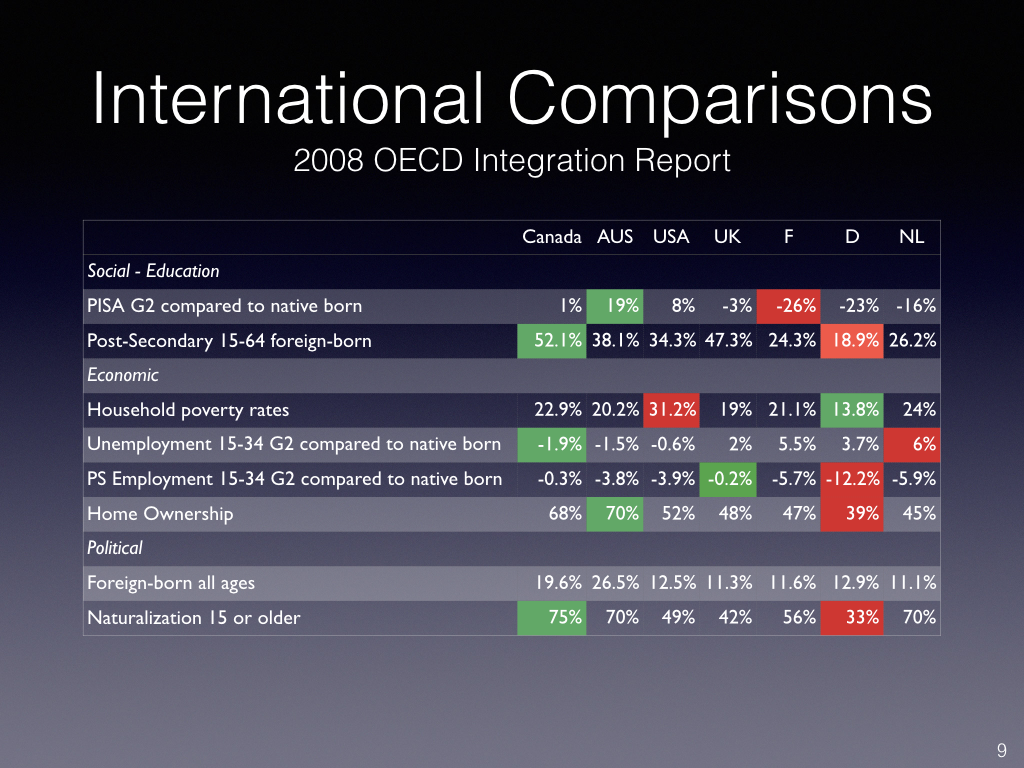
Another good piece by John Geddes, with this excellent summary of the data and evidence from the latest OECD immigrant indicators report.

I am a great fan of these reports (used it for the above summary table in Multiculturalism in Canada: Evidence and Anecdote) and am using it to prepare for an upcoming seminar in Copenhagen.

I generally find these data based comparisons more informative than the policy comparison indexes like MIPEX or the Multiculturalism Policy Index although both, of course, are helpful to understanding and discussion.

As with previous and other studies, the sharp contrast between immigration-based countries, particularly Canada, Australia, New Zealand and to a lesser extent, the USA, is striking:

All those images of border-crossing migrants, and swaggering tough talk about what to do about them from some federal Conservative leadership aspirants, have prompted a lot of discussion about how Canada absorbs newcomers, and if we do it differently, maybe better, than other countries.

My colleague Scott Gilmore warned here that we should brace for anti-immigrant populism to rise in Canada, as it has in other countries after the immigrant portion of their populations reached a certain level. I reported here on research that suggests that where immigrants tend to live in Canada, and how they vote, makes the path to political power steeper for right-leaning populists in this country than in the U.S. and Europe.

No matter how you see the issue, understanding how immigrants fare in Canada suddenly seems essential—if the debate is going to be about more than hunches. If you’re really gripped by the subject, you might want to take a look at “Indicators of Immigrant Integration 2015: Settling In,” by the Organization for Economic Cooperation and Development.” Here’s some of what jumped out at me from that study of the OECD’s 35 member countries [I have only listed the titles, the article has charts and narrative – well worth reviewing]:

  1. The Big Picture

  2. Recent Change and Stability

  3. Points of Origin Vary

  4. A Gender Gap

  5. Credentialed Newcomers

  6. Second-Generation Acceleration

  7. But Catching Up Isn’t Easy

  8. … And Some Will Stall

Source: Anxious about immigration? Here’s some food for thought – Macleans.ca

Why are so many Hungarians deported? A look at Canada’s ‘Unwelcome Index’ 

The Globe continues to impress me with some of its serious evidence-based reporting (e.g., unfounded sexual assault cases by police department) with this being another good example of reporting by obtaining and analyzing data and explaining what it means:

The U.S. government’s determined efforts to restrict immigration and the number of refugees entering the country has invited comparisons with Canada, heralded by some (including The Economist) as a last bastion of openness among Western countries. But Canada has its own apparatus for ejecting the unwelcome; the Canada Border Services Agency is charged with removing people who don’t meet entry requirements.

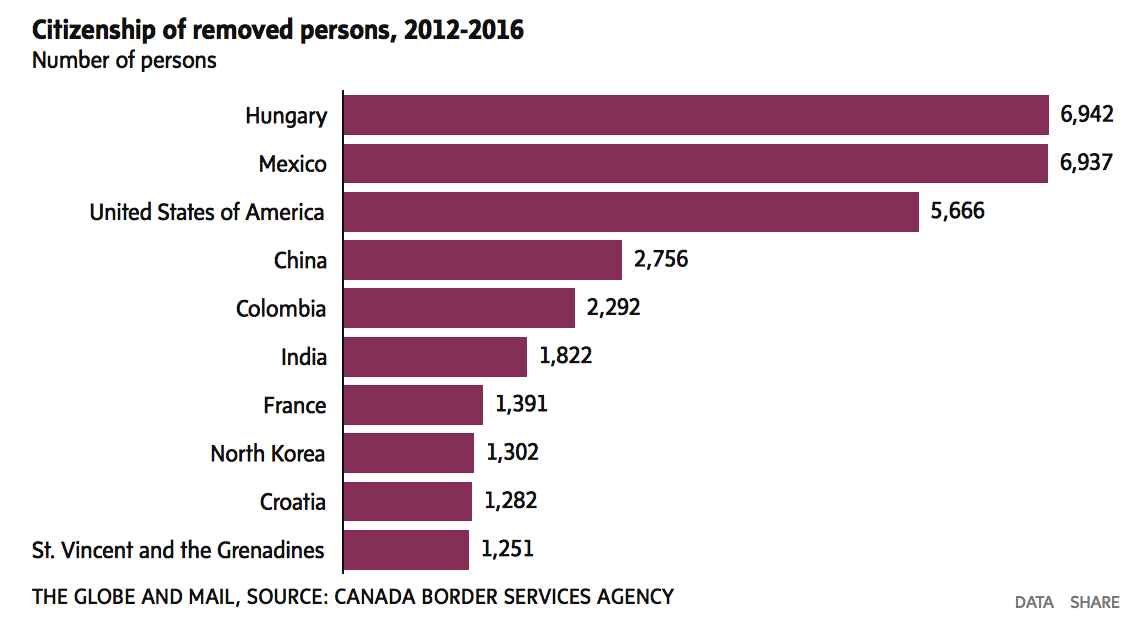
To understand who Canada deports, and why, The Globe and Mail requested data from CBSA showing total removals by year, broken out by citizenship, the destination to which the person was sent and justifications for these removals. The data shows Canada removed Hungarian citizens in disproportionate numbers over the past few years. The story of those thousands of unwelcome people contrasts with international perceptions of Canada’s warm embrace of foreigners.


The unwelcome

The CBSA ejects thousands of people annually. However, the data doesn’t reveal much about why those people were removed: By far the most common official justification was “non-compliance,” a sweeping category. Fewer than 10 per cent of removals cited criminality, the second most common justification.

A clearer picture emerges when one examines the citizenship of removed persons: Hungarians topped the removals list during the five-year period from 2012 to 2016.

It is perhaps unsurprising to discover large numbers of Americans and Chinese on the list: Both countries rank among the world’s most populous, and the United States and Canada share the world’s longest border between two countries. Mexico has been a major source of immigrants, and also refugee claimants: The government of prime minister Stephen Harper responded in the late 2000s by imposing new visa requirements on Mexican visitors; removals surged.

Hungary is less populous than those countries, and distant to boot. What gives?

Hungary stands out even more when one compares numbers of removals with numbers of people of the same citizenship accepted as permanent residents. The result is a crude sort of “Unwelcome Index.” Between 2011 and 2015, more than three removal orders were issued for every Hungarian granted permanent-resident status.


Backstory of an exodus

Most Hungarians removed during this period were Roma, explained Sean Rehaag, an associate professor at Osgoode Hall Law School in Toronto who specializes in immigration law. Studying a random sample of 96 decisions of the Immigration and Refugee Board between 2008 and 2012 involving Hungarian claimants, Mr. Rehaag and his colleagues found 85 per cent involved Roma.

Roma comprise Hungary’s largest ethnic minority. There, they encounter “discrimination and exclusion on a regular basis” concerning education, employment, housing, health and much else, according to a 2014 report by Harvard University’s François-Xavier Bagnoud Center for Health and Human Rights. The late 2000s witnessed the rise of right-wing political parties and paramilitaries, accompanied by increasing rhetoric, rallies and attacks directed at Roma. Many Roma sought asylum abroad; thousands arrived in Canada after it lifted visa requirements on Hungarians in 2008.

Gina Csanyi-Robah, a teacher and human-rights activist with Hungarian Roma roots met many applicants in her capacity as executive director of the Roma Community Centre in Toronto, and also at Toronto schools. They fled Hungary because they were “scared that their home was going to be burned down,” Ms. Csanyi-Robah said. “Tired of their children getting beaten up at school and put into segregated classes. Tired of being subjected to verbal, psychological, physical violence when they left their homes.”

 Source: Why are so many Hungarians deported? A look at Canada’s ‘Unwelcome Index’ – The Globe and Mail

Add women, change budgets? Underused gender policy tool finds new fans in Trudeau’s cabinet

In contrast to the bleak assessment posted earlier (Ottawa’s gender-based analysis was predestined to fail : Lynda Gullason), there does appear to be some progress on GBA (requirement in MCs and TB submissions).

This not only sends a key signal but equally important requires background analysis in order to be mentioned in cabinet documents. We will only know how effective this requirement has been following the next OAG audit:

There’s a T-shirt for sale on the Liberal Party’s website that features the slogan “Add women… change politics.”

You can’t say self-described “feminist” Justin Trudeau isn’t trying.

First, he picked a half-female cabinet. Four of the five Liberal candidates in the by-elections now underway are women — including those in three ridings Liberals won in 2015 and look to win again.

But changing politics — or its politicians — is one thing. Changing policy is another.

That’s one of the reasons March 22’s federal budget will be worth watching.

The finance department will include something that’s never been offered before: a gender-based analysis for budget measures.

It’s the latest way Liberals are trying to walk the talk they campaigned on in the last election.

“We will consider the gender impacts of the decisions we make,” the Liberal platform promised. “Public policies affect women and men in different ways.”

Finance Minister Bill Morneau’s fall economic statement promised “more rigorous analysis” to “deliver real and meaningful change.”

But what does that mean?

Social Development Minister Jean-Yves Duclos offered reporters a preview last Friday. One of highest-profile things his government introduced so far is a good example of more gender-sensitive policy, he said.

The Canada Child Benefit (CCB) is helping lift about 200,000 parents out of poverty, and about 70 per cent of those are mothers, he said.

“Almost half of the children that are being lifted out of poverty because of the CCB are in single-parent families. And 90 per cent of these single-parent families are headed by women,” the minister said.

Not just about women

Trudeau’s team didn’t invent gender-based analysis.

Canada made a commitment at the 1995 United Nations conference on women to “ensure that before policy decisions are taken, an analysis of their impact on women and men, respectively, is carried out.”

But progress in the 22 years since has been slow.

The auditor general has scolded the government twice for its tepid embrace of gender analysis, most recently after an audit completed in the final year of the former Conservative government.

Among over 100 federal departments and agencies, only 30 had committed to it by early 2015, and six of those hadn’t fully implemented it.

Four departments that were doing gender analyses were examined by the auditor general, who in 2015 found incomplete work that lacked enough evidence for decision-makers.

The Liberal platform promised to do better. “We will also ensure that federal departments are conducting the gender-based impact analyses that have been required of them for the past 20 years,” it said.

It’s not only about advocating for women. Status of Women Canada says the government’s current requirements go beyond gender-based analysis: analyzing not just gender, but also age, education, language, geography, culture and income to find ways some aren’t equal to others.

“Have you or someone you know taken parental leave, been treated for heart disease or recently immigrated to Canada?” its website says, offering examples of policy shaped by studying inequalities.

Equality equals economic growth?

Officials admit things aren’t fully in place across every department this spring. But starting from the top and trickling down, it’s clear this way of thinking is the new intended normal.

The privy council office is asking for gender analysis when policy proposals are prepared for cabinet.

Duclos said gender parity among ministers making those decisions has already had “tremendous value.”

“It’s been extremely satisfying to see both the level of actions and the attitudes, how that changes,” he said.

Asked for examples of policy from his shop now shaped by gender analysis, Duclos names two areas: housing and child care.

The budget will offer more details, he said, following recent work with the provinces.

Duclos, an economist before entering politics, is on a pre-budget tour this week, putting down markers for how Morneau’s budget will promote economic growth.

He laid out three things Liberals are focusing on — innovation, public and private capital, and labour, or human capital.

Making it easier to start or return to work — offering training or child care, for example — improves labour force participation rates and in turn, overall productivity. And more people working improves economic growth.

“We’re sensitive to both economic inclusion and social inclusion,” he said. “It involves all characteristics beyond income that make it difficult sometimes for Canadians to feel included in our society. And gender is one.”

Spending proposals submitted to the Treasury Board now must include proof that gender was considered.

A form available online that civil servants use for Treasury Board submissions asks for evidence and data sources, as well as a plan for monitoring what happens after a program starts.

That fits with the Trudeau government’s affection for “deliverology” — measuring results, not just the initial splash of an announcement.

Widespread compliance with bureaucratic processes isn’t the end goal. Equal opportunities are.

Source: Add women, change budgets? Underused gender policy tool finds new fans in Trudeau’s cabinet – Politics – CBC News

Starbucks faces backlash over CEO’s vow to hire thousands of refugees

Not necessarily surprising but not clear whether those more opposed to the hiring of refugees were regular Starbucks customers (the “latte sipping elites” as some would portray them) or the broader population:

Starbucks Corp.’s vow to hire thousands of refugees after President Donald Trump’s first executive order that temporarily banned travel from seven mostly-Muslim nations appears to be hurting customer sentiment of the coffee chain.

Trump supporters have used Twitter, Facebook and other social media sites to call for a boycott since Jan. 29, when Starbucks chief executive Howard Schultz vowed to hire 10,000 refugees over five years in the countries where it does business.

Schultz in a letter to employees said the promise of the American Dream was “being called into question” and that “the civility and human rights we have all taken for granted for so long are under attack.”

YouGov BrandIndex, which tracks consumers’ sentiment toward companies and their willingness to purchase from those brands, noted that the data around this boycott is different because both measures are declining.

Starbucks’ consumer perception levels took an immediate hit as measured by YouGov BrandIndex’s Buzz score, falling by two-thirds between Jan. 29 and Feb. 13, and have not recovered.

Starbucks Buzz score fell to four from 12 during that time. Such scores can range from 100 to -100 and are compiled by subtracting negative feedback from positive. A zero score means equal positive and negative feedback.

Immediate drop

Prior to Schultz’s refugee comments, 30 per cent of consumers said they would consider buying from Starbucks the next time they made a coffee purchase, that fell to a low of 24 per cent and now stands at 26 per cent, according to a YouGov spokesman.

“Consumer perception dropped almost immediately,” said YouGov BrandIndex CEO Ted Marzilli, who added that the statistically significant drop in purchase consideration data showed that consumers became less keen to buy from Starbucks.

“That would indicate the announcement has had a negative impact on Starbucks, and might indicate a negative impact on sales in the near term,” he said.

Marzilli noted that the Starbucks holiday “red cup” controversy from November 2015 corresponded with an even larger drop in perception, but no real impact on purchase consideration scores.

Support for rival urged

Among other things, boycott supporters are urging like-minded friends to support Starbucks rival Dunkin’ Donuts . Representatives from Starbucks and Dunkin’ Donuts declined to comment on the surveys and the boycott’s impact on sales.

Source: Starbucks faces backlash over CEO’s vow to hire thousands of refugees – Business – CBC News

ICYMI: Government called ‘heartless’ for deporting 59-year-old bipolar man who came to Canada as baby

It is. Doesn’t acknowledge that Canada is responsible for him, not the Netherlands:

Immigration Minister Ahmed Hussen is facing calls to reverse the deportation of a 59-year-old man with bipolar disorder who lived in Canada since he was eight months old.

Len Van Heest of Courtenay, B.C., was deported to the Netherlands this week after a string of criminal convictions for uttering threats, mischief and assault that his lawyer says were linked to his mental illness.

His brother Daniel Van Heest expressed his anger at judges and immigration officials who allowed the deportation to happen. He said his brother is now in the care of family in the Netherlands with the help of the Salvation Army.

“Needless to say his mental faculties have been stressed to the max,” he said. “The system is skewed. Mentally ill people should never be deported. It is wrong.”

Lawyer Peter Golden said Van Heest’s parents didn’t seek citizenship for him. The last time he was in the Netherlands he was in diapers, he doesn’t speak Dutch and doesn’t know his relatives there.

“However kind and well-meaning they are, the stresses of this whole process of removal will be difficult for him. He hasn’t made connections with people very easily in the past.”

Van Heest was diagnosed with bipolar disorder when he was 16, said Golden. By the time he was old enough to seek citizenship for himself, he had a criminal record and could not apply.

His last conviction was in 2012. He has been ordered removed from Canada in the past but has previously won stays on deportation, Golden said.

In January, a Federal Court judge rejected Van Heest’s challenge of a Canada Border Services Agency officer refusing to defer his removal order. Last week he lost a last-ditch attempt for a stay, and on Monday he was deported to Amsterdam.

“It’s really an example of criminalization of mental illness,” said Golden. “The criminal justice system isn’t designed to deal with people like Len.”

He said Van Heest was ensnared by legislation introduced by the former Conservative government in 2012, which banned non-citizens from appealing deportation after being sentenced to six months in jail. Previously, people could appeal if they were sentenced to less than two years.

Immigration, Refugees and Citizenship Canada was unable to respond to questions Wednesday.

The man’s 81-year-old mother, Trixie Van Heest, who Golden said has a very close relationship with her son, sounded distraught when reached by phone. She said she could not talk about the matter anymore and hung up.

Source: Government called ‘heartless’ for deporting 59-year-old bipolar man who came to Canada as baby | National Post

Le rêve brisé de candidats à l’immigration – change in selection process

Understandable reaction, given retroactivity and that the fees will apparently not be reimbursed:

Rétroactives, les nouvelles règles du ministère de l’Immigration pour sélectionner les travailleurs qualifiés affecteront près de 30 000 dossiers, a appris Le Devoir. Dans le lot, les demandeurs qui ne se qualifieront plus en vertu de la nouvelle pondération de la grille de sélection seront rejetés, sans le remboursement des quelque 1000 dollars payés pour déposer une demande.

« C’est une façon inhumaine de traiter les gens. Ce n’est pas la première fois que le MIDI [ministère de l’Immigration, de la Diversité et de l’Inclusion] utilise cette tactique et qu’il change les règles du jeu. C’est désolant », s’est indigné Jean-Sébastien Boudreault, président de l’Association québécoise des avocats et des avocates en droit de l’immigration (AQAADI). « Ce qui est encore plus troublant et alarmant, c’est que ces gens-là se qualifiaient, ont payé des sommes importantes et ne seront pas remboursés. Ils se voient voler. »

Photo: David Afriat Le DevoirLa ministre de l’Immigration, Kathleen Weill

Sur des forums d’échanges, certains aspirants immigrants crient à la fraude. « Je trouve ça assez honteux de faire ça rétroactivement. Certains vont se retrouver en dessous du seuil et leur rêve et leur argent partiront en fumée… », peut-on lire sur Immigrer.com. « Difficile à avaler. Notre rêve du Québec s’éloigne. On était déjà juste… Alors avec ça… », écrit un Français ayant déposé une demande. « Il risque d’y avoir une ribambelle de rejets à la suite de la mise en place de cette grille. »

Pour l’heure, il est toutefois impossible de dire combien de demandes seront rejetées, faute d’un nombre suffisant de points. Mais selon Jean-Sébastien Boudreault, le ministère profite largement de cette situation. Si 10 000 demandes sont rejetées, le gouvernement aura encaissé « 10 millions sur le dos des immigrants, rien qu’en changeant les règles du jeu », déplore-t-il. L’avocat estime que ces dernières années, le ministère a refusé des « quantités astronomiques » de dossiers. « Ce sont des milliers de dossiers rejetés par année. Des gens voient leur dossier fermé pour des détails ou des changements de règles, dit-il. Ils n’ont aucun recours. »

Nouvelles règles

Ce qui choque tant les candidats à l’immigration dans ce changement de pointage, c’est qu’ils ont déposé et payé leur demande en ayant préalablement mesuré leurs chances d’être sélectionnés grâce à un formulaire d’« évaluation préliminaire » en ligne qui leur permet de calculer leurs points. Ensuite, le travailleur qualifié doit débourser 773 $ et 166 $ pour chaque membre de sa famille, conjoint(e) ou enfant. L’obtention du Certificat de sélection du Québec (CSQ) prend six mois au minimum, parfois plusieurs années.

En vertu des nouvelles règles en vigueur depuis mercredi, qui s’appliquent rétroactivement à toutes les demandes qui étaient en attente de traitement, le système de pointage a été ajusté pour donner plus de points à des personnes parlant le français. En revanche, on attribue moins de points dans certains domaines de formation et plus aucun point pour les candidats ayant un diplôme secondaire professionnel ou un diplôme postsecondaire technique et à ceux détenant une formation dans un domaine recherché au Québec.

Source: Le rêve brisé de candidats à l’immigration | Le Devoir