Statscan can’t afford for data access to play favourites

Former Chief Statistician Wayne Smith’s critique of Shared Services Canada may have some merit as this example illustrates:

There were some curious and intriguing details behind the headlines of Statistics Canada’s monthly employment report, as there always are. It’s a serious shame – and a serious problem – that almost no one could see them.

Again.

The national statistical agency’s website was out of commission since early Friday morning, before the 8:30 a.m. ET release of the February labour force survey. As of late afternoon, Statscan’s website remained dark; the details of one of the most important economic indicators of its monthly calendar were invisible to the Canadian public all day.

(By the way, the report showed that the Canadian economy added an estimated 15,000 net new jobs in February, a bit better than economists had expected, and the unemployment rate dropped to 6.6 per cent, matching an eight-year low.)

You might recall that something like this happened before, about eight months ago, when Statscan’s systems were down for more than seven hours on another jobs-report Friday. Not to mention the many, many occasions that Statscan’s website has fizzled out for much briefer periods shortly after the release of major economic indicators, during moments of peak traffic scrambling for the fresh data.

At the time of this writing, we don’t know what the problem was with Friday’s system failure. Neither Statscan nor Shared Services Canada, the agency that oversees e-mail, data and network services across the vast breadth of the federal public service, got back to us with an explanation. Certainly past snafus have been placed at the feet of Shared Services, the $1.9-billion brainchild of the previous Conservative government that was supposed to streamline Ottawa’s complex tangle of information technology, but has instead been blamed for everything from AWOL paycheques to RCMP systems failures.

The previous head of Statscan, Wayne Smith, resigned last September over Shared Services’ handling of Statscan’s information systems, which he said had not only become “disruptive, ineffective, slow and unaffordable,” but compromised the independence and confidentiality of the statistical agency’s data.

Now, I’m not here to point fingers. But the point is that these Statscan failures, while maybe not the same risk to public safety as the RCMP’s problems, are more than just a nuisance to the economists and journalists who wallow in these economic numbers.

The system problems, when they arise, create inequitable distribution of information that is relied on, and more to the point traded on, by financial markets. That’s a serious problem.

In the case of Friday’s jobs data, instead of every market participant being able to see the same data at the same time on the same website, each was left to his or her own devices (literally and figuratively). The lucky ones had access to Bloomberg data and news terminals, the expensive yet indispensable toys of professional trading operations, where at least the basic highlights of the report would have been fairly quickly disseminated. Others could have turned to media reports from the smattering of news organizations that attended Statscan’s pre-release lockup (in which reporters were given the release in advance but kept sequestered in a room, unable to communicate the information until the moment of the release time).

But if you were in need of the deeper statistical details below the surface of these quick-hit reports, good luck. Even the research departments of the big banks were scrambling, relying on friendly contacts at Statscan to e-mail to them whatever data they could.

All of which not only delayed the dissemination of this key economic data to the public and to financial markets, but also resulted in some very uneven distribution – in terms of both the timeliness and the amount of information that reached different sets of ears and eyes with an interest in the data.

And the employment data are very significant indeed to the bond and currency markets, especially now. It has become increasingly evident that the direction the Bank of Canada will take on interest rates hinges substantially on the evolution of the labour market. In its rate decision earlier this month, the central bank pointed specifically to “subdued growth in wages and hours” as key evidence of “persistent economic slack” in Canada.

And indeed, the February jobs report showed that despite the improvements in hiring and the unemployment rate, growth in wages and hours worked remained disappointing. Knowledge of this spoke volumes to any bond or currency trader placing bets on the timing of future Bank of Canada rate moves. And some traders had access to this information long before others.

That’s simply unacceptable.

As long as these technology problems persist, they undermine the integrity of an independent, impartial national statistics provider. Access to critical data can’t play favourites, even if it’s by accident.

Source: Statscan can’t afford for data access to play favourites – The Globe and Mail
More men moving into women-dominated fields of work: U.S. study

Important study that helps explain some of the political currents. Not sure if there has been equivalent research in Canada:

Even as women moved into men’s jobs, in fields like medicine, law and business, men did not flock to the lower-status jobs that women mostly did.

That’s changing. Over the past 15 years, according to a new study in the United States, men have been as likely to move into predominantly female jobs as the other way around – but not all men. It’s those who are already disadvantaged in the labor market: black, Hispanic, less educated, poor and immigrant men. While work done by women continues to be valued less, the study demonstrates, job opportunities divide not just along gender lines but also by race and class.

At the same time, the women who have continued to make inroads into more prestigious male-dominated professions in that period are likely to be white, educated, native-born and married, according to the research, which is not yet published.

“More privileged men can resist entry into predominantly female occupations more readily than their less privileged counterparts,” said Patricia A. Roos, a sociologist at Rutgers, who did the study with Lindsay M. Stevens, a sociology doctoral student there.

The gender composition of jobs matters for reasons of equality – fields with a majority of men pay 21 per cent more than those with mostly women. Also, the fastest-growing jobs are dominated by women, while the fastest-shrinking ones are predominantly male.

The jobs that have become more female are generally professional or managerial ones, the study found. Some examples of high-paying, high-status jobs done mostly by men in 2000 that had an increased share of women by 2014: supervisors of scientists, which had 19 per cent more women, podiatrists with 8 per cent more and chief executives with 5 per cent more.

Jobs that were mostly female in 2000 and have become more masculine are lower-status jobs. The share of women who work in stores selling products and answering customer questions fell 10 per cent; the share for crossing guards and counter clerks each fell 7 per cent, and for textile workers it fell 5 per cent.

Men are much less likely to have moved into the higher-status professions that are majority women, like nursing and high school teaching (they became more male by about 2 per cent between 2000 and 2014.) The share of women grew slightly in two female-dominated professions, social worker and librarian.

Race, ethnicity and gender have always contributed to who does what work. Women have typically entered occupations when men find better ones, and immigrants have filled the ones women left behind. In the 1800s, according to previous research by Roos and Barbara Reskin of the University of Washington, Irish men replaced native-born white women in textile mills. The women moved to middle-class jobs like teaching – which native-born white men were leaving.

The current patterns reflect widening inequality as a whole, said Leslie McCall, associate director of the Stone Center on Socioeconomic Inequality at CUNY, who was not involved in the new research but said it was consistent with past findings. She said it shows that policymakers who want to improve jobs should focus not on gender or race, but on general working conditions at the bottom of the income ladder.

“People are focusing too much on the white, male working class,” she said, “but if you look at the working class more broadly, the issues are quite similar across all groups: wages, economic security, employment support, training.”

The Rutgers researchers used census data to track 448 occupations. Occupations were considered male or female if they had more than 60 per cent of one sex in 2000, and they were considered to have masculinized or feminized if the percentage of men or women changed by at least 4 per cent by 2014. This happened in 27 per cent of occupations.

Health care showed some of the most striking changes: Every health care job except one is more female than in 2000. (The exception is radiation therapists: from 72 per cent female to 65 per cent.) The share of female dentists, optometrists and veterinarians each increased by more than 10 per cent. The majority of doctors are still men, but women have become the majority in some health care specialties, including pharmacists and veterinarians.

Men’s movement into low-skilled women’s jobs since 2000 is partly a result of the hollowing out of middle-skill jobs in fields like clerical and manufacturing work, which was described by economist David Autor. Women were hit harder – female employment in those jobs fell 16 per cent from 1979 to 2007, compared with 7 per cent for men. But women almost uniformly moved into high-skill jobs, while men were more likely to move into low-skill, low-paying jobs.

Other research has found that men resist so-called pink-collar work, and those who end up in the lowest-status of those jobs, like nurses’ aides who bathe patients and change bedding, are already disadvantaged in the labor market because of race and class.

Sociologists have described the phenomenon as a trap door; these men drop into less desirable jobs. At all levels of work, it seems, white Americans have more choices.

Source: More men moving into women-dominated fields of work: U.S. study – The Globe and Mail

How a Crazy Idea About Islam Went From the Fringe to the White House | Mother Jones

The Islamophobia ‘industry’ and its influence:

In 2011, shortly after the controversy over the so-called Ground Zero mosque and the spread of a conspiracy theory that Shariah was taking over America, the Center for American Progress published a lengthy report titled “Fear Inc.,” which documented what amounted to a cottage industry of Islamophobic misinformation. Prominent players include Act for America, a “national security” group that currently boasts Flynn as a board member. Another is Frank Gaffney, the founder of the Center for Security Policy, which has pushed the unlikely notion that Islamists are secretly trying to infiltrate the American government and prominent organizations—including the National Rifle Association—through a process he calls “civilization jihad.”

“These were people who were always on Fox News, being cited on Pamela Geller’s blog, who were always on Sean Hannity, the Christian Broadcast Network, the National Review, and others,” says Faiz Shakir, the national political director of the American Civil Liberties Union and one of the authors of the report. (Pamela Geller writes a prominent anti-Muslim blog.) “You had major political groups who were then taking this and getting it into the mouths of lawmakers. At that time it was Allen West, Herman Cain, and Michele Bachmann. We went through a period where we had really fought back and marginalized some of these voices,” says Shakir. “They lost some credibility and respect in Republican circles—until Donald Trump came around. He gave them the biggest platform they ever could have imagined.”

This network also had links with what would become Trump’s inner circle. Gaffney appeared on Bannon’s radio show 34 times. Gorka, a former Breitbart editor, has regularly appeared at Center for Security Policy events and on Gaffney’s own radio program. Gaffney once defended the disgraced former FBI agent turned anti-Muslim crusader John Guandolo—who has said that mosques in the United States “do not have a First Amendment right to anything” and has helped draft anti-Muslim legislation.

Trump himself has expressed some of the key tenets of the Islamophobic right. In late 2015, Trump proposed a total ban on Muslims entering the country, justifying the idea by citing a debunked survey commissioned by Gaffney’s Center for Security Policy and conducted by Kellyanne Conway, who would become Trump’s campaign manager. The survey claimed that 51 percent of those polled believe that Muslims in America should have the choice to be governed by Shariah, and a quarter agreed that violence against Americans in the United States “can be justified as part of the global jihad.” A few weeks earlier, he stated that the United States will have “absolutely no choice” but to shut down mosques because “some bad things are happening.”

There have already been previous efforts to prevent mosques from being built using the “Islam is not a religion” argument. “Those are all real efforts,” says Shakir. “They have been on the back burner and bubbling up for a long time, and now they have people in positions of power who can effectuate these radical ideologies that they’ve long held on to.” Until Trump provides some clarity on his true views, people on both sides of the issue may assume that he is unwilling to publicly state that Islam deserves the same legal status and protections as other religions.

Source: How a Crazy Idea About Islam Went From the Fringe to the White House | Mother Jones

The Trouble With India’s New Citizenship Bill | The Diplomat

Look forward to some comments from those more familiar with India and Indian politics than I:

Granting citizenship to Hindu refugees and making India “a natural home for persecuted Hindus” were among the promises made by Prime Minister Narendra Modi in his election manifesto. Modi, in a 2014 election rally, specifically promised citizenship to Hindu-Bangladeshis, saying that they would be removed from the migrant camps. Since then, the current government has taken many steps which may seem majoritarian and anti-Muslim.

Against this backdrop, the Citizenship (Amendment) Bill, 2016 seems to be aimed toward making India a haven for Hindus, Sikhs, Buddhists, Jains, Parsis, and Christians from neighboring countries such as Afghanistan, Bangladesh, and Pakistan. A closer look at the provisions indicates that the current government is attempting to increase its Hindu voter count. The BJP government’s website about Hindutva ideology clearly draws from Israel’s law of return and aims to do the same for Hindus in India. This policy in the Indian context would be contrary to the ideals of secularism and pluralism and thus unconstitutional.

The provisions of the bill would affect over 200,000 Hindus from Pakistan and Bangladesh and their migration into the border states of India would change the voter demographics in the region. The BJP government came to power in Assam in 2016, for the first time in 15 years, by using the agenda of ending illegal migration from Bangladesh. According to the Census of India (2011), 34.2 percent of Assam’s population is Muslim and the census shows that there has been a 4 percent rise in Muslim population over the past five years. The BJP government used the data as the basis of their campaign to gain votes in the region. If the Citizenship (Amendment) Bill is passed, in its current form, then the border regions would face an influx of Hindu migrants, which would change the voter demographics in the region.

The bill aims to save religious minorities from violence and blasphemy laws in Pakistan, Bangladesh, and Afghanistan. The rationale for selecting just these three countries, which are Muslim-dominated countries, is a cause for concern. The bill at first glance seems like a humanitarian effort to help persecuted minorities but it only seeks to help Hindus, Sikhs, Buddhists, Jains, Parsis, and Christians from the neighboring Muslim countries. Muslim minority communities facing oppression in other countries have been completely ignored. If the bill was really an attempt to provide a safe haven for minorities facing violence in their countries then it should also offer the same provisions to the minority Muslim communities in China and Myanmar as well. The Rohingya Muslims in Myanmar, Uyghur Muslims in China, and the Ahmaddiya Muslims in Pakistan and Bangladesh have been facing persecution for years. Further, Myanmar’s Hindus have also been ignored in the bill.

India is not a signatory of the United Nation Refugee Convention; therefore it is not required to provide safe haven to people seeking asylum from persecution in other countries. No attempts have been made by the government to debate the issue of joining the United Nation Refugee Convention. That would have been the natural step to take if the government was indeed interested in formulating a humanitarian refugee policy. Further, the provisions of refugee protection cater to all minorities fleeing countries due to a humanitarian crisis but, in this bill, India is offering citizenship based on religious predilections. The bill, if passed in its current form, seeks to give preference to Hindu refugees over Muslim refugees migrating to India, which is unconstitutional as, the preamble of the Constitution confirms India as a secular state.

The refugees who will actually benefit from this policy are living in abject poverty with no sanitation and infrastructure facilities. The government, instead of using a blanket refugee policy, has made this a communal issue with a veiled political agenda, which would be counterproductive to the seemingly humanitarian goal of the bill.

A member of the ruling Pakistan Muslim League-Nawaz (PML-N), Dr. Ramesh Kumar Vankwani, revealed in the National Assembly that around 5,000 Hindus migrate from Pakistan to India every year. In 2015, the BJP government approved citizenship for 4,230 Hindus and Sikhs from Pakistan and Afghanistan who sought refuge in India. The BJP had earlier claimed that they had granted Indian citizenship to 4,300 Pakistani nationals during 2014-15. However, a response to a query filed under the Right to Information by Seemant Lok Sanghthan showed that only 289 Pakistani Hindus were granted Indian citizenship in this period. This furthers the argument that the BJP’s political agenda supersedes its humanitarian goals.

It is also interesting to note that BJP’s stance on refugees has completely turned around in the last decade. In 2003 when 213 “Bangladeshi citizens” were stranded in the no man’s land between India and Bangladesh, neither country accepted them. Yet the BJP, in 2014, declared itself as a “natural home for persecuted Indians” and extended long-term visas in various states and provided citizenship to Hindus from Pakistan and Afghanistan. The constant emphasis on granting refuge on the basis of religion is in keeping with the Hindutva ideology popularly advocated by the current government.

The bill, if passed and made into an act, could be challenged and struck down by the judiciary later because of its unconstitutional nature — the provisions go against the secularism enshrined under the preamble. The government’s stance of helping refugees only if they fall under the category of persecuted religious minorities is heavily biased.

The Citizenship (Amendment) Bill 2016 may be presented as a move to protect the religious minorities in other countries from being persecuted but, the underlying issue clear: the bill is meant to address the BJP’s stated objective of making India the “Hindu Homeland.” The provisions blatantly ignore Muslims in the protection clauses and mention only religious minorities in Muslim-dominated countries. Further, the bill will change the demographics of the border states. The Bill adds to an ominous trend of a government which is not afraid of pushing a religious ideology, even when it is in contravention of the Constitution, in order to further its own political agenda.

Source: The Trouble With India’s New Citizenship Bill | The Diplomat

Keeping K2 (European Human Rights Court Decision on Citizenship-Stripping) in Perspective | Just Security

Good analysis of the impact of the recent ruling:

Strasbourg rejected as inadmissible an application by K2, a terror suspect born in Sudan but who acquired British citizenship by naturalization. At first glance this admissibility decision might seem to be of general significance but it is actually highly fact-specific and does not substantively address the single material general issue of principle raised by the applicant, i.e. the potentially discriminatory effect of the relevant citizenship-stripping laws. This is unsurprising since admissibility decisions – initial decisions about whether an application satisfies the stringent admissibility criteria and should proceed to be considered on its merits – are rarely of general significance, and this is especially so when, as in this case, the application is deemed inadmissible. It would be odd, therefore, if, as opined by the Guardian, the decision “is likely to encourage Home Office ministers to make greater use of their power to exclude terror suspects even if they are British citizens.”

Article 8

K2 complained that the Home Secretary’s decision to deprive him of his British citizenship violated his Article 8, ECHR right to respect for family and private life. The decision to deprive him of his citizenship was taken pursuant to the statutory power in section 40 (2) of the British Nationality Act 1981.

The ECtHR assessed this complaint by reference to established principles: by asking whether the revocation was arbitrary (i.e. was it in accordance with the law, was it accompanied by necessary procedural safeguards and did the authorities act diligently and swiftly) and by considering the consequences for the applicant.

The ECtHR held that the revocation was not arbitrary. The principal issue that it considered in this regard was the adequacy of procedural safeguards on the facts of the applicant’s case. The ECtHR also held that the consequences for the applicant did not violate his Article 8 rights because, for example, he was not rendered stateless by the deprivation of British citizenship (see here and here my 2014 posts on statelessness and citizenship stripping) and because his wife and child could visit him in Sudan or relocate there. The Article 8 claim regarding the decision to deprive K2 of his British citizenship was, therefore, held to be manifestly ill-founded. 

Similarly, the Article 8 claim regarding the Home Secretary’s decision to exclude him from the UK was manifestly ill-founded.

Article 14

K2 also complained that there had been a violation of the prohibition of discrimination in Article 14 (read together with Article 8). The ECtHR rejected this claim too.

It rejected K2’s claim that he had been treated differently from a non-national resident because he was denied an in-country right of appeal: the ECtHR held that the reason he had been denied the right of appeal was not because he was a British citizen but because he had chosen, voluntarily, to leave the UK.

More significantly, the ECtHR also rejected K2’s complaint that he had been treated differently from a British citizen considered a threat to national security but who did not hold a second nationality. However, the Court did not substantively address this complaint – essentially the only part of the case that could have been of general significance. The ECtHR rejected this complaint on the technical ground that K2 had not raised it before the domestic, English courts and he had, therefore, failed to exhaust domestic remedies (a pre-condition for a claim to be admissible before the ECtHR). Thus, the only material principled point in the case was not substantively decided.

Source: Keeping K2 (European Human Rights Court Decision on Citizenship-Stripping) in Perspective | Just Security

The Order of Canada and diversity

My latest, in Policy Options:

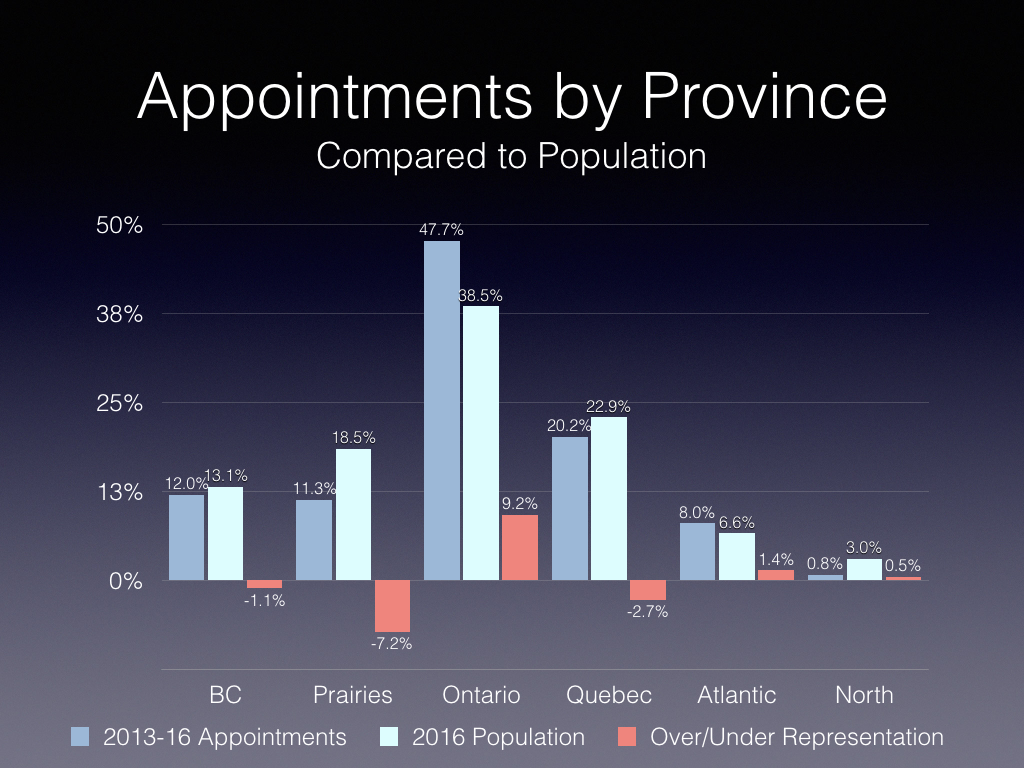
In Budget 2015, the then Conservative government announced additional funding of $13.4 million over five years and $2.8 million in ongoing funding for the Canadian Honours System. This aimed to “bring [honours] closer to all Canadians” by increasing the number of Order of Canada nominations from “under-represented sectors” (e.g. business) and regions (i.e. the West).

This was prompted by an Ottawa Citizen analysis that showed only 26 percent of recipients since the Order’s creation in 1967 came from the West, compared to the region’s 31 percent share of the population. In contrast, Atlantic Canada had 11 percent of recipients, about twice its share of the population. Moreover, the study showed an increasing percentage of awards had gone to those active in the arts while the share going to business people had declined.

Source: The Order of Canada and diversity (for complete article)

Senate proposes major amendment to Liberal citizenship legislation [C-6] : ‘It goes a long way’

As indicated during committee hearings, the amendment to restore procedural protections to those accused of fraud or misrepresentation was tabled in the Senate March 9:

The Liberal government’s update to immigration law is poised to be changed by the Senate after a major amendment was introduced Thursday.

Elaine McCoy, who acts as a “facilitator” for a de facto caucus of independent senators, tabled the amendment during debate over the third reading of Bill C-6.

If someone is served notice their citizenship is being revoked due to fraud or misrepresentation, the amendment requires the immigration minister to inform them of their right to appeal that decision in Federal Court.

Under Conservative legislation that took effect in May 2015 (referred to as Bill C-24), the process for citizenship revocation was significantly streamlined, and revocation notices have since ramped up significantly. The National Post reported last month that at least 236 people were served notice since the Liberals took power in November 2015.

Under the new process, people can submit written arguments as to why their citizenship should not be revoked, but there’s no clear option to have these arguments assessed by an independent judge.

It’s a loophole that many committee witnesses, in both the House of Commons and the Senate, argued should be fixed with the Liberal update. In the House, New Democrat MP Jenny Kwan attempted to move amendments but they were ruled out of scope at committee stage.

It’s in the Senate that proponents hoped to see the fix. Previous immigration minister John McCallum told senators he would “welcome” such an amendment, but new minister Ahmed Hussen said in Senate committee last week he would have to see the amendment before promising the government would commit to it — although “we are committed to procedural fairness.”

McCoy said the amendment is designed to give people “due process.” It puts decision-making back in the hands of the elected and accountable minister, she said, and allows the independent judiciary to review those decisions.

Drawing laughter from fellow senators, McCoy gave an example of how anonymous the revocation system has become. A revocation notice letter she obtained was signed with a citizenship analyst’s number rather than their name — “D 1816,” she said.

“This amendment is not going to fix everything, but it goes a long way,” McCoy said.

It’s been a “labour of many, many months,” the bill’s sponsor, Ratna Omidvar, added Thursday. The amendment is four pages long and determines exactly how the process would work — the “bare bones of due process,” Omidvar said, including a 60-day deadline for people to decide whether or not to take their appeal to court.

André Pratte, rose to support McCoy’s amendment. It addresses a “serious shortcoming,” he said, and will make the entire citizenship revocation process “much fairer.”

“Some will wonder why are we doing favours to people who have cheated the system. I would argue those are not favours, but fundamental human rights,” Pratte said.

Conservative senator Yonah Martin indicated Thursday she was concerned about the amendment being out of scope, and wondered why it wasn’t moved in committee. But McCoy said she was trying to be transparent by sharing the amendment with senators ahead of time and allowing it to be brought to the wider chamber.

Another Conservative senator, Daniel Lang, said he is concerned that some people could drag out the process over “years and years and years without any definitive decision being made.” Omidvar responded that court isn’t automatic. The amendment requires people to specifically ask for a court appeal in order for that appeal to be heard. Imposing a deadline on the court might not be possible, she added.

Debate was adjourned Thursday and the Senate now enters a two-week break, meaning votes on the amendment and the bill can’t happen until at least the week of March 28. If the Senate passes an amended version, the House of Commons will have to decide whether or not to accept the amendment before the bill can become law.

Source: Senate proposes major amendment to Liberal citizenship legislation: ‘It goes a long way’ | National Post

The text of the amendment can be found here: Motion in Amendment

Supreme Court judge [Justice Wagner] says Canadians shouldn’t worry about arrival of refugees, migrants 

Thoughtful and pertinent comments, particularly interesting his comments on identity:

Wagner said the notions of identity, human dignity and democratic values permeate the Charter and “lay the foundations for looking beyond our own borders.

“We can welcome refugees and migrants with the confidence that our society is able not only to manage our differences, but to thrive on them,” said Wagner.

Speaking to reporters later, Wagner acknowledged that, while his speech was delivered to a legal and academic audience, there was a message for Canadians concerned about the influx of refugees and migrants.

“We should, I think, welcome all those people and we should be willing to accommodate them and not change them,” he said.

“People should not be afraid of having migrants and refugees in their own countries. I think we’re strong enough and . . . we have strong moral values, and one of those values is the respect for human dignity. And, if we take our role seriously, we’ll look, we’ll adopt the perspective of the other, and it could only, I think, as far as I’m concerned, grow society much better in the future.”

Asked if that means there should be room for face veils and other individual expressions of religious identity, Wagner declined to answer, saying: “I don’t know if those cases will come before the court, so I don’t want to comment.”

Wagner holds one of the three high court seats reserved for Quebec. Quebec’s legislature is now studying a bill to require “religious neutrality” of those who deliver or receive public services, amid calls to ditch the bill in the wake of the slaying of six Muslims at a Quebec City mosque.

Wagner said judges have an “obligation” to try to understand the perspective of a person who says their equality rights are breached, but he added “that doesn’t mean that the claimant is right . . . that doesn’t mean that I would adopt his way, or his reasoning, or his opinion, or his end result.”

In his speech, Wagner admitted early approaches to how judges analyzed discrimination did not stand up to the task. He said Charter interpretation is still “a work in progress,” but, he added, over the past 150 years “the constitution has enabled us to navigate difficult questions of identity.

“Personal and group characteristics are the starting point of Charter equality jurisprudence, but identity is not about labels; it is a shorthand for how people see themselves, how others see them, and how those two things interact in people’s lives.”

Wagner said the Supreme Court looks to the context and experiences of a person claiming discrimination, and seeks to understand the person’s perspective, which is an especially important consideration in cases of aboriginal law or where there are overlapping characteristics of a person’s identity that influence how they experience discrimination.

Wagner said the experience of a woman who is part of a visible minority can be totally different from that of a young man who has the same characteristics. “If one of the two is not a citizen, or has a different sexual orientation, their experience could be even more different.”

“When the court eventually faces a question touching on trans-gender identity, these two propositions will provide essential frames of reference: that identity is not fixed, but changing, and that identity is not innate, but contextual,” he said.

Wagner predicted that, although the principle of “dignity” fell out of favour in judicial analyses of equality claims, it would find new traction in future Charter litigation. It is a crucial consideration when judges weigh whether a rights violation is reasonable and justified. “Equality infringements ought to be increasingly difficult to justify to the extent that it strikes at the heart of someone’s individual or group identity and, with it, their recognition as full participants in Canada’s ongoing democratic dialogue,” he said.

University of Ottawa law professor Errol Mendes said Wagner’s speech would please equality-seeking groups on the one hand, but he said Wagner also emphasized “democratic values” and “substantive” equality over any superficial concept of equality.

To Mendes, it was a signal from a judge who some suggest could one day become the chief justice of Canada, that the balance won’t always tip in favour of those who feel their rights are breached.

Helping Immigrant Students Catch Up, Fast — It Takes A Whole School : NPR

US example of how schools facilitate the integration process:

For many immigrant students, the trauma of crossing the border follows them into the classroom — affecting their performance and ability to learn. And that’s where Michelle’s school comes in.

At Langley Park, in Prince George’s County, Md., 87 percent of students are Spanish-speaking. Out of 176 students, 24 countries are represented and 15 languages are spoken at home, not including English.

The school started last fall. So far, the school sits in temporary buildings, but the kids don’t mind it too much — unless it’s raining.
Her school is part of a larger network across the country called Internationals Network For Public Schools. It serves English language learners, or ELLs, and recent immigrants.

For students like Michelle, the problem is two-fold: Not only are they dealing with trauma, but they also belong to one of the most marginalized student populations.

According to a recent Stanford study, the achievement gap between ELL-Hispanic and white students is the largest in the context of race and ethnicity. And, the average high school graduation rate of ELLs is 19 percentage points lower than the national rate, 63 percent compared to 82.

In 1985, the network opened its first school to address that long-standing disparity. Since then, it has grown to 27 schools in seven states, including Washington, D.C.

And, it seems to be working. Last year, ELLs who attended the network’s high schools in New York City graduated at a rate 16 percentage points higher than ELL students in the city’s public schools, the nation’s largest school district.

As for Langley Park, it hasn’t had a graduating class, yet — it opened last fall — but results so far look promising. In the first class of students, 98 percent showed improvement in their English language skills.

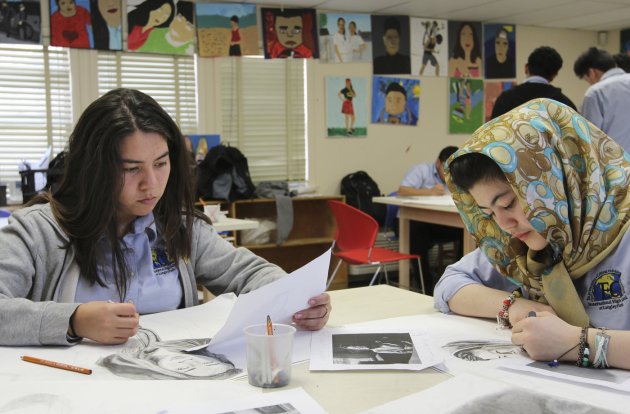
Two talented young artists — Stefany Novoa (left), 16, and Frishta Wassl, 14 — work on self-portraits in Christine Wilkin’s art class.

LA Johnson/NPR

How does the network do it when so many other schools struggle to educate ELLs? It seems to boil down to three simple things:

Every teacher is a language teacher. Tammy Tatro, who teaches technology, says implementing English-language instruction into her class curriculum is “really hard.” But she does it by repeating herself and using visual aids to get concepts across to students.

Second, one of the network’s vital principles is collaboration. That’s why the classes are a mix of students with varying English language skills.

“They all want to lift each other up,” Tatro says. “When one fails, especially if they’re working on a team project, then they all kind of fail. So, they have to help each other.”

A third key principle, Principal Carlos Beato says: the school’s partnerships.

Christine Gilliard, a phys ed teacher, used to teach at a large high school where she had “a two-story gym and two storage closets.” Now she teaches out of a trailer-sized temporary building. “We may not have the best of everything, but we have each other,” she says.

LA Johnson/NPR

CASA de Maryland, a Latino advocacy organization, is one of Langley Park’s partners. The organization offers legal advice for students and their families. Students can also take a social justice class from CASA to learn about advocacy and their rights, depending on their immigration status.

Partnerships like this are crucial, given the extra challenges many of these students face — homelessness, separation from their parents and, of course, the language barrier. Without tending to all of their social and emotional needs, Beato explains, “we wouldn’t be getting any of the academics done.”

Most of the network’s schools employ a full-time social worker. At Langley Park, that’s Lesly Lemus. Her job is to support students any way she can as they cope with life outside school, whether it’s connecting them to community resources or just listening.

Source: Helping Immigrant Students Catch Up, Fast — It Takes A Whole School : NPR Ed : NPR

ICYMI: 82 per cent of BC minorities have experienced racism, survey finds

Not surprising, and likely similar in other major centres. No gradation regarding the degree or seriousness of racism encountered. These regional studies, as useful as they are, suggest the need for a new Ethnic Diversity Survey (the last one was carried out in 2002):

As multicultural as Canada may be, it appears we are not immune to racism.

According to a new survey conducted in B.C., 82 per cent of visible minorities say they have experienced prejudice or some form of discrimination, while 56 per cent of all respondents reported having overheard racist comments.

Of those who identified themselves as visible minorities, 46 per cent said they believe they face social disadvantages because of their background, and 33 per cent said they have been a target of abuse. Another 29 per cent reported facing discrimination simply based on their name, while 10 per cent have dealt with disadvantages because of their religious beliefs.

And 11 per cent said their experiences with discrimination were traumatic enough to prompt thoughts of moving to a new location.

“The majority of British Columbians are welcoming and embrace multiculturalism. However, it’s clear that racism is alive and well in our communities and we need to call it out when we see it,” said Catherine Ludgate, a spokeswoman with Vancity. The report was commissioned by the credit union as part of its community investment efforts.

 Some 82 per cent of all those who responded said they felt multiculturalism has been “very good” or “good” for Canada, though three-quarters thought the population of immigrants should remain the same. Just over a quarter thought the population should increase.

…The numbers are from a new report released today, conducted in January by Insights West and is in anticipation of a community roundtable series to be launched by SUCCESS B.C., an immigrant assistance organization, and sponsored by Vancity.

Dates for the roundtable series have yet to be announced, but the series follows a forum on immigration hosted by SUCCESS in February.

Queenie Choo, CEO of SUCCESS BC. According to a new report conducted in B.C., 82 per cent of visible minorities have experienced prejudice or some form of discrimination, while 56 per cent of all respondents have overheard racist comments being made.“We didn’t want to host the forum and the forget about it,” said Queenie Choo, CEO of SUCCESS, who was quick to note that it’s important to continue discussing these issues lest history repeat itself.

Choo said the discussions would be a chance for immigrants to share their experiences with social groups and government, which in turn could help shape programs and policy. She also noted it’s important to ensure Canadians speak up for social justice in light of events taking place in the U.S.

“I truly believe that we (Canada and the U.S.) hold shared values of diversity and inclusion. If those are no longer our shared values, then there is a big question mark,” she said. “We need to make a stand. By not raising the issue and creating this opportunity (to discuss racism), it will signal to people that it’s acceptable.”

For every individual that joins Vancity between now and May 30 and sets up a pre-authorized payment or deposit, the credit union will donate $100 to the Vancity Humanitarian Fund to support refugee families. The donations are in addition to $100,000 already donated to the fund, part of which has already helped refugees settling in Victoria and Abbotsford.

Source: 82 per cent of BC minorities have experienced racism, survey finds | Vancouver Sun