Google is funding a new software project that will automate writing local news – Recode

More white collar jobs at risk – other professions will likely face similar partial replacement (e.g., lawyers, accountants):

Google is awarding the Press Association, a large British news agency, $805,000 to build software to automate the writing of 30,000 local stories a month.

The money comes from a fund from Google, the Digital News Initiative, that the search giant started with a commitment to invest over $170 million to support digital innovation in newsrooms across Europe.

The Press Assocation received the funding in partnership with Urbs Media, an automation software startup specializing in combing through large open datasets. Together, the Press Assocation and Urbs Media will work on a software project dubbed Radar, which stands for Reporters And Data And Robots.

Radar aims to automate local reporting with large public databases from government agencies or local law enforcement — basically roboticizing the work of reporters. Stories from the data will be penned using Natural Language Generation, which converts information gleaned from the data into words.

The robotic reporters won’t be working alone. The grant includes funds allocated to hire five journalists to identify datasets, as well as curate and edit the news articles generated from Radar. The project also aims to create automated ways to add images and video to robot-made stories.

“Skilled human journalists will still be vital in the process,” said Peter Clifton, the editor in chief of the Press Assocation in a statement. “But Radar allows us to harness artificial intelligence to scale up to a volume of local stories that would be impossible to provide manually.”

The Associated Press, a major U.S. news agency, started using automation software to generate stories about corporate financial quarterly earnings in 2014. The AP now posts thousands of stories every quarter with the help of its robotic reporting tools.

But the AP generally automates the generation of stories that don’t require investigation. Quarterly earnings are essential to cover for business journalism, but it often amounts to essentially sharing and comparing new numbers from the company with past earnings reports. That requires crunching numbers quickly, which might make more sense to be done by a robot.

The Radar project, on the other hand, plans to cover issues of local importance, digging into government datasets to find stories that matter. That kind of news judgement takes a deep understanding of social, political and local contexts, which humans are better suited to determine than software. The team of journalists who work on the project will likely be key to making it a success.

Still, Clifton says that this type of automated reporting can go a long way at a time of extreme financial pressures on media outlets, helping to cover important local stories — albeit with fewer people involved in the process.

Source: Google is funding a new software project that will automate writing local news – Recode

Alt-right’s jocular façade attempt to deny responsibility: Southey, Proud Boys’ behaviour goofy, but hardly ‘deplorable’: Blatchford

Interesting contrast between Tabatha Southey’s description of the “Proud Boys” and Christie Blatchford’s.

Starting with Southey:

The Halifax incident made national headlines, as a story like this should, particularly as all the men involved – who later celebrated at a local Halifax pub, posting pictures of themselves making the “okay” symbol with one hand, a beer in the other – turned out to be members of Canada’s Armed Forces. As a nation, we are now forced to ask ourself the question “Who the hell are these jokers?” and, always anxious to serve, I present A Brief History of Slime, the story of the Proud Boys.

It’s best to think of the Proud Boys as a group of guys possessed of a seriously shaky grasp of history and a burning desire to wear the same shirt as the guy next to them, who want a white supremacist to tell them when they are allowed to masturbate.

It’s not a fetish I’ve encountered before, but were the Proud Boys not also a far-right group of self-described “Western Chauvinists who will no longer apologize for creating the modern world,” who are against “racial guilt” and who “venerate the housewife” and believe “that the last 50 years have been a disaster for women” (one doesn’t have to be Alan Turing to break thatcode), I wouldn’t kink-shame.

As it is, I have concerns.

The Proud Boys were launched and are headed by Gavin McInnes, Vice magazine co-founder (although they parted long ago) and current contributor to The Rebel Media, the right-wing website founded by Ezra Levant; and yes, a strict limit on masturbation is one of their many peculiarities.

They “believe that this energy,” the energy spent masturbating, “is better spent … getting married, and having children,” and I suppose that’s their call but I can’t help thinking that if you truly believe that by not masturbating you’ll be able to save enough energy to raise a child, you are doing one of these things very, very badly.

Some of you may remember Mr. McInnes as the man who made a bit of a splash with neo-Nazis in March when a number of videos he recorded on a recent trip to Israel were posted.

In these videos, one of which was called “10 things I Hate About the Jews,” Mr. McInnes variously put the word “Holocaust” in air quotes, complained that Jews, who he said “are ruining the world with their lies and their money and their hooked-nose, bagel-eating faces,” have a “whiny paranoid fear of Nazis.” He repeatedly spoke in a grotesque cartoon Jewish accent and said that people in Israel spit when they talk and that “Middle Easterners reek.”

Ensconced in his hotel room in Israel, which he believes was likely paid for, along with the rest of his “propaganda tour,” by private Israeli donors and the Israeli government, Mr. McInnes told viewers that while they “assume we’re going to listen to all this shit we get fed” it’s “having the reverse effect on me: I’m becoming anti-Semitic.”

“Well, we’re at the Holocaust museum, and we’re being told, ‘The Germans did this. The Germans are horrible people …’” he sulked, apparently irritated that Holocaust deniers might not be getting a fair hearing at Yad Vashem, the Holocaust memorial.

“Well, they never said it didn’t happen,” he said, in an attempt to remedy this perceived injustice. “What they’re saying is it was much less than six million and that they starved to death and they weren’t gassed …”

Mr. McInnes was quick to ask that the viewer not “take that clip out of context.” He’s not saying “it wasn’t gassing” – that’s just what the “far-right nuts are saying” and, being “sick of so much brainwashing,” he felt compelled to articulate the theories of said nuts.

Mr. McInnes worries that we’re too caught up on the Holocaust in general. “There’s been a lot of genocides,” he says, most notable to him being the Soviet Holodomor, of which he says, “I think it was 10 million Ukrainians who were killed. That was by Jews. That was by Marxist, Stalinist, left-wing, commie, socialist Jews.”

It seems that the major distinction between the alt-right and Mr. McInnes’s preferred “alt-light” is that the former are very concerned about “Judeo-Bolshevism,” the Nazi conspiracy theory that Jews were secretly behind the rise of communism; and the latter just wish to inform you that the Soviet Union (or at least the more genocidal aspects of it) was secretly run by Jews.

Jews have been very busy in the Proud Boy’s founder’s bizarre understanding of history. When not engineering the downfall of the Russian Czar, they were “disproportionately” influencing the Treaty of Versailles, forcing terribly unfair terms of surrender on Germany. The treaty “sucked and the Germans hated it” Mr. McInnes says, indicating that “Jewish intellectuals” were, at least in part, responsible for the Second World War, and the Holocaust, such as it was.

If this sounds extreme, anti-Semitic, or perhaps dangerous to you, it’s okay: Mr. McInnes chortles when he says these things, allowing his fans to assure us that it’s just harmless comedy.

If much of what you see on the alt-right side looks and sounds so ridiculous, such jocular goose-stepping, these days, that’s deliberate. Share a photograph of you and your be-polo-shirted buddies flashing the Nazi salute, and the popular discourse knows just what to do with you. Substitute the “okay” gesture – unofficially but lovingly adopted by this crowd – and anyone who points out the white-supremacist imagery is just a crazy leftist snowflake who probably thinks a cartoon frog is a hate symbol too.

What we’re seeing here, and in Halifax, is white supremacy painted over with a coat of irony, euphemism and plausible deniability. All of that just barely thick enough that Mr. McInnes still gets airtime on CBC’s Power & Politics. He used this airtime, speaking in his capacity as the Proud Boys’ founder and leader, to ask the host “Can you see why Cornwallis issued a bounty on Mi’kmaqs?” and spread, pretty much unchallenged, a number of hateful and damaging historical inaccuracies about the Mi’kmaqs. (The CBC has since apologized for the segment.)

Source: The alt-right’s jocular façade is an attempt to deny responsibility – The Globe and Mail

Blatchford’s alternative universe:

A small crowd was gathered around the statue, one of them carrying an upside-down Canadian flag with the word “decolonize” written on it, there to mark the various atrocities committed against Indigenous people while Chief Grizzly Mamma, who is originally from British Columbia, shaved her head.

According to what McInnes later told the CBC, the five were in a bar on July 1, heard rumours of an anti-Canada protest, and decided to go check it out.

Also for the record, the men were well-spoken, polite and respectful; they were met by a young woman, from the protesters, who was equally polite and respectful. The men explained they were curious and wanted to see what was going on; she said they’d be welcome to listen quietly if they didn’t disrupt things.

But a couple of other protesters were not similarly inclined.

One snarled, “This is a fucking genocide.” Someone else said, “This is Mi’kmaq territory, to which one of the Proud Boys replied, “This is Canada.” Members of each side tossed about historically inaccurate facts in the manner of the young and unschooled. Another young woman bristling with hostility kept moving closer to one of the men until she was practically touching him. “You don’t seem to like me standing so close,” she said. “You’re very close,” he replied calmly.

But then the Proud Boys left, having been chastised for their pronunciation of Mi’kmaq and for their disrespectful tone, or, as a protester put it, got “the —- out of here.”

There were no harsh words from the Proud Boys. There was even some humour; once, told by a protester to speak more softly, one of the men said, in effect, “What? This is a library now?” But he did as he was asked.

Not a blow was struck. Not a disrespectful word was uttered, unless, of course, one counts the mere questioning of Indigenous protest as disrespectful. Not a gram of cereal was consumed or thrown.
Source: Christie Blatchford: Proud Boys’ behaviour might be goofy, but is hardly ‘deplorable’


Bahrain is stripping dissidents of their citizenship, and the U.S. is silent – The Washington Post

Another example of revocation being used to political ends:

The tiny island kingdom of Bahrain is increasingly turning to a particularly draconian tool of repression: stripping dissidents of their citizenship.

Rights activists say authorities have revoked the citizenship of 103 people so far this year, already more than in 2016. All were convicted of terrorism-related crimes in trials that rights activists say lacked due process and transparency.

The pace of citizenship revocations has increased amid an intensifying crackdown on opposition. And activists charge that the silence of the West, particularly the United States and Britain, has emboldened authorities to press ahead with more repressive measures than the kingdom has employed since the response to mass protests in 2011.

“There’s absolutely zero pressure for them to reform or do anything that’s less than repressive,” said Sayed Ahmed Alwadaei, director of advocacy at the Bahrain Institute for Rights and Democracy and one of those deprived of his citizenship. That attitude was clear, he said, when President Trump reassured the king of Bahrain at a meeting in May that there would be no “strain” in their relationship.

“This was an indicator that human rights is absolutely not part of the U.S. interests,” Alwadaei said.

An official at the Bahraini Embassy in Britain said authorities revoke citizenship “in the aim of preserving security and stability while countering threats of terrorism.”

“Revoking citizenship is only done in accordance with the provisions of the law, in cases where the person involved were engaged in activities that has caused damage to the interest of the Kingdom and its national security,” the official said in an email, responding to questions on the condition of anonymity.

Bahrain, an archipelago in the Persian Gulf that is home to the U.S. Navy’s 5th Fleet, has a majority-Shiite population but is governed by a Sunni monarchy. In 2011, thousands of protesters demanding democratic reforms were met with a brutal crackdown and mass arrests. International pressure led to an inquiry that documented allegations of torture and violations by security forces, and recommended reforms.

But that pressure has largely evaporated, and the government has recently taken the crackdown to new lengths, dissolving political groups and the kingdom’s last independent newspaper. Many activists and opposition figures have been jailed, and security forces killed five protesters in a raid on a demonstration in May.

Source: Bahrain is stripping dissidents of their citizenship, and the U.S. is silent – The Washington Post

El Salvador woman at the heart of legal challenge to Safe Third Country Agreement

Interesting case to watch given that it centres around a person rather than the previous more general one:

When an El Salvador woman and her two children arrived from a Buffalo, N.Y., shelter to the Fort Erie border crossing Wednesday, seeking to make a refugee claim in Canada, a team of lawyers from Toronto’s Downtown Legal Services was on high alert. They had U of T law students waiting and watching to report back from the border.

As soon as the woman — identified only as “ABC” in court documents — was denied entry under the Safe Third Country Agreement, the legal team filed a Federal Court challenge to the agreement, which they had been working on for months.

The agreement requires refugees to request protection in the first safe country they arrive in. Refugees crossing from the U.S. at official border crossings are usually denied entry into Canada. That’s part of the reason why so many risk sometimes dangerous illegal border crossings to make a refugee claim once already in the country — a legal loophole that’s permitted.

This is the second legal challenge to the agreement but the first with a person at its core.

“I feel happy and nervous and I am very thankful the lawyers are helping,” said ABC through a translator, when CBC News met her in a Toronto home on Thursday. “Canada is more humane than the U.S. In the U.S. it’s not safe, and I was worried about being sent back to El Salvador.”

Fear of gangs in El Salvador

Justice Ann Marie McDonald granted the woman a stay to live in Canada while her case is being considered. McDonald said there was clear and non-speculative evidence that she would suffer irreparable harm if she were to return to the U.S. and could even be sent back to El Salvador.

ABC’s lawyer, Prasanna Balasundaram, said that some of the strongest legal arguments in this case are based on charter rights. She is facing removal procedures in the U.S., and gender-based asylum claims in the U.S. have inconsistent results. He said that ABC has lasting psychological effects from persecution in El Salvador.

“Her family is the subject of gang violence in El Salvador,” said Balasundaram.

“I dream that all my family is together after all these years and that we don’t have to go home because of the gangs,” said ABC.

….Ottawa says U.S. safe for refugees

A spokesperson for Immigration, Refugees and Citizenship Canada said in an email to CBC News this week that “Canada has carefully analyzed recent developments in the United States, including the executive orders related to immigration and refugee matters, and determined that the U.S. remains a safe country for asylum claimants to seek protection there.”

Immigration Minister Ahmed Hussen has said there is no need to “tinker with” the Safe Third Country Agreement. This pending Federal Court challenge was brought to his attention before ABC even attempted to cross the border.

There may not be political will to challenge the U.S. over this right now, but the courts will have a say.

“I believe now it will be determined on a legal basis and not on the political climate,” said Balasundaram, who calls this a crucial first step — and only a first step — in what could take many months to a year to see through.

Toronto immigration lawyer Lorne Waldman represented Amnesty International in a 2005 court challenge to the Safe Third Country Agreement, which won in Federal Court but lost on appeal.

“It is not going to be easy to challenge,” said Waldman. “I would bet the government would not want this case to go ahead.”

In the previous case the court did not consider it a charter challenge, and there was not an individual such as ABC with a strong argument to make.

“I think the case will be heard,” said Waldman. “Its likelihood of success will depend on the evidence.”

Source: El Salvador woman at the heart of legal challenge to Safe Third Country Agreement – Canada – CBC News

Diversity and creativity: the link is not as simple as we think

A good summary of a study that is more nuanced than most in the link between diversity and creativity.

Of particular note is how the benefits of diversity are greatest in innovation, less so in implementation. And that personality diversity is likely more important than demographic diversity.

Some good leadership pointers in how to manage diverse work forces:

It has become customary to assume that diversity increases creativity. But Tomas Chamorro-Premuzic, a professor of business psychology at University College London and a faculty member at Columbia University, says the link is not as simple as we think.

Yes, teams with a diverse composition generate a wider range of original and useful ideas. But experimental studies suggest those benefits disappear when the team turns its attention to implementation, deciding which ideas to select and act upon, presumably because diversity hinders consensus.

He writes in Harvard Business Review that an analysis of 108 studies and more than 10,000 teams “indicated that the creativity gains produced by higher team diversity are disrupted by the inherent social conflict and decision-making deficits that less homogeneous teams create. It would therefore make sense for organizations to increase diversity in teams that are focused on exploration or idea generation, and use more-homogeneous teams to curate and implement those ideas.”

He adds that for all the talk about the importance of creativity, the critical activity is innovation – implementing creative ideas. “Most organizations have a surplus of creative ideas that are never implemented, and more diversity is not going to solve this problem,” he says.

Other factors to consider:

  • Good leadership helps. It can assist a team in overcoming the conflicts flowing from diversity. A key is to help members understand other people’s perspectives rather than fixating on their own individual agendas.Too much diversity is problematic. We might assume that the relationship between creativity and diversity is linear. But that appears to not be true and a moderate degree of diversity is more beneficial than a higher dose.


  • Psychology outweighs demography: While we tend to focus on gender, age and racial diversity, the most interesting and influential aspects are the psychological elements of diversity, such as personality, values and abilities. Those are the powerful factors to be alert to.


  • Knowledge sharing is key. For diversity to enhance creativity, a culture of sharing knowledge should be in place. “Studies mapping the social networks of organizations have found higher levels of creativity in groups that are more interconnected, particularly when creative and intrapreneurial individuals are a central node in those networks,” he writes.


  • Cynics are persuadable. He says diversity training is actually most effective with individuals who are skeptical of it. Of course, the challenge is to get them on board for training.


  • Other factors than diversity are more powerful in boosting creativity. He says analysis has found that vision, task orientation, support for innovation and external communication are the strongest determinants of creativity and innovation. Team composition and structure have much less impact.


Certainly diversity is nice for organizations to have. But he insists that if your actual goal is to enhance creativity, there are simpler, more effective solutions than boosting diversity.

Source: Diversity and creativity: the link is not as simple as we think – The Globe and Mail

The anti-racist ad that triggered a backlash

Certainly provoked discussion.

The comments by the Saskatoon city councillor on what they are trying to achieve with the campaign – more mindfulness and awareness of personal advantages (or disadvantages) – are sensible:

In the first phase of the campaign, the committee called on residents to submit videos of themselves answering questions about their thoughts on and experiences with racism, and what personal role they can play in ending it in Saskatoon. Williams was one of a few dozen culturally diverse volunteers to submit a video.

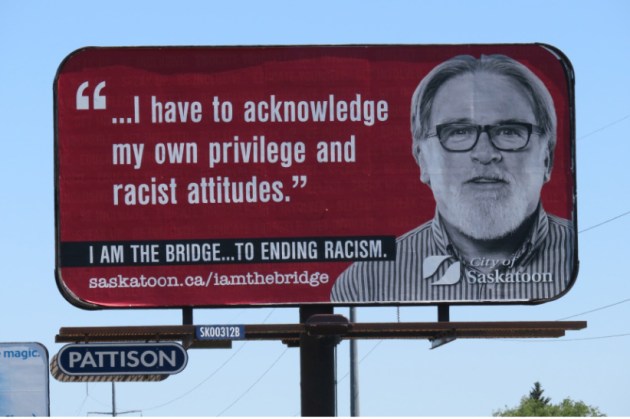
Here’s what he had to say: “I am a white, heterosexual, able-bodied male: the most privileged demographic in human history. If I’m going to be the bridge to ending racism in Saskatoon or anywhere else, I have to acknowledge my own privilege and I have to acknowledge my own racist attitudes, and work through my discomfort.”

In June, the city rolled out phase two of the campaign, which involves ads spread out across the city in bus shelters, restaurants and bars, along with four billboard installations, featuring quotes from former volunteers. In Williams’ billboard, which shows his face, but not his name, his quote was boiled down to: “…I have to acknowledge my own privilege and racist attitudes.”

With those 10 words, Williams, a professor at Saskatchewan Polytechnic, ignited a firestorm on social media of folks jumping to defend themselves against what they took as an accusation. One Reddit user kicked off a debate on the platform, asking: “Why is the city of Saskatoon purchasing billboards simply to say white men have privilege?” To which someone else replied: “You then invite a series of people who hate men and are racist against whites to criticise your every word and action until they are satisfied by your subservience.” Another wanted to make it clear that: “I have not had one hand out due to being white I’ve worked my ass off to get where I am. All of my friends and family have worked their ass off to get where they are.” Ezra Levant’s the Rebel, went on to call the billboard itself racist, as did an alt-right British group called Western Defence, and a slew of other Twitter users.

In an email to Maclean’s, Williams said that, despite the backlash, “I’m proud to be part of the ‘I am the Bridge’ campaign. I chose my words carefully and I stand by them completely.”

The city is likewise defending the billboard, saying that it wasn’t meant to suggest all people are racist, but rather to encourage residents to consider how they can play a personal role in mitigating racism. “Certainly the level of feedback indicates that the campaign is doing its job,” said Saskatoon city councillor Hilary Gough, “which is to get people talking and thinking about racism and the reality of it in our community.”

Indeed, surveys and polls on racism in the province do suggest that race relations are tense and deteriorating in Saskatchewan. Last year, following the murder of Colten Boushie, a 22 year-old Indigenous man from the Red Pheasant First Nation in Saskatchewan, the NRG Research Group and Peak Communications conducted a survey on racist attitudes across the country. In Saskatchewan, 46 per cent of respondents—more than anywhere else in the country—said racism was a big problem. Meanwhile 30 per cent of respondents in the western Prairies (Saskatchewan and Alberta), said race relations in their communities have gotten worse over the last decade.

Of course, broaching the issue of racism often draws prickly reactions like those towards Williams’ billboard. “Certainly, I think there is some defensiveness in this,” she says. “It takes time to learn about one’s own privilege without feeling like we need to feel guilty.” Part of the backlash, though, comes from a mistinterpretation of the campaign, says Gough. “We aren’t saying that everybody is racist and has racist attitudes, but we are trying to create space for each of us to consider how we can most productively engage with the structures we’re living in and figure out what our role is in eliminating and addressing racism.”

The I Am The Bridge ad campaign, which cost the city $14,000 this year, runs until July 16.

Source: The anti-racist ad that triggered a backlash – Macleans.ca

I applaud British Islam’s refusal to bow to the establishment | Giles Fraser | Opinion | The Guardian

I don’t really understand Fraser’s arguments. Is he against integrating into Britain’s civic life? Does it not make sense for religious institutions themselves find ways to integrate into society? Is refusal good for communities and society? Is respectability necessarily a bad thing?

Back in May, at the Roundhouse Poetry Slam, the brilliant Suhaiymah Manzoor-Khan took to the stage to denounce the importance of being one of those good Muslims, as opposed to one of the bad ones. I refuse to have to prove my humanity to you by cracking a smile, and saying how “I also cry at the end of Toy Story 3”, she said, her voice shaking with intensity and focus. I won’t try to tell you about “the complex inner worlds of Sumeahs and Aishas.” “No,” she insists, “this will not be a ‘Muslims are like us’ poem. I refuse to be respectable … Because if you need me to prove my humanity, I’m not the one that’s not human.”

I wholeheartedly applaud this refusal of respectability. I’m not asked to flaunt my moral or emotional credentials in order to be treated decently. I’m not asked to demonstrate that I am not a radical, or prove that I am an asset to society. Yet this is what immigrant communities, especially those that come with some “foreign” religion, are regularly pressed to do

A report out this week, chaired by the MP and QC Dominic Grieve and titled The Missing Muslims, encourages adherents of Islam to greater participation in civil society and public life. It calls for more British-born imams and greater integration of Muslims into British cultural life.

It’s not a bad report, and its intentions are worthy. It recognises that there are problems with the Prevent agenda – which is an understatement – and it wonders out loud if an official definition of Islamophobia, along the lines of that used for antisemitism, should be explored. But, as with so many of the numerous reports about British Muslims, the focus is always on Islam as a problem to be solved and the need to distinguish between good Muslims and bad Muslims.

This good Muslim/bad Muslim distinction has history, of course. It was precisely this distinction that the British colonial authorities used to separate the secular, wine-drinking, western-integrated, moderate Muslims who were prepared to collaborate with British rule and the suspiciously religious, uppity, bearded Muslims who refused to bend the knee to colonial power. As the Oxford professor Tariq Ramadan has rightly pointed out, the good Muslim/bad Muslim distinction is entirely unhelpful, not least because it associates being good and moderate with some diminution of a Muslim’s religiosity. The distinction effectively says: if you are brown and pray more times a day than the local vicar then you should probably expect to have your phone tapped.

There is another problem with establishment bodies calling for Muslim participation within civil society. The British establishment has a longstanding and highly effective strategy when forced to deal with a “foreign” religion they don’t really understand – they seek to transform it into a mini version of the Church of England. This is how it works: first they encourage an organisational coherence, and crucially a hierarchy, and then they draw the newly established leadership into the establishment, with invitations to the Queen’s garden party and possibly a seat in the House of Lords. They did this with Jews in the 19th century. And they are trying to do it to Muslims in the 21st.

Jews called it the Minhag Anglia. The very idea of the chief rabbi, for instance – not a traditionally Jewish institution – was modelled on the office of archbishop of Canterbury, and its office holders took to behaving likewise. Take Hermann Adler, appointed in 1891. Adler styled himself “Very Reverend” and started wearing gaiters. He liked dining in London clubs and was made a CVO, Commander of the Royal Victorian Order. “He gave the Chief Rabbinate a high, unique dignity, ensuring that the Jews would be accorded official representation in national life,” wrote Rabbi Raymond Apple in a 1998 essay. Others saw it differently: he was the “willing captive of the gilded gentry”, wrote one columnist of the time.

This same strategy of drawing Muslims into the establishment has been at work for some time. But it’s a much harder sell because Islam is so much more theologically resistant to hierarchical thinking. It shuns the idea of popes or archbishops and insists that all human beings have equal access to God. This is what I most admire about British Islam. Its bolshy “Protestantism”. Its refusal to be bought off by official trinkets. Its refusal of respectability. 

Source: I applaud British Islam’s refusal to bow to the establishment | Giles Fraser: Loose canon | Opinion | The Guardian

‘Impossible to close the gap’: Immigration board boss says more resources needed to process legacy refugees – Canada – CBC News

More on IRB problems – Dion is polite in not flagging the number of adjudicator issue (see Globe editorial: The Trudeau government is failing refugee claimants, and Canadians):

Faced with a swelling backlog and a promise to resolve five-year-old asylum claims, the chair of the Immigration and Refugee Board of Canada admits he needs more funding and more people.

Mario Dion insists the IRB has become more efficient in dealing with cases, but it’s not enough.

“I am afraid the way things are at this point we will need additional resources … because there is a limit to how much you can stretch one person’s time,” Dion said in an interview with CBC News.

He said it’s “essentially impossible to close the gap using existing resources.”

Immigration Minister Ahmed Hussen recently announced a review of the asylum system, but he’s offered no guarantee of additional funding.

The bulk of the backlog is made up of Canada’s so-called legacy refugees.

They are a group of about 5,500 people who have yet to have their asylum claims heard. That’s because they arrived in Canada in 2012, just before the federal government passed a law that requires new refugee clams to be heard within 60 days. Since the IRB had to comply with the law, it put thousands of existing files to the side — where they’ve stayed ever since.

Source: ‘Impossible to close the gap’: Immigration board boss says more resources needed to process legacy refugees – Canada – CBC News

Applicants for US Citizenship Surge; Mexicans Least Likely to Apply

Different trend in Canada. Country of origin differences interesting – expect that one reason for lower take-up rates for Mexican immigrants is related to the high cost of US citizenship (about CAD 1,000):

The number of legal immigrants applying for U.S. citizenship has surged by more than 20 percent since 2015, according to a recent Pew Research study – with Mexicans the least likely to apply.

Applications for citizenship were up by 21 percent in the first half of this year at 525,000, compared to the same period in 2016 when 435,000 applied, the report found.

The total number of applications in 2016 was 972,000, 24 percent higher than the approximately 800,000 who applied in 2015.

According to the report, in 2015 there were 45 million immigrants living in the U.S., of whom 11.9 million were “lawful permanent residents holding green cards.”

Among those green card holders, 9.3 million were eligible to apply for citizenship.

Of the 9.3 million, 37 percent or 3.4 million were of Mexican origin, but they were the least likely of all immigrant groups to seek naturalization.

In 2015, 67 percent of all lawful immigrants living in the U.S. and eligible for citizenship had applied – but for Mexicans the rate was considerably lower – 42 percent. That rate hasn’t changed much since then, the report found.

In comparison to the 42 percent of eligible Mexicans applying, 83 percent of those from the Middle East applied and 74 percent of those from Africa.

Middle Eastern immigrants had the highest naturalization rate among all immigrant origin groups, while African immigrants accounted for the largest increase in naturalization rate in the last decade, according to the report.

The report’s research is based on U.S. census data, a year-round survey of 3.5 million households, and a monthly survey of 55,000 households.

Source: Report: Applicants for US Citizenship Surge; Mexicans Least Likely to Apply

Canadian exceptionalism: Joseph Heath | In Due Course

Joseph Heath, of UofT’s department of philosophy, in a recent post paints an overly simplistic picture of “Canadian exceptionalism.”

While many of his points are valid, there is a surprising lack of a historical perspective in his treatment of integration and limitations to his analysis of the numbers and politics.

Historical perspective: Heath seems to anchor his post on the shift towards greater support for immigration in the mid-1990s – the inflection point when more people supported immigration than opposed.

But this ignores the longer term factors that are central to Canada’s relative success. First among them is a “culture of accommodation” that, however imperfect, reflects an early accommodation between settlers and First Nations (e.g., Royal Proclamation of 1763) and between French and English settlers (e.g., Quebec Act of 1774). While more observed in the breach than the observance for most of our early history, it nevertheless provided a way of thinking that underlies Canadian discourse.

The emphasis on integration, as distinct from assimilation, emerged in 1959 as Canadian citizenship articulated that integration was a voluntary process, respect for cultural traditions was compatible with loyalty to Canada, and that the host society was ultimately responsible for newcomer acceptance. The “Other groups” chapter of the Bi and Bi Commission provided further elaboration of the integration process.

The “other groups,” such as Ukrainian Canadians, pressed for multiculturalism in order to recognize their distinct identity and contribution to the building of Canada. The end result was the multiculturalism policy of 1971 and Act of 1988.

It was not merely “inadvertently” that Canada ended up being more successful in newcomer integration, but a series of earlier actions and policy choices – immigration, settlement, citizenship and multiculturalism – that enabled us to do so.

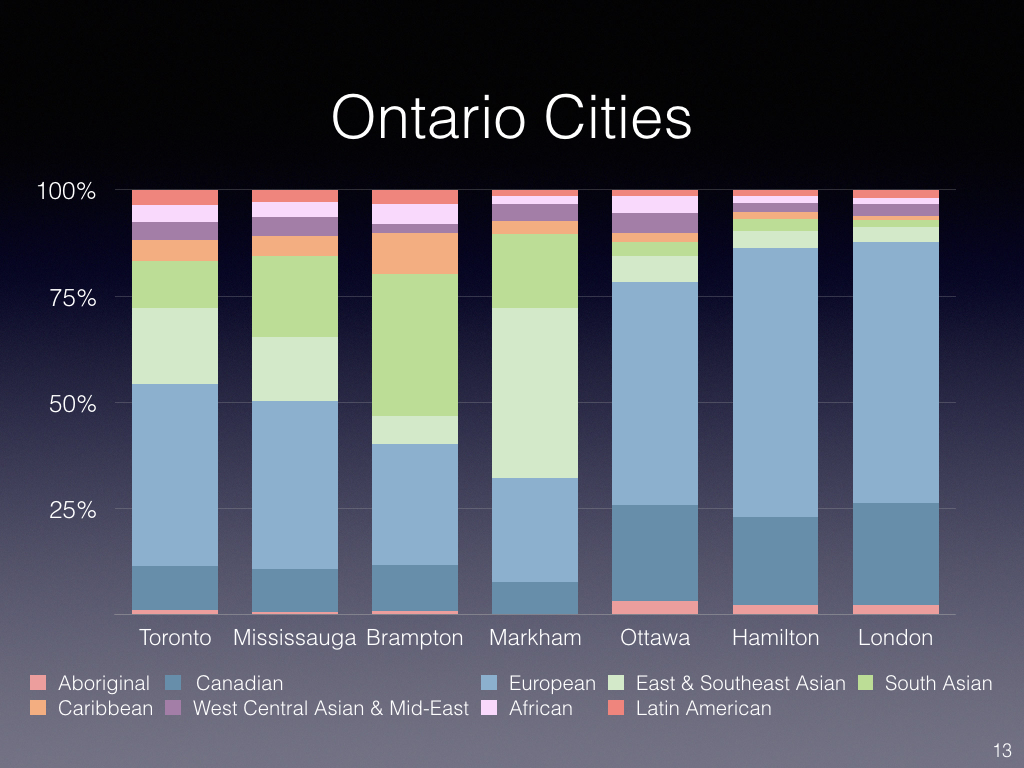
Numbers: While Canada does have more diverse newcomers than most other countries at the national level, the same cannot be said at the regional or municipal levels. The various controversies that emerge from time-to-time in places such as Brampton, Surrey or Richmond illustrate that.

Political system:

Similarly, his treatment of how Canada’s political system lacks understanding of the numbers of new Canadian voters and their relative concentration in ridings.

The more fundamental reality is that no political party can win a majority (and would be hard placed to win a strong minority) without the support of new Canadian voters, particularly those in the suburban areas of Toronto (the 905) and Vancouver.

Moreover, he overstates the impact of the first-past-the-post system on the far right given that UKIP, at least in the 2015 election, was able to attract almost 13 percent (but less than two percent in 2017).

Personally, I find Keith Banting’s recent analysis of “Canadian exceptionalism” at a “Big Thinking” Parliament Hill event more convincing (see Big Thinking video).

The five factors of Heath:

1. Very little illegal immigration

2. Bringing people in from all over

3. A political system that encourages moderation

4. Immigrants are part of larger nation-building project

5. Protection of majority culture clear from the start

Source: Canadian exceptionalism | In Due Course