Why Google’s newest AI team is setting up in Canada – Recode

The Canadian advantage includes immigration and related policies:

DeepMind, Google’s London-based artificial intelligence research branch, is launching a team at the University of Alberta in Canada.

Why there? Two reasons come to mind:

1. Canada has a history of AI research

DeepMind is launching a team at the university partly for proximity to the broader AI research community in Canada.

A number of leading AI researchers in Silicon Valley hail from Canada, where they plugged away at deep learning, a complex automated process of data analysis, during a period when that technology — now popular at major tech companies — was considered by the larger computer science community to be a dead end.

Plus, almost a dozen DeepMind staff came from the university, according to a blog post by DeepMind co-founder and CEO Demis Hassabis announcing the new lab. An Alberta PhD and a former post doc from the school played key roles in one of DeepMind’s hallmark accomplishments, getting its AlphaGo software to beat the human world champion at Chinese strategy game Go.

“Our hope is that this collaboration will help turbocharge Edmonton’s growth as a technology and research hub,” wrote Hassabis, “attracting even more world-class AI researchers to the region and helping to keep them there too.”

2. The Canadian government is friendlier to AI research than the U.S.

Political realities also make Canada a particularly attractive place for Google to expand its AI efforts.

The Canadian government has demonstrated a willingness to invest in artificial intelligence, committing about $100 million ($125 million in Canadian currency) in its 2017 budget to develop the AI industry in the country.

This is in contrast to the U.S., where President Donald Trump’s 2018 budget request includes drastic cuts to medical and scientific research, including an 11 percent or $776 million cut to the National Science Foundation.

Another contrast to the U.S. is in immigration policies. Canada doesn’t have an equivalent of the U.S. travel ban, which restricts travel for immigrants and refugees from Iran, Libya, Somalia, Sudan, Syria and Yemen. In the U.S., the ban makes it more difficult for tech and academic talent to enter the country.

Something interesting: One of the three researchers leading the team, Dr. Patrick M. Pilarski, is part of the university’s Department of Medicine. Google won’t comment on whether Pilarski’s medical background will play a role in his machine learning work for DeepMind, but Google is working on ways to integrate AI for health care as part of its cloud offering.

Source: Why Google’s newest AI team is setting up in Canada – Recode

Toronto Councillor Kristyn Wong-Tam withdrawing ‘intersectional’ motion that clashed with Black activists: Paradkar

Eating their own rather than moving forward – action starts with awareness:

Toronto councillor is withdrawing a motion asking the council to establish an “Intersectional Awareness Week” after it ran afoul of detractors from unexpected quarters.

“I will be withdrawing the motion,” said Kristyn Wong-Tam, who also released a statement Wednesday morning, barely five days after the motion was launched. “I was hoping . . . that it was the beginning of a powerful movement to raise awareness that we are not single-issue people.”

The city council had directed Toronto’s city manager to create an “Intersectional Gender-Based Framework to Assess Budgetary Impacts” in next year’s budget, her statement said.

“A dynamic young, LGBTQ2S+ racialized woman working with my office proposed the creation of an Intersectionality Awareness Week. She diligently did her research and with the input of my office staff, drafted a motion which was wholeheartedly endorsed.”

The opposition to her proposal came not from the usual suspects such as Councillors Giorgio Mammoliti or Jim Karygiannis, who tabled an openly hostile motion against Black Lives Matter couched as support for Toronto police, but from several high-profile Black scholars, activists and community workers.

Intersectionality is the term coined by the American scholar and civil rights advocate Kimberlé Williams Crenshaw to describe the invisible overlapping or intersection of issues of class, race, gender, ethnicity and sexuality when it comes to discrimination. She first applied it in the context of Black feminism.

While she used the term in 1980s, it has entered the mainstream only in recent years, and though I have a distaste for what I call “academese” — jargon that serves to obfuscate rather than clarify — the word “intersectionality” has expanded into an exceptionally effective descriptor of marginalized people at the crossroads of multiple identities.

Wong-Tam’s proposal aiming to commence an educational campaign fell apart after her critics released an open letter asking for the motion to be withdrawn.

At issue were the following points:

  1. The timing. The proposal came on the heels of the inquest that ruled the death of Andrew Loku — a mentally ill Black man killed by police — a homicide, a verdict with no criminal liability. The timing suggested it was, yet again, a token gesture of mollification by the city, a symbolism without substance.
  2. The motion did not take into account the contribution of Crenshaw (an omission that was later amended) for the term intersectionality, and the work of other Black feminists, and it did not reference Blackness, suggesting it ignored Black struggles.
  3. The exclusion of Black activists from the planning of the proposal that suggested a disregard for their experiences.

“I was prepared to amend it after some of the comments I heard. I recognize there are individuals deeply attached to the discussion,” Wong-Tam told me. She says Crenshaw, whom she reached out to after the initial motion, was supportive of her proposal and described it as incredibly exciting news. The hope was that city council could partner with local universities to bring Crenshaw to Toronto to launch the initiative, she said.

The proposal also had the support of the Urban Alliance on Race Relations.

“Now that there’s this open letter,” Wong-Tam said. “I also want to be respectful of what they say. I understand their skepticism especially in light of police shootings.

“There was nothing behind the motion that was meant to harm anybody. It would allow us to create a forum to better understand the concept of intersectionality.”

Her critics didn’t see it that way. They saw the proposal as celebratory.

“What exactly has the city done in order to warrant the celebration of Intersectionality Awareness Week? What awareness does the city have that it feels that it can lead such an initiative?” asked OmiSoore Dryden, chair, department of women’s, gender and sexuality studies at Thorneloe University (at Laurentian). “I would really like councillors to focus on this job, instead of the time and energy they have put into the pretence of this ‘awareness week.’ ”

There are no bad people in this conflict — a rarity these days — only people on the same side disagreeing on the way forward.

As a racialized immigrant woman of colour in the LGBTQ community, Wong-Tam gets intersectionality.

As people experiencing daily oppression, Black people are opposed to yet another government awareness program with brochures and seminars.

There’s also a chicken-and-egg tension; Black activists want Wong-Tam to establish credibility and see action before words. “We want a commitment from the City of Toronto to actually do some substantive work in helping Black people live our lives fully,” the activists’ open letter says.

For Wong-Tam, spreading awareness would lead to action. “I don’t believe we can get to a place of full equity by not having these dialogues. This is how we build allyship.”

There is a gap in the understanding of the term “intersectionality” in the broader population, and Wong-Tam has identified it as one that needs to be addressed.

It does.

With the shock waves of the Loku verdict still reverberating, the time to address that gap may not be right now. But in time I hope these two sides get together to hammer out concrete steps to make it happen.

Source: Councillor Kristyn Wong-Tam withdrawing ‘intersectional’ motion that clashed with Black activists: Paradkar | Toronto Star

Groups ask Federal Court to strike down Safe Third Country deal with the U.S. – Politics – CBC News

Not entirely unexpected. Court case may as much to raise the political profile as expected a ruling in their favour:

A legal challenge is being launched against the Canada-U.S. agreement that governs where people can make asylum claims on either side of the border.

Three advocacy groups are throwing their support behind a woman being named only as “E” in asking the Federal Court to strike down the so-called Safe Third Country Agreement.

Under the deal, most people who make an asylum claim at the land border are denied entry; as a result, there’s been an influx of people crossing illegally into Canada in recent months to file asylum claims.

The Canadian Council for Refugees, Amnesty International and the Canadian Council of Churches are among the many groups urging Canada to suspend the arrangement following major changes to U.S. immigration and refugee policy since the election of President Donald Trump.

But now they’re asking the Federal Court to step in, arguing that sending claimants back to the U.S. is morally and legally wrong because it risks violating their basic rights.

The litigant in the case is described as a Salvadoran woman who fled after being targeted by a gang and who believes she won’t be protected in the U.S.

It’s not the first time the deal has been tested in court.

A legal challenge was mounted after it came into force in 2004, and while the Federal Court at the time agreed the U.S. may not be safe for all refugees, the decision was overturned on appeal.

Ensuring ‘human dignity’

“Our organizations have pressed repeatedly, expecting that Canada would move to suspend the Safe Third Country Agreement as regard for the rights of refugees has rapidly plummeted under the Trump administration,” said Alex Neve, secretary general of Amnesty International Canada in a statement.

“To our astonishment and disappointment, however, the Canadian government continues to maintain that the U.S. asylum system qualifies as safe. We are left with no choice but to turn to the courts to protect refugee rights.”

Despite the deal, there are people showing up at the land border and getting through based on the exemptions that exist, including having family already in Canada.

Data obtained under the Access to Information Act showed that over a six-day period in March, 123 people showed up at legal entry points along the border and requested asylum; 66 were judged eligible and 57 turned away.

But Canada needs to go further, Rev. Karen Hamilton, general secretary of The Canadian Council of Churches, said in a statement.

“The government of Canada has a responsibility to ensure that the human dignity of all persons is respected. So it is imperative that all who seek refuge in Canada are afforded the protections guaranteed to them under the Canadian Charter of Rights and Freedoms and international human rights treaties.”

A spokesperson for Immigration Minister Ahmed Hussen said the government’s position on the agreement has not changed, and the deal remains in force

The federal Liberals have said they believe the deal does not need to be suspended or altered, as the asylum system in the United States is still functioning.

Source: Groups ask Federal Court to strike down Safe Third Country deal with the U.S. – Politics – CBC News

Egerton Ryerson doesn’t deserve an anti-Indigenous label: Smith

Good historical account of Ryerson’s life and relationships with some Indigenous persons by Don Smith:

A variant of the line “those who forget history are condemned to repeat it” could be “those who are ignorant of history are condemned to ignorance:”

As a Canadian historian of nearly half a century’s standing, I find the current controversy over Egerton Ryerson, the namesake of Ryerson University, totally baffling. I wonder how deeply his critics have probed into the past of the founder of the modern Ontario public-school system. Their portrayal of him as anti-Indigenous misrepresents the man completely.

Egerton Ryerson (1803-1882) was a Christian minister. Perhaps this is the central problem. As the University of British Columbia anthropologist Kenelm Burridge said so well in his book, In the Way: A Study of Christian Missionary Endeavours (1991): “Whatever missionaries do or have done will be perceived as good by some, otherwise by others.”

At the Credit Mission, located in what is now Mississauga, young Egerton set out in 1826/27 to learn Ojibway. As he later wrote: “I must now acquire a new language, to teach a new people.” The first Methodist (now the United Church) minister to the Mississauga (Ojibwa, or Anishinabeg) acquired a basic speaking knowledge. The future Mississauga chief, Kahkewaquonaby (Sacred Feathers), known in English as Peter Jones, became a close life-long friend. The Credit Mississauga liked Ryerson. He rolled up his sleeves, worked beside them in the fields, ate and lived with them. He gained their respect. At a council meeting in December, 1826, they gave him the Ojibway name of one of their deceased chiefs: “Cheechock” or “Chechalk.” The name meant “Bird on the Wing.”

A decade later, Ryerson did his best to advance the studies of Henry Steinhauer or Shahwahnegizhik, an Ojibwa from the Lake Simcoe area, at the Methodist College that is now Victoria University in the University of Toronto. In the 1850s, Ryerson, as the superintendent of education for Canada West, welcomed Allen Salt, a Mississauga from the Rice Lake area near Peterborough to the Toronto Normal (teacher training) School, the predecessor of what is now Ryerson University.

So grateful was Steinhauer for his assistance and encouragement that he named one of his sons Egerton Ryerson Steinhauer. At Rev. Salt’s last mission on Parry Island (Wasauksing) on Georgian Bay, the mission day school bore the name Ryerson. Only recently was the First Nations day school renamed, to Wasauksing Kinomaugewgamik.

As educational historian Robin Harris wrote in 1959: “Ryerson was Christian, first, last, and all the time; his religious principles were his first principles.” Yes, he had a Christian agenda, but he also supported the Credit Mississauga’s fight for a title deed to their Credit River reserve and their efforts to build a strong economic base for their community.

Ryerson was not the creator of the Indian residential-school system. The Final Report of the Truth and Reconciliation Commission of Canada, vol. 1. The History, Part 1. Origins to 1939 (Montreal and Kingston: McGill-Queen’s University Press, 2015), pp. 75-78, clarifies his outlook toward Indigenous education. In 1847, he did write a short report on Indian boarding schools where older male students could learn European-style agriculture.

In preindustrial Ontario, farming was the motor of the economy. As his educational model, he favoured the respected Hofwyl School for the Poor near Berne, Switzerland.

Jones and Ryerson were true friends, perhaps best described as “blood brothers.” Toronto’s Dundas Square borders Victoria Street. The site ofRyerson’s home 150 years ago is located toward the eastern end of the urban park. Its actual site is now under Dundas Street East.Ryerson welcomed Mr. Jones and his wife to stay with his family for a month in the spring of 1856 while Ryerson sought the best medical advice to restore Jones’s health. After the attempt to find a cure failed, Jones returned to his home in Brantford, where he died two weeks later. As Jones had requested while he stayed at the Ryerson’s that spring, Ryerson gave the eulogy at his funeral on July 1, 1856.

To describe Egerton Ryerson, or Chechalk as the Mississauga called him, as anti-Indigenous misses the mark. Back to you, Ryerson Students’ Union, for further study.

Source: Egerton Ryerson doesn’t deserve an anti-Indigenous label – The Globe and Mail

Globe editorial: The Trudeau government is failing refugee claimants, and Canadians

Valid points – backlogs will only increase, requiring more funding and personnel to handle.

Hard to understand why IRB appointments are taking so long – after all, the government has been able to appoint almost 100 judges over the past year and a half (after a slow start):

Our neighbour to the south has taken a pronounced nativist turn in recent months, and the government of Canada’s response has been to throw the doors open – rhetorically, at least.

Last January, Prime Minister Justin Trudeau took to social media and proclaimed, “To those fleeing persecution, terror & war, Canadians will welcome you, regardless of your faith. Diversity is our strength #WelcomeToCanada.”

As political marketing goes, it was nicely timed. But to be completely insulated from truth-in-advertising complaints, it should have included a disclaimer – “Offer available only to genuine refugees, as defined by law. As we are experiencing an unusually high number of claimants at this time, it could take many years for our government to decide whether you are legally entitled to welcome, or removal.”

According to the latest federal statistics, more than 14,000 people have registered their intention to seek asylum in Canada through the first five months of 2017.

That number doesn’t include refugees from Syria, who are being fast-tracked, and it adds upon the 23,900 who arrived in 2016 – itself a sharp increase from the 16,000 who came in 2015.

Last month, the federal government offered a modicum of good news to 5,500 people whose claims had been shunted to the back burner by the former Conservative government. Most have been waiting in limbo since at least 2012; their cases are expected to proceed in the fall.

Unfortunately, this will barely dent the application backlog, which is estimated at close to 40,000 cases.

The wait faced by refugee claimants – legitimate or otherwise – is too lengthy, and also unfair. It is well known that the longer an application is delayed, the lower the chance of it being accepted.

Meanwhile, the influx of asylum-seekers is unlikely to abate. There’s been a surge in the number of claimants showing up at Canada-U.S. border crossings since President Donald Trump took office in January, but even that is not the whole story.

The United Nations’ Refugee Agency calculates there are more displaced people on the planet right now – 65 million – than at any point since the Second World War.

A government analysis obtained by the Canadian Press forecasts the number of refugee claimants in Canada will hit 36,000 this year, and rise by as much as 20 per cent a year after that.

If the current trends hold, the time required to process an application will reach 11 years in 2021, and could cost $3-billion in social support payments. This must not be allowed to happen.

Hiring more staff and expanding budgets are an unavoidable aspect of correcting the situation, but it isn’t a matter of applying a simple fix.

The new federal appointments process announced earlier this year, billed as independent and competence-based, has been a disaster for the Immigration and Refugee Board. Dozens of key jobs remain vacant, while the number of claims is rising rapidly.

On June 21, the IRB announced its Western Canada immigration appeal division – which deals primarily with applications involving family members and dependents abroad – would be working at reduced capacity “for at least the next six months” because of staffing shortages.

The re-appointment of two outgoing members to one-year terms, announced that same day, won’t do much to ease the bottleneck. There should be 11 on the job, but there are currently only four.

Across all regions, the IRB’s refugee and immigration appeals divisions have a shortage of at least 29 members, and the terms of another 29 are set to expire at the end of this year, according to one news report.

The vacancies, and the slowness with which the Trudeau government is filling them, have led to accusations that Ottawa is culling IRB members who were appointed by the Conservatives in order to replace them with Liberal supporters.

Whatever the reasons, the IRB is unable to handle the load because Ottawa is allowing members’ terms to end while failing to appoint new people in a timely fashion.

Immigration Minister Ahmed Hussen recently announced a third-party review to examine resource levels and the various bureaucratic mechanisms involved. However, it won’t be concluded until next year, and that’s not good enough.

The IRB has raised the alert about under-staffing for years. An overwhelmed immigration and refugee process, already buffeted by an ill-advised overhaul under the Harper government, has real-world impacts. It’s bad for asylum seekers, and undermines public confidence.

Ottawa must move quickly to show Canadians that their government is doing more than drifting in its response. Tweeting “#WelcomeToCanada” is an empty gesture by the Prime Minister, if it’s not accompanied by action.

Source: Globe editorial: The Trudeau government is failing refugee claimants, and Canadians – The Globe and Mail

Une controverse religieuse s’invite au Parc Safari [Muslim call to prayer for private event]

The “sugar shack” type controversy of 2017:

Le Parc Safari a lancé un appel au calme, mardi, après avoir été la cible de réactions virulentes sur les réseaux sociaux dans la foulée d’un événement organisé sur place par des musulmans, dimanche.

L’Association musulmane du Canada avait réservé un espace dans le jardin zoologique pour tenir un rassemblement de 900 personnes. En fin d’après-midi, un appel à la prière a été lancé à l’aide d’un mégaphone, ce que certains visiteurs n’ont pas apprécié.

L’événement a été filmé et diffusé sur Youtube.

Après avoir reçu «plusieurs plaintes», le Parc Safari a tenté de calmer le jeu sur sa page Facebook. «Le Parc Safari est désolé que la liberté de religion ait pu offenser des gens, a écrit l’entreprise. En aucun cas, cela n’était l’objectif recherché.»

Au cours d’un entretien téléphonique avec La Presse, mardi, le propriétaire du Parc Safari, Jean-Pierre Ranger, a assuré que le volume sonore du mégaphone respectait les règles et qu’il n’était pas susceptible d’importuner significativement les autres visiteurs.

«La vidéo montre un moment où quelqu’un avec un mégaphone fait un appel à la prière. Bien oui, et puis? Ç’a duré cinq minutes. Ils n’ont pas dérangé 5000 personnes», dit M. Ranger.

Des centaines de personnes ont réagi à la publication du Parc Safari sur Facebook. Certains ont soutenu que l’événement n’avait pas sa place parce que le Parc Safari n’est pas un «lieu de culte» et que la religion «doit se vivre à la maison». D’autres ont salué l’«ouverture» et le «courage» de l’entreprise.

«Il y a un malaise»

Les regroupements et entreprises qui réservent un espace au Parc Safari ne paient pas de frais spéciaux, mais chaque participant doit débourser le tarif d’entrée, qui oscille entre 26 et 39 $, plus taxes. M. Ranger reconnaît qu’il courtise les communautés culturelles, et ce, depuis des années. Les publicités du Parc Safari sont traduites en 20 langues.

«Je ne me mêle pas du contenu éditorial des événements, pourvu que les gens ne se promènent pas tout nus, qu’ils ne font pas d’orgies et qu’ils ne deviennent pas ivres», a énuméré l’homme d’affaires de 73 ans.

«Je ne suis pas heureux de la situation parce que si on pouvait l’éviter, ce serait mieux, mais ça nous permet de constater qu’il y a un malaise», a-t-il poursuivi en faisant référence à l’inconfort que vivent certains Québécois à l’égard des musulmans.

Haroun Bouazzi, coprésident de l’Association des musulmans et des Arabes pour la laïcité au Québec, s’est indigné des commentaires de certains internautes, qu’il a qualifiés de «haineux».

«Ce n’est qu’une preuve de plus qu’il y a des groupes hyperactifs sur les réseaux sociaux qui carburent à la haine des minorités religieuses et principalement des minorités musulmanes», a commenté M. Bouazzi.

«Il est évident que ce non-événement, ça n’a rien à voir avec la laïcité parce que le Parc Safari n’est pas une institution de l’État», a-t-il ajouté.

Source: Une controverse religieuse s’invite au Parc Safari | Sylvain Larocque | Actualités

English version below:

A Quebec safari park that welcomed a Muslim community group Sunday and allowed afternoon prayers to be held on its site has become the target of “racist and hateful” comments after a short video of the gathering was posted online.

In a message posted on its Facebook page, Parc Safari in Hemmingford, Que. denounced the intolerant response and said it was “sorry if freedom of religion had offended some people.”

Park president and owner Jean-Pierre Ranger said Wednesday that the online abuse is coming from a minority of Quebecers who don’t understand what happened at his facility.

“Intolerance is a factor that occurs, but it’s a small percentage,” he said in an interview. “In some way, education will eventually bring the level of understanding a little higher, and there will be less stress in our society.”

The task of inter-cultural education does not usually fall to a zoo, but in Quebec flare-ups of intolerance can occur in unlikely places.

The province’s 2007 debate over reasonable accommodation featured outrage over Muslims being served pork-free meals and given prayer space at a maple sugar shack and Hasidic Jews being provided a kosher refrigerator at a pediatric hospital.

On Sunday, the Centre Communautaire Laurentien, part of the Muslim Association of Canada, organized an outing to the Parc Safari to celebrate the end of Ramadan and Canada’s 150th anniversary. The event had initially been scheduled for July 1 but was postponed because of rain.

About 950 people took part, and they were provided a small roped-off section of the park for a picnic. When the time arrived for afternoon prayers, the group used a loudspeaker.

A user going by the name guindon87 posted a 46-second video to YouTube in which people are seen at a distance gathering for prayer and Arabic words are faintly heard coming over a loudspeaker. The poster, whose YouTube contributions include a video describing Montreal activist Jaggi Singh with a racist slur, wrote that the Hemmingford prayers showed “a serious lack of respect for Quebec and Quebecers.”

The video had attracted 45,000 views Wednesday morning and was picked up by TVA news and other media outlets in the province.

Samer Elniz, manager of the Centre Communautaire Laurentien, said he found the reaction to his group’s visit “ bizarre” and particularly troubling because they were there in part to celebrate Canada.

“Personally, I go into public parks and I see Christians conducting a mass, I see baptisms. That doesn’t bother me, even if I am Muslim,” he said. “I like seeing the diversity, seeing people doing as they wish. There are countries where you don’t have those rights.”

Source: Quebec safari park defends religious freedom following ‘hateful’ response to Muslim visit

ICYMI – the Duck: The maple leaf flag embodies Canada’s national amnesia | C.P. Champion

Historian and former CPC staffer Champion on the current and former flags (under former Minister Jason Kenney, the Red Ensign was displayed at some citizenship ceremonies if memory serves me correct but the Conservative government declined to provide it more official status as Champion recommends):

There is much to celebrate on Canada’s 150th, and there will be no shortage of Canadian flags fluttering about. But the maple leaf flag is also the perfect embodiment of our national amnesia.

Unlike Canada’s original flag—the Canadian Red Ensign—the maple leaf tells no story of our country. The Red Ensign, by comparison, vividly embodies Canada’s rich history, inclusive of First Nations, the fleur-de-lis, and the diversity represented by Scottish, English and Irish symbols.

This history dates back much further than 1867. Canada’s traditions were shaped by the first colonists, the Conquest of 1759, the policies of Lord Dorchester, the resilience of His Majesty’s new French Catholic subjects, generations of American and British immigrants, and First Nations who prospered in the pre-Industrial era and understood themselves as proud, though cautious, allies of the King.

Jon Fogg, Saint James Marine operator, left, and his daughter-in-law Wendy Fogg, unfurl the original Canadian Red Ensign flag that flew over the S.S. Keewatin. Darren Calabrese/National Post

When these old colonies were reimagined and set on a new footing in the 1860s, four distinct Provincial shields were combined on the Red Ensign, which was flown by Sir John A. Macdonald. Lord Stanley, the governor-general, and Henri Bourassa, a French Canadian nationalist, both recognized the Red Ensign as a distinctive Canadian flag. After 1921, the flag bore the shield from Canada’s new coat of arms.

When Canadian soldiers took Juno Beach on June 6, 1944 (D-Day) they carried this Canadian flag ashore. Through Normandy and the Netherlands, between the Maas and the Rhine, under the Klever Tor at Xanten, in liberated Nijmegen, Arnhem, and Groningen: as the Reich flag was lowered across Western Europe, the Canadian flag was unfurled among the banners of victory. In 1945, there could be no doubt that “Canada had a flag,” as John Diefenbaker later said, “a flag ennobled by heroes’ blood.”

The Red Ensign was replaced by the red maple leaf in 1964, recommended in the sixth report of a parliamentary committee, voted for by 178 MPs in a discordant House of Commons, and implemented by a minority government led by a jittery Lester Pearson. Why the jitters? Because the old flag was so popular. As Senator Marcel Prud’homme, an M.P. in 1964, told me in 2007: “You see, we had to kill the Red Ensign” — so that the fledgling maple would have no rival.

Many celebrated the new dawn. The late Lt. Gen. Charles Belzile, who witnessed the maple’s raising for the first time while serving as a young soldier in Cyprus in 1965, told me: “It sure looked pretty good against those green hills!”

But the new flag also had its critics. Historian Marcel Trudel warned in 1964 that Canada’s new flag had “no historic significance” and was “a lamentable failure.” “I am convinced, for my part,” he said, “that any flag, if it is to be truly significant, must contain or represent the symbols of the nation or nations which contributed to establishing the country.”

First Nations leaders were strongly attached to the old flag. James Gladstone, a Blood (Kainai) appointed to the Senate in 1958 said: “Personally I do not want to see any other flag flying but the Red Ensign.” Many chiefs had received a Union Jack as a ceremonial seal on treaties: “Under these symbols of justice, we feel safe. Take them away from us and it will be another sign that we are not safe.”

While the national flag is obviously here to stay, Ottawa should accord the old flag official status as “The Canadian Red Ensign.” It should fly permanently alongside the Canadian flag at the National War Memorial — after all, it’s the flag our soldiers actually fought under. It should fly at war memorials everywhere, and at obvious locations such as the Canadian War Museum grounds. And finally, a Red Ensign should wave permanently above the East Block of Parliament as a symbol of our heritage of freedom.

Source: Beyond the Duck: The maple leaf flag embodies Canada’s national amnesia | National Post

International students in B.C. could be in fake marriage schemes: Douglas Todd

The ingenuity of persons wanting to come to Canada knows no bounds. No hard numbers but widespread anecdotes indicate that there is an issue (India sends the second largest number of students to Canada after China: 77,000 in 2016):

The newspaper ads in India are the visible tip of a booming underground industry in fake marriages involving would-be international students.

The prize for the “spouse” whose family buys an instant marriage with a foreign student is back-door access to a full-time job in Canada and a fast-track to citizenship.

The matrimonial ads normally promise that the foreign students’ sham marriage, plus all travel and study expenses, will be paid for by the Indian families who are determined to have their son or daughter emigrate.

The type of Indian student the ads seek is usually a teenage girl, who must have passed an English-language test and therefore be in line to be accepted as an international student.

Media outlets in India, such as the Hindustan Times, report there is a “booming matrimony market for ‘brides’ who can earn the ‘groom’” coveted status as a migrant to a Western country.

Canada is among the most sought-after destinations for Indian foreign students, say migration specialists, because it is the most generous toward foreign students and their spouses. Australia has also been popular, but recently tightened its rules.

Here is a typical recent ad from one Punjabi-language newspaper in India, Ajit:

“Jatt Sikh, boy, 24 years old, 5 feet 10 inches, needs girl with IELTS band 7. Marriage real or fake. Boy’s side will pay all expenses.”

The ad is listed by a high-caste “Jatt” Sikh male, or more likely his parents. It seeks a contractual marriage with a young woman who has scored well (“band 7”) on an international exam called “IELTS,” the International English Language Testing System. Almost three million IELTS exams are conducted each year.

Here is another ad, from the newspaper Jagbani:

“Barbar Sikh, 24, 5 feet 8 inches. Finished Grade 12. Looking for BSc or IELTS pass girl. Boy’s side will pay all expenses to go to Canada.”

In this ad the family of a lower-caste “Barbar Sikh” is seeking to have their son marry an Indian female with a bachelors of science degree, or a passing mark on the IELTS test, so their son can be allowed into Canada as her spouse.

As these kinds of ads illustrate, the parents of the male “spouse” typically offer to cover all expenses for the international student, who often end up attending one of the scores of private colleges in Canada with low to non-existent standards.

B.C. is home to 130,000 international students, the vast majority of whom are in Metro Vancouver, which has the highest concentration of foreign students in Canada.

In exchange for financing the foreign student, the phony spouse gets to live in Canada and legally work up to 40 hours a week, plus receive medical coverage and other benefits. That puts them in a strong position to become permanent residents of Canada.

The foreign-student marriage rackets are gaining attention in newspapers in India.

Indian media are reporting angry fallout when students financed by other families either fail to get into a Western college or university, or try to break up with their spouses of convenience.

Kwantlen Polytechnic University political scientist Shinder Purewal, a former Canadian citizenship court judge, says Punjabi- and Hindi-language newspapers in India run dozens of such ads each week.

“Families are looking for matches to get their sons or daughters abroad. And the most successful route to Canada is through international-student channels. It’s an easy way to get immigration,” said Purewal.

Source: International students in B.C. could be in fake marriage schemes | Vancouver Sun

Your name may dictate your apartment, degree, and career: Kutty

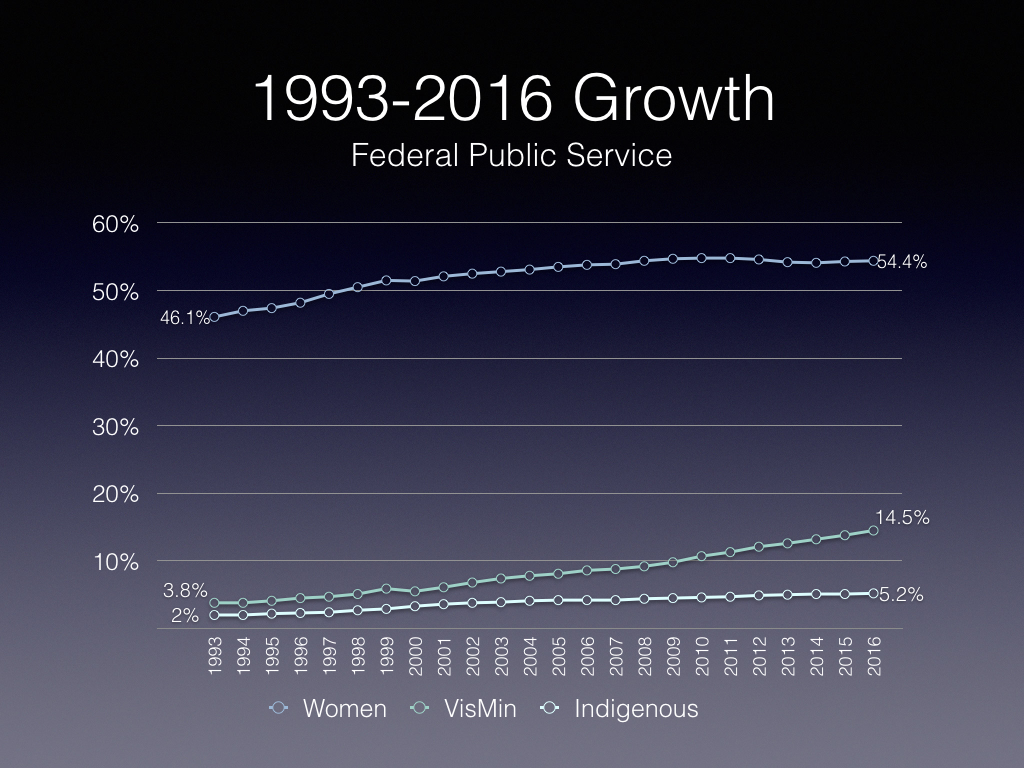
Ironically, although singling out the federal public service and its pilot project, Kutty is silent on the overall numbers which are largely representative of the visible minority population who are also Canadian citizens – 15 percent (some visible minority groups do better than others).

Above chart shows the 25 year trend for women, visible minorities and Indigenous peoples:

Having found the perfect rental property near the law school, a student of mine could not get a call back from the landlord despite repeatedly leaving messages. When a friend of his called, the call was returned within minutes.

Why?

Well, my student’s name was Mohamed. His friend used the name “Joe.”

Many Canadians with non-Anglicized names can speak of similar experiences. A CBC Marketplace segment from last year, for example, explored the idea of implicit bias affecting shoppers, apartment-seekers and job-hunters across Canada, finding that those with “foreign-sounding” names tended to face challenges that the “Joes” of the country did not.

That phenomenon in mind, then-rookie MP Ahmed Hussen — who has since been named immigration minister — introduced the idea of bringing name-blind recruitment to the civil service in Parliament last year. At the time, he said the move would “assist in our fight to end discrimination and attain real equality in our country.”

Ottawa has now adopted as a pilot project involving six federal ministries: National Defence, Global Affairs, Immigration, Refugees and Citizenship, Public Services and Procurement, Environment and Climate Change and the Treasury Board.

According to the Treasury Board, the initiative will “conceal an applicant’s name, email addresses, employment equity information (i.e., gender, visible minority, person with a disability, Indigenous peoples), names of educational institutions, and country of origin at the initial screening stage.” The results will then be compared to outcomes from traditional applicant shortlisting and will be made available in a report due in October.

There is not much available data yet other than figures showing there has been a slight decrease in the number of visible minority applicants from the year 2012-13 to 2013-14 and subsequent years. One can hope that this initiative would reverse that trend.

As with most government pilots, there are surely some critics wondering why the federal civil service is busying itself with such projects.

Well, first off, there shouldn’t be any dispute that this is indeed a problem. A joint study from the University of Toronto and Ryerson University found that job applicants with Asian-sounding names received 20.1 per cent fewer calls from large organizations than those with Anglo names, and 39.4 per cent and 37.1 per cent fewer calls, respectively, from medium-sized and small employers.

A similar study by the U of T in 2011 — one called “Why do some employers prefer to interview Matthew, but not Samir?” — found that employers in Toronto, Montreal and Vancouver were about 40 per cent more likely to interview candidates with Anglo-sounding names, as opposed to those with Chinese or Indian-sounding names, even if the candidates were equally qualified. The government’s pilot project aims to remedy this.

The idea is not new, in fact. Countries such as the U.K. and Australia have led the way in this regard. The British Civil Service and some of the large corporations including HSBC, Deloitte, BBC, and the U.K.’s National Health Service, initiated such a program in 2015. Last year, the Victoria Police, Australia Post and Ernst & Young (Australia) joined a recruitment program that strips out gender, age and cultural details.

Here in Canada, many law schools have implemented a blind grading system whereby students’ names are replaced by numbers to avoid instructor bias. And the Toronto Symphony Orchestra has demonstrated the success of blind auditions for years — evolving from a white, male orchestra in the 1970s to one that is now half female and much more diverse.

A name-blind recruitment process for the federal government is hardly more cumbersome in procedure, and the makeup of the civil service only stands to gain. A more reflective service will have more credibility with the populace but will also better understand the public it is serving. Moreover, as a recent study demonstrated there is a positive correlation between diversity and increased productivity.

That said, as many critics point out: name-blind screening is not a panacea — unconscious biases can’t be eliminated with one little recruitment remedy, and candidates will eventually be evaluated face to face. But removing a barrier to diversity in the federal civil service is a positive step, even if it is a minor one.

Let’s hope that this is just one component of a more comprehensive strategy involving: management acknowledging and confronting their own biases; better training on how biases impact decision-making; more objective hiring processes; and a more diverse group involved in the actual hiring process.

Source: Your name may dictate your apartment, degree, and career: Kutty | Toronto Star

What an Irrational Immigration Policy Looks Like | Commentary Magazine

Hard to argue but not optimistic regarding change:

President Trump was elected on a platform that called for deporting more illegal immigrants who committed crimes and doing more to stop illegal arrivals. In theory, there is little here that anyone can quarrel with. Few Americans other than the most extreme pro-immigration activists will dispute the need to secure our borders and to evict criminal aliens. In the quest for border security, though, we should not sacrifice our humanity or common sense.

To wit: Recently, six teenage Afghan girls assembled a robot to enter into an international robotics competition behind held in Washington this month. They had to travel 500 miles from their home city of Herat to Kabul to apply for visas at the U.S. Embassy—a trip that is far from safe, and yet they made it twice. They had to order components from abroad, and it took extra long for them to arrive because they could easily be confused with bomb-making parts. Yet after trying so hard, and assembling their robot, they were crestfallen to learn that the State Department had denied their visas.  This is all the more inexplicable and heartbreaking given that girls’ education—forbidden under the Taliban—has been one of the major achievements of the post-2001 state created at such great cost in American blood and treasure.

That’s hardly the only episode of temporary insanity resulting from the president’s new tougher immigration initiatives.

Radwan Ziadeh is exactly the kind of Syrian that the U.S. would like to see running the country. He is a young, liberal, pro-American activist. He has lived in the U.S. for the past decade, and his three children were born here. Yet the U.S. Citizenship and Immigration Services has notified him that he may soon be deported because he provided “material support” to an “undesignated terrorist organization.” The “terrorist organizations” in question were the Free Syrian Army and the Syrian Muslim Brotherhood, which, the USCIS notes, “used weapons with the intent to endanger the safety of Syrian government officials.”

What ICE’s judgment leaves out is that many of the weapons provided to the Free Syrian Army came from the United States. Ziadeh’s association with these two groups stems from his work as an organizer of Syrian opposition conferences in 2012 and 2013 in Istanbul that were sponsored by the U.S. and Canadian governments. “ In effect,” notes a Washington Post editorial, “Mr. Ziadeh is being accused of terrorism because he acted at U.S. urging (and with Canadian funding) to bring together U.S.-backed Syrian leaders.”

Amid this hysteria, the U.S. is at risk of not just sacrificing its soul but also its security.

The Pentagon launched a program in 2009 called Military Accessions Vital to the National Interest (MAVNI) to enlist foreigners with vital skills in the U.S. military. They would receive expedited citizenship in return for service. More than 10,400 troops have since served honorably and bravely under the program, bringing vital skills in such disciplines as medicine and Chinese, Pashto, and Russian language skills that are in short supply among native-born recruits. But now the Pentagon is contemplating canceling contracts for roughly 1,000 recruits who are ready to start Basic Training, thus exposing to them to the danger of deportation.

These episodes are the work of three different government departments: Rex Tillerson’s State Department is responsible for not issuing visas to the Afghan girls robotics team. John Kelly’s Department of Homeland Security is responsible for notifying Radwen Ziadeh that he is likely to be deported. Jim Mattis’s Department of Defense is responsible for possibly canceling the enlistment of 1,000 foreign-born volunteers.

The good news is that none of these decisions are irreversible—yet. There is still time for the Cabinet agencies in question to display some humanity and common sense. The risk is, in pursuit of a rational immigration policy, America could lose its mind.

Source: What an Irrational Immigration Policy Looks Like | commentary