Multiculturalism in Canada: Evolution, Effectiveness and Challenges: My latest

The Pearson Centre asked me to do a piece on multiculturalism for the 46th anniversary of the policy and Canada 150.

This article is part of a longer piece I am working on, looking at how immigration, settlement, citizenship and multiculturalism work together to foster integration.

I hope you enjoy it.

Source: Multiculturalism in Canada: Evolution, Effectiveness and Challenges (Pearson Centre), Multiculturalism in Canada: Evolution, Effectiveness and Challenges (pdf)

How Immigration Foiled Hillary – The New York Times

This is a really good long read and analysis of the tensions in rural America over immigration and related issues.

While the Canadian electoral system (ridings) makes lop-sided margins in cities and rural ridings less significant, it nevertheless is a reminder of the need to find ways to alleviate the concerns and apprehensions of rural voters:

Democrats point to a thousand reasons that Hillary Clinton lost the presidential election. Here is another.

In political circles, it’s common knowledge that in four key states President Trump unexpectedly carried counties that Democratic presidential campaign strategists had failed to recognize as crucial terrain — sparsely populated areas of Wisconsin, Michigan, Ohio and Pennsylvania.

In “What I Got Wrong About the Election,” for example, published right after Clinton lost, David Plouffe, who had managed the Obama campaign in 2008, wrote that

Trump’s margins in rural and exurban counties were off the charts. For example, in Madison County, an exurban area outside Columbus, Ohio, Mr. Romney’s margin over Mr. Obama was 20.4 percentage points; Mr. Trump’s margin over Mrs. Clinton was 39.8.

Plouffe added that this “happened in thousands of counties throughout the country, and it added up quickly.”

What Democrats missed was the profound political impact recent immigration trends were having on the more rural parts of the once homogeneous Midwest — that the region had unexpectedly become a flash point in the nation’s partisan immigration wars.

In a Brookings essay published last month, John C. Austin, director of the Michigan Economic Center, a local think tank, writes that the region is experiencing a “steady stream of immigrants from Mexico, Central America, Asia, Africa, and the Middle East.”

As a result, Austin continues,

Immigration has become an unambiguous factor in this racially charged Midwestern landscape. While immigrant-rich states like Arizona, California, and Florida are often at the center of immigration policy discussions, the political debate about the role of immigrants burns hottest in the heartland.

Austin went on, in an email, to provide more detail about the power of immigration to move white voters into the Trump column:

The “rural” voters here are some farmers, but more likely, as in the hinterlands outside Flint, Monroe, Toledo, Erie, or Janesville, Wisconsin, they are mostly white, working class blue collar workers or retirees, many, sadly, who fled their small cities to escape blacks. They are anxious about the economic prospects for their future, their aging communities (the kids have fled), making folks mad. And now all these immigrants come and are changing the society!! Just as Macomb County, where working class white voters fled Detroit in advance of blacks, now sees nearby communities like Hamtramck becoming (in their view) a Bangladeshi bazaar — and they don’t like that. And they are easily fanned to blame those folks.

In February 2017, Stanley Greenberg, a Democratic pollster and strategist, conducted four postelection focus groups with white voters who had cast ballots for Trump in Macomb County, Michigan, an area he has been studying since 1985. The participants were not Republicans. They were whites without college degrees who identified themselves as independents, as Democratic-leaning independents, or as Democrats who voted for Obama in 2008, 2012 or both.

“Immigration is a powerful issue for these Trump voters, representing a demand that citizens come before noncitizens, Americans before foreigners, and that we take care of home first before abroad,” Greenberg wrote in his report for The Roosevelt Institute:

They believe that we have “opened up our borders, they pretty much made it a free for all” which means fewer jobs and greater demands on government services and more concerns about safety.

Greenberg’s report is replete with revealing quotes from the focus groups:

I went and finally signed up for Medicaid, and I’m standing in the damn welfare office, and I’m looking around at all of these people that can’t even say hello to me in English. But they’re all there with appointments for their workers, which means they have the health care, they have the food stamps…. If you can come from somewhere else, why can’t we all get it?

And:

My grandson’s school, I went to as a child, there are hardly any — I’ll just say American families there now. It’s mostly Middle Eastern and people all standing outside waiting for their kid, to pick them up at the end of the day, and nobody’s speaking English. Everyone’s speaking other languages, which, there’s nothing wrong with other languages.

And:

You know what, like where I’m working, at Kroger, how many Spanish people I wait on. The universal language — I don’t care, if you smile — hello, I don’t care what country you’re from, but some of these people, they act like they can’t do that, even. It’s like, “You know what? You’re in America.” Get with either — you can learn to say hello, goodbye, thank you, in our language. This is America.

Three developments are taking place in the rust belt simultaneously.

First, as recently as 2000, many of the key Midwestern counties that moved from blue to red in 2016 had very few minority residents. Since then, their immigrant populations began to increase at a rapid rate well above the national average. Second, at the same time that immigrants are moving in, younger native-born residents are leaving in droves to seek employment elsewhere, while the remaining white population is aging and is often hostile to change. It is the perfect formula for cultural conflict, and Trump proved to be the perfect candidate to exploit it. Finally, these changes are taking place in a region that Austin points out is home to “15 of the nation’s 25 major metro areas with the sharpest black-white segregation,” making it even more unreceptive to nonwhites than other sections of the country.

One way to understand what has been taking place recently in the Midwest is through the use of a measure called the diversity index. This index ranks geographic areas — states, counties and ZIP codes — on a scale from 0 to 100. The higher the number, the more likely that two people chosen at random will be different by race and origin. Put another way, a higher number means more diversity, a lower number, less diversity. (The diversity index for states and counties can be found here.)

Arrayed on a diversity index, Michigan with an index of 42, Wisconsin at 35, Ohio at 36, and Pennsylvania at 41, all rank in the bottom twenty — i.e., the least diverse — of the fifty states. The diversity index for the entire country is substantially higher at 63. Examples of states with very high diversity indexes include California at 79; Nevada at 73; Texas at 70; and New York at 70.

A rapid rate of growth in the percentage of immigrants in communities that have in the past experienced little diversity is particularly explosive.

Benjamin J. Newman, a political scientist at the University of California-Riverside, described this phenomenon in a 2013 paper:

Growth in local Hispanic populations triggers threat and opposition to immigration among whites residing in contexts with few initial Hispanics, but reduces threat and opposition to immigration among whites residing in contexts with large pre-existing Hispanic populations.

In other words, communities that are close to 100 percent white will react intensely to a modest increase in foreign-born residents, while highly diverse communities will shrug it off.

…In a prescient 2010 paper, “Politicized Places: Explaining Where and When Immigrants Provoke Local Opposition,” Daniel Hopkins, a professor of political science at the University of Pennsylvania, described the crucial interaction of the rate of change in the level of immigration with the politicization of the immigration issue by national figures:

When faced with a sudden, destabilizing change in local demographics, and when salient national rhetoric politicizes that demographic change, people’s views turn anti-immigrant.

In an email, Hopkins elaborated on his thesis: “sudden influxes of immigrants generate hostility, likely because they destabilize long-time residents’ sense of their communities’ identity.”

Looking back on the 2016 election and the importance of the immigration issue, what stands out is the failure of the Clinton campaign to address the immigration concerns of the Obama-to-Trump voters who played such a key role in the outcome. Campaign strategists may not have been aware of the intensity with which these voters viewed the issue, or they may have decided that given their target voters, the Democratic Party was not at liberty to moderate its unwavering pro-immigration stance.

The immigration stance of the Clinton campaign contrasted with Obama’s record. While Obama called for immigrants who were brought into this country as children to be allowed to stay, he stressed policies calling for the deportation of criminals and in fact deported more people than George W. Bush or Bill Clinton.

The campaign’s public stance on Immigration Reform declared:

Hillary has been committed to the immigrant rights community throughout her career. As president, she will work to fix our broken immigration system and stay true to our fundamental American values: that we are a nation of immigrants, and we treat those who come to our country with dignity and respect — and that we embrace immigrants, not denigrate them.

Eight of the nine policies described in Clinton’s statement are pro-immigration, and the ninth refers only peripherally to enforcement:

Enforce immigration laws humanely. Immigration enforcement must be humane, targeted, and effective. Hillary will focus resources on detaining and deporting those individuals who pose a violent threat to public safety, and ensure refugees who seek asylum in the U.S. have a fair chance to tell their stories.

The Clinton campaign has come under some fire from fellow Democrats on immigration. In a June American Prospect essay, Stanley Greenberg wrote:

The Democrats have moved from seeking to manage and champion the nation’s growing immigrant diversity to seeming to champion immigrant rights over American citizens’. Instinctively and not surprisingly, the Democrats embraced the liberal values of America’s dynamic and best-educated metropolitan areas, seeming not to respect the values or economic stress of older voters in small-town and rural America.

The contest for the 2020 Democratic presidential nomination will test whether and how the explicitly liberal stance adopted by Clinton might evolve. This is a moral and political challenge for left-liberal parties throughout the Western Hemisphere. On one hand, there has been the prospect of “an emerging Democratic majority.” In the United States, Obama won the White House twice relying on just such a majority.

An issue that first came to the fore 52 years ago after passage of the 1965 Immigration and Nationality Act has yet to be resolved. The task for Democrats is how to come up with a non-xenophobic, non-racist answer to this problem.

Still, Trump’s 2016 victory — as well as Brexit, Marine Le Pen’s episodic successes (33.9 percent of the French presidential vote last May), and the emergence of the anti-immigrant AfD in Germany last month as the third largest party in the Bundestag — all demonstrate that backlash politics continue to gain ground and remain a powerful force.

Ryerson study highlights severe lack of visible minorities on corporate boards

Important study.

The approach of the Employment Equity Act to require federal public sector and regulated companies to publicly report on designated group representation has shown the benefits of transparency and regular reporting:

Visible minorities make up more than half of Toronto’s population, but only 3.3 per cent of corporate boards and 9.2 per cent of the private sector’s senior management, a new study finds.

While the percentage of women on large corporate boards has steadily grown, from 14.8 per cent in 2012 to 23.6 per cent in 2017, the representation of visible minorities in leadership has stalled, inching up from 2.8 per cent to 3.3 per cent over the five years, said the study by Ryerson University’s Diversity Institute, released Wednesday.

“Diversity is more than gender,” said Wendy Cukier, the institute’s founder and professor at the Ted Rogers School of Management, at a forum on advancing diversity and inclusion in Canadian Business. “If you look at the minority representation on boards, it is not a pretty picture.”

The six-year study, funded by the Social Sciences and Humanities Research Council, analyzed data on senior leaders from the largest organizations in Greater Montreal and the GTA in six sectors — elected, public, private, volunteer, education and agencies/boards/commissions.

Although the representation of women has improved, the gains are primarily made by white women, said Cukier.

“While equally represented in the workforce, white women outnumber racialized women 16 to 1 on corporate senior management teams,” noted Cukier.

In Toronto, 24 per cent of companies have more than 30 per cent women on their boards while 28 per cent have none. By contrast, only 3 per cent of firms have 20 per cent visible minorities on their boards and 90 per cent have none.

In Montreal, where minorities make up more than 20 per cent of the population, almost 10 per cent of corporate boards actually had more than 40 per cent women, while 25 per cent had none. Only 3 of 60 of the largest companies there had any racial minorities on their boards.

“We have a problem,” said Cukier, adding that the research findings underline the significance of moving forward two government bills currently before the Parliament and Queen’s Park — that aim at tracking racial diversity data in organizations.

Navdeep Bains, federal minister of innovation, science and economic development, said Bill C-25, which is now before the Senate, requires publicly traded corporation to report on diversity data and policies.

“Diversity is not just the right thing to do. It has a strong economic case,” Bains told the Toronto forum attended by business leaders, diversity and industry experts. “Canadian competitiveness and strength and resourcefulness come from our people and diversity.”

Michael Coteau, Ontario’s children and youth services minister and minister responsible for anti-racism, said Bill 114 will extend reporting requirements on race, gender and other demographic characteristics to provincially-funded agencies.

“Eliminating systemic racism and advancing racial equity is integral to our plan to create jobs, grow our economy and help people in their everyday life,” said Coteau, who was also on the panel. “We believe that data is the foundation of an effective strategy to advance inclusion.

Tiffany Gooch, a public affairs consultant in Toronto, said she was not surprised by the little progress made by visible minorities as the hope was that changes would trickle down from gender diversity to other aspects of diversity representation.

“You need a critical mass for any conversation to take on,” said Gooch, who believes both proposed government bills can help build a good foundation for meaningful conversations about organizational diversity.

Andi Shi, executive director of the Chinese Professionals Association of Canada, was disappointed by the poor minority representation in leadership roles despite Canada’s celebrated pride in multiculturalism.

“There is still the unconscious assumption that racial minorities are not good enough, and the fear that we are not going to perform as good as a white person,” said Shi. “We need quotas to force organizations to make changes.”

Overall in 2017, women are faring well in taking senior leadership positions in all sectors in Toronto compared to private companies, representing 42 per cent in agencies, boards and commissions, 40.1 per cent in education, 42.5 per cent in the volunteer sector, 44.4 per cent in the public sector, and 41.5 per cent among elected officials.

However, visible minority representation is still dismal in 2017 in all areas, accounting for just 17.2 per cent in agencies/boards/commission, 23.1 per cent in education, 12.3 per cent in the volunteer sector, 9 per cent in the public sector, and 29.8 per cent among elected officials.

Source: Ryerson study highlights severe lack of visible minorities on corporate boards | Toronto Star

Government hastily removes Holocaust plaque that doesn’t mention Jewish people 

Oops. That should have been caught at the bureaucratic and political levels. Quick corrective action, however.

Any plaque should emphasize the devastating impact on Jews but at the same time should mention that other groups were affected. The US Holocaust Museum notes: “During the era of the Holocaust, German authorities also targeted other groups because of their perceived “racial inferiority”: Roma (Gypsies), the disabled, and some of the Slavic peoples (Poles, Russians, and others). Other groups were persecuted on political, ideological, and behavioral grounds, among them Communists, Socialists, Jehovah’s Witnesses, and homosexuals.”

Having visited the Memorial this week, amidst all the scuffle regarding the plaque, it seems no one has read the interpretative panels which, IMO, are excellent both overall as well as having the appropriate emphasis on the impact on Jews as well as other communities:

The federal government has removed a plaque inaugurating Ottawa’s new Holocaust memorial that failed to mention anti-Semitism or Jewish people.

Conservative MP David Sweet raised the issue in question period on Tuesday, asking if Prime Minister Justin Trudeau would be correcting this “profoundly obvious omission.

“If we are going to stamp out hatred toward Jews, it is important to get history right,” said Sweet.

The plaque originally commemorated the “millions of men, women and children murdered during the Holocaust” and the survivors who made it to Canada “after one of the darkest chapters in history.”

Heritage Minister Melanie Joly said the plaque has been taken down and will be “replaced with language that reflects the horrors experienced by the Jewish people.”

The monument was inaugurated last Wednesday. Canada had been the only allied power from the Second World War that did not have a national Holocaust monument.

A similar mistake was made by U.S. President Donald Trump earlier this year, although the Liberals’ quick reversal is in contrast to Trump’s response. Administration spokesperson Hope Hicks told CNNthat Jews and anti-Semitism weren’t mentioned in a White House statement for International Holocaust Remembrance Day because “despite what the media reports, we are an incredibly inclusive group and we took into account all of those who suffered.”

After opening the monument, the Liberals are also expected to apologize for the Canadian government’s 1939 decision to turn away a boat holding 900 Jews seeking asylum from Germany, according to the Canadian Press.

The ship was turned away from Cuba and the United States before a group of Canadians tried to convince then-prime minister Mackenize King’s government to let it dock in Halifax.

About 500 of the ship’s passengers ended up back in Germany, half of whom did not survive the Holocaust.

Source: Government hastily removes Holocaust plaque that doesn’t mention Jewish people | National Post

Thousands of refugee claims from asylum seekers remain unprocessed: federal immigration officials

One of the few articles with more detailed numbers, showing the relatively small number of claims that have been processed to date compared to the number of asylum seeks (13,000):

Only 300 refugee claims filed by the thousands of asylum seekers flowing across the Canadian border in Quebec in recent months have been processed by the federal tribunal that decides who gets refugee status, officials told the House Immigration and Citizenship Committee on Tuesday.

Only half of those 300 asylum seekers have been granted refugee status, representatives from the federal Immigration and Refugee Board revealed in testimony to the committee.

The surge in asylum seekers crossing into Canada slowed in the first half of September; IRB officials told the committee that from Sept. 1-17 about 2,000 asylum claims were filed from those who illegally entered Canada, a drop from the more than 8,000 claims made in July and August.

Asylum seekers who illegally entered Canada have filed roughly 13,000 refugee claims this year, according to officials from the IRB, which is responsible for assessing the validity of refugee claims.

In response to a question about why it had only processed 300 of the claims so far, IRB spokesperson Anna Pape wrote in a written statement to The Hill Times that it was “based on the readiness of the claims to proceed to a hearing and our capacity to hear them.”

“Although the [Refugee Protection Division] makes every effort to be as efficient as possible in it’s scheduling it can sometimes be faced with cases that cannot proceed for reasons outside of its control,” Ms. Pape wrote, referring to the division of IRB tasked with handling the refugee claimants.

Many of the recent asylum seekers have crossed the southern Quebec border, leaving the United States to avoid a possible deportation from there to another country, including 1,928 Haitians this year, according to the IRB.

President Donald Trump announced an extension in May to the temporary protection status given to Haitian nationals in the U.S. after the island nation’s horrific 2010 earthquake, but only until January 2018.

A large number of refugees arriving in Quebec are also from Colombia and Burundi, while many were born in the United States, according to the IRB. Around 60 per cent of Quebec border crossers were male, and 20 per cent were children, with a sizeable number of families arriving together.

Source: Thousands of refugee claims from asylum seekers remain unprocessed: federal immigration officials – The Hill Times – The Hill Times

New language and residency rules for Canadian citizenship kick in next week 

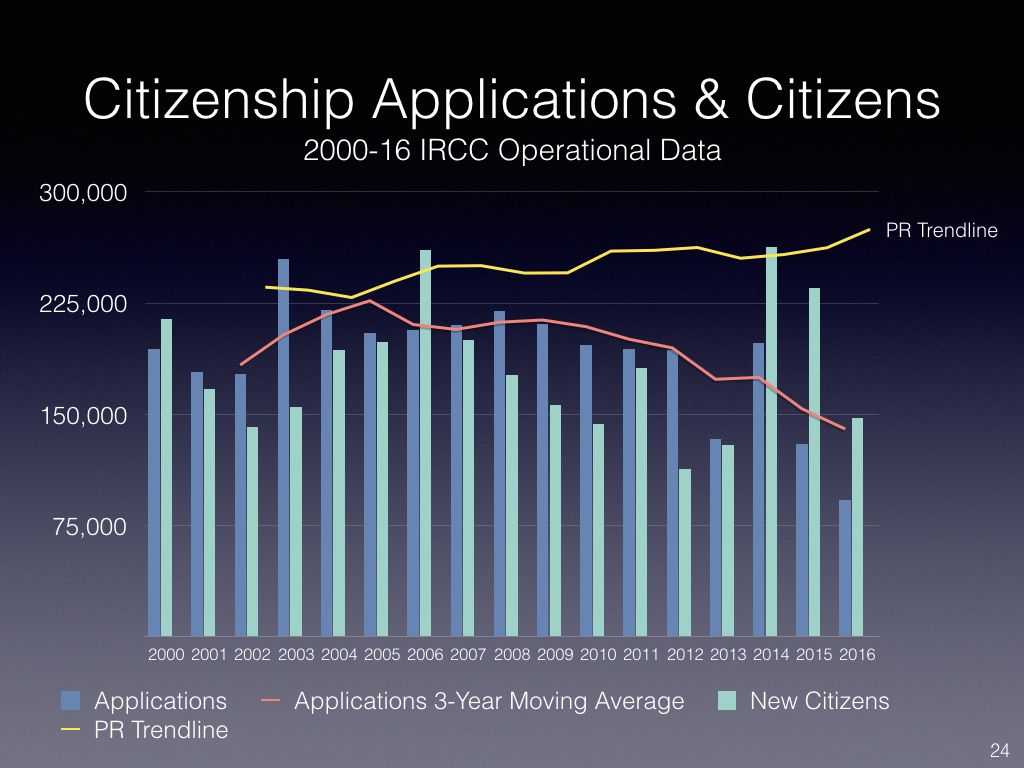
The coming into force of these changes within six months of Royal Assent is faster than the almost one year period for the C-24 changes that C-6 undoes. These will have an impact on the number of applications and new citizens.

  • The changes to residency requirements (from four out of six to three out of five years) will have a one-time impact, but with likely a small ongoing one.
  • The changes to testing ages are unlikely to have much of an impact with respect to 14-17 year olds given their time in the Canadian school system.
  • With respect to 55-64 year olds, there will be an ongoing impact. About seven percent (2013 numbers) of all applications were from this age cohort. So there will likely be both a significant one-time bump of those who have not applied over the last two and a half years given testing concerns (more than seven percent), as well as an ongoing impact of up to seven percent.
  • Fees will remain a significant barrier for lower-income immigrants, including of course refugees, and the Minister’s lack of flexibility remains of concern.

The impact of these changes in terms of any sense of pent-up demand will likely await first quarter 2018 data, with early signs from fourth quarter 2017 data:

Starting Oct. 11, permanent residents will be eligible to apply for Canadian citizenship if they have lived in the country for three out of the previous five years.

Also, applicants over 55 years of age are once again exempt from the language and knowledge tests for citizenship under the amended citizenship regulations to be announced by Immigration Minister Ahmed Hussen on Wednesday.

The changes will be welcoming news for the many prospective applicants who have been holding off their applications since the newly elected Liberal government introduced Bill C-6 in March 2016 to reverse the more stringent changes adopted by its Conservative predecessor to restrict access to citizenship.

Citizenship applications are expected to go up, reversing the downward trend observed over the last few years after the Harper government raised the residency requirement for citizenship — requiring applicants to be in Canada for four years out of six — and stipulated that applicants between the ages of 14 and 64 must pass language and citizenship knowledge tests.

Immigrant groups and advocates have said the more stringent rules discouraged newcomers’ full integration and participation in the electoral process.

“Citizenship is the last step in immigrant integration. Those unnecessary obstacles put in place by the previous government are hurting us as a country,” Hussen told the Star in an interview Tuesday. “We are proud of these changes and are excited about it.”

Another Liberal reform that takes effect next Wednesday is granting one year credit to international students, foreign workers and refugees for time spent in Canada before becoming permanent residents toward their residency requirements for citizenship.

Despite the anticipated surge in citizenship applications as a result of the relaxed requirements, Hussen said the department will ensure resources are in place to respond to the increased intake. However, he insisted there is no plan to reduce the current $630 citizenship fee for adults and $100 for those under 18.

The changes announced Wednesday are part of the amendments that received Royal Assent in June, including repealing the law that gave Ottawa the power to strip citizenship from naturalized citizens for crimes committed after citizenship has already been granted as well as handing over the power of citizenship revocation to the Federal Court from the immigration minister.

According to government data, 108,635 people applied for Canadian citizenship in the year ended on March 31. Historically, citizenship applications received have averaged closer to 200,000 a year. 

Source: New language and residency rules for Canadian citizenship kick in next week | Toronto Star, Government Bill C-6 Backgrounder

Barbara Kay: Liberals left reeling by clear, rational criticisms of M-103

It would be far more interesting if Kay, rather than writing about the witnesses she agrees with (and which the National Post seems to be featuring more in its news coverage) would write about the one’s she disagrees with and why (similarly, those in favour of M-103 should write about the critics’ positions and the reasons for their disagreements).

Otherwise, these commentaries only reinforce the respective bubbles:

With Parliament’s passage in late March of Motion 103, which condemned “Islamophobia and all forms of systemic racism and religious discrimination,” the Canadian Heritage Committee was tasked with a study to determine “what Canadians have to say” on the motion. Now underway, formal hearings are revealing what polls have already made clear: many Canadians find M-103 disturbing.

They dislike it because it singles out one religion for special consideration and because they don’t believe Canada is a systemically hateful nation. But they particularly fear its implications, as the principals behind M-103 — proposer MP Iqra Khalid, Prime Minister Justin Trudeau, Heritage Minister Melanie Joly, and Muslim community spokespeople — keep balking when called on to define “Islamophobia.”

(Feeding that fear: until B’nai Brith expressed public concern Monday, the newly-released Toronto District School Board’s Islamic Heritage Month Guidebook — citing input from some of the same actors engaged in promoting M-103 — defined Islamophobia as “fear, prejudice, hatred or dislike directed against Islam or Muslims, or towards Islamic politics or culture.” “Islam”? “Islamic politics or culture”? According to a TDSB representative, this ghastly mile-wide definition was chosen “in error.” Please, TDSB, a little respect for Canadians’ intelligence.)

Hearings began in June. Anti-M-103 activists, noting that the Liberals were allowed to call 36 witnesses, the NDP 12 and the Conservative Party 24, wondered if the fix was in for M-103 opposers. 

They were not heartened by Heritage Committee chairperson Hedy Fry’s on-record comment: “There is no guarantee that radical voices won’t speak at M-103 hearings.” So far, pro-M-103 voices predictably toe the Liberal party line that racism and Islamophobia are serious problems in Canada. What Fry might call “radical voices” have raised sensible, compelling challenges to this assumption, and have expressed concerns this kind of motion could eventually lead to politicians creating laws that further limit free speech.

On Sept 20, Toronto Sun columnist Tarek Fatah (himself a victim of oppressive speech codes in his native Pakistan) testified that discouraging or limiting criticism of Islam would, in effect, most harm those secular or free-thinking Muslims who came to Canada precisely for the freedom to speak their mind to Islamic authority figures as they could not do in their countries of origin. In any case, “You cannot define (Islamophobia),” he charged, “because the word is a fraud.” According to Fatah, these bold challenges earned him such frosty treatment from “the phalanx of Liberal MPs” and “haranguing” from Fry that one MP contacted him later to apologize for the “intimidation and bullying” he had experienced.

On Sept. 27, all four individuals who testified opposed M-103.

Father Raymond J. de Souza (speaking for himself, not the Catholic Church) said it was unwise to single out any one religion, and that government should encourage theological exchange rather than impede it.

Peter Bhatti, Chair of International Christian Voice, noted that his brother was murdered in Pakistan for daring to protect Christian lives from that country’s suffocating blasphemy laws. Bhatti said anxiety over the vagueness of the term “Islamophobia” was creating distress amongst Canada’s Pakistani Christians, who see M-103 as being tantamount to a repressive blasphemy law.

Jay Cameron, a lawyer with the Justice Centre for Constitutional Freedoms, denounced M-103’s linkage of the word “quell” to “climate of hate and fear,” as “quell” is a word normally reserved for policing riots, not words (excellent point). “Racism is something you can’t legislate against, per se, because it begins in the mind,” he pointed out.

Raheel Raza, president of the reform-oriented Council for Muslims Facing Tomorrow, asked, “Why are only Muslims mentioned by name?” and, “It’s not the government’s responsibility to babysit just one community.” She suggested that instead of the government deflecting attention from retrograde Islamic behaviours like honour killings and polygamy, Canada should take a leadership role in encouraging a return to a “free thinking” model of Islam, once a widespread norm.

The Liberals were back-footed by these forcefully argued dissents. Various Liberal MPs tried to “explain” the motion, muddying the “Islamophobia” waters further and monopolizing so much time that Conservative MP David Anderson accused them of “filibustering their time.”

One witness who earned the right to testify was shunted to “standby” status as a replacement in the unlikely event of a dropout. Major (Ret’d) Russ Cooper is a highly decorated combat veteran of the first Gulf War, recognized by the Air Force for courage and leadership in his role. The M-103 pushback campaign was kicked off by Cooper’s national anti-M-103 petition drive, which garnered 27,000 signatures and was then leveraged by other outlets to gain 200,000 signatures. Cooper’s prepared testimony to the hearings, which may never be heard formally, is a model of reason, clarity and high intelligence. You can read it in an online Canadian Heritage Committee briefing note. And the pith of his argument can be viewed on this concise YouTube video.

Stay tuned. Far from the slam-dunk feel-goody gesture it was meant to be, M-103 is looking more and more like a pivotal political and cultural moment in Canadian history.

Source: Barbara Kay: Liberals left reeling by clear, rational criticisms of M-103 | National Post

Malaysia’s Slide Toward More Conservative Islam | The Diplomat

Another example of the negative influence of Saudi Arabia on moderates within Muslim majority countries:

Saudi Arabia has long seen Malaysia, along with Indonesia, as regional bastions of Islam, and has consistently tied its investment in both countries to Wahhabism – the brand of conservative Islam initially embraced by Muhammad Ibn Saud in 1744 through a pact with Abd al-Wahhab to expand the former’s empire. The pact resulted in support for Wahhabism gaining legitimacy and followers representing themselves as defenders of the true teaching of Islam. This position today is prevalent in Malaysia and Indonesia as a majority of Muslims in both countries conflate conservative Arab culture and practices with Islam, although historically, Southeast Asia has always been more inclined towards a more moderate version of Islam. A “good” Muslim to many in Malaysia is a person who adheres to Arab culture, and practices the literal version of Islam exported by Saudi Arabia. While Islam has been written into the country’s constitution as the religion of the federation, the constitution’s drafters saw only a ceremonial role for the religion. Shortly after independence, Malaysia’s first prime minister, Rahman, informed parliament that Malaya “is not an Islamic state as it is generally understood.”

The United Malays National Organization (UMNO) has dominated politics in Malaysia since independence in 1957, but has found it increasingly difficult to maintain its stronghold on government during the past two election cycles. Although initially rolled out as a strategy to curb the opposition Malaysian Islamic Party (PAS)’s, influence on young middle class Malays, UMNO has come to rely more and more on political campaigning focused on Islam to attract and retain the Malay vote. Many urbanites today worry that this shift will lead Malaysia down the rabbit hole of a stricter, more literal version of Islam instead of the more moderate and tolerant version upon which the nation was founded. In June 2014 while celebrating the 20th anniversary of one of UMNO’s branches, Party President and Prime Minister Najib Razak called on members to emulate ISIS to ensure the survival of UMNO. Quoting an example where ISIS defeated the Iraqi army despite being outnumbered, the prime minister said, “when someone dares to fight to their death, they can even defeat a much bigger team.” The statement was at odds with his support, made clear at various international fora, of a moderate Islam.

Economic inequalities, the government’s pandering to Muslim hardliners, and its silence on racially divisive politics have created a perfect storm – youths unable to compete in an urban setting find purpose in fundamentalist teachings. In the mid-1980s, radical Indonesian preachers Abu Bakar Bashir and Hambali set up a regional network of extremists in Malaysia. Today, the government invites the likes of Zakir Naik, a hate preacher banned in India, and the UK for talks in Malaysia, while it arrests moderates such as Turkey’s Mustafa Akyol.

The ease with which youths have access to fundamentalist thought is cause for concern. According to the Associated Press in spring 2016, authorities in Malaysia have arrested more than 160 for suspected ties to ISIS over the previous two years. Malaysian intelligence reports that about 60 Malaysian youths have been entrenched in ISIS’ ranks in Syria although former Inspector General of Police Khalid Abu Bakar has stated that about 50 Malaysians are looking to return home. If and when they do return, they will find large swathes of rural Malaysia eager to listen to tales of their jihad. Malaysia will inevitably continue down a less tolerant, more conservative path, unfriendly to unbelievers and suspicious of everyone not conforming to a fundamentalist way of life.

The reliance of successive governments on race-based policies to address the long-standing socio-economic inequalities has resulted in more racial and religious tension, thus rendering conservative Islam an attractive vehicle for change. Many are eager to look to Saudi Arabia for paternalistic assistance without much thought for the strings attached to the assistance. The closer Malaysia inches to the Kingdom, the wider the door opens for conservative values which criticize a gold-medal winning gymnast’s attire, call for a ban on a beer festival, and deny social justice and women’s rights. To contextualize how acute the problem is for Malaysia, Pew Research Center’s Spring 2015 Global Attitudes Survey found that only 26 percent of Malaysians were very concerned about the rise of Islamic extremism in the country. The same question yielded 48 percent in Pakistan, 67 percent in Lebanon, and 20 percent in Indonesia.

Source: Malaysia’s Slide Toward More Conservative Islam | The Diplomat

Massey College and insidious racism on Canadian campuses – Abdullah Shihipar

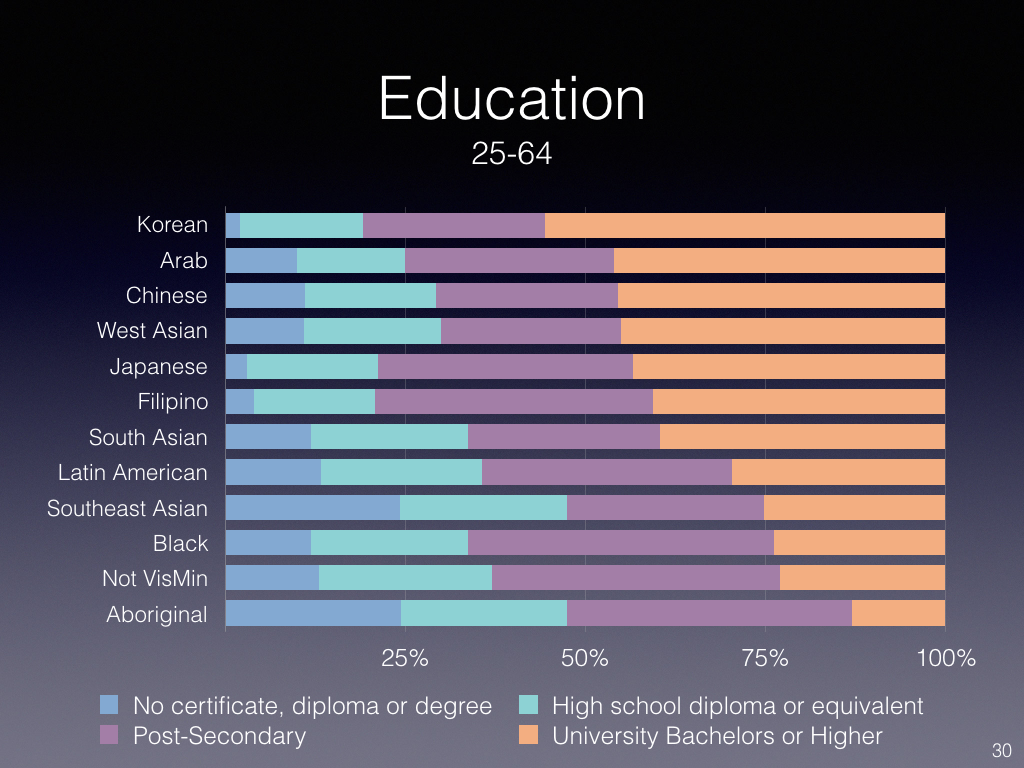
Some context for this article: visible minority students are more likely to have a university education compared to non-visible minorities.

While there are issues, it does not appear to be holding back visible minority educational achievements:

While U of T weathered the Massey controversy, student leaders are beginning their terms across campus. They’re now busy working with their teams to plan for the new year and navigating racial tensions is bound to be a topic of discussion. Dealing with these situations would be difficult enough for anybody, but people of colour face an additional burden when taking on leadership roles.  I can relate to the latter experience.

I am of Sri Lankan descent. From 2014 to 2016, I served as the President of the Arts and Science Students’ Union (ASSU) at the University of Toronto, one of the largest academic student unions in North America. As president, I led a team of seven executives to advocate to the faculty on behalf of students, as well as run campaigns, services and events. My time at ASSU proved invaluable in my personal development, shifting my politics and dramatically changing not just how I saw the world, but how I interacted with it too. As much as I loved being president, the experience exposed me to subtle ways that racism operates. Too often, we think of racism in terms of extreme—the slur said on the bus or the mosque that was torched. More often than not, it’s more insidious.

Racism manifested itself to me mainly as a set of double standards. Student leaders are minor public figures on a university campus, so some criticism is to be expected. But during my tenure, it quickly became obvious which representatives were under the most scrutiny. For example, while it was commonly accepted that  representatives could be compensated for their labour, there were those who sought to challenge a meager honorarium I received.  These conversations happened in meetings and in face-to-face conversations, where I was made to feel guilty about collecting something that others were taking without challenge. These challenges did not seem to happen when the representative in question was a white man.

Leadership often requires making tough decisions on behalf of the student body. When you are a person of colour, you constantly wonder how your calls will be construed. From what I have seen on campus, people of colour are more likely to be accused of corruption, of not being transparent and, crucially, not being representative of the student body. This frequently manifested itself when student representatives would use their role to advocate for marginalized people and their causes. Just this past summer at Ryerson, two executives—who happened to be Black and Indigenous—at the Students’ Union launched a Colonialism 150 campaign in response to Canada 150 festivities. Other members of the unions’ executive complained of being allegedly kept out of the process and not consulted, adding that they would have taken a different direction had they been involved.

When you are agreeable, your race is rarely an issue. It’s only when you offer pushback or articulate policies that are deemed “too radical,” that you face harassment. Caricatures are created and  quickly posted on online message boards like reddit. White men are praised for strong leadership. But people of colour, myself included, are described as “bullies,” “aggressive” and “angry.”  In my case, more than one anonymous commentator on reddit thought it appropriate to call me a “dictator” and “tyrant.” Society already views people of colour, specifically Black and Brown people, as more violent, so it should come as no surprise that we are being described this way when we disagree. This sends a chilling message to representatives of colour—agree or be subjected harassment.

While people of colour can face harassment, on other occasions they’re simply not taken seriously at all. Ondiek Oduor knows all about what that’s like. Oduor, served as President of ASSU from 2016-2017 and as Student Head of Non-Resident Affairs at U of T’s Trinity College in 2014.  That year, the Student Heads team, who ran Trinity’s student government, wanted to implement equity reforms.  When it came to selling these ideas to the student body and the administration, the team made a strategic choice about who would speak.  “We collectively made a choice for the Male Head of College, who happened to be a white man to speak on these issues,” he says. “We knew it would be taken more seriously coming from him, rather than from person of colour or a woman.”

Ondiek, who is Black, describes his involvement at Trinity as “frustrating” and says everyday interactions made him acutely aware of the fact that he was in white space.  Frequently, when attending parties as a student leader with alumni at Trinity, some of the older alumni would often ask him “where he was from” or explicitly reference how rare Black students are at Trinity, whereas white student leaders would be asked about their studies.

Chris Ramsaroop, an organizer for Justicia for Migrant Workers, echoes some of Ondiek’s concerns about representation. Serving as President of the Student Administrative Council at U of T (now known as the University of Toronto Students’ Union) in 1998,  Ramsaroop says whenever people of colour raised concerns to those in the administration or to their peers, they were met with token gestures that were meant to pacify dissent. After a scandal surrounding Professor Kin-Yip Chun allegedly being denied a tenure track job because he was Asian, the university committed to reviewing its practices, but the promises were forgotten when student leaders inevitably ended their terms and passed responsibility to their successors.

If the consequences of getting involved in student politics are high for people of colour, then they are disproportionately high for women of colour.  Najiba Ali Sardar, a first generation Bangladeshi-Canadian activist served as Vice President Equity for the University of Toronto Students’ Union from 2014 to 2015. She says she found being a woman of colour in a students’ union to be one “one of the most taxing experiences of her life.” During her time as a student leader, a campus society decided to throw an insensitive “Mexican-themed” party. As VP Equity she started a dialogue around the event to explain to individuals why it was offensive. Rather than listening to her, she was attacked and harassed for weeks. Later, when the society did make changes, she found that her contributions to the discussion were not acknowledged. “It’s a bit disheartening to put all of your time, labour, and energy towards issues you’re incredibly passionate about, just to have all of that be disregarded.”

Racism in student politics is rarely visible to the average student, but takes its toll on student representatives. Accused of playing the race card, representatives are more likely to recede and play less of a role in the future; almost everyone I interviewed referenced being burned out.  This discourages people of colour from pursuing leadership roles in the future. If student leaders, a privileged group of students, are undergoing this type of harassment, then chances are, members of the student body are too. The people who contribute to this climate may not be bad individuals or may not intend to be racist, but that is how systemic bias works, it operates under the radar. This is not about accusing people of wrongdoing but rather about actively confronting these biases.

Universities can start to take steps to tackle this problem. The collection of race-based data is a first step, which some universities, like U of T, have committed to implementing. It will allow for better, targeted policies. To mitigate the barriers that prevent marginalized groups from getting involved in student government, universities and student organizations must work together to introduce bursaries, awards and honorariums to people of colour, especially for those who demonstrate financial need.  Finally, once in their roles as leaders, people of colour need access to support systems and student organizations need to ensure they have robust harassment policies that work.

When we talk about representation, whether at the workplace or at our universities, we have to talk about what that actually looks like; there is no use in having a diverse board if you don’t value the contributions of the people on it. We have a choice, we can either choose to do the hard work of achieving meaningful diversity, or we can continue on this unproductive path of tokenism.

Source: Massey College and insidious racism on Canadian campuses – Macleans.ca

Why I quit the Art Gallery of Ontario: former Canadian-art curator Andrew Hunter explains

Interesting commentary on the challenge of making collections reflect current as well as earlier society. The National Gallery in Ottawa mixes Indigenous art with non-Indigenous art in its Canadian galleries in a compelling narrative:

An image greets visitors as they enter Every. Now. Then: Reframing Nationhood, my final exhibition for the Art Gallery of Ontario.

It’s called The Edge of a Moment and the artist, Meryl McMaster, is seen pausing at the lip of Head-Smashed-In Buffalo Jump, a sheer cliff face in Southern Alberta: Treaty 7 territory, her ancestors’ homeland. As she moves north, her face, masked with white paint, turns toward me, away from the cliff.

She’s not looking at me, of course, but the image makes me feel conspicuous and so very present: McMaster, a strong voice within an emerging generation of Indigenous artists, moves with a confidence tinged with anxiety and sadness as she calls her “ancestors to travel with her into the future” — a future weighed down by the presence of my ancestors and our colonial legacy.

I had the honour to co-curate Every. Now. Then. with Anique Jordan, an artist, activist and independent curator based in Toronto. It was our critical response to Canada 150, designed to be a catalyst for significant change within an institution that remains (like so many others in this country) burdened by, and seemingly committed to, a deeply problematic and divisive history defined by exclusion and erasure.

Carried by the confident voices of many artists, Every. Now. Then. embodies the momentum of transformation that so many of us felt was powerful and real. Its reception, both publicly and critically, has been remarkable and moving; it confirmed for me that this messy, problematic initiative is in sync with this moment.

So my decision to give up my senior position at the AGO during the run of this exhibition has come as a surprise to many. Why leave now?

My choice rests in a disappointment: not in what we achieved, but the fragility of its ability to persist. As I leave, I worry about an institution wavering in its commitment to make space for new voices — voices traditionally excluded from senior roles at public cultural institutions in Canada.

It rests in issues that have informed my work as a curator, artist, writer and educator for almost three decades: the elitist, colonial roots of public museums, what being a public institution truly means, and who controls and is allowed to speak in these nominally “public” realms.

I have always been concerned about the role art museums play in the wider world, about how truly engaged they are with the critical issues of our times. I’m fortunate to be able to teach regularly on museum and curatorial practice (currently in the graduate program at OCAD University). We often begin with the origins of the contemporary museum, which was born out of the private collections of wealthy Europeans who had built their fortunes on the extraction of resources, and people, from the most vulnerable nations in the world.

Out of this dubious practice evolved public educational institutions, or so they self-described. Really, they were outward displays of power that reinforced class division and validated the corporate and colonial systems that had made their founders rich. From wealth came power and then cultural dominance: museums set social rules, coercing the broader public toward shared values they deemed to be “acceptable.”

Despite everything, for most institutions, that’s the model that remains: “Value” is decided by the very few and then presented to the many. When I look at the AGO and so many of its peers, I see an institution guided not by public participation, but by the generic, elite consensus that rules the global art market, which sees product over public good.

I see institutions that look for leadership and to fill critical content roles outside of this community and country (a remarkable community, by the way, of cultural professionals with diverse and distinct voices that has been deeply invested here for decades). At the AGO, the curatorial department is becoming dominated (at various levels) by individuals from, or primarily trained in, the United States. It has become abundantly clear to me that it is highly unlikely that the currently vacant position of chief curator — a critical role, from which many content decisions flow — will be filled by a Canadian.

I see too many who lack true knowledge of this place. I see those same people committed to sustaining dated academic divisions that wrongly take priority over the kinds of interdisciplinary, cross-cultural, community-focused work that is desperately needed for our culture to adapt and evolve.

The current program of reinstalling the permanent collections of European and Modern art, called Look: Forward, lays bare this disconnect: it lacks any deep engagement with Canada, Canadian art or the diversity of this community.

I see overgrown institutions grounded in a corporate model that appears uncritically committed to expansion at a time when we should all be making it a priority to question its role in the public conversation here, and acting against the destructive impulse of such generic “world class” aspirations.

The star system of the contemporary “art world” and the hierarchical corporate model create divisive, competitive, unhealthy environments for work. For Indigenous peoples, people of colour and many youth, these institutions remain unwelcoming spaces of trauma — spaces where their marginalization remains at the core of the institutions’ mission.

At the AGO, there have been some major contemporary exhibitions by compelling international artists in recent years (Theaster Gates and Hurvin Anderson, for example). But as with the new permanent collection program, very little has been done to ground these projects and make meaningful connections to the local, or break out of the rigidly defended curatorial silos. In these two examples specifically, opportunities for local engagement abounded; instead, they remained closed off by the barriers imposed by the global art world model, inoculated from real engagement.

Worse, they consistently overshadow, in profile and financial commitment, the work of leading artists in this region, who have significant, and long established, national and international careers. There are exceptions — Song Dong’s Communal Courtyard, initiated by former AGO chief curator Stephanie Smith, had a rich program of local content developed collaboratively across the institution and with community partners — but they’re all too rare.

Engaging with diversity has to mean more than just expanding an audience for an established model, to be more than some insidious missionary program of converting more to have faith in these institutions, and drawing communities into a program of their own marginalization and erasure.

These debates were front and centre when I was a student in the 1980s. The key critical texts of that time continue to be primary references, three decades on, confirming that little has changed.

Reading again the words of James Baldwin, who offered searing criticisms of the deep, systemic racial barriers of his day, I find his words familiar and offering a kind of radical hope. At the close of No Name in the Street, from 1972, he writes of a crisis, of racism and colonialism, a “global, historical crisis” not about to resolve itself soon. “An old world is dying,” Baldwin declares, “and a new one, kicking in the belly of its mother, time, announces that it is ready to be born. This birth will not be easy, and many of us are doomed to discover that we are exceedingly clumsy midwives. No matter, so long as we accept that our responsibility is to the newborn: the acceptance of responsibility contains the key to the necessarily evolving skill.”

And so I return to The Edge of a Moment, to that image of Meryl McMaster moving across that sublime landscape. I imagine her turning away and continuing on as I struggle to keep up. She walks with her ancestors into the future while I plead with mine to stay behind, to give up and give back this space. Undepleted.

Source: Why I quit the Art Gallery of Ontario: former Canadian-art curator Andrew Hunter explains | Toronto Star