What immigration target should Ottawa set for 2018? – Conference Board

An important and balanced take on the choices facing Canada and the government. The full report is worth reading as it makes a serious effort, through scenarios, to assess likely overall impact of increased levels, for GDP and more important, per capita GDP.

Unlike most immigration boosters, it also emphasizes the need for associated investments to ensure that immigrants integrate successfully into the economy and society (Doug Saunders in Maximum Canada makes the same essential point):

Federal Immigration Minister Ahmed Hussen is currently consulting with his colleagues and Canadians to identify the appropriate number. This is a much more challenging task than it sounds. Canada must not only consider demographic and economic metrics – such as birth, death and unemployment rates – but also “known unknowns,” such as the impact that automation will have on jobs in Canada. Immigration levels are also influenced by key social factors such as public opinion.

The Conference Board of Canada does detailed modelling on the impact of various immigration-level scenarios. We look at the effect on economic growth, income per capita, health-care costs, the ratio of workers to retirees and other metrics. Most importantly, we also consider the challenges of integrating newcomers into the Canadian economy.

While immigration is a huge benefit to our economy, the Conference Board estimates that $12.7-billion of potential is lost each year as a result of the labour market barriers that immigrants experience. This gap occurs in spite of the fact that immigrants are highly educated and bring many skills. Canada’s economic performance suffers through lost productivity, lower tax revenue and reduced purchasing power for immigrants.

Canada has made significant reforms in recent years to improve immigrant outcomes. These changes include: giving provinces and employers a bigger role in the selection process; increasing selection standards; and giving advantage to immigration applicants already in Canada, such as international students. Much work has also been done on the settlement front, such as increased investments in language training and providing immigrants with more information before they arrive in Canada.

In addition to these positive reforms, Canada can pursue other measures. Often, businesses are keen to hire immigrants but don’t know where to start. Governments can do more to help businesses navigate the immigration system and develop intercultural competency. Canada also needs to identify the right balance between accountability and flexibility for the settlement program. It is vital to ensure that taxpayer dollars are spent prudently, while also giving settlement organizations the ability to be flexible and innovative to respond to the needs of immigrants and business within their local communities.

Source: What immigration target should Ottawa set for 2018? – The Globe and Mail

Full report: 450,000 Immigrants Annually? Integration is Imperative to Growth

Grubel: Curb immigration to let housing catch up to demand

Herbert Grubel takes the contrarian view regarding immigration levels, proposing an over 80 percent cut to some 50,000 annually. His characterization that Parliament could “easily” do this for a five-year period, as well as the political dynamics at play (no political party support for such a dramatic reduction), is naive at best.

As there is ongoing need to discuss what levels of immigration are  appropriate, it is useful to have contrarian views.

And it is also a useful reminder that quality of life issues in our largest cities need to be part of discussion.

But a more sensible contrarian view would be to propose a more modest reduction, rather than one that will understandably be dismissed out of hand:

Such unpleasant overcrowding of the Joffre Lakes Park is typical of all recreational facilities in the Lower Mainland. It also afflicts the region’s roads, bridges, public transit, hospitals, schools, universities and water supply, and, most importantly, Vancouver’s housing market.

What causes these problems? The simple answer is that for these facilities demand exceeds supply, but for the design of remedial policies, the fundamental, but also more difficult question, is why is there this excess demand?

Currently, the most popular answer is a shortage of investment in housing and infrastructure. Governments for some time have adopted policies to remedy this situation. The very existence and growth of the excess demand is clear evidence that these policies are inadequate and are likely to remain so. The relief from recently announced increases in publicly subsidized housing will quickly be overwhelmed by the torrent of additional demand for it.

Popular are also policies designed to reduce demand. They’re focused on the housing market and involve taxes on foreign buyers, raising the cost of mortgages and reducing regulation. These policies at best have had only transitory effects on demand for housing. More investment in infrastructure has been promised by all parties at every election, but obviously has failed to eliminate the problems.

However, there is one simple way to reduce demand. Lower immigration from the present rate, which sees about 250 new immigrant families settle every week of the year in Greater Vancouver. This rate of increase has brought the total population of B.C. from 2.2 million in 1972 to 4.8 million in 2017. The projection that it will reach six million in 2037 strongly suggests future worsening of excess demand.

Parliament could easily reduce the number of immigrants temporarily from the present, national 300,000 per year to 50,000. While in place for perhaps five years, the construction of housing and investment in infrastructure can catch up with demand. Thereafter, the number can be raised again to a level equal to the economy’s absorptive capacity marked by the sustainably matched demand and supply in housing and of infrastructure services.

Canadians really face no costs resulting from such a temporary reduction in the number of immigrants. Politicians proposing this policy run the risk of electoral losses from some powerful interest groups, but these could easily be exceeded by the gain in votes from suffering Canadians who benefit from it and who let the politicians know about their preferences.

Source: Opinion: Curb immigration to let housing catch up to demand | Vancouver Sun

The Studies Behind Canadian Health Care Seem To Have Forgotten Us

Valid points. Studies need to reflect the increased diversity of our population:

One of the most important campaigns in Canada has nothing to do with politics. Choosing Wisely Canada is an initiative that aims to curtail the unnecessary tests and treatments in our health-care system. Started in 2014 by a team from the University of Toronto, Canadian Medical Association and St. Michael’s Hospital, Choosing Wisely is part of a global movement that first began in the United States by the American Board of Internal Medicine Foundation. It now spans 20 countries across five continents and includes the majority of medical societies and associations, including those in Canada​​​​​.

The evidence to support a reduction in wasteful diagnostic and therapeutic resources is clear and uncontroversial. The Canadian Institute for Health Information estimates that 30 per cent of health care, or nearly 1 million tests and treatments annually, is unnecessary. This is a staggering figure, and especially worrisome given Canada’s growing health-care expenditure, which totaled $228 billion dollars — or 11 per cent of its gross domestic product — in 2016. A national effort to curb unnecessary testing and treatment not only makes medical sense, but is also economically prudent in the context of ballooning health care utilization.

Choosing Wisely hopes to achieve its goals through grassroots advocacy by publishing a series of practice recommendations for physicians based on peer-reviewed research. These recommendations, organized by specific specialties, are often based on meta-analyses of research already conducted in different areas of clinical medicine. Interestingly, many of the studies used to ultimately guide these recommendations did not collect data or outcomes on minority populations. In studies that did, most of the patientsanalyzed were Caucasian. It begs the question, is Canadian health care choosing wisely or merely choosing whitely?

Inexplicably, research data on minority and female populations is not collected in Canada — seemingly a theme in this country.

This is why it matters. The medical community has long ignored minority, female and low socioeconomic communities in its research initiatives. In order to combat this trend, the National Institutes of Health (NIH) passed the Revitalization Act in 1993 that mandated the appropriate inclusion of women and minorities as subjects in clinical research. Inexplicably, research data on minority and female populations is not collected in Canada — seemingly a theme in this country. Despite the lofty goals of the NIH, however, the research community has fallen well short of its intended demographic targets.

Clinically, this has significant implications. Studies have shown that a patient’s race and gender play a large role in disease screening, diagnosis and management. For example, the Framingham Risk Score, which is considered the gold standard algorithm to predict a patient’s 10-year risk of having a cardiovascular event, was primarily validated in the Caucasian population. Unfortunately, clinicians still rely on this tool and often apply it to minority populations despite it not accurately estimating their risk.

Similarly, research has shown that African American women suffer higher mortality ratesfrom breast cancer relative to Caucasian American women. It has been hypothesized that they may be at higher risk from early onset disease, which may put them at a disadvantage when considering current screening guidelines. These illustrations demonstrate that our medical research infrastructure has focused on promoting the health of patients who are most often male, Caucasian and well-heeled.

These research biases are hard to shake because research is notoriously hard to conduct. It first involves identifying a clinical question, generating an hypothesis, developing an experimental protocol and securing funding. Subsequently, researchers need to navigate the important but Byzantine institutional review processes before addressing the challenges associated with subject recruitment, data collection and analysis. Ideal research patients are those who have the luxury of time and who are able to travel to downtown research hospitals for repeated evaluation. It is easy to see how this is unlikely to include a minority single mother working multiple jobs in Scarborough.

Our society will migrate away from a one-size-fits-all health-care paradigm.

Canada’s Minister of Science, Kirsty Duncan, has recently called science sexist, but sadly stopped short of also calling it racist. She, did however, recently introduce the Equity, Diversity and Inclusion Action Plan in order to address the chronic under-representation of women, First Nations, visible minorities and persons with disabilities among Canada Research Chairs. This laudable effort should also dovetail with the minister’s insistence — along with support from the newly installed chief science advisor — that taxpayer-funded medical research focus on all communities represented in our country and not just select groups. She could make significant strides in this area by following the NIH’s lead with a Canadian version of the Revitalization Act.

In an era that will be increasingly dominated by big data genomics, artificial intelligenceand personalized medicine, our society will migrate away from a one-size-fits-all health-care paradigm. Choosing Wisely will continue being an essential and vital initiative in helping to reduce unnecessary tests and streamline medical care in this country. Future iterations of its recommendations, along with any practice guidelines created, should endeavour to more comprehensively apply to and represent the great diversity of Canada.

Source: The Studies Behind Canadian Health Care Seem To Have Forgotten Us

People of color — especially women — aren’t being promoted in tech as fast as they should be – Recode

The latest diversity study:

While women and people of color are employed at tech companies in larger numbers than they used to be, their upward mobility at those companies has stagnated.

A study by the Ascend Foundation, an organization for Asian professionals in North America, examined tech professionals over a period of eight years using government data, and found that white men were consistently promoted at a higher rate relative to their non-white, non-male peers.

From 2007 to 2015, white men consistently composed a higher share of executive roles than professional roles at tech companies, the study found. It’s the reverse for Asians, Hispanics and blacks, especially if they’re women.

The study looked at Equal Employment Opportunity Commission data from 2007-2015 for manufacturing and information companies with more than 100 employees based in San Francisco and San Jose areas. This is used as a proxy for major tech hardware and software companies, which tend to be based there.

More than 1,000 Bay Area tech companies were included in this review, providing a wider lens than the data released by individual tech companies.

Some key findings:

  • Though Asian men and women were more common in entry-level professional jobs, white men and women were twice as likely as Asians to become executives.
  • Asian women were the least likely among any cohort to become executives.
  • Black and Hispanic professionals are much less likely than their white peers to become executives.
  • The number of black executives had increased by 43 percent in the time period examined. At the same time, there has been a decline in the number of black managers and black female professionals (which could spell trouble for the future executive pipeline).
  • Hispanics remained only 3.5 percent of all executives but declined from 5.2 percent to 4.8 percent of all professionals (also not promising for future promotions).
  • White women are now more likely to be executives than professionals, but they are still underrepresented generally — an issue with recruiting rather than promotion.

Source: People of color — especially women — aren’t being promoted in tech as fast as they should be – Recode

Toronto District School Board revises Islamic guide

Appropriate correction:

The Toronto District School Board said it will change portions of a guidebook that uses a definition of Islamophobia that a Jewish community group has called “overly broad.”

The guidebook defines Islamophobia, in part, as “fear, prejudice, hatred or dislike directed against Islam or Muslims, or towards Islamic politics or culture.” B’nai Brith Canada had complained earlier Monday that the reference to “politics” could lead to students or staff being punished for expressing dislike for the Republic of Iran’s persecution of LGBTQ people or restrictions placed on women in Saudi Arabia.

Hours later, TDSB chairperson Robin Pilkey said in a letter to the group that the updated guide will reflect the Ontario Human Rights Commission’s definition of Islamophobia, which makes no reference to politics.

Pilkey said the guide was not enforceable as policy and denied it would have led to silencing of staff or students.

“The TDSB welcomes important input from the community and from organizations such as B’nai Brith, however we must say that some of the suggestions made in your letter and subsequent news release are outrageous,” she said in the letter. “To suggest that the TDSB is encouraging students to stay silent about what they experienced in their countries of birth or that the TDSB is somehow banning students and educators from criticizing executions and other human rights abuses around the world is categorically untrue.”

The Toronto District School Board created the guide to be used in public schools in October, which it declared Islamic Heritage Month. The Toronto District School Board also celebrates Sikh Heritage Month in April and Jewish Heritage Month in May annually.

B’nai Brith Canada CEO Michael Mostyn said a school board representative told the group the definition was included in the guidebook “in error.”

“We thank the TDSB for acting swiftly to correct this serious problem,” he said in a statement. “The definition of Islamophobia initially presented by the TDSB was clearly inappropriate, and we look forward to seeing a proper definition presented to Toronto students.”

Source: Toronto District School Board revises Islamic guide | Toronto Star

Anthony Furey’s commentary from the Sun:

The Toronto District School Board is temporarily pulling an Islamic Heritage Month guidebook following complaints from Jewish advocacy group B’nai Brith Canada, the Toronto Sun has learned.

The book, as I described in a recent column, is a robust 170-page document that encourages a great deal of religious intrusion in a classroom setting that’s otherwise supposed to be a non-religious environment.

The recommendations include reciting and explaining the Muslim greeting “As-salamu alaykum” (peace be upon you) alongside the singing of O Canada and inviting children to visit a local mosque. It also includes templates of famous mosques around the world for children to construct during cut and paste exercises.

But it’s the guide’s alarming definition of Islamophobia that has caught the attention of the leading Jewish advocacy group. The school board’s guide defines the term as “fear, prejudice, hatred of dislike directed against Islam or Muslims, or towards Islamic politics or culture.”

“The TDSB definition, if enforced, could lead to punishment for students or teachers who display “dislike” towards the persecution of LGBTQ people in the Islamic Republic of Iran, harsh restrictions on women in Saudi Arabia, and Palestinian terrorism against Israelis, all of which are examples of “Islamic politics,” an earlier press release from B’nai Brith Canada says.

The organization contacted the TDSB Monday morning and by the afternoon the school board had committed to pulling the online guidebook until they revised the definition of Islamophobia, according to B’nai Brith Canada.

“A link to the resource guide was provided to school administrators across the system,” TDSB spokesperson Ryan Bird told the Sun. “A revised version with an edited definition of Islamophobia will be available online shortly.”

It’s unclear if they plan to revise or remove any of the other controversial aspects of the guide.

“There are many students in Toronto schools who have come to Canada fleeing persecution from countries like Iran, Pakistan or Saudi Arabia — and now the TDSB is telling them to stay silent about what they’ve suffered. It’s simply ludicrous,” B’nai Brith Canada CEO Michael Mostyn said in the earlier press release. They’ve since issued another release thanking the board for swift action on the issue.

Source: Toronto school board recalls, revises controversial Islamic guidebook

Quantifying antisemitic attitudes in Britain: the ‘elastic’ view of antisemitism | British Politics and Policy at LSE

I have quoted the entirety of  Daniel Staetsky’s post on antisemitism, and the nuances and different degrees of intensity. While he applies this analysis to antisemitism, the same approach can, and should, I believe, be applied to other forms racism, bias and prejudice:

Surveys of attitudes towards Jews have repeatedly shown that antisemitism in the UK remains relatively low when compared to other European countries. The last decade alone has seen at least 15 such surveys, all of which tell us that antisemitic attitudes in the UK are rather low in prevalence (around 10% of adults can be characterised as antisemitic) and that the trend in attitudes is stable.

Yet we know from the previous surveys of Jewish population that nearly 50% of British Jews perceive antisemitism to be a problem in the UK. How does one explain this dissonance? To begin to answer this question we propose a novel concept of an ‘elastic’ view of antisemitism. We develop this concept on the back of a large survey of antisemitic attitudes in Britain, conducted in the late 2016 and early 2017 by the Institute for Jewish Policy Research.

In line with the previous surveys of attitudes towards religious groups, we found that an unfavourable opinion of Jews is, distinctly, a minority position in Britain. In response to the question ‘Please tell me if you have a very favourable, somewhat favourable, somewhat unfavourable or very unfavourable opinion of’ [ Jews , Muslims, Hindus, Christians], 2.4% said that they have very unfavourable opinion of Jews, 3% have somewhat unfavourable opinion, and together these groups comprise 5.4%.

Further, we found that an unfavourable opinion of any religious group is distinctly a minority position in Britain. The most favourably seen group is Christians, perhaps unsurprisingly so, given the Christian heritage on Britain. The least favourably-seen group is Muslims: about 15% declared that they have strongly unfavourable or somewhat unfavourable opinion of this group. Jews and Hindus feature in-between.

We experimented with different response possibilities to the favourability question in order to test the sensitivity of our findings to the way the question is asked. Typically, survey questions include some ‘opt-out’ possibilities which could be used by people without strong opinions, people who have difficulty responding, and people who are not eager to reveal their true feelings. This led us to the decision to split the sample into two sub-samples, with half of our respondents being asked exactly the same question as before but with fewer opt-out options. A certain degree of sensitivity was revealed. Still, we found that only 2.4% of the population hold very unfavourable opinions towards Jews and 10.2% – somewhat unfavourable, together comprising 12.6%, raising the probability of Jewish encounter with unfavourable opinions from 1 in 20 (as a 5.4% level of unfavourability would suggest) to about 1 in 8.

Figure 1 casts the findings obtained so far in a graphic form and introduces the concept of an ‘elastic’ view of antisemitism that will pave the way-eventually- to understanding Jewish anxieties. The circle represents the population of Great Britain.
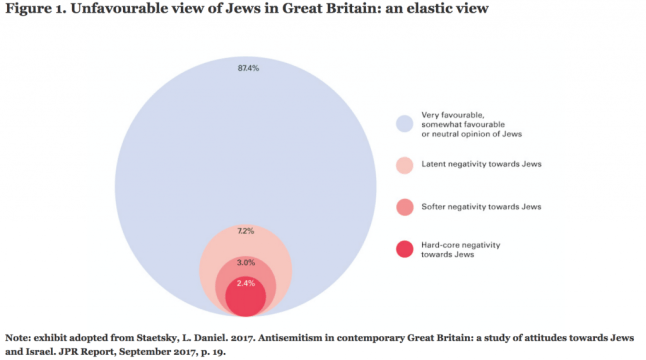
The proportion holding a favourable or neutral opinion of Jews is very dominant numerically – about 87%. The proportions holding unfavourable opinion are in warm colours:

  • 1)  2.4%: hard core negativity towards Jews (in strong red), a level repeatedly seen irrespective of the type of response schedule used;
  • 2)  3.0%: softer negativity (dark pink), a level of ‘somewhat’ unfavourable opinion obtained when many opt-out options were available, and
  • 3)  additional 7.2%: best thought of as latent negativity (light pink)-expressed only under a less ‘generous’ response schedule, in terms of response options available.

At the core of an ‘elastic’ view is the notion that one cannot measure the prevalence of antisemitism using just one number. All three figures appearing in Figure 1 are meaningful in their own right. The power of these figures is their capacity to capture the different intensities of negativity towards Jews. From the Jewish point of view, Jews come in contact with the entire spectrum of negativity towards them, and more often than not, they will have an imperfect knowledge about which part of the spectrum any given antisemitic view arises. It can arise from the segment holding a very weak and hesitant form of negativity towards Jews. However, there is only so much that a given Jew can do in the course of regular social interaction to clarify this.

An ‘elastic’ can be developed further. Attitudes in general, and anti-Jewish attitudes in particular, are not limited to simple emotional characterisations. In practice, we also offered our respondents a selection of specific negative statements about Jews. All of the statements have been known to resonate with Jews as antisemitic from previous surveys. Ideas around excessive and sinister ‘Jewish power’, ‘Jewish exclusivity’, ‘Jewish wealth’ and ‘Jewish exploitation’ (of other people-for economic or political gain) are the most common antisemitic ideas, but they are not widely prevalent among the British. In their strong form they are held by about 2% of the population, in their weaker form-by additional 10% or so. The most offensive and extreme forms of Holocaust denial are especially rare.

At the next step we collated these results into a single index of antisemitism, where each respondent who agrees strongly or somewhat with any of the negative views receives a score of 1 in relation to that particular view. We then sum across the responses to different questions and obtain a total score for this individual. The maximal number of antisemitic attitudes that one can hold is eight, which would effectively mean that an individual holds both an unfavourable view of Jews and endorses all specific antisemitic statements (seven in number, in this context). The minimal is one – which signals endorsement of just one attitude.

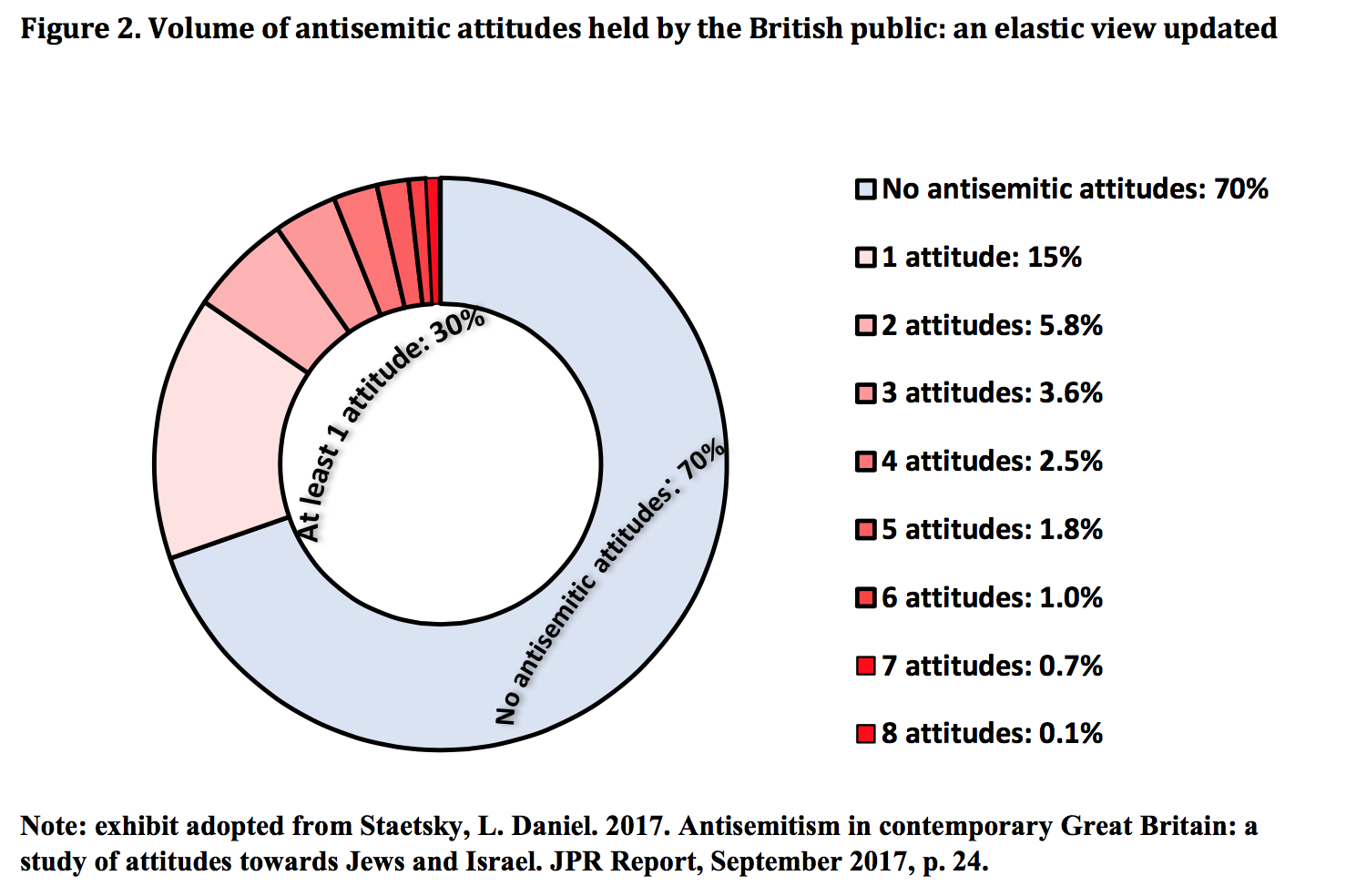
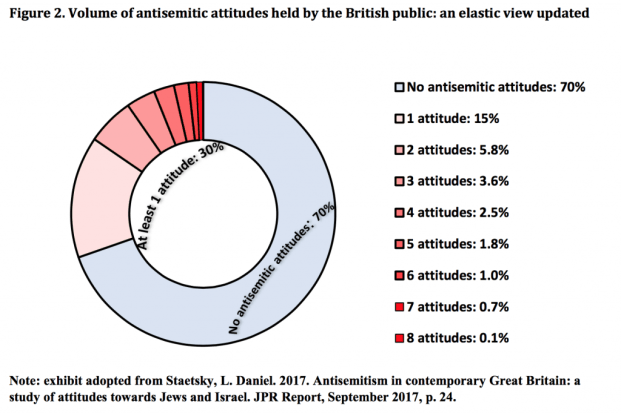
The distribution of this new variable-which we call the Antisemitism Index is set in Figure 2.
Note that:

  • 70% of British population did not endorse a single antisemitic attitude.
  • Holding 6-8 antisemitic attitudes is very low in prevalence, affecting about 2% of the population. This figure is remarkably similar to the levels of hardcore antisemitism captured by the favourability question (2.4%).
  • About 15% of British adults hold two or more antisemitic attitudes to some degree at least. Beyond this boundary are a further 15% who either strongly agree with, or tend to agree with just one such attitude. Accounting for all groups endorsing at least one attitude brings the total prevalence of antisemitic attitudes, at different intensities, to 30%.

How is this 30% best understood? Categorically, 30% does not represent the proportion of antisemites in society. Only a small proportion of them can be called antisemitic in a political sense of this word. What it represents instead is the level of diffusion of antisemitic ideas and attitudes, and the extent to which these ideas permeate society. With this we make a shift from counting antisemites to quantifying antisemitism, which may appear subtle, but it is very important for a proper understanding of Jewish anxieties.

This analysis suggests that while strong antisemitism is a marginal position in British society, antisemitic ideas are not. These ideas can be held with and without open dislike of Jews, and they are present to some extent in one third of Britons. In day-to-day life, the frequency of Jewish people’s encounters with antisemitism is determined not necessarily by the small minority of hardcore antisemites, but rather by much more widely diffused elements of attitudes that Jews commonly consider to be antisemitic. Thinly scattered and weakly held antisemitic attitudes matter, because they are more prevalent than strong attitudes, so the probability of an encounter is higher.

To sum up the most important lesson from the elastic view – the hardcore prejudice towards Jews is rare, but encountering some degree of prejudice is much more common, and, as a result, that kind of prejudice is more visible and more impactful when Jewish lives are concerned. In many instances, those expressing such views may not even realise that a particular comment or remark might be experienced by Jews as offensive or upsetting, but they can impact significantly on the perceptions, sense of comfort and safety, and, ultimately, the quality of life for Jews in Great Britain.

_____

Note: you can read the full report on which the above draws here.

Source: Quantifying antisemitic attitudes in Britain: the ‘elastic’ view of antisemitism | British Politics and Policy at LSE

Massey College professor resigns over racially offensive remark, cites lack of ‘due process’ 

Opportunity for dialogue lost.

Who among us has never made any such missteps? Marrus’ comments below highlight his personal dignity in dealing with the complaint, as well as the serious process issues he raises.

There is something shameful here about the lack of willingness or openness for dialogue, and the lack of grace in acknowledging that someone can make an inappropriate comment without being automatically labelled as racist, irrespective of their personal and professional history:

Michael Marrus, the history professor whose racially offensive remarks have led to a public controversy at the University of Toronto’s Massey College, has submitted his resignation as a Senior Fellow from the college, but says he is “disheartened” by the lack of dialogue between him and those who asked for his resignation.

“Where was the due process, where was the effort to hear me out, where was the effort to relate to 30 years of scholarship that have a lot to do with human rights? There is something cruel and reckless about this campaign,” he said in an interview with The Globe and Mail.

He had been trying to apologize for the comment he made, e-mailing the person he hurt and offended and trying to talk to them, but his apology was not accepted, he said.

“I was so sorry for having wounded someone,” Dr. Marrus said. “But nothing availed,” he said.

The resignation comes after an incident during a lunch last week that gave rise to a petition that was signed by almost 200 students and faculty at U of T.

Dr. Marrus was seated with three Junior Fellows, graduate or professional students who live in residence at Massey. Hugh Segal, the head of the college, who has – until recently – carried the formal title “Master,” came to join them. As Mr. Segal sat down, Dr. Marrus said to a black student:

“You know this is your master, eh? Do you feel the lash?”

The students have filed a written complaint with the college. They have not spoken about the incident to The Globe and Mail. Mr. Segal could also not be reached.

The petition, which was made public on Thursday, demanded extensive changes and asked Massey to sever its ties with Dr. Marrus.

“In our eyes, the very legitimacy of Massey College hinges on the effectiveness of your response to this incident,” the petition stated. “We encourage you to approach this moment with the seriousness it demands, and with the courage and vision to make this an occasion for fulsome transformation.”

On Friday, Massey College agreed to almost all the demands made in the petition, temporarily suspending the title of “Master,” beginning anti-racism training and offering a “sincere and unreserved apology” for the incident.

On Sunday, Dr. Marrus sent a resignation letter to Mr. Segal, in which he conveyed his “deepest regrets to all whom I may have harmed.”

“I am so sorry for what I said, in a poor effort at jocular humour,” Dr. Marrus wrote in his letter. ” I want to assure those who heard me … that while I had no ill-intent whatsoever I can appreciate how those at the table and those who have learned about it could take offence at what I said,” he wrote, adding that he will leave his office of 20 years as soon as possible.

An emeritus professor and internationally respected Holocaust scholar, Dr. Marrus is retired from U of T. But he has maintained an office and senior fellowship at Massey College, an affiliated independent college at U of T which opened its doors in the late 1960s. The fellowship carries no financial stipend.

“The decision [to resign] is the best one for me, the best one for my family, the best one for Massey College, for which I have a lot of affection and respect, the best one for the students who are so angry,” he said. “If so many people have announced that they don’t want me at Massey College, why should I persist?”

People may not believe him, Dr. Marrus added, but he is on the same side as those who launched the complaint against him. “I understand the anti-racist commitment of the people who have mobilized,” he said.

In addition to his scholarship, he has fundraised for Massey College’s Scholar-at-Risk program, which offers a haven for refugee researchers and has worked and written on international humanitarian law, he said.

“I feel uncomfortable citing all the work that I’ve done, but I have, and no one seems interested in it or interested in me,” Dr. Marrus said. “To be treated as a non-person is so wounding and so cruel. If you want to know what racism is it’s to treat someone as a non-person.”

 Source: Massey College professor resigns over racially offensive remark, cites lack of ‘due process’ – The Globe and Mail
Today’s Globe editorial says it well:

A senior fellow at a University of Toronto college made a stupid and hurtful racial comment to a black student last week and has been drummed out of his position. There is much to discuss here.

First, the comment. There is little dispute about what happened: Michael Marrus was sitting at lunch with three junior fellows at Massey College when the Master of the college joined them. Dr. Marrus turned to one of the students, who is black, and said, “You know this is your master, eh? Do you feel the lash?”

It is easy to imagine how hurt the student was. To find oneself the target of a bad joke about plantation owners and their tortured slaves, delivered by someone you barely know, at one of Canada’s leading academic institutions, would have been a deeply painful shock – one that absolutely required redress.

Now, the redress. Dr. Marrus has been forced to resign after a petition signed by fewer than 200 U of T students and faculty called for his removal.

He has not been given an opportunity to defend himself, or to apologize directly to the student. Nor is anyone on campus willing to take into account his much-praised scholarship about the Holocaust and anti-Semitism. That has been conveniently erased.

“I understand the anti-racist commitment of the people who have mobilized,” he said – something he would do, of course, given that he is a Jewish scholar who has spent a lifetime studying one of the greatest acts of racism in history.

In short, Dr. Marrus has been treated unfairly, which is as unacceptable as the remark he made. He has not sought to exonerate himself, but he deserved the right to make amends, just as the petitioners deserved the right to complain.

Instead, the professor has been summarily exiled by a widespread on-campus climate of illiberality that can fairly be characterized by “its self-exoneration from any and all contradictions; and its contempt for precedent, conventions… and civility.”

Those are Dr. Marrus’s words, from a piece he wrote in The Globe and Mail last July. He was describing the subtler traits of totalitarianism.

As for Massey College, it has announced that its head will no longer be called “master,” pending a search for another title, because the word, intended in this context to denote expertise – as in a Master of Arts degree – is presumed racist, and must be expelled.

Oh the irony. As Massey College was purging itself of Dr. Marrus, the Invictus Games for wounded warriors were holding their closing ceremonies a few blocks away. The event is named after a 19th-century poem, whose final lines are, “I am the master of my fate/I am the captain of my soul.” That is also the Invictus Games’ motto.

The poem was Nelson Mandela’s favourite and an inspiration to him during his long imprisonment, before becoming South Africa’s first black president. In 2013, Barack Obama, America’s first black president, speaking at Mr. Mandela’s funeral, closed his eulogy by quoting its last stanza.

If only they’d been educated at Massey College.

Source: Editorial Globe editorial: Massey professor showed terrible judgment, but the response was worse

Handling the public policy hot potatoes

Rachel Curran, former director of policy to former PM Harper, argues correctly for governments to “embrace debate.” While some, of course, will dispute the record of the Harper government with respect to its receptivity to debate, it nevertheless is sound advice to all governments and public servants.

Her point about diversity of political views, apart from her reflexive reference to elites (of which she is one), is particularly important, as well as, of course, not automatically labelling as, for example, “elitist” or xenophobic:

The most important lesson from our summer of discontent, however, is this: we should not shy away from the necessary and inevitable debates around policy-making in sensitive areas. Too often in Canada, governments avoid so-called “third rail” policy issues because they are afraid of the political consequences. That doesn’t serve our country or its citizens well.

The Harper government never returned to the problems it was attempting to address in Bill C-30, and our police forces still don’t have the tools they need to fight online crime effectively. Our employment insurance system continues to perpetuate a widespread system of part-time employment in some regions, while leaving full-time workers without needed coverage in others. Jurisdictions elsewhere in the world with mixed public/private healthcare systems achieve notably better outcomes, spending less money per capita, than we do. But we are not talking — really talking — about any of these issues. In that sense, it is a blessing when internal and external events coincide to force a public conversation on an issue like immigration or our refugee system.

Government aside, as a society we should not be afraid of public debate, or differences in outlook. Elite Canadian opinion, whether represented in the media, academia, think tanks, or even the business world, is often reluctant to tolerate and accommodate dissent, or to provide space for alternate views. Suppressing freedom of thought and speech does not suppress or eliminate opinions we find uncomfortable or unpleasant; in fact, the opposite is true. Shutting down the expression of alternate views simply encourages individuals to seek out less productive outlets, because there is no space or voice for them in mainstream discussion.

We need to actively embrace difference. Diversity does not just encompass ethnicity or gender or sexual orientation; it also includes political and cultural views. This does not mean tolerating hate speech or exhortations to violence, but it does mean accommodating opinions and concerns without painting them as de facto racist, for example. Vigorous disagreements on matters of policy and politics are not cause for hand-wringing, but are indicative of a dynamic and thriving democracy. Only when our public discussion is fully open and honest will we also have public policy that is truly representative and informed.

Source: Handling the public policy hot potatoes

Erick Erickson: How to Find Common Ground @NYTOpinion

Health crisis and mindfulness of mortality provoke reflection on all sides of the political spectrum. Unfortunately, all too often, this awareness does not occur before:

The truth, though, is that our Facebook friends are probably not going to water our flowers while we are on vacation and our Twitter followers will not bring us a meal if we are sick. But the actual human being next door might do both if we meet him.

This is what I want my children to know if I should die before they wake. The kitchen table is the most important tool they have to reshape their community. Preparing a home-cooked meal and inviting people over, both those we know and those we want to know, forces us to find common ground.

Not everything should be political, and we can only make everything political when we decide the other side is evil just because they disagree with us. We can see the world only in this polarized way if we never take the time to know anyone on the other side, if we never find ways to build friendship despite our differences.

Every person has an interesting story to tell. I want my children to know my story. But I also want them to know that the stranger next door has one, too, and that even if they disagree on much, they can still be friends.

We may also never find that common ground with people whose politics or faith conflicts with ours. But we owe it to one another to disagree agreeably, without anger or intimidation, whether on a front porch or a Facebook page. A little more grace among us all would go a long way toward healing the nation.

Why Canada’s political pipeline leaves little room for anyone but white men

Good study by Erin Tolley (disclosure: know Erin from our time together at CIC/IRCC and we remain in contact):

For women, the toughest hurdle is at the nomination level, the first checkpoint into the political realm.

Racialized minorities come up against barriers further along, beginning at the candidate selection stage.

That’s according to Erin Tolley, who teaches political science at the University of Toronto.

Tolley is among the first to map the race and gender of more than 800 people vying for a political party’s nomination ahead of the 2015 vote in 136 of the country’s most diverse ridings, where racialized minorities make up at least 15 per cent of the population, half of which are in Ontario. (Her tally uses Statistics Canada’s definition of “visible minority” and therefore does not include Indigenous nomination contestants or candidates.)

Wannabe politicians must first successfully compete for their choice party’s nomination in order to become the candidate in an election.

Though Tolley’s project is still in the works, early findings suggest political parties aren’t doing enough to diversify the pool of candidates.

“The dynamics for women and racialized minorities are different,” she said. “That’s important for parties to know because they therefore need to have different strategies if they want to attract and want to run women or racialized minority candidates.”

Women make up 52 per cent of the population, but only accounted for 33 per cent of nomination contestants across those 136 ridings. The proportion of female election candidates ticked up slightly, to 36 per cent, and 31 per cent of elected MPs in those districts were women.

That suggests women are less likely to throw their hat in the ring, but once they do, they fare well.

“Maybe women don’t want to run, they don’t want to be called ‘Barbies,’ for example,” Tolley said, citing veteran MP Gerry Ritz’s now-deleted and apologized-for recent tweet that referred to Environment Minister Catherine McKenna as “climate Barbie.”

Tolley put the onus on political parties.

“Political parties don’t do sufficient work to identify women candidates and encourage them to run,” she said. “Frankly, not enough fingers are pointed at political parties. We don’t need to change the electoral system to get women into politics. All parties need to do is nominate more women. It’s actually pretty simple.”

Racialized minorities don’t experience the same obstacle.

According to the data, minorities declare their candidacy in proportions that match their presence in the population. However, by the time Canadians go to the polls the share of MPs of colour is far below that.

“They want to be nomination contestants, but then the party is less likely to select them, and voters are even less likely to select them,” Tolley said.

Across the 136 ridings, racialized minorities comprised 38 per cent of the population and 37 per cent of nomination contestants. That dwindled to 33 per cent of election candidates, and to 29 per cent of MPs — an eight-point gap between the number of hopeful nominees and those who won a seat on the Hill.

A contributing factor is one Tolley has previously explored — that minority candidates tend to compete against each other in battleground districts.

That’s because racialized minorities are more likely to run, and win, in more diverse ridings, Tolley said. For instance, three candidates of colour may vie for their party’s nomination in an ethnically-rich district, and split the ballot.

“So, you have this big pool of people who are interested, but they’re competing against each other, essentially cancelling each other out — and that’s happening at each level,” she explained.

As for white men, their political possibilities widen.

Thirty-nine per cent of nomination contestants in those diverse ridings were white men, and they comprised 40 per cent of candidates on the ticket. Nearly half, 48.5 per cent, of those who won a seat were white males.

Source: Why Canada’s political pipeline leaves little room for anyone but white men | Toronto Star